Shared posts

12 Sep 11:26

Dear stupid, stupid NSA

by David Meyer

Dear stupid, stupid NSA,

I’ve got to hand it to you: as an agency set up with the task of breaking codes and spying on people, you seem to be doing a pretty sterling job.

You and your counterparts in the UK, Australia, Canada and New Zealand (and possibly elsewhere) are able to monitor most of the communications flowing around the world. You appear to have successfully subverted the American web services that everyone uses, and you’ve used the value and size of the U.S. market to bring all manner of internet backbone providers and hardware vendors on-side too.

Now we also know that you have – in your own words — “some capabilities against the encryption in TLS/SSL, HTTPS, SSH, VPNs, VoIP, WEBMAIL, and other network communication technologies.” So even if it takes a fair amount of effort (unlike your indiscriminate data-trawling techniques), that’s basic internet security out the window then. Nicely done.

We’re still pretty sure that strong encryption is safe (Edward Snowden said so, and he’s yet to be proven wrong on this stuff), but even there it’s not unreasonable to suspect you can muscle your way in if the situation merits it.

Again, well played, maybe.

Subversive insecurity

However, you’ve not stopped at codebreaking – you have also made sure that vulnerabilities have been inserted into “commercial encryption systems, IT systems, networks, and endpoint communications devices used by targets.”

Here’s where the stupidity creeps in: you actively work to “influence policies, standards and specifications for commercial public key technologies” and “shape the worldwide commercial cryptography marketplace to make it more tractable to advanced cryptanalytic capabilities being developed by” yourselves.

In other words, instead of just building a better lockpick, you are trying to make sure that all locks are faulty by design.

What is so jaw-droppingly idiotic about your actions is that you have not only subverted key elements of modern cryptography, but you have also appointed yourself as the guardian of the knowledge that the resulting vulnerabilities exist. And if your own security systems were up to the task, then those secrets wouldn’t be sitting in the offices of The New York Times and ProPublica.

One must possess a panglossian view on things to assume that Edward Snowden was the first person out of the many thousands in his position to make away with such material. He brought it to the public, and without that move there’s a good chance you wouldn’t have even known he took it. So who else has it? Bet you have no idea. So well done; you’ve probably put your own citizens at risk.

But let’s ignore that distinct likelihood for a moment, and concentrate on the aftermath of Snowden’s revelations.

One must have standards

If the first tranche of those revelations will hit the U.S. web services and cloud economy hard — estimates vary as to how hard, and only time will tell – then the crypto scandal is going to do the same to the U.S. security industry. In fact, it’s probably going to hurt more. Most people have too much invested in American web services to pull out on short notice; it’s relatively trivial in many cases to switch security services.

Of course, the implications aren’t only glum for U.S. firms. There are enough hints in your leaked documents to suggest that you got to some foreign firms too. And as you seem to have influenced the standards-setting process (sometimes cack-handedly) the global security industry must now think about starting from scratch.

Sadly for you, this time round your influence will be vastly diminished: it’s going to be much harder to insert your demands into the finished product. As far as the rest of the world is concerned, the forum provided by the U.S. National Institute of Standards and Technology will now carry less weight. And because the security industry will now shift to open source – there is no other option if the new standards are to be trusted – installing hidden backdoors will be nearly impossible.

But what’s really going to hurt is the U.S.’s slow loss of control over the internet itself. As crypto guru Bruce Schneier wrote on Thursday:

“I have resisted saying this up to now, and I am saddened to say it, but the US has proved to be an unethical steward of the internet. The UK is no better. The NSA’s actions are legitimizing the internet abuses by China, Russia, Iran and others. We need to figure out new means of internet governance, ones that makes it harder for powerful tech countries to monitor everything. For example, we need to demand transparency, oversight, and accountability from our governments and corporations.

“Unfortunately, this is going play directly into the hands of totalitarian governments that want to control their country’s internet for even more extreme forms of surveillance. We need to figure out how to prevent that, too. We need to avoid the mistakes of the International Telecommunications Union, which has become a forum to legitimize bad government behavior, and create truly international governance that can’t be dominated or abused by any one country.”

Just because the U.S. invented the internet doesn’t mean it gets to maintain the level of control it now exercises forever. Particularly when you’ve now forced everyone to think about re-engineering it.

Oh, and by the way, whether or not you do succeed in cracking the encryption protecting 4G communications by the end of this financial year, as you have predicted, you can probably expect U.S. influence in international telecommunications standards-setting to take a knock too.

So in summary, you’ve blown it – and not just for yourselves. Good luck readjusting in the coming years!

Yours etc,

David


Related research and analysis from GigaOM Pro:
Subscriber content. Sign up for a free trial.

10 Sep 10:48

jakelevine: triciawang: The Audience Has an Audience: Kevin...

Claus.dahl

Kevin er lidt af en tryllekunstner med de her ting. Vigtigt stof hvis man vil forstå sjovsjal


jakelevine:

triciawang:

The Audience Has an Audience: Kevin Slavin & Kenyatta Cheese 

This is the future of media. It really is. I got chills watching this. 

(Future of StoryTelling 2013) (by Charles Melcher)

In which Kevin Slavin uses a hypnotic spiral background and purple lighting to take control of our brains. Watch at your own risk…

For the record, neither the spirals nor the purple lights were our idea. But if they work, I might start using them for everything else as well.

10 Sep 10:43

prostheticknowledge: DIY Kindle Scanner Machine made with LEGO...

Claus.dahl

Cracking illustration of the analog loop hole


prostheticknowledge:

DIY Kindle Scanner

Machine made with LEGO Mindstorms automates ebook scanning, theoretically rebuilding text free of DRM - video embedded below:

DIY kindle scanner from peter purgathofer on Vimeo.

DIY kindle scanner. this is an art project reflecting the relation of book scanning, copyright, and digital rights management. this is not intended to be understood as an instruction or invitation, but rather as a provocative thought experiment.

10 Sep 10:30

Four short links: 9 September 2013

by Nat Torkington
Claus.dahl

Link 1: Android er Open-Schmopen at best. Det er også bare source drops; ikke åbent mens nye revs bliver arbejdet aktivt på

  1. How Google’s Defragging Android (Ars Technica) — Android’s becoming a pudgy microkernel for the Google Play Services layer that’s in userland, closed source, and a way to bypass carriers’ lag for upgrades.
  2. Booting a Self-Signed Linux Kernel (Greg Kroah-Hartman) — procedures for how to boot a self-signed Linux kernel on a platform so that you do not have to rely on any external signing authority.
  3. PaperscapeA map of scientific papers from the arXiv.
  4. Trinket — Adafruit’s latest microcontroller board. Small but perfectly formed.
10 Sep 07:53

If New York is so great, how come it sucks?

by Jason Kottke

Choire Sicha ponders.

But if New York City is better than ever -- and we think it is -- then why does it suck so bad?

The money, yes. And the cupcakes, and the ATMs, and all these apartments that somehow are in clock towers, which are all also just money. Among the young set, it's newcomers' parents paying up at our phantom tollbooth. There is now a class of New Yorkers with the luxury of not just money but also plenty of time. Once you got a crappy coffee at the deli or you didn't get coffee. Now the city is a wonderland of delicious pour-over. Every day is choose-your-own-adventure when you're not dying over the rent. Now there's a substantial population who thinks New York's a lark, or college 2.0, or an indie-lectual Rumspringa, a lazy not so Grand Tour before packing it in to get married in Dallas. Not to pick on the millennials: The olds aren't suffering either. Now a vast number of them pretend to live in the city while gardening at their second homes, in the sweet spread from Germantown to Ghent to Kinderhook. The result: New York has fewer who'd bleed for her. Once the city was for people who craved it with the stridency of a young Madonna. The result was entertainment, friction, mayhem, disaster, creation, magic.

(via @tcarmody)

Tags: Choire Sicha   NYC
09 Sep 10:04

fleshwar: keyframedaily: Today’s news + views. High Rise...

Claus.dahl

How could they not?


fleshwar:

keyframedaily:

Today’s news + views.

High Rise being made into a film.

Don’t fuck this up.

06 Sep 12:43

The end of integrated systems - O'Reilly Radar

by clausd
Claus.dahl

I like it, weak - but mature - signals, instead of rigid and new and immature re-workings of them.

These services are increasingly enabled not by rigid software infrastructure that connects giant systems end-to-end, but by ambient data-gathering, Web-like connections, and machine-learning techniques that help computers interact with the same user interfaces that humans rely on. We’re headed for a re-hash of the API/Web scraping debate, and even more than on the Web, scraping is poised for an advantage since physical-world conventions have been under refinement for millennia. It’s remarkably easy to differentiate a men’s room door from a women’s room door, or to tell whether a door is locked by looking at the deadbolt, and software that can understand these distinctions is already available.
06 Sep 12:37

Ministry of Sound: 'It is time that Spotify's actions are held to account'

Claus.dahl

obnoxious fuckwits. As if compiling a list of things is copyrightable

Chief executive Lohan Presencer explains why his company has filed a copyright infringement lawsuit against the streaming music service

When Apple launched iTunes in 2003 the major record companies missed a trick. They never imagined a computer firm would change the shape of the music business.

iTunes is now the largest music retailer in the world with 575 million customers and annual sales of $23bn. It is the main source of income for every record company on earth. Not only that, Apple built its hardware business on an iTunes foundation – iPods, iPads, iPhones. Not a penny of the sales of which were shared with record companies. The music industry swore never to make the same mistake again.

Fast forward to 2008 and the launch of Spotify. Hailed as the ultimate counter attack to online piracy, it offered unlimited on-demand music from all the major labels, some 18m tracks. It was free so long as you were prepared to put up with an advert after every few songs. There was an ad-free version for a small monthly fee (£10/$10 a month subscription).

How could Spotify sustain this model? Why were the majors prepared to license a service which so clearly devalued their product and would inevitably cannibalise the lucrative download market, albeit a market dominated by Apple?

Well, Spotify can't afford it. The three years of published accounts to the end of 2012 show cumulative losses of over $154m and a further increase in annual losses on the previous year.

Why are the majors prepared to support it? They've been 'incentivised' with equity and cash. The cash fills short-term holes and the equity is insurance against another Apple, just in case someone does decide there is a sustainable business there and buys out Spotify.

On its website, Spotify currently claims to have more than 24 million active users but admits nearly 80% are on the free service. How long can it continue to raise money against astronomical valuations (the last one being $4bn) when its model means it has little prospect of gaining critical mass or turning a profit?

In the meantime, Spotify is addicted to PR, its oxygen of growth. Favourable comparisons to Apple and positive reports of industry data showing exponential growth of streaming revenue are its lifeline. Yet what the believers fail to tell you is that published streaming figures include advertising revenue from YouTube, the great hidden free music streaming service.

There's also much discussion about Spotify saving the music industries of Sweden and Norway. What the commentators don't explain is that a substantial proportion of this 'growth in revenues from streaming' comes from deals with mobile phone and broadband operators. It doesn't necessarily mean that all their customers are actually using the service and that the deals will be long term and sustainable sources of income for the industry.

Let's put this in perspective. According to BPI annual figures, UK record company revenues in 2011 were £795m. Total paying UK Spotify customers at that point could be reasonably estimated to be no more than 250,000. At £10 a month that's total net income of £25m. About 55% of this is paid through to record companies, £13.75m - less than 2% of total industry income. Even by generously assuming paying users doubled in 2012, Spotify's contribution still only amounts to 3.5% of total industry income.

Radiohead frontman Thom Yorke and his producer Nigel Godrich recently created headlines when they accused Spotify of not supporting or paying new artists – something fiercely rejected by Spotify CEO Daniel Ek, who drew attention to the increasing amounts his company is paying labels.

But that's just the point. The money Spotify pays labels is not necessarily flowing through to artists. Also Spotify isn't paying all labels.

Ministry of Sound is a different type of record label. Like others, we sign and develop artists. We also have hit singles - including seven UK No 1 records in the past two years.

Unlike others, the largest part of our business comes from sales of compilation albums. We painstakingly create, compile and market our albums all over the world. We help music fans discover new genres, records and classic catalogues. Millions trust our brands, our taste and our selection. We give them great listening experiences at a good price.

But you won't find our compilation albums on Spotify. Why not? Because its business model does not recognise that our products have any material value. It doesn't consider them worth licensing. Which would be entirely its prerogative had our paths not crossed. But last year we noticed something on Spotify. Users of the service were copying our compilations. They were posting them as their own playlists and calling them "Ministry of Sound". We assumed it was an oversight on Spotify's part and contacted the company to request it remove the offending playlists. It declined, claiming there was no infringement and it wasn't its responsibility to police its users.

Several rounds of legal letters later, this dispute will now be settled in court. We believe we have a clear cut case. After 20 years and more than 50m album sales, the value and creativity in our compilations are self evident.

Until now, we've watched Spotify's progress from a distance. But we can no longer remain silent. This so-called saviour of the industry and enemy of the pirates is allowing our compilations to be used without permission and refusing to take action when told about the problem.

This is a David vs Goliath battle, but one which we have no choice in fighting. If we roll over and don't protect our rights, then we open the floodgates to others. We will not let that happen.

It is time that Spotify's actions are held to account.


theguardian.com © 2013 Guardian News and Media Limited or its affiliated companies. All rights reserved. | Use of this content is subject to our Terms & Conditions | More Feeds


06 Sep 12:32

The Immaterials project

by Timo
Claus.dahl

Still good after all these years

Light painting the field around an RFID reader
Light painting the field around an RFID reader.

The Immaterials project is concerned with the increasing invisibility of interfaces and infrastructures. The systems we interact with everyday such as WiFi and 3G networks have a profound impact on how we experience the world. As Adam Greenfield says:

the complex technologies the networked city relies upon to produce its effects remain distressingly opaque, even to those exposed to them on a daily basis. […] it’s hard to be appropriately critical and to make sound choices in a world where we don’t understand the objects around us.

And as James Bridle has eloquently and disturbingly observed:

Those who cannot perceive the network cannot act effectively within it, and are powerless.

The project set out to expose some of the phenomena and mechanisms of technological infrastructures through visual, photographic, narrative, animated and cinematic techniques. Over the last five years I have worked with Einar Sneve Martinussen, Jørn Knutsen, Jack Schulze and Matt Jones towards a body of work that is now brought together in an exhibition for the first time.

From 2004–2008 I speculated about the ways in which wireless interactions inhabited physical space, through my work on a Graphic language for touch, and also through films such as Wireless in the world. Some of my students made beautiful but fictional speculations about the physical qualities of different kinds of radio.

Jack Schulze and I also made a short, playful film called Nearness about action at a distance. In the film, a series of simple reactions are set off by immaterial phenomena, such as radio waves, mobile networks, light, magnetism and wind.

In 2006 we ran a Touch workshop with BERG where we became concerned about the invisibility of RFID technology, and the effect that had on our ability to design with it. We found it extraordinary that a technology that was defined as a proximity or ‘touch’-based interface, was so opaque in terms of its physical, spatial, gestural materiality. How do we as designers make these materials visible, so we can have reflective conversations with them?

We developed Experiments in Field Drawing as a method of revealing, literally drawing, the physical presence of RFID interactions. We revealed these fields in a much richer, multi-dimensional way using photography, animation and light painting in the film Immaterials: Ghost in the Field.

Matt Jones coined the term immaterials to describe the project and gave a great talk about some ways of understanding the immaterials of interaction design. Matt and I also looked at machine vision, another phenomena that increasingly becomes a material for design in Robot Readable World.

In 2011 at AHO, as part of a research project called Yourban, we extended the investigations to WiFi, using similar light painting techniques we revealed the enormous scale and pervasiveness of ad-hoc WiFi networks in urban spaces in Immaterials: Light Painting WiFi.

Finally, over the last two years we’ve become increasingly interested in the Global Positioning System (GPS), that has become a central part of both the vision and the implementation of contemporary interfaces.

Satellite Lamps
Satellite Lamps Exhibited at Dread 2013 at De Hallen Haarlem.

We have built a series of Satellite Lamps that sense the presence of the 24 GPS satellites in orbit. The lamps change brightness according to the strength of GPS signals they receive, showing how the technology itself is messy and unpredictable, and revealing how GPS is a negotiation between radio waves, earth-orbit geometry and the urban environment.

Satellite Lamps has so far been exhibited at Lighthouse and Dread, you can watch the film and read the extensive article detailing our process as well as a cultural history of GPS.

The visual languages that we’ve developed have ended up in advertising, on the BBC and Discovery Channel, and the techniques have been extended in research at MIT and CIID, and by many designers, enthusiasts and hackers. It’s exciting that both the subject and the methods are being taken up and used broadly by other people, and we’re looking forward to seeing more.

the truly pressing need is for translators: people capable of opening these occult systems up, demystifying them, explaining their implications to the people whose neighborhoods and choices and very lives are increasingly conditioned by them. — Adam Greenfield (2009)

The Immaterials project emerged from the humble preoccupations of a few designers dealing with some of the invisible, immaterial, intangible stuff we had in front of us. These small experiments led to larger and more visually and narratively communicative work. In the end what I think we’ve developed is an approach to technology that revolves around material exploration, explanation and communication. Because images and language, as well as materials, form our understandings of technology, Immaterials has shown how we can use ‘design and playful explorations to shape or stir the popular imagination’.

The exhibitions

All the Immaterials projects are on display at Lighthouse in Brighton from 5 September until 13 October 2013.

Satellite Lamps and Robot Readable World are on display at Dread in Amsterdam from 7 September until 24 November 2013.

06 Sep 12:21

Apple doubles down on China with separate event September 11

by Lauren Hockenson
Claus.dahl

Haha, pretty much everywhere in the west 9/11 would be a horrible day for your upbeat product launch....

It appears that Apple is finally closing in on its long-planned infiltration into the Chinese telecom market, as the eagle eyes over at The Next Web spotted a specialized invitation released to Chinese media outlets about a separate event held at Beijing’s World Trade Center on September 11.

ChineseiPhoneInvite

The composition of the invitation closely mirrors that of the American invite, except for the obvious Chinese characters and alternate information. This is likely due to the fact that both shows are expected to unveil Apple’s iPhone 5C — the low-cost, high-color phone that could compete with the Chinese phone market, where cheap Android phones remain the mobile technology of choice.

Apple now appears poised to enter the Chinese market, where mobile manufacturers clamor to produce low-cost phones for the masses. CEO Tim Cook has spent plenty of time crafting deals with the country’s top mobile carriers, and the 5C could usher in a new era that the Cupertino, Calif. company was previously locked out of due to the high cost of its own hardware.  Increased visibility in China could help Apple bring low cost phones all over the world — effectively competing with the Android devices.

But the 5C won’t be the only product onstage in Beijing — Chinese tech blog Sina Tech also expects the appearance of the much higher-end iPhone 5S, showing that Apple will still provide its top-of-the-line product to those who want it.


Related research and analysis from GigaOM Pro:
Subscriber content. Sign up for a free trial.

06 Sep 10:25

Topsy adds historical Twitter search

Claus.dahl

Det er en mellemting mellem "åhja jeg husker dengang Twitter virkede som en platform"-sejt og parodisk ringe at Twitter ikke selv er leverandør af den her service.

they claim all tweets back to 2006  
06 Sep 10:20

What do you think about Yahoo’s new logo?

by Om Malik
Claus.dahl

Det er ikke så pænt, og det er en banal misforståelse at de hoppende bogstaver og skæve størrelser virker lige så godt i det strammere skriftdesign, som de gjorde i det gamle tegneserieudtryk; men jeg synes stakkels Marisa Meyer får en ruff behandling i denne forbindelse - det er da *glimrende* at der endelig er en produkt- og virkningsorienteret chef, istedet for Yahoos sidste 3-4 chefer der anæmisk fejlede i på noget tidspunkt at mene noget som helst om andet end strategi og ressource-allokeringer

yahoologo

Yahoo wasn’t innovating with the old logo. And it isn’t innovating with the new logo, announced today. I  am pretty ambivalent about the logo. What do you guys think?


Related research and analysis from GigaOM Pro:
Subscriber content. Sign up for a free trial.

06 Sep 10:13

The Eye Tribe Starts Pre-Orders For $99 Eye Tracking Developer Device For Windows PCs

by Darrell Etherington
Claus.dahl

Need more platforms - ideally platform insensitivity

Tablet_mount_1

Denmark’s The Eye Tribe is not an indigenous group that worships the ocular organ, but a startup that works in machine vision, specifically developing eye tracking tech for use in consumer electronics. In service of its goal of delivering gaze controlled games and software applications to users on a broad scale, The Eye Tribe today unveiled a $99 USB 3.0 hardware accessory for Windows devices, which provides eye tracking capabilities to any tablet, laptop or PC running Microsoft’s desktop OS.

The Eye Tribe Tracker, as it’s called, is aimed at developers, and ships with an SDK to help devs build eye tracking and control functionality into their existing software. Just a few lines of code are required, The Eye Tribe claims, resulting in a real-time feed on “on-screen gaze coordinates” which a software developer can use as an input mechanism or to collect data.

This initial batch of pre-orders is targeted specifically at developers, The Eye Tribe co-founder and CEO Sune Alstrup Johansen tells me, but the eventual goal is to ship to consumers, something Johansen says the company would “preferably” accomplish “together with an OEM.”

“We are determined to provide eye tracking for everyone,” he explained. “Finding a strong hardware partner that will bring this to market with us is the optimal way for us. However, we can and will do it ourselves, if we do not find the right partner in proper time.”

As for the current price point, which seems quite low at under $100 for The Eye Tribe’s advanced tech, Johansen wouldn’t say exactly whether the startup was making money or taking a loss on these dev units, but did say they expect pricing of Eye Tribe hardware to go down, and the cost of the tech itself being largely invisible to general users.

“We wanted this to be available for every developer out there, and our software can work with affordable components,” he said. “In the future prices will go down, as volume goes up. We want to earn money on licensing, not on hardware sales. We see this being integrated into tables, smartphones and laptop without any visible price changes for the consumers.”

Samsung and others are building similar tech into mobile devices, and other startups like Israel’s Umoove are anticipating demand from OEMs. Still, it’s hardly a crowded space just yet. If The Eye Tribe can get a jump on the market by seeding low-cost developer hardware, then it should stand a chance of becoming a go-to supplier, when and if eye tracking becomes a standard device feature.


06 Sep 10:10

Paypal freezes Mailpile's $45,000 funds from crowdfunding campaign

this goes out to everyone who complained Kickstarter doesn't take Paypal  
06 Sep 09:52

1 graph that shows BuzzFeed is killing it

by David Holmes
Claus.dahl

Audiences still exist and gravity/mass still pulls them in

PerettiD

Yesterday, BuzzFeed CEO Jonah Peretti posted a memo announcing that the company had reached a record traffic milestone of 85 million unique visitors in August. That’s three-times growth in one year and eight-times growth in two years. Visitors are nice, but BuzzFeed also posted record profits, Peretti writes, a far cry from the zero-revenue days of four years ago.

But how does BuzzFeed’s traffic compare to other popular websites? As you can see from this graph, BuzzFeed’s traffic is closer to the tech giants like Twitter and Amazon than traditional news organizations. It’s also dwarfed Craigslist and AOL, two of the companies that initially helped blow apart the media industry’s business model.

As for whether or not BuzzFeed should try to be a platform or a publication? Judging by its traffic, at least, it’s definitely looking more like a platform.

(We used US monthly unique counts calculated and estimated by Quantcast.)

David Holmes

Studio20profile
David Holmes is the head of social media and experimental journalism for PandoDaily. He is also the co-founder of Explainer Music, a production company specializing in journalistic music videos. His work has appeared at FastCompany.com, ProPublica, the Guardian, the Daily Dot, NewYorker.com, and Grist.
You can follow David on Twitter @holmesdm


06 Sep 09:48

Uber to Lyft: We’ll beat you with our money

by Hamish McKenzie
Claus.dahl

Uber are libertarian assholes - but that's not why I share: Love this post for the uber-complicated disclosure section...

Uber Driver

Lest you ever be in doubt about Uber’s fuck-you attitude to any company that isn’t itself, check out what the “innovation at all costs!” car-booking service is now doing with a chunk of its recent $258 million windfall.

Because Lyft, a ride-sharing service that has raised a total of more than $75 million, has just moved into St Paul and Indianapolis, Uber has decided to do the same with UberX, the lower-cost version of its premium booking service.

But Uber isn’t interested in making this a fair fight. It’s using the bully position granted by its vaults of cash to give itself a little leg up over Lyft: It is offering people in those cities free UberX rides for the rest of September.

Uber’s challenge to Lyft: “How much market share can your money buy?”

Business competition is often aggressive, but Uber founder Travis Kalanick and company are giving new meaning to the word. It’s not enough that Uber win black-car booking services – it wants to own all private transport on the road. We’ve also heard that it might be about to buy its own cars, too.

Kalanick has spent much time railing about “corrupt” and broken taxi companies, but as Uber grows and spends more money, it seems it has no qualms about attempting to become an entity with similarly monopolistic powers.

(Disclosure: Lyft investors Andreessen Horowitz and Founders Fund are also PandoDaily investors. Crunchfund and Menlo Ventures are investors in both PandoDaily and Uber. Josh Kopelman and Matt Cohler are both investors in PandoDaily, and their firms, First Round Capital and Benchmark, are investors in Uber.)

Hamish McKenzie

hamishmckenzie
Hamish McKenzie is a Baltimore-based reporter for PandoDaily who covers media, politics, and international startups. He wrote an ebook called "Beta China: The Dawn of an Innovation Generation." His first name is pronounced "hey-mish" and you can follow him on Twitter. Also: How to pitch Hamish.


02 Sep 15:23

Links for August 29th

by delicious
  • "After a couple of appearances on the interview program “Donahue,” in 1979 and 1980, the author and philosopher Ayn Rand enjoyed something of a renaissance in popular culture, including a week as a panelist on “Match Game” and a guest appearance on “Fantasy Island” as the Spirit of Capitalism. In 1980, two years before her death, she was offered a short column in “Parade.” Here are some excerpts." Snorting with laughter a bit.
02 Sep 15:09

Berg’s CEO on the experience of connected devices & avoiding the creep factor

by Katie Fehrenbacher
Claus.dahl

Jeg burde tjekke det her ud; men jeg kan ikke se andet end at de har opfundet noget der ikke rigtig er brug for.

Eight-year-old London-based Berg has long straddled two hip and high-tech worlds. For years it’s been operating as one part design consultancy — working on creative projects like iPad magazines for clients like Google and The Guardian — and one part product maker, developing quirky and thought-provoking connected devices like its Little Printer. If you missed Little Printer, it’s a wee printer with a smiling face and growing hair that spits out news and social tidbits on command from the web.

But as the company has matured and reached its milestones — Fast Company called it one of the 50 most innovative companies last year — Berg has decided to stop straddling and has been transforming into, gasp, a proper tech startup. That means no more iPad mags for brands, and the crew is now knee-deep in developing the Berg Cloud, a connectivity platform for devices, which it sells alongside dev kits, offering a sort of Amazon Web Services for connected devices.

Berg CEO Matt Webb

Berg CEO Matt Webb

One of its first customers for the new service is Twitter, who worked with Berg to create #Flock, a cuckoo clock that connects to a Twitter account and cuckoos (an audio tweet if you will) according to certain Twitter actions (new followers, @messages, etc). Berg will continue to brainstorm quaint products, like #Flock, as a way to inspire and work with customers, though it remains to be seen if it’ll commercialize those on its own. We’ll be highlighting the design of connected devices at our RoadMap conference in San Francisco in November.

To learn more about Berg’s pivot, I sat down with Berg’s CEO Matt Webb and picked his brain on the future of connected devices, the term “Internet of Things,” London tech, and how connectivity changes objects (the creep factor). Here’s our lightly edited conversation with Webb:

Fehrenbacher: How’s the pivot going?

Webb:The short answer is exciting and in progress. Watch this space.

We originally made Little Printer as one of a family of connected products. The platform we built was basically to give products web APIs, because that’s where we cut our teeth: on the open web. But sometime around the beginning of this year, we were like ‘whoa’, if this makes it easier for us to invent connected devices, maybe it’ll do the same thing for other people, so let’s do that. So we’ve spent this year going through that transition. We’ll be done with that very soon, I hope, and be able to focus completely.

What’s the business model of the new product?

Long term it’s Amazon Web Services for connected devices. There are so many difficult things when you try making connected devices. Moving bits and bytes between the cloud and the device is just 10 percent of what you’re trying to do. The rest of it is common developer challenges. Everything from figuring out a password reminder button, to debugging tools and analytics, to fleet management, and all those sorts of things.

For the user side you need a trusted experience that lets you interact with your products as those products actually are in the real world. So no super admins or no dialogue boxes that interrupt your flow. We need interface elements that are native to making connected things.

#Flock by Twitter, powered by the Berg Cloud

#Flock by Twitter, powered by the Berg Cloud

The other thing we’ve learned is that you need to make things to spark ideas in people. We do a lot of prototyping here and work with partners like Benetton to help people think about what connected devices are going to be. One of my main takeaways has been that nobody really knows what connected devices are going to be yet. Nobody really knows what the value proposition is going to be yet. It’s a bit too early to just decide on one thing and bet your company on that. But it’s a really good time to find easy ways to experiment. So that’s going to be as much of our business going forward as our cloud services.

So you were saying that you think this Summer is a breakthrough moment in London for connected devices?

I think so. From the consultancy and Little Printer being so public, we get to speak to a lot of companies. There are three areas that people need to figure out for connected devices: 1) tech, 2) design and 3) business. The technology is being figured out and it feels like there’s no massive innovation that needs to be done there. For the business model, people seem to have a clear idea of that.

The thing that is really missing is the user experience. The thing that people can’t really guarantee is what should the products be? They’re sure there’s something there but they don’t know what it should be and they have no belief that they can make it. So I find this to be an interesting time.

From the London startup perspective there’s more and more hardware development going on. So I would liken London’s hardware scene at the moment to what it was like four years ago with Silicon Roundabout then, which became Tech City when the government supported it. The government support ignited the city, whereas before it was a bunch of people who happened to be in the same area. The hardware scene is a bit like that: there’s people going around doing roughly the same thing, we’re all chatting on an adhoc basis, and people are making investments, but it hasn’t been ignited yet. There’s a few exceptions like the London Internet of Things meetup. But it feels like something’s tipping this Summer.

By the way, what do you think of the term “Internet of Things”?

I don’t like that term. That’s why I say connected devices. I sort of regard the network as being like the next generation of electricity: it will end up hitting all products sooner or later. But we wont really think about them as being “networked products,” in the way we don’t think about things as “electrical products.” Take a sewing machine: in the old days you had to stamp or pedal it, and then sewing machines became electrified and you just plugged them in. So now people don’t buy an electric sewing machine as a part of their collection of electrical goods — they just know they don’t need to pump their foot anymore. The product is slightly better. There will be a bunch of that with connected devices.

Berg's labs filled with Little Printers, in Shoreditch, East London

Berg’s labs filled with Little Printers, in Shoreditch, East London

There will also be new product categories, as there always are. But much of it will be an incremental improvement. So calling it the Internet of Things names it in the wrong way. Also I suspect that Internet of Things bundles up too many things, and the people making them are too different. Connected home is different from quantified self is different from agriculture is different from city sensor arrays. So I think, at least in the field of consumer connected devices – which is where Berg is – there’s more in common between people that make consumer hardware that isn’t connected than with people who make connected things in different verticals.

Do you think devices will always get better when connected?

I’m going to say no to that. Because I take quite a social attitude to technology. I think it has to make you feel good. I remember when we did Mag+ the iPad magazine, and the company we were working with did research into why people read magazines, and one of the reasons they love magazines is for “permission to have time on their own.” What people do when they pick up a magazine is they’re buying solitude and time in their own head. I found that absolutely fascinating. Are magazines helpful by being live and connected? I wonder. I think it makes something different, and that’s its own thing. What comes first is the experience and that’s what design is for.

So what products are coming out of the Berg pipeline?

We’re super preoccupied by white goods at the moment. It’s really nuts. We’re obsessed with washing machines and it just feels like one of those areas where there’s a lot of room to explore. We’ve also been looking at office equipment. Ask me again in a few months and I’ll show you some stuff.

Will you be selling any more of these devices commercially, like Little Printer?

I’ve got ambitions to do more than Little Printer in terms of releasing products, but we’ll see I guess. If anything comes up that we think is absolutely fantastic then sure, why not. But I would prefer to be making dev boards, and learning from people working on dev boards, and creating prototypes to inspire people. I think that’s where our time can be well spent for the next 12 months or so.

I’ll give you an example of something we learned from Little Printer. On Valentine’s Day, all the Little Printers printed out with the faces wearing heart-shaped sunglasses. Which we all thought was super cute. The face of the device is a complex graphic, and it represents the life of your product. We looked on Instagram, and everyone was loving it and it was great — apart from two people, who said, ‘this is not OK.’ They were like this is my product, I’ve invited it into my home and how dare you change it. There’s a phrase, an Englishman’s home is his castle, and once you start connecting devices in the front room to the web, then things become more permeable. Its weird, its like that creepy line.

So would you not do something like that again?

Of course we’d do it again. It was hilarious. But you have to figure out ways to frame it.

Little Printer is like a little probe that can look six months into the future and help figure out what are the actual concerns with connected devices. It’s being used by non-technical people at ad agencies, and in families with little kids. We’re learning stuff like that.


Related research and analysis from GigaOM Pro:
Subscriber content. Sign up for a free trial.

01 Sep 19:37

Four short links: 30 August 2013

by Nat Torkington
  1. intention.jsmanipulates the DOM via HTML attributes. The methods for manipulation are placed with the elements themselves, so flexible layouts don’t seem so abstract and messy.
  2. Introducing Brick: Minimal-markup Web Components for Faster App Development (Mozilla) — a cross-browser library that provides new custom HTML tags to abstract away common user interface patterns into easy-to-use, flexible, and semantic Web Components. Built on Mozilla’s x-tags library, Brick allows you to plug simple HTML tags into your markup to implement widgets like sliders or datepickers, speeding up development by saving you from having to initially think about the under-the-hood HTML/CSS/JavaScript.
  3. F1: A Distributed SQL Database That Scalesa distributed relational database system built at Google to support the AdWords business. F1 is a hybrid database that combines high availability, the scalability of NoSQL systems like Bigtable, and the consistency and usability of traditional SQL databases. F1 is built on Spanner, which provides synchronous cross-datacenter replication and strong consistency. Synchronous replication implies higher commit latency, but we mitigate that latency by using a hierarchical schema model with structured data types and through smart application design. F1 also includes a fully functional distributed SQL query engine and automatic change tracking and publishing.
  4. Looking Inside The (Drop)Box (PDF) — This paper presents new and generic techniques, to reverse engineer frozen Python applications, which are not limited to just the Dropbox world. We describe a method to bypass Dropbox’s two factor authentication and hijack Dropbox accounts. Additionally, generic techniques to intercept SSL data using code injection techniques and monkey patching are presented. (via Tech Republic)
01 Sep 19:30

Kobo stops using the Amazon-owned Goodreads API

by Laura Hazard Owen
Claus.dahl

Fuck jer, lorteplatforme, der i virkeligheden bare er butikker. Vi bliver nødt til at gøre det værdifuldt at være en platform, eller også dør internettet simpelthen

Maybe this was inevitable since Amazon acquired book-based social network Goodreads (see disclosure), but Kobo has stopped using the Goodreads API on its website and in its apps, Good E-Reader reports.

That means no more Goodreads ratings and reviews on Kobo book pages. It sounds as if the decision was driven by Kobo, not AMazon: The company’s chief content officer Michael Tamblyn tells Good E-reader that Kobo might re-add the Goodreads API in the future. And back in March when Amazon acquired Goodreads, the companies told me they would leave the Goodreads API open and would not shut off the Kobo feed.

Nonetheless, the move demonstrates the risk of relying on what is now a competing retailer’s API. At one point, Goodreads actually encountered a similar problem itself: In early 2012, it stopped sourcing its book data from Amazon’s API, switching over to book wholesaler Ingram’s data instead. I’ve asked Goodreads whether it’s back to using Amazon’s API — and also whether it had anything to do with the changes at Kobo — and will update this post when I hear back.

Disclosure: Goodreads is backed by True Ventures, a venture capital firm that is an investor in the parent company of GigaOM/paidContent.


Related research and analysis from GigaOM Pro:
Subscriber content. Sign up for a free trial.

01 Sep 08:32

Facebook is hiring a data scientist, but you’ll have to fight for the job

by Derrick Harris

Facebook is looking to hire a new data scientist, but rather than sift through résumés it’s planning to sift through algorithms. The company is turning to the data-science competition platform Kaggle to host a contest that will determine who gets brought in for an interview. This is the third time Facebook has used Kaggle to identify possible data scientists.

The challenge this time around involves text mining. Specifically:

“This competition tests your text skills on a large dataset from the Stack Exchange sites.  The task is to predict the tags (a.k.a. keywords, topics, summaries), given only the question text and its title. The dataset contains content from disparate stack exchange sites, containing a mix of both technical and non-technical questions.”

The competition began at 4:00 p.m. UTC on Friday and ends at 11:59 p.m. UTC on Dec. 20.

In a hiring environment where demand outstrips supply — especially quality supply — it’s arguable that anyone with aspirations of becoming a data scientist should be on Kaggle, Facebook challenge or not. Kaggle now boasts more than 100,000 members, and standing out among this group can be a good feather in one’s cap. At the very least, it’s a good chance to gain experience working with real-world datasets and possibly win some prize money in the process.

Feature image courtesy of Shutterstock user Simon Bratt.


Related research and analysis from GigaOM Pro:
Subscriber content. Sign up for a free trial.

28 Aug 14:25

10 years ago today at 50,000 feet !

by Ed
Claus.dahl

Concorden er truly en Ting Vi Mistede.

At just after 9:00 am on the 29th May 2003, I achieved a lifetime ambition and flew  Concorde ! Concorde had six months of service remaining with British Airways so the rush was on for fellow Aviation geeks to organise the trip of a lifetime.

The journey was perhaps the last occasion that I could describe as an example of glamorous air travel. The dedicated Concorde lounge at JFK’s Terminal 7 had a real buzz about it, although the usual compliment of banker and celebrity passengers was supplemented my people such as myself who were here for the ride..

IMG_0037.JPG


Clearly visible through the wall to celling windows was the flagship of British Airways fleet, G-BOAC. After the obligatory glass of champagne it was time to board and I took my seat 6D inside as everyone says the rather cramped cabin, similar to a modern Embraer E jet .

I had specifically chosen to fly back from New York to London on flight BA002 as my Concorde experience for what happened next.. Anyone who flew on Concorde will tell you the take off was like no other experience  after all it was the only commercial airliner to take off using afterburners ! But the take off from New York was even more special, because of the need to carry out noise abatement procedures very quickly after take off, Concorde made a hard left turn, enough to make you feel both pushed down and back into your seat from the acceleration - very roller-coaster like !

This video give you some sense of this unique departure..


Very quickly after take off the afterburners are switched off and there is a noticeable deceleration and reduction in noise. After a few minutes and another glass of Champagne and canapés, it was time to really get going.. the Captain made a short announcement switched on the afterburners again which felt like a kick in the back  and we rapidly accelerated to Mach 2.0 1330 MPH and an altitude of 56,000 feet.

IMG_0058.JPG


At such a speed and altitude there was no real impression of speed, other than perhaps from the heat felt when touching the small windows, the heat a product of air friction.

IMG_0048.JPG

Looking out of the window produced a view quite different to the 747 flying only half as high as Concorde. The sky was much darker and it is possible to just about see the curvature of the earth, and the thin blue line which represents the vital but very fragile part of the atmosphere in which we all live.

IMG_0056.JPG

I will never in all likelihood be as high or travel as fast again in my life as I did for those couple of hours ten years ago,  indeed the captain made the point at that moment there were only five people higher than the 100 passengers in Concorde, and they were on the International Space Station !

I completely understand the economics of why Concorde no longer flies, but is still seems wrong that the technological masterpiece on which  I flew now sits in a Museum at Manchester Airport !

Written and submitted from home (51.425N, 0.331W)


28 Aug 14:14

Missing man found by news crew

by Jason Kottke
Claus.dahl

Fuck det' sjovt det her.

Watch as a crew from WMTW News 8 in Maine is preparing to do an update on a missing man when the man in question just saunters up right behind them.

The first 55 seconds of this video is like a real life version of the moonwalking bear test. (via devour)

Tags: video
28 Aug 11:36

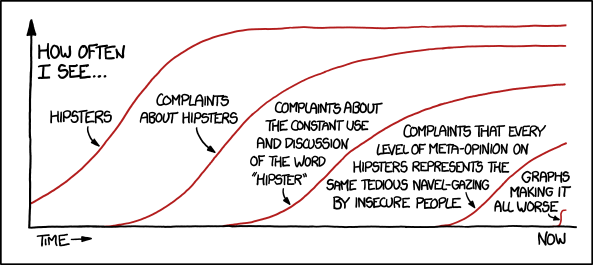
Hipsters

Claus.dahl

åhh ja, jeg husker nu at folk var optagede af hipsters....

You may point out that this very retreat into ironic detachment while still clearly participating in the thing in question is the very definition of contemporary hipsterdom. But on the other hand, wait, you're in an empty room. Who are you talking to?
28 Aug 11:34

What is happening in Istanbul?

by Jason Kottke
Claus.dahl

Hvor ville jeg dog gerne have det som en feature i noget, at det floatede de historier der havde varig værdi, så man kan få et revjoo af dem. Nu har jeg skabt det til mig selv ved at være 3 måneder om at tømme min inbox

Small protests in Istanbul over the past few days have erupted into what's becoming a typical scene across the world: authoritarian governments attempting to crack down on a citizenry agitating for increased freedom.

No newspaper, no television channel was there to report the protest. It was a complete media black out.

But the police arrived with water cannon vehicles and pepper spray. They chased the crowds out of the park.

In the evening the number of protesters multiplied. So did the number of police forces around the park. Meanwhile local government of Istanbul shut down all the ways leading up to Taksim square where the Gezi Park is located. The metro was shut down, ferries were cancelled, roads were blocked.

Yet more and more people made their way up to the center of the city by walking.

They came from all around Istanbul. They came from all different backgrounds, different ideologies, different religions. They all gathered to prevent the demolition of something bigger than the park:

The right to live as honorable citizens of this country.

They gathered and marched. Police chased them with pepper spray and tear gas and drove their tanks over people who offered the police food in return. Two young people were run over by the panzers and were killed.

To keep up with events in Turkey, try Occupy Gezi's Tumblr and Facebook page.

Tags: politics   Turkey
28 Aug 11:29

End of Democracy: NSA and Present Shock

by Douglas Rushkoff
Claus.dahl

Ouch den gør ondt, We didn't get participatory politics, we just got a new way to fundraise....

Here's my short closing keynote for day one at PDF 2013. The NSA story was buzzing on my phone as I walked to the stage. 

28 Aug 11:18

Senator Russ Feingold Correctly Predicted How The Patriot Act Would Be Abused; Too Bad He Got Voted Out Of Office

by Mike Masnick
Claus.dahl

Nobody listened

Before there were Senators Ron Wyden and Mark Udall speaking out against the Patriot Act, the FISA Amendments Act and secret interpretations of the law that take away our civil liberties, there was Senator Russ Feingold -- the only Senator who voted against the Patriot Act at the beginning. At the time, he clearly warned what it would lead to:
One provision that troubles me a great deal is a provision that permits the government under FISA to compel the production of records from any business regarding any person, if that information is sought in connection with an investigation of terrorism or espionage.

Now we're not talking here about travel records pertaining to a terrorist suspect, which we all can see can be highly relevant to an investigation of a terrorist plot. FISA already gives the FBI the power to get airline, train, hotel, car rental and other records of a suspect.

But under this bill, the government can compel the disclosure of the personal records of anyone - perhaps someone who worked with, or lived next door to, or went to school with, or sat on an airplane with, or has been seen in the company of, or whose phone number was called by -- the target of the investigation.

And under this new provisions all business records can be compelled, including those containing sensitive personal information like medical records from hospitals or doctors, or educational records, or records of what books someone has taken out of the library. This is an enormous expansion of authority, under a law that provides only minimal judicial supervision.

Under this provision, the government can apparently go on a fishing expedition and collect information on virtually anyone. All it has to allege in order to get an order for these records from the court is that the information is sought for an investigation of international terrorism or clandestine intelligence gathering. That's it. On that minimal showing in an ex parte application to a secret court, with no showing even that the information is relevant to the investigation, the government can lawfully compel a doctor or hospital to release medical records, or a library to release circulation records. This is a truly breathtaking expansion of police power.
That was in October of 2001. And he was right. And, since the beginning, he was the only Senator who consistently voted against the Patriot Act and various extensions and expansions. And, over the years since then he regularly warned us about secret interpretations of the law, including putting together a hearing more than five years ago on "Secret Law and the Threat to Democratic and Accountable Government."

Not only did people fail to take him seriously back then, they voted him out of office in the 2010 "tea party" wave. Considering how many in the Tea Party are now among those most upset about the revelations of NSA surveillance, they might regret that decision... especially since the man they replaced him with, Senator Ron Johnson voted for both the FISA Sunsets Extension Act of 2011 and the FISA Amendments Reauthorization Act of 2012 which extended the various provisions that we now know were secretly interpreted by the FISA Court to make these surveillance programs "legal."

Feingold is now speaking out about the NSA surveillance, and it's already leading some to suggest he run again for public office.

Permalink | Comments | Email This Story
28 Aug 11:16

How much could the iOS 7 icons be improved in two hours?

by Mark Jensen
Claus.dahl

Nice work

Thomas Baekdal made this overview, which shows exactly why the icons create the reactions Twitter is overflowing with:

iOS 7 icons overview

He goes on to make this in two hours which is a tremendous improvement, even if you disagree with the direction itself of flat or whatever you call it:

Baekdal's icons for iOS 7

Baekdal's icons for iOS 7 on the iPhone

Baekdal's icons for iOS 7 on the iPhone multitasking dock

Two hours of work shouldn’t give such an improved impression over months of work from a design hailed to the degree Apple (rightfully) is.

So, it’s back to the drawing board before regular folks see those icons.

Isn’t there anything good about iOS 7?

Oh, sure. There’s tons of great stuff. Just have a look at the animations in the interface on Apple’s iOS 7 overview page.

That is where iOS 7 will be judged the most, because you spend so much time interacting with the screen, not just looking at it.

It’s just those icons that really get people going, because that’s what we can see right now.

(I once bricked an iPhone installing a beta, and everyday phones shouldn’t be used for first beta releases, thus no actual using it for me right now.)

Update:

Leo Drapeau gets in the game of redesigning as well, which is an example much closer to the style laid out by Apple, but still vastly improved.

Leo Drapeau

28 Aug 11:14

Play-companies and the value of a hard day's work

by Jason Kottke
Claus.dahl

Fuck yeah

James Somers, writer and web developer, ponders the value of the work that he does.

I have a friend who's a mechanical engineer. He used to build airplane engines for General Electric, and now he's trying to develop a smarter pill bottle to improve compliance for AIDS and cancer patients. He works out of a start-up 'incubator', in an office space shared with dozens of web companies. He doesn't have a lot of patience for them. 'I'm fucking sick of it,' he told me, 'all they talk about is colours.'

Web start-up companies are like play-companies. They stand in relation to real companies the way those cute little make-believe baking stations stand in relation to kitchens.

Take Doormates, a failed start-up founded in 2011 by two recent graduates from Columbia University whose mission was to allow users 'to join or create private networks for buildings with access restricted to only building residents'. For that they, too, raised $350,000. You wonder whether anyone asked: 'Do strangers living in the same building actually want to commune? Might this problem not be better solved by a plate of sandwiches?' (The founders have since moved on to 'Mommy Nearest', an iPhone app that points out mom-friendly locations around New York.)

A lot of the stuff going on just isn't very ambitious. 'The thing about the advertising model is that it gets people thinking small, lean,' wrote Alexis Madrigal in an essay about start-ups in The Atlantic last year. 'Get four college kids in a room, fuel them with pizza, and see what thing they can crank out that their friends might like. Yay! Great! But you know what? They keep tossing out products that look pretty much like what you'd get if you took a homogenous group of young guys in any other endeavour: Cheap, fun, and about as worldchanging as creating a new variation on beer pong.'

Tags: James Somers   web development   working
27 Aug 19:29

ARM acquires Sensinode to build better protocols for the internet of things

by Stacey Higginbotham
Claus.dahl

6lowpan er the shit. undeployed shit, men the shit. cld be huge

ARM, the chip architecture licensing firm, has acquired a Finish software company called Sensinode that has been building software for the internet of things. The price of the deal wasn’t disclosed, but the deal nets ARM 20 people who worked at the seven-year-old firm.

Sensinode is the company that helped build 6LoWPAN, a compression format for IPv6 that is designed for low-power, low-bandwidth wireless links. In short, it’s a variation of the internet protocol (IP) designed for the internet of things. The company has also built a few Constrained Application Protocols (CoAP) that will enable and support connected nodes talking to cloud-based servers.

sensinode-solution-600px

Sensinode makes money licensing its software to chipmakers and device manufacturers and having them build it into the stack of protocols their chips support. So much like ARM, it’s licensing intellectual property (different IP) to chip vendors. Adam Gould, the CEO of Sensinode explains that while the wireless protocols that sensors might use to communicate could be one of any flavor of Wi-Fi, Bluetooth, Zigbee or something else, at higher levels the goal is to hide that fragmentation from the user and the developer.

This is where ARM’s mbed platform comes in. The mbed platform is pre-certified ARM-based hardware that now comes with Sensicore’s protocols and cloud support enabled. ARM has a similar relationship with other internet of things platforms such as Xively. I wonder if ownership of Sensicore will change the relationship ARM has with Xively or other platform partners?

Regardless, this level of support via Sensicore should make it easier to develop on ARM-based hardware and run those products and implementations of multiple ARM-based products in the cloud. That’s a good thing as developers and hardware manufacturers are the key to success in this market.

ARM and Sensinode have been working together for several months before this deal came to fruition. It represents another step ARM has taken in pulling together a strategy for the internet of things. ARM’s new CEO Simon Segars is clearly steering the firm toward connected devices, much like his predecessor opened up ARM to the data center and rode the smartphone revolution. I expect Segars to discuss his strategy more fully in a chat with me at our Mobilize conference October 16 and 17 in San Francisco.


Related research and analysis from GigaOM Pro:
Subscriber content. Sign up for a free trial.