Shared posts

13 Jan 00:22

john mcphee on structure

John McPhee’s Structure made a big impression on me when I read it last year, so I’m happy to see it out from behind the New Yorker paywall. It’s a longform investigation of thought process and order and tools and approach to writing, and I’ve nicked some of the scissors & paper ideas for my own organization.

On crisis:

The picnic-table crisis came along toward the end of my second year as a New Yorker staff writer (a euphemistic term that means unsalaried freelance close to the magazine). In some twenty months, I had submitted half a dozen pieces, short and long, and the editor, William Shawn, had bought them all. You would think that by then I would have developed some confidence in writing a new story, but I hadn’t, and never would. To lack confidence at the outset seems rational to me. It doesn’t matter that something you’ve done before worked out well. Your last piece is never going to write your next one for you. Square 1 does not become Square 2, just Square 1 squared and cubed. At last it occurred to me that Fred Brown, a seventy-nine-year-old Pine Barrens native, who lived in a shanty in the heart of the forest, had had some connection or other to at least three-quarters of those Pine Barrens topics whose miscellaneity was giving me writer’s block. I could introduce him as I first encountered him when I crossed his floorless vestibule—“Come in. Come in. Come on the hell in”—and then describe our many wanderings around the woods together, each theme coming up as something touched upon it. After what turned out to be about thirty thousand words, the rest could take care of itself. Obvious as it had not seemed, this organizing principle gave me a sense of a nearly complete structure, and I got off the table.

On order:

When I was through studying, separating, defining, and coding the whole body of notes, I had thirty-six three-by-five cards, each with two or three code words representing a component of the story. All I had to do was put them in order. What order? An essential part of my office furniture in those years was a standard sheet of plywood—thirty-two square feet—on two sawhorses. I strewed the cards face up on the plywood. The anchored segments would be easy to arrange, but the free-floating ones would make the piece. I didn’t stare at those cards for two weeks, but I kept an eye on them all afternoon. Finally, I found myself looking back and forth between two cards. One said “Alpinist.” The other said “Upset Rapid.” “Alpinist” could go anywhere. “Upset Rapid” had to be where it belonged in the journey on the river. I put the two cards side by side, “Upset Rapid” to the left. Gradually, the thirty-four other cards assembled around them until what had been strewn all over the plywood was now in neat rows. Nothing in that arrangement changed across the many months of writing.

On attention:

So I always rolled the platen and left blank space after each item to accommodate the scissors that were fundamental to my advanced methodology. After reading and rereading the typed notes and then developing the structure and then coding the notes accordingly in the margins and then photocopying the whole of it, I would go at the copied set with the scissors, cutting each sheet into slivers of varying size. If the structure had, say, thirty parts, the slivers would end up in thirty piles that would be put into thirty manila folders. One after another, in the course of writing, I would spill out the sets of slivers, arrange them ladderlike on a card table, and refer to them as I manipulated the Underwood. If this sounds mechanical, its effect was absolutely the reverse. If the contents of the seventh folder were before me, the contents of twenty-nine other folders were out of sight. Every organizational aspect was behind me. The procedure eliminated nearly all distraction and concentrated only the material I had to deal with in a given day or week. It painted me into a corner, yes, but in doing so it freed me to write.

On software:

He listened to the whole process from pocket notebooks to coded slices of paper, then mentioned a text editor called Kedit, citing its exceptional capabilities in sorting. Kedit (pronounced “kay-edit”), a product of the Mansfield Software Group, is the only text editor I have ever used. I have never used a word processor. Kedit did not paginate, italicize, approve of spelling, or screw around with headers, wysiwygs, thesauruses, dictionaries, footnotes, or Sanskrit fonts. Instead, Howard wrote programs to run with Kedit in imitation of the way I had gone about things for two and a half decades. … Howard thought the computer should be adapted to the individual and not the other way around. One size fits one. The programs he wrote for me were molded like clay to my requirements—an appealing approach to anything called an editor.

Comments (66)

12 Jan 19:14

The Making of Raiders of the Lost Ark

by Jason Kottke
Claus.dahl

Delish!

This is wonderful: an hour-long PBS documentary from 1981 on the making of Raiders of the Lost Ark. Lots of behind the scenes footage, interviews with Spielberg, Lucas, Ford, etc.

I love how delighted Spielberg is after the idol exchange scene.

Tags: Indiana Jones   movies   Steven Spielberg   video
12 Jan 19:10

The script to the first episode of HBO’s “‘Entourage’ for Silicon Valley” show

by David Holmes
Claus.dahl

about right

silicontourage

Silicon Valley tends to bristle at how it’s depicted in movies and TV shows, often with very good reason. Despite many strong qualities, “The Social Network” received a ton of criticism over accuracy from the people who really lived it. And of course there was Bravo’s disastrous reality show, “Start-Ups,” which was soundly rejected by audiences, critics, and entrepreneurs alike.

So when yesterday’s headlines about HBO’s new series “Silicon Valley” referred to it as “‘Entourage’ for the startup scene,” many in the Valley naturally wanted to remove their eyeballs and light them on fire. “Entourage” wasn’t a terrible show, at least not at first before it began to take itself too seriously. But it quickly ran out of things to say about its four photogenic stars, whose personal goals rarely strayed from grabbing as much cash, fame, and sex as possible (yes, yes, I know it’s about “male friendship” too, but those themes usually only arose when the quest for all that other stuff failed).

So in the spirit of our fake “Newsroom” script, here’s how we imagine an episode of HBO’s “Silicon Valley” might play out, “Entourage”-style.

OPENING CREDITS

A limo speeds down the Golden Gate Bridge as a new Buckcherry song written specifically for the show blares. Our hero, Dashiell Champ, emerges from the sun roof of the limo with his very best buds: close friend Todd “T” O’O'Donnelly, Dashiell’s brother Chad-Brad “Tad” Champ, and eternal hanger-on “Skunk Troll.” Lots of champagne splashing about, strippers, all that “Entourage” stuff, etc.

INT. THE SPRAWLING MARKET ST. OFFICE OF SHAREABLES, WHICH IS LIKE AIRBNB BUT FOR WEARABLES. IT’S THE WORST.

T is furiously tapping on a computer. Dashiell enters with the bluster befitting a CEO whose company was just valued at $2 billion.

DASHIELL

What it do, what it do? How’s my favorite C “T” O doing? [laughs]

T

About to be on the other side of a 12-hour marathon coding session on my Lenovo N308 laptop with quad-core Tegra processor. All this coding is really hard work! But you gotta do a lot of coding when you’re a startup, you know?

DASHIELL

Bro, I feel you. Are you ready for the big party tonight?

T

Ehhhhhh I’ve been giving that some thought. I don’t know if it’s such a good idea to throw a big crazy party at this stage of our company. We still have no revenue, we don’t have a plan for how we’re going to get revenue…

DASHIELL

My man, don’t get all nervous on me now, I got it under control. Remember back home how everything always turned out okay for us no matter what happened, because we were white males growing up in suburbia? It’s just like that. Plus I got some booth babes for the event. I know you like booth babes!

T

Ehhhhh….. yeaahhhhhhhhh

DASHIELL

That’s what’s up!

Dashiell and T high-five for a while

Enter Chad-Brad

CHAD-BRAD

Whoa! Get a room guys, gross!

T

Hey, we were just high-fiving!

CHAD-BRAD

I know, I’m just busting your balls. You know I love you like a brother, T. Male friendship is very important to my personal sense of self.

DASHIELL

You get those booth babes I asked for?

CHAD-BRAD

I got the booth babes… and I got the booze, babe! $100,000 worth!

Dashiell and Chad-Brad high five for a while.

Enter Skunk Troll

SKUNK TROLL

 What are we celebrating? <snort> <gargle>

CHAD-BRAD

We’re celebrating your mom because she’s a mega hottie! Ha ha.

SKUNK TROLL

Aw come on, Chad-Brad <snargle>. Not cool!

CHAD-BRAD

Naw, I’m just playing. Bros before hos. Male friendship is like a glorious light in the fog of my existence, lending both clarity and meaning to an otherwise gray, empty life.

Bro-hugs all around

Enter venture capitalist Maxim Fisher

MAXIM

Baby, baby, baby you ready for your big fucking night tonight, fuckheads? I’m fucking stoked. You know that drug from “Limitless”? I got a whole fucking pirate’s chest full of it in my car. If Skunk Troll tries it maybe he’ll finally reach a sixth-grade reading level, am I right!

SKUNK TROLL

Awww <blart> <skroink>

T

Uhhh guys we got a problem

MAXIM

What’s T got his panties in a bunch over now?

T

Someone hacked all of our user data.

DASHIELL

Okay, so what? We only have, like, 25 customers.

MAXIM

Wait, I thought you said you experienced 2500% growth?

DASHIELL

We did. From 1 customer to 25.

MAXIM

I sunk 90 million of the firm’s money into this startup! I’m toast. You fucked me, Dashiell. What are we going to do?

DASHIELL

You’re on the board, I just work here. You tell me.

MAXIM

Okay okay okay okay. I’ll put out a press release saying only 25 users were hacked. And that that’s only a fraction of our total user base, a figure we are not ready to divulge at this time. But I’ll reiterate the 2500% growth data point. Then I’ll start shopping you guys around for an acquisition. I’ll plant a rumor that you turned down a $3 billion offer from Airbnb and before you know it, Yahoo will be knocking on our door and we all go home millionaires to fuck the prom queen. Maxim Fisher!

DASHIELL

I don’t understand any of what you said.

MAXIM

That’s fine. You guys relax and have a good time. Just remember that famous Steve Jobs quote. In Silicon Valley, the dream never dies, and the party never stops. And whatever you do, don’t apologize.

Door swings open

TAYLOR SWIFT

Did somebody say “Party?”

Buckcherry’s “Lit Up” begins to play, fade-to-black.

David Holmes

Studio20profile
David Holmes is the head of social media and experimental journalism for PandoDaily. He is also the co-founder of Explainer Music, a production company specializing in journalistic music videos. His work has appeared at FastCompany.com, ProPublica, the Guardian, the Daily Dot, NewYorker.com, and Grist.
You can follow David on Twitter @holmesdm


12 Jan 17:45

Invester i dannelse

by Morten

Det er vigtigt, at vi har noget at leve af. Investeringer i vækst og arbejdspladser står naturligt højt på dagsordenen for de fleste politikere.

Det er også vigtigt, at vi har noget at leve for. Det er sjældent, at man hører politikere foreslå investering i dannelse.

I dag hørte jeg eksempelvis VU’s formand Jens Husted i P1-programmet Mennesker & Medier. Han gjorde sig til talsmand for at privatisere DR. Det ønske kan jeg sådan set godt forstå. Men det deprimerende var, at hans tanke var, at markedet ville producere det, der er værd at se. Fordi det, der er værd at se, er det, der bliver set af mange (lad så være, at markedet ikke nødvendigvis producerer de mest populære produkter, hvis man kan producere noget næsten lige så populært til den halve pris).

En ren privatisering af DR vil være en falliterklæring for dannelsen i Danmark. Også selvom DR alt for ofte undervurderer danskernes intellekt. Jeg skrev lidt frem og tilbage med Jens Husted på Twitter: Han ville også privatisere bl.a. højskoler, kirker, museer, kunst mm.

Alt sammen legitime politiske holdninger. Men for mig er de også et udtryk for en åndelig falliterklæring. Jeg er liberal, og jeg tror på, at markedet er bedst til det meste.

Men jeg tror også, at dannelse er et kollektivt gode i økonomisk forstand. Vi bør stræbe efter at blive et mere dannet samfund. Og vi bør investere i at øge dannelsen, eksempelvis inden for kunst og kultur. Jeg tror, vi får et bedre samfund, hvis vi ikke alene er velnærede, under tag og i arbejde, men hvis vi også er dannede, kulturelle individer.

Ikke fordi kulturstøtte i dag bruges optimalt. Alt for meget støtte er subsidiering af en kulturel elites forbrug – de borgere, der i forvejen går på museum eller i teatret. Men for de fleste er murene ind til højskoler, operahuse og endda biblioteker desværre en uoverstigelig barriere.

Derfor bør vi også investere i, at kunst og kultur bevæger sig ud af disse kulturmausolæer. Ud i virksomheder, butikscentre, på internettet, i medier, på fodboldstadioner og hvor vi ellers færdes.

DR spiller allerede i dag en vigtig rolle i populariseringen af dannelse – fra Arvingerne til X-factor. Derfor har vi brug for DR som offentlig institution. Men DR skal gøre sig ansvaret bevidst og arbejde for en øget dannelse: Ellers har VU-formanden sørgeligvis ret, og DR kan ligeså vel produceres på markedets præmisser.

Ansvaret for at skabe et mere dannet samfund ligger mange steder. Hos politikerne, der i for høj grad blot forvalter velfærdssamfundet. Hos kulturinsitutionerne, der alt for ofte lukker sig om sig selv og reproducerer den kultur, de allerede skaber. Og ikke mindst hos os som borgere, der bør opdyrke samtalerne om kunst, kultur og samfundet som andet og mere end et produktionsfællesskab.

The post Invester i dannelse appeared first on Morten Gade.

12 Jan 17:44

Coding Math

Keith Peters' free video lessons teach the math useful in coding; support his work [via
10 Jan 18:20

Bret Victor's 2013 reading list

by Jason Kottke

From Bret Victor, a reading list of meaty material from the past year. His Reading Tip #1 in the sidebar is how I'd like my ideal self to read:

It's tempting to judge what you read:

I agree with these statements, and I disagree with those.

However, a great thinker who has spent decades on an unusual line of thought cannot induce their context into your head in a few pages. It's almost certainly the case that you don't fully understand their statements.

Instead, you can say:

I have now learned that there exists a worldview in which all of these statements are consistent.

And if it feels worthwhile, you can make a genuine effort to understand that entire worldview. You don't have to adopt it. Just make it available to yourself, so you can make connections to it when it's needed.

Fantastic tip.

Tags: Bret Victor   lists
10 Jan 18:20

Every fancy cocktail menu ever

by Jason Kottke

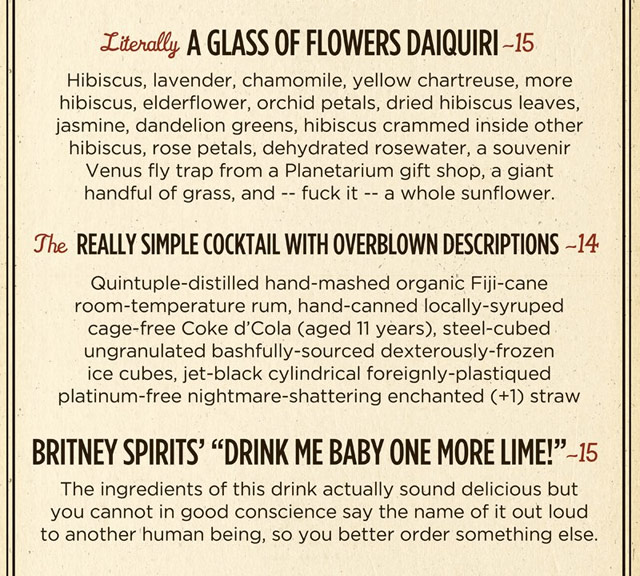
Often, cocktail menus are a little ridiculous.

Cocktail Menu

I am totally going to order some drinks like these at my usual fancy but still cool bar pub speakeasy tonight!

Tags: food
10 Jan 18:13

Wes Anderson slow motion supercut

by Jason Kottke

No one uses slow motion more consistently than Wes Anderson; all his films except Fantastic Mr. Fox use the technique. Here are all the slow-mo scenes from his films strung together:

(via devour)

Tags: movies   slow motion   video   Wes Anderson
10 Jan 18:11

The Museum of Simulation Technology

clever game mechanic that plays with forced perspective  
10 Jan 17:56

President Of CBS News Knew 'Reporter' John Miller Would Go Back To NYPD Before His 60 Min Propaganda Piece Aired

by Mike Masnick
So we've already discussed the massively conflicted John Miller, employed by CBS News while clearly being about to take a job in counterterrorism, reporting for 60 Minutes the most amazing pro-NSA propaganda infomercial you can imagine. At the time, the rumors were already swirling that Miller was about to take the job as head of counterterrorism for the NYPD, though he denied it. He also, laughably, insisted that he'd asked hard questions of the NSA, none of which made it to air (assuming he actually did ask hard questions). In response to all of this, Miller insulted his critics as not being real reporters (despite the fact many of them were), and then confirmed the big conflict that most people expected, taking the job that everyone knew he was going to take.

A NY Times piece on Miller notes that the offer to take the job was actually "informally" given to him over dinner with incoming police commissioner (and close friend of Miller) Bill Bratton on December 5th. That's a week and a half before 60 Minutes aired its piece. And, among the "everyone" who knew he was taking the job was... David Rhodes, the President of CBS News.
“As soon as the reports came out that de Blasio” -- Bill de Blasio, the city’s new mayor -- “was thinking of bringing Bratton back, I immediately assumed that John would be going too,” Mr. Rhodes said in an interview. “It was literally the first thing that I thought of.”
And yet... he still allowed Miller's highly conflicted story on the NSA to air. That raises all sorts of questions, especially for CBS News, whose editorial failings over the past few months have received a tremendous amount of attention.

Permalink | Comments | Email This Story


10 Jan 17:55

Four short links: 10 January 2014

by Nat Torkington
Claus.dahl

Dominus should really get off perl and start fixing real problems. This is super basic stuff, a lot of corners of which have been fixed tons of times elsewhere

  1. Software in 2014 (Tim Bray) — a good state of the world, much of which I agree with. Client-side: Things are bad. You have to build everything three times: Web, iOS, Android. We’re talent-starved, this is egregious waste, and it’s really hurting us.
  2. Making Systems That Don’t Suck (Dominus) — every software engineer should have to read this. Every one.
  3. IBM Struggles to Turn Watson Into Big Business (WSJ) — cognition services harder to onboard than seemed. It smells suspiciously like expert systems from the 1980s, but with more complex analytics on the inside. Analytic skill isn’t the problem for these applications, though, it’s the pain of getting domain knowledge into the system in the first place. This is where G’s web crawl and massive structured general knowledge is going to be a key accelerant.
  4. Reading This May Harm Your Computer (SSRN) — Internet users face large numbers of security warnings, which they mostly ignore. To improve risk communication, warnings must be fewer but better. We report an experiment on whether compliance can be increased by using some of the social-psychological techniques the scammers themselves use, namely appeal to authority, social compliance, concrete threats and vague threats. We also investigated whether users turned off browser malware warnings (or would have, had they known how).
09 Jan 15:46

Photos

Claus.dahl

Yeah. Because the most horrible thing in the world is to mean enough to other people, that they actually care how you behave. Fucking internet aspies.

I hate when people take photos of their meal instead of eating it, because there's nothing I love more than the sound of other people chewing.
09 Jan 15:15

France fines Google over privacy violations and makes it put a notice on its site

by David Meyer
Claus.dahl

Der er heldigvis nogle få ting Europa stadig gør rigtigt - som databeskyttelse. Desværre så ikke fra regeringerne.

The French data protection authority CNIL has fined Google €150,000 ($204,000) over its unified privacy policy, which regulators believe violates European privacy law. The EU data protection authorities are coordinating their anti-Google efforts – Spain became the first to levy a fine last month, relieving the company of $1.2 million.

In a statement on Wednesday, CNIL said Google’s merging of its various services’ privacy policies into a unified policy was in itself legal, but the way in which it implemented that unified policy was not legal.

Specifically, the regulator said, Google did not inform its users enough about how their data would be mixed and matched between the various services, such as Gmail and Google Maps, nor why this data was being combined in this way (hint: advertising).

If this sounds familiar, that’s because it’s almost exactly what the Dutch regulator and a Berlin court said in November. CNIL also said Google didn’t get sufficient user consent before storing cookies on devices, nor was it clear to its users about how long it would keep their data in its systems.

Now, it doesn’t take a genius to note that €150,000 is chump change for Google, but it is the largest fine ever levied by CNIL. The regulator also ordered Google to put a notice on google.fr over 2 days – within 8 days from today – about the decision.

“This publicity measure is justified by the extent of Google’s data collection, as well as by the necessity to inform the persons concerned who are not in a capacity to exercise their rights,” CNIL said.

BONUS FACT: The news drew a quick response from SafeGov.org, which stated:

“Google’s continued violation of and obstinacy against EU data protection rules is deeply concerning, not just to the average consumer, but also to the schools, governments, hospitals and businesses that Google is increasingly targeting. There is an inherent conflict of interest in allowing the world’s largest advertising company to collect, process and store such sensitive personal data. We encourage Data Protection Authorities to look specifically at this issue as they continue to investigate privacy abuses.”

Who’s behind SafeGov.org? Why, Microsoft, of course!

Related research and analysis from Gigaom Research:
Subscriber content. Sign up for a free trial.

09 Jan 15:13

The Eye Tribe Says It’s Shipping Its First $99 Eye-Tracking Units, Raises Another $1M

by Anthony Ha
Claus.dahl

Shout out to Anders Bo Pedersen, god zyb-kollega, som er med ombord og med til at snakke varen op på CES

the eye tribe

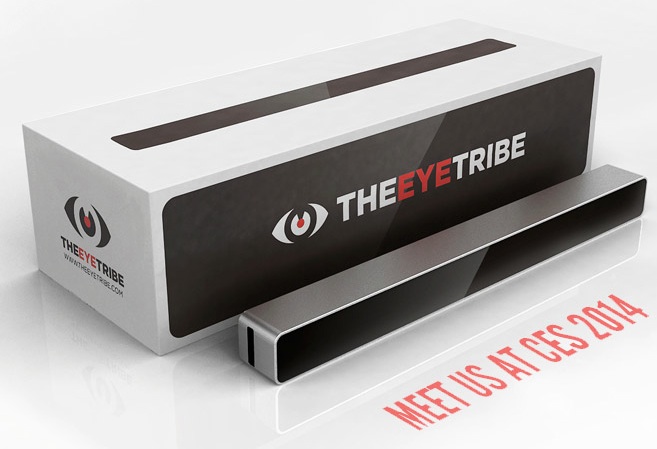
The Eye Tribe, which took the stage today at TechCrunch’s CES Hardware Battlefield, is developing hardware that allows users to control technology with the motion of their eyes.

In fact, co-founder and CEO Sune Alstrop Johansen told me that the company has started shipping its first units and software development kits (they’re available for $99), and that the initial users should be receiving them now.

Johansen said The Eye Tribe has also raised another $1 million in seed funding, bringing its total seed/angel funding to $1.8 million. (It  also received a $1.3 million grant from the Danish government.) The money comes from “primarily existing investors, board members and key individuals from the US,” he said — new backers include former semiconductor executive Richard Sanquini.

CES marks the first time that the finished product, not just a prototype, has been demonstrated publicly, he added. And although the initial version was built for Windows, he said the company is unveiling a Mac version too. As for the iOS and Android versions that the company has mentioned in the past, Johansen said they’re still on the product roadmap but declined to get specific.

I didn’t get a chance to try the product out for myself, but if you’ve ever wanted to see someone play Fruit Ninja with their eyes, well, watch this video.

As you can probably guess from the fact that an SDK is included, the company is currently focused on recruiting the developers that it hopes will actually build applications that take advantage of these capabilities. In fact, when a prototype of The Eye Tribe Tracker was demonstrated in our Hardware Alley at last fall’s Disrupt Europe conference, the company said it was also going to provide free trackers to developers with the best ideas.

Those ideas also help answer the question, “Why the heck would I want to control software with my eyes?” — they give a sense of what people could potentially do with the technology. The winners include an idea for a device combining eye tracking and EEG technology to help those with ALS (Lou Gehrig’s Disease) communicate, as well as ideas for driver assist applications, breast cancer detection, drone control, and improved reading on tablets.

Last fall, a company representative told us that users don’t have to train themselves to act differently. Instead, they claimed that after the initial calibration, users could just let their eyes interact normally with applications and the software should respond accordingly.

The company has also said the eventual goal is to partner with hardware makers who want to integrate these capabilities — so in the future, you could get a tablet with eye-tracking capabilities built in, rather than having to buy a separate to device. In fact, Johansen told me this week that the company is setting up an office in Palo Alto “as we believe this will be the best place for us to engage” with the manufacturers.

You can see the specs of The Eye Tribe Tracker here.


09 Jan 15:12

think on

by russell davies
Claus.dahl

The hell it did. Nukes and military expansion did; the russians were scared to death and finally exhausted themselves trying to keep up with US military budgets. The cold war was brute force, not smart thinking.

"Cybernetics and game theory won them the Cold War, so paying for philosophers is militarily more sensible than paying for an extra company of marines, don’t you think?"

Charles Stross - The Atrocity Archives


08 Jan 06:30

Steven Levy's How the NSA Almost Killed the Internet

the story of the Snowden leaks from inside tech giants  
08 Jan 06:28

The Daggers of Jorge Luis Borges

by Klint Finley

Ostensibly a review of Professor Borges: A Course on English Literature, this essay is a great overview of how Jorge Borges’ politics affected his work:

Throughout his life, Jorge Luis Borges was engaged in a dialogue with violence. Speaking to an interviewer about his childhood in what was then the outlying barrio of Palermo, in Buenos Aires, he said, “To call a man, or to think of him, as a coward—that was the last thing…the kind of thing he couldn’t stand.” According to his biographer, Edwin Williamson,1 Borges’s father handed him a dagger when he was a boy, with instructions to overcome his poor eyesight and “generally defeated” demeanor and let the boys who were bullying him know that he was a man.

Swords, daggers—weapons with a blade—retained a mysterious, talismanic significance for Borges, imbued with predetermined codes of conduct and honor. The short dagger had particular power, because it required the fighters to draw death close, in a final embrace. As a young man, in the 1920s, Borges prowled the obscure barrios of Buenos Aires, seeking the company of cuchilleros, knife fighters, who represented to him a form of authentic criollo nativism that he wished to know and absorb.

The criollos were the early Spanish settlers of the pampa, and their gaucho descendants. For at least a century now, the word has signified an ideal cultural purity that, according to its champions, was corrupted by the privatization of the pampa and, later, by the flood of immigrants from Italy and elsewhere in Europe that took place in the late nineteenth and early twentieth centuries.

Borges spent much of his twenties attempting to write a full-length epic poem that would mythologize this “innumerable Buenos Aires of mine,” as he called it—a work that would, in Borges’s words again, “converse with the world and with the self, with God and with death.” He saw it as a way to reflect the city’s essence, as Joyce had done with Dublin, a way to establish a lasting cultural identity that Argentina did not yet possess in the world. His aim, in part, was to enshrine the urban descendent of the criollo, with his ubiquitous dagger and supposedly honorable outlaw ways. Eventually he would abandon the project—Borges was never able to conquer the long form; and though his cultural vision, as it later developed, would be much broader, the romance of the criollo would continue to animate his imagination. Some of his finest fiction—including the stories “The South,” “The Dead Man,” and “The Intruder,” to name just a few—was kindled by the dagger.

Full Story: The New York Review of Books: The Daggers of Jorge Luis Borges

04 Jan 20:33

The NYT editorial board argues clemency for Edward Snowden

"He may have committed a crime to do so, but he has done his country a great service."  
04 Jan 20:32

Haskell

Claus.dahl

Snap! (dobbelt snap i alt-texten)

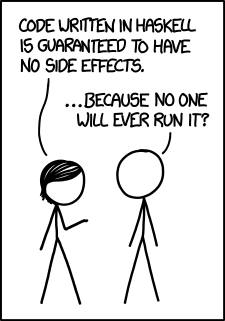
The problem with Haskell is that it's a language built on lazy evaluation and nobody's actually called for it.
04 Jan 20:32

Four short links: 3 January 2014

by Nat Torkington
Claus.dahl

seeeje links her. Link to er vildt

  1. Commotion — open source mesh networks.
  2. WriteLaTeX — online collaborative LaTeX editor. No, really. This exists. In 2014.
  3. Distributed Systems — free book for download, goal is to bring together the ideas behind many of the more recent distributed systems – systems such as Amazon’s Dynamo, Google’s BigTable and MapReduce, Apache’s Hadoop etc.
  4. How Netflix Reverse-Engineered Hollywood (The Atlantic) — Using large teams of people specially trained to watch movies, Netflix deconstructed Hollywood. They paid people to watch films and tag them with all kinds of metadata. This process is so sophisticated and precise that taggers receive a 36-page training document that teaches them how to rate movies on their sexually suggestive content, goriness, romance levels, and even narrative elements like plot conclusiveness.
04 Jan 14:18

Web Semantics: Language as vector space mathematics

by Bruce Sterling
Claus.dahl

Chomsky havde ret

*Makes one wonder what it would sound like to simply speak vector space mathematics aloud, rather than bothering with human language.

http://www.technologyreview.com/view/519581/how-google-converted-language-translation-into-a-problem-of-vector-space-mathematics/

“Computer science is changing the nature of the translation of words and sentences from one language to another. Anybody who has tried BabelFish or Google Translate will know that they provide useful translation services but ones that are far from perfect.

“The basic idea is to compare a corpus of words in one language with the same corpus of words translated into another. Words and phrases that share similar statistical properties are considered equivalent.

“The problem, of course, is that the initial translations rely on dictionaries that have to be compiled by human experts and this takes significant time and effort.

“Now Tomas Mikolov and a couple of pals at Google in Mountain View have developed a technique that automatically generates dictionaries and phrase tables that convert one language into another.

“The new technique does not rely on versions of the same document in different languages. Instead, it uses data mining techniques to model the structure of a single language and then compares this to the structure of another language.

” ‘This method makes little assumption about the languages, so it can be used to extend and refine dictionaries and translation tables for any language pairs,’ they say.

“The new approach is relatively straightforward. It relies on the notion that every language must describe a similar set of ideas, so the words that do this must also be similar. (((That’s some “notion,” eh Plato?))) For example, most languages will have words for common animals such as cat, dog, cow and so on. And these words are probably used in the same way in sentences such as “a cat is an animal that is smaller than a dog.”

“The same is true of numbers. The image above shows the vector representations of the numbers one to five in English and Spanish and demonstrates how similar they are.

“This is an important clue. The new trick is to represent an entire language using the relationship between its words. The set of all the relationships, the so-called “language space”, can be thought of as a set of vectors that each point from one word to another. And in recent years, linguists have discovered that it is possible to handle these vectors mathematically. For example, the operation ‘king’ – ‘man’ + ‘woman’ results in a vector that is similar to ‘queen’.

“It turns out that different languages share many similarities in this vector space. That means the process of converting one language into another is equivalent to finding the transformation that converts one vector space into the other.

“This turns the problem of translation from one of linguistics into one of mathematics. So the problem for the Google team is to find a way of accurately mapping one vector space onto the other. For this they use a small bilingual dictionary compiled by human experts–comparing same corpus of words in two different languages gives them a ready-made linear transformation that does the trick.

“Having identified this mapping, it is then a simple matter to apply it to the bigger language spaces. Mikolov and co say it works remarkably well. “Despite its simplicity, our method is surprisingly effective: we can achieve almost 90% precision@5 for translation of words between English and Spanish,” they say.

“The method can be used to extend and refine existing dictionaries, and even to spot mistakes in them. Indeed, the Google team do exactly that with an English-Czech dictionary, finding numerous mistakes.

“Finally, the team point out that since the technique makes few assumptions about the languages themselves, it can be used on argots that are entirely unrelated. So while Spanish and English have a common Indo-European history, Mikolov and co show that the new technique also works just as well for pairs of languages that are less closely related, such as English and Vietnamese….”


04 Jan 14:15

3D Printering: Making A Thing In Blender, Part I

by Brian Benchoff
Claus.dahl

this is the huge problem with 3d: The tools suck

printering

In case you weren’t aware, having a 3D printer is nothing like owning a real-life Star Trek replicator. For one, replicators are usually found on Federation starships and not hype trains. Secondly, the details of how replicated objects are designed in the 24th century is an issue completely left unexplored by TNG, and DS9, and only a minor plot point in a few Voyager episodes. Of the most likely possibilities, though, it appears replicated objects are either initially created by ‘scanning’ them with a teleporter, or commanding the ship’s computer to conjure something out of the hologrid.

No, with your own 3D printer, if you want a unique object you actually have to design it yourself. Without a holodeck. Using your hands to move a mouse and keyboard. Savages.

This series of ‘Making a Thing’ tutorials aims to fix that. With this post, we’re taking a look at Blender, an amazing 3D modeling and animation package.

Because we still haven’t figured out the best way to combine multiple blog posts together as a single resource − we’re working on that, though − here’s the links to the previous “Making a Thing” posts:

This list is sure to grow thanks to your suggestions on what 3D modeling software to feature, but for now let’s make a thing in Blender.

Our Thing

EngineeringDrawing

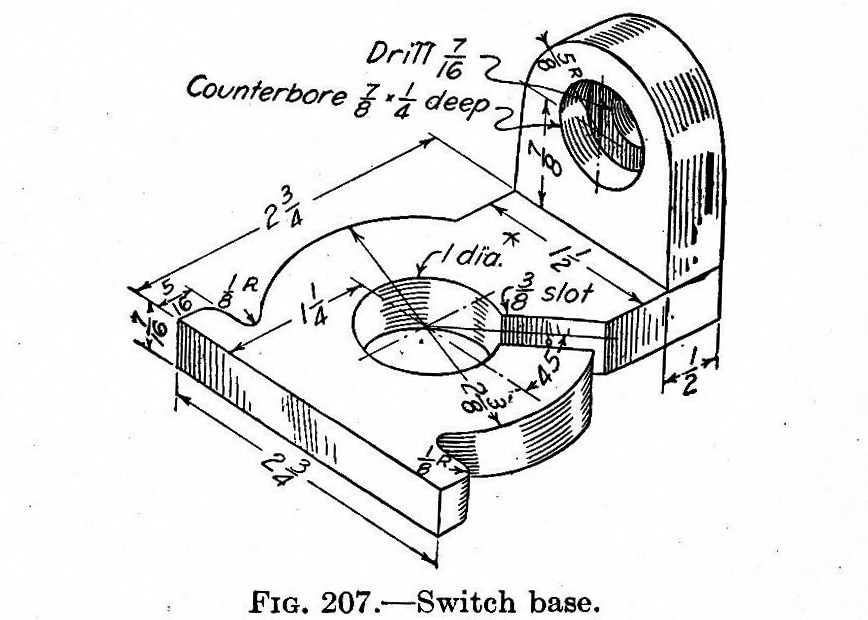
To the right is the part we’ll be designing in Blender. Just like the OpenSCAD and AutoCAD tutorials, we’re using the same object, a weird switch base thing taken from a 90-year-old book on drafting. You can click to embiggen that.

A Word About Blender

Blender is designed as a 3D animation suite. You know the old mid-90s Pixar short films? You can make those with Blender easily. Using Blender to design a small object to send to a 3D printer is like using a bulldozer to build a sand castle. You can do it, but it’s overkill.

Ideally, Blender should be used for objects that aren’t mechanical in nature. If you’re designing a gearbox for an RC car, don’t use Blender. If you’re making a replica of the Antikythera mechanism, don’t use Blender. If, however, you’re designing something more sculptural – a Pietà, for instance – Blender is a great tool.

Despite Blender being complete overkill for this simple part, and the fact Blender isn’t well suited for designing mechanical parts anyway, a lot of people asked for a Blender tutorial.  Who am I to argue with the commentors on Hackaday?

Starting Up

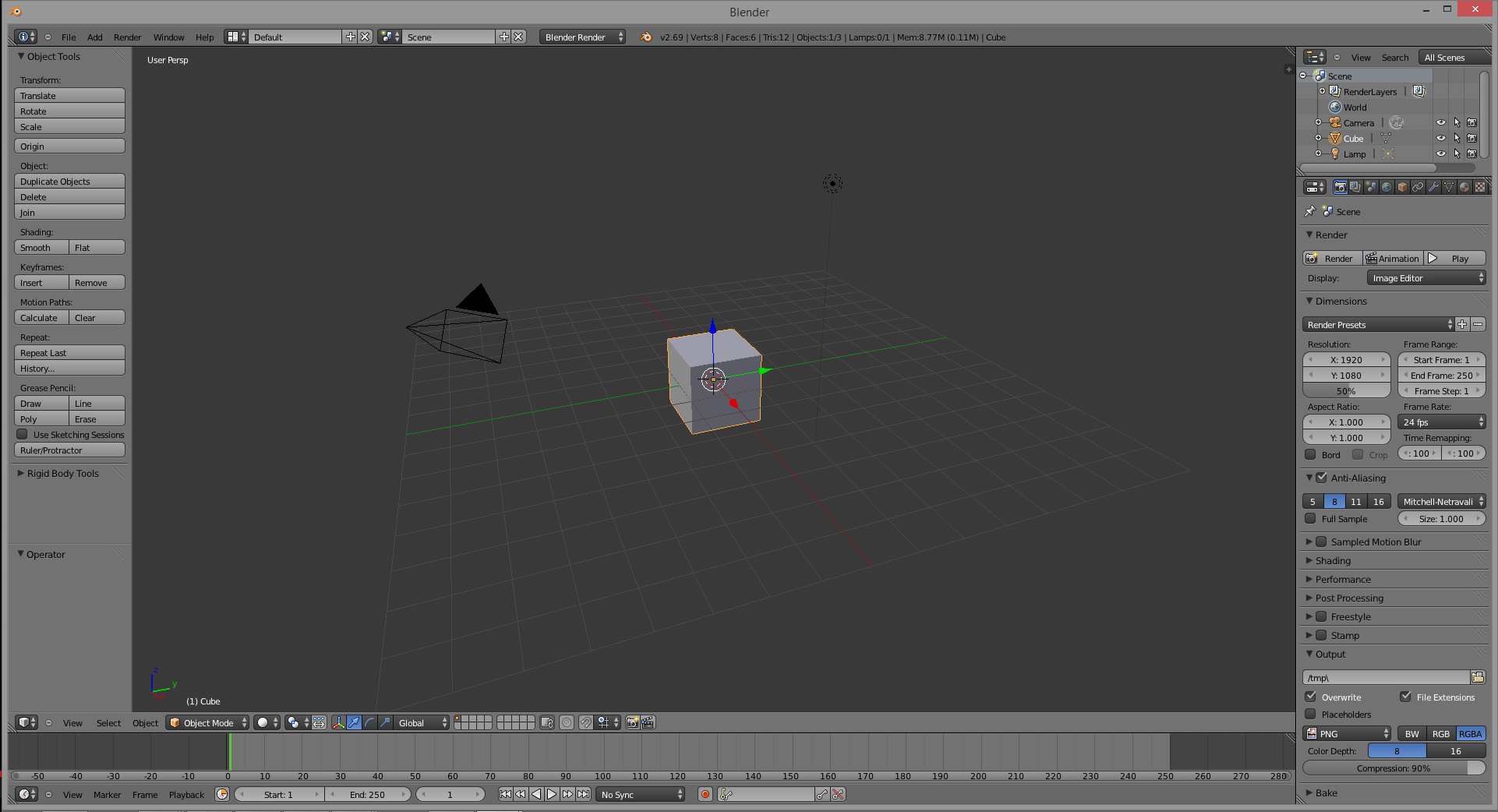
Installing Blender is left as an exercise to the reader. Do that here. When you first start Blender you’ll see the following screen that includes a cube, a camera (the pyramid-looking thing), and lamp. This is the default starting screen and we don’t need any of these objects. On your right hand toolbar, go to your Scene tab (at the top of the toolbar), right-click the cube, camera, and lamp, and delete them.

1

Meshes

Now that we have a blank canvas, we can start designing our part. Since this part of this tutorial is already halfway done, we’re only going to design the ‘washer’ part of our thing – the circle with a 3/8″ slot.

Cylinder

Instead of editing solids like OpenSCAD and AutoCAD, Blender does things entirely differently. It uses meshes,  or collections of vertices (points in 3D space), edges (lines between two vertices), and faces (polygons made of edges) to define an object. We can start building our thing by making a cylinder mesh. From the top menu bar, select Add -> Mesh -> Cylinder and left click. A cylinder will appear at coordinates 0,0,0 in your scene.

Add Cyl

After you’ve done this, you’ll see an ‘Add Cylinder’ window on your left hand toolbar. This window allows you to edit the number of vertices, the radius, and the depth of the cylinder. Now is a good of a time as any to start editing our part, so make the radius of the cylinder 1.1875 (one half of the 2 3/8″ diameter of our part), and the depth 0.4375.

By the way, yes, I am regretting using a part from a 100-year-old drafting textbook right about now.

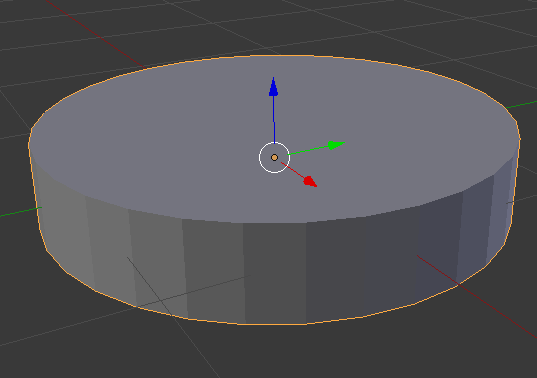
Here’s what we end up with:

new cyl

That’s making a very primitive object in Blender. To make anything useful, though, we need to go into edit mode.

edit mode

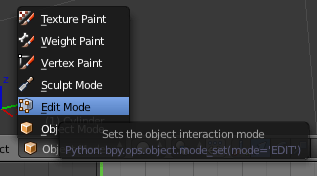
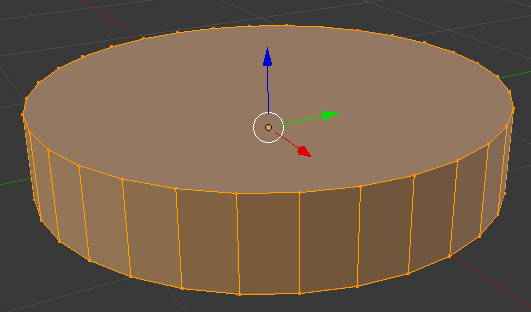
At the bottom of your Blender window, you’ll find a menu that will change how you can interact with Blender. Right now we’re in Object mode, which allows for the creation of meshes, surfaces, cameras, and lamps. To edit our object we need to be in…. Edit mode. Click on the little pull-down menu and change over. Doing this allows us to edit all the vertices, edges, and faces of our object. Here’s the cylinder we just created with all these selected:

Edit cyl

Hit the ‘A’ key on your keyboard to deselect everything. Now the cylinder is gray.

Now we need to put a hole in this part of our thing. If we were modeling with solids, we would simply create another cylinder, smaller than the one we have now, and subtract it from our current model. We’re not working with solids, though; we need to create the faces of our objects without Boolean operations.

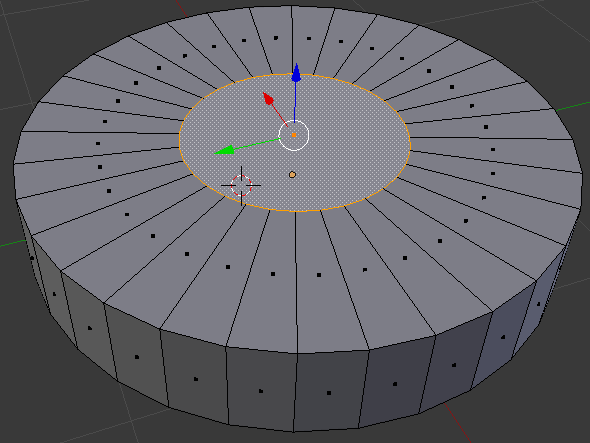
To create the hole in this part of our thing, select the top face of the cylinder and with the ALT+F keyboard combo, select inset faces with the tool tip pop up thingy. Insetting a face allows us to create a new top and bottom for this cylinder that will correspond to the exact sized hole we need.

Hole 1

Inset toolbar

When you enable the Inset Faces command, the size of the hole you’re creating is dependant on how far you move your mouse; not great for something we’re creating from precise measurements. On the left hand toolbar, though, you can enter the thickness we want.

Here’s how the math goes, if you’re wondering. The ‘cylinder’ of our part is 2 3/8″ in diameter, and we want a 1″ diameter hole in the middle. Subtract 1 inch from 2.375 and you get 1.375. Since the thickness of this face is in reality a radius, divide 1.375 by two and you’ll get the number we want. I truly hate decimal inches.

After deleting the top part of our hole, flip the part over in Blender and do the same thing to the other circular face of our part. You’ll end up with something like this:

Hole 2

Now all we need to do is join up the top and bottom faces.

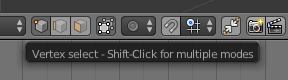
VertexOn the toolbar where you selected Edit Mode, you’ll see a set of three buttons. One is a cube with a vertex highlighted, one is a cube with an edge selected, and the other is a cube with a face selected. Any ideas what these buttons do?

Instead of individually selecting each of these edges on the inside of our part and creating 36 individual faces, we’re going to do something much simpler. Holding down the ALT key, select one of the inside edges with the right mouse button. This enables edge loop selection. Now, on the mesh tools toolbar (left side), hit Extrude and press the ‘Z’ key on your keyboard to lock your mouse input to one axis of movement.

Extrude Edges

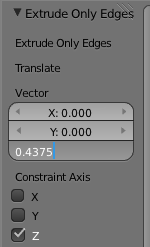
Again on the right toolbar, you’ll see a trio of boxes labeled ‘Vector’. This is how far Blender will extrude our…. extrusion in the X, Y, and Z axis. We want to extrude this edge 7/16″ (or 0.4375 decimal inches in the negative Z direction. That’s easy enough.

Here’s what we end up with when that’s done. Yes, it took me one thousand words to describe how to create a washer in Blender.

So what did you just learn?

As far as the creation of our ‘thing’ in Blender, we didn’t get very far. There’s still flanges and holes and round overs to do, but this is only part one of this Blender tutorial. Hopefully this served as a good introduction to Blender’s meshes and editing those mesh’s faces and edges.

See you here again next week!


Filed under: 3d Printer hacks, Hackaday Columns, how-to
04 Jan 14:10

Every 'Threat' The NSA Spreads FUD About Seems To Be Something The NSA Itself Is Actually Doing

by Mike Masnick
Nearly a year ago, well before all the Snowden leaks, we had a discussion about how, for all the talk from Keith Alexander about how the US was facing "unprecedented cyberattacks" that might bring about a "cyber Pearl Harbor," in reality, it appeared that the real global threat to computer systems was... the US government itself, via Keith Alexander's "US Cyber Command," which had, by far, the most sophisticated and advanced digital attack unit and wasn't afraid to use it. In fact, the US government seems to think it has incredibly broad powers to attack digitally. Of course, the nature of those attacks have become a lot more clear lately. And, as a part of that, one thing that's becoming clear: every time you hear a scary story about a kind of attack that some foreigners might do, you can pretty much guarantee: the NSA has already done it.

You may recall that, late in 2012, the House Intelligence Committee, led by dishonest NSA defender Rep. Mike Rogers, put out a report claiming that Americans should not use networking equipment made by Huawei, the Chinese networking giant, hinting that the company might be inserting backdoors and spyware into the equipment for the Chinese government. Huawei -- which had actually previously publicly asked the US government to investigate it to prove that such claims were false -- was not at all pleased about this, claiming that the whole thing was libelous and "utterly lacking in substance." A month ago, Huawei suggested that it was going to just ditch the US market because of all of this.

And yet... the recent NSA revelations about its technical capabilities to backdoor various hardware products showed that it's actually the NSA which has backdoors in Huawei's equipment. That doesn't foreclose the possibility that the Chinese have hacked it as well, but it sure looks ridiculous. As the Wired article linked above summarizes: "US to China: We hacked your internet gear we told you not to hack." This certainly plays into the hands of the Chinese, who have long argued that the attack on Huawei by Mike Rogers and friends was really just an attempt to pump up US-based competitors like Cisco (whose products the NSA has also apparently compromised).

And then there's the whole "BIOS" attack thing. You may recall that the big "scoop" in the hilariously lopsided 60 Minutes infomercial for the NSA by John Miller (a counterterrorism official pretending to be a journalist), was that there was some scary foreign threat out there from another country that was going to "infect the BIOS" of every computer on earth and turn them all into bricks. Experts pointed out that the claims were pure gibberish.

Except in that same report about the NSA's technical capabilities came the news that it's the NSA that is installing malware in the BIOS. As Marcy Wheeler notes:
Most fearmongering claims the NSA makes may well be projection about its own activities.
None of this means that others (and the finger is usually pointed at the Chinese) aren't doing the same sorts of things themselves. But it sure does seem pretty hypocritical to go around fearmongering about the things that we, ourselves, are doing.

Permalink | Comments | Email This Story


04 Jan 14:02

Is the NSA spying on Congress?

by David Sirota

nsa-spying-on-lawmakers

“Has the NSA spied, or is the NSA currently spying, on members of Congress or other American elected officials?”

This is the huge question U.S. Senator Bernie Sanders (I-Vt.) is asking the National Security Administration in a new letter to the agency’s chief, Gen. Keith Alexander. If at first glance this seems like a legislator’s blind fishing expedition prompted by fact-free conspiracy theory, think again. As I noted in a NSFWCORP report back in August, there’s very good reason for every elected official in Washington to suspect – and fear – that the NSA is surveilling them.

We already know the NSA has swept up a “large number” of calls from the Washington, D.C. area code. We know that the NSA has the capacity to rake in up to 75 percent of all Internet traffic. We know that Alexander’s surveillance ethos is to “collect it all” – with “all” presumably including information from elected officials. And we know that in his aggressive lobbying of Congress, Alexander would almost certainly have a coercive use for any incriminating information on lawmakers that his minions might be able to vacuum up.

But maybe most damning of all, we know that the NSA has not denied surveilling Members of Congress. Indeed, when I asked U.S. Rep. Alan Grayson (D-Fla.) if the NSA was keeping files on his colleagues, he recounted a meeting between NSA officials and lawmakers in the lead-up to a closely contested House vote to better regulate the agency:

“One of my colleagues asked the NSA point blank will you give me a copy of my own record and the NSA said no, we won’t. They didn’t say no we don’t have one. They said no we won’t. So that’s possible.”

Grayson is right: presumably, if the NSA wasn’t tracking lawmakers, it would have flatly denied it. Instead, those officials merely denied lawmakers access to whatever files the agency might have. That suggests one of two realities: 1) the NSA is keeping files on lawmakers 2) the NSA isn’t keeping files on lawmakers, but answered vaguely in order to stoke fear among legislators that it is.

Regardless of which of these realities happens to be the case, the mere existence of legitimate fears of congressional surveillance by an executive-branch agency is a serious legal and separation-of-powers problem. Why? Because whether or not the surveillance is actually happening, the very real possibility that it even could be happening or has happened can unduly intimidate the legislative branch into abrogating its constitutional oversight responsibilities. In this particular case, it can scare congressional lawmakers away from voting to better regulate the NSA.

Thus, Sanders very simple question - “Has the NSA spied on members of Congress?” – is entirely appropriate and warranted. In fact, in one sense, it is amazing it has taken this long for a legislator to publicly demand an answer to the question. But, then, in another sense, maybe that proves the NSA’s scare tactics have worked. Not only have congressional lawmakers done nothing to rein in the agency’s illegal surveillance programs, they haven’t until now even dared to ask whether they are a target of said surveillance.

That’s what makes Sanders letter so important – it breaks the larger omerta surrounding the NSA and, in the process, effectively dares the NSA to try to mete out retribution.

Now sure, the NSA’s record of lying to Congress suggests the Vermont senator may not get a straight answer to his specific question. However, in so boldly putting the question out there, Sanders may end up emboldening other lawmakers to take other actions against the agency – and do so without regard to whether the NSA will deploy its surveillance apparatus against its congressional critics.

Illustration by Brad Jonas


04 Jan 13:47

Movie Code

on-screen source code in movies, and what it actually does  
04 Jan 12:41

azspot: Ruben Bolling: 5 Tips for Living in a Surveillance...

04 Jan 12:40

Zynga Links Up With BitPay For A Bitcoin Payment Test In FarmVille 2, CityVille And Other Web Games

by Ingrid Lunden
Claus.dahl

The perfect bullshitstorm of BitZynga. If only there was a deals site involved as well....

Screen Shot 2014-01-04 at 09.59.13

Gaming giant Zynga has started to accept the cryptocurrency as a payment option for those buying tokens for virtual goods on the web versions of FarmVille 2, CastleVille, ChefVille, CoasterVille, Hidden Chronicles, Hidden Shadows and CityVille. It makes Zynga the first major gaming company to accept Bitcoin.

Zynga posted the news first on Reddit rather than release an official announcement. It is calling this a “test” being run in partnership with BitPay — the startup backed by the likes of the Founders Fund and Li Ka-shing that is vying to be the “PayPal of the Bitcoin world.”

“We wanted to share with the r/bitcoin community that Zynga Inc. (NASDAQ: ZNGA) is now conducting a Bitcoin test with BitPay (https://bitpay.com/), a leading Bitcoin service provider, in select Zynga.com web games,” Zynga wrote in a post on Reddit.

“In response to Bitcoin’s rise in popularity around the world, Zynga, with help from BitPay, is testing expanded payment options for players to make in-game purchases using Bitcoin. The Bitcoin test is only available to Zynga.com players playing FarmVille 2, CastleVille, ChefVille, CoasterVille, Hidden Chronicles, Hidden Shadows and CityVille. The games can be accessed at http://zynga.com.

“Zynga is always working to improve our customer experience by incorporating player feedback into our games. We look forward to hearing from our players about the Bitcoin test so we can continue in our efforts to provide the best possible gaming experience.”

We have tried buying tokens for the games ourselves and confirm that Bitcoin is coming up as an option in the UK — meaning that it’s likely that this is a global rollout.

We have reached out to Zynga to ask whether it plans to extend this to other games — namely those on mobile and its real-money gambling effort, currently live in the UK.

On the mobile front, considering that Zynga has a huge business on iOS devices, extending Bitcoin acceptance there could prove problematic, considering that Apple has recently shown that it does not support Bitcoin transactions.

Up to now, Bitcoin has not made much headway in the world of gaming, although it is seeing some traction in online gambling, where one Bitcoin-wielding player netted a $1.3 million win on one Bitcoin-based gambling site.

One of the attractive points about Bitcoin compared to more established currencies and payment platforms is that transaction fees tend to be lower than those of platforms that transact in more established currencies like dollars.

The deal is a nice coup for BitPay, which in December said it had processed $100 million in transactions in 2013. The startup has largely grown on the back of partnerships with merchants to process payments for things like electronics, precious metals, “and other low-margin products.” These merchants, the company has said, see “a large increase in profitability by accepting Bitcoin payments.”

That should come as good news for Zynga, which is focused on cutting costs while it grows revenues. The company was once a rising star with big social gaming hits like Farmville that people played via Facebook.

More recently, it’s fallen on harder times with a massive drop in users — its last quarterly report noted that daily active users were halved to 30 million compared to a year ago, with falling sales alongside that — as consumers flock to newer casual games and newer experiences from other publishers like King.com and Supercell.

The company has been trying hard to shore up its business and recover, appointing Microsoft veteran Don Mattrick as its CEO to replace founder Mark Pincus, laying off staff, and shuttering unprofitable games. In that vein, adding Bitcoin acceptance may not translate into billions more in sales, but it could give the company a little burnish of good PR among investors for being an early mover and innovator, as well as a boost of credibility among Bitcoiners who might come to play on the platform as a result.

(With thanks and H/T to Daniel Z.)


25 Dec 23:50

Want to build a brand? Make one great product

by Andy Dunn

one

A lot of brands don’t make it, because in the process of trying to get many things right, they don’t get anything right. Why are they in such a hurry?

A great brand is a privilege, and it’s a privilege best earned through an item, not through a collection. Designers and merchants and founders think about collections. Consumers think about items. Designers and merchants and founders think about one-stop shops. That kind of thinking may lead you to a no-stop shop.

Consumers don’t need many things from your brand — they just need one thing from your brand. You may want them to need everything from your brand, but guess what: Consumers don’t care what you want. Your job is to care about what they want, not what you want them to want. The difference between the two is the distance between a customer-centric company and an ego-centric company.

If you’re not careful, the mentality of you wanting them to buy everything from you could lead to them buying nothing from you.

Make one thing great. Get one thing right. That earns you the right to go from product one to product two. Take as much time as you need to get product one right, and to prove it. Because if you don’t, no one is going to be waiting on pins and needles for product two.

The stories about the singular products that started many great brands crowd out the stories about the singular brands that started with many great products. You know where I’m going: Ralph Lauren and a tie, Diane Von Furstenberg and a wrap dress, Potbelly and a heated sandwich, Theory and a women’s pant, Tory Burch and a ballet flat, Kate Spade and a handbag, Google and an “I’m feeling lucky” button, Warby Parker and a pair of glasses…

You want your inaugural product to be wanted badly by your inaugural users, and that is hard to do with multiple products. Paul Graham has written expertly on this in his seminal essay “How to Get Startup Ideas,” and the must-read section entitled “Well” begins:

When a startup launches, there have to be at least some users who really need what they’re making — not just people who could see themselves using it one day, but who want it urgently. Usually this initial group of users is small, for the simple reason that if there were something that large numbers of people urgently needed and that could be built with the amount of effort a startup usually puts into a version one, it would probably already exist. Which means you have to compromise on one dimension: you can either build something a large number of people want a small amount, or something a small number of people want a large amount. Choose the latter. Not all ideas of that type are good startup ideas, but nearly all good startup ideas are of that type.

It takes time. It can take focus on a single product for years to build a brand or a company, which makes the logic of launching with all kinds of products even more confounding. As we gradually evolve from a wholesale-driven world to a vertical retail-driven world, as e-commerce proliferates and it becomes increasingly easier to get the best price on the best product, as the app store gets even more full, my belief is it becomes even more important to be focused on singular product-driven excellence from launch.

The moral is this: If you don’t start with a relentless focus on an amazing first product, odds are you won’t even get a seat at the table. You don’t start with the right to do product two. You earn it.

At Bonobos, it has taken years to perfect our first product: men’s pants — and we’re still doing work every day to make them better. My cofounder Brian Spaly, who is my role model on entrepreneurial tinkering, began developing the idea for better pants in 2005 when we were Schwab roommates at Stanford business school. He conducted lean consumer research in 2006 on our classmates, including me. He wanted to know what kinds of pants we wore, what we thought about them, and where we bought them.

What he discovered is no one really liked their pants.

He developed the first prototypes to solve this problem, “Spaly-pants,” in 2007. The Spaly-pants really did fit better — with an innovative contoured waistband, and a tailored fit through the seat and thigh which threaded the needle on the “American pants are too boxy, European pants are too tight” conundrum. He made them in pliable fabrics, some in bright colors, and all with aesthetically-exciting contrast pocket liners that attracted a lot of attention to the joy put into the product. You know you have a hit product when you have $10,000 of cash in your hands from your first production run, which Brian soon did.

When I realized Brian’s hobby could become a company, I began helping him. Eventually, at his invitation, I became the founding CEO. We teamed up and sold pants like crazy for the next six months to everyone we knew. We did trunk shows. We did pants parties. I took a duffel bag of pants wherever I went, including to weddings in LA and in Hawaii where I still get grief for being the guy hawking pants at brunch or over poolside mai-tai’s.

We took our first product, a product we knew a very small group of people loved, and we sought to expand that number of people as fast as we could. After a successful trunk show at the loft of Michael Spirito (more on him later), I pitched “The Oracle and the Jedi” in July of 2007. They each committed to investing. Soon our classmate-customers began asking if they could invest; the first of those to invest was our first customer and our now CFO Bryan Wolff. We decided it would be great to take on angel investors who were brand evangelists, even if they could only invest $10,000 or so. Over the next six months we raised what had started as a $300,000 round and eventually became a $750,000 round, with over 40 investors contributing. It was a long cap table, but we thought it was worth it to have our early adopters spreading the word with skin in the game.

We didn’t begin angel investor conversations until we had tens of thousands of dollars of sales, until we knew “the dogs were eating the dog food,” as the Oracle likes to say. This is the opposite of the model where you raise seed money before you know if your product even works. We were lucky to be able to do this because Brian had saved money to invest in the working capital to start the company, and I cashed in a 401k to be salary free as our CEO for the first several months.

We never thought about a second product. In fact I had one slide in the appendix of our initial angel investor deck which showed the progression of products we might make years down the road in the event that we were successful, and I’ll never forget what the Oracle told me: “I don’t want you even thinking about this stuff, until you have proven you can sell pants.”

While many angel investors were classmates from Stanford or mentors, another dozen or so were new customers I met in New York. They were the early adopters of the brand when I moved the company to NYC in the fall of 2007 — guys who came over to try on pants at an apartment I shared with a friend and angel investor at 17th and Irving in Manhattan. The new NYC customer-investors were guys who loved the product and the business model, and many of them offered to invest on the spot.

That summer, I had recruited another Stanford GSB classmate, Erik Allebest, to become our e-commerce advisor. He had built the largest chess e-commerce site in the US prior to Stanford. Prior to my move to NYC, we spent the summer of 2007 in a yurt behind his house in Menlo Park building what would become www.bonobospants.com. The site cost roughly $20,000 to make.

Once we launched the site in October of 2007 we re-doubled our in-person selling efforts. We sold more, not less, to feed our new automated selling engine with demand. Trunk shows expanded, to Chicago, Philadelphia, D.C., and Boston. We brought on early brand enthusiast, and another friend from Stanford GSB, Michael Spirito, as an off-hours advisor who “prototyped” selling pants out of his apartment on 14th street. His loft was, in a way, the first Bonobos Guideshop. He was such an enthusiast that he proactively wanted to sell pants in his free time to friends and colleagues.

We began to get great editorial PR without asking for it. I was sitting at the Heartland Brewery in Union Square that November talking to a potential vendor, when I had a number of angel investors text me that our site was down. UrbanDaddy had run a story on us called Monkey Business: Towards a Better Fitting Pant and it crashed our site. It was also our first $2,000 day. Soon we hired the wife of another Stanford GSB classmate-customer-investor, Polly Ryerson, to drive our PR strategy. With great PR, word-of-mouth, continued in-person selling, and some very limited experimentation with online marketing, this happened:

Screen Shot 2013-12-24 at 2.04.44 PM

Revenue ramp of Bonobos, Inc. from October 2007 through August of 2008

I marvel when I reflect on this: We didn’t have straight leg fit, let alone our now amazing slim straight fit — just a super exaggerated boot-cut. We didn’t offer inseams yet, so most likely you had to get the pants hemmed. We had just a couple of fabric choices, in a about a dozen colors; a minisucle fraction of what we now offer, and in a single category when there are now more than a handful. We didn’t have denim. We had only just launched khaki color chinos.

And yet we saw a hockey stick ramp. We hit a nerve with our product. Bonobos was born.

Bootcut is now less than 10 percent of our pants business. Pants are now less than 40 percent of our total business. Our online-driven model is now complemented with personalized, service-focused e-commerce stores – Guideshops – which are our most investable growth channel.

We’ve come a long way, but we’d never have made it here if it weren’t for that first product.

What I learned from this experience is the best way to get volume is to sell a lot of one thing, not a little of a lot of things. It’s obvious in retrospect, but not necessarily in the moment. Building Bonobos through pants has informed our decision to pre-launch with just denim at our women’s brand, AYR. We have spent a year obsessing over the product and we did a 1,000 unit tests this fall to make sure we had a hit product before proceeding with the fuller brand launch early next year.

So how do you build a brand in the digital age?

My belief is you do it with a narrow and deep story about what you are doing, and that what you are doing requires a high net promoter score — a high-level of customer-to-customer recommendation. A high NPS gives you the best kind of marketing there is: word-of-mouth and organic PR. This creates buzz. Buzz creates brands.

It’s a paradox: Even if you make two great items right out the gates, just by having two you make it harder for the customer to know what job to hire you for.

So why start with two, when it creates more risk to what you’re doing, when it requires more capital, when it dilutes your focus, and when it’s harder to message who you are in those precious early innings? Remember, you’ll have opportunities to grow revenue and extend the brand later.

Our CFO loves to remind me: “Money runs out faster than opportunities.” Make one thing great. Get one thing right.

[Image via Thinkstock]

Andy Dunn

Andy is the cofounder and CEO of Bonobos, a menswear brand focused on fit, fun, and service which is digital at its core. Andy is also the founder of Red Swan, an angel investment firm.


10 Dec 12:57

Design Fiction: Sputniko! “The Moonwalk Machine”

by Bruce Sterling

*I’m frankly at a loss for commentary here, but I’d recommend a look.

http://sputniko.com/2013/10/the-moonwalk-machine-selenas-step/


10 Dec 12:57

Design Fiction: Alex Cornell, “Our Drone Future”

by Bruce Sterling

*That’s a nice use of video effects. Check out all those deliberate little glitches.

Published on Dec 9, 2013

https://twitter.com/alexcornell

“Created with DJI Phantom Drones, After Effects, Premier, Logic, GoPro, and a liberal interpretation of FAA regulations:

“Our Drone Future explores the technology, capability, and purpose of drones, as their presence becomes an increasingly pervasive reality in the skies of tomorrow.

“In the near future, cities use semi-autonomous drones for urban security. Human officers monitor drone feeds remotely, and data reports are displayed with a detailed HUD and communicated via a simulated human voice (designed to mitigate discomfort with sentient drone technology). While the drones operate independently, they are “guided” by the human monitors, who can suggest alternate mission plans and ask questions.

“Specializing in predictive analysis, the security drones can retask themselves to investigate potential threats. As shown in this video, an urban security drone surveys San Francisco’s landmarks and encounters fierce civilian resistance.”