The first thing buried in a graveyard, so the story goes, has the duty to stand watch over it for eternity and keep the bad things out. It became tradition to bury a black dog before any man or woman was laid to rest, to make sure that no human would be locked out of heaven (or, for that matter, hell) forever.
They never asked the dogs what they felt about that sort of thing, but then, they were good dogs, and were doing their duty. And would do so for eternity. The black dogs who stood watch were dubbed Grims, though as time passed, no one ever thought they’d be needed. Still, the tradition went on.
When the dead began to rise to attack the living, the Grims were standing watch. Not one walking corpse made it out of a graveyard with a Grim standing guard over it, for dogs know the secrets of burying bones so that they stay buried.
Without the reinforcements of all the dead ever buried, the others who rose that day did not overwhelm the living. And when those living went to find out why, they found the Grims, still standing watch. The survivors told them that they were good dogs, who had done their duty. And the Grims were satisfied, and taught the living the trick of making sure bones stayed buried, so no dead would walk again.
This week, two important publications set the standard for embracing gender-neutral language in the media.
First, the New York Times used the gender-neutral honorific “Mx.” to refer to an interviewee in a story, a big deal particularly because the Times said as recently as June that it wouldn’t be using Mx. anytime soon. Next, the Washington Post announced that writers can use the singular “they” when needed.
From the Washington Post memo:
It is usually possible, and preferable, to recast sentences as plural to avoid both the sexist and antiquated universal default to male pronouns and the awkward use of he or she, him or her and the like: All students must complete their homework, not Each student must complete his or her homework.
When such a rewrite is impossible or hopelessly awkward, however, what is known as “the singular they” is permissible: Everyone has their own opinion about the traditional grammar rule. The singular they is also useful in references to people who identify as neither male nor female.
Millions of people read these publications every day, and they’re considered leaders in the industry. This is a really big deal.
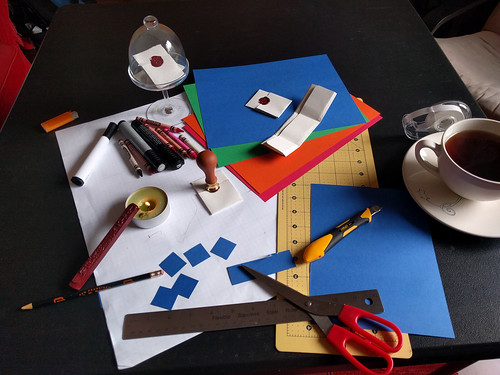
I like gaming. The social aspect is fun, yes, and story telling, but it's this whole crafting/art project portion that really hooks me.
As I've aged I'm finding it a little harder to just make things willy nilly without thought as to why or for what purpose. I've tucked about as many little monsters about the house as Adam will let me. I've given ones to many friends and all family members. Why make more things? Well, making things is FUN! But... why? That's where gaming comes in. Now I'm making not just "something" but rather a prop or an accessory. A visual aid for something that involves more people than just me. Purpose.
Up until this point I've mostly been playing in games but 2016 is the year I dip my toe in trying to run them. Picked up the D&D 5e suite of books/rules and have run 2 little one-shot games for my friends. Wouldn't say they've been that successful but I've definitely enjoyed having friends over and having an excuse to think creatively. The first game involved a 2 level map where I drew the ground on graph paper and then had a tree branch level drawn with dry erase markers on a glass shelf (resting on several cardboard tube tree trunks). The second involved a dungeon map slowly revealed as people explored it.
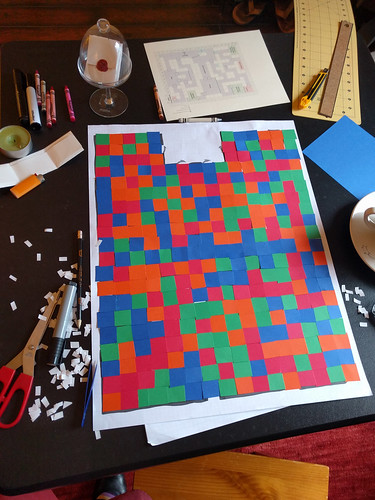
Turns out peeling off square by painful square of "fog of war" isn't super fun. Also, candy colored "fog of war" really doesn't add to the "dungeon crawl" vibe... The problem wasn't the taping down (that actually worked super well) but just the general scrabbling for a hold on tiny paper piece in order to pick up. One takeaway from it though was that drawing the map was a good exercise in thinking about the story and helping me build out an idea. Drawing is my best way of building a narrative- something I've known for a while.
Another delightful gaming craft recently worked on was the Rogue Trader Yu'Vath Battlestation Assault Plan. Given a rather math-y description of a patrolling ships around a point of interest, friend Nate and I wrote a little simulator to help find the best approach. Mind you, this is for a game I'm not even in. Was thrilled to have a valid reason to use the three.js library again and limber up my mind, wrapping it around 3D math/space/modeling. Not sure how long Nate will host it for, but the simulation is up at this site right now. [code posted on Github]
While not really a craft, I've found games (mine but especially others') to be an excellent source of sketching and art. Friend Kelly drew the characters from a game and then flattered me by asking to help with inking/coloring it. I appreciate that with her effort/interest/involvement I managed to overcome the wall of white space most my sketches hang in and provide the vaguest of something for background (drawing backgrounds being my majorly failed 2015 New Years resolution). Never mind the fact that it's mostly a munged photo I found on the Internet...
I was going to follow this up with several more gaming sketches but alas this week's plot didn't get far enough...
Along the gaming craft tangent: applying game content to other activities. Friend Suko and I continue our once-a-month shooting. I've marked my arrows with names of 4th Terminus characters and not only does it help me improve my aim/track my shot history but it also tells a story with every round. "Oh Hayley, once again going off target. Morgan, always flies true. Jayce, right where I send him and look at that- the Jaya arrow is snug up against him. Again." What I need to do now is figure out a better way to label the arrows. Right now I've scribbled the names on the nocks (over half of which need to be re-aligned) but the ink rubs off so easily there.... Anyway, the important take away is that once I named my arrows and could track which offset/corrections were needed for each I was able to hit the bullseye three times with the arrow named Jaya. Just saying. The other arrows need to start pulling their weight.
In conclusion gaming is fun. Friends are great, telling stories with them is a fantastic way to pass the time, and using said content to overlay on other actives makes everything better.
I dunno. *pushes glasses up nose, thereby exaggerating nasal tone* The D&D 5th Edition book _clearly_ states that it takes ten minutes to don plate mail armor, and five to doff it. This tutorial notably implies it would take _far_ longer unless you had _exceptional_ manual dexterity and training.
There’s always space for yet another armor tutorial, right? (ノ´ヮ´)ノ*:・゚✧
Note that the armor I drew would be worn around 15th century, the more into the future the less and less components knight’s armor had (i. e. in early 14th century instead of greaves a knight would wear long boots only; in 12th century knights didn’t wear plate breastplates and instead a chain mail only). Also the design of armor pattern changed by year and was different in every country (i.e. in eastern Europe armors, while still looking European, were heavily influenced by Turkey). so just make sure you always do research whenever drawing an armor. And one more thing to keep in mind is that armors were expensive, knights wearing a full plate armor weren’t an often sight.
Some links that may be useful:
Armour Archive (I strongly suggest to browse its forum, there is no country or period of which armor wouldn’t be discussed)
Therion Arms (armorer’s page; each accessory is photographed in big resolution and several time so it’s a nice page to use as reference for drawing)
Revival Clothing (another store, but both with medieval clothing and armors; I suggest to read the articles, they’re often supported with pictures)
How shall a man be armed? (youtube; another demonstration but with 4 different knights from different periods)
Bringing back this handy resource for how plate armor is actually worn on, also demonstrating how the major parts It’s particularly worth noting how the smaller bits tend to be layered over the major parts - thus ensuring effective layered protection and not having armor pushed into you by the enemy’s attacks. Unlike well… some designs.
I was never a super big Holmes fan, but Cohle, Hardy, Linden, Miller... there is definitely something to this musing.
Detective stories aren’t really about solving mysteries.
Very few detective stories are Encyclopedia Brown-style “solvable murder puzzles” where the reader can find every clue necessary to discover The Truth. Even most of Doyle’s classic Sherlock Holmes stories are not solvable puzzles; Sherlock has insights and background knowledge the reader does not. Most mystery stories play with hunches and suspicions, but almost never with full, fair data. This is because most mystery stories are not as much about the mystery as they are about the mystery-solver.
Mystery novels featuring a private eye or a detective are almost always primarily character studies. We are likely to spend a lot of time watching smart people struggle with difficult problems. We are going to spend a lot of time ‘in’ their brains, following their patterns of thought and learning about how they think. Their personalities become the entire organizing logic through which we see a world. Though the mystery may change every novel or every week, the window we see the world through– the detective– does not.
It is therefore necessary that the detective’s brain be a fun place for the audience to hang out. The detective must look at the world in a fresh, fascinating way. If the story has long-term character development, he or she must have secrets, or drama, or something fraught and tense that they can think about all the time– some problem that lives wholly or largely in the brain. An interesting nut for the detective to crack. Our shared fantasy of fictional detectivehood is generally a fantasy of an incredibly smart, troubled person whose brain is so mysterious and cool that we must spend many books or many episodes of television unriddling it.
And despite the fact that they have no ongoing character development whatsoever, the Sherlock Holmes stories are, of course, the ultimate example of this. Most modern-day adaptations of the story add significant character development to Holmes in order to make his brain even more interesting. It is fitting that the “fandom” for the Sherlock TV show fixates so heavily upon Benedict Cumberbatch and his character as an object of (often sexual) fantasy: Sherlock Holmes stories were always about ordinary people fixating on and obsessing over and worrying about the much-more-interesting life and brain of the famed detective, and fans replicate those patterns in the real world. They adopt Watson’s worshipful awe as their own. Sherlock Holmes stories have always been about ordinary people describing and marveling over the fascinating brain of a much more interesting and important person, and this very much par for the course for detective stories in general.
It is true even when the detectives in question are not tremendous, wonderful, sexy, pedestal-standing people. The Wallander books by Swedish author Henning Mankell– who died, actually, in October of this year– are a character study of an incredibly ordinary person with extremely typical problems. But Kurt Wallander’s problems have interesting stakes, and his brain becomes interesting because we care about it and because its contents are familiar enough that we sympathize with them. He may remind us of people we know, dads and grandads we know.
This weird frisson between his highly unusual problem-solving detective brain and the difficult familiarity of his problems is even more effective in the three excellent seasons of the Swedish TV show starring Krister Henriksson. Henriksson’s Wallander is the ultimate cranky old community misfit, uncomfortably occupying both a position of power and a position somehow outside the normal functioning of the community. He is always both exactly where he needs to be and terribly out-of-sorts. We watch with fixed attention as he experiences a variety of absolutely tragic miseries and stumbles over them with his sad, fraught detective brain. I, personally, would watch an episode consisting entirely of Wallander crankily trying and failing to board a flight at an airport. Though he’s no Holmes, this is exactly the kind of fascinating broken loner detective brain we all expect and crave from the genre.
Of course, the loner identity is the other side of the detective-brain coin. Because they think so differently from other characters in their fictional worlds, our detectives are very often major loners. they run the full gamut from ‘amusing and eccentric aloneness’ to ‘apocalyptic aloneness.’ They may have a partner, and they may have a family, but there is usually something about them and their precious brain and precious problems which makes it hard for them to fit in with the rest of their community. Holmes is a loner. Wallander is a loner. Rust Cohle and Sarah Linden and Alec Hardy and John Luther and Stella Gibson and Will Graham and, reaching back, Hercule Poirot and Miss Marple are all loners, to greater or lesser degrees. Here in the US, Netflix has just released a BBC TV show called ‘River’ where Stellan Skarsgaard, trying very hard (and failing) to not sound as Swedish as he actually is, acts the part of a completely bonkers detective who is so alone and miserable that he hallucinates the presence of his murdered partner almost 100% of the time. Our logic goes: if we are going to spend this much time in a stranger’s brain, it better be interesting. And ‘interesting’ usually means ‘broken’– so ‘interesting’ and so ‘broken’ that this person must be totally, astonishingly alone.
Of course, this is not all innocent drama. It is political that one of our major entertainment genres is primarily concerned with telling elaborate melodramatic stories about the precious brains and precious problems of imaginary good-guy policemen. And it is also wierd that we are glorifying and idolizing a bunch of imaginary people whose behavior nevertheless conforms pretty closely in many cases to untreated depression and other serious untreated mental illnesses, especially when these problems are credited with giving them their “appeal” and “charm” and “mystery.”
And these imaginary people are all so elaborately broken! Now, I don’t actually know any detectives personally, but I hear tell that the vast majority of them are fairly ordinary people whose lives feature no extraordinary, melodramatic level of brokenness or aloneness. Most people, I think, are aware of this. The Sad Lonely Detective Man is very obviously a trope that we use because it is fun, not because it tells any great truth about detectiving or detectivehood. I think the point of detective stories is to give us a place where we can do outrageously melodramatic character studies, where we can feel free to stretch out and roll around in the misery-mud with a bunch of wan-faced wasting men and women. The framing fiction of a ‘detective story’ has built-in goals and built-in villains and provides excellent structure upon which we can hang the frail, tortured skins of our imaginary brain-dudes.
I think this genre has largely become about what it is like to be various kinds of lonely sad person. We may not really have any idea what it is like to detect shit, but we all know exactly what it is like to be sad. The detectives are all establishment figures, System People, and that makes it easy and uncomplicated for the average person to empathize with their complicated sadness. We definitely need this place in fiction where loads and loads of imaginary sad characters can putter over fairly-formulaic problems while the story really focuses on how sad and interesting their brains are. I am not being facetious! There are so many of these stories, and they are all so similar, that there really must be something in them that we want. They aren’t filling a niche; they are filling in a gigantic crater of lonely sadness. They’re doing a good job.
Of course, I am not being entirely fair to the genre. The formula is much more varied than I have described it. You have shows like The Blacklist, where ‘the detective personality’ has been displaced from the actual detectives onto their criminal consultant; you have the US version of The Killing, which features loners but gives them absolutely no hint of abnormal brilliance. Broadchurch has one drama detective and one relentlessly ordinary detective, then partially swaps their roles at various points in the story. You have stuff like Columbo, which turns the misery-brain trope on its head, featuring instead a very down-to-earth detective who is interesting for his common friendliness. You have anti-detective stories, like Twin Peaks, where the detective’s smart-man expertise makes absolutely zero sense to the audience. The genre is so big that I cannot ever cover it comprehensively. There are endless twists on the formula. You can probably name many yourself.
But we do cleave to the formula a little too tightly. For example, we will even stretch it to include baffling examples of “anti-establishment” policemen. On The X Files we followed the adventures of two rebellious FBI agents who, over the course of the show, somehow managed to shed almost 100% of their institutional qualities and become entirely anti-system rebels while inexplicably retaining their jobs– and even when they lost their jobs, we received two replacement agents who began an identical journey from scratch. We’d apparently rather jump through those bizarre hoops than deviate even slightly from the time-tested detective-man plan!
I’ve been spending a lot of time thinking about this lately because I am halfway (well, slightly more than halfway) through writing an interactive mystery story myself. In some ways, it is extremely formulaic: it features a very alone adult man who has a melodramatic past and who is trying very hard to solve a murder case. But it also deviates from the formula in a few ways I think are important. I have been taking absolutely for-fucking-ever to write this story, but I am making consistent progress, and that’s giving me a good environment to slowly mull over what I think of these tropes and whether they are useful or good for me. It is important to think about what you are supporting or buying into through the tropes and stereotypes you use in your work. I have a better idea of what I like, now.
But: I would recommend staying far, far away from TV Tropes when doing this kind of thing. Losing yourself in TV Tropes has never been better than simply marathoning a TV show or chain-reading an entire book series and just allowing yourself to get lost in someone else’s story. A writer reading TV Tropes is like an alien trying to learn what a cake tastes like from a cookbook. The best solution is to simply go eat the cake.
—
A final story: since first or second grade, I have been repeatedly and relentlessly informed by all my peers and many of my elders that I am extremely weird, and that I have an unusual way of putting things and of looking at the world. I can’t disagree. As a child I had an encyclopedic command of large numbers of useless facts, an aggressive, double-barreled stare, a complete lack of interest in all gendered social activities, and a habit of constantly trying to get and hold other people’s attention. Though this stopped being a problem for me over a decade ago, when I was very small I derived enormous amounts of angst from my defective personality. But in third grade, after a life-changing classroom reading of The Red-Headed League (that I still remember with bizarre detail), I ended up absolutely inhaling Sherlock Holmes. I read almost all of the original canon without stopping and later re-read it all on a yearly basis, novels and all, all the way up through high school. I found the stories soothing, not least because they were about a weird person whom everyone seemed to worship.
As a child I took Sherlock Holmes as proof that someone could be weird and smart and alone, but nevertheless fulfilled. I sort of idolized the Holmes-Watson pair as an example of complete and ultimate friendship, and I took it as proof that if I could only do one or two things extremely well, then someone would admire me for it and be my friend. It did not occur to me until much later that the Holmes-Watson friendship is actually rather shitty, and that Watson is constantly trying to get away from it by marrying people and having a career. I also sort of glossed over the fact that Holmes is a sexist and that he probably would have despised me if he were real. For quite a long time, my secret role model and idol was a caricature of a grouchy fictional British detective, and I can tell you: it didn’t do me much good.
In high school I changed my behavior dramatically and became rather decent at making friends. My opinion of Sherlock Holmes changed too, and although I still think those stories are the finest short stories ever written, I no longer treat glorified miserable smartass aloneness as a thing to aspire to. As a result, my relationship to the entire goddamn mystery genre has changed. I don’t necessarily laugh at these stories, but I do a lot of laughing with them, with their melodramatic mud-rolling misery, and I think I enjoy them in a more genuine way now that I can treat them as inherently absurd.
I think the true sign of real comfort with a genre or style of writing is the ability to treat it as completely ridiculous. Not necessarily all the time, but some of the time, certainly. I would give a lot to be a fly on the wall in some of my favorite detective shows’ writers’ rooms. I would like to see whether they laugh at themselves, and how much. I think I can guess which writers’ rooms are relentlessly po-faced.
"I know we have our differences, but if we as programmers can't come together through our collective shared horror over PHP, the Nickelback of programming languages, then clearly I have failed."
I saw in today's news that Apple open sourced their Swift language. One of the most influential companies in the world explicitly adopting an open source model – that's great! I'm a believer. One of the big reasons we founded Discourse was to build an open source solution that anyone, anywhere could use and safely build upon.
It's not that Unix won -- just that closed source lost. Big time.
People were also encouraged that Apple was so refreshingly open about this whole process and involving the larger community in the process. They even hired from the community, which is something I always urge companies to do.
Also, not many people were, shall we say … fans … of Objective C as a language. There was a lot of community interest in having another viable modern language to write iOS apps in, and to Apple's credit, they produced Swift, and even promised to open source it by the end of the year. And they delivered, in a deliberate, thoughtful way. (Did I mention that they use CommonMark? That's kind of awesome, too.)
One of my heroes, Miguel de Icaza, happens to have lots of life experience in open sourcing things that were not exactly open source to start with. He applauded the move, and even made a small change to his Mono project in tribute:
When Swift was open sourced today, I saw they had a Code of Conduct. We had to follow suit, Mono has adopted it: https://t.co/hVO3KL1Dn5
It surprises me that anyone could ever object to the mere presence of a code of conduct. But some people do.
A weak Code of Conduct is a placebo label saying a conference is safe, without actually ensuring it’s safe.
Absence of a Code of Conduct does not mean that the organizers will provide an unsafe conference.
Creating safety is not the same as creating a feeling of safety.
Things organizers can do to make events safer: Restructure parties to reduce unsafe intoxication-induced behavior; work with speakers in advance to minimize potentially offensive material; and provide very attentive, mindful customer service consistently through the attendee experience.
Creating a safe conference is more expensive than just publishing a Code of Conduct to the event, but has a better chance of making the event safe.
Safe conferences are the outcome of a deliberate design effort.
I have to say, I don't understand this at all. Even if you do believe these things, why would you say them out loud? What possible constructive outcome could result from you saying them? It's a textbook case of honesty not always being the best policy. If this is all you've got, just say nothing, or wave people off with platitudes, like politicians do. And if you're Jared Spool, notable and famous within your field, it's even worse – what does this say to everyone else working in your field?
Mr. Spool's central premise is this:
Creating safety is not the same as creating a feeling of safety.
Which, actually … isn't true, and runs counter to everything I know about empathy. If you've ever watched It's Not About the Nail, you'll understand that a feeling of safety is, in fact, what many people are looking for. It's not the whole story by any means, but it's a very important starting point. An anchor.
I also had a direct flashback to Deborah Tannen's groundbreaking You Just Don't Understand, in which you learn that men are all about fixing the problem, so much so that they rush headlong into any remotely plausible solution, without stopping along the way to actually listen and appreciate the depth of the problem, which maybe … can't really even be fixed?
If women are often frustrated because men do not respond to their troubles by offering matching troubles, men are often frustrated because women do … he feels she is trying to take something away from him by denying the uniqueness of his experience … if women resent men's tendency to offer solutions to problems, men complain about women's refusal to take action to solve the problems they complain about.
Since many men see themselves as problem solvers, a complaint or a trouble is a challenge … Trying to solve a problem or fix a trouble focuses on the message level. But for most women who habitually report problems at work or in friendships, the message is not the main point … trouble talk is intended to reinforce rapport by sending the metamessage "We're the same; you're not alone."
Women are frustrated when they not only don’t get this reinforcement but, quite the opposite, feel distanced by the advice, which seems to send the metamessage "We’re not the same. You have the problems; I have the solutions."
Having children really underscored this point for me. The quickest way to turn a child's frustration into a screaming, explosive tantrum is to try to fix their problem for them. This is such a hard thing for engineers to wrap their heads around, particularly male engineers, because we are all about fixing the problems. That's what we do, right? That's why we exist? We fix problems?
I once wrote this in reply to an Imgur discussion topic about navigating an "emotionally charged sitation":
Oh, you want a master class in dealing with emotionally charged situations? Well, why didn't you just say so?
Have kids. Within a few years you will learn to be an expert in dealing with this kind of stuff, because what nobody tells you about having kids is that for the first ~5 years, they are constantly. freaking. the. f**k. out.
If this seems weird to you, or like some kind of made up exaggerated hilarious absurd brand of humor, oh trust me. It's not. Real talk. This is actually how it is.
In their defense, it's not their fault: they've never felt fear, anger, hunger, jealousy, love, or any of the dozen other incredibly complex emotions you and I deal with on a daily basis. So they learn. But along the way, there will be many many many manymanymanymany freakouts. And guess who's there to help them navigate said freakouts?
Empathize, hug, and echo back to them. Don't try to solve their problems! DO NOT DO IT! Paradoxically, this only makes it way worse if you do. Let them work through the problem on their own. They always will – and knowing someone trusts you enough to figure our your own problems is a major psychological boost.
(protip: this works identically on adults and kids. Turns out most so-called adults aren't fully grown up. Who knew?)
I guess my point is that rats aren't so different from people. We all want the same thing. Comfort from someone who can tell us that the world is safe, the world is not out to get you, that bad things can (and might) happen to you but you'll still be OK because we will help you. We're all in this thing together, you're a human being much like myself and we love you.
That's why a visible, public code of conduct is a good idea, not only at an in-person conference, but also on a software project like Swift, or Mono. But programmers being programmers – because they spend all day every day mired in the crazy world of infinitely recursive rules from their OS, from their programming language, from their APIs, from their tools – are rules lawyers par excellence. Nobody on planet Earth is better at arguing to the death over a set of completely arbitrary, made up rules than the average programmer.
I knew in my heart of hearts that someone – and by someone I mean a programmer – would inevitably complain about the fact that Mono had added a code of conduct, another "unnecessary" ruleset. So I made a programmer joke.
@migueldeicaza I find these rules offensive and will be fining a complaint
OK, maybe sometimes my Twitter jokes aren't very good. Well, you know, that's just, like … your opinion, man. I should probably switch from Twitter to Myspace or Ello or Google Plus or Snapchat or something.
But it bothered me that people, any people, would think I actually asked new hires to put the company above their family.* Or that I didn't believe in a code of conduct. I guess some of that comes from having ~200k followers; once your audience gets big enough, Poe's Law becomes inevitable?
I know we have our differences, but if we as programmers can't come together through our collective shared horror over PHP, the Nickelback of programming languages, then clearly I have failed.
To show that I absolutely do believe in the value of a code of conduct, even as public statements of intent that we may not completely live up to, even if we've never had any incidents or problems that would require formal statements – I'm also adding a code of conduct as defined by contributor-covenant.org to the Discourse project. We're all in this open source thing together, you're a human being very much like us, and we vow to treat you with the same respect we'd want you to treat us. This should not be controversial. It should be common. And saying so matters.
If you maintain an open source project, I strongly urge you to consider formally adopting a code of conduct, too.
[advertisement] Building out your tech team? Stack Overflow Careers helps you hire from the largest community for programmers on the planet. We built our site with developers like you in mind.








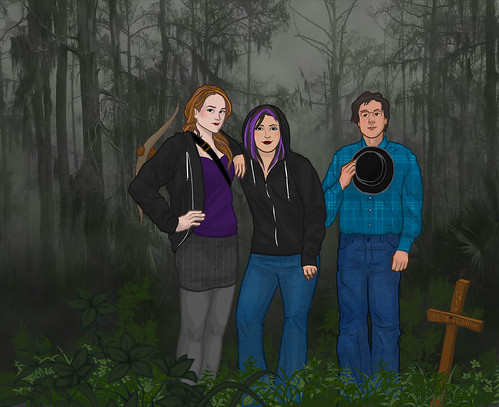 While not really a craft, I've found games (mine but especially others') to be an excellent source of sketching and art. Friend Kelly drew the characters from a game and then flattered me by asking to help with inking/coloring it. I appreciate that with her effort/interest/involvement I managed to overcome the wall of white space most my sketches hang in and provide the vaguest of something for background (drawing backgrounds being my majorly failed 2015 New Years resolution). Never mind the fact that it's mostly a munged photo I found on the Internet...