09 Mar 08:13
Chem. Sci., 2018, 9,2130-2134
DOI: 10.1039/C7SC05192A, Edge Article

Open Access
R. J. Sullivan, S. G. Newman
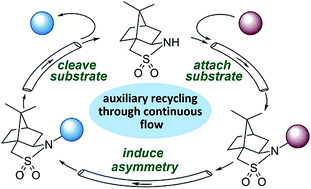
The telescoping of a three-stage, chiral auxiliary-mediated transformation in flow is described, including continuous separation of the product and auxiliary, enabling automated auxiliary reuse.
The content of this RSS Feed (c) The Royal Society of Chemistry

23 Jan 07:28
Chem. Sci., 2018, 9,2295-2300
DOI: 10.1039/C7SC04900E, Edge Article
Open Access
R. J. Griffiths, W. C. Kong, S. A. Richards, G. A. Burley, M. C. Willis, E. P. A. Talbot
A new and efficient process to access [small beta]-functionalisation of cyclic amines via a mild oxidative [small beta]-sulfonylation.
The content of this RSS Feed (c) The Royal Society of Chemistry

18 Jan 16:50
by Xingyu Jiang, Philip Boehm and John F. Hartwig

Journal of the American Chemical Society
DOI: 10.1021/jacs.7b12824

11 Jan 18:34
by Samuel E. Dalton, Lars Dittus, Daniel A. Thomas, Máire A. Convery, Joao Nunes, Jacob T. Bush, John P. Evans, Thilo Werner, Marcus Bantscheff, John A. Murphy and Sebastien Campos

Journal of the American Chemical Society
DOI: 10.1021/jacs.7b08979

12 Dec 18:18
by Lei Yang, Markus Neuburger, Olivier Baudoin
Abstract
Previous enantioselective Pd0-catalyzed C−H activation reactions proceeding via the concerted metalation-deprotonation mechanism employed either a chiral ancillary ligand, a chiral base, or a bimolecular mixture thereof. This study describes the development of new chiral bifunctional ligands based on a binaphthyl scaffold which incorporates both a phosphine and a carboxylic acid moiety. The optimal ligand provided high yields and enantioselectivities for a desymmetrizing C(sp2)−H arylation leading to 5,6-dihydrophenanthridines, whereas the corresponding monofunctional ligands showed low enantioselectivities. The bifunctional system proved applicable to a range of substituted dihydrophenanthridines, and allowed the parallel kinetic resolution of racemic substrates.

Chiral chimera: Bifunctional ligands incorporating both a phosphine and a carboxylate moiety provide high enantioselectivities in the synthesis of 5,6-dihydrophenanthridines. In contrast, the corresponding bimolecular systems are poorly stereoselective.
tao and -1 others like this
12 Dec 18:14
by Jason P. G. Rygus and Cathleen M. Crudden

Journal of the American Chemical Society
DOI: 10.1021/jacs.7b08326

12 Dec 18:12
by Bernhard Blümich, Kawarpal Singh
Abstract
NMR spectroscopy is an indispensable method of analysis in chemistry, which until recently suffered from high demands for space, high costs for acquisition and maintenance, and operational complexity. This has changed with the introduction of compact NMR spectrometers suitable for small-molecule analysis on the chemical workbench. These spectrometers contain permanent magnets giving rise to proton NMR frequencies between 40 and 80 MHz. The enabling technology is to make small permanent magnets with homogeneous fields. Tabletop instruments with inhomogeneous fields have been in use for over 40 years for characterizing food and hydrogen-containing materials by relaxation and diffusion measurements. Related NMR instruments measure these parameters in the stray field outside the magnet. They are used to inspect the borehole walls of oil wells and to test objects nondestructively. The state-of-the-art of NMR spectroscopy, imaging and relaxometry with compact instruments is reviewed.

NMR spectroscopy is known not only for its outstanding analytical power but also for the large size and costs of the instruments. In recent years, the family of instruments with bulky superconducting magnets has been complemented with compact tabletop and portable devices suitable for small-molecule analysis and nondestructive materials testing. The state of the art of compact NMR instruments is reviewed and illustrated with selected examples.
12 Dec 07:22
by Wilson, Kirsty L.
Synlett
DOI: 10.1055/s-0036-1589143

The Suzuki–Miyaura (SM) cross-coupling is the most broadly utilized Pd-catalyzed C–C bond-forming reaction in the chemical industry. A large proportion of SM couplings employ dipolar aprotic solvents; however, current sustainability initiatives and increasingly stringent regulations advocate the use of alternatives that exhibit more desirable properties. Here we describe the scope and utility of the bio-derived solvent Cyrene™ in SM cross-couplings and evaluate its suitability as a reaction medium for this benchmark transformation from discovery to gram scale.
[...]
© Georg Thieme Verlag Stuttgart · New York
Article in Thieme eJournals:
Table of contents | Abstract | Full text
05 Dec 15:44
by Tobias Gensch, Michael James, Toryn Dalton, Frank Glorius
Abstract
C−H activation reactions with high catalyst turnover numbers are still very rare in the literature and 10 mol % is a common catalyst loading in this field. We offer a representative overview of efficient C−H activation catalysis to highlight this neglected aspect of catalysis development and inspire future effort towards more efficient C−H activation. Examples ranging from palladium catalysis, Cp*RhIII- and Cp*CoIII-catalysis, the C−H borylation and silylation to methane C−H activation are presented. In these reactions, up to tens of thousands of catalyst turnovers have been observed.

Go, catalyst, go! C−H activation reactions with high catalyst turnover numbers are still very rare in the literature and 10 mol % is a common catalyst loading in this field. A representative overview of efficient C−H activation catalysis is presented here to highlight this neglected aspect of catalysis development and inspire future effort towards more efficient C−H activation.
04 Dec 07:49
by Kang Chen, Nele Berg, Ruth Gschwind and Burkhard König

Journal of the American Chemical Society
DOI: 10.1021/jacs.7b10755

04 Dec 07:46
by Christopher G. McPherson, Alasdair K. Cooper, Andrius Bubliauskas, Paul Mulrainey, Craig Jamieson and Allan J. B. Watson

Organic Letters
DOI: 10.1021/acs.orglett.7b03470

21 Nov 08:37
by Kazimer L. Skubi, Jesse B. Kidd, Hoimin Jung, Ilia A. Guzei, Mu-Hyun Baik and Tehshik P. Yoon

Journal of the American Chemical Society
DOI: 10.1021/jacs.7b10586

15 Nov 09:16
by Thomas A. Clohessy, Alastair Roberts, Eric S. Manas, Vipulkumar K. Patel, Niall A. Anderson and Allan J. B. Watson

Organic Letters
DOI: 10.1021/acs.orglett.7b03214

08 Nov 07:59
by Nicholas A. Isley, Ye Wang, Fabrice Gallou, Sachin Handa, Donald H. Aue and Bruce H. Lipshutz

ACS Catalysis
DOI: 10.1021/acscatal.7b03241

02 Nov 08:45
by Ying Xia, Di Qiu and Jianbo Wang

Chemical Reviews
DOI: 10.1021/acs.chemrev.7b00382

01 Nov 10:31
by Andreas Greb, Jian-Siang Poh, Stephanie Greed, Claudio Battilocchio, Patrick Pasau, David C. Blakemore, Steven Victor Ley
Abstract
Coupling of readily available boronic acids and diazo compounds has emerged recently as a powerful metal-free carbon–carbon bond forming method. However, the difficulty in forming the unstable diazo compound partner in a mild fashion has hitherto limited their general use and the scope of the transformation. Here, we report the application of oxadiazolines as precursors for the generation of an unstable family of diazo compounds using flow UV photolysis and their first use in divergent protodeboronative and oxidative C(sp2)−C(sp3) cross-coupling processes, with excellent functional-group tolerance.

Photo finish: A mild versatile method for the generation of highly unstable diazo compounds through photolysis of oxadiazolines and subsequent coupling with boronic acids is described. Simple changes in the workup conditions allow the divergent generation of protodeboronated and oxidized products, along with boronic pinacol esters, with excellent functional-group tolerance.
01 Nov 10:30
by Nicholas E. S. Tay and David A. Nicewicz

Journal of the American Chemical Society
DOI: 10.1021/jacs.7b10076

01 Nov 09:45
by David C. Leitch, Matthew P. John, Paul A. Slavin and Andrew D. Searle

Organic Process Research & Development
DOI: 10.1021/acs.oprd.7b00262

30 Oct 10:38
by Núria Miralles, José Enrique Gómez, Arjan W. Kleij and Elena Fernández

Organic Letters
DOI: 10.1021/acs.orglett.7b02947

27 Oct 06:48
by Miriam L. O’Duill, Rei Matsuura, Yanyan Wang, Joshua L. Turnbull, John A. Gurak, De-Wei Gao, Gang Lu, Peng Liu and Keary M. Engle

Journal of the American Chemical Society
DOI: 10.1021/jacs.7b08383

27 Oct 06:46
by Sascha Gehrke, Oldamur Holloczki
Abstract
Azolium cations are widely employed in organocatalysis to catalyse highly valuable synthetic processes in the presence of a base. These reactions are called “N-heterocyclic carbene catalysis”, based on the assumption that they are initiated by the formation of a free carbene through deprotonation, which can then react with the substrates and thereby affect their reactivity to obtain the desired products. However, we herein provide evidence that an electrophilic aromatic substitution mechanism is energetically more favourable, in which the azolium cation reacts directly with the substrate, avoiding the formation of the free carbene in solution.

Another alternative: A novel reaction pathway for N-heterocyclic carbene organocatalysis has been identified. In this process, proton transfer and the binding of the substrate to the catalyst occur simultaneously in a single elementary reaction step, without the formation of a free carbene molecule in the reaction mixture.
25 Oct 07:49
by Leyre Marzo, Shun Wang and Burkhard König

Organic Letters
DOI: 10.1021/acs.orglett.7b03001

25 Oct 07:44
by Hakan Keles, Flavien Susanne, Hamish Livingstone, Sarah Hunter, Charles Wade, Rose Bourdon and Andrew Rutter

Organic Process Research & Development
DOI: 10.1021/acs.oprd.7b00245

23 Oct 20:35
by Danielle Schultz, François Lévesque, Daniel A. DiRocco, Mikhail Reibarkh, Yining Ji, Leo A. Joyce, James F. Dropinski, Huaming Sheng, Benjamin D. Sherry, Ian W. Davies
Abstract
Aliphatic amines, oxygenated at remote positions within the molecule, represent an important class of synthetic building blocks to which there are currently no direct means of access. Reported herein is an efficient and scalable solution that relies upon decatungstate photocatalysis under acidic conditions using either H2O2 or O2 as the terminal oxidant. By using these reaction conditions a series of simple and unbiased aliphatic amine starting materials can be oxidized to value-added ketone products. Lastly, NMR spectroscopy using in situ LED-irradiated samples was utilized to monitor the kinetics of the reaction, thus enabling direct translation of the reaction into flow.

Going with the floW: Decatungstate anion, a UV absorbing photocatalyst, was utilized in the conversion of unprotected aliphatic amines, into products containing a ketone functionality at a remote position, by using either H2O2 or O2 as the terminal oxidant. NMR studies employing LED-irradiated samples aided in the identification of a key reaction intermediate, and ultimately allowed the transformation to be translated into flow.
23 Oct 20:23
by Kilian Colas, Raúl Martín-Montero, Abraham Mendoza
Abstract
A new Pummerer-type C−C coupling protocol is introduced based on turbo-organomagnesium amides, which unlike traditional Pummerer reactions, does not require strong electrophilic activators, engages a broad range of C(sp3)-, C(sp2)-, and C(sp)-nucleophiles, and seamlessly integrates with C−H and C−X magnesiation. Given the central character of sulfur compounds in organic chemistry, this protocol allows access to unrelated carbonyls, olefins, organometallics, halides, and boronic esters through a single strategy.

The Pummerer coupling allows C−C bond formation to be performed in a single operation but it is limited by the need of electrophilic activators. Reported herein is an efficient and orthogonal protocol for electrophile-free Pummerer C−C coupling, which addresses the scope and limitations of traditional approaches, by using DIPAMgCl⋅LiCl.
23 Oct 20:11
by Cristina García-Ruiz, Jack L.-Y. Chen, Christopher Sandford, Kathryn Feeney, Paula Lorenzo, Guillaume Berionni, Herbert Mayr and Varinder K. Aggarwal

Journal of the American Chemical Society
DOI: 10.1021/jacs.7b10240

22 Oct 20:35
by Jae Yeon Kim, Byung Chul Kang and Do Hyun Ryu

Organic Letters
DOI: 10.1021/acs.orglett.7b02928

22 Oct 20:03
by Jian Wen, Hanchao Cheng, Gerhard Raabe and Carsten Bolm

Organic Letters
DOI: 10.1021/acs.orglett.7b03106

22 Oct 19:38
by Ran Liang, Shun Li, Rongzhou Wang, Lei Lu and Feng Li

Organic Letters
DOI: 10.1021/acs.orglett.7b02723

cxl, 古月 and one other like this
22 Oct 19:30
by Tim Markovic, Benjamin N. Rocke, David C. Blakemore, Vincent Mascitti and Michael C. Willis

Organic Letters
DOI: 10.1021/acs.orglett.7b02944

   This article is licensed under a Creative Commons Attribution 3.0 Unported Licence.



