Axisymmetric solitonic states (chiral skyrmions) have been predicted theoretically more than two decades ago. However, until recently they have been observed in a form of skyrmionic condensates (hexagonal lattices and other mesophases). In this paper we report experimental and theoretical investigations of isolated chiral skyrmions discovered in PdFe/Ir(111) bilayers two years ago (Science 341 , 636 (2013)). The results of spin-polarized scanning tunneling microscopy analyzed within the continuum and discrete models provide a consistent description of isolated skyrmions in thin layers. The existence region of chiral skyrmions is restricted by strip-out instabilities at low fields and a collapse at high fields. We demonstrate that the same equations describe axisymmetric localized states in all condensed matter systems with broken mirror symmetry, and thus our findings establish basic properties of isolated skyrmions common for chiral liquid crystals, different classes of noncentrosymmetric magnets, ferroelectrics, and multiferroics.
Dr.jens.brede
Shared posts
The properties of isolated chiral skyrmions in thin magnetic films. (arXiv:1508.02155v1 [cond-mat.mes-hall])
Nanobubbles at GPa Pressure under Graphene

Sub-surface alloying largely influences graphene nucleation and growth over transition metal substrates

DOI: 10.1039/C5CP03820K, Paper
Sub-surface alloying (SSA) can be an effective approach to tuning surface functionalities.
The content of this RSS Feed (c) The Royal Society of Chemistry
Surface Chemistry of Trimethylaluminum on Pd(111) and Pt(111)

Comment on "Electromagnetic Radiation under Explicit Symmetry Breaking". (arXiv:1508.01730v1 [physics.optics])
Recently published paper [PRL 114, 147701 (2015)] contains several misleading statements and misinterpretations of known facts. The main massage of the paper [PRL 114, 147701 (2015)] is as follows: "We have shown that explicit symmetry breaking in the structural configuration of charges leads to symmetry breaking of the electric field which results in electromagnetic radiation due to non-conservative current within a localized region of space and time" seems to transcend mere empiricism, touching the theoretical foundations of electromagnetism. Moreover, basic mistakes are numerous in this article and its main claim is wrong. Below we prove it citing the paper and arguing against it.
Two-Dimensional Superlattices of Bi Nanoclusters Formed on a Au(111) Surface Using Porous Supramolecular Templates

Grain Boundary Structures and Electronic Properties of Hexagonal Boron Nitride on Cu(111)

Two-Dimensional Topological Crystalline Insulator and Topological Phase Transition in TlSe and TlS Monolayers

Beating the Stoner criterion using molecular interfaces
Beating the Stoner criterion using molecular interfaces
Nature 524, 7563 (2015). doi:10.1038/nature14621
Authors: Fatma Al Ma’Mari, Timothy Moorsom, Gilberto Teobaldi, William Deacon, Thomas Prokscha, Hubertus Luetkens, Steve Lee, George E. Sterbinsky, Dario A. Arena, Donald A. MacLaren, Machiel Flokstra, Mannan Ali, May C. Wheeler, Gavin Burnell, Bryan J. Hickey & Oscar Cespedes
Only three elements are ferromagnetic at room temperature: the transition metals iron, cobalt and nickel. The Stoner criterion explains why iron is ferromagnetic but manganese, for example, is not, even though both elements have an unfilled 3d shell and are adjacent in the periodic table: according to this criterion, the product of the density of states and the exchange integral must be greater than unity for spontaneous spin ordering to emerge. Here we demonstrate that it is possible to alter the electronic states of non-ferromagnetic materials, such as diamagnetic copper and paramagnetic manganese, to overcome the Stoner criterion and make them ferromagnetic at room temperature. This effect is achieved via interfaces between metallic thin films and C60 molecular layers. The emergent ferromagnetic state exists over several layers of the metal before being quenched at large sample thicknesses by the material’s bulk properties. Although the induced magnetization is easily measurable by magnetometry, low-energy muon spin spectroscopy provides insight into its distribution by studying the depolarization process of low-energy muons implanted in the sample. This technique indicates localized spin-ordered states at, and close to, the metal–molecule interface. Density functional theory simulations suggest a mechanism based on magnetic hardening of the metal atoms, owing to electron transfer. This mechanism might allow for the exploitation of molecular coupling to design magnetic metamaterials using abundant, non-toxic components such as organic semiconductors. Charge transfer at molecular interfaces may thus be used to control spin polarization or magnetization, with consequences for the design of devices for electronic, power or computing applications (see, for example, refs 6 and 7).
The Covalent Functionalization of Graphene on Substrates
Abstract
The utilization of grown or deposited graphene on solid substrates offers key benefits for functionalization processes, but especially to attain structures with a high level of control for electronics and “smart” materials. In this review, we will initially focus on the nature and properties of graphene on substrates, based on the method of preparation. We will then analyze the most relevant literature on the functionalization of graphene on substrates. In particular, we will comparatively discuss radical reactions, cycloadditions, halogenations, hydrogenations, and oxidations. We will especially address the question of how the reactivity of graphene is affected by its morphology (i.e., number of layers, defects, substrate, curvature, etc.).

Covalent modification of graphene on substrates allows fine control of its chemical structure and opening of the bandgap for electronic applications. The graphene type and morphology, the nature of the substrate, and mechanical forces are key factors affecting reactivity. Analysis of these parameters and comparison of the different functionalization routes is essential to make an informed choice when working with functionalized graphene on a support.
Ordered Fe(II)Ti(IV)O3 Mixed Monolayer Oxide on Rutile TiO2(011)

Atomically Precise Growth of Catalytically Active Cobalt Sulfide on Flat Surfaces and within a Metal–Organic Framework via Atomic Layer Deposition

Real-Space Observation of Short-Period Cubic Lattice of Skyrmions in MnGe

Competing Forces during Contact Formation between a Tip and a Single Molecule

Linear relation between Heisenberg exchange and interfacial Dzyaloshinskii–Moriya interaction in metal films
Nature Physics. doi:10.1038/nphys3418
Authors: Hans T. Nembach, Justin M. Shaw, Mathias Weiler, Emilie Jué & Thomas J. Silva
Proposals for novel spin-orbitronic logic and memory devices are often predicated on assumptions as to how materials with large spin–orbit coupling interact with ferromagnets when in contact. Such interactions give rise to a host of novel phenomena, such as spin–orbit torques, chiral spin structures and chiral spin torques. These chiral properties are related to the antisymmetric exchange, also referred to as the interfacial Dzyaloshinskii–Moriya interaction (DMI; refs , ). For numerous phenomena, the relative strengths of the symmetric Heisenberg exchange and the DMI are of great importance. Here, we use optical spin-wave spectroscopy (Brillouin light scattering) to directly determine the volume-averaged DMI vector D for a series of Ni80Fe20/Pt thin films, and then compare the nearest-neighbour DMI coupling energy with an independently measured value of the Heisenberg exchange for each sample. We show that the dependence on Ni80Fe20 thickness of both the microscopic symmetric and antisymmetric exchange are nearly identical, consistent with the notion that the fundamentals of the DMI and Heisenberg exchange essentially share the same underlying physics, albeit with different symmetries, as was originally proposed by Moriya for superexchange in magnetic oxides, and by Fert and Levy for RKKY coupling in metallic spin glasses. Indeed, our result demonstrates the generality of the original DMI theory, insofar as the proportionality of the symmetric and antisymmetric exchange is robust with regard to the details of spin coupling for the material system in question. Although of significant fundamental importance, this result also leads us to a deeper understanding of DMI and how it could be optimized for spin-orbitronic applications.
Unraveling the Molecular Structures of Asphaltenes by Atomic Force Microscopy

Contrasting interedge superexchange interactions of graphene nanoribbons embedded in h-BN and graphane
Author(s): Sun-Woo Kim, Hyun-Jung Kim, Jin-Ho Choi, Ralph H. Scheicher, and Jun-Hyung Cho
Based on first-principles density-functional theory calculations, we present a comparative study of the electronic structures of ultranarrow zigzag graphene nanoribbons (ZGNRs) embedded in a hexagonal boron nitride (BN) sheet and fully hydrogenated graphene (graphane) as a function of their width N …
[Phys. Rev. B 92, 035443] Published Fri Jul 31, 2015
Superconductivity in Weyl metals
Author(s): G. Bednik, A. A. Zyuzin, and A. A. Burkov
We report on a study of intrinsic superconductivity in a Weyl metal, i.e., a doped Weyl semimetal. Two distinct superconducting states are possible in this system in principle: a zero-momentum pairing BCS state, with point nodes in the gap function, and a finite-momentum FFLO-like state, with a full…
[Phys. Rev. B 92, 035153] Published Fri Jul 31, 2015
Experimental Discovery of Weyl Semimetal TaAs
Author(s): B. Q. Lv, H. M. Weng, B. B. Fu, X. P. Wang, H. Miao, J. Ma, P. Richard, X. C. Huang, L. X. Zhao, G. F. Chen, Z. Fang, X. Dai, T. Qian, and H. Ding
Weyl fermions possess exotic properties and can act like magnetic monopoles. Researchers show that TaAs is a Weyl semimetal, demonstrating for the first time that Weyl semimetals can be identified experimentally.
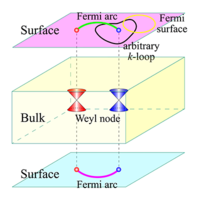
[Phys. Rev. X 5, 031013] Published Fri Jul 31, 2015
Low-Temperature Reductive Coupling of Formaldehyde on Rutile TiO2(110)

Understanding How Nanoparticle Attachment Enhances Phosphotriesterase Kinetic Efficiency

Manipulating Magnetism at Organic/Ferromagnetic Interfaces by Fullerene-Induced Surface Reconstruction. (arXiv:1507.08378v1 [cond-mat.mes-hall])
Fullerenes have several advantages as potential materials for organic spintronics. Through a theoretical first-principles study, we report that fullerene C$_{60}$ adsorption can induce a magnetic reconstruction in a Ni(111) surface and expose the merits of the reconstructed C$_{60}$/Ni(111) \emph{spinterface} for molecular spintronics applications. Surface reconstruction drastically modifies the magnetic properties at both sides of the C$_{60}$/Ni interface. Three outstanding properties of the reconstructed structure are revealed, which originate from reconstruction enhanced spin-split $\mathrm{\pi}$$-$d coupling between C$_{60}$ and Ni(111): 1) the C$_{60}$ spin polarization and conductance around the Fermi level are enhanced simultaneously, which can be important for read-head sensor miniaturization; 2) localized spin-polarized states appear in C$_{60}$ with a spin-filter functionality, and 3) magnetocrystalline anisotropic energy and exchange coupling in the outermost Ni layer are reduced enormously. Surface reconstruction can be realized simply by controlling the annealing temperature in experiments.
[Report] Epitaxial growth of a monolayer WSe2-MoS2 lateral p-n junction with an atomically sharp interface
Supramolecular Rotor and Translator at Work: On-Surface Movement of Single Atoms

Direct Imaging Single Methanol Molecule Photocatalysis on Titania

Graphene kirigami
Nature advance online publication 29 July 2015. doi:10.1038/nature14588
Authors: Melina K. Blees, Arthur W. Barnard, Peter A. Rose, Samantha P. Roberts, Kathryn L. McGill, Pinshane Y. Huang, Alexander R. Ruyack, Joshua W. Kevek, Bryce Kobrin, David A. Muller & Paul L. McEuen
For centuries, practitioners of origami (‘ori’, fold; ‘kami’, paper) and kirigami (‘kiru’, cut) have fashioned sheets of paper into beautiful and complex three-dimensional structures. Both techniques are scalable, and scientists and engineers are adapting them to different two-dimensional starting materials to create structures from the macro- to the microscale. Here we show that graphene is well suited for kirigami, allowing us to build robust microscale structures with tunable mechanical properties. The material parameter crucial for kirigami is the Föppl–von Kármán numberγ: an indication of the ratio between in-plane stiffness and out-of-plane bending stiffness, with high numbers corresponding to membranes that more easily bend and crumple than they stretch and shear. To determine γ, we measure the bending stiffness of graphene monolayers that are 10–100 micrometres in size and obtain a value that is thousands of times higher than the predicted atomic-scale bending stiffness. Interferometric imaging attributes this finding to ripples in the membrane that stiffen the graphene sheets considerably, to the extent that γ is comparable to that of a standard piece of paper. We may therefore apply ideas from kirigami to graphene sheets to build mechanical metamaterials such as stretchable electrodes, springs, and hinges. These results establish graphene kirigami as a simple yet powerful and customizable approach for fashioning one-atom-thick graphene sheets into resilient and movable parts with microscale dimensions.
Electric-Field Control of Interfering Transport Pathways in a Single-Molecule Anthraquinone Transistor

Gyrational modes of benzenelike magnetic vortex molecules
Author(s): Christian F. Adolff, Max Hänze, Matthias Pues, Markus Weigand, and Guido Meier
With scanning transmission x-ray microscopy we study six magnetostatically coupled vortices arranged in a ring that resembles a benzene molecule. Each vortex is contained in a ferromagnetic microdisk. When exciting one vortex of the ring molecule with an alternating magnetic high-frequency field, al…
[Phys. Rev. B 92, 024426] Published Mon Jul 27, 2015
Tunable Fermi level and hedgehog spin texture in gapped graphene
Article
Potential electronic applications of graphene rely on controlling its spin-dependent properties. Here, the authors use spin-resolved photoemission spectroscopy to demonstrate how Au-intercalation produces gapped one-dimensional quasi-freestanding graphene on Fe(110) with tunable Fermi surface spin texture.
Nature Communications doi: 10.1038/ncomms8610
Authors: A. Varykhalov, J. Sánchez-Barriga, D. Marchenko, P. Hlawenka, P. S. Mandal, O. Rader
Spin vibronics in interacting nonmagnetic molecular nanojunctions
Dr.jens.brede...
Author(s): S. Weiss, J. Brüggemann, and M. Thorwart
We show that in the presence of ferromagnetic electronic reservoirs and spin-dependent tunnel couplings, molecular vibrations in nonmagnetic single molecular transistors induce an effective intramolecular exchange magnetic field. It generates a finite spin accumulation and precession for the electro…
[Phys. Rev. B 92, 045431] Published Mon Jul 27, 2015