
The Journal of Physical Chemistry C
DOI: 10.1021/acs.jpcc.5b04883
Author(s): K. V. Shanavas and David J. Singh
Photoemission studies of FeSe monolayer films on SrTiO3 substrate have shown electronic structures that deviate from pristine FeSe, consistent with heavy electron doping. With the help of first-principles calculations we studied the effect of excess Fe and Se atoms on the monolayer and oxygen vacanc…
[Phys. Rev. B 92, 035144] Published Fri Jul 24, 2015
Thin-film sub-5 nm magnetic skyrmions constitute an ultimate scaling alternative for future digital data storage. Skyrmions are robust non-collinear spin-textures that can be moved and manipulated by small electrical currents. We show here an innovative technique to detect isolated nanoskyrmions with a current-perpendicular-to-plane geometry, which has immediate implications for device concepts. We explore the physics behind such a mechanism by studying the atomistic electronic structure of the magnetic quasiparticles. We investigate how the isolated skyrmion local-density-of-states which tunnels into the vacuum, when compared to the ferromagnetic background, is modified by the site-dependent spin-mixing of electronic states with different relative canting angles. Local transport properties are sensitive to this effect, as we report an atomistic conductance anisotropy of over 20% for magnetic skyrmions in Pd/Fe/Ir(111) thin-films. In single skyrmions, engineering this spin-mixing magnetoresistance possibly could be incorporated in future magnetic storage technologies.
Article
A proper theoretical description for unconventional superconductivity in iron-based compounds remains elusive. Here, the authors, to capture the electron correlation strength and the role of Fermi surfaces, report ARPES measurements of three iron chalcogenide superconductors to establish universal features.
Nature Communications doi: 10.1038/ncomms8777
Authors: M. Yi, Z-K Liu, Y. Zhang, R. Yu, J.-X. Zhu, J.J. Lee, R.G. Moore, F.T. Schmitt, W. Li, S.C. Riggs, J.-H. Chu, B. Lv, J. Hu, M. Hashimoto, S.-K. Mo, Z. Hussain, Z.Q. Mao, C.W. Chu, I.R. Fisher, Q. Si, Z.-X. Shen, D.H. Lu
Author(s): A. Polyakov, Holger L. Meyerheim, E. Daryl Crozier, R. A. Gordon, K. Mohseni, S. Roy, A. Ernst, M. G. Vergniory, X. Zubizarreta, M. M. Otrokov, E. V. Chulkov, and J. Kirschner
The atomic structure of ultrathin iron films deposited on the (0001) surface of the topological insulator Bi2Se3 is analyzed by surface x-ray absorption spectroscopy. Iron atoms deposited on a Bi2Se3 (0001) surface kept at 160 K substitute bismuth atoms within the first quintuple layer. Iron atoms a…
[Phys. Rev. B 92, 045423] Published Wed Jul 22, 2015

Nature Chemistry 7, 623 (2015). doi:10.1038/nchem.2300
Authors: Niko Pavliček, Bruno Schuler, Sara Collazos, Nikolaj Moll, Dolores Pérez, Enrique Guitián, Gerhard Meyer, Diego Peña & Leo Gross
Based initially on the outcome of certain reactions but later backed up by spectroscopic evidence, chemists have proposed — for more than a century — the existence of arynes as extremely reactive intermediates in chemical transformations. Now, with the help of atomic force microscopy, it is finally possible to generate and directly visualize this elusive intermediate.

Author(s): Lu Zhao, Jianfeng Wang, Junwei Liu, Yong Xu, Bing-Lin Gu, Qi-Kun Xue, and Wenhui Duan
Inspired by helicity dependent optical phenomena in chiral metamaterials the authors exploit the idea of helicity degree of freedom of Dirac fermions. They perform a first-principles study of SnTe films and show that giant helicity splitting in the band structures can be induced under moderate electric field. They suggest using helicity as an extra degree of freedom for helicity-resolved filtering and focusing of Dirac fermions.

[Phys. Rev. B 92, 041408(R)] Published Tue Jul 21, 2015
We demonstrate the tip induced control of the spin state of copper phthalocyanine (CuPc) on an insulator coated substrate. Accounting for electronic correlations, we find that, under the condition of energetic proximity of neutral excited states to the anionic groundstate, the system can undergo a population inversion towards these excited states. The resulting state of the system is accompanied by a change in the total spin quantum number. Experimental signatures of the crossover are the appearance of additional nodal planes in the topographical STM images as well as a strong suppression of the current near the center of the molecule. The robustness of the effect against moderate charge conserving relaxation processes has also been tested.


Quantum entanglement permeates the complex ground states of correlated electron materials defying single-particle descriptions. Coupled magnetic atoms have potential as model systems for entanglement in condensed matter giving the opportunity to create artificial many-body states which can be controlled by tuning the underlying interactions. They provide an avenue to unravel the complexities of correlated-electron materials. Here we use low temperature scanning tunnelling microscopy (STM) and atomic manipulation to tune entanglement in chains of magnetic atoms. We find that a Kondo singlet state can emerge from this entanglement. The many electron Kondo state is based on the screening of the entangled spin ground state of the chain by substrate electrons and can be engineered to envelop at least ten magnetic atoms. The concomitant Kondo resonance measured in the differential conductance enables the electric read-out of entanglement. By tuning composition and coupling strength within atomic chains it is possible to create model spin chains with defined entanglement. This lays the foundation for a new class of experiments to construct exotic correlated-electron materials atom by atom.

Cyclotrimerization-induced chiral supramolecular structures of 4-ethynyltriphenylamine (ETPA) have been synthesized on the Au(111) surface through alkyne-based reactions. Whereas the ETPA molecules adsorbed on the Au(111) surface remain inert and form a close-packed self-assembled structure at room temperature, the combination of scanning tunneling microscopy observations and theoretical calculations unambiguously reveal that the ETPA molecules cyclotrimerize to form new trimer-like species—1,3,5-tris[4-(diphenylamino)phenyl]benzene (TPAPB)—after annealing at 323 K. Further annealing drives these cyclotrimerized TPAPB molecules to form chiral hexagonal supramolecular structures with an extraordinary self-healing ability.

Healing hexagons: Highly selective [2+2+2] cyclization of 4-ethynyltriphenylamine (ETPA) molecules is achieved on a gold surface under ultra-high vacuum. These cyclotrimerized ETPA molecules self-assemble into chiral hexagonal supramolecular structures with an extraordinary self-healing ability after thermal treatment (see figure).
Article
Atomic force microscopy is capable of resolving the chemical structure of a single molecule on a surface, usually at low temperatures. Here, the authors demonstrate that the chemical structure of a single molecule strongly adsorbed onto a silicon surface can be determined at room temperature.
Nature Communications doi: 10.1038/ncomms8766
Authors: Kota Iwata, Shiro Yamazaki, Pingo Mutombo, Prokop Hapala, Martin Ondráček, Pavel Jelínek, Yoshiaki Sugimoto

Author(s): Kunihiko Yamauchi, Paolo Barone, Tatsuya Shishidou, Tamio Oguchi, and Silvia Picozzi
A theoretically proposed oxide-based heterostructure indicates how coupling of spin and valley degrees of freedom may be engineered and controlled via the ferroelectric properties typical of transition-metal oxides.
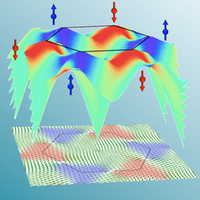
[Phys. Rev. Lett. 115, 037602] Published Thu Jul 16, 2015
Magnetic skyrmions are localised non-collinear spin textures with high potential for future spintronic applications. Skyrmion phases have been discovered in a number of materials and a focus of current research is the preparation, detection, and manipulation of individual skyrmions for an implementation in devices. Local experimental characterization of skyrmions has been performed by, e.g., Lorentz microscopy or atomic-scale tunnel magnetoresistance measurements using spin-polarised scanning tunneling microscopy. Here, we report on a drastic change of the differential tunnel conductance for magnetic skyrmions arising from their non-collinearity: mixing between the spin channels locally alters the electronic structure, making a skyrmion electronically distinct from its ferromagnetic environment. We propose this non-collinear magnetoresistance (NCMR) as a reliable all-electrical detection scheme for skyrmions with an easy implementation into device architectures.
Laboratory confirmation of C60+ as the carrier of two diffuse interstellar bands
Nature 523, 7560 (2015). doi:10.1038/nature14566
Authors: E. K. Campbell, M. Holz, D. Gerlich & J. P. Maier
The diffuse interstellar bands are absorption lines seen towards reddened stars. None of the molecules responsible for these bands have been conclusively identified. Two bands at 9,632 ångströms and 9,577 ångströms were reported in 1994, and were suggested to arise from C60+ molecules (ref. 3), on the basis of the proximity of these wavelengths to the absorption bands of C60+ measured in a neon matrix. Confirmation of this assignment requires the gas-phase spectrum of C60+. Here we report laboratory spectroscopy of C60+ in the gas phase, cooled to 5.8 kelvin. The absorption spectrum has maxima at 9,632.7 ± 0.1 ångströms and 9,577.5 ± 0.1 ångströms, and the full widths at half-maximum of these bands are 2.2 ± 0.2 ångströms and 2.5 ± 0.2 ångströms, respectively. We conclude that we have positively identified the diffuse interstellar bands at 9,632 ångströms and 9,577 ångströms as arising from C60+ in the interstellar medium.
A recent experiment [Nadj-Perge et al., Science 346, 602 (2014)] provides evidence for Majorana zero modes in iron (Fe) chains on the superconducting Pb(110) surface. Here, we study this system by scanning tunneling microscopy using superconducting tips. This high-resolution technique resolves a rich subgap structure, including zero-energy excitations in some chains. We compare the symmetry properties of the data under voltage reversal against theoretical expectations and provide evidence that the putative Majorana signature overlaps with a previously unresolved low-energy resonance. Interpreting the data within a Majorana framework suggests that the topological gap is significantly smaller than previously believed. Aided by model calculations, we also analyze higher-energy features of the subgap spectrum and their relation to high-bias peaks which we associate with the Fe d-bands.
Author(s): J. Gayles, F. Freimuth, T. Schena, G. Lani, P. Mavropoulos, R. A. Duine, S. Blügel, J. Sinova, and Y. Mokrousov
A new theoretical treatment of Skyrmions in ferromagnets shows that electron dynamics are governed by Berry phase physics.
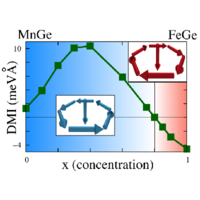
[Phys. Rev. Lett. 115, 036602] Published Tue Jul 14, 2015
A rapid and catalyst-free cycloaddition system for visible-light-induced click chemistry is reported. A readily accessible photoreactive 2H-azirine moiety was designed to absorb light at wavelengths above 400 nm. Irradiation with low-energy light sources thus enables efficient small-molecule synthesis with a diverse range of multiple-bond-containing compounds. Moreover, in order to demonstrate the efficiency of the current approach, quantitative ligation of the photoactivatable chromophore with functional polymeric substrates was performed and full conversion with irradiation times of only 1 min at ambient conditions was achieved. The current report thus presents a highly efficient method for applications involving selective cycloaddition to electron-deficient multiple-bond-containing materials.

Quick as a flash: A rapid and catalyst-free cycloaddition system for visible-light-induced click chemistry at ambient conditions is reported. Irradiation of a 2H-azirine moiety with low-energy light sources enables efficient small-molecule synthesis with a diverse range of multiple-bond-containing compounds, as well as rapid quantitative ligation of the photoactivatable chromophore with polymeric substrates.
Nature Physics. doi:10.1038/nphys3385
Authors: Jesús Martínez-Blanco, Christophe Nacci, Steven C. Erwin, Kiyoshi Kanisawa, Elina Locane, Mark Thomas, Felix von Oppen, Piet W. Brouwer & Stefan Fölsch
Transistors, regardless of their size, rely on electrical gates to control the conductance between source and drain contacts. In atomic-scale transistors, this conductance is sensitive to single electrons hopping via individual orbitals. Single-electron transport in molecular transistors has been previously studied using top-down approaches to gating, such as lithography and break junctions. But atomically precise control of the gate—which is crucial to transistor action at the smallest size scales—is not possible with these approaches. Here, we used individual charged atoms, manipulated by a scanning tunnelling microscope, to create the electrical gates for a single-molecule transistor. This degree of control allowed us to tune the molecule into the regime of sequential single-electron tunnelling, albeit with a conductance gap more than one order of magnitude larger than observed previously. This unexpected behaviour arises from the existence of two different orientational conformations of the molecule, depending on its charge state. Our results show that strong coupling between these charge and conformational degrees of freedom leads to new behaviour beyond the established picture of single-electron transport in atomic-scale transistors.
Abstract
Transformations of molecular structures formed by perylene-3,4,9,10-tetracarboxylic dianhydride (PTCDA) molecules on a rutile TiO2(110) surface are studied with low-temperature scanning tunnelling microscopy. We demonstrate that metastable molecular assemblies transform into differently ordered structures either due to additional energy provided by thermal annealing or when the influence of intermolecular forces is increased by the enlarged amount of deposited molecules. Proper adjustment of molecular coverage and substrate temperature during deposition allows for fabrication of desired assemblies. Differences between PTCDA/TiO2(110) and PTCDA/TiO2(011) systems obtained through identical experimental procedures are discussed.
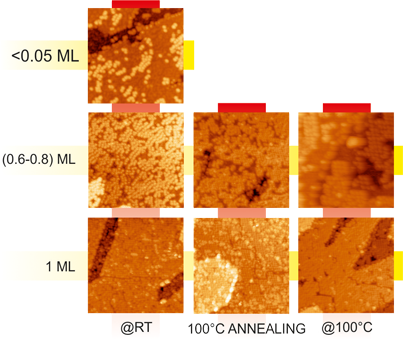
Beilstein J. Nanotechnol. 2015, 6, 1498–1507. doi:10.3762/bjnano.6.155
Article
Bilayer graphene nanoribbons are very promising for future nanoelectronics. Here Lopes et al. show a novel approach for the fabrication of quasi-free-standing bilayer graphene nanoribbons on SiC, based on the precise control of the layer-by-layer growth of graphene and a simple annealing step in air.
Nature Communications doi: 10.1038/ncomms8632
Authors: Myriano H. Oliveira, Jr., Joao Marcelo J. Lopes, Timo Schumann, Lauren A. Galves, Manfred Ramsteiner, Katja Berlin, Achim Trampert, Henning Riechert

