Shared posts

26 Oct 18:20

While Most Of The Rest Of The Internet Industry Is Fighting Against CISA, Facebook Accused Of Secretly Lobbying For It

by Mike Masnick
For the past few years, much of the internet industry had been mostly silent on CISA, or vaguely for it, mainly because it would provide them immunity from liability if they share too much information with the government. However, as more details have come out about CISA, making it clear that it's a surveillance bill, rather than any sort of cybersecurity bill, the internet industry has finally, mostly come out against it. It started with Salesforce.com, after people started protesting a letter it had signed saying it favored "cybersecurity" legislation, but without naming CISA. In response, Salesforce came out directly and said that it did not support CISA. Soon after that, the BSA (the Business Software Alliance, which now prefers to just be called "The Software Alliance"), which had put together the letter Salesforce signed, said that it did not support CISA (or any of the other cybersecurity bills that have been introduced). Soon after that, CCIA, which represents a bunch of internet companies, came out directly against CISA, saying:
CCIA is unable to support CISA as it is currently written. CISA’s prescribed mechanism for sharing of cyber threat information does not sufficiently protect users’ privacy or appropriately limit the permissible uses of information shared with the government. In addition, the bill authorizes entities to employ network defense measures that might cause collateral harm to the systems of innocent third parties.
With that, the ball was rolling. Both Apple and Dropbox directly came out against CISA. Then Twitter, Yelp, Wikimedia and Reddit.

However, the folks at Fight for the Future, who have been working hard to stop CISA, are now claiming that they have it on good authority that Facebook is one of the only internet companies secretly lobbying in favor of the bill and is asking people to sign its petition to convince Facebook to back down:
This bill is toxic. The public hates it and tons of tech companies are against it, but Congress keeps trying to ram it through. Now that we know that Facebook lobbyists are working behind the scenes to get it passed, it makes more sense why Congress keeps coming back to it.

Facebook’s chief Senate lobbyist, Myriah Jordan, worked as General Counsel for CISA's sponsor, Senator Richard Burr, right up until taking the job at Facebook. On her lobbying disclosures she lists “cybersecurity” as one of the issues she's been discussing with senators. These “revolving door” connections give companies more power and influence than ordinary people could ever have, and it’s part of the reason why companies like Facebook think they can get whatever they want out of Washington.

Several offices on the Hill have heard from Facebook that they support CISA. As much as we wish we could reveal our sources, we agreed not to (selective leaking is part of how the lobbying game works, unfortunately). But this information matches with everything we know about Facebook's love for CISA over the years. They backed the bill loudly before it was unpopular and then stayed silent as other big tech companies came out against it. We've asked them to state their position publicly, bu they have said nothing. Facebook has backed this from day one, and now they're the lone tech voice still working to make sure it passes.
This would seem to be very unfortunate if it's true, and hopefully Facebook reconsiders. While Apple, Twitter, Yahoo, Google, LinkedIn and others have been quite vocal in fighting back against government surveillance, Facebook has been much less involved in those fights -- despite the fact that it often has more information than those other players. Facebook seems increasingly out of step with the rest of the internet industry in making sure that protecting the privacy of their users against government surveillance is a top priority. Hopefully, the company changes its position on this.

Update: For what it's worth, Facebook is now denying the story, saying that it has not taken a position either for or against CISA (and doesn't seem interested in doing so either way). That still seems like an odd position to take given that most of the other companies in the industry have come out against the bill. And, in addition, I've now heard from others on Capitol Hill as well supporting the statements from Fight for the Future that Facebook is considered to be in favor of CISA, though it's not clear if the company has been actively lobbying for it.

Permalink | Comments | Email This Story


25 Oct 13:00

This Year's Most Insane Halloween House Light Display Synchronized To Ghostbusters Theme Song

Brindle

8000+ channels! Good thing this is their job and not just a hobby...

halloween-light-display-ghostbusters.jpg Every year the folks at Creative Lighting Displays produce a ridiculously elaborate Halloween house display. This is a video of this year's, synchronized to the Ghostbusters theme song. How many lights are there? F***ING TONS, THAT'S HOW MANY. So many you can see the house from space. Just kidding, but you can definitely see it from the road.
4 singing pumpkin faces, tombstones, hand carved pumpkins, strobes, floods, 2 Matrix boards and thousands of lights. All RGB LED except for the faces, floods and a few light strings. E1.31 DMX and LOR driven. 8000+ channels. Riverside, CA.
Man, I would love to live in that neighborhood. Not because I necessarily want to watch the display, but anybody who goes that buck-wild with Halloween decorations better be handing out full-size candy bars. Keep going for the video, it really is worth a watch, even if you just skip around. Those lights are nuts. Thanks to Rebecca B, who didn't synchronize a Halloween light display, but does flick the porch light on and off real quick when trick-or-treaters approach.
23 Oct 16:29

More Legislators Think Underprivileged Cops Need 'Hate Crime' Law Protections

by Tim Cushing
Brindle

Huh... did you know oppressing people makes them violent to authorities? Weird.

Another US city has stepped up to shelter some of its most privileged citizens from "hate crimes."

The Red Wing (MN) City Council passed a resolution last week calling for crimes against law enforcement to be prosecutable as hate crimes.

The picturesque town on the banks of the Mississippi River is believed to be the second place in the nation — and the first city — to pass such a resolution.

“It seems that anyone wearing a blue uniform has become a target in the minds of a lot of people — a target not because of what they’re doing, but a target because of who they are, which for me really kind of moves it into the hate crimes area,” said Council Vice President Peggy Rehder. “In this case, it’s not the color of their skin, but the color of their uniform.”
First off, cops aren't being targeted with any more regularity than they've ever been. In fact, the last time cops were "targeted" at a level anyone rational would consider to be a problem was during Prohibition, nearly 100 years ago. (The second spike is due to another round of prohibition -- the declaration of the "War on Drugs" by President Richard Nixon.)


What "hate crimes" laws attempt to do (in their very inept, redundant way) is address inequality. Underprivileged groups often subjected to racism and other biases are the beneficiaries of these well-meaning laws. But even the most ardent supporter of hate crime legislation would be hard-pressed to find a reason to "protect" a group with vast amounts of authority and power.

If evening out inequality is the goal, the law's intentions are being severely twisted by resolutions like these. To paraphrase George Orwell, law enforcement officers are animals much more "equal" than the public they're supposed to serve. Much like the politicians that so often shield them, cops, sheriffs and others are a step or two above the laws they enforce. It takes an incredible stretch of the imagination to find police officers deserving of additional protections.

As Overlawyered's Walter Olson points out in his editorial at the Minneapolis Star-Tribune, this resolution is a solution in search of a problem. And applying it will only create more problems.
It is common for hate-crime laws to create multiple jeopardy at different court levels arising from a single offense, which is often considered a danger to liberty, even if courts do not always find that it formally violates the Bill of Rights’ double jeopardy clause. But defenders of these laws argue that local authorities in many parts of the country long refused to take seriously crimes against certain scorned or disenfranchised minorities, thus in their view justifying a second layer of prosecutorial attention.

But there’s no evidence that authorities now or in the past have brushed off lethal attacks on police as something not worth investigating or prosecuting.
If a person shoots a cop, a manhunt immediately ensues. The same cannot be said about racially or religiously-motivated killings. In those cases, an investigation ensues before such a motive is firmly established. Recently though, any act of violence against an officer has almost always been portrayed as a "targeted" attack.

Law enforcement officers work in a violent business. They will often find themselves in situations where they may be injured or killed. This is part of the job. What it isn't, however, is a non-stop sequence of "hate crimes. But if this law goes into effect, any act of violence -- even the BS "assault" of officers (attacking fists with faces, inadvertent contact, not somehow materializing fully-cuffed and seated in a squad car the moment an officer declares you under arrest, etc.) -- can subject a person to additional legal penalties. And this would be on top of existing additional legal penalties.
Attacking a police officer already carries serious consequences in Minnesota. Under state law, an assault on a law enforcement officer can mean increased fines and jail time. If the officer is injured, a misdemeanor assault can bump up to a felony. State law also carries enhanced penalties for attacks on many professions, including firefighters, judges, prosecutors, teachers and postal workers, among others.
This isn't stopping police unions and the politicians who listen to them from pushing for these extra protections. And they're doing so with a dearth of evidence supporting their claims that being a cop is more dangerous than it's ever been. Even the National Law Enforcement Memorial Fund's official stats show an 18% decline in fatal shootings of officers compared to last year.

Pay no attention to the statistics, though. It's what law enforcement officers feel is happening that really matters.
Over time, the number of officers killed has remained “relatively static,” [Fraternal Order of Police Executive Director] Jim Pasco said, but the numbers don’t take into account the better equipment, training and medical care benefiting police in recent years. “The overwhelming anecdotal evidence that comes to us: There’s an increased hostility,” Pasco said.
The words "overwhelming" and "anecdotal" should never be combined with "evidence." You can strike either "overwhelming" or "anecdotal" and still form a credible sentence. But you can't combine both and expect to be taken seriously. Not when the actual stats don't back up these assertions.

These are legislative proposals based on nothing more than law enforcement's unwillingness to reap what years of abusive behavior has sewn. These entities aren't pushing these laws to address known flaws in the justice system. They're pushing them to forcefully "restore" the respect they've squandered.

Permalink | Comments | Email This Story


23 Oct 13:39

FASTR Ensures that Publicly Funded Research Belongs to the Public

by Elliot Harmon
Brindle

+1 definitely support.

When taxpayers pay for research, everyone should have access to it.

That’s the simple premise of the Fair Access to Science and Technology Research Act of 2015 (S.779, H.R.1477), or FASTR. If enacted, FASTR would keep federally funded research where it belongs, in the hands of the public.

Under FASTR, every federal agency that spends more than $100 million on grants for research would be required to adopt an open access policy. Although the bill gives each agency some leeway in adopting a policy appropriate to the types of research it funds, each one would require that published research be available to the public no later than six months after publication.

FASTR was first introduced in 2013. Shortly after that, the White House Office of Science and Technology Policy released a memo requiring agencies to develop public access policies. We applauded the directive then, while noting that it was not as strong as FASTR—most notably, the White House directive sets the embargo period for making federally funded research available to the public at 12 months and frames it as a “guideline.” FASTR would lock the policy into law and reduce the embargo to six months, a win for public access.

Since 2013, understanding and appreciation of open access have grown considerably, both in academia and in the general public. 2015 should be the year that the United States adopts a strong open access mandate.

That’s not to say that FASTR removes every barrier to widespread use and dissemination of research. Neither it nor the White House memo address the limitations copyright imposes on using research. An ideal open access mandate would require that the research be shared under a license that allows maximum reuse by anyone in the world for any purpose, commercial or noncommercial. True open access, as defined in the Budapest Open Access Initiative, gives everyone the right “to read, download, copy, distribute, print, search, or link to the full texts of these articles, crawl them for indexing, pass them as data to software, or use them for any other lawful purpose.”

Interestingly, the text of FASTR even addresses the possibility of users being able to use published research for data mining and similar purposes. It’s clear that the authors of the bill had maximal access and reuse in mind, but carving out certain secondary uses is a clunky fix: part of what’s great about using an open access license is that it keeps the door open for new uses that haven't been invented yet.

An open access license requirement would protect translation, adaptation, and any number of other innovative uses from doubts over copyright. Most people in the open access community consider the Creative Commons Attribution License (CC BY) the standard for open access licensing (here at EFF, we license almost all of our content under it).

Finally, codifying the open access mandate in law makes it much more stable than the White House memo alone. Priorities will change with each administration, but passing FASTR now will guarantee that the open access requirement remains for future generations.

Yesterday, we discussed some of the ways that open access can lead to sharing and collaboration between disciplines and even between academics and laypeople. By supporting a federal open access mandate, we can help society get the most possible benefit out of federally funded research.

Take ActionTell your lawmakers that open access is important to you.

All this week, EFF is participating in Open Access Week. Read all of our OAWeek blog posts.

Related Issues: 

Share this: Share on Twitter Share on Facebook Share on Google+ Share on Diaspora  ||  Join EFF
23 Oct 13:31

UK Goes Full Orwell: Government To Take Children Away From Parents If They Might Become Radicalized

by Timothy Geigner
Brindle

what the fuck

If there are two edicts I try to follow whenever I'm writing, they are, first, write what is true and, second, avoid cliche at all costs. I bring that up only as a preface before saying the following: the UK is walking down an Orwellian path. It's nearly the cliche of cliches to say something like this, and yet it happens that the cliche is true. While there is most certainly a real thing known as a threat from Islamic terrorism, there is also such a thing as overreaction. What started as the British government's attempt to ban extremist thought from social media and television (under the notion that some thoughts are too dangerous to enjoy the freedom that other thoughts deserve) then devolved into the conscripting of teachers that were to be on the lookout for children that might become radicalized. To assist them with this, the government helpfully provided spy-software to use against students. Spy-software which itself was found to be exploitable in the most laughably easy of ways. This employed two of the most horrifying aspects of Orwell's Oceania: the concept of thought-crime and the employ of citizens to fearfully surveil one another.

And now it seems the UK is going even further, adopting Oceania's reputation for the swallowing up of citizens should they be found suspect of thought-crime by those watchful citizens. Specifically, the Family Division of the Judiciary has put out a memo declaring exactly how it will remove children from the homes of anyone it suspects might radicalize those children. Here's a snippet.

Recent months have seen increasing numbers of children cases coming before the Family Division and the Family Court where there are allegations or suspicions: that children, with their parents or on their own, are planning or attempting or being groomed with a view to travel to parts of Syria controlled by the so-called Islamic State; that children have been or are at risk of being radicalised; or that children have been or at are at risk of being involved in terrorist activities either in this country or abroad.

Only a local authority can start care proceedings (see section 31(1) of the Children Act 1989 – the police powers are set out in section 46). However, any person with a proper interest in the welfare of a child can start proceedings under the inherent jurisdiction or apply to make a child a ward of court.2 Usually, in cases falling within the description in paragraph 1 above, it will be the local authority which starts proceedings under the inherent jurisdiction or applies to make a child a ward of court, and the court would not expect the police (who have other priorities and responsibilities) to do so. There is, however, no reason why in a case where it seems to the police to be necessary to do so, the police should not start such proceedings for the purposes, for example, of making a child a ward of court, obtaining an injunction to prevent the child travelling abroad, obtaining a passport order, or obtaining a Tipstaff location or collection order. Given the complexities of these cases, I have decided that, for the time being at least, all cases falling within the description in paragraph 1 above are to be heard by High Court Judges of the Family Division.
In other words, the High Court Judges within the Family Division are now tasked with determining whether children will be made wards of the state based solely on suspicions of possible radicalization. Children torn from mothers and fathers in Muslim homes will be subject to the whims and inherently flawed watch of the larger citizenry. A citizenry, mind you, that has had its vigilance unduly ramped up by the government's past actions and requests. It's hard to imagine a better recipe for the unfair targeting of Muslim families than this. Unfortunately for all concerned, this same memo imagined just such a recipe, making things even worse.
Judges hearing cases falling within the description in paragraph 1 above will wish to be alert to: (a) the need to protect the Article 6 rights of all the parties;4 (b) the fact that much of the information gathered by the police and other agencies will not be relevant to the issues before the court; (c) the fact that some of the information gathered by the police and other agencies is highly sensitive and such that its disclosure may damage the public interest or even put lives at risk; (d) the need to avoid inappropriately wide or inadequately defined requests for disclosure of information or documents by the police or other agencies; (e) the need to avoid seeking disclosure from the police or other agencies of information or material which may be subject to PII, or the disclosure of which might compromise ongoing investigations, damage the public interest or put lives at risk, unless the judge is satisfied that such disclosure is “necessary to enable the court to resolve the proceedings justly” within the meaning given to those words when used in, for example, sections 32(5) and 38(7A) of the Children Act 1989 and section 13(6) of the Children and Families Act 2014; (f) the need to safeguard the custody of, and in appropriate cases limit access to, any sensitive materials provided to the court5 by the police or other agencies;6...
It goes on from there, essentially giving courts and law enforcement an absolute free pass to deny the court open access and review of the very intelligence that landed the case before it in the first place. This is a memo designed to create a court system by which Muslim parents will lose their children and won't even be told why, or have the opportunity to rebut evidence against them, as no evidence need be presented. This isn't just overreaction, it's terrifyingly provocative action designed with one target in mind and built on the back of a process designed to be flawed in favor of a government that apparently can't get its head on straight.

Nobody means to suggest that there is no threat that the UK might face from Islamic terrorists and/or extremists. But you simply don't adopt the tactics of Orwell to combat that threat. Not if you want to claim your own people remain free, that is.

Permalink | Comments | Email This Story


23 Oct 13:24

Hungarian Camera Woman Filmed Tripping Refugees Plans To Sue Facebook, Refugee She Tripped

by Karl Bode
Brindle

apparently not familiar with the Streisand effect :\

You probably recall that during the recent and ongoing Syrian refugee crisis, Petra Laszlo, a camera woman for Hungarian news outlet N1, was recorded tripping refugees and kicking their children as they ran for their lives across the Hungarian border. Laszlo was ultimately fired by her employer, and initially "apologized" for her behavior by trying to claim that she wasn't an unnecessarily angry racist, she simply tripped and kicked refugees because she thought she was being attacked:
"The camera was shooting, hundreds of migrants broke through the police cordon, one of them rushed to me and I was scared,” she wrote. Then something snapped in me … I just thought that I was attacked and I have to protect myself. It’s hard to make good decisions at a time when people are in a panic."
Except in this new video-crazed era, we're all simply more accountable, and all of the photos and videos taken of her that day pretty clearly show her being an absolutely legendary, insufferable asshole: Apparently not content to quietly go down in history as arguably one of the worst people currently on the planet, Laszlo has now declared that she intends to file two lawsuits once her trial is over (Hungarian authorities have taken her to court for disturbing the peace). Laszlo says one lawsuit will be filed against Facebook for failing to take down the oceans of well-deserved criticism she received after the incident, and one will be filed against the refugee she kicked who has since started a new life in Italy:
"Laszlo told Izvestia that she plans to sue Facebook for allegedly refusing to remove threatening groups on the site while deleting groups that supported her. She has also directed her anger towards Osama Abdul Mohsen, one of the Syrian refugees she kicked, and says she plans to sue him. "He changed his testimony, because he initially blamed the police," Laszlo said, though she can be clearly seen in two different videos kicking him. "My husband wants to prove my innocence. For him, it is now a matter of honor. It is now a matter of honor."
And really, what's more honorable than kicking and tripping children, then suing their families for good measure?

Permalink | Comments | Email This Story


20 Oct 17:35

Appeals Court Smacks Lower Court For Making It Even Harder For People To Challenge Civil Asset Forfeiture

by Tim Cushing

Asset forfeiture often appears to be nothing more than the government seeing just how hard and long it can screw someone. Beyond the fact that assets can be seized, deemed guilty and spirited away into the pockets of multiple law enforcement agencies with minimal effort, there's the long and expensive battle citizens must fight to reclaim what the government has taken from them.

Five years ago, Robert Moser was arrested by federal agents. They took him home to pick up his medication before taking him in for processing. When they were there, they asked if he had any weapons in the house. He said he did and told them where to find it. The feds called in a local sheriff to take control of the weapon. When the deputy arrived, he said he smelled marijuana. Moser handed over a trash bag with discarded marijuana plants. At that point, the deputy decided he'd take a look around the garage and house -- all without obtaining a warrant -- and discovered a small grow operation, along with a pile of cash.

A couple of years later, the court found that Moser had been subjected to "serial constitutional violations" that were "purposeful and flagrant." It suppressed the evidence obtained by the illegal search, including the $28,000 that was found on the premises.

The government didn't let go of the cash so easily, though. It fought the return of the illegally-seized money for another year, causing Moser to rack up legal bills that exceeded the amount of cash taken from him. The district court again found in favor of Moser and awarded him legal fees… but only a small portion of what had been requested. His lawyer went in seeking over $50,000. Moser left with only $14,000.

The Ninth Circuit Appeals Court has corrected the lower court's fee award, and it's none too thrilled that the lower court pitched in to screw Moser and his attorney. Moser's attorney's fee estimate was fair and well-documented.

As the prevailing party, Moser then moved for attorney’s fees under CAFRA [Civil Asset Forfeiture Reform Act of 2001]. See United States v. $186,416.00 in U.S. Currency, 642 F.3d 753, 754 (9th Cir. 2011). He requested fees of $50,775, based on Barnett’s hourly rate of $500 and 101.55 hours of work. The motion was supported by declarations from attorneys knowledgeable about legal fees in the San Diego market, including several specializing in forfeiture litigation. Barnett provided a detailed accounting of his hours and eliminated 25.95 hours from the fee request because he considered the work “fruitless or unnecessary.”
Here, the lower court did the government's work for it by recharacterizing the nature of the litigation and applying outdated pay scales.
[T]he court awarded Moser only $14,000 in fees. Disregarding three declarations from forfeiture specialists, the district court incorrectly stated that Moser’s declarations did not accurately reflect the forfeiture market rate because they discussed only litigation fees generally. The court then purported to apply its own knowledge of the market, and, based on its characterization of Barnett’s work as essentially criminal in nature and a nine-year-old fee award mentioned in one of the declarations, determined that $300 was a reasonable hourly rate.
Then it blamed the victim.
Turning to the hours expended, the court found that Barnett gave the government’s aggressive and often specious litigation arguments “more respect than [they] deserved,” and that such an experienced attorney should have expended fewer hours opposing the government’s arguments. Although the court specifically identified as questionable only 6.75 hours of work on a reply brief, it reduced the hours for which fees would be awarded from 101.55 to 60.
When slashing the hours supposedly "misspent" by Moser's lawyer, the court refused to show its work. A footnote explains just how wrong the court was to claim hours spent defending against the government's bullshit arguments were somehow excessive, and therefore unrecoupable.
When the government takes unsupported positions, an applicant is not unreasonable in responding forcefully. There is no indication that anything but Barnett’s professional judgment guided his approach to the litigation. A CAFRA claimant should not be concerned that his attorney is advocating less than zealously out of fear that the district court will take a different view of what the case required and reduce any fee award accordingly.
Evan Bernick of the Institute for Justice (which has battled against asset forfeiture for years) applauds the Appeals Court for wading into the murkier depths of forfeiture litigation -- the fee awards that make these nearly insurmountable challenges worth undertaking on behalf of screwed citizens.

As Bernick states, the public is slowly moving towards shutting this crooked system down. Because at this point, there seems to be only two groups of people that still support it: law enforcement and people who've never heard of it.

Permalink | Comments | Email This Story


20 Oct 15:22

Congress Introduces Provision That Could Make Vehicle Security Research Illegal

by Mark Jaycox

Far too often Congress proposes tech legislation that is either poorly researched or poorly drafted (or both). Fortunately, most of the bills don't advance. Unfortunately, this doesn’t seem to dissuade Congress from constantly writing these types of bills. The House Energy and Commerce Committee released such a bill last week. It's only a discussion draft and hasn't been introduced as a formal bill yet, but its provisions would not only effectively put the brakes on car security research, but also immunize auto manufactures from FTC privacy enforcement when (not if) they fail to secure our cars. It's a classic one-two punch from Congress: not understanding something and then deciding to draft a bill about it anyway.

Bad Law Already on the Books                                         

Today's cars are computers with wheels. And the provisions of this bill would effectively shut down the incredibly young area of automobile computer security research. The first provision allows the government to fine users $100,000 every time they gain access to the car's data and computer code "without authorization." The "without authorization" language begs the question of whose authorization is required. Similar language is in the Computer Fraud and Abuse Act and three different Circuit courts have struggled with what the term exactly means. Do car owners ever exceed authorized access on their own cars? Under the CFAA the answer is almost certainly “no,” but a recent filing in the DMCA rulemaking process by car companies says "yes," under copyright law. 

It would be bad policy to prohibit vehicle owners from studying and tinkering with their own vehicle computers. Many innovations and repairs require access to the Electronic Control Unit (ECU) code. Errors in ECU code can cause braking systems to malfunction, create security vulnerabilities, and—as seen in the Volkswagen scandal—can also increase pollution. The provision’s vague language about authorization might implicate all of these activities. We would certainly argue that the language shouldn’t be read so expansively, but people shouldn't have to hire a lawyer before repairing their cars or inspecting code to make sure they are safe. And they certainly shouldn't have to fear a $100,000 penalty.

We can only wonder what would've happened with the recent Tesla hack at DEF CON if the company were not as friendly to security researchers. Or if the researches who hacked a Jeep would have been willing to do it had the provision been law. Their discoveries helped make Jeeps and Tesla cars safer. Of course, it’s already illegal to hack into someone else’s car without authorization; the CFAA clearly covers Internet-connected automotive computers. With two vague and overly broad laws already chilling vehicle research in this area, there’s no justification for adding a third.

Privacy Exemptions 

Unsurprisingly the bill gets worse. The second provision makes car manufactures immune to FTC enforcement around privacy issues so long as they publish a bare-bones privacy policy saying the manufacture will provide the owner with certain information. Why the House and Energy Commerce committee decided to only exempt the FTC's enforcement authority relating to privacy is confusing. The House should look towards the Senate for a good start regarding privacy and automobiles. For instance, Senators Ed Markey and Dick Blumenthal's SPY Act, would initiate more transparency around data collection, allow users to opt-out of certain collection, and also prohibit car manufactures from certain marketing practices.

We Don't Need More Bad Law

The bill is more of the same from Congress. The provisions will be discussed this Wednesday at a hearing in front of the House's Energy and Commerce Committee where we're hoping they will be dropped from the discussion draft. Congress should be encouraging security research and consumer innovation, not hindering it with undue and unneeded legislation.       


Share this: Share on Twitter Share on Facebook Share on Google+ Share on Diaspora  ||  Join EFF
17 Oct 23:26

Amsterdam Photographer Wanders Around At Night Customizing Stranger's Cars With Cardboard Mods

custom-cardboard-car-mods-6.jpg This is a series of photos taken by Amsterdam photographer Max Siedentopf featuring the random cars he pimped out with cardboard. Apparently Max wanders the streets at night customizing stranger's cars with cardboard and and masking tape. Admittedly, some of those mods are pretty sweet. You think if somebody caught him in the act they would thank him or yell at him? Because here in the U.S. he would almost certainly have been shot and killed. Keep going for a bunch more.custom-cardboard-car-mods-1.jpg custom-cardboard-car-mods-2.jpg custom-cardboard-car-mods-3.jpg custom-cardboard-car-mods-4.jpg custom-cardboard-car-mods-5.jpg custom-cardboard-car-mods-7.jpg custom-cardboard-car-mods-8.jpg Thanks to Tepy, who taped a toaster to the hood of a neighbor's car and tried to convince them it's a time machine now.
16 Oct 13:11

Third Circuit to the City of New York: Being Muslim is not Reasonable Suspicion for Surveillance

by Nadia Kayyali
Brindle

In case it needed to be stated explicitly... oh dammit :\

Being Muslim can’t be the basis for law enforcement surveillance. That was the message from the Third Circuit on Tuesday when it told the plaintiffs in Hassan v. The City of New York that their lawsuit could go forward. The plaintiffs are suing over the New York Police Department’s suspicionless mass surveillance operation revealed by the Associated Press in 2011.

The NYPD targeted the plaintiffs, who include student groups, imams, business owners, and individuals, based solely on religion. The court’s decision affirms what should be an obvious principle: being Muslim (or from a country with a lot of Muslims) is not reasonable suspicion. But it did more than that. It gave the City a history lesson that bears repeating:

What occurs here in one guise is not new. We have been down similar roads before. Jewish-Americans during the Red Scare, African-Americans during the Civil Rights Movement, and Japanese-Americans during World War II are examples that readily spring to mind.

Without restrictions on the government’s efforts to keep us “safe”, the government ends up doing unforgivable things. As the court recognizes, Muslims are the latest, but they won’t be the last if we don’t learn from history. 

Street level mass surveillance of entire communities

"Take a big net, throw it out, catch as many fish as you can and see what we get," one investigator recalled [the deputy commissioner for intelligence, David] Cohen saying. 

The NYPD’s program was a disturbing example of street level mass surveillance. It treated an entire population as potential terrorists—much like the NSA mass phone surveillance program has treated every phone call as a potential terrorist connection. Perhaps even scarier for ordinary people, this surveillance hit close to home. It was conducted by law enforcement agents on the street, who had the means to physically harass or even arrest any Muslim they wanted to—on the spot.

The NYPD program was developed with the help of the CIA. The Demographics Unit, “maintained a long list of ‘ancestries of interest’ and received daily reports on life in Muslim neighborhoods.” Police used informants in cafes, mosques and student groups, photographed businesses and schools, and made maps showing where populations of “ancestries of interest” were concentrated. They did this without any particular suspicion about any of the people or places surveilled.

In addition to spending huge amounts of human hours on this surveillance, the NYPD also used street level surveillance technology—something we’ve warned is allowing local law enforcement to mirror the NSA’s mass surveillance much more easily. It’s disturbing to think what the demographics unit would do now, with 2015 technology.

But even with the technology available between 2002-2011, when the AP broke the story, the NYPD managed to use automated license plate readers (funded by federal dollars under the guise of fighting drug trafficking) to conduct mass surveillance. The AP reported that “police in unmarked cars outfitted with electronic license plate readers would drive down the street and record the plates of everyone parked near the mosque.” The Fourth Amendment was added to the U.S. Constitution precisely in order to prevent law enforcement from conducting mass, suspicionless investigations under “general warrants” that target no specific person or place and never expire. And ALPR scans (like the rest of the NYPD’s program) look a lot like these general warrants.

While the district court dismissed the case despite these disturbing parallels—since it believed that the surveillance was harmless—the Third Circuit disagreed.

Discriminatory surveillance is its own harm

Much of what both the Third Circuit and the district court discussed in their opinions was whether the plaintiffs had standing (the legal right) to sue.

The lower court dismissed Hassan partly because it said that the plaintiffs hadn’t shown any injury, comparing it to “[a]llegations of a subjective chill” in another case. But what’s more dangerous, the district court agreed with the City when it argued that “[e]ven if Plaintiffs had an injury in fact…the Associated Press and not the City is the manifest cause of Plaintiffs’ alleged injuries.” The City argues that the plaintiffs would’ve been fine if they’d never known about the city’s extensive surveillance. The ramifications of this theory for lawsuits like Hassan, where the media and whistleblowers reveal surveillance overreach, are disturbing to say the least. 

Fortunately, the Third Circuit tore these arguments apart easily when it held that discriminatory surveillance alone was enough to "get in the courthouse door":

In short, [the City] argues, “What you don’t know can’t hurt you. And, if you do know, don’t shoot us. Shoot the messenger.”…The City’s argument is legally untenable because (to repeat) the discrimination itself is the legally cognizable injury.

In fact, the Third Circuit compared this attitude to the one displayed in the now infamous “separate but equal” Plessy decision, where the Supreme Court said “[If] enforced separation of the two races stamps the colored race with a badge of inferiority . . . [,] it is not by reason of anything found in the act, but solely because the colored race chooses to put that construction upon it.”

Courts have to closely scrutinize religious discrimination

The district court said that plaintiffs hadn’t pled enough facts for their case to go forward at all, and didn’t comment on the appropriate constitutional standard the NYPD program should be examined under—but the Third Circuit did. And it’s a question the Supreme Court has never definitively decided, so the answer could affect similar lawsuits against surveillance based on religion in the future.

The Third Circuit determined that, as an essentially immutable characteristic closely associated with inequality, government practices or laws based on religion should be treated as a “suspect classification” and the government’s reasons should be subjected to heightened scrutiny. In contrast, where the government does not use a suspect classification, it just needs to have a rational basis for the policy.1

In the case of a religious classification, the court explained, a rational reason isn’t good enough. Instead, because religion is an immutable characteristic, courts must look more closely at the purpose of the governmental policy in question. Although the court doesn’t answer how closely the policy should be scrutinized, rational basis isn’t good enough.

The court also made it clear that national security as a purpose for a policy doesn’t trump rights, despite what the government seems to think:

No matter how tempting it might be to do otherwise, we must apply the same rigorous standards even where national security is at stake. We have learned from experience that it is often where the asserted interest appears most compelling that we must be most vigilant in protecting constitutional rights.

We’ve got a lot to learn from the surveillance of Muslims in America

Executive Director of the Center for Media Justice Malkia Cyril has said of the state of surveillance, “we have some new technology doing some very old work.” The “old work” is the work of controlling the movements and activities of minorities—like the passes African-Americans had to carry just to move around in public in the 1700s. And as the court recognizes, we are in very real danger of repeating history.

The Third Circuit’s decision pointed out that when it happened, the internment of Japanese-Americans during World War II, the targeting of civil rights leaders by the FBI during the 60s and 70s, and the public trials and surveillance of perceived communists during the Red Scare were all considered appropriate responses to national security threats:

Given that unconditional deference to [the] government’s invocation of “emergency” has a lamentable place in our history, the past should not preface yet again bending our constitutional principles merely because an interest in national security is invoked.

Hindsight is 20/20. But we shouldn’t have to wait to find out that the FBI has tried to convince a civil rights leader like Martin Luther King Jr. to commit suicide to stop government overreach. It is exactly because of the risk of government repression that we have constitutional protections. Without them, as Cyril points out, "the 21st century will supplement 1963’s informants with 2016’s facial recognition software."

The Third Circuit has placed the NYPD's surveillance in its proper place, in the context of our history. For us not to fall into tyranny, we must never forget that history.  


  • 1. For example, doctors may be burdened by a law that requires all doctors to pass a test and get certified before practicing, but the government clearly has a rational reason for doing so and being a doctor isn’t an immutable characteristic like gender or race.
Related Issues: 

Share this: Share on Twitter Share on Facebook Share on Google+ Share on Diaspora  ||  Join EFF
16 Oct 12:59

Leaked Documents Show US Drone Killings Racking Up Collateral Damage, Damaging Future Intelligence Efforts

by Tim Cushing
Brindle

Yep... "This is part of who we are as a country: judge, jury and executioner, divorced from the humanity at the other end of the drone strikes by lines of code and thousands of miles. "

The Intercept has just published an incredible article (in five parts) on the United States' drone-strike programs. Based on documents handed over by yet another leaker, the article contains some very disturbing information about the CIA's targeted killing activities -- including the fact that targeted killings are rarely well-targeted.

To begin with, there's the problem of distance. The drone strikes in Yemen and Somalia attack targets much further away than those targeted in the Iraq and Afghanistan. Because strikes routinely occur on the outer limits of the Predator drones' range (up to ~1000km), surveillance is abandoned in favor of attacks. When a drone strike does occur, it usually utilizes multiple drones to ensure the target has been killed (the "Find, Fix and Finish" or "F3" cited in the documents). Because of this, lots of "blinking" occurs (gaps in surveillance coverage) that snowballs into future intel gaps that make other "targeted" strikes even less targeted.

Added to this is the fact that blowing someone up doesn't leave much for analysts to sort through.

Deadly strikes thus truncate the find, fix, finish cycle without exploitation and analysis — precisely the components that were lacking in the drone campaign waged in East Africa and Yemen. That shortfall points to one of the contradictions at the heart of the drone program in general: Assassinations are intelligence dead ends.

The ISR study shows that after a “kill operation” there is typically nobody on the ground to collect written material or laptops in the target’s house, or the phone on his body, or capture suspects and ask questions. Yet collection of on-the-ground intelligence of that sort — referred to as DOMEX, for “document and media exploitation,” and TIR, for “tactical interrogation report” — is invaluable for identifying future targets.

Stating that 75 percent of operations in the region were strikes, and noting that “kill operations significantly reduce the intelligence available from detainees and captured material,” the study recommended an expansion of “capture finishes via host-nation partners for more ‘finish-derived’ intelligence.”
The "host-nation partners" are also part of the problem. They have their own needs and desires and aren't above having the CIA do their dirty work for them.
In 2011, for example, U.S. officials told the Wall Street Journal that they had killed a local governor because Yemeni officials didn’t tell them he was present at a gathering of al Qaeda figures. “We think we got played,” one official said.
Even in Afghanistan, where surveillance coverage was better and signals intelligence stronger, drone strikes still resulted in the deaths of several non-targets.
[D]ocuments detailing a special operations campaign in northeastern Afghanistan, Operation Haymaker, show that between January 2012 and February 2013, U.S. special operations airstrikes killed more than 200 people. Of those, only 35 were the intended targets. During one five-month period of the operation, according to the documents, nearly 90 percent of the people killed in airstrikes were not the intended targets.
The US government marginalizes this collateral damage by referring to nearly everyone it kills -- targeted or not -- as "combatants," "military-aged males," or simply "enemies killed in action." Very rarely has it been forced to confront the reality of its inaccurate attacks.

But the CIA is sold on the program and it has been for years. Drone strikes may cause a lot of collateral damage and are prone to manipulation by local governments, but the US considers this program to be the most "efficient" way to "eliminate" terrorist threats. It has almost completely eradicated an essential component of its counterterrorism efforts, though. Dead men provide no HUMINT. At one time, capturing suspected terrorists used to be part of the equation. That's no longer the case.
“The drone campaign right now really is only about killing. When you hear the phrase ‘capture/kill,’ capture is actually a misnomer. In the drone strategy that we have, ‘capture’ is a lower case ‘c.’ We don’t capture people anymore,” Lt. Gen. Michael Flynn, former head of the Defense Intelligence Agency, told The Intercept. “Our entire Middle East policy seems to be based on firing drones. That’s what this administration decided to do in its counterterrorism campaign. They’re enamored by the ability of special operations and the CIA to find a guy in the middle of the desert in some shitty little village and drop a bomb on his head and kill him.”
Surveillance now appears to be used mainly for targeting, rather than intelligence. Data and communications acquired by the NSA feeds into drone strike operations -- not to provide information on potential attacks -- but to locate targets. Money and man-hours are poured into surveillance, only to have a possible source of future intel killed off, rather than made use of.

Take the case of Bilal er-Berjawi, known to the US government as "Objective Peckham." British and US intelligence surveilled Berjawi for six years, without ever making a serious move to "capture" him. Once it was decided he was supplying terrorists with weapons and money, the UK government stripped him of his citizenship and a CIA drone strike in Somalia took his life.

The entire Intercept piece is more than "worth reading." It's an essential, damning look at a program the US government has long touted as a success. The leaked documents suggest otherwise. Instead, they point towards an "extrajudicial killing" regime that sanitizes the carnage and deprives collateral damage of its humanity. While the program may have eliminated a few terrorism suspects, the program is predicated on the notion that only those who present an "immediate threat" will be killed. As we can see from the case of Berjawi, this "immediate" threat lasted more than six years and included multiple, unchallenged reentries to the UK.

This is part of who we are as a country: judge, jury and executioner, divorced from the humanity at the other end of the drone strikes by lines of code and thousands of miles.

Permalink | Comments | Email This Story


15 Oct 15:23

Kim Davis's Approach To Email More Outdated Than Her Views On Marriage

by Tim Cushing

Kim Davis -- yes, THAT Kim Davis -- is proving to be as willfully obtuse in her other duties as a Kentucky county clerk as she has been in refusing to recognize the Supreme Court's decision on same-sex marriage. Her brief stint in the local jail for contempt charges hasn't dampened her indomitable spirit, much to the chagrin of her critics, fellow employees (except her son, who works in her office as a deputy clerk) and anyone still attempting to make their way past her refusal to separate church and state.

Shawn Musgrave has requested all of Kim Davis's emails (sent or received) from August 1st through September 16th. It would appear Davis's current status as a pariah/hero (mileage varies greatly) has resulted in an outpouring of support/hate. According to her estimate, there are 6,000 emails responsive to Musgrave's request. So, of course, she has decided to handle her office's response in the least efficient way possible.

Hello,

I have received your request and need to confirm, I can furnish you with all that you have requested. There are well over 6000 or so emails received/sent during the time period you have ask for. With that being said, there will be considerable time and paper consumed in the processing of your request. I am estimating approximately 40 hours of labor at $12.50 per hour to retrieve and print all emails, along with a copy fee of $.10 per copy and the open records $3.00 fee plus postage for mail (estimated $100.00) for the request. This would make the approximate amount due $1,203.00. Once that amount is received, ($1,203.00 will be considered a deposit until all the records have been processed, if it is less, I will refund you the difference, and if more is due, I will contact you with the additional amount due prior to releasing said records), your request can begin to be processed.

Respectfully,

Kim Davis
Rowan County Clerk
Yes, as you probably would have guessed even without seeing it in [print] pixels, Kim Davis is one of THOSE people. The kind of person who still thinks email is a passing fad/tool of the devil and views trips to the post office as social events. And if she isn't one of THOSE people, she's one of those OTHER people -- the kind of public servant who thinks the government's job is to be as much of a standoffish dick as possible to the "little people" who pay their salaries. (Think every DMV you've ever set foot in...)

Davis's response was probably meant to dissuade Musgrave from pursuing this further. She picked the wrong FOIA warrior to tangle with.

Musgrave's immediate followup was to ask why in the name of all that is considered holy by certain people/not-so-holy by others would someone print out 6,000 emails and hand them off to the next Pony Express rider?
Is it possible to avoid copying time and fees by sending electronic copies of the emails?

Best,
Shawn
Davis's tone then shifts from deliberately unhelpful to "I'm in charge here" dismissiveness.
Dear Sir,

I have responded to and conveyed what all was needed to be able to process your request. I do not have the means to transfer electronic and the email dated 9-16-2015 is still my response. Once you have sent the fees as I had indicated in the email dated 9-16-2015, your request will be processed as timely as possible.
I think what Davis is trying to say is she doesn't have the "technical capability" needed to "transfer electronic." And I'm going to assume she's above asking for help. If not, then she's just trying to make Musgrave pay for inconveniencing her with an open records request.

Musgrave asks for clarification on the inability to "transfer electronic" and receives nothing more than Davis impatiently tapping her finger on the printout of her original response to his request.

Musgrave then tries to get some assistance on appealing her decision to ramp up fees by felling a forest. Davis basically tells him he's screwed.
Dear Mr. Musgrave,

Your consideration regarding my response contrary to the spirit and letter of the KRS in estimating cost to your KORA request is not substantiated. The Attorney General Opinion from 2012 states 'the agency may, but is not required to, provide the requested format. The agency may then recover staff costs as well as any actual costs it incurs.'

I was trying to be fair in this request, while I do retain the right, through the Kentucky Open Records Law, to refuse your request all together, as it is an 'overly burdensome request'. Again, I will refer to the email dated 09-16-2015 for the cost of this request and upon receipt, your request will be processed in as timely manner as possible.
Nah. There's nothing "fair" about her response. It's now clear she's taken this open records request up as Yet Another Personal Crusade in which Davis abuses her elected position to withhold for as long as legally possible something the law requires her to hand over.

Musgrave then tells Davis he will be filing a complaint with the District Attorney over the excessive fees, as is provided for in Kentucky's open records laws. No dice.
Mr. Musgrave,

I have tried to be obliging to you and your request, however, if you feel I have not, you may do as you have stated in your email.

With that being said, if you feel reviewing and printing or transmitting well over 6000 emails is not a burdensome task, I am sorry. I have said many times prior and will say again in this email, I will be happy to complete your request, for the fees as discussed in the email dated 09-16-2015…
Musgrave says, "Let me help you lower the cost."
Ms. Davis -

That is a substantial number of emails, admittedly. I am attempting to lower your manhour requirement (as well as the cost) by requesting that emails be sent in electronic format, rather than printed. As printing comprises approximately half of your fee estimate, eliminating the print requirement would cut down the cost considerably.)
And with that, Davis is done discussing this with Musgrave. After two more attempts to have the unresolved issue (the unnecessary printing of electronic mail) cleared up -- and receiving no response from Kim Davis -- Musgrave utilizes a communication Davis might be more familiar with.
Ms. Davis -

As you've stopped replying to emails regarding my two open requests — both of which you initially acknowledged by email — I am reaching out by fax.
Apparently Davis still answers faxes. But her answer is the same obstinate recital of her first estimate and a brief reminder that nothing will be returned to him until payment is made. A little more back-and-forth confirms Davis believes she's entirely in the right and that Musgrave's threatened appeal will go nowhere.

Because it appears nothing will move forward without payment and/or the District Attorney weighing in on the massive tree cull Davis has planned, Musgrave is crowdfunding the release of these emails over at MuckRock. The final total appears to be nearly $1,400. For 6000 emails that could easily fit on a single $10 USB stick/$1 blank DVD.

What makes Davis' response even worse is that when the emails finally arrive in paper format, Musgrave will have to spend his own time converting them back to electronic format. It's yet another case where government employees begrudgingly follow the letter of the law while steamrolling right over its spirit.

Permalink | Comments | Email This Story


15 Oct 15:18

Law Enforcement And The Ongoing Inconvenience Of The Fourth Amendment

by Tim Cushing
Brindle

"Finally, he was killed by a police sniper to prevent him from committing suicide."

The Fourth Amendment somehow still survives, despite the government's best efforts to dismantle it… or at the very least, ignore it.

Law enforcement agencies seemingly have never met a warrant they didn't like. They'll do everything they can to avoid getting one, even though the process appears to be little more than [INSERT PROBABLE CAUSE] [OBTAIN WARRANT].

New Jersey was one of the last states to pay lip service to the warrant requirement for vehicle searches, but recently overturned that because it seemed to be too much of an inconvenience for officers (and drivers [but really just officers]). The court noted that the telephonic warrant system no one had bothered using didn't seem to be working very well, and so the warrant requirement had to go.

Everywhere else, there's any number of ways law enforcement officers can avoid seeking warrants. Exigent circumstances, bumbling ineptitude/warrant-dodging d/b/a "good faith," the Third Party Doctrine, coming anywhere near a national border, dogs that always smell drugs, the superhuman crime-sensing skills of patrolmen, etc.

Even when an incident lends itself to the successful acquisition of a warrant, law enforcement still seeks ways to avoid taking this step. Here are two such incidents -- both called out by judges -- in which warrants could have been easily obtained, but simply weren't.

Tennessee:

Captain Greg Workman of the Elizabethton Police Department (“EPD”) testified that on August 14, 2012, he received a dispatch at 1:47 a.m. to a single-car accident on Milligan Highway. He arrived at the scene within five minutes of the dispatch and found a white BMW “intertwined with a metal pole in the Milligan Grocery parking lot” and an individual, later determined to be the Defendant, lying outside of the driver‟s side door. Captain Workman observed another individual in the passenger seat of the car and attempted to make contact with the Defendant to determine the number of occupants in the car and their identities. The Defendant appeared to have an open fracture to his left leg and was “obviously in pain” and “confused.” He was unable to recall the number of occupants in the car or the identity of the individual in the passenger seat. While assessing the scene, Captain Workman smelled an “odor of alcohol, but could[ not] determine whether or not it was coming from [the Defendant] or from the vehicle.”


Because of his injuries, the Defendant was soon transported by ambulance to the Johnson City Medical Center (“JCMC”). Captain Workman testified that he “knew it was a possibility” that the Defendant was under the influence of alcohol at the time of the accident, and based on the totality of the circumstances, he believed that “exigent circumstances existed and [the police] needed to draw blood as soon as [the Defendant] got to the hospital.” He explained, “[There was] a high impact collision to a fixed structure[,] . . . [and the Defendant] was lying in the roadway with an open fracture to his leg. We [were] concerned not only about the injuries that we observed externally, but [also] the internal injuries that he could have[.]” He directed an officer to follow the ambulance and obtain a blood sample from the Defendant.
So, a person with a broken leg on his way to being confined to a hospital bed needed to be tested for his blood alcohol content. The officer claimed "exigent circumstances" prevented him from seeking a warrant. But exigent circumstances hardly describe an immobile, hospitalized person. And the officer freely admitted he had plenty of warrant acquisition options.
On cross-examination, Captain Workman testified that he observed the Defendant for approximately 45 seconds to one minute while on the scene. He also stated that he had investigated three mandatory blood draw cases and had never sought a search warrant to draw the suspect‟s blood. He agreed, however, that he had drafted approximately 40 search warrants in his career and had taken 20 to 25 search warrants to a nearby judge‟s house “at all hours of the night.” He further agreed that two judges lived within a few miles of the accident scene and were willing to receive officers at any hour of the night to sign search warrants. He acknowledged that the EPD has search warrant templates and that search warrants can be drafted based on knowledge received from other officers. He also acknowledged that the officers on the scene had cell phones and radios but stated that there were no officers on duty at the police station at the time of the accident. He conceded that four of the 11 officers that responded to the scene had experience drafting search warrants.
A suspect in a hospital bed… eleven cops on the scene… and two judges a few miles away. And yet, no warrant was sought. When the court punched holes in the "exigent circumstances" excuse, the police tried to use the state's "implied consent" statute. (Basically, by operating a motor vehicle, you consent to blood draws and other sobriety tests.) But the court pointed out that the officers predicated their actions on "exigent circumstances" and they can't have it both ways.
Despite these [implied consent] arguments on appeal, the State conceded at the suppression hearing that this case involved a “non-consensual blood draw” and relied solely on exigent circumstances to justify the search… Accordingly, we conclude that the State has waived our consideration of this issue and decline to address it.
Conviction reversed, evidence suppressed and remanded to the lower court for a retrial. All for the lack of warrant any of the eleven responding officers could have sought during the time the driver was en route to the hospital.

California:
Police engaged in a long standoff with a suicidal subject whose only alleged crime was to fire a gun into the woods which he thought were unoccupied. Every window in the house was broken by tear gas canisters, and he didn’t come out. The police threw in a throw phone to communicate with him, but he wouldn’t pick it up. Finally, he was killed by a police sniper to prevent him from committing suicide.
The standoff lasted twelve hours. In the early morning hours, the tactical team thought it might need a few things, but a warrant wasn't one of them.
The Team maintained the siege of the house all night without seeking a warrant. They did request and receive coffee, granola bars, and hot chocolate. Fewins later indicated that he never considered asking for a warrant because he believed it was unnecessary. Asked to explain why he would not need a warrant to arrest Carlson in his home, Fewins referred to his earlier speculation that the shot into the woods might have constituted “reckless discharge of a weapon”—a misdemeanor.
The Sheriff's Department claimed exigent circumstances excused it from seeking a warrant. While the lower court bought the argument, the appeals court found this much harder to believe.
Thus, the district court believed that exigent circumstances existed at 9:00 p.m. when the tactical response team began surrounding Carlson in his house and continued unabated for more than twelve hours until the sniper killed him there the next morning.
Exigent circumstances, the judge points out, are linked to time and danger. The longer a situation lasts, the less likely it is that the circumstances are still "exigent." A standoff might seem like a tense situation, but when the suspect has done nothing threatening for several hours in a row, it's pretty tough to claim the danger hasn't dissipated past the point of exigency.
Viewing the totality of the circumstances from the perspective of a reasonable officer at the time of the first tear gas barrage, Carlson was thought to be (and actually was) alone in the house. His neighbors were safely out of Carlson’s reach (though not, as it turns out, entirely safe from the tear gas). The Team had Carlson contained with snipers and other officers carefully monitoring his floodlit house. Even after Carlson stopped responding to their negotiator, they had family members near at hand with open lines of communication. They had time to call a convenience store for refreshments; they had time to call a judicial officer.
Not exactly the most exigent of circumstances. The court goes on to call out the Sheriff for his inability to understand a warrant's purpose under the guidance of the Fourth Amendment.
The choice to call for granola bars but not a warrant appears to have been driven by the Sheriff’s misunderstanding of the Fourth Amendment. “[I]nconvenience to the officers and some slight delay . . . are never very convincing reasons . . . to bypass the constitutional [warrant] requirement.” Fewins’s approach—choosing not to even request a warrant because he thought a misdemeanor arrest warrant would not have been “handy” or “put [the Team] in a better bargaining spot”—misses the point entirely. Judicial warrants are not intended to blindly facilitate whatever course of action a sheriff prefers. They are required by the Fourth Amendment “so that an objective mind might weigh the need to invade th[e] privacy [of the home] in order to enforce the law.” The Fourth Amendment thus protects people from the power of the state by requiring judicial preapproval, time permitting, of intrusive or forceful entrances and seizures.

Instead of giving a sheriff the discretion to decide whether to seek a warrant from a neutral judicial officer based on how helpful the warrant would be to the sheriff, “[t]he point of the Fourth Amendment” is to vest the discretion to approve or deny an officer’s plan to seize a person or search a house in a “neutral and detached magistrate.” Id. The warrant requirement is relaxed when an emergency situation makes it unreasonable to delay long enough to seek one, not when—as Fewins suggests here—a warrant simply would not have been particularly useful in the field. The facts available at summary judgment raise an inference that the Team had the time—and thus the constitutional obligation—to get a warrant from a judge before entering Carlson’s house with tear gas and surveillance equipment.
Summary judgment in favor of the law enforcement agency reversed and remanded to the lower court for a trial.

A warrant is an insurmountable inconvenience, it seems, even when everything about the situation suggests it isn't.

Permalink | Comments | Email This Story


15 Oct 15:12

Tesla's cars can drive themselves starting tomorrow

Brindle

Welcome to the future - beta autodriving firmware automatically installed over the air...

This isn't a fully autonomous vehicle in the vein of a Google car, though - the primary feature is what Tesla calls Autosteer, which keeps the car in its current lane once you're already on the road and manages speed and distance from the car ahead. On the call, Elon Musk was careful to call out Autosteer as a "beta" feature - drivers are told to keep their hands on the wheel, even when the function is engaged. "We want people to be quite careful" at first, Musk said, while admitting that "some people" may take their hands off the wheel regardless. "We do not advise that," he added. An upcoming version 7.1 will add the ability to send the car off to a garage on its own and come back to pick you up, another feature teased when Musk first announced autopilot capabilities last year. Am I the only one who feels a little uncomfortable about a function like this being designated 'beta', but still sent to every Tesla driver? People - including myself, and yes, even Tesla drivers - are idiots, and I don't trust them to follow Musk's advice at all.
14 Oct 17:50

3 California Cities Blocking Parking Ticket App For Being, Like, Way Too Useful

by Timothy Geigner
Brindle

Nice...

There's an app for just about everything it seems, including apps for parking tickets, apparently. One of these apps, called Fixed, is specifically designed to do several things with parking and/or traffic tickets. When you get a ticket, you take a picture of it with your camera on your phone. From there, the app allows you to automate the process of paying the ticket or disputing it. Specifically, by scanning the picture of the ticket you've taken, the app will automatically scan the ticket for common mistakes that are made that might invalidate the ticket entirely, at which point you can use the app to lodge your dispute. Sounds incredibly useful, right?

Well, three California cities think it's so useful that they've done everything in their power to block people from using it to dispute or pay their tickets, because that's apparently easier than getting officers to simply write tickets correctly.

The startup has had issues with the San Francisco Municipal Transportation Agency (SFMTA) for some time. The agency was never all that receptive to the service, and the way it automated the ticket contesting process for locals. Using its app, Fixed customers could snap a photo of their parking ticket using their phone’s camera, and then Fixed would check against a variety of common errors before writing a customized letter to the city on the user’s behalf. The app also cleverly tapped into Google Street View to check to see if the city had the proper signage in place in the area a ticket was received. However, even when customers didn’t beat their ticket, the app could help automate the payment without having to use a city’s often outdated website.

Of course, the cities haven’t been welcoming to an app that was aimed at helping locals not pay their tickets by automating the process of jumping through legal loopholes. When Fixed began faxing its submissions to SFMTA last year, the agency emailed the startup to stop using their fax machine. When Fixed pointed out that it was legal to do so, the agency simply shut off their fax.
Keep it classy, San Francisco. It turns out that Los Angeles and Oakland all behaved similarly with respect to Fixed, harrassing and blocking the app and the people using it to the point where the makers of the app simply shut down the parking ticket part of the software in those three cities. This despite the app successfully contesting something like a third of the tickets that users had chosen to dispute using it. Drink that in for a moment. A sizeable percentage of parking tickets were found to have errors on them using this app and, rather than address this by having tickets be properly filled out, the cities in question decided instead to keep people from using the app to contest these error-ridden tickets. It's hard to imagine how a city might be able to display more contempt for its own citizens than this.

And what's really crazy about this? The app had as much to do with getting people to pay their valid tickets on time as it did contesting the incorrectly filled out tickets.
“It’s unfortunate that the SFMTA decided to block our service. Over 60,000 parking tickets had been submitted to Fixed. Not only were we helping people beat their unfair parking tickets, but the alerts on our app were helping people pay their parking fines on time and avoid late fees,” [Founder David Hegarty] continues. “Parking Ticket Fines account for 15% of the SFMTA operating budget, and it looks like they objected to us providing some accountability to their process,” Hegarty adds.
Hmm, it's almost like the city knows it's collecting money it might not deserve and doesn't want to let a simple piece of technology stop that gravy train...

Permalink | Comments | Email This Story


13 Oct 16:11

Biology Teacher Uses Own Body To Teach Anatomy

Brindle

This is awesome.

biology-teacher-teaching-anatomy-1.jpg These are a couple pictures and video of Dutch biology teacher Debby Heerkens teaching anatomy to her class by wearing different spandex suits printed with internal organs, muscle groups, and the skeleton. An interesting approach. Of course, this would probably never fly in the United States. That school would get so many complaints from soccer moms concerned a biology teacher is perverting their children that Debby would probably lose her job. That makes me sad. Is it a coincidence the Netherlands is ranked 9th in the world in math and science education and the U.S. is tied for 28th? You do the math. I just tried but my U.S. education failed me. Keep going for a couple more shots and a video.biology-teacher-teaching-anatomy-2.jpg biology-teacher-teaching-anatomy-3.jpg Thanks to Jeffrey S, who asked me what my favorite body part is. Hmmm, I don't know, but I kinda have a thing for thumbs.
12 Oct 18:35

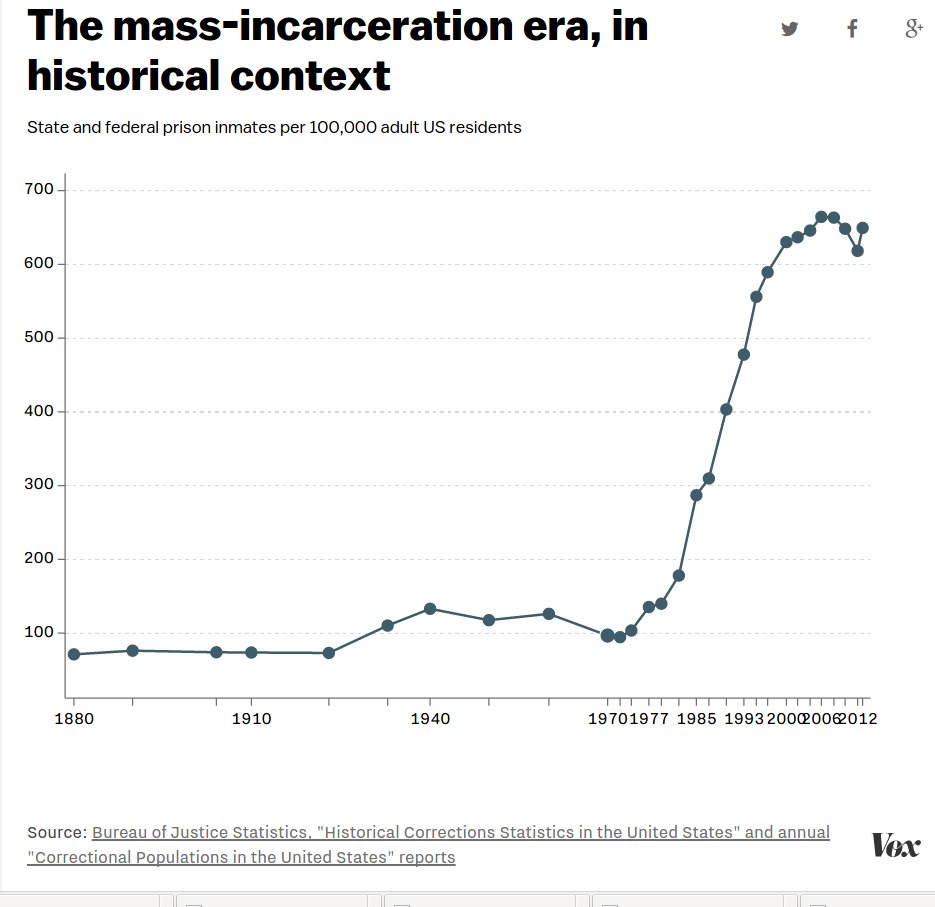
The hockey-stick from hell: US incarceration per 100,000 people, 1890-today

by Cory Doctorow
Brindle

obviously they caught all the criminals and put them in jail so there is no crime now...

thumb82

Vox parsed out the Bureau of Justice Statistics' numbers on incarceration in prisons (excluding jails) and produced this ghastly visualization tracking the transformaiton of America into the country with the highest rate of incarceration in the history of the world. (more…)

12 Oct 17:57

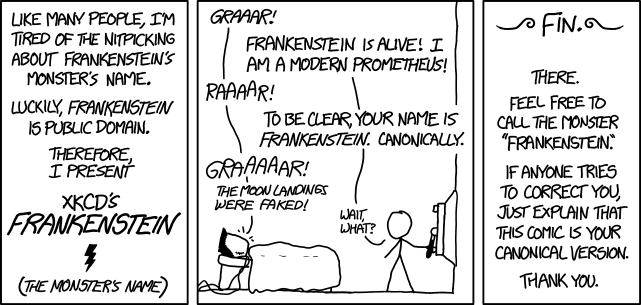
Frankenstein

Brindle

FTFY...

"Wait, so in this version is Frankenstein also the doctor's name?" "No, he's just 'The Doctor'."
09 Oct 21:44

What Do Yoga and APIs Have in Common? Neither Are Copyrightable

by Michael Barclay

Yesterday, the U.S. Court of Appeals for the Ninth Circuit issued a significant decision rejecting an absurd copyright claim in yoga poses. The decision is pretty entertaining, but its implications are important for technologists as well as yogis.

That’s because the opinion offers a close analysis of one of the crucial limits of copyright: Section 102(b) of the Copyright Act, which forbids protection of ideas, processes, systems, methods of operation, and similar concepts. Relying on Section 102(b), the court concluded that a “Sequence” of 26 yoga poses and two breathing exercises, performed in a particular order, was not subject to copyright protection. Bikram Choudhury had sued a competitor who also used the same Sequence. Simply put, Choudhury was claiming copyright in an idea or process for improving one’s health by practicing certain yoga poses in a specific order.

Writing for the court, Judge Wardlaw first observed that the purpose of copyright is to “promote the Progress of Science and useful Arts,” so that “copyright assures authors the right to their original expression, but encourages others to build freely upon the ideas and information conveyed by a work.” Copyright thus recognizes a “vital distinction” between ideas and expression, so “the copyright for a work describing how to perform a process does not extend to the process itself.”

In this case, Choudhury himself described his Sequence as a “system” or “method” to use yoga to optimize the body’s health and function. The “system” used 26 yoga poses in a particular arrangement as a healing art. Given that, Judge Wardlaw had little difficulty concluding that the idea/expression dichotomy, codified in Section 102(b), precluded copyright protection of the sequence.

Significantly, the Ninth Circuit stated that it made “no difference that similar results could be achieved through a different organization of yoga poses and breathing exercises.” Choudhury argued that he could have chosen hundreds of different yoga postures, with “countless” arrangements of those postures. Judge Wardlaw rejected that argument, holding that “the possibility of attaining a particular end through multiple different methods does not render the uncopyrightable a proper subject of copyright.”

That analysis matters for software, because it suggests that a recent computer copyright opinion by the U.S. Court of Appeals for the Federal Circuit, Oracle v. Google, completely misread the Copyright Act. In that case, Oracle accused Google of infringing 37 “packages” of the Java programming language. The packages included specifications for part of the Java Application Programming Interface (API). APIs enable computer programs to communicate with each other, or allow a program to communicate with a human being.

The Federal Circuit used different reasoning to achieve the opposite result from yesterday’s Ninth Circuit opinion. Specifically, the Federal Circuit held that because Oracle had “unlimited options” and “alternative expressions” of how to write its Java packages, Oracle’s particular choice was copyrightable expression—the exact opposite of what the Ninth Circuit held.

Appeals courts disagree with each other all the time. But in this case, that disagreement shouldn’t exist. The Oracle v. Google appeal went to the Federal Circuit because of a procedural quirk—that court hears patent appeals, and Oracle had sued on a patent claim in the district court. But where the appeal is over non-patent issues, the Federal Circuit is supposed to apply Ninth Circuit copyright law, since the case started out in a Ninth Circuit district court.

Yesterday’s opinion makes clear, as we’ve argued before, that Oracle’s claim would have failed under Ninth Circuit law. Perhaps the only meaningful difference between Choudhury’s 26 yoga poses and Oracle’s 37 Java packages is that the latter involved a functional computer program. But that difference even more strongly shows that the Federal Circuit got it wrong. There are dangerous implications of treating computer APIs as copyrightable, including negative impacts on interoperability and innovation. 

The Federal Circuit’s decision has been harshly criticized for its misunderstanding of both computer science and copyright law. Now that the Ninth Circuit has explained (again) how Section 102(b) works, future courts will hopefully ignore the Federal Circuit’s bad decision.

Related Cases: 

Share this: Share on Twitter Share on Facebook Share on Google+ Share on Diaspora  ||  Join EFF
08 Oct 21:37

Happy Birthday And The Problem With The Copyright Office's 'Orphan Works' Plan

by Mike Masnick
Brindle

The person hosting the video in this reminds me of Vitak...

A few weeks ago, we wrote about the big ruling by Judge George King in a district court in California that Warner/Chappell does not hold a valid copyright in the song "Happy Birthday." The press ran with the story, with nearly all of the coverage falsely stating that the judge had declared Happy Birthday to be in the public domain. As we noted in our post, however, that was not the case. While the plaintiffs had urged just such a finding, Judge King noted that there were issues related to this that a jury would need to answer, and he would not go that far. Instead, he merely stated that Warner did not hold a valid copyright. Many people assume that this is good enough. The likelihood of some third party magically showing up after all of these years and not just claiming the copyright, but having enough evidence to prove it seems very slim. Glenn Fleishman has done a nice job writing up a detailed explanation of this copyright mess for Fast Company, in which he notes the "uncertainty is maddening."

It's worse than that. As we noted in our original post, technically, this makes "Happy Birthday" an orphan work -- i.e., a work where the exact copyright status or owner is "unknown." Orphan works have been a big problem that the Copyright Office has been studying for some time. However, the solution proposed by the Copyright Office is ridiculous, and the case of Happy Birthday should demonstrate pretty simply why the proposal is broken.

The plan says that anyone who wants to make use of an orphaned work would have to meet six criteria to avoid possible liability:
Users must: (1) if sued for infringement, prove to the court by a preponderance of the evidence that they performed a good faith, qualifying search to locate and identify the owner of the infringed copyright before the use of the work began; (2) file a Notice of Use with the Copyright Office; (3) provide attribution to the legal owner of the copyright, if reasonable under the circumstances; (4) include a to-be-determined "orphan works" symbol with any public distribution, display, or performance of the work; (5) assert eligibility for such limitations in the initial pleading in any civil action involving the infringed work; and (6) state with particularity the basis for eligibility for the limitations during initial discovery disclosures.
Now, let's look at this in terms of Happy Birthday. If you want to sing Happy Birthday, you would first have to conduct and document a "good faith, qualifying search to locate and identify the owner" of Happy Birthday before you sang it. You would then have to file a "notice of use" with the Copyright Office, telling the Copyright Office about this use of an orphaned work. Now, obviously, for most folks singing "happy birthday" at a birthday party, they're not going to do that -- and that's fine. After all, they ignored the copyright when many believed Warner/Chappell held a valid copyright.

But -- and here's the important point -- all of the "professional" situations where the song was used would almost certainly have to go through this process. Films that used the song wouldn't be able to get "errors and omissions" (E&O) insurance without first proving they made it through this process (and you need E&O insurance to ever get a movie released). Restaurants that wanted to sing Happy Birthday rather than their made up song would need to do the same thing. And they'd all likely have to hire lawyers in order to properly document the "search" and to file the notice with the Copyright Office. And very few people are going to want to go through that process. It may be slightly better than paying thousands of dollars to Warner/Chappell, but not much.

How is this solution possibly a "good compromise" on the issue of orphan works? How does adding such a burden, just so someone can sing Happy Birthday, possibly make sense?

Once again, the "problem" of orphan works is a self-made problem, created by copyright laws that automatically grant copyright to all new fixed works, rather than requiring registration in the first place. If it required registration, there would be some sort of record and paper trail of who owned the copyright and when it was valid. But in a world where everything gets copyright protection, we get a world with millions upon millions of orphaned works -- and if anyone who ever wanted to do anything with it had to go through the convoluted mess just to do something like sing Happy Birthday, the "answer" is no answer at all. It's just making a bad problem worse.

The way to fix orphan works is not to increase the burden, it's to fix a broken copyright system, and to require registration in the first place.

Bonus content: This doesn't fit directly into this post about orphan works, but this video by Vi Hart about the copyright on Happy Birthday is totally worth watching, presenting the issue from the perspective of someone knowledgeable about music theory, rather than copyright law, and showing yet another way in which the idea that Happy Birthday ever deserved copyright is a ridiculous idea.

Permalink | Comments | Email This Story


08 Oct 17:27

Instagram Account Collects Google Map Pictures Of The Saddest Named Places On Earth

sad-places-2.jpg Sad Topographies is an Instagram account that posts pictures from Google Maps featuring the saddest named places on earth. I feel like I've lived in all of these places. Currently though I feel like I live smack dab between a rock and a red-hot hard place. "Why is it red-hot?" Because it's the devil's boner. Keep going for a bunch more, although I'd definitely recommend wearing full chain-mail if you have any intention of climbing Bloody Dick Peak without incident.sad-places-1.jpg sad-places-3.jpg sad-places-4.jpg sad-places-5.jpg sad-named-places-1.jpg sad-named-places-2.jpg sad-named-places-3.jpg sad-named-places-4.jpg sad-named-places-5.jpg sad-named-places-6.jpg sad-named-places-7.jpg sad-named-places-9.jpg sad-named-places-8.jpg Thanks to David D, who only wants to visit happy places like Sunshine Island and Butterfly Cove.
03 Oct 14:15

Homeland Security Detains Stockton Mayor, Forces Him To Hand Over His Passwords

by Mike Masnick
Brindle

umm...

Anthony Silva, the mayor of Stockton, California, recently went to China for a mayor's conference. On his return to San Francisco airport he was detained by Homeland Security, and then had his two laptops and his mobile phone confiscated. They refused to show him any sort of warrant (of course) and then refused to let him leave until he agreed to hand over his password:
“A few minutes later, DHS agents confiscated all my electronic devices including my personal cell phone. Unfortunately, they were not willing or able to produce a search warrant or any court documents suggesting they had a legal right to take my property. In addition, they were persistent about requiring my passwords for all devices,” Silva said.

Silva was not allowed to leave the airport until he gave his passwords to the agents, which the mayor’s personal attorney, Mark Reichel, claimed is illegal.

The mayor said the agents told him confiscating property from travelers at the airport was “in fact routine and not unusual,” and promised to return the items within a few days.
To some extent what the DHS told him is true. It's not that unusual, but it's not that common either. But forcing him to turn over the passwords is unusual, and not standard practice. Besides, courts have been growing increasingly less impressed with Homeland Security's willingness to ignore the Constitution at the border.

The feds, of course, refuse to say anything, saying they cannot confirm or deny anything. Silva first claimed that he's "happy to cooperate and comply with these inspection procedures if they are in fact routine and legal," but pretty quickly notes how ridiculous all of this is:
"I think the American people should be extremely concerned about their personal rights and privacy," he said. "As I was being searched at the airport, there was a Latino couple to my left, and an Asian couple to my right also being aggressively searched. I briefly had to remind myself that this was not North Korea or Nazi Germany. This is the land of the Free."
So they keep telling us.

Permalink | Comments | Email This Story


02 Oct 20:20

Cable Company Totally Unsure What Neighborhoods It Serves, Wants $117,000 For Broadband Service

by Karl Bode
Brindle

Its like that time they told us we'd have verizon in the building we moved the business in to... doh

Here's a tip if you're looking to move or building a new house: get your ISP to write you a letter confirming that they service your new address. While you're at it, get three copies of it from three different executives, have it notarized, and force the ISP to swear a blood oath, because even then you may find yourself without service at your new address. As we've noted a few times, users often assume ISPs actually know what neighborhoods they service, only to later have a Kafka-esque introduction to the U.S. broadband industry's blistering incompetence and dismal customer service.

The latest example comes via a Wisconsin resident who planned to build a new home on a lot both Frontier Communications and Charter Communcations said they were able to service. To be sure, the user double and triple-checked with Charter before beginning the build process:
"Despite not being in a densely populated area, Marshall said the lot was advertised as "cable-ready." Before committing to the purchase, Marshall said, “I looked on Charter’s website, and I typed in the address of the lot, and it said, ‘yep, we can service you.’" Just to make sure, Marshall said he looked up the addresses of neighboring homes and got the same answer. Just to make extra sure, Marshall said he called Charter “and gave them the address, and they said, ‘yup we can service that lot.’" Construction on the house began in November 2014 and finished in June."
The user did everything right short of getting the promise in writing. And guess what? Charter wasn't able to service that lot. Worse, after admitting error about its own network coverage, the cable operator informed the user it would cost him a whopping $117,000 to provide service:
""Once my house was built, I called [Charter] to set up service, and that’s when they told me they made a mistake. I was too far away from their network," Marshall said. In June, a Charter construction coordinator told him he’d have to pay $117,000 to cover all labor, materials, and permitting for a network extension to serve the home. Marshall would have to pay the entire $117,000 up front before Charter would begin construction, and the price would not go down even if other homeowners signed up for service.
The user got the same runaround from Frontier Communications, who originally promised it was able to deliver 24 Mbps to that address, only to later admit it could only provide around 3 Mbps -- at best (and which will likely be force-bundled with an expensive legacy voice landline the user won't want). The kicker is that both of these companies have lobbied to erect state barriers to community broadband, which is often an organic response to this kind of dismal coverage and customer service. So again, this is a market where you've got lumbering ISPs with absolutely no incentive to expand or improve service, literally writing state law ensuring that nobody can do anything about it.

Fortunately the FCC has finally started to attack these state laws so communities can improve their own broadband in cases of market failure, but it's a contentious fight with states busy pretending that it's their god-given right to erect duopoly-protectionist laws written by AT&T and friends. Meanwhile, our national broadband map, which cost $300 million to build, often doesn't help matters. Plug your name into the government mapping apparatus, and it will often not only hallucinate broadband providers in your area, but it will utterly fabricate available speeds. That's because it relies largely on the word of ISPs eager to pretend that the U.S. broadband industry is awash in competition, with much of the data never fact checked.

And good news, everyone! Charter Communications is on the cusp of buying both Time Warner Cable and Bright House Networks (in a $79 billion merger), and Frontier is busy gobbling up AT&T and Verizon's unwanted DSL territories. In other words, there's a pretty good chance this exact brand of incompetence could be coming to your neighborhood very soon.

So if you're moving to a new area and an ISP claims they offer broadband, get it in writing. Wander the neighborhood asking neighbors what services they can get. Get sixteen company executives on tape insisting they provide service. Because most U.S. ISPs not only don't know the physical footprint of their network, it's abundantly clear they have absolutely no interest in accurate data, customer service, or being accountable for false promises. When you're the only game in town, you quite frankly don't have to give a damn. And when you're the one buying and writing state telecom law, it's remarkably easy to keep it that way.

Permalink | Comments | Email This Story


02 Oct 15:08

Chip And PIN Meets Facial Recognition: Chipping Away At Privacy, Pinning You Down In A Database

by Glyn Moody
Brindle

god damnit. This could be what actually makes me go cash-only...

As part of President Obama's BuySecure initiative, US merchants and the public are being encouraged to adopt the Chip and PIN technology for credit, debit, and other payment cards. As the announcement in October last year noted, these Chip and PIN cards have been used for some years in other parts of the world, notably Europe and Canada. For all the technology's vaunted security, there are inevitably still weaknesses that can be exploited, as with any system. That was true five years ago, and it's still true now, as shown by this story on the BBC Web site about one company's idea for reducing Chip and PIN fraud:

One of the biggest payments processing companies has revealed it is developing a chip-and-pin terminal that includes facial recognition technology.

Worldpay's prototype automatically takes a photo of a shop customer's face the first time they use it and then references the image to verify their identity on subsequent transactions.
The company admits that the system is unlikely to be perfect:
Worldpay is not suggesting that shoppers be blocked from making payments if its computer system failed to make a match.

Rather, it suggests that tills would display an "authorisation needed" alert, prompting shop staff to request an additional ID, such as a driving licence.
It's only an experimental idea at present, but Worldpay says it could roll it out to the 400,000 retailers that use its system within five years if there's sufficient interest. That would obviously create rather a large collection of facial biometrics, which raises questions of how they would be stored. But don't worry, Worldpay has got that sorted:
The firm says it would store the captured images in a "secure" central database.
Well, that shouldn't be a problem, then -- provided you remember to change your face when that database gets broken into….

Follow me @glynmoody on Twitter or identi.ca, and +glynmoody on Google+


Permalink | Comments | Email This Story


02 Oct 15:06

Here’s Amazon’s stupid excuse for banning sales of Chromecast and Nexus Player in their store

by Quentyn Kennemer
Brindle

anticompetitive much?

Dear Amazon. My name is Quentyn, and I’ve been an Amazon Prime subscriber for nearly 5 years. I love your products, and I love your store. Free 2-day shipping is awesome, and I love how easy it is to buy movies on Amazon Instant Video. I read great novels on my 2nd Gen Kindle Paperwhite every single day. Hell, I’ll even have to start going to Amazon for baby stuff because it’s been more convenient to get nursing items for my newly-born nephew online than it is at brick and mortar retail.

Chromecast featured 2

All that said, this sort of nonsense is not cool. For those who aren’t sure what I’m talking about, Amazon has issued memos to merchants warning them that they will soon be unable to sell Chromecast (old and new), the Nexus Player and Apple TV on the mega-shop. They’ll stop letting you list new products now, and the existing listings will all disappear by the end of the month.

Their reasoning might sound sensible to a total moron:

Over the last three years, Prime Video has become an important part of Prime. It’s important that the streaming media players we sell interact well with Prime Video in order to avoid customer confusion.

But we aren’t buying it. So, instead of working with Apple and Google to get Amazon Instant Video loaded up on their respective products, you’ll instead opt to ban their products from the store so as to not confuse consumers? What kind of idiots do you take us for?

Chromecast 2nd Gen 2015 DSC00135

Here’s the full drivel being dished out to Amazon sellers in email communication:

Dear Seller,

Over the last three years, Prime Video has become an important part of Prime. It’s important that the streaming media players we sell interact well with Prime Video in order to avoid customer confusion. Therefore, Amazon has implemented listing restrictions for the followings products:

Apple TV, Chromecast, Nexus Player

Effective immediately, you may no longer create new listings for these products, and as of 10/29/15, any existing listings for these products will be removed. There will be no adverse impact on your seller account for the removal, but we request that you refrain from relisting removed products.

Roku, XBOX, and PlayStation all interact well with Prime Video and are not affected by this change.

Thank you for selling on Amazon.

Sincerely, Amazon Services

Notice how they neglect to include the fact that it’s their fault that Amazon Instant Video isn’t supported on these products. They’d rather you believe that it’s an issue out of their hands, but we all know that isn’t true.

It’s especially ridiculous to try and paint Google and the Chromecast in that light considering Google invites literally everyone (no really, the SDK is public) to support Chromecast in their apps. Apple, to our knowledge, also doesn’t mind competing video services having a home on their respective platform.

You’ve shown that you aren’t above putting Amazon Instant Video on other platforms, even if you do so reluctantly. It’s been available for the iPad for who knows how long, and it took forever to get it over here on Android. And don’t think we’ve forgotten about the fact that your app was installed and working perfectly fine on many users’ Android TV boxes before you decided to flip a switch and render it useless.

amazon instant video android tv

Clearly there are other factors at play as to why you’re making these sorts of random and seemingly pointless moves. Otherwise, why aren’t you banning all the countless other multimedia players which don’t support Amazon Instant Video being pushed through your warehouse?

Our first guess will always be related to financial incentive, but we obviously can’t say that for certain without sitting in on private meetings. It probably sounds like a great idea when you talk about it in your big board rooms, but if you seriously think yanking competing products out of your stores will help improve the sales of Fire TV then you’ve already failed.

amazon fire tv and remote

You truly want your product to succeed? Make it innovative, fresh and cost effective. Advertise it, and advertise it well. The sad thing is you actually tick all of those boxes quite nicely for the Fire TV line. But for one reason or another, a lot of consumers would rather get their hands on a Chromecast or Apple TV, and if you’re going to flat-out refuse to sell it to them and dismiss it with a bullsh*t excuse like the one you provided above I’m sure they’ll find plenty other places to complete their goal.

You were once loved, revered and celebrated for being the most pro-consumer online retailer there is, but in your quest to be everything to everyone you’re losing sight of what made you great in the first place. There’s only so much more folks will take before they realize there’s plenty of business to be done elsewhere without having to be manipulated for the sake of raking in a few more pennies.

02 Oct 13:22

10,000 companies now use Android for Work

by Rob Jackson
Brindle

whoa

It wasn’t long ago that Google announced Android for Work, an enterprise program that allows companies to offer their employees one single device for both work and play. Since then they’ve been steadily adding partners and today – at their Nexus event – the company announced that over 10,000 US companies are now enrolled and using the Android for Work program.

These companies include such important institutions as the US Army, World Bank, and Guardian Life. Sounds to be like Blackberry’s last ditch effort to corner the security market is a fleeting dream.

Screen Shot 2015-09-29 at 12.11.53 PM

Is your company enrolled in Android for Work? If not, Google has put together a dedicated website for Android lovers to send to their IT departments. Put on your lawyer pants and let the convincing begin.

01 Oct 23:09

This is why the Nexus 6P and 5X don’t have Qi Wireless Charging

by Rob Jackson
Brindle

hrm...

It’s nearly impossible to design a tech product that won’t generate some reason for complaints from some cross-section of consumers. Make the world’s thinnest device and people complain about specs. Make the most powerful device on the planet with amazing battery life and people complain its too bulky. Everything is a balance, but one particular omission from the newly announced  Nexus 6P and Nexus 5X are drawing a lot of complaints: there is no Wireless Charging.

Now we know why Google didn’t include Qi Wireless charging in these new devices:

We added Qi wireless charging starting with N4 because plugging in USB micro B was such a hassle! (Which way is up!?) With this year’s Nexii, we support USB Type-C which has a reversible connector so there’s no more guessing. AND it charges incredibly swiftly: 1% to 100% in 97 mins on the 6P for example (the first ~45 mins of charging is especially fast). Meanwhile, wireless charging adds z (thickness). So, ease of plugging in + fast charging + optimizing for thinness made us double down on Type-C instead of wireless!

IKEA Qi wireless charging furniture 4

The above quote is from a Reddit AMA featuring Hiroshi Lockheimer, part of the Google Nexus Team.

We won’t agree or disagree with the question, because it all comes down to personal preference, and that’s part of Android’s beauty- if you don’t like it there are dozens of other amazing Android phones from which to choose. We will say, however, that we hope the next generation of wireless charging comes soon.

What are your thoughts on the lack of Qi charging on the Nexus 6P and 5X?

Take Our Poll
30 Sep 18:48

Man Gets $35k Settlement After Arrest For Posting 'Fuck The Fucking Cops' On Department Facebook Page

by Timothy Geigner
Brindle

Newsflash, it isn't illegal to be a jerk in the US (yet...)

It's becoming quite a period of time for the profane when it comes to interacting with law enforcement, apparently. We had just recently discussed one man's victory in federal court over a town that didn't appreciate him writing "Fuck your shitty town bitches" on a speeding ticket he'd mailed in. Well, back in 2012, another delightful human, Thomas Smith, was apparently arrested for being an ass on the Arena, Wisconsin, Facebook page.

In July 2012, the Village of Arena in Wisconsin posted a note on its Facebook page announcing a slew of arrests. Smith then posted "Fuck ths fucking cops they ant shit but fucking racist basturds an fucking all of y'all who is racist," as well as "Fuck them nigers bitchs wat you got on us not a dam thing so fuck off dicks." He was arrested for disorderly conduct and unlawful use of a computer and telephone. He was originally convicted by a local jury, but that decision was overturned by the Wisconsin Court of Appeals, which ruled Smith's First Amendment rights were violated.
Um, yeah, memo to the police in Arena: being a jerk to police, calling them names, and using deplorable language is no more a violation of the law than blatantly mispelling the insults themselves and using the kind of grammar that I actually kind of wish would get people thrown in the clink. Likely the jury was presented with what Smith had written and decided he was a jerk and ruled against him. That doesn't change the fact that the arrest and conviction were both unconstitutional, of course. And, after Smith and his attorney sued the village, the village agreed, settling with Smith for $35,000.
Smith and his attorney, Tom Aquino, sued the village for an unspecified amount. Wednesday, the village settled with him, according to Aquino.

"We have always believed that the defendant’s liability was clear. Federal and state courts have routinely held that the right to free speech is not limited to polite speech alone," Aquino wrote in a blog post. "In our country, we are entitled to criticize our government with passion. The use of some four-letter words in the course of doing so is never a crime."
It can't be easy to be a good cop and have to endure a profane tirade on a public town Facebook page, but that doesn't excuse the violation of basic civil rights in retaliation. And Smith's speech, while lacking poetry and panache, is certainly protected. It's about time law enforcement realizes that profanity is still free speech so that they can stop costing municipalities this kind of settlement money.

Permalink | Comments | Email This Story


30 Sep 12:37

That Big Security Fix for Credit Cards Won’t Stop Fraud

by Kim Zetter
Brindle

That is because it isn't about stopping fraud, it is about shifting liability. CC companies are tired of paying out so now they will make vendors do it

That Big Security Fix for Credit Cards Won’t Stop Fraud

The new chip cards and readers won't stop card fraud but will simply shift it to a different area.

The post That Big Security Fix for Credit Cards Won’t Stop Fraud appeared first on WIRED.


28 Sep 20:04

71% Of Americans Oppose Civil Asset Forfeiture. Too Bad Their Representatives Don't Care.

by Tim Cushing

According to a YouGov/Huffington Post poll, 71% of Americans are opposed to civil asset forfeiture.


Too bad their opinion doesn't matter. This is part of the problem.


Most Americans haven't even heard of civil asset forfeiture. This is why the programs have run unchallenged for so many years. An uninformed electorate isn't a vehicle for change. This issue is still a long way away from critical mass.

Without critical mass, there's little chance those who profit from it will lose their power over state and federal legislatures. Forfeiture programs are under more scrutiny these days, but attempts to roll back these powers, or introduce conviction requirements, have been met with resistance from law enforcement agencies and police unions -- entities whose opinions are generally respected far more than the public's.

California's attempt to institute a conviction requirement met with pushback from a unified front of law enforcement groups. Despite nearly unanimous support by legislators, the bill didn't survive the law enforcement lobby's last-minute blitz. They also had assistance from the Department of Justice, which pointed out how much money agencies would be giving up by effectively cutting off their connection with federal agencies if the bill was passed.

Meanwhile, Michigan lawmakers have gathered unanimous support of asset forfeiture reform, but are not introducing a conviction requirement. This will make the bill more palatable for law enforcement, as it only raises the bar from a "preponderance of evidence" to "clear and convincing evidence" that seized property is linked to criminal activity. It would also make it a little easier for citizens to fight for the return of seized property if not charged with any crimes.

A reform bill introduced in Texas died an unceremonious death back in April when the committee chairman refused to move the legislation along until more concessions to law enforcement interests were made. The legislator who introduced the bill refused to budge and the bill was killed off.

Virginia's attempt to add a conviction requirement was similarly killed off by a legislative committee, despite nearly universal support from other legislators. The Senate Finance Committe claimed the State Crime Commission needed to examine the issue first, which will buy those opposed to reform at least another year to shore up their defenses.

Wyoming's governor vetoed an asset forfeiture reform bill, claiming the seizure of property without securing convictions was "important" and "right."

On the bright side, Montana and New Mexico have both enacted forfeiture reform. Montana introduced a conviction requirement and New Mexico went even further, eliminating civil asset forfeiture altogether. (Property can only be seized in criminal cases.)

But as for the rest of the nation, there has been little movement on asset forfeiture reform. Utah -- a state that overhauled its forfeiture system 15 years ago -- rolled those reforms back just as national scrutiny was increasing. A broader movement for reform seems unlikely when less than a third of the nation is even aware of these programs.

Even if awareness increases, legislators at the top end of the food chain are more interested in appeasing law enforcement agencies and prosecutors than pushing through reform bills that arrive on their desks with nearly unanimous support. Informing the electorate may put better people in office, but it won't change the mindset that almost always believes law enforcement knows best.

This problem is compounded when the law enforcement lobby starts complaining about the budgetary shortfalls reform efforts will create. If they aren't allowed to seize anything for any reason, they won't be able to buy the things they want or offset the costs generated by their seizure efforts. Any state strapped for cash -- and that's most of them -- will be hesitant to pick up the tab for "lost" revenue.

It all adds up to little forward motion. The public may be displeased with the status quo, but the status quo has paid off so much for so long, those with the power to motivate politicians won't be in any hurry to give up their forfeiture programs.

Permalink | Comments | Email This Story