Shared posts

21 Oct 16:54

Former CIA Employee Sues Agency Over Its Refusal To Provide Documents In Electronic Form

by Tim Cushing

The CIA is still causing problems for Jeffrey Scudder. Scudder used to work for the CIA. He was forced out of the agency after making a FOIA request for "historical documents of long-dormant conflicts and operations" while still employed there. Perhaps the agency thought only citizens outside of the agency should be making FOIA requests. Or maybe it thought Scudder was engaged in a particularly labyrinthine plot to exfiltrate declassified documents out of the agency. Whatever its thought process, it resulted in an FBI raid of Scudder's house, the seizure of his electronics, and the end of his career.

Unfortunately for the CIA, this has given Scudder more time to file FOIA requests and sue the agency when it responds in increasingly ridiculous ways. Scudder has already tangled with the CIA over its refusal to join the 20th century (never mind the current one) when turning over responsive documents. His last major request to the agency asked for "softcopy" -- i.e., not paper -- copies of 419 articles from the CIA's "Studies in Intelligence."

The CIA told him it had no way of providing him documents in the format he asked for. Instead, it claimed it only had one way to comply with the request: the stupidest, most circuitous way.

The defendant [CIA] avers that if it were ordered to honor the plaintiff's [FOIA] request [for soft copy records], it would have to print the existing electronic documents to paper and then rescan them into electronic documents so that they may be reproduced and released on removable media..."

Scudder called this an "administrative gimmick" -- something meant to discourage requesters and generate extra FOIA fees. The judge presiding over the case was less kind. She called it "Rube Goldbergian" while pointing out that FOIA law does allow requests to be turned down if they're too burdensome, but that's not an invitation to agencies to turn normal requests into overly burdensome ones by adding several layers of administrative busywork.

It's this case that's cited in Scudder's latest lawsuit against the CIA -- again hoping to force the agency to deliver documents digitally, rather than via a method lying somewhere between the hellish bureaucratic redundancy of Terry Gilliam's "Brazil" and a shoddy steampunk plot point. (To be fair, it could be institutional. The Defense Department itself once turned down a request from MuckRock because it couldn't find any money in its budget to repair/replace the single fax machine it used to receive FOIA requests.) From the filing [PDF] (via The FOIA Project)

Mr. Scudder, joined by three esteemed members of the academic community, now seeks through this new FOIA litigation to resolve once and for all whether CIA’s electronic production policy inextricably conflicts with the agency’s obligations under FOIA. A new FOIA request – outlined below – seeking electronic copies of historical CIA records is ripe for adjudication by this Court. Through this litigation, Mr. Scudder and his colleagues seek to bring CIA’s refusal to adhere to the letter – to say nothing of the spirit – of FOIA to an end.

This is pretty much more of the same for Scudder v. CIA, only this time Scudder brought colleagues: Ken Osgood, Hugh Wilford, and Mark Stout. He's also getting out ahead of the CIA's eventual denials and obtuse claims of technical ineptitude. He's forcing the issue by forcing the CIA to respond well ahead of its usual lackadaisical FOIA response schedule. Even better, he's brought another federal judge's not-at-all-impressed opinion of the CIA's reluctance to familiarize itself with peedee effs and ceedee romms… in 2016.

Hopefully, the court will prevent the CIA from continuing to blow taxpayer dollars on reams of paper, black toner cartridges, and snail mail postage.


Permalink | Comments | Email This Story
21 Oct 16:31

China's Manufacturers Now Producing Copies Before Original Products Are Even Launched

by Glyn Moody

Techdirt has written a number of articles tracking how China is moving beyond its traditional counterfeit imitation culture to one of collaborative innovation, as exemplified by "gongkai". An article on the Quartz site provides a useful update on this world, concentrating on developments in Shenzhen, generally regarded as China's hardware equivalent of Silicon Valley. Things have now progressed from simply copying top-selling products, to spotting future winners on the Web:

Thanks to the internet, factories and designers looking for the next hit product can easily turn to Kickstarter, Amazon, or Taobao to see what gadgets are hot.
The article describes how nimble Chinese operations even produce their own versions before the original is released. For example, Yekutiel Sherman, an Israeli entrepreneur, came up with a design for a smartphone case that unfolds into a selfie stick. After months of research and design, here's what happened:
one week after his product hit Kickstarter in December 2015, Sherman was shocked to see it for sale on AliExpress -- Alibaba's English-language wholesale site. Vendors across China were selling identical smartphone case selfie-sticks, using the same design Sherman came up with himself. Some of them were selling for as low as $10 a piece, well below Sherman's expected retail price of £39 ($47.41). Amazingly, some of these vendors stole the name of Sherman's product -- Stikbox
As the article goes on to describe, enforcing traditional monopolies like patents is so difficult as to be pointless, thanks to the highly-fragmented and fluid nature of Shenzhen's ecosystem. Instead:
Businesses are now forced to come to terms with this new reality. It’s not enough to create a product with a groundbreaking design or features, like a smartphone case that turns into a selfie stick. Companies dealing in the creation of physical goods now must make products that are impossible to copy exactly from the get go, by focusing on a special feature they can protect, or creating a coveted brand name consumers will pay more for.
In other words, the competitive environment in Shenzhen is driving the uptake of approaches that Techdirt has been advocating for years. That's good for customers, who enjoy a greater choice and more rapid innovation as a result, but this shift can be good for companies too, as the Quartz article notes:
Joffe, the venture capital investor, argues that some companies might even benefit from copycatting, as it can bring more awareness to the product itself. "If you have more customers buying the fake product then it creates more awareness for the real product, and it becomes an aspirational thing. At some point they might be able to afford the real thing."
It's well worth reading the whole article for its description of the Shenzhen scene, even if regular Techdirt readers will find the main ideas there extremely familiar.

Follow me @glynmoody on Twitter or identi.ca, and +glynmoody on Google+


Permalink | Comments | Email This Story
21 Oct 13:35

Skittles Photographer Actually Sues Trump Campaign Over Infringement

by Mike Masnick
A few weeks ago, we wrote about how David Kittos was threatening the Trump campaign with a copyright infringement lawsuit after Donald Trump Jr. tweeted out a really dumb image involving a bowl of Skittles and a ridiculous statement about refugees.
There was some irony there, in that Kittos himself was a refugee from Turkish occupation in Cyprus and escaped to the UK. His photo is still up on Flickr, and does say that it's "all rights reserved." At the time, Kittos only hinted at a lawsuit, but also said "I don't know if I have the patience" to follow through on a lawsuit. We did notice that a week or so later, Twitter had removed the image after receiving a DMCA takedown notice from Kittos.
So that was at least some indication that Kittos may have found some lawyers to help him. And now those lawyers have actually sued the Trump campaign for copyright infringement. You can read the whole lawsuit, if you'd like. He's suing the Trump campaign, along with Donald Trump Sr. & Jr. and Mike Pence personally.

Some interesting points about the lawsuit. Kittos did register the image... but not until after all this went down. The Copyright Office lists the registration date as October 3rd of this year:
That's why the lawsuit asks for "actual damages" rather than statutory damages (you can only ask for statutory damages if the work was registered prior to infringement). But good luck showing any actual damages.

The bigger issue, though, is that this is almost certainly a bogus copyright infringement case. The Trump campaign has a pretty strong fair use argument, helped along by Kittos himself originally admitting that "I have never put this image up for sale" and "I was just experimenting with something called off-camera flash." There goes prong four of the fair use test, the "effect on the market," when the plaintiff has already admitted there never was a market. Also, the lawsuit itself makes it pretty clear that the lawsuit isn't really about copyright infringement, but about Kittos being upset about the message of the Trump meme.

I get that. I mean, I agree that the tweet is stupid and ignorant. But that's not the role of copyright. And yet, throughout the lawsuit, Kittos' lawyer keeps pointing to the "offensive" nature of the content as the reason that it's infringement. But that does not matter at all for a copyright infringement claim.
The unauthorized use of the Photograph is reprehensibly offensive to Plaintiff as he is a refugee of the Republic of Cyprus who was forced to flee his home at the age of six years old.
That's an interesting news hook, but it has nothing to do with copyright.

Also, given that this is someone trying to silence a political campaign, it seems fairly obvious that this is actually a SLAPP lawsuit, rather than a legitimate copyright lawsuit. Of course, that may explain why the lawsuit was brought in Illinois (remember, Kittos is in the UK, and the Trump campaign is certainly not based in Illinois). Illinois has an anti-SLAPP law, but it's been interpreted narrowly, and it's unclear if it would be allowed here -- though it's possible. The key case, Sandholm v. Kuecker, does include a test on "the plaintiff's intent in bringing the lawsuit." If it's to stifle speech or participation in government, then the anti-SLAPP law may apply. So Kittos may actually end up in trouble himself for filing this lawsuit. Notably, if the Trump campaign argues that this is a SLAPP suit and it wins, Kittos himself may be responsible for Trump's legal fees.

In other words, while I can understand why Kittos may have filed this lawsuit, it seems like someone may have given him some bad advice, and it may cost him.

Of course, he may be hoping that the Trump campaign just pays him off to go away. After all, the lawsuit mentions another copyright lawsuit filed against the campaign earlier this year, over a bald eagle photo -- and in that one, the Trump campaign settled the case, though no details were given on how it was settled.

Permalink | Comments | Email This Story
20 Oct 22:12

Come On Elon! Tesla Stupidly Bans Owners From Using Self-Driving Teslas For Uber

by Mike Masnick
We've talked a lot about the end of ownership society, in which companies are increasingly using copyright and other laws to effectively end ownership -- where they put in place restrictions on the things you thought you bought. This is bad for a whole variety of reasons, and now it's especially disappointing to see that Tesla appears to be jumping on the bandwagon as well. The company is releasing its latest, much more high powered, version of autonomous self-driving car technology -- but has put in place a clause that bars Tesla owners from using the self-driving car for any competing car hailing service, like Uber or Lyft. This is not for safety/liability reasons, but because Tesla is also trying to build an Uber competitor.

We wrote about this a few months ago, and actually think it's a pretty cool idea. Part of the point is that it effectively will make Tesla ownership cheaper for those who want it, because they can lease it out for use at times when they're not using it. So your car can make money for you while you work or sleep or whatever. That's a cool idea.

But it's flat out dumb to block car owners from using the car however they want.

If Tesla wants to compete with Uber, that's great, but it should compete and offer a better deal for car owners, rather than artificially limiting what they can do. And the thing is, Elon Musk knows this. Remember, a few years ago when he famously freed up all Tesla patents into the public domain, recognizing that it was better to compete on execution rather than artificial legal limitations? So why not take that same approach with competing in car hailing services as well? Don't limit what owners can do with their cars. That's now ownership. ow they're just leasing.

Tesla's plan for a competing ride hailing service is a good idea, and I'm excited to see what the company does with it, but if it starts off by artificially blocking Tesla owners from using their cars on competing services, it makes me think that Tesla doesn't think it's own service will be very good, and therefor it needs to artificially lock Tesla owners into its own platform, rather than competing on the merits. That seems antithetical to the message that Tesla and Elon Musk have given off in the past. Hopefully Musk reconsiders this anti-consumer move and recognizes that Tesla can build such a service that can stand on its own merits without artificially restricting Tesla owners.

Permalink | Comments | Email This Story
18 Oct 12:36

Stepdad Goes To Police With Stepdaughter's Sexts, Asks Them To Intervene, Is Prosecuted For Child Porn

by Timothy Geigner

Sexting continues to be a thing. And, as we have covered various stories revolving around people sending pictures of their naughty bits to one another, much of the consternation in the public tends to be around children partaking in sexting. And I can see their point. While I tend to laugh at prudishness in general, it would probably be best for all involved if underage youngsters weren't texting each other provocative pictures of themselves with reckless abandon.

So what is a parent to do if their children are found to be doing just that? One might think that going to both the child's school and authorities to ask for help in stopping this behavior would be in order, right? Well, for one parent in Australia, doing just that landed him a conviction for child pornography and sex offender registration, even as essentially the entire legal system acknowledged that he was just trying to be a good father.

A man who found out that his 15-year-old stepdaughter was sexting her boyfriend proceeded to download the evidence to bring it to the school and the police to ask them to intervene. Oh dear, readers. You know where this is heading. Intervene they did. Now the dad has been convicted on child pornography charges and placed on the sex offender registry. This, despite the judge understanding exactly why the man, Ashan Ortell, 57, held onto the images.

"There is no suggestion of any exploitation of them by anybody," ruled Judge Jane Patrick, over in Australia, which is becoming as daffy as the United States. "You made no attempt to conceal the images. In fact, you were so concerned that you contacted the authorities about the images."

And then the judge proceeded to levy the conviction for child pornography upon Ortell. Why? Well, because Ortell made copies of the images he'd found his stepdaughter sending around on a USB stick and brought them to the school and police. The police apparently warned him to delete the images or risk prosecution, before reportedly failing to do much at all to address the behavior about which Ortell was concerned. Because of that, he kept the images, ostensibly so that he could address the behavior with other parties that might help him intervene. And that's when he was prosecuted for child pornography.

Let's be clear here: everyone agrees that Ortell did not keep the images for lewd reasons. There is a complete consensus, up to and including the judge who convicted him, that Ortell is merely a concerned parent attempting to do the right thing. Yet here we are. Legal systems routinely take intention into account with regards to charges, prosecutions, and rulings. Yet that failed to happen here, because context and nuance go right out the window when it comes to certain topics that have been overhyped in the public discourse as some kind of impending doomsday. Sexting amongst children is one of those topics.

Need more proof? The local police department has reached out to parents as a result of this whole fiasco with advice that wouldn't have helped in this case.

The ridiculous advice the Victoria police are giving to parents in the wake of this case is: Talk to your children about sexting "and encourage them not to communicate with people they don't know."

Well, okay. How would that have helped? The girl was definitely communicating with someone she did know: her boyfriend. I'm also guessing that talking to your kids about sexting is like talking to them about abstinence. A few may pay heed, but many won't.

The fact that sexualized pictures of "children" (anyone under 18 qualifies in federal child porn statues) are rampant and often consensual should somehow be reflected in the laws. Instead, low-level sex offenses are becoming the low-level drug offenses of this century: Something we overreact to in a charade of concern and, in the process, turn decent people into criminals.

Child pornography is not an issue to be taken lightly, to be sure, but making a mockery of the public's concern by convicting a well-meaning parent isn't the answer to anything at all.


Permalink | Comments | Email This Story
12 Oct 20:49

Facebook's Nudity Ban Affects All Kinds of Users

by Jillian York

Facebook’s recent censorship of the iconic AP photograph of nine year-old Kim Phúc fleeing naked from a napalm bombing, has once again brought the issue of commercial content moderation to the fore. Although Facebook has since apologized for taking the photo down from the page of Norwegian publication Aftenposten, the social media giant continues to defend the policy that allowed the takedown to happen in the first place.

The policy in question is a near-blanket ban on nudity. Although the company has carved out some exceptions to the policy—for example, for “photographs of paintings, sculptures, and other art that depicts nude figures”—and admits that their policies can “sometimes be more blunt than we would like and restrict content shared for legitimate purposes,” in practice the ban on nudity has a widespread effect on the ability of its users to exercise their freedom of expression on the platform.

In a statement, Reporters Without Borders called on Facebook to “add respect for the journalistic values of photos to these rules.” But it’s not just journalists who are affected by Facebook’s nudity ban. While it may seem particularly egregious when the policy is applied to journalistic content, its effect on ordinary users—from Aboriginal rights activists to breastfeeding moms to Danish parliamentarians who like to photograph mermaid statues—is no less damaging to the principles of free expression. If we argue that Facebook should make exceptions for journalism, then we are ultimately placing Facebook in the troubling position of deciding who is or isn’t a legitimate journalist, across the entire world.

Reporters Without Borders also called on the company to “ensure that their rules are never more severe than national legislations.” Indeed, while it is now largely accepted that social media companies take down content in response to requests from governments, the idea that these companies should temper their rules to be more in line with the liberal policies of other governments—to keep up nudity that violates no local regulation, and is inoffensive by the societal standards of many countries outside the United States—has not yet entered the public discussion.

Despite recent statements and certain exceptions, Facebook certainly doesn’t see nude imagery as a component of freedom of expression. In a letter to the Norwegian prime minister in which she apologized for the recent gaffe, the company’s COO, Sheryl Sandberg, wrote that “sometimes … the global and historical importance of a photo like ‘Terror of War’ outweighs the importance of keeping nudity off Facebook”. What Facebook hasn’t explained, however, is why it’s so important to keep nudity off the platform.

The company’s Community Standards state that the display of nudity is restricted “because some audiences within our global community may be sensitive to this type of content - particularly because of their cultural background or age.” Facebook’s concern for this unnamed set of users rings hollow, perhaps because the fear of getting blocked by conservative authoritarian governments is more likely the real impetus behind the policy.

As a company, nothing obliges Facebook to adhere to the principles of freedom of expression. The company has the right to convey, or remove, whatever content it chooses. But a near-blanket ban on nudity certainly contradicts the company’s mission of making the world more open and connected.

So what should Facebook do? Short of getting rid of the policy altogether, there are several simple changes the company could make that would place it more in line with both its own mission and the spirit of free expression.

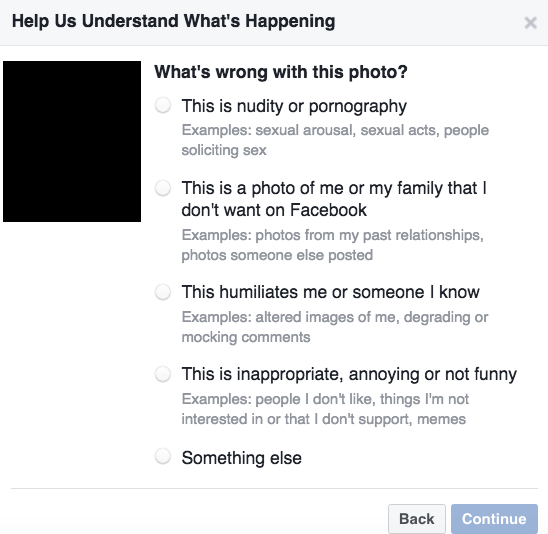
First, Facebook could stop conflating nudity with sexuality, and sexuality with pornography by making changes to their user reporting mechanism. Currently, when users attempt to report such content, their first option reads: “This is nudity or pornography,” with “sexual arousal,” “sexual acts” and “people soliciting sex” as examples listed below. This creates a blurry line between non-sexual nudity (which is legal and uncontroversial in a number of jurisdictions in which the company operates) and sexual content.

Facebook's reporting mechanism conflates mere nudity with sexuality

Another option would be to apply content warnings . Facebook already employs such warnings for graphic violence (a subject that promotes greater concern in much of northern Europe than nude imagery) and could easily roll them out to apply to nudity as well. The company could institute different guidelines for public and private content as well, allowing nudity on friends-only feeds, for instance. .

Facebook could also consider whether its ban on female nipples—but not male ones—is a just policy. A number of countries and regions throughout the world have equalized policies toward toplessness, but Facebook’s policy remains regressive, and discriminatory. Furthermore, it often affects transgender users, an already vulnerable population.

Finally, Facebook could reconsider the punitive bans it places on users who violate the policy. Currently, users who violate the policy first have their content taken down, while a second violation typically results in a 24-hour ban—the same length of time meted out for seemingly more egregious policy violations.

All of these would help mitigate the confusion, concern and accusations of censorship, that incidents like the Kim Phúc takedown provoke. But if Facebook wants to avoid being seen as the world’s arbitrary and prudish censor, the company should perhaps spend more time thinking—and articulating—about why a ban on nudity is so important in the first place.


Has your content been taken down, or your account suspended, on a social media platform? Report your experience now on Onlinecensorship.org, a project of EFF and Visualizing Impact which aims to find out how social media companies’ policies affect global expression.


Share this: Share on Twitter Share on Facebook Share on Google+ Share on Diaspora Join EFF
10 Oct 14:54

Baby Sneezes Snapchat Filter Beard Off Himself, Onto Father

Brindle

ah, this lightens my day a little :)

snapchat-beard-sneeze.jpg This is a very short video (ten seconds, ideal Youtube video length) of a baby sneezing a Snapchat filter beard off himself and onto his dad. According to the father: "Whoahohoho, that was crazy, how does that work?" I think originally he was going to talk about how he can't believe his son is so young and already has a beard. Please, by the time I was one day old I already had a mustache. A milk mustache. HIYO, breastfeeding! Just kidding, I was a formula baby. Keep going for the video.
Thanks to Ryon, who agrees it would be awesome if people grew facial hair every time they sneezed. Except for ladies. Plus everybody with allergies would look like a lumberjack.
05 Oct 20:41

State Appeals Court Says Not Just Any Nonexistent Law Can Be Used To Initiate Traffic Stops

by Tim Cushing

The US Supreme Court issued law enforcement fishing licenses with the Heien decision. Vehicle stops no longer needed to be predicated on legal violations. (If they ever were...) Law enforcement officers were no longer required to know the laws they were enforcing. The Supreme Court's decision combined reasonable suspicion with an officer's "reasonable" grasp of moving violations, further deteriorating the thin Fourth Amendment insulation protecting drivers from suspicionless, warrantless searches.

With the standards lowered, officers can now stop anyone for almost any reason, provided they can make the justification stated in their report sound like a reasonable approximation of what they thought the law was, or what they wanted the law to be. (The Supreme Court's Rodriguez decision still allows for bogus traffic stops. It just puts a highly-subjective time limit on the fishing expedition.)

The Supreme Court's case originated in North Carolina. Oddly enough, further down the judicial food chain, a North Carolina state appeals court has just suppressed evidence based on a traffic stop with no legal basis. (h/t The Newspaper)

Antwon Eldridge was pulled over because his vehicle was missing the driver's side mirror. This led to a search of his vehicle and the discovery of crack and marijuana. But the reason for the stop failed to hold up in court, even with the Heien decision in place.

The opinion [PDF] details the officers' version of the events and the reason for the stop.

On 12 June 2014, Deputy Aaron Billings of the Watauga County Sheriff’s Office was traveling northbound on U.S. Highway 421 while talking on the phone to his supervisor, Lieutenant Brandon Greer. As he was driving, Deputy Billings noticed a white Ford Crown Victoria driving without an exterior mirror on the driver’s side of the vehicle. The vehicle was registered in Tennessee.

Deputy Billings was aware that North Carolina law generally requires vehicles to be equipped with exterior mirrors on the driver’s side. He asked Lieutenant Greer to confirm that the applicable statute did, in fact, require the presence of an exterior mirror on the driver’s side of a vehicle, and Lieutenant Greer responded that Deputy Billings was correct.

Everything is correct but the jurisdiction. Both agreed it was illegal to operate a vehicle without a side mirror in the state, but they were unaware that the statute limited that rule solely to vehicles registered in North Carolina.

The lower court found the officers' mistake reasonable and refused to suppress the evidence. The appeals court, however, found the officers' error unreasonable, even when considering the Supreme Court's Heien decision. In its take on Heien -- which overturned one of its earlier decisions -- traffic stops can be based on misinterpretations of law, but only if the cited law is unclear or vaguely written.

Unlike the statutory language at issue in Heien, the text of N.C. Gen. Stat. § 20-126(b) is clear and unambiguous. The phrase “registered in this State” as used in this statutory provision is susceptible to only one meaning — that is, the vehicle must be registered in North Carolina in order for the requirements of N.C. Gen. Stat. § 20-126(b) to apply. Thus, a reasonable officer reading this statute would understand the requirement that a vehicle be equipped with a driver’s side exterior mirror does not apply to vehicles that — like Defendant’s vehicle — are registered in another state.

Unfortunately for drivers, there's no shortage of vaguely-written laws. This isn't going to turn North Carolina into a state where motorists are only pulled over for actual illegal activity. What it does do, however, is take away a bit of the useful ignorance that law enforcement likes to rely on. Both officers claimed they were unfamiliar with the statute's jurisdictional limitations and only discovered this after the fact. No "good faith" is extended to these officers by the appeals court, which seems to actually expect officers to know the law they're enforcing -- unlike other courts more willing to give the government the benefit of a doubt they rarely extend to criminal defendants.


Permalink | Comments | Email This Story
01 Oct 14:34

Photographer Successfully DMCAs Trump Jr.'s Skittles Image

by Mike Masnick
Brindle

laugh out loud.

So, just last week, we wrote about how David Kittos, a refugee from Cyprus now living in the UK, had taken the photograph of a bowl of Skittles that Donald Trump Jr. had used in a tweet about banning refugees. Kittos said he was thinking about taking legal action, but said he wasn't sure he had the patience for it. But, of course, thanks to US copyright law, if you want something to disappear, you don't have to go through a whole litigation process, you can just use the DMCA. And that's exactly what David Kittos did (first noticed by The Washington Post, which may have a paywall).
-------

== Description of original work: Photography of a bowl of Skittles from my flickr library which was copied WITHOUT my permssion

== Links to original work: https://www.flickr.com/photos/david_kittos/[REDACTED]/

---

== Reported Tweet URL: https://twitter.com/DonaldJTrumpJr/status/[REDACTED][REDACTED]

== Description of infringement: The image of a bowl of skittles is mine and has always been set as "ALL RIGHTS RESERVED" in my flickr library It was copied and is being used WITHOUT my permission. I have never been contacted by Donald Trump Jr or any representative about the image, before of after it was used in the Tweet.

-------
And it worked:
Now, of course, there's a question of whether or not Trump Jr. will file a counternotice, and then if Kittos would actually follow through with a lawsuit. I'm guessing neither will happen, but who really knows? There's a possible, but not really that strong, argument that Trump Jr.'s usage was fair use. And it does seem like Kittos' takedown is much more about his objection to the speech, rather than the possible infringement -- and, once again, that suggests it's another example of using copyright to censor speech someone doesn't like. As I made clear, I think the Skittles analogy is incredibly stupid (and racist), but that doesn't mean I'm comfortable with using copyright to silence it.

Permalink | Comments | Email This Story
01 Oct 14:34

Make It Stop: 11 Childhood Characters Drawn As Terrifying Monsters

scary-childhood-characters-11.jpg These are two handfuls of digital paintings by Swedish illustrator and tattoo artist Dennis Carlsso reimagining some iconic childhood characters as terrifying monsters. I probably could have gone my whole life without seeing them, especially Pooh, Totoro, Pikachu, Eeyore, a Minion, Piglet, Stitch, Mike Wazowski, Tweety and Tigger. "That's all of them." No, that's all of them except Shrek -- Shrek wasn't all that bad. Don't get me wrong, I wouldn't want him hiding in my closet at night, but if he was willing to cuddle and be big spoon I'd be open to it. Keep going for the rest. Poor Eeyore.scary-childhood-characters-10.jpg scary-childhood-characters-9.jpg scary-childhood-characters-8.jpg scary-childhood-characters-7.jpg scary-childhood-characters-6.jpg scary-childhood-characters-5.jpg scary-childhood-characters-4.jpg scary-childhood-characters-3.jpg scary-childhood-characters-2.jpg scary-childhood-characters-1.jpg Thanks to Jan, who agrees everybody with young children should show these to them immediately.
30 Sep 12:26

How I Taught A Jury About Trolls, Memes And 4Chan -- And Helped Get A Troll Out Of Jail

by Mike Masnick
Brindle

though I will admit to some confusion over being asked, twice, on the stand if I consider myself "an advocate for internet freedom," as if that were a bad thing...

A few weeks ago, CNN had a story on how a jury failed to convict Peter Wexler, an unemployed IT worker, who had been arrested and spent nearly a year in jail (without bail) for writing some mean stuff on his blog. He was literally arrested for five blog posts (which came with 20 criminal charges, as they had multiple charges on each post) and was facing up to 15 years in jail for those posts. Ken "Popehat" White blogged briefly about it, noting that it was a huge First Amendment win in a case where the defense team included one of his partners, Caleb Mason (along with lawyer Marri Derby, who was appointed by the court to represent Wexler through the Criminal Justice Act). It's also a case that involved... me. I was an expert witness in the case, brought in to explain to the jury the nature of internet discourse, including how trolls quite frequently say outrageous things to get attention, and how it's (for better or worse) not that uncommon to see people post angry rants on the internet, or to talk about how certain people should die, or to photoshop famous people into weird scenarios.

I've avoided writing about the case up until now, mostly because of my involvement. And since Wexler was found not guilty on some charges, while the other charges resulted in a hung jury (the jury foreperson said that they voted 8 to 4 to acquit on those other charges), there's a chance there may be a second trial. So recognize that it's a case that I may still have future involvement in -- and where I'm choosing my words carefully (the prosecutors in the case tried to take some of my posts on Techdirt out of context to attack my credibility, and it's possible that could happen again -- though I will admit to some confusion over being asked, twice, on the stand if I consider myself "an advocate for internet freedom," as if that were a bad thing).

What I will say is that I was asked to review Wexler's blog -- and while I certainly don't agree with much of what he wrote there, I didn't see anything that seemed out of character in many internet forums. Much of it seemed straight out of 4chan's /pol/ honestly. Wexler cheered on ISIS beheadings and cop shootings. He blasted US politicians and US policy both at home and abroad. He's not a fan of the mainstream media. He's not a fan of any "establishment" politician, and would mock them all, while cheering on both Donald Trump and Bernie Sanders. In short, he had opinions and he expressed them, sometimes angrily and in ways that were clearly designed to get people to react. At one point, responding to the news that the online troll Joshua Goldberg had been arrested (a story we wrote about, in part because of my own interactions with Goldberg), Wexler declared himself to be an "ISIS SUPPORTING ONLINE TROLL" (echoing the language being used to describe Goldberg):
Even an FBI special agent, Voviette Morgan, noted to others in the Bureau that "everything we have reviewed to date [on Wexler's blog] falls into the category of First Amendment protected speech." But the FBI still sent some agents to visit him. And that led him to post some fairly angry rants against the FBI and the FBI's top agent in Southern California, David Bowdich (who has since moved up to a new position in DC), including the one in the image above.

After a few more posts calling out Bowdich, and photoshopping him into a variety of images -- including taking a picture of a Bowdich press conference and overlaying a forearm and hand holding a gun pointing at Bowdich, overlaying a target on Bowdich's face in a press shot, and photoshopping Bowdich into a still from an ISIS beheading video (something that Wexler did with other people, including Brian Williams and Ben Carson, which the FBI also seemed to think was protected speech), Wexler was arrested, with the charges focusing on his posts about Bowdich, and arguing that statements like what he says above about how he wants "to shove my Fat Man Gadget up David Bowdich's limpwristed West Los Angeles ass, and I intend to!" should be seen as a legitimate threat on Bowdich's life (anyone know what a Fat Man Gadget is?).

Wexler then spent basically the last year in jail for a bunch of angry blog posts, without even the option of being bailed out allowed. There were a number of other issues at play in the trial, some of which I may get to in a future post, but I was there to just explain the nature of online trolling, and how what Wexler said -- while certainly distasteful, and perhaps offensive -- was hardly out of the ordinary in certain online communities, and how many people in those communities recognized that kind of shitposting for what it was, and would laugh at those who "fell" for such extreme and offensive statements. I got to explain 4chan and trolling and even the creation of memes (yes, I explained rickrolling to a jury). I discussed numerous examples of similar blog posts, tweets, Facebook posts and forum posts. I highlighted numerous examples of people declaring publicly that some public figures (and some not so public figures) should be executed. I talked about (and showed examples of) politicians calling for the death of Hillary Clinton. I talked about photoshopping and photoshopping contests -- including ones that involved photoshopping targets or First Person Shooter-style overlays onto images of people. I showed many examples of famous people having targets overlayed on their images.

Basically, I showed the simple fact that in some corners of the internet, posting crazy offensive stuff is pretty commonplace, and it rarely means they're actually planning to go out and do anything. I don't know how useful my testimony was, though the fact that Wexler was not convicted and is now free from jail at least suggests it did not hurt the case. I recognize that what Wexler was saying on his blog is stuff that many people find offensive -- but if what he said was a crime, then a hell of a lot of people spouting off online are criminals too, and I'm pretty sure that's not how the First Amendment is supposed to work.

Once the case is really over, there are some other elements of the case that I'd feel more comfortable discussing, but for now, since a few people had asked about it, I did want to share this part of the story. A guy just spent nearly an entire year in jail because he blogged some (admittedly extreme) things in expressing his anger over the state of things in the world today. I may not agree with Peter Wexler's views on most of those things, but it seems like he should have the right to express himself on a blog without being thrown in jail for a year (or much longer).

Permalink | Comments | Email This Story
30 Sep 01:45

Congressman In Charge Of OPM Hacking Report Announces Plan To Investigate Stingray Use Next

by Tim Cushing

Representative Jason Chaffetz, fresh off his bombshell report on the OPM hacking, is promising to drop another explosive report in the future. This one will deal with law enforcement's dirty little secret -- one that's not that much of a secret anymore.

The Stingray, a controversial cellphone tracking device used by the U.S. government and law enforcement, will be the subject of a forthcoming investigation from the House Oversight Committee, according to Committee Chairman Jason Chaffetz (R-Utah).

"You will be shocked at what the federal government is doing to collect your personal information," Chaffetz said on Wednesday morning. "And they can't keep it secure, that's the point."

It's a good point, one fresh in the mind of millions thanks to the just-delivered OPM report. The government appears willing to take security seriously if it means doling out tax dollars to dozens of agencies with cyberstars in their eyes and crafting bad legislation, but not so much when it comes to actually ensuring its own backyard is locked down.

Chaffetz was one of the legislators behind the 2015 attempt to turn the DOJ's Stingray guidance into law, laying down a warrant requirement for US law enforcement. Unfortunately, the bill went nowhere. Presumably, a thorough investigation into law enforcement use of this repurposed war tech might prompt more legislative cooperation in the future.

Chaffetz has done little to endear himself to security and law enforcement agencies since his arrival on the Hill. In addition to the failed Stingray warrant bill, Chaffetz also partnered with Ron Wyden to attempt to add a warrant requirement for law enforcement GPS tracking -- something the Supreme Court almost addressed in its US v. Jones decision.

He also made new friends with the Secret Service while grilling officials over an incident where drunken agents arrived on the scene of a "suspicious package" report in spectacular fashion, crashing the vehicle they were driving into a White House barricade. Almost as soon as the hearing had begun, Secret Service employees were accessing Chaffetz's personal info (generated by his attempt to join the Secret Service in 2003), hoping to find something embarrassing they could use to discredit him.

This new report will further alienate law enforcement agencies and personnel, starting with the FBI -- which has acted as Stingray Overlord since the introduction of the equipment -- and trickling all the way down to the local level, where agencies have relied on secrecy, lies, and case dismissals to keep information about the cell phone-tracking devices from being made public.


Permalink | Comments | Email This Story
26 Sep 23:17

Before Forfeiture Is Finalized, Sheriff Racks Up 54k Miles On Seized Vehicle, Sells It To Private Buyer

by Tim Cushing

Drive it like you stole seized it.

Documents provided by Outside Legal Counsel show the department seized the Ostipow’s 1965 Chevy Nova SS on April 24, 2008, when the vehicle’s mileage was 73,865. [Sheriff William L.] Federspiel, who signed the vehicle title transfer form, sold the partially restored muscle car over a year later on June 4, 2009, for $1,500.

The vehicle’s title certificate filled out by Federspiel around the time it was sold says the mileage was 130,000 — 54,000 miles more than when the department seized the car.

The backstory to this seizure and extended joyride starts at the plaintiff's farm. In 2008, the sheriff's office obtained a warrant to search a second house on the Ostipow's property -- one in which their son lived. In the house, deputies found marijuana plants and seeds. The Ostipow's steadfastly maintain they knew nothing about their son's illegal activities. Presumably, they allowed him to live his own life in a house located some distance away from theirs. [Photo courtesy of Outside Legal Counsel]

Ostensibly there for drugs, deputies soon broadened their horizons.

Instead of only seizing the illegal plants and seeds, deputies seized essentially everything from the farmhouse, including, oddly, dozens of animal mounts being kept long-term at the farmhouse by Gerald because Royetta, his wife, simply didn't like these mounted animals in the main house.

But that is not all the deputies seized. The deputies also went out to outbuildings of the farmhouse and seized all the equipment, deer blinds, hundreds of tools, and many other items which lacked any realistic connection to the pot plants and seeds of Steven's grow. They even seized the '65 Nova and the car trailer it was on.

Not satisfied with cleaning out the farmhouse the Ostipow's son resided in (as well as every building surrounding it), the deputies returned with another warrant and cleaned out the Ostipow's house -- one located a half-mile away from the supposed grow operation. They found no illegal evidence, but that didn't stop them from taking plenty of their property, including the cash in Gerald Ostipow's wallet.

Then they just kept coming.

In the weeks that followed, deputies from the Saginaw County Sheriff's Office would arrive, off duty, in their personal vehicles and would continue to take more items long after the completion of the execution of the search warrants. No inventory tabulation exists for these items taken and there appears to be no records of these "self-help" items being officially sold.

The proceedings -- which have dragged on for eight years now -- never resulted in criminal charges against the Ostipows. After a trip up to the state Supreme Court, it was finally determined that Gerald Ostipow "should have been aware" of the grow operation taking place on his property. But it was also determined that Royetta's (Gerald's wife) interest in the belongings taken was free and clear. The Sheriff's office was ordered to return most the property it seized.

The problem is that the Sheriff's department no longer had the property it seized, including the vehicle it racked up 54,000 miles on.

However, the injury inflicted upon the Ostipows was not complete. After the final judgment was entered, it was discovered that all of the Ostipow's property had been sold by Sheriff Federspiel (he himself having signed the vehicle title transfer document for the Nova) and members of his department before there was a final determination about forfeitability of items seized and held.

The department's actions are indicative of an agency that seldom has trouble retaining anything it designates as "guilty" property. So secure was the sheriff's office in its belief that it would ultimately prevail -- despite never bringing criminal charges against the couple whose assets it seized -- that it moved ahead with converting the property to cash without having any legal right to do so.

The Ostipows are now suing [PDF] the sheriff and his deputies in federal court for blithely blowing past even the minimal protections granted to victims of asset forfeiture. In addition to $1 million+ in damages, the Ostipows are seeking declarations that the asset forfeiture processes deployed by the sheriff's department are Constitutional violations and the compelled released of documents requested by the couple in an earlier FOIA request.

Hopefully, Sheriff Federspiel will learn from this experience. Then again, he's already converted a seized Mustang into a department/personal vehicle and has gone on record with statements that portray his anti-drug efforts as shopping trips for his department.

Federspiel hopes his department will claim more vehicles through drug forfeiture or drunk driving laws to equip his six-person cadre of captains, lieutenants and sergeants by the end of his first term. “I don’t want to buy another vehicle for my command staff,” he says.

He’s targeted a 2008 black Cadillac Escalade which, if acquired, would become the mobile, anti-drug dealing billboard for Undersheriff Robert X. Karl.

Given that this is the voice of leadership in the department, it's hardly surprising deputies feel search warrants entitle them to grab as much as they can from citizens they either can't or won't bring charges against.


Permalink | Comments | Email This Story
26 Sep 22:55

NYPD Says Releasing Basic Stingray Contract Info Will Result In A Supercriminal Apocalypse

by Tim Cushing

Secrecy still continues to shroud law enforcement Stingray use, in large part because courts have been far too receptive to the government's insistence that the release of any details at all would result in the expensive tech being rendered instantly useless.

The NYPD has decided to go past the usual "law enforcement means and methods" obfuscatory tactics and push a rather novel narrative about why it would be "dangerous" for IMSI catcher info to make its way into the public domain. (I mean more so… I guess.)

Joseph Cox of Motherboard reports the NYPD's latest opacity play involves hoodie-wearing males operating laptops in underlit rooms and comic book supervillain-esque levels of coordinated criminal activity.

In a recent case, the New York Police Department (NYPD) introduced a novel argument for keeping mum on the subject: Asked about the tools it uses, it argued that revealing the different models of IMSI catchers the force owned would make the devices more vulnerable to hacking.

In the words [PDF] of the NYPD's Gregory Antonsen, hackers would be able to crack open Stingrays like OPM records if the department were to turn over Harris Corp. contract info and nondisclosure agreements to the New York branch of the ACLU in response to its FOIL request. Also: terrorism.

The purpose of this affidavit is to explain the reasons that disclosing the Withheld Records would cause grave damage to counterterrorism and law enforcement operations, and so could endanger the lives or safety of New Yorkers.

Additionally, disclosing the Withheld Records would reveal confidential and non-routine criminal investigative techniques, which would hamper ability to conduct operations and would permit perpetrators to evade detection. Moreover, disclosure of the Withheld Records would jeopardize the ability of NYPD to secure its information technology assets.

After detailing the use of Stingrays to perform a variety of heartwarming investigations (tracking down a missing elderly person, rescuing someone from sex trafficking, etc.), Antonsen gets down to business. According to the NYPD's theory, any information released about the NYPD's IMSI catcher contracts could be "scrutinized" by bad guys who would be able to infer from extremely limited information the extent of the department's cellphone-tracking capabilities. It's basically the mosaic theory, but without the mosaic.

But the far stupider assertion is the one made without any supportive citations -- just a far-fetched hypothetical.

The CSS technologies are also critical and essential information technology assets. As such, all CSS technologies require periodic software updates. Public disclosure of the specifications of the CSS technologies in the NYPD's possession from the Withheld Records would make the software vulnerable to hacking and would jeopardize ability to keep the technologies secure. Of great concern is that a highly sophisticated hacker could use the knowledge of CSS technologies to invade the CSS software undetected, thus creating a situation in which law enforcement personnel are lured into a situation based on a misleading cell-phone location and are then trapped and ambushed.

The ACLU's Chris Soghoian has responded [PDF] to the NYPD's assertions. As to the claims that providing contract information would somehow result in sophisticated criminals finding ways to route around this surveillance, Soghoian points out that every Stingray device -- no matter its capabilities -- can be defeated by even the dumbest thug… and all without having to scour a redacted invoice for clues.

The most effective countermeasure, which can be used by anyone at no cost is to simply turn off a phone or put it into airplane mode. This will thwart tracking by any model of Stingray. Knowing the models of Stingrays that the NYPD uses does not make this countermeasure more or less effective. It is 100% effective regardless of which models of Stingrays the NYPD uses.

Soghoian went easy on the "but criminals will beat our IMSI catchers" argument. The "but we'll be hacked" argument is treated with all the respect it deserves: none.

It would be a serious problem if the costly surveillance devices purchased by the NYPD without public competitive bidding are so woefully insecure that the only thing protecting them from hackers is the secrecy surrounding their model names.

He also chides the NYPD for making claims the federal government isn't even willing to make.

The Harris Corporation, which in addition to manufacturing Stingrays has been awarded public contracts for securing the President's communications and supplying secure radios used by the U.S. Army, is clearly capable of designing secure products for its government customers that does not rely on keeping secret the mere existence of the devices for their security.

Soghoian also points out that the release of other information would similarly have zero effect on the devices' capabilities. Because they spoof cell towers, it does criminals no good to know how many the NYPD has or even where they tend to deploy them. A cellphone can't tell it's connected to a BS "tower." And just because the NYPD may be more likely to deploy them in certain areas does not guarantee that avoiding those areas will allow criminals to avoid detection.

And this wonderful paragraph snarkily deflates the NYPD's paranoid ravings its tech officers deploy as justification for continued secrecy.

Inspector Antonsen also claims that knowing the number of Stingrays owned by the NYPD may enable an extremely well-resourced criminal group to orchestrate a greater number of simultaneous hostage situations than the number of Stingrays available to the NYPD. Even assuming that such a sophisticated criminal group made the unlikely decision to rely on its knowledge of the number of Stingrays in the possession to use cell phones in executing such a hypothetical event, knowing that number will not help them as it is almost certainly the case that one, if not multiple, federal law enforcement agencies would step in and assist the NYPD with their own cellular surveillance technology. Moreover, this hypothetical is no different from saying that at some point some criminal group may be able to overwhelm the number of police cars that the NYPD owns or the number of police officers on the force.

It's hard to believe law enforcement is still throwing out these tired arguments after nearly a decade of incremental exposure of Stingray information. The NYPD wants publicly-available information (Stingray names, suggested retail prices) to somehow be the first cat successfully stuffed back into the bag. Since it has no legitimate arguments to justify this cat stuffing, tech officers are resorting to hypothetical scenarios even the most-handwavingest of sci-fi writers wouldn't feel comfortable inserting into their speculative fiction.


Permalink | Comments | Email This Story
26 Sep 21:26

The Barnacle, An Alternative To Parking Enforcement Tire Boots

barnacle-parking-enforcement-1.jpg This is the Barnacle, a parking enforcement alternative to tire boots. It attaches to any windshield with two powerful suction cups and forces a person with too many unpaid parking tickets to drive with their head out the window. I'm cool with that.
Violators can pay over the phone and receive the code to unlock the Barnacle, rather than needing someone to come unlock a boot or similar device. If a car with a Barnacle needs to be towed, it can be done without removing the Barnacle first. The Barnacle was designed to make the entire parking violation process easier for both the offender and the people installing the Barnacle and issuing fines.
"Violators can pay over the phone and receive the code to unlock the Barnacle?" Then what? Can you just toss it in the road? Can you sell it on eBay to recoup some of the money you just spent on parking tickets? Do I have to take it somewhere? I bet you have to drop it off somewhere or they charge you for the cost of a Barnacle. Parking enforcement is such a racket. One time I got my car towed for parking in an 'undesignated' parking spot. Sidewalks don't even have spots! Keep going for a couple more shots including one of a guy about to open a used Barnacle store.barnacle-parking-enforcement-2.jpg barnacle-parking-enforcement-3.jpg barnacle-parking-enforcement-4.jpg Thanks to Stephanie B, who agrees the key to avoiding parking tickets is driving a monster truck so tall the parking enforcer can't reach your windshield.
26 Sep 21:20

UK’s Top Police Warn That Modding Games May Turn Kids into Hackers

by Joseph Cox for Motherboard
Brindle

I sure as hell hope so...

Last week at EGX, the UK's biggest games event, attendees got a chance to play upcoming blockbusters like Battlefield 1, FIFA 17, and Gears of War 4. But budding gamers may also have spotted a slightly more unusual sight: a booth run by the National Crime Agency (NCA), the UK's leading law enforcement agency.

Over the last few years, the NCA has attempted to reach out to technologically savvy young people in different ways. EGX was the first time it’s pitched up to a gaming convention; the NCA said it wanted to educate young people with an interest in computers and suggested that those who mod online games in order to cheat may eventually progress to using low level cybercrime services like DDoS-for-hire and could use steering in the right direction.

“The games industry can help us reach young people and educate them on lawful use of cyber skills,” Richard Jones, head of the NCA's National Cyber Crime Unit’s 'Prevent' team, told Motherboard in an email.

“Through attendance at EGX and various other activities, we are seeking to promote ethical hacking or penetration testing, as well as other lawful uses of an interest in computers to young people,” Jones said. Penetration testing is essentially hacking done with the consent of the target company, usually done in an effort to uncover vulnerabilities which the company can then fix.

Read More: The UK Wants Gamers to Fix Its Cybersecurity

Jones said that the EGX presence wasn't part of an NCA recruitment campaign, and there aren't any specific ethical hacking jobs at the agency.

“The conversations we have been having with younger attendees have been about promoting career pathways into gaming, cyber security, or law enforcement, where they can use their cyber skills positively to have interesting and prosperous careers. Where needed, we have also explained that certain online activity is illegal and there are consequences for victims,” Jones added.

In December, the NCA announced that the average age of cybercrime suspects over the last year was 17 years old, compared to 24 the previous year. The agency has a particular interest in reaching those who cheat at online games, suggesting they may eventually dabble in criminal activities.

“We have undertaken analysis on pathways into cyber crime offending and can conclude that some young people who have an interest in online games may begin to participate in gaming cheat websites and ‘modding',” Jones said. “This has the potential to progress to criminal hacking forums and use of low level cybercrime services like DDOS for hire. We are therefore at the event to speak to young people who may be vulnerable to becoming involved in cybercrime and promote lawful career pathways.”

Holly Nielsen contributed reporting.

Get six of our favorite Motherboard stories every day by signing up for our newsletter.

21 Sep 03:06

US Map Of The Dirtiest Sounding Town In Each State

Brindle

blue ball village... huh

dirty-town-names.jpg This is a map highlighting the most lewd sounding town name in each US state. Of course, lewd sounding is all subjective. To me, Wankers Corner, Oregon sounds like a lovely place to hang out with your bros. Dickshooter, Idaho not so much. Did you know Sugar Tit, South Carolina got its name because (SPOILER: surprisingly nothing to do with Mel Gibson) "the men spent so long socializing at the local general store, their wives complained they took to the store like a baby to a sugar tit." A sugar tit is a folk name for a pacifier, by the way. I know, I was hoping they discovered some sort of gigantic Candyland Queen's tits in the woods too. I have dreams about stuff like that. Very X-Files. Keep going for the entire list of all the dirty sounding town names that didn't get first place. ALABAMA: Ballplay, Boar Tush, Smut Eye ALASKA: Clam Gulch, Covenant Life, Manley Hot Springs, Mary's Igloo, North Pole ARIZONA: Cyclopic, Kaka, Parker Strip, Show Low, Three Way ARKANSAS: Bald Knob, Biggers, Blue Ball, Boeuf, Corning, Flippin, Greasy Corner, Pea Ridge, Romance, Toad Suck, Weiner CALIFORNIA: Bush, Chubbuck, Clam Beach, Fort Dick, Hooker, Johnsondale, Johnsons, Old Fig Garden, Peters, Prunedale, Raisin City, Ragged Point, Ragtown, Rough and Ready, Shafter, Woody COLORADO: Atwood, Beaver Creek, Delores, Hotchkiss, Johnson Village, Lay, Loveland, Lubers, Slagger, Wetmore, Woodrow, Woody Creek CONNECTICUT: Happyland, Moosup, Seymour, Essex DELAWARE: Blue Ball, Bunting, Cave Colony, Cocked Hat, Cowgills Corner, Hoars Addition, Midnight Thicket, Swallow Hill FLORIDA: Briny Breezes, Bunker Donation, Chattahoochee, Fluffy Landing, Miccosukee, Needmore, Wildwood GEORGIA: Balls Ferry, Boneville, Butts, Cumming, Experiment, Faceville, Flippen, Gumlog, Hardup, Lumpkin, Pyles Marsh HAWAII: Honaunau-Napoopoo IDAHO: Bone, Cream Can Junction, Dickshooter, Dingle, Hand Place, Headquarters, Player Place, Slickpoo, Wickahoney ILLINOIS: Bone Gap, Boody, Breeds, Bush, Chicken Bristle, Chittyville, Diswood, Dongola, Ficklin, Honey Bend, Kumler, La Fox, Lick Creek, Love, Shobonier INDIANA: Beaver City, French Lick, Effingham, Floyds Knobs, Friendswood, Gnaw Bone, Rocky Ripple, Spurgeon IOWA: Balltown, Beaverdale, Cumming, Fertile, Hard Scratch, Inwood, Manly, Sac City KANSAS: Deerhead, Dry Wood, Skiddy KENTUCKY: Bald Knob, Beaver Dam, Beaverlick, Bigbone, Broad Bottom, Co-Operative, Girdler, Knob Lick, Load, Morehead, Mud Lick LOUISIANA: Dry Prong, Grosse Tete, Grand Cane, Hardwood, Lucky MAINE: Bangor, Owls Head, Schoodic, Shady Nook MARYLAND: Blue Ball Village, Bushwood, Cockeysville, Crapo, Dames Quarter, Loveville MASSACHUSETTS: Felchville, Mashpee, Woods Hole MICHIGAN: Climax, Colon, Dick, Felch, Green Bush, Romeo, Sac Bay MINNESOTA: Ball Bluff, Ball Club, Balsam, Beaver, Big Woods, Burnsville, Bush Landing, Chokio, Clappers, Climax, Comstock, Cumming, Embarrass, Erhard, Goldenrod, Good Thunder, Johnson, Kiester, Makinem, Moorhead, Remer, Sexton, Underwood, Whipholt MISSISSIPPI: Biggersville, Buckatunna, Hushpuckena, Leakesville, Purvis, Saukum, Shivers, Splunge, Sweatman, Woodville MISSOURI: Conception, Conception Junction, Cooter, Corning, Fidelity, Ginger Blue, Knob Noster, Licking, Loose Creek, Number Eight, Pilot Knob, Tightwad, Wide Ford, Wien, Wood MONTANA: Big Sag, Comertown NEBRASKA: Beaver City, Comstock, Dix, Lodgepole, Ough, Purple Cane, Valentine NEVADA: Coyote Hole, Jackpot, Lovelock, Pahrump, Parker Strip, Sugar Bunker NEW HAMPSHIRE: Effingham, Merrimack NEW JERSEY: Antrim, Bay Head, Buttzville, Manahawkin, Nutley, Ramtown, Ringwood, Spotswood, Succasunna, Tuckahoe NEW MEXICO: Bluit, Crown Point, Faywood, Loving, Lovington, Pie Town, Truth or Consequences NEW YORK: Atwood, Ausable Chasm, Baiting Hollow, Ballston, Butternuts, Climax, Conewango, Conquest, Corning, Croton-On-Hudson, Cumminsville, Coxsackie, Feura Bush, Fort Johnson, Glen Head, Johnson, Johnson City, Kringsbush, Mannsville, Porcaville, Pound Ridge, Rathbone, Rockwood, Rodman, Sugarbush NORTH CAROLINA: Aho, Blowing Rock, Butters, Climax, Coinjock, Engelhard, Forbush, Hobucken, Hookerton, Lizard Lick, Love Valley, Low Gap, Mann's Harbor, Nags Head, Pee Dee, Rhodiss, Roughhedge, Stumpy Point NORTH DAKOTA: Cummings, Spiritwood OHIO: Ballville, Corning, Dry Run, Kunkle, Knockemstiff (ghost town), Laings, Licking View, Long Bottom, Mack, Pee Pee Township, Plumwood, Seaman, Shadyside, Spunky Puddle (ghost town), Trotwood OKLAHOMA: Beaver, Bowlegs, Bushyhead, Dripping Springs, Greasy, Hooker, Jumbo, Loving, Olustee, Pump Back OREGON: Ballston, Bridal Veil, Butteville, Climax, Drain, Wankers Corner, Woodburn PENNSYLVANIA: Big Beaver, Blue Ball, Black Lick, Coplay, Hopwood, Hop Bottom, Intercourse, Lickdale, New Beaver, Rough and Ready, Virginville, Youngwood RHODE ISLAND: Cranston, Woonsocket SOUTH CAROLINA: Fingerville, Ninety Six, Sugar Tit, Thicketty SOUTH DAKOTA: Beaver Crossing, Black Pipe, Bonesteel, Castlewood, Hooker, Rumpus Ridge, Swett TENNESSEE: Ballplay, Big Barren Creek, Bumpus Mills, Finger, Flippin, Guys, Lick Skillet, Nutbush, Rockwood, Shackle Island, Sweet Lips, Wartburg TEXAS: Bangs, Bleakwood, Camp Wood, Cumby, Cumings, Comstock, Dickens, Ding Dong, Friendswood, Glaze City, Greatwood, Jean-Loving, Kinkler, Latex, Leakey, Lovelady, Rockwood, Snook, Spearman, Tool UTAH: Beaver, Beaver Dam, Honeyville, Koosharem, Nibley, Shivwits, Teasdale, Virgin, Whipup, Wildwood VERMONT: Antrim, Cozy Corner, Essex, Hancock, Shaftsbury, Woodford VIRGINIA: Allison Gap, Assawoman, Bloxom, Brightwood, Bumpass, Fancy Gap, Onancock, Pound, Short Pump, Tuckahoe WASHINGTON: Babcock, Baring, Big Bottom, Chimacum, Chuckanut, Chumstick, Humptulips, Kooskooskie, Packwood WEST VIRGINIA: Bald Knob, Beech Bottom, Big Chimney, Big Sandy, Brohard, Cloverlick, Concepcion, Cougar, Cougar Valley, Cucumber, Droop, Floe, Johnson Crossroads, Knobs, Lick Creek, Longpole, Mercers Bottom, Nutterville, Organ Cave, Pickle Street, Pnch, Pipestern, Rimel, Romance, Sandlick, Stony Bottom, Wood WISCONSIN: Breed, Cheat Lake, Dickeyville, Clam Falls, Imalone, Longwood, Sextonville, Spooner, Spread Eagle, Tainter WYOMING: Goshen Hole, Hoback, McNutt, Miner's Delight, Ten Sleep, Teton Village (Teton means "Breast" in French) Thanks to Dave L, who wants to visit every one of these and get his picture taken with a sign. Just any sign? "One with the town name." Oh right right right, that makes sense.
21 Sep 00:14

Town Loses Gigabit Connections After FCC Municipal Broadband Court Loss

by Karl Bode
Back in February the FCC voted to use its Congressional mandate to ensure speedy broadband deployment to dismantle protectionist state laws intentionally designed to hinder broadband competition. But the FCC recently found itself swatted down by the courts, which argued the agency lacks the authority to pre-empt even the worst portions of these laws. As a result municipal broadband providers continue to run face first into protectionist provisions written by incumbent ISP lawyers and lobbyists solely concerned about protecting the current broken broadband market.

The impact of the FCC's loss is very real. Ars Technica notes that one of the broadband ISPs that originally asked for help from the FCC, Wilson North Carolina's Greenlight, has had to disconnect one neighboring town or face violating state law. With state leaders tone deaf to the problem of letting incumbent ISPs write such laws, and the FCC flummoxed in its attempt to help, about 200 home Internet customers in Pinetops will thus lose access to gigabit broadband service as of October 28:
"We must comply with our state law," Agner said. But city council members were very vocal in their opposition to the law and regret having to disconnect the service, she said. "We have not identified a solution where Greenlight can serve customers outside of our county," Wilson City Manager Grant Goings told The Wilson Times earlier this week before the city council vote. "While we are very passionate about reaching underserved areas and we think the laws are atrocious to prevent people from having service, we’re not going to jeopardize our ability to serve Wilson residents."
Greenlight's fiber network provides speeds of 40Mbps to 1Gbps at prices ranging from $40 to $100 a month, service that's unheard of from any of the regional incumbent providers (AT&T, CenturyLink, Time Warner Cable) that lobbied for the protectionist law. Previously, the community of Pinetops only had access to sluggish DSL Service from CenturyLink:
Wilson already had fiber in Pinetops, which has been an electric customer of Wilson's for more than 40 years. Before deploying Internet access to Pinetops, Wilson was laying fiber in the town to support smart grid initiatives. After the FCC voted to let city Internet services expand outside their boundaries, Wilson extended the fiber network to pass the roughly 700 homes in Pinetops, Agner said. Prior to this, Pinetops residents' only option was CenturyLink DSL, she said.
That's the same CenturyLink that's currently using the lack of competition in its markets to begin saddling already slow and expensive DSL service with usage caps and overage fees. ISPs have been very successful in sowing partisan discord by framing municipal broadband as a partisan issue (pesky government interfering in private enterprise!). In reality, most municipal broadband networks have been built in Conservative areas and see broad, bi-partisan support. Disliking the local phone and cable company (and the market failure that built them) is actually something that tends to bring bickering partisans together.

Still, with the FCC's loss there's nothing really stopping ISPs from continuing to use state legislatures as their personal playthings. Currently there's twenty such laws protecting broadband duopolies in place, and despite growing attention to the practice, new protectionist laws are being passed each year.

Permalink | Comments | Email This Story
20 Sep 16:35

Will The Washington Post Give Back Its Pulitzer And Stand Trial With Snowden?

by Mike Masnick
We already know that the Washington Post editorial board has some cognitive dissonance when it comes to Ed Snowden. Three years ago, right after the Washington Post itself, via reporter Barton Gellman, broke a bunch of the initial stories around the Ed Snowden documents -- including the first public report on the Section 702 PRISM program -- the editorial board wrote a piece condemning Snowden's leaks. Now, it's true (as many point out) that the editorial board is separate from the reporters who work at the paper, but it still is really quite amazing that the editorial board would not only burn a source like that but basically complain about its own journalism.

It appears that three years later, the Post's editorial board has not changed its perspective. In response to the campaign to pardon Snowden, the Washington Post has come out with a tone deaf editorial against pardoning Snowden, calling for him to be prosecuted, and insisting that Snowden caused real harm with the revelations. Here's the really incredible part. The Post focuses its complaint on the revelation of the PRISM program -- and that is the story that the Post broke. Glenn Greenwald and the Guardian had the first story, about the Section 215 mass phone records surveillance program. But it was the Post that had the first story about PRISM. And yet, the Washington Post now says that while revealing the 215 program may have been a public service, revealing PRISM was a crime.
The complication is that Mr. Snowden did more than that. He also pilfered, and leaked, information about a separate overseas NSA Internet-monitoring program, PRISM, that was both clearly legal and not clearly threatening to privacy. (It was also not permanent; the law authorizing it expires next year.) Worse — far worse — he also leaked details of basically defensible international intelligence operations: cooperation with Scandinavian services against Russia; spying on the wife of an Osama bin Laden associate; and certain offensive cyber operations in China. No specific harm, actual or attempted, to any individual American was ever shown to have resulted from the NSA telephone metadata program Mr. Snowden brought to light. In contrast, his revelations about the agency’s international operations disrupted lawful intelligence-gathering, causing possibly “tremendous damage” to national security, according to a unanimous, bipartisan report by the House Permanent Select Committee on Intelligence. What higher cause did that serve?
Except it wasn't Ed Snowden who publicly revealed information about PRISM. It was the Washington Post. And it won a freaking Pulitzer Prize for that reporting as well. And now it says that the revelation of that program should never have happened?

Really?

Remember that, while many people falsely think that Snowden is the one who revealed these programs to the public, that's not the case. He gave the documents to certain journalists, saying that he trusted them to sort through them and determine what was newsworthy, what was not, and what should be kept secret. It was the Washington Post that determined the PRISM program -- which is still subject to legal challenges (though so far has been found to be legal) -- was serious enough for news coverage. Not Ed Snowden. And yet now the Post says Snowden should be prosecuted for the journalistic decision it made, which earned it a Pulitzer.

Yes, the Post editorial board is free to make such a stupid decision, but it's only going to harm its journalistic staff. What source is going to go to the Washington Post now, when it's the very paper that took all the glory from publishing stories from a source -- and then called for him to be thrown in jail?

Here's what the Washington Post's Executive Editor Marty Baron said about the Pulitzer Prize when it was announced:
Post Executive Editor Martin Baron said Monday that the reporting exposed a national policy “with profound implications for American citizens’ constitutional rights” and the rights of individuals around the world.

“Disclosing the massive expansion of the NSA’s surveillance network absolutely was a public service,” Baron said. “In constructing a surveillance system of breathtaking scope and intrusiveness, our government also sharply eroded individual privacy. All of this was done in secret, without public debate, and with clear weaknesses in oversight.”

Baron added that without Snowden’s disclosures, “we never would have known how far this country had shifted away from the rights of the individual in favor of state power. There would have been no public debate about the proper balance between privacy and national security. As even the president has acknowledged, this is a conversation we need to have.”
Hmm. That doesn't seem to fit with what his own editorial board is now saying about Snowden's revelations. When asked about this now, in response to the editorial, Baron suddenly came down with a case of the "no comments."
In an email response to Fortune, Post editor-in-chief Marty Baron said: “I don’t comment on editorials. As you know, that department is entirely separate from the newsroom. You should contact Bart Gellman.”
Gellman, of course, is the reporter who wrote those stories for the Post and who has said he "profoundly" disagrees with the Post's editorial.

As he should, because the editorial is not just tone deaf and ridiculous, it's cowardly bullshit that massively harms the reputation of the Post itself, and certainly undermines its credibility with sources.

Permalink | Comments | Email This Story
20 Sep 16:35

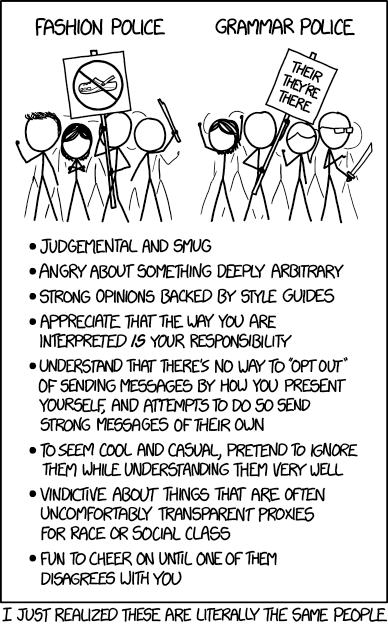
Fashion Police and Grammar Police

Brindle

god damnit.

* Mad about jorts
19 Sep 13:57

NYC Kills Internet Browsing At Free WiFi Kiosks After The City's Homeless Actually Use It

by Karl Bode
Earlier this year, New York City undertook one of the biggest free city WiFi efforts ever conceived. Under the plan, an outfit by the name of LinkNYC is slated to install some 7,500 WiFi kiosks scattered around the five boroughs that will provide free gigabit WiFi (well, closer to 300 Mbps or so), free phone calls to anywhere in the country (via Vonage), as well as access to a device recharging station, 311, 911, 411 and city services (via an integrated Android tablet). The connectivity and services are supported by a rotating crop of ads displayed on the kiosks themselves.

The only problem? As part of the initiative, the city and LinkNYC attached an Android-powered tablet that lets anyone browse the internet for as long as they wanted. This, as you might expect, has resulted in some people camping out for long periods of time actually using the free service. That includes, unsurprisingly, New York City's ample homeless population. As Motherboard notes in a report, after spending much of August tracking usage of the kiosks, a snapshot view of daily use doesn't make for shiny marketing fodder:
"My small sample of Link users that Saturday afternoon suggests these kiosks are indeed mostly used by the city’s least privileged. Of the 15 people I saw using a Link, only two or three of them would be likely to appear on LinkNYC promotional materials (i.e., one well-dressed woman making a phone call, or one middle aged, casually-dressed tourist waiting for his phone to finish charging).
Again, this shouldn't really be surprising, especially since the city has consistently claimed that one of its goals is to close the digital divide. Since June there has also been a lot of breathless hysteria about the fact that some of the homeless users have been using the tablets to watch porn. In response, LinkNYC began implementing internet filters that, as internet filters tend to do, didn't seem to work.

Responding to public complaints, LinkNYC announced this week that it would be discontinuing tablet browsing functionality at the kiosks:
"...Some users have been monopolizing the Link tablets and using them inappropriately, preventing others from being able to use them while frustrating the residents and businesses around them. The kiosks were never intended for anyone’s extended, personal use and we want to ensure that Links are accessible and a welcome addition to New York City neighborhoods.
The announcement notes that the internet browsing will be disabled, but other services will still work:
"Starting today, we will be removing web browsing on all Link tablets while we work with the City and community to explore potential solutions, like time limits. Other tablet features—free phone calls, maps, device charging, and access to 311 and 911—will continue to work as they did before, and nothing is changing about LinkNYC’s superfast Wi-Fi. As planned, we will continue to improve the Link experience and add new features for people to enjoy while they’re on the go."
While countless news stories suggest that the move was primarily in response to overwhelming porn consumption, there's no real evidence that this was an epidemic of any real scale. While there have certainly been documented instances of public masterbation at the kiosks (this is NYC after all, and occasionally viewing a homeless person's gentials is not a new concept), LinkNYC has suggested that people camping out around the kiosks (sometimes bringing chairs, couches and crates with them) was the larger source of complaints by locals.

The real problem appears to be that the service put the city's homeless population on stark display, making them more difficult for city residents to ignore. On one hand it's understandable that homeless populations camping around the kiosks isn't great "optics" or olfactory ambiance for the city and local business owners, but at the same time it's not clear what one expects to happen when you provide the city's 60,000 homeless residents with free access to technology they otherwise lack access to. LinkNYC says it's working with the city on a solution, and may restore public browsing at a later date with tougher filters and access limitations in place. Given the fact that filters historically don't work, it seems more likely that the free browsing will be gone for good.

Permalink | Comments | Email This Story
15 Sep 20:17

Sega Takes Potshots At DMCA-Happy Nintendo While Being Cool About Fan Games

by Timothy Geigner

While Nintendo has been making waves for some time with its overly aggressive DMCA takedowns of any fan-work that includes its intellectual property, the company has really ramped things up lately. Recent actions include the takedown of a Mario fan game, a remake of a 25-year-old Metroid title, and engaging in all kinds of craziness over its Pokemon Go title. It was enough that one of Nintendo's biggest rivals couldn't help but take a subtle potshot at it, while simultaneously treating Sega fans like human beings.

Daniel Coyle, on Twitter as SuperSonic68, headed up a team of Sonic the Hedgehog fans in the development of a fan-made 3D Sonic game. Their work has been received rather well as of late, including on gaming blogs and YouTube channels. When one YouTube channel, GameGrumps, did a "let's play" of the fan game, it appears that Sega noticed and reached out in the comments section with a poke at Nintendo's aggressive nature and some encouragement.


This is the kind of thing we talk about a great deal around here: being human and awesome to your fans, while also understanding that not every use of your intellectual property is a threat. In fact, it can be a boon instead. This case is doubly so, with the fan-created work propelling more attention to the Sonic franchise as a whole by getting the brand into the gaming news bloodstream, while embracing fan creations builds up all kinds of goodwill towards Sega in general. This is how you do it.

Where Nintendo is in the news for treating its fans poorly, Sega makes news for treating them well, which will encourage other Sega fans to create more fan-works, which will keep Sega's properties moving around the wider internet as a result.

Sega’s latest dunk on their litigious competition shows a massive difference in how fan content is approached and I think they’ve got it right. Games Green Hill Paradise Act 2 like generate interest in properties and encourage passionate engagement with their franchise. They’ve even brought fans in to work on projects. Christian Whitehead, a long time fan, is now a programmer on Sonic Mania.

This is how you build loyalty, instead of anger, amongst a fan-base.


Permalink | Comments | Email This Story
15 Sep 19:37

This Bill Could Stop Protectionist State Broadband Laws, But ISP Control Over Congress Means It Won't Pass

by Karl Bode
We've noted for years that one way incumbent broadband providers protect their duopoly kingdoms is by quite literally buying state laws that protect the status quo. These laws, passed in roughly twenty different states, prevent towns and cities from building their own broadband networks or in some instances from partnering with a private company like Google Fiber. Usually misleadingly presented by incumbent lobbyists and lawmakers as grounded in altruistic concern for taxpayer welfare, the laws are little more than pure protectionism designed to maintain the current level of broadband dysfunction -- for financial gain.

Earlier this year, the FCC tried to use its Congressional mandate under the Communications Act to eliminate the restrictive portions of these laws in two states. But the FCC's effort was shot down as an overreach by the courts earlier this month, and the FCC has stated it has no intention of continuing the fight. That leaves the hope of ending these protectionist laws either in the hands of voters (most of whom don't have the slightest idea what's happening) or Congress (most of whom don't want the telecom campaign contributions to stop flowing).

Undaunted, Representative Anna Eshoo this week introduced the Community Broadband Act of 2016 in the House, which is intended to be a companion bill to the existing bill of the same name already introduced in the Senate by Senators Cory Booker and Ron Wyden. Both bills would ban states from passing any law that prohibits a city, municipality or public utility from providing "advanced telecommunications capabilities" to state communities. In a statement, Eshoo expressed her displeasure at the ongoing efforts to thwart alternative broadband options:
"I’m disappointed that a recent court ruling blocked the FCC’s efforts to allow local communities to decide for themselves how best to ensure that their residents have broadband access,” Eshoo said. “This legislation clears the way for local communities to make their own decisions instead of powerful special interests in state capitals."

"Rather than restricting local communities in need of broadband, we should be empowering them to make the decisions they determine are in the best interests of their constituents. Too many Americans still lack access to quality, affordable broadband and community broadband projects are an important way to bring this critical service to more citizens."
Which is all true, though both bills have virtually no chance at passing. Incumbent ISPs have been very successful in paying lawmakers to argue that any attempt to eliminate these protectionist laws is an "assault on states' rights," as argued by the likes of Marsha Blackburn. Of absolutely no concern to these critics is the fact that large companies are writing and buying the passage of state laws that ensure many states remain broadband backwaters solely to protect incumbent ISP revenues.

On the bright side, the rise of alternative (though limited) options like Google Fiber -- and the FCC's fight -- have shined a very bright spotlight on a practice that has been ongoing for fifteen years with little to no public and press attention. As such, ISPs (and the politicians that love them) are having a much harder time than ever convincing locals that laws keeping them on expensive, sluggish broadband are in their collective best self-interest.

Permalink | Comments | Email This Story
15 Sep 19:33

Cuba's Telecom Monopoly Banning Text Messages Containing Words Like 'Democracy'

by Karl Bode
The door to modernizing Cuba's communications networks opened slightly wider recently after the FCC removed the country from the agency's banned nation list. That allows fixed and wireless companies alike to begin doing business in Cuba as part of an overall attempt to ease tensions between the States and the island nation. And while Cuba has been justly concerned about opening the door to NSA bosom buddies like AT&T and Verizon, it's still apparently not quite ready to give up some of its own, decidedly ham-fisted attempts to crack down on free speech over telecom networks.

A recent investigative report by blogger Yoani Sanchez and journalist Reinaldo Escobar found that the nation has been banning certain words sent via text message with the help of state-owned telecom monopoly ETECSA. The report, confirmed in an additional investigation by Reuters, found that roughly 30 different keywords are being banned by Cuba's government, including "democracy," "human rights," and the name of several activists and human rights groups. Words containing such keywords simply aren't delivered, with no indication given to the sender of the delivery failure.

Initially, the researchers thought this was just incompetence on the part of ETECSA:
"Eliecer Avila, head of opposition youth group Somos Mas, which participated in the investigation, said 30 key words that triggered the blocking had been identified but there could be more.

"We always thought texts were vanishing because the provider is so incompetent, then we decided to check using words that bothered the government," he said. "We discovered not just us but the entire country is being censored," he said. "It just shows how insecure and paranoid the government is."
You can understand some degree of paranoia when you've got the United States and Russia battling over who gets to bone graft surveillance technology into your fledgling communications networks, but the clumsy censorship also isn't too surprising for a nation that still bans advertising across the island.

That said, the real problem for most Cubans remains that broadband and wireless communications is a luxury commodity well out of reach of most residents. Only between 5 and 25% of Cubans even have access to the internet, and while many can access Wi-Fi via hotspots opened just last year, the cost of connection is roughly $2 an hour, or around a tenth of the average monthly Cuban salary. As such, Cubans are "fortunate" in that they can't yet even afford to be comprehensively spied on.

Permalink | Comments | Email This Story
12 Sep 00:23

Samsung will be deactivating your defective Galaxy Note 7 if it isn’t returned

by Andrew Myrick
Brindle

well huh... wonder what mechanism they use for that...

If owners of the Galaxy Note 7 do not return their defective devices by September 30th, Samsung may be remotely deactivating any devices, rendering them useless, to avoid anymore issues.
09 Sep 19:32

The recalled Samsung Galaxy Note 7 to get replacement stock as early as Sept 21

by Nick Gray
Brindle

hrm...

Replacement units for the Samsung Galaxy Note 7 may only be a few weeks out. Samsung Australia has announced that is plans to get replacement units into the hands of its customers starting on September 21.
09 Sep 19:31

Holy Crap: Wells Fargo Has To Fire 5,300 Employees For Scam Billing

by Mike Masnick
This story is crazy. Late yesterday it was revealed that banking giant Wells Fargo had to fire 5,300 employees over a massive scam in which those employees created over 2 million fake accounts to stuff with fees in order to meet their quarterly numbers. The Consumer Financial Protection Bureau also fined the company $185 million ($100 million to the CFPB, $35 million to the Office of the Comptroller of the Currency and another $50 million to Los Angeles). Oh and it needs to pay back around $5 million to the customers it screwed over. The CFPB provides some crazy details:
  • Opening deposit accounts and transferring funds without authorization: According to the bank’s own analysis, employees opened roughly 1.5 million deposit accounts that may not have been authorized by consumers. Employees then transferred funds from consumers’ authorized accounts to temporarily fund the new, unauthorized accounts. This widespread practice gave the employees credit for opening the new accounts, allowing them to earn additional compensation and to meet the bank’s sales goals. Consumers, in turn, were sometimes harmed because the bank charged them for insufficient funds or overdraft fees because the money was not in their original accounts.
  • Applying for credit card accounts without authorization: According to the bank’s own analysis, Wells Fargo employees applied for roughly 565,000 credit card accounts that may not have been authorized by consumers. On those unauthorized credit cards, many consumers incurred annual fees, as well as associated finance or interest charges and other fees.
  • Issuing and activating debit cards without authorization: Wells Fargo employees requested and issued debit cards without consumers’ knowledge or consent, going so far as to create PINs without telling consumers.
  • Creating phony email addresses to enroll consumers in online-banking services: Wells Fargo employees created phony email addresses not belonging to consumers to enroll them in online-banking services without their knowledge or consent.
  • The thing is, if 5,300 employees were a part of this, this was not some random scam. This was a bank-approved plan to goose their numbers. It seems like among the 5,300 employees, management should be in serious trouble as well. What's really astounding about all of this is that it took this long for the practice to come to light. As the CFPB notes, end users were impacted by this, and you'd think that complaints would have made it clear that this was a problem much sooner. Or is that people are just so used to getting screwed by their bank that they let it slide? The CNN report notes that Los Angeles had sued Wells Fargo over this practice last year (hence LA being a part of the settlement fines), but having such a widespread scam going on is somewhat astounding.

    And, of course, it raises questions about what other banks are doing similar things as well. We've seen this kind of activity in the telco space at times with cramming, but that was generally third party scammers, where the telcos just looked the other way. This was full-time Wells Fargo employees doing the scam itself, and the bank apparently either encouraging it or just looking the other way from upper management.

    Permalink | Comments | Email This Story
    09 Sep 19:30

    Comcast Already Whining About New FCC Cable Box Plan, Despite It Being The Cable Industry's Idea

    by Karl Bode
    We've noted how the FCC's plan to bring competition to the cable box fell apart over the last few months, thanks to a massive disinformation effort by the cable industry involving a flood of hugely misleading editorials and some help from the US Copyright Office. In short the cable industry used a sound wall of hired voices to claim that cable box competition would hurt consumer privacy, violate copyright, result in a huge spike in piracy, and was even racist. Despite these claims being nonsense, the unprecedented PR campaign managed to sway several FCC Commissioners that had originally voted yes on the proposal.

    With his ally commissioners waffling on the original plan, FCC boss Tom Wheeler was forced to offer up a new watered down proposal (pdf). Under the new plan, cable operators would have two years to develop apps that let all cable customers access content (small cable ops are exempt) on the streaming hardware of their choice. In an editorial defending the plan being circulated to numerous websites, Wheeler makes it abundantly clear that cable providers can use any standard of their choice to develop the app, and have control of their content from end to end:
    "While our primary focus during this proceeding was to promote consumer choice and fulfill our congressional mandate, we recognize that protecting the legitimate copyright interests of content creators is also key to serving the public interest. To ensure that all copyright and licensing agreements will remain intact, the delivery of pay-TV programming will continue to be overseen by pay-TV providers from end-to-end. The proposed rules also maintain important protections regarding emergency alerting, accessibility and privacy."
    Except the copyright concerns weren't legitimate, because cable box competition has nothing to do with copyright. The cable industry's opposition to real cable box competition is driven by two simple things: a desire to retain control as users flee legacy TV (or more accurately the illusion of control), and a desire to protect $20 billion in annual revenue from cable box rental fees. But the sector obviously can't just come out and say this, so instead they've hidden their motivation behind a litany of hyperbole and bloviation.

    Amusingly, it was the cable industry that originally approached an "app based" alternative to Wheeler's initial plan (the flaws in which we've previously dissected here). Yet it didn't take Comcast long to circulate a statement to various press outlets stating that it didn't like this new proposal, either:
    "While we appreciate that Chairman Wheeler has abandoned his discredited proposal to break apart cable and satellite services, his latest tortured approach is equally flawed. He claims that his new proposal builds on the marketplace success of apps, but in reality, it would stop the apps revolution dead in its tracks by imposing an overly complicated government licensing regime and heavy-handed regulation in a fast-moving technological space.
    By "discredited" proposal, Comcast means that it paid an ocean of think tankers, academics, lobbyists, consultants and others to lambaste the plan at every conceivable opportunity (with news outlets rarely disclosing the financial ties). And by "fast moving technological space" Comcast means a sector historically known for doing everything in its power to not only cripple consumer choice, but punish consumers for seeking out better alternatives to legacy TV. And again, the FCC effectively gave the cable sector the app-based approach its own lobbyists pushed for, and Comcast's still not happy:
    "It perpetuates many of the concerns that led hundreds of Members of Congress, content creators, diversity and civil rights organizations, labor unions, and over 300,000 individuals to object to his original flawed approach, including problems with privacy, copyright protection, content security, and innovation. Heavy-handed government technology mandates have a long history of failure. The Chairman’s approach would likely meet the same fate, while causing real damage to the thriving apps marketplace and real harm to consumers."
    Again, it's wise of Comcast to avoid mentioning that Comcast paid for, either overtly or covertly, the lion's share of opposition to the FCC's plan. It's also probably smart of Comcast to avoid mentioning that the FCC's counter proposal is almost exactly what cable industry lobbyists asked for. The FCC says it will vote (again) on its cable box proposal at its meeting on September 29, meaning the next few weeks you'll see a barrage of new editorials trying to claim that cable box competition will hurt the children, frighten puppies, and almost certainly rip a giant hole in the time-space continuum.

    Permalink | Comments | Email This Story
    09 Sep 19:26

    What A Time To Be Alive: A Beer Mug You Can Drink Out Of Without Blocking The Television

    television-watching-beer-mug.jpg This is the one pint Better TV Viewing Beer Mug available from Perpetual Kid. It costs $11, is made of plastic, and has a portion shaved out of the top so that, when lifted to your mouth to drink, you can still see over the mug and not miss any decapitations on Game Of Thrones (see graphic on packaging). Alternatively, do what normal people do and drink at an angle facing the television and watch out of one eye like a creeper. Or, do what I do and drink your beer with a crazy straw shaped like a penis you got at a bachelorette party. Thanks to hairless, who just shotguns beers during commercial breaks. That works too.

    01 Sep 20:41

    AT&T, Poster Child For Government Favoritism, Mocks Google Fiber For Government Favoritism

    by Karl Bode
    You'd be hard pressed to find a better example of government-pampered mono/duopoly than AT&T. For years, the ISP has all but bought state laws protecting it from broadband competition. When simply buying awful state laws proves too cumbersome or obvious, it often tries to use poison pills in unrelated legislation (like traffic laws) to hinder competitors. The end result is a laundry list of states like Tennessee that remain broadband backwaters, quite by AT&T design, as the company uses state legislatures as glorified marionnettes, all marching in line to protect the status quo.

    That's why it's more than a little amusing to see AT&T pen a new blog post that mocks Google Fiber's lack of progress (in part thanks to AT&T), while maligning the upstart ISP for "seeking out government favoritism at every level":
    "Google Fiber will no doubt continue its broadband experiments, while coming up with excuses for its shortcomings and learning curves. It will also no doubt continue to seek favoritism from government at every level. Just last week Google Fiber threatened the Nashville City Council that it would stop its fiber build if an ordinance Google Fiber drafted wasn’t passed. Instead of playing by the same rules as everyone else building infrastructure, Google Fiber demands special treatment and indeed in some places is getting it, unfairly."
    First, let's just get out of the way that the idea of AT&T, now bone-grafted to our intelligence agencies' domestic surveillance efforts, giving anybody a lecture on government favoritism deserves a major hypocrisy award.

    What's AT&T actually upset about? Google Fiber has been pushing to reform utility pole attachment rules, one of several layers of regional bureaucracy telecom monopolies used to slow broadband competitors from coming to market. Google Fiber's been pushing cities like Louisville and Nashville for "one touch make ready" laws that let a single, insured contractor move any ISPs' hardware -- often reducing installation from half a year to just a month. AT&T's response? To sue cities like Louisville for overstepping their authority. Such decisions, AT&T argues, should be left up to the state regulatory bodies that AT&T all but owns.

    AT&T's taking the opportunity to kick Google Fiber while it's down, the company plagued by recent rumors that it's pausing a handful of unannounced cities to consider supplementing fiber service with wireless broadband. Sources with knowledge of Google Fiber's plan tell me many of the reports about Google Fiber hitting deployment "snags" have been either overstated or in error, but the fact that Google Fiber hasn't publicly clarified its dedication to expansion suggests there likely is some possible restructuring going on as the company takes stock of its recent Webpass acquisition and eyes wireless as a way to supplement fiber.

    Regardless, AT&T's blog post goes to great lengths to lecture Google Fiber about the limited impact of its gigabit fiber to the home deployments. This, despite the fact we've highlighted time and time again how AT&T's own gigabit deployments are dramatically and misleadingly overstated (something I affectionately refer to as "fiber to the press release."). Amusingly, AT&T's Joan Marsh also goes out of her way to mock Google Fiber for recently saying it might have to abandon Nashville as a launch market if AT&T and friends don't get out of the way:
    "Meanwhile, without excuses or finger-pointing, and without presenting ultimatums to cities in exchange for service, AT&T continues to deploy fiber and to connect our customers to broadband services in communities across the country. Welcome to the broadband network business, Google Fiber. We’ll be watching your next move from our rear view mirror. Oh, and pardon our dust."
    Right, like that time AT&T falsely threatened to withhold all fiber deployments if the government passed net neutrality rules?

    There are plenty of things AT&T is perfectly suited to give lectures on. How to buy state legislatures and laws? Sure. How to help government tap dance around the law to spy on Americans? Yup. How to turn the other cheek while scammers rip off your customers and the hearing impaired? Sure tootin'. But AT&T giving lectures on government favoritism, integrity and level playing fields is kind of like receiving lectures on halitosis from twelve-day-old road kill.

    Permalink | Comments | Email This Story