Federal forecasters expect 3 to 6 major hurricanes during the 2020 hurricane season, which runs from June 1 to November 1. Rising seas and a warmer climate make storms of all sizes more damaging.
Made a “The hardest job you’ll ever stream” joke to yourself during an online faculty meeting and then had to claim WiFi issues because you couldn’t stop giggling.
Nodded politely while listening to two diametrically opposed opinions on the closure of schools in a virtual PTA meeting, then was not asked what you think.
Accepted unsolicited feedback on the state of your hairstyle (“Maybe buy a dye-at-home kit, Miss?”).
Learned how to text snarky asides to teacher friends on your phone without breaking eye contact in a Zoom classroom.
Initiated a round of Heads Up, Seven Up, so your students wouldn’t see your crusty old sweatpants when you had to get up to pee.
Said “Zoom adds 35 pounds!” without irony.
Discovered that it’s harder to hide crying in front of your students when you can’t stand in the back of the room.
Realized that not even a pandemic is not going to motivate you to bury the hatchet with the colleague who always left the copier jammed.
Received an email from the administration telling you that these are “unprecedented times” but "we are all in it together, followed immediately by an email encouraging you to keep “productivity high” for your end of the year evaluations.
Gained a deeper understanding of your town’s geography from driving to three birthday parades a day.
Allowed briefly back into your classroom where you discovered that no, you did not throw out the spreadable cheese you kept in your desk at the end of March, after all.
Kept yourself from calculating whether the amount of the pay cut your boss’s boss’s boss has agreed to take is still more than your regular salary.
Posted a note on your laptop that reads, THEY CAN SEE YOU. DO NOT PICK YOUR NOSE.
Streamed a student’s Important Life Event online with the sound off, remembering to send the “Like” reaction every fifteen minutes-ish.
Strongly suspected the family dog now understands basic algebraic equations.
Developed many ideas for how your students’ families can improve their living room décor, despite receiving no invitations to share those ideas.
During a conference with one of your children’s teachers, ended up drinking wine and blearily discussing all of the pre-coronavirus things you both miss instead of child’s social studies grade.
Somehow still ended up grading past midnight.
Cried at your students’ virtual graduation, then cried because you couldn’t hug your students as they graduated, and then felt perhaps the slightest twinge of relief that you didn’t actually have to go to a graduation. Then ate a brownie. Then started planning for next fall.
District Judge Fred Biery granted a preliminary injunction that allows all registered voters to apply to vote by mail during the coronavirus pandemic after finding the state's existing election rules violate the Equal Protection Clause.
The energy market regulator wants the ability to switch off or constrain the output of household solar systems when the grid is overwhelmed, and not everyone is pleased.
Wayne Booth from Karanja Timbers says his son was near a log when the saw hit a deliberately-concealed bolt, one of six found in logs using metal detectors, and police and Work Place Safety are now investigating.
US President Donald Trump has defended his use of an unproven treatment in a bid to guard against the coronavirus, saying it is an individual decision to make.
Mail-in ballot application.
Miguel Gutierrez Jr./The Texas Tribune
Editor's note: This story has been updated with additional details.
A federal judge opened a path for a massive expansion in absentee voting in Texas by ordering Tuesday that all state voters, regardless of age, qualify for mail-in ballots during the coronavirus pandemic.
Days after a two-hour preliminary injunction hearing in San Antonio, U.S. District Judge Fred Biery agreed with individual Texas voters and the Texas Democratic Party that voters would face irreparable harm if existing age eligibility rules for voting by mail remain in place for elections held while the coronavirus remains in wide circulation. Under his order, which the Texas attorney general said he would immediately appeal, voters under the age of 65 who would ordinarily not qualify for mail-in ballots would now be eligible.
Biery's ruling covers Texas voters "who seek to vote by mail to avoid transmission of the virus."
In a lengthy order, which he opened by quoting the preamble to the Declaration of Independence, Biery said he had concerns for the health and safety of voters and stated the right to vote "should not be elusively based on the whims of nature."
"Two hundred forty-years on, Americans now seek Life without fear of pandemic, Liberty to choose their leaders in an environment free of disease and the pursuit of Happiness without undue restrictions," Biery wrote.
"There are some among us who would, if they could, nullify those aspirational ideas to return to the not so halcyon and not so thrilling days of yesteryear of the Divine Right of Kings, trading our birthright as a sovereign people for a modern mess of governing pottage in the hands of a few and forfeiting the vision of America as a shining city upon a hill," he said.
In the federal lawsuit, the Texas Democrats argued that holding traditional elections under the circumstances brought on by the coronavirus pandemic would impose unconstitutional and illegal burdens on voters unless state law was clarified to expand who can qualify to vote by mail.
Under existing law, Texas voters qualify for ballots they can fill out at home and mail only if they are 65 years or older, have a disability or illness, will be out of the county during the election period, or are confined in jail.
The Democrats argued that the age limitation violates the U.S. Constitution because it would impose additional burdens on voters who are younger than 65 during the pandemic, and Biery agreed. Biery also found the plaintiffs were likely to succeed in proving the rules violate the 26th Amendment's protections against voting restrictions that discriminate based on age.
In a statement, Texas Attorney General Ken Paxton said he would seek immediate review of the ruling by the U.S. 5th Circuit Court of Appeals.
“The district court’s opinion ignores the evidence and disregards well-established law," Paxton said.
In ruling against the state, Biery cast aside arguments made by Paxton's office that he should wait until a case in state district court is fully adjudicated. In that case, state District Judge Tim Sulak ruled that susceptibility to the coronavirus counts as a disability under the state election code. The Texas Supreme Court put that ruling on hold last week.
During a hearing last week in federal court, Biery scrutinized the state’s argument that it had a significant interest in enforcing existing absentee voting requirements to preserve “the integrity of its election” and to prevent voter fraud.
The attorney general's office had submitted testimony from the long-winding litigation over the state’s voter ID law that touched on instances of fraud involving the mail ballots of voters who are 65 or older or voters in nursing homes.
“So what’s the rational basis between 65 and 1 day and one day less than 65?” Biery asked.
In his ruling, Biery said the state had cited "little or no evidence" of widespread fraud in states where voting by mail is more widely used.
"The Court finds the Grim Reaper's scepter of pandemic disease and death is far more serious than an unsupported fear of voter fraud in this sui generis experience," Biery said. "Indeed, if vote by mail fraud is real, logic dictates that all voting should be in person."
The case in Biery’s court is part of a growing collection of legal challenges to the state’s existing rules for absentee voting. In other lawsuits, Paxton has argued that a fear of contracting the virus while voting in person doesn’t meet the state’s definition of a disability.
But Biery also took issue with Paxton's reading of the state's voting-by-mail qualifications.
The Texas election code defines disability as a “sickness or physical condition” that prevents a voter from appearing in person without the risk of “injuring the voter’s health.” Biery opined that Paxton’s interpretation “rendered the statute unconstitutionally vague” because it left unclear which voters qualify to vote by mail under its provisions.
Biery also found that the plaintiffs were likely to succeed on their claim that Paxton's statements on voting by mail amounted to unlawful voter intimidation.
Paxton previously issued guidance to local election officials in which he raised the prospect that “third parties” could face criminal sanctions if they advise voters who typically do not qualify for mail-in ballots to request them under the circumstances allowed by Sulak’s ruling. Paxton has also claimed in public statements that expanding eligibility for absentee voting “will only serve to undermine the security and integrity of our elections.”
"Defendant Paxton's statements operate to discourage voters from seeking mail-in ballots because of their fear of criminal sanction or victimization by fraud,” Biery wrote, “and have the intention and the effect of depriving legally eligible voters' access to the franchise.”
In a live interview as news of the ruling broke, Gov. Greg Abbott indicated he expected the ongoing cases to wind up at the U.S. Supreme Court.
“Here's the important deal, and that is we want people to vote based upon our current laws,” Abbott said. “We want them to be able to vote safely, and we want to do so in the way that does the most to reduce any potential fraud.”
B.C.'s appeal court has ordered a new trial for a man acquitted of sexual assault after he allegedly reneged on a promise to wear a condom during sex. In arriving at their judgment, two of the three judges agreed that sex without a condom is a fundamentally different activity — legally — from sex with a condom.
“The president, offering no evidence, insisted upon his version of the story.”
“The president extemporized with a blithe disregard for established fact.”
“Confounding experts and antagonizing the historical record, the president painted his own, rosier portrait of events.”
“The president, perhaps inadvertently, wound up smudging the line between empirical verification and his own boundless optimism.”
“The president once again found himself galloping ahead of reality’s leisurely pace.”
“The president dabbled anew in the shallow pond of misrepresentation, filling his beak with succulent morsels hidden among the reeds.”
“The president’s most recent encounter with the specter of honesty caught him wrong-footed.”
“Two roads diverged in a yellow wood, and the president? The president took the one less truthful.”
“Quantum physicists posit the existence of infinite universes, so it is entirely within reason that one or more such contained the timeline described by the president, and we look forward to seeing it.”
A photojournalist checks in on the critters — including Holly the tortoise and Frisky the frog — who have relocated from her son's Brooklyn school during the pandemic.
Last December, a Saudi Arabian cadet training with the US military opened fire at Naval Air Station Pensacola, killing three soldiers and wounding eight others. The FBI recovered two iPhones, and after failing to access their data, asked Apple to unlock them. The company refused, but eventually the FBI unlocked at least one of them without Apple’s help, and discovered substantial ties between the shooter and terrorist group al Qaeda. US Attorney General Barr suggests forcing Apple to take action in the future, saying “...if not for our FBI’s ingenuity, some luck, and hours upon hours of time and resources, this information would have remained undiscovered. The bottom line: our national security cannot remain in the hands of big corporations who put dollars over lawful access and public safety. The time has come for a legislative solution.”
It’s not clear if the shooting was an order from al Qaeda, but the data shows that the shooter was in touch for an extended period of time with the organization, including its leadership. During the attack, he shot both phones in an attempt to destroy them, and he had been using apps with end-to-end encryption in order to communicate with the terrorist group. The FBI was able to access the data regardless, though Attorney General Barr and FBI Director Chris Wray suggest that results would have come much quicker if Apple had helped to unlock the phones.
ACLU Senior Staff Attorney Brett Max Kaufman responded to Barr’s comments, saying "Every time there’s a traumatic event requiring investigation into digital devices, the Justice Department loudly claims that it needs backdoors to encryption, and then quietly announces it actually found a way to access information without threatening the security and privacy of the entire world. The boy who cried wolf has nothing on the agency that cried encryption." While Barr’s push for backdoors and cooperation from phone manufacturers raises concerns, Kaufman’s response doesn’t address that the DoJ isn’t seeking the ability to unlock phones, but to do so as quickly as possible.
Apple’s refusal to work with law enforcement has been an issue for years. The company wants to ensure its users feel confident in trusting Apple with their data, yet police and the FBI say that the refusals to cooperate hinder investigations and put lives at risk. It sounds like Barr wants to put a system into law that would oblige Apple to comply in future cases. How realistic this plan is -- or how much buy-in from politicians it will get -- remains to be seen, though it would force Apple to rethink how it approaches user privacy.
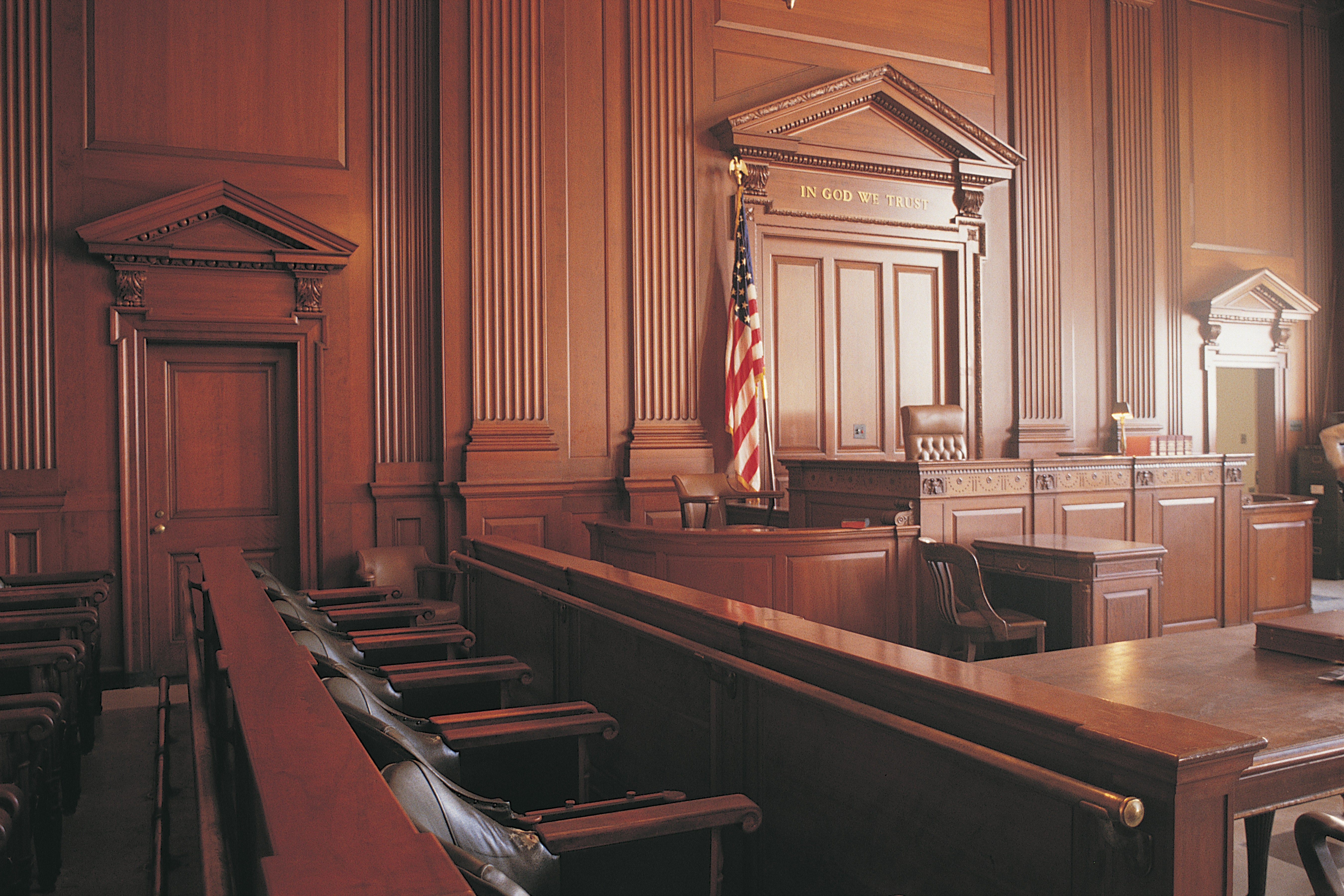
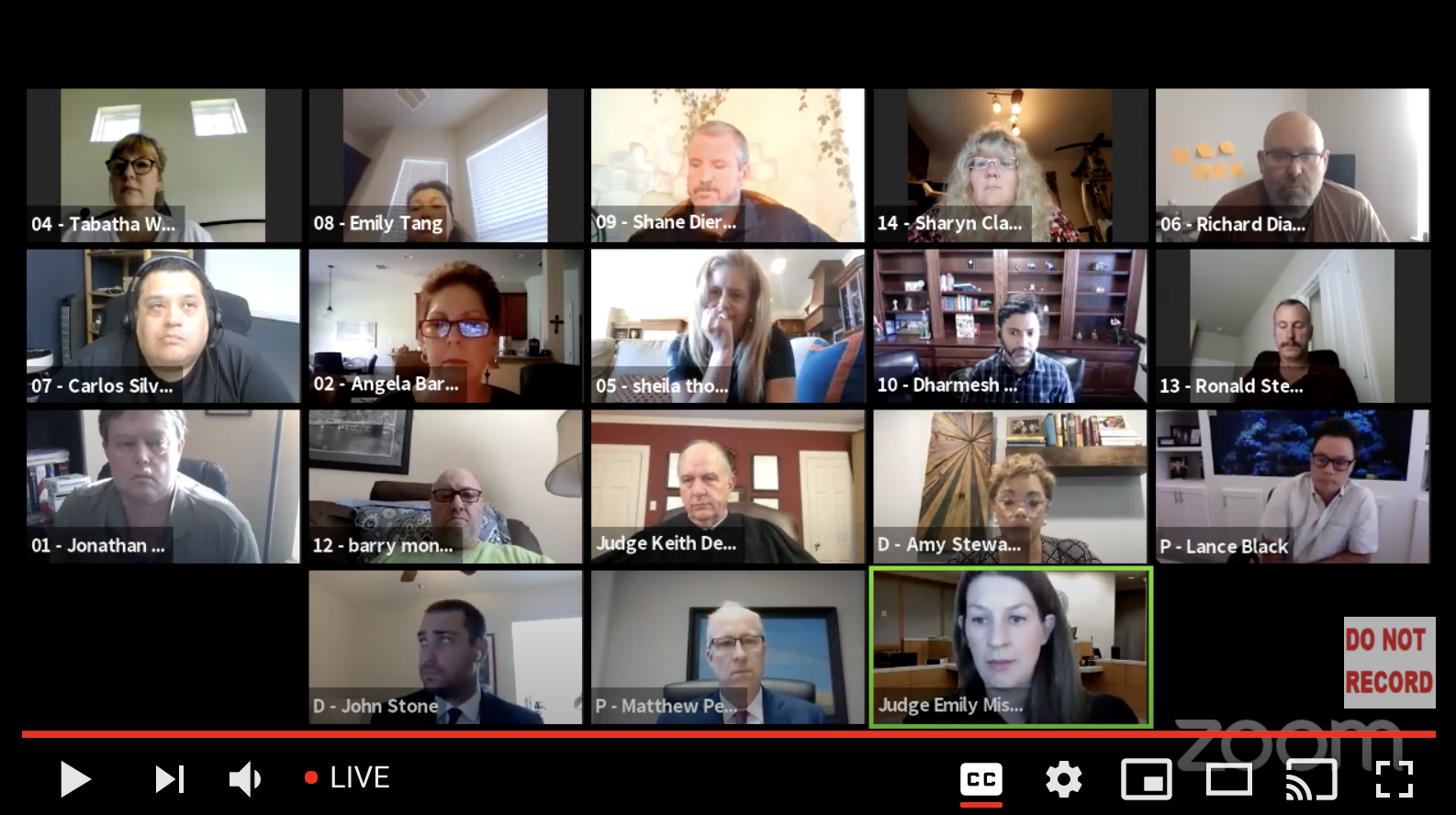
If you live in Texas, the coronavirus pandemic might not get you out of jury duty. Today, Collin County District Court is conducting what officials believe is the first virtual jury trial. The one-day summary judgment trial will be held via Zoom, with jury selection streamed via YouTube, Reuters reports.
Because of the format of this trial, jurors will hear arguments from both sides and offer a non-binding verdict. The parties will then sit for mediation and attempt to negotiate a settlement. This makes the case an ideal way to experiment with a virtual jury.
Judge Emily Miskel
According to the National Center for State Courts, 39 states and the District of Columbia have encouraged judges to conduct hearings remotely, but bringing in jurors poses another challenge. Arizona’s top court has already approved remote jury selection, and once jury trials resume in Indiana, parties in civil cases will have the option to conduct them remotely, Reuters says.
There are some obvious concerns to address before this becomes the norm. For starters, Zoom has been plagued by security issues, and it may be extra hard to keep remote jurors focused or prevent them from doing research during a trial. At the very least, this could pave the way for virtual jury selection so that people only have to show up in person if they are indeed selected.
Office buildings in downtown Midland and elsewhere were short on tenants during the 1987 oil bust.
Bob Daemmrich/BDP, Inc.
When Kathy Whitmire ran for Houston mayor in 1981, helicopters were among the top sources of municipal strife. Residents of the Memorial neighborhood were irate over the daily noise of west Houston businesspeople who opted to fly over the gridlocked freeways for their morning commutes.
That's just how over the top the Texas economy had become as oil prices skyrocketed in the 1970s and into the early 1980s.
Whitmire won the race. But a plunge in oil prices effectively resolved the noise complaints. And about about a year into office, her problems became bigger and more unexpected.
"All of the party was over," Whitmire said in a recent interview with The Texas Tribune. "At first, I thought this would be temporary."
Instead, the oil bust engulfed the decade.
She and other leaders across the state confronted an economic crisis for the ages, at least until the current oil bust and the COVID-19 pandemic ravaged the Texas economy this spring. The fallout forever changed Texas, but it also offers warnings and lessons for the anticipated trouble ahead.
It all started in 1973, when oil in the United States cost $3.89 per barrel. The state's image was already rooted in oil produced-wealth. But for the most part, oil was a bargain for most Americans.
Late that year, the cartel of mostly Middle Eastern oil-producing countries known as OPEC retaliated against the United States for supporting Israel in the 1973 Arab-Israeli war with a whopper of an oil embargo. Americans found themselves waiting in long lines at gas stations for a commodity that they had always taken for granted. Prices jumped, and the U.S. economy suffered.
Not so in Texas.
Money sloshed around the state as independent oil producers took out millions in loans to buy the equipment needed to drill from Kilgore to Wichita Falls to Midland. Manpower was needed not just in the oil patch but in the search for petroleum. Geologists, landmen and attorneys flocked to the state to find the underground reservoirs and to secure the mineral rights needed to drill.
And then there were the banks, jewelers and car dealerships that catered to the overnight millionaires.
Real estate soon emerged as the most noteworthy outlet for Texas money. With growth in commerce and in population, it seemed quite logical at the time to invest big in new housing developments, soaring skyscrapers in Dallas and Houston, shopping centers, and vacation condominiums on South Padre Island.
Out in the oil nerve center of West Texas oil commerce, locals nicknamed two-seater Mercedes convertibles "Midland Mustangs." In Houston, Rolexes were rechristened as "Texas Timexes." Prominent Houstonians were known to stagger out of business lunches flagrantly intoxicated. The most prominent of Texans shrugged off their lack of business pedigree and leveraged themselves to the hilt in oil and real estate. And one in every 20commercial Bell helicopters sold on the continent ended up in Houston — forcing the international airport to task an air traffic controller solely to juggle the chopper traffic, according to a Newsweek article at the time.
The only uncertainty in those days was just how high the prices of oil would go.
Then, everything fell apart.
Sick of high energy costs, Americans gave up their gas guzzlers and bought efficient cars. New fossil fuel discoveries in non-OPEC regions like in the North Sea only further glutted the oil supply. Texans who hoped OPEC itself might begin regulating its output only read in the news about dysfunctions and rivalries within the cartel.
The bottom hit in 1986. Oil was priced at $12.51, still high compared with 15 years before. But historical context was no help to oil producers who plunged deep into debt buying up rigs amid the frenzy to meet anticipated demand. The economic angel of death for oilmen came in the form of bankers calling in loans.
A real estate foreclosure auction on the steps of the Travis County Courthouse in Austin during the 1980’s oil bust.
Bob Daemmrich/BDP, Inc.
Real estate foreclosre auction on the steps of the Travis County Courthouse in Austin.
Bob Daemmrich/BDP, Inc.
A real estate foreclosure auction took place on the steps of the Travis County Courthouse in Austin during the 1980s oil bust.
Bob Daemmrich/BD INC
“The Dairy Queen was filled with the usual hardbitten but dejected crowd — noveau riche only a few months earlier, now nouveau bankrupt," Larry McMurtry wrote in his 1987 novel "Texasville," set in a bust-era fictionalized version of Archer City in northwest Texas.
And it was not just the small-town guys. Perhaps the most famous bankruptcy happened to a resident of the fashionable River Oaks neighborhood — former Gov. John Connally.
Connally, famously, was hit in chest with a bullet while riding in the same car as President John F. Kennedy in 1963. He would go on to serve two more terms as governor, then as a treasury secretary in the Nixon administration. After a party switch to the GOP, he ran unsuccessfully for president in 1980.
Former Texas Gov. John Connally had perhaps one of the most famous bankruptcies of the era.
Bob Daemmrich/BDP, Inc.
After Connally sold off his Austin home and Houston condominium to pay off debtors, national reporters descended onto Houston in 1988 to cover Connally as he tearfully auctioned off his possessions to pay off only a fraction of his debt. Items up for grabs included artwork, a parade saddle and the desk he used as governor. One attendee described it to the Associated Press as the "Super Bowl of auctions."
But he would not be alone in despair. The pain hit prominent Texans across the state.
Connally's longtime business and political partner, former Lt. Gov. Ben Barnes of Austin, also declared bankruptcy. So, too, did the energy company owned by Texas Rangers owner and Fort Worth oilman Eddie Chiles. The Dallas-based Hunt oil family went bust as well. Even George W. Bush, the old-moneyed son of the vice president, found his Midland oil company so deep in debt in 1986 that he sold it off.
But nowhere in the state bore the brunt like the Bayou City.
Suddenly, Houstonians were frantic to dump those helicopters. A pawnshop owner who found himself flooded with businessmen selling their Rolexes off to pay their mortgages firmly turned down an offer for a chopper.
"I wouldn't take it," pawnshop owner Keith Shaw told The Guardian Weekly in April 1986. "I never take things I can't store on these premises."
Another phenomenon sprouted up around River Oaks and downtown Houston: "see-through buildings," which were glassy, newly constructed skyscrapers in which a motorist driving by could see the sunset through the buildings because there were no walls, people or office furniture to obstruct the view.
On the residential front, Houston was bleeding out its tax revenue. With so many newcomers during the boom, once-rural towns like Katy evolved into bedroom communities. Many of these transplants lost their jobs, and their home values plummeted. Without family nearby, many surrendered their homes to the banks and left behind suburban ghost towns.
More ominously, food banks were still new institutions. In Houston and other big cities, food donations had traditionally been the work of scattered individual religious and nonprofit groups. The movement for a more organized food outreach strategy took hold in the early 1980s with the creation of food banks in the state's largest cities.
A group of physicians even traveled to Houston to study the hunger problem there. They found a dire situation in the refinery town Pasadena, sight of the “Urban Cowboy” premiere four years before.
"I was struck at the irony of a middle-class neighborhood, with neatly kept lawns, where people don't have enough to eat," Dr. Larry Brown of the Harvard School of Public Health told the Associated Press. "We saw a lot of once-stable families now in shaky circumstances."
The pullback of spending and real estate collapse exacerbated the problems. Tax revenues plummeted, and governments cut services. And in Houston, Whitmire and other leaders worried the city had lost its swagger.
So they took a cue from another city that was only beginning to recover from its own series of calamities: New York. After a catastrophic fiscal crisis, rampant arson and a 1977 blackout riot that destroyed parts of the city, New York implemented a public relations campaign with a new logo: "I ❤️NY."
Oil rigs in Brown County were idle during the bust of the late 1980s.
Bob Daemmrich/BDP, Inc.
It was a formative message to future U.S. Rep. Lizzie Pannill Fletcher, a Houston Democrat who was a River Oaks grade schooler in that era.
"Times were hard, but there was this bursting civic pride," she told the Tribune. Thirty years later when she ran for Congress, her campaign messaging echoed that boosterism.
Not everyone in Texas hurt, though. Many Texas communities and industries outside of the petroleum industry did just fine in the 1980s. Some even thrived, including bankruptcy and divorce attorneys and real estate investors who had access to cash to buy up distressed properties.
Many Texans who lived through the bust told the Tribune that some good did come of the misery. In Houston, community leaders from all walks of life who had never interacted with each other were forced to work together to find solutions, and the city remains stronger today for that, Whitmire said. And the food bank movement became more organized and effective, providing a lifeline to thousands hit by the current economic crisis.
In September 1986, The New York Times sent writer Robert Reinhold to Houston to capture a city in distress, and he came away with this impression: “For all its troubles, perhaps because of them, Houston seems a more human place.”
Public policy would change as well.
Republican Cyndi Taylor Krier represented San Antonio in the state Senate and saw firsthand as government officials dealt with the fallout.
"People kept their wits about them, and the good news was you still at that time didn’t have the partisan divide that we’ve all seen much more recently," she said. "There were Republicans and Democrats, but first there were Texans. People really were trying. You had disagreements, but it a wasn’t the anger and the distress and unwillingness to try to find common ground that is so sad now and will cost us in the long run far more.
"If this brings us back to that point where we put Texas ahead of partisan politics, as bad as this is, I think it will be worth it in a long term," she added.
Eventually, oil prices recovered.
In 1992, Houston was ready for its comeback party. The Republican National Committee chose the city for President George H.W. Bush's reelection convention. And by the mid-2000s, the cost per barrel would approach $100, albeit with 20 years of inflation factored in.
Many older Texans who lived through 1980s turmoil wince at the memories. Since those days, they made sure to keep some cash on hand for another crash. It's a sentiment Krier endorses for governments as well.
"If there’s one thing that Texans should know is that we live in a cyclical economy, whether it is oil and gas, or agriculture," said Krier. "You can’t assume you’ll always be on top of the mountain."
She pointed to the crisis as the genesis of the state's rainy day fund, a $10 billion state savings account that will lend state legislators some measure of relief when they convene again in 2021.
Now, though, Texans are looking into a new abyss, and it looks like a steeper fall ahead.
Tension between Russia and Saudi Arabia helped set off this new crash, but now with a worldwide COVID-19 lockdown, people are barely driving or flying.
As bad as the 1980s were in Texas, the state's unemployment rate rose only 3.8% over six years between January 1981 to January 1987. It topped out at 9%, which is surely an upheaval. The current unemployment trend lines are steep enough to make economists' blood run cold. Amid the pandemic, the price of oil even dropped into negative territory: Producers had to pay to get rid of it.
U.S. Rep. Lloyd Doggett, D-Austin, served in the state Senate during that previous crisis, and he pointed out to the Tribune that the COVID-19 economic crisis spills into nearly every sector of the economy.
The 1980s oil bust "affected particular sectors of our economy, but they didn't necessarily affect everyone everywhere, and so this is one where we really do all have a stake in how this all turns out," he said.
Retired U.S. Rep. Joe Barton, a Republican, came to Congress at the peak of the crash and devoted his career to the oil and gas issue. He warned that a return to past demand will not be immediate, even when the world returns to normalcy.
"Long term, the future's very bright for Texas and very bright for the oil sector, I'm guessing," he said. "It's just the next two to three years you just don't know how fast demand for energy will come back."
If there is any correlation to that time and what is potentially ahead for Texans now, it is this: Misery has company.
"There's no disgrace attached to losing your money in a bust like this one: it doesn't mean you did anything wrong, everybody's bust," columnist Molly Ivins wrote in 1986.
Canadian oil is now a U.S. election issue. Joe Biden's promise to cancel the Keystone XL pipeline raises the stakes for a long-delayed oil project. But things have changed since this project was a hot topic in Washington and Ottawa.
The tropical storm developed Saturday off the Florida coast and is expected to inch up along the mid-Atlantic region. It's the sixth straight year that such a system has developed before June 1.





/https://static.texastribune.org/media/files/3ad824a74f2121700d3f4375f8fcd241/Mail%20in%20Ballot%20Form%20Voting%20MG%20TT%2002.jpg)




/https://static.texastribune.org/media/files/36d5c0c04a582732d724d32cade3812d/1980%20Oil%20Bust%20BD%20INC%2001.jpg)
/https://static.texastribune.org/media/files/10b2c4a122f3d3dfc3fd2937e7e1a202/1980%20Oil%20Bust%20BD%20INC%2002.jpg)
/https://static.texastribune.org/media/files/905a491cd10c7529d5a2582d525f4a07/1980%20Oil%20Bust%20BD%20INC%2003.jpg)
/https://static.texastribune.org/media/files/4bd6fd04ab2f424abcaab5e947fb3c0a/1980%20Oil%20Bust%20BD%20INC%2004.jpg)
/https://static.texastribune.org/media/files/24a990b56929900f3eea66aee482d36e/1980%20Oil%20Bust%20BD%20INC%2005.jpg)


