Shared posts

01 Oct 23:19

For the Voter Who Needs an Abortion

by Sarah Gerard

Though we’ve known for four years that the 2020 US election cycle would be even more fraught than the strange and painful fall of the 2016 elections, most of us still find ourselves a little disoriented these days. For some, the urgency to remove Trump from office has immobilized us. For others, it’s fortified us into action to get out the vote and to sway those who are undecided, apathetic, and reluctant.

In the final five weeks before the election of a lifetime, we asked writers to consider the undecided voter and contribute compelling arguments and ideas for making the world right. Some contributors sent us work that takes on issues with precision and gravity. Others sent us different work, perhaps an even more visceral snapshot of this alarming moment — a one-act play, an open letter, a story of exile. New writing will be published weekdays; we believe its wisdom and strength will help us all navigate the uncertainty ahead.

- - -

I confirmed I was pregnant in the bathroom of the Grey Dog on Mulberry Street, the day after I found out my first book would be published, after months of rejection. My husband was unemployed, and I’d been working for two months at a magazine where I stared into a computer screen all day for a near minimum-wage salary.

I’d been married three tumultuous years. I was dreaming of an exit that I wouldn’t find for another three. Our marriage from the start was ill-conceived — we’d never dated; we were young and impulsive. We lived in a studio apartment the size of a prison cell. We called my parents from my husband’s car, parked across the street from our marriage counselor’s office, and asked them for $500.

I called in sick the day I took the second pill. I’d taken the first one the day before, and had carried my dead fetus for 24 hours. I lay crying in the bathtub with my husband, blood snaking through the water around us and dying it pink, waves breaking through my abdomen.

My grief seemed to stand in opposition to my politics. It was dark and overwhelming, my uterus a cavern. I bled for weeks. I was alone in my body and preoccupied with my perceived debt to my mother’s generation for the sacrifices and stands they’d made, which had won me freedom from unplanned parenthood. Admitting I was in pain was an unspeakable secret, something I thought I could never reveal, even to myself.

The persistent cultural stigma around abortion denied me the right to grieve properly, so my grief spilled out everywhere. Each successive failure to write about it only underlined the seeming banality of my abortion. I witnessed myself shoehorning it into the first paragraph of a book review, only to have the editor who had solicited me turn it down. “I had an abortion, too,” she told me. “But it’s really nobody’s business.”

The shame of it. I hoped to give my trauma at least some use. I grappled with the undramatic nature of it: I had not been raped, I was not a teenager, I was not homeless, I was not even single. At the time, I believed that I needed a justification. I don’t. Neither do you. I was forced to admit that my story was unremarkable. As it should be: nearly one in four women in the United States will have an abortion by the time we’re 45. Yet, 58 percent of us live in states where laws are hostile to abortion rights.

I have never wanted to be pregnant. Some women find the experience of bodily transformation fascinating; I did not. I felt as if my body had been stolen from me. I’ve had a conflicted relationship with my body since childhood: I struggle with gender and food. For these reasons, and others political, I’d prefer to become a parent through adoption.

It’s my choice — just as it’s my choice, on Election Day, to support the bodily autonomy of all people by voting Donald Trump out of office.

- - -

If you enjoyed this essay, please share it with an undecided voter in your life, and please consider contributing to Planned Parenthood.

To learn more about the Trump presidency, McSweeney’s is compiling a list of his misdeeds and is also tracking the Trump years, by the numbers.

- - -

Sarah Gerard is the author of the essay collection Sunshine State, and the novels Binary Star and True Love. Her work has appeared in the New York Times, Granta, the Baffler, the Believer, and the anthologies We Can’t Help It If We’re From Florida, Small Blows Against Encroaching Totalitarianism Vol. 2, Erase the Patriarchy, and Tampa Bay Noir. She lives in Florida with her partner, the writer Patty Yumi Cottrell.

01 Oct 21:26

Texas governor cuts back on voting locations weeks before election

Critics accuse the Republican governor of voter suppression, just weeks before the election.
01 Oct 20:49

Optional

by Cassandra Calin

Spoken like a true Romanian. ---- PORTRAIT GIVEAWAY : LAST CHANCE TO ENTER! For more details on how you can participate, check out the episode "Portrait giveaway" (ep. 292). Good luck, everyone!

01 Oct 20:48

Gov. Greg Abbott limits counties to one absentee ballot drop-off location, bolstering GOP efforts to restrict voting

by Emma Platoff
Frannie Griffin submits her ballot at Booker T. Washington High School in Dallas for the state’s runoff elections on July 14.
Frannie Griffin submitted her ballot at Booker T. Washington High School in Dallas for the state’s July 14 runoff elections. Credit: Shelby Tauber for The Texas Tribune

Sign up for The Brief, our daily newsletter that keeps readers up to speed on the most essential Texas news.

Gov. Greg Abbott threw the weight of his office Thursday behind Republican efforts to limit options for Texas voters who want to hand-deliver their completed absentee ballots for the November election — a rebuke to some large, Democratic counties that have set up multiple drop-off locations in what they call an effort to maximize voter convenience.

The Republican governor issued a proclamation directing counties to designate just one location for ballot drop-offs, and allowing political parties to install poll watchers to observe the process.

An unprecedented number of absentee ballots are expected to be cast this year as voters who qualify under Texas’ unusually strict vote-by-mail rules opt to avoid the health risks of voting in person. Republican officials have aggressively fought Democratic efforts to expand access to mail-in ballots during the pandemic.

President Donald Trump and many Republicans have sowed misinformation and confusion about the integrity of mail-in voting, which experts say is safe. With the U.S. Postal Service warning of potential delays, many Texans are eager to deliver their completed absentee ballots in person.

Harris County, the state’s most populous and a major Democratic stronghold, had designated a dozen locations where voters could deliver their own ballots — and already began collecting them this week. The locations are spread out across the county’s roughly 1,700 square miles, an area larger than the state of Rhode Island.

In Travis County, also a major Democratic stronghold, officials had designated four locations where voters could deliver their ballots.

“This is a deliberate attempt to manipulate the election,” Travis County Clerk Dana DeBeauvoir said Thursday at a press conference outside one of the county’s drop-off locations. Travis County officials say they plan to fight the order.

Lina Hidalgo, the Democratic Harris County judge, said “this isn’t security, it’s suppression.”

And Harris County Clerk Chris Hollins said “to force hundreds of thousands of seniors and voters with disabilities to use a single drop-off location in a county that stretches over nearly 2,000 square miles is prejudicial and dangerous.”

Democratic groups are weighing filing a lawsuit as soon as Friday challenging Abbott’s order, according to one party source who was not authorized to speak on the record.

The ballot drop-off locations are staffed, and voters must present an approved form of identification to deliver their ballots. They may not turn in ballots for other voters.

Voting rights advocates say Abbott’s move will make absentee balloting more difficult in a year when more Texans than ever are expected to vote by mail. Drop-off locations, advocates said, are particularly important given concerns about Postal Service delays, especially for disabled voters or those without access to reliable transportation.

“It raises a real concern that people are going to have just one more barrier to successfully submitting their ballot,” barriers that will disproportionately hurt voters of color and those with disabilities, said Mimi Marziani, president of the Texas Civil Rights Project, which advocates for voting rights among other issues. “And it opens the door to voter intimidation.”

Texas has extended the early voting period by six days and is allowing voters to drop off absentee ballots before Election Day, but has done little else to give voters more options for safely casting ballots during the coronavirus pandemic. Other states have allowed for universal absentee voting or even set up drop-off boxes where voters can deliver their ballots.

Abbott described his proclamation as an effort to “strengthen ballot security protocols throughout the state.” A spokesperson did not respond to questions about how allowing multiple drop-off locations might lead to fraud.

There is “not a shred of evidence,” Marziani said, that it would.

Abbott also announced that election clerks may collect absentee ballots only if they also permit poll watchers to observe the delivery of those ballots, “including the presentation of an acceptable form of identification.”

Nationally, the Republican Party is ramping up a multimillion-dollar effort to recruit poll watchers this year, the first presidential election in almost 40 years that the Republican National Committee has not been under a federal court order imposed to rein in the party’s “ballot security” efforts, which have a history of trying to intimidate voters of color.

In Texas, poll watchers are selected by candidates, political parties, or proponents or opponents of ballot measures — that is, people who have a stake in the outcome of the election. They must stand as silent sentinels and are not permitted to speak to voters or be inside voting booths.

But they, like voters themselves, are not required to wear masks to polling places this year, an exemption from the governor’s statewide mask order.

“These enhanced security protocols will ensure greater transparency and will help stop attempts at illegal voting,” Abbott said.

While there are documented cases of voter fraud in Texas, they are rare, and experts say absentee ballots are a secure way to vote this year.

The Texas Democratic Party slammed Abbott’s move.

“Republicans are on the verge of losing, so Governor Abbott is trying to adjust the rules last minute,” Democratic Party Chair Gilberto Hinojosa said in a statement. “We are creating a movement that will beat them at the ballot box on November 3, and there’s nothing these cheaters can do about it.”

Wesley Story, spokesperson for the liberal group Progress Texas, called the proclamation “a blatant attempt to suppress voters.”

Harris County has already begun collecting absentee ballots at a number of locations across the sprawling county. Abbott said that ballots collected before Oct. 2 remain valid, subject to earlier rules. In July, Abbott gave voters more time to deliver their absentee ballots in person, an option typically available only on Election Day.

Texas has maintained its unusually strict criteria for absentee ballots during the pandemic. Voters qualify only if they are 65 or older, are confined in jail but otherwise eligible, are outside of their county through the election period, or cite a disability or illness. The Texas Supreme Court has ruled that lack of immunity to the coronavirus does not itself constitute disability, but that voters must consider that alongside their own personal medical history to decide whether they are eligible. Election administrators do not have the power to vet a voter’s disability claims or demand documentation, but providing false information is a crime.

The question of absentee ballot delivery in Harris County is already being disputed in a legal challenge filed by Houston Republicans earlier this week. A group of candidates and officials including the Harris County GOP has asked the Texas Supreme Court to limit the locations where voters can drop off their ballots, as well as to shorten the early voting period Abbott has laid out. That case is pending before the court.

On Wednesday, the day before the governor’s proclamation, Texas Solicitor General Kyle Hawkins weighed in at the request of the court and backed Harris County’s efforts as lawful under the governor’s earlier orders.

Nothing in the law says that multiple drop-off locations cannot be used, Hawkins argued, and “accordingly, the Secretary of State has advised local officials that the Legislature has permitted ballots to be returned to any early-voting clerk office.”

Early voting is set to begin Oct. 13.

Disclosure: Progress Texas and the Texas secretary of state have been financial supporters of The Texas Tribune, a nonprofit, nonpartisan news organization that is funded in part by donations from members, foundations and corporate sponsors. Financial supporters play no role in the Tribune's journalism. Find a complete list of them here.

01 Oct 20:46

For Subway, A Ruling Not So Sweet. Irish Court Says Its Bread Isn't Bread

by Reese Oxner
Ireland

Yes, Ireland has a legal definition for bread. And the nation's Supreme Court said Subway's bread has too much sugar to satisfy it.

(Image credit: Joe Raedle/Getty Images)

01 Oct 19:42

Trump 'Will Not Accept Any Result That Is Not A Victory,' 'Atlantic' Writer Says

by Dave Davies
Voters cast ballots during early voting last month in Fairfax, Va. During the first presidential debate, President Trump would not commit to refraining from declaring victory until the election has been independently certified.

Atlantic writer Barton Gellman says the 2020 election could trigger a constitutional crisis: "This is not going to be a normal election. ... Preserving its legitimacy is going to take extra effort."

(Image credit: Tasos Katopodis/Getty Images)

01 Oct 19:29

People Have Ideas About What ‘Poll Watchers’ Do. Here’s What Texas Law Says They Can Actually Do

by Matt Largey, KUT
Before you grab your face mask and head down to your local polling place to “keep an eye on things," you should probably know what Texas law says about poll watchers. Some of it might surprise you.
01 Oct 16:37

Distaste for President Trump Confronts a Long Conservative Legacy in the Houston Suburbs of TX-22

by Dan Solomon
district-3-sri-kulkarni-troy-nehlsFor years, the tantalizing prospect of Texas becoming a “purple” battleground state has motivated Democrats—who have had their hopes dashed in election after election. However, the 2018 midterms showed cracks in the GOP’s hold on the state, with Democrats picking up congressional seats in districts that were drawn by Republican mapmakers to be easy holds. Now polling suggests that 2020 could see further gains by Democrats. While all eyes are on the presidential campaign, and, er, some eyes are on the surprisingly low-profile Senate race between GOP incumbent John Cornyn and Democratic challenger MJ Hegar, the fiercest battles in Texas are over seats in the U.S. House of Representatives. Four years ago, the state had just one competitive congressional race; this year, there are a…View Original Post

The post Distaste for President Trump Confronts a Long Conservative Legacy in the Houston Suburbs of TX-22 appeared first on Texas Monthly.

01 Oct 16:00

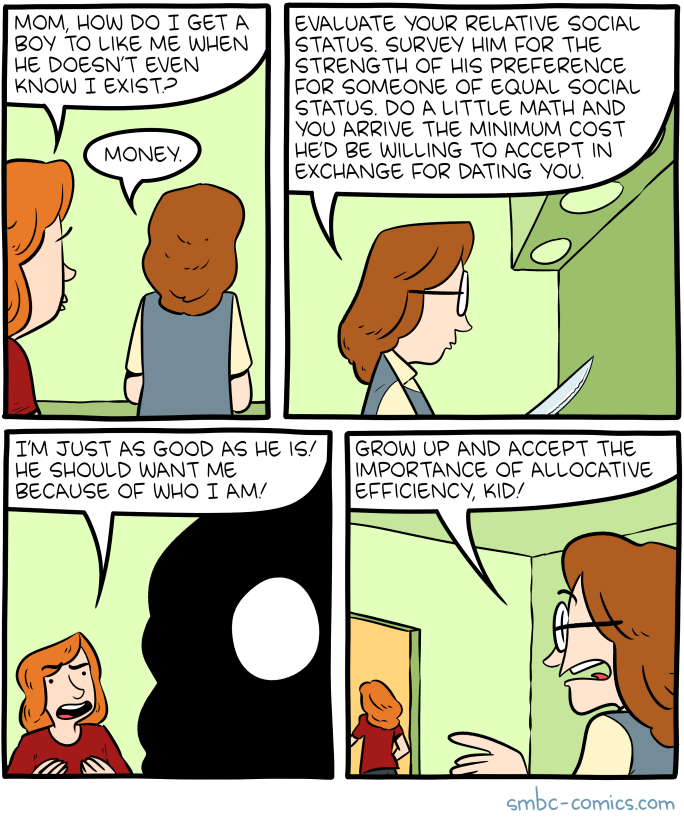
Saturday Morning Breakfast Cereal - Preference

by tech@thehiveworks.com


Click here to go see the bonus panel!

Hovertext:
Somewhere out there, and economist doesn't see what the joke is.


Today's News:
01 Oct 15:06

The next 'Super Smash Bros. Ultimate' fighter is Steve from 'Minecraft'

by Kris Holt

There’s always huge speculation around the identity of the next downloadable character for Super Smash Bros. Ultimate. Rumors prior to today’s reveal suggested the latest addition would be Tracer from Overwatch. Instead, Steve from Minecraft is joining the Smash lineup as a DLC fighter.

That’s right, SSBU is getting a crossover with the best-selling game of all time. Other Minecraft characters — Alex, Enderman and the iconic Zombie — will be available as alternative outfits. A Minecraft-themed stage and seven new music tracks will also be available as part of the crossover.

It looks like Steve can build structures on Smash stages using Minecraft blocks, and he’ll wield a pickaxe (of course). However, Nintendo didn’t delve into his fighting style in the announcement. It’s saving that for another stream, which takes place on Saturday at 10.30 AM ET (just ahead of Minecraft Live). That’s also when you’ll find out the release date for the fighter and the rest of the Minecraft DLC.

Steve and his cohorts are the second additions to SSBU through the Fighters Pass Vol. 2. The first was Arms pugilist Min Min. There are four other fighters on the way, and they’ll arrive by the end of next year.

01 Oct 14:52

Subway rolls ruled too sugary to be bread in Ireland

A court says the bread used in the firm's hot sandwiches must be taxed because of its sugar content.
01 Oct 11:49

GitHub can actively look for security holes in your code

by Daniel Cooper

GitHub, the Microsoft-owned code repository, has announced something that will hopefully make all our software much more secure. The platform has, after several months of testing, now launched code scanning, a system that will read through software looking for security holes. As the code is created, the system will now scan through it, highlighting areas that could be exploited in future. The hope is that, by catching errors ahead of time, the number of security incidents we all face could be reduced.

So far, GitHub has scanned 12,000 repositories 1.4 million times, with the company’s Justin Hutchings saying that it’s caught 20,000 security issues. That included holes that would have enabled remote code execution, SWL injection and cross-site scripting, of which 72 percent was fixed in the subsequent 30 days. Given that GitHub’s public libraries can be examined, worked on and adopted by lots of other GitHub users, that’s plenty of crises averted already. 

01 Oct 11:37

We’ve Had 56 Statewide Elections During The Pandemic. Here’s What We Learned From Them.

by Nathaniel Rakich

The 2020 primary season finally ended last month, meaning there have now been 56 statewide elections (presidential primaries, state-level primaries and even the occasional runoff) since the coronavirus outbreak was declared a pandemic by the World Health Organization in mid-March — dress rehearsals of sorts for opening night on Nov. 3. And while, through mid-July, these “pandemic primaries” had an inconsistent record of success, more recent elections have settled into more of a groove.

Here are three takeaways from a primary season like no other, and what they could mean for the general election:

1. Mail voting is still way up, but more people are voting in person

The most obvious change that states have made to the way elections are held during the pandemic is to encourage mail voting. Going into the year, 16 states did not allow anyone who wanted to to vote absentee, but only two (Louisiana and Texas) kept that restriction in place for their primary after the pandemic hit.19 And voters largely embraced the new method of voting: In every election except Colorado, Oregon and Washington (which already conducted elections by mail before the pandemic), a greater share of people — and usually many more people — cast absentee ballots in 2020 than in the equivalent election in 2016.20 Overall, in 44 of the 55 elections for which we have data,21 at least 40 percent of the ballots cast were absentees.22 And 15 of the elections were almost entirely (95+ percent) conducted via absentee ballot.

Mail voting spiked in 2020 primaries, especially early on

Share of ballots cast absentee in statewide elections held during the pandemic, and how much that share increased from 2016

Date State Absentee Access share Absentee Change from 2016
March 17 AZ Anyone could vote absentee 89% +8
FL Anyone could vote absentee 46 +16
IL Anyone could vote absentee 9 +6
April 7 WI Anyone could vote absentee 75 +65
April 10 AK Mailed ballots 100 +100
April 17 WY Mailed ballots 100 +100
April 28 OH Mailed instructions 99 +85
May 2 KS Mailed ballots 100 +100
May 12 NE Mailed ballot applications 84 +63
May 19 OR Mailed ballots 100 0
May 22 HI Mailed ballots 100 +100
June 2 ID Mailed ballot applications 100 +86
IN Anyone could vote absentee 51 +35
IA Mailed ballot applications 78 +59
MD Mailed ballots 97 +93
MT Mailed ballots 100 +30
NM Mailed ballot applications 63 +56
PA Mailed instructions 51 +48
RI Mailed ballot applications 83 +79
SD Mailed ballot applications 58 +44
DC Mailed ballot applications 71 +64
June 9 GA Mailed ballot applications 48
NV Mailed ballots 100 +89
ND Mailed ballot applications 100 +73
SC Anyone could vote absentee 22 +10
WV* Mailed ballot applications 50 +48
June 23 KY Mailed instructions 72 +69
VA Anyone could vote absentee 21
June 30 CO Mailed ballots 99 0
OK Anyone could vote absentee 14 +10
UT Mailed ballots 100
July 7 DE Mailed ballot applications 45 +42
NJ Mailed ballots or applications 88 +83
July 11 LA Excuse required 19 +16
July 14 AL Anyone could vote absentee 5
ME Anyone could vote absentee 60 +50
TX Excuse required 16
Aug. 4 AZ Mailed ballot applications 88 +4
KS Anyone could vote absentee 41 +28
MI Mailed ballot applications 65 +30
MO Anyone could vote absentee 15 +9
WA Mailed ballots 100 0
Aug. 6 TN* Anyone could vote absentee 10 +8
Aug. 8 HI Mailed ballots 99 +37
Aug. 11 CT Mailed ballot applications 59
MN Anyone could vote absentee 59 +45
VT Mailed ballot applications 73 +54
WI* Anyone could vote absentee 64 +52
Aug. 18 AK Anyone could vote absentee 36 +25
FL Anyone could vote absentee 60 +17
WY Mailed ballot applications 47 +25
Sept. 1 MA Mailed ballot applications 48 +40
Sept. 8 NH Anyone could vote absentee 30 +25
RI Anyone could vote absentee 41 +36
Sept. 15 DE Mailed ballot applications 43 +38

*2020 data is preliminary.

Elections highlighted in gray did not offer any in-person voting or offered it only to those who could not vote by mail (e.g., people with disabilities or without mailing addresses).

No 2020 data was available in New York, so it has been omitted from the table. No 2016 data was available in Utah. Alabama, Connecticut, Georgia, Texas and Virginia did not have a 2016 election to make an apples-to-apples comparison to.

Figures do not necessarily reflect the percentage of ballots cast by mail. Most states do not distinguish between absentee ballots cast by mail and those cast in person at a local election office. In addition, Arizona and Nebraska do not distinguish between in-person early voting and absentee voting.

Source: State election offices

But in recent months, there have been noticeably fewer of these universal mail-voting elections. Although a significant chunk of the electorate is still choosing to vote absentee, there have been more numbers like Connecticut’s 59 percent absentee-voting rate than Maryland’s 97 percent absentee-voting rate from earlier in the summer. Overall, 74 percent of voters cast absentee ballots in an average pandemic primary through the end of June — but only 50 percent have done so in the average statewide election since then. And that latter number would be even lower if it weren’t for the presence of states like Arizona and Washington that vote heavily absentee or by mail even under normal circumstances. The absentee-voting rate has increased by an average of 32 percentage points in primaries since July 1, whereas it increased by an average of 55 points in primaries between March 17 and June 30.

This may partly be because people have adjusted to our new reality and have grown more comfortable reengaging in in-person activities — from eating out to seeing friends to, yes, voting. But of course, it’s also because states are more open now than they were in the spring. For instance, as you can see from the shaded rows in the table, several states eliminated in-person voting altogether in their April, May and June primaries (although some still offered the option for voters who physically could not vote by mail, such as people with disabilities or without mailing addresses). And even those that did not, such as Kentucky, Montana, Nevada, New Mexico, and Washington, D.C., still decreased access to in-person voting by closing many polling places.

By contrast, every election since the beginning of July has offered in-person voting options, and some states were even able to open their full suite of polling places. A great example of this is in Rhode Island and Delaware, which opened 47 and 80 polling places, respectively, for their early-summer presidential primaries but, given more time to prepare sites and recruit poll workers, were able to open 280 and 286 polling places, respectively, for their state-level primaries in September. This also bodes well for in-person voting access for the general election; most polling places are expected to be open in most states.

Overall, the downward trend of mail voting suggests that the popular perception that the pandemic would prompt a national, predominantly mail election — an idea crystallized during the spring and early summer — is outdated. According to virtually every recent poll, only about 30 to 40 percent of voters are planning to vote by mail in the general election. Simply put, fewer people are voting by mail these days than in the first few months of the pandemic (though still a lot more than before the pandemic).

2. The pandemic isn’t depressing turnout

In the first few months of the pandemic, the effect on turnout was uncertain. The first four states to hold statewide elections during the pandemic saw their voting eligible population turnout rates decrease significantly compared with the equivalent election in 2016 — perhaps unsurprisingly, given that these states had so little time to prepare for holding an election amid a public-health crisis. (Of course, the fact that the Democratic presidential primary race ceased to be competitive around this time also probably contributed.) And although some spring primaries (e.g., in Iowa and Nebraska) broke turnout records, almost as many (e.g., in Indiana and Ohio) saw turnout plunge from 2016 levels.

But then, as the uncontested presidential primary drew to a close and state-level primaries began to dominate the calendar, turnout decreases were less common. In fact, every election after the Louisiana presidential primary on July 11 saw higher turnout than its 2016 equivalent — at least among those for which it is possible to make an apples-to-apples comparison.

Overall, through the end of June, turnout in the pandemic primaries was an average of just 2 percentage points higher than 2016 levels. But in elections after July 1, turnout was an average of 9 percentage points higher.

Primary turnout was generally higher in 2020 than in 2016

Turnout as a share of the voting eligible population in statewide elections held during the pandemic, and how much it changed from 2016

Date State Turnout Change from 2016
March 17 Arizona 12% -12
Florida 20 -9
Illinois 25 -14
April 7 Wisconsin 35 -14
April 10 Alaska 4 +2
April 17 Wyoming 4 +2
April 28 Ohio 21 -17
May 2 Kansas 7 +5
May 12 Nebraska 36 +13
May 19 Oregon 42 +1
May 22 Hawaii 3 0
June 2 Idaho 26 +11
Indiana 22 -15
Iowa 23 +14
Maryland 32 -1
Montana 46 +9
New Mexico 28 +5
Pennsylvania 30 -4
Rhode Island 16 -8
South Dakota 24 +4
Washington, D.C. 22 +2
June 9 Georgia 30
Nevada 22 +10
North Dakota 28 +4
South Carolina 20 +8
West Virginia 32 -2
June 23 Kentucky 31 +11
Virginia 9
June 30 Colorado 38 +21
Oklahoma 24 +12
Utah 27 +10
July 7 Delaware 17 -6
New Jersey 24 +1
July 11 Louisiana 16 -3
July 14 Alabama 17
Maine 25 +16
Texas 10
Aug. 4 Arizona 28 +7
Kansas 31 +11
Michigan 33 +15
Missouri 29 +5
Washington 47 +19
Aug. 6 Tennessee* 19 +8
Aug. 8 Hawaii 40 +16
Aug. 11 Connecticut 13
Minnesota 22 +15
Vermont 34 +10
Wisconsin* 22 +7
Aug. 18 Alaska 26 +9
Florida 25 +5
Wyoming 33 +6
Sept. 1 Massachusetts 34 +26
Sept. 8 New Hampshire 28 +10
Rhode Island 12 +3
Sept. 15 Delaware 25 +11

*2020 data is preliminary.

No 2020 data was available in New York, so it has been omitted from the table. Alabama, Connecticut, Georgia, Texas and Virginia did not have a 2016 election to make an apples-to-apples comparison to.

Sources: State election offices, United States Elections Project

To be sure, some of these turnout increases can be attributed to some of these primaries being much more competitive than they were in 2016. Massachusetts, home of the biggest turnout increase of all (+26 points), is exhibit A: The Democratic primary for Senate there was as bitterly contested as any election this year, primary or general. But plenty of states, frankly, had pretty boring primaries this year and still saw turnout rise.23

And it may not have escaped your notice that the states with the highest turnout rates included those that held their primaries predominantly by mail: Washington, Montana, Oregon, Hawaii, Colorado. Given that some studies have shown that mail voting boosts political participation, the increased popularity of vote-by-mail in 2020 is a plausible explanation for why turnout is up this year despite a deadly pandemic. That said, we’ll probably never be able to say so for sure, since there are also plenty of other potential factors. For example, Colorado opened its primaries up to unaffiliated voters, and Kentucky and Nebraska went from holding only one party’s presidential primary in 2016 to two in 2020, doubling the potential electorate.

But even if we can’t credit mail voting (and therefore, indirectly, the pandemic) for increasing turnout, we can at least be confident that the pandemic hasn’t lowered it (at least not since the spring). That’s reassuring as we look ahead to the general election, which before the pandemic was inspiring historic levels of voter enthusiasm. This led some analysts to predict extraordinarily high turnout in 2020, a forecast that now seems like it is on firmer footing given what we saw in the primaries.

3. Fewer problems are being reported

Finally, elections in the first few months of the pandemic were plagued by problems that threatened to disenfranchise voters — or else put them at risk of being exposed to the coronavirus. Of the 29 pandemic primaries from March 17 through June 23, at least 21 experienced problems of some sort. The most common issues were long lines outside polling places (which happened in at least 14 elections during this time frame) and voters not receiving absentee ballots they had requested (at least 11 elections).

But since June 30, more elections appear to have gone off without a hitch. According to my research, there have been reports of electoral problems in only 10 of the 27 statewide elections during this period (and while it’s possible I missed one or two, I follow this stuff pretty closely!). However, truant absentee ballots still remained a problem in Connecticut, Michigan, Minnesota, Missouri, Tennessee and Texas. And some polling places opened late in Delaware (for the state-level primary), Michigan and Tennessee thanks to machine errors or poll worker no-shows.

But other problems tended to be less severe than those reported in the spring. For example, while there were scattered social-media reports of lines at polling places in Delaware (both for the presidential primary and the state-level one), Missouri and New Jersey, they did not appear to be as widespread or interminable as those in, say, Nevada or Washington, D.C., in early June. And in Massachusetts, the biggest problem was that some voters were mailed the wrong ballot — a mistake that election officials quickly rectified by sending replacements.

In summary, it seems like states are getting better at avoiding election snafus — and hopefully this means they will be minimal in November.


The three evolutions that primaries have made since July — with regard to mail voting, turnout and problems with voting — are, of course, interconnected. The consistently higher turnout rates are probably related to the increased access to mail voting. However, the fact that fewer people are taking advantage of that option may explain why there have been fewer problems reported with recent elections. And the relatively smooth sailing in those elections may even have contributed to the higher turnout.

Altogether, the pandemic primaries suggest that the climactic election of 2020 will be heavily (but not predominantly) vote-by-mail, that turnout will outstrip 2016 and that there will be sporadic (but not crippling) problems with lines and absentee-ballot delivery. Based on other evidence, that’s a very plausible scenario for November. But of course, the general election is not a primary — and Trump is waging a campaign to undermine the election results — so any precedent for it is imperfect. Anything can still happen.

How Trump could spark a full-blown election crisis | FiveThirtyEight

01 Oct 11:29

Comic for 2020.09.30

New Cyanide and Happiness Comic
01 Oct 02:55

“This unfortunate situation”: Journal retracts bizarre paper about a black hole at the center of Earth

by Ivan Oransky
It was a paper that caught the attention — and bemusement — of Twitter: And now it is no more, along with four more articles from the Open Access Macedonian Journal of Medical Sciences in what was billed as a special issue on Global Dermatology. Here’s the whole title: “A black hole at the center … Continue reading “This unfortunate situation”: Journal retracts bizarre paper about a black hole at the center of Earth
01 Oct 02:50

Trump's Tiny Taxes

A totally refreshing 20 minutes or so of infotainment related to Trump, taxes and toy wooden arrows. | Subscribe to our weekly newsletter here.
01 Oct 01:05

Craziest Atari Collection Ever - Cinemassacre

by Cinemassacre

Mike Matei visits a crazy Atari collection. This guy Matt has a huge Atari collection that spans the entire run of the system. He even has a ton of imports, beta cartridges, and oddities. The original Atari, Inc., founded in Sunnyvale, California in 1972 by Nolan Bushnell and Ted Dabney, was a pioneer in arcade games, home video game consoles, and home computers. The company's products, such as Pong and the Atari 2600, helped define the electronic entertainment industry from the 1970s to the mid-1980s.

Check out Matt's Atari collecting Facebook page:
https://www.facebook.com/Matts-Atari-2600-collection-2019-408258329772318

See Mike Matei's live streams here:
https://www.twitch.tv/mikemateilive

Follow us on Twitter:
James - https://twitter.com/cinemassacre
Mike Matei - https://twitter.com/Mike_Matei
Ryan - https://twitter.com/schottr
Justy - https://twitter.com/JustySilverman
Kieran - https://twitter.com/Kieeeeern
Tony - https://twitter.com/HacktheMovies

Cinemassacre Shirts, DVDs, and Blu-rays: https://store.screenwavemedia.com/collections/cinemassacre

Merch on Amazon.com: https://amzn.to/2ORk1s8

Teespring exclusive shirts: https://teespring.com/stores/cinemassacre

Click to Subscribe: http://www.youtube.com/subscription_center?add_user=JamesNintendoNerd

#Atari #Collection #Cinemassacre #MikeMatei
01 Oct 00:59

Ecco the Dolphin (Sega Genesis) - Angry Video Game Nerd (AVGN)

by Cinemassacre

AVGN 1&2 Deluxe coming October 30th to Nintendo Switch and Steam!!
New Merch Store: https://store.cinemassacre.com
Wishlist on Steam: https://store.steampowered.com/app/1162960/Angry_Video_Game_Nerd_I__II_Deluxe/
Preorder on Nintendo Switch: https://www.nintendo.com/games/detail/angry-video-game-nerd-1-and-2-deluxe-switch/
Coming later to PlayStation and Xbox stores!!

Angry Video Game Nerd (AVGN) episode 183: Ecco the Dolphin. Ecco is an action-adventure game originally developed by Ed Annunziata and Novotrade International for the Sega Genesis and published by Sega in 1992. The original game followed the exploits of a young dolphin named Ecco as he searched the seas, and eventually time itself, for his missing pod. The game is known for being super unique with a great art style, but it's also known for being hard, frustrating, and unfair.

James Rolfe's Twitter: https://twitter.com/cinemassacre
Mike Matei Live Streams: https://www.twitch.tv/mikemateilive

Crew: Justin Silverman, Kieran Fallon, Antonio Piluso
https://twitter.com/JustySilverman
https://twitter.com/Kieeeeern
https://twitter.com/hackthemovies

Special thanks to Ecco creator Ed Annunziata!
His Twitter: https://twitter.com/edannunziata
Check out his new games:
https://www.spacewararena.com
https://www.facebook.com/bigbluegame

AVGN Theme Punk Cover by B PLOT:
https://www.youtube.com/channel/UCXnQbOMTk3PAbrajhlrjCtA
https://www.instagram.com/b_plot_punk/

AVGN Game Theme (for the trailer) by SiIvaGunner:
https://www.youtube.com/watch?v=-qccACqT8Ss
https://www.youtube.com/channel/UC9ecwl3FTG66jIKA9JRDtmg

Additional Footage from Frank Minichini (KingOfApoc):https://www.twitch.tv/KingOfApoc

--

Cinemassacre Shirts, DVDs, and Blu-rays: https://store.screenwavemedia.com/collections/cinemassacre

Merch on Amazon.com: https://amzn.to/2ORk1s8

Teespring exclusive shirts: https://teespring.com/stores/cinemassacre

Click to Subscribe: http://www.youtube.com/subscription_center?add_user=JamesNintendoNerdFollow

Angry Video Game Nerd Playlist: https://www.youtube.com/playlist?list=PL2B009153AC977F90

#AngryVideoGameNerd #EccotheDolphin #AVGN183 #Cinemassacre
01 Oct 00:01

Trump’s Chances Are Dwindling. That Could Make Him Dangerous.

by Nate Silver

President Trump’s quest to win a second term is not in good shape. He entered Tuesday night’s debate with roughly a 7- or 8-point deficit in national polls, putting him further behind at this stage of the race than any other candidate since Bob Dole in 1996.24

If we look at potential tipping-point states, the race is a bit closer, but not that much closer. After a couple of strong polls for Joe Biden earlier this week in Pennsylvania — the state that’s currently most likely to decide the election — Trump now trails there by 5 to 6 points. He’s down by about 7 points in Michigan and Wisconsin, meanwhile. Those states, along with Minnesota, Maine and New Hampshire — where Biden has also polled strongly lately — suggest that Biden is winning back some of the Obama-Trump white working-class voters who flocked to Trump four years ago. Indeed, Biden is as close to winning South Carolina or Alaska as Trump is to winning Michigan and Wisconsin, based on recent polls of those states.

At a time when Trump desperately needed a boost, the debate probably didn’t help him either — it may have hurt him. Every scientific poll we’ve seen had Trump losing the debate, some by narrow margins and some by wide ones.

That includes the poll FiveThirtyEight conducted with Ipsos, which surveyed the same group of voters before and after the debate. While the poll didn’t show a massive swing — most voters stuck to their initial preferences — more voters did rate Biden’s performance favorably, and Biden gained ground relative to Trump based on the number of voters who said they were certain to vote for him, roughly tantamount to a 3-point swing toward Biden in head-to-head polls.

How Trump could spark a full-blown election crisis | FiveThirtyEight

Now, I’m not predicting this will happen, but if Biden’s national lead were to expand to 9 or 10 points, which is consistent with the sorts of polling bounces we’ve seen in the past for candidates who were perceived to win debates — especially challengers debating an incumbent for the first time — Trump’s situation could become quite desperate.

To be clear, none of this means that Trump’s chances are kaput. As of this writing, our forecast still gives him around a 21 percent chance of winning the Electoral College. That’s not great, but it’s a lot better than zero.

But it’s possible Trump’s chances may decline further after post-debate polling begins to roll into our forecast. Furthermore, the mere passage of time helps Biden in our model, because every day that Trump doesn’t gain ground is a day when his fate becomes slightly more sealed. (Lots of people have already voted!) Case in point: In an election held today — Trump has no more time to make up ground — his chances would be 9 percent, not 21 percent, according to our forecast.

Then again, there are some possibilities that our model doesn’t account for, and they have become more pertinent after Trump has repeatedly refused to commit to a peaceful transfer of power and declined to commit to respecting the election results. As we wrote when launching the forecast:

We assume that there are reasonable efforts to allow eligible citizens to vote and to count all legal ballots, and that electors are awarded to the popular-vote winner in each state. The model also does not account for the possibility of extraconstitutional shenanigans by Trump or by anyone else, such as trying to prevent mail ballots from being counted.


Let’s back up for a second. This is FiveThirtyEight’s fourth presidential election campaign. And in the previous three, there was at least some question about who was ahead in the stretch run of the race. John McCain, for instance, briefly pulled ahead of Barack Obama following the 2008 Republican convention, and Obama didn’t really solidify his lead until early October. In 2012, national polls were very tight between Obama and Mitt Romney following the first presidential debate, and remained fairly tight thereafter (although Obama always maintained an Electoral College edge). And people forget how close the 2016 race was for stretches of the campaign; it was not such a huge upset. In fact, Hillary Clinton led by only 1.4 points in our national polling average heading into the first debate that year.

But there isn’t any of that ambiguity this time. Since we launched our general election polling averages on June 18, Biden has never led by less than 6.6 points nationally. Literally only one national poll — a Rasmussen Reports poll that put Trump ahead by less than a full percentage point — has shown Trump leading by any margin during that period. It’s been an exceptionally stable race.

But, amazingly, that hasn’t really shaken people’s confidence in Trump’s ability to win. In our own poll with Ipsos, we found respondents thought Biden and Trump had roughly equally likely chances of winning. And maybe that boils down to three perpetual sources of anxiety I hear in conversation with liberal friends or liberal readers:

  1. Trump could win the Electoral College despite losing the popular vote by a wide margin.
  2. There could be a large polling error in Trump’s favor.
  3. Trump could somehow steal the election.

All three are legitimate sources of concern for Biden backers. The first two are relatively easy to quantify, however. Indeed, the whole purpose of a model like FiveThirtyEight’s presidential forecast is to answer questions like those. The third one, however, is harder to get a handle on, so let’s talk about No. 1 and 2 first..

The Electoral College could still help Trump, but it only goes so far

The possibility of an Electoral College, popular vote split remains a point in Trump’s favor. In fact, there’s an 11 percent chance that Trump wins the Electoral College but not the popular vote in our forecast (but less than a 1 percent chance the other way around). At the same time, Biden’s strength in the Upper Midwest relative to Clinton’s — at least, if polls are correct there — potentially mitigates this disadvantage to some extent. The table below shows Biden’s probability of winning the Electoral College given various popular vote margins, according to our forecast as of Wednesday afternoon. And as you can see, Biden is only truly safe to win the Electoral College once he has a popular vote margin of 5 points or more! But, he’s a fairly heavy favorite with a 3- to 5-point margin, and has roughly break-even odds with a 2- to 3-point margin.

Biden’s favored, if he wins the popular vote by +2 to +3 points

Chances of Biden winning the Electoral College under different popular vote scenarios, according to the FiveThirtyEight presidential forecast, as of Sept. 30

POPULAR VOTE MARGIN scenarios Biden’s chances
of winning the ELECTORAL COLLEGE
Biden +6 to Biden +7 >99%
Biden +5 to Biden +6 98
Biden +4 to Biden +5 93
Biden +3 to Biden +4 77
Biden +2 to Biden +3 54
Biden +1 to Biden +2 29
TIE to Biden +1 11
Trump +1 to TIE 3
Trump +2 to Trump +1 <1

So, for practical purposes, you can take Biden’s lead in national polls and subtract 2 or 2.5 points from it to infer his margin in tipping-point states. In other words, if he’s ahead by around 7.5 points in national polls, that’s more like the equivalent of a 5-point lead in the Electoral College. That’s still a reasonably large advantage; empirically, it’s not that easy to overcome a 5-point deficit at this stage of the race.

A big polling error could help Trump … or Biden

One of the misconceptions I hear about FiveThirtyEight’s forecast is that “it assumes that polls are right.” Actually, in some sense the whole purpose of the forecast is to estimate the chance that the polls are wrong. In 2016, the polls did show Clinton ahead, but between tight margins in tipping-point states and the large number of undecided voters, there was a fairly high probability — around 30 percent, according to our forecast — that Trump was going to win anyway.

So while a polling error is possible — indeed, our forecast assumes there’s likely additional error this year because of an uptick in mail voting — it would still take a bigger error than in 2016 for Trump to win.

Assume that current polls hold until Election Day, and subtract 3 points from Biden’s margin in every state (roughly the average error in swing state polls in 2016) … Biden still wins Pennsylvania, Michigan and Wisconsin fairly comfortably, and therefore, the Electoral College; he’d also be a slight favorite in Arizona. And as our friends at the Upshot have calculated, even if you had a polling error of the exact same magnitude in the exact same states as in 2016, Biden would still win, albeit narrowly.

Of course, nothing intrinsically rules out a larger polling error. We had one in 1948 — when Dewey didn’t defeat Truman, after all — and in 1980, when Ronald Reagan won in an epic landslide instead of the narrow margin that polls predicted.

But there’s no guarantee such an error would favor Trump. Historically, the direction of polling bias has not been predictable from cycle to cycle; the same polls that underestimated Trump in 2016 tended to underestimate Obama and Democrats in 2012, for instance. If anything, to the extent there are polling errors, they sometimes come in the opposite direction of what the conventional wisdom expects.

I want to spend more time on this topic in the coming days, so I won’t go on at too much length here. But for now, know that a 7-point Biden lead on Election Day could, indeed, turn into a 2-point Biden popular vote win where Trump narrowly wins the Electoral College.

As I wrote earlier in the piece, our forecast gives Trump about a 9 percent chance of winning an election held today despite his current deficit in polls — not bad when you’re 7 points down! But it’s about equally likely that a 7-point Biden lead could translate into a 12-point Biden win, in which he’d not only carry states like Georgia and Texas, but would also have a shot in South Carolina, Alaska and Montana.

Trump’s comments on respecting the election outcome are deeply worrisome, but it’s hard to estimate his chances of overturning the result

Hoo, boy. At some point I’m going to have to write a column about this too, I suppose. As I said at the outset, our forecast assumes that the election is free and fair — at least to the extent that past elections that we used to train the model were free and fair. (Throughout American history, there has always been plenty of voter suppression and voter disenfranchisement.)

But for now, let me advance a few propositions:

  • Even a small probability that the U.S. could become a failed or manifestly undemocratic state is worth taking seriously.
  • There are a wide range of things that Trump could attempt to do, many of which would be quite damaging to the country, but they are not necessarily equally likely to succeed.
  • Trump’s actions are much more likely to actually change the result of the election if the outcome is close, and right now, the most likely scenario is that Biden wins by a not-so-close margin.

Beyond that, it’s hard to estimate the probability that Trump could steal the election to any degree of precision. It requires, at a minimum, some knowledge of the probabilities in a free and fair election plus some knowledge of election law and how many votes could realistically come under dispute plus some theory of the institutional incentives of the Supreme Court and various other courts plus some opinions on how Congress might interpret the Constitution in the event of a disputed election. Maybe a panel of experts could get together and try to put together some reasonable bounds on the probability of various scenarios, but I don’t know that any individual could — certainly not me.

After Trump’s actions over the past few weeks, though, I wonder if there’s some tradeoff between Trump’s chances of winning legitimately and his willingness to engage in authoritarian rhetoric and behavior, even if it probably wouldn’t succeed at stealing the election. It’s not like this is coming entirely out of left field; Trump also said in 2016 that he wouldn’t necessarily respect the election results. But his recent statements have come at a moment of increasing peril for his campaign. It’s hard to know for sure, but I think Trump’s comments might be more tempered if he were 2 points ahead in Wisconsin instead of 7 points down.

It’s not easy to see which cards Trump has left to play or which contingencies could work in his favor enough for him to win — other than if the polls have been wrong all along.

Consider that Trump’s convention produced, at best, a very meager bounce in his favor. His attempt to pivot the campaign to a “law and order” theme fell completely flat in polls of the upper Midwest. He’s thrown the kitchen sink at Biden and not really been able to pull down Biden’s favorables. His hopes that we’d turn the corner on COVID-19 before the election are diminishing after cases have begun to rise again in many states. His campaign, somehow, is struggling to hold on to enough cash to run ads in the places it most needs to run them. The New York Times and other news organizations are likely to continue publishing damaging stories on his taxes and personal finances from now until the election. And now he’s seemingly lost the first debate.

If Trump intuits that he’s unlikely to win legitimately — it’s not hard to imagine him escalating his anti-democratic rhetoric and behavior. It’s also not hard to imagine this rhetoric further eroding his position in polls. It’s highly unpopular in focus groups (yes, take those with a huge grain of salt) and Trump’s polling over the past several days has been particularly bad (although there’s been a lot of other news, too).

So we could be headed for a vicious cycle where Trump increasingly gives up on trying to persuade or turn out voters and voters increasingly give up on him. But from a polling standpoint, this is one of the clearer elections to diagnose: Biden isn’t home-free, but he’s in a strong position. Nonetheless, the outlook for what’s actually in store for America has rarely been more cloudy.

30 Sep 23:21

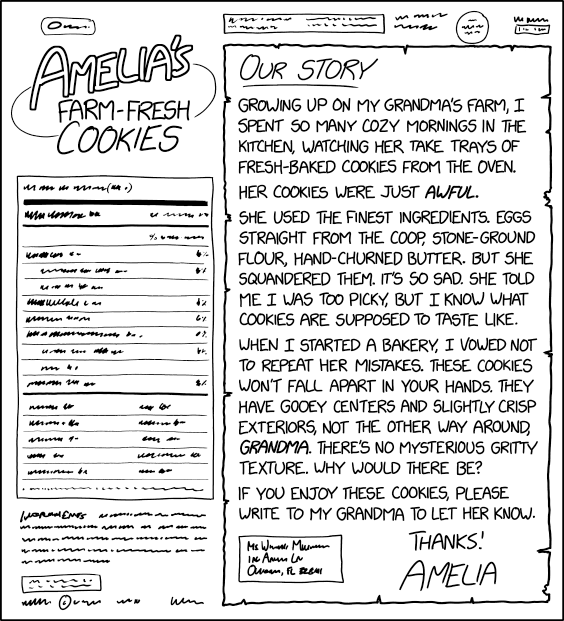
Amelia's Farm Fresh Cookies

I told her I'd take her address off the packaging if she'd stop submitting anonymous food safety complaints about my bakery to the health department, but she sent me a note that said NO DEAL along with an extra large batch of cookies.
30 Sep 22:14

Trump On Defensive Over White Supremacist Group After Debate Comments

by Deirdre Walsh
President Trump answers questions about his remarks in Tuesday

President Trump attempted to walk back his comments about the Proud Boys, a right-wing group he declined to disavow in Tuesday night's presidential debate. Some GOP lawmakers urged him to clarify.

(Image credit: Carolyn Kaster/AP)

30 Sep 21:47

Donald Trump denies knowledge of the far-right Proud Boys, despite telling them to ‘stand by’ during debate

It comes as the US Commission on Presidential Debates pledges to enact new measures to "maintain order" at upcoming events following Wednesday’s bitter encounter.
30 Sep 20:30

Portland, Ore., Sheriff Says He 'Will Never Support' President Trump

by Bill Chappell
During the presidential debate on Tuesday night, President Trump claimed the "Portland sheriff" supports him.

"Donald Trump has made my job a hell of a lot harder since he started talking about Portland," says Multnomah County Sheriff Mike Reese. The president claimed that the "Portland sheriff" supports him.

(Image credit: Matthew Hatcher/Bloomberg via Getty Images)

30 Sep 20:28

All My Clothes

by Reza
30 Sep 20:27

Why Didn’t Sauron Condemn the Orc Hordes?

by Tara Millette

“Donald Trump ruined the biggest layup in the history of debates by saying — not condemning white supremacists. I don’t know if he didn’t hear it, but he’s gotta clarify that right away. That’s like: Are you against evil?” — Brian Kilmeade, Fox & Friends co-host, 9/30/2020

- - -

Why didn’t Sauron condemn the orc hordes?

I’m totally puzzled, you guys. After being asked to comment on the orc hordes maiming and eradicating whole villages, Sauron kind of sidestepped the question and started talking about how orcs actually have great table manners? What does this mean?

And then, when later asked to clearly condemn the orcs and their violent extremism, Sauron went quiet and then blinked a bit before giving a weird coded message that only orcs can understand. Then all the orcs cheered and started repeating it? Anyone have a beat on this?

It’s strange, to say the least. On the one hand, it seems clear in multiple ways that Sauron is benefitting from their bloodlust, but on the other hand, he didn’t blatantly say, “I love orcs and fully support their massacres,” so I’m not sure what to make of it.

- - -

Why didn’t Bacteria condemn the warm
protein-rich environment in which it thrives?

I’m totally stumped. When asked to clarify some earlier statements on the hazards of humid and sugar-packed petri dishes, Bacteria kind of pivoted to talking about the hazards of dry alkaline-heavy areas? What does this mean?

I mean, I get that Bacteria might tangentially benefit from dank and dextrose-laden regions, but they’ve never come up to me personally and explicitly told me so. So, in that sense, I feel like, at the very least, it’s a wash?

- - -

Why didn’t Hades condemn the kidnapping
and forced marriage to his now-wife, Persephone?

I’m confused, folks. Hades is a real off-the-cuff kind of guy, granted, but I’m really unsure of why he won’t openly condemn his brother for kidnapping Persephone and essentially ordering her into marriage, thus shackling her to the duties of Queen of the Underworld.

Even though Hades profits directly off of these heinous circumstances, and the simplest explanation is that he’s just, like, “down” with it, there must be something else to it, right? Some reason, any other reason (except the very obvious one) for why he’s not speaking out?

I’d just hate to condemn his non-condemnation. I feel like that would be such a rush to judgment. I mean, then we’d have to start thinking that something’s up, and I’d hate to accidentally normalize something so terrible.

- - -

Why won’t the White Dwarf Star condemn
the accretion of its companion star?

I get that a White Dwarf Star essentially sucks the matter from a nearby star. I get that it does this in order to accrue mass. I also get that through this process the White Dwarf Star exponentially boosts its own gravitational force, creating a powerful and unstoppable cataclysmic variable.

But I don’t get why it’s so quiet about it.

You’d think it’d say something about sucking another star dry for its own gain. I just can’t figure out what’s stopping it from being so direct about it, y’know? It’s a real head-scratcher.

- - -

Why didn’t the Media condemn dancing around the truth?

I can’t figure this one out. Does it benefit the news Media to not call out what we all know to be true? Is it possible that in order to not face the full horror of what is right before us, they’ve decided to instead ask feeble questions like “Gosh, why couldn’t he condemn white supremacy?” and “Sheez, shouldn’t he have knocked that question out of the park?”

Is it possible that plainly stating that the President of the United States is a virulent racist might be seen as “disloyal,” and that scares them more than telling the truth?

Nah, that can’t be it.

After all, how would they benefit from all of that?

30 Sep 16:00

Maura Quint’s Presidential Debate Recaps: The One That Broke Us

by Maura Quint

First Presidential Debate
Case Western Reserve University
Cleveland, Ohio
September 29, 2020

- - -

9:03 PM: Moderator and Fox News anchor Chris Wallace opens the debate by welcoming the at-home audience in a calm cadence, blissfully and perhaps recklessly unaware of what is to come. He notes that this debate is sponsored by the Commission On Debates and is being conducted under the health and safety protocols of Trump’s America where, just like in Hollywood, being old — over 68 for men, and over 27 and a half for women — counts as an incurable preexisting condition, and anyone the audience sees coughing is likely going to die.

9:05 PM: The candidates enter the debate stage. President Donald Trump, debuting a fall-inspired bright new shade of sweet-potato skin tone, ambles to his podium like a lightly concussed gorilla. Former Vice President Biden walks out to put his arm around his opponent but stops when he remembers the social-distance protocols. So instead, he gets a little too handsy with his lectern.

9:07 PM: Wallace begins by asking Donald Trump about his Supreme Court nominee, Amy Coney Barrett. Trump says that she’s highly respected and that he won the election, so he has the right to elect her, and the Democrats would do the same thing in reverse if the ridiculous, clearly unprecedented scenario where a sitting Democratic president might happen to have the opportunity to nominate a justice right before a national election, if that were ever to happen, they’d clearly push through their nominee, whichever Tom, Dick, or Merrick that might be. Biden responds by politely chuckling.

9:09 PM: Biden praises Coney Barrett as a “very nice person” but adds that she would overturn the Affordable Care Act. Trump rolls his eyes and scoffs. Biden attempts to continue his answer. Trump sneers. Biden tries again. Trump chants, “You don’t know, you don’t know, you don’t know.” Biden throws his hands in the air, pulls his lectern to the side of the road, and looks back at the president. “Donald, will you just be quiet!?!” He takes a Ziploc bag of Cheerios from his pocket and hands them one by one to Trump, who immediately starts tossing them back at Biden. Also, the Cheerios are now inexplicably covered in mashed potatoes. Trump continues to whine: “Socialism, you’re a socialist — I saw you kissing Bernie Sanders in the Socialism Tree because you love it and you just lost the radical left because you don’t know and I know because I’m the smart one, I put smarties up my nose so they could go to my brain and make me extra smarts, you idiot dum dum SOCIALISM HAHA I WIN.” Chris Wallace coughs politely, then nervously glances at his production team for guidance, only to find they’ve already abandoned this shitshow and locked the doors behind them.

9:13 PM: Seeing no other alternatives, Wallace attempts to assert himself by puffing out his chest and saying in his best indoor voice, “Mr. President, I am the moderator of this debate, and I’d like you to answer my question, sir, please. You have had four years and have never come up with a comprehensive healthcare plan. What is your healthcare plan, sir, Mr., sir?” Trump pulls out a slingshot and nails Wallace directly in the forehead with a Cheerio. “I’m the best at healthcare,” he brags. “It’s because of me, insulin is so cheap, it’s like water, and the water’s so polluted it’s got all the drugs you need right in it, the fish, you know the fish don’t have any cancer anymore because of the drugs in the water, that’s because of me. See, don’t you like this water?” Trump casually pours a pitcher of water over Wallace’s head. Wallace, dripping but dignified, again says, “Sir,” in a voice just loud enough to momentarily panic a mother of a newborn but not actually forceful enough to wake a baby. The president puts Wallace in a headlock and gives him a noogie. “See, here’s my healthcare plan, it’s good, everyone says how good it is.” Wallace pleads, “You’ll be happy about this next question, I promise, you’ll like it — I’ll ask what you want, sir!” Trump releases him, smiling softly and shaking his head in the world-weary way of someone who just can’t stop giving of himself to others.

9:16 PM: Wallace turns to the former vice president. “Just answer how he wants you to answer,” he sighs. Before Biden can speak, Trump takes an air horn out of the cotton candy pompadour on his head and gives it a blast. Biden tries again, but then Trump pulls a pair of cymbals from the butt of his pants and clangs them together. Biden, beyond exasperated, says, “Look, this is—” but is interrupted by Trump riding a parade of elephants across the stage, whacking them with his little lunchmeat hands to get them to trumpet. “FOLKS!” Biden yells as Trump starts doing a brain-addled version of an Andrew Dice Clay routine through a megaphone. Finally, grabbing a micro-second pause, Biden says, “Would you shut up man. This is so unpresidential.” Seeing the opening, Wallace jumps in to say, “Okay, that’s over, next topic.”

9:23 PM: “Let’s turn to COVID,” Wallace says, but Trump already has him back in a headlock. “Goddamnit,” Wallace mutters. “Anything you didn’t like that I said? That was me being sarcastic,” Trump says. “Next topic,” Wallace whimpers.

9:38 PM: Trump, having been asked about the economic downturn, speaks for several minutes as though he’s just arrived on Earth and his only exposure to English was watching two hours of Fox News: “Violence and Democratic governors siege cities are seeing, like being in prison, close the whole country they heard there was a guy and the Democrats run these look at destroy economy will it with anti-Christian take your guns.” Wallace whispers, “What the fuck is happening?” Offstage, Jill Biden holds up a large portrait of Trump. The president wanders towards it, mesmerized by his own image. Biden quickly tries to take advantage of the lull: “Millionaires and billionaires like Trump have been doing well during this economic downturn, while everyone else suffers,” he says. “Trump couldn’t even be bothered to give school children masks.” Unable to hold it up any longer, Jill drops the portrait, and Trump saunters back to his lectern, declaring, “I get to speak!” Wallace reminds him he already spoke and that each candidate had equal time. “Not fair! Not fair — NOT FAIR!” Trump screams, ripping the microphone from its stand and throwing it into the crowd. It hits Melania in the face and spins her head 180 degrees. Without reacting, she calmly reaches up and repositions her head forward. Don Jr. scrambles to return Trump’s microphone to his podium.

9:45 PM: “Let’s talk about the tax returns, President Trump. How much did you pay in taxes in 2016?” Wallace asks. Trump answers that he paid “millions.” Biden says, “Show us your tax returns.” Trump responds, “I will as soon as I’m done fabricating them.” Biden says that when he’s president, he’ll eliminate the Trump tax cuts. “Oh, really?” Trump asks. “Why didn’t you do that before?” Biden is baffled. “Why didn’t I repeal the tax cuts you passed before you passed them?” he asks. Trump nods. Biden shakes head and says, “You’re the worst president we’ve ever had.” Trump replies, “No, you are!” Biden says, “I’ve never been president.” Trump nods, “Exactly!”

10:08 PM: As the debate turns towards issues of racism and violence, Wallace asks Trump if he is willing to condemn white supremacist militia groups. Trump answers that all of the violence he sees is from the left. Wallace asks him again if he would condemn white supremacists. Trump flippantly says he’d be willing, sure, and says, “Proud boys? Stand back and stand by.” Wallace moves on because that certainly isn’t a statement that would lead one to ask many more questions of a sitting president, and clearly requires no follow-up at all.

10:17 PM: “I’d like to talk about climate change,” Wallace announces, before taking out a match and lighting the stage on fire. “What do you believe about the science of climate change, and do you think your suit is flammable because this is all fucking going up. Let’s just recreate global warming right here. I’m fucking done.” Biden takes a swig of coffee and remarks, “This is fine.” Trump responds, “I want crystal clean water. For myself. There’s water in puddles for everyone else, which I gave them because I control the rain and no one ever gives me credit for that.” Trump then shouts that Biden “Wants socialism, the Green New Deal, and to take out all the cows!” Biden replies that he won’t be taking anyone out because he is married and that he absolutely does NOT want the Green New Deal. Trump smirks again, “See, ha, there: you just lost the radical left!” Biden retorts, “Can’t lose what you never even tried to have, pal!”

10:30 PM: Wallace is now walking around the smoking, smoldering room, trying every door. He has fastened a makeshift skeleton key out of his earpiece and a ballpoint pen and scans the room for any possible exit. Unfortunately, he asks one final question: “Voting, democracy, all that stuff: you for it or against it, or what?” Biden replies, “Voting matters, make sure you’re registered, we can all come together and make this country better,” as though he still thinks he’s in a presidential debate and not trapped inside a live horror show. Trump answers, “I’m not for it, this democracy thing, not going to happen, it’s all rigged, there’s no way to know who is gonna win, so let’s just assume I did because Joe’s obviously a loser.” “Mhm,” Wallace mumbles as the lock in the door in the back of the room finally gives way and he pushes it open. Running out the door with far more speed than you’d think his frail body could summon, he shouts something that sounds like, “AND THAT’S THE DEBATE, THANK YOU ALL AND SEE YOU IN HELL.”

- - -

Author Note

I wrote this because I promised you all I would. I did my best to make it funny because sometimes only through humor can we have the strength to look directly at horrible things. But I want to be clear, the debate last night was not funny. It was terrifying. The President of the United States of America refused to condemn white supremacists and, in fact, told them to “stand by.” He cast doubt on the fairness of the elections and scoffed at the notion of a peaceful transfer of power. If you took the minute to read this piece, please take another minute to double-check that you’re registered to vote and haven’t been removed from voter rolls. If you can, volunteer to be a poll-watcher. Call your local party affiliates and help with get-out-the-vote efforts. Help a college kid get a voting plan. Give a family member a ride to the polls. Do what you can, however you can — please take action. Thank you.

30 Sep 15:00

Portland, Ore., Sheriff Says He 'Will Never Support' President Trump

by Bill Chappell
During the presidential debate on Tuesday night, President Trump claimed the "Portland sheriff" supports him.

"Donald Trump has made my job a hell of a lot harder since he started talking about Portland," says Multnomah County Sheriff Mike Reese. The president claimed that the "Portland sheriff" supports him.

(Image credit: Matthew Hatcher/Bloomberg via Getty Images)

30 Sep 14:59

Found at Computer Reset - IBM 7496 Executive Workstation

by The 8-Bit Guy
30 Sep 13:09

Trump Derails 1st Presidential Debate With Biden, And 5 Other Takeaways

by Domenico Montanaro
President Trump ran roughshod over debate moderator Chris Wallace and his Democratic opponent Joe Biden — and crossed many lines in the process.

The president ran roughshod over debate moderator Chris Wallace and his Democratic opponent Joe Biden — and crossed many lines in the process.

(Image credit: Patrick Semansky/AP)

30 Sep 12:51

Will Such A Cacophonous Debate Change Any Minds?

by A FiveThirtyEight Chat

Welcome to a special, post-debate edition of FiveThirtyEight’s politics chat. The transcript below has been lightly edited.


sarah (Sarah Frostenson, politics editor): Last night marked our first real opportunity to see President Trump and Joe Biden go head-to-head, but it was very much unclear who was in control of the debate, given the interruptions and sniping. But let’s discuss what our takeaways are…

What surprised you the most?

geoffrey.skelley (Geoffrey Skelley, elections analyst): I guess I expected interruptions and “Trump to be Trump,” but the degree to which the debate couldn’t proceed without constant interruptions was pretty remarkable … er, tiresome.

julia_azari (Julia Azari, political science professor at Marquette University and FiveThirtyEight contributor): I’m surprised that I — and seemingly a lot of other people — are surprised. Trump did nothing out of character based on what we know. But somehow in a debate setting it rattled us. Norms are eroded, but we still, out of habit, expect something different in a debate.

geoffrey.skelley: Julia, that’s a fair point. Trump memorably crossed some lines in 2016, including in a town hall debate when he loomed behind Hillary Clinton while she was speaking. So I guess we should have taken what we expected to be the worst possible debate and then gone lower.

What’s the headline takeaway from this debate?

lee.drutman (Lee Drutman, senior fellow at New America and FiveThirtyEight contributor): The standard debate format has outlived its usefulness, at least for a while.

julia_azari: After years of people saying debates don’t really have a point, this one kind of really didn’t. There weren’t even coherent exchanges. The idea that I keep coming back to is that Trump used that chaos to keep the debate on his own terms.

geoffrey.skelley: Well, until the end when Trump once again refused to say he’d accept the results of the election, I would say it was the exchange about race relations that was headline grabbing for me. Chris Wallace, the moderator, asked Trump to condemn white supremacists and right-wing militias, and Trump instead said, “Proud Boys, stand back and stand by,” a reference to a white supremacist group.

That organization is apparently very happy to be mentioned by the president, too, and may view it as a call to arms ahead of the election.

lee.drutman: Geoffrey, I think “exchange” is a generous term for what was happening.

julia_azari: Trump reframed the question on race so completely that nothing substantive was said about structural racism. Trying to push Biden to defend the Obama administration and take positions that might divide Democrats didn’t really work. That said, I think it does show that Trump’s one area of success might be in shaping how people talk about politics and what the salient issues are.

The fact that he’s the incumbent president at a time when 200,000 people are dead from the coronavirus means it’s a feat that the entire debate is not devoted to his record on that alone.

Did Trump help his case?

lee.drutman: Trump’s case, as I understand it, is that Biden and the Democrats represent a radical left threat to America. He tried to goad Biden into that, but Biden didn’t take the bait. So in that respect, I don’t see how Trump helped his case.

geoffrey.skelley: I think the fundamental problem for Trump is that he’s down by 7 points nationally and trails in most of the swing states. So Trump needs to expand his base by winning over some undecided voters — who probably weren’t watching, but will hear about the debate tomorrow — or convert some Biden supporters.

He certainly tried to argue that Biden is a leftist or that he’s in league with radical socialists. He also tried to attack Biden on “law and order” by claiming that Biden wants to defund the police. But Trump’s campaign has been trying these lines for months without much apparent success, including at the GOP convention. Why would it work now?

Perhaps more people are paying attention now and some lower-information voters could be brought in by his appeals, but even then I’m pretty skeptical.

Did Biden lose any ground tonight?

lee.drutman: No, I don’t think we’ll see any movement in the polls. These are two candidates who are extremely well-known at this point, and everyone knows their strengths and weaknesses, and nothing we saw did anything to change those deeply-held views.

julia_azari: I think Biden’s temperament and demographic profile allowed him to get a bit angrier than, say, Hillary Clinton could when facing off against Trump in 2016.

I wouldn’t say that debates have been Biden’s best format in the 2020 cycle, but he came off more or less as expected.

lee.drutman: And if you are an undecided voter from a cave just tuning in, you went back into your cave and planned to hibernate for another four years.

julia_azari: I saw some Twitter grumbling about Biden’s statements about the police, but his position on those issues are well-known, so the fact that he didn’t strike a more progressive stance wasn’t particularly surprising.

geoffrey.skelley: Biden was pretty weak early on, but at the same time, it wasn’t all that different of a performance from the ones he had in most primary debates, either. And like Lee said, things are pretty baked in at this point. Moreover, challengers have tended to gain after the first debate, so if the polls do move, it’s possible that Biden might gain instead of Trump.

Did you learn anything new?

julia_azari: I don’t think I learned anything new, but this feels like a new low. Debates are an important exercise in legitimate opposition, and the norms that candidates follow seemed unimportant … until they were gone.

lee.drutman: My priors going into tonight were: 1) Biden is sluggish and sometimes incoherent; 2) Trump is often all over the place; and 3) American democracy is in a dark place in 2020. I’m not sure that changed after tonight, to be honest.

geoffrey.skelley: I don’t think we can entirely rule out some poll movement, but I’d be pretty amazed if it shifted the state of the race to a noticeable degree. And even if it does, that might be ephemeral. Our forecast model anticipates that a post-debate change might be temporary and that the polls could return to the pre-debate equilibrium. So I think we’ll have to wait and see.