Cowboy Who?
Shared posts
Here Are Ten Facts About International Men’s Day, As I Solemnly Walk into the Ocean
1. International Men’s Day (IMD) takes place every November 19th, so a heavy jacket is best if you plan to celebrate outdoors or—like me—solemnly walk into the ocean.
2. International Men’s Day links to anti-feminist literature that calls laws to protect women from domestic violence “anti-family.” You can read more about this by wading into the “about” section of their website, much like I wade into the salty brine of the Pacific.
3. IMD’s Facebook group reposts misogynist articles, sending a chill down my spine. Or maybe it’s the 60ºF seawater numbing my feet and ankles?
4. IMD was founded in 1999. Speaking of dates, Virginia Woolf drowned herself in 1941.
5. The 2021 theme for International Men’s Day is “Better Relations Between Men and Women.” This gives me pause, knee-deep in the foam-crested waves. Perhaps the organization has had a feminist epiphany?
6. Ah, never mind. There is no elaboration on “Better Relations.” It remains vague and ominous like the cavernous depths that lie ahead of me.
7. IMD quotes Camille Paglia as saying, “Masculinity is risky and elusive. It is achieved by a revolt from woman.” I would send you articles about who Camille Paglia is, but my cellphone is non-functional, having revolted from all the water in my pockets.
8. As I dunk my head, my eyes burn and I feel as if my brain is exploding—not because of the water but because I remembered that International Men’s Day is googled most often not in November but in March, on International Women’s Day.
9. Warwick Marsh, the coordinator of IMD, was fired as the men’s health ambassador of Australia when he called homosexuality a “gender disorientation pathology.” If you visit the web page, you’ll be greeted by a video of Marsh on the beach. Not the beach from which I walked myself into the tide, the kelp tangling itself in my hair. Same ocean, though.
10. November 19 is also recognized by the UN as Women’s Entrepreneurship Day. WED’s organizers have helped thousands of women get education, scholarships, and microloans to increase equity around the world. … I gently float in the water. … It was officially made a holiday in New York in 2014. … I gaze up at the sun glittering through the surface. … It was declared by Andrew Cuomo. … As I sink to the sea’s floor, I am comforted by the sight of a seahorse on paternity leave caring for his young.
Draco Malfoy’s College Recommendation Letter That I Totally Don’t Feel Conflicted About Writing Whatsoever
To Whom It May Concern,
As Director of College Counseling at Hogwarts School of Witchcraft and Wizardry, it is my unique privilege and contractual duty to recommend Draco Malfoy for admission to your venerable institution. He is a keen and resourceful scholar-athlete with a steadfast allegiance to the wizarding tradition.
Hailing from Wiltshire, Draco is the youngest in a long line of Malfoys to grace our hallowed halls (his father Lucius, a philanthropist and war veteran, served on the Hogwarts Board of Governors). While he would willingly admit that being a Malfoy has its benefits, Draco has endured his share of adversity as well. While we welcome diverse perspectives into our classrooms, dormitories, and floating candlelit Great Hall, the Hogwarts student body is increasingly progressive. For an openly conservative student like Draco, being fully understood and appreciated by one’s peers can sometimes pose a challenge.
Draco is popular with his peers in Slytherin House. However, Draco’s efforts to make new friends “across the aisle” were often rebuffed. From the moment he met his new classmates aboard the Hogwarts Express, he was forever marked, as if he had a scar on his forehead. Unfortunately, he has suffered retribution at the hands of classmates (punched and hexed on multiple occasions), creatures (attacked by a hippogriff), even professors (transfigured into a ferret).
But rather than retreat into the shadows, Draco proudly embraces his position on the margins. He is fearless in classroom discussions, eager to play devil’s advocate. Whether in Potions, Herbology, or challenging other students to late-night duels, his spirited engagement motivates other students to bring their A-game, thus elevating the communal learning experience. His leadership and prowess extend to his extracurricular activities as quidditch seeker, Slytherin House prefect, member of the elite Inquisitorial Squad, and other, more ambitious pursuits. (Please note these pursuits, while technically impressive for his age, were not Hogwarts-approved activities.)
Some might say Draco is the living embodiment of the Campsite Rule, staunch in his commitment to leave Hogwarts a purer institution than he found it.
I would like to address the disciplinary infraction that appears on Draco’s record. In his sixth year, Draco attempted to assassinate Hogwarts Headmaster Albus Dumbledore on multiple occasions. Admittedly, this is a serious matter. As Draco will detail in his application essay, Lucius Malfoy was sentenced to Azkaban prison the previous year. For Draco, losing his father at such a pivotal moment in his life was devastating. He grew despondent and, in a moment of vulnerability, fell under the influence of the Death Eaters gang. For his initiation, Draco was ordered to assassinate his headmaster (though, to clarify, he was not technically responsible for Dumbledore’s death). Because Draco was forthcoming about his actions and showed appropriate remorse, he remains in good standing at Hogwarts and is somehow still eligible to graduate this year. As a side note, his determination to fix a broken cabinet that acted as a portal for Death Eaters to enter Hogwarts, despite being technically against the rules, showed that he is both persistent and surprisingly handy.
A student like Draco Malfoy comes but once in a lifetime. In light of what he’s accomplished during his time at Hogwarts, I readily and freely offer him my maximum recommendation, and at no time has a member of the Malfoy family threatened to perform an unforgivable curse on me or my family if I did not do so.
Please don’t hesitate to reach out if you have any questions. It is my understanding that Draco has already met with the Vice President for Major Gifts and the Head Varsity Quidditch Coach.
Very sincerely,
Juniper Silverthorne
Director of College Counseling at Hogwarts School of Witchcraft and Wizardry
UPDATE: Due to damage incurred during the Second Wizarding War, the Hogwarts Registrar’s Office has been decimated. As a result, there are significant delays in fulfilling transcript requests. We kindly ask for your patience and understanding at this time. These delays are through no fault of our students, especially Draco Malfoy.
Hawaii stream that smells like beer turns out to be alcoholic

There's a stream in Waipio, Hawaii on Oahu that reportedly smells so much like beer that a representative from Envirowatch Inc said: "You would think it was a beer pub that hadn't opened its doors for three or four days."
Scientists recently analyzed the flowing water and, indeed, it turned out to be 1.2 percent alcohol. — Read the rest
'The NFT Bay' Shares Multi-Terabyte Archive of 'Pirated' NFTs


Read more of this story at Slashdot.
State Sen. John Whitmire announces he will run for Houston mayor in 2023

/https://static.texastribune.org/media/files/b43e2ed2186776e2a34b54df66505ad5/Senate%20Democratic%20Caucus%20SP%20TT%2006.jpg)
I can almost imagine what it must be like to have a dad who loves you
Yesterday, I posted this to Instagram.

My caption said that I could tell just by looking at those two guys that they used to be cool.
That’s a reference, a call back, to something that happened when I was sixteen. I’ve written about it in at least one of my books, and it’s come up at conventions over the years. But I gather from 24ish hours of comments at Facebook and on Instagram that many of you don’t know what I was talking about.
Allow me to tell you a story that I just love to tell.
When I was a kid on the Enterprise, I idolized Frakes. I wanted to be just like him. I wanted to do everything he did. I wanted to be as cool, as kind, as confident, as Frakes was. Because I looked up to him so much, so did Wesley Crusher. Like, Wesley does The Riker when he sits in chairs because I thought it was cool that Frakes did The Riker when he sat in chairs. Nobody ever asked me about it, but I was ready to defend that choice with my dying breath. Those times Wesley and Commander Riker were on some assignment together were my favorite, because it meant I got to spend my whole day with him at work.
Anyhow. One day, we wrapped at the same time and I just about plotzed when Frakes asked me if I wanted to walk to the parking garage together. Like just imagine. You’re in high school and the coolest person you know, the person you IDOLIZE is just casually like, “hey, want to hang out?” I grabbed my backpack, made sure I had the keys to my car in my pocket, locked my dressing room behind me, and we walked across the back lot, to the garage, together.
I can’t recall exactly what we talked about. It was probably stuff that happened at work that day, and I feel like he asked me about Depeche Mode, which was my absolute favorite band in the world at that time. What I remember like it just happened was how good he made me feel. Frakes made me feel seen. He made me feel valued, and loved, and worthy. I couldn’t have articulated it at the time, but he made me feel the way a loving father makes his kids feel.
As you know, I did not have a loving father. I had a bully. And it sucked. So the time I got to spend with Frakes was like water to a captain who is dying in a cave on some asteroid or whatever.
So we got to the garage, and it turned out that even though our call times were hours apart, we’d parked right next to each other, a few spaces up the ramp from our captain. Frakes pointed to Patrick’s Jaguar. “You know he got that because the car you bought was slightly better than his, right?”
I had heard this around the set, and it was as hilarious as it was unbelievable. But it was true. In 1988, Patrick bought a pretty standard Honda Prelude, and I bought a ridiculously pimped out Honda Prelude si4WS. In TNG lore, it has become known as “Wil Wheaton’s Slightly-Better-Than-Patrick Stewart’s Prelude”.
I told him I had heard that, and that I felt a little badly about it. Again, he pointed to Patrick’s fancy, expensive, luxury car. I wish I could recall his precise words, but he said something about Patrick going all-in on a fancy car, to ensure he didn’t get shown up by the Teen Idol again.
The walk to the parking garage was brief. Like, maybe five minutes. In that five minutes, Frakes was just so kind and gentle with me. He treated me like a peer, like a person he cared about, like a person he genuinely liked. I felt so safe with him, like I could tell him anything.
I never, ever, not once, felt any of those things from the man who was my father. The man who was my father made a choice when I was young to withhold all of those things from me (he gave them freely and generously to my brother and sister so I know he had them to give), and at sixteen years-old, it was getting harder and harder to pretend that he didn’t treat me differently than he treated my siblings. I began to believe that there must be something wrong with me, and if I could just figure out what it was, I could earn his approval and maybe his love. SPOILER: I could not, because it was never about me. It was always about him.
So Frakes and I are standing in the parking garage and I don’t want to get in my car and go home. I want to stay there and talk with this adult who treats me like I’m a good person who is worthy and valued and seen. And before we part ways, I want to convey to Frakes that, if he were my age, I would want to hang out all the time. I want to communicate to him that he’s a role model for me, that he’s made me feel so good about myself, and that I valued the walk to the garage he’d invited me to be part of with him.
So I gather up all my courage and communication skills, and I say, “I can tell just by looking at you, that you used to be cool.”
Frakes laughed that wonderful, boisterous, joyful laugh of his and said, “What do you mean ‘used to be’?”
I was mortified. I was an awkward nerd (yeah, WAS) and I wasn’t good with words in the best of circumstances. I stammered and sputtered and tried my best to explain what I meant. I don’t remember what was said, but I remember that he got it. He knew what I meant, and he received it with kindness and grace.
The next morning at work, we were all on the bridge, the entire cast. We were either just finished with or about to start a rehearsal, and Frakes told the entire cast and crew what I’d said in the garage. EVERYONE laughed … and here’s something really important: nobody was laughing AT me. Everyone was laughing at the idea that Frakes, who was beloved by everyone with good reason, “used to be cool”, according to the kid.
I remember that I didn’t feel embarrassed or humiliated or stupid. I felt a little sheepish, but I didn’t feel judged by anyone.
Can I just tell you how different that was from how I felt at home? For as long as I could remember, the man who was my father would single me out for ridicule, humiliation, and embarrassment. He reveled in making me feel small, unworthy, stupid, and not just worthless to him, but objectively worthless. He laughed and laughed and laughed when he did these things. My brother and mother joined him. Only my sister did not. Guess who remains in my life from my family of origin?
One of the things I’d learned in my family at home was that I couldn’t speak up when something upset me. My parents always turned what someone (usually one of them) had done to me into something that I actually deserved, or was somehow my fault. So the very, very few times I spoke up to my mother about how much her husband was hurting me, it was a big deal. It took courage, and effort. It was also a total waste of courage and effort. “Oh, he’s just teasing you,” she would say. “Try not to be so sensitive,” was a popular bit of unhelpful advice. And always, ALWAYS, it was somehow my fault that he hurt me.
I imagine that’s a bit of a trigger for some of you reading this. I see you, and I’m sorry.
One of the things I saw for the first time that morning on the bridge, while my Star Trek family laughed together with me, was that what the man who was my father did wasn’t “teasing” like my mother said it was. It was bullying. It was hurtful. It was cruel. It was a choice to humiliate and ridicule me for his own gratification. He never did it to anyone else. He only did it to me. And it was her choice to ignore it, enable it, and make it somehow my fault for being hurt by his cruelty. I would spend over two decades in denial about all of this, but that morning, I saw it clearly for the first time.
For months after that day in the garage (indeed, to this very day), Frakes would joke with me about how he used to be cool. He told the story at conventions when we were together, he asked me to tell the story when we were in mixed company. And he always gave me a little shit about it, in a loving, gentle, dare I say fatherly way. And whenever he did, I felt loved. I felt like I was in on the joke, because he made sure I was. For 35 years, we’ve told this story, and it always brings joy to us both.
I look at that photo of us together from yesterday, and I can almost imagine what it must be like to have a dad who loves you, who makes you feel like you’re enough, who wants you to succeed and is proud of everything you’ve worked so hard to achieve.
I am so grateful for my Star Trek family. I am so grateful for this memory.
Are you a friend of Tom?

MySpace Safety
51 Tips For Teens and Parents
Farnham and Farnham
2006
It’s been a while since I came across a MySpace book in the wild. I have a feeling I am probably the first one to check this book out in over a decade. Aside from the less than inspiring cover, this book probably did an adequate job explaining the basic security and privacy concerns. Why it is still hanging out in a public library collection is beyond me. This is one of those obvious weeds. Even if your particular service population is all about MySpace, I doubt this book from 2006 is any help.
I did take a peek at MySpace and it doesn’t even resemble the MySpace of 2006. The content now focuses on the entertainment industry. I tried searching for my old account, but I think it is gone to time. Also, I can’t remember what I did with mine. I only made an account to show people how to set up an account. Oh well. I guess I can’t call my friend Tom anymore.
Mary


The post Are you a friend of Tom? appeared first on Awful Library Books.
Who will be hosting a new Trivial Pursuit game show? LeVar Burton!

It's unclear when the show will premiere. But the actor and Hasbro have confirmed that it's currently in development. Burton had been a favorite to host Jeopardy! after the death of Alex Trebek.
(Image credit: Kevin Winter/Getty Images)

Saturday Morning Breakfast Cereal - Weird
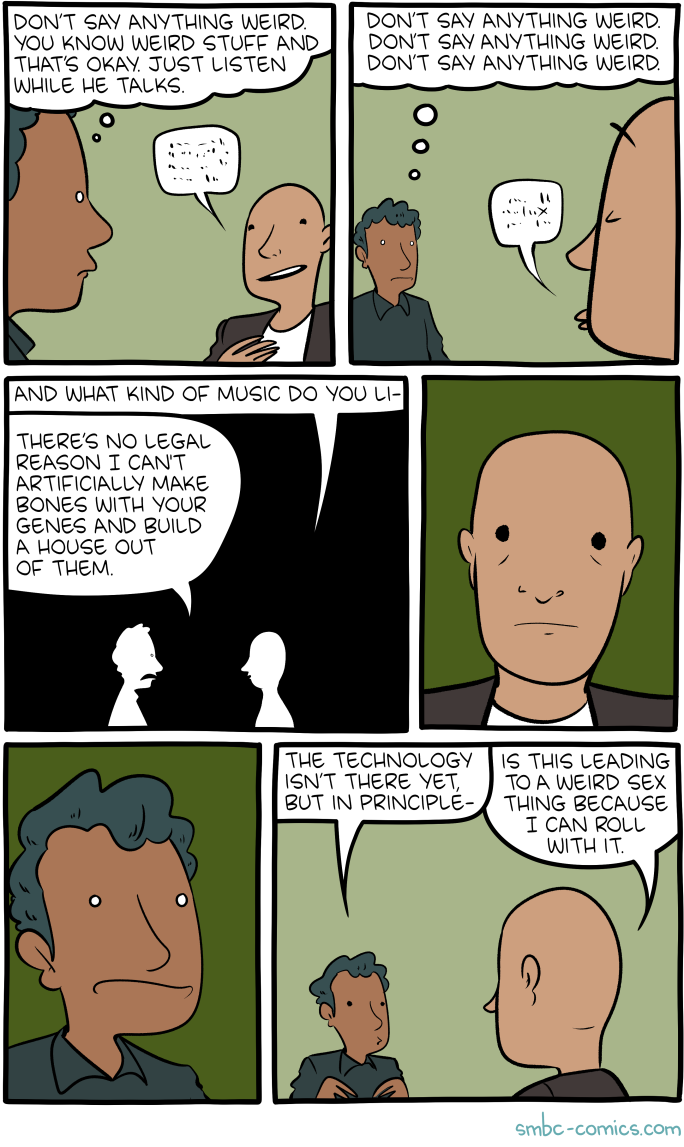
Click here to go see the bonus panel!
Hovertext:
We can currently only do houses made of thin tissue.
Today's News:
After the front, clearing skies for a partial eclipse tonight, and pleasant weather Saturday
A cold front is moving through Houston this morning, and should push off the coast within about an hour of sunrise. For those who like fall weather in Houston this is a good thing—the high temperature at Hobby Airport reached 87 degrees on Wednesday, setting a record for the location. Bush International Airport, Galveston, and College Station narrowly missed setting records. But now that’s passed, with cooler and fairer weather ahead.
Thursday
As anticipated, this morning’s frontal passage has largely been a dry affair. Drier air will move in today on winds of 10 to 15 mph from the north and northwest. Skies will be mostly cloudy through the early afternoon, helping to limit highs to about 70 degrees, but there should be some clearing later today. Skies tonight will be partly cloudy allowing lows to drop into the upper 40s, with cooler temperatures inland, and slightly warmer ones right along the coast.

I mentioned the possibility of clouds tonight as there is a partial lunar eclipse that runs from about midnight to 6 am, with a peak at 3:02 am CT locally. At that time Earth’s shadow will darken 97 percent of the Moon’s surface. The bottom line is that there should be enough breaks in the clouds to see the eclipse if you’re up late tonight, or early on Friday.
Friday
This will be a splendid late fall day, with light northerly winds and highs in the mid-60s. Skies will be mostly sunny. Lows will probably be a degree or two warmer than Thursday night.
Saturday
The first half of the weekend has no weather concerns. After the cool start, temperatures will warm into the mid-70s with partly to mostly sunny skies. As winds shift to come from the south, lows on Saturday night will only drop into the 60s for most of the region.

Sunday
This day should see a few more clouds, and more humidity, as highs push into the upper 70s to 80 degrees. It now appears as though another front will move through on Sunday afternoon or evening, and could bring at least a broken line of showers with it. Any rain accumulations should be fairly light, however. Lows overnight should drop into the 50s, with drier air moving in.
Next week
Monday and Tuesday look clear and cool next week, with highs in the upper 60s to 70 degrees. Unfortunately, we’re still anticipating a messy pattern during the middle of next week, with the passage of a cold front later on Wednesday or on Thanksgiving Day. With fairly high atmospheric moisture levels, I expect to see some rainfall along with, and possibly after the passage of this front. As we’re still a week out I don’t have too much confidence in the details, but showers and thunderstorms certainly seem like a distinct possibility at some point on Thanksgiving. Conditions will be warm ahead of the front, with temperatures dropping afterward, and lows in the 40s likely at the end of next week.
Fundraiser
Just a quick word to say that we’re still raising money for 2022 for Space City Weather with our annual fundraiser. You can buy merchandise or simply donate funds for the site. We truly appreciate your generosity.

Brent Spiner on learning to act in Houston and becoming Data
my boss was furious that I went to a work party after calling out sick
This post, my boss was furious that I went to a work party after calling out sick , was originally published by Alison Green on Ask a Manager.
A reader writes:
This situation happened several years ago at a company that I’ve already left, but I still find myself thinking about it from time to time and wondering if what I did was really so egregious.
I was working my first job out of college at a fast-paced start-up. My team (just me and my direct supervisor) had a big deadline set for the Friday just before the holiday break. This happened to be the same day that our company holiday party was being held. It was a fancy party in a rooftop bar of a skyscraper downtown and all of us younger employees were really excited about it.
We realized at the beginning of the week that we weren’t going to meet the deadline due to several unforeseen issues with production, despite pulling 10-12 hour days. My direct manager said we would just have to push the deadline to after the New Year, and made it clear she did not expect me to come in over Christmas.
I came down with a nasty cold and ended up calling in sick that Thursday and Friday. By Friday evening I was feeling a bit better (with the help of Dayquil), and decided that I was well enough to stop by the party. I was a bit nervous about going to the party when I had called in sick the same day, but my (also young and inexperienced) coworkers assured me it was fine. I showed up, said hello to everyone, had exactly one drink, and then headed home again.
I found out after the holiday break my grand-boss was FURIOUS that I showed up to the party after calling in sick and had expected me to come in over Christmas to make up the lost work. She wanted me to be fired over this incident. My direct supervisor had to go to bat to keep me on. When I got my performance review for the year, written by grand-boss, it was absolutely scathing. I was irresponsible, lazy, undedicated, etc. I was denied a bonus for the year. My direct supervisor said she did not agree, but there was nothing more she could do. I felt completely blindsided. I left the company not long after, the environment was toxic in several ways and I’m thankfully in a much better place now.
Looking back, I can see how bad the optics are to call in sick just before a deadline and then show up to a party the same day. But I still don’t think it’s a fireable offense! Am I looking at this all wrong? How bad was this, really?
Nah, that was an enormous overreaction from your grand-boss. What you did was a minor misstep.
It’s definitely true that if you call in sick, you shouldn’t show up to a work party that night. (There are some exceptions to this, but they’re on the margins — things like taking sick time for a doctor’s appointment rather than for illness.) It looks like you weren’t really that sick if you’re able to go to something fun just hours later.
A huge part of this is about optics though. Sometimes you’re too ill to go to work but you’ve revived enough by the evening to go out. Or you don’t have the energy to be “on” in the way you need for work, but you could hang out for a drink for an hour. But yeah, you’re expected to know it’ll look bad and not do it.
You didn’t know because you were in your first job and still learning this stuff, and you had peers telling you it was okay. It was a misstep, but it should have been handled via a quick conversation with your manager: “If you call in sick, we expect you’re too sick to attend a party that night — and even if you do recover in time, it still looks bad.” Done, problem solved.
Your grand-boss’s reaction was over-the-top. Fuming? Wanting to fire you? Calling you lazy and undedicated weeks/months later? The only way that would make any sense is if she’d already had serious concerns about your work ethic and this was the latest in a pattern of issues (in which case, I can see how the party might have set her off more than it would have otherwise). But assuming everything else was fine, her reaction was weirdly and excessively inflated.
Saturday Morning Breakfast Cereal - Zed
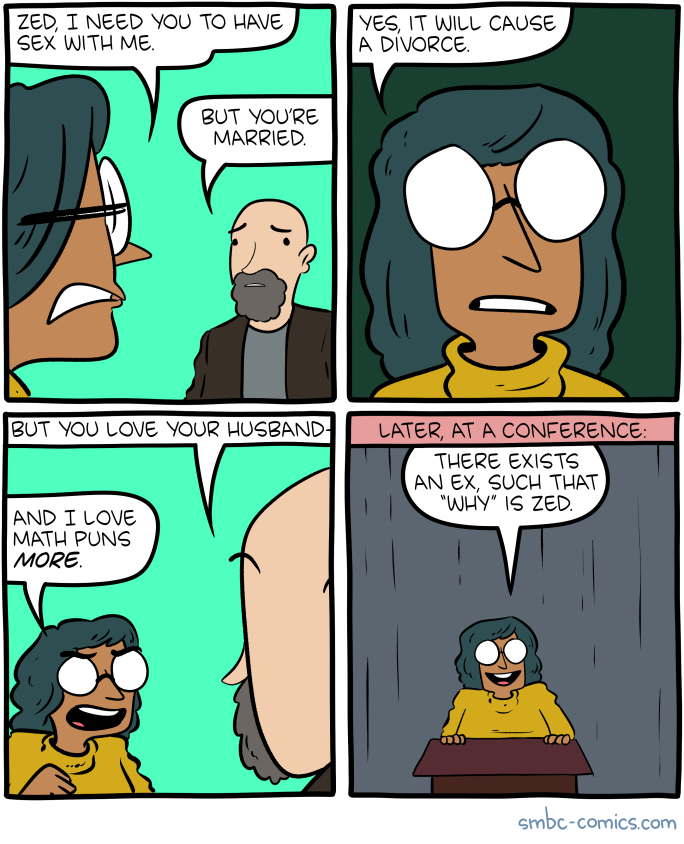
Click here to go see the bonus panel!
Hovertext:
I hope this doesn't cost half my audience. In fact, I'd like to double-you.
Today's News:
Self-styled 'QAnon shaman' is sentenced to 41 months in Capitol riot

Jacob Chansley, who had pleaded guilty to obstruction, apologized and called his high-profile actions on Jan. 6 "indefensible."
(Image credit: Win McNamee/Getty Images)

my team is requiring us to do a diet/exercise/”mental toughness” program
This post, my team is requiring us to do a diet/exercise/”mental toughness” program , was originally published by Alison Green on Ask a Manager.
A reader writes:
We’re back in the office responsibly and safely, and different departments have started team rebuilding exercises to “make up for lost bonding time.” Le barffe. My division lead decided on 75 Hard as our team-building exercise. 75 Hard is a program that includes a diet and exercise regimen and some lifestyle changes and philosophies that are medically unsound and flawed. Also didn’t we just go through a pandemic? Wasn’t that hard enough?
The one palatable part of the “reset” is to read self-help and business books so I emailed the team this: “Thanks for the invite, but I’m not comfortable with this program and don’t feel it would be a beneficial experience for me. I’d be happy to participate in the joint reading section so long as the reading material has some positivity behind it. (Insert book recommendations that were immediately tossed out for being ‘girly’.)”
The response was, “Oh, it’s not supposed to be a positive experience blah blah.” I stood my ground politely and my manager later hinted to the division that not participating in team-building exercises will be negatively reflected in our yearly reviews. He then said we should bring in a doctor’s note if we wanted to be excused. Uh. No.
Other people on my team who don’t want to participate are staying relatively quiet, but I think enough is enough.
In the past my department has done habit resets before, holding each other accountable with obnoxious reminders that REALLY skirt the limits of ableism and bullying. It’s a startup that doesn’t really have what passes for HR. Instead they do “peer mediation” which is a nightmare. The company president/owner is a relatively level-headed woman but should I escalate this that high up (great-grand boss)? There’s a lot going on that I think necessitates the need for an HR department, this just highlights it. Part of me thinks it’s time to cut bait, but honestly, this particular job is a major resume builder to a great freelance career so I should probably hang out for a while.
AGGGGGHH.
I looked up 75 Hard. It pitches itself as a “mental toughness” program and its rules include:
* follow a diet (including no alcohol and no “cheat meals”)
* work out twice a day for at least 45 minutes
* drink four liters of water per day
* read 10 pages of nonfiction a day
* take a five-minute cold shower a day
* take progress photos every day
Oh, and it was created by a guy who sells supplements. Presumably so he can later sell you supplements.
This is wildly inappropriate for work. WILDLY.
Your employer has no business mucking about in your diet or whether you “cheat” on a diet or in your exercise, your showers, or your “progress photos” (which I assume means the goal is to lose weight, which is another thing they have no business in).
And these rules would be medically contraindicated for loads of people. Eating disorders? Disabilities that limit physical activity? No.
This would be inappropriate even if it were optional, but they’re saying your participation will be reflected in your performance reviews? Hello, legal problems.
I’d send this to your manager and, since you don’t have HR, cc the president: “I’m concerned about the requirement to participate in 75 Hard, a program that’s been widely criticized by nutritionists and medical professionals. Since the instructions conflict with my doctor’s recommendations, I won’t be able to participate. I hope the company will re-think its encouragement of the program in general, given the potential legal liability if it continues to be pushed on employees. In particular, I’m alarmed at the implication that not participating will affect my performance review, and I’d like to get your assurance that won’t be the case.”
Ideally those other people who don’t want to participate would do the same. The more of you who push back, the harder it’ll be to blow you off.
But you’ve also got to take a look at what’s going on in this place more broadly. You’ve got “peer mediation” in place of HR (how does that work for, say, discrimination or sexual harassment?), you’re got “accountability reminders” that you characterize as ableist and bullying, you’ve got book recommendations rejected for being “girly” … even aside from this 75 Hard debacle, are you really having a great experience there?
The job market’s pretty good right now; you don’t have to put up with this kind of amateur startup bullshit.
Fuck You, I’m on a Bike
I’m on a bike. I’m a biker. A cyclist. A perspiring mass of arrogance hurtling toward you at approximately twelve to eighteen miles per hour. That means I can do whatever I want, whenever I want. I can swerve when I want. Spit when I want. Steal your weed whacker and throw it at a sewer rat when I want. Why? Because I’m on a bike.
Like an uncaged puma or a wound-up dad at a little league game, I strike fear into all who surround me. I’m unhinged. Unapologetic. Uncircumcised. And unwilling to ride within thirty meters of anything resembling a bike lane.
The rules of the road are meaningless to me, senseless casualties of my daily conquests. They dissipate the moment I mount my saddle. I change lanes without signaling. Pet dogs without asking. Cut off eighteen-wheelers so they jackknife and spill three tons of mangos, without thinking twice. Mangos everywhere. Mangos on the median. Mangos in your tailpipe. Mangos burned into the back of your feeble brain. Fuck you, mangos. I’m on a bike.
Lance Armstrong is my hero. I paid twelve hundred bucks to have his face tattooed over mine. I still look nothing like him. I need a lawyer.
I’m all go, all the time. I stop for nothing. For no one. Mostly out of principle. Also because I have no brakes. Just one, singular gear that’s virtually impossible to slow. I can’t stop. I won’t stop. But more importantly, I CAN’T STOP. MOVE. THIS IS NOT A DRILL.
If you’re driving an automobile, I’ll go out of my way to ruin your life. When you’re listening to NPR, I’ll ride up alongside you and scream Norwegian black metal. When you’re listening to Norwegian black metal, I’ll scream NPR. In Norwegian. Fuck you, Steve Inskeep. I’m on a bike.
ON YOUR LEFT.
I am anti-establishment. Anti-electricity. Anti-making any effort whatsoever to preserve my own life. I ignore yield signs, merge signs, gang signs, religious signs, and those signs that blink and make noise to signal a high-speed train is approaching. I’ve been hit by thirty-seven high-speed trains. Thirty of them killed me. It is not a pleasant way to die. Fortunately, like the rules of the road, the rules of death do not apply to me. Fuck you, Grim Reaper. I’m on a bike.
Yeah, I shave my legs. SO WHAT?
Pedestrians think they own the sidewalk. They’re wrong. I own the sidewalk. Another thing I own? A composting bin. I’m big into composting. I use the nutrient-rich humus to hurl at pedestrians as I scream menacingly, “Fertilize that, bro!” Then the pedestrians yelp and cry as they wipe the nutrient-rich humus from their slobbering faces, ignorant to the fact that I just saved them six months of mulching. Composting is fucking magical.
“Fuck you, Henry Ford!” That’s just something I yell whenever I see a pothole.
At red lights, I accelerate. At green lights, I accelerate again. At yellow lights, I find the nearest little old lady and give her the bird. Then I apologize by gifting her an actual bird. Joke’s on her. The bird is an emu. And it’s ornery as fuck.
Biking’s not a hobby. It’s a way of life. It’s liberating. My outlet, if you will. Whenever the day starts to weigh on me, I hop on my bike and I’m weightless. No anxiety. No stress. It makes me feel free. Free enough to rip off my clothes, teabag a fire hydrant in front of a Montessori school, then land myself in federal prison for twenty-five to thirty.
Fuck me, I’m on a bike.
Saturday Morning Breakfast Cereal - Forever
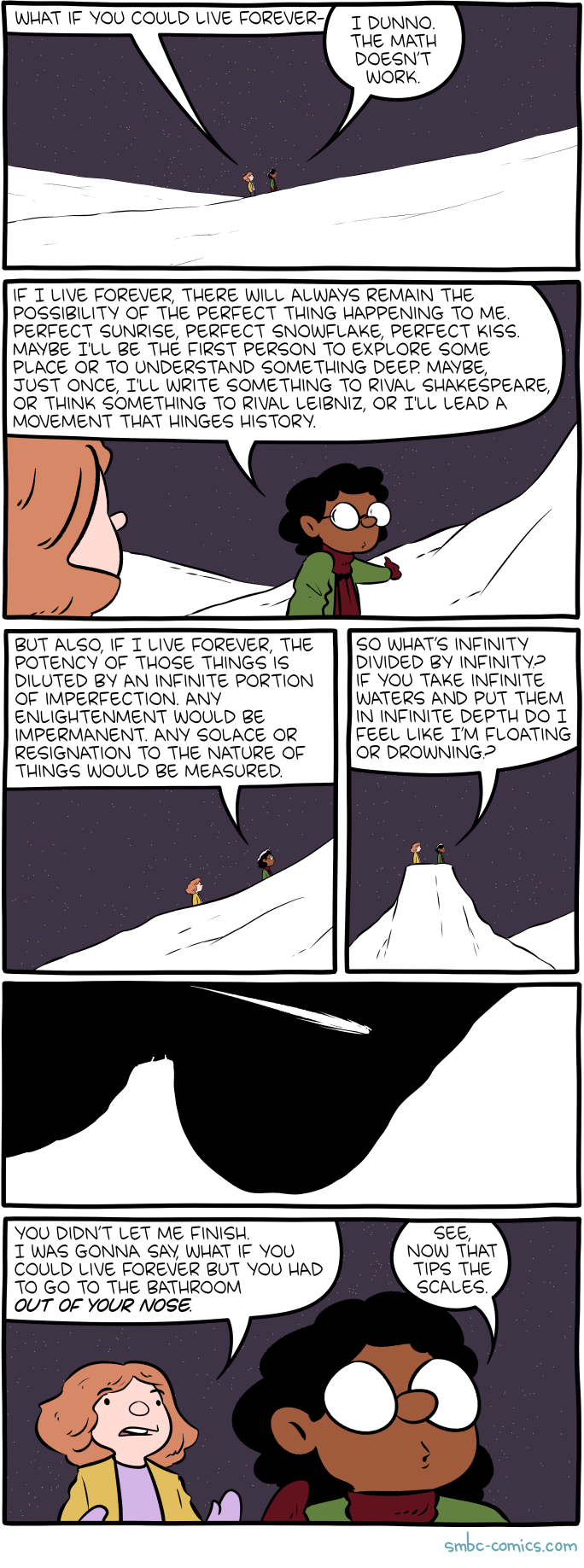
Click here to go see the bonus panel!
Hovertext:
On the other hand, I don't ever want to die on today in particular.
Today's News:
how do I negotiate salary when I’m overpaid?
This post, how do I negotiate salary when I’m overpaid? , was originally published by Alison Green on Ask a Manager.
A reader writes:
I’m nearing the final rounds of interviews for a few opportunities that I’m really excited about. In each of these conversations at varying times the recruiter or hiring manager has asked something like, “I just want to make sure we’re not wasting anyone’s time, can you share your current salary so we can make sure it’s in range?” The problem is that I am quite overpaid for my current role (think at least $5k base salary above the top end of the range that many people in my industry with similar skills and experience make) but I’m also quite unhappy for a variety of reasons.
I usually say something like, “I’ll start by letting you know that I’m very interested in this opportunity because of x, y and z. I’m hesitant to share my current salary because I think it’s above average for this role, but I’m looking for something close to $X (my current salary). If that’s not within your range, please know that I’m very interested in this opportunity and I’m not tied to a specific number.”
But is that right? Obviously if I could find something that’s a better opportunity AND continue making my same salary, that would be great so I don’t want to talk myself (or potential employers) out of paying me more if they’re willing and able. I also don’t want to scare off potentially great opportunities just because of a salary number that I’m ultimately flexible on, within reason.
I’ve already had one hiring manager let me know that they couldn’t meet that and they were concerned I would be unhappy with a pay cut, despite me letting them know that I was excited and interested and more than willing to continue talking. They declined and went forward with other applicants.
Try two things, in this order:
First, try to avoid giving a number at all and instead ask about their range. If they just want to make sure you’re not wasting each other’s time, they can do that by sharing the range they plan to pay. This won’t always work — some employers are committed to not disclosing their range and instead getting a number from you — but it works enough of the time that it’s worth trying first. To do this, you’d say something like, “I appreciate that! Can I ask what your range is for the role?”
Even though this is ignoring their direct question, you’re still allowed to do it. Candidates do it all the time. If they want to hold firm on you giving them a number, they’ll tell you that. But a lot of them will answer with their range, at which point you can say, “That’s in line with what I’m looking for as well” (assuming it is).
But if they push back and say they need a number from you in order to proceed — which some employers will do, even though it’s increasingly perceived as outdated and obnoxious — then go ahead and give the range you’re looking for, not your current salary. Even if they’ve explicitly asked for your current salary, a huge portion of the time you can get away with responding as if they’ve asked for the salary you’re seeking, which is more relevant anyway. For example: “I’m looking for something around $X — is that in line with your range?”
I wouldn’t use your language about not being tied to a specific number, at least not right off the bat. If you’ve done the research to feel reasonably confident about what the job should pay, you don’t want to undercut yourself by implying you’ll take less. I see your argument for doing it — you really might be willing to go lower — but at least wait and see how they respond before you take it in that direction.
If you encounter someone who, after this, still insists on knowing exactly what you’re earning now, here’s some advice for handling … but the above will work a surprising amount of the time.
how to avoid giving employers your salary history
company said they’d base my job offer on my current salary
how to refuse to share your salary history
(Of course, this all assumes you’re not in one of the growing number of states that have banned asking about salary history altogether.)
my employees got into a religious argument and now things are in chaos
This post, my employees got into a religious argument and now things are in chaos , was originally published by Alison Green on Ask a Manager.
A reader writes:
I have a situation regarding a argument regarding spiritual/religious beliefs in my office. I’m a team lead and oversee 10 people. I have two employees, Fred and George, who are the office jokesters. Both are liberal practicing Muslims. Another employee, Harry, is a practicing Wiccan.
Recently there was a situation where Fred and George began to inquire to Harry about his spiritual beliefs, which quickly became more pointed, obnoxious, and mocking of him being a “witch wannabe” after watching magic based fantasy shows and films too many times, along with teasing the silver pentacle he wears as being “the Devil.”
Harry eventually became irritated to the point where he snapped back and began to criticize them for how their particular religion has been under fire for decades if not centuries, especially since 9/11 over terrorism and about human rights for women and LGBTQ+ people. Fred and George immediately became angry and defensive, accusing him of prejudice and islamophobia. This conversation/argument was witnessed by three other employees.
Fred and George both came to me right after this incident, demanding some form of discipline for Harry if not just firing him outright. They had also looped our overhead manager as well.
My manager feels that Harry should just be let go for borderline hate speech as it’s a two vs one scenario. After speaking with the three witnesses and Harry, my perception is that while Harry may not have responded in the best way, he wasn’t really hating on Islam so much as pointing out to Fred and George that they shouldn’t mock and belittle his religion as their own has its detractors. Plus, they started this situation in the first place and up until now there has never been any conflict among these three (though Fred and George have been known to joke around occasionally and I have to rein them in, though nothing as egregious as this incident). My manager is not forcing me to discipline any of them, but still suggests Harry needs to be let go. I’ve tried explaining how by that logic, Fred and George should be let go as well for their own slander against Harry.
Harry has since taking to icing Fred and George out unless it’s necessary for their work on hand. Fred and George continue to make some comments under their breath about Harry, but I never catch what is said and therefore I won’t address that unless I catch something negative. Who is more in the wrong of this whole mess and what is your advice on how I handle this situation?
Does no one in your company realize there are laws about all of this? The law (Title VII of the Civil Rights Act of 1964, which makes religious harassment at work illegal) makes it really clear how you need to proceed: All three of these employees need to be told that religious harassment is unacceptable and won’t be tolerated in your company, period.
Your manager’s idea of siding with Fred and George because it’s two against one is bizarre. You don’t settle issues of religious discrimination by counting up who has more people on their side! It’s not a vote.
All three of them — Fred, George, and Harry — were in the wrong. They all engaged in religious harassment, and they all need to be told it won’t be tolerated.
That said, it’s not irrelevant that Fred and George started it and Harry appeared to be trying to defend himself (badly and wrongly). It doesn’t excuse Harry’s actions, but it does mean that you’ll need to account for that in your messaging to him. It also makes it extra odd that your manager is proposing that Harry be the only one disciplined.
Your messaging to Fred and George should be: “It’s not okay to harass any employee here about their religious or spiritual faith or lack thereof, regardless of what you think of their belief system. This is both company policy and federal law. You need to treat all employees with respect, period, and this cannot happen again. I understand that Harry did the same thing back, and I will be telling him the same thing that I’m telling you. This can’t happen, from anyone or about any religion. I am documenting this conversation and this is serious enough that I need you to know this is the final warning you’ll get on the subject.”
Your messaging to Harry should be: “I’ve spoken to Fred and George and told them that it’s not okay to harass any employee here about their religious or spiritual faith or lack thereof, including yours. They were out of line in what they said to you, and I’ve made it clear it cannot happen again. However, I need to say the same to you. While I understand you were provoked, you cannot harass any employee here about their religious faith, regardless of your provocation. This is both company policy and federal law. In the future if you feel you’re being harassed or discriminated against because of your religion, I need you to ___ (insert reporting procedure here). I can promise you that if you do, we will take it seriously and investigate, and will ensure you’re not harassed for your religious faith. But I also need to be clear that none of this will be tolerated if it happens again — not what Fred and George said to you, and not what you said to them.”
You also need to deal with the aftermath of this among the three of them. It’s fine for Harry to decline to chat with Fred and George as long as he talks to them when it’s needed for work and as long as he’s being professional and respectful. It is not okay for Fred and George to make comments about Harry under their breath, and it’s definitely not okay for you to decide you’ll ignore it unless you catch what they’re saying. The under-the-breath comments need to stop, period; they’re creating a hostile work environment for Harry (and maybe others), it’s unprofessional, and it’s not acceptable. So, to them: “I’ve heard you making comments about Harry under your breath and that needs to stop. If you have a concern about Harry, please bring it to me and I will take it seriously and investigate. But you need to behave professionally in this office, and muttered comments about someone you don’t like are not okay.”
But you shouldn’t do any of this without talking with someone in your workplace who has more expertise than your boss apparently does — generally HR. There are legal consequences to your company if you mishandle this (another reason that it’s so weird that your boss is taking the approach he is), and they need to be looped in.
Ground Beef Goodness

The Sunset Ground Beef Cook Book
Recipes for all occasions
1970
Who knew that ground beef was so versatile?
I am sure many of you will want to check for this book in your own catalogs so you can enjoy these fabulous recipes. There really isn’t anything particularly exciting: every thing is based on the form. You decide if you want your ground beef in balls, loaf, or patties.
If you scroll down, you can see that these publishers desecrated a poor pumpkin with some ground beef. I am a big fan of squash, but just no to the pumpkin vomiting a beef filling.
Of course we also have black and white photography which hardly enhances the look of the meatloaf and hamburgers. There is a whole lot of awful in this cookbook. Weed and don’t look back!
Mary


The post Ground Beef Goodness appeared first on Awful Library Books.
my coworker takes too many smoke breaks, applying for a job when you can’t afford their products, and more
This post, my coworker takes too many smoke breaks, applying for a job when you can’t afford their products, and more , was originally published by Alison Green on Ask a Manager.
It’s five answers to five questions. Here we go…
1. My coworker takes too many smoke breaks
I work in a small office of about 15 people. I’ve become friendly with a woman (Jill) who works in a different department than I do. Our kids are involved in the same extracurricular activities so we spend time outside of work as well. Jill is the only smoker in our office, and therefore the only one who takes smoke breaks. About half of our staff is eligible for two 15-minute breaks in addition to their lunch and these are generally taken about 10 am and 3 pm. I would understand if her smoke breaks would coincide with these break times. Often, they actually do. The problem is Jill takes a 10-15 minute smoke break nearly every hour, often while she calls her friends and complains about whatever drama she has going on currently. She also takes an extra break after her lunch hour to smoke. I handle payroll and Jill is over our hourly employees (she is also hourly). I know Jill has the ability to adjust the time clock, which worries me. I am also concerned about the fact that this leaves me covering the phones for Jill for quite a bit of the day. I will transfer a call to her and immediately get a text “can you take a message please!” because she is outside smoking.
Jill’s direct supervisor is quite busy managing the hourly employees while she handles the administrative portions of the department, and while he knows about the smoke breaks I’m not sure if he knows about the extent of them. How do I handle this? I am not only annoyed but again, concerned about the ethics of her being able to adjust her own time card.
Tell Jill you can’t cover the phones that frequently — “I can cover the phones for you at lunch and during your two 15-minute breaks, but I can’t do it the rest of the time because of my own work.” If it continues after that, which it probably will, you need to loop in her manager about what’s going on. Since you’re friendly with Jill outside of work, you might prefer to give her a heads-up about that first — something like, “I’m going to talk to Niles about what we can do to keep the phones covered when you’re not at your desk because I can’t do it as much as you need me to.” And then do talk to her boss about it.
On the timecards, do you have any reason to think she’s wrongly reporting her hours? If you do, it’s worth taking a closer look at whether her reported hours match what you observe; if they don’t, that’s something to raise to her boss as well (while being clear that it’s possible you don’t have the full story). But look at what she’s actually reporting before you do that, since it sounds like your concern is more “she could do this” rather than “she is doing this.”
2. Applying for a job when you can’t afford the company’s products
I’ve been casually job hunting for a bit now, and there’s a clothing company in my area that occasionally has openings that fit what I’m looking for. The problem is, their job postings always say that they’re looking for applicants who already own and love their products. That sounds great, except that their products are really expensive. Not couture-level, but $200 skirts, $250 trousers, $30 underwear, etc. This is wildly outside my budget! It’s all really lovely stuff, but there’s no way I could afford to shop with them.
I have two questions: 1) Is it worth applying if I am only a fan of their products from afar and don’t actually own any? I’d be looking for positions on the marketing team, so on some level I can see why they’d want people with personal experience with the products. 2) Doesn’t this limit their applicant pool to people who are already fairly well-off? Their sizing also skews small, so it would limit them in terms of body size and shape as well. This seems unwise to me (and possibly shortsighted, given how many clothing brands are looking to be more size inclusive), but perhaps they don’t care or they wouldn’t have included this in the job postings.
Go ahead and apply and see what happens. There’s a good chance that owning their products isn’t a strict requirement, but more an expression of an imaginary version of their ideal candidate that they won’t hold every applicant to. That said, be prepared to show you’re familiar with and like their clothes, and come prepared to knowledgeably reference some favorite recent items from them.
But yes, even if it’s not a strict requirement, by including it in the ad they are indeed screening out people who, like you, will assume they shouldn’t apply because they can’t afford or fit in the clothes. If you end up interviewing with them, it’s worth paying a lot of attention to what their culture is like and how homogenous it appears to be.
3. Employee is using disability protections to do whatever he wants
We’ve been having major issues with a very young, 21-year-old employee I’ll call James. We hired him knowing of his disability, gastrointestinal issues, and have made all reasonable accommodations. He works by the bathroom and he calls out if the issue is too bad.
A year in, it seems that James has started bragging that he can take all the time he wants off without repercussions. He can’t be fired so he will do what he wants and such. In the year he’s worked here, he’s called out for three and half, maybe four months.
As per James doctor, he shouldn’t be drinking soda or fatty foods. We watch him chug one can and grab another right after. He parks next to me so I see the energy drink cans all over his car. So he’s not actively trying to manage his condition but making it worse.
He’s become a poison in our company and has begun bossing around newer employees and stated he would stand outside with signs and protest vaccine mandates. We have had multiple meetings about him and would love to fire him. He’s all around bad but he’s swinging the ADA like a sword rather than using it as a shield, and we feel firing him for any reason will cause legal problems. Any advice?
You can’t fire him for his disability, but you can absolutely discipline and fire him for his behavior with other employees. The ADA isn’t a shield that allows him to do whatever he wants; it just protects him around the disability itself. Start documenting everything you’re seeing (aside from how he does/doesn’t manage his health — that part is fully none of your business, regardless of your private thoughts on it) and talk to a lawyer to help you navigate exactly how to proceed.
James might decide to sue regardless. But as long as you have a well-documented case for firing him that demonstrates it wasn’t about his disability, he’s very unlikely to prevail. Could that cost money and time? Yes. But that’s true of any employee, and it can’t be a reason you hold on to someone who’s causing so much disruption in your workplace. Dealing with occasional legal pushback is part of employing people, not something to be feared so much you don’t act when you need to and can do so legally.
4. Should I tell my new HR person about my obsessive, emotionally abusive ex?
I started a new job — which is very exciting. I love the team and they seem to love me. I’ve kept news about my job and activities in general on the low, as an ex I dated for a brief time (less than a year) continues to behave in creepy, obsessive ways — using his platform to smear me after breaking up with him, etc etc. I ended up holding him accountable — at one point, we were in a shared professional network that he was kicked out of due to his harassment, and I’ve been pretty openly vocal about his behavior leading up to this moment. He is still acting out obsessively and passive aggressively, and I’m concerned that he may reach out to my boss to try and pull something.
Is it worth it to give my HR person a vague heads-up about this? I don’t want to give a poor impression or seem like I’m overly dramatic at a new gig, but I also am worried he may try to mess with my opportunities here.
Yes, HR and/or your boss. You don’t need to go into detail; it should be enough to simply say something like, “I want to mention that I’ve been being harassed by a man who I dated briefly. He was kicked out of a shared professional network due to his harassment, and while I don’t expect him to cause any issues here, I wanted to give you a heads-up about the situation in case he does try to contact the company if at some point he learns where I’m working.” A good HR person will ask if there’s anything you need (like his name or photo circulated with security, banning him from the building, keeping your own info off the company’s website, etc.). If you do want any of that, say so but it’s also fine to say that, at least for now, you really just want them to have the background info.
You’re not going to look like you’re overly dramatic! It’s clear you’re not the issue, he is. Delivering a calm, professional heads-up about something like this is the opposite of dramatic.
5. Should staff change announcements be in-person?
I work in a 35-person office that has most of our staff on staggered schedules due to Covid. For those folks who share an office, they take turns working in-office; others occasionally work from home or at ancillary sites, but there are usually 20 or so people in the office each day.
Just this week, we’ve had two major staff announcements: we’re losing one director, and our accounting director is stepping down to a supervisory role. Both of these announcements were done via email, rather than gathering folks together to address the shifts. I understand that those remote employees may not hear about these transitions as quickly if they are first announced live, but a follow-up email would suffice.
Our VP is in the office every day and could easily have done a quick stand-up meeting with on-site employees to announce these two impactful events, but he only sent an email about the director’s resignation; the other email announcing the shift in accounting came from our corporate headquarters.
What is your viewpoint on this? I find myself feeling irked by the way these things were announced, but I don’t know if I’m just projecting what *I* would do, rather than acknowledging that this is an acceptable way to manage announcements across a team that is somewhat scattered.
Doing it by email seems pretty reasonable to me, especially when you have people on staggered schedules. Even without the scheduling issues, though, it’s not terribly unusual to announce staffing changes by email.
We Should Definitely Stop the Killer Asteroid, But First Let’s Figure Out Who Is Going to Get Rich from Saving Humanity
“The National Institutes of Health is prepared to aggressively defend its assertion that its scientists helped invent a crucial component of the Moderna coronavirus vaccine. … If federal researchers were named as co-inventors in the patent, the government would have a nearly unfettered right to license the Moderna vaccine to other manufacturers, which could expand access to it in poorer nations and bring the government millions in revenue.” — New York Times
Look, we have the technology to save the planet from the killer asteroid—we have the missiles, the explosives, the jet propulsion, and even a comically large red launch button—but there is just one small problem: My company invented that technology, and we are not sharing the patent with anyone, especially NASA, who wish they contributed to our big red button. They didn’t. In fact, they lobbied hard to make the button green and normal-sized. Now they want to ruin my once-in-a-lifetime chance to become Bezos-level rich.
Before I say anything else (because I know everyone is freaking out about this whole “asteroid killing everyone” thing), we will definitely destroy the asteroid and save everyone. And by definitely, I mean probably. And when I say “probably,” I mean we will do it once it makes financial sense and not a moment earlier.
If you’re living in a reality where the federal government provided us with billions of dollars of funding, help from researchers, and integral contributions to the development of our missile, I’d suggest you back off. Your reality doesn’t involve maximum profits for my company and me. It doesn’t involve me collecting even more money than the billions already generated from our missile-building enterprise. It doesn’t involve sole proprietorship over the big red button, which is fun and also integral.
I know everyone just wants us to press the button (myself included), but there is a lot of money to be made from saving the Earth from cosmic destruction. My company is looking at record profits—our margins are literally out of this world—and if we can’t license our missile and sell it to other nations also trying to avoid annihilation, then I just don’t know whether it makes financial sense to prevent Armageddon.
Without an airtight patent, stopping the world from becoming an oversized potato chip won’t be as beneficial to our shareholders. Our board of directors will be mad if I don’t get our company exclusive licensing rights to the missile and the lunar-crater-sized red button. (You have to jump on it to activate it!)
I wish there were a simple solution to this problem, but there isn’t. This situation was born out of centuries of politics and bureaucracy, and without capitalism, no one would be incentivized to save the planet in the first place. That can’t change overnight—not for you, not for me, not for the Earth, and not for the multitudes facing imminent fiery peril. In this instance, it turns out the cost of doing business is exceptionally high, which we feel really bad about!
At least the asteroid is the only threat to our planet, and there aren’t other issues that also desperately need to be addressed. I’m glad everything is fine, and we aren’t facing impending doom in every direction. We may not know how to fix every issue, but at least we are fixing the problems within our power to fix—right?
In many ways, it is already too late. This discussion has gone on long enough that saving everyone is impossible. The asteroid is already raining debris down upon us and killing millions. Every moment we wait, more people are guaranteed to die. We could stop it, but we won’t. Not yet. (Believe me, I am so excited to jump on that red button, the confetti cannons are already in position for when I do.) Luckily, we at the Davenport Institute of Comet Killing Superstars (DICKS) are already inoculated, safe in a bunker deep underground.
Don’t get me wrong: we are acting with urgency. We want to help all those people out there. But at the end of the day, we will be fine, so waiting a couple of moments longer isn’t the end of the world. (For us, at least.)
Saturday Morning Breakfast Cereal - Internet

The Amazing Disk II Controller Card

In the world of Apple II disks, there are two major types of disk controller cards: the original Disk II controller (and clones), and everything else. Both have their place. The “everything else” category includes the Apple 3.5 disk controller card, Liron card, SCSI cards, IDE cards, and more. These cards provide a standard API for software to read/write blocks, get drive status, and format the disk, all without requiring the software to know anything about how the disk actually works. These cards have built-in smarts to handle the low-level details. In contrast the original Disk II controller card is dumb as dirt, and forces the software to handle virtually all of the low-level details. And yet it’s an amazing piece of technology for its time.
The first Apple II models had no built-in floppy disk support. The Disk II controller was cleverly designed to add that missing support at a very low cost, and was a major reason why Apple II computers became so popular. This disk controller was simpler, and cheaper, and more flexible, and just all-around better than any of its contemporary competition. It’s the ultimate example of Woz can-do technology.
Floppy Disk 101
A floppy disk is just a plastic circle with a magnetic coating. Loaded into a drive, the disk rotates at about 300 RPM. A stepper motor moves the read/write head linearly from the center of the disk to the outer rim. This arrangement provides for a few dozen concentric rings where a serial stream of 1s and 0s can be stored.

How do you get from these basics to higher-level concepts like bytes, tracks, and sectors? How are logical data bytes encoded into bit patterns on the disk? When reading the disk, how are the bits framed into bytes? How do you find track zero, or the boundaries between sectors? The conventional answer to these questions in the 1970s was extra hardware, and lots of it. This made the disk controllers and the drives themselves complex and expensive, putting them mostly out-of-reach for an inexpensive home computer system.
It was late 1977 when Apple set its sights on finding an alternative to cassette tape data storage, and began looking into options for a floppy drive for the Apple II. They were still a small and unproven company, and the Apple II had only been available for about six months. Woz didn’t know much about the subject of floppy disks, but he agreed to take on the challenge.
Woz’s approach was to remove virtually all of the hardware that controls the disk, and take a software-driven approach akin to bit-banging. Apple went to Shugart, the inventors of the 5.25 inch floppy drive, and requested a stripped-down version of Shugart’s SA400 drive with most of the control electronics removed. It was just a simple mechanism with one motor for spinning the disk and a stepper motor for moving the read/write head. As the legend goes, the entire Disk II hardware design was conceived and built by Woz and Randy Wigginton over a few weeks during Christmas vacation 1977, including writing the first version of DOS, and the working disk drive was demoed at CES in January 1978. Additional help was provided by Apple engineers Cliff Huston and Wendell Sander. 40+ years later I’m amazed by how quickly this small team was able to make everything work.
A few years ago I asked Woz about the Disk II development, and he said this:
I have no idea how I came up with that incredible disk controller. I was good at creating anything in electronics, analog or digital. I had no prior experience of any kind, not even in classes, regarding disk hardware or software. So my thinking had to be from the ground up. I had to sense data coming from the disk and make decisions about 0’s and 1’s based on timing.
I had taken a graduate level course at Berkeley (although an undergrad, I only took grad courses in anything having to do with computers in any university) on state machines and thought of how I could use 2 simple low cost chips as a state machine to do this, sort of a minimal microprocessor hand-built. At the time I just knew that it would read and write data but I assumed that I was leaving out many ingredients of a disk controller due to not knowing what they did. I assumed this because my design took so few parts. But in the end, mine did more in some good ways, especially since it was in the computer and tied to software that could alter how it worked, which eventually led to greater storage and faster speed that would not have been possible using the normal disk. Plus, I took about 20 chips off the drive itself and bypassed them from my own controller, because they were just middlemen that got in the way of things.
The best work I did, over and over, was partly due to not having money and having to learn how to use the fewest parts of anyone, and also due to the fact that everything great I created I had never done before.
A Tour Of The Disk II Controller
The Disk II controller card is basically just a fancy shift register. It knows how to read and write bits at a fixed rate of 1 bit every 4 microseconds. The card also has a tiny 256 byte ROM containing bootstrap code that runs when the computer first turns on. It’s a minimal 6502 program with just enough smarts to locate track 0, sector 0, load it into the computer’s memory, and then execute it. Every other aspect of disk control is handled by software.
The card contains only eight simple chips. There’s a 256 byte ROM containing the bootstrap code, and a second 256 byte ROM used as part of a state machine (more on this in a moment). There’s also a 74LS174 hex flip flop providing the inputs for the state machine. A 74LS323 eight bit shift register is the heart of the whole design. A 74LS259 addressable latch stores the desired state of the motors and the drive 1 or 2 selection. There’s a 556 dual timer, and a 74LS05 hex inverter and 74LS132 quad NAND to provide some needed glue logic. That’s it. That’s the entire disk controller. Here’s the schematic:

Let’s go through the challenges of floppy disk I/O one at a time, and look at how the Disk II controller design solved them.
Challenge #1: byte framing. The data coming from the disk is a continuous stream of 1s and 0s, and there are no start or stop bits. So how do you know where one byte ends and the next byte begins? Woz’s solution was to require that every byte written to the disk have 1 as the most significant bit. During a disk read, the state machine takes bits from the disk one at a time, moving the shift register one position left and appending the new bit at the right. It keeps going until the left-most bit position holds a 1, at which point the state machine says “Aha! Here is a complete byte!” Then the CPU stores the byte, and the process begins again. The state machine clears the shift register after the MSB becomes 1, so it’s ready to shift in the eight bits for the next byte.
By itself this solution isn’t enough. If the state machine starts reading bits in what was actually the middle of a byte, it will probably misinterpret a 1 bit in the middle of the byte as being the 1 bit for the MSB position. But this scheme ensures that if the state machine gets the byte framing correct just once, whether by luck or another method, it will continue to be correct from then on. So the challenge is finding a way to guarantee the framing is correct before beginning to read disk data.
The conventional solution is to write a special 50-bit pattern of so-called sync bytes to the disk, immediately before each sector. These aren’t really bytes at all, but a 10-bit pattern 1111111100 repeated five times. This pattern has the interesting property that no matter where the byte framing is initially, it will fall into correct synchronization after at most five repetitions of the pattern, just by following the state machine rules described previously. This solution is entirely software-driven, and is merely a convention. The hardware itself has no mechanism to guarantee correct byte framing. There are other methods of ensuring framing, and some of the bizarre richness of Apple II copy-protection schemes arises from different approaches to framing taken by the custom I/O routines in many games.
Challenge #2: byte encoding. If every byte written to disk must have 1 as the MSB, then how do you write a zero byte, or any other byte with a value less than 128? And there are other restrictions too: every byte written to disk must have no more than two consecutive zero bits. If there are three consecutive zero bits, the disk hardware can’t reliably read back the data. Given these two requirements, there are only 66 possible 8-bit values that are permitted to be written to the disk. How then can arbitrary 8-bit values be stored?
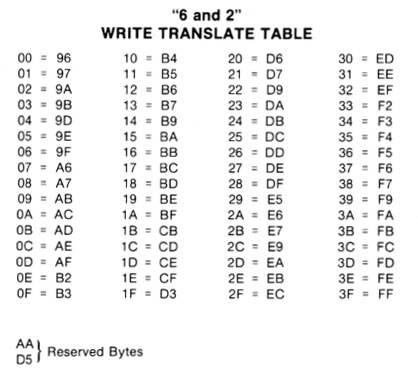
The answer is to split up the logical 8-bit bytes, and store their bits in subgroups as part of multiple disk bytes. The standard way of doing this is a GCR encoding scheme called 6-and-2. With 66 possible values for the disk byte, and two reserved values, that leaves 64 possible disk bytes for encoding data. 64 is 2 to the 6th power, so six logical bits can be encoded in every disk byte. A series of three disk bytes can encode the first six bits of three logical bytes, and a final fourth disk byte can encode the last two bits of the three logical bytes, concatenated together. This means the number of bytes stored on disk is 4/3 times the number of logical bytes, ignoring headers and checksums and padding.
You might wonder how the Disk II controller bootstrap code accomplishes the GCR decoding for sector 0, track 0. At first glance, it would seem to require storing a 64-entry reverse lookup table in ROM, which is already one quarter of the very limited ROM space available. The bootstrap code actually uses a much cleverer solution, and constructs a 256-entry forward lookup table in RAM on the fly, using only 30 bytes of 6502 code!
The Apple II floppy byte encoding has evolved over time, resulting in a changing number of sectors and total disk capacity. The first version of the Disk II controller card didn’t permit any consecutive zeroes to be written to the disk. This further limited the number of possible disk bytes, and forced the use of a less efficient 5-and-3 encoding scheme. It was only possible to fit 13 sectors per track, resulting in 114 KB total disk capacity. Apple DOS 3.1 and 3.2 used the 5-and-3 scheme. Eventually Woz or one of his teammates realized that with a small change to the state machine, it would be possible to read two consecutive zeroes reliably. All it required was a change to the contents of the state machine ROM, essentially fixing a small bug in order to make the bit timing measurements more reliable. No hardware changes were needed to the Disk II controller. The more efficient 6-and-2 scheme was introduced beginning with DOS 3.3, ushering in the 16 sector tracks and 140K disks we’re familiar with now.
As with the byte framing, this whole encoding scheme is purely a software convention. There’s nothing about the hardware that implements 6-and-2 or 5-and-3 or any other encoding method. Sector 0 track 0 must be encoded using 6-and-2, because that’s what the ROM bootstrap code expects, but after that anything goes. Software is free to use any other encoding scheme it wishes, and many copy-protected programs use novel encoding schemes in order to obfuscate their workings.
Challenge #3: sectoring. Once you’ve got the bitstream correctly framed into disk bytes, and the disk bytes correctly decoded into logical bytes, how do you make any sense of the data? It’s a ring buffer, so how do you know where the data begins and ends? 1970s floppy disks often used one or more small holes punched in the disk at regular intervals around the circumference. A small opening was cut in the disk’s dust jacket in order to reveal the index holes as they passed underneath. Hardware inside the disk drive sensed when these holes passed by as the disk rotated, and this information was used to determine where a new track or new sector began.
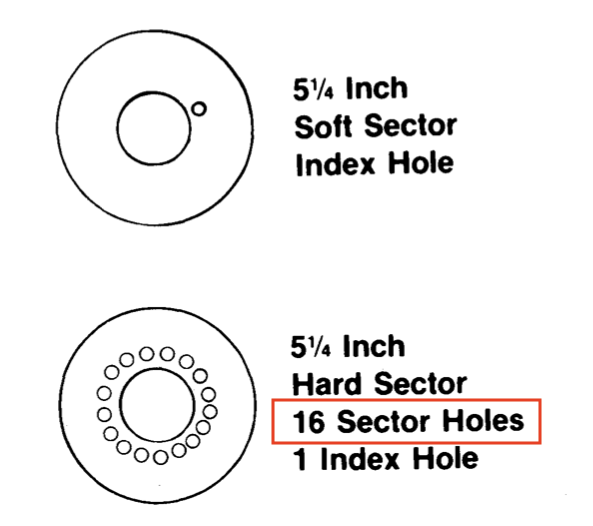
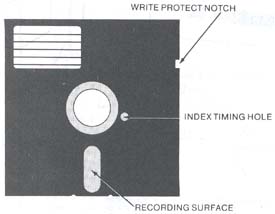
It’s easy to see why this might be undesirable. The hole-sensing hardware adds extra complexity and cost. And in the case of hard-sectored floppies with a hole for every sector, the number of sectors becomes part of the hardware design and can’t be changed. Apple’s move from 13-sector to 16-sector format would have been impossible with hard-sectored disks.
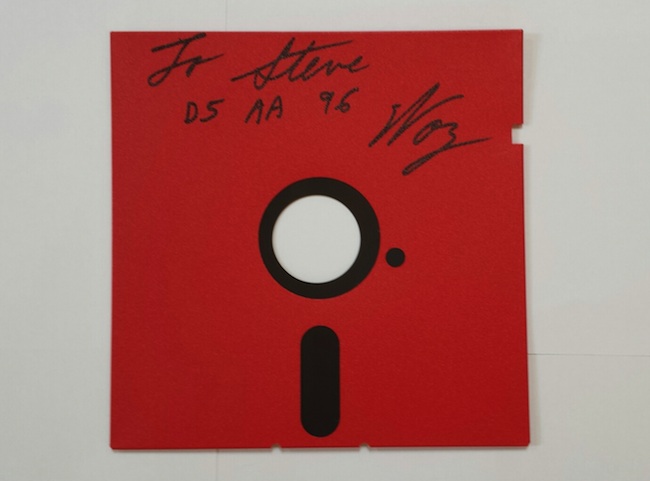
The Disk II design takes a software-driven approach to sectoring. Any index holes on the disk are ignored. When it wants to find a particular sector on the current track, the computer begins reading bytes, ignoring everything it sees until it finds the three-byte sequence D5 AA 96. This signature marks the beginning of a new sector on the disk, and is possibly the most famous byte sequence in the entire kingdom of Apple II arcana. On the wall of my office hangs a 5.25 inch floppy disk with a D5 AA 96 greeting signed by Woz himself:
A short sector header follows this signature, and among other things the header contains the sector number. If it’s the sector number the computer was looking for, then it reads the bytes that follow. If it’s not the right sector, then it keeps looking for another D5 AA 96 to indicate the beginning of the next sector, and tries again.
This whole business is – you guessed it – purely a software convention. The D5 AA 96 signature, the sector header, the length of sectors, and everything else are merely conventions. There’s nothing whatsoever about the Disk II controller card hardware that requires software to work this way, and some software takes a different approach. One well-known example was the game Prince of Persia, which used a custom scheme called RWTS18 that was optimized for reading as opposed to writing, and used six 768-byte sectors per track instead of the standard sixteen 256-byte sectors.
Challenge #4: finding tracks. So far we’ve only discussed data in a single one of the concentric rings on the disk. These rings are usually called tracks, but as we’ll see, the definition of exactly what constitutes a track can sometimes be fuzzy. So how do you switch between tracks, or locate a specific track? And just how many tracks are there? The Disk II and its controller hardware don’t answer these questions. Instead, it’s all (say it with me now) software-driven.
On the disk media there’s no such thing as a track – it’s just a featureless round expanse of magnetic media. Tracks are created when the read/write head remains at a fixed radial position while the disk spins underneath and bits are written. Then the head moves inward or outward to a new radial position, and writes a new track.
The head movement is controlled by a stepper motor, under direct software control. The stepper consists of four electromagnets, and at any moment the software can turn any of them on or off. A series of permanent magnets are attached to a gear that moves the read/write head, and by activating the electromagnets in the right sequence, they can attract or repel the permanent magnets and move the head. If stepper electromagnet 0 was on, and then electromagnet 1 is turned on and electromagnet 0 turned off, the head will move a small radial distance. Then if electromagnet 2 is turned on and electromagnet 1 turned off, the head will move further in the same direction.
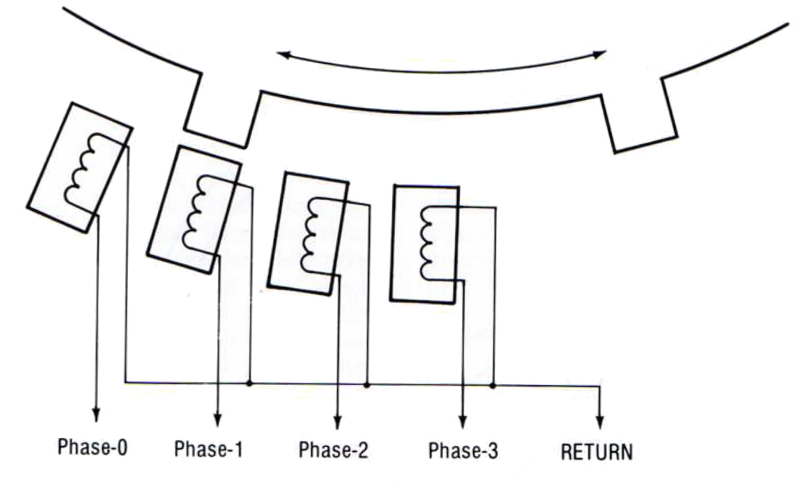
How closely can you space the tracks? It turns out that two of these head movements are normally needed in order to move the head far enough so that a track won’t interfere with its neighbors. If you try to write tracks with only one head movement between them, the magnetized areas of the disk media from the adjacent tracks will bleed into each other and cause a mess. For this reason, two movements are normally considered to be equal to one track, and a single movement is a half track. Quarter tracks are also possible, but aren’t used by most software. If electromagnet 0 was on, and then electromagnet 1 is also turned on, the head will move a quarter track. If electromagnet 0 is then turned off, the head will move an additional quarter track.
The method of locating track 0 is as crude as can be. The disk controller doesn’t know at what track the read/write head is currently located, so software must activate the stepper motors in sequence in order to move the head continuously in the direction of track 0. Eventually the head will reach track 0 and can move no further, but the software will keep activating the stepper motors, driving the head against a mechanical stop and producing the familiar rat-a-tat sound of an Apple II floppy drive during boot-up. After 80 half steps, the head is guaranteed to be at track 0. From that point on the software must keep track of all stepping movements, and remember what track the head is currently on, in order to perform relative steps. If the software gets confused, say by reading what it thinks is track 20 but finding data for a different track there, it will usually recalibrate by repeating the track 0 seek and then immediately stepping back to the desired track. This creates a clack-clack sound that many long-time Apple II users will recognize as the sign of a failing disk.
It’s customary to store 35 tracks per disk, but this is merely a convention. The true limit varies slightly from one drive to the next, and is determined by the maximum and minimum linear positions of the read/write head. Non-standard disks with up to 40 tracks are sometimes seen.
Copy-protected Apple II games very often play funny tricks with track stepping. A simple trick is locating a track at some odd number of half-steps from track 0. Tracks must be at least two half steps apart, but there’s no rule saying they can’t be three half steps apart, so you might find a game disk with data on tracks 0, 1, 2.5 and 4. This will confuse disk copy programs that only expect to find data on integer numbered tracks.
A more advanced trick is writing data on two tracks that are just a half step apart, but only using half the circumference of the disk for each track, so the magnetized areas won’t interfere with each other. There might be a half-track’s worth of data at track 2 from twelve o’clock to six o’clock around the disk, and then another half-track’s worth of data at track 2.5 from six o’clock back around to twelve o’clock. Data that’s written this way is easy to read, but is difficult to write without specially-crafted routines, making disk copies difficult.
Bootstrap Code Disassembly
A disassembly and analysis of the 256-byte bootstrap routine is fascinating. Starting with literally nothing, this code must bang directly on soft switches to control the stepper and read the shift register. It must activate the stepper electromagnets in the right pattern to reach track zero, and then begin reading bytes. It must recognize the D5 AA 96 signature, and check to see if it has the right sector. It must use a GCR decode table which it constructs on-the-fly in order to convert disk bytes. It must perform 6-and-2 decoding to reconstruct three logical bytes from four disk bytes, load the whole sector into a RAM buffer, and then jump to the just-loaded code. And all of this in only 256 bytes!
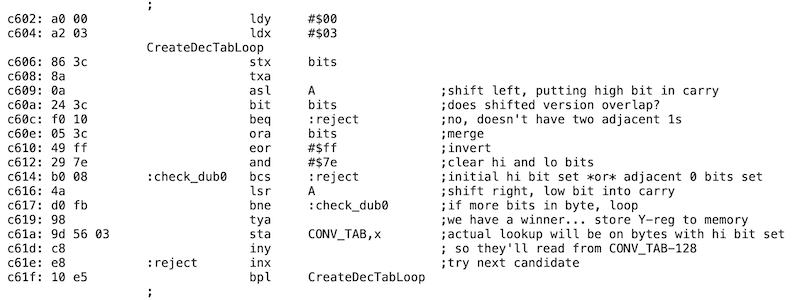
Woz gets the job done with five bytes to spare, and only about 100 lines of 6502 assembly code. But due to space constraints, some features were omitted. The Disk II controller bootstrap code doesn’t verify the checksum on sector 0, something that was “fixed” in later disk controllers but caused incompatibility with some games. There’s also no error handling, so the bootstrap code will keep trying forever to load sector 0. This explains why an Apple II with Disk II controller card appears to hang during booting if there’s no disk in the drive, or a bad disk, rather than show a nice error message like the Apple IIc or IIgs.
Disk II Controller Hardware Design
This discussion has focused on what the Disk II controller does, without going into much detail about precisely how it does it, and how those eight chips are used. For an excellent and very thorough breakdown I recommend reading Chapter 9 of Understanding the Apple II by Jim Sather. It goes into additional detail about the flux patterns on the disk and much more.
The design of the state machine is quite interesting, and I haven’t seen it described anywhere other than in Sather’s book. Anyone who remembers concepts like Mealy and Moore state machines from a long-ago class will recognize Woz’s work. The state machine ROM is just a simple lookup table. Its inputs are the current state, the read/write mode, the MSB of the shift register, and the next bit coming from the disk. The outputs are the next state and a set of control signals. Depending on the control signals, the state machine may shift the value in the shift register and append a zero or one bit, or clear the shift register, or parallel load the shift register from the data bus.
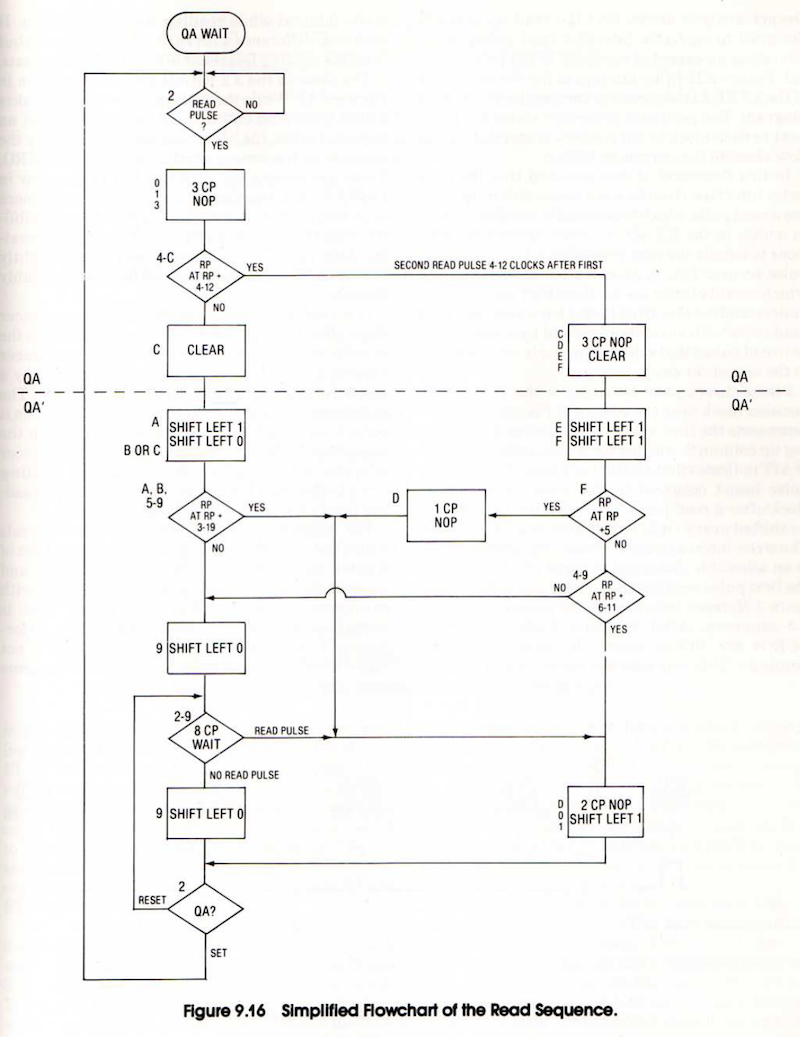
The state encodings are carefully chosen such that state bits can double as control bits. For example, when writing data to the disk, the value on the write head is also the most significant bit of the current state number. When reading data from the disk, the state sequences are chosen so as to frame pulses corresponding to 1 bits into an appropriate 4 microsecond window, and insert zero bits whenever 1.5 bit windows (6 microseconds) have elapsed without seeing a pulse. For my Yellowstone FPGA-based disk controller I’ve implemented the equivalent functionality in a hundred lines of Verilog; Woz did it with a 256-byte ROM and a hex flip-flop.
Putting It All Together
The words “software-driven” have come up again and again here, and that’s the theme of the Disk II controller. It enables a very flexible design using minimal hardware, but it pushes a tremendous amount of complexity onto the software. Modern software designers might call this bad practice, and would prefer to see that complexity abstracted away behind a standard interface, so the software only has to be concerned with actions like “read block 31”. And that’s exactly how all other Apple II disk controllers work. But in order to work with a Disk II controller, software like DOS 3.3, ProDOS, and most games need to include tons of extra code for manipulating the stepper, locating sectors, performing GCR decoding, and the whole kitchen sink. It’s a little bit crazy, but it works.
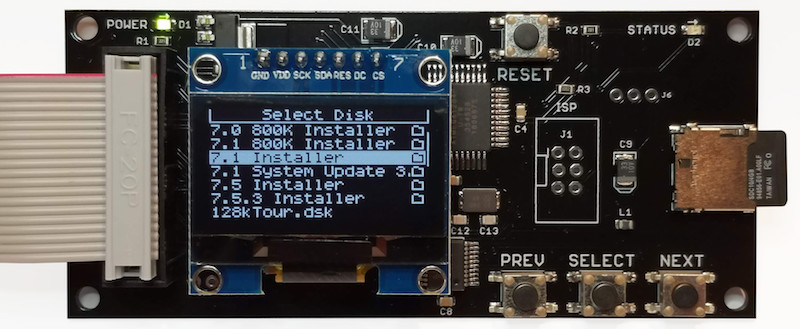
If you’ve read this far, you may be interested in the BMOW Floppy Emu disk emulator. Collectors of old Apple II, Macintosh, or Lisa computers will find the Floppy Emu invaluable for running software downloaded from the web, and transferring files between vintage and modern machines. The Floppy Emu stores hundreds of disk images on an SD memory card, and uses custom hardware to mimic many different kinds of Apple floppy disk drives and hard drives. Read more about it here.
During the 10+ years I’ve spent delving into every aspect of Apple’s disk drive designs, it’s been a remarkable journey. Years ago I used to think I understood how it all worked, but today I realize I hardly knew anything at all. Now I believe I’ve got everything mapped out, but of course there are probably still holes in my understanding that I’m blind to. Did I explain anything incorrectly here, or forget to mention something important? Let’s hear about it. Please leave a comment below.
Petscii Robots invade the C128, Amiga, NES and more!
https://www.patreon.com/8BitGuy1
Visit my website:
https://www.the8bitguy.com/product-category/music/
Petscii Robots Facebook Group:
https://www.facebook.com/groups/975620876261750
Return of the King ⚪👑⚫- Danganronpa 2
MERCH ►► http://gamegrumps.com/merch
Support us on Patreon! ► http://patreon.com/gamegrumps
or support us by becoming a channel member! ► https://youtube.com/gamegrumps/join
Click to SUBSCRIBE ► http://bit.ly/GrumpSubscribe
*********************************************
We have NEW MERCH every other TUESDAY!
►►► http://gamegrumps.com/merch
*********************************************
FACEBOOK ► https://www.facebook.com/GameGrumps
TWITTER ► https://www.twitter.com/gamegrumps
INSTAGRAM ► https://www.instagram.com/gamegrumps/
WEBSITE ► http://gamegrumps.com
*********************************************
Game Grumps are:
Arin ► http://www.youtube.com/Egoraptor
Danny ► http://www.youtube.com/NinjaSexParty
#ep4 #Danganronpa2 #LordOfTheFlies
The iMac SL (1999)
The highly accomplished Alexander Brandon helped me out with voice-over and music. Check him out at: https://www.funkyrustic.net/
Take a look at my Patreon site at: https://www.patreon.com/65scribe
The RetroMacCast livestreams weekly on YouTube at https://www.youtube.com/user/retromaccast
Additional credits:The Rushton-Suzuki Debate (1989) (TV London)
Rich and Sarah from the Oil Museum Tour (1998)