Cowboy Who?
Shared posts
The NRA's Secret Tapes
We Buy a Superhero 7: Collectibles (Live Show!)
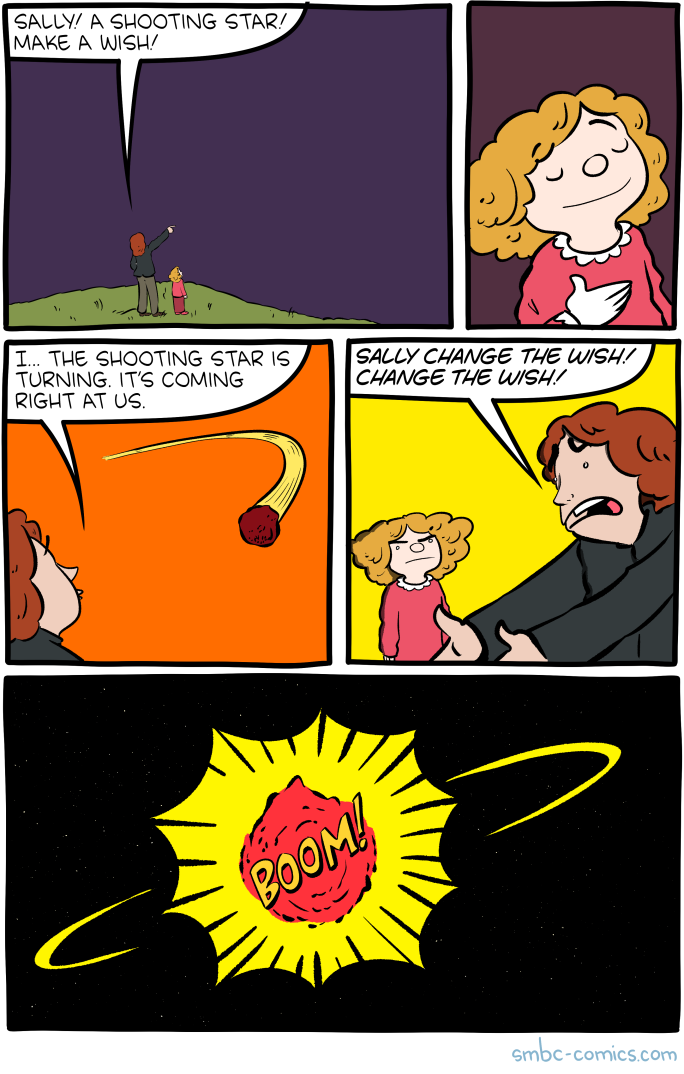
Saturday Morning Breakfast Cereal - Wish
Click here to go see the bonus panel!
Hovertext:
I want you to know I spent several seconds on the shading for Sally.
Today's News:
Impact of Posing with Cats on Female Perceptions of Male Dateability [research study]
“Not the Cat’s Meow? The Impact of Posing with Cats on Female Perceptions of Male Dateability” [by Lori Kogan and Shelly Volsche, published in Animals, vol. 10, no. 6, June 9, 2020, E1007] is a featured study in “Cats Research: Girls, and Men and Datability“, which is a featured article in the special Women (and Men) issue of the magazine—Annals of Improbable Research. The study reports:
The aim of this study was to investigate whether men were considered more attractive when posing for a photo alone or holding a cat. Prior research suggests that women view pet owners as more attractive and dateable than non-pet owners; however, this effect was strongest with dog owners. We hypothesized that men posing with cats would be more attractive than those posing alone. Using an online survey, women viewed images of a man posing alone or with a cat and rated the men on the Bem Sex Role Inventory (BSRI) and the Big Five Inventory. Women viewed men as less masculine when holding the cat; higher in neuroticism, agreeableness, and openness; and less dateable.
interviews with a prison librarian, a brothel receptionist, an Arctic Circle lab worker, and other interesting jobs
This post, interviews with a prison librarian, a brothel receptionist, an Arctic Circle lab worker, and other interesting jobs , was originally published by Alison Green on Ask a Manager.
Do you know this site has a whole section of interviews with people with interesting jobs? Here’s the complete list:
a former receptionist at a legal brothel
a lab worker at the Arctic Circle
an incredibly diplomatic person … or how to agreeably disagree
a former professional matchmaker
a 16-year-old working her first summer job
an office admin in the adult industry
an employee at a majority-autistic company
an employee at an employee assistance program (EAP)
Decorating Ideas

Decorating Ideas for Every Room in Your Home
Eisinger (Ed.) /Knapp (Illus)
1969
Another decorating books from the olden days. For those of you looking for retro chic, this is your chance!
All our 60’s favorites are here:
-
- Seizure inducing prints
- Matching everything
- Crappy/meaningless artwork
- Blinding colors and patterns
It’s almost like Beverly Hillbillies meet the Playboy Mansion, with some Grandma stuff on the side.
No thank you. Please use caution viewing the interior pictures.
Mary


The post Decorating Ideas appeared first on Awful Library Books.
How Top Gun Became A Gay Classic
Over 36 years since the release of "Top Gun", its long awaited sequel is finally premiering in theaters. "Top Gun: Maverick" sees the return of Tom Cruise as Pete "Maverick" Mitchell, the hot-shot Navy pilot with a need for speed and a penchant for ignoring the rules. Directed by Joseph Kosinski, taking over from the late great Tony Scott, the movie has received near-universal praise from critics, thanks to its astounding stunt work and evolution of its central character. Deadline even declared that it "tops the original in every way imaginable" while our own Ben Pearson said "this could end up being one of the most crowd-pleasing and satisfying movie experiences of the year."
The original "Top Gun" is a fascinating movie, an unabashedly propulsive blockbuster that is proudly a product of its time. It's pure '80s cheese, complete with Kenny Loggins songs, high-concept stunts, and good-old American patriotism dialed up to 100. It's also, to put it bluntly, one of the most homoerotic movies ever made.
Top Gun's Homoeroticism
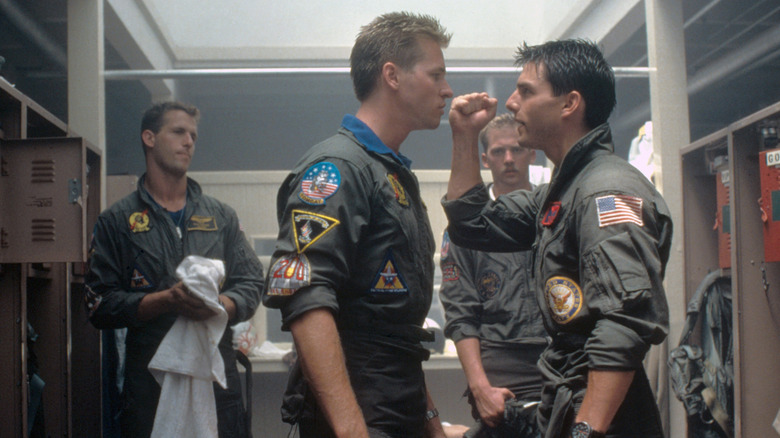
It's truly fascinating how unbridled the homoeroticism of "Top Gun" is. For a movie made by mainstream Hollywood in the midst of the AIDS crisis, it's a remarkably warm depiction of male friendships that cannot help but take on the steamy and giddy air of queerness. Google "Top Gun Gay" and you'll get a hefty 1,390,000,000 results. This reading isn't something that audiences later projected onto the film through fan theories and nostalgic reconsiderations.
Everyone called it out in 1986, from critics to audiences. In her review, critic Pauline Kael said that "the movie is a shiny homoerotic commercial [...] It's as if masculinity had been redefined as how a young man looks with his clothes half off." Quentin Tarantino would famously give voice to the theory that the film is actually a gay love story via a typically Tarantino-esque monologue in the movie "Sleep with Me." Neither he nor Kael are wrong.
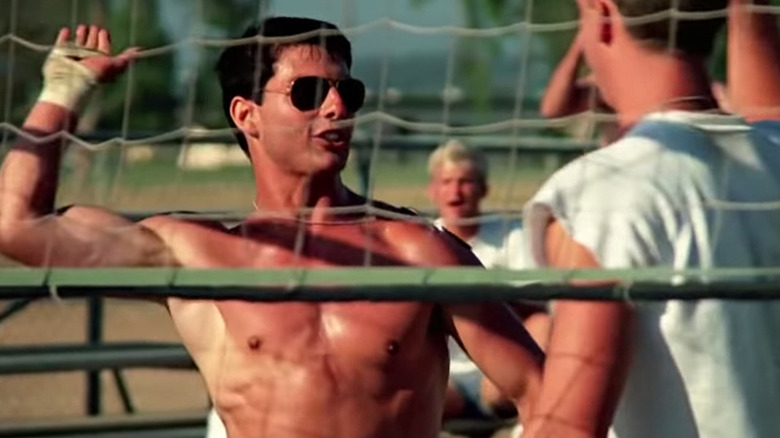
There are so many scenes of sweaty muscled men strutting around one another like prowling peacocks, clad in nothing but towels that seem ready to fall to the floor at a moment's notice. The guys play volleyball in the scorching sun in a scene set to the Loggins song "Playing With the Boys." It's hard not to be taken in by lines like "you can be my wingman anytime" and "I want somebody's butt, I want it now!"
The True Romance
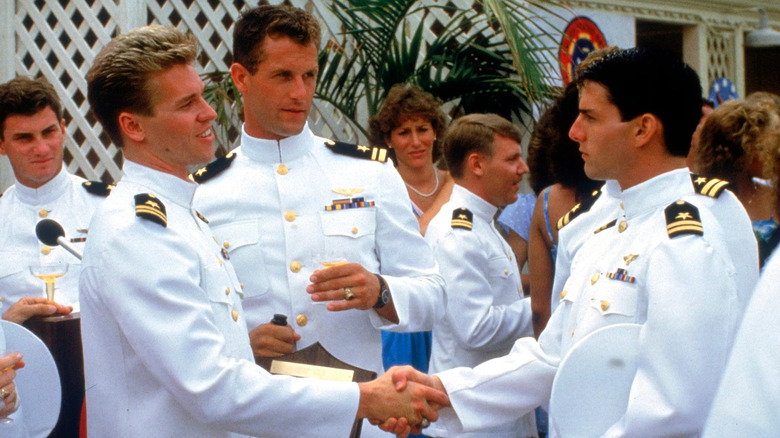
And then there's the chemistry between Cruise and Val Kilmer as his main competition, Iceman. Practically every scene between the two men reeks of the energy of two petty exes who aren't really over one another. In one oft-memed scene, Iceman cheekily bites at Maverick in a moment that would be the peak swoon-worthy moment of any romantic comedy. Sure, Maverick eventually ends up with the lovely Kelly McGillis but the real heat is with Iceman, and the true emotional climax his ability to move on from the loss of Goose, his best friend with whom he has far more emotional chemistry than any woman.
The imagery of "Top Gun" speaks for itself. We revel in shirtless volleyball set to the least subtle scene ever, and moments where men say to one another things like "I'd like to bust your butt, but I can't!" But watching the film in 2022 as this relic of unexpected gayness is still a curious experience. The subtext is undeniable but the movie also spends a lot of time emphasizing Maverick's straightness. Cruise and McGillis do a lot of sloppy open-mouthed kissing that screams "I'm straight, guys!" (But you can totally still read it as him trying too hard to prove something.) The straight romance is still the moment that ends the film, the conclusion to Maverick's narrative and the ideal Hollywood ending. There are moments of the movie that are so startlingly gay that they go right back round to being hetero.
The Filmmakers React
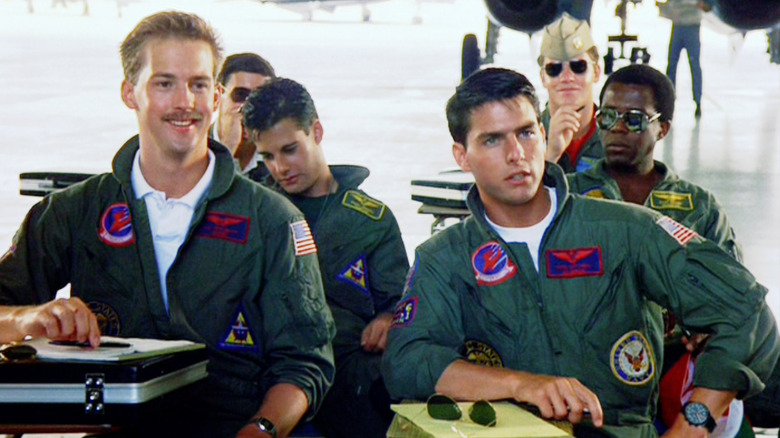
The queerness of "Top Gun" has now been widely accepted by the mainstream, even if it wasn't wholly intentional on the part of the filmmakers. In the commentary on the physical releases of the film, Tony Scott said he found inspiration for the aesthetic of "Top Gun" in a book of black and white photographs by gay photographer Bruce Weber. "Everyone was scared because it was infamous in terms of the gay community, this book," said Scott. He also acknowledged that the film had become popular with gay audiences.
Producer Jerry Bruckheimer was interviewed by Vulture last year for the movie's 35th anniversary and was asked about the subtext, specifically as it's discussed by Tarantino in "Sleep with Me." He said:
"When you make a movie, people can interpret it in any way they want and see something in it that the filmmakers had no idea they were tapping. So we're surprised every time we hear something talked about, or written about, the films that we make that have no real context for the filmmakers or what the filmmakers wanted to do. And yet there's a relevance to them, because people believe it [...] Coming from Quentin, it's always a compliment."
An Unexpected Queer Classic

It's pretty cool and kind of a relief that the filmmakers did not shirk at the notion of their uber-macho, peacock strutting movie of military men being seen as anything less than stridently heterosexual. It would have been wearily unsurprising had such responses elicited gay panic, especially given the startling homophobia of the era. Remember, this was a time when the LGBTQ+ community was dying en masse thanks to a plague that the sitting president refused to acknowledge or do anything to stop.
There's also a cathartic thrill to be had with seeing a film that is pure military propaganda be this gay, given that it was illegal to be out and serving in the '80s (the Department of Defense declared in 1981 that "the presence in the military environment of persons who engage in homosexual conduct or who, by their statements, demonstrate a propensity to engage in homosexual conduct, seriously impairs the accomplishment of the military mission." They must have not liked volleyball.) Queer representation of any kind was extremely rare, particularly in films of this scale, and gay jokes were common. So, "Top Gun" embracing its reputation warms the heart in its own bare-chested way.
Top Gun In 2022

But what makes "Top Gun" so interesting to watch is what they reveal about our staid ideas of masculinity. These moments that we think seem gay are positioned here as guys being dudes, just friends and colleagues hanging out and enjoying themselves free of scorn or judgment. This kind of intimacy between men, even when it isn't romantic or sexual, comes with its own undeniable passion. It's refreshing to see, even if you take out the queer reading. How many films have you seen where guys refuse to hug one another or be open about their feelings because it would be seen as too gay to do so? The refusal to categorize certain types of behavior as "gay" or "straight" is a powerful move that disrupts homophobic mindsets. Would that more pop culture stories be so candid about masculinity.
However you read "Top Gun," it's a film that remains a unique time capsule of its time. It seems unlikely that "Top Gun: Maverick" will top its predecessor in this way (all jokes intended) but as we finally see slivers of LGBTQ+ representation in these mega-blockbusters intended for worldwide audiences, perhaps we owe a salute to Maverick and Iceman for their inadvertent contributions to the cause.
Read this next: 14 Remakes That Are Better Than The Original
The post How Top Gun Became a Gay Classic appeared first on /Film.
Saturday Morning Breakfast Cereal - Behold
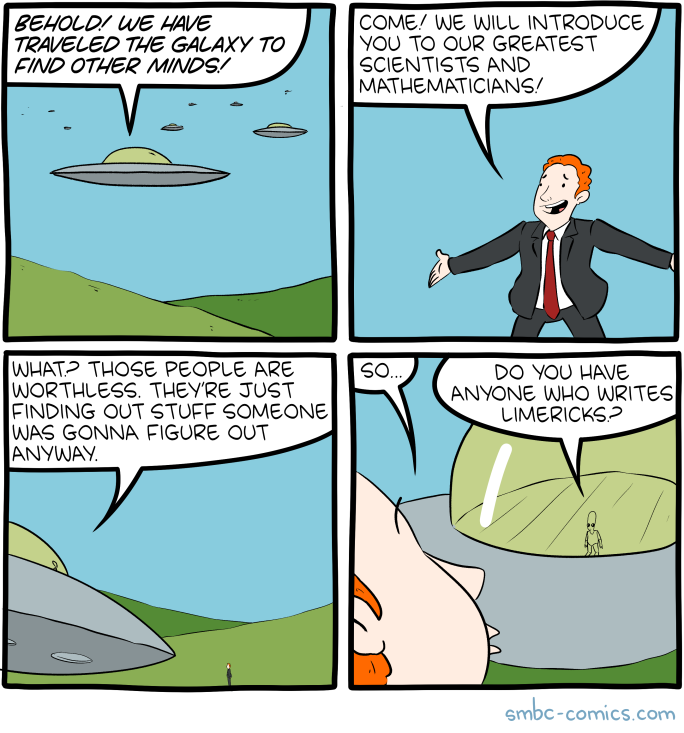
Click here to go see the bonus panel!
Hovertext:
The one about the man from Madras is the main reason they kept us alive after we used nukes on ourselves.
Today's News:
the popcorn calamity, the chair battle, and more stories of dramatic reactions to small changes at work
This post, the popcorn calamity, the chair battle, and more stories of dramatic reactions to small changes at work , was originally published by Alison Green on Ask a Manager.
Last week, I asked for stories about weirdly dramatic reactions that you’ve seen people have to small changes at work. The comment section was full of fantastic stories — so many that I had to split my favorites up into two posts. Yesterday was part one, and here’s part two.
1. The picnic table
A new unit was added to my state government division, and the unit’s purpose was bitterly fought in the media by locals losing the power to do this function. Because it was a new unit, a large percentage of the team were new to government service.
Outside the exit door near the unit was a lovely picnic table under an old tree. Shady, cool, comfortable – and it gained a lot of use as the new unit staff spent breaks and lunch hours there. Unfortunately, it was on a main corner, and our agency had only been in the building for a few months, so the use was highly visible to passersby. Complaints about lazy state workers were made, and so the command staff decided to remove the table, especially since a new outdoor area was constructed where it wasn’t visible to the public. This was not acceptable to new unit.
New unit went ballistic. It was bitterly complained about at staff meetings, and then division meetings. The suggestion box was stuffed. A petition was signed and submitted to the director. Finally, one Friday, they walked through the halls of our office with large hand drawn picket signs, shouting, “No table no peace!” After marching around for 15 minutes, they headed off to the director’s office. They didn’t come back for an hour, and when they did, they were silent, and all talk about the table ended.
2. The new phone system
My office switched to a new phone system because the previous one was ancient. The new system has such wild features as … the ability to put a call on hold! The ability to transfer a call to someone else! My colleagues lost their minds, even though the new system had features they specifically requested. But the best part was that after the installation of New System, anything and everything that broke in the office was blamed on New Phone System. Copier started jamming? It must have something to do with New Phone System. Printer ran out of toner? New Phone System is to blame. My all-time favorite was when the COFFEE MAKER broke and several of my colleagues genuinely believed the New Phone System was somehow responsible. It took everything in me not to crack up with laughter explaining that the phone system was not connected to the coffee maker *at all*, and there was literally no way one could affect the other.
3. The Slack resistance
Our office exchanges a lot of correspondence with each other, and email imboxes were imploding – and many emails were just single sentences, or the sentiment in the subject line itself. To help reduce the sheer number of emails, we created a Slack for the entire 40-person office, and I assisted with making sure each team had various channels for their projects. The launch was pretty seamless, and the majority of the teams loved it. Except one team.
One team insisted on continuing with email. They go as far as to ignore direct messages on Slack and reply via email that they only communicate via email. These folks were also the ones responsible for the majority of the one-word, one-sentence email replies, and often send multiple one-sentence emails back to back about the same topic … you know, things that could just be Slack messages!! The inability to adapt is mind-boggling to watch. We only do office catering and other fun announcements via Slack now … and these folks have been mad they haven’t been “notified via formal communications.” It’s free cookies in the breakroom, Mark – we’re not going to send you a special email just because you won’t join our Slack!
4. The reycling
A company I used to work in decided in an effort to be greener to introduce recycling bins at all sites. Four separate bins: glass, tin, paper, general waste. There was such backlash! One guy even tried to start a mutiny; he didn’t want anyone to use them until we’d “received proper training.”. My dude, they’re bins with pictures on them! Put your paper in the bin that says paper with pictures of paper on the side. I could never understand the outrage that caused.
5. The free popcorn
Free Popcorn Monday being taken away. Well, not taken away but the person who’d pop it retired and despite many emails asking for others to volunteer to do it, no one signed up. Yet loud and numerous complaints about it would occur, and when you told them they could volunteer to pop it, they’d always have an excuse. I do feel gender did play into this as the complainers were exclusively male and the person who retired was a woman.
6. Perfect WordPerfect
I worked for a large government office where people would stay for 30+ years. This meant I had colleagues who had started in 1985 and learned how to use computers while on the job. One in particular decided that WordPerfect was much better than Word, and therefore that was the program he would learn. In the 2010s, the office decided to officially remove WordPerfect from the system and force everyone to switch to Word (yes, 2010s – it was not only the employees who were averse to change). When the colleague found out about this, he decided to refuse all updates and upgrades to his computer. Six months later, his computer was incredibly slow and failing to start half the time, but he refused to let IT touch his computer, and filed a grievance with the union when our boss tried to force him. The end result was that he was allowed to keep WordPerfect on his computer.
7. The oatmeal
Six months into my first post-grad job (2007), the hospital cafeteria steps away from our offices changed the price of a cup of oatmeal from $.55 to $1.25. We were incensed: that’s a 227% increase! … to $1.25. The sense of injustice and outrage was incredible in our office: so many conversations about the price of oatmeal these days; laments about the old days when you could grab a decent breakfast with whatever change you may have found in your desk (who did that?!); They Just Can’t more-than-double the price on anything like that; rumors started about all the doctors who probably filled their cups 2/3 full of walnuts/other expensive oatmeal toppings and now we’re paying for their dishonesty, etc. etc. for WEEKS.
Anyone who attempted to express how horrible this was to anyone outside the office was soundly ridiculed, with good reason. Even now I intellectually know this is ridiculous, and yet…
8. The meeting
I work in IT for an enormous organization, so I have about 50 million stories like this from internal customers. One of the weirder ones that comes to mind, though, is from my team. I took over a team that had been around a long time when they were reorganized into my area. They had an exorbitant number of standing meetings, and they ALL attended ALL of them (a team of ~7). I was trying to cut down on the team’s meetings to free up time for other work. I decided to pull most of the team out of this one particular meeting, and keep it to a select group of people. The people I pulled had no business reason to be there. But when this was announced, you would have thought I announced they were being fired. Two people in particular were very upset, and made it known that they really wanted to be put back in the meeting. One of them literally loudly sang, “I want my [name of meeting]” to the tune of “I want my baby-back” (from the Chili’s commercials) over and over in a large team meeting.
I eventually settled on “Ok, you are an optional attendee in this meeting. You can go if you have no pressing work, but this is your lowest priority.” They now all attend that meeting every week again, just like old times. It drives me a little crazy, but it was NOT a Hill to Die On for me.
9. The pens
We had ACTUAL TANTRUMS and a petition (signed by about four people…) when we changed stationery suppliers and a particular brand of fine liner pen was no longer available.
10. The intranet redesign
We redesigned our intranet many years back and people went MAD. The old site was built on the most un-user-friendly platform I’ve ever seen, and the homepage was this godawful list of random links (not kept current, and missing a lot of info so people couldn’t even do a search on the page to find what they needed). The navigation was nonsensical and outdated, so most of the links didn’t even work. The search function for the site didn’t even work anymore. There was no grouping of similar pages into sections; it was basically just a bunch of pages with completely outdated information in places that you couldn’t find unless someone sent you the link they had bookmarked.
We built a new intranet using a more modern platform. The search worked, the homepage had more general info but still had some icons that linked to the most-used pages, there were separate “sites” for different departments, and it no longer looked like something a teenager built in 1996. Hundreds of employees (out of several thousand) were furious at losing the old site. These were people that had been employed for decades and were angry we would deign to update to something more usable when they relied on a bunch of bookmarks in their browser (because even they knew the old site was unable to be navigated).
This was 10 years ago and people STILL complain. Just wait until we migrate the intranet into a new platform next year…
11. The chairs
At a former workplace, it was decided that all the desk chairs would be replaced. The existing chairs came in two styles – a standard, green upholstered office desk chair, and then for certain offices/people, an “executive” desk chair (these were nicer, with wooden handles and leather upholstery and such).
It is worth noting that the design scheme of the building was rigorously adhered to in all things, so everything matched. All the wood furniture was the same wood tone. All the upholstered furniture had to match. You weren’t allowed to bring anything in without approval (and you rarely got approval).
So the new chairs are ordered, and we are notified that they also have two options – they were both the same style, but one was simply wider than the other.
It caused an uproar the likes of which you would not believe. The few people with executive desk chairs were wondering why they were not being given nicer chairs again and complained about that. Others just didn’t want to give up their existing chair (even though the chairs were over 10 years old at that point). Passionate speeches were given in the breakroom about why people should be able to keep their old chairs. Meetings would be derailed with chair talk. It consumed people.
The day before the switch happened people were hiding chairs wherever they could. I went into the restroom and there was a chair sitting on top of a toilet in a stall. I had a vault in my office, and multiple people stopped by and asked if they could stash chairs in it.
The day the switch actually happened must have been the least productive day in the company history. People were going from suite-to-suite looking at other chairs (again, even though they were all the same color/style), people were gathering in the hallway to complain. Every time I passed an office window there was someone bouncing up and down in their chair and complaining. People were filing complaints with HR, a couple of people went home early in protest, some people that had stashed their old chairs pulled them back out and were sitting in them again, which made other people upset so there was a lot of “Steve is sitting in an old chair! I just want my old chair back!” so then they would go and take Steve’s old chair and then Steve would be upset about that. I ended up leaving early because I was just so tired of hearing about it.
12. The copier
When I used to volunteer to make copies at my kid’s school, the other parent volunteer who trained me was really upset because one of the copiers had been turned to the side so that the paper was easier to load. It was the same machine, it was just turned 90° to the left. She kept saying how sorry she was, like it was some kind of embarrassing faux pas.
13. The pizza
I once got called in to my manager’s office because of pizza. Yup. I dared to suggest we order from a different place. The chaos that caused was mind blowing. The person who usually placed the order freaked out because she “didn’t know how to order from the new place.” No one could make up their minds what they wanted. Everyone was upset because it wasn’t their usual place so I got reprimanded for causing disruption. In my defense, the pizza from their usual place tasted like ketchup flavored cardboard. Yeah, that place was toxic in more ways than one. I did not last long there.
14. The shoe
This one isn’t about dramatic responses to mundane changes; it’s a quitting story. But it was in that thread and it must be shared.
A coworker (a manager at a large retail store) was walking to work and stepped in dog poop.
He walked in, came up to the register counter where we were opening tills for the day, put his soiled shoe on the counter, said “I quit.” and walked out only wearing one shoe.
'The Onion' has republished a grim headline about mass shootings 21 times since 2014

The satirical news site publishes modified versions of the article after major mass shootings, always with the same headline: "No Way To Prevent This,' Says Only Nation Where This Regularly Happens."
(Image credit: Screenshot by NPR)

Atlantic Tropical Weather Outlook
967
ABNT20 KNHC 250501
TWOAT
Tropical Weather Outlook
NWS National Hurricane Center Miami FL
200 AM EDT Wed May 25 2022
For the North Atlantic...Caribbean Sea and the Gulf of Mexico:
Tropical cyclone formation is not expected during the next 5 days.
$$
Forecaster Cangialosi
update: employer wants friends and family to participate in 360 feedback reviews
This post, update: employer wants friends and family to participate in 360 feedback reviews , was originally published by Alison Green on Ask a Manager.
Remember the letter-writer whose sister’s employer who wanted friends and family to participate in 360 feedback reviews? Here’s the update.
Thank you for answering my question about filling out a 360 review for my sister. The letter was published on a day when I had spotty cell/wifi reception, so I couldn’t participate in the conversation, but my sister and I read every single comment.
By the time the letter was published, we agreed that her company was being inappropriate with its request but couldn’t quite figure out why they made the decision (my favorite hypothesis was that they got wowed by a sales pitch and didn’t critically think about how dumb the policy was). I also decided I wasn’t going to respond to the survey, but part of me wanted to respond with family-related issues only to see if they put them in her performance review (“She’s too tall so I can no longer borrow her clothes” “Mom always makes me help cook for family get togethers- she gets to hang out and socialize” “She forgets that mom is terrible at keeping secrets and it messes up family surprises”). I would have died of laughter if my sister had to put ‘cooking at family get-togethers’ as her yearly performance goal.
Afterwards, we had further discussions about her company, which uncovered a myriad of concerns. To try to simplify things, let’s say she started as a generalist, but worked very hard to achieve certification in a very specific area (like starting in chocolate teapot production and becoming certified in making the teapot molds). She was promoted to supervisor of chocolate molds but wouldn’t tell her the pay—they claimed they needed to hire another person to be a mold admin. This hire did not have certification and no experience in chocolate teapot molds but was still offered a salary 10k higher than my sisters. They did eventually raise her salary to match his, but then decided that she shouldn’t have the supervisor title, and essentially demoted her to being an admin (despite being the only staff certified in molds with experience in the specific mold of the company).
My sister was conflicted about staying or leaving; she was hoping to make this job a long-term career, but the run-around eroded a lot of trust she had for the company. She found another company that was looking for someone certified in chocolate molds and was offered a job that had both the senior title and a hefty pay bump. When she resigned, apparently her old job was completely shocked that she would leave.
The company has not reached out to me to ask my opinion on my sisters’ resignation.
should we require “they/them” pronouns as the default for everyone at our meetings?
This post, should we require “they/them” pronouns as the default for everyone at our meetings? , was originally published by Alison Green on Ask a Manager.
A reader writes:
I just stumbled across your 2021 post “my office wants my pronouns — but I’m still figuring it out.“ I was so grateful to the letter writer and commenters who described the turmoil I feel when asked for my pronouns in a work context. The best parallel I can imagine is an icebreaker where meeting participants are asked to describe their relationship with their mother in two words: I don’t know how to answer the question, and even if I did, I don’t want to share it with a group of professional contacts before we turn to a work topic.
I manage HR at a small nonprofit, and I’m thinking about proposing an organizational standard that for external meetings/events, we ask folks to refer to each other as “they” unless they know the person prefers a given pronoun (from prior knowledge, inclusion in their Zoom participant name, etc). When we ask for pronouns, what we really want is to keep from misgendering each other in the course of our work — but why do we put the onus on individuals to come out rather than removing the gender default from our language in the first place?
I wondered if you’d be willing to ask your readers for feedback on this idea? It’s hard to find communities of other professionals with diverse gender identities to run this by. I’d love to hear any implications of this idea that I’m not considering! I’m picturing a script along the lines of:
“Before we do introductions, I want to acknowledge how much we don’t know about each other just by looking. There’s likely a spectrum of racial/ethnic and gender identities in this meeting, as well as neurodiversity, an array of areas of expertise, and more. So we’re asking all participants to challenge yourself to not make any assumptions about others in how you talk to or about each other. In particular, please refer to other people by their name or the gender-neutral pronouns ‘they’ or ‘them’ unless you happen to know someone prefers another pronoun (he, she, xe, etc.). And if you are someone who wants specific pronouns used for you, you can mention that in your intro or add them to your Zoom name. Any questions?”
Are people ahead doing this anywhere? In addition to the distress caused to me and apparently others by asking everyone to disclose something personal at the top of the meeting, practically speaking, no one remembers all the names from intros, much less each individual’s pronouns. Plus, beyond my own identity, I’d really like to avoid hearing a slew of femme-presenting people ask for “she/her” pronouns (as often happens in the spaces I’ve been in); this can quickly feel alienating, like a public celebration of the gender binary rather than the acknowledgment of diversity it’s meant to be, depending on who’s in the room.
What I’m curious to hear from you and readers is, can we put the affirmation that comes from using people’s individual pronouns back on an individual level? This proposal would make me feel more able to participate in a meeting. Would it do the same for others?
To make sure readers are following: the idea would be to request that everyone use “they/them” as the default when referring to other people, unless someone names different pronouns for themselves.
I’m interested to hear feedback from others, but I don’t think it’s practical. Getting people to reprogram their language for an entire group for a single meeting is not a small request (look at how much trouble people have getting individual people’s pronouns correct when they change, even when they’re genuinely trying). And you’re expecting them to remember who introduced themselves with specific pronouns and who didn’t — when, as you point out, people don’t even remember everyone’s names.
Moreover, how do you plan to enforce it? And are your meetings going to be regularly derailed by people apologizing for getting it wrong?
You mentioned that part of your motivation is to avoid hearing a slew of she/her pronouns when people introduce themselves. But your script specifically invites people to name any specific pronouns they want used for themselves, so most likely you’ll still get lots of people saying “I use she/her” during introductions. And the solution definitely isn’t to remove the invitation to offer those — because lots of people feel strongly about their gender identities and want their correct pronouns used. That’s much of the point, really.
In fact, that’s the other issue with this plan — you can misgender people with “they/them” just like with anything else.
So by all means, encourage people to share their pronouns if they want to (as long as you don’t require it). But trying to impose “they” for everyone as a default unless they request an exception is likely to draw a ton of attention away from what you’re there to do and ultimately not have the effect you want.
Divorce Mediation Help

The Divorce Mediation Handbook
James
1997
Divorce mediation is a great topic for library collections and can be a cheaper alternative to traditional divorce. However, it isn’t right for everyone, especially when there are complex issues or unequal power dynamics. In 1997, this would have been a great choice for a public library collection. In 2022, the topic still has merit, but it is essential that this material is up to date.
I would like to also say that this could qualify as an easy weed. Topics in the legal and medical areas are easy weeds just based on date alone. If the book purports to give advice to the reader for a current medical condition or current legal situation, the publication date automatically throws that material into question. I have often discussed this issue with people when they argue that “most” of the book is still relevant. I think that argument might have more standing with topics that are less time sensitive.
Non-public libraries should look to their collection objectives and/or mission. Clearly this book’s intended audience is the general public. It is not for professional practitioners. It may or may not fit with some retrospective research objectives, but for the most part, it is NOT for current use. Compare the title about the value of a housewife in divorce, where the author was the actual change agent in a significant area of the law. Even though both of the books are out of date with respect to divorce laws, and are not appropriate for a public library collection, the “housewife value” book has more significance in a research context. For special and research collections, impact and context of certain materials should be part of your weeding criteria.
Holly and I are currently working on the third edition of our book (provided we don’t kill each other before it’s done), so this kind of stuff is sitting in my brain marinating. Bottom line: if you want to be efficient with your weeding time, develop some quick criteria for your collection that can automate your obvious weeds quickly.
Happy weeding,
Mary


The post Divorce Mediation Help appeared first on Awful Library Books.
How to Talk to Your First Grader about School Shootings
1. Ask them if they’ve heard about anything scary at school. (You have to send them back to school.) Sometimes they come home with interesting facts about butterfly migrations or plans to stop people from littering, so their teachers are likely sharing some news and current events with them.
If they say yes: Separate fact from fiction. It’s fact that the school shooting happened. It’s fiction that it probably won’t happen again.
If they say no: Call your nearest NRA-supporting senator’s office. When the staffer picks up, request that the senator explain to your six-year-old child what happened. It’s doubtful that the senator will answer because Disney World is only open 365 days a year, but the college intern who’ll take your call is probably trained in speaking with the public, and old enough to remember Sandy Hook.
2. Ask them if they have any questions. It’s normal for kids to be curious about things happening in the world, just like it’s normal for lawmakers to offer “thoughts and prayers” when children are killed by someone with a gun.
If they say yes: They will probably ask you where babies come from or if they can have a snack. Say, “No, about the scary thing that happened at the other school. You can have an apple, but cookies are treats, and those are for after dinner.”
If they ask you why the shooter did it: Tell them you don’t know.
If they ask you if the kids were scared: Tell them you don’t know.
If they ask you if something like that will happen here: Tell them no (even though you don’t know).
3. Ask them if they know what to do if there is gun violence at their school. American schools are full of rules and regulations. This means that instead of relying on laws that would make school shootings a thing of the past, your child will undergo active shooter drills. Your first grader will call them, “What we do if a scary person gets in the building” practice.
If they say yes: Think about your child hiding in the darkest corner of their classroom. (They will want to sit on the rainbow carpet, but that’s in view of the windowed door.) They will earn a good behavior point if they stay quiet. A police officer will walk the hallways to ensure that all classes are participating in the drill. Your child will hear their footsteps coming closer.
If they say no: Think briefly about bulletproof backpacks that you can’t afford. Tell your child not to worry. There will be another drill soon.
4. Ask them if there’s anything else they want to tell you. Leaving room for conversation is important because it allows your child to bring up their own fears about being murdered in their elementary school.
If they say yes: Have their baby book ready for this part. You’ll want to record these precious thoughts; they don’t last forever. Don’t think about those other parents and their baby books. Don’t think that leaving your kid’s baby book unfinished will somehow magically keep them safe. This is America.
If they say no: Ask them again the next time this happens.

Music Library Association Opens Publications at Internet Archive

For librarians who specialize in caring for music collections, it can be challenging to keep up with the latest technology and resources in the profession. The Music Library Association recently helped address this problem by making many of its publications openly available online.
The MLA donated 21 of its monographs to the Internet Archive for digitization and worked with authors to make the material free to the public under Creative Commons licenses.
The new collection of backlist titles includes information on careers in music librarianship and history of the field. It also covers planning and building music library collections, which can be complicated and involve individual creators and small publishers, said Kathleen DeLaurenti, who helped lead the partnership with the Internet Archive in her role as MLA’s first open access editor. There are also valuable materials on music library approaches to technical services—everything from how to preserve music materials to how to bind and catalog them.
“Increasingly in librarianship, we have people who are being tasked to do this work who don’t have a specialized background, especially in smaller organizations, rural places, and public libraries,” DeLaurenti said. “We’re really excited to be able to make this content available to folks who may not have access to professional development in those spaces, and who may be looking for some materials to bolster their training and their own work.”
The MLA has been publishing new research of interest to music librarians since the 1970s and wanted to find a platform to make the information easier to discover, said DeLaurenti, director of the Arthur Friedheim Library at the Peabody Institute of Johns Hopkins University in Baltimore. The Internet Archive provided the open infrastructure to share and leverage the work of the MLA, which is a small organization with about 1,000 members.
While the MLA began with 21 of the monographs, it is working to obtain rights clearance for an additional 20 titles and DeLaurenti hopes the online collection will grow. So far, authors have been excited that the association is making their work available as it increases access for scholars with the potential for more citations of their research.
The audience for the online collection will likely be “accidental music librarians”—people tasked with music library responsibilities who aren’t musicians but are looking for professional development resources in the area, DeLaurenti said, as well as individuals considering music librarianship as a career.
“As libraries are looking at what kinds of open infrastructure is out there and available, I think the work that the Internet Archive has done through COVID has really changed our perception and how they can work as a potential collaborator in that space,” DeLaurenti said. “We hope to continue different kinds of collaborations with [the Archive] in the future.”
LEARN MORE
- To browse the Music Library Association publications now online at Internet Archive, please visit https://archive.org/details/musiclibraryassociationpublications.
- To learn more about the Music Library Association, please visit https://www.musiclibraryassoc.org/.
The post Music Library Association Opens Publications at Internet Archive appeared first on Internet Archive Blogs.
Places to Avoid While We Continue to Wait for Lawmakers to Enact Meaningful Gun Control Legislation
While we wait for our elected officials to stop dicking around and finally do something to stop the relentless gun violence in this country, Americans should avoid the following high-risk locations:
This list will be updated as needed.
What we know about the Uvalde elementary school massacre

Uvalde joins Parkland, Sandy Hook, and America’s long list of horrific massacres in schools.
An 18-year-old gunman killed 19 students and at least two adults at Robb Elementary School in Uvalde, Texas, on Tuesday morning, just 10 days after another mass shooting at a supermarket in Buffalo, New York, that claimed the lives of 10 people.
It’s the deadliest US school shooting in years: In 2018, 17 were killed at Marjory Stoneman Douglas High School in Parkland, Florida; in 2012, a shooter at Sandy Hook Elementary School in Newtown, Connecticut killed 26 people. It marks the 27th school shooting this year alone; in addition to the deaths reported in Uvalde, 25 people have been killed in school shootings since January.
/cdn.vox-cdn.com/uploads/chorus_asset/file/23587636/GettyImages_1240886339.jpg) Jordan Vonderhaar/Getty Images
Jordan Vonderhaar/Getty Images
In a national address on Tuesday night, President Joe Biden called for lawmakers to pass “common sense gun laws.” As vice president, he tried and failed to pass universal background checks, a new assault weapons ban, and a prohibition on high-capacity gun clips.
“Why are we willing to live with this carnage? Why do keep letting this happen? Where in God’s name is our backbone to have the courage … to stand up to the lobbyists?” he said. “It’s time to turn this pain into action. For every parent, for every citizen of this country, we have to make it clear to every elected official in this country, it’s time to act.”
Despite that plea, several Republicans, including Sens. Ted Cruz of Texas and Jim Inhofe of Oklahoma, have already publicly rejected the prospect of passing gun control legislation in response to the shooting. And Texas Gov. Greg Abbott suggested in a press conference on Wednesday afternoon that the shooting was the symptom of a broader mental health crisis, not the state’s lax gun laws.
“The ability of an 18-year-old to buy a long gun has been in place in the state of Texas for more than 60 years,” he said. “Why is it that for the majority of those 60 years, we did not have school shootings? And why is it that we do now? . ... One thing that has substantially changed is the status of mental health in our communities. We as a state, we as a society, need to do a better job with mental health.”
His remarks prompted Democrat Beto O’Rourke, who is running against Abbott for governor, to angrily interrupt the press conference, resulting in his being escorted out.
“This is on you,” O’Rourke told Abbott. “The time to stop the next shooting is now, and you are doing nothing.”
/cdn.vox-cdn.com/uploads/chorus_asset/file/23586523/AP22144729712308.jpg) Dario Lopez-Mills/AP
Dario Lopez-Mills/AP
What we know about the Uvalde shooter and the Robb Elementary School shooting
In Wednesday’s press conference, Abbott said that the gunman made a post on Facebook about 30 minutes before arriving at the school that said he intended to shoot his grandmother.
He then shot his grandmother in the face, and made a new post saying he’d done so. She called the police and remains in critical condition. In his final post, about 15 minutes before he opened fire at the school, the gunman wrote that he was going to shoot an elementary school. He crashed his car outside the school before running inside, barricading himself in a fourth grade classroom.
According to Texas Department of Safety spokesperson Lt. Christopher Olivarez, the shooter had on body armor. Abbott said Wednesday that the only weapon used was an AR-15 semiautomatic rifle. The shooter is now dead, killed by a responding Border Patrol officer, according to Abbott.
/cdn.vox-cdn.com/uploads/chorus_asset/file/23587545/GettyImages_1240886517.jpg) Jordan Vonderhaar/Getty Images
Jordan Vonderhaar/Getty Images
The gunman legally purchased the semiautomatic rifle at a local sporting goods store on March 17, then bought 375 rounds of ammunition the following day and a second semiautomatic rifle at the same store on March 20, according to Texas Department of Public Safety director Steven C. McCraw.
There is no age restriction on possessing guns in Texas, but you have to be 21 or older to carry a concealed handgun without a license under the permitless carry law that went into effect last September. And it’s generally not legal to carry a handgun on K-12 public school property, though one Republican lawmaker sought to make that possible for licensed adults in the last session of the Texas legislature. There are no specific state law restrictions on carrying a rifle.
There have already been two school campus-related shootings in Texas this year, each of which left one injured. But the Uvalde school shooting is the worst in Texas since 2018, when a student at Santa Fe High School near Houston shot and killed 10 people and wounded another 13.
What we know about the victims
The victims were all in the same fourth grade classroom where the shooter had barricaded himself, Olivarez told CNN on Wednesday.
Not all of the victims have been publicly identified yet, but as of Wednesday afternoon, they include:
- 10-year-old Amerie Jo Garza; her father searched for her for seven hours before posting an update on Facebook on Wednesday that his “little love is now flying high with the angels above.”
- Fourth-grade teacher Eva Mireles, who had been an educator for 17 years.
- 10-year-old Xavier Lopez, who had just made the school’s honor roll Tuesday morning.
- 10-year-old Uziyah Garcia, whose grandfather described him to KSAT as the “sweetest little boy that I’ve ever known.”
- 10-year-old Jose Flores Jr., whose father described him as “always ready to play ’til the night” to CNN.
- 10-year-old Lexi Rubio, who had also just made the honor roll.
/cdn.vox-cdn.com/uploads/chorus_asset/file/23587517/AP22145084513318.jpg) Dario Lopez-Mills/AP
Dario Lopez-Mills/AP
/cdn.vox-cdn.com/uploads/chorus_asset/file/23587567/GettyImages_1240886718.jpg) Allison Dinner/AFP via Getty Images
Allison Dinner/AFP via Getty Images
The Uvalde shooting — the second in a month — puts a renewed spotlight on gun control
Two mass shootings in 10 days should be a wake-up call for lawmakers. After the Buffalo shooting, nothing was done to tighten federal gun laws. The House of Representatives passed a bill aimed at addressing domestic terrorism, since the shooter was a white supremacist who invoked the “Great Replacement” conspiracy theory before he opened fire on shoppers in a predominantly Black neighborhood. But even that bill, which only tangentially addresses the underlying gun violence issue, has stalled in the Senate.
The Uvalde shooting isn’t likely to meaningfully change the status quo.
Democratic Senate Majority Leader Chuck Schumer signaled Tuesday that he will put to a vote a bill to extend the window for completing a background check before a gun sale, but it would need 60 votes to pass — and it’s not even clear whether all 50 Democrats are on board. West Virginia Sen. Joe Manchin, for instance, has previously opposed certain legislative efforts to expand background checks, and though he told CNN Tuesday that he would do “anything I can” to move “common sense” gun legislation forward, he still refused to change or eliminate the filibuster so that Democrats could do so with a simple majority in the Senate.
Uvalde’s Rep. Tony Gonzalez, a Republican who is running for reelection this year, has repeatedly voted against gun control measures while in Congress, including legislation that would require a background check for every firearm sale and for private transfer of firearms.
“My heart breaks for the city of Uvalde. Pray for our families,” he tweeted on Tuesday.
Sen. Chris Murphy, a Democrat from Connecticut and a leading proponent of gun control, urged Congress to take action in the wake of the second mass shooting in two weeks.
/cdn.vox-cdn.com/uploads/chorus_asset/file/23587582/AP22145459300149.jpg) J. Scott Applewhite/AP
J. Scott Applewhite/AP
“What are we doing? What are we doing? Just days after a shooter walked into a grocery store to gun down African American patrons, we have another Sandy Hook on our hands,” he said in an address on the Senate floor Tuesday.
If history is any evidence, it’s unlikely that Texas Republican lawmakers, who control the state legislature and pushed to loosen state gun laws in the lead-up to the midterms, will change course as a result of the Uvalde shooting. After the Santa Fe shooting, Abbott signed bills that bolstered mental health initiatives for children, removed the cap on how many school marshals can carry guns on public school campuses, and gave school districts money to prevent and make emergency preparations for shootings — but didn’t enact gun control measures.
Instead, he’s led successful state legislative efforts to relax gun laws, most recently signing legislation to remove permit requirements to carry a concealed handgun in public. Abbott is still scheduled to speak Friday at the National Rifle Association’s annual meeting in Houston alongside other prominent Republicans, including Sen. Ted Cruz of Texas and former President Donald Trump.
/cdn.vox-cdn.com/uploads/chorus_asset/file/23588301/GettyImages_1240899375.jpg) Allison Dinner/AFP via Getty Images
Allison Dinner/AFP via Getty Images
That’s in contrast to New York Democrats’ response to the Buffalo shooting, which was to tighten the state’s already restrictive gun laws.
New York Gov. Kathy Hochul announced last week that police will now be required to bar individuals who are believed to pose a danger to themselves or others from possessing firearms. She also called on the state legislature to pass bills that would require police to report guns associated with crimes within 24 hours and mandate that semiautomatic pistols sold in New York be microstamped so that law enforcement can link cartridges found at crime scenes to the gun that fired them.
But there’s only so much that individual states can do without federal gun control measures, which have remained stalled in Congress for a decade due to Republican opposition. Tuesday’s shooting, particularly because it happened in a deep red state, probably won’t soften that longstanding opposition.
Atlantic Tropical Weather Outlook
000
ABNT20 KNHC 241710
TWOAT
Tropical Weather Outlook
NWS National Hurricane Center Miami FL
200 PM EDT Tue May 24 2022
For the North Atlantic...Caribbean Sea and the Gulf of Mexico:
Tropical cyclone formation is not expected during the next 5 days.
$$
Forecaster Blake
Confronted with mass shootings, Texas Republicans have repeatedly loosened gun laws

/https://static.texastribune.org/media/files/2e695d4608e83e6af88af60101ccd7e2/Abbott_roundtable_BD_TT.jpg)
The small town of Uvalde, Texas is reeling from tragedy
Confidence is high in thunderstorms late tonight, bringing strong winds and briefly intense rainfall
Just wanted to provide a quick update on an approaching cold front that will push a line of thunderstorms, some of them severe, into the Houston metro area early on Wednesday morning. The main threats will be damaging wind gusts as well as heavy rainfall. In terms of timing, the line of storms should reach the College Station area shortly after midnight, push into the central Houston region around 4 am, and be off the coast by about 6 am.
Matt and I discussed issuing a Stage 1 flood alert for this storm, but ultimately we decided not to. First of all, the storms look to keep moving along at a good clip as they push through the region. So while rains may be intense, accumulations probably won’t be above 1 or 2 inches for most locations. (Some isolated areas, of course, will probably see more). And given the timing of these storms, they should affect the bulk of the metro area before sunrise. So as the morning commute gets going on Wednesday, the worst should be over for Houston. For areas further east, such as Beaumont-Port Arthur, the timing is such that the storms will be hitting around 6 to 8 am.

It’s always possible that these rains come in heavier than we’ve forecasted above, but for now I think accumulations will be manageable, and certainly our soils need these rains. Some additional scattered showers will be possible later on Wednesday afternoon, but I think overall chances are low, especially after a much drier air mass moves into the region during the late afternoon and evening hours. Thursday morning should be absolutely spectacular.

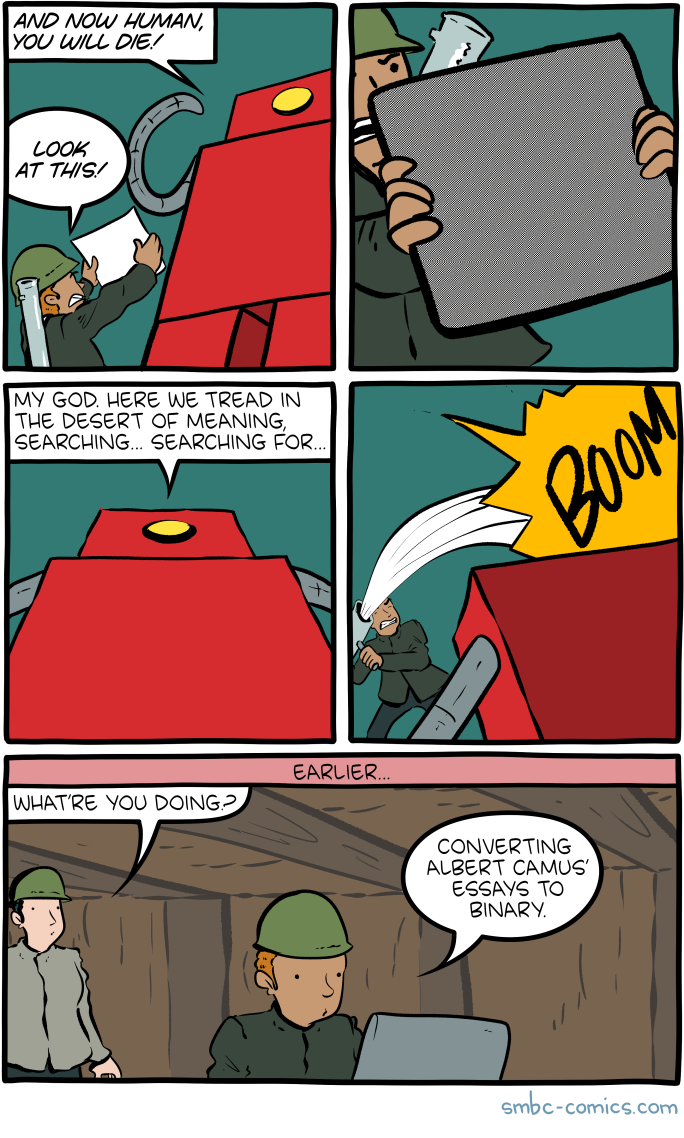
Saturday Morning Breakfast Cereal - Binary
the shirt crusade, the bacon crisis, and other stories of dramatic reactions to small changes at work
This post, the shirt crusade, the bacon crisis, and other stories of dramatic reactions to small changes at work , was originally published by Alison Green on Ask a Manager.
Last week, I asked for stories about weirdly dramatic reactions that you’ve seen people have to small changes at work. The comment section was full of fantastic stories — so many that I have to split my favorites up into two posts. So here’s part one, and part two is coming tomorrow.
1. The shirts
When I worked at a Scout camp, we would usually get two shirts each summer specific to the year: a polo shirt in that summer’s color, and a t-shirt listing what area of the camp you worked in. For years we wore the polo shirts on Mondays and the area shirts on Wednesdays, when families came to visit. Then one year management decided we should switch that, so campers could see who worked where at the start of the week and we’d all look nice and fancy when Mom and Dad showed up.
There was a minor uprising. Yelling arguments. Flat refusal to cooperate. We had staff for YEARS after the change who would wear the wrong shirt and say “oh — you didn’t tell me we were doing it different this week from how we’ve always done it.” We had staff members going so far as to carry two shirts with them all day Monday and Wednesday so they could put on the correct shirt when management was around, then change back to the other shirt when nobody was looking. Some of the worst offenders were our old retired guys (who are like gold, it’s hard to find adults to work at summer camp, so they weren’t disciplined over minor shirt disobedience) and carried the torch for their preferred shirt rotation for a literal decade after the change.
2. The bacon
Our cafeteria bought a different the type of bacon than they usually purchased because the usual stock was out. I think it was from a thick cut to a slightly thinner cut. People were incensed. There were several emails directly to the senior vice president in charge of the cafeteria. Other senior vice presidents had “quick chats’”with their peer about it. Some people even went as far as to email other places who they knew still used the preferred bacon to get the type/name/product number to forward to the cafeteria staff so that the correct bacon was purchased. Literally, it was the talk of the entire place for about two weeks until the supply ran out and our cafeteria could buy the usual bacon type. This was, literally, years ago, and people still talk about it as one of the biggest issues to plague our work.
3. The emojis
We all work remotely so we use Teams to communicate. This is a large organization that changes constantly and we all are typically very used to it. Until the day earlier this year that Microsoft decided to change their emojis. All hell broke lose. Senior managers and directors were melting down. Nobody would acknowledge IMs because the thumb-up was too bulbous and the smiley face was scary. People were looking up ways to use other emoji options instead of doing actual work. It’s been months and we still regularly get people complaining about the emojis.
4. The “approved” stamp
We had a department that was being completely redesigned. Think something like a laboratory where employees do various hands on work all day. The current layout wasn’t functional and staff had to jump across the room constantly to complete tasks. Funds were secured to construct a new state-of-the-art area and an architect experienced in this kind of work was hired.
Plans were reviewed by the decision makers, contractors were hired, permits and licenses were updated, a schedule was created, everything was done perfectly. I had never seen such a complicated project planned so well. They even had observers in the lab to watch current processes and they interviewed staff to make sure they didn’t miss anything.
Once everything was signed off on, a meeting was set to present the department with the final plan and schedule. One of the employees listened politely to the architect and CEO, and then rolled out THEIR OWN HAND MADE BLUEPRINTS on top of the presentation. The employee had even stamped their blueprints as “APPROVED” across the top.
Speechless.
5. The birthday celebrations
I was in an office that had over the top birthday celebrations. On someone,’s birthday, the staff would be asked to sign up for a potluck for breakfast and lunch. Inevitably people would forget what they signed up for and we would end up with many boxes of donuts and cakes when the day was done. Other staff would go all out and bring in catering trays worth of home cooked food.
To try to get control of the situation, management decided to limit the celebrations to a cake in the afternoon. All hell broke loose — one manager wouldn’t let their staff take time away from their desk for cake. Another department kept going with the potluck but wouldn’t let other departments join. There were many manager meetings scheduled to resolve the issue but they couldn’t come up with a solution to make everyone happy. Obviously this place was a mess in many ways and the bday controversy highlighted the worst of it.
6. The files
File cabinets … there had been a long-standing tradition that each person would file their completed work in their own desk drawer, resulting in needing to know who completed something to ever find the file again, rather than file by category. So, a new manager came in and asked for a specific file needed for an internal audit and was told, “Oh, Fergus did that one and he’s on PTO. You’ll have to wait until he gets back with his keys.”
New Manager (reasonably) declared that going forward files needed to be filed in a central cabinet by category so if someone needed TPS reports from Branch A it would not be necessary to remember who did the work, or for that person to be present at the moment.
The outcry was worthy of a true human rights violation. It was finally resolved several levels up the management chain following DAYS of heated discussion in closed door meetings with various executives … and the decision was made to make the central file optional and those who wanted to continue filing in their own desks could do so.
Two years later, we failed an external audit for being unable to locate the files being requested, and the original manager was blasted for not having a better filing setup. We finally transitioned to filing everything electronically in 2020. (And did I mention that these files were all comprised of work completed on the computer and then printed out for the file?)
7. The pretzels
There was a guy who would stop at the bakery once a week and bring in a box of pretzels. There was an honor system for paying, and after weeks of notes explaining that the pretzels would go away if people didn’t stop stealing them, the pretzels stopped showing up. So many people were so angry that their pretzel supply had been cut, and you could hear them for weeks in the break room complaining about not having pretzels anymore. We’re in Philly. You can get the same pretzels in our cafeteria. Imagine being angry that someone decided to stop buying pretzels for thieves.
8. The security doors
My old company got told they needed to tighten up security in the building. This included a mandate that you could no longer hold the outside security doors open for people — everyone had to let the door fully close and electronically lock behind them, then the next person to come in had to swipe their badge and be admitted. This is pretty standard for companies that deal with sensitive information! We were a big enough office (~350 people onsite) that you couldn’t know everyone by sight, and even if you knew someone, you wouldn’t necessarily know if they’d been fired and had their access removed, etc.
I’d say it’s reasonable to have some discomfort adjusting; letting the door close in someone’s face does feel rude when you’ve been raised with different manners. I’m a risk management guy and knew the importance from the start, and even I felt a little uneasy the first time I let the door bang closed when I knew someone was right behind me.
But boy howdy, the drama that erupted. Some people made a loud and deliberate point of always holding secured doors open and letting in as many people as they could get to do so — “OF COURSE I will let you in, Mrs. Potts! I KNOW YOU AND TRUST YOU!” A guy told me he would always hold the door open for his boss because he was afraid he would get fired if he didn’t. (I knew his boss, and that would never happen; she was a consummate professional and generally lovely.) One woman used the ALL-STAFF email list to trumpet that she would never bow to the Corporate Overlords and shame the memory of her dear departed grandma who had raised her right.
Things simmered down after a while — a few of the most ostentatious offenders got fired, several more got written warnings, and people adapted. But there were always people who would take a quick look around and then let you in if no one was watching.
9. The eSports
My boyfriend works at a three-letter federal agency. At that agency, employees get a few hours a week on the clock for physical fitness. You can walk, run, lift weights, etc. Whatever matches your physical abilities. You can also participate in a sports team like soccer or volleyball.
Well, apparently they have some on-site “eSports” leagues — I’m pretty clueless about this but it seems to just be groups of gamers playing regular video games (so, not games that force you to be active like Wii Sports). And the agency had to specifically say that yes, while you are allowed to use your physical fitness time to play actual sports, you are not allowed to use them to play “eSports.”
Apparently the whining was epic. It has sports in the title!!! How we were to know that it didn’t count as a sport as defined for physical fitness purposes???
10. The appointment times
I used to work for doctor’s office. The doctors weren’t partners or private practice providers, they were employees just like the rest of us. They had some wiggle room with their schedules and preferences on what procedures they did when but they couldn’t make it hard for us to put patients in the books. We ended up with an interim boss who didn’t care so the doctors started catching on and making bonkers limitations on what we could schedule and when. For example: Doctor Bob won’t see upper respiratory issues on Thursdays and Tuesdays. Dr. Evan will only see New Patients on the third Tuesday of the month from 1-5 pm. They were limiting exams and appointment types so tightly that we started getting a huge number of complaints. We would turn away someone who needed to be seen for migraines, they couldn’t be seen for five months despite us having open appointments literally that day. We literally had a huge whiteboard with an if-this-then-that kind of math for scheduling.
We got a director of Patient Services and she sat us all down, docs, nurses, support staff, everyone, and she laid out that the schedules are going back to open registration (no more bonkers requirements or wait times). One of the docs, “Doctor Lizzie” was one of the biggest bullies about her schedule, she literally made the staff cry, threatened to fire people (she had no authority to do that), and was a nightmare. During this meeting all the other docs were like yeah, we get it, patients aren’t being seen because of this and Dr. Lizzie kicked a chair after sitting there and basically seething for ten minutes. She stood up, flipped another chair, and kicked the heater all while screaming “I refuse to do pap smears after 1 pm! I refuse! I refuse! I refuse!” she then fell to the floor kicking, pounding her fists, and screaming like a toddler. She kicked over the garbage can, dented the wall, and broke a desk with her tantrum. She was excused for the day, and very shortly after quit to open a private practice, presumably where she does not do pap smears after 1 pm.
I have no idea why she needed that rule, and I think she would have been accommodated if she had explained it. And it’s not like it was the only thing she did every afternoon, it was rare for her to have one in her schedule. Based on what she was like as a coworker, I would hate to have her providing women’s health care. I worked there for three more months and we would respond “I REFUSE” when asked a general question. It was BANANAS.
11. The coffee
The coffee at my OldJob was awful. I think they got it from the same place they purchased office supplies – it came in a gray can labeled “Institutional Blend.” I offered to pick up much better coffee from the roaster around the corner. This was not snob level coffee – it was a large scale, low end roaster but they were local and would give me wholesale pricing, so it actually cost less than the gray can. I chose a nicely balanced, light roast.
People lost their minds! “Poison!” “Tastes like soy sauce!” “TOO STRONG!!!”
12. The cookies
This was really only one person, but I used to work at a place where once a week, there would be coffee and cookies set out for a “collaboration break.” It was meant to spur casual work conversations. It was totally optional but a lot of people went because, well, cookies.
During the 2008 recession, we had some budget cuts, and one thing they did was downgrade the kind of cookies they were getting. It used to be big fancy bakery cookies, and they downgraded to packaged supermarket cookies. No one really cared because, well, cookies! There were still cookies, there was still an excuse to get up from your desk and chat and eat some sugar.
But one lady LOST HER MIND. It was weird because she didn’t even EAT cookies (she was gluten sensitive and also always on a diet). But she made this huge deal about how there would be complaints, even riots, etc. She said this with disdain as though everyone who went to the cookie chats was greedy and unreasonable. She gleefully made a point to lurk at the cookie table to “watch everyone’s horror” when they found out that the cookies were of lesser quality than previously. I think she was actually disappointed that other people barely noticed or cared.
13. The parking spaces
I worked at a company with many buildings on a large campus. The most senior person in each building, and his admin, had reserved parking spaces next to the front door of that building. Then one year the company realized that it wasn’t good business to ask visitors to park in a single centralized lot several blocks away, instead of next to the building they needed to do business in, so they took away those reserved spaces and make them Visitor spaces.
The admin in my building took the loss of her reserved parking space very badly.
She spent all her time glued to the window at the front of the building, watching that parking space, and at the end of the day sent everyone in the building an email with what we came to call “the daily parking report”:
7:30 am – black Honda Accord license number 12345 was already here – visitors wouldn’t be here so early!!!
9:14 am – blue Toyota Civic license number 34567 – it was here last Thursday, can it really be a visitor?
11:45 am – blonde woman driving a black Mustang convertible, Tim came out of the building and got in the car and drove away – was that really a visitor, Tim? DOES YOUR WIFE KNOW WHO THAT WAS, TIM?????
It went on for months! I think she’d convinced herself that if she documented that it wasn’t needed by visitors – if it wasn’t used, or she caught employees using it – she’d get her reserved spot back. She was finally put on a PIP, continued to do the daily parking report instead of her job, and was totally surprised when she was let go.
The kicker? She got there so early every day that she was usually parked exactly 2 spaces down from her formerly-reserved spot.
14. The yellow paper
We had a paper that went along with each batch during processing which included useful info but had to be discarded before we delivered the product to the customer. It was printed on yellow paper for visibility but we still had a huge problem with people forgetting to remove it and not notice it. So management made the decision to switch to bright orange paper to make it more noticeable.
We ordered a bunch of orange paper and threw away the yellow. Somehow the yellow paper kept reappearing. We checked old store rooms, offices, weird nooks and crannies throughout the building. We threw away all the yellow paper we could find. And yet, it kept showing up. At this point I’m fairly certain that someone was buying reams of yellow paper with their own money and sneaking it into the building under cover of darkness on the night shift. Because they didn’t want to use orange paper.
Southern Baptist leaders plan to release a secret list of accused sex abusers

Leaders of the Southern Baptist Convention said they will release a secret list of hundreds of pastors and other church-affiliated personnel accused of sexual abuse.
(Image credit: Holly Meyer/AP)

A pastor quits over 'adultery,' but a woman says she was 16 when he abused her

Pastor John Lowe II received a standing ovation after he confessed. But then a woman stepped forward and told him, "You are not the victim here."
(Image credit: Screenshot by NPR)

Looking Back and Moving Forward: An Interview with Rabéa Ballin
Rabéa Ballin is a multi-disciplinary artist who has been a key member of the artist community in Houston’s Third Ward for many years. She is also a part of the Roux Collective, with Ann Johnson, Delita Martin, and Lovie Olivia. A day after the opening of Project Row Houses’ Round 53, The Curious Case of Critical Race… Theory?, where she is exhibiting an installation as a part of Roux, Ballin and I had a chance to talk about the connection between her early and recent works around themes of place, identity, and their relationship to form and politics.
Liz Kim (LK): I wanted to start off by talking about some of your early work from 2009 and onwards. Could you tell me about the series Fresh?
Rabéa Ballin (RB): I graduated in 2006, and during my last semester at grad school I saw Okhai Ojeikere’s photographs at the Blaffer Museum. Most people know that I was raised learning how to do hair in my mom’s hair salon. When I saw the Ojeikere photographs, it was the first time I looked at hair as sculpture. These are ceremonial hairstyles that identify roles within a culture, Nigerian culture specifically. It changed the way I looked at my experience with hair. I was at a point of leaving graduate school where I really wanted to make work that was about myself and my own experiences. A lot of people ask me why hair braiding or Black hair imagery. And it’s because of my personal experience with it — I was braiding in college.
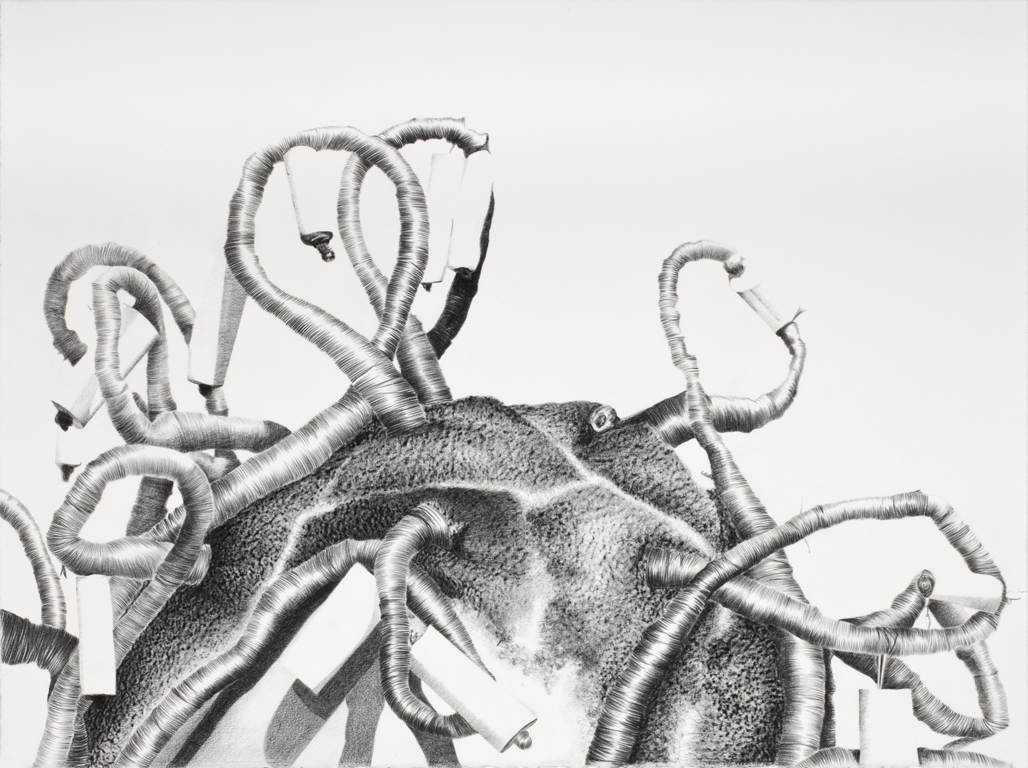
Rabéa Ballin, “Untitled,” 2009, black prisma on paper, 22 x 30 in. Courtesy of the artist. Copyright Rabéa Ballin.
LK: Was that at McNeese State University?
RB: Yes, I braided on the weekends to earn gas money. It was my “other” thing, my craft. But, at the time, I didn’t think of it as my art. I saw Ojeikere’s photographs, and I was like, “Oh, wait, I braid.” So I began documenting the hair braiding. In this first series Fresh, I’m remixing his photographs. It was the first time I had such a meticulous approach to drawing hair. I changed my perspective, and I zoomed in. I’ve never drawn portraits of faces. I developed my portraiture into drawing the backs of people’s heads. That’s where you see the hair, and I didn’t want to personalize my portraits by focusing on who these individuals were. It was more representative of other things.
LK: That’s also a conceptual part of your practice. One of the unique things about his photography is that subjects are anonymized.
RB: Yeah, absolutely. I see myself as a documentarian, and also an image maker. I want to take responsibility for the images I put out, and I saw these natural hairstyles —that trend towards natural hair — in the 90s, especially as it pertained to African American women, but I felt that the imagery was underrepresented. Hair eventually became a focus of my work because I had been around it so much. I feel it. I braid it. I understand the dexterity it takes to twist and plait. The Fresh series was my first solo exhibition, and it had to be these hair drawings because I was trying to find who I was in my practice, and blending that history of hair.
Most of the images of hair that you see in my work currently are my own. I knew that I wasn’t going to always continue appropriating Ojeikere’s work. From then and moving forward, it was a self-discovery of how hair is still an important element of the work. It always is, because I still braid. I photograph my own hairstyles, then I zoom in closer and closer, and then the hair becomes abstractions.
Also, Fresh has a set of photographs that went with it, and the Museum of Fine Arts Houston just bought them for their permanent collection. It says the word “fresh.”
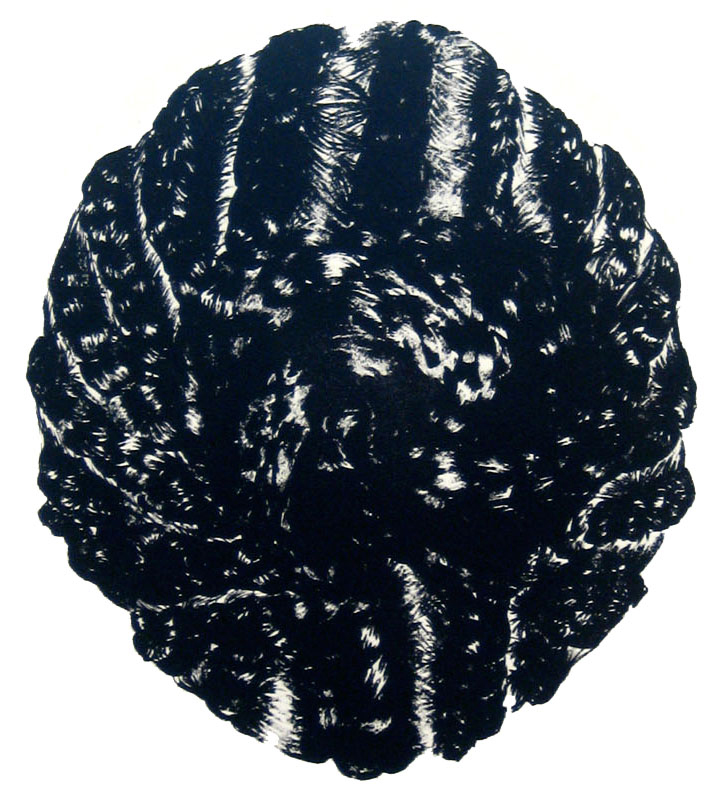
Rabéa Ballin, “coincoin,” 2011, lithograph, 15 x 11 in. Courtesy of the artist. Copyright Rabéa Ballin.
LK: How did you connect with the history of Marie Thérèse [Coincoin]?
RB: I have a Creole dictionary at my house. If I remember correctly, I was just flipping through it, found a trigger word and maybe searched it, then stumbled across her story.
LK: You added several other elements to your interest that began with Ojeikere’s work.
RB: Even though I alter his images, he’s talking about his specific culture and I don’t have a personal connection to Nigerian hair. I don’t want to misrepresent myself, those drawings came from a sincere desire to acknowledge and celebrate him. But it gave me the permission to use hair as a subject, to do something similar, to archive what’s in front of me. So that’s very important because people often ask why do I work with imagery of African American women primarily when it’s actually not.
LK: Yeah, I mean this is where you were going, from Nigeria…
RB: …To Louisiana, in some cases Houston, and with the Caucasian women from the Caucasus mountain region. I work with multiple nationalities, which is a direct result from my experience at my mom’s beauty shop that tended to all races.
LK: Hair International.
RB: Hair International, and it was near a military base. When you grow up in a military community, there’s a sense of social acceptance and understanding that your peers come from culturally blended families. Racially blended families are a common thing. My dad is Mexican. My mom is German, first generation German. Our first language at home was German. But we were stationed in southern Louisiana and I was primarily raised there. Now there are, but at the time there were no Hispanic communities near there, other than the families that were in the military, who were mainly Puerto Rican, Cuban, Dominican, and Mexican. All those cultures are represented, but as far as in civilian life, it was Black or white and extremely segregated.
My mother and I lived in a Black neighborhood on Martin Luther King Street in a small town called DeRidder, Louisiana, which was very much segregated at the time. Her beauty shop was on a corner. I would overhear comments about my mother, that she was cool, but lived in the quarters. They weren’t referring to “military quarters,” it was a derogatory term — now outdated — about the section of town we lived in. It conjures up the ‘“French Quarter,” which ties into the story of plaçage that I have explored. Specifically, the location of quadroon balls.
There’s no connection to my Hispanic roots in Louisiana where I lived, so I embraced the cultures that I was around. Do your best, and get out of here. And that’s what I did. When I got to college, I made it a point to double minor in Spanish and German. I’ve always wanted to make a connection to my personal upbringing, but I wasn’t raised in that environment, so it’s been a mixture of a lot of influences, which is what Louisiana is. The blending of many cultures — Cajun, Creole, Spanish, French, Haitian.
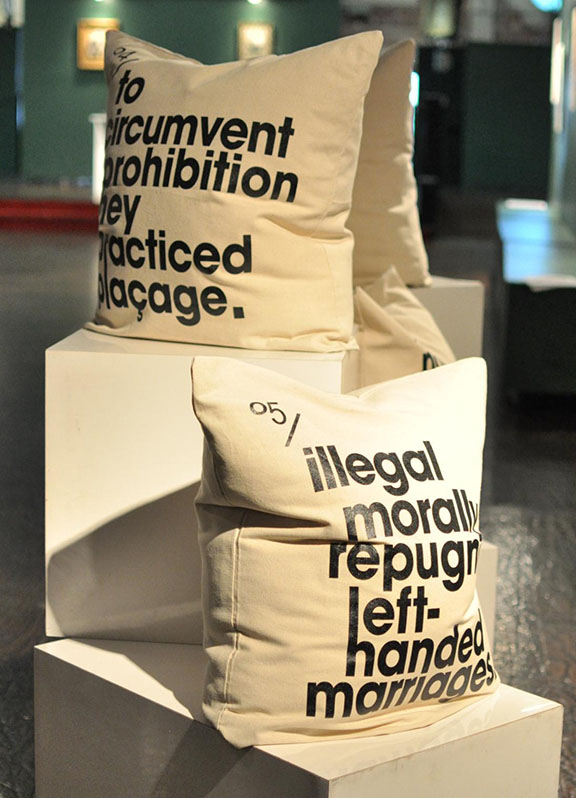
Rabéa Ballin, “#sixwordstories Chapters 04 & 05,” 2012, silkscreen on canvas, 25 x 25 in. each. Courtesy of the artist. Copyright Rabéa Ballin.
LK: The next series is the History Slept On series (2012), through which I also see a point at which your practice becomes more political around 2011.
RB: Survival was heavy on my mind then, You know, I’ve been through a lot. I’m tired. Katrina, Rita…each disaster affected me directly. I wasn’t in New Orleans for Katrina, I was in Houston for Katrina. I went to the Astrodome and I braided hair.
I was a grad student, and with a friend of mine, Lisa, and we were like “let’s go to the Astrodome and see if anybody wants their hair braided.” And they did, Black and white. Because they were disheveled, traumatized, and they wanted their humanity back. They wanted their dignity back, and hair and beautification practices gives you that.
A lot of the work is about access or lack thereof. People were angry, in distress, and for a few moments they were able to sit, get their hair braided, have a conversation, calm down. and tell their story. It was a lot, and I left that experience recognizing hair is political.
LK: When you started digging and bringing research and history into your work, you also brought text into your work.
RB: Triggering words. Words like: miscegeny octoroon, quadroon, these supercharged words that I love.
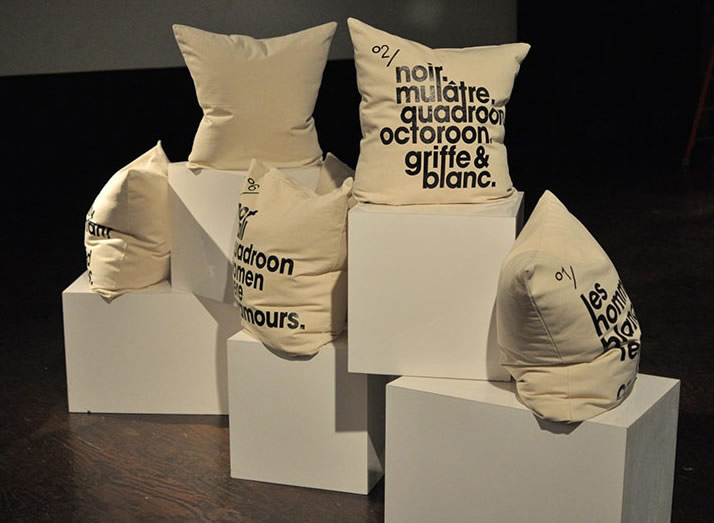
Rabéa Ballin, “#sixwordstories,” 2012, silk screen on canvas, 25 x 25 in. each. Courtesy of the artist. Copyright Rabéa Ballin.
I love the power of words. Words are so intimidating. I like the beauty of letters, typography as shapes and forms, but my goodness, words are powerful. That came together in Six Word Stories. I challenged myself to tell the history of plaçage, in six words. I loved it.
I wanted to do the art equivalent of what Public Enemy was doing — I started looking at David Hammons, Adrian Piper, Coco Fusco — they weren’t necessarily making in the way I thought my art had to be. Black contemporary performance art was a huge influence in being able to create work.
LK: Your History Slept On series continues with the Original Dimepiece series (2013).
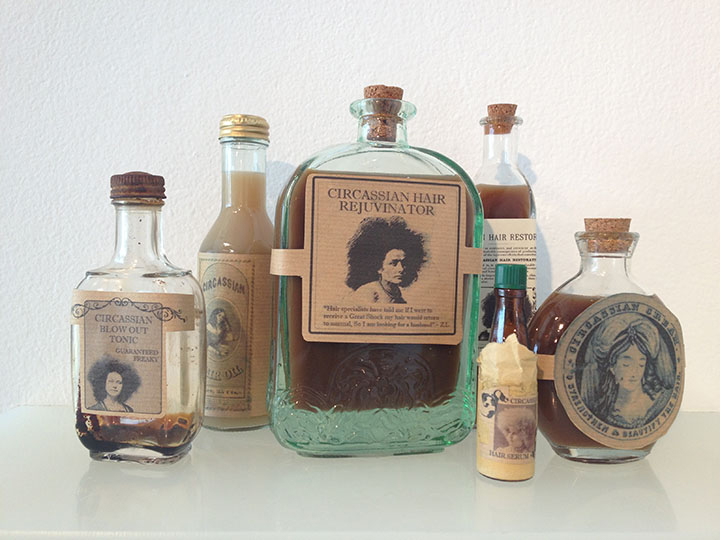
Rabéa Ballin, “Collection of Circassian Hair Serums,” 2013, digital print, handmade paper, vintage glass, relief seal, 8 x 12 in. each. Courtesy of the artist. Copyright Rabéa Ballin.
RB: This is the story of the Circassian Beauties in the American Sideshow. I started reading and researching Circassian women. What does that word mean? The Caucasus mountains — what region is that? Then, Barnum and Bailey, I found a letter that he wrote to his guide, searching for these Circassian women. It led to sex trafficking during the Ottoman Empire. That led to the appeal of these women. He had them doing snake charming, and at the end of the day he had girls from Jersey. He changed all their names. They have these ‘Z’ names, like Zula, Zenobia, which are just fetishized, exoticized names.
This series captures that very complex idea of race and identity, and the whole purpose of Barnum showing these women because of their supposed racial purity, a pseudoscience. That was a construct, a performance in exoticism, that people bought into and paid $0.10 for. And this is another pop culture reference and hip-hop reference: the dime piece. If you have a dime, that means you got a girl that’s perfect, ‘you got a dime.’ We rate our beauty based on a scale of one to ten. That was just a jackpot for me. That fakeness of it, the fake within the fake. But the story of humans as curiosities is real.
LK: Going back and forth between these different modes, to these drawings from 2014, back to the fundamentals of drawing practice.

Rabéa Ballin, “Untitled (green),” 2014, lithograph, 30 x 22 in. Courtesy of the artist. Copyright Rabéa Ballin.
RB: Yeah, that flip. It went from very cerebral, to “let me go back to what I know.” Or that I’m familiar with that’s not as heavy. Let me go back, and let me bring in some color. Not too much. Let me keep it monochromatic, but I’m going to play with color and that’s just what happened. I was very intentional.
LK: The imagery itself, it’s very reminiscent of your work in your Fresh series.
RB: Yeah, they’re revisiting or remixing those for sure.
LK: And now we’re going back to your conceptual and critical work here in 2014.

Rabéa Ballin, “Country Code 234,” 2014, text installation. Courtesy of the artist. Copyright Rabéa Ballin.
RB: Yep, and this is the summer because this is another Roux exhibition, Suga. We showed at BLUEorange Gallery. The name of the show references the number of the Nigerian girls said to have been abducted. Those numbers changed; this was the initial report that I got. It just so happened to be the country code of Nigeria. Some of the names, half of them aren’t even there. They’re unknown, unknown, unknown. I just really felt just personally drawn to them because of my own experience of walking to school alone and the fear of being kidnapped.
LK: Also, your interest in Nigerian culture with Ojeikere.
RB: Yes, I’m tying those threads together in these pieces. There’s something cold and very dismissive when you’re just a number. So I’m adding names if I had them, adding parts of imagery if I had it. The repetitive work of cutting circles by hand, I don’t really know why that felt good at the moment or why that felt right. It was just a very methodical thing to do and sometimes doing things repeatedly brings comfort in the same way that my drawings bring me comfort. I felt like I was doing something when there’s nothing you could do.
LK: Yeah, and you have the material remnants.
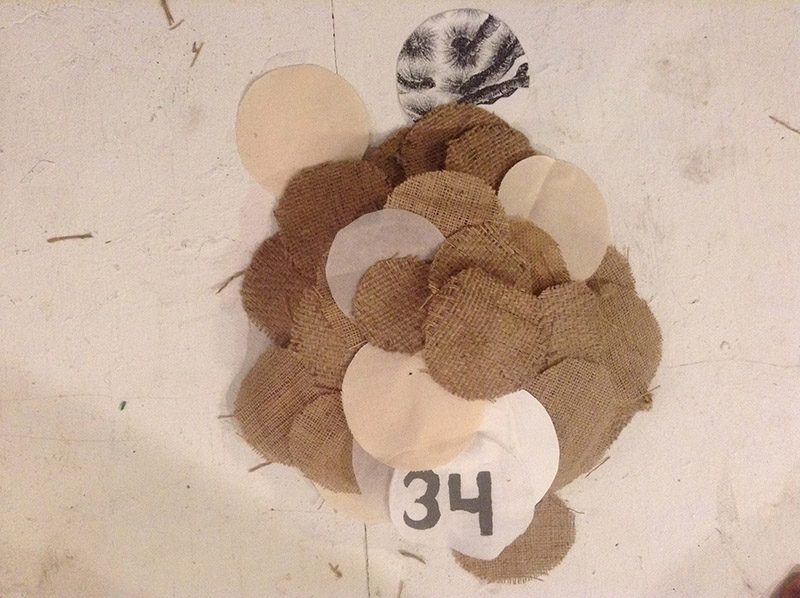
Rabéa Ballin, “Mound 34,” 2014, floor installation. Courtesy of the artist. Copyright Rabéa Ballin.
RB: I just wanted to make the viewer uncomfortable, having to tiptoe around these mounds that were all over the floor. It had a performative aspect in that sense.
LK: With Project Row Houses’ Round 41, What is Natural (2014), what was the significance of this exhibition?
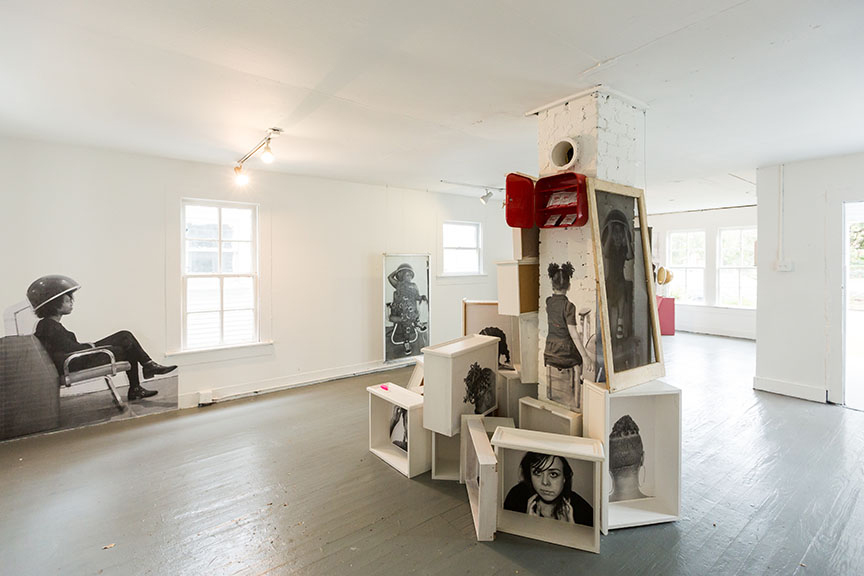
Rabéa Ballin, “What is Natural,” 2014, installation view. Courtesy of the artist. Copyright Rabéa Ballin.
RB: Lack of access to beauty products. From my experience from Hurricane Katrina, I had these little cases, medicine cabinets placed around the house with free beauty products for the community to take, and I had a discussion with people that centered on the age they were when they realized they were beautiful or had sparked someone’s interest based on physical beauty.
It was interesting — the conversations went from “I was 30 before I ever felt beautiful” to “I was eight when I felt over sexualized and gawked at by adult males.” Then we talked about hair. We shared stories about why stigma is attached to hair and how this is the only part of our body that we can change the most on a daily basis if we choose to. It’s this ephemeral material that grows out of our head that we can mold and shape and form, and when we can’t, we have anxiety about whether or not we feel beautiful. Some women feel beautiful after they shave their head. Some women only feel beautiful when they add in hair. It’s a very open conversation that I loved having.
We included my mom’s hair dryer in the show. We also pasted life-size images of my neighbor at the time, who was a hair braider in prison. We had a conversation on beautification practices within the prison industrial complex, which was a great.
LK: Then we have the show, Salt (2017), with Roux.
RB: That’s when my world of collage, hair and photography came together. I started doing digital collages with the intention of drawing them, which I did for some, but I also came to a place where I was like, “these are kind of dope, just as digital collages.”
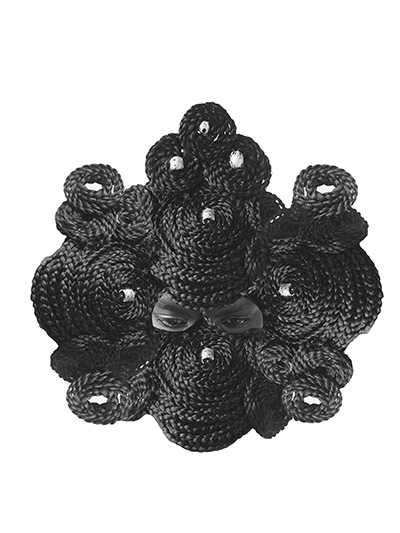
Rabéa Ballin, “Remixing Delphine,” 2017, digital image, 18 x 24 in. Courtesy of the artist. Copyright Rabéa Ballin.
That’s when I met Leslie Moody Castro in 2017 for the Texas Biennial. I had printed the digital collages on metal just to see what they looked like, and those are the ones she liked. I had them printed at Burning Bones Press. They are the digital images, but they also live as prints on paper and on Mylar.
LK: This series once again sees a transformation of your practice.
RB: Yeah, the transformation was totally experimental. There was no agenda. It was just me playing around, giving myself the permission to just show the object — don’t draw it if you have the object, why turn these into drawings if you don’t have to? They’re my photos, so I’m allowed to use them however I want. It’s knowing when to stop.
LK: Now we’re getting into your recent works.
RB: In 2020, I started drawing in my studio at home. I need to draw. Let me just give myself the hardest thing I could think of. It looks like a meteor going through space.
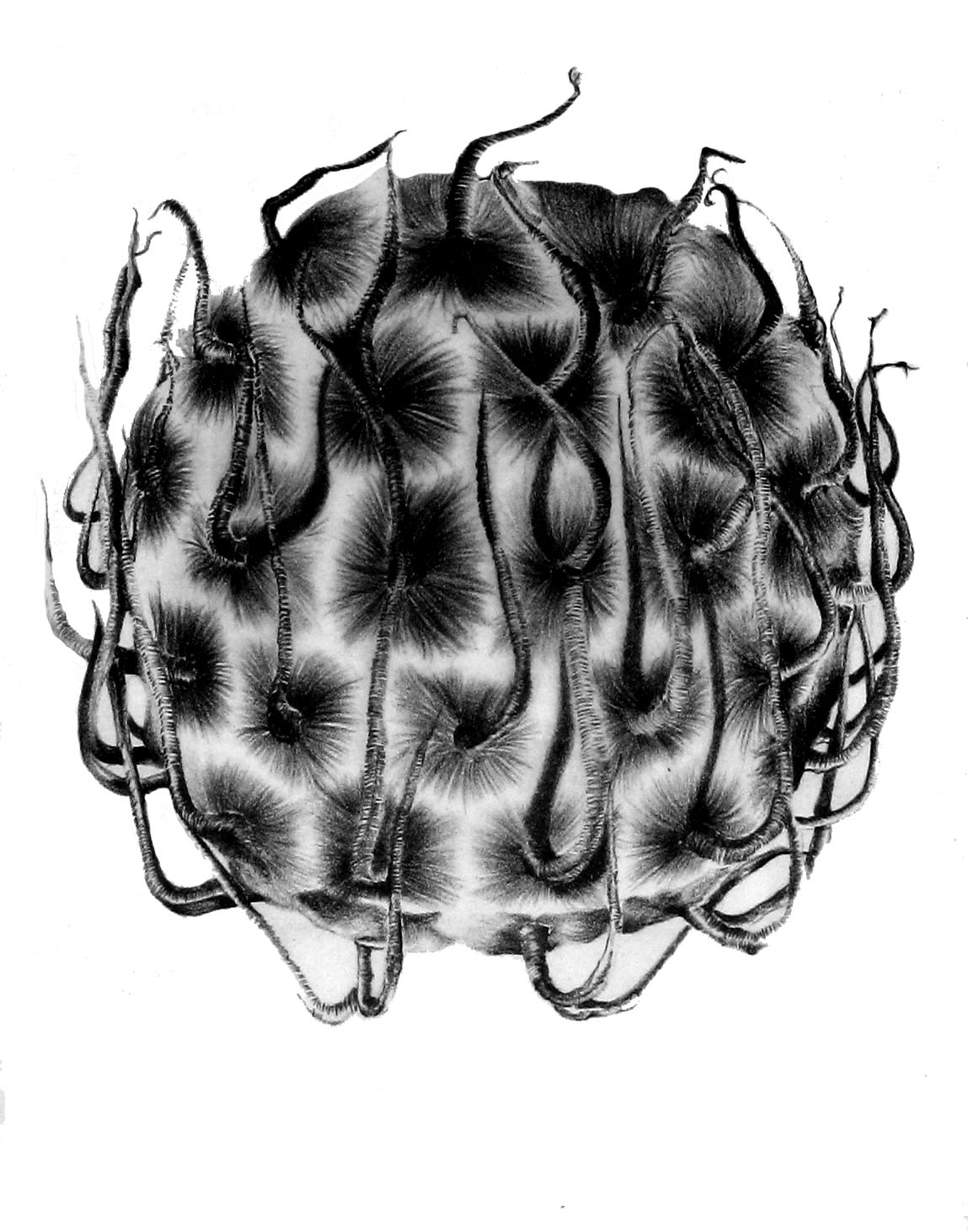
Rabéa Ballin, “Think of Me,” 2011, solar plate etching, 15 x 11 in. Courtesy of the artist. Copyright Rabéa Ballin.
All of these photographs came from COVID, during which everyone documented the backs of their heads after not having access to getting our hair done for months (including myself) and loving it. For many years I very rigidly slicked my hair back in a bun — that was only because I’m the product of a mother who owns a hair salon, and I’ve had every hairstyle on the planet. I was tired and I was going for job interviews, and my mom said “just slick your hair back and put it in a bun.” I did, and that became my go-to hairstyle for years, until COVID, when I started wearing my hair down. I know it’s not down at this moment, but it’s either braids, or frizzy braids, or hair down. I love the freedom that COVID gave us with all of that. I read a lot of positive feedback on the flip side of not having access to beautification rituals and/or beauty shops, or simply embracing the fact that you’re going gray.
LK: Something that Leslie brought up was how, from her perspective, in your work around this time you started to get more ‘kitschy.’
RB: I love the word kitsch.
LK: She noted that with your recent work, particularly the Cluley Projects show in Dallas in 2021.
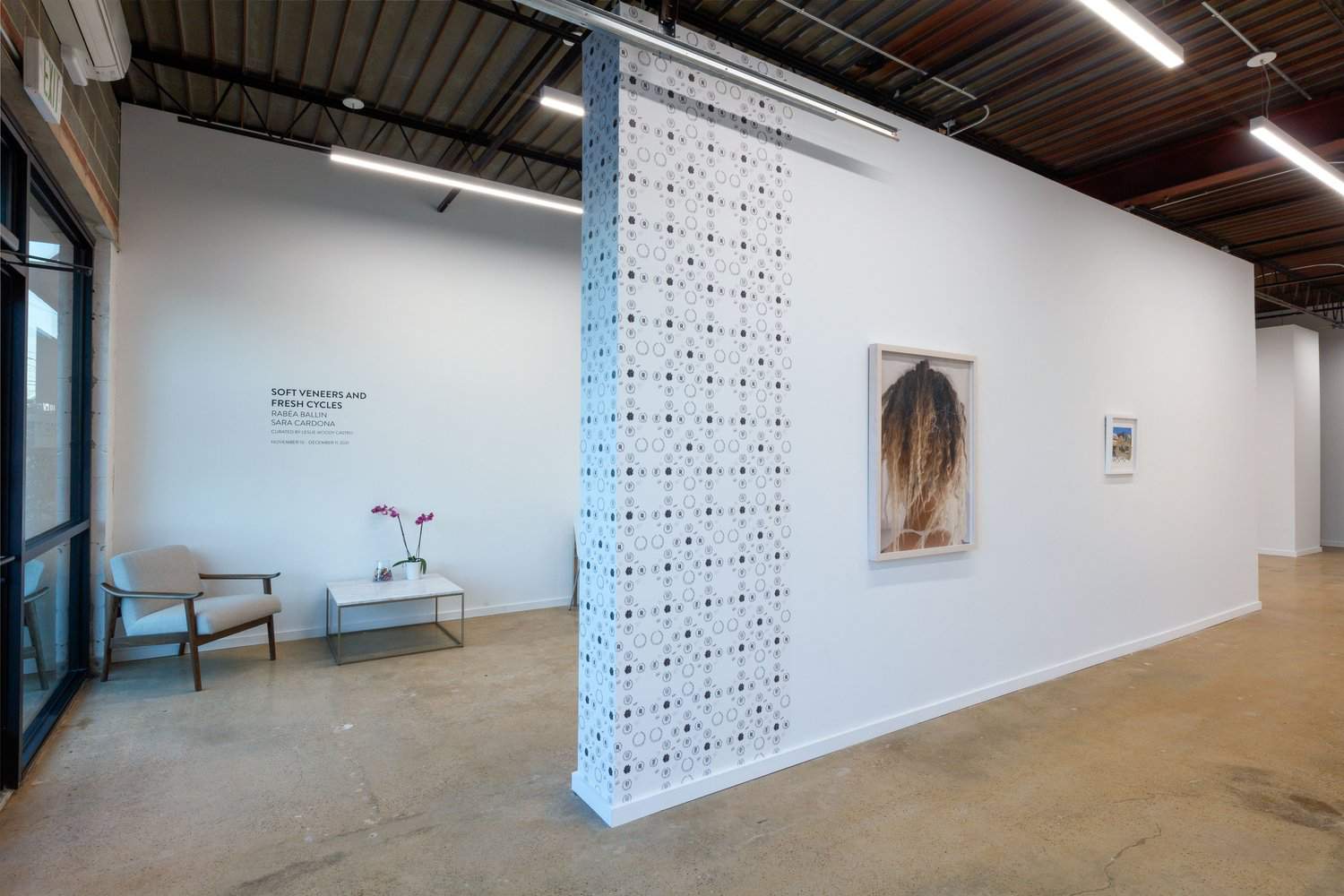
Rabéa Ballin and Sara Cardona, “Soft Veneers and Fresh Cycles,” 2021, installation view. Courtesy of the Artist and Cluley Projects, Dallas. Photo by Kevin Todora.
RB: Kitsch is a word that I was raised hearing a lot. Germans use that word kitsch. When I hear the word kitsch, I don’t think of it as an art subculture. When I hear the word kitsch, I hear my mom saying kitsch, like “it’s tacky.” Of course I love that, permeating those spaces with what might be tacky. That’s me addressing the elitism of things. When Leslie and I worked together, that was very much our intent. What if we take a little bit of lowbrow into the highbrow.
LK: With your current installation here at Project Row Houses with the Roux Collective, could you talk about how everything comes together?
RB: This has been a great building up to where I’m at now. We’re celebrating ten years in the game as a collective (we’re in our 11th year), and I see my progression. I don’t consider myself separate from the Roux Collective any longer, when I did at first. I had my personal practice, and I had Roux in the summer. Not having gallery representation anymore and attaching myself to Roux was a very important personal event for me. I have the support of my sisters to give me critique when I need it. Just being around them and doing a very grassroots effort of showing, as we do everything ourselves. We publish, we design our own books, then we all go in our separate ways and have our own separate careers. But we’re all still part of Roux.
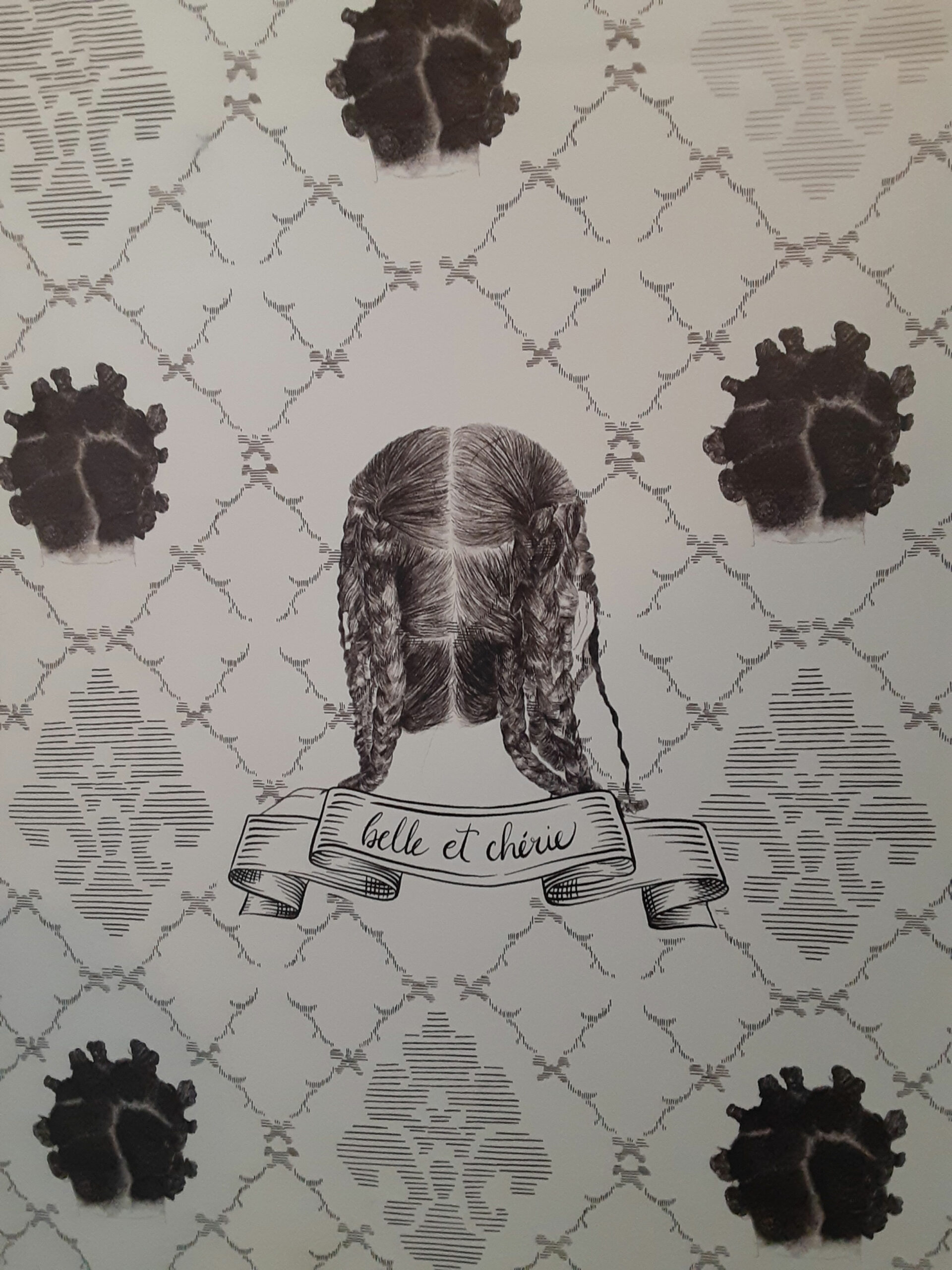
Rabéa Ballin, “The Drawing Room,” 2022, installation view. Photo by Liz Kim. Copyright Rabéa Ballin.
For this show I just wanted to show that progression, who I was in the beginning and where I am now. I brought everything together — so I’m making drawings, but they’re digital. I’m referencing history very directly, using the patterns of my mom’s couch back home in Louisiana in my wallpaper. I’m giving a nod all the way back to Marie Thérèse with the tobacco, but using the materials I’m using now with my photography, which is perforated vinyl. Everything came together for me for this one — my hair drawings and my digging into the lost stories of early Creole writers, musicians, poets, artists, and craftsmen of the period. My wallpaper is an homage to African women, European women, and Latina women. Everything together as a blend: and that’s my definition of what Creole is. My experiences, they all came together in this house.
This interview has been edited for length and clarity.
The post Looking Back and Moving Forward: An Interview with Rabéa Ballin appeared first on Glasstire.
our receptionist is rude to people
This post, our receptionist is rude to people , was originally published by Alison Green on Ask a Manager.
A reader asks:
The receptionist in my office is the first to answer the phone, and she is the first one clients see when they walk in the door. A big part of her job is customer service, but lately I’ve received complaints about her interactions with people — two from other employees and two from customers.
It has been very surprising to me because she is so friendly with me. She’s upbeat, bubbly, and friendly — part of why I hired her. But my office is in the back of our suite so I cannot overhear her interactions with people. The complaints I have received say that she is rude, difficult to work with, and unfriendly, but when I asked for the specific conversation no one has been able to say “I said X and she said Y.”
I’ve spoken with her once about this in the past because I had received other complaints. During the conversation, she got very quiet and just said she’d do better. She didn’t rebut the complaints or say they were wrong. It seemed like there was improvement based on some of my office creeping (literally standing around the corner while she was on the phone so I could overhear). But today I got two more complaints saying she was rude, and unfriendly. One of the complainers asked me if there was a way to work directly with me as he wanted to avoid any interaction with the front desk because he says it is so bad.
I obviously need to do something, but I’m not sure how to fix this since I already talked to her once. Other than this, she is a stellar employee. Her work is quick, perfect, and she’s very proactive. I’ve asked if she felt overwhelmed and she said no. I thought maybe that could have been causing her stress and that’s where the behavior came from. What do you think? How do I handle this the second time around? I really like her and see her moving up in our office. She’s rather young and this is one of her first jobs so then I wondered if maybe it could be inexperience. But maybe I like her so much that I’m just trying to make excuses for her.
I answer this question over at Inc. today, where I’m revisiting letters that have been buried in the archives here from years ago (and sometimes updating/expanding my answers to them). You can read it here.