Shared posts

26 Jan 16:12

A couple of sunny days before our pattern turns more gray for awhile

by Eric Berger

Houston will enjoy another day or two of sunny weather before cloudier and rainier conditions return to the metro area for awhile. The rain chances will peak this weekend, but gray skies will probably remain until next Wednesday or Thursday. So soak up some rays today, if you can.

Thursday

Temperatures have generally fallen into the upper 30s this morning, with light northerly winds. We will see plenty of sunshine today, and this will allow highs to climb into the upper 50s. Low temperatures tonight may be a degree or two colder than Wednesday night, as winds become calm and there is little mixing.

Low temperatures on Thursday night will be cold in Houston and surrounding areas. (Weather Bell)

Friday

Skies will be partly to mostly sunny, but as high pressure slides east we will start to see a southeasterly breeze. This will introduce a few clouds, and moderate temperatures. Lows will only fall into the low 50s on Friday night.

Saturday

Our pattern turns more complex by the weekend, with a southerly flow and more disturbed atmosphere. Skies will be cloudy on Saturday, and some light, fast moving showers will be possible. With the southerly flow the air will turn a bit more muggy, and highs will climb into the low 70s. Rain chances start to perk up during the evening hours, and I expect fairly widespread showers after midnight, into Sunday morning. If you have late night plans, prepare to dodge showers.

Sunday

Rain chances will probably start to diminish by Sunday morning, but the potential for showers will remain through much of the day on Sunday. Overall, I expect on the order of 0.5 to 1.5 inch of rain this weekend. That’s not a huge concern, flood-wise, but it will be a nuisance. Highs on Sunday should reach the low- to mid-70s, with continued cloudy skies, before a weak front drops most of the area into the 50s on Sunday night.

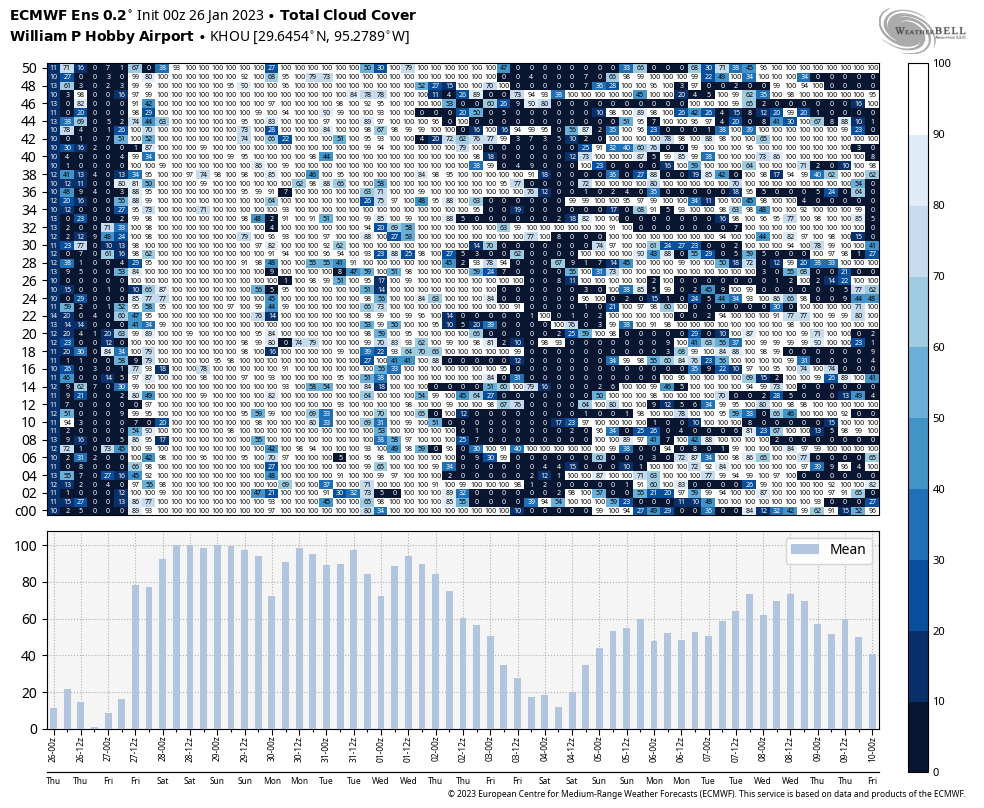
Cloudy skies, indicated by white in the ensemble forecast above, will be prevalent from late Friday through next Wednesday. (Weather Bell)

Next week

Sunday’s front will be short lived. Accordingly, we’ll see chances for (mostly) light rain through the first three days of next week, along with gray skies and warm temperatures in the 70s. The pattern finally starts to change some time on Wednesday, when the next front arrives and may act to clear out our skies. I think we’re probably looking at a few days with highs in the 50s and lows in the 40s, but this far out the details are fairly blurry. We should start to see at least some sunshine again by next Thursday or so.

26 Jan 16:11

Water From Splash Mountain Selling For Up To $1,000 On eBay After Ride Closes

People are selling water they claim is from Disney World’s Splash Mountain ride for as much as $1,000 after the ride based on the racist 1946 film Song of the South closed for good this week. What do you think?

Read more...

26 Jan 16:11

Our Annual Parenting Edition: How Much Wine Is Too Much Wine For Your Infant And Other Questions Answered

26 Jan 16:10

Man Buys Slice Of Honey-Roasted Ham For Attractive Woman At Other End Of Deli Counter


DAYTON, OH—In an effort to extend his compliments to the alluring shopper after she caught his eye, local man Andrew Williamson reportedly bought a slice of honey-roasted ham Thursday for the attractive woman at the other end of the deli counter. “This was sent from the gentleman standing over by the hot bar,”…

Read more...

26 Jan 07:56

I made a port of Xixit to the X16

by The 8-Bit Guy
26 Jan 07:43

A Camera With Only One Pixel, Better Phone Memory, Carbon Offsetting Woes & More

by Sabine Hossenfelder

Try out my quantum mechanics course (and many others on math and science) on Brilliant using the link https://brilliant.org/sabine. You can get started for free, and the first 200 will get 20% off the annual premium subscription.

Correction to what I say at 12 minutes 14 seconds: That's 3000 megatransfers, which is 3000 million transfers.

Today we’ll talk about advances in room temperature superconductivity, greenwashing and carbon capture, an experiment that sheds light on the mystery of cosmic magnetic fields, a robot arm with a needle, a camera with only one pixel, the supposedly coming age of clean technology, better phone memory, why rats might not have brought the plague after all, and of course, the telephone will ring.

👉 Transcript and References on Patreon ➜ https://www.patreon.com/Sabine
💌 Sign up for my weekly science newsletter. It's free! ➜ https://sabinehossenfelder.com/newsletter/
📖 Check out my new book "Existential Physics" ➜ http://existentialphysics.com/
🔗 Join this channel to get access to perks ➜
https://www.youtube.com/channel/UC1yNl2E66ZzKApQdRuTQ4tw/join

00:00 Intro
00:37 Progress on Room Temperature Superconductivity
04:03 Rainforest Carbon Offsets Inefficient
05:26 Report on Carbon Capture
07:00 Experiment Sheds Light on Cosmic Magnetic Fields
09:25 Tiny Robot Arm With Needle
10:37 Clean Technology Report from IEA
12:06 Faster Phone Memory is On The Way
14:12 Fastest Single-Pixel Camera
16:55 Rats Not To Blame for Black Death
18:26 Learn Science With Brilliant

#science #sciencenews #tech #technews
26 Jan 07:22

The story of "Monopoly" and American capitalism

Monopoly is one of the best-selling board games in history.

The game's staying power may in part be because of strong American lore — the idea that anyone, with just a little bit of cash, can rise from rags to riches. Mary Pilon, author of The Monopolists: Obsession, Fury, and the Scandal Behind the World's Favorite Board Game.
But there's another origin story – a very different one that promotes a very different image of capitalism. (And with two sets of starkly different rules.) That story shows how a critique of capitalism grew from a seed of an idea in a rebellious young woman's mind into a game legendary for its celebration of wealth at all costs.

This episode was made in collaboration with NPR's Throughline. For more about the origin story of Monopoly, listen to their original episode Do Not Pass Go.

This episode was produced by Emma Peaslee, mastered by Natasha Branch, and edited by Jess Jiang.

The Throughline episode was produced by Rund Abdelfatah, Ramtin Arablouei, Lawrence Wu, Laine Kaplan-Levenson, Julie Caine, Victor Yvellez, Anya Steinberg, Yolanda Sangweni, Casey Miner, Cristina Kim, Devin Katayama, and Amiri Tulloch. It was fact-checked by Kevin Volkl and mixed by Josh Newell.

Subscribe to Planet Money+ in Apple Podcasts or at plus.npr.org/planetmoney


26 Jan 06:53

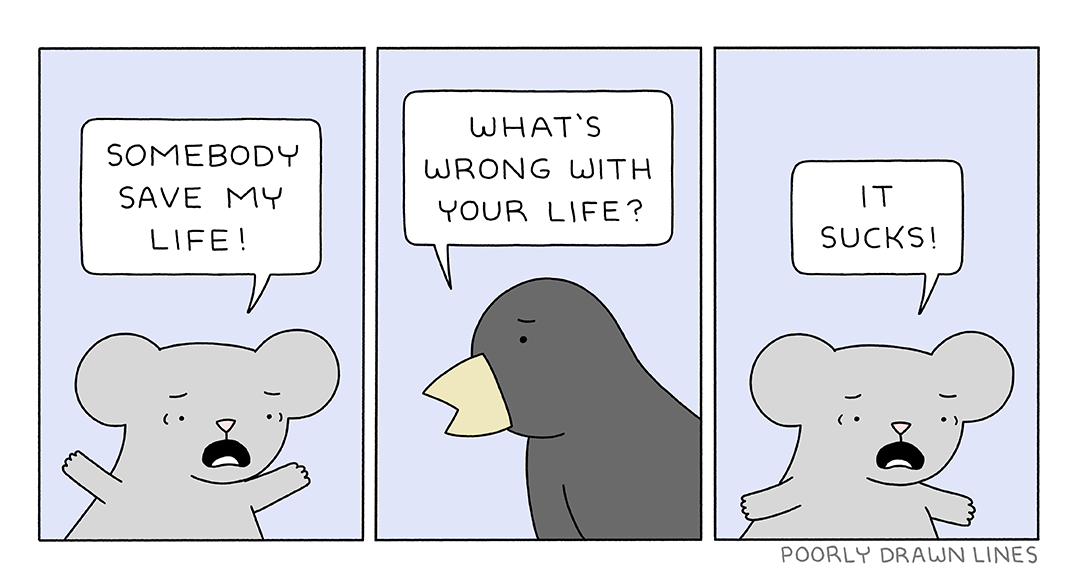
Save My Life

by Reza
26 Jan 06:53

THE THEME PARK OF THE MILLENIUM!

by noreply@blogger.com (JerryMaguire)
26 Jan 06:51

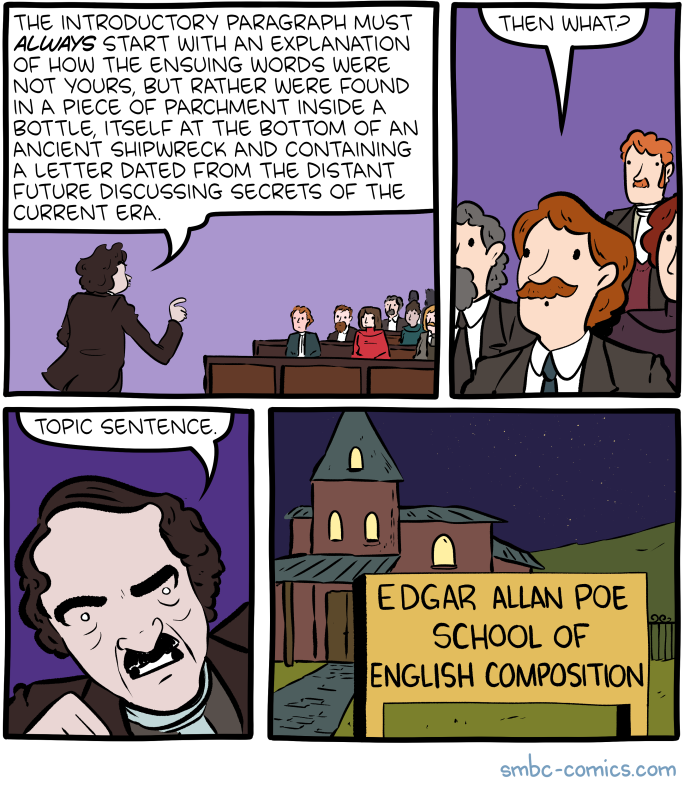
Saturday Morning Breakfast Cereal - Intro

by tech@thehiveworks.com


Click here to go see the bonus panel!

Hovertext:
Now, you'll want to use the 500 paragraph format.


Today's News:
26 Jan 06:50

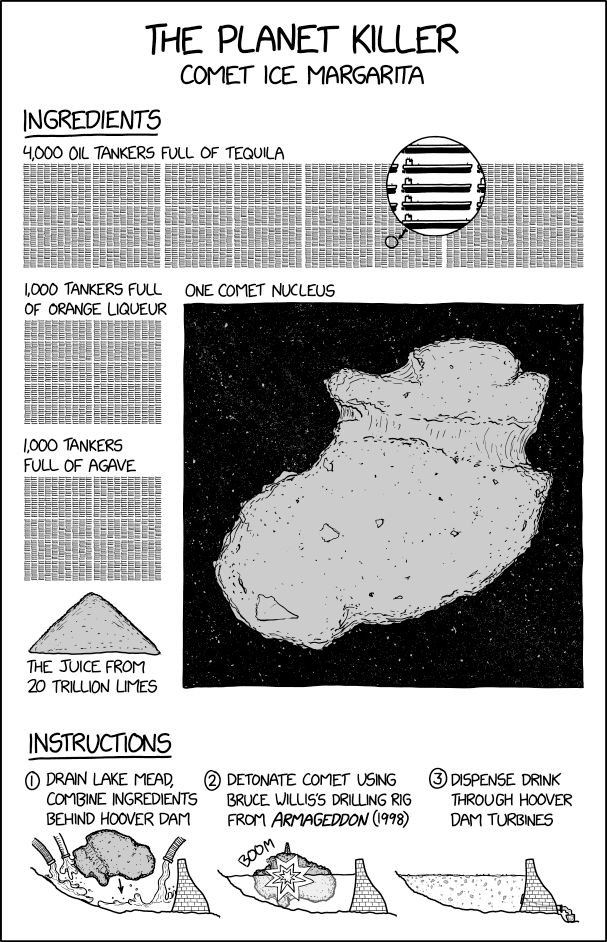
Planet Killer Comet Margarita

I'll take mine on the rocks, no ice.
26 Jan 03:17

my last company was horrible — how do I save other people from it?

by Ask a Manager

This post, my last company was horrible — how do I save other people from it? , was written by Alison Green and published on Ask a Manager.

A reader writes:

I recently started a new job and escaped my previous job. The previous job was for a CEO who fancies himself a LinkedIn influencer and life coach. His actual business is a for-profit tech company. He brags about putting his employees first and people over profits.

The actuality of working there was a terror. They send employees to a mandatory, multiday 13-hour workshop that is essentially therapy with the people you work with. The CEO is hot and cold. One day, you’re the best person he’s ever hired. The next day, he’s cornering you in the break room interrogating you on your weight and offering you weight loss advice that you never asked for.

None of this is apparent in the interview process. You don’t know what you’re signing up for, until you’re at an off-site meeting getting yelled at by the CEO on a basketball court at 11 p.m. to change your life.

Beyond leaving a bad Glassdoor review, I don’t know what to do. I don’t have any tangible proof, since most of these interactions happened in person. I worry about the potential harm that will be inflicted on people who think they’ve found a dream tech job, only to be put through intensive therapy by unlicensed counselors.

I would love to tell you there’s action you can take. There should be action you can take. But there’s not a ton you can do.

Glassdoor — definitely. That’s hands-down the best way to reach people who are considering working for the company in the future and especially those who are outside your own network. Encourage other current or former employees from there to do the same. One bad review is easier to dismiss; multiple bad reviews with similar themes send a message that’s hard to ignore.

You also can just talk. Be open and honest with people you know about what your experience was there. I’m sure you’re already doing that with close friends, but be willing to talk to your professional network as well if it ever comes up. (If this is a small company, it might not come up much, if at all … but if it’s larger, there’s a good chance you’ll find openings to share your experience.)

Beyond that, there isn’t really a mechanism for the kind of warning you want to give. Frustrating as it is, I think you’ve got to accept this isn’t a problem you can fix for other people. The most you can hope is that people will do their due diligence before accepting a job there (including looking at Glassdoor) and that they’ll get out quickly once they start seeing what it’s like.

It’s also worth noting that not everyone will respond the way you did. Don’t get me wrong, this guy sounds horrible and shouldn’t be running a business or have power over others, but people are bothered to different degrees by that stuff. You probably had coworkers who were more on the rolling-their-eyes end of the spectrum than the truly-shook end of the spectrum. That doesn’t mean you shouldn’t do what you can to warn people away, but don’t let the limits of your ability to protect future hires eat away at you either. It’s okay to move on and disconnect from the experience completely.

26 Jan 03:12

Timer switches: literally just a clock and a switch

by Technology Connections

It's about time.
Links n' stuff:

Technology Connextras (my second channel where stuff goes sometimes)
https://www.youtube.com/@TechnologyConnextras

Technology Connections on Mastodon:
https://mas.to/@TechConnectify

The TC Subreddit
https://www.reddit.com/r/technologyconnections

This channel is supported through viewer contributions on Patreon. Thanks to the generous support of people like you, Technology Connections has remained independent and possible. If you'd like to join the amazing people who've pledged their support, check out the link below. Thank you for your consideration!
https://www.patreon.com/technologyconnections
25 Jan 17:47

my boss collected money for flowers for me … and then kept it for herself

by Ask a Manager

This post, my boss collected money for flowers for me … and then kept it for herself , was written by Alison Green and published on Ask a Manager.

A reader writes:

Unfortunately, seven weeks ago my dear grandmother passed away at 91. A coworker of mine told me our supervisor collected money from our team for flowers as condolences for her death. No flowers were delivered from my supervisor and team to the funeral home.

Two weeks after the funeral, I found out a florist in town didn’t deliver all their orders for my grandmother’s funeral. I sent my supervisor a text explaining the flower mix-up we had experienced. In the text, I told her I was worried about not sending my gratitude to her and the team, as I never got the flowers. Also, I wanted to make sure she and the team were not out the money because of the inept florist. I included my appreciation for her and the team thinking of me. My supervisor replied she didn’t order any flowers for the funeral, telling me not to worry and thankfully they were not lost. Instead, she was planning to send something else to my new husband and I as a condolence. Then she added a flippant, “Sorry I haven’t gotten there yet.”

Now it has been seven weeks since my grandmother’s passing and four weeks since I sent the text about the flowers to my supervisor. My supervisor didn’t follow through with sending my team’s condolences for the death of my grandmother. My husband and I have not received anything from my supervisor or the team, but my boss still has their money, which is technically theft.

Also, I’m feeling hurt by her lack of regard to my emotions about losing a very close loved one. My grandmother passed away 15 days after my wedding, which she couldn’t attend due to the injury which led to her death. She was going to be the flower girl in our non-traditional ceremony. All of which I shared with my boss. It was a roller coaster of emotions in a short time frame!

I’m uncertain of my course of action here. Should I go to HR? What should I say? My boss didn’t take my money, but she did take my coworkers money and didn’t send their condolences. Do I tell HR I’m being treated unfairly, as my boss didn’t send me condolences like she has to others? She’s made sure to send prompt bereavement gestures (within two weeks) for my coworkers with the family losses they’ve experienced in the past. It’s not like it’s required or expected for her or my coworkers to send condolences, though it is a considerate thing to do.

I feel going to HR will make our already challenging relationship even worse and she will be supported by them. HR will see it as a personal matter and she was just forgetful. She may get a small slap on the wrist, but I will pay big as the employee that tattled on her (our team is only seven people so she’ll definitely know it was me).

Do I ask her again about sending the flowers/gift? It already felt awkward when I contacted her before about the flowers, especially after her dismissive response. Also, I’m not certain how to approach it because it’s a gesture of caring and other people’s money that I’m asking her about. It just feels icky!

Many people are telling me to just let it go, but others are saying she committed theft and to report her to HR. What do you think is the best way to handle the situation?

I’m so sorry about your grandmother, and that you’re dealing with this in the middle of grieving.

Your manager is 100% in the wrong here. She collected other people’s money and let them believe it was going toward flowers for you, but instead she has apparently just … pocketed their money. Presumably that wasn’t her intent from the beginning — and who knows what life events might have intervened for her in the interim; it’s possible she’s so genuinely frazzled for legitimate reasons that it slipped her mind — but when you collect other people’s money, you have a responsibility to make sure you use it as they intended and not personally profit from it. Being frazzled can excuse lateness (sometimes) but it can’t excuse not doing it at all. If the responsibility did just slip her mind, your text should have nudged her to immediately remedy that, even if that meant giving the money to someone else on the team and asking them to handle it.

However, I wouldn’t take it to HR. You’re right that they’ll almost certainly just assume she was just forgetful and just tell her to fix it … while apparently causing problems for you. (I’m basing that last part on your own assessment; it sounds like you have reason to believe you’d see repercussions.)

What I would do, though, is let your teammates know that the money they contributed for a condolence gift wasn’t used that way. Since they’re the ones whose money was taken under false pretenses, they have the most standing to take it up with your boss. The most diplomatic way for you to alert them would be to say to a couple of people privately, “I was waiting to thank you for the condolences until Jane sent the flowers you all contributed to, but she never did send me anything and I don’t think is going to. I know you all did a collection, though, so thank you for thinking of me.” But you can also be blunter if you want to — “I feel awkward about this, but I feel like I should tell you that Jane still has the money you contributed for flowers to me. Since it’s your money and she never sent anything, I thought I should let you know.”

25 Jan 17:41

Nation’s 56,000 Acres Of Spinach Crops Cooked Down To Single Half-Cup Serving

25 Jan 16:21

Artpace Announces Spring 2023 International Artists-in-Residence

by Jessica Fuentes

Artpace San Antonio, a nonprofit residency program, has announced Reynier Leyva Novo, Yuliya Lanina, and Nohemí Pérez as its Spring 2023 International Artists-in-Residence. 

Headshots of artists Reynier Leyva Novo, Yuliya Lanina, and Nohemi Perez.

Left to Right: Reynier Leyva Novo, Photo by Ana Moreira; Yuliya Lanina, Photo courtesy of the artist; Nohemi Perez, Photo by Simón Hernandez

Selected by Gabriela Rangel, a New York-based independent curator, writer, and editor, the artists will be on site from January 23 through March 20, 2023. As part of their three-month residency, each artist will be provided with a studio/exhibition space, a furnished apartment, access to a van, a $6,000 stipend, and a production budget up to $10,000.

This Thursday, January 26, an in-person welcome dinner will be held from 6 pm to 8 pm. The free event will be open to the public and will be streamed via Facebook Live. Artpace will provide a light meal and invites attendees to bring a side dish or dessert. During the dinner, each artist will discuss their body of work and their plans for the residency.

Learn more about the selected artists below, via descriptions provided by Artpace.

A photograph of a large-scale installation by Reynier Leyva Novo featuring a large rectangular table filled with an array of white sculptures of household items like vases and bowls.

Reynier Leyva Novo, “Solid Void” at Sicardi | Ayers | Bacino, 2022.

Reynier Leyva Novo is one of Cuba’s leading conceptual artists. Working across media, Mr. Novo combines anthropological research with cutting-edge technology to examine the psychological and sociological effects of complex issues throughout the history of Cuba and the Caribbean. He develops his projects through mining historical data and official documents, transforming their contents into minimalist and conceptually charged sculptures and multimedia installations that are at once visually engaging and intellectually provocative. Mr. Novo currently lives and works in Houston, Texas.

A photograph of an large projection by Yuliya Lanina. The projections takes up two walls and features animals and animal/human hybrid figures in a surreal landscape.

Yuliya Lanina, “Never and Both” at the High Line, 2019.

Yuliya Lanina is an interdisciplinary artist whose work exists at the intersection of visual art, performance, and technological innovation. She creates alternate realities in her works—ones based on trauma, sexuality, loss, and identity. A secular Jew of Ukrainian descent who was born and raised in Moscow, Ms. Lanina arrived in New York in 1990 as a political refugee. There, she established herself as a pioneering artist on the cutting edge by combining digital technologies with handmade media. Ms. Lanina holds an MFA in Combined Media from Hunter College and a BFA in Painting and Drawing from SUNY Purchase College. She is currently Assistant Professor of Practice at the Department of Arts and Entertainment Technologies at The University of Texas at Austin.

A charcoal drawing of a wild landscape with an array of foliage.

Nohemí Pérez, “Panorama Catatumbo,” 2012–2016. Photo by Ernesto Monsalve.

Colombian artist Nohemí Pérez creates multidisciplinary work that revolves around the relationship between men and nature and the conflicts, tensions, and genesis that arise from this constant friction. Based on the notions of architecture, cinema, and sociology, the artist proposes a rereading of the Catatumbo territory, a geographical region with a very particular natural and sociocultural ecosystem. Ms. Pérez mainly uses charcoal in her work as a reference to mining; With charcoal, she aims to make visible the exploitation of natural resources and the violence that these events trigger. A particular interest in Nohemí’s work is to draw new symbolic and geographical maps that correspond to the various realities of the Catatumbo to allow it to appear on the scene of reconstruction and peace.

The post Artpace Announces Spring 2023 International Artists-in-Residence appeared first on Glasstire.

25 Jan 16:20

A memorable day of severe weather for parts of the Houston area

by Matt Lanza

Today was certainly a day. First off, we want to express our thoughts and best wishes to those impacted by today’s tornadoes, and we hope that the recovery process presents the fewest amount of headaches that are possible.

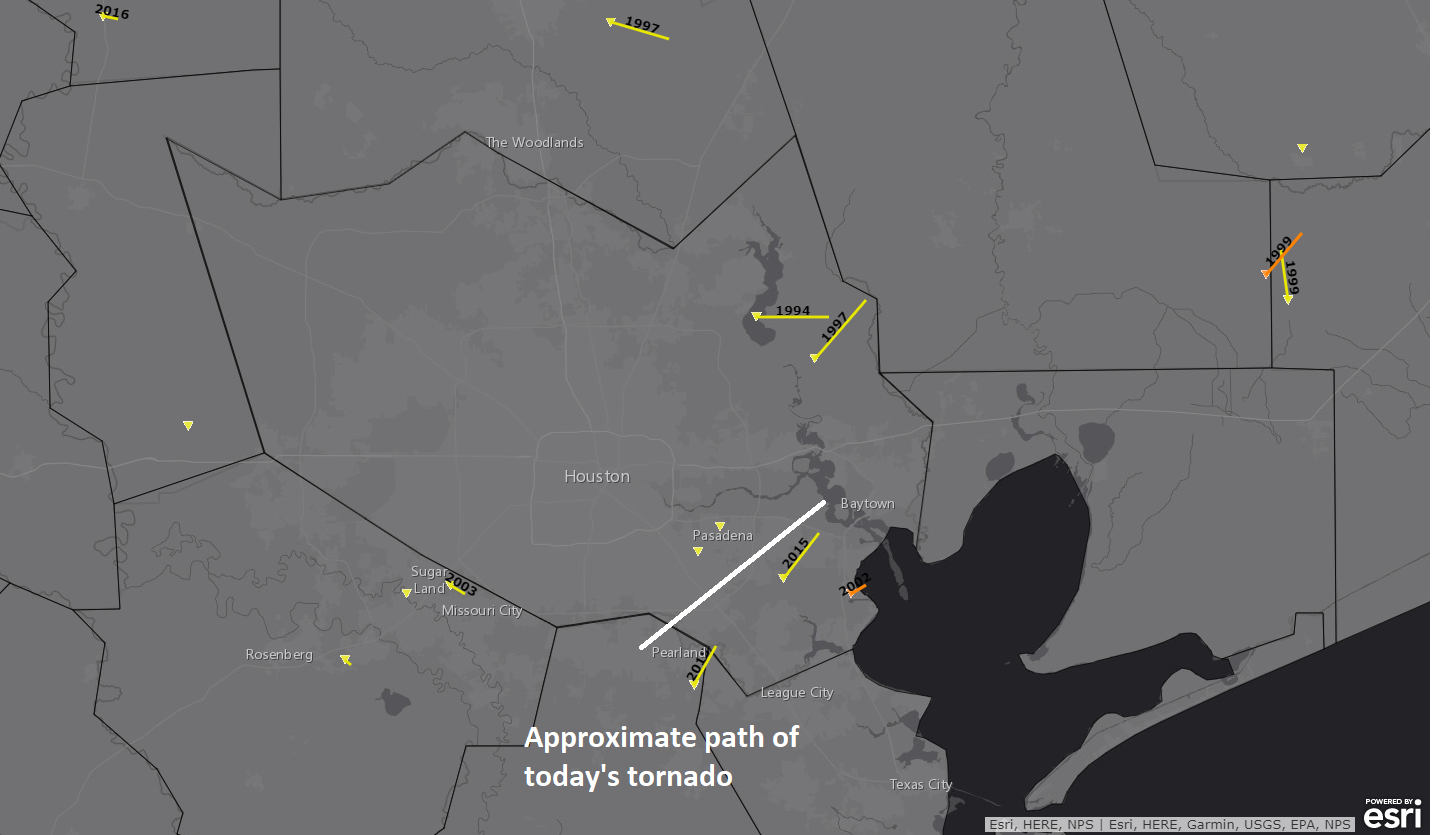
Tornadoes of that scale and length are not common in Houston. Since 1993, we’ve had a number of “strong” (EF-2+) tornadoes in the Houston area, most of which have been on the eastern side of the city. Today’s tornado was no exception. Here’s a map of tornadoes since 1993 that are EF-2 or greater. Only one in the immediate area rated an EF-3, which was a short tracked twister near Shoreacres in 2002.

Map of all EF-2 or greater tornadoes since 1993 in the Houston metro area. (EF-2 in yellow, EF-3 in orange) This one will likely have the longest track in recent memory. (Midwest Regional Climate Center)

In the tornado records, an EF-2 tornado has never struck the Houston area in January. Why 1993 as a cutoff? Because November 1992 had the king of modern Houston tornado outbreaks, including an F4 in Channelview, which we wrote about a few years ago.

If you’re curious, here’s a map of all known “strong” tornadoes in the Houston region since 1950.

All known EF-2 or stronger tornadoes in the Houston area since 1950. Yellow for 2, orange for 3, red for 4. We’ve never experienced an EF/F-5 in this area. (Midwest Regional Climate Center)

The National Weather Service will be sending out survey teams tomorrow morning to assess the damage and assign a rating to the tornadoes. So we will see if it was indeed a “strong” tornado or not. Remember, the rating is determined by a number of factors, not the least of which is building construction. Some poorly constructed, smaller buildings can be obliterated in a mere EF-1 tornado. Based on the initial photos of damage, I am guessing it will be at least an EF-2. But the NWS folks are the experts on this, and they’ll make that call.

Today also marked the first time a Tornado Emergency has been issued in Houston. We all know about Flash Flood Emergencies from recent years. But Tornado Emergencies certainly represent a new kind of horror for our area. They are rare and only issued when there is a confirmed, likely strong to catastrophic tornado ongoing in a populated area. If ever there were a day to issue one in Houston, today was the day. Hopefully we don’t see that again for many years.

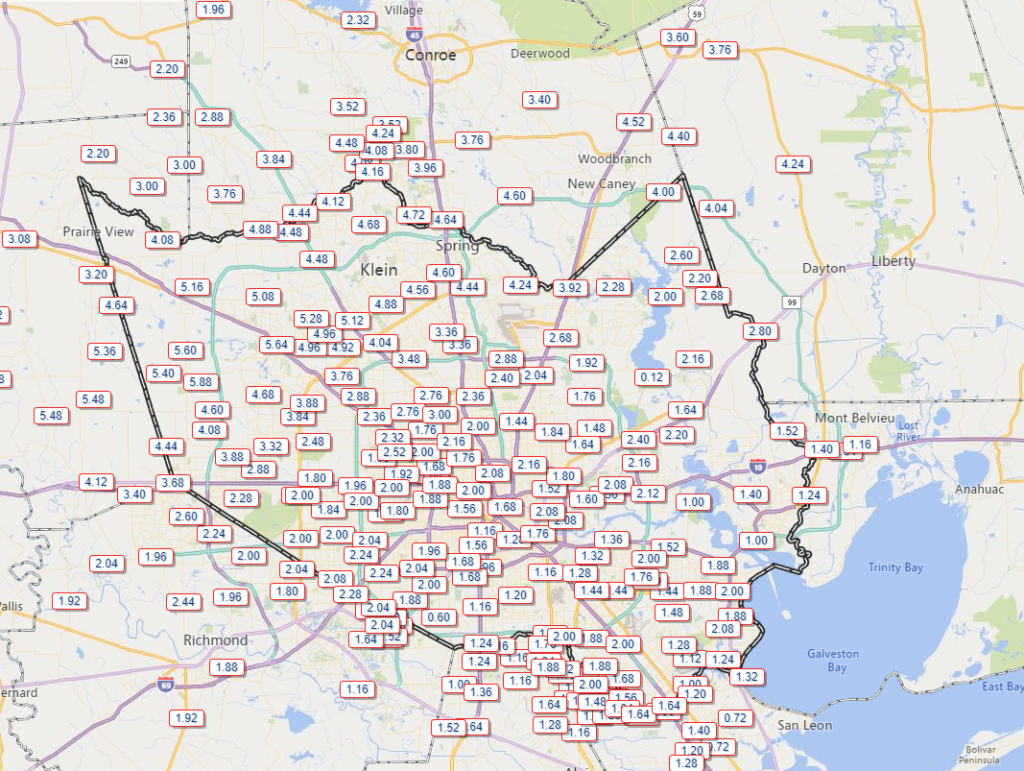
Rain totals were rather impressive, especially in Waller County, western & northern Harris County, Montgomery County, and Liberty County where 3 to 6 inches of rain fell. (Harris County FWS)

Not to be outdone, the rainfall today was tremendous for January. We still have flooding ongoing out by Mound Creek and Little Cypress Creek in western Harris County. Several bayous ended up at bankfull or even out of their banks today. We mentioned flooding. We mentioned heavy rain. But we probably could have been a little more aggressive on the rainfall aspect of things. Today certainly qualified as a Stage 1 flooding event on our flood scale.

At any rate, we’ll know more about today’s events tomorrow. On a personal note, I want to thank the folks at the National Weather Service, as well as our other colleagues across media here in Houston for a very strong, effective messaging campaign today. Collectively, our messaging and the issuance of a Tornado Emergency by NWS no doubt helped protect lives and property in the Houston area today. For us here at SCW, this is truly why we exist. I saw several comments say that “we saw Eric and Matt really ramp up their messaging today, so it was concerning.” That’s exactly why we operate how we do. We want to be the jovial, informative but not in your face meteorologists 90-95 percent of the time. But on days like today, we get serious and down to business. Houston gets a lot of severe weather “days,” but most of them are low-end potential. They get a lot of chatter and sometimes some hype, and yes maybe on a couple of those days something happens. But we knew this had a unique high end potential for this area, and at least in a couple parts of the area, this potential was likely realized. We are grateful it was not worse. As we always say, we are here to help serve the community, and tomorrow we will be back to our normal, mostly boring selves. But when it’s really, truly time to stand up, act, and pay attention, we will make sure that message gets across. Thanks for your continued loyalty and readership. -Matt

25 Jan 16:16

VP says people working from home haven’t developed as much, is “it’s so good to see you” suggestive, and more

by Ask a Manager

This post, VP says people working from home haven’t developed as much, is “it’s so good to see you” suggestive, and more , was written by Alison Green and published on Ask a Manager.

It’s five answers to five questions. Here we go…

1. VP says people working from home haven’t developed as much

My company has announced a return to office plan for January. After the announcement last month, my VP held a meeting with our group, during which he said, “People who have been working in the office have developed more than those working from home.” Now, we all know this may be true — but neither our company nor he has ever required anyone to come in, until our now.

If there was never a requirement to come in, is he just stating facts or does what he said toe the line of being an HR issue?

It’s not an HR issue. He’s not saying, “You’re in trouble for not doing something that was never required.” He’s saying “This is a relevant difference I’ve observed.”

Of course, he may or may not be right about that. He definitely could be! There are jobs where it’s easier to grow when you’re in the office around other people — especially junior-level jobs, where a ton of learning happens from being around more experienced people and observing them doing their own jobs. And if that’s so, it makes sense that he’s flagging it as part of the reason he thinks the change is a good one. Or of course, it’s also possible that he has no basis for the statement and just sees everything through an “in office is better” lens, because those people exist too.

But there’s no HR issue here (at least not unless it starts playing out in clearly unfair ways, like if people are getting better performance ratings solely for having been in the office, while objectively higher performers are rated lower because they worked from home … but even that stuff can get fuzzy, because he might weigh aspects of people’s work differently than you do).

Related:
does working remotely harm your chances of advancement?
did the pandemic really show we can be just as effective working from home?

2. Is it suggestive to say “it’s so good to see you”?

I am a woman in my upper 20s. A 50something-year-old man who works on my floor but in another department (so our paths rarely cross) went around to some of the offices near his own to let us know, mostly one-by-one, that he will be starting a cancer treatment soon, presumably so we would not wonder at his absences and would hear it from him directly instead of through the rumor mill. I expressed what I believe to be a standard, empathetic response about thoughts and prayers (we are both Christian).

A few weeks later, we bumped into each other when no one else happened to be around. After he shared a little about his treatment, in wrapping up the conversation I stated with more emotion than I would typically use in professional conversation, “It’s so good to see you.” There was a palpable change in his expression and body language, and he quickly said, “I’ll let my wife know you say hi'” and turned and left. I was confused by the direction the conversation had taken (I had met his wife once or twice and spoken with her briefly, but the comment felt out of place in this context). It dawned on me that perhaps my comment had felt too familiar and made him uncomfortable, as if it was meant in a suggestive way. I felt a little embarrassed but tried to brush it off, knowing my intentions were pure and he has bigger things to deal with.

Months later, he was experiencing remarkable recovery and I began seeing him around the office again. The first time I did, in spite of myself, I somehow said again, “It’s so good to see you.” I immediately internally cringed and, sure enough, the statement garnered the same response as the first time.

I am a little socially awkward, especially about such serious topics, so I am seeking some advice about whether I need to ban this phrase from all further workplace interactions with people. If it ever were to slip out while talking with other coworkers, I would like to know if the meaning can be misconstrued and, if so, if I need to make a point of never saying it. Or am I maybe misinterpreting why he responded that way? In terms of my future interactions with this person specifically, I plan to keep things polite, professional, and perhaps a little more distant for his own comfort level moving forward.

“It’s so good to see you” is a pretty normal thing to say, especially when someone has been away or sick. It’s not suggestive. Of course, like anything, it could be said in a suggestive way — like if you looked him up and down while saying it, or gave him a lascivious look — but assuming you’re not doing that, it’s really not suggestive. It’s just kind. I suspect the issue is on his side; he might be one of those men who assumes every friendly overture by a woman is a come-on.

Now that you know he reacts weirdly to it, it makes sense to be more distant with him, but you definitely don’t need to ban the phrase from your conversation with others.

3. My employee seems annoyed when he’s assigned certain tasks

I’m noticing a trend in an employee who joined my team after working on another team at our company, Fergus. Fergus has been with the company a long time, although he only switched roles earlier this year, and is one of the most capable people I’ve ever worked with. I’m so thankful he chose our team. However, I’m starting to see a pattern when I assign work or projects that he views as too remedial for his skill set. I will ask Fergus to pitch in on such an item and I can tell immediately that he does not like that he’s being asked to do the task. He was very unhappy in his old role, which is why he switched, and it seems that these tasks in some way remind him of his old job that he wants nothing to do with or he feels they are beneath him. Our team is used to dealing with these types of odd requests, as we can be a bit of a catch-all for the organization.

Now that this has come up a few times, I’m thinking I need to address this. Honestly, I would be willing to do these things myself if I had the bandwidth and my manager would allow it (but they expect that these items will be delegated by me to others on the team). How do I let him know how much I value his experience and the work he does on bigger items while addressing that sometimes we all get asked to do tasks at work that we don’t want to do, especially on a team like ours where the expectation is you help where you are needed?

Name what you’re seeing, and what the reality of the job is. For example: “I might be reading you wrong, but I’ve gotten the sense that you really don’t like being asked to do tasks like X or Y. I want to be up-front that tasks like X and Y are part of the job and that’s unlikely to change.” He might not realize his irritation has been so noticeable (and this would hopefully be a nudge to rein it in) or he might have avoided looking at the reality of the job head-on and this might nudge him to think about whether he can live with it reasonably happily, or who knows what. But step one is to lay out that this is the job and see what kind of response you get.

But before you do that, I want to ask this: if he’s more capable than others on your team — and I’m not sure that he is, but it sounds possible — would it make sense to structure his role so that he’s mostly working on higher-level stuff that he’s better than others at? On many teams you don’t need everyone’s job structured the same way and it can make sense to have higher-skilled people in more senior roles. You wouldn’t want to do this if he’s not that much better than other team members, but if he’s really good it’s worth considering whether his skills warrant it. If not, have the conversation above.

4. My boss is sending me job postings

I need a reality check here. My boss is sending me job postings for positions outside our company, some even out of state!

I can’t help but feel like I’m being managed out because these job postings come on top of being denied promotions, being left out of important conversations, and her showing favoritism to other employees. I am actively looking to move on, but she doesn’t know that. Is this weird?

It’s definitely possible she’s prodding you to move on, especially combined with the other things you’re noticing. But some managers do this with good intentions — it’s genuinely “I want to see you grow and this seems like a great next move for you.”

Why not ask? There’s nothing wrong with saying, “What made you send me those job postings?” In some relationships, you could add, “I want to make sure there’s not a message I’m missing.” If you weren’t actively looking to leave, it could also be an opening to say something like, “Ideally I’d like to stay here and advance, and I’m wondering if your sense is that I’m better off looking for that somewhere else.”

5. Putting speed reading on a resume

I’m a speed reader. Really. I taught myself to read when I was two, and have been zooming through 200-300 books a year ever since. I retain content, I’m not just skimming.

This is something my parents constantly tell me I should put on my resume. I can see their argument, as it’s a hugely useful asset in many ways (quickly becoming domain-ready, digging into complex research problems, getting through those 500 emails a day, etc.).

However, I struggle with how to put it on a resume in a way that sounds … well, real, and piques the hiring manager’s interest without sounding a little juvenile or braggy. Do you have any advice on how to navigate this, and whether it is appropriate resume material?

There’s not a really obvious place for it to go, but if you have a section for hobbies or skills, you could put it there. (A skills section would be the most obvious fit, as long as the rest of what’s there is worth using the real estate for; a lot of skills sections are unnecessary.)

It’s not going to sound braggy or juvenile. It won’t get you a job on its own but it’s more interesting and potentially more professionally relevant than “running marathons” and “jazz aficionado” and “strong communicator” and other stuff people sometimes list, and it could end being something a hiring manager asks you about.

25 Jan 16:14

Archive for Amateur Radio Grows to 51,000 Items

by kaysavetz

Internet Archive’s Digital Library of Amateur Radio & Communications is quickly growing to become an important archive of radio’s past and present. The collection has blossomed to well over 51,000 items related to ham radio, shortwave listening, scanners, and related communications. The newest additions include books, journals and magazines, newsletters, and archives of early Internet discussion lists.

More than 3,300 books and magazines are now available via controlled digital lending in the DLARC lending library. These materials, including hundreds of magazine and journal issues including Popular Electronics, RF Design, and General Radio Experimenter, can be borrowed for online or offline reading, one reader at a time, by anyone with a free Internet Archive account. DLARC has also added amateur radio magazines QST from 1912-1961, Radio & Television News from 1919-1959, and Radio magazine from 1920-1947.

Nearly 1,300 episodes of The RAIN Report, an audio program that aired news and interviews relevant to the amateur radio community from 1985-2019, are now available, including hundreds of lost episodes, thanks to the help of the program’s producer, Hap Holly. DLARC has also added the 700-episode library of the National Radio Club DX Audio Service, which reported radio-related news from 1985 through 2015.

The archive of radio-related podcasts now includes QSO Today, Linux in the Ham Shack, RAIN Hamcast, Amateur Logic, and others. 

Radio clubs are utilizing the DLARC archive to provide long-term backup of content and increase their visibility to new audiences. The Milwaukee Radio Amateurs’ Club, one of the oldest ham radio groups, is uploading its entire historical archive, an unparalleled collection of newsletters, correspondence, newspaper clippings, and meeting minutes documenting the group’s history. 

Other group newsletters include British Amateur Television Club’s CQ-TV, the CWops Solid Copy newsletter for Morse code enthusiasts, Boulder Amateur Television Club TV Repeater’s REPEATER, and Scope, the newsletter of the Palomar Amateur Radio Club. The DLARC library has also added newsletters from radio clubs around the world, including the Dutch Amateur Radio Union, the Chester & District Radio Society (England), and the defunct Canadian Amateur Radio Operators’ Association.

DLARC now archives papers and presentation slides from 41 years of TAPR conferences, including the ARRL and TAPR Digital Communications Conference, and the Computer Networking Conference. The collection is accessible like never before, full-text searchable and with detailed metadata. In addition, TAPR’s Packet Status Register newsletter, published since 1982, is also archived.

DLARC has also begun archiving amateur radio email discussion lists, so far making tens of thousands of discussion threads available and searchable — going as far back as the late 1980s — for the first time in decades. The selection includes INFO-HAMS Digest, Boatanchors (a mailing list for fans of vacuum tube radios), Packet-Radio Digest, and Ham-Digital Digest.

DLARC is funded by a significant grant from Amateur Radio Digital Communications (ARDC) to create a digital library that documents, preserves, and provides open access to the history of this community.

The Digital Library of Amateur Radio & Communications invites radio clubs and individuals to submit collections of material, whether they are already in digital format or not. Anyone with material to contribute, questions about the project, or interest in creating a digital library for other professional communities, please contact:

Kay Savetz, K6KJN
Program Manager, Special Collections
kay@archive.org
Mastodon: dlarc@mastodon.radio

The post Archive for Amateur Radio Grows to 51,000 Items appeared first on Internet Archive Blogs.

25 Jan 16:12

‘No Way To Prevent This,’ Says Only Nation Where This Regularly Happens

Cowboy Who?

We dream of rain and the history of the gun

HALF MOON BAY, CA—In the hours following a violent rampage in California in which a lone attacker killed seven individuals and injured one other, citizens living in the only country where this kind of mass killing routinely occurs reportedly concluded Tuesday that there was no way to prevent the massacre from taking…

Read more...

25 Jan 16:12

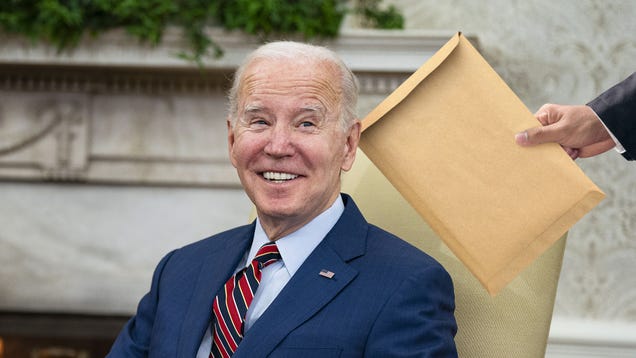
Biden Claps In Amazement After FBI Agent Pulls Classified Document From Behind His Ear

WASHINGTON—Cheering for the incredible sleight-of-hand on display, President Joe Biden reportedly clapped in amazement Tuesday after an FBI agent pulled a document marked “top secret” from behind his ear. “Whoa-ho-ho! How the heck did you do that, man?” said the commander-in-chief, who appeared to beam with …

Read more...

25 Jan 14:34

Pizza Hut Sets New Guinness World Record For Largest Pizza

Pizza Hut has broken the world record for the world’s largest pizza, making a nearly 14,000 square-foot New York-style pizza capable of serving 68,000 slices. What do you think?

Read more...

25 Jan 14:34

Comic for 2023.01.25 - Skittles

New Cyanide and Happiness Comic
25 Jan 14:33

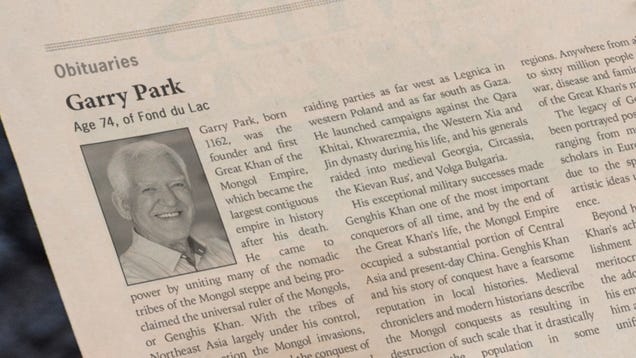
Obituary Clearly Just Copied From Wikipedia Article On Genghis Khan

FOND DU LAC, WI—Questioning the accuracy of a recent article in the local newspaper, friends and neighbors of late Fond du Lac resident Garry Park, 74, reportedly took issue with The Reporter Wednesday after surmising that Park’s obituary was clearly copied from the Wikipedia article on Genghis Khan. “For starters, it…

Read more...

25 Jan 14:32

Food from The Great British Bake Off or Song by The Cure?

by Lisa Borders

1. Angel Cake
2. Just Like Heaven
3. Genoise Sponge
4. A Japanese Dream
5. Charlotte Sometimes
6. Charlotte Royale
7. Icing Sugar
8. Mirror Glaze
9. Piggy in the Mirror
10. Cornish Pasties
11. Baked Alaska
12. Fire in Cairo
13. Black Forest Gateau
14. A Forest
15. The Hanging Garden
16. Small Edible Flowers
17. The Caterpillar
18. Clootie Dumpling
19. The Baby Screams
20. Syllabub

- - -

Foods from The Great British Bake Off: 1, 3, 6, 8, 10, 11, 13, 16, 18, 20
Songs by The Cure: 2, 4, 5, 9, 12, 14, 15, 17, 19
Both: 7

25 Jan 14:32

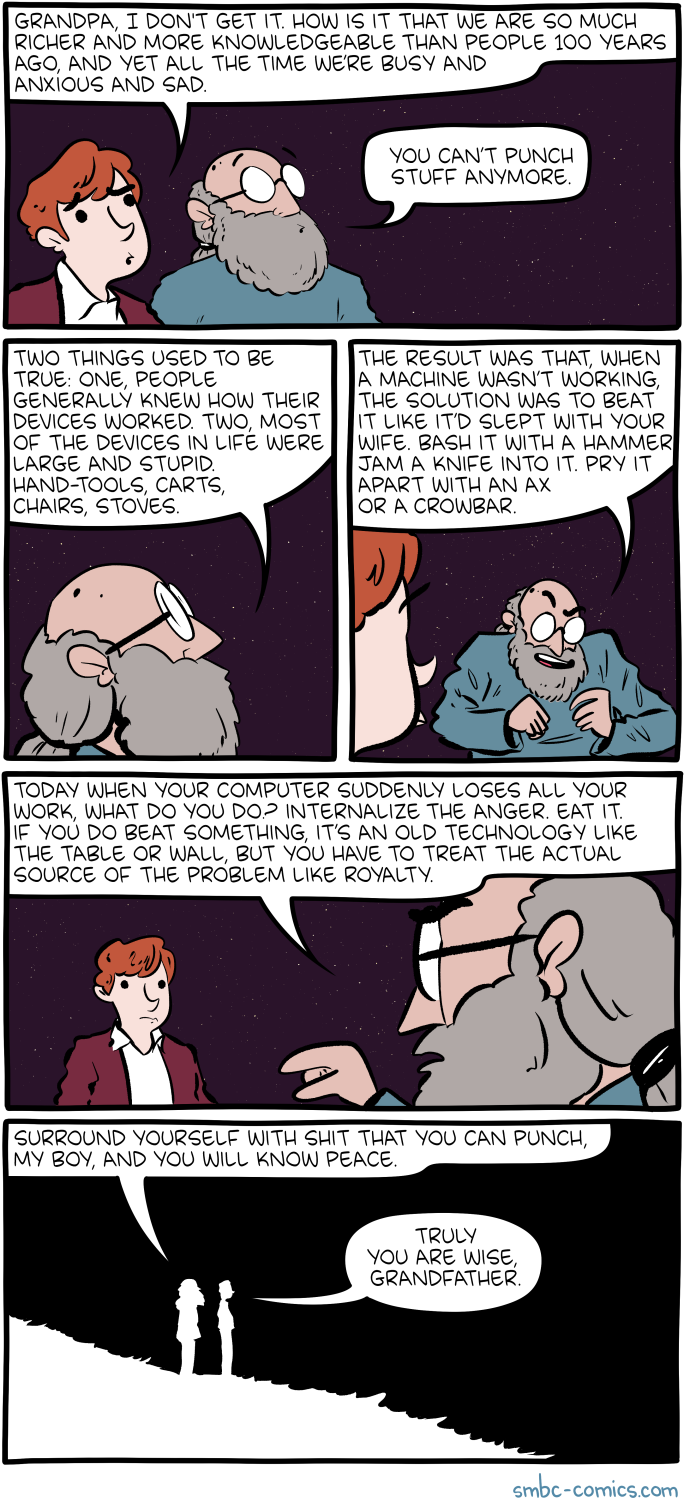
Saturday Morning Breakfast Cereal - Punch

by tech@thehiveworks.com


Click here to go see the bonus panel!

Hovertext:
Note, this morning, when I have a lot of drawing to do, my stylus isn't working.


Today's News:
25 Jan 12:25

The World’s First Robot Lawyer Isn’t A Lawyer, And I’m Not Sure It’s Even A Robot

by Mike Masnick

Note: This post is an adaptation of what started initially as a Twitter thread.

I’ve been going pretty hard on DoNotPay and its founder/CEO Joshua Browder for the past couple of days, and I’ve had a lot of people defending the service, saying that it could be a real boon to those who can’t otherwise afford legal aid.

So, I thought maybe I should give it a fair shake — after all, I’m mostly arguing with what my idea of a “legal AI” is, right? So I signed up for an account at DoNotPay and took the service for a little whirl. There’s no option to test out the real-time AI, or at least not one that I could find. But the site does offer a dazzling array of services under the category “legal tools.” I used the site to undertake three different tasks: Defamation Demand Letter, Divorce Settlement Agreement, and Sue Anyone in Small Claims Court.

Those of you who know me will be unsurprised to learn that I started with “Defamation Demand Letter.” I was a little taken aback by the description “File a demand letter” — you don’t file a demand letter, you just send it — but decided to press on.

The site leads you through a fairly basic set of question and answer prompts, asking you to identify the potential defendant and the defamatory statements, state the basis for their falsity, explain how they damaged you, etc.

After I filled in the prompts, which required my full name, address, and phone number, I pressed “next,” eager to see the “expertly drafted demand letter” DoNotPay generated on my behalf with the “most relevant state legislation regarding defamation” based on my location.

Instead, I got a little progress bar, informing me that my defamation demand letter would be ready in an hour.

That . . . seems a little slow for something that is supposed to be able to respond to a judge and give instructions in real time. But whatever, let’s press on.

I went back to the front page of the site to select “Divorce Settlement Agreement,” observing in passing that DoNotPay describes itself in full color as “the home of the world’s first robot lawyer” and promises the ability to “sue anyone at the press of a button.”

Once again, I stepped through my various prompts, giving information like my address, my putative soon-to-be-ex’s address, our comparative incomes, the number of hypothetical children we had, etc. so that I could get “the fair terms [I] deserve.”

This time, after I was done, I got a little “task progress” bar that said that my divorce settlement would be ready in EIGHT hours. Y’all, eight hours seems like a really, really long time for an AI to need to generate a document. But, whatever, we’re giving it a fair shake.

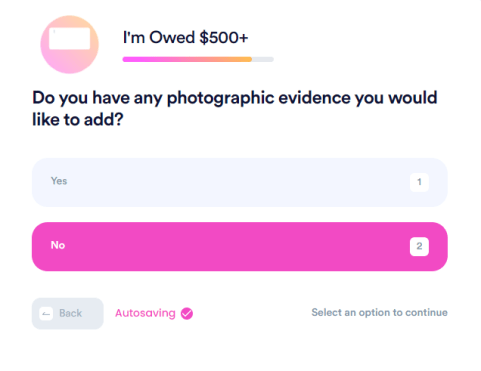
Time to Sue Anyone in Small Claims Court! I typed “Sue Now” into the search bar and was greeted with the following prompt:

This gave me significant pause. First of all, it says “I’m owed $500” at the top, but I haven’t entered any specific information yet. Second, “generating court filings” and giving people “a script to read in court” is… I mean, that’s the practice of law. It just is. Third, though, just from a UX perspective, the prompt ends with a yes or no question (“Are you ready to proceed?”) but has a text box which will only accept a dollar amount. What am I supposed to enter here?

So I entered a dollar amount and pressed “Enter.”

The next page presented what I thought was an odd question. Why would I have received a demand letter? I’m the one suing, right?

(Later, from context clues, I managed to figure out that what they meant was if I had already generated a demand letter with DoNotPay. I guess you can only use this service to create filing documents if you have already used it for a demand letter. But I digress.)

Another UX note — I originally found this prompt from an article entitled “Sue Anyone for Assault in Small Claims Court,” but “Assault” isn’t one of the options listed here. So I figure, go with what you know.

Ooooookay. I… this is not how I would ever phrase this question. But I’m not a lawyer at all, never mind the World’s First Robot Lawyer. Let’s press on.

Fortunately, these are the only types of contracts where you could ever have a breach and be owed money damages, right? Right?

At this point in the process, I seem to suddenly have been switched from drafting a lawsuit to drafting another demand letter. Not sure when that happened — the service certainly didn’t notify me about it.

But in for a penny, in for a pound. As requested, I selected all the appropriate dates for my hypothetical breach of contract: contract formation on 9/6/2019, due date on 12/6/2019, most recent request for payment on 11/11/2022, final due date of 1/31/2023. As requested, I gave details of what services I had theoretically performed.

. . . and got this extremely puzzling prompt in reply. Photographic evidence? What? At no point did the service ask me to provide any documentary evidence or give any terms of the contract other than the date the payment was due.

And HEY PRESTO! This time, no timer, no progress bar, just an instant PDF or Word demand letter to download!

The PDF document had all my personal information in it and was somehow in a format that could not be redacted. I’ve never seen this behavior before — it persisted through all my tricks like saving it as an archivable PDF and everything.

The author of the PDF was listed as some guy named Platon Konstantinos Mazarakis.

Out of curiosity, I did the zip trick on the Word file so that I could look at the properties without opening it. Interestingly, it has some custom XML in it; I’m not much of an XML expert, so I asked software engineer Debbie Mia to take a look at it. The docprops/core.xml file has Mazarakis as the document author once again but also shows that this Word document, generated by the World’s First Robot Lawyer, was last edited by “Denise.”

In order to get the PDF into a redactable format, I had to export it to TIFF and then reconvert it. There’s a big loss in quality, unfortunately. But let’s take a look at this demand letter, generated for me when I asked to sue someone in small claims court!

There is literally nothing AI about this. This is a straight-up plug-and-chug document wizard, and it is not well done at all.

I will admit, I threw it a couple of curve balls, like placing my defendant in Canada. But it didn’t attempt to do any kind of jurisdictional analysis at all — I could have put him on the moon and it wouldn’t have mattered. There is no date on the first page of the letter.

There was no widow or orphan control. After my “signature” there’s a space for “Additional Remarks,” which it never prompted me for. There’s also a random orphaned date in the second page header.

Did the contract say I would be paid for OFFERING the following services, or for PERFORMING them?

In addition to there being zero jurisdictional analysis, there’s also zero thought to engage with the fact that depending on the choice of law in the contract (which the prompt also didn’t ask me about) this action may well already be time-barred.

Or with the fact that Small Claims Courts have an upper limit on the amount you can claim, and I’m pretty sure $17K exceeds it. And, yes, that fucking orphaned “Sincerely,” is still killing me.

Also also? The prompt never asked whether I was amenable to a payment plan. Just went ahead and hucked that in there on its own. (Also never asked me about the interest rate, I have no idea where it got that.)

Let me be clear: this is a terrible demand letter. Absolutely terrible. Useless or worse than useless — if an actual attorney saw this, she would instantly know that the sender was unsophisticated, unrepresented, and gullible as fuck.

For this service, DoNotPay charged me $36 ($18/month and it charges you for two months at a time). But hey, there’s an unlimited number of documents we can generate, right? Let’s go see how the others are doing!

Turns out… not so great, Bob. The minute the defamation letter hit its one-hour limit, it flipped over to a little clock icon and said it would need more time. Same for the divorce settlement’s eight-hour limit. That was two days ago.

No updates since then. No contact from the company, no way to generate a support ticket, no hint as to what the trouble is. Just a cheerful, brightly colored promise that it’s doing its best.

I have literally no way to know what the fuck is actually going on here, but I can think of two likely options. The first is that the whole tool is just fucking broken, and Joshua Browder is scamming people out of almost $20 a month for a service that simply does not work. The second, though — and I find this much more likely based on the one-hour and eight-hour timelines given — is that this isn’t AI at all; DoNotPay collects the information from the prompt and then hands it to a human to go find the relevant law and customize the doc.

That would explain why the defamation demand letter gave me a one-hour deadline while the breach of contract letter happened instantly. Remember, the defamation demand SPECIFICALLY promises the “most relevant state legislation” “based on your location.”

It doesn’t take an AI an hour to look up the relevant law based on a physical address. Westlaw can do it… well, I was going to say instantly, but anyone who has used Westlaw knows that’s a lie. But Westlaw can do it in thirty seconds. If there are human beings doing the Googling and making the decision as to what the “most relevant state legislation” is for a defamation action (and, let me tell you, there’s a sign of a pretty glaring error just in that phrase on its own) then any argument that this isn’t unauthorized practice of law (UPL) goes straight out the fucking window.

But hey, maybe those aren’t the only two options! Maybe Browder recognized my usage of the site — after all, I did sign up for it with my real name, which I also tweet under — and panic-blocked me because he was salty that I think his idea is dumb. Or maybe there’s some other perfectly innocent reason why this brand-new revolutionary technology that is getting its debut in a live courtroom setting in less than a month has been wedged for almost 48 hours with no updates or signs of life.

Regardless, though, I don’t think any of the lawyers I know have any cause to fear for their jobs any time soon.

P.S. Browder, who had blocked me a few days ago, unblocked and followed me today!

But apparently only for long enough to promise to listen to feedback, and then to block me again. So, you know, good talk etc.

Awww, and the robot blocked me too!

Update: Josh Browder unblocked me and messaged me again, explaining that my account was automatically flagged because my usage “didn’t seem like authentic activity” and informing me that he had refunded my subscription. I asked him if I could see the two other documents I had already generated or unlock my account so that I could generate similar documents; he said he would try to make them available by tomorrow afternoon (January 25th), explaining that “[t]he engineer who understands the blocking code is out until 12 or so.”

Josh also stressed that “the letters aren’t being typed out by hand and in general are all generated instantly 😂.” Although I did not claim, nor did I intend to suggest, that the documents on DoNotPay.com were typed by hand, I have included his statement here in the spirit of good faith and full disclosure.

24 Jan 23:49

Amazon’s Dying Smile Donation Program… Was Really All About Amazon Keeping Referral Fees To Google Down

by Mike Masnick

You may have heard last week that Amazon has announced the end of its “AmazonSmile” program, in which you could shop at Amazon, and a portion of all of the money you paid would actually go to the charity of your choice. Amazon claimed that the program “has not grown to create the impact we had originally hoped” and (perhaps reasonably!) implied that the overhead of delivering small amounts to many different charities was not very efficient. The company noted that the “average” donation to charities was less than $230 per charity.

Of course, a simpler solution if that were really the problem would be to keep the program running, but limit the number of charities to which the money could be directed. That would likely annoy some of the smaller charities who had benefited, but still.

Some people, naturally, assumed that Amazon was doing this to claw back some of the money that it had previously been sending to the various non-profits. But, it appears the actual story here may be even more crazy.

Soon after the news broke, there was a fascinating post on Reddit from someone claiming they used to work at Amazon corporate and was around when the Smile program was launched, and claimed that the program was never designed to be as generous as it was presented. It was really just designed to fuck over Google and have to pay that company less in referral fees.

Here’s the most messed up part. I used to work at Amazon corporate, let me tell you how the entire program Amazon Smile got created.

So basically, when a customer wants to buy a product, they usually go straight to Amazon.com and enter what they’re looking for. But there’s also a large segment of customers who begin their search on google, and ends up at Amazon. Well guess what. When that type of search to purchase experience happens, Amazon has to pay google. Internally, Amazon thought that if they could force users to go straight to Amazon, offer a small but obviously less amount of money to charity from each customer than would have been paid to google, it would help kill customers going to google, save Amazon more money than paying google, and be good overall for the brand value of Amazon.

That’s why for the program to work, the user has to start shopping at smile.amazon.com. Until recently, the option to use amazon smile wasn’t even available in the app, and even then the user still had to ‘renew’ being a part of Smile multiple times a year. There is no way for a customer to go through the traditional shopping experience, and then during checkout decide they want to give a portion of their purchase to charity, because giving to charity isn’t the point of the overall program. Amazon Smile was developed by the Traffic Optimization team, whose entire purpose is increasing efficiency and lowering costs of getting customers to Amazon. A team of Amazon employees whose sole purpose is doing good in the world doesn’t exist, despite employees repeatedly asking for such a team to be built in pretty much every single all-hands meeting.

Literally everything the company does is about profits, and extended customer lifetime value. Everything. Even the charity programs are just designed to save Amazon money.

Incredible.

While there’s no way to prove that this person really did work there, it does sound accurate, and another commenter backed this up, with credible additional info:

I also used to work at Amazon, and was a founding member of the AmazonSmile program, part of the Charity Support team working with the nonprofits to help them actually receive the funds. This was 2013. Left in 2016 after fully fleshing out the program, developed the metrics reporting system for tracking charity issues, and even a blurb document to respond to the most common questions nonprofits had.

You are completely correct. The intent of the program was to be cost neutral – the amount Amazon donated to charities was about equal to the costs it saved by not having to pay Google for advertising clicks. Tax writeoff was a negligible side benefit, goodwill was just marketing fodder.

Later on that same commenter notes that another “side benefit” to doing this was to push back on some local news stories that had slammed Bezos for not being involved in enough charitable works. So this kinda killed multiple birds with a single “look at how good we’re being” stone.

From all that, I’m wondering if Amazon is now realizing that the overhead of handling this program just wasn’t worth it any more, and the fact that they made it so difficult to use didn’t really stop that many people from Google, so if they have to just write a slightly larger check to Google that’s easier than having a team figuring out how to send hundred dollar checks to charities.

24 Jan 17:59

‘I Love That It Has Pockets,’ Says Woman Showing Off New Boyfriend

KANSAS CITY, MO—Appearing pleased and presenting the new acquisition with a twirl, local woman Nelly Winters was overheard saying “I love that it has pockets” to a group of friends Tuesday as she showed off her new boyfriend. “I know it’s not my usual style, but it does have four pockets around the waist and this…

Read more...

24 Jan 07:36

trainer wants us to “get emotional” with each other, tamale theft, and more

by Ask a Manager

This post, trainer wants us to “get emotional” with each other, tamale theft, and more , was written by Alison Green and published on Ask a Manager.

It’s five answers to five questions. Here we go…

1. Our trainer wants us to “get emotional” with each other

I work in education. Specifically, in an urban high school with a high proportion of disadvantaged students with trauma and/or learning disabilities. Work and professional development events can get kind of touchy-feely (emotionally) because so much of what we do is based on forming relationships with our students. Most recently, our school is putting in place a “restorative justice circles” program. The general idea is to regularly do talking “circles” to form community, talk through hard community or life events, and restore relationships after fights or other behavior issues. The circles have a protocol and a talking piece, etc. All teachers are getting trained to run them. They might turn out to be a really good thing for our students or they might be another education fad that will be gone by next year.

At the last meeting, an outside consultant introduced the idea of circles to us and touted their success in other schools. He will be training us on how to conduct the circles. He ended the meeting by saying that our next meeting will consist of practicing the circles and getting emotional with one another. The idea of which being, you have to be willing to share something of yourself in order to expect to form real relationships.

I am not a big emotion sharer at work at the best of times. This month I’ve returned from maternity leave with my first baby to a new staff (last year was terrible, everyone quit but three teachers, a story for another time) and new routines and it’s been especially tough. Is there any way to professionally opt out of something like this, without looking like I am not a team player?

They want all teachers trained to run these circles? That seems like a terrible idea to me — not everyone is suited to doing this kind of work, and I’m sure we can all think of teachers we had who no student would have trusted in that role. However, assuming your leadership isn’t receptive to that argument and they’re committed to going forward with it…

Based on how they’ve framed it so far, I doubt you can opt out of this piece of the training without opting out of the whole thing. Your easiest path might be to participate but come prepared with really bland responses. They can tell you they want you to get emotional (!) but they can’t actually make you do it. Instead, you can share things that you’re not emotionally invested in. Hell, you can make things up! When people are stuck in a work-mandated activity that wants them to share more of themselves than they’re comfortable with, and when they don’t have the capital or standing to get out of it, that’s often the simplest approach … and most of the time it works because no one is paying that much attention to any one person’s contributions.

For the record, I’d love to give you different advice and suggest you fight the whole thing, pointing out how violating it is and how dangerous it is for some people to be vulnerable at work, but it’s an uphill battle and you’re already exhausted. It’s okay to decide to just take the path of least resistance.

2. Tamale theft

A coworker stole my tamales out of the communal freezer at work. Would it be inappropriate to leave a note in the freezer saying “to whomever stole my tamales, your mom is a ho”?

I’m pretty sure you know that would be both misogynistic and rude.

3. How do I stop being excessively loyal to my jobs?

I’m a lawyer and my profession is definitely my personality. I absolutely love my work. The problem is that I get excessively loyal to my workplace, even when it’s toxic or detrimental to my upward mobility and mental health. For example, I formerly worked for a government agency with a supervisor that was demeaning and allowed for zero work/life balance but I hung in for 12 long years because I was so committed to the work.

I’m currently working for a firm that is truly a sinking ship. We’re taking in almost no money and we can’t hire competent staff, invest in new technologies, or even buy supplies on occasion. I fully recognize that I’ve maximized my earning ability here and live in constant fear that the whole thing will collapse. My supervisor is very much the kind of person who takes care of himself financially first and even though he’s promised partnership, I also know how much debt the firm is in and that it would be a terrible investment. However, I love the work and feel this weird internal motivation to see the firm succeed, even if I’ll never reap the benefits. I know that I don’t owe this place anything and that my primary motivator should be taking care of myself. How do I break this curse of obsessive loyalty despite obvious toxicity?

To figure this out, you’re going to need to identify what need this fills in you — and that can mean digging pretty deep psychologically. For example, are you fulfilled by feeling like you’re the one bringing order to chaos or that things would fall apart without you? If so, any chance you filled that role or a similar one in your family when you were growing up? Or, did you grow up in chaos and/or scarcity and so at some level this feels familiar and comfortable to you? Staying on the childhood theme, because that’s what a lot of this stuff is rooted in, did your role models growing up teach you that you don’t leave no matter how bad things are? Or that you don’t deserve good things so you should take whatever you can get?

When there’s a pattern in your life that isn’t serving you but you’re having trouble breaking it, it’s often because it was wired into your brain pretty early, and therapy can really help you unwire it.

4. Going back on an offer of hardware

I’m about to join a small but growing company as a software engineer. My manager asked what sort of computer hardware and setup I’d like, as they would purchase completely new equipment for me (they shared they use XYZ setup). I said I would prefer ABC setup, as I’m used to working on ABC. They responded that “management would prefer you go with XYZ to keep it consistent across the company.”

I don’t mind going with XYZ, but WHY did you ask for my preference in the first place if I didn’t really have a choice? I find this lack of openness about something so simple really weird and a potential red flag, especially for a company that prides itself on having transparency and “no bullsh*t” as core values. What do I make of this?

My guess is that they weren’t asking whether you wanted, for example, Apple or Windows, but rather if there were particular specs your computer needs to have or if you work with a second monitor or so forth.

5. How much enthusiasm should we care about candidates showing for the organization?

I was recently on a selection panel with three other interviewers. We had a discussion about how much enthusiasm a candidate should show for the organization. For the opening “tell us why you applied for this job” question, one interviewer kept downgrading candidates who mentioned the importance of the organization but pivoted fairly quickly to the job itself. I agreed that the one candidate who didn’t mention the organization at all probably should have at least indicated which organization they were applying to work at, but extended monologues about how important the organization was and the great work we do was not necessary. In my opinion, being motivated by the job itself was as legitimate as being motivated by our organization’s mission.

What weight would you give to mission vs. job as a persuasive answer to this opening interview question? Should we even be assessing this question, which has always seemed to me to be a softball to help the candidate relax?

If you do advocacy or many other types of nonprofit work, you do want to see a commitment to the objectives of the organization — but it doesn’t need to be a major focus or passion. In fact, after working in nonprofits for years, I haven’t seen any correlation between visible passion for the mission and effectiveness! I’d much rather see a passion for the job the person will be doing (and even that isn’t that useful unless it’s backed up by skills and a track record of getting things done).

“Tell us why you applied for this job” can give you interesting information, but it’s not something you should be placing a huge amount of weight on except in the rare cases that something really notable comes out in response (like a complete misunderstanding of what the organization does, not an insufficient focus on it).