Shared posts

27 Feb 17:25

my new coworker is putting fake mistakes in my work so she can tell our boss I’m bad at my job

by Ask a Manager

This post, my new coworker is putting fake mistakes in my work so she can tell our boss I’m bad at my job , was written by Alison Green and published on Ask a Manager.

A reader writes:

I’ve been with my company for over 10 years at this point. It was my first job out of college and I have successfully worked myself up the ranks to the corporate offices. I’ve been immensely proud of my progress, up until recently.

I transferred to a new team, which was presented as a great opportunity. Once I was here, it became very clear this manager, Celia, is a hot mess who does not have any idea how to manage people. I’m talking not having proper training programs and then reprimanding people for making mistakes on things they weren’t trained on, reaming people out for leaving at their assigned time, badmouthing employees to their coworkers, etc. It’s just been miserable and I constantly have a pit in my stomach because of it.

In addition to all of this, it feels like one of my coworkers is surgically attached to Celia. This coworker, Julia, is a new hire and has been with the company for less time than everyone else. She is constantly in Celia’s office. There have been multiple times where the team has been working and engaging in normal chit chat, Julia gets up and quietly goes to Celia’s office, and then moments later Celia is reaming us out for not “staying on task” (we are always working, just also talking because this isn’t elementary school, we can talk and work). Julia never works on the reports with us and we’ve been told she’s on a special project for the manager. I have no idea what this means.

Recently, I’ve been getting negative feedback from Celia about not completing tasks or making mistakes. When I go into the record to see who last touched it, it’s always Julia. I just thought Julia was finding the mistakes and fixing them. But I’ve never been one to make the same mistake over and over, so I started to get suspicious. I decided to take screenshots of my work at the end of the day to see if the next time I’m told Julia had to fix a mistake, it actually was correct to begin with.

This is what happened. I was reprimanded through email about not correcting something. When I compared the correct version to my screenshot, I could see very clearly that the record was right to begin with and Julia just re-executed it to make it seem like she had to fix it.

I’m absolutely livid and confused. Why would you alienate yourself from the team like this? But now I’m not sure what to do with this information. I don’t want to let Julia get away with this shady behavior but I also don’t trust Celia to take this seriously or, worse, to even believe me to begin with. Celia clearly never took the time look into the history of who modified the record and what was done (which she can see from her access), she just believed Julia was a genius and I’m some dunce who kept making the same mistake. I would go above her head but I’m hesitant that this would cause more drama. I did mention it to three of my coworkers who I’m close to and advised them to start screenshotting as well as they also are receiving negative feedback.

How would you handle this? Is there a way to go about this without looking like some paranoid lunatic? I’m just so tired of leaving work on Fridays with a lump in my throat because I already have anxieties about being reprimanded on Monday morning.

What the hell!  Julia sounds like she’s intentionally undermining you and your coworkers in order to curry favor with Celia.

In a normal situation with a different manager, you could go to Celia and lay out what you’d found: “I’ve been so baffled about how I could be repeating the same mistakes that I started screenshotting my work after finishing it. My screenshots show that the things Julia has been reporting as mistakes were correct the first time; it’s looks like she’s just re-executing the records so it looks like she had to fix them.”

Are you sure you can’t say that to Celia? If you have the screenshots, it might not be a question of whether to believe you or not.

But if you think she’s too defensive of Julia to hear it, could you say it in a way that doesn’t blame Julia? For example, you could use the script above but rather than outright saying that Julia is re-executing the records to make it look like she fixed something, you could say: “It seems like something is going wrong with our system if Julia is finding mistakes, when you can see from these screenshots that it was right the first time. If the system isn’t saving things correctly, that’s a huge problem so I think we need IT to figure out what’s going on.”

You might even put that in an email to her, attach the screenshots, and cc Julia — framing it all as “something’s going wrong with our system if Julia is seeing mistakes since, as you can see, these were done correctly.” That would put Julia on notice that what she’s doing won’t continue to work, without you having to directly confront her. Hell, with that framing, it might even be reasonable to cc your whole team as an FYI that your database isn’t saving records correctly — “is anyone else seeing this?” — which should really mess with Julia’s scheme.

If none of those feel like options, then I do think you need to go over Celia’s head. Yes, it will mean drama — but there is already drama! Julia is stirring up an entire cobra’s nest of drama by what she’s doing. If you can’t count on Celia to squash it, then the only real alternative is to go to someone who will. When a manager is regularly reprimanding you for something you didn’t do and can’t be trusted to hear reason, that warrants escalation. And the stakes are high enough here that you really should — because the lies Julia is feeding Celia have the potential to seriously impact your reputation in this company you’ve spent a decade working your way up in, and could even cost you your job at some point. You’ve got to bring this to someone — if not Celia, then someone above her. (And when you do that, consider having some of your coworkers join you, to demonstrate that this is a widespread issue, not a misunderstanding with one person.)

If none of the above works, I strongly recommend working on getting out of there. If things remain as they are — with someone actively working to harm you and a manager who’s willing to believe her — the risk to you if you stay is too high.

27 Feb 17:22

Saturday Morning Breakfast Cereal - Milton

by tech@thehiveworks.com


Click here to go see the bonus panel!

Hovertext:
OK OK but I am CORNERING the market on Milton-related humor.


Today's News:
27 Feb 17:21

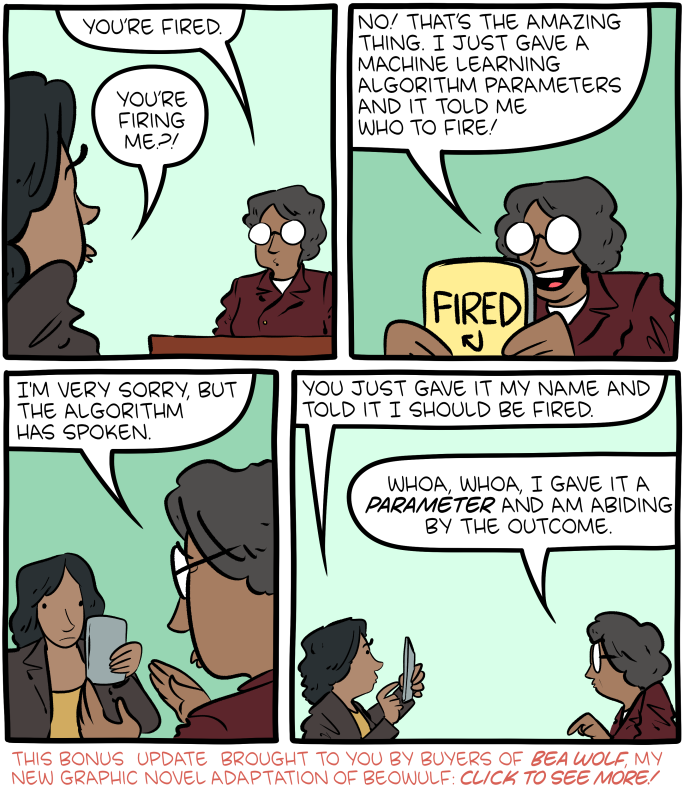
Saturday Morning Breakfast Cereal - Algo

by tech@thehiveworks.com


Click here to go see the bonus panel!

Hovertext:
Meet Algo, the Boss-Guilt Absolver


Today's News:

Feel free to continue destroying my hand buy buying additional copes:

https://www.smbc-comics.com/bea


27 Feb 14:50

Don’t blink—or you’ll miss today’s front

by Eric Berger

Good morning. Houston will see a brief reprieve from humidity today and tonight as a weak front moves in, stalls, and then moves back across the region. After this we will be warm through Thursday before a stronger front brings substantially colder and drier air into the region. At this vantage point, the weekend looks absolutely sensational.

Monday

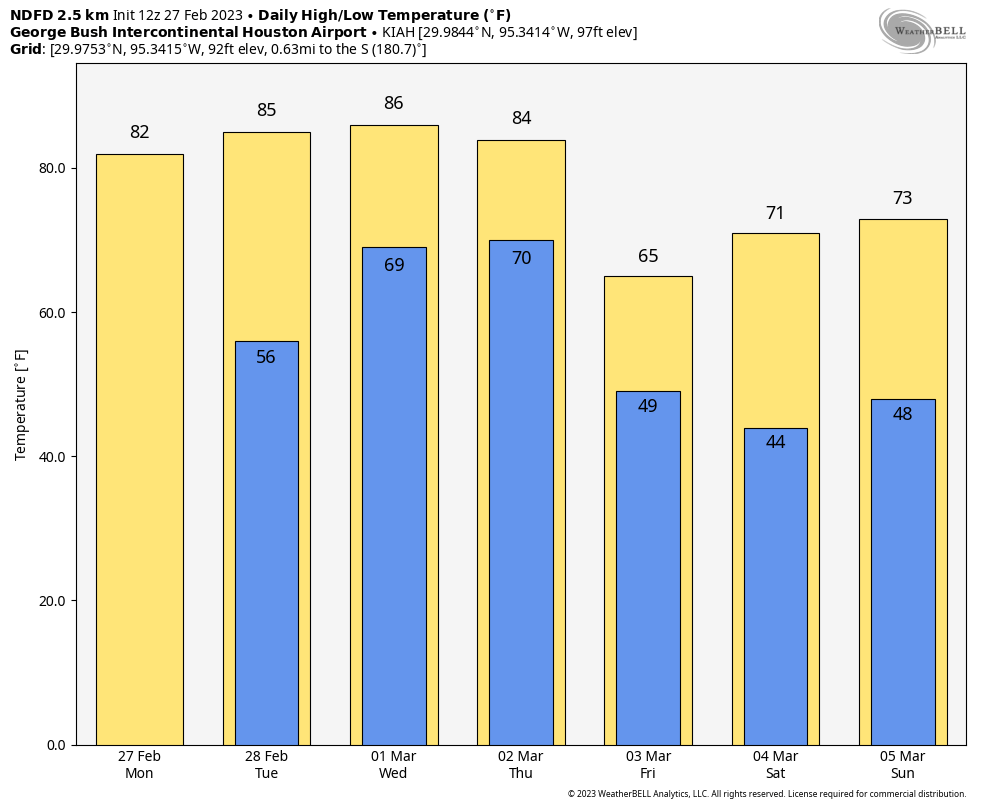
The first front will move down toward the coast by around noon. This front will probably push just offshore, or it may get hung up right along the coast. Either way a very thin line of light showers may accompany the front, and it will usher in some notably drier air—for about 12 hours. That’s because the front will start lifting back north by Monday night or early Tuesday morning. The bottom line is that, the further inland you live, the longer the dry air will last. Most of us will still reach the low 80s today, albeit with less humidity, and Houston proper should drop into the upper 50s tonight before the front lifts back north.

Houston will briefly see cooler temperatures tonight, especially away from the coast. Emphasis on briefly. (Weather Bell)

Tuesday

This will be a warm, mostly sunny day with light southerly winds. Look for high temperatures in the low 80s, and overnight lows dropping only to around 70 degrees.

Wednesday

Expect another warm day, although with more clouds building over the area. Southerly winds will also be more pronounced, gusting perhaps to 20 or 25 mph.

Thursday

Our final 80-degree day of the week comes on Thursday, with partly to mostly cloudy skies. A reasonably strong front will arrive sometime later on Thursday, perhaps during the afternoon or evening hours. This is a challenging one to forecast because it looks as though there will be a fairly strong capping inversion in place—that is to say warmer air higher in the atmosphere that prevents moisture near the surface from rising. The bottom line is that if this cap holds in place over the metro area, this mostly likely will be a dry passage. But if the cap breaks, well, storms could be on the menu. Hopefully as we get closer to the front’s passage we can confidently say one way or the other. For now, I’m leaning toward a mostly storm-free passage, but with fairly strong winds Thursday night after the front moves through. Temperatures will drop to around 50 degrees late Thursday night as a result.

Change is coming to Houston with this weekend’s forecast. (Weather Bell)

Friday

Expect mostly sunny skies and highs in the mid-60s on Friday. Winds will be breezy from the north, but also lessening the further into the day we get. Lows on Friday night may drop into the mid- to upper-40s in Houston, with cooler conditions inland, and warmer ones near the coast.

Saturday and Sunday

The forecast for the weekend looks extremely pleasant. We will no doubt have to tweak the details. But for now we’re probably looking at mostly sunny skies and highs in the low 70s. Humidity will be slowly on the rebound, but it should remain mostly at bay through the weekend. This will be one to spend outdoors.

27 Feb 14:49

Dalai Lama Worried There’s Nothing More To Life Than Feeling Deep Connection With All Existence

MCLEOD GANJ, INDIA—Letting out a sigh as he buried his head in his hands, the Dalai Lama reportedly was worried Monday that there was nothing more to life than feeling a deep connection with all existence. “Wait, so all there is to life is experiencing the full profundity of the interconnectedness of all things to…

Read more...

27 Feb 12:38

Biden Announces Nation Can Stay Up Till 9:30 Tonight

WASHINGTON—Sighing as he gave in to the demands of all 330 million Americans, President Joe Biden announced Monday that the nation could stay up until 9:30 p.m. just this once. “But then it’s straight off to bed, no complaining,” said the commander in chief, informing the U.S. populace that, should they choose to stay…

Read more...

27 Feb 12:19

insensitive “Diversity Day,” how to fire someone who refuses to talk to us, and more

by Ask a Manager

This post, insensitive “Diversity Day,” how to fire someone who refuses to talk to us, and more , was written by Alison Green and published on Ask a Manager.

It’s five answers to five questions. Here we go…

1. Is our “Diversity Day” as insensitive as I think it is?

I’m looking for a gut-check on something that’s been bothering me since it started. My company has something called a Diversity Day where our HR team supplies us with a list of holidays that people in the U.S. don’t traditionally get as a day off and our workforce votes on which one is going to be our “Diversity Day” that year and it gets added that year’s holiday calendar. Last year we got Diwali off and this year we get Yom Kippur.

It’s probably meant well, but it feels very othering and like, “Look at these ~*exotic*~ holidays! We want you to vote on which one is the most valid and gets to ascend to the status of ‘real’ holiday this year!” It’s like weird a popularity contest.

Also our workforce is mostly white, which adds to the ick for me.

Am I off-base in thinking this is problematic and they’d be better off just giving everyone a floating holiday to use as they please?

You are not off-base. This is really distasteful and othering. It’s also disrespectful — for example, Jews take Yom Kippur off for a very specific reason (fasting, attending services, and private introspection and repentance); it’s not just a day off. (And something similar is true for all/most of the other holidays on the list, I’d imagine.)

And what could the votes even be based on?

A floating holiday would be far better.

2. How do we fire someone who refuses to talk to us?

I am a volunteer on the personnel committee for the small church I attend. We only have three staff members (two ministers and an office person). We have determined that one of the ministers needs to be terminated — I’ll spare you the details but she is colossally bad at her job and has responded angrily to feedback. So, we asked her to attend a meeting to discuss “next steps” (we were going to tell her we are ending her employment, which should not be a surprise to her at this point) and she refused to attend. She, in fact, said via email, “This meeting is non-consensual.” She came to church the next day and performed her role in front of the congregation as scheduled, pretending everything was fine.

So the question is: How do we fire a person who sneaks out the back door and refuses a meeting? It seems so cold to fire her by email and turn off her key fob (not to mention she’ll need to go into the church to collect her belongings!).

If she won’t let you call a meeting, then the next time she’s supposed to be there in person, walk into her office and do it on the spot as soon as she arrives. You don’t need the meeting to be scheduled in advance. But if there’s no practical way to do that and she’s going to keep showing up and speaking to the congregation and then sneaking out while you’re sidetracked with other things, your only option is to do it via remote methods — meaning both call and email, one right after the other. Leave a voicemail letting her know you’re terminating her and follow it up with an email, both saying that (a) you tried to do this in person but she’s made that impossible, (b) she is not authorized to do any further work for the church (you don’t want her to just show up at the pulpit next Sunday as if nothing happened!), and (c) she should call or email to arrange a time to collect her belongings. In a case like this where someone is actively trying to avoid the conversation, it also makes sense to follow up with the same message by certified mail (include a note explaining you’re doing that because she’s made it impossible to meet in person).

Based on what you’ve seen so far, is there any chance she’ll try to show up at church to perform her normal role anyway, even after this? If so, you’ll need a plan for how to handle that if it happens. In a normal workplace, I’d say you’d want security there to prevent that from happening — and frankly I’d recommend it here too, although it’s more complicated as church with a congregation this might happen in front of.

3. Assistant keeps introducing me as tech support … I’m not

I am a senior professional with a specialized role. I would consider myself to be about average in my technological proficiency, fully able to use everything I need to do my job, but not to the level of an IT person (nor do I work in IT). However, because many of my coworkers are terrible at office technology, I have become a go-to for help with these matters. It’s really a distraction from the professional level-responsibilities, but I put up with it when it isn’t egregious.

Recently, however, our department’s executive assistant has begun referring to me as our “tech support” when talking with new hires. This really rubs me the wrong way. First of all, there are tech support workers in our IT department who would help new hires with their email, computer, etc. so it’s legitimately confusing. Second, “tech support” is not really a reflection of my professional duties and significantly lower than those duties. In my mind, it’s similar to referring to the aforementioned executive assistant as a “typist” or “meeting scheduler” in that it does not refer to most of what I do.

The executive assistant knows full well what my title is. We’ve worked in the same department for five years and have a really contentious relationship, in part because she thinks that reporting to our department head puts her on a higher level than the rest of our team. (She sees herself as equal to the person who is our department’s second-in-command, when that’s not the case.) How can I address getting my job description correct with her in a firm yet tactful way?

“Please don’t introduce me as tech support to new hires. That’s not my role, and it causes confusion when they don’t realize they need to see IT for help with their computer and email. Please introduce me as (title).”

If she continues doing it after that, correct her on the spot in front of the new hire: “No, I’m not tech support. I manage our llama campaigns. We have an IT department that will help you with any tech issues.”

4. Job searching when I can’t drive

I know you’ve addressed the question of if/when to disclose disability in job searches before, but I’m in a situation that complicates things a bit. Last year my spouse and I moved to a state with very little local work because he was offered a good job here. I was working remotely on a long-term contract at the time, as well as finishing grad school. I’ll graduate in May and my contract is coming to an end.

I’ve been interviewing for other fully remote roles in my field, which is legendarily unfriendly to disabled folks like me, as well as to technological advances like remote work. I’ve had some interviews and I’ve even made it to the final round a few times. The problem is that all of these “remote” jobs require the ability to travel and that always requires the ability to drive. I am epileptic and cannot drive. I’ll never be able to drive. Sometimes the job postings make the driving part obvious and I can opt out, sometimes I don’t find out until I’m 2+ interviews in.

Some of these jobs are great and at excellent organizations, but I think it would be dishonest if I wait to disclose that I can’t drive until I have an offer in hand. I don’t want to waste anyone’s time, but at the same time, I also want to work to change the assumptions about how disabled people can work, particularly in remote jobs. I’d like to work in my industry, or in an adjacent one, but this problem is also not industry-specific. I’m not sure what to do and this problem isn’t going to just go away.

Unless driving is clearly a key piece of the job (for example, if the job were for a social worker who would have to transport clients to various appointments, or a traveling salesperson), it’s not dishonest to wait until you have an offer to raise it. If the travel is just a handful of trips a year, having you fly/take a train and then use a ride service while you’re there is a reasonable accommodation, and one that the Americans with Disabilities Act would expect them to make. As with any disability that they’re legally obligated to accommodate, you’re doing them a favor by waiting until the offer stage so that it doesn’t unconsciously bias them (and also so if they reject you before the offer stage for other reasons, they don’t need to worry you’ll think the disability was the reason).

For jobs where you thought there was no driving and then you learn about it a few interviews in, you can ask for more info on the spot: “Can you tell me more about how much driving is involved in the job and in what contexts?” And then you can assess for yourself if it’s closer to the reasonable accommodation/“handful of trips a year” end of the scale, or the “frequent and essential duty of the role” end. And if you’re not sure, you can ask outright — “I don’t drive for medical reasons; is that something we could work around?” (Or you might prefer to wait for the offer to avoid illegal/unconscious bias, but some people in this situation would rather hash it out before investing more time. It’s up to you.)

5. My coworker got an internal job I wanted that wasn’t even posted

I have worked for a local hospital for 34 years. I have been looking within the hospital for a different position for the last couple years. No position was posted or announced, but I discovered that a woman I used to work with was appointed to the position I was looking for. My qualifications would have exceeded hers. Where I have been loyal to the hospital, she has left on two occasions to work in an unrelated capacity. Is HR allowed appoint someone to a position without posting it? How can I prevent something like this recurring? Do I have any recourse?

Yes, your employer is allowed to hire people without posting the position, unless their own internal rules say they must post all positions before hiring someone. (Some employers do have that rule, but it’s up to them; it’s not a legal requirement.) It’s not terribly uncommon for an employer to move someone internally when a job opens up rather than posting it first if they feel like they have a good internal candidate.

For what it’s worth, loyalty isn’t usually a factor in hiring decisions; managers are generally looking at who they think will do the best job (and sometimes other things too, like who they’re prioritizing retaining). It could even be to your coworker’s advantage that she left twice to work somewhere else, because it could mean that she expanded her experience range and then brought those skills back!

The best thing to do is to make sure that the right people at your hospital know the kind of job you want to move into, so probably HR and the people who hire for the areas you’d like to move into. Let them know what you’re interested in and that you want to be considered when jobs open up in the future, and ask what you can do to make yourself a stronger candidate for when that happens.

27 Feb 01:08

Local son happily purchases board game that will unwittingly cause parent’s divorce

by Geoff Cork

Bucks Game Emporium, Ontario – Daniel Martow is pretty jazzed about the board game he just purchased that will, unbeknownst to him, lead to his parent’s divorce in one year. “I haven’t seen my parents for a long time,” admitted Daniel. “And they love board games. They’re both pretty competitive, so I think a game […]

The post Local son happily purchases board game that will unwittingly cause parent’s divorce appeared first on The Beaverton.

26 Feb 06:37

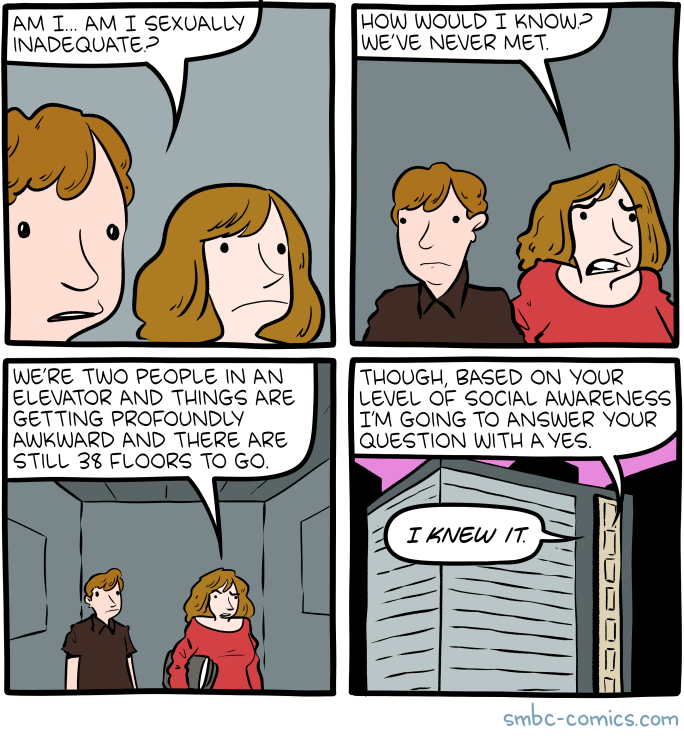
Saturday Morning Breakfast Cereal - Inadequate

by tech@thehiveworks.com


Click here to go see the bonus panel!

Hovertext:
The sad part is he's been in that elevator for twelve hours now, and so far everyone has reached the same conclusion.


Today's News:
25 Feb 15:12

I recently learned that waste heat will boil the oceans in about 400 years.

by Sabine Hossenfelder

Try out my quantum mechanics course (and many others on math and science) on Brilliant using the link https://brilliant.org/sabine. You can get started for free, and the first 200 will get 20% off the annual premium subscription.

All power plants create waste heat that contributes to global warming. At the moment, the contribution is fairly small, but if mankind flourishes it is bound to increase and eventually it will become a problem. The only thing we an do about it is to build an air condition for the planet. Scientists have come up with some ideas how to address the problem that I hope you will find entertaining.

The full video of Michael Pesochinsky's super chimney demonstration is here: https://www.youtube.com/watch?v=COlz9J2wMeA

👉 Transcript and References on Patreon ➜ https://www.patreon.com/Sabine
💌 Sign up for my weekly science newsletter. It's free! ➜ https://sabinehossenfelder.com/newsletter/
📖 Check out my new book "Existential Physics" ➜ http://existentialphysics.com/
🔗 Join this channel to get access to perks ➜
https://www.youtube.com/channel/UC1yNl2E66ZzKApQdRuTQ4tw/join

Many thanks to Jordi Busqué for helping with this video http://jordibusque.com/

00:00 Intro
00:38 What is Waste Heat?
04:46 How Big Is the Waste Heat Problem?
08:29 What Can We Do About Waste Heat?
10:07 Reuse Waste Heat
12:30 Reduce Incoming Solar Energy
15:20 Improve Planetary Cooling
17:47 Planetary Air Condition
20:17 Summary
20:51 Learn More About Solar Power With Brilliant

#science #tech #climate
25 Feb 13:01

Meow Money Meow Problems

More than 20 years ago, something unusual happened in the small town of Dixfield, Maine. A lady named Barbara Thorpe had left almost all of her money—$200,000—to benefit the cats of her hometown. When Barbara died in 2002, those cats suddenly got very, very rich. And that is when all the trouble began.

Barbara's gift set off a sprawling legal battle that drew in a crew of crusading cat ladies, and eventually, the town of Dixfield itself. It made national news. But after all these years, no one seemed to know where that money had ended up. Did the Dixfield cat fortune just...vanish?

In this episode, host Jeff Guo travels to Maine to track down the money. To figure out how Barbara's plans went awry. And to understand something about this strange form of economic immortality called a charitable trust.

This episode was produced by Willa Rubin with help from Dave Blanchard. It was engineered by Josh Newell. Sally Helm edited the show and Sierra Juarez checked the facts. Jess Jiang is Planet Money's acting Executive Producer.

Help support Planet Money and get bonus episodes by subscribing to Planet Money+ in
Apple Podcasts or at plus.npr.org/planetmoney.
25 Feb 12:58

SCHOOL IS JAIL!

by noreply@blogger.com (JerryMaguire)
25 Feb 12:56

YOU'RE GOING TO HELL!

by noreply@blogger.com (JerryMaguire)
25 Feb 12:55

Comic for 2023.02.25 - Where Did he Touch You

New Cyanide and Happiness Comic
25 Feb 02:12

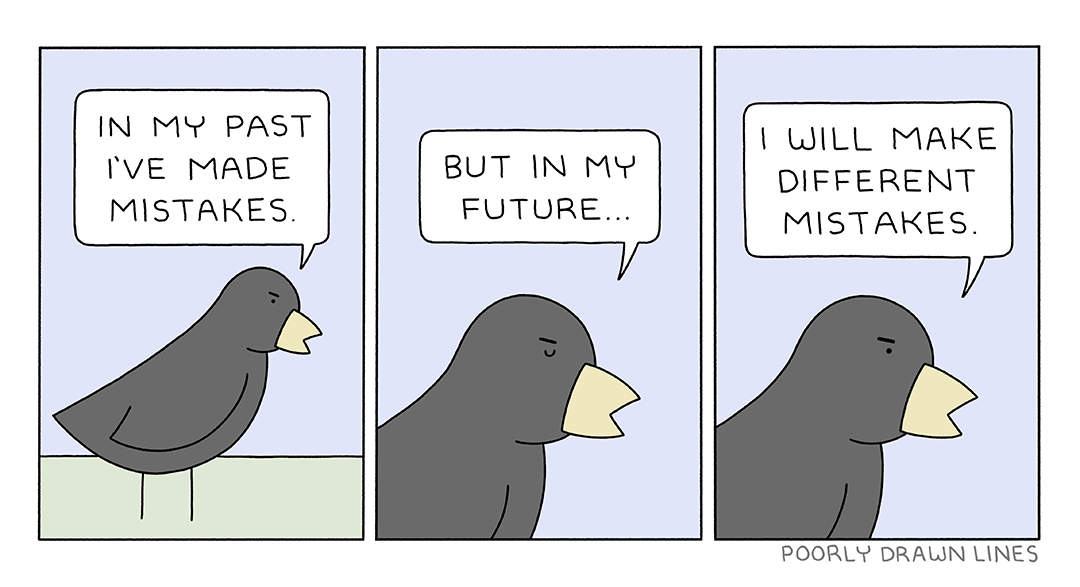
Made Mistakes

by Reza
24 Feb 21:11

Secret crawlspace cryptomine discovered in routine inspection of MA high school

by Ashley Belanger
Cohasset Police Department found electrical wires, temporary duct work, and numerous computers confirmed to be a cryptomine operating illegally.

Enlarge / Cohasset Police Department found electrical wires, temporary duct work, and numerous computers confirmed to be a cryptomine operating illegally. (credit: Cohasset Police)

After a former town employee of Cohasset, Massachusetts, was accused of stealing thousands of dollars in electricity from a local middle/high school to operate a secret cryptocurrency mine in a seemingly overlooked crawlspace, police grew concerned when the suspect missed a court date and couldn’t be located.

A warrant was then issued for the accused, 39-year-old Nadeam Nahas, who resigned his position at the Town of Cohasset last year, police said. That warrant got quickly pulled, though, after Nahas appeared in court today, Cohasset Police Department (CPD) communications specialist Justin Shrair told Ars.

The department can’t share any other new information at this time, Shrair told Ars. But he confirmed that the possible cryptocurrency mining operation was discovered in December 2021, when the director of Cohasset Middle/High School conducted a routine inspection and “noticed electrical wires, temporary duct work, and numerous computers," which "seemed out of place.”

Read 4 remaining paragraphs | Comments

24 Feb 19:30

Panicked ‘Cocaine Bear’ Producers Scrambling To Expand 4 Minutes Of Social Media Clips Into Actual Movie

HOLLYWOOD—Rushing to gather as much footage as they could piece together from what was already available on the internet, panicked producers of the film Cocaine Bear were scrambling Friday to expand four minutes of social media clips into an actual movie. “Shit, we didn’t think anyone was actually going to expect an…

Read more...

24 Feb 18:19

Harris County Public Library eliminates late fees, following Houston’s lead

by Adam Zuvanich
The county library system, which operates 26 locations across the Houston area, also is forgiving users' outstanding debt for overdue charges.
24 Feb 18:14

Kingwood wastewater plant released inadequately treated sewage, falsified sample reports, Houston police allege

by Adam Zuvanich
Environmental investigations units with the Houston Police Department and Texas Commission on Environmental Quality are looking into alleged criminal activity at the Kingwood Central Wastewater Treatment Plant, where operators are accused of concealing the release of pollutants into a public waterway. But the City of Houston says its drinking water has been unaffected and is safe for consumption.
24 Feb 18:00

How Texas activists turned drag events into fodder for outrage

by Robert Downen
The Tribune analyzed more than two dozen anti-drag protests. Opponents frequently characterized the drag events as catering to children, even when businesses advertised them as adults-only or provided warnings about the potential for explicit material.
24 Feb 17:40

A pesky front toys with Houston area humidity the next couple days

by Matt Lanza

Yesterday, Eric touched on the mostly dry forecast for the next week or so. You may be starting to ask yourself if we are heading back into drought. The answer is that we aren’t yet, but a few more weeks like this and we may be starting to discuss it more.

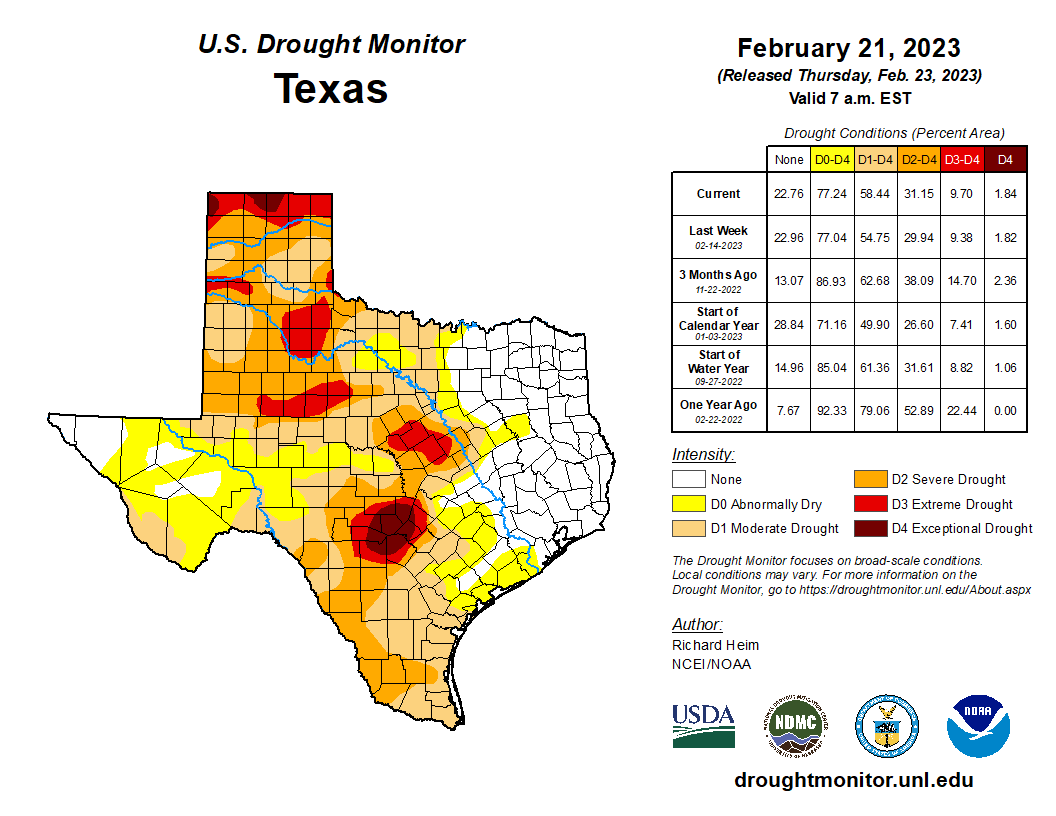
A bit over half of Texas is in drought right now, compared to almost 80 percent a year ago. (NOAA)

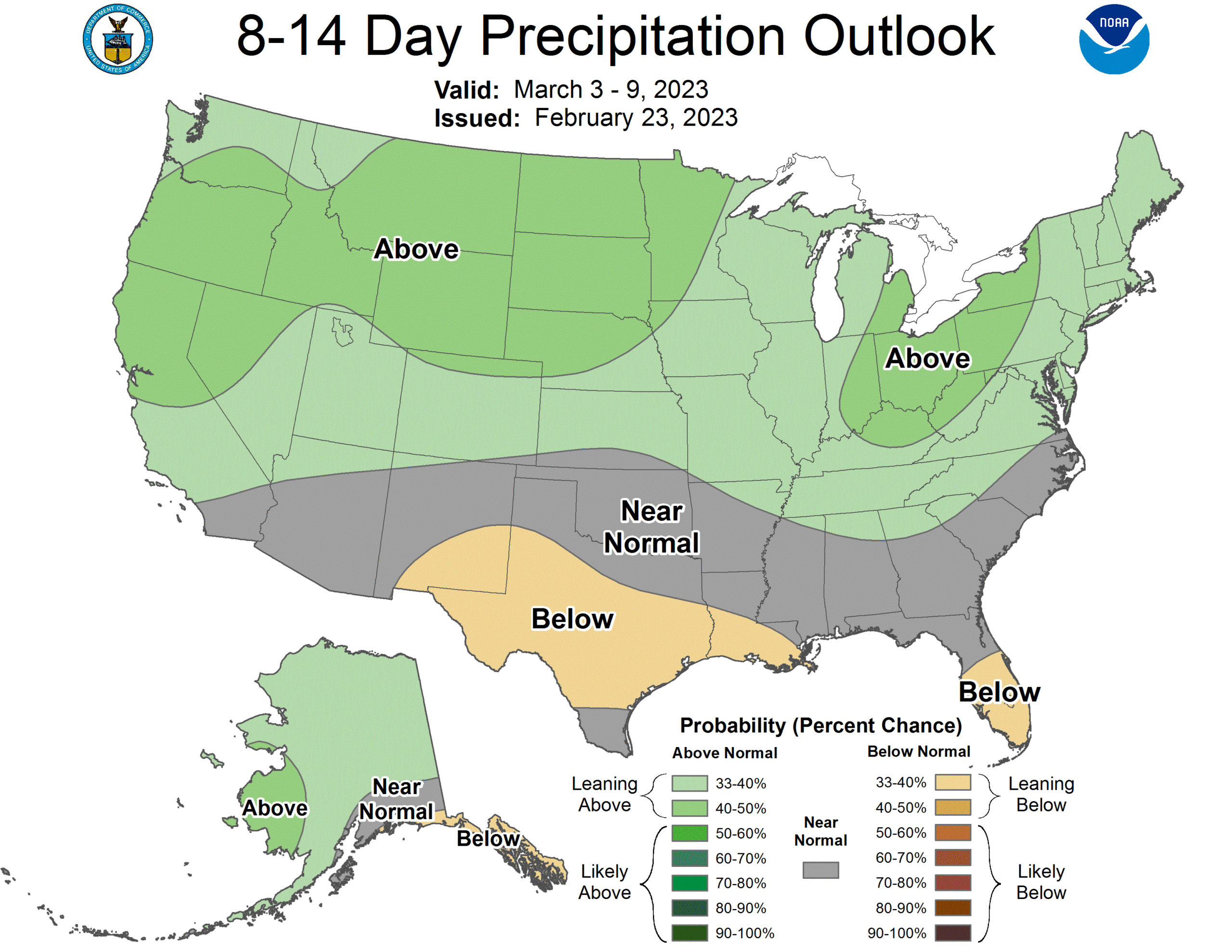
The Houston area right now is fine in terms of official drought. I imagine some farmers are beginning to feel it though across the region. In terms of Texas, about 58 percent of the state is in drought, substantially less than a year ago, so that’s great. But as temperatures begin to heat up and the days get longer, this becomes a little less likely to continue unless we see some meaningful rain. The good news is that parts of North Texas may get a bit of rain, but for the rest of us, it looks less positive. With a mostly dry forecast over the next week and the Climate Prediction Center calling for a dry-ish 8 to 14 day period, expect drought to start entering the vernacular a bit more.

After a mostly dry week 1, the second week of the forecast period also looks drier than normal in Texas. (NOAA CPC)

Meanwhile, it hit 83° yesterday, our third consecutive 80 degree day. In February, we’ve done 5 straight days before, in 1986 and 1996. We aren’t expected to hit 80 today, so we will probably end it at three. Just a gentle reminder: These early 80s mean absolutely nothing at all about our later spring or summer. Nothing. So, you may love this or hate this early spring warmth, but it doesn’t mean April or August will go one way or the other.

Today and Saturday

In terms of actual weather, the forecast for today and tomorrow is relatively simple: Clouds, sun, and coastal fog. A passing shower or some light rain, drizzle, or mist is possible as well. We won’t see anything more significant than that.

In terms of temperature and humidity? Yeah, that’s another story. Depending on where you live or where you commute, you may experience both late spring and early spring today. As of 6 AM, the cold front was located basically from Sugar Land through Spring to Lake Livingston.

The cold front is located right through the middle of the Houston metro area, based on this 6 AM map of observed dewpoint, and it’s about to slam on the brakes. (Weather Bell)

Why does this matter? From a temperature perspective, yes it’s cooler on the other side of the front, but it’s not exactly “cold.” I would expect mostly 60s to low-70s behind the front, while areas ahead of the front do mid to upper-70s today. More importantly, the humidity is sharply lower behind the front. Literally, right now it’s very, very humid at Bush Airport, yet just a little humid in Spring and bordering on comfortable in Conroe. So with this front literally parked over the metro area today, exactly where it’s parked will make the difference between a very warm and humid February day or a mild but somewhat comfortable one. It just so happens that millions of people live around that boundary, so your mileage is going to vary a lot today.

It’s unlikely that this front would get too far south and east today, so most areas south and east of Houston should stay warm and humid with areas of fog or low clouds.

This story continues Saturday. The front is going to move back to the north and west, but exactly how fast and from exactly what start point in the Houston metro area is difficult to say. In general, look for more warm and humid weather to gradually work north and west tomorrow, while coastal areas remain stuck in low clouds and fog. We’ll call it mid-70s for most, but a few places south and east could test 80°, while some places north and west may stay in the 60s to low-70s.

Sunday

By Sunday, the front should finally be making steady progress north. Weather-wise, it will be more of the same: Clouds, sun, and coastal fog. But! Winds on Sunday look a little stronger than Friday or Saturday, so I would hope that we could see the fog get lifted a bit on the coast. Look for a south wind of 10 to 15 mph, or a bit stronger at times over the water. Overall, Sunday should be a mostly cloudy, breezy, and warm day with 80s possible in many spots again.

Monday

Our next real definitive cold front is still scheduled for Monday. There could be an overnight or early morning burst of 20 to 30 mph south winds near the coast ahead of the front Monday, but things will calm down in the morning rather quickly. The front should clear the region by mid-morning Monday with only a handful of showers as it moves through. The rest of the day will actually look gorgeous. Expect sunshine, much lower humidity, and highs in the 70s.

Tuesday & Wednesday

We get our usual bout of cool weather behind the front on Tuesday morning, with lows mostly in the 50s.

Morning lows on Tuesday will be much cooler than they have been, with 50s in most spots and even a few 40s possible in the coldest locations. (Pivotal Weather)

A few 40s may be possible in outlying areas. Tuesday itself looks great with sunshine and highs in the 70s to near 80 degrees. Low, comfortable humidity will continue — a great opening night for the Houston Livestock Show & Rodeo!

Onshore return flow means the humidity comes roaring back on Wednesday. Expect more clouds as well. We’ll test the 80s, and it will feel much less comfortable.

Later next week

Our next front is penciled in for Friday morning. This one should bring some rain and wind (especially offshore) with it, but whether it’s noteworthy or just something you’ll notice remains to be seen. We’ll watch it through the weekend. I’d expect Thursday to be cloudy, warm, and breezy. Friday should be changeable with a chance of early AM storms and gusty winds followed by clearing, much cooler, and drier weather. If all goes well, next weekend will be an absolute winner. Fingers crossed.

Pollen

It’s that time of year, allergy sufferers. This weather is not helping. But the trees are producing heavy pollen this week, and it will only get worse before it gets better. We’re not even close to peak yet, so start prepping now. You can track pollen levels during weekdays via the City of Houston.

24 Feb 17:35

Celebrating Library Fair Use

by Peter M. Routhier

It’s fair use week in the United States, and here at the Internet Archive, we join all those in the library community and beyond who celebrate the role fair use plays in enabling access to knowledge. 

Fair use is a tremendously important part of US copyright law. From effectuating First Amendment rights to fostering innovation, the Supreme Court has described its “basic purpose” as “providing a context-based check that can help to keep a copyright monopoly within its lawful bounds.” And over the years, fair use has rightly evolved to ensure it can continue to play its role in changing times. 

But fair use is not without its challenges. Professor Larry Lessig once famously quipped that “fair use in America simply means the right to hire a lawyer.” And given the associated expense, this can have an asymmetric effect on fair use. The book publishing industry, for example, is dominated by multi-billion-dollar firms; their economic power is so concentrated that a federal court recently enjoined a further attempt at consolidation. Meanwhile, although libraries collectively represent a substantial portion of book purchasers, their economic power is dispersed among many thousands of public, research, academic, and other institutions. Thus, while some may be willing to “roll the dice” on fair use, the costs and risks lead many to underuse this important user’s right.

As the defendant in a years-long fair use case of our own—recently scheduled for oral argument on March 20th—we are all too familiar with this aspect of the law. As our case demonstrates, the economic challenges of fair use are not only about legal fees; economics are embedded in the doctrine. In some ways, this is a good thing. For example, as we explained in our brief, fair use has always been concerned with protecting non-profit and educational uses of copyrighted works. When considering whether a particular use is fair, the first question is ordinarily whether it’s “noncommercial.” With respect to our own book collections, this is straightforward: the books are lawfully acquired, digitized at our own expense, and lent to one reader at a time—without any cost to them—for personal, research, or scholarly use. And while noncommerciality does, of course, have to be balanced against certain economic interests of the publishers as part of the fair use analysis, that’s precisely what the owned-to-loan ratio and other strictures of controlled digital lending work to do. 

For all its challenges, fair use continues to provide important rights and safeguards to libraries. Among other things, it allows libraries to utilize new technologies and respond to new challenges without waiting for the legislature to pass new laws. In fact, this is exactly what the legislature intended it to do. Fair use means libraries can develop innovative services like our work to support Wikipedia citations, respond to new challenges like the COVID lockdowns, and otherwise continue to serve patrons as the world evolves. And it means libraries, like the Internet Archive and many others, can lend their books to one reader at a time, as they have always done.

The post Celebrating Library Fair Use appeared first on Internet Archive Blogs.

24 Feb 17:31

Nation Installs 2,000 Mile Long Privacy Curtain After Mexico Sees It Naked

U.S.-MEXICO BORDER—Emphasizing that the event had left citizens feeling embarrassed and exposed, U.S. Secretary of Homeland Security Alejandro Mayorkas announced Friday that the nation had installed a 2,000-mile-long privacy curtain after Mexico saw it naked. “Starting today, the entire U.S.-Mexico border will be…

Read more...

24 Feb 17:28

After a Decade of Tracking Politicians’ Deleted Tweets, Politwoops Is No More

by by Derek Willis

by Derek Willis

ProPublica is a nonprofit newsroom that investigates abuses of power. Sign up to receive our biggest stories as soon as they’re published.

Politicians haven’t stopped deleting some of their most cringeworthy tweets, but Politwoops, our project that has tracked and archived more than half a million deleted tweets from candidates and elected officials since 2012, is no longer able to track them.

Since Elon Musk took over Twitter, the platform has disabled the function we used to track deletions — and the new method that Twitter says should identify them appears to be broken. We have been unable to find anyone who can help us, and with Twitter surprising developers by announcing a move to a paid model for gathering tweet data, it’s no longer clear that Twitter is a stable platform on which to maintain this work. It seems fitting to give Politwoops a sendoff, a farewell to not exactly a friend but an odd part of our national political discourse for a decade.

Originally built by the Sunlight Foundation, Politwoops always had a tenuous existence. Born in 2012, it received its first eulogy just three years later after Twitter pulled the plug, only to come back just in time for the 2016 presidential election. (Now-House Speaker Kevin McCarthy welcomed it back, then deleted that tweet.) When Sunlight closed up shop, ProPublica took over the app, which is when I started to maintain it.

Politwoops was built on the idea that what elected officials and candidates said on Twitter mattered, at least a little. Like most users of Twitter, politicians usually tweet pretty mundane stuff: celebrations of victories mixed with jeers for opponents, some local flavor and attempts to jump into trending conversations. Most of the deletions are for mistakes any Twitter user could make: typos, forgotten or incorrect images, bad URLs. The occasional seems-like-a-toddler-grabbed-the-phone posts. Truly forgettable stuff.

But for those politicians who really embraced Twitter as a place where they could be themselves, the deletions sometimes spoke volumes. Some deleted posts are hard to forget, like one from then-President Donald Trump in the early evening of Jan. 6, 2021, not long after a mob invaded the U.S. Capitol and assaulted police officers in an attempt to stop Congress from certifying Joe Biden’s victory in the 2020 presidential election:

Trump had perhaps the most-watched Twitter account during my time running Politwoops. While he was in office, Trump’s tweets got a ton of attention, but they seldom were a departure from other things he said in public. I would often get emails from reporters asking whether he had, in fact, deleted some alleged tweet they had seen, and mostly he had not; other accounts would post images of fake tweets that never appeared on his timeline. Politwoops became an integral resource for checking whether viral (and often poorly photoshopped) tweets were fake.

All the while, other politicians were posting — and deleting — interesting, newsworthy and bizarre things on the platform. Running Politwoops for the past six years has, strangely enough, made many elected officials seem more human to me. They, and not Trump, are what I’ll remember most about the site.

Sometimes deleted messages appear to be offhand remarks that politicians have instantly thought better of: When political scientist Larry Sabato wrote, “You have to admit, Biden is on fire,” referring to then-Vice President Joe Biden’s debate performance against Republican Paul Ryan in October 2012, Texas Republican Sen. John Cornyn retweeted it. And then deleted it 11 seconds later.

Other examples of this genre include Kentucky Republican Rep. Thomas Massie’s deletion of this somewhat cryptic tweet about men and war a minute after posting it, while New York Democratic congressional candidate Nate McMurray did the same for this hot take about The Buffalo News in October 2020.

In other cases, it was harder to tell why a tweet was deleted. Iowa Sen. Chuck Grassley, famous for his use of abbreviations and sparsely worded posts, is a known booster of the University of Northern Iowa, his alma mater. In November 2021 he posted that UNI was trying to recruit a local volleyball player. Fourteen hours later, he deleted the tweet. That athlete did, in fact, sign with UNI a year later.

As Twitter grew in popularity among politicians, its use became more professional, with staffers posting news and pictures. That led to some interesting conversations as staffers who had access to multiple accounts, including their own personal ones, sometimes clicked the wrong button. I’ve gotten more than one email or phone call asking if a tweet posted by mistake to the wrong account and then deleted could be removed entirely from Politiwoops. (Answer: We don’t do that.)

In December 2020, I got an email from someone who worked on the campaign of then-Rep. Sean Patrick Maloney, D-N.Y. The congressman had posted and deleted a tweet that showed up on Politwoops, and would we consider removing it? It’s very rare that we would do that — that’s the whole point of the site — but when I brought up the deleted tweet I saw why he was asking: Maloney had mistakenly sent a public tweet that should have been a direct message, because it included his personal cell phone number. After some conversation, we decided to redact the number.

After the 2016 election, when Twitter became an important part of fundraising for political campaigns, I started to notice a very strange pattern: some accounts, especially long-shot candidates running against high-profile incumbents, dramatically increased the number of their deletions. A good example of this was Kim Mangone, a California Democrat then running against McCarthy for a House seat. Mangone’s deletions consist mostly of her own retweets, which seems like a weird thing to do until you discover that Twitter prevents users from reposting identical tweets or retweets over and over in a short time span. The only way around that restriction is to delete the earlier post and then repost it.

Perhaps the most interesting political deleter is Sen. Brian Schatz, a Hawaii Democrat active on the platform. Like many of his colleagues, Schatz deleted typos and some retweets of others’ posts. But he often posted an informal message — almost always without a link or mentioning other accounts — that gave you a glimpse into his actual thinking. Here’s an example where Schatz could have tagged some of the pundits he was criticizing, but didn’t. And another one in that vein. Or this one with early COVID advice on mask-wearing. Sometimes he’d even acknowledge the deletions, or provide an explanation for doing it. Most politicians do not do this.

Other senators are famous for their folksier tweets — Grassley excels at this — and there are some lawmakers who can be equally blunt on the platform. But I’d like to believe that I learned something about how Schatz thinks that would be hard for me to know otherwise, given that we’ve never met.

That’s one of the things I’ll miss most about running Politwoops: getting a glimpse behind the carefully crafted images that politicians present to the public. ProPublica would be happy to continue running this service, so if anyone at Twitter wants to help out, please get in touch. That includes you, Elon. politwoops@propublica.org

Correction

March 1, 2023: This story originally misidentified who sent a profane tweet, later deleted, from Rep. Chuy Garcia’s account. After publication, a Garcia spokesperson said the tweet was sent by a staffer who was dismissed the next day, not by the representative himself. The text referring to that tweet has been removed.

24 Feb 12:01

Top Five: February 23, 2023

by Glasstire

Glasstire counts down the top five art events in Texas.

For last week’s picks, please go here.

A print by Luis Jiménez of a wolf howling in front f a large yellow moon with the word "Howl" spelled out in the sky above.

Luis Jiménez, “Howl,” 1977.

1. Life and Death: Luis Jiménez
Gallery at UTA (Arlington)
January 23 – April 1, 2023

From the Gallery at UTA:

Life and Death: Luis Jiménez is an exhibition of 35 works by the late, internationally known artist Luis Jiménez who was born in El Paso, Texas and died in Hondo, New Mexico in 2006. The works range in date from 1973 through 2001, and include his sketches, studies, drawings and prints that he created to work through ideas that culminated in his famous large-scale sculptures. The exhibition also includes maquettes, four final concept prints for his famous Progress Suite of which only two were completed as sculptures, and a wall-size drawing/painting of Fiesta Dancers.

Guest curators Benito Huerta and Christina Rees have borrowed a wide array of Jiménez’s works from galleries, museums, and private collections throughout the region. Known for his large and colorful fiberglass sculptures, Jiménez also used painting, drawing, and printmaking to address social and political issues and explore the cultures of Mexico and the southwestern United States. After considering hundreds of pieces, Huerta and Rees noted several broad motifs they used as an organizing force and have gathered a robust set of works that encompass Jiménez’s themes including immigration, car culture, ‘the West,’ everyday life, and mortality.”

A photograph of a projected video on a large screen set on a red stage with red curtains around it.

Diane Severin Nguyen, “If Revolution Is a Sickness”

2. Diane Severin Nguyen: IF REVOLUTION IS A SICKNESS
Contemporary Arts Museum Houston
October 28, 2022 – February 26, 2023
Read our review here.

From the Contemporary Arts Museum Houston:

Diane Severin Nguyen: IF REVOLUTION IS A SICKNESS is the first solo museum exhibition of artist Diane Severin Nguyen. The exhibition features a recent video installation, photographs, and the artist’s first public art commission through billboards located throughout Houston. The exhibition is built around the Warsaw-set titular video, IF REVOLUTION IS A SICKNESS, and loosely follows the character of an orphaned Vietnamese child who grows up to be absorbed into a South Korean pop-inspired dance group. K-pop is used by the artist as a vernacular material to trace a relationship between Eastern Europe and Asia with roots in Cold War allegiances. Nguyen’s work reckons with the process of finding shared symbols and naming oneself from within another’s regime, while also positioning youth culture as a critical and crucial site of revolutionary power.”

An installation image of works by Lordy Rodriguez in a white walled gallery space.

Lordy Rodriguez, “Since Last We Met,” at Artpace

3. Since Last We Met
Artpace (San Antonio)
January 12 – April 30, 2023
Read our review here.

From Artpace:

“Lordy Rodriguez was an Artpace International Artist-in-Residence in 2001. Now, 22 years later, Rodriguez returns to Artpace with a selection of artworks he’s created since his residency. Since Last We Met, as the title suggests, is a conversation between friends, and like the artwork in his oeuvre, it is a play on place and memory. The exhibition consists of a variety of ink drawings that utilize alcohol-based inks and Micron pens to create what appear, at first glance, as maps. For example, Since Last We Met includes a selection of work from his America Series, composed of 56 drawings that took about ten years to complete. This series became a map of America based on Rodriguez’s own history, interaction, and memory of this country and culture.”

A print by Katsushika Hokusai featuring a large wave crashing with a mountain in the background.

Katsushika Hokusai, “The Great Wave off the Coast of Kanagawa,” 1830 – 1831, ink on paper

4. Floating Beauty: Women in the Art of Ukiyo-e
International Museum of Art and Science (McAllen)
February 4 – May 28, 2023

From the International Museum of Art and Science:

Floating Beauty: Women in the Art of Ukiyo-e examines the historical perspectives on the depiction of women in art during the Edo Period in Japan (1615 – 1858). This exhibition highlights female characters painted on woodblock prints, all created in the ukiyo-e style. The prints show women in literature, kabuki theatre, poetry, and courtesans as well as geishas of the Yoshiwara district. Wives and mothers from different social classes performing the duties of their station are also portrayed in the woodblocks in order to give us insight into the lives of women in pre-modern Japan. In the tradition of ukiyo-e, women are most often represented in the bijinga (“pictures of beautiful women”) genre. This was the passive, attentive, and demure idea of feminine beauties.

Looking beyond the bijinga though, the exhibition shows that women in Edo society took an active role in their own lives, and this fact is echoed through literature and drama of the period. Over fifty woodblock prints are featured in the exhibition which include works by ukiyo-e masters Kitagawa Utamaro, Suzuki Harunobu, Utagawa Kunisada, Katsushika Hokusai, Utagawa Hiroshige and Kikugawa Eizan. The entire exhibition is taken from the permanent collection of the Reading Public Museum.”

A collaged work by Gary Burnley that merges two portraits.

Gary Burnley, “Stranger in the Village,” 2020, unique inkjet photo and mixed media physical collage

5. Gary Burnley: Stranger(s) in the Village
Amarillo Museum of Art
January 14 – March 26, 2023

From the Amarillo Museum of Art:

“Gary Burnley (b. Saint Louis, Missouri) creates physical collages and stereographic devices that encourage dissociated images to merge in the eye and mind of the viewer. Resulting in optical rivalries that explore representation, memory and an image’s meaning through contrast, his amalgamations imagine strange bedfellows congruent for moments in time, space and reason.

The world of most Western museums was created for and is meant to be consumed by white audiences. The history of art has largely reduced ‘Others’ to an uncomplicated characterization of a stranger in the world of the white man’s imagination, a shadowy figure without a gaze, a presence or a voice. Whiteness is and has been the exemplar of beauty, curated, maintained and preserved in museums, excluding non-whites except in reference to a vanishing past or less than desirable future.

I think of being an artist as a way of trespassing where historically ‘Others’ have not been welcomed nor seen as belonging. If one of the primary functions of any image is to validate and give permanence to the world it describes and to the persons that inhabit that world, the physicality of collage allows me to, materially and psychologically, construct a world of my specification.

The post Top Five: February 23, 2023 appeared first on Glasstire.

24 Feb 11:59

assistant became abusive when she wasn’t invited to a meeting, my coworkers don’t check on people who are out sick, and more

by Ask a Manager

This post, assistant became abusive when she wasn’t invited to a meeting, my coworkers don’t check on people who are out sick, and more , was written by Alison Green and published on Ask a Manager.

It’s four answers to four questions. Here we go…

1. Our assistant turned abusive when she wasn’t invited to a meeting

I work in a small office (five owners/managers, including me, and three assistants). Three of the managers are siblings, and one assistant, Kate, is the cousin of one of the managers. For years, we have allowed all eight people to attend office meetings. Unfortunately, this has morphed into the three assistants feeling entitled to ownership-type opinions regarding investments and office policies. It is nearly impossible to make a decision with eight people. For the last year or so, one manager, Bob, has requested that the meetings be managers only. It has been significantly more efficient.

For the most recent meeting, Bob again requested managers only. Someone mentioned that Kate wanted to be included, but the message was that Bob said no. The meeting wasn’t a big deal — we basically rehashed the same tired old questions that we discuss almost every time (should we eventually sell the company or pass it off to our children, what if one person wants out but the rest don’t — same-o, same-o). I typed up the minutes outlining the various opinions expressed and summarizing the meeting. No decision were made. I sent the summary only to the managers, but Kate got ahold of a copy.

The meeting was 10 days ago. Since then, Kate has gone ballistic. Every single day, I get 2-3 emails and/or texts about how mean we are, how we make the assistants feel like outsiders, how she has valuable opinions, she deserves a seat at the table, she refuses to be part of “taxation without representation,” she will no longer invest any money with the company (for the record, she never has), I have a bad attitude, she doesn’t know how I got so nasty. Quite the river of vitriol. So far I have not replied. The reality is that it wasn’t my decision; I am just the messenger. Bob made the request. I have always solicited input from everyone, and I am a big fan in theory of a completely level playing field, rather than a rigid hierarchy. But it has been much more efficient meeting only with the managers, and some of the decisions frankly need to be manager only (like selling the company someday).

I hate to pull rank on her, but this nastiness is debilitating. Any suggestions, other than “I’m sick of your drama”? I don’t really want to dump it all on Bob because his manager-only approach has been a good one, but I also don’t want to be the punching bag for her insecurity or controlling behavior, or whatever it is.

What on earth! How was Kate’s behavior allowed to get to this point without any of the managers stepping in to shut it down? I’m guessing it’s because Kate is someone’s cousin, plus some of that aversion to hierarchy, but you can’t effectively run an office this way. The reality is, there is hierarchy — some of you own the company and have decision-making authority and some of you don’t — and as this incident with Kate shows, you’re not doing anyone any favors by hiding that fact.

Right now you’re thinking of this as a sort of interpersonal dilemma (“I’m sick of your drama”), but you need to address it as a work issue between a manager and an employee, because that’s what it is.

One of the owners needs to talk to Kate and tell her what she’s doing is unacceptable (all else being equal, it should probably you since you’re the one she’s directing her hostility toward). Explain that the owners play a different role and have different responsibilities than she does, she needs to accept that if she wants to stay on, and she cannot send vitriolic messages to anyone on staff, including you. If it continues after that, you really, really need to let her go. You can’t conduct business with this happening in the background and it’s not okay for her to abuse people … plus, think about what working around her must be like for the other assistants, who don’t have the authority to shut her down. This will be complicated by the fact that she’s someone’s cousin, but you can’t let it continue (and if you do, you’re just asking for ever more outrageous behavior from her in the future because she’ll know there are no consequences).

2. My coworkers don’t check in on people who are out sick

My coworker, Jane, and I are close and we work on a very small team of six. A month ago, Jane went on leave to have a pretty major surgery. She was supposed to be on bed rest for a couple weeks following surgery, then back online for the month following, and then back to the normal hybrid office/work from home schedule by March. Well, she had some surgery complications and she’s been on bed rest for way longer than originally expected.

I know the details because I’ve been in regular contact with her. I texted her the day after her surgery and wished her a speedy recovery and we chat pretty regularly. She mentioned to me that I’m the only one on the team who has said a word to her since her leave. She told our lead when her recovery plans changed and what was happening with that and it sounded like our lead didn’t even ask how she was holding up or if she was okay or anything. The rest of the team, this is pretty expected, but I feel like our lead should have shown some form of human empathy.

But then it also happened to me on a much smaller scale. I got Covid and was out for a week and a half recently. I wasn’t hospitalized but I was pretty miserable. One of my teammates did reach out and ask how I’m holding up, which I appreciated. Other than that, only Jane has been asking me how I’m doing. My lead has been radio silent the whole time other than telling me to come back to work when I’m ready in response to me telling her that I’d probably be out for the week. I wasn’t expecting an outpouring of empathy or anything, but even just a mid week “how are you holding up?” text would be nice. The relationship I have with my team otherwise is fine. I guess I’ve just never been on a team that couldn’t care less about the others.

Is this normal? Should I just temper my expectations and know that aside from Jane and the other coworker who reached out, the rest of my coworkers are just kinda chilly? Or is there something I can/should do about it? It feels weird to have a conversation with my lead about empathy, but it also feels weird that she in particular showed no signs of any for two people on her team, one of which had major surgery.

I think you’re reading chilliness when it’s not there!

Not contacting people who are on sick leave isn’t unusual, and it doesn’t signal that people on your team don’t care about each other. If anything, it’s more common for teams not to message people who are out sick. It’s definitely true that your team lead should have expressed some basic human concern when Jane told her about how her recovery plans needed to change. But beyond that, it’s very normal for people not to check in with coworkers when they’re on sick leave. They want to leave you alone so you can rest and not think about work.

(Also, some people would take leads/managers checking in as pressure to return more quickly, and a lot of managers have it drilled into them that they shouldn’t bother people who are out sick.)

3. The company owners tell us how much money they are making, but none of us make a living wage

I work for a small, relatively new company in a new booming industry in the state. Most people working here make $15-18/hour, with abysmal benefits. At weekly company-wide meetings, the business owners regularly talk about how they have become millionaires due to the company. At the last meeting, the owners stated that they are forecasted to make millions of dollars in revenue by the end of this year, and discussed how rich they are for the next 20 minutes. As I am sure you can imagine, this is extremely grating when no one who works for them makes a living wage!

How would you suggest we handle this? It seems that most people are annoyed, but these are the owners so most people feel their options are limited. Unfortunately, we live in the rust belt so for most people, this is the best job they can get.

That’s incredibly oblivious and obnoxious. That’s the kind of thing they should discuss privately. It’s hard to imagine what kind of reaction they think they’re going to get from their far-lower-earning staff.

The next time it happens, are any of you willing to say, “It’s great to hear the company is doing so well. Is there a plan to put some of the profits into raising staff salaries to more livable levels?”

If that feels too confrontational to do on the spot, it still might be a good time to ask for a raise separately. If they balk or cite the budget, feel free to mention the numbers they’ve been sharing with the staff.

Related:
we got quizzed on our new boss’s horses, family, and vineyard

4. Jet lag as a pre-planned sick day

I have a U.S.-based employee who has been working internationally many time zones away for a few months. In the upcoming weeks, they are traveling back on a work day (let’s say Monday) using personal leave and then asking for all of the next day (Tuesday) to be “tentative” sick leave based on jet lag. How should I handle the request to use sick time for jet lag?

Potentially unnecessary context: they are a solid performer who asked to work internationally more than the allotted month allowed due to family needs. Those needs are fulfilled, and the employee is able to return to the U.S. earlier than originally scheduled, but still beyond the typical stint of working fully remotely. They have been accepting work and meetings at all hours of the day and night (local time – though that’s just daytime in the U.S.), so it hasn’t had much impact on their day-to-day. This is a company where there is a lot of employee trust around sick days, though HR has defined it as an “illness or injury.”

Seems reasonable to me. They’re saying they won’t be in any shape to work due to exhaustion and their body readjusting; that’s close enough to sick leave for me, and as a general rule it’s good to look for ways to say yes when you can.

23 Feb 21:03

my former boss won’t leave me alone

by Ask a Manager

This post, my former boss won’t leave me alone , was written by Alison Green and published on Ask a Manager.

A reader writes:

I currently have a full-time job as a manager in an industry that is a very small world. I’ve worked here for three years, and I love it. My question concerns a boss I had at the previous company where I worked, Bob. He wants to stay in touch. I don’t.

When I worked for Bob, I got promoted multiple times and eventually became his second-in-command. But he wouldn’t relinquish any power to me, instead always asking for my advice and never taking it. I found the position extremely frustrating. It felt like a waste of time, plus I wasn’t learning anything.

The company had multiple under-performers, but Bob wouldn’t fire anyone. He always wanted to be liked. Even when serious behavior issues arose, including racist and sexist comments at work, he would let it fester rather than disciplining or firing the offender. (Example: One employee made inappropriate jokes about child sexual abuse material at work. Bob told me, “His wife just had a baby! I can’t fire him!”) Several talented female employees and employees of color quit the company over Bob’s behavior. This company did have an HR department, but Bob would always pressure people not to make official reports to HR, claiming he would handle disputes himself – which he never did.

After getting a much better job, I’ve realized just how much Bob failed me and my colleagues. But because I ignore his texts, he has started talking to other people I know – including my current coworkers and boss – about how I’m “ignoring him” and he’s sad. Again, because my industry is small, I will most likely run into him at conferences someday, which I’ve avoided due to pandemic cancellations but soon won’t be able to avoid anymore.

I think I have a few options:

• Continue to ignore him. When coworkers/peers tell me he’s asking about me, keep shrugging it off and saying we simply lost touch. I’m not sure how to keep this up if I run into him at a conference and he asks me outright if I’m upset with him, though.

• Send him an email apologizing for ignoring his texts, explaining that I needed some space to mentally regroup/adjust to my new job. This would also require me to respond to any future contact and to generally pretend I still like him.

• Send him an email explaining that I feel like he failed me as a boss and that I wish he would make some changes to how he manages other people, especially since he is currently still a manager. I know that this would upset him greatly, due to his need to be liked by everyone, but he is already upset that I am ignoring him. Sending him a message like this might end our relationship (what little is left of it), but it also might lead to further problems, such as him continuing to complain to my current boss/colleagues/peers about my decision to cut ties.

I’m worried my coworkers think it’s weird that I don’t talk to him. I have explained the full situation to my boss and he seems understanding, if a bit confused by how firm my decision has been to cut off a former boss in a small industry like ours (I have a good reputation with my boss thanks to my past three years of good work at this job, which probably helps). With my other coworkers, I have not really elaborated on any of this, although naturally they are curious.

I don’t think sending Bob a message about his failures as a boss will result in much meaningful change to how he functions as a manager. If it were that easy to get managers to change, there would be far fewer bad ones. People aren’t usually bad managers because no one has ever told them things like “you shouldn’t let behavior problems fester” or “you can’t allow racist and sexist comments at work.” They’re bad managers for much more complicated reasons — in a case like Bob’s, probably some combination of a deep-rooted fear of upsetting people or being disliked (the terribly irony of which is that it nearly always leads to the manager being disliked by their best employees), bad priorities, incompetence, and insufficient oversight from above him. You can’t fix any of that with an email to Bob.

I do think you can just continue to ignore him if you want. If you run into him at a conference and he asks outright if you’re upset with him, you can say, “I’ve just been incredibly busy and terrible about keeping in touch— sorry about that!” That may or may not be credible, but it’s a thing you’re allowed to say and he can’t really insist that it’s not true. (Or rather, he could but that would be extremely weird and you could stick to your story and then quickly excuse yourself.)

The easier option, though, especially since he’s complaining about your lack of response to others, is probably to respond to one of his recent messages. Don’t respond immediately; let it sit for a bit and then respond by saying, “Sorry for the long delay in responding! I’ve been incredibly busy and terrible at keeping in touch. My schedule won’t calm down for the foreseeable future but I hope all is well with you!”

Frankly, if you wanted to, you could even say, “I’ve been hearing from colleagues that you’re worried that I’m ‘ignoring’ you. I’m just really busy and I hope you will stop saying that to people since it’s making it sound there’s drama when there isn’t. Hope all is well and I’ll see you at (conference)!”

You could also choose to just have the bare minimum amount of contact with Bob to stay on good terms, given the small industry — meaning you respond to the occasional message (but not all) with something cheerful, vague, and brief. Sometimes it makes sense to do that for political reasons, although I can’t tell whether or not it’s the case for you (and if you can’t stomach it, then so be it).

But also, you can just keep ignoring him if you want, and shrugging it off (“eh, we lost touch”) if anyone asks you about it. It doesn’t need to be a big deal to you just because Bob has turned it into a big deal for himself.

23 Feb 20:58

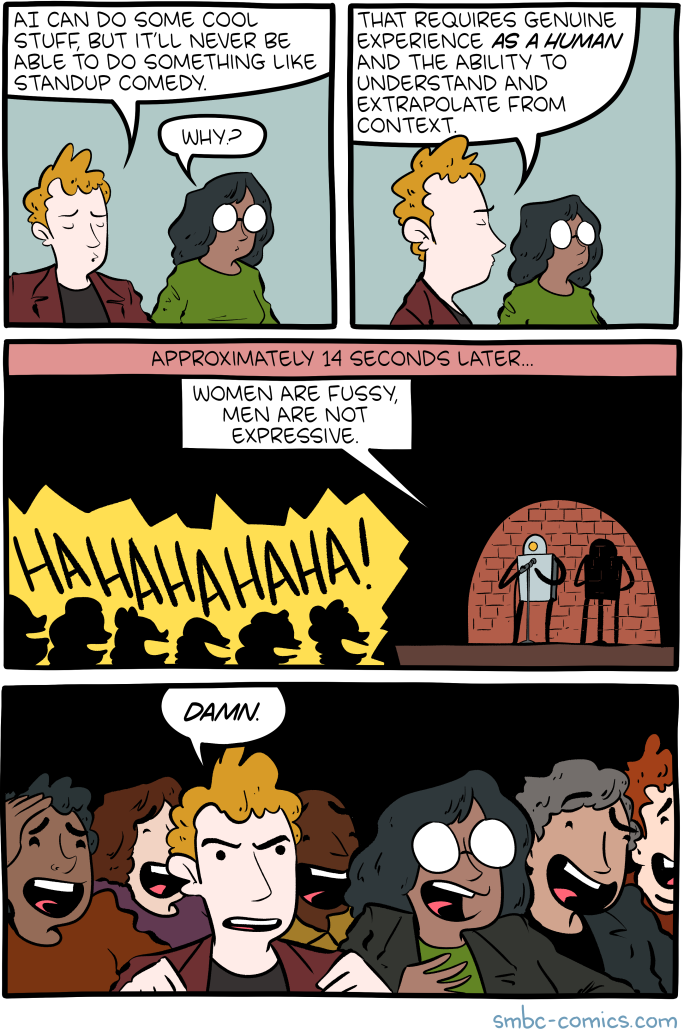
Saturday Morning Breakfast Cereal - Standup

by tech@thehiveworks.com


Click here to go see the bonus panel!

Hovertext:
Have you noticed this thing where people say AI will never be as good as Shakespeare, but then nobody mentions that none of us are as good as Shakespeare?


Today's News:
23 Feb 12:56

as a manager, should I not wear a “childless” shirt in my off-hours?

by Ask a Manager

This post, as a manager, should I not wear a “childless” shirt in my off-hours? , was written by Alison Green and published on Ask a Manager.

A reader writes:

This is a low-stakes question and one that’s more philosophical than imminent, but I’ve been curious about your take on it for a couple weeks now and decided to write in.

A women-focused satire site has been advertising me a pullover sweatshirt that says CHILDLESS in big letters across the front. Could this get me in trouble at work, or appear discriminatory against colleagues with children if I ran into a coworker in town in my off hours?

My personal context that has me thinking about it —

Two years ago ago I was promoted to my first management, surpassing a few colleagues with 5+ more years of tenure. While I believe my promotion was based solely on work quality, and in the past two years I think I’ve proven my worth as the right person to lead our team, I’m also someone who generally falls into the “preferred” side of societal biases — e.g. youth, physical appearance, health status, family status (not having to flex time for child care). To be clear, I don’t think this makes me a better person and I’m continually working to diminish my own acceptance of these biases, but I am aware of my privileges and the potential appearance of colleagues being passed over for discriminatory reasons.

I would feel pretty awkward if I ran into any of my colleagues with kids while wearing a sweatshirt championing childlessness (and already feel pretty awkward in meetings when they’re talking about kids/pets and I have to repeatedly say that no, I have none and won’t be getting any). But is that awkwardness a me problem or a potential work issue? How far does a management role extend into someone’s off-work personal expression?

For what it’s worth, I do ask my colleagues with kids about them, pass on notices about local family-friendly events, and always make accommodations for them to take off work or flex hours as needed to care for their families (which is the most important bit, I think).

I’m not seriously considering buying the sweatshirt. I just can’t get it out of my targeted ads and I think about this every time I see it!

Ooooh, this is an interesting question (and I will be answering it as someone who is also childless by choice).

I think you’ve got two competing principles here. On one hand, what you wear on your own time should be your own business (within some reasonable limits — if you’re wearing racist slogans, don’t be surprised if your employer takes an interest, especially if you manage people). And this sweatshirt doesn’t say that people with kids suck — it’s a statement about you, not anyone else. Is it that different than if you wore a shirt that said ITALIAN? Or for that matter, MOM? So from that perspective, this is no one’s business.

However … you’re a manager and that can change things. You don’t want anyone who reports to you to wonder if you think it’s somehow better not to have kids, or if you look down on people who do. You don’t want them to wonder whether you favor people who never need time off for a sick kid, or how you really felt about their maternity leave, or whether you’ve got biases that affect who gets what projects or promotion opportunities.

And to be clear, maybe a sweatshirt shouldn’t make them wonder any of those things. But given how very weird we are in this country about parenthood, and about motherhood in particular (it’s the highest calling a woman can aspire to! the most important job you’ll ever do! so selfish not to! oh, but don’t expect any support from society as a parent! you’re completely on your own! if it’s hard or messes up your career, well, you chose this so how dare you expect help) and the reality that many women do get penalized professionally for having children and that society is outright hostile to working moms in many ways … well, I sure could see an employee running into their manager wearing that sweatshirt and not feeling great about it.

So while you could wear it around town, I think it would be kinder and wiser not to, as long as you’re managing people, and I think that’s what your awkward feelings about it are telling you. But by all means, buy it and wear it around the house if you want to.

(As a side note, it’s interesting that you categorized being childless on the ““preferred” side of societal biases! It definitely can be at work, as detailed above … but holy wow, there’s some weirdness out there toward people who don’t have kids. Which is what gives the shirt its subversiveness. Society cannot be satisfied! If you are a woman, you’re going to be told you’re messing it up one way or another.)

23 Feb 12:52

assigning women extra work to “help” them, calling out when you’re in the ER, and more

by Ask a Manager

This post, assigning women extra work to “help” them, calling out when you’re in the ER, and more , was written by Alison Green and published on Ask a Manager.

It’s five answers to five questions. Here we go…

1. To help women, we assign them extra work and penalize them if they don’t do it

I work for a large organization that tries to be proactive about diversity and inclusion. One if their iniatives seems wrong to me. To provide women with better resume building and networking opportunities, the company has a list of projects that they nominate women to complete. The nomination is more you being told by your manager that you have to do this. The extra work is in addition to your day job and if you fall behind because of it, you will likely be penalized. The company tries to make the work high-visibility by showcasing it at the annual town hall. However, I wonder … why do women have to do this extra work when their male counterparts do not? How does this seem fair?

Wow, no, that is not how this is supposed to work. And legally, it can’t work like that.

It is fine to design a program to try to redress systemic disadvantages by making networking and resume-building opportunities available to women in your company who want them. It is not okay — and crucially, it is not legal — to assign women extra work because they are women. And then to claim that it’s to help them! Agggh. (It’s also not legal to assign work by gender, period.)

The women employees in your organization should be up in arms about this.

2. Did I mess up how I called out when I was in the ER?

A few years ago, I worked in a large division of a large company. Although all my job functions had previously been supervised by one person — Maarva, with whom I got along well — a reshuffle meant that I took on a second supervisor, Kino, for one facet of my job.

About three weeks after Kino’s arrival, I woke up in the middle of the night with horrible abdominal pain. At 6 am, I went to the emergency room and was admitted for what turned out to be a terrible gallbladder attack. Around 8 am (an hour before we were expected to be at work), I called Maarva’s voicemail, told her what was going on, and asked her to please inform Kino that I would be out that day. I did not call Kino as well because (a) I was nervous about my cell phone battery running down, (b) I felt horrible and could barely focus, and (c) I figured that Maarva passing along this information would constitute adequate notice. For what it’s worth, I had no particularly pressing deadlines or projects for that day, for either Maarva or Kino.

Once my attack had subsided and future surgery was tentatively scheduled, I was sent home that night and returned to work — tired but functional — the following day and discovered that Kino was furious with me. He told me that I was never to call out without informing him again and he had written me up over it. Later in the day, the managers had a meeting, and Kino griped about my “lack of respect.” Only then did Maarva realize she’d forgotten to mention my call to Kino, who hadn’t even known I was in the hospital — he just thought I took an average day off and failed to inform him. To Kino’s credit, he apologized to me and attempted to take back the write-up, but our horrible division head refused, because the incident “taught me a lesson” (about gallstones? who knows?).

This incident left a really bad taste in my mouth. I still feel that Kino could have at least spoken to me about the incident and gotten his facts straight before writing me up. The division head’s behavior was about what I would expect from him, but it still seems to me that if a write-up turns out to be based on a faulty premise, it ought to be rescinded. But maybe I’m giving myself too much of a break here? Yeah, I was in agonizing pain in an ER, but Kino didn’t know that. If Kino had written in to you, what course of action would you have suggested for him on the day I was gone? The day after? How much did I mess up?

(Maarva apologized profusely to both Kino and to me, sent flowers while I was in the hospital for my surgery, and served as my reference for my next job. She was a great supervisor aside from her occasional absent-mindedness!)

Of course it left a bad taste in your mouth! You were in the ER dealing with excruciating pain, called in as required, and assumed Maarva would handle it from there — and then got attacked by Kino the moment you returned to work. Even if you had neglected to call in, Kino’s reaction was way over the top! When he couldn’t find you the day you were out, why didn’t he ask Maarva — your primary manager — if she’d heard from you? Or start by asking you what happened once you returned, rather than assuming and launching into a furious tirade and write-up? If it turned out you had in fact just blown off work for no reason and without alerting anyone, he could have dealt with that — but you don’t start by jumping to the worst conclusions about someone and raging at them … and as a manager he should be aware that sometimes when someone is out unexpectedly, it’s because something really bad happened, the sort of thing that would make his reaction incredibly misplaced.

You didn’t mess up at all. You alerted your office you’d be out and asked them to notify others who needed to know. You were fine. Kino sucked.

3. Am I supposed to address all MDs as “Doctor so-and-so”?

I work for an organization where I frequently interact with medical doctors in a professional capacity, for specific projects made up of medical doctors and others. Many of my non-MD colleagues exclusively address these individuals as “Dr. so-and-so” forever and always. For me, as soon as they say they say their first name only (“Hi, I’m Jane”) or sign their first name only in an email — which they usually do immediately — I take that as a sign they are happy to be on a first name basis and use that. They are not my doctor. And, we are working together as equals. Also, these are regular work meetings often in groups so it would be weird to ask them in front of everyone “May I call you Jane?” Last, no one ever calls me “Mrs so-and-so.”

For comparison, at my kids’ schools, everyone addresses me as “Mrs” and I use their titles as is appropriate. In that case, it’s mutual and reciprocal.

Am I wrong here?

Nope, that is in fact the long-time etiquette rule: If someone introduces themselves with only their first name or signs off using it, that’s a signal that you should address them by their first name. That’s what it means!

4. New colleague keeps blaming a coworker for missed deadlines

I work for a large company. My team collaborates with several different teams on various projects. One of these teams has a new structure with a new point of contact. Since the new contact came on board six months ago, we have noticed that the team is often late on deadlines, even those they suggested. The contact person consistently and proactively blames their tardiness on one specific member of their team, calling them out by name and noting what a burden their time out of office has caused, is causing, or will cause. That named team member, whom we have worked with for years and have found to be excellent, has taken a total of about three weeks of PTO, scheduled well in advance, during this time frame. They are not in the meetings where their absence is discussed. (For what it’s worth, we have not seen evidence that this “named” team member is assigned to any of the late work, but rather the suggestion is that her absence causes stress on the rest of the team which in turn affects their work.)

Our team has grown increasingly uncomfortable with how often this person’s PTO is used as an excuse, not just because our timelines are not met but because it seems to unfairly target one person for the productivity of a full team. Is there anything we can or should be doing to address this situation?

Ideally your team’s manager would speak to the manager of the new point of contact about what’s happening — explaining that she keeps blaming a colleague for late deadlines, it doesn’t seem to be true, and it’s making your whole team uncomfortable.

If for some reason that doesn’t happen or doesn’t solve it, the rest of you should feel free to speak up when this contact person blames the other team member. For example: “That doesn’t sound right. Jane has always been on top of deadlines and hasn’t taken an unusual amount of PTO.” Or, “It’s not sitting right with us that you blame Jane when this happens. She has always been on top of deadlines and hasn’t taken an unusual amount of PTO.” And consider adding, “Maybe you can sit down with us, Jane, and (this person’s manager) and hash this out.”

5. Interview travel expenses

What expenses is it appropriate for a company to cover when you travel to their location for an interview? In my field, people often interview with organizations that are located in different cites than their own. Typically, the schedule is to fly in the night before, interview the entire day, have dinner that night with the interview committee, and then fly out the next day.

However, I was recently offered an interview where they wanted me to fly back right after I interviewed — they were not willing to cover a hotel for that night. That would have meant interviewing from 9-5 (there was no dinner, I guess, another bad sign), then an hour or longer ride to the airport in rush hour traffic, and flying another 1.5 to 2 hours to get home. That sounded like an exhausting day, so I declined to continue on with the interview process.

They did mention that things would have been different if I lived on the opposite coast from the organization’s location, but since I was located on the same coast they would only pay for a hotel the night before. Is that standard for interviews? I was kind of offended and it honestly felt a bit ableist, like they were looking for the candidate with the most stamina vs. the one who would be the best fit for the role.

There’s no real standard across fields; some organizations won’t pay to fly candidates out at all, some try to keep their expenses as low as possible, and some pay more to prioritize candidate comfort and will happily pay for that second night. But more often than not, with an organization that’s already flying someone out, it’s reasonable to expect they’d cover a second night, given the schedule you described — or would at least agree to it if you asked, even if it wasn’t their first proposal. (A lot of people would prefer to fly home that night since the flight was short, and they might have assumed that was your preference … but there should have been room for you to explain it wasn’t.)

I doubt they were looking for the candidate with the most stamina; more likely they were trying to save money (although the effect could be the same).