Cowboy Who?
Shared posts
This Burned-out Texas Teacher Unseated His School Board President
Andrew Gonzales never expected his name to be on a ballot. The 30-year-old native Austinite had taught for seven years in the Austin Independent School District (AISD) before quitting in October 2021—joining an exodus of instructors fleeing the pains and indignities of Texas’ public schools. Then, last November, Gonzales shocked the local political scene by ousting Austin’s sitting school board president, earning himself a board seat from which to try to fix the problems that drove him out of teaching.
Gonzales, whose campaign was endorsed by the Austin American-Statesman and Mothers Against Greg Abbott, has spent much of his life on AISD property: as a student, the son of a teacher, a mentor and substitute, and finally a full-time instructor. But the stresses of working during the pandemic, when teachers were expected to meet lofty instructional goals without proper resources or compensation, proved too much. In resigning, he became part of the nearly 17 percent of teachers statewide who left their teaching positions—either for other teaching opportunities or other careers—during the 2021-22 school year. Now, he plans to prioritize teacher retention and mental health for staff and students as a board member.
The Texas Observer spoke with Andrew Gonzales about the pressures teachers face and what school districts can do to support them—and keep them from leaving en masse.
Tell me about your experience with the public school system as a kid.
I am a graduate of AISD. I have lived in the district my entire life. My mom was also a teacher in the district—not only her, but multiple aunts, uncles, cousins have also worked for AISD. They always made sure that I had what I needed, and they were very ardent defenders of my public education. So I had a pretty good experience as a student in AISD, although that was not necessarily the case for everybody.

Was there a particular point in the last few years that made you rethink your decision to be a teacher?
It was the disillusionment during the pandemic. The demoralization was so great that I just couldn’t do it anymore. It wasn’t tenable. Expectations on teachers did not change. When we came back into the classroom full-time, the demand and the expectation for academic growth was at the same place, but without any extra allocation of resources in a meaningful way to get to that end.
So you decide to leave, then you decide to reenter the fray as a school board candidate for the district you just left. It’s an interesting choice.
I guess because I’m really crazy. I left a profession where I was getting way under-compensated now to take a different role in this district that is not compensated at all. I cannot give you a rational reason I would do that, other than that I just really love this district. I really care about the mission, the value of public schooling. We’re heading toward death by a thousand cuts as a public school system and as a country.
What does AISD—and other large school districts in Texas—need to do to get teachers like you to stay?
The obvious low-hanging fruit is compensation. Teachers and all the support staff who make up the ecosystem of a campus need to be able to afford to live. My mom and I overlapped in the classroom for one year. When her final year ended, she was making barely more than I was making at the start, and that was after 36 years. So the initial compensation that teachers receive when they enter the profession, but also the schedule of salary increase over time, needs to get better.
But even if you paid someone $80,000, it’s not enough if the district does not have functional systems of support. My colleagues and I often stepped in to meet needs like serving as a counselor informally for students because there just isn’t somewhere where I can send them, or the place that I can send them is overwhelmed with demand. We need to beef up the ways that we support special education students, students who are having mental health struggles, and our multilingual students. It contributes to the disillusionment that teachers feel when they’re pouring everything out of their own personhood to support those students with those needs, and there isn’t a structure to support them.
This legislative session, there are a lot of education-related things up in the air, including the funding system. Do you think Texas’ current school funding setup is working?
No. The volume of demand for services to meet students’ needs has dramatically increased as a result of the pandemic. In addition to that, our basic allotment as a state has not been adjusted in four years, and we’re all living through what was a very real period of inflation. So the costs associated with educating those students have dramatically increased. I do not think that our current model is functional, particularly for urban districts in our state.
“I left a profession where I was getting way under-compensated now to take a different role in this district that is not compensated at all. I cannot give you a rational reason I would do that, other than that I just really love this district.”
A lot of the proposed bills are about things like curriculum and parental involvement. In your opinion, is that something we should be focusing on?
What you just brought up is another factor that contributed to the mass exodus of teachers. It’s no surprise to me that these assaults on academic freedom, and what these right-wing politicians are insinuating about the motives of public educators across the state, are discouraging teachers. And at the rate that we’re compensated? Why would I want to stick around in this profession?
In your experience, are students feeling the strain of the teacher shortage?
Yes. And they are feeling it at ages that you would be surprised to hear. I’ve had second- and third-graders bring up mental health.
I do absolutely think we need to beef up our literacy instruction—the number of students who are literate in third and fourth grade is much too low, and it’s been too low for too long. But we need to understand that there are foundational things that have to be laid before we can get to that point. So yes, I’m hearing from students in high school and middle school, for sure, but even as low as the elementary grades, that something is very wrong here.
There’s so many different things that are out there in the ether, it’s impossible for them not to pick up on the fact that something is amiss.
The post This Burned-out Texas Teacher Unseated His School Board President appeared first on The Texas Observer.
Your Tesla Has Installed the Latest Update and Is Now a Toaster
The latest over-the-air software update for your Tesla Model 3 has been successfully installed. Your vehicle is now a toaster.
Frequently Asked Questions About This Update
Where is my steering wheel?
You don’t need a steering wheel anymore. Your car is now a toaster. Toasters do not require steering wheels.
Why is my car a toaster?
Tesla’s safety team discovered that automobile accidents kill more than one million people annually. Toasters are much safer, killing fewer than one thousand people per year. We have reduced the likelihood that your Tesla will kill you by more than 99.9 percent.
Why won’t my car move?
Your car is a toaster. You are now much safer.
I was not at home when this update was installed. How do I get home?
It sounds like you need a car. Press the Bagel button to access the main menu, then tap Tesla Showroom Locator and filter by “cars” to find a showroom near you that still sells deadly cars instead of safe toasters.
I can’t believe I’m asking this, but does Ludicrous Mode still work?
Yes! Ludicrous Mode now coats any item you wish to be ludicrously delicious in a thick casing of everything bagel seasoning, then flash-toasts it in 2.8 seconds.
What about Autopilot?
Most people toast on Autopilot. You can use the accelerator pedal to toast manually if you prefer.
Do I still need a driver’s license to operate my Tesla?
No, anyone can use a Tesla Model 3 toaster without a license. It’s like owning a gun in Texas. You can throw away your driver’s license. Or toast it in Ludicrous Mode.
What do I do if my waffles get stuck?
Pull the emergency brake to raise the toaster slots. Do not stick a butter knife into your Tesla Model 3 toaster.
How do I clean my Tesla?
To remove loose crumbs, wait for your Tesla Model 3 toaster to cool, then hold it upside down over your kitchen sink and shake gently.
How do I contact customer support?
Just say, “Hey, toaster, call Tesla support.”
Can I revert this update?
No, you cannot revert this update. Reverting this update would increase the likelihood that your Tesla will kill you by more than 100,000 percent.
Oh, no. Did my wife’s Model Y update too?
Yes, it was updated.
Is it still a Model Y?
Of course. It is now a Tesla Model Y panini press!
Can I trade in my toaster for a car?
No. Cars are much more expensive than toasters. We will trade you a new Tesla Model 3 Deathcar Classic for 1,142 safe toasters. You can upgrade to the Performance model for an additional 476 toasters.
Can I talk to Elon?
Sorry, Mr. Musk is busy toasting a zillion-dollar bill.
Enjoy your toast.
Why does the usage of the initial registers of a Win32 process depend on whether it is a 32-bit or 64-bit process?
Someone noticed that when you create a process suspended and snoop at its registers, the results vary depending on wither it is a 32-bit or 64-bit process.
For a 32-bit process, the initial register state puts something in eax and something else in ebx.
For a 64-bit process, the initial register state puts something in rcx and something else in rdx.
Why do 32-bit and 64-bit processes use different registers to pass the initial state? Either make the 32-bit initial state use ecx and edx, or make the 64-bit initial state use rax and rbx. This appears to be an intentional divergence. What’s the reason for it?
First of all, note that all of what I’m writing here is internal implementation detail that can change at any time. I’m discussing it to satisfy your curiosity, not to provide information that you can rely on.
Okay, so back to the question. Why do 32-bit and 64-bit processes disagree?
Well, really, the question is “What makes you think they should agree?”
I sort of hid an assumption in the question. Did you spot it?
The customer is asking not about 32-bit and 64-bit Windows, but about the x86-32 and x86-64 processor architectures. The question is based on a limited understanding of the world of CPUs. “We got both kinds. We got x86-32 and x86-64!”
Windows has supported many 32-bit processor architectures, and I’ve covered many of them in the past: x86-32, Alpha AXP, MIPS III, PowerPC, SuperH-3, and ARM. It also has supported a number of 64-bit processor architectures, including Alpha AXP (using all 64 bits this time), Itanium, x86-64, and AArch64.
All of these architectures are different, and there’s no a priori expectation that any two of them match up in register usage in any particular way.
Here’s a comparison of calling conventions, with a lot of details omitted.
| 32-bit architectures | x86-32 | Alpha AXP | MIPS III | PowerPC | SuperH-3 | ARM |
|---|---|---|---|---|---|---|
| iarg1 | [esp+4] | a0 | a0 | r3 | r4 | a1 |
| iarg2 | [esp+8] | a1 | a1 | r4 | r5 | a2 |
| iarg3 | [esp+12] | a2 | a2 | r5 | r6 | a3 |
| iarg4 | [esp+16] | a3 | a3 | r6 | r7 | a4 |
| iarg5 | [esp+20] | a4 | a4 | r7 | @(16, r15) | [sp, #0] |
| iarg6 | [esp+24] | a5 | 20(sp) | r8 | @(20, r15) | [sp, #4] |
| iarg7 | [esp+28] | 0(sp) | 24(sp) | r9 | @(24, r15) | [sp, #8] |
| iarg8 | [esp+32] | 8(sp) | 28(sp) | r10 | @(28, r15) | [sp, #12] |
| iarg9 | [esp+36] | 16(sp) | 32(sp) | 32(r1) | @(32, r15) | [sp, #16] |
| fpargs | on stack | f16…f21 | f12…f15 | f1…f13 | fr4…fr7 | d0…d7 |
| iret | eax, edx | v0 | v0, v1 | r3 | r0 | a1, a2 |
| fpret | st(0), st(1) | f0, f1 | f0/f1, f2/f3 | f1 | fr0 | d0, d1 |
| home space? | no | no | yes | yes | yes | no |
| i/fp separate alloc | no | yes | no | yes | sort-of | yes |
| reuse partial fp regs | no | no | no | no | yes | yes |
| stack alignment | 4 | 16 | 8 | 8 | 4 | 8 |
| red zone | 0 | 0 | 0 | 232 | 0 | 8 |
And for 64-bit architectures:
| 64-bit architectures | Alpha AXP | Itanium | x86-64 | AArch64 |
|---|---|---|---|---|
| iarg1 | a0 | r32 | rcx | x0 |
| iarg2 | a1 | r33 | rdx | x1 |
| iarg3 | a2 | r34 | r8 | x2 |
| iarg4 | a4 | r35 | r9 | x3 |
| iarg5 | a4 | r36 | [rsp+32] | x4 |
| iarg6 | a5 | r37 | [rsp+40] | x5 |
| iarg7 | 0(sp) | r38 | [rsp+48] | x6 |
| iarg8 | 8(sp) | r39 | [rsp+56] | x7 |
| iarg9 | 16(sp) | [sp] | [rsp+64] | [sp, #0] |
| fpargs | f16…f21 | f32…f39 | xmm0…xmm3 | v0…v7 |
| iret | v0 | ret0…ret3 | rax | x0 |
| fpret | f0, f1 | f8 | xmm0 | d0, d1 |
| home space? | no | no | yes | no |
| i/fp separate alloc | yes | yes | no | yes |
| reuse partial fp regs | no | no | no | no |
| stack alignment | 16 | 16 | 16 | 16 |
| red zone | 0 | −16 | 0 | 16 |
Certainly you don’t expect all of these process to agree on what registers to use. They don’t even all have the same registers to begin with!
Okay, so maybe the question is “Yes, I know that Windows supports more than just x86-32 and x86-64, but the two architectures are clearly descended from each other, so why are things so different between them?”
Well, why should they be the same? After all, x86-32 descended from 8086, but it’s not like we still using the 8086 calling convention in x86-64 code. With a newer processor, we can take advantage of newer features, and that means we can re-optimize the calling convention to take advantage of them: Use the SSE registers for floating point instead of the legacy st(n) registers. Use compile-time exception handling tables instead of run-time stack threading. Increase the stack alignment requirements to be SSE-friendly. Pass parameters in registers rather than on the stack, now that we are no longer under severe register pressure.
We also see changes when moving from 32-bit ARM to 64-bit AArch64: The number of register-based parameters increases from four to eight, the partial floating point register backfill was dropped, the stack alignment became stricter, and the red zone expanded.
I mean, clearly you have to change something because the 64-bit registers are bigger than the 32-bit registers. At a minimum, you’ll have to expand the register sizes. And once you decide to expand the register sizes, you’ve committed to the cost of change, so you may as well get your money’s worth.
One thing you might notice is that the 32-bit and 64-bit Alpha AXP calling conventions are identical. What happened here? Was the 32-bit calling convention so perfect that nothing had to be improved for the 64-bit convention? What about the whole “expanding registers from 32-bit to 64-bit requires a change at least for the new register sizes”?
Recall that the Alpha AXP was always a 64-bit processor. There was no 32-bit Alpha AXP processor. The “32-bit” Alpha AXP calling convention was developed with a 64-bit processor in hand, just with the understanding that pointers are only 32 bits in size, for now. (Though you could ask for memory in the parts of the address space that require the use of 64-bit pointers. It would then be on you to figure out how to cajole the compiler into using 64-bit pointers.)
When the 32-bit ABI for Alpha AXP was invented, the processor already had 64-bit registers and full support for 64-bit operations. It’s just that 32-bit Windows voluntarily restricted itself to 32 bits of address space. When designing the calling convention, the ABI designers made parameters 64-bit values, even if only the lower 32 bits were significant in practice. Everything was carefully designed so that the 32-bit calling convention could be repurposed as a 64-bit calling convention without any changes.¹ (This came in handy when the Alpha AXP was used as a proof-of-concept hardware platform for 64-bit Windows, since it avoided having to change large portions of the compiler.) In other words, the 32-bit ABI for Alpha AXP was invented with the power of clairvoyance: They knew what the 64-bit process was going to look like, and they could design the 32-bit ABI to be identical to the 64-bit one.
One thing you may notice is that all of the calling conventions pass parameters in registers except for one: x86-32. Once again, the x86 is the weirdo. The internal kernel infrastructure for creating a process lets you specify an initial register state and an initial instruction pointer, but it doesn’t let you describe the contents of the stack. This means that all parameters must be passed in registers. This is straightforward for the register-based calling conventions, since they can just put the parameters directly in the initial register state. But for x86-32, that doesn’t work.
What happens on x86-32 is that the kernel puts the parameters in some dummy registers, and then sets the initial instruction pointer not to the start of the process but rather to a helper function written in assembly language that takes those values from registers, pushes them onto the stack (to conform with the x86-32 calling convention), and then calls the real process start function.
The registers to use for this “custom calling convention” are completely arbitrary, and the kernel folks chose eax and ebx out of alphabetical convenience.² This choice was made several decades before the x86-64 convention was invented, so there was nothing to be compatible with.
So that’s the reason why the x86-32 and x86-64 architectures disagree on how to pass the initial parameters to the process. There was no reason why they had to agree in the first place. The 32-bit version picked two registers arbitrarily, and those didn’t happen to correspond in an attractive way with the x86-64 calling convention that would come later.³
¹ In theory, this would even let 32-bit and 64-bit Alpha AXP code coexist within a process, since they could just call into each other without having to do any calling convention thunking. The 64-bit code would have to be careful to pass only pointers to memory addressible with 32-bit pointers.
² What the kernel folks could have done was declare the process start function as using the __fastcall calling convention, which takes the first two parameters in ecx and edx. That would have avoided having to write the little helper function.
³ I guess you could turn the question around and ask “Why doesn’t the x86-64 calling convention use rax and rbx for the first two register parameters, so it would align in an attractive manner with the custom calling convention used by this one specific corner of the kernel.” That was a one-off dark corner of the kernel that uses a custom calling convention that only a handful of people even know about, so there’s no reason that the people who designed the x86-64 calling convention even knew about it, much less possessed any desire to align with it in an attractive manner. And even if they knew about it, there’s really no need to accommodate it when designing a calling convention for general-purpose computing. There are probably quite a few one-off custom calling conventions scattered around the system. The one used by the kernel for starting new processes isn’t particularly prominent. (Indeed, it’s so deeply buried that it’s probably one of the most obscure ones.)
The post Why does the usage of the initial registers of a Win32 process depend on whether it is a 32-bit or 64-bit process? appeared first on The Old New Thing.
Catholic High School Newsletter Has Updates On Which Alumni Are In Hell Now

FLINT, MI—Calling the dispatches a great way for students to learn what the institution’s former attendees have accomplished since graduation, sources confirmed Tuesday that the Powers Catholic High School’s newsletter provides updates on which alumni are in hell now. “Every monthly bulletin does a couple features on…
Historical Figures, Food, and Feminism
Earlier this month, I had the opportunity to see third-year Texas Christian University MFA student Sheryl Anaya’s thesis exhibition, Let Things Taste of What They Are, at the Moudy Gallery. I was familiar with Anaya’s work from last year’s group show, With Pleasure, at TCU’s Fort Worth Contemporary Art gallery. That installation featured playful ceramic spoons, culturally-specific sculpted food, and other objects that spoke to domesticity, like embroidered napkins and a mango wallpaper vinyl. Anaya’s newest installation incorporates many of these same broad strokes, while narrowing into a cohesive singular, yet massive work. Though the piece is deeply rooted in a specific story, its overarching themes — traditional female roles, important historical female figures, performance art, and the female body — have a rich history throughout the art canon, and brought to mind other Dallas/Fort Worth artists whose work approaches similar topics.

Sheryl Anaya, “Let Things Taste of What They Are,” 2023
At first glance, Let Things Taste of What They Are immediately conjures Judy Chicago’s The Dinner Party, an iconic work on permanent exhibition at the Brooklyn Museum of Art. The installations are both massive tables extravagantly set in a way that feels reverent and over the top. Chicago’s table forms a large open triangle, with each uniquely designed place setting dedicated to an important historical woman. By contrast, Anaya’s table is a filled-in rectangle with bench seating and place settings that, though individually unique because of their organic shapes, are all in the same style. Though Chicago’s piece is more solemn and Anaya’s more absurd, the use of the dinner party vernacular in both works alludes to traditional female roles of cooking, hosting, decorating, and craft.
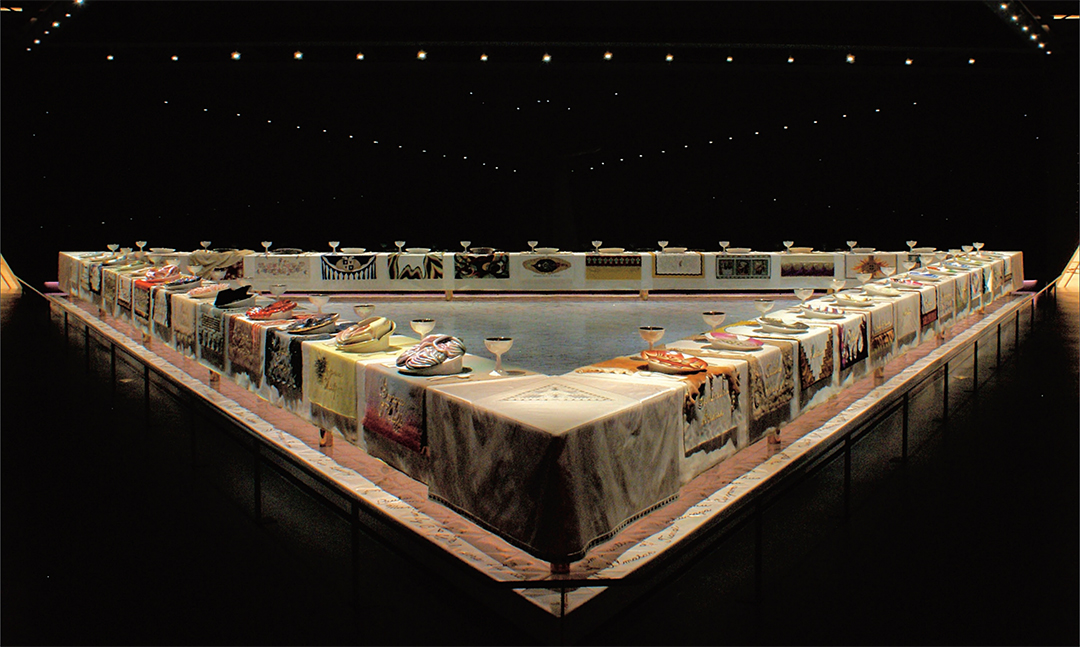
Judy Chicago, “The Dinner Party,” 1974–79, mixed media: ceramic, porcelain, textile. Brooklyn Museum, Gift of the Elizabeth A. Sackler Foundation, 2002.10. © Judy Chicago. Photograph © Donald Woodman
Another key difference between the works is the absence of food on Chicago’s table and the abundance of it on Anaya’s. From pears wearing tiny knit aprons to gelatin molds with hot dog wieners placed at the center to look like breasts, Let Things Taste of What They Are is filled with food that reference the female body. Anaya’s attention to detail is astounding; across the quilted tablecloth made from pastel work shirts, tiny sculpted butter flowers sit on white ceramic dishes and raw eggs are tucked into beds made of bread, cheese, and lettuce.
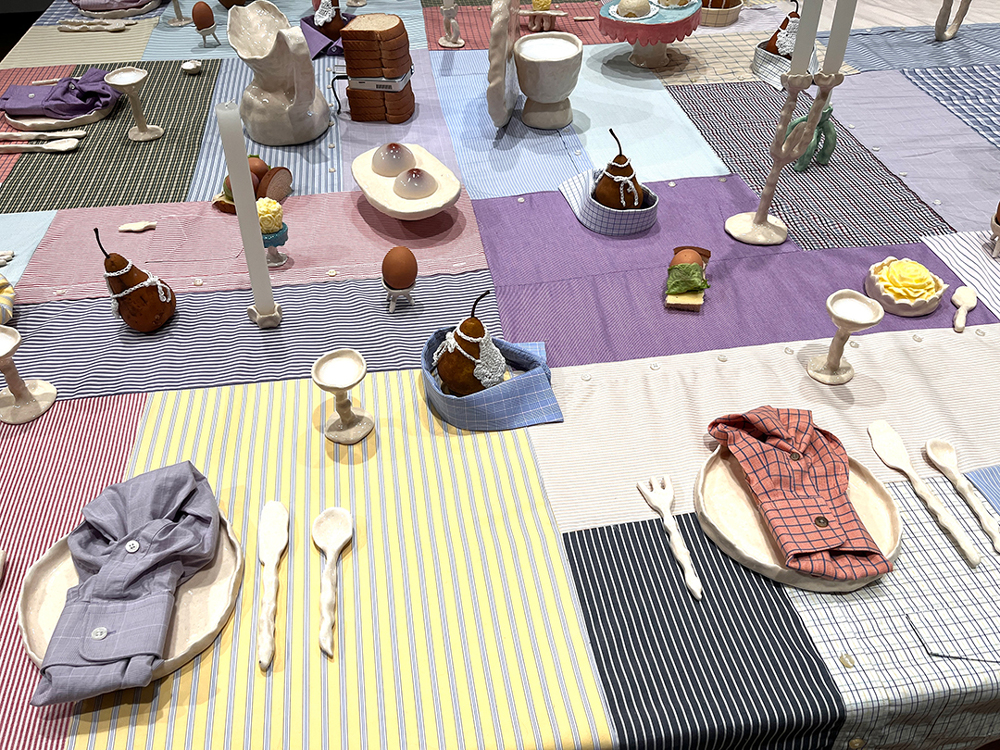
Detail of Sheryl Anaya, “Let Things Taste of What They Are,” 2023
Anaya’s use of food in this elegantly constructed manner reminds me of fellow Fort Worth artist Sarah Ayala. Though Ayala works in a variety of formats, from large-scale murals to intricately decorated maps, she is also known for her brightly painted and sculpted cakes calling for women’s reproductive and economic rights. In a recent collaboration with Deryk Poynor, Cuntrol: A Lavish Socioeconomic Ecosystem Controlling the Underfunded, Ayala transformed a shipping container into a lush dinner party set-up. The dark wood table was filled with cakes, each with hand-lettered text. Some referenced amounts of money related to the Economic Impact Payments made by the government at the height of the COVID-19 pandemic; others referenced minimum wage and compared the pay gap between men and women. The phrase “Let Them Eat…” appeared on two of the cakes, alluding to the expression that has been attributed to Marie-Antoinette, the queen of France during the French Revolution.
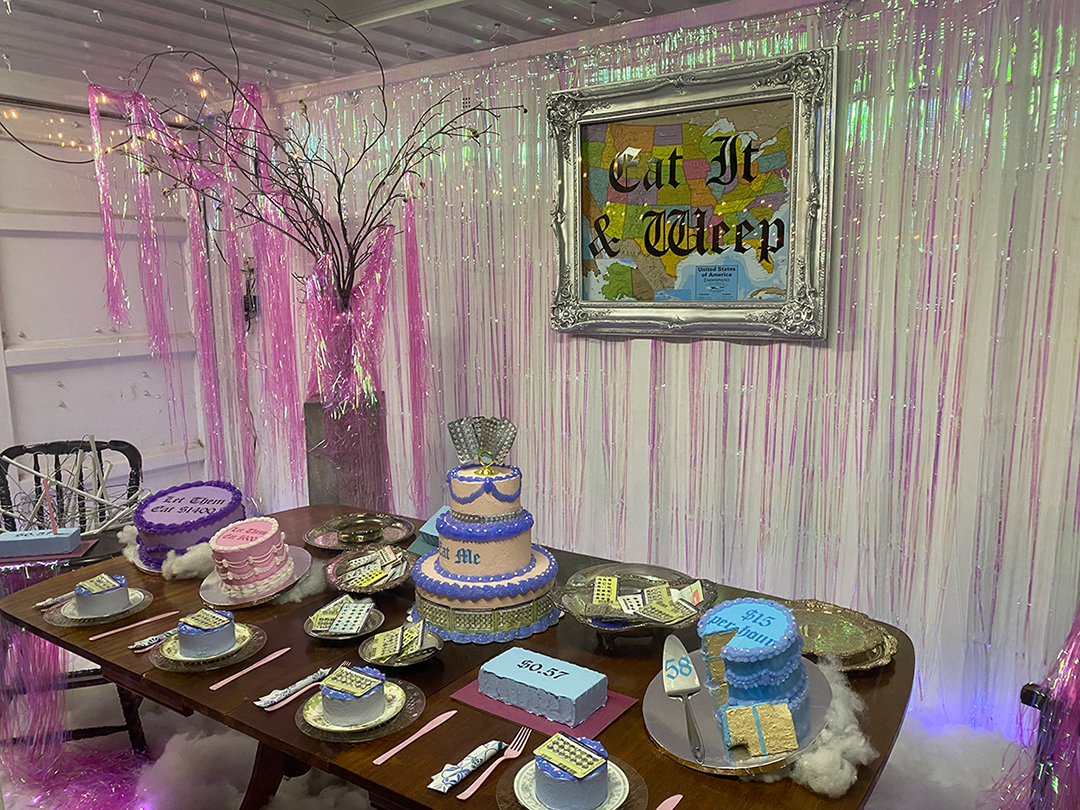
Detail of work by Sarah Ayala in collaboration with Deryk Poynor: “Cuntrol: A Lavish Socioeconomic Ecosystem Controlling the Underfunded”
While Ayala’s cake’s references may be more accessible to the general public, the cakes seen throughout Anaya’s installation also relate to a historical female figure, though perhaps less known to a U.S. audience. With so much to see on Anaya’s table, it’s easy to miss the half-sphere cakes with a candied cherry on top, known as minne di Sant’ Agata or Saint Agatha’s Breasts. This Sicilian dessert references the tragic fate of a young pious woman who dedicated her life to God, taking a vow of celibacy. When she refused the advances of a Roman governor who wished to marry her, he had her imprisoned and tortured. The many abuses she endured included the governor’s call for her breasts to be cut off. She later died in prison. Now, Agatha is revered as the saint of breast cancer, rape victims, and wet nurses, and she has often been depicted in paintings carrying a platter holding her own breasts or breast-shaped foods.
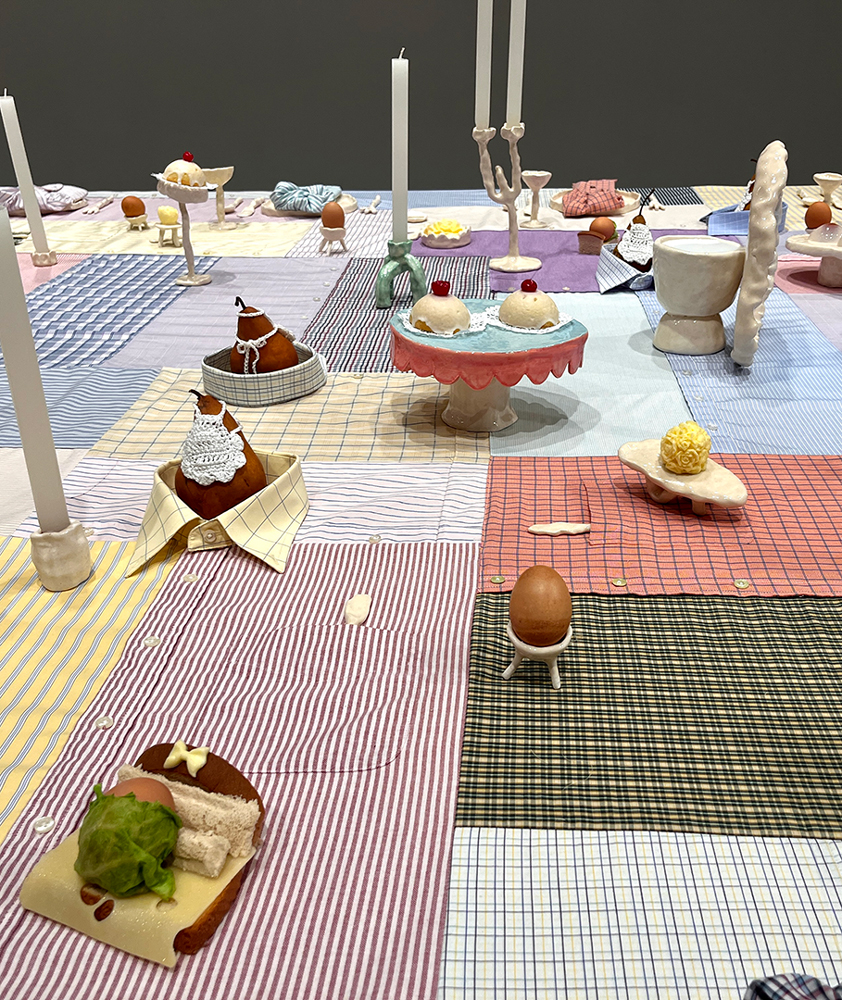
Detail of Sheryl Anaya’s work, “Let Things Taste of What They Are,” 2023
Like Ayala, Anaya too uses the visuals of food to speak to the physical treatment of women’s bodies, but her work perhaps goes a step further by also spotlighting their objectification and consumption. Saint Agatha is believed to have lived from 231 to 251 AD, and yet her story echoes throughout history. Camouflaged on the table within Let Things Taste of What They Are are three video performance pieces. The small, square projectors are somewhat hidden in stacks of white bread, and each projects small videos onto the surface of white ceramic platter-like sculptures, which are leaned up against other small works. In one video, the artist wears an apron while she prepares a meal in a kitchen. All seems quite normal until the end, when she turns and reveals she is naked beneath her apron. In another video, Anaya bites a hole into a piece of lunch meat before placing it on top of her breast so that her nipple remains exposed. Each video adds to the absurdity of the work, but also can be seen as the artist reclaiming ownership of her body, deciding which parts to reveal and when.
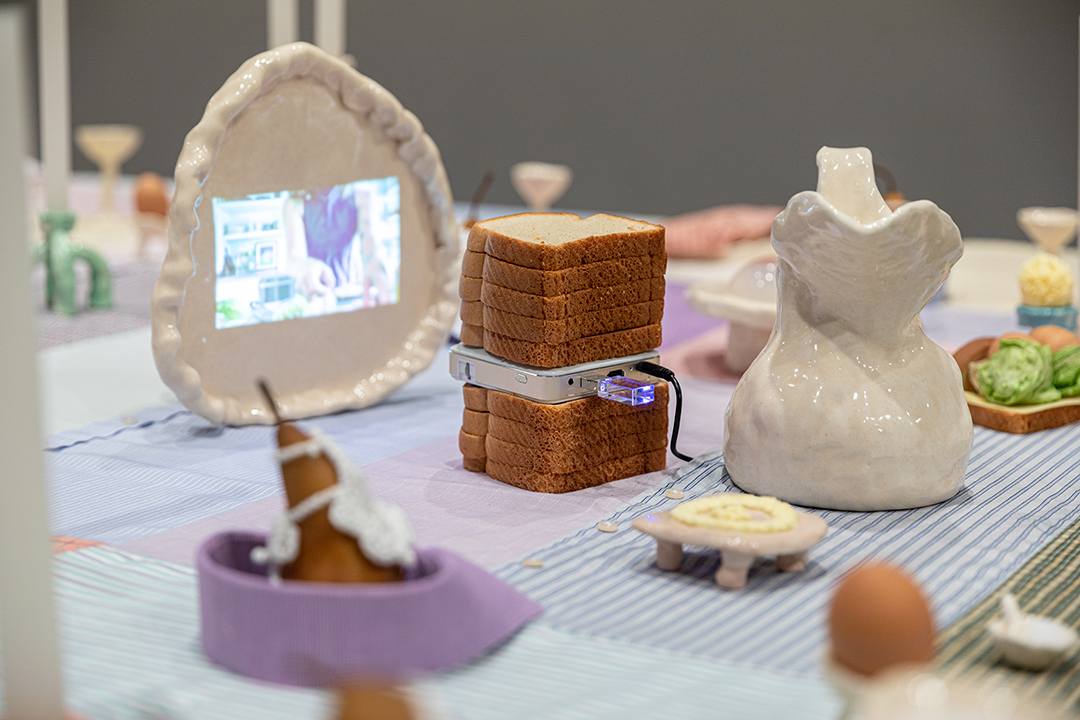
Detail of Sheryl Anaya’s work, “Let Things Taste of What They Are,” 2023
The performance aspect of the installation, along with the concept of reclamation, relates back to Jer’Lisa Devezin’s 2019 Kiss My Ass performance, which took place at the Southern Methodist University Pollock Gallery as part of the artist’s MFA thesis exhibition. Though visually Devezin’s work is more minimal and severe than Anaya’s, both artists engage in restorative acts for specific historic women, and ultimately for themselves.
Devezin’s performance references Saartjie (Sarah) Baartman, an African woman born in 1789, who was fetishized and treated like an oddity for the entertainment of European society. Known derogatorily as the “Hottentot Venus,” Baartman was paraded and displayed at circuses so audiences could gawk at the shape of her body, specifically her buttocks. Even after her death, a plaster cast of her body, along with her brains and genitals, were displayed at the Musee de L’Homme (Museum of Mankind). Following his election as President of the Eastern Cape South Africa in 1994, Nelson Mandela requested the repatriation of her remains and the casting. The French government did not comply until March 2002, and her remains were buried in the Eastern Cape in August of that year.

Jer’Lisa Devezin, “Kiss My Ass,” 2019, bronze, patina, rope, pulley, steel.
During her performance, Devezin used a hoist to move a bronze cast of her own bottom up from cinder blocks sitting on the ground to atop a six-foot-tall pedestal. The action lasted just over ten minutes, and while most of the work was in the creation of a secure rope harness around the sculpture, the performance was still powerful and charged. Watching Devezin carefully secure and move the sculpture made me reflect on the care that we show art objects, compared to the violence with which Black bodies are too often treated. By the end, she had, in effect, uplifted and revalued the Black female body. The title of the work, too, uses a colloquial dismissive phrase as a call for respect.
Similarly, the title of Anaya’s installation repurposes a phrase from popular culture. A well-known quote by Alice Waters, the first woman named Best Chef in America by the James Beard Foundation, “Let things taste of what they are” was originally a call for simplicity in cooking to showcase the natural flavors of a food. Anaya uses the phrase to call out the absurdity of a dessert shaped like a woman’s breast, which itself commemorates a young woman who was brutalized. And, perhaps even more generally, Anaya is asking that society strip the pretense and reveal the harsh realities that shape our world.
Art is a reflection of the society from which it is birthed. Created nearly a decade after the publication of Betty Friedan’s The Feminine Mystique, Judy Chicago’s The Dinner Party honors over 1,000 women across history because the artist sought to celebrate important female figures and showcase the untold and underrepresented histories of women. For all of the excitement around Chicago’s piece, the major criticism of her work (and feminism at large) is the lack of inclusion of women of color and women whose sexual orientation, gender expression, mental or physical ability, or even nation of origin further complicate their personal experiences and struggles. It is particularly poignant, then, to see how female artists of color address universal themes related to women’s traditional roles and women’s treatment in society.
Nearly fifty years later, though much has changed in the U.S. regarding gender equality — since 1974, women can now have credit cards in their names, since 2014 a higher percentage of women are enrolled in higher education than men. But much has remained the same — between 2014 and 2020, femicide in the U.S. has increased by 24%. This is why, after decades, artwork addressing women’s place in and treatment by society is as prescient as ever.
Devezin’s and Anaya’s works, though depicting women who lived 1,500 years apart, retell stories of people who were treated as objects. Though women today surely have more rights and authority over their lives than women of the past, there’s an unescapable undercurrent of potential threat to our bodies — we walk with keys between our fingers, prepared to fight an attacker, and share our location with friends and family so they can find us should we go missing. Highlighting women’s historical mistreatment reveals the deep-seated nature of violence against them, helping to shine a light on the realities that women still face today, and providing an opportunity for female artists to make defiant statements about their rights to their own bodies.
The post Historical Figures, Food, and Feminism appeared first on Glasstire.
Houston ISD Takeover Is a Trojan Horse for Privatization
Donnie Walker, U.S. history teacher at Wheatley High School in the Houston Independent School District (HISD), has a family legacy at the school. His grandparents went to Wheatley. His great-aunt graduated from the same class as Barbara Jordan, the first southern Black woman to be elected to the U.S. House of Representatives. His father and mother met at Wheatley.
Since Walker joined Wheatley’s teaching staff in 2019, the school has been at the center of a political power play by the state that resulted in an announcement by the Texas Education Agency (TEA) last week that they are seizing control of the largest school district in Texas.
Since 2019, Wheatley High School teachers and administrators have weathered a pandemic, all while improving their students’ academic performance, receiving a C state accountability rating last year. HISD earned an overall B rating with a score higher than 611 other Texas districts, including Dallas.

Still, TEA cites Wheatley’s past failures to meet state standards as reason to disband HISD’s elected school board. By June 1, the agency plans to appoint a new board of managers and superintendent, which could remain in charge for two to six years.
“Since 2019, we’ve been doing a wonderful job at holding our students accountable, the community accountable, parents accountable. Unfortunately, politics come into play, and guess who’s at the forefront of the politics. The State of Texas, Governor [Greg] Abbott, they’re not going to look in the mirror and point the finger at themselves. We’re getting blamed for everything,” Walker said.
Walker said the school has had to address plenty of new challenges since the time his family attended, particularly challenges created by school privatization in the Fifth Ward community.
In 2011 Yes Prep Fifth Ward Secondary School, a charter institution, opened less than 5 miles from Wheatley. Since then, Wheatley has seen its enrollment decline. In 2017, the magnet school Mickey Leland College Preparatory Academy for Young Men also opened in the Fifth Ward.
“You could probably kick a ball in the backyard of Yes Prep and it’ll probably land in our football field,” Walker said.
While magnet schools are still run by public school districts, like charters, they are selective and can draw the highest-performing students away from neighborhood schools, along with the money allotted to those students. Meanwhile, local schools still need to pay for the same fixed costs of operating schools, such as building maintenance.
Unlike charter schools, as a neighborhood public school Wheatley is held accountable by federal laws to enroll and educate all students in the neighborhood, no matter their background. Wheatley educates more students receiving special education services, more students in the ESL program, and more students identified as at-risk than nearby private or charter schools.
“A lot of parents have this notion that Wheatley is already a school [with] issues, and what they do is place their children into these independent charter schools,” Walker said, thus siphoning off potential Wheatley students.
When students get kicked out of neighboring charter schools for disciplinary issues, Walker said, they often come to Wheatley, where teachers “rebuild them and prep them for life. We do all the things that these other schools failed to do for these students. They just get rid of them.”
In 2019, more charter school districts than public school districts received an F accountability rating from the TEA. That year, HISD received an overall B rating, but TEA threatened the district with school closures and a state takeover. In a November 2019 audit of HISD, which the state released a few days after announcing its plans to take over the district, the state recommended closing or consolidating 39 HISD school campuses deemed “underutilized.” Like Wheatley, these schools have experienced declining enrollment due to proliferating charter schools in Houston’s low-income communities.
TEA Commissioner Mike Morath told Houston’s KHOU in a TV interview that he is not ordering any schools in the district to be closed, saying that the law stipulates a choice between state-appointed managers and school closures during a state takeover.
But community leaders are concerned that the state takeover will replace schools in low-income Black and brown communities with charter schools, which will not serve all students in the neighborhood. The Greater Houston Coalition of Justice, consisting of more than two dozen civil rights groups, filed a discrimination complaint with the U.S. Department of Education Office for Civil Rights last Friday.
TEA did not respond to the Observer’s inquiry into whether the agency plans to turn some HISD schools into charter schools.

In a press conference last Wednesday, Bishop James Dixon II, pastor of the Community of Faith Church and president of the Houston NAACP, questioned why the state is targeting HISD when other districts received lower accountability ratings.
“If academic achievement and financial management are the measures by which TEA determines whether a school is desirable, then what is it that the government hasn’t told the public that’s really driving this action?” Dixon said. “Why HISD? Does it have to do with the fact that we are majority brown and Black? Does it have to do with an economic agenda that is designed to close our schools and privatize our schools?”
Walker says that any plans to turn more schools into charters will only deepen existing inequalities in Houston’s communities.
“Charter schools have a right to turn their backs on kids and a part of the community. And if we start on that train and kick kids out and don’t cater to their academic needs, their social needs, these kids will be left behind in society,” Walker said.
He plans to stick around to make sure that doesn’t happen.
“Let’s prove everybody wrong and show that we are taking care of business. So the teachers at Wheatley are still pushing forward strongly to continue the legacy of doing positive things in our community, and continue the progress we’ve made since 2019.”
The post Houston ISD Takeover Is a Trojan Horse for Privatization appeared first on The Texas Observer.
Forget A TikTok Ban, We Need To Regulate Data Brokers And Pass A Real Privacy Law
We’ve noted for a while now how the great TikTok moral panic of 2023 is largely a distraction. It’s a distraction from the fact we’ve refused to meaningfully regulate dodgy data brokers, who traffic in everything from your daily movement habits to your mental health diagnosis. And it’s a distraction from our corrupt failure to pass even a baseline privacy law for the internet era.
Most of the folks crying the loudest about TikTok were the same people that created the policy environment that lets TikTok (and anybody else) play fast and loose with consumer data in the first place.
And they don’t want to actually fix the mess they created. U.S. corporations don’t want to make slightly less money under a policy framework that empowers consumers, and the U.S. government doesn’t want to have to get a warrant for all of that data it buys from brokers.
So you get what we have here: a big dumb performance in which we pretend that banning a single app actually does anything of use. After all, the Chinese, Russian, and U.S. governments can all just buy data from the poorly regulated data broker market. They don’t need TikTok for surveillance and propaganda; they have plenty of data brokers and U.S. tech giants for that.
For a while it was actually kind of hard to see this viewpoint reflected in press coverage of the TikTok fracas, which initially leaned heavily toward patriotic fervor. Fortunately that’s slowly starting to shift as calls for a ban begin to grow in earnest. Case in point: this New York Times piece by Julia Angwin that once again makes it clear that a TikTok ban isn’t thinking broadly enough:
The even deeper problem is that putting TikTok under state control, banning it or selling it to a U.S. company wouldn’t solve the threats that the app is said to pose. If China wants to obtain data about U.S. residents, it can still buy it from one of the many unregulated data brokers that sell granular information about all of us. If China wants to influence the American population with disinformation, it can spread lies across the Big Tech platforms just as easily as other nations can.
Angwin also points out something else I’ve found annoying about the myopic fixation on TikTok: we’ve never seen anything close to the same level of concern about the poorly-secured Chinese-made routers and internet of things devices Americans happily attach to their home networks with reckless abandon:
Not to mention that our national lack of focus on cybersecurity defenses means that it would be much more effective for China to just hack every home’s Wi-Fi router — most of which are manufactured in China and are notoriously insecure — and obtain far more sensitive data than it can get from knowing which videos we swipe on TikTok.
None of this is to say that TikTok is some innocent daisy and doesn’t pose a privacy risk.
Just that myopically fixating on the ban of one app — but doing nothing about the shitty policy environment that created the problem — is more political performance than meaningful solution. A performance that will annoy young voters, make it tougher on researchers and educators, uproot established community, face numerous First Amendment challenges, and not actually fix the core issues.
I still maintain that the most vocal supporters of a TikTok ban understand this perfectly well, and couldn’t actually care less about consumer privacy or national security. They’re eager to deflect blame for decades of failures on consumer protection, to pretend they’re being “tough on China,” to agitate a xenophobic base, and if they’re really lucky, to offload TikTok’s ballooning billions in ad revenues to U.S.-based cronies (as Trump indicated was his intention from the start).
Dunkin’ Discontinues Fan-Favorite Dunkaccino Drink

Dunkin’ has quietly pulled the Dunkaccino from the coffee chain’s menus, ending a more than two-decade run for the fan-favorite drink that mixed together coffee and hot chocolate as the company focuses on innovation. What do you think?
Review: “Mark Flood: A Guide for Nude Investors” at Reeves Art + Design, Houston
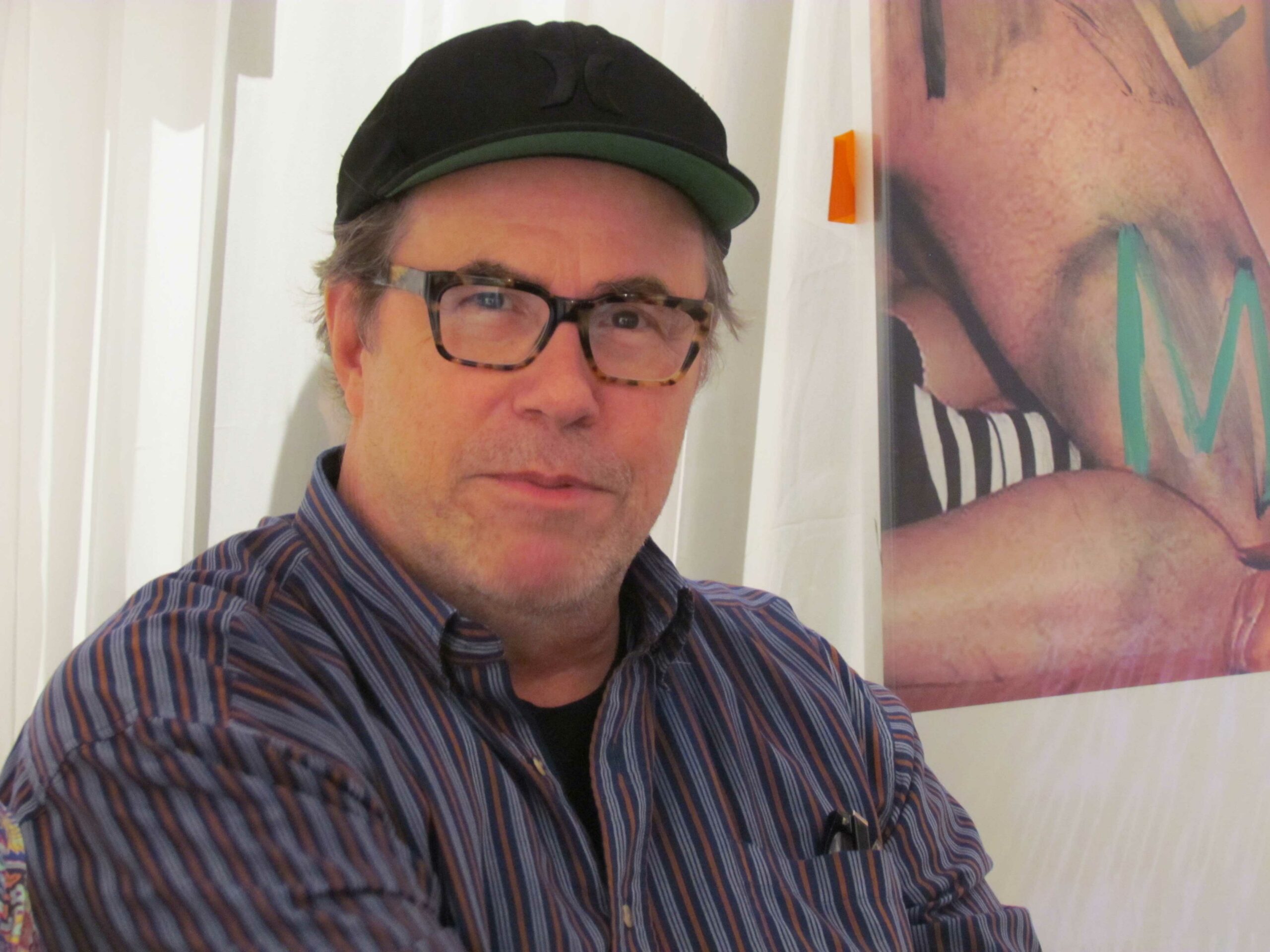
Mark Flood at Reeves Art + Design. Photo: Michael Flanagan.
Mark Flood is sitting on a bench in a room obscured by large white curtains. Outside the room is a painting bearing the words “ADULTS ONLY.” Flood holds court with a few figures from the Houston art world amidst his Virtue Signals series, a collection of pornographic images that have been digitally printed on canvas and painted over. The series is one of several being shown in A Guide for Nude Investors, Flood’s first solo exhibition in Houston since a large-scale survey of his career at the Contemporary Arts Museum Houston in 2016. It was unclear whether Flood would attend this opening, as he has been known to send surrogates to similar events in the past. But here he is, albeit taking refuge in the “ADULTS ONLY” section of the gallery, where there are markedly fewer people present.
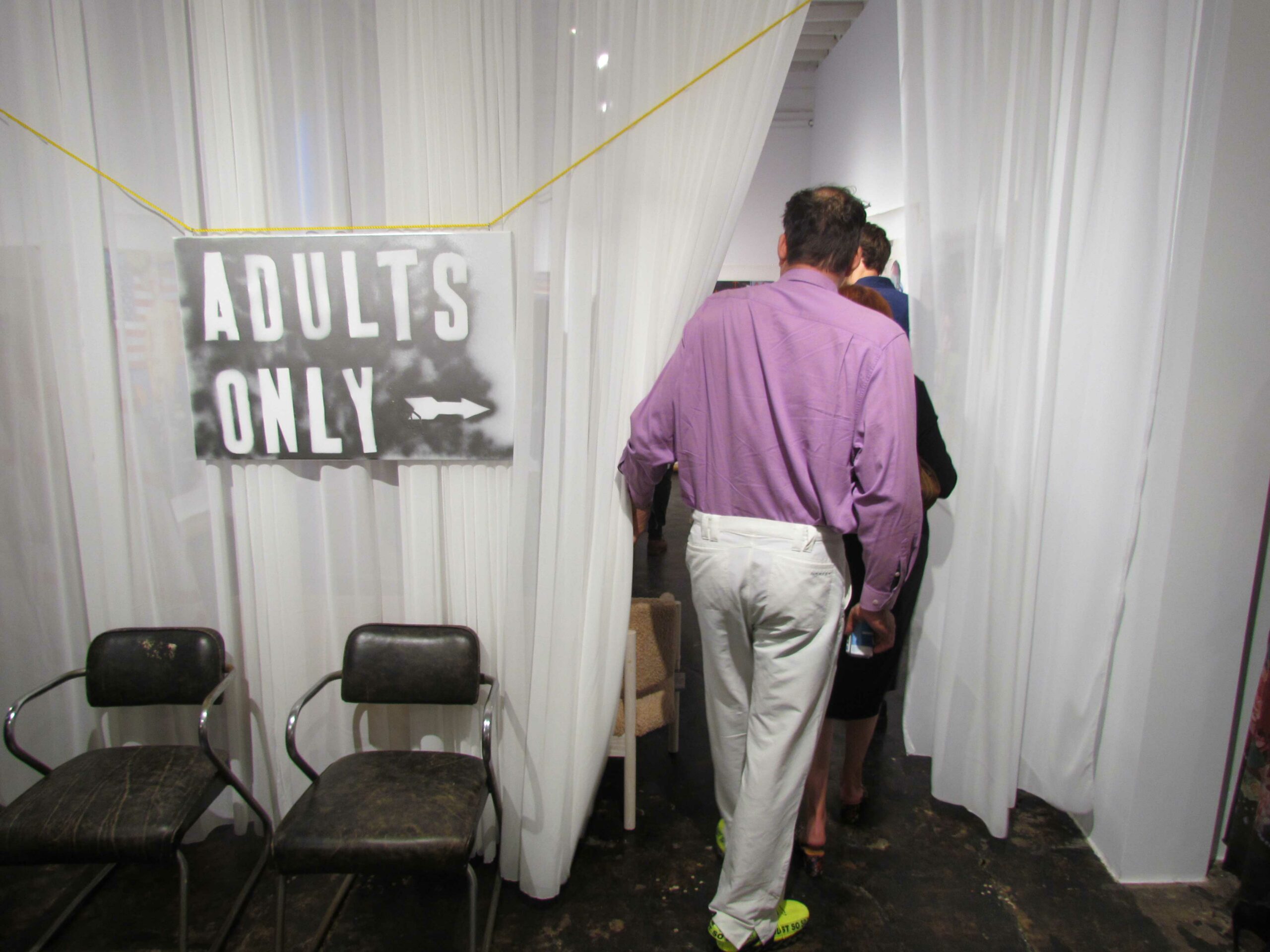
“A Guide for Nude Investors: Mark Flood” at Reeves Art + Design. Photo: Michael Flanagan.
It’s a lively scene throughout Reeves Art + Design for what has been billed as “[T]he opening of the year.” Lifesize cardboard cutouts of memes called NPCs, or “Non Player Characters,” have been placed throughout the gallery, and attendees are beginning to engage with and rearrange them. I spot a woman in the crowd wearing a T-shirt emblazoned with a figure of clustered body parts that Flood has used throughout his career.

Kathleen Boyd with a work by Mark Flood at Reeves Art + Design. Photo: Michael Flanagan.
Kathleen Boyd tells me that she purchased the shirt from Flood in 1991 at a space in Houston called The Eight-O, where the artist was exhibiting work. “He and I were at Rice University together,” Boyd recalls, “and then I worked for Continental Airlines for many years. He was interested in getting a gallery in New York, so I was taking him to New York on buddy passes. And we did a barter on a portrait he did of me.”
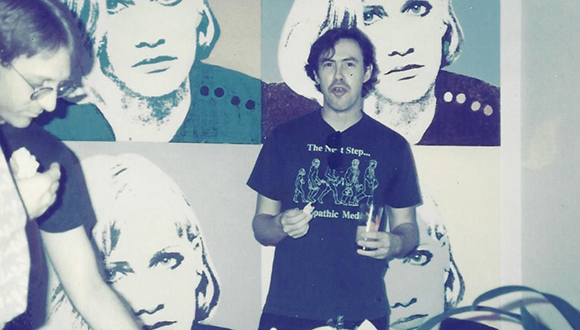
Mark Flood with his portraits of Kathleen Boyd, 1992. Photo courtesy of Kathleen Boyd.
Flood’s art came to prominence in the early 2000s when his series of lace paintings caught the attention of the international art world. This success came by design. After having spent most of the 80s and 90s “making ugly art,” Flood was inspired by Dave Hickey’s The Invisible Dragon: Four Essays on Beauty, to create beautiful paintings that allowed him to bypass “parasitical art bureaucracies.” In a series of diary entries from 2016, Flood explained, “Lace paintings are my attempts to capture beauty, and use it to attract an audience that has little use for critical theories and anti-retinal readymades.”

Installation view of “A Guide for Nude Investors.” Photo: Michael Flanagan.
The more than 60 artworks on view in A Guide for Nude Investors vary widely from inkjet prints of digital images to figurative works in acrylic, all executed between 2013-2021. While there are no lace paintings in the show, similarities to them can be seen in the application of paint to Flood’s Dominoes series, paintings that incorporate images of manipulated and magnified corporate logos. A press release shared by the gallery explains, “Their resemblance to abstractions of the Modern era, which we all adore more than our own parents, delighted the artist.”

Mark Flood, “Dominoes paintings,” 2021, at Reeves Art + Design. Photo: Michael Flanagan.
Walking among the various images of violence, sexuality, popular culture, and obscure internet memes, one gets the sense that Flood has found a way to reconcile the “beautiful” and the “ugly” in his art.
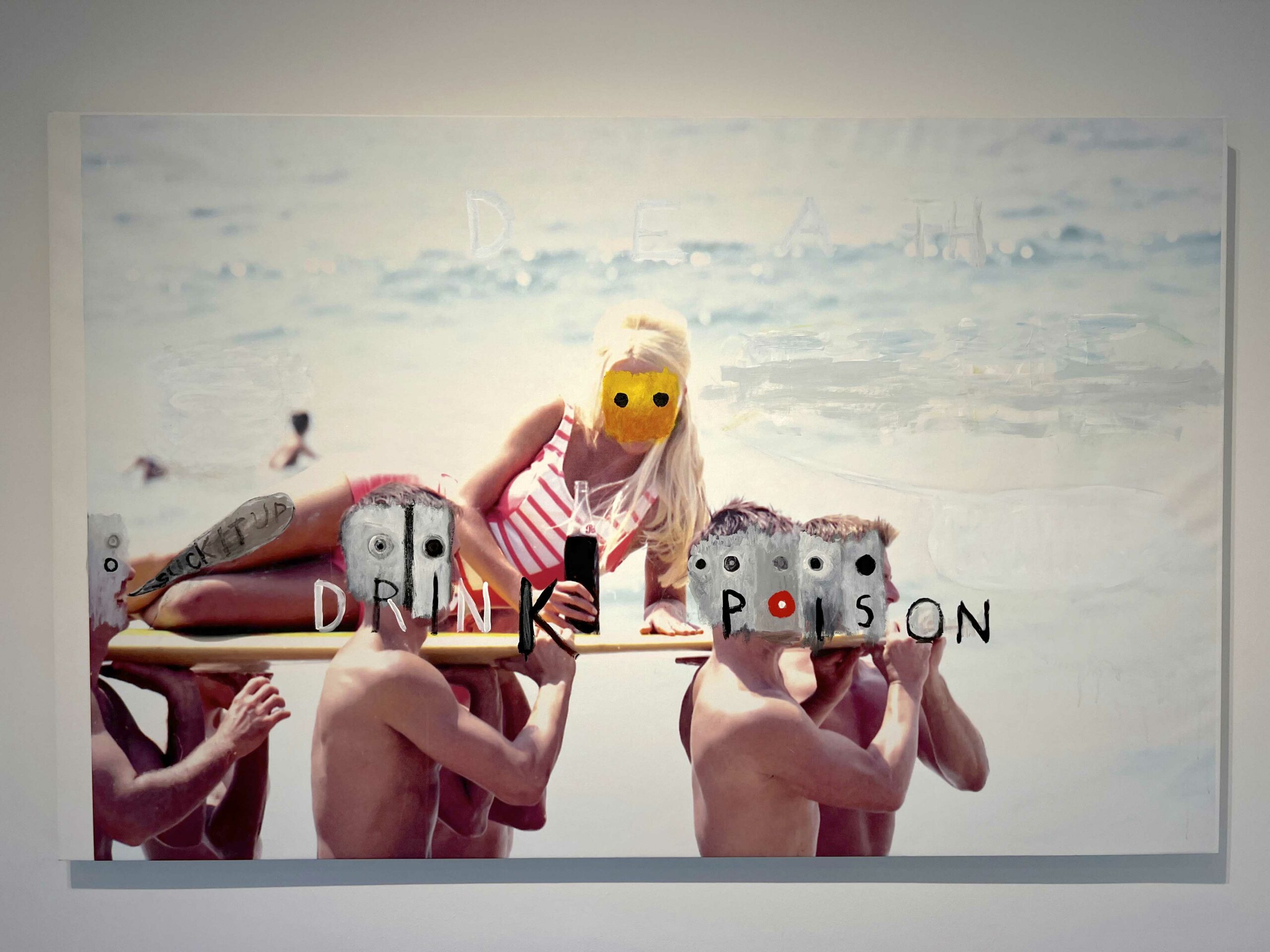
Mark Flood, “Death Wave,” 2018. Photo: Michael Flanagan.
This reconciliation is perhaps most apparent in Death Wave (2018), wherein the faces of attractive beachgoers from an archival inkjet print of a Pepsi advertisement are obscured by ghostly abstractions and texts painted by Flood. The application of paint in the various details here, as in other similar artworks present in the show, is quite beautiful. While the words “DRINK POISON” set against the bulging eyeballs of strange gray faces might be disturbing, it’s hard not to appreciate the aesthetic value of “DEATH” hovering over the scene, merging subtly into the incandescent ocean background. It’s like Flood has exorcized a demon from the advertisement, revealing its true form and creating something both disturbing and triumphant in the process.
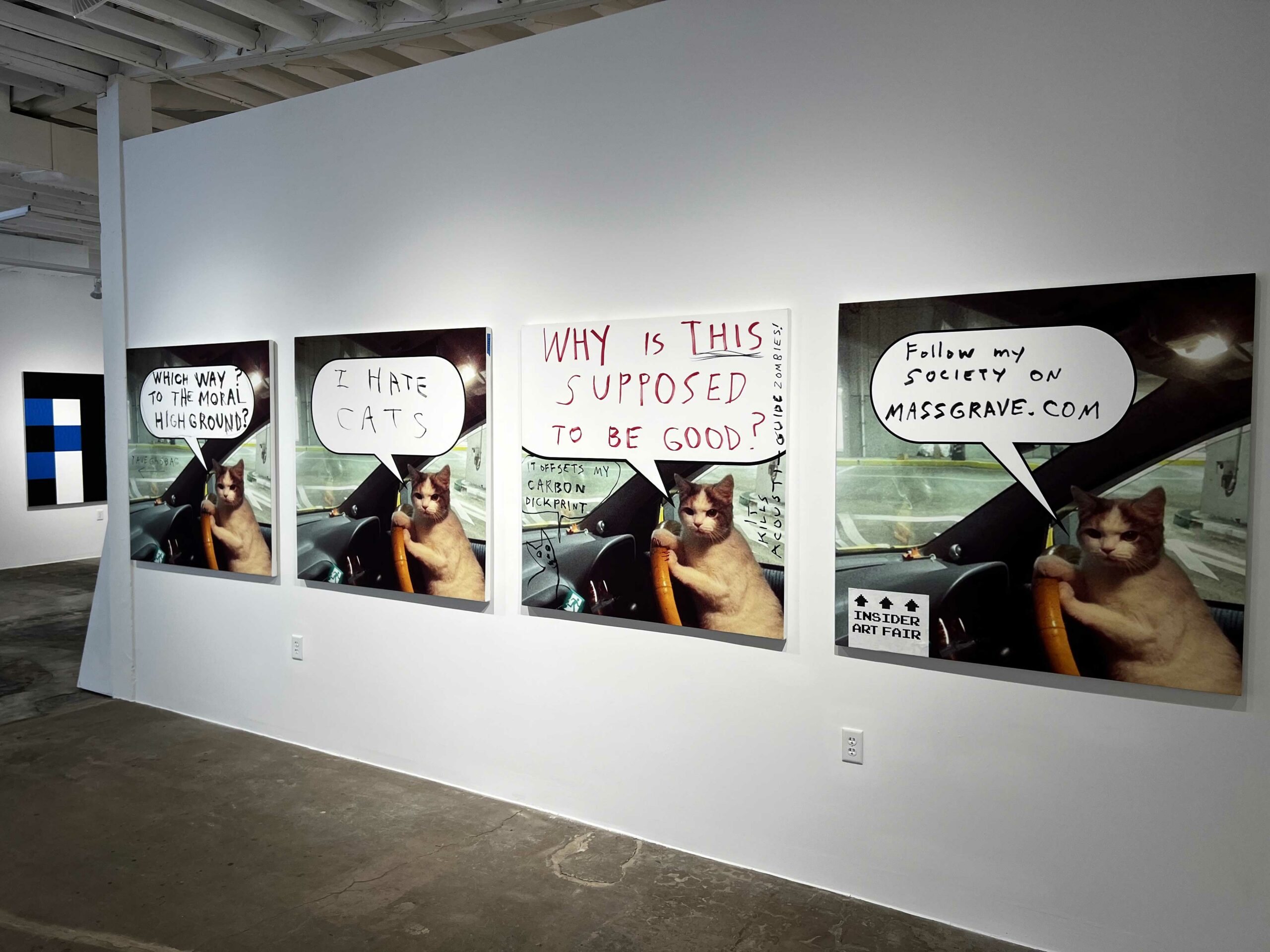
Mark Flood, “The Cat Paintings,” 2014, at Reeves Art + Design. Photo: Michael Flanagan.
Not all of the work in A Guide for Nude Investors is as straightforward as Death Wave. Around the corner is a series of Cat Paintings featuring “the famous meme of a mean feline driving… with a word balloon added.” At first glance these may seem sophomoric and trite, nothing like the delicate beauty of Flood’s, Trojan Horse (2004), a lace painting in the collection of the Modern Art Museum of Fort Worth.
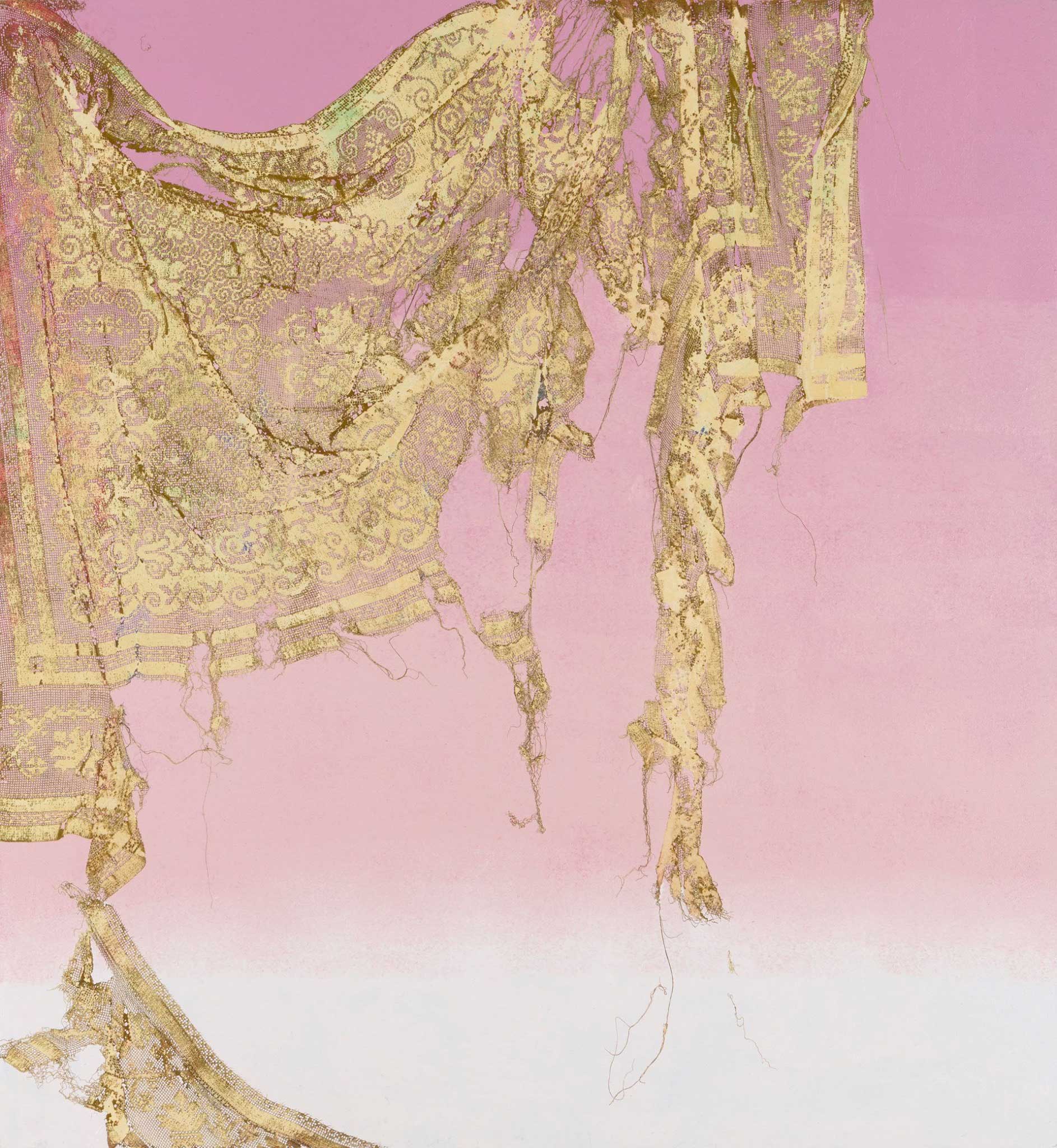
Mark Flood, “Trojan Horse,” 2004, collection of the Modern Art Museum of Fort Worth.
However, these pieces are not lace paintings — they are the “anti-retinal readymades” that Flood warned us about. Originally shown during the 2016 Insider Art Fair, an exhibit of Flood’s paintings satirizing art fair culture, the work’s purpose was “to cover with filth that which poses as scientific sterility, objectivity and cleanliness…” We’re not meant to be pacified or entertained, but instigated and provoked. As it goes with understanding any art, the more research you’re willing to do into the context surrounding Flood’s work, the more it makes sense.
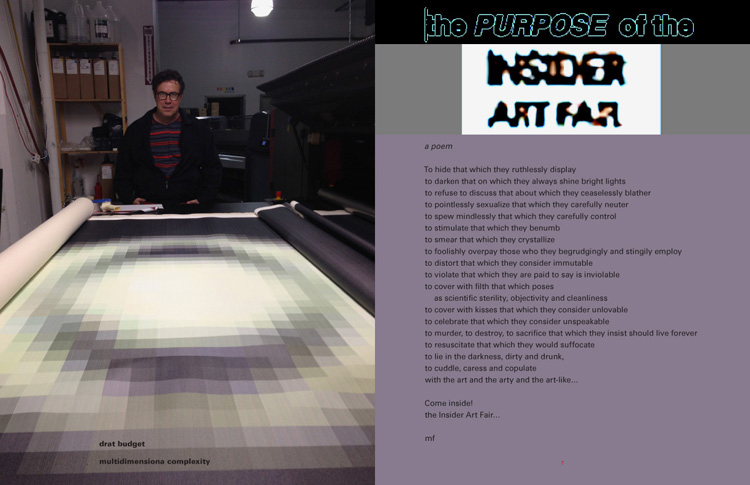
“a poem,” from the “Insider Art Fair Souvenir Survival Guide,” 2014.
Part of any serious research into Flood’s oeuvre should certainly include a look at his output with the experimental punk group Culturcide. They’re best known for Tacky Souvenirs of Pre-Revolutionary America, a 1986 LP that features popular music of the era overdubbed with “weird own sounds and new cynical lyrics.” Take, for example, the opening verse of “Star-Spangled Banner”, a reappropriation of the US national anthem:
Oh, say can you see/in the blinkless electron-gun eye/of the mainstream media mirage//
That what we hail/are the hallucinations of authority/and progress and righteousness//
Whose sweet and stern voices/have captivated and conditioned/millions of human creatures//
Flood has continued to produce experimental audio recordings, often as the soundtrack to promotional videos for his various gallery exhibits. These videos, along with the artist’s many published writings (some in Glasstire), provide valuable insight and function as a sort of artist statement. In fact, one of these videos is literally titled “ARTIST’S STATEMENT.”
Despite the overwhelming amount of information about his life and work that is already publicly available, I was compelled to ask Flood a few questions about A Guide for Nude Investors. He was kind enough to provide the following answers:
Michael Flanagan: What was the impetus for the NPC cutouts that populate the gallery?
Mark Flood: I like the NPC meme, and I found these standees on eBay a few years ago. I don’t know what the seller thought they were about, but to me they looked like frustrated artists holding up their work.
I like to have exhibits where the audience is partially artificial. This is the second time I’ve used standees. I thought people would move them around, like they did the LIKE paintings [at my CAMH show], and I was right.
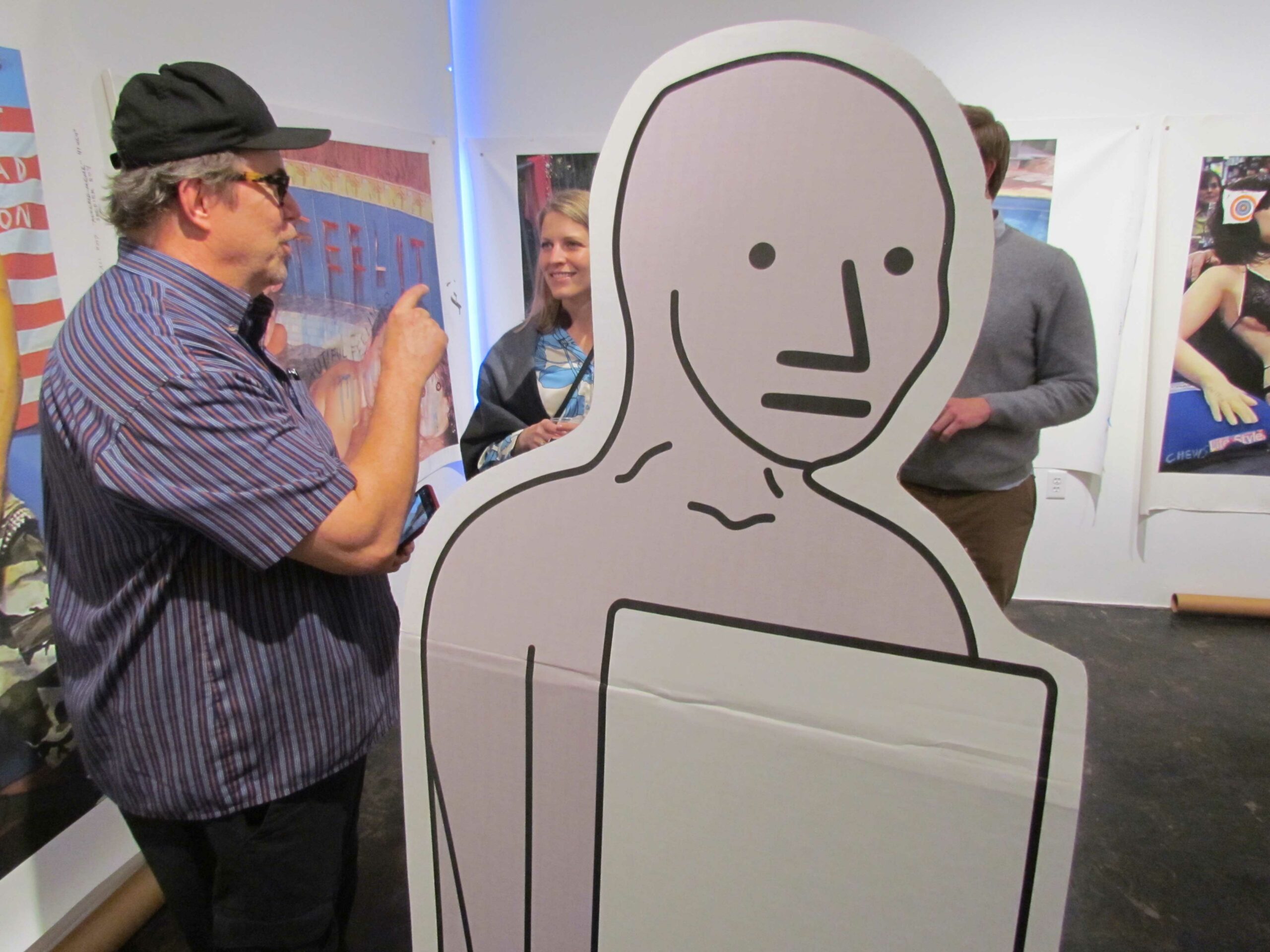
Mark Flood at Reeves Art + Design. Photo: Michael Flanagan.
Flanagan: In an interview with ANP Quarterly from 2009, you referred to your artwork as “research into the way pictures and music control people.” What conclusions have you drawn from your research into the pornographic images used in the “ADULTS ONLY” section of the show?
Flood: Research into hard-core porn pics was a long while ago, in the collages of the 1980s. In the Virtue Signal series up at Reeves, I worked with scenes from soft-core porn. I prefer pics where there’s no junk visible, because it’s too distracting.
I’m inspired by the orgy atmosphere. I associate it with the fantasy of pretty people being real about who they are, and what they want. I try to imagine conversations they might have.
Flanagan: The black and white figurative paintings from the exhibit are a bit anomalous — Veronica and The Corner in particular. How do they relate to the rest of the work in the show?
Flood: Sometimes I like to paint from my imagination. These are the most recent works in the show.
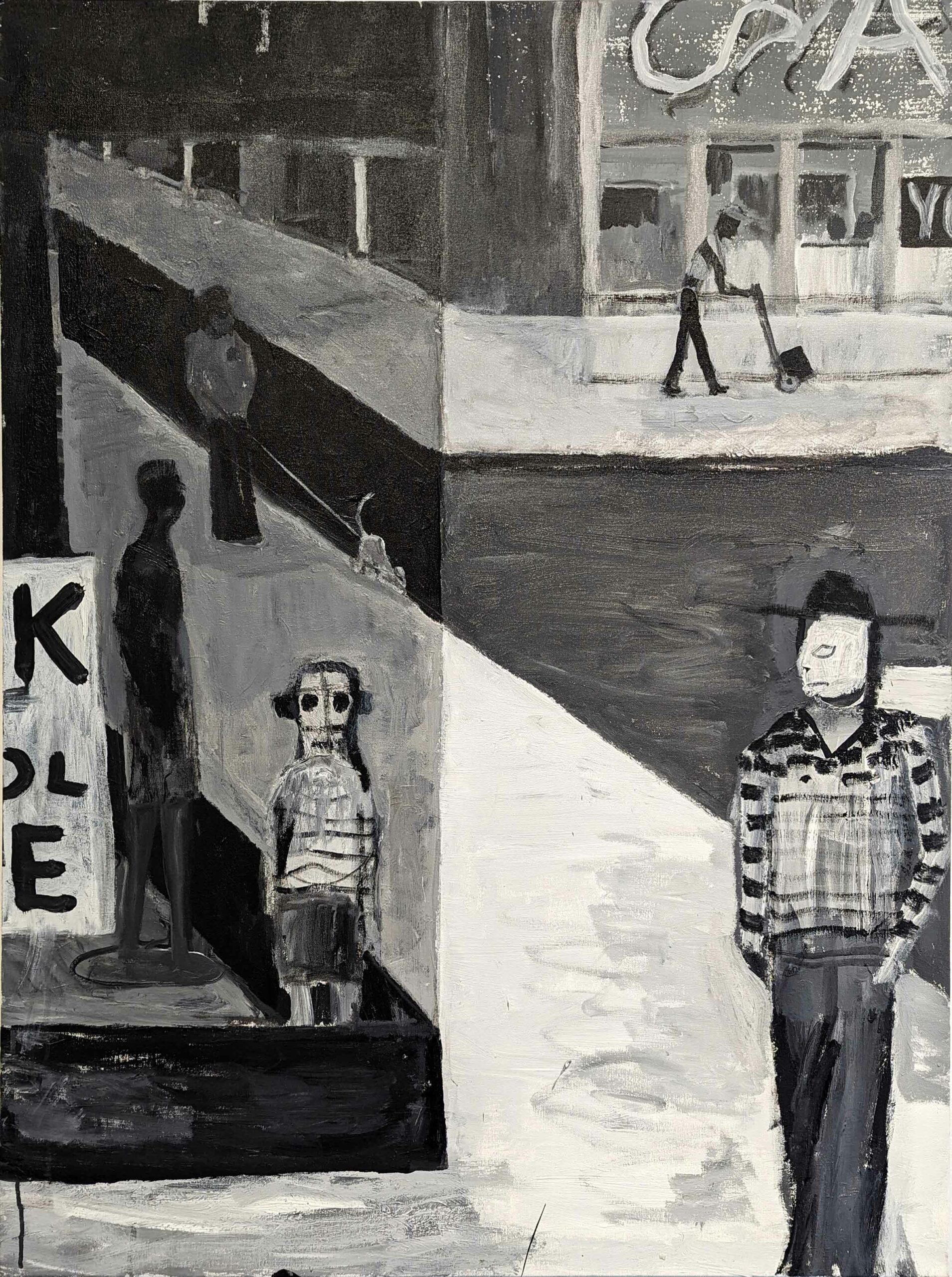
Mark Flood, “The Corner,” 2018, at Reeves Art + Design.
Flanagan: You were quoted by Vice in 2016 as “being competitive with Picasso” from a young age. Is that accurate? Some of the figures in these paintings seem to reference Picasso. The face on the bottom left of Death Wave reminds me of Guernica, and there is a red figure on the back of a woman’s head in The Interview that is also reminiscent of his style. What is your relationship to Picasso’s work?
Flood: When I was little, Picasso was in magazines like Time and Life. He was one of the few artists I knew about. So he defined the activity for me, for a while. I like his work but it’s not important to me these days.
Flanagan: The press release for this show was created using Chat GPT. How do you feel about using AI to create artwork?
Flood: There’s a never-ending roll-out of new technology applicable to making art. The hard part is chasing the audience, which is evolving at the same rate.

Mark Flood, “Two Bachelor Frogs (Nervous),” 2013. Photo: Michael Flanagan.
Flanagan: I gather that you’re well read on topics including psychology, philosophy, art theory, and history. Going back to the question of your artwork being a form of research, what general conclusions have you made about the current state of human culture and the direction it might be heading?
Flood: People still hang things on the wall. That’s my compass. Screen art is huge, but it’s trickier for the individual to get paid.
Flanagan: What are you currently working on? You recently told Kaleidoscope that you’re going to retire and focus on selling old work. Is that true?
Flood: I want to spend more time writing.
A Guide for Nude Investors is on view at Reeves Art + Design through Saturday, March 25th. A virtual walkthrough of the exhibit can be viewed here.
The post Review: “Mark Flood: A Guide for Nude Investors” at Reeves Art + Design, Houston appeared first on Glasstire.
Comic for 2023.03.21 - He’s Gone


James Reimer can’t wear Pride jersey due to Christianity even though Bible also bans working on sabbath, coughing up 3 goal lead to Bruins in Game 7
SAN JOSE – Sharks backup goaltender and .895 save percentage holder James Reimer said that he wouldn’t wear a Pride jersey for 10 minutes during warm ups on account of the Bible’s views on homosexuality, even though the Bible also prohibits a lot of other things like losing a Game 7 in OT to the […]
The post James Reimer can’t wear Pride jersey due to Christianity even though Bible also bans working on sabbath, coughing up 3 goal lead to Bruins in Game 7 appeared first on The Beaverton.

Ron DeSantis Answers Questions about Your Period
Our 16th most-read article of 2023.
Originally published March 20, 2023.
“As local bills on gender, sexuality, and diversity make their way through Florida’s state legislature, new legislation would ban any discussion of menstrual cycles in school before sixth grade.” – USA Today
As usual, the woke mob is accusing me of attempting to strip schools of their educational and societal value, deprive students of their basic human rights, and shamelessly pander to every conservative who might cast a presidential vote my way. To absorb the flow of outrage, I’ve decided to address Florida’s young girls directly. So put down those banned Judy Blume books because all the answers to your burning menstrual questions are right here.
Q: What is a period?
A period is one of the many kinds of goo that girls and women secrete in their role as sacred, yet also extremely gross, vessels for human life. In less scientific terms: a period is God deciding it’s not your time to be pregnant. And remember, God and the state of Florida are the only ones who can make decisions about your body.
Q: How will I know when I’m about to get my first period?
You’ll start showing subtle signs of sluttiness, like breast buds, emergent pubic hair, and a fixation on sullenly licking a lollipop. Also, Matt Gaetz will start sexting you.
Q: I’m embarrassed to carry pads in my school bag; what should I do?
Embarrassment is a normal and appropriate response to feminine bodily functions. Your school nurse will most likely have some supplies in her office. Unfortunately for you early-in-life-bleeders, asking for them will soon be illegal. Try hanging around her door, dropping vague hints like, “I’m riding America’s red wave!” or “Flo Rida is sliding down my Splash Mountain.” If the nurse still doesn’t get your drift, try being more direct with the headline, “Florida Man bit my vagina, and it won’t stop bleeding.”
Q: What if I bleed through my clothes before I can make it to the nurse’s office?
Honestly, that’s a pretty likely possibility, given how little information and resources the state of Florida will have provided to you. Just grab some Hawaiian punch from the vending machine, pour it all over your crotch to disguise your menses, and run away screaming. Then you’ll be sent to the hospital and involuntarily committed for hysteria. Problem solved.
Q: Does it hurt to get your period?
Cramps are a myth that lazy girls made up to get out of helping move books about g*y people out of all of the classrooms.
Q: I’m experiencing gender dysphoria and am interested in hormone blockers so that I don’t start my period. What should I do?
Send me your parents’ names. I’m not going to put them in jail or anything—I just want to talk.
Q: How do I use a tampon?
First, consider whether you’re ready to lose your virginity. And remember: unless you’re legally married to the tampon, you will burn in hell.
Q: How do I decide which type of pad is best for me?
There are different kinds? I thought there were just the ones with the belt.
Q: My period is late. Should I—
No need to say more. We will be monitoring all of your text messages from now on.
Q: Can you recommend any books for more information about periods and my changing body?
We all know that girls should not be reading books, but if you insist on educating yourself, I can arrange a flight to Martha’s Vineyard.
Q: What is toxic shock syndrome?
The radical left would have you believe that it occurs when young girls learn about upcoming changes in their bodies and simultaneously realize that they are second-class citizens and will be until the day they die—the weight of these realizations fills them with such rage that they lose their minds and become feminists. But it’s really God punishing you for using tampons.
Q: What is a diva cup?
I think she’s one of the Drag Queens we banned from Children’s Story Hour at the library. Or maybe it’s some kind of accessory? I’ll ask my stylist if a Diva cup would look good with my white go-go boots.
Requirements in Technicolor
Managing the requirements for an application is a huge challenge. The hardest part of the challenge is that, very frequently, the user's don't know what they really want or need. Prying it out of them, and giving them an application that actually solves the real problem they have, is an art.
The worst situation is when the users are absolutely certain that they do know what they want. This was the situation that Irini found herself in.
The project started, as many such projects do, in the wake of a disaster. One of the company's many Capital Improvement Projects (CIP) slipped through the cracks during budgeting. It ran six months past schedule, but managed to close out with a few hundred grand still unspent in its budget. When someone tried to reallocate that money, the management team in charge of managing CIPs found out, they went full code-red, trying to do two things at the same time: understand why that project got lost in tracking, and also why when they tried to reallocate the money, it kept getting reset in their Enterprise Resource Planning (ERP) system.
Eventually, that lead them to Sofia, the VP of Finance, and managed them all through a spreadsheet she had created by herself. The ERP kept getting reset because she manually updated it based on the contents of the spreadsheet. The project got lost because she manually color-coded the projects in her spreadsheet, and one day accidentally hid the row, instead of making it yellow.
No one liked that there was a manual process. No one liked that only one person ever touched this system. Management wanted a robust, backed-up IT system, and wanted to open the management of this process to more of the finance team, so Sofia wasn't the only failure point.
The solution was clear: gather requirements from Sofia and either purchase a product or develop something in house to replace the spreadsheet. Very quickly, it was decided that "develop in house" was the only way to customize the tool to what Sofia's process already looked like, and "standardizing the process" was not an option.
Irini was on the IT team that was chosen to build this product. A business analyst tried to sit down with Sofia to suss out her actual requirements, but hit a brick wall. The spreadsheet already did everything she wanted. The spreadsheet was the requirements. She gave the analyst a copy and sent him on his way to get something built.
As mentioned, Sofia manually color-coded the rows in the sheet to help with project tracking. Fortunately for the development team, her spreadsheet included a key, describing what the colors meant. Unfortunately, it was this "technicolor yawn", as Irini puts it:

Now, as "re-implement this spreadsheet as an application" goes, this isn't terrible. It's an ugly, complicated set of rules, but at least it's documented. But what we have here is a case of one person's idiosyncratic style of organization determining the features for all users of the application.
This is what the users said they wanted. This was what the dev team implemented. Everyone on the dev team suggested that maybe they needed a better way of letting users filter, sort, and prioritize their capital projects, possibly even allowing each user to manage custom filters, but no- the spreadsheet was the requirements.
When the app launched, the Finance team was excited to have more control over their capital projects. Then they started to use the application, and quickly got confused. It was built, not to solve the problem of managing projects, but to fit Sofia's workflow, and her workflow alone. It was impenetrable and opaque to everyone else. After a few months of endless tickets as users got lost in the confusing interface, most of them gave up.
Sofia stuck with it longer, but she hated the application. As it turned out, automatic color coding was a big anti-feature for her, because the rules she had in the sheet were just guidelines, and she wanted to be able to apply any color to any project based on information that existed only in her head.
The application is still technically running, but nobody in Finance is using it. They've reverted back to "Sofia has a spreadsheet for it."
 [Advertisement]
Otter - Provision your servers automatically without ever needing to log-in to a command prompt. Get started today!
[Advertisement]
Otter - Provision your servers automatically without ever needing to log-in to a command prompt. Get started today!
Showing Off My Pixel Art
I'm hoping to practice and improve my pixel art skills. To that end, I'm aiming to do at least one of the Pixel Dailies a week (assuming there is a theme that inspires me) and archiving them on my site. I'm not a graphic artist by any stretch of the imagination, and quality may vary wildly. Consider these experiments and exercises.

Pixel art, as I see it, is digital art where the pixel structure is readily visible and where each pixel has been deliberately placed and coloured to contribute to the image in the most effective way. It often has a limited palette to achieve a clean look and a low resolution to make the pixels easily disinguishable. Although there are tools specifically designed for pixel art, such as Aseprite and Pro Motion NG, my bitmap editor of choice is PaintShop Pro, mostly out of force of habit. And, to be honest, I find older versions of that software far more suitable than the current ones.
An archive of my attempts so far is now available on this site. If you'd like to see new ones whenever I post them, you can follow me on Mastodon (@shdon@mastodon.gamedev.place), Twitter (@shdon) or Instagram (stevendon249).
Michigan To Become First State To Repeal Right-To-Work Laws In 60 Years
The Michigan Senate has approved a bill to repeal the state’s right-to-work law that allows employees in unionized jobs to opt out of membership and paying dues in a victory for organized labor. What do you think?
Congress Rules Food Stamps Can Only Be Used On Rutabagas

WASHINGTON—In an effort to prevent needless eating among those in poverty, Congress passed legislation Monday that makes it illegal to use food stamps on anything other than rutabagas. “After much tense negotiation, we have settled on providing SNAP recipients with the ability to purchase rutabagas and rutabagas…
Lazy EPA Tries To Claim They Successfully Brought Dogs Back From Brink Of Extinction

WASHINGTON—Maintaining that the effort definitely happened and anyone who doubted them was probably just jealous, lazy officials at the Environmental Protection Agency claimed Monday that they’d successfully brought dogs back from the brink of extinction. “The truth is, a year ago, Canis familiaris was almost wiped…
MORE Aquatic Ecological Succession - This Happens When Leaving Water Outside for 4.5 months
Enjoy!
Merch:
https://www.bonfire.com/lifeinjars
https://bit.ly/3v7Cu83
Patreon:
https://bit.ly/3vHtZAd
Patrons: Claudia Watrin, Justin Duch, Connor Johnson, Cherry's Jubilee Costume and Design, Lisa L. Altizer, Quim Gil
Movie Sign: Bert I. Gordon
Bert I. Gordon passed away a few weeks ago. He was a prolific director of the 60’s, producing both noteworthy and campy movies. One of my favorite Gordon directed movies – and my favorite episode of MST3k – is Tormented.
Don’t take my YouTube away from me!
I can’t remember the first place I saw a Soft Pink Truth video … I think it may have been on Everything is Terrible … but maybe not?
I really like Kitchen. It’s a stupidly fun song and kinda awesome video.

Blanton Museum of Art Announces Two New Permanent Installations
The Blanton Museum of Art at The University of Texas at Austin has announced the acquisition of two permanent installations by artists Kay Rosen and Gabriel Dawe. The works will debut to the public at the opening of the museum’s newly renovated grounds on Saturday, May 13, 2023.
In a press release, the Blanton’s director, Simone Wicha, stated, “Extending the museum experience beyond the gallery space has been integral to the design of the new grounds. Gabriel Dawe has designed his artwork and Kay Rosen has adapted her mural with the Blanton’s new architectural spaces in mind, in ways that encourage us to linger and wonder.”
Ms. Rosen’s billboard-sized text-based mural, HI, will be displayed on the east-facing exterior wall of the Blanton’s Michener Gallery building. First exhibited in Dusseldorf, Germany in 1997, the mural has been adjusted to fit the scale and shape of the museum’s façade. HI features the first nine letters of the alphabet in a bold capitalized font on a bright blue background. The final two letters, “H” and “I,” are rendered in bright yellow.
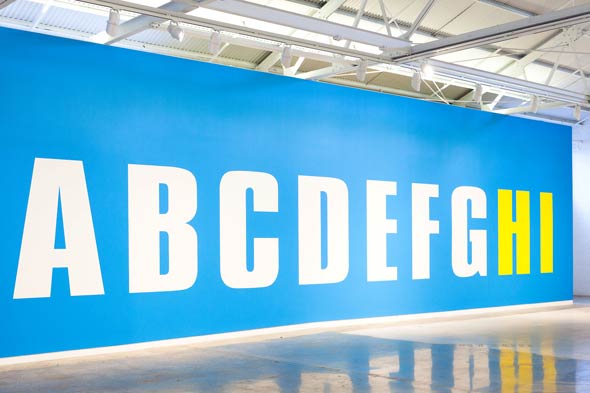
Kay Rosen, “HI,” 1997/2012, in “Girl Talk: Women and Text,” at the Contemporary Art Museum, Raleigh.
Ms. Rosen has explained, “I think of language as found material, and HI is an example of how meaning can be discovered in the raw material that is the alphabet. A personal message emerges from an impersonal system.”
Known for his vibrant installations composed of countless pieces of embroidery thread which together transform the space, Mr. Dawe’s Blanton installation, Plexus No. 44, will create an immersive experience in the museum’s lobby. Similar works by Mr. Dawe have been installed at the Amon Carter Museum of American Art, the Crystal Bridges Museum of American Art, and the Smithsonian American Art Museum’s Renwick Gallery.

Rendering of Gabriel Dawe, “Plexus No. 44,” 2023. ©Gabriel Dawe
Mr. Dawe explains that the color gradient of his Plexus installations, “alludes to a symbolic quest to materialize light, to give it density, so that I can offer the viewer an approximation of things otherwise inaccessible to us — a glimmer of hope that brings us closer to the transcendent.”
Carter E. Foster, the Blanton’s Deputy Director for Curatorial Affairs, remarked, “Rosen’s and Dawe’s visually powerful works complement strengths in the Blanton’s collection. Dawe’s investigation of color and light beautifully complements Ellsworth Kelly’s Austin, while Kay Rosen’s HI bridges U.S. conceptual art and Latin American concrete poetry as well as the general importance of language in Latin American art. Besides these striking connections, their works impart a lot of joy and playfulness. I cannot wait for visitors to experience them.”
Both pieces, along with a large-scale mural by Carmen Herrera and Bill Fontana’s sound installation, will be unveiled at the Blanton’s Gala on April 29, 2023. The works and the new grounds will be opened to the public during the celebration on Saturday, May 13, starting at 2 pm.
The post Blanton Museum of Art Announces Two New Permanent Installations appeared first on Glasstire.
Saturday Morning Breakfast Cereal - Your Father's

Click here to go see the bonus panel!
Hovertext:
Also you'll want to call this tech support number your father called before you.
Today's News:
This is probably the right place to mention we made the thing people kept asking for.

Nuclear Fusion: Who'll Be First To Make It Work?
Correction to what I say at 25:08 -- That should have been 100 million Kelvin, not 100! Sorry about that.
In this video we survey the biggest and most interesting nuclear fusion startups which want to make nuclear fusion commercially relevant. What are the different approaches, how far along are they, and what are the pros and cons. This video has been in the works for months and it's the longest video we've made so far, almost half an hour, so I hope you have a comfortable seat!
Many thanks to Jordi Busqué for helping with this video http://jordibusque.com/
👉 Transcript and References on Patreon ➜ https://www.patreon.com/Sabine
💌 Support us on Donatebox ➜ https://donorbox.org/swtg
📩 Sign up for my weekly science newsletter. It's free! ➜ https://sabinehossenfelder.com/newsletter/
🔗 Join this channel to get access to perks ➜
https://www.youtube.com/channel/UC1yNl2E66ZzKApQdRuTQ4tw/join
00:00 Intro
01:35 Nuclear Fusion Pros and Cons
04:37 Approaches to Nuclear Fusion
07:34 Field Confinement, Tokamaks
12:57 Field Confinement, Stellarators
16:19 Field Confinement, Plasma Beams
21:15 Inertial Confinement
24:04 Hybrid Approaches
27:31 Summary
28:20 Learn Physics With Brilliant
#science #tech
Biden wants Congress to boost penalties for executives when mid-sized banks fail

President Biden said the current law limits his administration's power to hold executives responsible when mid-sized banks fail due to mismanagement.
(Image credit: Yuki Iwamura/AP)

Turkey says it will ratify Finland's bid to join NATO

"NATO will become stronger with Finland's membership and thus, I believe, will play an active role in maintaining global security and stability," Turkey's president said Friday.
(Image credit: Burhan Ozbilici/AP)

Parliament-Funkadelic singer Clarence 'Fuzzy' Haskins dies at 81

The influential vocalist played a key role in shaping the funk and R&B sound of the 1970s.
(Image credit: Rock & Roll Hall of Fame)
