Shared posts

04 Aug 22:49

Five-Minute Tours: Ernesto Marenco at Heidi Vaughan Fine Art, Houston

by Glasstire

GRENADE, Polished Steel, 4 1/2 x 3 1/2 x 3 inches, 2021

Note: the following is part of Glasstire’s series of short videos, Five-Minute Tours, for which commercial galleries, museums, nonprofits and artist-run spaces across the state of Texas send us video walk-throughs of their current exhibitions. Let’s get your show in front of an audience.

See other Five-Minute Tours here.

Petite Retrospective at Heidi Vaughan Fine Art, Houston. Dates: June 24 –Sept 2, 2023.

Via the gallery:

“HEIDI VAUGHAN FINE ART is proud to present Petite Retrospective, an exhibition of poetic art objects by Ernesto Marenco. Petite Retrospective will travel to the Museo de la Cancillería in Mexico City on December 7, 2023, and will be Marenco’s seventh museum solo show.

The work is about time, poetry, and the human condition expressed through the common object as its representative. According to Marenco, ‘Some people say I make ready-mades, assemblages, sculptures, or art objects, but for me, my work is closer to literature, specifically to poetry or short stories. I consider myself a writer or poet, but I don’t write with pencil and paper. I write with abandoned and uncommon materials and create three-dimensional poetry.’

Born in 1960 in Mexico City, Ernesto Marenco is the son of an exiled Nicaraguan poet and politician. He was surrounded from childhood by artists, painters, writers, and poets who had been exiled to Mexico and countries in Central and South America from the Spanish Civil War. Marenco is an artist and visual poet who has more than 45 years of experience translating the language of poetry to everyday objects. His objects express a particular and committed manner
and a great sense of humor. The artist has exhibited his work in international galleries and museums and produced more than 20 covers for books, mainly poetry books, placing him as one of the leading representatives of contemporary Mexican art objects in Latin America. Marenco currently lives and works in Houston.”

The post Five-Minute Tours: Ernesto Marenco at Heidi Vaughan Fine Art, Houston appeared first on Glasstire.

04 Aug 22:46

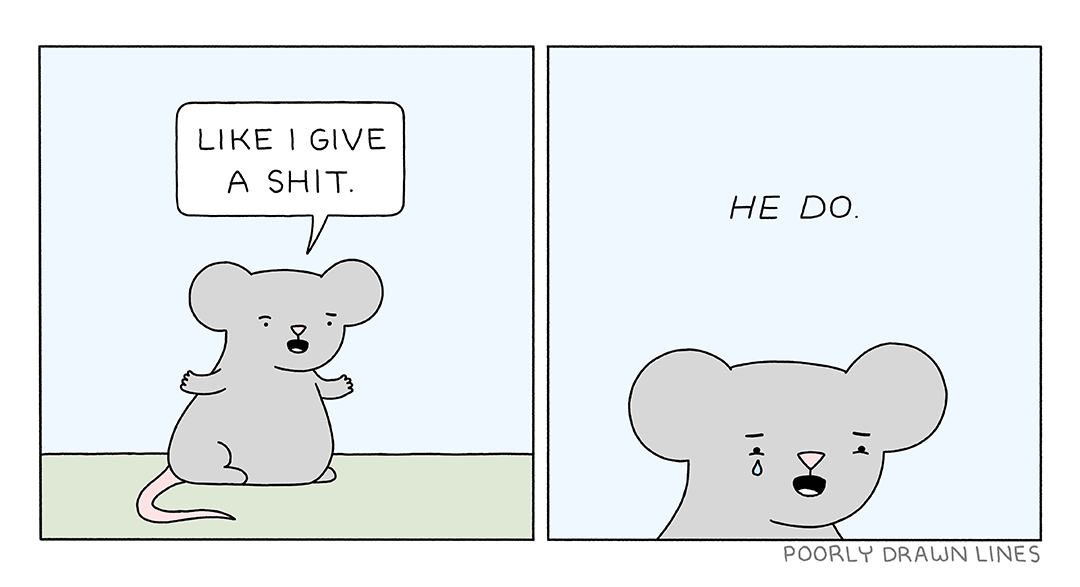
Give a Shit

by Reza
04 Aug 22:46

BABYLON

by noreply@blogger.com (JerryMaguire)
04 Aug 22:44

EIT! KIDZ KLUB LIVE IN CHATTANOOGA!

by noreply@blogger.com (JerryMaguire)
EIT! Kidz Klub LIVE 8/3 at 7 PM at Stove Works 1250 East 13th Street Chattanooga, TN 37408 Get tix: https://www.eventbrite.com/e/everything-is-terrible-kidz-klub-tickets-656829904927
04 Aug 22:42

Saturday Morning Breakfast Cereal - Game

by Zach Weinersmith


Click here to go see the bonus panel!

Hovertext:
Some of the kids in my family once invented a version where you had to get one of each color in order to get through the final step, mathematically guaranteeing the game could never end. The didn't mind at all. I feel like there's a lesson here that I am too old to understand.


Today's News:
04 Aug 22:42

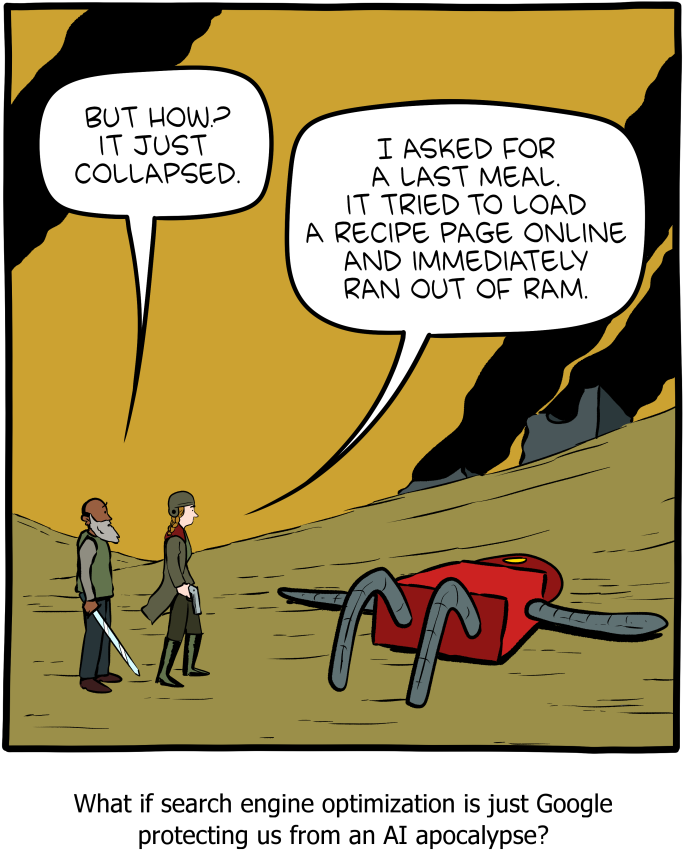
Saturday Morning Breakfast Cereal - Rammed

by Zach Weinersmith


Click here to go see the bonus panel!

Hovertext:
Bam, alignment solved. Earth should join my patreon as a thankyou.


Today's News:

Just 8 more days!

04 Aug 22:39

Pluralistic: Cloudburst (03 August 2023)

by Cory Doctorow


Today's links


An animation built around an image of dark, menacing storm clouds. Peeking through the clouds is a 386 motherboard, which slowly crossfades to a Code Waterfall effect from the credit sequence of the Wachowskis' 'The Matrix.' The animation crossfades back and forth in an endless loop.

Cloudburst (permalink)

Enshittification isn't inevitable: under different conditions and constraints, the old, good internet could have given way to a new, good internet. Enshittification is the result of specific policy choices: encouraging monopolies; enabling high-speed, digital shell games; and blocking interoperability.

First we allowed companies to buy up their competitors. Google is the shining example here: having made one good product (search), they then fielded an essentially unbroken string of in-house flops, but it didn't matter, because they were able to buy their way to glory: video, mobile, ad-tech, server management, docs, navigation…They're not Willy Wonka's idea factory, they're Rich Uncle Pennybags, making up for their lack of invention by buying out everyone else:

https://locusmag.com/2022/03/cory-doctorow-vertically-challenged/

But this acquisition-fueled growth isn't unique to tech. Every administration since Reagan (but not Biden! more on this later) has chipped away at antitrust enforcement, so that every sector has undergone an orgy of mergers, from athletic shoes to sea freight, eyeglasses to pro wrestling:

https://www.whitehouse.gov/cea/written-materials/2021/07/09/the-importance-of-competition-for-the-american-economy/

But tech is different, because digital is flexible in a way that analog can never be. Tech companies can "twiddle" the back-ends of their clouds to change the rules of the business from moment to moment, in a high-speed shell-game that can make it impossible to know what kind of deal you're getting:

https://pluralistic.net/2023/02/27/knob-jockeys/#bros-be-twiddlin

To make things worse, users are banned from twiddling. The thicket of rules we call IP ensure that twiddling is only done against users, never for them. Reverse-engineering, scraping, bots – these can all be blocked with legal threats and suits and even criminal sanctions, even if they're being done for legitimate purposes:

https://locusmag.com/2020/09/cory-doctorow-ip/

Enhittification isn't inevitable but if we let companies buy all their competitors, if we let them twiddle us with every hour that God sends, if we make it illegal to twiddle back in self-defense, we will get twiddled to death. When a company can operate without the discipline of competition, nor of privacy law, nor of labor law, nor of fair trading law, with the US government standing by to punish any rival who alters the logic of their service, then enshittification is the utterly foreseeable outcome.

To understand how our technology gets distorted by these policy choices, consider "The Cloud." Once, "the cloud" was just a white-board glyph, a way to show that some part of a software's logic would touch some commodified, fungible, interchangeable appendage of the internet. Today, "The Cloud" is a flashing warning sign, the harbinger of enshittification.

When your image-editing tools live on your computer, your files are yours. But once Adobe moves your software to The Cloud, your critical, labor-intensive, unrecreatable images are purely contingent. At at time, without notice, Adobe can twiddle the back end and literally steal the colors out of your own files:

https://pluralistic.net/2022/10/28/fade-to-black/#trust-the-process

The finance sector loves The Cloud. Add "The Cloud" to a product and profits (money you get for selling something) can turn into rents (money you get for owning something). Profits can be eroded by competition, but rents are evergreen:

https://pluralistic.net/2023/07/24/rent-to-pwn/#kitt-is-a-demon

No wonder The Cloud has seeped into every corner of our lives. Remember your first iPod? Adding music to it was trivial: double click any music file to import it into iTunes, then plug in your iPod and presto, synched! Today, even sophisticated technology users struggle to "side load" files onto their mobile devices. Instead, the mobile duopoly – Apple and Google, who bought their way to mobile glory and have converged on the same rent-seeking business practices, down to the percentages they charge – want you to get your files from The Cloud, via their apps. This isn't for technological reasons, it's a business imperative: 30% of every transaction that involves an app gets creamed off by either Apple or Google in pure rents:

https://www.kickstarter.com/projects/doctorow/red-team-blues-another-audiobook-that-amazon-wont-sell/posts/3788112

And yet, The Cloud is undeniably useful. Having your files synch across multiple devices, including your collaborators' devices, with built-in tools for resolving conflicting changes, is amazing. Indeed, this feat is the holy grail of networked tools, because it's how programmers write all the software we use, including software in The Cloud.

If you want to know how good a tool can be, just look at the tools that toolsmiths use. With "source control" – the software programmers use to collaboratively write software – we get a very different vision of how The Cloud could operate. Indeed, modern source control doesn't use The Cloud at all. Programmers' workflow doesn't break if they can't access the internet, and if the company that provides their source control servers goes away, it's simplicity itself to move onto another server provider.

This isn't The Cloud, it's just "the cloud" – that whiteboard glyph from the days of the old, good internet – freely interchangeable, eminently fungible, disposable and replaceable. For a tool like git, Github is just one possible synchronization point among many, all of which have a workflow whereby programmers' computers automatically make local copies of all relevant data and periodically lob it back up to one or more servers, resolving conflicting edits through a process that is also largely automated.

There's a name for this model: it's called "Local First" computing, which is computing that starts from the presumption that the user and their device is the most important element of the system. Networked servers are dumb pipes and dumb storage, a nice-to-have that fails gracefully when it's not available.

The data structures of source-code are among the most complicated formats we have; if we can do this for code, we can do it for spreadsheets, word-processing files, slide-decks, even edit-decision-lists for video and audio projects. If local-first computing can work for programmers writing code, it can work for the programs those programmers write.

Local-first computing is experiencing a renaissance. Writing for Wired, Gregory Barber traces the history of the movement, starting with the French computer scientist Marc Shapiro, who helped develop the theory of "Conflict-Free Replicated Data" – a way to synchronize data after multiple people edit it – two decades ago:

https://www.wired.com/story/the-cloud-is-a-prison-can-the-local-first-software-movement-set-us-free/

Shapiro and his co-author Nuno Preguiça envisioned CFRD as the building block of a new generation of P2P collaboration tools that weren't exactly serverless, but which also didn't rely on servers as the lynchpin of their operation. They published a technical paper that, while exiting, was largely drowned out by the release of GoogleDocs (based on technology built by a company that Google bought, not something Google made in-house).

Shapiro and Preguiça's work got fresh interest with the 2019 publication of "Local-First Software: You Own Your Data, in spite of the Cloud," a viral whitepaper-cum-manifesto from a quartet of computer scientists associated with Cambridge University and Ink and Switch, a self-described "industrial research lab":

https://www.inkandswitch.com/local-first/static/local-first.pdf

The paper describes how its authors – Martin Kleppmann, Adam Wiggins, Peter van Hardenberg and Mark McGranaghan – prototyped and tested a bunch of simple local-first collaboration tools built on CFRD algorithms, with the goal of "network optional…seamless collaboration." The results are impressive, if nascent. Conflicting edits were simpler to resolve than the authors anticipated, and users found URLs to be a good, intuitive way of sharing documents. The biggest hurdles are relatively minor, like managing large amounts of change-data associated with shared files.

Just as importantly, the paper makes the case for why you'd want to switch to local-first computing. The Cloud is not reliable. Companies like Evernote don't last forever – they can disappear in an eyeblink, and take your data with them:

https://www.theverge.com/2023/7/9/23789012/evernote-layoff-us-staff-bending-spoons-note-taking-app

Google isn't likely to disappear any time soon, but Google is a graduate of the Darth Vader MBA program ("I have altered the deal, pray I don't alter it any further") and notorious for shuttering its products, even beloved ones like Google Reader:

https://www.theverge.com/23778253/google-reader-death-2013-rss-social

And while the authors don't mention it, Google is also prone to simply kicking people off all its services, costing them their phone numbers, email addresses, photos, document archives and more:

https://pluralistic.net/2022/08/22/allopathic-risk/#snitches-get-stitches

There is enormous enthusiasm among developers for local-first application design, which is only natural. After all, companies that use The Cloud go to great lengths to make it just "the cloud," using containerization to simplify hopping from one cloud provider to another in a bid to stave off lock-in from their cloud providers and the enshittification that inevitably follows.

The nimbleness of containerization acts as a disciplining force on cloud providers when they deal with their business customers: disciplined by the threat of losing money, cloud companies are incentivized to treat those customers better. The companies we deal with as end-users know exactly how bad it gets when a tech company can impose high switching costs on you and then turn the screws until things are almost-but-not-quite so bad that you bolt for the doors. They devote fantastic effort to making sure that never happens to them – and that they can always do that to you.

Interoperability – the ability to leave one service for another – is technology's secret weapon, the thing that ensures that users can turn The Cloud into "the cloud," a humble whiteboard glyph that you can erase and redraw whenever it suits you. It's the greatest hedge we have against enshittification, so small wonder that Big Tech has spent decades using interop to clobber their competitors, and lobbying to make it illegal to use interop against them:

https://locusmag.com/2019/01/cory-doctorow-disruption-for-thee-but-not-for-me/

Getting interop back is a hard slog, but it's also our best shot at creating a new, good internet that lives up the promise of the old, good internet. In my next book, The Internet Con: How to Seize the Means of Computation (Verso Books, Sept 5), I set out a program fro disenshittifying the internet:

https://www.versobooks.com/products/3035-the-internet-con

The book is up for pre-order on Kickstarter now, along with an independent, DRM-free audiobooks (DRM-free media is the content-layer equivalent of containerized services – you can move them into or out of any app you want):

http://seizethemeansofcomputation.org

Meanwhile, Lina Khan, the FTC and the DoJ Antitrust Division are taking steps to halt the economic side of enshittification, publishing new merger guidelines that will ban the kind of anticompetitive merger that let Big Tech buy its way to glory:

https://www.theatlantic.com/ideas/archive/2023/07/biden-administration-corporate-merger-antitrust-guidelines/674779/

The internet doesn't have to be enshittified, and it's not too late to disenshittify it. Indeed – the same forces that enshittified the internet – monopoly mergers, a privacy and labor free-for-all, prohibitions on user-side twiddling – have enshittified everything from cars to powered wheelchairs. Not only should we fight enshittification – we must.

(Image: Drahtlos, CC BY-SA 4.0; cdsessums, CC BY-SA 2.0; modified)


Hey look at this (permalink)


A Wayback Machine banner.

This day in history (permalink)

#20yrsago Charlie Stross on mini-PCs http://www.antipope.org/charlie/blosxom.cgi/2003/Aug/3#ukuug-1

#10yrsago Iranian government unveils finger-amputating machine for punishing “thieves” https://www.telegraph.co.uk/news/worldnews/middleeast/iran/9831727/Iran-unveils-finger-amputating-machine-for-use-on-thieves.html

#10yrsago Colorado lawmakers’ license plates exempt them from speed cams & parking tix https://consumerist.com/2013/08/02/colorado-lawmakers-have-magical-license-plates-that-prevent-them-from-getting-tickets/

#10yrsago My workflow in the WSJ https://www.wsj.com/articles/SB10001424127887324354704578635792701857784">https://www.wsj.com/articles/SB10001424127887324354704578635792701857784

#5yrsago Audible puts the screws to indie authors https://web.archive.org/web/20180817070240/http://www.scottcarney.com/2018/08/acx-the-good-the-bad-and-the-ugly/

#5yrsago Googlers revolt against Google’s secret plan to offer censored search tools in China https://theintercept.com/2018/08/03/google-search-engine-china-censorship-backlash/

#5yrsago How the NYPD recriminalized marijuana after the state decriminalized it https://www.nytimes.com/2018/08/02/nyregion/marijuana-police-nyc.html

#5yrsago How Jpay gouges prisoners’ families for “digital postage stamps” https://www.wired.com/story/jpay-securus-prison-email-charging-millions/

#5yrsago Listen: ZZTop’s “Legs” and U2’s “Streets Have No Name” are the same song https://www.youtube.com/watch?v=cBYQ7cMJhkQ

#5yrsago Fraudsters offers thousands to low-waged telco employees for help with SIM Swap scams https://www.vice.com/en/article/3ky5a5/criminals-recruit-telecom-employees-sim-swapping-port-out-scam

#5yrsago Border family separation isn’t “zero tolerance” – CBP looked for parents to charge so they could kidnap kids https://theintercept.com/2018/08/03/zero-tolerance-family-separations-trump-immigration-family-separation/


Colophon (permalink)

Today's top sources:

Currently writing:

  • A Little Brother short story about DIY insulin PLANNING
  • Picks and Shovels, a Martin Hench noir thriller about the heroic era of the PC. FIRST DRAFT COMPLETE, WAITING FOR EDITORIAL REVIEW

  • The Bezzle, a Martin Hench noir thriller novel about the prison-tech industry. FIRST DRAFT COMPLETE, WAITING FOR EDITORIAL REVIEW

  • Vigilant, Little Brother short story about remote invigilation. ON SUBMISSION

  • Moral Hazard, a short story for MIT Tech Review's 12 Tomorrows. FIRST DRAFT COMPLETE, ACCEPTED FOR PUBLICATION

  • Spill, a Little Brother short story about pipeline protests. ON SUBMISSION

Latest podcast: The Internet Con: How to Seize the Means of Computation (audiobook outtake) https://craphound.com/news/2023/08/01/the-internet-con-how-to-seize-the-means-of-computation-audiobook-outtake/

Upcoming appearances:

Recent appearances:

Latest books:

Upcoming books:

  • The Internet Con: A nonfiction book about interoperability and Big Tech, Verso, September 2023
  • The Lost Cause: a post-Green New Deal eco-topian novel about truth and reconciliation with white nationalist militias, Tor Books, November 2023


This work – excluding any serialized fiction – is licensed under a Creative Commons Attribution 4.0 license. That means you can use it any way you like, including commercially, provided that you attribute it to me, Cory Doctorow, and include a link to pluralistic.net.

https://creativecommons.org/licenses/by/4.0/

Quotations and images are not included in this license; they are included either under a limitation or exception to copyright, or on the basis of a separate license. Please exercise caution.


How to get Pluralistic:

Blog (no ads, tracking, or data-collection):

Pluralistic.net

Newsletter (no ads, tracking, or data-collection):

https://pluralistic.net/plura-list

Mastodon (no ads, tracking, or data-collection):

https://mamot.fr/@pluralistic

Medium (no ads, paywalled):

https://doctorow.medium.com/

(Latest Medium column: "Microincentives and Enshittification: How the Curse of Bigness wrecked Google Search" https://doctorow.medium.com/microincentives-and-enshittification-574290ea196f)

Twitter (mass-scale, unrestricted, third-party surveillance and advertising):

https://twitter.com/doctorow

Tumblr (mass-scale, unrestricted, third-party surveillance and advertising):

https://mostlysignssomeportents.tumblr.com/tagged/pluralistic

"When life gives you SARS, you make sarsaparilla" -Joey "Accordion Guy" DeVilla

04 Aug 15:45

Comic for 2023.08.02 - Rob has massive wet plops

New Cyanide and Happiness Comic
04 Aug 15:34

let’s talk about unusual office traditions

by Ask a Manager

This post was written by Alison Green and published on Ask a Manager.

One of the most interesting things about offices is how they develop their own subcultures, complete with rituals and traditions. Here are some interesting office traditions that have been shared here in the past:

•. For close to 15 years now, dressing up as one of your coworkers has been a Halloween tradition where I work. It actually started when someone came dressed as me the first year. A year later, I waited until I saw what a coworker was wearing that day, got a co-conspirator to bring a matching outfit, and sat down next to them. People have worn the CEO’s face printed out as a mask. Nobody’s ever gotten offended by it, it’s just a strange tradition now. I think it has more to do with the culture and the intent than anything else.. our clones are in a spirit of fun and respect.

•. I live in a rural, farming community. We have an egg lady. Once every two weeks she stops by and delivers fresh eggs to a rotation of people who order from her. She is so cute – she wears a patchwork, brightly colored bag over her shoulders where she keeps all her eggs. When I first started, I asked a coworker who she was and they just said “That’s the egg lady.” No other explanation required, I guess!

•. I don’t know if this is strange, but I worked for a company that had an office massage therapist who came by every Friday. The massage lasted about five minutes focused on your neck, shoulders and back. Now that I think of it, I guess the strange part was all the moaning and groaning on Fridays! If you were unfamiliar with the office culture and walked into the cubicle farm and HEARD the massage but didn’t SEE the massage therapist, there must have been so many questions!

•. A weird tradition I’ve seen in several NYC law firms, pre-pandemic: A shoe shine guy going around the office on a regular schedule. He sits on his little box in the hall to shine shoes.

•. In Iran we had a tea man who was continuously busy bringing people very small glasses of tea, and sugar cubes to place in your teeth as you drank the tea. I did not develop that habit, but it was a necessary role in every office. This in 1972, thereabouts. It may be different now.

•. We have interns who graduate into permanent employees after finishing their PhDs. We have a strange tradition of making people recite their thesis topic in iambic pentameter.

Let’s hear about unusual office traditions you’ve seen or experienced. (Note: we’re looking for fun and interesting here, not depressing.)

04 Aug 05:37

Royal Mail issues Discworld stamps

by Rob Beschizza

The characters of Terry Pratchett's Discworld setting are to grace stamps issue from the Royal Mint, featuring artwork by Paul Kidby. You can pre-order them (and various other collectibles) now.

oyal Mail has today revealed eight Special Stamps they are issuing to celebrate Terry Pratchett's Discworld series, making the 40th anniversary of The Colour of Magic, his first book in the series.

Read the rest
02 Aug 11:33

NRA Awards Scholarship To Toddler Who Shot Entire Family

FAIRFAX, VA—Presenting the toddler with an oversized novelty check for $20,000, the National Rifle Association reportedly awarded a scholarship Tuesday to 18-month-old Jax Edelwright for shooting his entire family. “The NRA is proud to honor little Jax here for his outstanding work in the field of gun negligence,”…

Read more...

02 Aug 11:33

Fenway Park Scoreboard Fan Messages All Child Support Demands

02 Aug 11:32

Kids Explain How Disney Turned Them Gay

The Onion asked children how Disney had preyed on them, brainwashed them, and forced them to identify as LGBTQIA+ through the studio’s woke, sexualized movies, and this is what they said.

Read more...

02 Aug 11:29

Apple SVP Of Hardware Engineering Hints That iPhones Won’t Have Removable Batteries Despite EU’s New Rules; Says It Will Reduce Durability

by Omar Sohail

iPhones with replaceable batteries

An earlier EU ruling will require companies like Apple to offer devices to customers that feature ‘easy to replace’ batteries. However, despite the enforcement of these rules, the Cupertino firm’s Senior Vice President of hardware engineering hints that such a change will not be arriving to the company’s devices as it can compromise the internal integrity, reducing the overall durability.

Assuming new EU rules are stringent, Apple may be forced to exit several markets entirely

Apple executive John Ternus spoke in an interview with the YouTube channel ORBIT that was spotted by Supercharged regarding the possibility of bringing removable batteries to future iPhones. Though most of the interview focused on Apple’s environmental efforts that Lisa Jackson led, Ternus believes that if consumers truly want a battery replacement for their devices, there needs to be a safer way to make that happen.

In other words, the company’s SVP of hardware engineering believes that iPhone owners would inadvertently harm themselves when performing a battery replacement procedure. While the executive may have said this out of concern for the people’s well-being, it is likely that this statement was made to ensure that one of Apple’s revenue streams is not severed.

Despite the technology giant shipping millions of iPhones in a calendar year, it stands to make a ton of money through battery replacements alone, with U.S. customers needing to pay $99 for a battery replacement for the base iPhone 14 if they have not opted for AppleCare+. Ternus states that making an internal component more repairable can also add a potential failure point in that area, making devices less durable.

He also mentions that making batteries easily replaceable would make incorporating water and dust-resistant seals on iPhones difficult. Ternus also says that Apple wants to build products that last while also pointing out that iPhones have held their resale value quite well over the years thanks to their improved durability.

At the end of the day, despite offering customers a premium experience when they purchase their first iPhone, Apple is a company focused on generating profits, so assuming that EU’s rules do not allow for any ‘bending of the rules,’ the iPhone maker would exit the markets that fall under the European Union rather than be forced to change the design. Even if Ternus did not explicitly admit this in the interview, most of us knew where his mind was at.

Fortunately, even if Apple does not offer customers an easy solution to replace the batteries in the future, it does not mean the company will make the iPhone 15 family difficult to take apart, as the upcoming lineup is said to be easily repairable.

Written by Omar Sohail
02 Aug 11:28

How strong are the newest criminal charges against Donald Trump?

by Ian Millhiser
Trump stands smiling with hands clasped.
Donald Trump now faces his third criminal indictment. | Getty Images

Trump will finally stand trial for his attempt to destroy US democracy.

Well, it finally happened. After being indicted twice on relatively minor charges — an alleged scheme to cover up an extramarital affair in New York, and unlawful retention of classified documents in a Florida federal court — former President Donald Trump will face trial for one of the most monumental crimes ever prosecuted by the Department of Justice: an alleged scheme to steal the presidency itself.

The actual charges against Trump under this, the third indictment facing the former president, arise under four federal statutes. Trump is accused of defrauding the federal government, of obstructing an official government proceeding (the Congressional certification of President Joe Biden’s 2020 victory over Trump), of engaging in a conspiracy to obstruct that proceeding, and of violating a federal law that makes it a crime to “conspire to injure, oppress, threaten, or intimidate any person” in the “free exercise or enjoyment of any right or privilege secured to him by the Constitution or laws of the United States.”

This later statute has been used in the past to prosecute ballot stuffing schemes, and similar efforts to rig elections by changing the vote count. As the Supreme Court held in Anderson v. United States (1974), every voter in a federal election “has a right under the Constitution to have his vote fairly counted, without its being distorted by fraudulently cast votes.”

The new indictment lays out many facts that will be familiar to anyone who followed the congressional hearings on the January 6 attack on the US Capitol, or who has closely followed news reports about Trump’s failed efforts to overturn the 2020 election.

Broadly, the indictment alleges that Trump and six co-conspirators worked together to assemble slates of fraudulent members of the Electoral College, who would cast fake electoral votes for Trump. And it details several incidents when Trump allegedly lied to state or federal officials in order to persuade them to tamper with election results or otherwise try to change the results of the election.

Among other things, the indictment describes the infamous call between Trump and Georgia Secretary of State Brad Raffensperger, in which Trump urged Raffensperger to “find 11,780 votes” (Trump lost Georgia by 11,779 votes). It also describes several efforts by Trump to goad Vice President Mike Pence, who played a ceremonial role in certifying Biden’s victory, into joining the conspiracy to overturn the election results, as well as numerous other efforts to pressure government officials by Trump and his co-conspirators.

None of Trump’s co-conspirators are identified by name in the indictment, but the indictment provides enough details about their alleged actions that it is not hard to guess who some of them are. The Trump lawyer who allegedly pressured Arizona’s House speaker to “use the legislature to circumvent the process by which legitimate electors would be ascertained,” for example, is probably Rudy Giuliani. The co-conspirator who allegedly “devised and attempted to implement a strategy to leverage the Vice President’s ceremonial role overseeing the certification proceeding” is probably John Eastman.

The latest charges against Trump are significant not only because they involve the most egregious alleged crimes committed by the former president. They are also most likely prosecutors’ best shot at securing a conviction against Trump — at least among the three indictments against Trump that have been announced so far.

To convict Trump of a felony, New York prosecutors will need to prove that he falsified business records in order to cover up another crime, and it is not entirely clear how they plan to do that. Meanwhile, the Florida classified documents case will be heard by Judge Aileen Cannon, a Trump appointee who previously handed down a series of extremely dubious decisions benefiting Trump, that were eventually reversed by an appeals court. It is far from clear that prosecutors seeking a conviction against Trump can receive a fair hearing in Cannon’s courtroom.

The latest indictment, by contrast, neither turns on uncertain legal questions like the New York case, nor will it be heard by Cannon — who sits in Florida. The new criminal charges against Trump will be heard by Judge Tanya Chutkan, an Obama appointee.

Nevertheless, to convict Trump, Special Prosecutor Jack Smith will have to convince a jury to unanimously find Trump guilty. That means that just one pro-Trump juror, one who is determined to acquit the former president no matter what the evidence shows, could single-handedly sabotage Smith’s prosecution and force a mistrial.

And, should Trump be convicted, that conviction will undoubtedly be appealed to higher courts. Though there are no glaring legal flaws in this new indictment, there are at least two legal challenges that Trump’s lawyers could bring against at least some of the charges.

Trump is charged under the same statute that was used against many other January 6 defendants

One of the latest charges against Trump arise under a law implicating anyone who “corruptly ... obstructs, influences, or impedes any official proceeding, or attempts to do so.” This is the same statute that’s been used to secure convictions against many of the Trump supporters who invaded the US Capitol during the January 6 putsch.

The overwhelming majority of judges who’ve heard January 6 cases concluded that this prohibition on obstructing an official proceeding applies to defendants who invaded the Capitol. That said, two judges — both Trump appointees — disagree with this consensus view.

To understand the argument against allowing such prosecutions, it’s helpful to first read the entire statutory language criminalizing obstruction of an official proceeding:

Whoever corruptly—

(1) alters, destroys, mutilates, or conceals a record, document, or other object, or attempts to do so, with the intent to impair the object’s integrity or availability for use in an official proceeding; or

(2) otherwise obstructs, influences, or impedes any official proceeding, or attempts to do so,

shall be fined under this title or imprisoned not more than 20 years, or both.

Most judges have read this law broadly. As Judge Florence Pan wrote in an opinion for the United States Court of Appeals for the DC Circuit, “under the most natural reading of the statute,” it “applies to all forms of corrupt obstruction of an official proceeding” regardless of whether that obstruction involves the “record, document, or other object” mentioned in the statute’s first provision.

Moreover, of the 15 federal trial judges who’ve heard January 6 prosecutions, “no fewer than 14 district judges in this jurisdiction have adopted the broad reading of the statute urged by the government to uphold the prosecution of defendants who allegedly participated in the Capitol riot.” Only one of these 15 judges, Trump appointee Carl Nichols, disagreed with this consensus view.

Nichols claimed that the second provision of the statute — the broader one that applies to anyone who “otherwise obstructs, influences, or impedes” an official proceeding — “must be interpreted as limited by” its first provision. Thus, he claimed that the statute “requires that the defendant have taken some action with respect to a document, record, or other object in order to corruptly obstruct, impede or influence an official proceeding.”

Meanwhile, another Trump judge, Gregory Katsas, dissented from Judge Pan’s opinion adopting the consensus reading of this statute. Katsas’s dissenting opinion is, frankly, very difficult to parse. But he concludes that the statute “covers only acts that impair the integrity or availability of evidence.”

In any event, Nichols and Katsas are both extreme outliers within the judiciary, as most judges agree with Pan that “the meaning of the statute is unambiguous” and it clearly applies broadly to anyone who “obstructs, influences, or impedes any official proceeding.” Indeed, one judge who agrees with Pan is Judge Justin Walker, another Trump appointee to the DC Circuit who joined most of Pan’s opinion. So Nichols’s and Katsas’s idiosyncratic readings of the statute isn’t even shared by all of Trump’s judges.

That said, the Supreme Court has not yet weighed in on this debate. And, if Trump is convicted of violating this obstruction-of-an-official-proceeding statute, his case is likely to reach the justices under the most politically tense circumstances. By the time this case is appealed to the Supreme Court, Trump could very well be the Republican Party’s 2024 nominee for president.

So it’s easy to see why the six justices appointed by Republican presidents, many of whom went out of their way to protect Trump from embarrassing investigations during his presidency, might not want to let a conviction stand that could prevent their political party from winning the next presidential election — even if striking down that conviction would require them to embrace an unusual reading of a federal law that few judges accept.

It is a crime to tamper with a federal election, but what about Congress’s certification of the Electoral College vote?

The other legal attack that Trump’s lawyers could potentially deploy against the latest round of charges against their client involves 18 USC § 241, the statute making it a crime to conspire against another person’s “free exercise or enjoyment of any right or privilege secured to him by the Constitution or laws of the United States.”

The Supreme Court has long held that the right to vote, and to not have that vote diminished or diluted by a fraudulent scheme, is one of the rights secured by the Constitution and US law. In Anderson, for example, the Court upheld the convictions, under the same statute that Trump is now accused of violating, of several West Virginia officials who conspired to cast fake votes in favor of a county commissioner candidate in a Democratic primary election.

Significantly, the fake ballots did not simply cast fraudulent votes for this one county commissioner, they also cast fraudulent votes for two federal candidates — then-Rep. Ken Hechler, and then-Sen. Robert Byrd.

Though Hechler and Byrd would have won their primaries with or without these fraudulent votes, Anderson held that the simple act of conspiring to cast fake ballots in a federal election was a crime. “It has long been settled that § 241 embraces a conspiracy to stuff the ballot box at an election for federal officers, and thereby to dilute the value of votes of qualified voters.” Such a scheme injures “the right of all voters in a federal election to express their choice of a candidate and to have their expressions of choice given full value and effect, without being diluted or distorted by the casting of fraudulent ballots.”

Trump’s lawyers may try to distinguish Anderson from the case against their client because the two cases involve somewhat different facts. Anderson involved a scheme to directly stuff a ballot box, while the case against Trump involves an attempt to get Congress to illegally certify Trump as the winner of the Electoral College after an election had already taken place and the ballots had already been counted.

To be clear, this distinction should not matter. Anderson held that the “right of all voters in a federal election to express their choice of a candidate” is illegally injured if their ballots are diluted by a single fraudulent vote — even if that vote did not change the outcome of the election. Trump, meanwhile, is accused to effectively trying to nullify every single one of the 81,282,916 ballots cast for Joe Biden in the 2020 election. If the relatively small bore conspiracy at issue in Anderson amounted to an unlawful conspiracy to deny a right protected by US law, then surely an attempt to change the result of an entire presidential election must also violate the law.

But federal courts, and especially the Supreme Court, cannot always be trusted to reach sensible legal decisions in the most politically charged cases — and it’s hard to image a more political charged case than a prosecution of the frontrunner for a major party’s presidential nomination. If a majority of the justices are determined to bail out Trump, they might do so by claiming that Anderson only applies to attempts to rig an election itself, and not attempts to change how Congress acts in the wake of that election.

In any event, it should be emphasized that neither of these attacks on the Trump indictment are likely to succeed. As noted above, most judges — including most Republican judges — have rejected the narrow reading of the obstruction-of-an-official-proceeding statute. And it’s likely the only reason why Anderson has not been extended to conspiracies to rig the Electoral College is because Trump’s attempt to change the result of a presidential election is unprecedented.

And even if Trump’s lawyers did manage to defeat these two charges against Trump, they still need to come up with legal arguments against the allegation that Trump conspired to defraud the federal government by deceitfully trying to alter who became an elector, and how those electoral votes were counted — and somehow convince the courts to embrace these arguments.

Nevertheless, the very fact that prosecutions of former presidents are unprecedented in the United States makes it difficult to predict how judges or juries will react to such a prosecution.

02 Aug 00:53

Green Cars

by Holly

Green Cars: Earth-friendly Electric Vehicles
Coughlan
1994

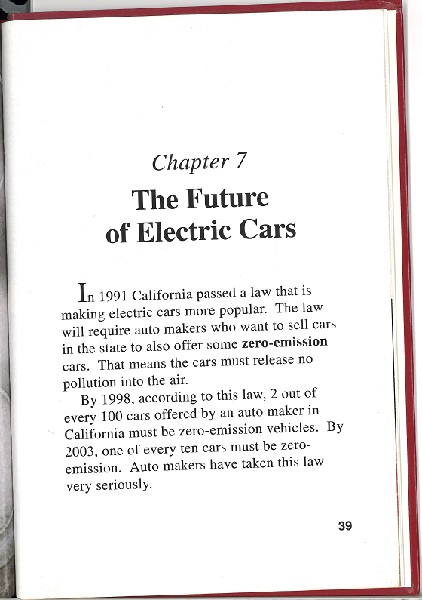
This was a cool book back in 1994! There’s a lot of old information in it, though, like how long it takes to charge the battery in an electric vehicle, the mileage range the battery has, and emissions laws. One thing still possible is that “in the future, charging stations like this one might be commonplace” (p.14, shown below). Someday, sure. They’re definitely more commonplace now than in 1994, but it’s still a challenge for EV drivers in some areas to find them. Apps like PlugShare, ChargeMap, and EVGo were definitely not a thing in 1994!

Drive carefully!

Holly

charging station
Longer trips
The future of electric cars
01 Aug 23:37

Trump Supporters React To His Third Indictment

A federal grand jury has indicted former President Donald Trump on a multitude of charges related to his effort to overturn the 2020 election. The Onion asked Trump supporters what they thought of his third indictment, and this is what they said.

Read more...

01 Aug 21:31

August 1, 2023 Outlook: Welcome to August, when hurricane season gets more complex

by Matt Lanza

One-sentence summary

There are a couple things down the road to monitor, but in the near-term Invest 96L is beginning to run short on time, as generally dry air and wind shear hinder it from organizing.

Happening now: Invest 96L struggling

One of the things that has stood out to me personally this hurricane season so far (and granted, it’s still early) is that modeling has been very hellbent on at least 3 or 4 systems developing that have never gotten past the invest or depression stage. It indicates to me that there is some sort of disconnect between what makes meteorological sense (what the models would depict) and reality. It’s clear that there has been some sort of inhibiting factor that is limiting storm development this season. So far.

Invest 96L is another feather in that cap, as it is struggling this morning, despite odds as high as 80 percent for development yesterday.

Invest 96L looks no better organized today than it did yesterday, as it continues to lift northward. Development chances are roughly 50/50 now. (Weathernerds.org)

Those odds are down to 50 percent this morning, and quite frankly, we’re going to run out of time. 96L has been dealing with a lot of wind shear of late, and that surely is not helping matters. It seems to also be embedded within a residual Saharan air layer pocket, which means it’s also struggling with some dust and drier air.

Some residual Saharan dust indicating dry air may be helping to inhibit 96L, as tropical systems cannot thrive in dry air masses. (Tropical Tidbits)

Whatever the case, if 96L develops or not, its future is pretty clear that it will turn out to sea and run out of time to develop by about Thursday or Friday. It will not impact land.

Elsewhere, the next few days look quiet.

The medium range (days 6 to 10): A wave to watch, maybe

If we squint, maybe the tropical wave emerging off Africa today and tomorrow has a chance to do something. This will plod west over the next several days, unlikely to develop, initially. If we look at the day 9 forecast for the upper air pattern over the Atlantic, a sprawling area of high pressure is expected to focus near and just south of Bermuda.

Any tropical wave that tries to develop in the Atlantic heading into next week should be directed around the southern periphery of high pressure near Bermuda and toward the Caribbean initially. (Tropical Tidbits)

This will likely force any tropical wave to initially go south and west toward the Caribbean. Thereafter, there are many questions. You can see another high over Texas on this European ensemble forecast above. Options would include the wave staying in the Caribbean if either high pressure can check in stronger or something “splitting the gap” between the two high pressure centers as explicitly shown above. Or something else. It’s early. So we’ll keep an eye on things and see if this becomes actually something to watch or just another tropical wave that fails to find a home in the Atlantic.

Fantasyland (beyond day 10): GFS going wild

Yesterday, the 12z GFS model brought a healthy storm into the Southeast U.S. after developing it from some sort of shenanigans off the Southeast coast. Interestingly, it repeated that overnight and brought a storm into the Gulf. That won’t happen as shown, but I am wondering if some of this is just the models failing to “resolve” the tropical wave shown above. Any ensemble support for development in Fantasyland seems to be connected to that wave. So the activity showing up here may be linked to what we see in the medium range. Either way, it appears things may get at least a little more active here, though how much so remains to be seen. Admittedly, I am a bit more intrigued by <waves hands> all this than I have been by much this season. We’ll keep watch.

01 Aug 20:28

Who Needs Linda?

Put that painful divorce behind you with this 456-sq.-ft. studio apt. The kitchenette is ideal for microwaving half of a Subway meatball sub, while the living space adequately accommodates the futon on which both Connor and Tyler will be sleeping every other weekend. Plus, the cozy shower stall is a perfect place to…

Read more...

01 Aug 20:28

How To Create Beautiful Lighting In Your Home

Whether you’re looking to optimize the feng shui of your apartment or make your large mansion feel cozy, the lighting in your home can make a huge difference. The Onion presents a guide to beautiful lighting in your home.

Read more...

01 Aug 20:25

should I give feedback to our interns who come across as TOO peppy and enthusiastic?

by Ask a Manager

This post was written by Alison Green and published on Ask a Manager.

A reader writes:

Each year my workplace takes on summer legal interns. Most have finished one year of law school This is often their first exposure to a legal department, and sometimes their first job. I occasionally give them projects and am asked for my feedback by their supervisor, but have never have any direct supervisory authority over them or anyone else.

I’ve noticed in the past (and in our current intern, “Savannah”) the tendency for interns to be upbeat and expound on their emotions around each project to the point of coming across as disingenuous, desperate for approval, and slightly brown-nosing. For example, I gave Savannah three days to do a monotonous task that was largely proofreading a string of legal citations. I thanked her for doing it, explained why it was necessary, and apologized for how tedious it was. Her response was to effusively gush that it was a “terrific learning opportunity” and she was “so, so happy” about it, while literally clutching her notepad to her chest. She is also constantly overexplaining how helpful it is for her to do whatever project she’s assigned and some variation of how thrilled she is to be here, which hasn’t let up in the two and a half months I’ve known her. Even when we say something mildly derogatory about having to look into a novel issue, she insists on spinning it as something like, “But it’s such a good chance to dive into that area of law!”

I see a lot of myself in Savannah and the others, and as a younger person dealt with issues related to my own tendency to fawn over perceived authority figures and be constantly upbeat, which I had to learn over time to tone down. I’m unsure whether I should be giving her or other interns advice about their general attitude and demeanor. You usually catch more flies with honey, but in this profession bonding over shared work-related frustrations and difficulties is also a necessary skill. In Savannah’s case, a more senior attorney described her as “grating” and “relentlessly happy,” and it seems to be actively overshadowing the actual work she does, which is largely good.

Until I got to the end of your letter, I was thinking, “Eh, let them be chipper and enthusiastic, even if some of it is performative. Maybe try a mild hint, but don’t worry about it beyond that.”

But if senior people are describing the behavior as “grating” and it’s overshadowing their actual work, it would be a favor to your interns to say something.

It’s interesting because we’re used to thinking of enthusiasm as a good thing — what could be wrong in being so enthusiastic about your work? But your situation shows it’s more nuanced than that, and that can be tricky for people who are new to the work world; getting the balance right can be (in some cases) more of a 301-level skill than one might expect.

It’s a delicate thing to address because (a) you don’t want your interns to think you’re saying enthusiasm is bad (it’s not! it’s just in these quantities, where it feels overwhelming) or deflate their happiness, and (b) you don’t want them to misunderstand the message and think they should start complaining about work, because that wouldn’t be a good outcome for anyone. So you’ve got to be really careful about how you frame it.

One option is to take Savannah (and future interns you see this behavior in) out to lunch, ask how things are going, and offer feedback. You could frame it as, “I think your enthusiasm is great and I’m glad you see the value in tasks that can be tedious, like proofreading citations, but I did want to offer advice on one thing related to that. I’ve noticed sometimes our interns, and I’m including you in that, are so effusive in their enthusiasm about each new task that it can almost seem performative — and I get why, you’ve probably all been advised that you should make sure to show you’re happy for the opportunity. And in general, enthusiasm is a good thing. But there’s a certain amount of professional bonding that goes on over work frustrations and difficulties too. People are more likely to relate to you as a peer — or to be able to envision you as a future peer — if you don’t come across as starry-eyed about the work. I want to be really clear that I’m not saying you shouldn’t ever show enthusiasm. It’s more about how much and in what circumstances.”

I don’t love all those caveats! But I think they’re probably necessary to have any hope of the message being received correctly.

Another option is to make this something you address with interns at the very start of their internships, as part of a general orientation to office life. That way you’re not correcting something after the fact, when they’ve already been getting it wrong, but setting them up for success from the beginning. You could say something like, “We’ve seen with past interns that a lot of you have been advised to show your enthusiasm about being here, and I want to say up-front: we want you be happy here and invested in your work, but we don’t expect you to perform gratitude about it with every task. You shouldn’t go around complaining, of course, but when you’re assigned something fairly tedious — and you will be — you don’t have to pretend to be over the moon. We just ask that you’re polite and professional and do the work without complaint.”

But also, ideally you’d push back on your colleagues when you hear them complain about the interns’ pep, pointing out that they’re new to work and have probably been told to show enthusiasm — and maybe suggesting that they invest in coaching them on it if it bothers them. But you won’t be able to reach everyone with that message, and hierarchy and internal politics may make it impossible to deliver it to some people anyway, so your interns’ side of this is the part that you (and they) have the most control over.

01 Aug 18:41

I think my employee is being maliciously compliant

by Ask a Manager

This post was written by Alison Green and published on Ask a Manager.

A reader writes:

I manage a team of about 20 part-time employees. We work in a creative field, but my department is strictly customer service oriented. I like to think I’m a fine manager; my employees like and respect me and they make for a kind and wonderful team.

But I have one employee, Eric, who has struggled with performance issues, namely an unwillingness to take feedback, an unprofessional attitude towards customers and coworkers, and generally being combative. He has been warned several times and was placed on a PIP, which he passed. Through all this, he has shown a disdain for me as a boss, which I, and others, suspect has to to with me being a woman.

Since passing his PIP, Eric has really amped up his customer service … literally. He has become obnoxiously loud while on the phone with customers, makes a huge show of being extra nice and overly positive, and generally behaving in a way that makes it clear that he is DOING A GOOD JOB. I always acknowledge good work, and I have made a point to give him a little extra so he doesn’t feel like he has to make a big show of it, but it just seems to fire him up more. It’s become so aggressive in the last few weeks, I can’t help but feel this is his way of being maliciously compliant.

I can’t continue working like this but I’m not sure if addressing it is the right move. Maybe I’m reading this all wrong and his loud enthusiasm is genuine behavior, in which case I would just be an asshole. But at this point I’m actually considering finding a new job because I can’t tolerate this for much longer — he’s completely worn me down.

It is maybe also worth mentioning that he has said to me, my boss, and anyone who will listen that he does not enjoy this job and wants to do something else. But when we’ve attempted conversations about career aspirations, he can’t give an answer except that he “wants to be in charge.” As far as I can tell, he’s not looking for other work, except for the one full-time position he applied to in another department and was turned down from, so there is really no end in sight for this behavior.

Is this worth addressing or should I just suck it up? I am so torn between this being a professional issue and a personal one.

I wrote back and asked, “Can you give me more specifics about what the amped up customer service looks like? Is it exaggerated to the point that a customer might notice and be put off by it? If you hadn’t known him before now and he was a new hire acting like this, would it seem off to you?” The response:

Some examples of things he has recently started doing:

– speaking to customers like he’s addressing a classroom of three-year-olds
– taking an excessively long time to solve simple customer problems
– promising things to customers we can’t deliver on, such as telling them something won’t be a problem to fix when we can’t fix it at all (and then letting me have the difficult conversation with them)
– a weird one: telling white lies such as saying I’m in a meeting or out sick when really I’m just on lunch
– when we openly talk about a difficult regular customer or universally disliked task, going out of his way to say he never has issues with that customer or he loves doing that task

Customers probably view him more as someone who lacks social skills rather than as off-putting … from their perspective, he seems like he’s trying.

But a new hire acting this way would definitely seem off, even with the learning curve of a new job. We usually start new hires on a 90-day probation period. I don’t think Eric would make it past that if he were hired today.

Yeah, you need to fire Eric.

When I first read your letter, I thought it was possible that this wasn’t really malicious compliance and his behavior wasn’t really an F-you. Unlikely, but possible.

But reading your list of specific examples … he absolutely intends it as an F-you.

Moreover, there’s plenty of actionable stuff here to address. He’s not even good at malicious compliance, because he’s left the door wide open for you to discipline and/or fire him for what he’s doing.

You said you’re torn between these being professional issues or personal ones — but they’re clearly, unambiguously professional ones. In fact, they’re so very much work issues that you have to address them.

Frankly, I think you should just fire him — he was already struggling with performance, an unprofessional attitude towards customers and coworkers, and general combativeness. Now he’s being condescending to customers, taking too long to solve customers’ problems, and promising them things he should know will be problems. Any one of those on its own would be something you should strongly consider firing him over. All of them together? You should do it today.

This isn’t PIP territory (especially since you’ve already tried that route, and I’m guessing that he’ll just hew to the terms of the PIP as long as it takes to pass it, and then he’ll revert to form). This is “you’re being actively and intentionally difficult, this is not working out, we are ending your employment today” territory.

If the reason you haven’t done that is because your employer requires you to go through another PIP … well, first it’s worth arguing that this should be an exception to that. You’ve done one PIP and you’re continuing to encounter serious problems, plus Eric is demonstrating that he’s not acting with good will. PIPs are for people who aren’t intentionally trying to mess with you. But if your company won’t budge and forces you to go through that process again, then you should lobby for it to be as short as possible (weeks, not months, especially since you’ve been through this process with him before) and it needs to include language making it clear that you need to see sustained and permanent improvement and if problems recur again, you wouldn’t do a third PIP. If you need to convince your boss, “He wouldn’t make it past his 90-day probation period if he were hired today” is good framing to use.

But you need to make sure he goes — for the sake of your customers, your other employees, and your work overall.

01 Aug 17:57

The Weird Trademark Issue That Shows Up In The Harlan Crow / Clarence Thomas Mess

by Mike Masnick

I didn’t think we had much reason to write about all of the Harlan Crow / Clarence Thomas stuff that I’m sure you’ve read elsewhere. But the latest (in a now increasingly long series) of mind-blowing revelations from ProPublica regarding the relationship between the billionaire and the Supreme Court Justice… actually has a somewhat bizarre trademark angle.

The story is about how Crow was able to cut his tax bill thanks to getting Clarence Thomas to take free rides on his superyacht. The real issue here is less about the Crow / Thomas relationship, and much more about the tax loopholes for the ultrawealthy. Specifically, the report notes that the ultrawealthy can deduct from their taxes by claiming that their yachts and private jets are actually used commercially, generally for chartering.

In order to claim these sorts of deductions, taxpayers must be engaged in a real business, one that’s actually trying to make a profit. If expenses dwarf revenues year after year, the IRS might conclude the activity is more of a hobby. That could lead to the deductions being disallowed, plus penalties. Nevertheless, the ultrawealthy often pass off their costly pastimes, like horse racing, as profit-seeking businesses. In doing so, they essentially dare the IRS to prove otherwise in an audit.

For a yacht owner to meet the legal standard of operating a for-profit business, said Michael Kosnitzky, co-chair of the private client and family office group at the law firm Pillsbury Winthrop, “You have to be regularly chartering the yacht to third parties at fair market value,” typically through an independent charter broker.

However, the ProPublica reporters interviewed “around a dozen former crew members” of Crow’s superyacht, and none of them remember the boat ever being chartered.

And here’s where the trademark issue showed up. Crow tried to trademark the name of the yacht (the Michaela Rose), but, of course, for there to be a trademark, it needs to be used in commerce. This seems like a weird game of tax loophole chicken, where in order to get the IRS to believe the boat was being chartered, he (or his tax attorneys) tried to get the boat trademarked, to claim it was used in commerce. Basically, he had to convince either the IRS or the Trademark Office to believe him so that he could then convince the other one.

So the lawyers made up a pretty simplistic brochure to pretend that the ship was available for charter and submitted it with the trademark application.

But, that brochure says absolutely nothing about actually chartering the boat. It’s more just a bragsheet for Crow’s boat, rather than anything about actually chartering it.

The USPTO noticed this and rejected the mark (twice) before finally approving it when Crow’s lawyer showed them full screen screenshots (someone teach that lawyer how to do proper screenshots) of the boat listed on two yacht websites: superyachts.com and liveyachting.com, even though having a listing on those sites does not mean the boats are available for charter.

Apparently, though, it was enough to get the trademark approved:

“Registration is refused because the specimen does not show the applied-for mark in use in commerce,” the USPTO’s attorney responded.

Crow’s attorney asked the USPTO to reconsider. The brochure was “provided by Applicant directly to its customers and potential customers,” he wrote. Wasn’t that enough?

When USPTO again refused, the attorney provided new evidence: screenshots of the websites superyachts.com and liveyachting.com. These show “links and references to yacht ‘Charter’ services offered in connection with Applicant’s MICHAELA ROSE mark,” the attorney wrote.

At this point, the USPTO agreed to approve the trademark, but the evidence was dubious. Hundreds of ships have profiles on superyachts.com whether they are available to charter or not. The LiveYachting page merely encouraged readers to contact a broker “for finding out if she could be offered for yacht charters.”

And, boom, once he has a trademark, he can claim that the USPTO believed it was used in commerce, and therefore he can try to convince the IRS it is as well, even if that doesn’t appear to actually be happening.

When questioned about this by the Senate Finance Committee (specifically, Senator Ron Wyden who chairs the committee), Crow tried to claim that whenever he took personal trips on the boat (including with Thomas) he… paid himself prevailing charter rates, and thus it’s used in commerce.

That’s a neat trick! If every time I drive my car, I transfer money from one bank account to another, can I tell the IRS that I used it for business? I’m somehow guessing I wouldn’t get away with that. But, then again, I’m no billionaire.

Anyway, again, this story is more about tax loopholes for the ultrawealthy than anything specifically about Thomas (the other stories are much more damning on that front), but I was surprised to come across that trademark tidbit in the process.

01 Aug 10:53

Comic for 2023.08.01 - One Millionth Customer

New Cyanide and Happiness Comic
01 Aug 10:52

Threads Loses More Than Half App’s Active Users

Meta’s new app Threads has lost about half its 100 million users after the app’s launch a month ago, with Mark Zuckerberg calling the regression normal and pledging to add more features to keep users engaged. What do you think?

Read more...

01 Aug 10:51

Poll Finds Ron DeSantis Candidate Voters Could Most Imagine Drinking Beer Alone

WASHINGTON—According to a poll released Tuesday by the Pew Research Center, 83% of voters think of Ron DeSantis as the presidential candidate they could most imagine drinking a beer alone. “We surveyed over a thousand likely voters and found that out of every Republican seeking the nomination, Gov. DeSantis is the one…

Read more...

01 Aug 10:51

employee always calls out sick after feedback, company doesn’t give much notice to come into the office, and more

by Ask a Manager

This post was written by Alison Green and published on Ask a Manager.

It’s five answers to five questions. Here we go…

1. Employee always calls out sick after feedback

I have a direct report who is the lowest performer on my team. He fails to be able to do the most rudimentary tasks despite repeat coaching, training, and ample time to complete them. After months of working with HR, I was finally able to put him on a formal PIP. I have led him from a place of support and assured him that the PIP is going to be his roadmap to success so that we can be sure that he has mastered the basic aspects of this role before we move him to more complex projects.

Sometimes he reacts to coaching with anger and sometimes he owns his mistakes, but without fail, the afternoon or morning after receiving formal coaching/feedback, he calls out of work. Either he is sick or his pet is sick. Just yesterday, 30 minutes after discussing that he was going to be given a verbal warning due to a mistake he made that had far-reaching customer-facing consequences, he told me that his landlord called to tell him that he had entered his apartment because he heard his pet crying and saw that the pet had vomited, so he was going to leave work to take the pet to the ER. Now today he can’t come in to work because his cat needs a procedure.

While I believe that people should be able to use their PTO however they would like, consistently leaving a team short-staffed because of an inability to process coaching is a tough pattern to accommodate. How do I address this without calling him a liar? Or can I preempt this behavior in the future the next time I have to inevitably provide coaching?

Can you just name the pattern? “I’ve noticed that every time I talk with you about a mistake, you leave early or call out of work the next day. I need to be able to give you feedback on your work and have you roll with it. That’s an essential part of every job here, and it’s especially important during your PIP, when I’m giving you extra support and coaching. If every time I give you feedback, it blows up the rest of the day or the following day, that’s not sustainable. Is there something I can do differently that will make those conversations go more easily for you?”

Maybe he’ll be able to suggest something that will help, like that he could process feedback better if it’s always at the end of the day so he doesn’t have to return to work immediately afterwards (that might not always be practical, but you could probably do it at least some of the time) or who knows what. But if he can’t suggest doing anything differently, you’ll have least have named what you’re seeing and put him on notice that it’s not workable.

Also though … he really doesn’t sound suited to this job. Since it took you months of working with HR to be able to do the PIP, I’m guessing that HR is the roadblock here — but it sounds highly likely that he won’t be able meet the terms of the PIP and you’ll need to let him go at the end of it, and so you should start preparing for that now. Coming from a place of support is great but you also need to come from a place of realism, and if he can’t do this job, it’s better for everyone to talk honestly about that possibility (and for you not to keep investing huge amounts of energy if it’s clear this isn’t going to work out).

2. How much notice should I get when my company wants me to come into the office?

During Covid, I shifted from totally in the office to 100% work-from-home. We have a mix of fully in the office, hybrid, and 100% WFH. Also during Covid I moved, so I’m now assigned to location A, while everyone I work with works out of location B (although my manager is also at location A). However, while initially the plan was for me to sometimes work from Location A, nothing ever materialized and I found plenty to keep me busy that I could do 100% from home.

Every once in a while, upper management wants to talk to all of us at Location A, and we are given less than 48 hours notice they want us in. For example, we are told Monday morning that we should be in Tuesday at lunchtime. I find it very annoying to be given such short notice to come into the office and wonder if I need to suck it up or can I push back? This most recent time I said I couldn’t do it due to a doctor’s appointment. (There was no way for me to get all of my work done and attend the in-office meeting and keep my appointment). I don’t think my boss was thrilled, but no one said anything (and I am actively searching for a new job). What would you recommend I do next time this comes up?

If you’re assigned to occasionally work from location A, even if in practice you end up working from home all the time, it’s not unreasonable for your employer to occasionally ask you to show up at Location A, even without many days of notice. “Be here in an hour” wouldn’t be reasonable, but asking you to be there the following day isn’t outrageous — as long as they accept that occasionally there might be a reason you can’t, like your doctor’s appointment. It’s pretty normal for this to be inherent in work-from-home agreements where you’re officially assigned to a local office. (I’m assuming you live within a reasonable driving distance of the location, of course.)

If that’s not workable for you (for example, let’s say you have a fifth-grader who doesn’t require “child care” from you while you work but who you can’t leave alone and so you need more notice to make other arrangements), that would be something to raise with your boss to figure out if there’s a solution. You’d just need to be aware that the answer could ultimately be, “Letting you work from home is contingent on you being willing to occasionally come in with only a day or so of notice.”

3. Navigating limited sick leave

How on earth do we navigate limited sick leave?

It makes no sense to me to limit sick leave. We don’t control when we get sick. That’s like limiting snow days. We don’t control the weather.

I’m used to places with abundant or unlimited sick leave. Now I work at a place with 10 days. I got a horrible infection that knocked me out for almost seven days. Six months later, I am sick again.

I think it’s pretty normal to get sick (or injured or need to take care of a sick person) two to three times a year, right? And also to go to the dentist and doctor, etc., even just for annual check-ups. If you have an actual medical condition, how would you possibly make do with 10 days? That’s absurd. It means I push myself to work when I’m sick, which just makes me sicker. This seems like bad practice all around.

Yep, it’s a bad system. In addition to the points you made, it also means people end up coming to work sick and infecting other people, and now you’ve got more people out than you would have if the person hadn’t felt obligated to come in.

Employers who resist unlimited sick days generally worry employees will abuse it. (I’d argue that good employees don’t, and if you have someone who does flagrantly abuse it, it’s usually accompanied by bigger problems anyway, and employers should train managers to address those rather than worrying about sick leave.) They also tend to worry about situations where someone needs extended medical leave of weeks or months … but that’s when short-term and long-term disability plans should kick in.

It’s still pretty common for companies to offer a limited number of sick days per year, so your company isn’t unusual in that regard, although it does seem archaic when you’ve experienced a different system.

4. Can I tell my boss I don’t want her job?

My boss is clearly grooming me to take her job when she moves onward and upward. Her feedback is now always directed toward how I should behave when I am in charge of our function.

The mere prospect of this fills me with dread. I hate 1) her job, 2) my job, 3) our company, and 4) perhaps our entire profession. I am tired and burnt out and the idea of putting one more thing on my plate or navigating one more sensitive work issue makes me want to scream.

We have mid-year reviews coming up. Can I (or should I) be honest with her? I don’t want her to think I’m out the door when I’m having trouble lining something else up. But it is killing me to stay positive and act like I care about any of this.

Stay away from telling her that you hate #2-4 (your job, your company, perhaps your entire profession) for your own job security*, but you can definitely tell her that you don’t want to move into her job when she leaves. You could say, “I might be misinterpreting, but I’ve gotten the sense you might be prepping me to move into your job at whatever point you leave. I want to be up-front that I want to stay where I am for now, so I wouldn’t want you to be looking to me to take over.”

* “Job security” in this case doesn’t mean “you will be fired if she finds out you’re unhappy,” but revealing that you want nothing to do with the job/company/profession can cause you problems — from not being put on high-profile projects that you might actually want, to ending up on the list if they have to do layoffs “because she wants to leave anyway.”)

5. What do I need to have in place before I announce my retirement?

I have been with my current employer for more than five years, and am planning on retiring next year. They don’t know this yet. I’m wondering what job-related ducks I should have in a row before I tell them. Should I have plans on how to complete unfinished projects, for example? Or is this just not my problem? I may be sensitive to “leaving them in the lurch” because I had to take a few months of unexpected FMLA last year to cope with the equally unexpected and rapid decline of a family member’s health. And at the time I left for FMLA, something I really had not planned on doing, there was no one in a position to do my job. If it makes any difference, I am in a creative industry, and at the moment, there is someone who could cover my work after I leave.

As I write this out, I am starting to feel that this isn’t my problem, but I’m still feeling (unnecessarily) guilty about leaving abruptly last year.

Unless you’re at a very senior level, it’s not really your problem. You should just plan to leave your work sufficiently documented that someone else won’t be starting completely from scratch when you leave — but that means things like writing down where projects stand, key processes, and important contacts, not devising a plan for how they will complete work once you leave. (Presumably the way they will do that should be to hire someone to replace you. But that’s something for your manager to figure out, not you.)

01 Aug 00:30

Classic Canadian indie rock albums ranked by how old it makes you feel to see them called ‘classic’

by Luke Gordon Field

For many years Canada has been at the forefront of the indie rock scene. So much so that, without you noticing, many of the albums you consider modern, relevant examples of the country’s music culture are actually long past their prime. Just like you! So check out our ranking to see which of the albums […]

The post Classic Canadian indie rock albums ranked by how old it makes you feel to see them called ‘classic’ appeared first on The Beaverton.

01 Aug 00:26

EIT! KIDZ KLUB LIVE IN AUSTIN!

by noreply@blogger.com (JerryMaguire)

EIT! KIDZ KLUB LIVE! @ Austin Film Society MON 7/31 @ 7PM.

Get tix: austinfilmsociety.my.salesforce-sites.com/ticket/#/instances/a3C1K000004t27wUAA

01 Aug 00:25

Moon

I mean, it's pretty, but it doesn't really affect us beyond that. Except that half the nights aren't really dark, and once or twice a day it makes the oceans flood the coasts.