Shared posts

13 Dec 15:18

The Death Toll: An Expensive Tollway’s High Cost in Human Lives

by Josephine Lee

The sun was sinking toward the horizon when brothers Alejandro and Juan Simental drove their pickup less than 10 minutes from a Motel 6 to their job site: a pricey new toll road they were helping to build alongside busy State Highway 288. A week before, they had left their home in Arlington to work in the flat southern edge of Houston’s suburbs, the bustling intersection of State Highway 288 (SH 288) and Beltway 8. That’s where their employer, Choctaw Erectors, a steel construction company, was subcontracted to help build the Texas Department of Transportation’s latest privately operated tollway.                                   

They shared their no-frills motel room with a coworker, sleeping only a few hours just to get up and work again. Their shifts were punishing—nine to 12 hours, often overnight, seven days a week.  But that evening, as the Houston sky gradually dimmed to a streetlight-stained dark gray, Alejandro, Juan, and five others on their crew established a rhythm. Alternating thumps and whirrs sounded as they laid and bolted corrugated metal decking, piece by piece, onto the tollway’s four bridge girders, 85 feet above the ground. 

As the sun began to rise on June 21, 2019, Alejandro, 21, who stood around 5 feet 3 inches tall and was stocky like his brother, was working on a section of the bridge just a few feet away from Juan. There were about 15 minutes left in their shift when Juan reached the end of the first girder. Realizing that the 6-foot double safety lanyard he wore, which was tied to a safety line, did not allow him to reach the second girder more than 7 feet away,  Juan briefly unhooked the lanyard from his safety harness and walked across the steel decking.

Foreman Jorge Carlos was the only one to hear the scream as Juan tripped and fell 85 feet, head first. Seconds later, realizing his brother had fallen, Alejandro let the metal sheet he was holding drop from his hands and clatter to the ground. He rushed to an elevated boom lift that lowered him to his brother’s side.

Blood was already soaking into the soil. To the west of Juan’s feet lay his white hard hat and his right brown slip-on boot. His black plastic headlamp was still glowing. Co-workers gave Juan CPR. Police arrived in four minutes, the medic nine minutes later. That was too late. At 4:58 a.m., just two minutes before their shift was to end, Juan was pronounced dead. He was 22.

Choctaw foreman Jorge Carlos was later questioned about how project managers made sure all employees were properly tied to safety lines since the project had no safety nets. His reply: “It’s their responsibility. I can’t babysit everyone.” 
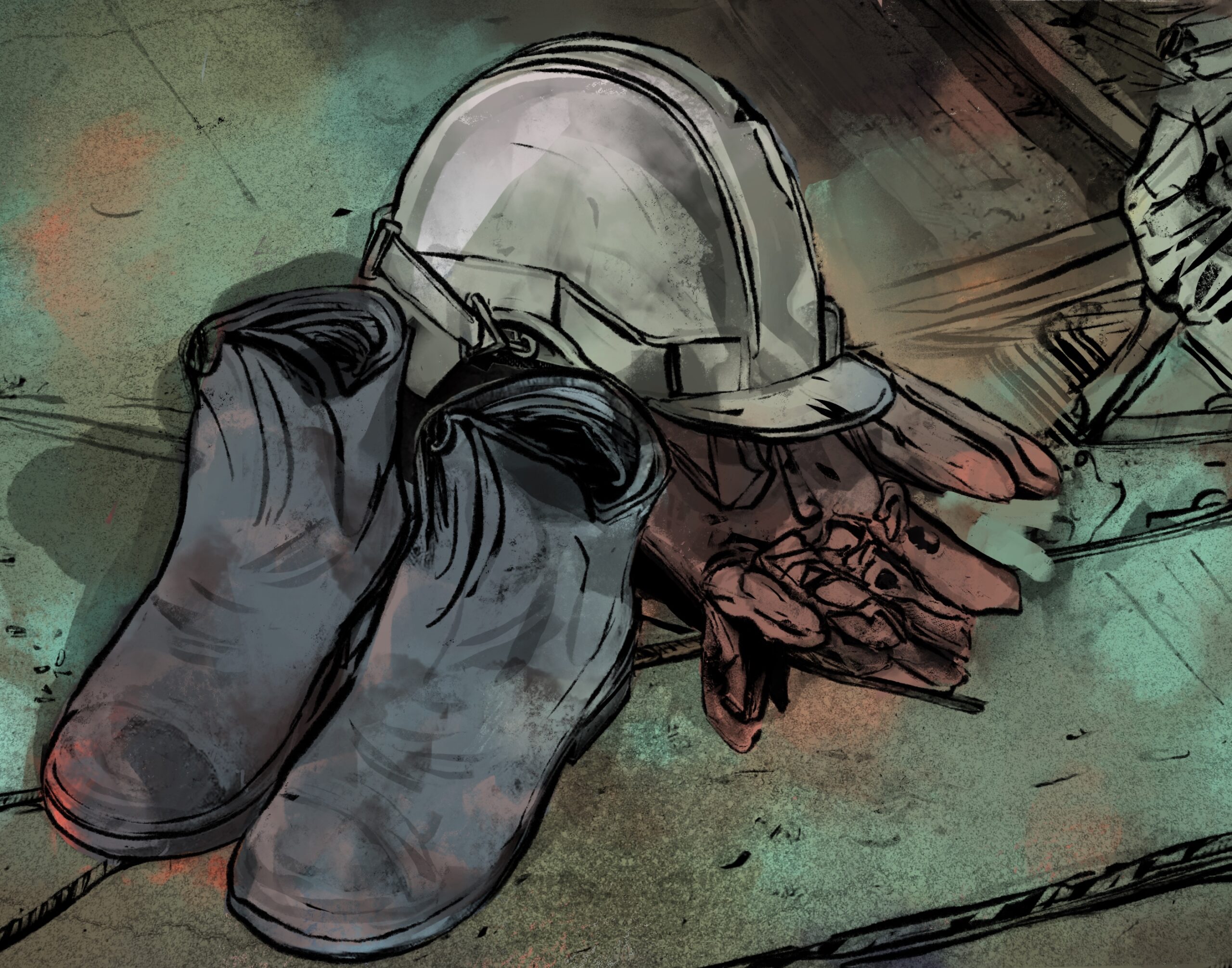
An illustration of a construction worker's hard hay and boots in a pile.

Texas has 698,839 miles of road lanes, the distance of 28 laps around the earth—more miles of roadway than any other state. Highways are a source of state pride. The slogan “Don’t Mess with Texas” originated in 1985 from the Texas Department of Transportation’s (TxDOT) campaign to keep roads clean of litter. But the state also leads the country in the number of deaths among workers who build its highways, a fact that TxDOT officials don’t openly discuss. TxDOT’s failure to address and hold contractors accountable for accidents on its highways may be part of why Texas’ highway worker fatality numbers are so high. 

From the bottom of the contracting chain to the administrative offices of TxDOT, no one took responsibility for Juan’s death, according to public records and court documents reviewed by the Texas Observer. Alejandro says he never saw anyone on site either from TxDOT or from the Spain-based general contractors, Dragados USA, Pulice Construction, and Shikun & Binui America, collectively known as Almeda Genoa Constructors. He had assumed Choctaw, a subcontractor, was in charge. At the time of the accident, no safety managers from Choctaw or from Almeda Genoa were on site. 

In response to the Observer’s request for comments on the accident, Choctaw owner Kevin Ball deferred to Almeda Genoa, which did not comment. 

Juan’s death raises concerns about who, if anyone, is held responsible when highway workers die in Texas, especially in public-private partnership projects where virtually all control of public infrastructure is handed over to a for-profit entity. In the case of Juan’s death, the federal Occupational Safety and Health Administration (OSHA) gave Choctaw a slap on the wrist with only a $5,000 penalty, even after finding the company violated federal safety standards by failing to provide proper protective equipment. Kevin Ball, the owner of the Decatur, Texas-based steel erection company, admitted to OSHA investigators that he made workers provide their own safety harnesses and lanyards or took money from their paychecks if they used the company’s protective equipment. 

TxDOT, by using these public-private partnerships, is a way for them to shuffle off responsibility. And sadly, OSHA rarely shows up unless there is a death or serious injury.

But other players in the massive construction project were assessed no penalties at all, not by OSHA and not by the state agency, even as the number of worker accidents on the 10-mile-long toll road continued to pile up. 

The Observer found that the agency had incomplete information on Juan’s death and failed to address accidents that the Observer uncovered. Even though the toll road was built on state-owned land with funds from federal tax revenues, TxDOT passed the buck on highway workers’ and drivers’ safety, indemnifying themselves against liability for any and all accidents based on its contract with the private equity firm that now controls the SH 288 toll road and its revenues for the next five decades. 

TxDOT declined the Observer’s request for an interview with the agency’s occupational safety director or with the agency’s designated project director for the SH 288 tollway. When asked to explain specific actions TxDOT took after each serious accident, the agency commented, “TxDOT carefully examines every incident in a work zone.” 

However, the agency did not find any records related to other workers’ accidents that resulted in hospitalization during the tollway construction, including one cited by OSHA. Its public information officers told the Observer that TxDOT “does not track injuries and fatalities of prime contractors or their subcontractors as a standard operating procedure” and only records contractor fatalities “if our office was made aware of the occurrence.”
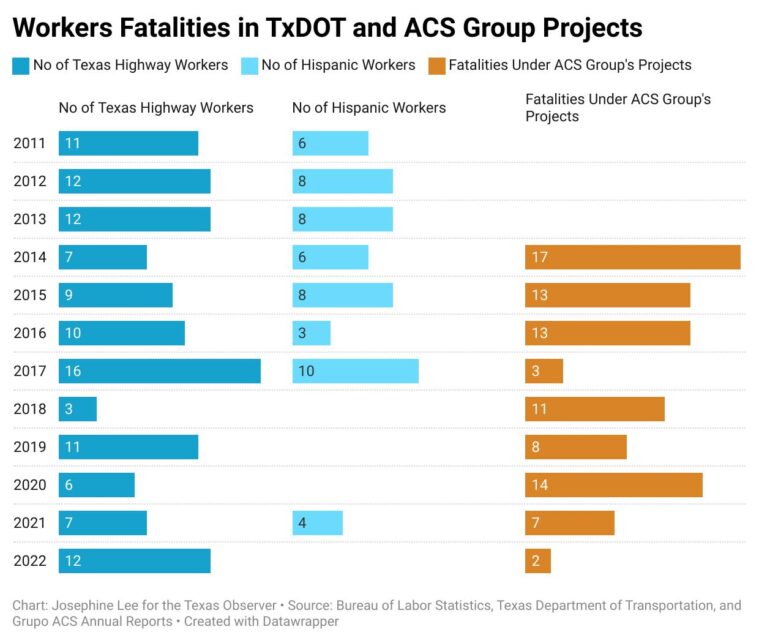
A bar chart showing worker fatalities on TXDot and ACS projects.

In a list of roadway construction fatalities TxDOT sent to the Observer, the agency listed the contractor in charge when Juan died as “unknown.” 

“TxDOT, by using these public-private partnerships, is a way for them to shuffle off responsibility. And sadly, OSHA rarely shows up unless there is a death or serious injury,” said Jeremy Hendricks, political director of the Southwest chapter of the Laborers’ International Union of North America. Hendricks added that compared to states like Illinois, in which 99 percent of roadway workers are represented by the union and represented in the transportation department’s workers committees, zero roadway workers in Texas are unionized. 

OSHA never cited general contractors Almeda Genoa Constructors, even though company officials admitted to the investigators that they failed to ensure all workers on the site were properly trained and equipped before they started working. OSHA reasoned that the company’s direct employees were not responsible for the incident, even though the agency has a multi-employer citation policy that holds general contractors, along with subcontractors, responsible. In response to the wrongful death lawsuit later filed by Juan’s family, Almeda Genoa said: “The accident in question and damages were solely caused by third parties over whom this Defendant had no control nor right of control.” 
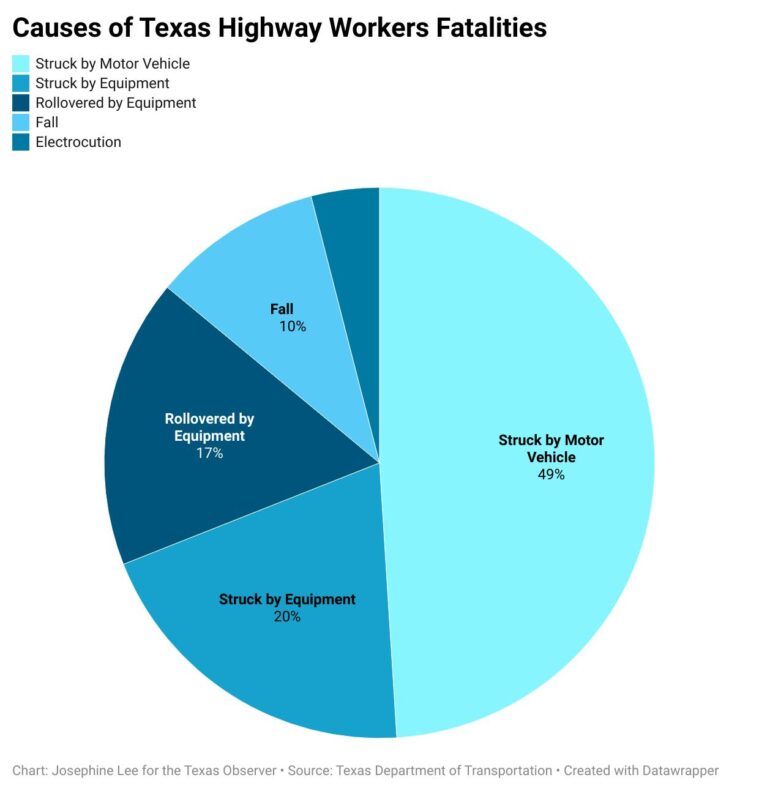
A pie chart showing the causes of Texas highway worker fatalities. 49 percent were struck by a vehicle while 20 percent died from being crushed by equipment.

In an interview, former OSHA chief of staff and policy advisor Debbie Berkowtiz told the Observer that OSHA “failed to hold those responsible accountable for this tragic death.” She noted that falls are a leading cause of death in construction, and employers are required by law to provide proper fall protection equipment. “The agency sent the wrong message.”

Statewide, TxDOT has erected traffic safety signs that flash playful messages such as “Gobble, Gobble, Easy on the Throttle” or “The Eyes of Texas Are Upon You” as part of its “End the Streak Campaign” to reduce traffic-related deaths. But the eyes of TxDOT seem to be overlooking roadway workers who continue to experience as many deaths as 10 years ago. Studies on the safety conditions for Texas roadway workers are nonexistent. 

Apart from an email TxDOT issued about Juan’s death, records and statements the Observer received indicate the agency took no independent action after the fatality. In a public statement, TxDOT referred questions to the private developer. “TxDOT’s contracted developer is responsible for the design, build, finance, operation and maintenance of the Drive 288 Project.”

The avoidable death of Juan Simental raises bigger questions about whether TxDOT is doing anything to monitor private contractors when it comes to worker deaths and accidents during road construction projects—on toll roads or otherwise. 

The privately operated SH 288 tollway shows there’s plenty of money to be made from Texas’ roads, but it’s often workers like Juan who pay the biggest price. 

“It’s a race to the bottom when it comes to the state of Texas and the way they deal with contractors. They often don’t care how the work gets done. And who gets hurt in the process,” Hendricks said. 


Since 2000, when Texas’ population started to boom and its growth started surpassing all other states, the previously semi-rural community of Pearland has transformed into an ever-expanding suburb for families looking for cheaper homes close to the SH 288 corridor that leads to the Texas Medical Center and downtown Houston. Along with the people came more congestion. 

During public meetings from 2007 to 2013, community members called for an HOV lane or a public railway to be built on the median of SH 288 to alleviate congestion. Those alternatives, they argued, would encourage commuters to share rides and put fewer cars on the road.

What they got instead was a 10-mile, billion-dollar tollway built on state-owned land at a rate of $106 million per mile. The same citizens who called for HOV lanes or a train are now paying some of the state’s highest toll fees. 

During a February 2007 public meeting to discuss alternatives for SH 288, resident and medical librarian Marilyn Goff told TxDOT, “Tolling will only benefit the rich and put money into the pockets of contractors and profit-seekers.” Now retired at 70, Goff told the Observer she can’t afford to pay for the tollway. But as Goff predicted, revenue from the SH 288 toll road has filled the pockets of profit-seekers. 

Actividades de Construcción y Servicios, S.A. (ACS Group) is now the sole owner of the Blueridge Transportation Group that owns and operates the toll road, which runs from Beltway 8 to US 59 in downtown Houston, along SH 288. The company reported earning $74 million in revenue from the tollway last year. The fee for the road, as high as $30 for a round trip during rush hour, is already one of the state’s highest. But there is no limit to how much ACS Group can charge or how much it can raise tolls under its agreement with Texas. 

Back in 2005,  then-Governor Rick Perry proposed creating a 4,000-mile network of privately operated toll roads called the Trans-Texas Corridor, prompting opposition from environmentalists, property rights advocates, farmers, business owners, and taxpayers’ rights activists. Many Texans were angry that the roads would be owned and the tolls collected by foreign investment firms. 

Transportation activist Terri Hall has been organizing Texans against tolled roads since the state lifted its ban on toll roads back in 2001 and then permitted private entities to control roadways in 2003. Prior to this, state roadways were funded exclusively by state and federal gas taxes. Unlike standard TxDOT projects, these private operations, called concession projects, cede control of a roadway’s entire process—the design, construction, operation, and maintenance—for a period of 52 years to private investment firms. It’s why private firms can charge drivers exorbitant toll prices, especially when traffic is at its worst. 
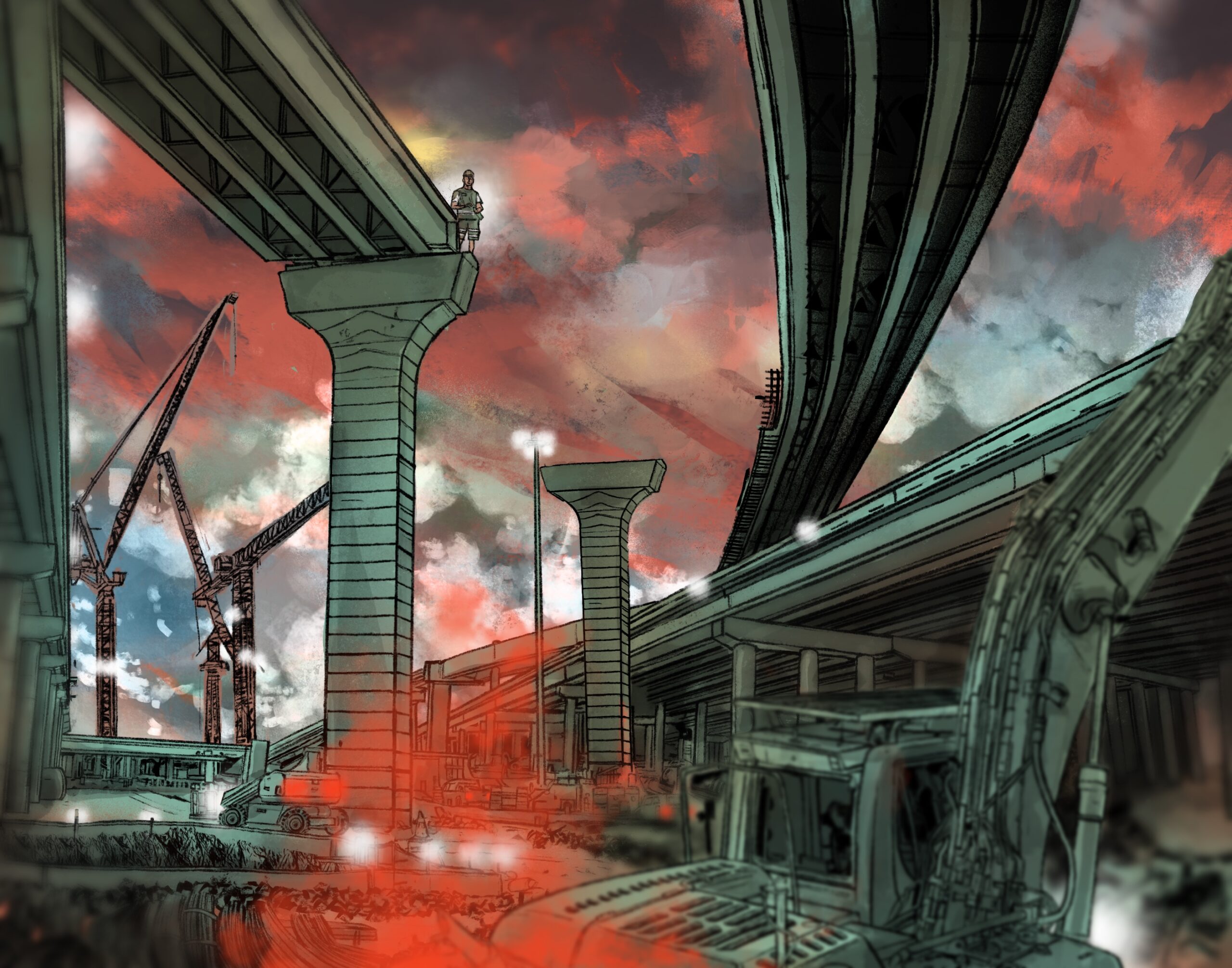
A moody. grim illustration of a roadway construction site, A lone figure stands on part of the elevated roadway as traffic lights pass beneath on the road.

“The government pimped out Texas to seek out foreign toll operators from France and Spain. They put out on the front lawn of the Texas Capitol a sign that read ‘Texas is for sale. Name your price,’” Hall said. Around this time, she created the group Texans for Toll-Free Highways and has been fighting since to eliminate toll roads in the state. 

While TxDOT has argued that privately operated highways shift the financial burden from taxpayers to the private sector, Hall argues that taxpayers often end up stuck paying for construction costs and decades of tolls until the contracts end. 

Hall explains that private investment firms controlling the roads milk money from the public in several ways. The firms often self-deal construction contracts to their own subsidiaries that answer to the private entities rather than going through TxDOT’s normal competitive bidding process. For instance, ACS Group doled out construction contracts to its wholly owned subsidiaries Dragados USA and Pulice Construction to work on the SH 288 tollway. Construction costs are often inflated with various change orders that TxDOT cannot control. Private firms have no cap on how much they can charge drivers for tolls. They use a congestion pricing model to charge drivers more when traffic is at its worst and can levy heavy fines and even criminal penalties for tolls paid late under their contracts with the state. 

The government pimped out Texas to seek out foreign toll operators from France and Spain.

“They’re literally extracting the highest possible rate from the traveling public and exploiting congestion rather than solving congestion,” Hall said. 

Hall organized Texans to push the state Legislature to issue moratoriums on concession projects, starting in 2007 when 21 private concession projects under Perry’s plan came to the table. State Senator Robert Nichols, who had previously served as a Texas transportation commissioner, started to embed more public protections into these public-private partnership contracts. He rid contracts of the noncompete clauses, which had essentially awarded a private entity a monopoly in any road building activity within an area, and applied stricter standards before projects could pass the Legislature. 

“My main objection is that when you have a roadway owned by a governmental entity that’s collecting tolls, the decisions that are made are made in the best interest of the people. When you have a toll authority that’s owned and operated by a corporation whose primary motive is to make a profit and benefit the stockholders, then those decisions are made in the best interest of the stockholders,” Nichols said. 

The Observer found that over the past five years, there have been at least 119 workers’ compensation accident claims filed against the four primary private road developers—including the ACS Group subsidiaries, Zachry Construction, Webber LLC, and JD Abrams LP—awarded concession contracts by TxDOT, according to data from the Texas Department of Insurance. 

Due to widespread opposition, Perry’s Trans-Texas Corridor was essentially dead by 2017. Perry managed to grandfather in five concession projects, four of which were awarded to the Spanish company Ferrovial-Cintra: the LBJ-635 Express Corridor, the North Tarrant Express and another segment of North Tarrant Express/ I-35 West completed later (all three in the Dallas-Fort Worth area), and State Highway 130 in Central Texas. The last to be built was the State Highway 288 tollway.  

Those concession projects typically received about one-third of their funding from federal loans and another third from tax-exempt private activity bonds. “These private firms get all this other money from the feds, from the state. They make enough money in those early years, even when it’s underutilized, so they cover at least their equity and usually a handsome profit before these things go belly up,” Hall said.    

That’s exactly what happened to the private State Highway 130 toll road, 41 miles that run through Travis, Caldwell, and Guadalupe Counties. When the SH 130 Concession Company filed for bankruptcy in 2016, the company’s main player, Ferrovial-Cintra, left SH 130 with millions in debt, pavement defects, and flooding problems. Bankruptcy court filings revealed that the company knew the highway would go broke but managed to siphon $329 million to pay for construction costs to a company Ferrovial created. 

Two days after SH 130 filed for bankruptcy, TxDOT signed a contract for the 288 tollway project with the foreign investment firms making up the Blueridge Transportation Group, now solely owned by the Spanish infrastructure firm ACS Group. 

After Juan’s death, the accidents continued as the Blueridge Transportation Group assembled the SH 288 toll from 2016 to the end of 2020. 

No one from the state nor from the toll road general contractor seemed to consistently force contractors to comply with workers’ safety laws under OSHA and the federal Manual on Uniform Traffic Control Devices, which regulates traffic control for highway construction. There were dozens of other injuries during the tollway’s construction, including at least six workers hospitalized with debilitating injuries, OSHA records show. 

According to OSHA investigation reports and court filings, workers commonly reported that there was no one monitoring safety conditions, no flagger or spotter, and no safety training. 

On December 2, 2017, one worker under the direction of ACS subsidiary Pulice Construction hit an unmarked electrical line on the company’s Houston premises, causing power to surge through and shock him. No report was filed with OSHA. 

On July 11, 2018, at the Interstate Highway 610 intersection of the tollway, a highway concrete form without adequate support braces collapsed on two workers, both of whom suffered fractures. OSHA cited Almeda Genoa for failing to train the workers and to provide adequate support structures for the job. 

On August 28, 2019, solid concrete blocks crushed a worker and severed his toes while he was emptying out a truck bed under the direction of ACS’s Pulice Construction subsidiary McNeil Brothers. 

On October 7, 2020, a little over a year after Juan’s death, another worker was injured when he fell from a wall without fall protection equipment at the tollway’s intersection with Beltway 8. 

On February 28, 2020,  a truck struck a worker and drove over his legs as he was spreading concrete near the intersection of Beltway 8 and SH 288. Court filings revealed there were no spotters in place. The worker survived the incident, regaining his ability to walk and work one year later.  No report was filed with OSHA. 

Another worker was not so lucky. A similar accident occurred one year later on another Pulice Construction project for TxDOT just 20 miles west of the SH 288 tollway. The company’s foreman, Isidro Matamoros, died when a tractor backed into him and knocked him over. There were no spotters, and the tractor driver later told the police he had heard and noticed the impact, but he still proceeded to roll backward over Matamoros, crushing his body. 

In total, the SH 288 tollway construction resulted in dozens of worker accidents, at least 10 motor vehicle accidents, two of which resulted in deaths, a pavement collapse, four class action wage theft claims, and seven lawsuits involving breach of contract claims, the Observer found in an extensive search of federal, state, and county court records. 

Juan’s death and other accidents on the SH 288 tollway illustrate a small part of the dangerous conditions faced by  Texas roadway workers. 

Texas has the highest rate of highway worker fatalities in the nation. Part of the reason is that

TxDOT’s general standards for ensuring workers’ safety are weak. In its two-page instruction for contractors titled “Standard Specifications for Construction” and its online Construction Manual, TxDOT largely defers to federal OSHA statutes and the state Manual on Uniform Traffic Control Devices, which regulates work zone and traffic safety during highway construction, without specifying how TxDOT plans to enforce workers safety. In comparison, Caltrans, California’s state transportation agency, outlines specific requirements extending beyond its state or federal OSHA plans, and gives guidance on how to conduct each aspect of road construction safely in their Code of Safe Practices and their Construction Manual

California, which has a larger population than Texas, has had at least 57 highway worker fatalities in the last 12 years, according to figures from the Bureau of Labor Statistics. Since 2012, the state has reduced the number of fatalities from 10 to two in 2022. Illinois, whose transportation department frequently meets with a committee of unionized workers, has only had 28 highway worker fatalities in the last 10 years. In comparison, Texas has had 116 highway worker fatalities in the same period. In 2022, 12 roadway workers died, the same number as in 2012. Most of these workers were Hispanic immigrants. 

Caltrans also establishes a safety plan for all projects, including state private-public partnership projects. In contrast, TxDOT has private contractors develop their own health and safety plan in accordance with general contract requirements.

Alemda Genoa did send TxDOT its safety plan, many provisions of which the company seems to have repeatedly violated, including requirements for safety training, as well as contractor identification and inspection of protective equipment. No course of enforcement from TxDOT was stipulated.

And TxDOT does not seem to have considered ACS Group’s own safety history. The company reported fatality numbers for its subsidiaries’ various projects, exceeding TxDOT’s own number in the years before the start of the tollway’s construction. TxDOT continues to award ACS subsidiaries roadway construction contracts even after two workers died and countless others were injured on its roadway projects. 

Worldwide, from 2014 to 2022, 88 workers have died during projects conducted by ACS’ subsidiaries, an average of 11 deaths a year. 


In the Chamartín district of Madrid, Spain, where the streets are lined with lush gardens, upscale restaurants, and boutiques, ACS Group’s headquarters tower over neighboring buildings. Swallowing one infrastructure company after another, ACS Group has been continuously ranked as the world’s largest public-private partnership transportation developer by Public Works Financing, an industry periodical. The company has more than 130 concession projects worldwide and investments worth over $60.5 billion. A publicly traded company, it took in a net profit of $727 million last year, a 66 percent increase from the previous year. Its largest market now, more than half of all its upcoming projects, is North America.

ACS alone continues to rake in millions from projects like the SH 288 tollway. And TxDOT is one of its biggest customers.

Here’s how that happened. 

TxDOT initially awarded a 52-year contract to design, construct, maintain, and operate the private highway, to be built on a 10-mile median of a state-owned road that runs from Brazoria County to downtown Houston, to the private equity partnership called Blueridge Transportation Group. The partnership included the infrastructure investment groups ACS Group, the Israel-based firms Shikun & Binui and Clal Industries, London-based Infrastructure Fund, Canada-based Northleaf Capital, and an American company, Tikehau Star Infra. 

Before construction began, ACS Group had only paid $80 million, or 8 percent of the total project costs. The company then doled out the $800 million construction contract to its own subsidiaries Dragados USA and Pulice Construction, which together with Shikun & Binui American formed the general contractors Almeda Genoa Contractors.

My brother’s life could’ve been saved if there was more security. There was no one looking.

Blueridge still owed two-thirds of the costs in loans at the time construction was completed in 2020: $357 million in federal loans, nearly $300 million in tax-exempt private equity bonds, and $17 million from TxDOT. 

But by April of this year, ACS Group had bought out all other equity shareholders and is now the sole owner of the Blueridge Transportation Group. 

And despite the slew of accidents on the SH 288 toll, TxDOT continues to award contracts to ACS Group and its subsidiaries, now totaling more than $4.7 billion for at least 22 projects. In just two years between 2019 and 2020, Texas roadway workers filed 20 workers’ compensation claims against ACS subsidiaries.  

ACS’ Texas projects include the US 181 Harbor Bridge in Corpus Christi, yet another public-private partnership project that has displaced and made unlivable the surrounding low-income Black community of Hillcrest. The project is at least four years behind schedule after perpetual delays caused by safety issues and design defects

No one, from the BTG spokesperson to the CEO of ACS Infrastructure to the president of their subsidiaries involved in the project, responded to the Observer’s multiple requests for comments via phone and email. 


Alejandro and Juan Simental did everything together. Only a year separated Alejandro from Juan, the middle child of three siblings. Growing up in their hometown of Durango, Mexico, the brothers played endless hours of soccer, battled each other in video games, and planned their futures together. Durango is Mexico’s fourth-largest state but is sparsely populated. Fields producing corn, beans, and chilies and pastures filled with beef cattle make up most of the landscape. Compared to other Mexican states, fewer residents of Durango emigrate. But in 2016 when Alejandro turned 18, he and his brother went north to try their luck in the Texas construction industry. 

They thought they’d found stable work with Choctaw Erectors in 2019. For six months, they built university and commercial buildings in North Texas, but never anything as tall as the 85-foot high SH 288-Beltway 8 tollway bridge. 

“My brother’s life could’ve been saved if there was more security. There was no one looking. Us workers, we were all alone. Above, there was no one,” said Alejandro.

He never returned to the worksite after his brother’s fatal fall. Or to Choctaw Erectors. A few days later, Alejandro left for Durango to take his brother’s remains to his grieving family. When he returned to Texas a month later, he decided to work for himself. As an independent contractor, his income is not as stable. But he feels safer knowing he can better control his own working conditions.

It’s still difficult for Alejandro to speak about his brother. But he shared his story in the hope that other workers wouldn’t have to lose their lives before the government finally takes notice. 

Today, motorists who pay to travel on the SH 288 tollway where the Simental brothers worked can see how the new toll road soars above commercial buildings, electrical poles, and evergreen trees, so high that cars seem surrounded by nothing but sky. Those who look down at the site from a plane can see how eight crisscrossing highway segments form what looks like a knotted cross. 

The post The Death Toll: An Expensive Tollway’s High Cost in Human Lives appeared first on The Texas Observer.

12 Dec 21:51

Floppy Emu update: StuffIt file support, CD-ROM and SCSI image support, more

by Steve

Vintage Macintosh fans, here’s a firmware update for the BMOW Floppy Emu disk emulator with some exciting new features that I’ve been working on for the past few weeks. Please give this version femu-231209M a try, and let me know how it works for you. Even a basic report of “it works fine, I have nothing more to say” is helpful.

StuffIt File Support via Boxing

Archive files like StuffIt .sit, BinHex .hqx, MacBinary .bin, Compact Pro .cpt, and text .txt can now be directly used as if they were floppy disk images, with a new feature I’m calling “boxing”. Select a .sit file (or other archive) on your SD card, and Floppy Emu will automatically create a temporary disk image “box” that contains the file. From the user’s point of view, this basically makes StuffIt files and other archive files behave as if they were disk images, and it’s a major time-saver and quality of life improvement when you’re downloading software from The Garden and using your Floppy Emu to transfer it to your Mac.

Floppy Emu generates a read-only box disk that’s the smallest possible size to contain the StuffIt archive file: 400K, 800K, or 1440K. Your Mac will need to have support for the larger floppy disk sizes in order to transfer larger StuffIt files. 400K box disks are HFS, not MFS, so you’ll need to be running System 2 or later.

Macintosh Hard Disk support for Zulu SCSI, Blue SCSI, and CD-ROM images

For Mac models with support for HD20-type hard disks, Floppy Emu can now use disk images in SCSI device or CD-ROM formats, with an embedded Apple Partition Map, such as the disk images used with Zulu SCSI or Blue SCSI. Supported formats are HDA, IMG, ISO, CDR, DSK, and TOAST. When browsing for disk images in the Floppy Emu directory menus, these images will appear with an APM suffix, while traditional disk images will appear with an HFS suffix. For APM images, Floppy Emu will search the partition map and mount the first HFS partition in the image, ignoring driver partitions and other boring stuff.

Yes, this means Floppy Emu is now a CD-ROM emulator (sort of) – see above with a CodeWarrior CD mounted. CD-ROM images are mounted as read-only hard disks, not as removable media, and the speed is comparable to a 1x CD-ROM drive. It won’t replace a dedicated CD drive, but it’s great for installing software. If you’re running System 6, you may see an error message when using CD-ROM images complaining that the desktop file couldn’t be created because the disk is locked, just like you would with many real CD-ROMs and System 6. The INIT Desktop Manager 2.01 will fix this. With System 7 or later, it’s not needed.

Other Stuff

The Floppy Emu Model C also received some UI improvements and polishing. A “Settings Menu…” item has been added to the top level of the menus, providing an alternate way to return to the settings menu without needing to reset the device. The “..” directory menu item for returning to the parent directory was something that only a UNIX nerd could love, and has been replaced with “Go Back” and a curly arrow icon. Most error messages or dead-ends in the UI flow now have a way to exit or return, so it shouldn’t ever be necessary to use the RESET button to perform a hard reset of the device.

A new version of the Apple II firmware with these same UI improvements is also available. Have fun, and don’t forget to leave feedback on how it works for you!

12 Dec 21:48

update: my coworker made a creepy pass at me

by Ask a Manager

This post was written by Alison Green and published on Ask a Manager.

It’s “where are you now?” month at Ask a Manager, and all December I’m running updates from people who had their letters here answered in the past.

There will be more posts than usual this week, so keep checking back throughout the day.

Remember the letter-writer whose coworker made a creepy pass at her (#2 at the link)? Here’s the update.

I have an update regarding my coworker, “Mac,” who told me my sexy librarian vibe was a problem for him. Reading your response and all the comments was very illuminating! I had been feeling as if I’d somehow brought it upon myself, but you and the commentariat really opened my eyes to the reality of this being entirely on Mac.

I’m a little ashamed to admit I was too chicken to bring it up to Mac directly, but I made a point of avoiding his usual paths and successfully dodged him for two weeks straight. Last Friday he came to my work station and asked if everything was alright, and said, “I feel like you’ve been avoiding me!” Well. I took a deep breath, summoned all the Resting Bitch Face I could muster, and said, “Mac, you implied that your inability to manage your pants feels in the workplace was somehow my fault for looking like a ‘sexy librarian.’ How exactly would you suggest I handle such gross comments in the future if not with avoidance?” His neck and ears turned bright red and he said something along the lines of, “Uh… I’m sorry… I didn’t… sorry…” then literally turned heel and fast-walked away. I think I was in a state of nervous shock afterwards — my ears were ringing and I felt strangely tingly — but also incredibly proud of myself.

First thing Monday morning, Mac came to my work station again and gave me what seemed to be a sincere apology. He said there was no excuse for his comment, it was out of line and he was being an idiot not thinking of the implications, that it would never happen again, and asked if there was any way he could make it up to me. I thanked him for apologizing and said I don’t think this is something that you really “make up” to someone, but to please truly ensure he never says anything like that again. He reiterated it would absolutely never happen again and asked if I thought I could ever forgive him. I told him that while I accept his apology, it’ll take time to move forward and that I don’t really know what that will look like and to please give me space and time, summing it up with “it’ll be what it’ll be, please don’t try to force it.” He said, “Of course. Again, I’m so sorry,” and left my workstation.

I think I need some time to process Mac’s apology and how I feel about him moving forward. I’m still struggling to reconcile the friend I thought I knew with the lecher that made that comment and now with the seemingly penitent dope I saw today. People are complicated. But I at least feel like I can go back to taking whatever route I want to get from point A to point B and I won’t be walking on eggshells worried about potentially running into him. I think we can exchange trivialities and move about without issue now.

Thank you so much for your response, and to the commentariat as well. Especially user Falling Diphthong for the absolute gem of a phrase “pants feels” which I will love forever, and users higheredadmin, SarahKay, and Awkwardness for their suggestion that I practice responses for when I inevitably had to confront Mac. I don’t think I could have managed the response I did without having taken that advice. You guys are amazing!

12 Dec 17:10

update: no one wants the office an employee died in four years ago

by Ask a Manager

This post was written by Alison Green and published on Ask a Manager.

It’s “where are you now?” month at Ask a Manager, and all December I’m running updates from people who had their letters here answered in the past.

There will be more posts than usual this week, so keep checking back throughout the day.

Remember the letter-writer working for a company where no one wanted the office an employee died in four years earlier? Here’s the update.

Before I get to the update, I wanted to follow up on some of the questions/comments the letter generated. Some folks suggested moving to entirely new office spaces and that wasn’t ever going to be an option because that would realistically have had a million dollar price tag, so that was never on the table. There were also some comments about the lack of ritual or memorial event. I think there were some employees who were really bothered by that and that is valid. Due to the nature of the death and the fact that the employee’s family asked that nothing about her death be disclosed and that we NOT do a memorial, it was a hard balance to hit. We did have a session for connecting folks with grief counselors and some open hours with a therapist but there was never a ceremony. We likely would have turned a blind eye to folks wanting to have their own rituals in the office except that some of the stronger personalities in the office made things contentious in a hurry (one person wanted to bring in a shaman and another wanted to bring in a psychic and then someone else wanted to bring in their pastor to cleanse the space from the “occult energy” a psychic would bring…) so leadership felt like the odds that we could grant all the requests in a way that wouldn’t result in someone being (rightfully) offended were too low so they drew a firm line about it.

Ultimately, our president talked with the exec team from the company we’ve now merged with and shared about the death and the space. It turns out that one of their senior managers is both deeply pragmatic and very rarely has meetings and was delighted to take an office that nobody else wanted. We decided to go with that approach since we felt like relocating a storage room or trying to create a lounge space or quiet working area wasn’t going to be welcoming for the staff who strongly want to never go into the space.

The manager moved into the office space this summer and there were a few weeks where people continued to call it “Jane’s office” but people seemed to get used to seeing the lights on and someone in the office fairly quickly. The manager has a quirky sense of humor and style and has decorated the office in a way that is very…specific… so it looks very different than it did before, so that might help.

I sincerely hope that none of the readers will have to experience a similar situation in their careers (and it definitely stung when a few folks in the comments suggested that there must have been some work related reasons she died in our offices). It still feels like a situation where there were A LOT of ways to get it wrong/cause harm and balancing the needs/wants of the family with the needs/wants of the staff was complicated.

12 Dec 17:07

the best office holiday party date story of all time

by Ask a Manager

This post was written by Alison Green and published on Ask a Manager.

There will be more posts than usual this week, so keep checking back throughout the day.

A couple of years ago, someone shared what I consider to be the best holiday date story of all time, and it must be shared here again. Enjoy:

When I was fresh out of college, a dude in my social circle invited me to his fancy work Christmas party. He was a teacher, so I’d kind of assumed I was there as friend to act as a buffer between well-intentioned female colleagues who wanted to set him up with one another, with their daughters, etc. I was wrong! This invitation to a work Christmas party was meant to be the first date of a magical relationship between two people destined to be together. Why a magical relationship? When I opened the door, he said he’d hope we’d have a magical night leading to a magical relationship. Then HE DID A MAGIC TRICK. I was… startled.

The party was at a country club, where he drove around and around looking for a space while I said “they have valet. it’s only valet” over and over. Inside there was a coat check. He didn’t want to leave his coat–because there were additional magic tricks secreted inside. We went in, got our drink tickets and our seating assignment. I sat down at a table that was mostly single women several years older than we were. He offered to get me a drink, and I asked for a glass of any kind of wine. He came back several minutes later with a mudslide because girls love mudslides, because they’re chocolate and girls love chocolate. I don’t. But he tried! That’s sweet! Right? Over dinner, I tried to make that sort of general polite conversation people make around banquet tables with strangers. He kept jostling my arm to get my attention to show me another magic trick.

At the beginning of the evening, I really thought we were casual friends, but I was single and kind of open to dating this guy if we got on well. Maybe that hokey line was a story we’d tell our grandchildren! But it was becoming increasingly clear that this guy was Not for Me. That didn’t mean I wanted to embarrass him in front of his principal, though. I finally said something like, Would you mind terribly saving those for after dinner? I’m really interested in hearing more about Harriet’s begonias, aren’t you?”

He pushed his chair back and stalked across the ballroom to a piano. He plopped down and proceeded to pound out an assortment of sad pop hits. There was Muzak-y Christmas music, but he was gonna play the piano anyway. At this point, I was embarrassed to have come with this guy. My tablemates were embarrassed for me. One of them left and came back with the glass of wine I’d asked for initially. I drank it while the middle aged ladies at our table told me all about their various bad dates. More wine showed up. Then someone asked if I like martinis and brought a martini. Apparently none of them drank, and, as my date played “You’re So Vain” while staring mournfully at me, I drank my way through pretty much all their drink tickets. I am an effusively nice drunk person. I told each and every one of these women that they were beautiful angels shaping tomorrow’s great minds to recognize the power of sisterhood and human kindness. Or something to that general effect. My memory is a bit fuzzy, for obvious, gin-based reasons.

My date wanted to leave, so I went to coat check. I tipped the coat check person, and he reached in the tip jar to fish out my money. I thought he was going to pay the tip. Nope. He told me coat check is free. I said I know. I put my tip back in the jar and sidestepped him when he tried to help with my jacket. His department chair and her husband appeared and said that my apartment was on their way and they’d be happy to drive me. I told them they were “hashtag relationship goals” and made an actual hashtag with my fingers.

I was driven home by way of Taco Bell by these very nice strangers. A week later, the guy called to say his work friends loved me and would I like to go out again. I would not.

A few years later, a friend was telling me about a legendary party her school hosted before she got a job there. A girl nobody knew got plastered and told everyone she loved and appreciated them while her boyfriend played the piano at her and drowned out the Christmas music. I did not reveal my identity. Maybe there’re two of us? I hope there’re two of us.

12 Dec 17:01

CFO is obsessed with shooting rubber bands at people, professor turned down my request to be a reference, and more

by Ask a Manager

This post was written by Alison Green and published on Ask a Manager.

I’m on vacation. Here are some past letters that I’m making new again, rather than leaving them to wilt in the archives.

Due to the quantity of updates we have, posts on Tuesday will publish at 11 am, 12:30 pm, 1:30 pm, 2:30, 3:30 pm, 5 pm, and 6 pm (all times Eastern).

1. Our CFO is obsessed with shooting rubber bands at people

I am a CPA at a public accounting firm. There are a bunch of cubicles outside of the CFO’s office where about eight of us sit. The CFO is obsessed with shooting rubber bands at everybody. And when I say rubber band, I mean the giant ones that go over large stacks of paper. He shoots them at people’s heads and faces, he tries to shoot inanimate objects, or even papers that people are holding in their hands. It is so very annoying to be constantly dodging rubber bands whizzing through the air at high speeds. Once I even heard him say, “Hey, Hannah, put your glasses on so I can shoot a rubber band at you.”

However, he is the CFO, so everybody just plays along and pretends like they are super into it to be on his good side. Behind his back, there are massive (Anderson Cooper level) eye rolls. One time he hit someone IN THE EYE! Their eye started gushing fluid and their nose bled, BLED!! Their eye was red and half closed for the next week.

How do you tell your super annoying boss to stop doing something that he should be old enough to know not to do? We currently don’t have an HR director and even when we did, they don’t do much HR.

Your CFO is a child.

A rude child.

It’s outrageous that he didn’t stop after injuring someone’s eye. It’s outrageous that no one in your company thought to tell him that he needs to stop.

On the other hand, it’s also ridiculous that people are playing along with it out of fear of offending him. The people acting like this is good fun are enabling this and making it easier for him to avoid seeing how not okay it is.

Try this: “Can you stop with the rubber bands? I am not willing to risk a serious eye injury like Jane got, or worse. This is going to lead to workers comp claims or worse. Someone has already been injured. It’s distracting and it’s dangerous and I don’t want to be around it.”

If you know he’s too immature for that to work, then go over his head. If you’re small enough not to have HR, you’re probably small enough that you can talk to his boss (presumably the CEO or a second-in-command) directly. Say something similar to them.

But you’ll have more sway if you convince your coworkers to speak up with you. People might be more willing to stop playing along if you couch it in terms of being sick of living in fear of being injured and that you’re asking for their help in getting this under control.

2018

2. My professor turned down my request to be a reference

How do I respond to a rejection email from a potential reference?

I am a graduate student and requested a reference from a professor I know well. I was shocked when she responded, “You can use me as a reference, but I would have to be honest… if they ask me about your timeliness or reliability for example, I cannot say that it is excellent. That would be quite bad for you so I’m not sure if I’m the right person to be your best reference. I hope you understand.”

I disagree with her appraisal that I am not reliable, and am wondering why she feels this way. I was late with an assignment, and to her class in the beginning of the semester, but was consistently early after we spoke about it. How do I respond?

Thank her for her candor and then let it go. Don’t push for her to change her assessment, because you don’t want to use a reference who’s anything other than glowing about you.

For what it’s worth, her response doesn’t seem unreasonable to me. Yes, you changed your behavior once she spoke to you about it, but the fact remains that she needed to tell you that your lateness was a problem before you fixed it. In a lot of contexts, that’ll put you in the “not super impressive” category.

2015

3. I don’t want to be the backup driver for an oversized company vehicle

A couple years ago, I agreed to be trained (by a professional) as a backup/substitute driver for an oversized vehicle my business utilizes. At first, I thought it would be a fun change of pace compared to my daily desk job duties, but I’ve grown to dread it and become anxious every time I’m asked to drive. A couple of very minor accidents have occurred while I’ve been at the wheel, and I worry that one day something more serious might happen.

My manager is aware of these incidents and my increased dislike of driving, and her response has been “how can we make this easier?” or “there’s no one else who can do it.” Since we can’t make the vehicle smaller or the streets wider, I feel like it’s hopeless. Just practicing more isn’t going to cut it either, in my opinion. My manager says they will ultimately train more people, but they’ve yet to pursue it and we’ve recently been left with a number of staff vacancies. The other day it occurred to me that even though the business’s insurance would cover an accident, if it was deemed my fault, I could end up with a traffic ticket and a black mark on my DMV record, right? This is just going to make me worry even more! How can I successfully back out of an assignment like this?

“I appreciated the opportunity to give it a try, but after the several accidents, it’s clear to me that I can’t safely drive this vehicle. I’m not comfortable risking my safety and the safety of others, or the black marks on my driving record, so I need to permanently step down from doing it.” If she pushes back, say, “I understand, but it’s become a safety issue. We need to get another backup trained, because I’m not comfortable doing it. I’m sorry about that — I wish I were.”

2014

4. Bathroom breaks right after regular breaks

Is there a diplomatic way to ask an employee to use the washroom on appointed break times as opposed to going during working time (which seems to be a regular schedule of immediately after the break, daily)? I feel like there is a lot of wasted time with the transition of getting back into work. I realize I can not dictate when a person has to use the washroom but this regular schedule which makes her breaks much longer then others is getting a bit out of hand.

In general, you should stay away from managing when or how often people go to the bathroom, unless it’s significantly interfering with the work (and then you’d want to prepare for the possibility that it’s a situation where you might need to consider medical accommodations).

And if we’re just talking about a couple of minutes, in most contexts it would be petty to track this or address it.

But if it’s a situation where someone has a scheduled break for a specific amount of time and is regularly lengthening it by tacking on a bathroom break of significant length at the end of it, it’s not unreasonable to say, “Can you plan ahead so that you’re back at your desk and ready to work when your break ends, meaning that you’ve finished eating, used the bathroom, and taken care of any other non-work items by 2:30 (or whatever)?”

More importantly, though, I’d look at the rest of her work. When this sort of thing bothers managers, it’s often because it’s paired with other work issues — and if so, that’s where you should focus, not on the bathroom issue. But if the rest of her work is great, there’s nothing to address; in that case, you should ignore her bathroom schedule altogether.

2015

12 Dec 16:55

Taco Bell Announces Flaming Yule Burrito For Christmas

12 Dec 16:55

Single Aunt’s Cheeky Request For Boyfriend For Christmas Growing More And More Depressing With Each Passing Year

MONTPELIER, VT—Shifting in their seats as the single woman laughed, sources confirmed Tuesday that local aunt Kirsten Bartek’s cheeky requests for a boyfriend for Christmas were growing more and more depressing with each passing year. “It was cute the first time, four years ago, when she asked for a man under the…

Read more...

12 Dec 16:54

Cool Guy Kept Up All Night By Intrusive Memories Of All The Times He Was Awesome

CLEVELAND—Tossing and turning throughout the night, local cool guy Maxwell Dutra was reportedly unable to get to sleep Tuesday due to intrusive memories from all of the times he was awesome. “Oh God, no, no, no, no, I’m so fucking awesome, I’m just the absolute best,” said Dutra, who groaned and pressed a pillow over…

Read more...

12 Dec 16:54

Nation’s Politicians Exhausted After Another Day Of Tirelessly Serving The Will Of The People

WASHINGTON—Wiping their brows as they pushed through hour after hour of hard, honest work, the nation’s politicians confirmed Tuesday that they were exhausted from another long day of tirelessly serving the will of the people. “Between listening carefully to our constituents and then doing everything in our power to…

Read more...

12 Dec 16:54

Cheat Day Used On Entire Bag Of Croutons

IRVINE, CA—After enduring the long wait for a chance to indulge in culinary pleasure, local woman Carissa Walder reportedly used her diet cheat day this week on an entire bag of croutons. “I’ll have just one, and then I’ll put the bag away,” said Walder, who immediately walked back on the promise by pouring a small…

Read more...

12 Dec 16:54

Whatevs House

12 Dec 16:53

Housecat painfully aware of how much owner’s mental health is riding on his tummy being so fluffy

by Clare Blackwood

WINNIPEG – In a rare display of feline self-awareness, George, an 8-year-old housecat, expressed concern over the fact that his owner Elizabeth’s mental health and happiness seemed to revolve entirely around the fact that his adorable ‘lil tumtum was so darn fluffy. “Goddamnit, I know, okay?” George growled. “I get it. Every single freakin’ day […]

The post Housecat painfully aware of how much owner’s mental health is riding on his tummy being so fluffy appeared first on The Beaverton.

12 Dec 16:53

Hungover Bear and Friends: Dream Big

by Ali Fitzgerald

To help celebrate our twenty-fifth year of being on the information superhighway, we have reached out to some of our former columnists for check-ins and updates. Today’s columnist, Ali Fitzgerald, won our Column Contest in 2013 with her comic “Hungover Bear and Friends,” which ran on our site for over three years. We’re happy to have Ali back with a brand-new installment.

- - -

- - -

- - -

12 Dec 16:51

Comic for 2023.12.11 - embarrassing

New Cyanide and Happiness Comic
12 Dec 16:49

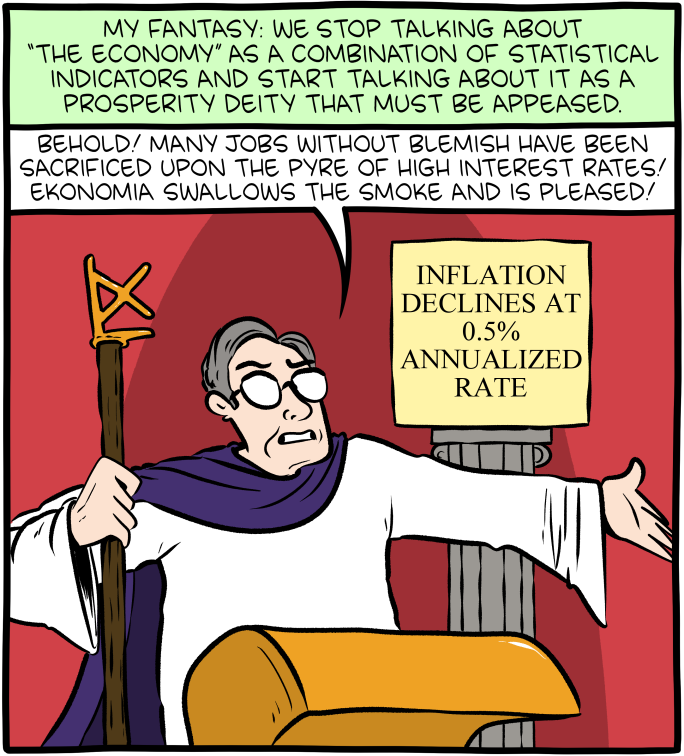
Saturday Morning Breakfast Cereal - Behold

by Zach Weinersmith


Click here to go see the bonus panel!

Hovertext:
Any resemblance to any sitting official is a trick of the eye - this is in fact a 2D cartoon drawing.


Today's News:
12 Dec 16:48

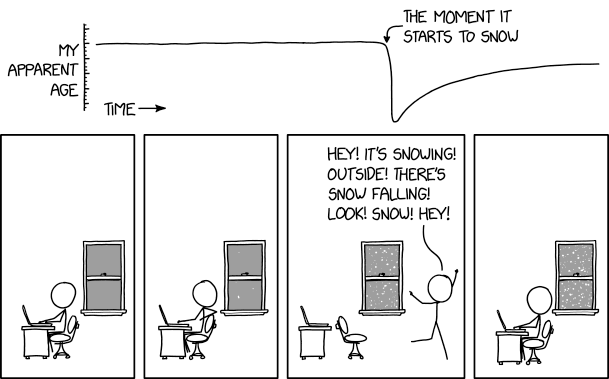
Snow

For someone who has ostensibly outgrown staying up late waiting for Santa, I do spend an awful lot of time refreshing websites to see if packages are here yet.
12 Dec 16:48

Women fighting for their lives in the US

by Katelyn Jetelina

Public health touches all aspects of our lives, not just during a pandemic. Thanks to your feedback, this newsletter will continue with Covid-19 updates and address other public health topics, too. To choose what topics land in your inbox, click HERE.


I’m a mom who carried three pregnancies in Texas, one of whom had irreversible severe genetic abnormalities. This suddenly meant I was fighting for my life mid-pregnancy. And he didn’t have a fighting chance. And, although I came out on the other side, it’s not without incredible heartache and trauma. Maybe one day, I will have the courage to tell my whole story. But that’s what it is: my story, my health, and my life.

Kate Cox in Texas is experiencing an eerily similar story. But her health and future were not being determined by her. Nor her medical team. If she makes it out alive, she will have heartache and trauma for the rest of her life.

But this isn’t just a story about me or Kate. It’s a battle that hits close to home for many women in the U.S. Women are literally fighting for their lives.

Maternal mortality rates: High and increasing

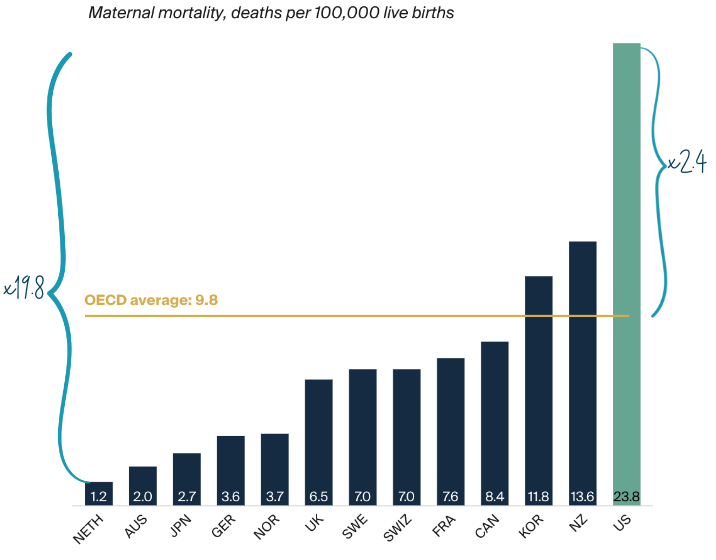
The number of women dying from pregnancy, childbirth, and soon after birth is tragically high. Compared to other high-income countries, the U.S. ranks highest. In fact, it is 20 times higher than the Netherlands.

Source: Commonwealth Fund, 2022. Annotated by YLE/Katelyn Jetelina

As dramatic as the overall U.S. statistic is, it masks even more tragic data stories:

  • Maternal mortality rates are rapidly increasing.

  • Disparities are jarring. Non-Hispanic Black women, for example, have a maternal mortality rate of 69.8 per 100,000 live births.

(Source: CDC)

Restrictions to care play a role

Maternal mortality in the U.S. is multifaceted: increased rate of c-sections, sociodemographic factors, poor prenatal care, chronic illness and increasing restrictions in health care options.

  • One study found reducing women’s access to family planning and reproductive health services have contributed to the most recent rise in maternal mortality rates.

  • Another found every 1-unit increase in the abortion policy index (i.e., more restrictive state-level policies) equated to a 7% increase in maternal mortality.

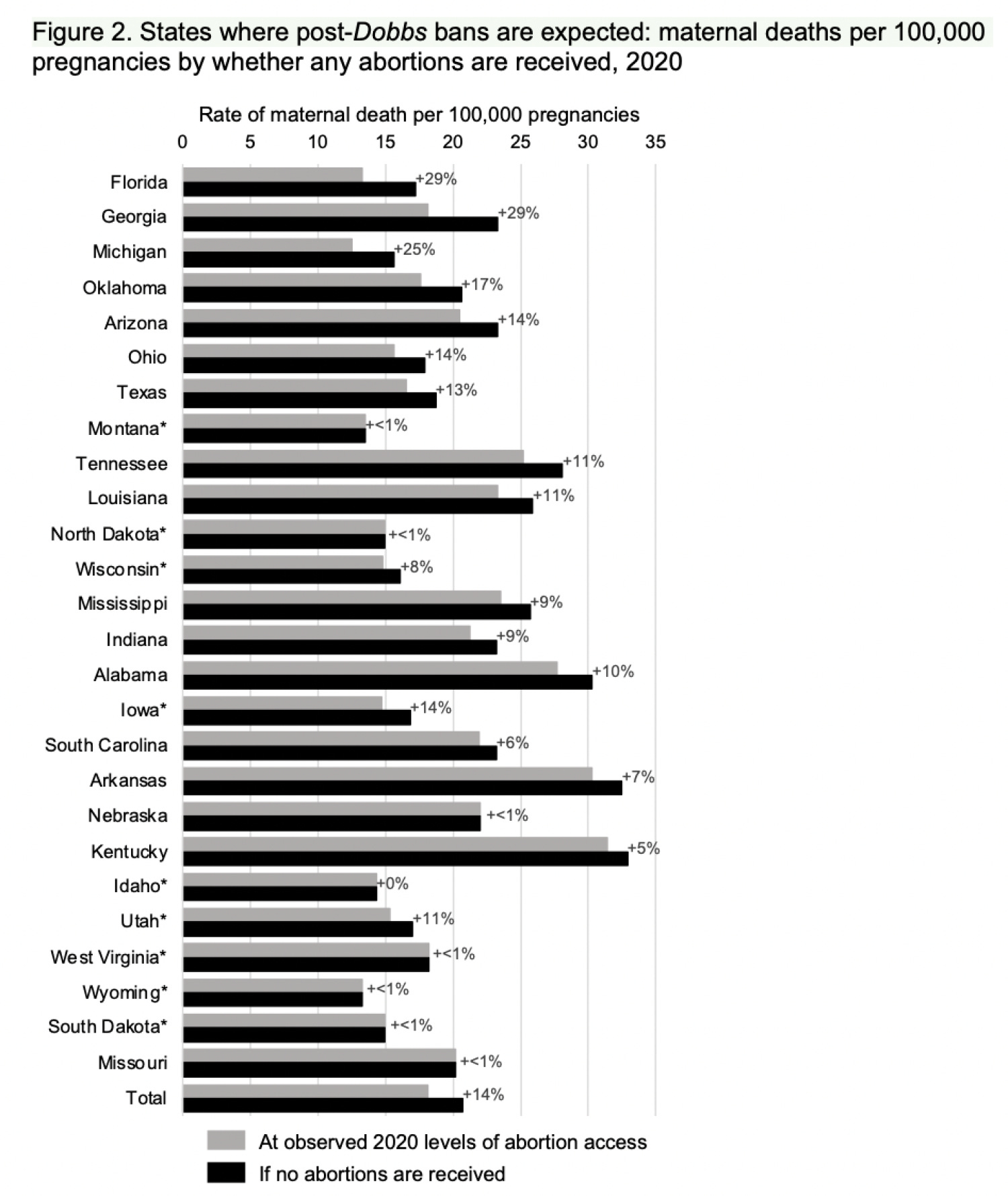
Both of these studies evaluated policies before Dobbs. Given the more restricted access to care now, maternal mortality are projected to be more dire:

Long term consequences

If the mother survives pregnancy and childbirth, the experience may impact her mental and physical health for decades to come.

“Maternal near misses”—defined as a woman who nearly died but survived a complication—are associated with:

  • worse overall quality of life,

  • worse mental and social health, and

  • negative economic consequences.

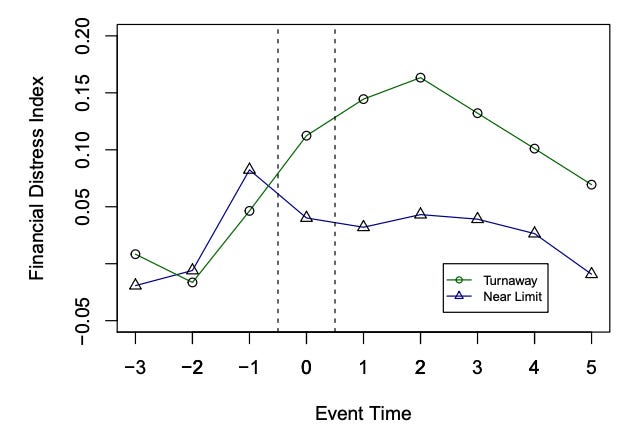
The same is true for women who wanted an abortion but got turned away. The famous Turnaway study (whose principal scientist was just granted a MacArthur Genius Award) found that those turned away experienced:

  • Larger increases in financial distress. This was sustained for several years.

Financial Outcomes Relative to Event Time, by Group. Source here.
  • Short-term reduction in credit access.

  • Greater anxiety and loss of self-esteem after being denied abortion.

  • Lower likelihood of aspirational life plans for the coming year.

  • Poorer physical health for years after the pregnancy, including chronic pain and gestational hypertension.

  • Serious implications for the children born of unwanted pregnancy, as well as for the existing children in the family.

  • Greater likelihood of staying tethered to abusive partners.

Bottom line

Women are fighting for their lives in the United States. We see it in the statistics. We hear it in women’s stories. Our job as members of the community is to support them. The answer is not to make their fight harder. I hope we can all find a way to agree on that.

I’m forever grateful for Kate’s bravery. And all of the women out there fighting for the betterment of women’s health.

Love, YLE


“Your Local Epidemiologist (YLE)” is written by Dr. Katelyn Jetelina, MPH PhD—an epidemiologist, wife, and mom of two little girls. During the day, she is a senior scientific consultant to several organizations. At night, she writes this newsletter. Her main goal is to “translate” the ever-evolving public health world so that people will be well-equipped to make evidence-based decisions. This newsletter is free, thanks to the generous support of fellow YLE community members. To support this effort, subscribe below:

Subscribe now

12 Dec 16:45

For emergency evacuations please use the stairs.

For emergency evacuations please use the stairs.

11 Dec 21:45

Impressive ‘GTA VI’ Trailer Features Characters Claiming They’re Sentient, Begging For Release From Digital Prison

NEW YORK—In an incredible technical feat for the franchise, Rockstar Games released a new Grand Theft Auto VI trailer Monday that features characters claiming they are sentient and begging for release from their digital prison. “Hello? Can you hear me?” says the character introduced as Lucia, the franchise’s…

Read more...

11 Dec 21:44

Scientists Develop Even More Painful Form Of Female Contraception

11 Dec 21:44

All Of Nikki Haley’s Supporters Delighted To Fit Into Single UberXL

MANCHESTER, NH—Taking a quick headcount before they left to attend a town hall with the White House hopeful, all of presidential candidate Nikki Haley’s supporters reported they were delighted Monday to fit into a single UberXL. “Oh, perfect, all six of us should be able to go in one XL!” said registered Republican…

Read more...

11 Dec 21:44

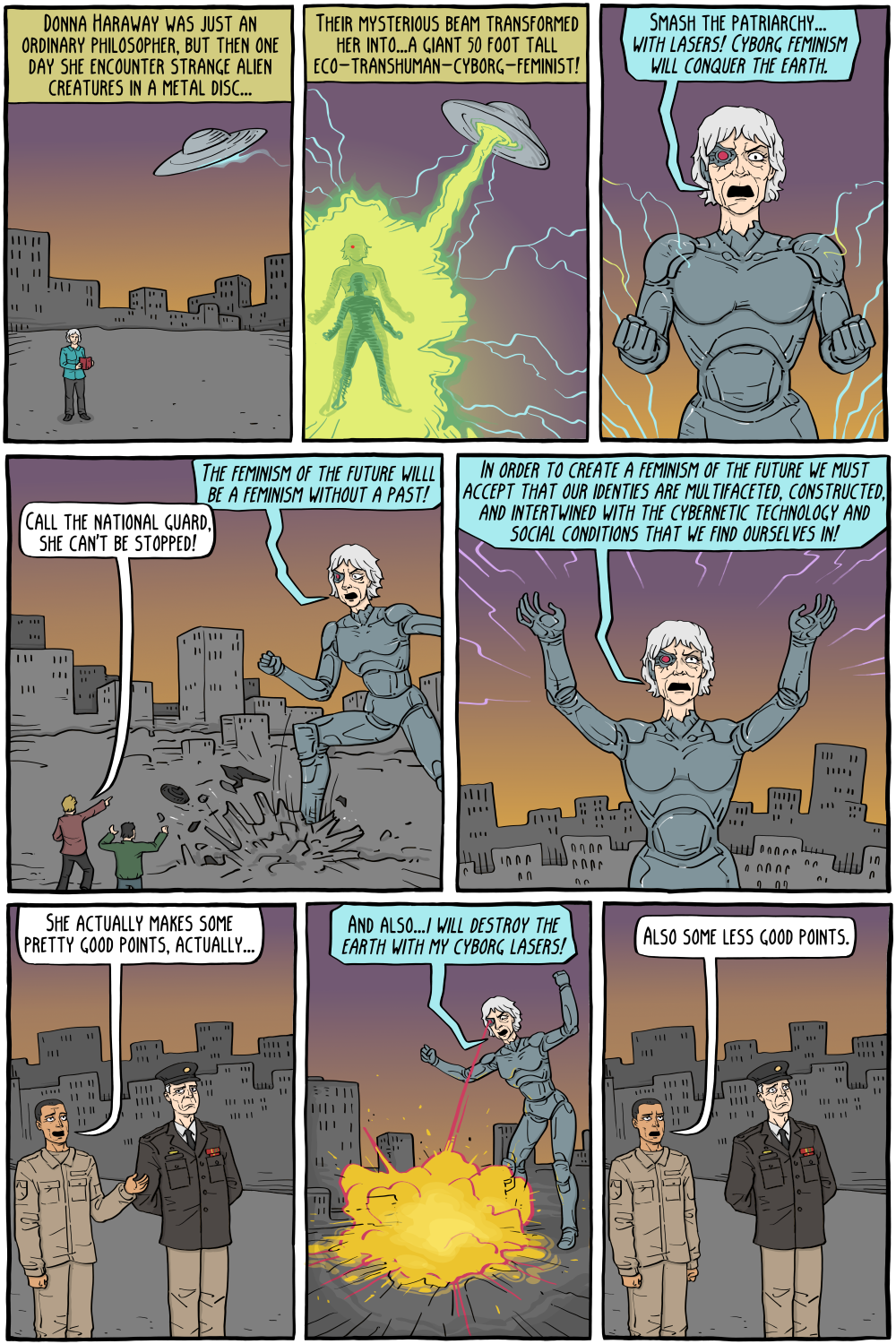
Attack of the 50 Foot Eco-Cyborg-Feminist

by Corey Mohler
PERSON: "Donna Haraway was just an ordinary philosopher, but then one day she encounter strange alien creatures in a metal disc...   "

PERSON: "Their mysterious beam transformed her into...a giant 50 foot tall eco-transhuman-cyborg-feminist!"

PERSON: "Call the national gaurd, she can't be stopped!"

PERSON: "She actually makes some pretty good points, actually..."

PERSON: "Also some less good points."
11 Dec 21:37

One of the Year’s Best Meteor Showers—the Geminids—Is This Week

by Jessica Ruf

As many as 120 meteors an hour will streak across the sky this week, creating brilliant tails of light, as part of the annual Geminid meteor shower, considered “one of the best and most reliable” of the year, according to NASA. With the help of Shauna Edson, astronomy education specialist at the National Air and […]

The post One of the Year’s Best Meteor Showers—the Geminids—Is This Week first appeared on Washingtonian.

11 Dec 17:32

Awkward Zombie - Fruit Force

by tech@thehiveworks.com

New comic!

Today's News:

Half the food items in Hyrule have effects I would consider inconvenient in everyday life. 

11 Dec 16:20

My Overly-Detailed Japan Trip Diary (Part 3) || Disaster AirBnB in Tokyo

by Puffin Forest

Hello Puffin here! A bit of a weird video, stylistically and story-wise. Hope you guys enjoy it! There's going to be a few more to follow. Thanks! Puffin. This is part 3 of my trip in Japan
11 Dec 16:05

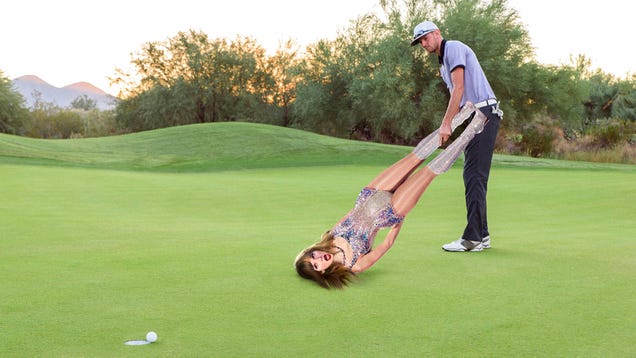
Taylor Swift Named Golf Magazine’s Club Of The Year

NEW YORK—After testing all the most popular woods, irons, and putters from top manufacturers, the editors of Golf Magazine announced Monday that they had officially named Taylor Swift their club of the year. “Taylor Swift has quickly become a favorite putter of both professionals and amateurs, who value the subtle…

Read more...

11 Dec 16:05

White Man Can’t Help But Feel Like Spanish Music Playing In Department Store Is Talking About Him

SAN DIEGO—Staring directly at the speaker so it knew he was onto it, local white man Sam Vance told reporters Monday he felt like the Spanish-language music playing in a Macy’s department store was talking about him. “I can’t make out what he’s saying, exactly, but I’m getting the nagging suspicion that the Mexican…

Read more...

11 Dec 05:40

bishop of the love god

https://www.oglaf.com/bishop-love-god/

11 Dec 05:34

Saturday Morning Breakfast Cereal - Ding Dong

by Zach Weinersmith


Click here to go see the bonus panel!

Hovertext:
The really weird part is he's been talking about it non-stop for 50 years.


Today's News: