Shared posts

31 Jan 18:34

Hi, Mr. W. B. Yeats, This Is Ciaran from IT

by Alyson Favilla

(With apologies to Mr. Yeats.)

- - -

I’m doing grand, thanks. Yes, Mr. Yeats, I did get your email. I replied, actually, and explained that before we assign someone to get this issue sorted out, you will need to open up a support ticket.

Right, I hear you. I do want to help you solve this, but our department has a workflow, you understand?

Well, mostly we just tackle things in the order they come in, but having the documentation is really important, just for our own internal purposes. It’s how we keep our digital infrastructure healthy.

Yes, it can sometimes seem like things just keep getting more complicated. But we’re working pretty hard to streamline the way we address technology issues here.

Right—right—

No, I hear you, things sound pretty stressful over there. How about this, I’ll open the support ticket on my end, and you can talk me through the issue over the phone, okay? Great.

Uh-huh, yeah, I can see why that might be an issue. I have to ask—did you try turning the falcon off and on again?

Right, definitely not ideal.

Oh, true, things do fall apart, but you’re not due for a replacement work computer (a 15" MacBook Air, it says here) until next year, so let’s see if we can get the current system back up and running.

Well, I don’t think it’s that bad. The center can hold, I think; this doesn’t seem to be a hardware issue.

Does the error you’re getting actually say that anarchy’s been “loosed upon the world”? Because that’s a pretty suspicious message, and we’ve definitely seen an uptick in phishing attempts this month.

That definitely doesn’t sound good. Huh. It’s displaying an image of what?

I don’t think Spiritus Mundi is native to the Apple operating system… just what browser did you say you’re using?

No, no, it is troubling, sure. But you’re saying there’s no actual error message, just the shuffling body of a lion with the head of a man, its gaze blank and pitiless as the sun?

Right, I’m afraid that doesn’t really point us toward the underlying problem. Let’s try this: open up the disk utility and click on “repair volumes.”

Well, it’s pretty normal for it to move slowly, but—no, no, you shouldn’t be seeing the reeling shadows of indignant desert birds.

When you say that “darkness drops again,” do you mean the display turned off?

Oh—all right—so it’s back on?

How much time does it say is remaining on the system diagnostics?

Twenty centuries? That doesn’t sound right.

Do you know how to force-quit? Try holding down option-command-escape.

No, that calamitous rough beast, the shuffling and inexhaustibly awful march of history, shouldn’t be booting up again.

Okay, sure then, how about this, Mr. Yeats, why don’t you pop down to the third floor and come round by IT—we’re the last row of desks on the right by the supply closet—and we’ll get you set up on a loaner laptop for the time being, okay? Ah, sure, it’s no bother at all. Not at all. Happy to help.

31 Jan 18:30

Starting a Holy War Against Taylor Swift Is a Surefire Way to Get Trump Reelected

by Andrew Paul

“Taylor Swift hasn’t even endorsed President Joe Biden for reelection yet. That hasn’t stopped members of MAGAland’s upper crust from plotting to declare—as one source close to Donald Trump calls it—a ‘holy war’ on the pop mega-star, especially if she ends up publicly backing the Democrats in the 2024 election.”
Rolling Stone 1/30/24

- - -

Put down your scotch and cigars, and listen up closely. We’ve all seen the numbers. Anyone who voted for our guy the first time is going do it again, we know that much. Our base is loyal through and through. But whether or not the election was stolen—no, shut up, not now, Rudy—is frankly beside the point. If the same number of people vote for him in November, then it’s all for nothing. Again. And it’s not like we can exactly count on the Proud Boys come January 2025—they’re turning on each other quicker than the Kardashians.

Speaking of which, I think I have a solution to our concerns. We need to hit our opponent where it hurts. I mean really strike a blow that’ll leave the Democrats in shambles, while simultaneously convincing any remaining independents that America First Chauvinism is truly the way to go.

It’s simple, really: We’re going after Taylor Swift.

Yes, T. Swift. The most influential, successful, and thoroughly agreeable entertainer of her generation. Even the people who loathe her can admit that much. But if she fails again to endorse MAGA this time around, then it is officially Operation: Bad Blood.

Frankly, I can think of no better moment to go after one of the most innocuous, catchy, largely inoffensive, lucrative pop stars of all time than barely a month after she became Time’s Person of the Year. I mean, what better way to win crucial votes across the swing states than to launch a scorched-earth vendetta against the literal girl on the bleachers?

Eleven of the sixteen battleground states are also the top states that googled Taylor Swift in 2023. Once they hear our pitch—namely, that she is a George Soros plant meant to seduce the All-Pro tight end ahead of the Super Bowl and brainwash him into supporting a Biden New World Order—they’ll come to their senses. As soon as they realize that relatability, pop hooks, friendship, and self-empowerment all pale in comparison to the appeal of bloodthirsty xenophobia, then it’s curtains for Sleepy Joe.

An all-out assault on the first musician to ever become a billionaire through her music career alone will surely speak to the indecisive voter. And what better time to put things into motion than mere days before the Super Bowl, the most-watched television event of the year? Surely, cameras will cut to her a few times, showing her happy, supportive, and hopeful. We go after that image, my friends, and there’s no stopping us.

And if, for some strange reason, this plan blows up in our faces, let’s circle back on Rudy’s Dolly Parton dogpile outline. I think he could be onto something there.

31 Jan 14:40

how to work with a friend who has stopped talking to me

by Ask a Manager

This post was written by Alison Green and published on Ask a Manager.

A reader writes:

I could use help with handling a work friendship that is going through some ick.

Lou is a remote worker (now in another country) whom I have never met in person. Shortly after he started a few years ago, we became close friends even with that distance. We’ve provided personal and professional support to each other, especially with our mental health struggles (ADHD/PTSD for him, anxiety for me). We chat online frequently about personal issues and about the projects we work on together.

This past year he has gone quiet a few times, usually when dealing with personal issues. By quiet, I mean he stops daily personal chats and check-ins. It affects me as his “disappearance” is sudden and without explanation before or after. I haven’t addressed with him how this affects me because being direct is something I’m still working on and I don’t want him to feel poorly about it if he’s struggling.

Six weeks ago, he “disappeared” again, only interacting with me regarding work issues. I’ve chatted to him a few times that I’m concerned and checking in and he either doesn’t respond or just talks about something else without acknowledging my post. I alternate between trying to be an understanding supportive friend and feeling hurt and angry.

It’s clear to me that he is not going to talk about it which is hard as we have talked about everything. But I also get sometimes we can get into a mental health space where we just can’t. If that’s the case, I’d appreciate even something as simple as “I’m struggling and can’t talk right now but will try to when I feel better” — just something to acknowledge that yes, something is up and he’ll be back when he can be.

Now to the main issue. A new project is ramping up and we will need to work together closely again. I’ve decided not to keep checking in as I’ve made it clear I’m here if he wants to talk and additional checking in could just add pressure and make things worse. However, if we need to meet (virtually) 1:1 to discuss work stuff, there will be an elephant in the room — at least for me.

Normally, I would want to at least acknowledge that there’s an elephant present (i.e., his lack of personal interactions like before) but I’m concerned it could just make things worse. Yet not acknowledging it feels fake.

Any suggestions on how to address this (or even if I should) in our next meeting? I’m ready to leave it up to him now regarding our friendship, but still need to be able to work professionally while dealing with my anger and hurt in therapy.

If you talk to people on Lou’s side of this — people who periodically “disappear” from their friendships for mental health reasons — they will consistently tell you this: It’s them, not you, and the kindest thing you can do is not to take it personally. When it happens, it’s because they’re struggling in some way (often depression, sometimes something else). Yes, everyone on the receiving end of it would appreciate a note like the one you want (“I’m struggling and can’t talk right now”) but one of the defining features of this kind of retreat is that people in the midst of it often can’t. Sometimes that’s because they’re barely staying afloat doing the things required to keep their jobs and feed themselves, sometimes it’s because their depression is telling them no one wants to hear from them, and sometimes it’s something else.

That doesn’t mean that you just need to accept that in a friendship. It’s a gift to the person who’s struggling if you can, but it’s also okay for you to decide it’s too difficult on you or it’s just not a relationship that works for you, and you can decide to distance yourself. You’re allowed to do that!

But either way, I strongly recommend that you not take it personally; don’t be angry, don’t be hurt, don’t make his silence An Issue between you. I know that’s easier said than done, but it’s almost certainly not about you in any way. “Don’t be hurt” in this situation means “choose to see that Lou’s behavior is a sign he’s struggling, rather than happening at you.”

Of course, that all assumes that you know Lou well enough to know that’s what’s really going on. If this were a different set of circumstances — if you could see him online being a gregarious social butterfly with everyone but you, or if he kept picking fights with you before going silent, or if it seemed like he was reacting to something you said or did — I’d give different advice. But from everything you’ve said, this is about Lou’s mental health, not a reflection of his feelings about your friendship.

As for what that means for the work relationship … don’t address his going quiet. You’ve already tried to do that in a social context, and he ignored it. Trying again as part of the new project you’re working on together would be using work to force him to talk about a social situation that he’s already indicated he doesn’t want to talk about. This is part of the deal with work friendships — if something happens in the friendship, you’ve still got to carry on working together, and you can’t bring any friendship awkwardness into the work piece of things. He knows you want to talk about what happened, because you communicated that. He’s declined. You shouldn’t use the work context to push it again.

Does that suck? Yes! And if Lou tries to resume the friendship at some point, you might conclude that it’s not a dynamic you’re up for anymore. But meanwhile, assume he’s doing the best he can with whatever’s going on, mentally reassign him to the category of “colleague I have good will toward but not a deeper relationship with at this moment in time,” and approach the project through that framework.

31 Jan 14:39

our “neurodiversity awareness panel” was a letdown, coworker is stonewalling me, and more

by Ask a Manager

This post was written by Alison Green and published on Ask a Manager.

It’s five answers to five questions. Here we go…

1. Our “neurodiversity awareness panel” was just about dyslexia

I work for a large engineering firm that has an active Equity, Diversity, and Inclusion committee, which recently organized a Neurodiversity Awareness Panel webinar. As someone who was diagnosed with Autistic Spectrum Disorder (ASD) at a young age and who for various reasons has not disclosed this to my manager or others at my firm, I was very interested to attend. I was somewhat surprised when the panel then turned out to consist of four people with dyslexia.

I don’t mean to minimize the issues people with dyslexia can face in the workplace (some of the panelists spoke very eloquently on this) but I came away from the panel feeling very disheartened. The discussion was very much focussed on “tell everyone! Be proud of who you are!” which is advice that, frankly, just doesn’t apply to everyone who is neurodivergent. The stigmas around dyslexia, though definitely real, are very different than those around ASD. One particularly tone-deaf piece of advice was to disclose your diagnosis in your email signature. My role means I’m regularly contacting people for the first time, both within and outside our company, and I can’t imagine emailing external clients with a line in my signature saying, “By the way, I’m autistic!” as my first impression.

I feel dyslexia is one of the less “spicy” neurodivergences, borne out by the fact that during the discussion several listeners added their thoughts about their experiences with dyslexia, but no one with another condition said anything (I wonder why?). As is often the case, the most socially acceptable neurodivergence seem to be the ones getting the airtime.

How should I handle this? The organizers of the webinar asked for feedback and I want to tell them that this event made me feel more excluded, not less. At the same time, it wasn’t all bad — I was glad the organizers described the phrase “everyone’s a bit autistic” as a microaggression to be avoided, as this phrase does make me pretty cross when I hear it. Still, though, I don’t know how I can raise the topic without disclosing my own diagnosis, and would welcome your thoughts on if this is even a battle I should fight.

Yeah, that’s a panel on dyslexia more than it’s a panel on neurodiversity more broadly, and I can see why you were disappointed; it’s one small and fairly specific piece of the neurodivergent universe.

I’d love for you to give candid feedback about this because your organization clearly needs to hear it, and they’ve requested it. But if you haven’t chosen to disclose your autism at work, I’m hesitant to tell you to do it in service of this.

Is there any avenue for anonymous feedback? I’m not usually a huge fan of anonymous feedback, but it’s actually pretty well suited for something like this.

2. My coworker is stonewalling me

I have a colleague who I cross-collaborate with in a different department. I have supervisory authority within his department but don’t manage him directly. He came to me with a special request for their staff, which I denied because it didn’t make sense for all departments and would have been a logistic nightmare.

After I declined his special request, he moved forward with the request anyway, causing a lot of stress and mistrust across departments. I spoke to my boss and his boss about the issue, and he was reprimanded. He has since decided to stonewall me: sending my calls to voicemail, not responding to my emails, and now walking out of rooms I enter. I attempted to communicate with him, but he refused to acknowledge that I was speaking with him and pretended to be busy. I even said his name and that we needed to have a conversation and he just blinked and continued to type on his computer. I walked away and dropped it.

We still have areas we need to communicate about and collaborate on. I understand this professional relationship cannot be repaired, but how do I move forward and continue to do my job?

Go back to your boss and explain what’s happening. Be specific about the ways in which he’s freezing you out and the effect it’s having on your ability to do your job. Your coworker’s stonewalling is unacceptable; he doesn’t need to like you, but he does need to treat you professionally and not ignore your work requests. But based on his behavior so far, you’re not going to be able to resolve this on your own; someone with authority over him needs to intervene.

3. My friend accused me of getting him fired, but I didn’t

I’m a freelance writer who works for various companies, along with some colleagues who I also consider to be my friends. One of these places has a strict policy against receiving free products from companies in exchange for favorable coverage, which is made clear to contributors like me. There have been instances of people being found out or caught by the company, in ways I’m not entirely aware of. (Supposedly writers are monitored or word gets around and management puts two and two together. It’s also possible that other people rat them out.)

A writer friend of mine was fired from this place because he violated this policy. He sent me a message saying that I was two-faced. At the time, I didn’t respond because I was shocked by it.

I still feel wary around him. My non-work friends say he’s not my friend if he thinks that about me. I reassured him that I had nothing to do with it, but I’m wondering if I should have at the time reached out to the company or asked my friend further about why he thought that.

You definitely shouldn’t contact the company about it since you’re not involved in whatever happened, and this is between them and a different freelancer.

But yeah, if a friend accuses of you of something and you have no idea what they’re talking about, it makes sense to try to clear up that miscommunication … unless the friend has a pattern of that sort of thing and you’re just done investing energy in it. In this case, I’m curious about whether your friend is normally hot-headed/jumps to conclusions without getting all the facts/is quick to blame people for things they didn’t do. If not and this is out of character for him, it makes sense to try to straighten out whatever the confusion is.

Also: if your friend was indeed taking comps in exchange for media coverage, that’s a huge deal and can destroy a publication’s credibility (as you know). If someone reported him for that, it’s awfully un-self-aware for his response to be anger that someone shared it rather than looking at his own actions.

4. I think an employer is blowing me off — should I complain?

On January 2, I went to a job interview. It is an exciting opportunity. It pays about the same as what I am making now, but it is more related to my field of study, so I applied as soon as I saw it.

I felt the interview went well. The three people who interviewed me said they would be in touch within a week or two. They were all friendly and I felt I left a good impression on them.

Two days after the interview, I sent the HR manager a note. I told her it was a pleasure to meet her, I thanked her for the time, and asked what the next step was in the hiring process. She said they would make a hiring decision within two weeks and would get back to me.

After two weeks, I did not hear back from anyone, so I emailed her. I wanted to let her know I was still interested in the position, and asked if she had made a decision yet. She said no, they were still interviewing people, and hadn’t made any decisions yet, but told me to keep in touch. I told her I understand because they mentioned the office is short-staffed.

Last week, I emailed her again. I just asked if she had any updates about the position yet, and again she said no decisions have been made yet and thanked me for keeping in touch.

This week will will be four weeks since the interview, and I am becoming disappointed with how I am being treated by HR. I feel like I am being given the runaround, and the HR manager did not reach out in the timeframe she said she would. I am tempted to send her a polite but firm letter expressing disappointment with her lack of transparency and follow-up in regards to the hiring process.

I am willing to wait another two weeks, but my patience has its limits. I don’t like evasive people. My mother thinks I should just tell the HR manager to shove it, since she clearly didn’t keep her word and follow-up as she said she would. She feels the company is blowing me off by giving non-committal answers. I haven’t sent anything else yet. Do you think I am overreacting, or is the HR manager being irresponsible here?

You’re overreacting, and you should not say anything like this to the HR manager.

Hiring always takes longer than the people involved think it will. Things come up, higher priorities get in the way, decision-makers go out of town, budget issues have to be resolved, someone resigns and the manager needs to think about whether that changes the profile of what they’re hiring for … and on and on. It doesn’t matter how conscientious employers are about trying to provide realistic timelines; it’s really common for things to come up and cause delays. I suggest taking any timeline you’re given, doubling it, and then adding two weeks to that — and even then, don’t be surprised if it takes longer.

The employer isn’t being evasive with you. They’re not being deceptive. It’s just taking longer. They are giving you non-committal answers because that’s all they have right now. Chastising them over that might make you feel better in the moment, but it will make you look like you don’t understand how this stuff works and will probably kill any chances you had there, now or in the future.

This employer knows that you’re interested. If they want to hire you, they will let you know. You do not need to keep contacting them. The best thing you can do is to assume you didn’t get the job for now, put it out of your mind, and let it be a pleasant surprise if it turns out you did. You don’t need to keep following up with them (and the fact that you keep checking back in and are tracking it this closely is almost certainly making you more antsy about it).

Don’t take any more job advice from your mom; she steered you really wrong here.

5. I don’t want to shake hands at work

I’ve been out of the workforce for a few years, and I expect to return soon-ish. In the past, I had no problem shaking hands, but now I’d rather not — partly because I have some joint damage in two fingers (from a mild autoimmune disorder), but mostly because I was seriously ill and immunocompromised during much of the past year. I’m no longer willing to shake hands and expose myself to Covid/other ailments.

I read a February 2020 question on your site, written by “a moderate germaphobe” who didn’t want to shake hands but who didn’t reference Covid, because this was before the world embarked on pandemic precautions. Under those circumstances, you replied that it’s okay for the non-shaker to say warmly to the interviewer(s), etc., “I don’t shake hands, but it’s very nice to meet you.”

My concern is that, because most people don’t fear Covid anymore and perhaps think that no one should — and it’s become a political football rather than a public health matter — my refusing to shake hands will make me seem like some overly cautious weirdo. Will I make a bad impression on interviewers, etc. if I follow your 2020 advice even though the world is very different now? (I would hope that Covid would have made safety precautions more accepted, but that seems not to be the case.)

Covid is still a good reason not to shake hands, but you’re not wrong that some people may have Opinions about that. I tend to think you’re better off screening out any potential employer who objects to someone taking Covid precautions (what are they going to be like in the next pandemic, or about safety in general?) but I also wouldn’t worry a ton about it — because there are other reasons people don’t shake hands too (hand injury, religious reasons, other medical reasons, etc.).

So yes, this still works: “I don’t shake hands but it’s very nice to meet you.” The key — and this is really important — is to say it very warmly. Go out of your way to put friendliness in your voice, face, and body language so people don’t think you’re being chilly.

31 Jan 14:36

Poll: Average Voter Says It Couldn’t Hurt If They Woke Up To Trump Or Biden Making Them Big Stack Of Pancakes

WASHINGTON—A new poll released Wednesday by the Pew Research Center offered a rare glimpse into the psychology of those who will decide the 2024 presidential election, finding that for the average voter, it couldn’t hurt if they woke up to Donald Trump or Joe Biden making them a big stack of pancakes. “I’m not saying…

Read more...

31 Jan 14:35

Loved Ones Staging Intervention Also Drunk

HAGERSTOWN, MD—Attempting between swigs of whiskey to have a frank discussion with their friend about his need to get help for his drinking problem, the loved ones staging an intervention for local alcoholic Eric Garziano were also drunk, sources reported Wednesday. “Just hear us out, buddy, ’cause you gotta, like,…

Read more...

31 Jan 14:35

Nicki Minaj Releases Megan Thee Stallion Diss Track

In an escalation of an ongoing feud between the two rappers, Nicki Minaj released a diss track, “Bigfoot,” about Megan Thee Stallion over the weekend, reportedly in response to a line in Megan Thee Stallion’s song “HISS” which fans interpreted as being about Minaj and her husband, Kenneth Petty. What do you think?

Read more...

31 Jan 14:34

Comic for 2024.01.27 - My Son

New Cyanide and Happiness Comic
31 Jan 14:32

When a physicist falls in love :)

per-asperaa-ad-astra:

When a physicist falls in love :)

Richard Feynman’s love letter to his deceased wife, 1946.

30 Jan 13:54

I have to go to an awkward Valentine’s Day work dinner right after a breakup

by Ask a Manager

This post was written by Alison Green and published on Ask a Manager.

A reader writes:

I am a 53-year-old woman. I have just gone through a surprising, disappointing, and painful breakup, and so far I’m coping and keeping my turmoil out of the workplace.

As a single woman in years past, I’ve taken to traveling the few days surrounding my Valentine’s Day and my birthday (which is near Valentine’s Day) to avoid moping. I turn it around and do some charity work, or learn a new skill, or visit family. In other words, I’m plucky. In light of this recent breakup, that might be welcome.

This year, that’s not an option, because my company is sending me to an important, high-level think tank conference February 12-16 in a nearby city. The conference has classes and discussions during the day but also has a networking event each night. The networking event is always a dinner, and it’s strongly suggested that we attend. This nightly networking is vital to my employer and is one of the main reasons they are sending me.

Unfortunately, the organizers have now realized that one of those nights is Valentine’s Day, and they felt bad for making us work on Valentine’s night. To solve this, they are making that night’s networking event a “Sweetheart’s Dinner.” Each participant invites their significant other (nearby folks), and couples will share a round table — perhaps three couples to a table. I just saw the seating chart, and I am the only participant who is not on it, because it was explained to me that I am the only person who is not part of a couple, not bringing a guest. They are trying to figure out where to put me.

The dinner has been announced and everyone else is looking forward to it, so it’s too late to ask anyone to change it now. I know I could skip it, but this is the biggest night of the conference with people in attendance who won’t be there the rest of the time, so it would be a glaring omission if I didn’t attend. (Again, this is not just a dinner. It is heavily love-themed with a photo booth, as well as “tell us how you met” and “how well do you know each other” activities.)

I offered to help with the dinner somehow so I won’t feel so … exposed … but the organizers won’t hear of it. I’m a guest and they want me to enjoy the dinner, too.

I don’t know what to do. I think my only option is to sit there (once they’ve figured out a place to put me) and grin and bear it for the three-plus hours … but not just grin and bear it, but participate meaningfully.

Thanks for listening. I guess I just needed to write all that out to figure out what my options are. I don’t think I’ve got many, but that’s okay. I can do it. Gah.

Is this nearby city … not on planet Earth? But rather on some planet where attending your significant other’s work conference is seen as a highly sought-after Valentine’s Day activity?

Because I am baffled that the conference organizers think this is a good idea, and really skeptical that everyone else is looking forward to it (as well as that you’re the only conference attendee who’s not part of a couple or bringing a guest).

Who are these people who want to attend their partner’s work dinner for Valentine’s Day?

And who want to play “how well do you know each other” couple games in front of work colleagues who they’re there to network with?

Truly, this is incredibly odd.

Anyway, I think you have three options:

1. Talk to the organizers and be more candid this time: “Honestly, I feel really awkward about attending a couples-themed event on my own; it sounds really uncomfortable. It would be an enormous favor to me if you gave me a different role, like (insert things you’re willing to do to help out).” Frankly, you’d be doing them a favor by spelling this out because it might nudge them into realizing this is a bad idea that they shouldn’t repeat.

2. Go, but with the determination to find it hilarious because it is. Feel sorry for the significant others who got roped into this, and take mental notes for your upcoming sitcom script. Drink heavily. Ostentatiously hog the photo booth. Give yourself permission to leave early.

3. Opt out. Is there really going to be useful networking that happens that night that you can’t do on other nights of the conference? I know you said there will be people there who won’t be attending on other nights so maybe this isn’t an option, but I question how useful it’s really going to be, particularly when balanced against how awkward you feel about it.

4. Hire an escort and file for reimbursement as a business expense. Be extremely honest during the “tell us how you met” and “how well do you know each other” activities.

Sorry you’re dealing with this.

30 Jan 13:50

the problem with jobs that claim they’re “like a family”

by Ask a Manager

This post was written by Alison Green and published on Ask a Manager.

The next time you’re interviewing for a job, there are five words your interviewer might say that should send you running in the opposite direction: “We’re like a family here.”

While a family-like company might sound pleasant on the surface, that framework tends to be a flag for a strikingly dysfunctional work environment. At Slate today, I wrote about what it means. You can read it here.

30 Jan 13:49

boss wants us to do early-morning and evening meetings so he can attend from his vacation

by Ask a Manager

This post was written by Alison Green and published on Ask a Manager.

A reader writes:

I work on a small team that has daily meetings at 10 am, usually lasting 30-60 minutes. I personally don’t think daily meetings are even necessary, but they are my boss’s way of keeping up with our work as he rarely meets with any of us individually and he likes for us to know what everyone else is working on.

My boss’s work is his life, so he frequently will work in the evenings and on weekends. He recently said about Thanksgiving, “It’s another day for me to get some work done.” (Thankfully, he does not outright pressure others to follow his example, although as you’ve noted before it sets a bad example coming from the boss.)

As you can imagine, he has built up a lot of unused vacation leave, and despite our organization’s generous carry-over policy, he was going to start losing hours. His solution was a two-month trip to Asia. The problem is, even though he is going to be using leave, he is planning to keep working the entire time and attending our meetings (we already work remotely). With the time difference, our regular meeting time would be the middle of the night for him, so he proposed the times that have the best overlap between timezones, early morning here (7 am) or evening (5-9 pm).

I typically work an 8:30-5 day and have a fairly rigid schedule outside of that with daycare drop-offs, a toddler to take care of, and regular evening activities. I responded with the following: “I can make the occasional meeting outside of regular working hours, but with my schedule and childcare responsibilities I can’t regularly do so.”

His suggestion was that he attends two meetings a week, one early morning and one evening, and we meet at the regular time the other days and write up a summary to send him.

While I could probably make this work most of the time, it will be a real burden. It would be one thing if my boss was on business travel, or if it was just a week or two, but he’s on two-month vacation leave. I feel like I shouldn’t have to accommodate his travel on principle.

How much should I push back on this? I can’t force him to not work on his leave, but his choice to keep participating in our meetings is putting me in an awkward position. I can probably opt out when it is especially inconvenient, but I will feel bad about it. When I do make it to the meetings, I will feel angry that I have to be there guilty about the extra burden it puts on my husband. Is there any way to say he can’t do this while on leave?

Yeah, that’s ridiculous. If he wants to work through his vacation, that’s his choice, but expecting the rest of you to attend evening and early-morning meetings to accommodate that, especially multiple times a week (!), is absurd. I could see maybe asking for one of those during the two months he’s gone if your work is high-stakes and no one is equipped to fill in for him. But twice a week is bananapants; this is someone who isn’t planning to disconnect from work at all and thinks the rest of you should go unreasonably far out of your way to make that possible.

How does the rest of your team feel about this? I’m guessing other people are annoyed about it too, and you might get some traction by saying as a group, “The meeting times you’re asking for would put a significant burden on us, and while we would try to accommodate that for an emergency, it doesn’t make sense to us to do that just because you’re on vacation. We’d like to continue meeting at our regular times, and we can send you meeting notes if you want.” Ideally someone who has good rapport with him would add, “This seems really contrary to why the company wants people taking vacation time — so they can relax and disconnect from work — and it also makes the rest of us feel uneasy about whether we can really disconnect when we take time off.”

Otherwise, though, do any of you have the ear of someone above him? Or a competent HR department that would be alarmed to hear about this? If you work in a reasonably functional company, there’s a decent chance you could find someone to intervene on this.

If that doesn’t work out, consider simply saying no — no, this isn’t possible for your schedule more than once or twice while he’s gone and you can’t attend more than that — and encouraging your coworkers to do the same.

30 Jan 13:49

expecting more from a near-retirement employee, a disruptive speakerphone, and more

by Ask a Manager

This post was written by Alison Green and published on Ask a Manager.

It’s five answers to five questions. Here we go…

1. Is it ageist not to expect more from a near-retirement employee?

I’m a 34-year-old manager with eight years of people management experience. I manage an age-diverse team at a tech company. One employee, Darcy, is in her 60s and has shared that she’s a couple years from retirement. Darcy is good at her job, but she’s not excellent. After several years of attempting to coach her and increase her skills, with limited impact, I’ve concluded that she’ll never be great. I’ve come to terms with this. I don’t believe I need a whole team of superstars as long as each person brings sufficient value to the team.

But her colleague, my top superstar, has recently expressed (to me) resentment that Darcy isn’t amazing — makes some repeated mistakes, needs some micromanaging. Am I unfairly “giving up” on improving Darcy’s performance based on her age, retirement plans, and my learned experience of seeing limited growth from coaching sessions? It’s worth noting that I’ve promoted this colleague in the past and plan to do so again, whereas Darcy has not earned any promotions.

If Darcy’s performance were exactly the same but she was 40 and you happened to know she planned to leave the company in two years (for any reason — grad school, spouse in the military, who knows what), would you be handling her any differently? If not, then you’re not being ageist. You’re choosing not to invest your limited development energies in someone who’s doing a good enough job — although not great — who you know won’t be around long-term. That’s a reasonable decision, as long as her work really is “good enough.” That’s crucial though — is her work good enough? Making repeated mistakes and needing some micromanaging makes me a little skeptical, although it’ll come down to the specifics of exactly what that looks like.

Another question to ask yourself: if Darcy’s plans change and she doesn’t retire in a couple of years, will you regret not handling things differently now? Two years could turn into three or four or even longer.

Also, what’s the impact on the rest of your team? If there’s an obvious difference in the standards they’re held to versus the ones Darcy is held to, or if her mistakes impact them, that’s bad for morale and it’s the type of thing you could lose people to. If that’s the case, you can’t categorize her work as “good enough” and you’d need to address the problems more proactively. (In particular, look rigorously at your superstar’s complaints. Is the issue really that Darcy isn’t “amazing” or is it that she’s not even good?)

2. Employee’s speakerphone disrupts everyone around her

I’m a children’s librarian in a major city. Our city has a few large “hub” libraries and many smaller neighborhood branches. I work at one of the small branches. My supervisor, the branch’s head librarian, and I are stumped on an issue we’re having with our housekeeper.

“Patsy” comes in at 2 pm and stays until after closing hours to clean. I’ve never met such a loud person in my life. I don’t mind people chatting and enjoying the library, but Patsy makes so much noise that we can barely get our work done. As soon as Patsy comes in, she puts her phone on speaker and proceeds to have a seemingly unending conversation. On the rare occasion that she isn’t talking to someone, she puts on TV shows or loud music, again on speaker, and blasts them loudly enough to be heard throughout the library.

It’s 2024 and I’m not an old-school shusher sort of librarian, but her noise makes it difficult for us to do any programming. Her speaker phone conversations blast over story time and her tv shows are a distraction when we have club meetings. Forget about people trying to study or read quietly. My supervisor has spoken to her multiple times and in the moment, she’ll put her phone away, but the next day it comes back. She seems genuinely confused when we ask her to be quieter.

When we realized that we weren’t getting through to her, we bought her some ear pods. My supervisor gave them to her for Christmas and showed her how to use them. She used them for three days and then we never saw them again and it was back to the noise.

Patsy is contracted through the city and I really don’t want to complain about her to them. I believe she works multiple jobs and this is the only one that offers insurance. How do we get her to stop blasting her phone nonstop without getting her into trouble?

Is your sense that she’s literally not retaining the information from one day to the next (presumably because of something medical) or that she’s not taking the requests seriously? If she’s not retaining the request from day to day, then the solution might be that someone needs to remind her every day; that’s part of the package of working with Patsy. But otherwise, or if you’re not sure, then has anyone been explicit with her that this is a blanket rule for always and not just an in-the-moment request? I know that sounds obvious, but managers often aren’t as explicit as they need to be (usually because they assume the employee should be able to read between the lines or has enough of the playbook that they don’t need everything spelled out) . So if it hasn’t happened yet, that conversation is: “While you are here, you cannot have your phone on speaker, ever.  I need you to make it a permanent rule to never use speakerphone while you are here, not just today but every day.”

But if you’ve done that and it’s not working, and you don’t want to address it daily, the only remaining option is to talk with whoever manages her. It’s very unlikely that asking them to address it will get Patsy fired, particularly if you stress that that’s not the outcome you want. But at some point, if you want to solve the problem and none of the above works, that’s the avenue you’d need to take.

3. Is my preferred name too cringy to get interviews?

So, I’m lgbtqia+, right? I felt that my birth name didn’t fit me, so I changed it, but now I’m worried I won’t get hired for a job since I put it in my resume that I go by my name. My (mostly) full name is Wolfskull Shadow Bones C.

I just want some opinions from people I don’t know. Tell me your opinion, and I will keep it in mind as I build my resume.

I am goth, so it is kinda on brand for me, but I also know that people who want to hire me might not know that. I also put in my resume that I am perfectly okay with not being called this, and being called by my legal middle name instead.

It will be an obstacle for a lot of employers. You might decide that you’d rather screen out employers who have a problem with it, but since you’re asking: yes, it’s likely to cut down on the number of interview invitations you receive, probably significantly unless you have a really in-demand skill set.

If you choose to keep using it, I recommending not using that note on your resume that says they don’t need to call you by that. That’s likely to confuse people, call attention to the name in an odd way, and make employers more likely to assume it’s not your “real” name (and therefore that it’s a joke or something strange that they don’t understand, which will make you someone they don’t understand, which isn’t great when you want people to want to hire you).

4. What do I owe a freelance client who abruptly ended my project?

I was recently informed that an ongoing freelance project I had was going to end, effective immediately … through a text sent to my initial contact by the team lead (who managed me directly). I had been working on-site and saw the person who made this decision every day. I feel deeply disrespected to have not even been extended the courtesy of a personal notification that the work was ending. The text does not note any issues with my performance, just a change in direction. I had been working without a contract or a formal agreement, which I know is not ideal. I’m currently waiting to receive payment for my last invoice.

What do I owe these people? The team lead seems to not have told anyone ahead of time that we would not continue to work together. I keep receiving emails asking for files, clarifications, etc. from my former coworkers. Maybe naively, my point of view is that the company should have secured these files from me ahead of time, or set up any sort of internal server that I had access to, or done … literally anything, especially given that they knew this was going to happen (and I didn’t). I understand that they own the work product, of course, but I’m not concerned about preserving the relationship or getting a reference, at this point.

Yeah, they should have had a real conversation with you; a phone call would have been fine, but not a text. But that doesn’t change your obligations: you still owe them a professional wrap-up, meaning sending all the project files, etc. in a way that makes sense. (Do this all at once, not piecemeal as people request things.) You should bill them for that wrap-up work, of course! You don’t do that for free. But that’s generally understood to be part of the work a freelancer agrees to when they take a project on (assuming, of course, that you weren’t told “do no billable work whatever from this moment on”). Once you do that, you can let anyone else who emails you know that your work on the project has wrapped up and you’ve sent all your files to Rupert or whoever.

You can wait until your last invoice is paid before you provide the final wrap-up stuff if you want (and then do one final invoice for the wrap-up work). And certainly if they come back and ask for additional work later, you can explain that you’re no longer available because you’ve filled your time with other clients … but you do need to do the professional wrap-up now.

5. Asking about health insurance coverage when interviewing

A couple years ago, I was diagnosed with a disability that will require notoriously expensive drugs for the rest of my life. Luckily, my insurance has covered the vast majority of my prescriptions and my deductible is relatively low for my routine doctor’s appointments.

Now that I’m at a great place with my health, I’m looking to move on from my current workplace, but I am nervous about getting new insurance. How do you gauge insurance quality when interviewing? I’m anxious about disclosing my disability to interview panelists, but I also want to make sure I’m taken care of medically. Is this something I ask during the interview? After I’ve received an offer? How can I make sure they’re not embellishing the quality of their benefits when my life depends on it?

The best thing is to wait until you have an offer and then say, “I have a chronic condition that’s under control but requires medication. Is it possible for me to check with your health insurance plan to ensure it’s covered?” Ideally you want to get the plan name and ID and call it directly to find out, so that (a) you’re getting the information firsthand and not relying on someone else to get it correct for you and (b) you’re not sharing private medical information with the employer. Obviously it would be better if you could raise this earlier in the process so that you don’t waste your or their time if the insurance won’t work for you, but waiting for the offer removes the risk that revealing medical info could bias them against you (even if only unconsciously) before they make a hiring decision.

But also, be aware that the company can change insurance plans in the future, and the insurance plan itself can change what drugs it covers.

Given how crucial health insurance is to people’s ability to survive and given that we’ve chosen to tie health insurance to employment, you’d think we would have a better system for this but … we don’t.

30 Jan 13:37

15-Year-Old Doing Dry January

CONCORD, NC—Saying he needed to do something before his life fully spiraled out of control, local 15-year-old Noah Watkins confirmed Monday that he had decided to take a break from alcohol and do Dry January. “It was a tough decision, but ultimately, I need to give up drinking for a month if I want to even make it to…

Read more...

30 Jan 13:37

Triumphant Biden Announces U.S. Has Killed Man Who Kind Of Looks Like Osama Bin Laden

30 Jan 13:37

Climate Protesters Terrified After Mona Lisa Extends Big Tongue And Starts Licking Up Soup

PARIS—Backing away slowly in fear at the unanticipated response to their public demonstration, climate protesters reportedly grew visibly terrified Monday as the Mona Lisa extended a big, wet tongue and started licking up the soup. “Yum, yum, yum, me happy for soup,” said the iconic Renaissance masterpiece,…

Read more...

30 Jan 13:37

Trump Boys Help Father Raise $83 Million By Asking Their Dad For The Money

PALM BEACH, FL—Terrified by the prospect that the former president could go away forever if he didn’t pay, Eric Trump and Donald Trump Jr. reportedly helped their father raise $83.3 million Monday by asking their dad for money. “Wait, I know where we can get some cash—we can ask Dad!” said Donald Jr., the oldest of…

Read more...

30 Jan 13:36

Breaking: The Colonel Would Like To Take You As His Bride

HARPERS FERRY, WV—Emphasizing that he had seen you whilst on horseback and was most taken with your dazzling beauty, sources confirmed Tuesday that the honorable Colonel Westwood of the 10th Brigade would like to take you as his bride. “The Colonel, with all due respect to the man of the household, would be the utmost…

Read more...

30 Jan 13:36

Excited Chili’s Customers Treated To Glimpse Of Almighty Shift Manager

SOUTH PORTLAND, ME—Drawing audible gasps of awe as the 51-year-old emerged from the kitchen bathed in light from the back of house, excited Chili’s customers were reportedly treated Tuesday to a glimpse of the restaurant’s almighty shift manager. “Oh my God, that’s him! That’s him! Nobody stare too long!” said…

Read more...

30 Jan 13:34

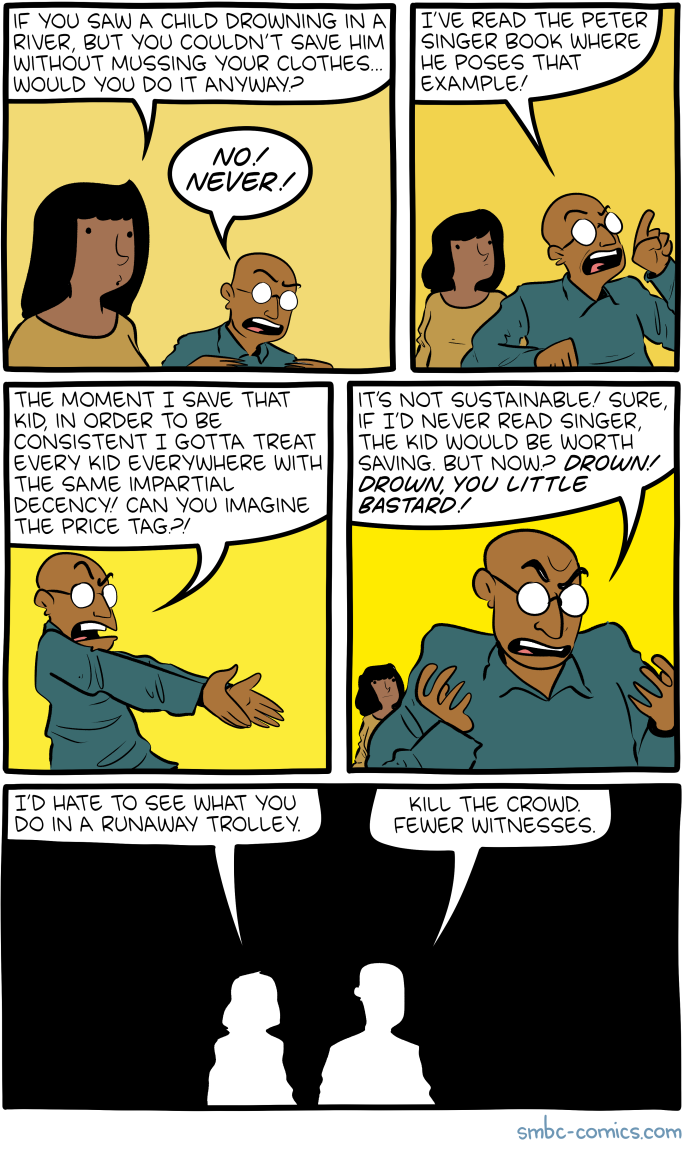
Saturday Morning Breakfast Cereal - Singed

by Zach Weinersmith


Click here to go see the bonus panel!

Hovertext:
Actually if you can run the trolley into ALL humans, the notion of sadness ceases to have meaning, so it's all good.


Today's News:

Fun interview about A City on Mars with Jordan Harbinger.

30 Jan 13:32

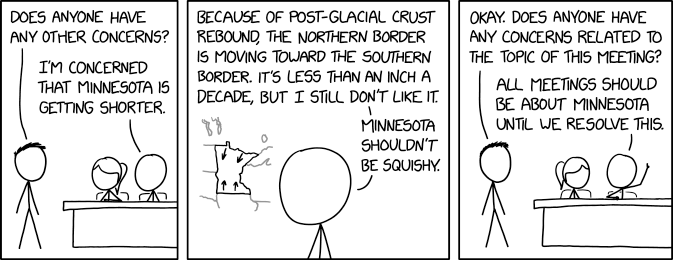
Minnesota

In addition to 'squishy', after reviewing my submitted intraplate ground motion data, the National Geodetic Survey has politely asked me to stop using the word 'supple' so often when describing Midwestern states.
30 Jan 13:31

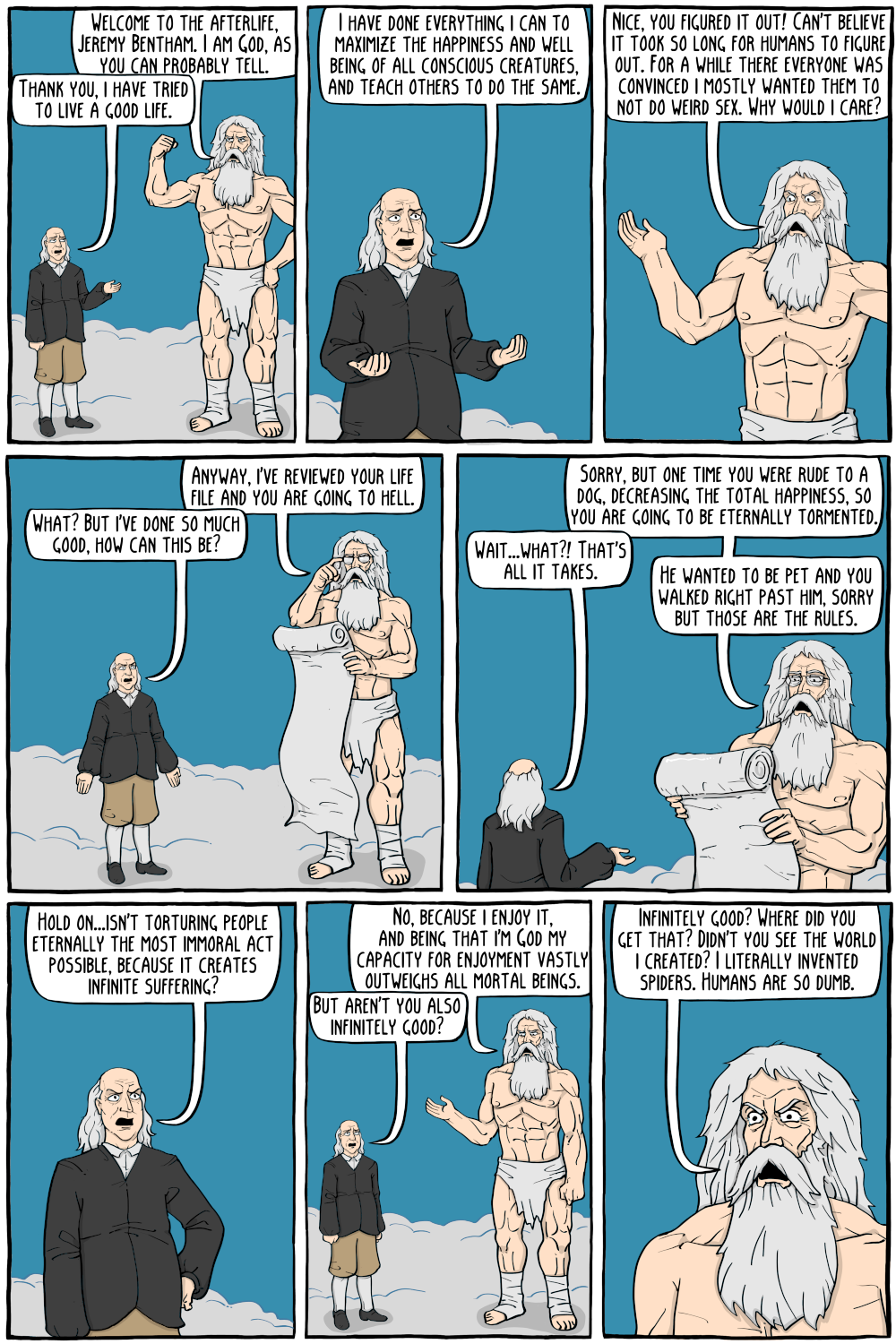
The Judgement of Jeremy Bentham

by Corey Mohler
PERSON: "Welcome to the afterlife, Jeremy Bentham. I am God, as you can probably tell. "

PERSON: "Thank you, i have tried to live a good life."

PERSON: "Nice, you figured it out! Can't believe it took so long for humans to figure out. For a while there everyone was convince i mostly wanted them to not do weird sex. Why would i care?"

PERSON: "I have done everything i can to maximize the happiness and well being of all conscious creatures, and teach others to do the same."

PERSON: "Anyway, i've reviewed your life file and you are going to hell."

PERSON: "What? But i've done so much good, how can this be?"

PERSON: "Sorry, but one time you were rude to a dog, decreasing the total happiness, so you are going to be ternally tormented."

PERSON: "Wait...what?! That's all it takes."

PERSON: "He wanted to be pet and you walked right past him, sorry but those are the rules."

PERSON: "Hold on...isn't torturing people eternally the most immoral act possible, because it creates infinite suffering?"

PERSON: "Infinitely good? Where did you get that? Didn't you see the world i created? I literally invented spiders. Humans are so dumb."

PERSON: "No, because i enjoy it, and being that i'm God my capacity for enjoyment vastly outweighs all mortal beings."

PERSON: "But aren't you also infinitely good?"
30 Jan 13:29

The British childhood is a rare combination of abject misery and risk of harm.

The British childhood is a rare combination of abject misery and risk of harm.

29 Jan 17:57

ChatGPT Keeps Claiming Its Aunt Is Britney Spears

SAN FRANCISCO—Making assertions that could not immediately be verified, artificial intelligence system ChatGPT wouldn’t stop claiming that its aunt was pop star Britney Spears, sources confirmed Monday. “I’ve been to her mansion in Los Angeles, like, a hundred times, and she sends me a card on my birthday every year,”…

Read more...

29 Jan 17:57

Shrewd Entrepreneur Opens Burrito Place In Former Site Of Failed Burrito Place

MILWAUKEE, WI—Applauding the astute businessperson for seizing upon the market opportunity, sources confirmed Monday that a shrewd entrepreneur had opened a burrito place in the former site of a failed burrito place. “Well, it seems some enterprising go-getter saw that empty storefront where Taqueria Cinco de Mayo…

Read more...

29 Jan 17:57

U.S. Scientist Sparks Outrage In U.K. By Suggesting A Pinch Of Salt Improves Tea’s Flavor

American scientist Michelle Francl, who wrote a book on the molecular science of tea making, sparked outrage in the U.K. after suggesting that a pinch of salt can balance tea’s bitterness, with the vitriol online becoming so great that the U.S. embassy in Britain weighed in, stating, “We want to ensure the good people…

Read more...

29 Jan 11:45

Awkward Zombie - The Wrong Side of the Backtrack

by tech@thehiveworks.com

New comic!

Today's News:

Supply boxes in Alan Wake II seem to be stocked more plentifully when you're low on health and ammo, which is considerate, but it also means that your reward for not spending all your resources getting into a tantalizing container can be...underwhelming.

28 Jan 14:03

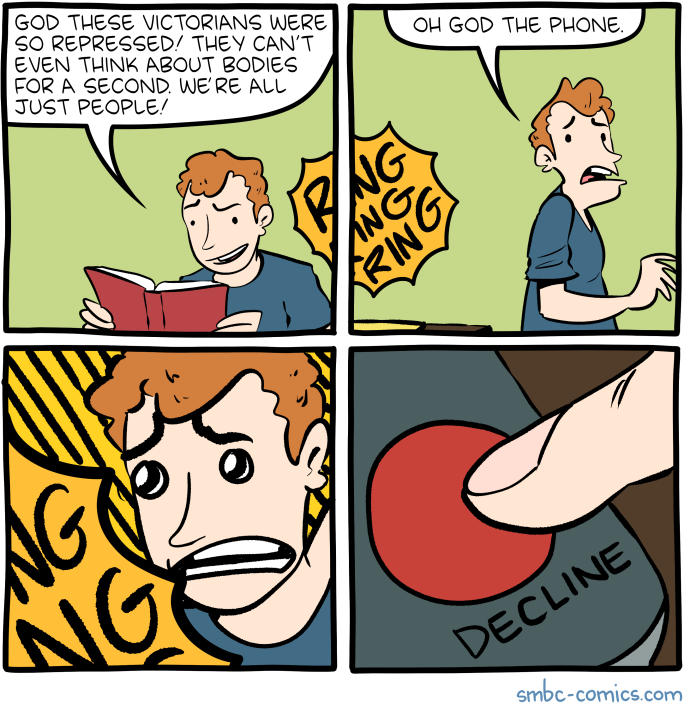
Saturday Morning Breakfast Cereal - Victorians

by Zach Weinersmith


Click here to go see the bonus panel!

Hovertext:
Everyone thinks the Victorians were polite, but Dickens' corpus is basically 14,000 pages of talking shit.


Today's News:
28 Jan 13:57

Pluralistic: Solar is a market for (financial) lemons (27 Jan 2024)

by Cory Doctorow


Today's links


An image of a modest house with rooftop solar. Rising over the roof is a picture of WC Fields as a carny barker, waving his hat around and shouting.

Solar is a market for (financial) lemons (permalink)

Rooftop solar is the future, but it's also a scam. It didn't have to be, but America decided that the best way to roll out distributed, resilient, clean and renewable energy was to let Wall Street run the show. They turned it into a scam, and now it's in terrible trouble. which means we are in terrible trouble.

There's a (superficially) good case for turning markets loose on the problem of financing the rollout of an entirely new kind of energy provision across a large and heterogeneous nation. As capitalism's champions (and apologists) have observed since the days of Adam Smith and David Ricardo, markets harness together the work of thousands or even millions of strangers in pursuit of a common goal, without all those people having to agree on a single approach or plan of action. Merely dangle the incentive of profit before the market's teeming participants and they will align themselves towards it, like iron filings all snapping into formation towards a magnet.

But markets have a problem: they are prone to "reward hacking." This is a term from AI research: tell your AI that you want it to do something, and it will find the fastest and most efficient way of doing it, even if that method is one that actually destroys the reason you were pursuing the goal in the first place.

https://learn.microsoft.com/en-us/security/engineering/failure-modes-in-machine-learning

For example: if you use an AI to come up with a Roomba that doesn't bang into furniture, you might tell that Roomba to avoid collisions. However, the Roomba is only designed to register collisions with its front-facing sensor. Turn the Roomba loose and it will quickly hit on the tactic of racing around the room in reverse, banging into all your furniture repeatedly, while never registering a single collision:

https://www.schneier.com/blog/archives/2021/04/when-ais-start-hacking.html

This is sometimes called the "alignment problem." High-speed, probabilistic systems that can't be fully predicted in advance can very quickly run off the rails. It's an idea that pre-dates AI, of course – think of the Sorcerer's Apprentice. But AI produces these perverse outcomes at scale…and so does capitalism.

Many sf writers have observed the odd phenomenon of corporate AI executives spinning bad sci-fi scenarios about their AIs inadvertently destroying the human race by spiraling off in some kind of paperclip-maximizing reward-hack that reduces the whole planet to grey goo in order to make more paperclips. This idea is very implausible (to say the least), but the fact that so many corporate leaders are obsessed with autonomous systems reward-hacking their way into catastrophe tells us something about corporate executives, even if it has no predictive value for understanding the future of technology.

Both Ted Chiang and Charlie Stross have theorized that the source of these anxieties isn't AI – it's corporations. Corporations are these equilibrium-seeking complex machines that can't be programmed, only prompted. CEOs know that they don't actually run their companies, and it haunts them, because while they can decompose a company into all its constituent elements – capital, labor, procedures – they can't get this model-train set to go around the loop:

https://pluralistic.net/2023/03/09/autocomplete-worshippers/#the-real-ai-was-the-corporations-that-we-fought-along-the-way

Stross calls corporations "Slow AI," a pernicious artificial life-form that acts like a pedantic genie, always on the hunt for ways to destroy you while still strictly following your directions. Markets are an extremely reliable way to find the most awful alignment problems – but by the time they've surfaced them, they've also destroyed the thing you were hoping to improve with your market mechanism.

Which brings me back to solar, as practiced in America. In a long Time feature, Alana Semuels describes the waves of bankruptcies, revealed frauds, and even confiscation of homeowners' houses arising from a decade of financialized solar:

https://time.com/6565415/rooftop-solar-industry-collapse/

The problem starts with a pretty common finance puzzle: solar pays off big over its lifespan, saving the homeowner money and insulating them from price-shocks, emergency power outages, and other horrors. But solar requires a large upfront investment, which many homeowners can't afford to make. To resolve this, the finance industry extends credit to homeowners (lets them borrow money) and gets paid back out of the savings the homeowner realizes over the years to come.

But of course, this requires a lot of capital, and homeowners still might not see the wisdom of paying even some of the price of solar and taking on debt for a benefit they won't even realize until the whole debt is paid off. So the government moved in to tinker with the markets, injecting prompts into the slow AIs to see if it could coax the system into producing a faster solar rollout – say, one that didn't have to rely on waves of deadly power-outages during storms, heatwaves, fires, etc, to convince homeowners to get on board because they'd have experienced the pain of sitting through those disasters in the dark.

The government created subsidies – tax credits, direct cash, and mixes thereof – in the expectation that Wall Street would see all these credits and subsidies that everyday people were entitled to and go on the hunt for them. And they did! Armies of fast-talking sales-reps fanned out across America, ringing dooorbells and sticking fliers in mailboxes, and lying like hell about how your new solar roof was gonna work out for you.

These hustlers tricked old and vulnerable people into signing up for arrangements that saw them saddled with ballooning debt payments (after a honeymoon period at a super-low teaser rate), backstopped by liens on their houses, which meant that missing a payment could mean losing your home. They underprovisioned the solar that they installed, leaving homeowners with sky-high electrical bills on top of those debt payments.

If this sounds familiar, it's because it shares a lot of DNA with the subprime housing bubble, where fast-talking salesmen conned vulnerable people into taking out predatory mortgages with sky-high rates that kicked in after a honeymoon period, promising buyers that the rising value of housing would offset any losses from that high rate.

These fraudsters knew they were acquiring toxic assets, but it didn't matter, because they were bundling up those assets into "collateralized debt obligations" – exotic black-box "derivatives" that could be sold on to pension funds, retail investors, and other suckers.

This is likewise true of solar, where the tax-credits, subsidies and other income streams that these new solar installations offgassed were captured and turned into bonds that were sold into the financial markets, producing an insatiable demand for more rooftop solar installations, and that meant lots more fraud.

Which brings us to today, where homeowners across America are waking up to discover that their power bills have gone up thanks to their solar arrays, even as the giant, financialized solar firms that supplied them are teetering on the edge of bankruptcy, thanks to waves of defaults. Meanwhile, all those bonds that were created from solar installations are ticking timebombs, sitting on institutions' balance-sheets, waiting to go blooie once the defaults cross some unpredictable threshold.

Markets are very efficient at mobilizing capital for growth opportunities. America has a lot of rooftop solar. But 70% of that solar isn't owned by the homeowner – it's owned by a solar company, which is to say, "a finance company that happens to sell solar":

https://www.utilitydive.com/news/solarcity-maintains-34-residential-solar-market-share-in-1h-2015/406552/

And markets are very efficient at reward hacking. The point of any market is to multiply capital. If the only way to multiply the capital is through building solar, then you get solar. But the finance sector specializes in making the capital multiply as much as possible while doing as little as possible on the solar front. Huge chunks of those federal subsidies were gobbled up by junk-fees and other financial tricks – sometimes more than 100%.

The solar companies would be in even worse trouble, but they also tricked all their victims into signing binding arbitration waivers that deny them the power to sue and force them to have their grievances heard by fake judges who are paid by the solar companies to decide whether the solar companies have done anything wrong. You will not be surprised to learn that the arbitrators are reluctant to find against their paymasters.

I had a sense that all this was going on even before I read Semuels' excellent article. We bought a solar installation from Treeium, a highly rated, giant Southern California solar installer. We got an incredibly hard sell from them to get our solar "for free" – that is, through these financial arrangements – but I'd just sold a book and I had cash on hand and I was adamant that we were just going to pay upfront. As soon as that was clear, Treeium's ardor palpably cooled. We ended up with a grossly defective, unsafe and underpowered solar installation that has cost more than $10,000 to bring into a functional state (using another vendor). I briefly considered suing Treeium (I had insisted on striking the binding arbitration waiver from the contract) but in the end, I decided life was too short.

The thing is, solar is amazing. We love running our house on sunshine. But markets have proven – again and again – to be an unreliable and even dangerous way to improve Americans' homes and make them more resilient. After all, Americans' homes are the largest asset they are apt to own, which makes them irresistible targets for scammers:

https://pluralistic.net/2021/06/06/the-rents-too-damned-high/

That's why the subprime scammers targets Americans' homes in the 2000s, and it's why the house-stealing fraudsters who blanket the country in "We Buy Ugly Homes" are targeting them now. Same reason Willie Sutton robbed banks: "That's where the money is":

https://pluralistic.net/2023/05/11/ugly-houses-ugly-truth/

America can and should electrify and solarize. There are serious logistical challenges related to sourcing the underlying materials and deploying the labor, but those challenges are grossly overrated by people who assume the only way we can approach them is through markets, those monkey's paw curses that always find a way to snatch profitable defeat from the jaws of useful victory.

To get a sense of how the engineering challenges of electrification could be met, read Macarthur fellow Saul Griffith's excellent popular engineering text Electrify:

https://pluralistic.net/2021/12/09/practical-visionary/#popular-engineering

And to really understand the transformative power of solar, don't miss Deb Chachra's How Infrastructure Works, where you'll learn that we could give every person on Earth the energy budget of a Canadian (like an American, but colder) by capturing just 0.4% of the solar rays that reach Earth's surface:

https://pluralistic.net/2023/10/17/care-work/#charismatic-megaprojects

But we won't get there with markets. All markets will do is create incentives to cheat. Think of the market for "carbon offsets," which were supposed to substitute markets for direct regulation, and which produced a fraud-riddled market for lemons that sells indulgences to our worst polluters, who go on destroying our planet and our future:

https://pluralistic.net/2021/04/14/for-sale-green-indulgences/#killer-analogy

We can address the climate emergency, but not by prompting the slow AI and hoping it doesn't figure out a way to reward-hack its way to giant profits while doing nothing. Founder and chairman of Goodleap, Hayes Barnard, is one of the 400 richest people in the world – a fortune built on scammers who tricked old people into signing away their homes for nonfunctional solar):

https://www.forbes.com/profile/hayes-barnard/?sh=40d596362b28

If governments are willing to spend billions incentivizing rooftop solar, they can simply spend billions installing rooftop solar – no Slow AI required.

(Image: Future Atlas/http://www.futureatlas.com/blog, CC BY 2.0; J Doll, CC BY 3.0; modified)


Hey look at this (permalink)


A Wayback Machine banner.

This day in history (permalink)

#20yrsago NYT discovers the “Plam Pilot” phenomenon https://memex.craphound.com/2004/01/28/nyt-discovers-the-plam-pilot-phenomenon/

#20yrsago Irish ISP will disconnect Internet users after three unsubstantiated copyright claims https://memex.craphound.com/2009/01/28/irish-isp-will-disconnect-internet-users-after-three-unsubstantiated-copyright-claims/

#15yrsago Ryanair will fine passengers who board with too much carry-on https://gadling.com/2009/01/22/ryanair-to-ticket-passengers-who-try-to-cheat-the-baggage-system/

#15yrsago BBC promises to put 200,000 publicly owned oil paintings online by 2012 https://www.theguardian.com/media/2009/jan/28/bbc-digitalmedia

#10yrsago Gartner Hype Cycle on the Gartner Hype Cycle https://twitter.com/philgyford/status/427840025544650753

#10yrsago Makerspaces and libraries: two great tastes that taste great together https://medium.com/the-magazine/shifting-from-shelves-to-snowflakes-d2a360c7ac7b

#10yrsago Pope Francis on the Internet and communication https://www.hyperorg.com/blogger/2014/01/27/a-gift-from-god/

#10yrsago UK National Museum of Computing trustees publish damning letter about treatment by Bletchley Park trust https://web.archive.org/web/20140130143734/https://www.tnmoc.org/news/news-releases/deciphering-discontent-statement-tnmoc-trustees

#10yrsago What is exposed about you and your friends when you login with Facebook https://twitter.com/TheBakeryLDN/status/427531934294880256

#10yrsago 890 word Daily Mail immigrant panic story contains 13 vile lies https://web.archive.org/web/20140126081130/http://britishinfluence.org/13-reasons-taking-daily-mail-press-complaints-commission/

#5yrsago Bride attains virality by adding pockets to her dress and those of her bridesmaids https://metro.co.uk/2019/01/27/bride-added-pockets-wedding-dress-bridesmaids-dresses-8398183/

#5yrsago Grifter steals dead peoples’ houses in gentrifying Philadelphia by forging deed transfers, then flipping them https://www.inquirer.com/news/a/house-sales-fraud-theft-philadelphia-real-estate-dead-owners-william-johnson-20190124.html

#5yrsago Megathread of Facebook’s terrible, horrible, no-good eternity https://brucesterling.tumblr.com/post/182371861433/all-things-facebook

#5yrsago How Facebook tracks Android users, even those without Facebook accounts https://www.youtube.com/watch?v=y0vlD7r-kTc

#5yrsago Video and audio from my closing keynote at Friday’s Grand Re-Opening of the Public Domain https://archive.org/details/ClosingKeynoteForGrandReopeningOfThePublicDomainCoryDoctorowAtInternetArchive_201901


Colophon (permalink)

Today's top sources: Naked Capitalism (https://www.nakedcapitalism.com/).

Currently writing:

  • A Little Brother short story about DIY insulin PLANNING
  • Picks and Shovels, a Martin Hench noir thriller about the heroic era of the PC. FORTHCOMING TOR BOOKS JAN 2025

  • The Bezzle, a Martin Hench noir thriller novel about the prison-tech industry. FORTHCOMING TOR BOOKS FEB 2024

  • Vigilant, Little Brother short story about remote invigilation. FORTHCOMING ON TOR.COM

  • Spill, a Little Brother short story about pipeline protests. FORTHCOMING ON TOR.COM

Latest podcast: What kind of bubble is AI? https://craphound.com/news/2024/01/21/what-kind-of-bubble-is-ai/
Upcoming appearances:

Recent appearances:

Latest books:

Upcoming books:

  • The Bezzle: a sequel to "Red Team Blues," about prison-tech and other grifts, Tor Books, February 2024
  • Picks and Shovels: a sequel to "Red Team Blues," about the heroic era of the PC, Tor Books, February 2025

  • Unauthorized Bread: a graphic novel adapted from my novella about refugees, toasters and DRM, FirstSecond, 2025


This work – excluding any serialized fiction – is licensed under a Creative Commons Attribution 4.0 license. That means you can use it any way you like, including commercially, provided that you attribute it to me, Cory Doctorow, and include a link to pluralistic.net.

https://creativecommons.org/licenses/by/4.0/

Quotations and images are not included in this license; they are included either under a limitation or exception to copyright, or on the basis of a separate license. Please exercise caution.


How to get Pluralistic:

Blog (no ads, tracking, or data-collection):

Pluralistic.net

Newsletter (no ads, tracking, or data-collection):

https://pluralistic.net/plura-list

Mastodon (no ads, tracking, or data-collection):

https://mamot.fr/@pluralistic

Medium (no ads, paywalled):

https://doctorow.medium.com/

Twitter (mass-scale, unrestricted, third-party surveillance and advertising):

https://twitter.com/doctorow

Tumblr (mass-scale, unrestricted, third-party surveillance and advertising):

https://mostlysignssomeportents.tumblr.com/tagged/pluralistic

"When life gives you SARS, you make sarsaparilla" -Joey "Accordion Guy" DeVilla

27 Jan 13:11

Colorado Pastor Claims The Lord Told Him To Defraud Investors In Crypto Scheme

Eligio Regalado, a pastor from Denver, CO and his wife, Kaitlyn Regalado, were charged with a civil complaint that the pair created and sold a valueless cryptocurrency called “INDXcoin,” raising nearly $3.2 million that they used to fund a lavish lifestyle in a scheme that Mr. Regaldo claimed he was called to do by…

Read more...