Shared posts

26 Mar 14:54

What is Temu?

by Nick Fountain
undefined

It is rare that a new e-commerce company has such a meteoric rise as Temu. The company, which launched in the fall of 2022, has been flooding the American advertising market, buying much of the inventory of Facebook, Snapchat, and beyond. According to the market intelligence firm Sensor Tower, Temu is one of the most downloaded iPhone apps in the country, with around 50 million monthly active users.

On today's show, we go deep on Temu: How does it work, how did it manage such a quick rise in the U.S., and what hints might it offer us about the future of retail? Plus, we'll talk to the bicycle-loving U.S. Representative who is working to shut down a loophole that has proved very helpful to Temu's swift ascent.

This episode was hosted by Nick Fountain and Alexi Horowitz-Ghazi with reporting from Emily Feng. It was produced by Sam Yellowhorse Kesler and Emma Peaslee. It was edited by Keith Romer, fact-checked by Sierra Juarez, and engineered by Cena Loffredo. Alex Goldmark is Planet Money's executive producer.

Help support Planet Money and get bonus episodes by subscribing to Planet Money+
in Apple Podcasts or at plus.npr.org/planetmoney.

26 Mar 13:32

Dade Phelan’s Efforts to Expand Healthcare Still Leave Many Struggling in His District

by Kim Krisberg

Three years ago, Texas House Speaker Dade Phelan unveiled a set of bills that he declared would improve the health of millions of Texans, largely by expanding access to healthcare.

The measures, authored by Republicans and Democrats, were applauded by health advocates such as the Texas Medical Association. This month, an updated version of one of the most noteworthy bills took effect, extending postpartum Medicaid coverage for new mothers from two months after giving birth to a year.

The reforms—most of which passed—fell short of full Medicaid expansion, but they cast the newly elected House speaker in a milder light: a conservative Texas GOP leader willing at times to prioritize the state’s serious healthcare gaps.

Phelan toes a conservative line, including supporting one of the country’s most restrictive abortion bans. But some advocates were hopeful that Phelan’s “Healthy Families, Healthy Texas” plan, which included bills from Republicans and Democrats, might signal openness to Medicaid expansion approval to cover more low-income adults. Texas is one of 10 states that haven’t expanded the program and has the nation’s highest rate of residents without health insurance, at nearly 19 percent for those under age 65.

But Republican leaders, including Phelan, haven’t budged. Asked in 2021 why his health reform agenda didn’t include expansion, Phelan said, “That’s a different conversation than what we’re discussing right now.” He didn’t rule it out, however. “We will have that debate,” he said.

Now, if he ever seemed like a willing listener on expansion, the prospect could soon vanish.

Phelan is fighting to keep his House seat in a primary runoff on May 28 in his far southeast Texas district. In the March primary results, Phelan trailed his Trump-endorsed challenger David Covey by three points. Another candidate, Alicia Davis, came in third and has since endorsed Covey. It was the first time Phelan had faced an opponent since he was elected to the House in 2014.

The high-profile face-off and other challenges to incumbents have spotlighted a power struggle among Texas Republicans that could push the Legislature further to the right.

Other than abortion, healthcare issues are not dominating the debates in Texas campaigns. Phelan’s office declined to talk to Public Health Watch for this story or provide a statement on Medicaid expansion.

But back home in his district—state House District 21, a vertical stretch of rural, metro, and industrial communities sandwiched between Houston and Louisiana—the needs for affordable healthcare are high.


District 21 represents all of Jasper and Orange counties and about a quarter of Jefferson County’s population, including part of Beaumont, Phelan’s hometown. Nearly 19 percent of District 21 residents younger than 65—or about 28,500 people—are uninsured, according to the Census Bureau’s 2022 five-year estimates. 

Like much of Texas, the district has a shortage of primary care providers. Hospital services are tenuous. In rural Jasper County, there’s only one hospital—Jasper Memorial, part of Christus Southeast Texas—and it no longer has a labor-and-delivery unit. The next closest is an hour northwest to Lufkin or an hour south to Beaumont. 

Bluebonnets near the Jasper County Courthouse on March 5 Kim Krisberg

Orange County, a major hub for chemical manufacturing, lost its only hospital in 2017, making it the most populous county in Texas without a hospital until Christus opened one there in January. 

The lack of access isn’t for lack of need. Federal, state and university research data show counties in District 21 are among the least healthy in the state, with high rates of cancer, diabetes, mental distress, and stroke deaths.

A handful of safety-net providers are available to the area’s thousands of uninsured, but their medical capacity is limited. And one—the Jasper Newton County Public Health District—is struggling to maintain its primary health-care program, its director said.

The health district started offering free and low-cost primary care about 30 years ago to help address the region’s access gap. Its clinic, located inside the agency’s century-old building near Jasper’s town square, sees hundreds of primary care patients a year, all of them uninsured and living on low incomes.

Services include preventive screenings, lab work, and chronic disease management, but providers can do little if patients need help beyond basic care. 

“The majority do without anything we can’t provide here,” said Patty Barthol, clinic director at Jasper Newton County Public Health District. “Most can’t afford even the discounted rate for a CT scan.” 

Transportation is also a major barrier in the rural area. “If you’re living in poverty, the disparity starts with just trying to get to the clinic,” said Diane Rashall, the health district’s administrative director.

Rashall said the area had a “[health] insurance deficiency” before COVID-19 and its related job losses made the problem worse. Nearly one-fifth of Jasper County adults younger than 65 are uninsured, according to Census Bureau data. The poverty rate is above 19 percent. 

If the health district closes its primary care program, it would leave a sizable gap in the local safety net and vulnerable patients without a medical home. But Rashall said the financial strain of keeping it open is getting too big to bear. 

The program is funded through a state grant, which means that if the funding pays for 600 primary care patients in a given fiscal year, the health district will lose money when someone needs more than a single visit. The cost of any additional clients is also unreimbursed. 

At the same time, the only way to increase the grant amount is to demonstrate  community need by accepting unfunded patients for treatment, Rashall said. It leaves the program in a chronic deficit, and it’s why many local public health departments stopped offering direct primary care, she said.

“Luckily, we have a board that has said it’s important in our county, and as long as we can pay the deficit, we’re going to do it,” she said. “But, to be honest with you … I really don’t know how long we’re going to be able to absorb that.”

Jasper resident Joycelyn Sampson Kim Krisberg

Jasper resident Joycelyn Sampson, 52, doesn’t think she would be alive today without the health district’s primary care program. Unable to afford insurance, she doesn’t know where she would turn if the clinic program were shuttered.  

Sampson, who works a part-time night shift at Walmart, has been a patient there for eight years. Last year, during a clinic visit, her blood pressure was so high that a staff member drove her straight to the emergency room.

“I thought I was just not feeling good that day,” she said. “Come to find out, I was almost about to stroke out.”

Sampson is lucky. Research shows uninsured patients are at a higher risk of experiencing and dying from a severe stroke, partly because they lack access to primary care.

Now, she’s on medication to manage her blood pressure.

“I could have really been gone if it weren’t for this place and these people,” Sampson said.


In addition to being House speaker, Dade Phelan works for his family’s fourth-generation commercial real estate and investment company.

The family is a fixture in Beaumont; its wealth traces back to the Texas oil boom of the early 1900s and a wholesale grocery business. A main thoroughfare through the city is named for the Phelan clan.

Philanthropy is part of the family’s profile. Phelan has served on the board of Catholic Charities of Southeast Texas, and his wife, Kim, a lawyer, once represented children and parents in Child Protective Services cases and is involved in charities promoting mental health services.

The area’s serious health needs have knocked repeatedly on Phelan’s door.

In 2016, Jessica Hill, then executive director of the Orange County Economic Development Corporation, was attending a Commissioners Court meeting when she got a text message: Baptist Hospital in Orange, which had been cutting its services for years, was closing its ER, citing financial strains that included the state’s failure to expand Medicaid. That left the county without a single hospital. 

“It was a shock,” she said. 

The next closest hospital was at least a 30-minute drive to Beaumont or Port Arthur, both west of the Neches River—hardly ideal. In the 2021 freeze that shut down Texas, the bridges to and from Port Arthur were too icy to safely cross. 

The hospital’s closure not only deepened the health gap and cost about 100 jobs, Hill said it also made her role—attracting new businesses and jobs to improve the economy—much harder. 

“Most young families won’t move to a community that doesn’t have those services, and most large employers won’t locate in communities that can’t offer employees that,” said Hill, who left the job in 2022.

In late January, after years of grassroots work and a 20-acre donation from a local philanthropist, Christus opened a new hospital in Orange with around-the-clock ER services. 

Phelan offered “critical” support in bringing a hospital back to Orange, Hill said, and attended the opening-day celebration.

“I think he sees [healthcare] as a very important issue,” Hill said. “I think he understands why it’s important … what it means to a community.”

Phelan’s House district cuts across a range of county-level uninsured rates. In Jefferson County, where Beaumont sits, the uninsured rate is almost 23 percent; in Orange County, it’s 16 percent, and in Jasper County nearly 19 percent. The district’s uninsured rate for children alone—those 18 and under—is in double digits, at 10.4 percent, despite Medicaid’s Children’s Health Insurance Program. One of Phelan’s “Healthy Families” priority bills, House Bill 290—which ultimately was folded into another bill signed into law in 2021—was aimed at streamlining CHIP enrollment so kids don’t churn in and out of coverage.

If Texas lawmakers passed Medicaid expansion—which extends eligibility to adults with incomes up to 138 percent of the federal poverty level, or less than $21,000 a year for a single person—researchers estimate that more than 1.2 million Texans could gain health insurance. 

Phelan hasn’t endorsed expansion, despite evidence of its positive health and financial benefits. But his healthcare work in the House—such as shepherding the Medicaid postpartum extension through two legislative sessions, benefitting 137,000 Texans—has signaled his interest in addressing systemic health issues.

It’s unclear if that focus will continue. If he loses his runoff—or even if he wins—healthcare issues could take a back seat to others dominating the campaigns.

“Well, it’s certainly not better for Medicaid expansion if Phelan loses,” said state Senator Nathan Johnson, a Democrat from Dallas, who’s filed bills to expand Medicaid during multiple sessions.  

Luis Figueroa, chief of legislative affairs at the progressive nonprofit Every Texan, said the District 21 GOP runoff could help determine if healthcare issues remain a top priority in the Texas House—“because healthcare access hasn’t been a priority in the [state] Senate.”


In Kirbyville, a small town in Jasper County, Nancy Davis will turn 65 in five years. She doesn’t plan to retire, but she said it will be a relief to qualify for Medicare and have health insurance. 

Davis, who owns a beauty salon and alterations shop, last had insurance in the early 2000s, when she briefly qualified for Texas Medicaid as a single mother raising three children.

Since losing Medicaid, she’s been a patient at the Jasper Newton County Public Health District. There, she’s been able to access a range of primary care services, such as mammograms and blood pressure checks—which she credits for keeping her healthy and out of medical debt. 

“There are lots of single women out there, working, trying to take care of their kids—they need to stay healthy, too,” Davis said. “At least if they had Medicaid, they could go to the hospital and not have to worry about debt they can never repay.”

Longtime Kirbyville resident Nancy Davis in her beauty salon on Main Street Kim Krisberg

Medicaid expansion would help many, but it won’t solve the access gap, partially because of the state’s low Medicaid reimbursement rates. Many doctors don’t accept the insurance. 

TAN Healthcare, a federally qualified health center in District 21, takes Medicaid, but its providers regularly have trouble finding nearby specialists willing to take Medicaid referrals, said Dena Hughes, TAN’s chief executive officer. Sometimes the closest available specialist is more than an hour away in Houston, which is especially difficult for people with limited incomes and transportation.  

About 40 percent of patients at TAN—which has sites in Beaumont and Orange and a mobile medical clinic that travels to Jasper and Newton counties—have no coverage, and most of its insured patients qualify for Medicaid. 

MyEisha Clifton, lead nurse practitioner and director of medical services at TAN, said the center can help people access low-cost primary care and discounted prescriptions. But if uninsured patients need higher-level care—for example, TAN has recently seen a lot of cancer cases, Clifton said—the costs can be devastating.    

“It’s hard for a provider to tell a patient that there’s nothing else that I can do for you because you don’t have health insurance,” Clifton said. 

Medicaid expansion wouldn’t plug every gap, Hughes said, but more coverage would matter for patients and providers. 

“It would still make a huge difference,” Hughes said. “Huge difference.”

The story is part of “The Holdouts,” a collaborative project led by Public Health Watch that focuses on the 10 states that have not expanded Medicaid, which the Affordable Care Act authorized in 2010.

The post Dade Phelan’s Efforts to Expand Healthcare Still Leave Many Struggling in His District appeared first on The Texas Observer.

26 Mar 13:17

What is Temu?

It is rare that a new e-commerce company has such a meteoric rise as Temu. The company, which launched in the fall of 2022, has been flooding the American advertising market, buying much of the inventory of Facebook, Snapchat, and beyond. According to the market intelligence firm Sensor Tower, Temu is one of the most downloaded iPhone apps in the country, with around 50 million monthly active users.

On today's show, we go deep on Temu: How does it work, how did it manage such a quick rise in the U.S., and what hints might it offer us about the future of retail? Plus, we'll talk to the bicycle-loving U.S. Representative who is working to shut down a loophole that has proved very helpful to Temu's swift ascent.

This episode was hosted by Nick Fountain and Alexi Horowitz-Ghazi with reporting from Emily Feng. It was produced by Sam Yellowhorse Kesler and Emma Peaslee. It was edited by Keith Romer, fact-checked by Sierra Juarez, and engineered by Cena Loffredo. Alex Goldmark is Planet Money's executive producer.

Help support Planet Money and get bonus episodes by subscribing to Planet Money+
in Apple Podcasts or at plus.npr.org/planetmoney.

Learn more about sponsor message choices: podcastchoices.com/adchoices

NPR Privacy Policy
26 Mar 12:48

“Upward Mobility” by Einar and Jamex de la Torre at the McNay Art Museum

by Ruben C. Cordova
installation of a replica of an olmec head sculture, an astronaut, a fiery earth and discarded tires

Einar & Jamex de la Torre, “Colonial Atmosphere,” 2002, mixed media installation at McNay Art Museum. Unless otherwise noted, all works are courtesy of the artists & Koplin Del Rio Gallery. Photograph: Ruben C. Cordova.

The first solo exhibition by the sculptors Einar (b. 1963) and Jamex (b. 1960) de la Torre in San Antonio, de la Torre Brothers: Upward Mobility, squarely confronts our current age of avarice, violence, dangerous over-consumption, and ecological degradation. One salutary highlight is the enormous and complex installation Le Point de Bascule (the Tipping Point), a maelstrom of excess. It is a ruin – not an archaeological ruin from an earlier age, but an eerily and hastily depopulated ruin that symbolizes our present. It’s not Nietzche’s Twilight of the Idols, but rather the Twilight of the Oligarchs. As we shall see, however, Le Point de Bascule is intended as a more general condemnation of affluence and consumption, one with consequences likely to be ruinous for the entire world and all of its inhabitants. 

Upward Mobility is divided into four sections: the first features hand-blown glass sculptures and lenticular prints; the second is Le Point de Bascule (2024), an immersive installation with an astounding banquet table as a centerpiece; the third section features two large-scale lenticular pictures that shine like hellish altarpieces in a darkened cathedral; the final room is a stage for Colonial Atmosphere (2002), a retro-futuristic reimagining of the moon landing — and the moon’s colonization — dominated by Olmec and Aztec sculptural imagery. For a quick tour of the exhibition, see the video linked here

The de la Torre brothers are sculptors who began as glass-blowing artists. Born in Mexico and educated in the U.S. (their family moved to California in 1972), the brothers currently work on both sides of the border in Baja California and San Diego. For an overview of the artists’ careers, see my Glasstire review “‘The Cheech Center’ for Chicano Art is Brilliantly Inaugurated by the de la Torre Brothers’ Collidoscope.”

Art glass is usually associated with decorative or utilitarian work that is primarily aesthetic in nature, so it defies expectations that artists who trained in the medium of glass would be taking on the biggest political issues of the day, but that is precisely the kind of subject matter that the de la Torre brothers have chosen to address. 

Glass Sculptures and Lenticular Prints

installation view of sculptures on white pedestals, work hanging on white walls and red walls in the background

Einar & Jamex de la Torre, “Upward Mobility” exhibition installation shot. Photo: Paul Feuerbacher, courtesy of the McNay Art Museum.

The brothers first made their names as glass artists with sculptures such as the ones in the first gallery at the McNay. Several of them utilize appropriated material, including the remarkable El Drugstronauta (2012) (see the “Collidoscope” review that is linked above). 

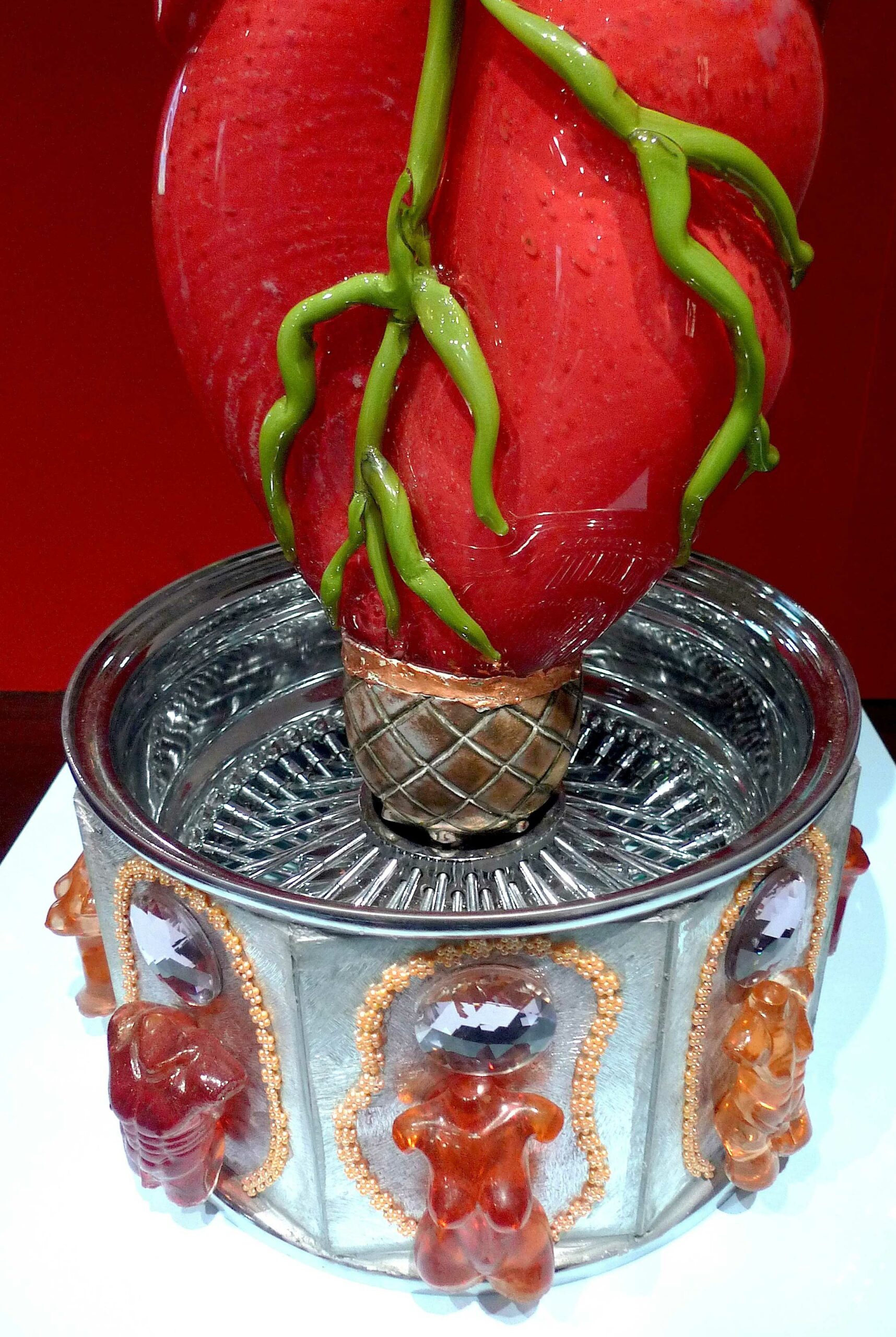
Sculpture of a ceramic cactus growing from a red heart

Einar & Jamex de la Torre, “Mi Chicano Corazón,” 2023, blown glass and mixed media, 40 x 20 x 16 inches. Photo: Philip Ritterman.

Mi Chicano Corazón features a prickly pear cactus that is growing out of a human heart. According to Aztec myth, the prickly pear cactus originated from the heart of Copilli, who made the mistake of opposing Huitzilopochtli, the Aztec patron god. Huitzilopochtli ripped out Copilli’s heart and threw it into Lake Texcoco. The cactus that sprouted from this heart in turn bears red fruit that symbolizes human hearts. 

Einar explains that Mi Chicano Corazón “is our answer to [the question] ‘are you guys Chicano?’” 

“Of course the answer is yes,” he adds, “although we did not grow up in a Chicano environment.” Chicano culture is rooted in Mexican culture, and the de la Torre brothers are here utilizing a core myth from the best-known indigenous Mexican civilization.

Detail of the base of a ceramic sculpture of a heart

Einar & Jamex de la Torre, “Mi Chicano Corazón” (detail), 2023, blown glass and mixed media, 40 x 20 x 16 inches. Photo: Ruben C. Cordova.

In the above detail, one can see that the heart is sprouting out of a wire hubcap housed within a rim, which serves as a shiny metal plant pot. This automotive imagery references lowriders and lowriding, which are important aspects of Chicano culture, as well as much beloved subjects utilized by the de la Torres (for other examples, see Mictlanteputin and Colonial Atmosphere, as well as the discussion of Gaiatlicue in the “Collidoscope” review). 

“We have all of the [Chicano] layered symbols in our work, and the use of iconography and color,” explains Einar. 

In the bottom section of Mi Chicano Corazón, one can see that the hubcap that brings life to the Chicano heart is divided into nine framing devices made of polished aluminum. Each of these features a hypersexualized nude torso; they are alternately male and female. The males are hypermuscular and the females are hyper-voluptuous. They refer to the sexualized aspects of car culture, and the mating rituals that surround it. Because glitz and glamor are part and parcel of lowrider culture, each of these orange torsos is framed by decorative strands of pearl-like flowers, topped by an enormous, faux gem.

Einar refers to these small torsos as “beautiful figures, attractive figures, ones that invoke fertility.” Einar views beauty as nature’s way of ensuring fertility and reproduction. So these tiny torsos are a way of “grounding” the piece, because, just as “wheels go round,” the mating rituals associated with low-rider culture are “part of the cycle of life.” Thus the literal wheel also represents the wheel of life. The product of that cycle is represented by the pregnant female torso. The brothers did not intend for the nine panels to represent the nine-month gestation period of a human pregnancy, but that number is serendipitously symbolic.

With respect to Chicano culture, Einar notes: “Culture is different when you are born into a culture, then when you are first or second generation.” He refers to himself and his brother as “phantom limbs” and avers: “we are not going to be defined by this or that [definition].” He liked the analogy I made of them as grafted, hearty nopal paddles. In this sense, he says they are “both prickly and succulent,” as they thrive on both sides of the border.
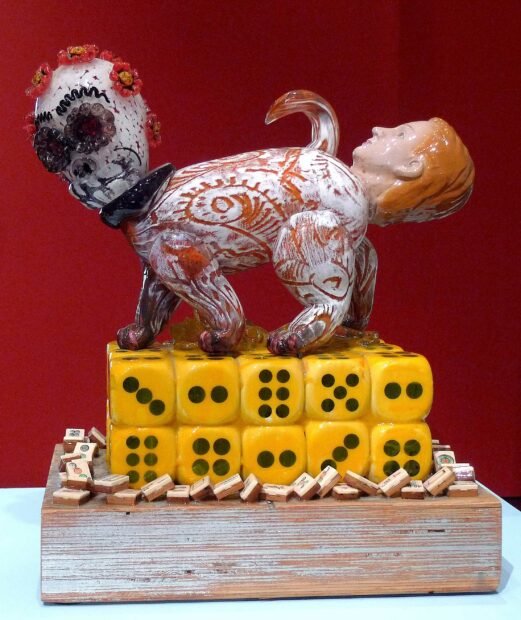
Glass sculpture of a cat body with a skull head and a doll head coming from the anus on a base of yellow and black dice

Einar & Jamex de la Torre, “Birth of Modern Medicine,” 2023, blown glass and mixed media. Photo: Ruben C. Cordova.

Some works in the first section have very pointed political content, such as the Birth of Modern Medicine, which features a white male’s head being birthed out of what looks like a skull-headed dog’s ass. This creature is actually what indigenous people refer to as a nahual, a shapeshifting animal spirit. The modern, Western doctor thus emerges from a symbol of ancient indigenous culture. “Where would medicine be without the cultures that come before it?” asks Einar. “Modern medicine is built on them.”

This appropriated head comes from a medical mannequin that doctors utilize in their offices for patients to locate aliments. The brothers had already used the mannequin’s torso in another piece. 

The large sets of dice refer to the element of chance in health, diagnosis of illnesses, and life in general. So, too, do the Mahjong chips beneath them. Einar emphasizes that though one is dealt a hand in life, one also “has to play the game.” In this sense, even “fate gives you choice,” to be “a victim of the cards you are dealt, or to make the best of that hand.” 

A recumbent female nude made of yellow glass lays beneath the nahual. Einar refers to it as “a beautiful figure, a Maja figure,” as in Goya’s Naked Maja (c. 1795-1800). He also associates it with classical female fertility figures, such as Venus. Einar also says it can be likened to Romulus and Remus, legendary founders of Rome, who suckled from a she-wolf. Consequently, it stands for an intercultural interchange of medical learning. 

wall sculpture of a glass cactus in a frame

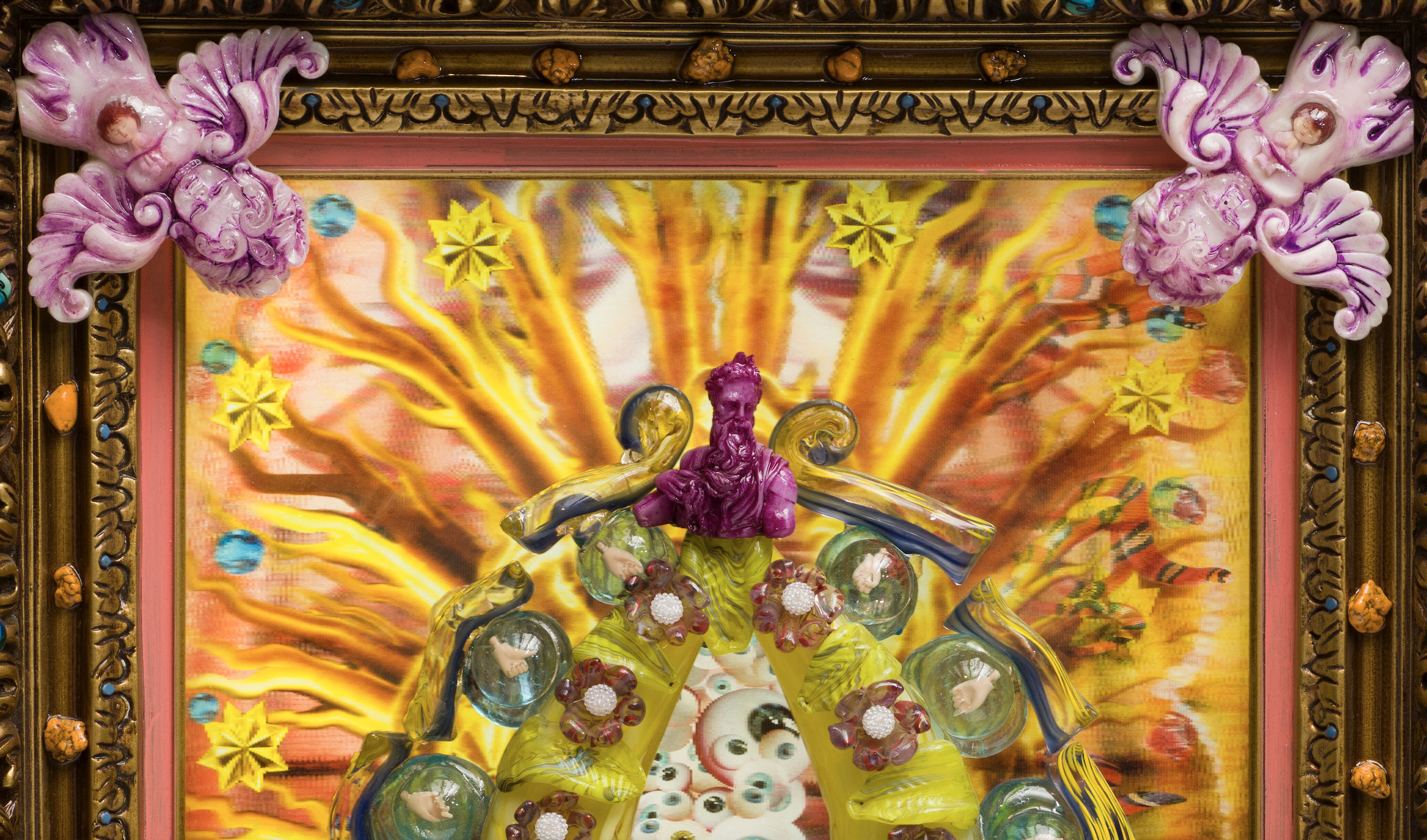
Einar & Jamex de la Torre, “Thoughts and Prayers,” 2020, blown glass on archival lenticular print in LED lightbox with resin castings 47 x 30 x 7 inches framed. Photo: Philip Ritterman.

Thoughts and Prayers includes blown-glass elements that are attached to a lenticular print. The latter are made by combining two or more images by cutting them into thin strips and reassembling alternating strips into a single image. Such images appear different when seen from different angles. The de la Torre brothers appreciate the “unparalleled depth” these images provide. See the Collidoscope review for a fuller discussion of lenticular prints.

The central image in Thoughts and Prayers is a depiction of the Virgin of Guadalupe’s mandorla (hence the green color). As Einar describes this form, “it is part of a series of Virgenes – minus the virgen – a kind of ‘portal of life.’” This portal has a vaginal shape, like others in the series discussed in the Collidoscope review. It is crowned by a miniature version of Michelangelo’s Moses, who occupies the position of the clitoris. He’s doing oversight. A monkey at the bottom takes the place of the angel that normally supports the Virgin of Guadalupe. Notwithstanding these irreverent substitutions, this is a serious piece.

The background image is from a church ceiling in Prague. Depending on the angle from which one looks at the piece, snakes appear on the sides of the portal. Deadly coral snakes have red, yellow, and black bands, but so do kingsnakes, their harmless Batesian mimics. Einar refers to these snakes as “a floating metaphor.” Snake imagery is widely utilized by the Catholic church, but, as these colorful snakes demonstrate, it is not always easy to determine who is truly dangerous. 

The eyes in the center of the portal are souls waiting to be born. From other angles, one sees a burning candle with recumbent nudes in the center (these derive from wallpaper the brothers made to symbolize sloth). The gesturing hands that surround the portal are taken from toy dolls. They reminded the artists of gang hand signs. 

Thoughts and Prayers has no gun imagery, no bullet holes, no reference to the National Rifle Association (NRA), because it was not conceived as a work about gun control. Initially a work that concerned prayer, Thoughts and Prayers became a work about life. The title came later.

In an early stage of thinking about this piece, the brothers asked themselves: “What are we praying to when the Virgin is absent?” With its panoply of saints and intercessors, the brothers consider Catholicism to be as polytheistic as Hinduism. 

Detail of a glass wall sculpture

Einar & Jamex de la Torre, “Thoughts and Prayers” (detail), 2020, blown glass on archival lenticular print in LED lightbox with resin castings 47 x 30 x 7 inches framed. Photo: Philip Ritterman.

In the four corners, bird-like, pink-purple glass cherubins whisk away the souls of children (represented by their heads in a transparent capsule) who have been killed by gunfire.

Einar points out that the title Thoughts and Prayers references “the gun lobby’s mantra of ‘thoughts and prayers.’” Endlessly repeated after fatal shootings in the U.S., it has been completely ineffective. Einar avers: “what we really need is strict gun control.” The brothers condemn the mendacity of the NRA, and all those who elevate gun rights above human rights – understanding the latter to include the right to continue living. Einar applauds the anti-Trump election meme: “Christians have warned about the anti-Christ for 2000 years. Now that he has appeared, they voted for him.”

There’s a lot going on in the de la Torre brothers’ glass pieces, and I wish the McNay had provided narrative labels to help viewers grasp some of the issues they are confronting in these works. 

Le Point de Bascule (the Tipping Point)

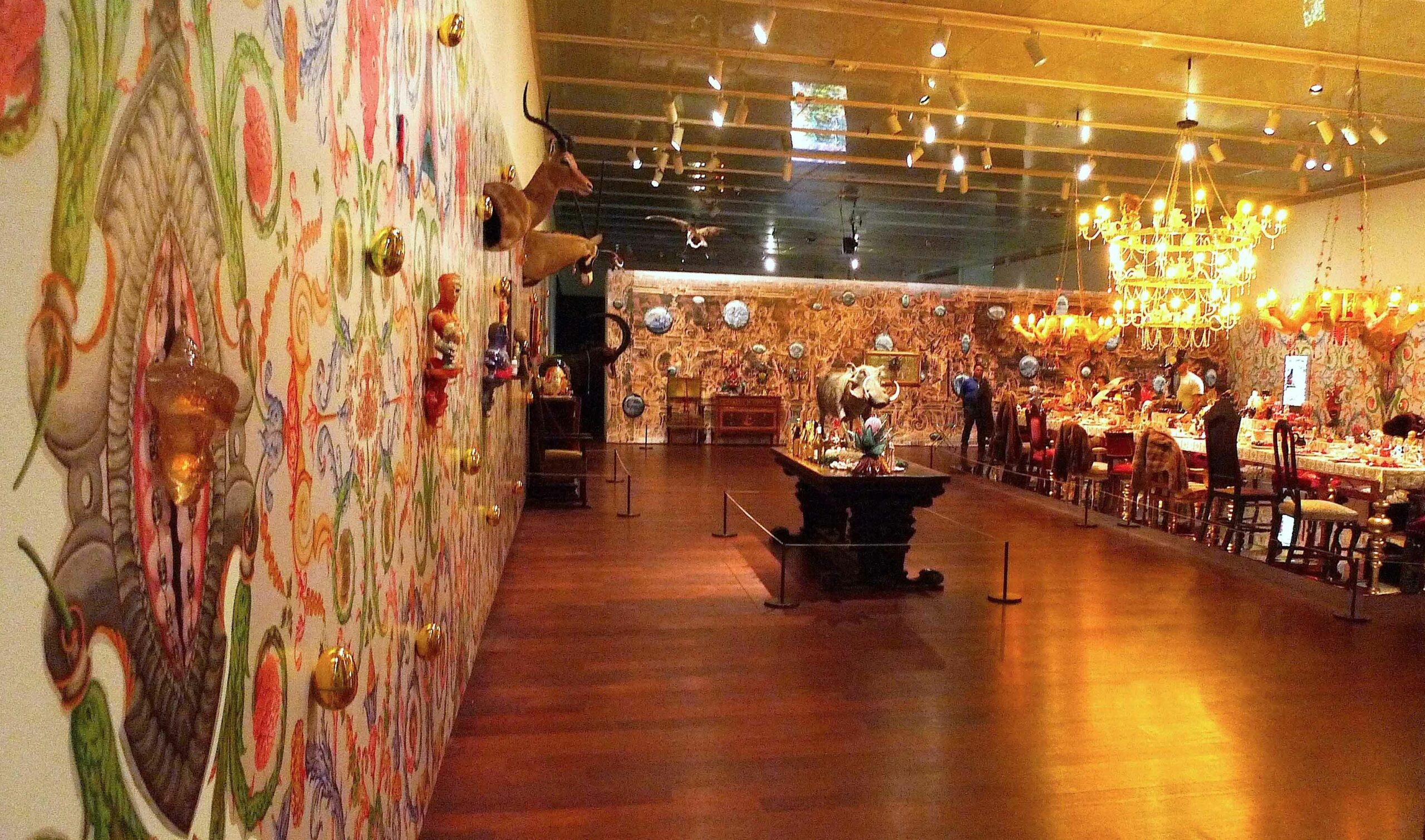
Installation view of a wall mural with two dimensional elements and aa full table

“Le Point de Bascule” (the Tipping Point), 2024, mixed media installation at the McNay Art Museum. Photo: Ruben C. Cordova.

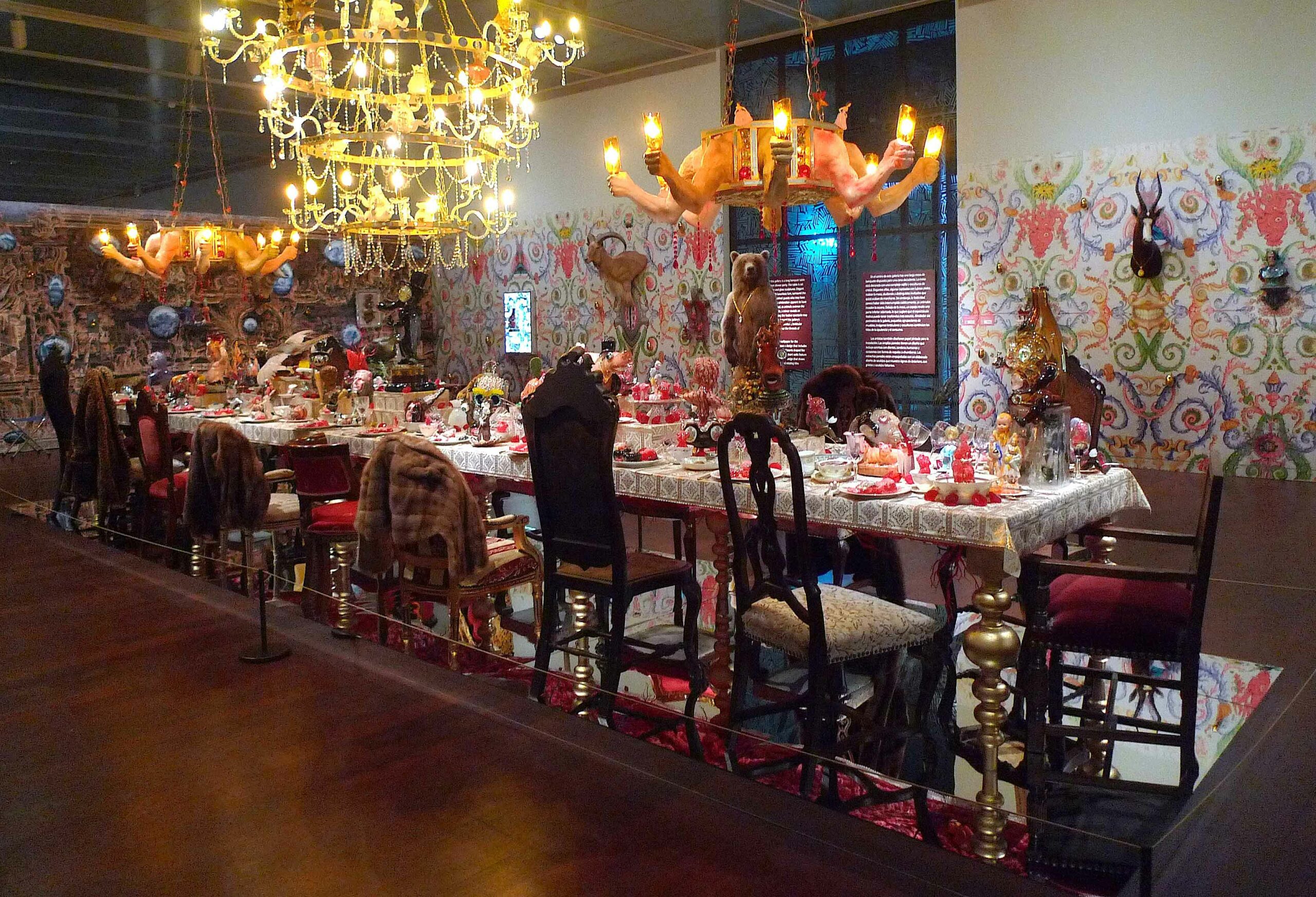
Le Point de Bascule provides an expansive context for a feast on the large table in the center of the room. The above view, from the entrance, shows light-colored wallpaper with arabesques on the left. These walls are peppered with stuffed animals, symbolizing human dominance of the natural world and the propensity of wealthy humans to hunt, kill, and utilize exotic animals as trophies. The wall on the left is mirrored by a wall on the opposite side with similar decorations.

The far wall in the above illustration is dark and ominous. Upon closer examination, the architectural elements depicted in it are photographically transformed into negative images. The entire wall is fictively composed of small tiles, with larger, blue-and-white plates set into it. 
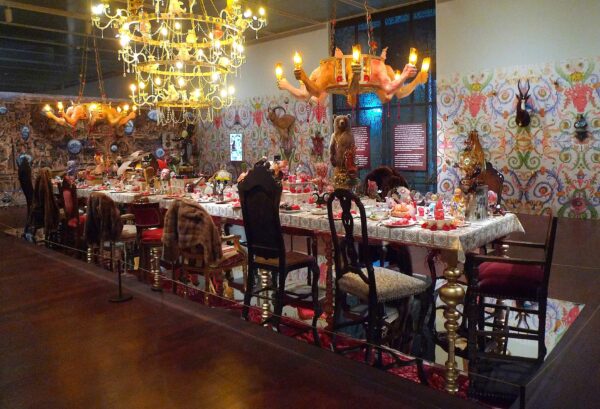
Installation view of aa fully set table

“Le Point de Bascule” (the Tipping Point), 2024, mixed media installation at the McNay Art Museum. Photo: Ruben C. Cordova.

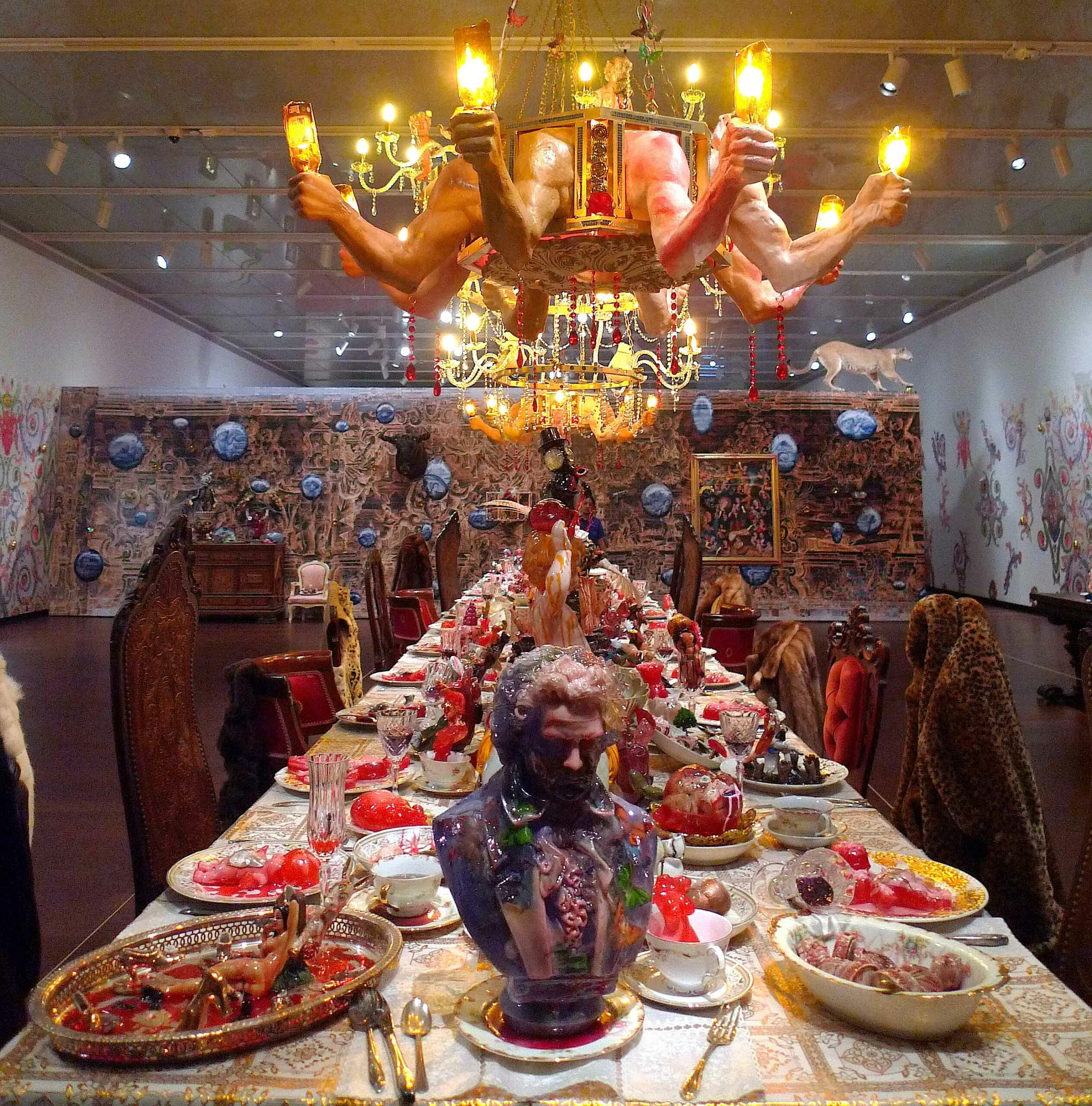
The central table is set for a luxurious meal with extremely affluent guests, given the fur coats that are draped over several of the chairs. In his film The Discreet Charm of the Bourgeoisie (1972), the great Surrealist director Luis Buñuel humorously portrays a group of corrupt, aristocratic would-be diners, who, in the course of interlocking dream sequences, are perpetually frustrated in their attempts to have a proper meal. In Le Point de Bascule, we have seemingly stumbled upon a case of banquet interruptus. The food is served, but all of the people are inexplicably gone.

Detail of small sculptures on a table

“Le Point de Bascule” (the Tipping Point) (detail), 2024, mixed media installation at the McNay Art Museum. Photo: Ruben C. Cordova.

Upon closer inspection, the meal at hand is grisly beyond belief. The present course consists primarily of infants in red sauce. This cannibalistic blood feast also features enucleated human eyeballs, excised hearts, severed hands, and other body parts, all ready to be devoured by a discerning clientele. Partially-sipped wine shows that the diners did not bolt from the table because of the menu. 

Detail of a place setting on a full table with dishes made from dolls

“Le Point de Bascule” (the Tipping Point) (detail with “Capitalist Pig” and stuffed warthog in background), 2024, mixed media installation at the McNay Art Museum. Photo: Ruben C. Cordova.

The table’s centerpieces bespeak the class status of the diners. The most explicit is a top-hatted glass pig titled Capitalist Pig. It bears a dollar sign on each of its flanks, and it defecates gold coins, signaling that the dinner guests are themselves bourgeois pigs, who wallow in this class-based, monetary iconography. The stuffed animals and fur coats further signify a predatory attitude towards the natural world. A course of candied infants merely extends this predatory approach to the lower classes of humans, who are not just oppressed in the workplace, but literally consumed at the dinner table.

Detail of a small glass sculpture

“Le Point de Bascule” (the Tipping Point) (detail with “The Stinking Rich Fly”), 2024, mixed media installation at the McNay Art Museum. Photo: Ruben C. Cordova.

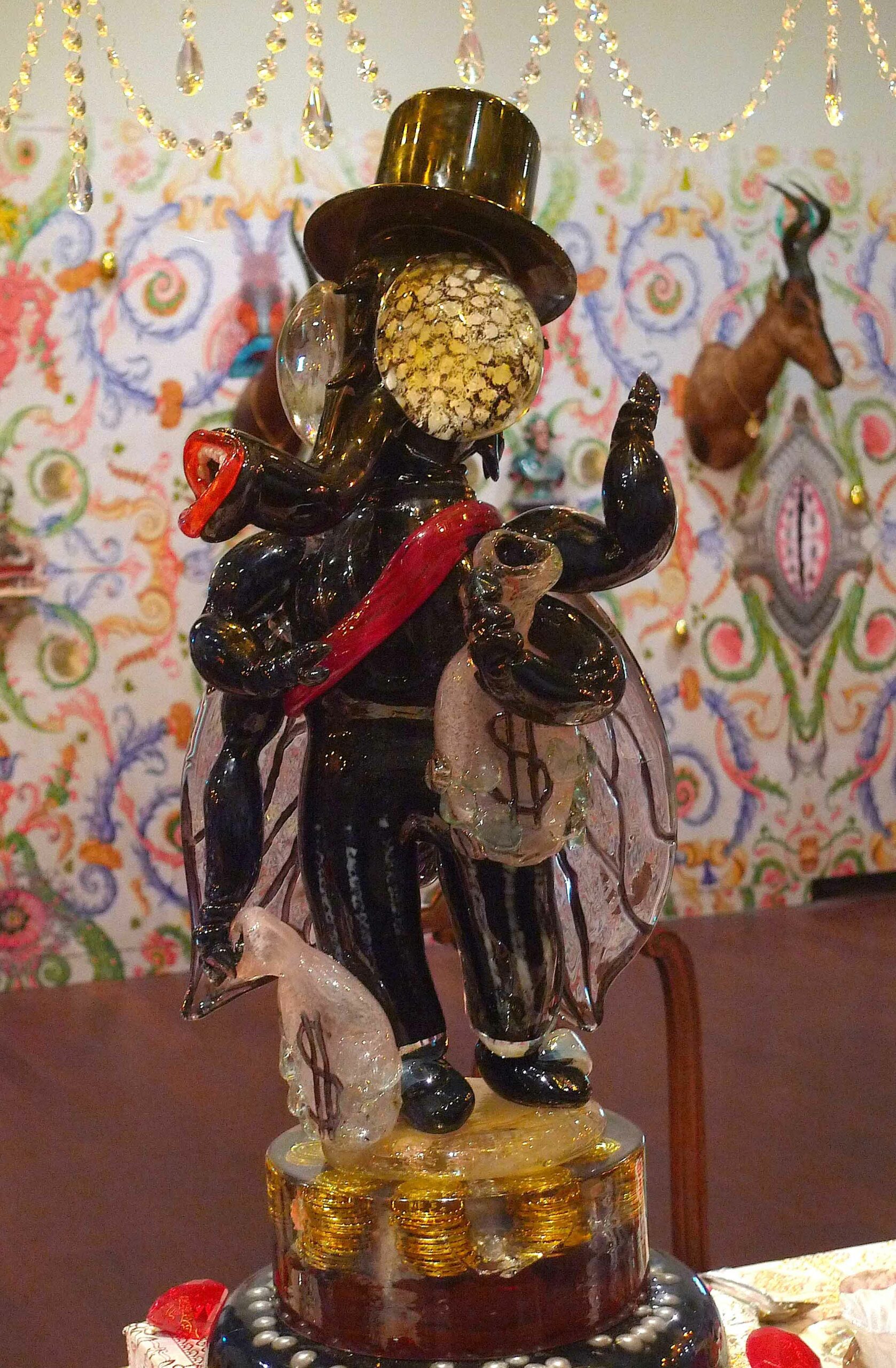
Le Point de Bascule’s primary centerpiece is a four-armed, top-hatted man with what looks like an elephant’s trunk and the bulging eyes and the wings of a fly. Called The Stinking Rich Fly, it is a fly-human hybrid inspired by the original science fiction film The Fly (dir. Kurt Neumann, 1958). (Einar does not care for the 1986 David Cronenberg remake). In the film, a scientist, experimenting with his molecular transporter, inadvertently scrambles his molecules with those of a housefly. The fly’s head replaces his own, and, as he terrifyingly experiences the continued loss of his human consciousness, he causes his own death. 

The Stinking Rich Fly (which has nothing to do with Ganesha, the elephant-headed Hindu god) is clearly losing his humanity in favor of filthy lucre. He stands on piles of gold coins and he grasps two money bags. With his six limbs, fly wings, enormous eyes, and a trunk-like proboscis, he is more fly than man. Unlike the protagonist of the film, this creature welcomes his transformation into a giant, dirty, greedy fly. The de la Torre brothers did not intend for the proboscis to reference the Republican Party, whose emblem is an elephant, but their attitude is that if the proboscis fits, wear it. 
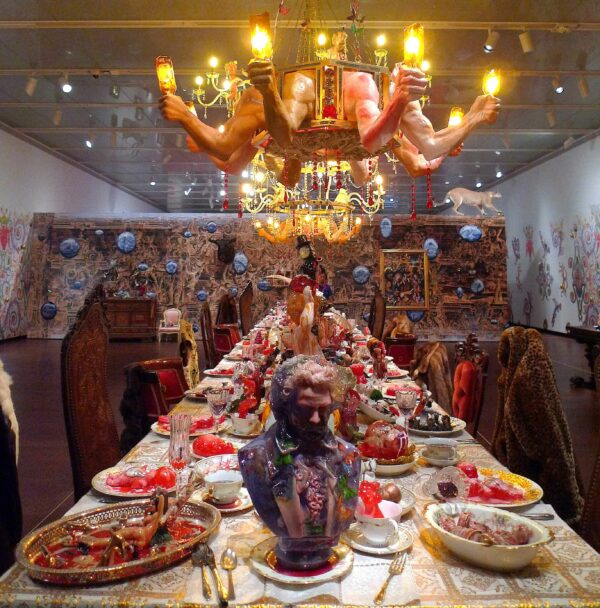
Installation view of a set table with various sculptural elements in a gallery

“Le Point de Bascule” (the Tipping Point) (detail of table with “handelier”), 2024, mixed media installation at the McNay Art Museum. Photo: Ruben C. Cordova.

The “girl-chandelier” was an astonishing invention featured in the Marilyn Monroe vehicle Gentlemen Prefer Blondes (dir. Howard Hawks, 1953). (It is visible in the trailer linked here.) In Le Point de Bascule, the de la Torre brothers have created what I call a “handelier” – a chandelier made of extended human arms and hands. 

Attempting to follow the logic of this piece, I assumed that these limbs were intended to represent taxidermied human body parts. That would mean that these people — like the stuffed animals surrounding them — would have been killed to compel them to serve the rich as a perpetual spectacle. They were, I assumed, light-bearers for the rich, available twenty-four hours a day at the flip of a switch.

Einar informed me, however, that the arms and legs are synecdochal stand-ins for rebellious underlings. Instead of wielding convenient light, they are brandishing makeshift torches, crafted out of broken wine glasses. In this fashion, class rebellion obtrudes into the spectacle of the grand banquet, like the armed guerrillas from Miranda at the end of The Discreet Charm of the Bourgeoisie. They too provide a narrative explanation for the absence of high-rolling diners, who could have fled without their valuable fur coats out of fear for their lives.

Beneath the table, the de la Torre brothers have created a photo-mural of raw hamburger, laid out in long decorative patterns, like bones lining certain crypts and ossuaries. This ground-up, decorative meat is also intended to give expression to the unwilling servitude of the working class. Almost out of sight — except to the most inquisitive viewers — this spectacle is not a pleasant one. Einar likens it to “how sausage is made,” a process its marketers want to keep private, and one its consumers “really don’t want to see.” 

The brothers endeavor to make open-ended work that is subject to multiple interpretations, in the present as well as in the future. As Einar explains, “our artworks have to exist without us being around to defend it.” Nonetheless, it would have been advantageous to have more guiding texts for visitors to the exhibition at the McNay.
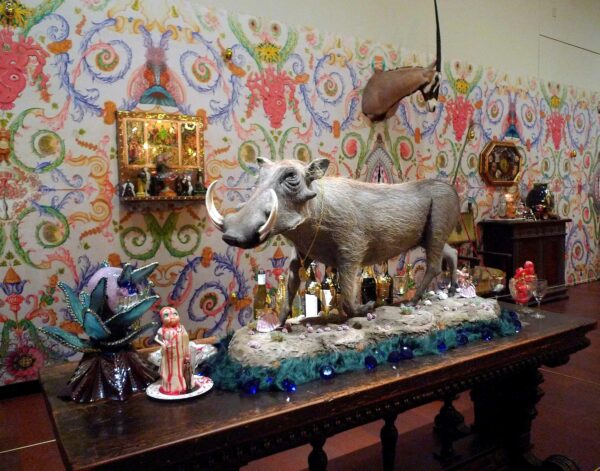
Installation view of small mixed media sculptures including

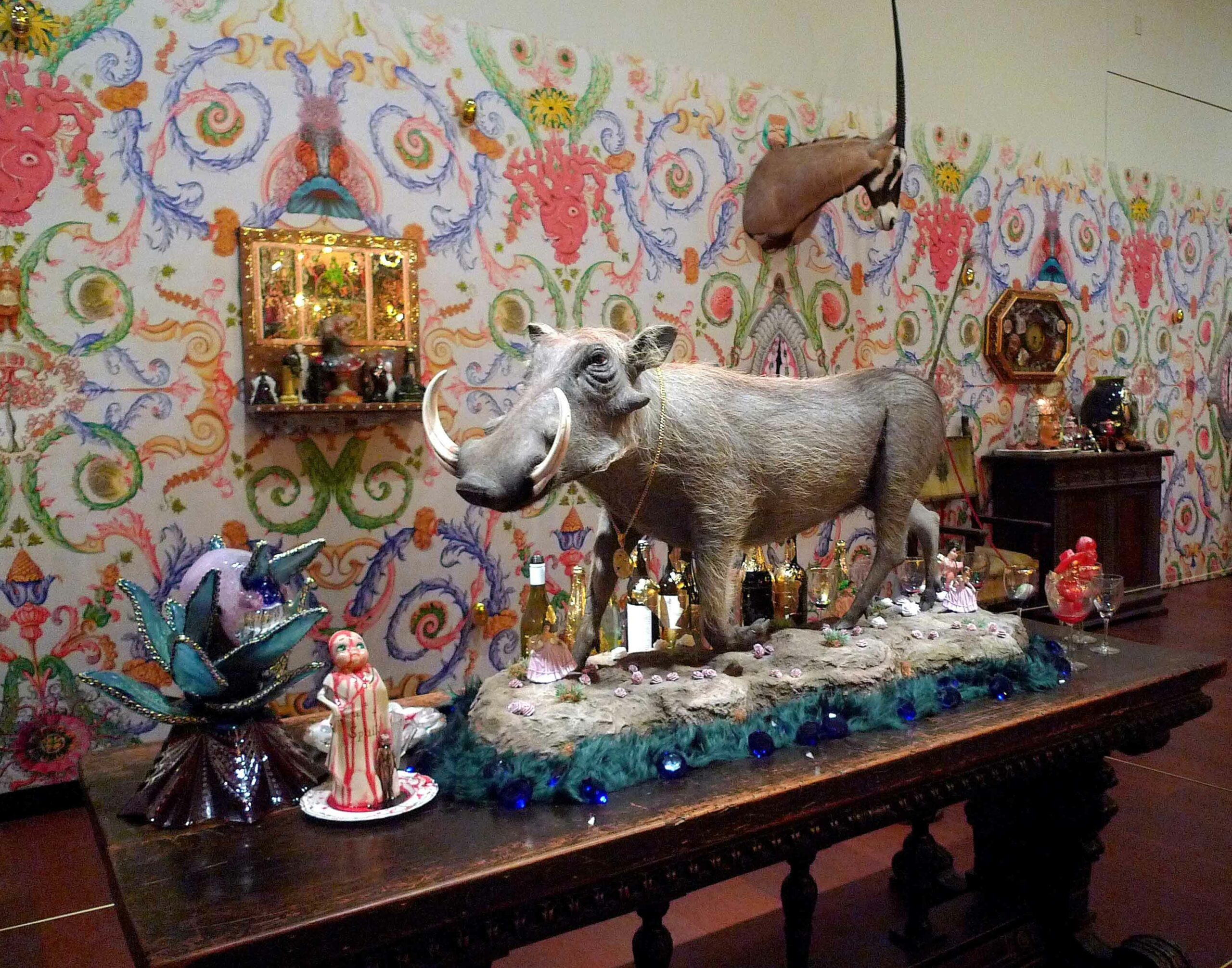
“Le Point de Bascule” (the Tipping Point) (detail of taxidermied warthog), 2024, mixed media installation at the McNay Art Museum. Photo: Ruben C. Cordova. On the table, an agave plant grows through a human skull, beside a bloody child. The warthog, like the other animals, wears a golden medallion. A human heart is stuffed into a large wine glass on the other end of the table. In the wallpaper one can see anthropomorphized human hearts and arabesques that terminate in human brains.

The title Le Point de Bascule references the two-degrees Celsius increase in temperature that scientists regard as the “tipping point” for global warming. It is a threshold that — after it has been breached — there may be no way to return to earlier lifestyles and standards of living. Extreme weather, melting ice, and rising seas will result in droughts, floods, mudslides, famines, desperate migrations, and deadly conflicts over food and potable water that could imperil many of the inhabitants of this earth.

By not including the diners of this sumptuous feast, the de la Torre brothers saved themselves the trouble of creating them. But let us apply the logic of the Anthropocene (the current epoch in which human activity has had a significant impact on climate and ecosystems) to this scenario. The diners have vanished. They represent the ever-rapacious, overconsuming elite. Their disappearance, therefore, can symbolize the ever-more probable extinction of the human race due to overconsumption and ecological disregard. The infant feast spread on the great table, it follows, could stand for the affluent devouring future potential generations, including their own progeny. 

Einar calls overconsumption “a form of cannibalism.” He points out that we are trodding the path blazed by other animals that achieved dominion. They also overproduced and damaged or destroyed their ecological niche. The difference is that humans have vastly greater powers. That is why gluttony for the good life could end all life as we know it. 

Le Point de Bascule, then, is a kind of warning, wherein the symbolic disappearance of the diners can be read as a harbinger of extinction. Such an impressive spectacle comes at a great cost, both individual and planetary. Only the super-rich would be invited to a dinner such as this one. The filthy rich, with their private jets, yachts, heated swimming pools at multiple mansions, rocket trips into outer space, etc., are the greatest culprits. Yet, less well-heeled contemporary witnesses to such overconsumption may often be ambivalent. “The palimpsest of the revelers,” says Einar, “leads us to despise and envy them.” 
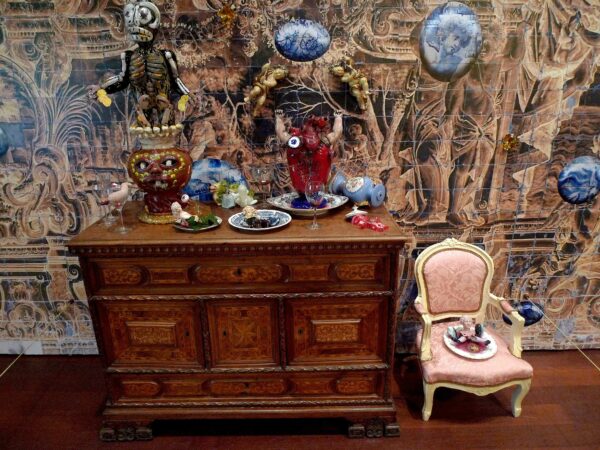
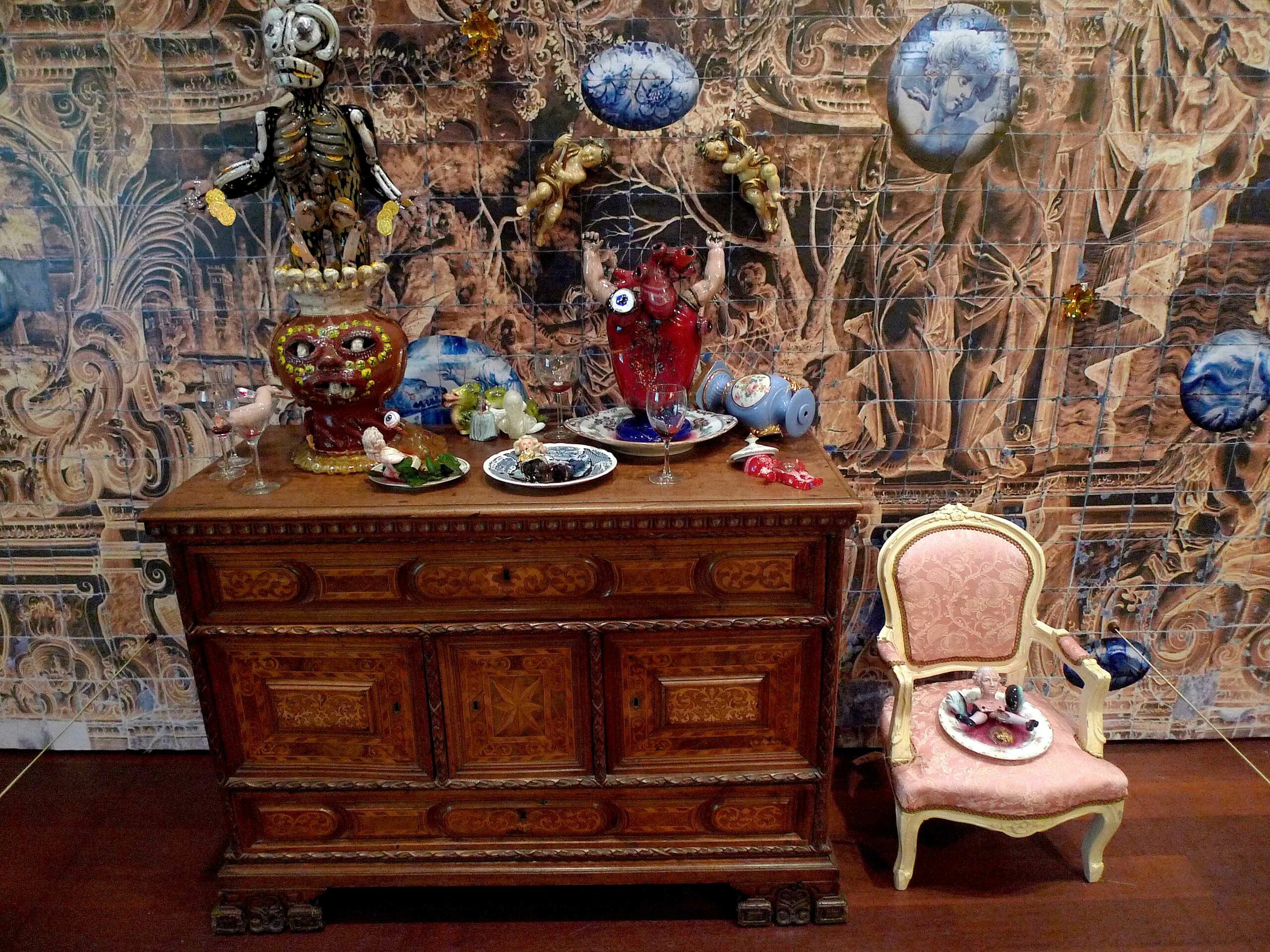
Installation with a wood bureau, an antique pink chair, both topped with small sculptures, and highly detailed wallpaper

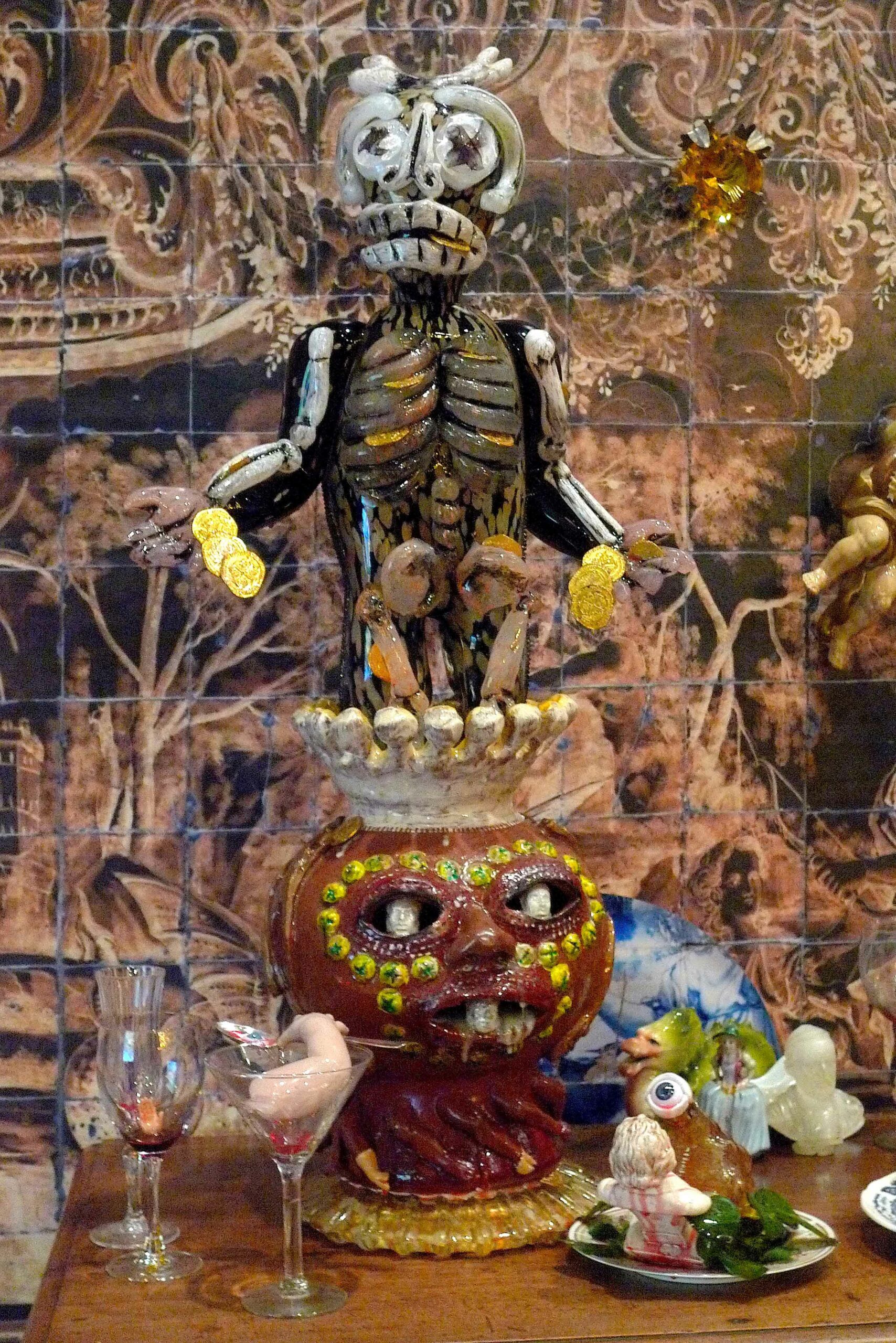
“Le Point de Bascule” (the Tipping Point) (detail of faux-tile wallpaper with furniture from the McNay colonial revival mansion), 2024, mixed media installation at the McNay Art Museum. Photo: Ruben C. Cordova. A skeletal figure bearing gold coins emerges from an updated Tlaloc vase, while a one-eyed anthropomorphized human heart raises its fists.

The de la Torre brothers are not letting the other inhabitants of affluent nations off the hook. “This is the quandary of our contemporary existence — we know we need to change our lifestyle, but who really does?” queries Einar. This is why the de la Torre brothers fear that the two-degrees threshold will be exceeded. “We are too entrenched in our ways,” warns Einar, “and we will all be guilty if we miss this deadline.” 
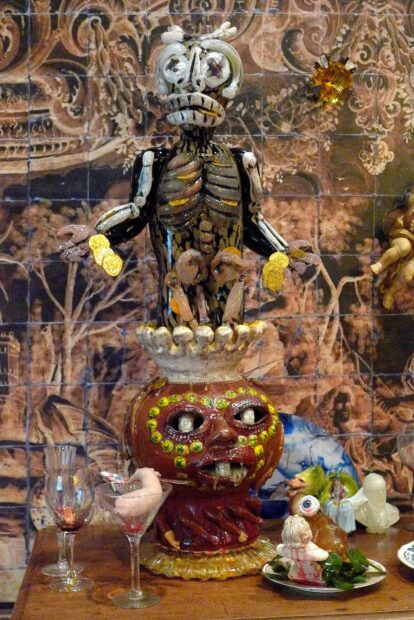
Detail of an installation of a skeleton on top of a ceramic sculpture with a face surrounded by smaller sculptures of fake dinner party pieces

“Le Point de Bascule” (the Tipping Point) (detail of skeleton and vase), 2024, mixed media installation at the McNay Art Museum. Photo: Ruben C. Cordova.

The first version of this installation was made at Kunstfort in Asperen, Netherlands in 2017. Others were staged at the Lille3000 festival in France (where the “El Dorado” theme led to the use of gold), the SIC! City Gallery in Wroclaw, Poland, the Museu do Vidro in Marinha Grande, Portugal, and it is now at the MusVerre at Sars Poteries, France. It was revamped (including the addition of taxidermies) at the Institute of Contemporary Art in San Diego last year. The iteration at the McNay is larger and more complex than these other versions, and it includes a considerable amount of new material. 

Two Horror-Filled Large-Scale Lenticular Prints

Installation view of a video on the ground showing a highway roundabout and a lenticular of godzilla as a cuatlicue attacking a skyscraper in mexico city

“Coatzilla,” 2023, lenticular print and LED light (suspended lenticular with video floor projection), 96 x 60 inches. Installtion view in “de la Torre Brothers: Post-Columbian Futurism,” 2023, Institute of Contemporary Art, San Diego. Photo: Philip Ritterman.

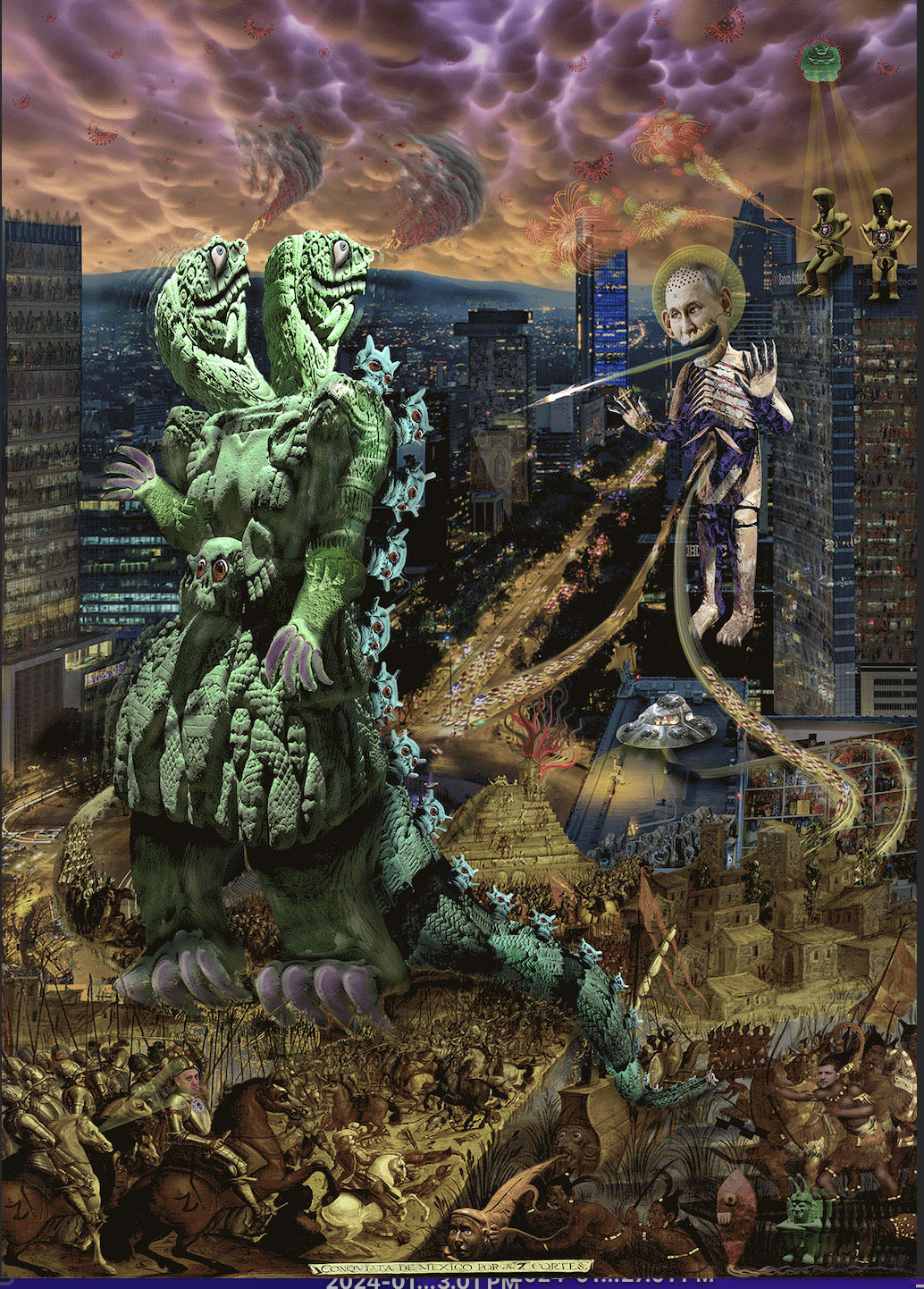
The de la Torre brothers describe the two large lenticular prints in this section as virtual “monster movie posters.” Both monsters are out to destroy human civilization, though their destructive acts are antithetical because they stem from antithetical motivations. 

The two lenticular prints face one another, while a feed of the traffic interchange at the Paseo del Reforma in Mexico City is projected onto the ground between the two prints. (See this video for the work in action.) This projection has the effect of situating the visitor to the exhibition in Mexico City. Importantly, it also creates the sense that the visitor, too, is a giant monster who obliviously tramples cars underfoot, and who is likewise a powerful and destructive force to be reckoned with. 
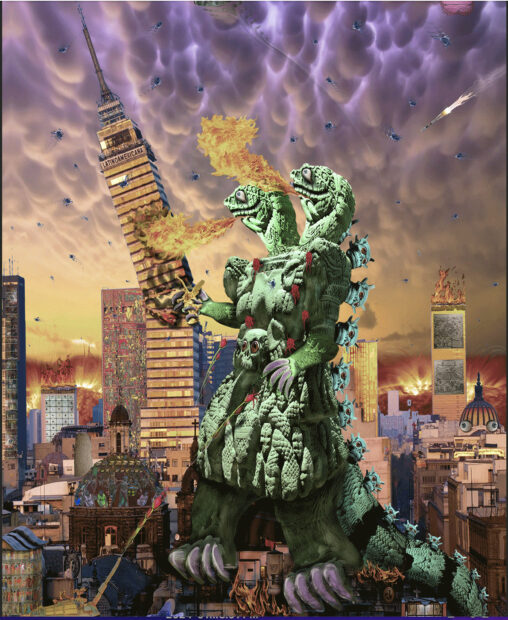
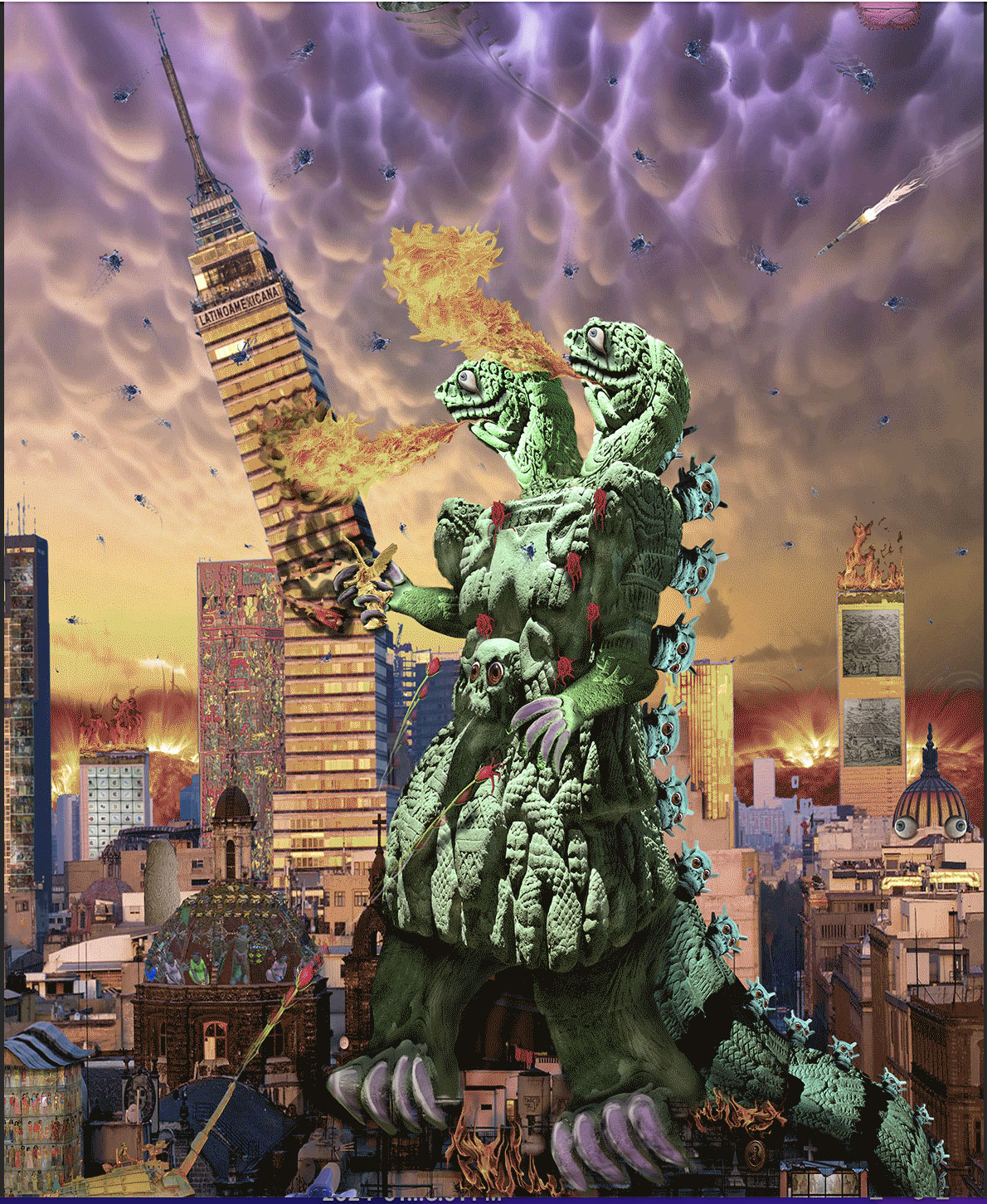
Image of a godzilla as the aztec deity cuatlicue attacking a skyscraper in mexico city

“Source image for Coatzilla” (the monster is destroying a building while a tank fires on it), 2023, one of the approximately 50 images that were synthesized into the Coatzilla lenticular. A source image such as this one is never seen completely at one time while viewing the finished work. Instead, various images combine as the visitor moves in front of the work.

The monster Coatzilla combines the Aztec life-death goddess Coatlicue (illustrated and discussed in the Collidoscope review) and Godzilla, the popular Japanese science fiction monster that first appeared in Godzilla in 1954 (dir. Ishirō Honda).
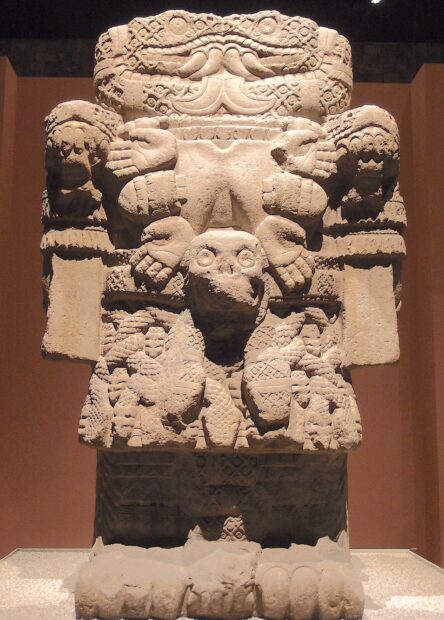
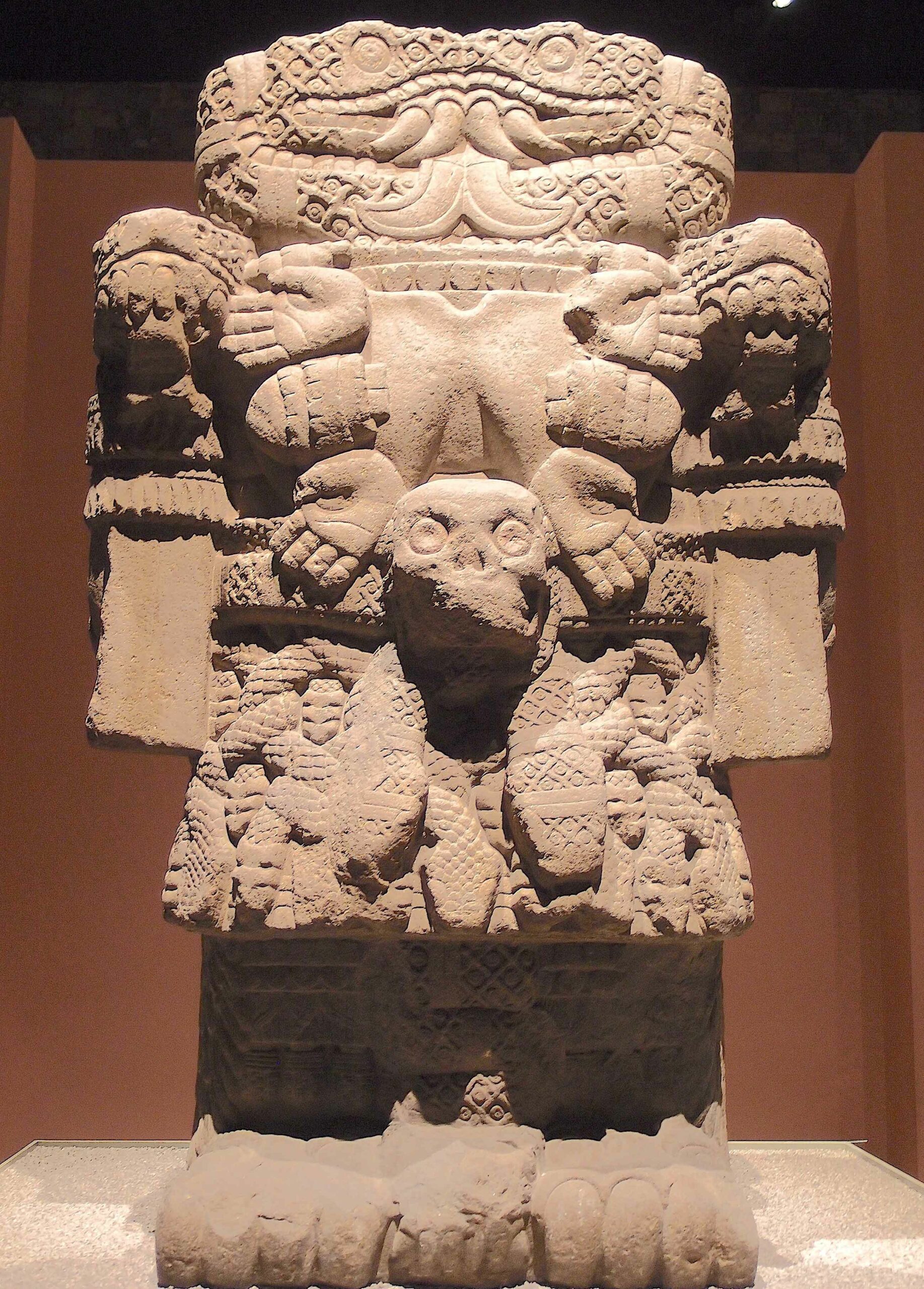
Statue of the Aztec war deity Cuatlique

“Coatlicue,” Aztec, c. 1487-1520, from Tenochtitlán, stone, 8 feet, 3 inches high, National Museum of Anthropology, Mexico City. Photo: Ruben C. Cordova.

Most of Coatzilla’s features come from Coatlicue. The de la Torre brothers’ creature has twin serpent heads. In the Aztec sculpture pictured above, they are understood as jets of blood combining to form a single living face to replace Coatlicue’s severed head. The de la Torres separate the two jets of blood, while maintaining their anthropomorphized character. Coatzilla also has the topless female body, the woven rattlesnake skirt, the garland of hearts and hands, and the central skull ornament possessed by Coatlicue. In Coatzilla, Coatlicue’s severed arms are restored, and her eagle taloned feet are set in motion. 

The de la Torre brothers’ composite creature has large dinosaurian scales on its back, similar to those possessed by Godzilla, but they take the form of skulls, closely based on those on the front and back of Coatlicue. The dinosaurian tail is also based on Godzilla, but the rattlesnake and feather patterns on it derive from Coatlicue. Coatzilla’s flaming “atomic breath” is a power derived from Godzilla, who was awakened from an eons-long slumber by nuclear bomb testing. Rather than perishing from the radiation, Godzilla absorbed and internalized this destructive atomic power, and unleashed it on Tokyo and other Japanese targets. 

Coatzilla is set in Mexico City. The creature’s flaming breath has toppled the Torre Latino Americano, the city’s preeminent skyscraper (loosely based on the Empire State Building). Behind it, one can see the mosaic-covered library building of the national university, and on the right, the golden dome of the Palacio de Bellas Artes. The world outside of the city is aflame, with the implication that Coatzilla was awakened by environmental degradation caused by global warming. The creature wants to put the final touches on the extinction of the human race, which resists with a tank, rockets and even a spaceship. 
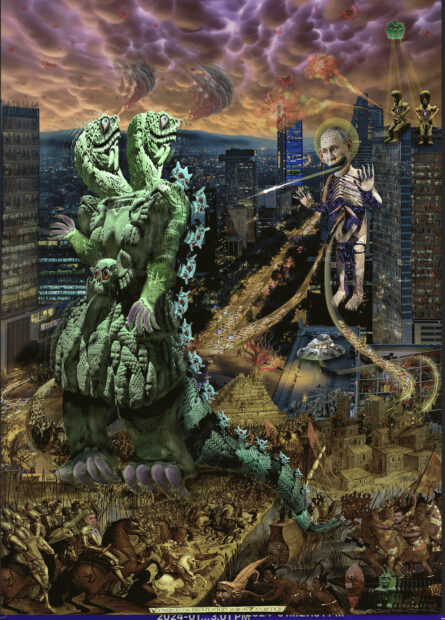
Lenticular of a Godzilla-Cuatlicue hybrid monster destroying a city

“Source image for Coatzilla” (Mictlanteputin attacks Coatzilla), 2023, one of the approximately 50 images that were synthesized into the “Coatzilla” lenticular.

The above image features a King Kong versus Godzilla scenario in which Mictlanteputin attacks Coatzilla from behind with a missile that blasts out of his hinged mouth. Coatzilla turns her heads around, but her scaly back is still facing her nemesis. 
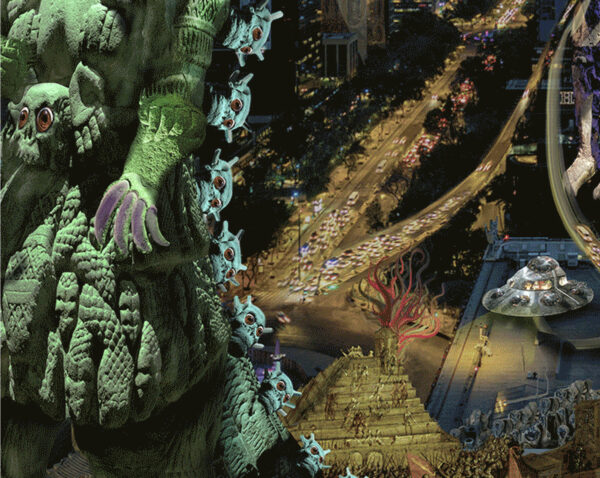
Detail of an image of aa godzilla-cuatlicue monster destroying a city

“Source image for Coatzilla” (detail of previous image), 2023, one of the approximately 50 images that were synthesized into the “Coatzilla” lenticular.

In the above image, one can see how Coatzilla’s scales are fashioned out of Coatlicue’s ornamental skulls. Also note the burning pyramid (a symbol of conquest utilized in Mesoamerican codices (books) and the flying saucer above it, which adds a quixotic sci-fi element into this already heady mix.

Detail of a scene of a city being destroyed by a Godzilla-Cuatlicue monster

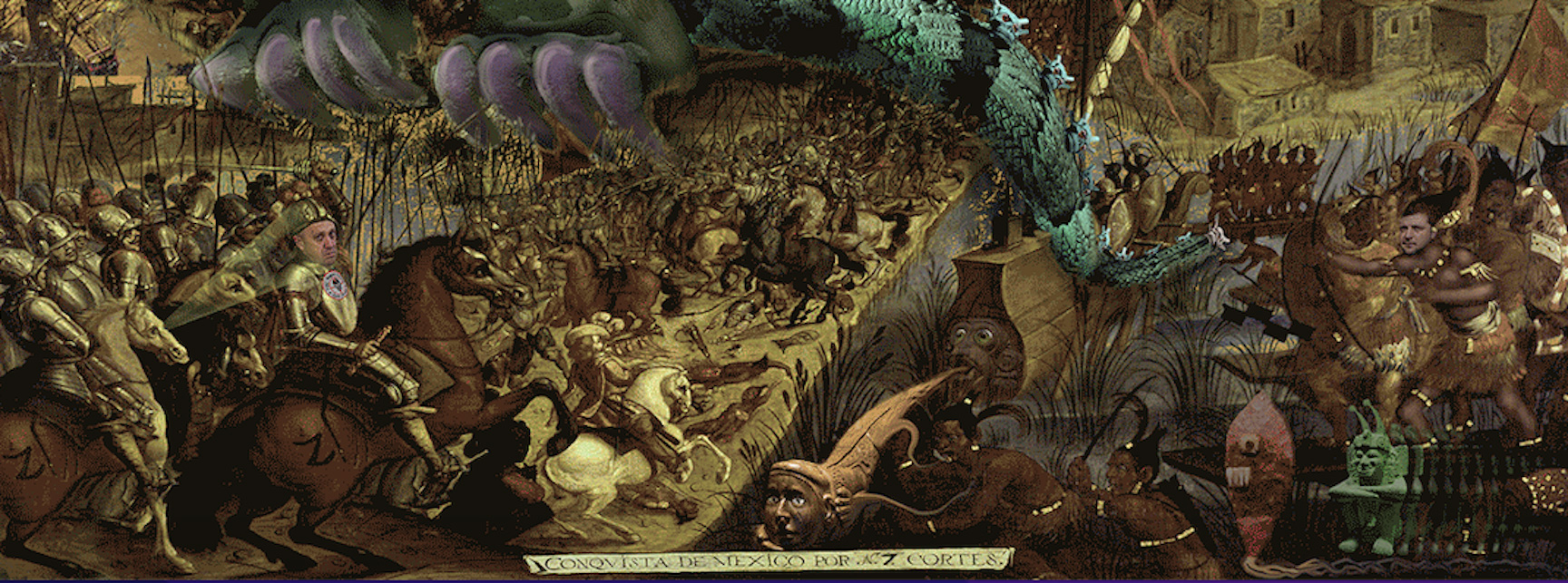
“Source image for Coatzilla” (detail of bottom of the last full image illustrated above), 2023, one of the approximately 50 images that were synthesized into the “Coatzilla” lenticular.

In the detail illustrated above, armies from different lands and different timeframes are doing battle. An army of knights on the left ride horses with a “Z” brand — a reference to the markings borne by Russian armored vehicles in the ongoing Ukrainian War. Yevgeny Prigozhin, the now deceased former leader of the mercenary Wagner group looks towards the viewer in the lower left. On the right, the Aztec resistance is led by none other than Volodymyr Zelensky, the president of Ukraine. The inscription in the center references the Conquest of Mexico by Cortez. Thus the Russian invasion of Ukraine is likened to a colonial conquest. In between them, a man on horseback resembles a Diego Velazquez portrait of Count-Duke Olivares. 

In the lower right, we see an Aztec drum, an anthropomorphic sacrificial knife (such as those excavated at the Templo Mayor), and a stone sculpture of Xiuhtecuhtli, the old god of fire. These elements form part of the backdrop for a battle royal between composite monsters. On upper levels shacks and pyramids give way to skyscrapers and highways. In another update, Coatzilla spews Covid-19 into the atmosphere (see full shot illustrated above).
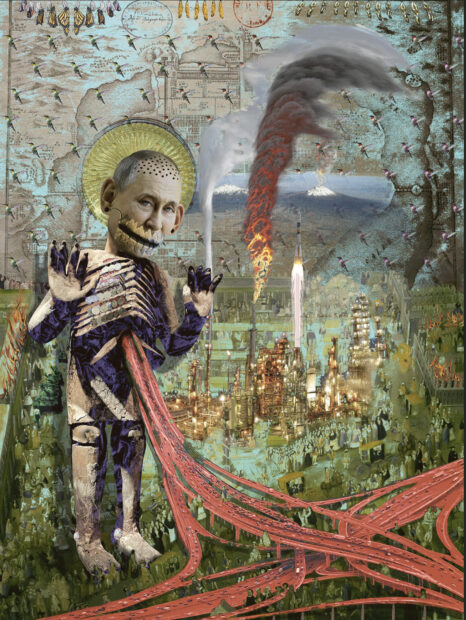
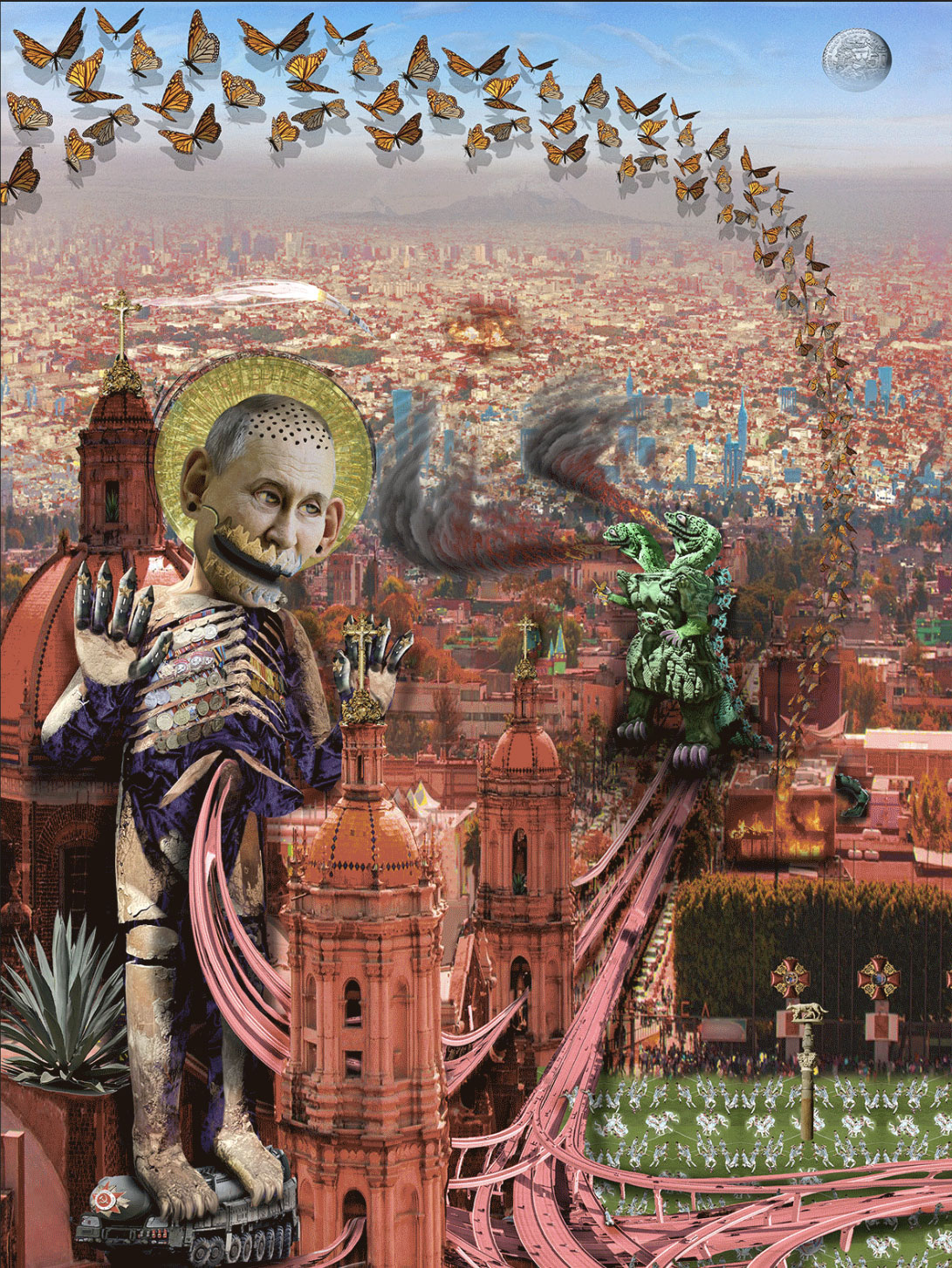
Detail of a skeleton Putin in a lenticular print of a city being destroyed

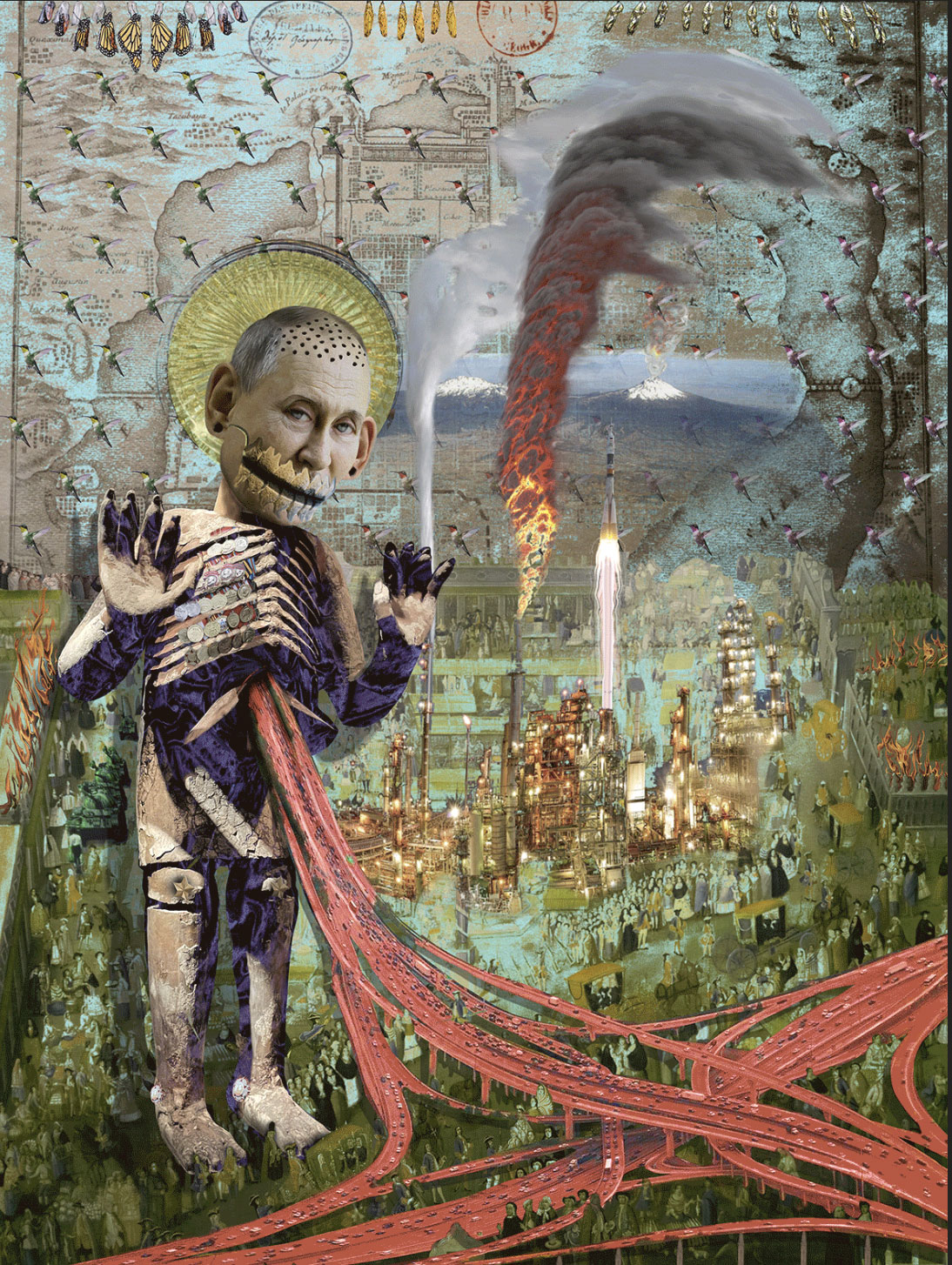
“Mictlanteputin,” 2023, screenshot from GIF of lenticular print.

The monster Miclanteputin is a mash-up of Mictlantecuhtli (the Aztec god of death and the underworld) and Vladimir Putin, the Russian President. 
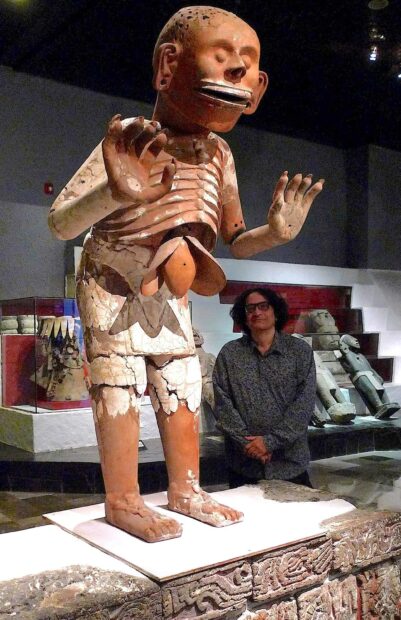
Aztec sculpture of a terra cotta figure

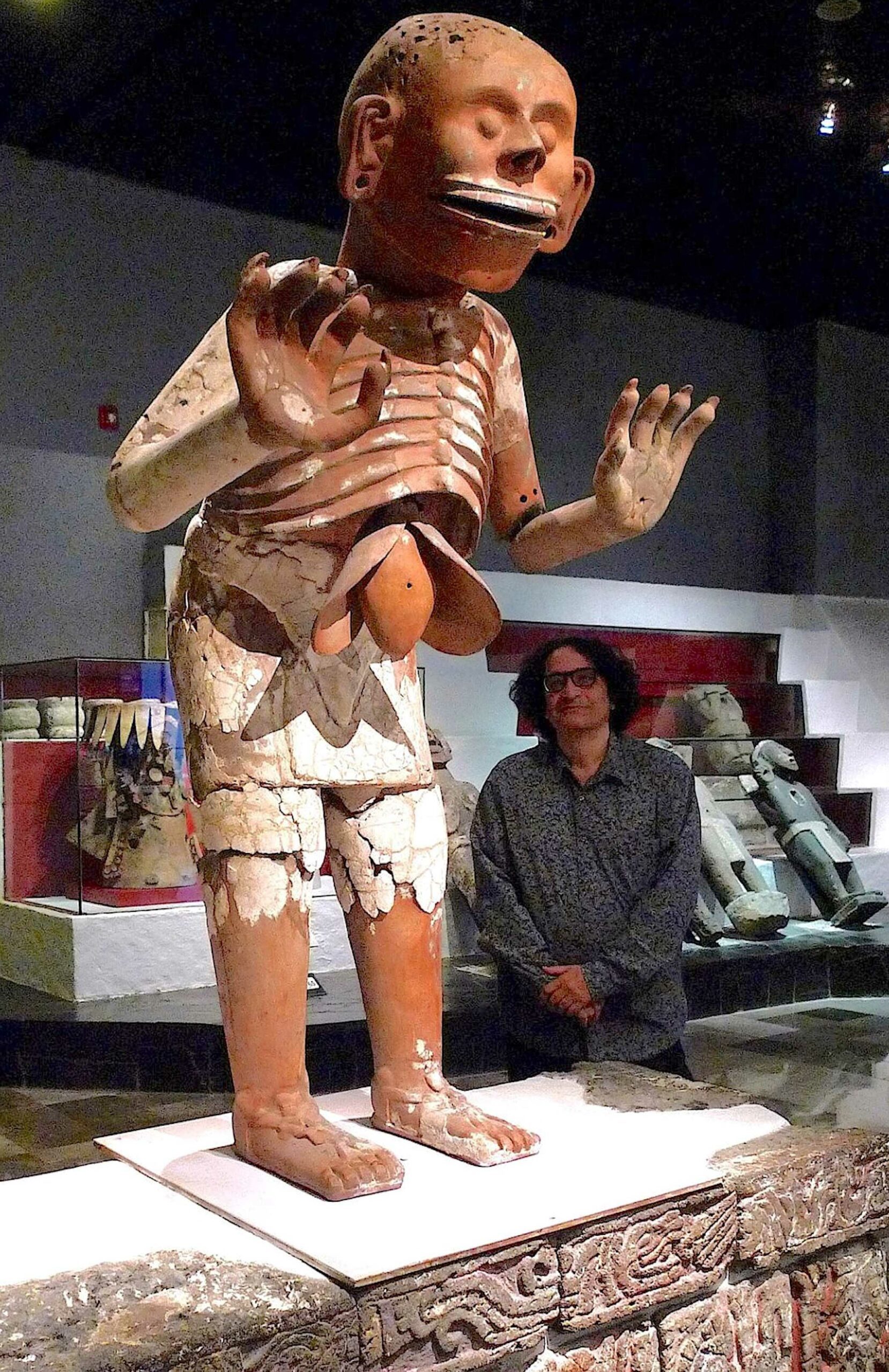
Mictlantecuhtli (with author in the background), c. 1480, fired clay, stucco and paint, height 176 cm., Templo Mayor Museum, Mexico City.

The large-scale ceramic statue pictured above is one of two that were excavated in the Templo Mayor’s House of Eagles in 1994. This is the statue of Mictlantecuhtli that the de la Torre brothers merged with Putin’s face, which is superimposed over the god’s head like a mask. The holes in Mictlantecuhtli’s head served to fix his wig. Here they humorously transition to Putin’s closely-cropped hair. 

Putin’s cold, shark-like eyes seem to be behind the mask he wears, rather than an organic or integral part of it. Soviet general’s medals are integrated into his rib cage, symbolizing Putin’s warmongering belligerence. Astonishingly, Mictlanteputin is adorned with a halo as he floats in the air. Or so it seems: his halo is actually a gold-colored wire wheel, another reference to lowrider culture.

Mictlanteputin’s body is wholly that of Mictlantecuhtli, with outstretched and menacing clawed hands (his fingers sometimes appear as missiles). He fires a missile at Coatzilla from his open, hinged jaw. 

Mictlanteputin retains the flower-like form emanating from Mictlantecuhtli’s ribcage. It is the god’s liver, understood as a seat of the ihíyotl (spirit). In Mesoamerica, the liver was traditionally associated with death and Mictlán (the underworld). Mictlanteputin continues this tradition by spewing highways — soon filled with cars — from his liver. This monster is a threat to the human race because, in devil-like fashion, he gives the people what they want. Bring on Carmageddon!
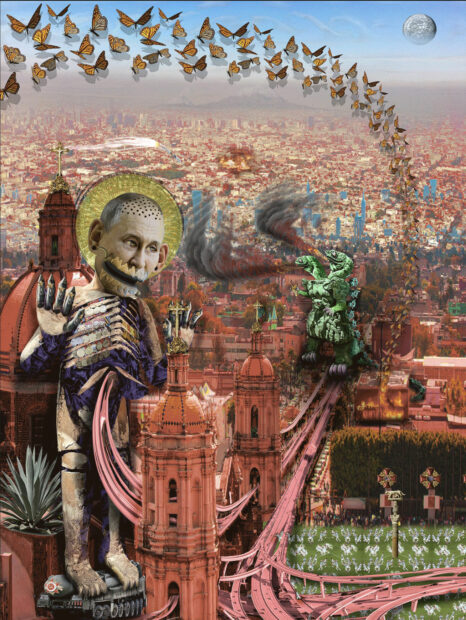
Detail of a city scene being destroyed by a Godzilla-Cuatlicue hybrid monster and Putin

“Mictlanteputin,” 2023, screenshot from GIF of lenticular print.

In the above image, Mictlanteputin is integrated into the Basilica of the Virgin of Guadalupe. A kaleidoscope of butterflies (which represent the souls of Aztec warriors who died in combat or by sacrifice) takes flight. Coatzilla, seen in the distance, is headed in Mictlanteputin’s direction. 

Both simulated movie posters deal with struggles over the earth and its resources. But, as Einar notes, while the creature Coatzilla is destroying humanity out of anger at our “mismanagement of the natural world,” Mictlanteputin, on the other hand, “revels in, and is all for the continuation of the industrial revolution in all its juggernaut glory of consumption.” For Mictlanteputin, it’s more highways, more cars, more refineries, more hell-on-earth heat and carbon monoxide. Pick your poison, because both monsters want us dead. 

Colonial Atmosphere
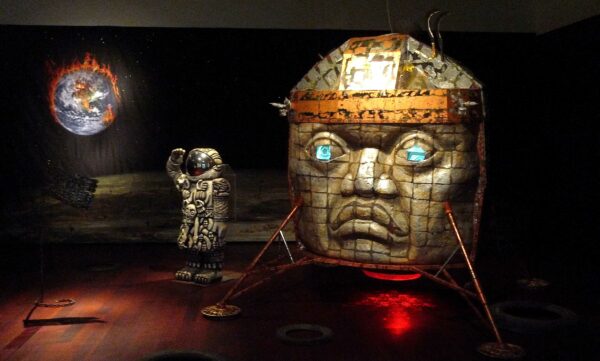
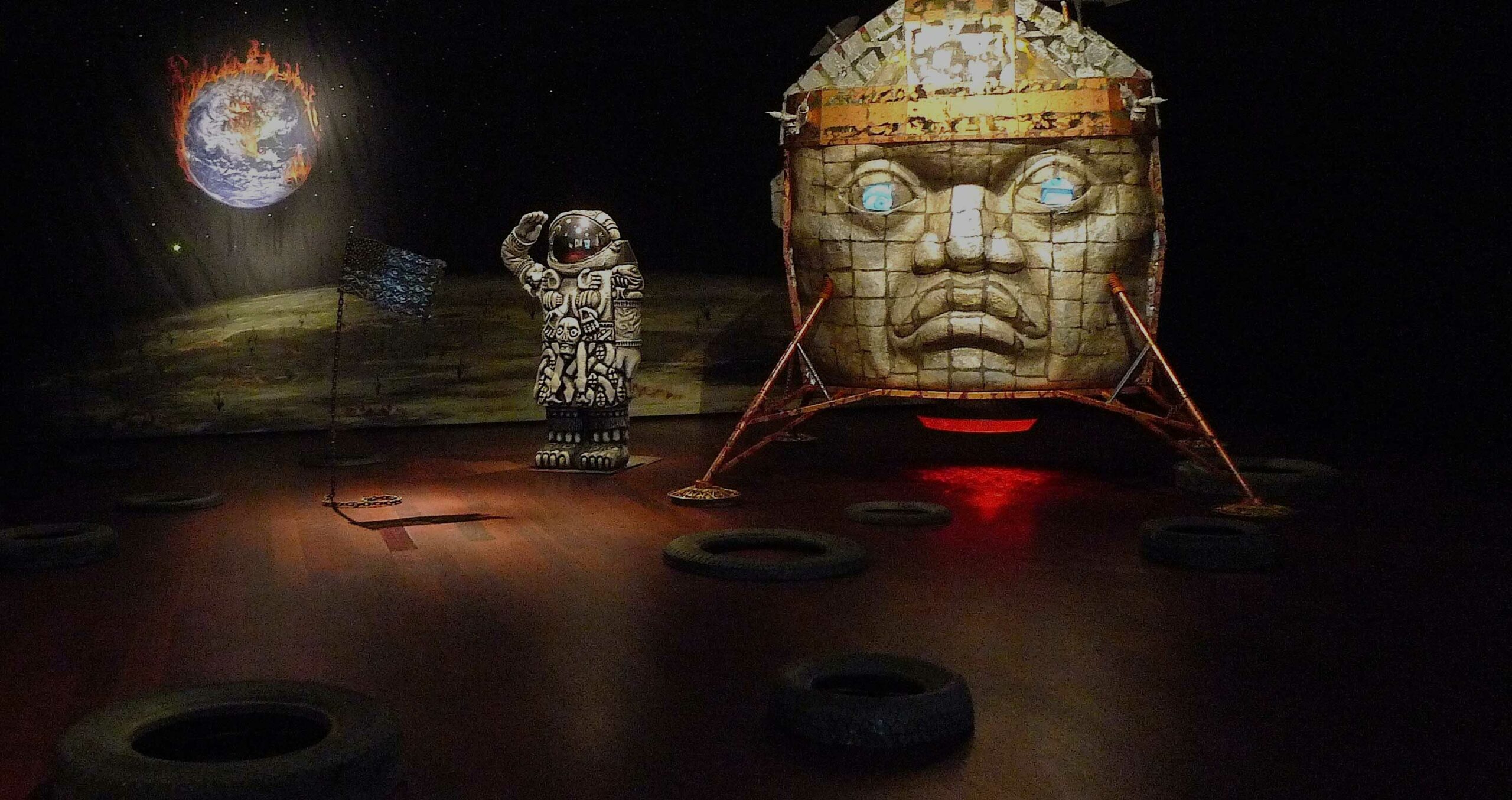
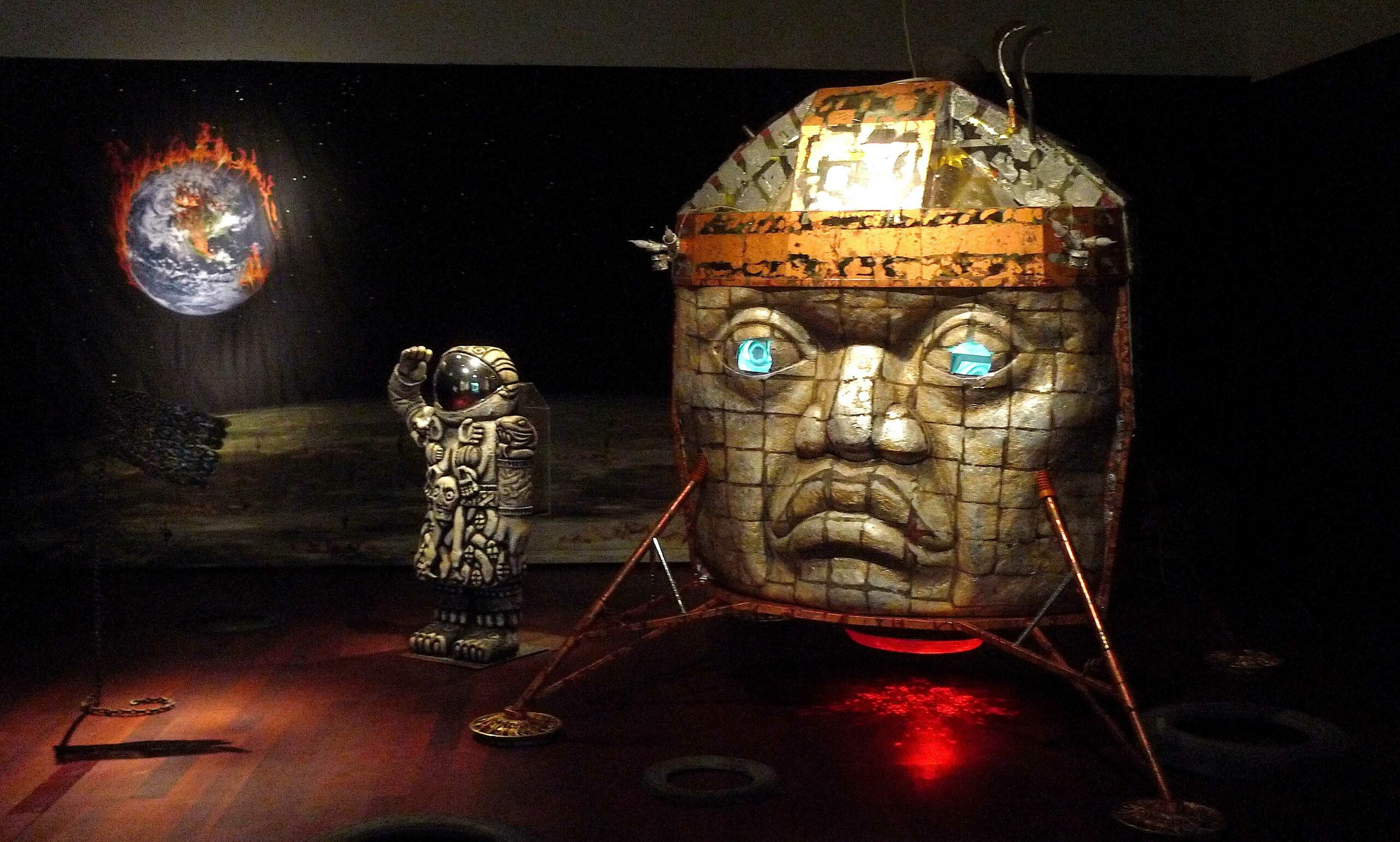
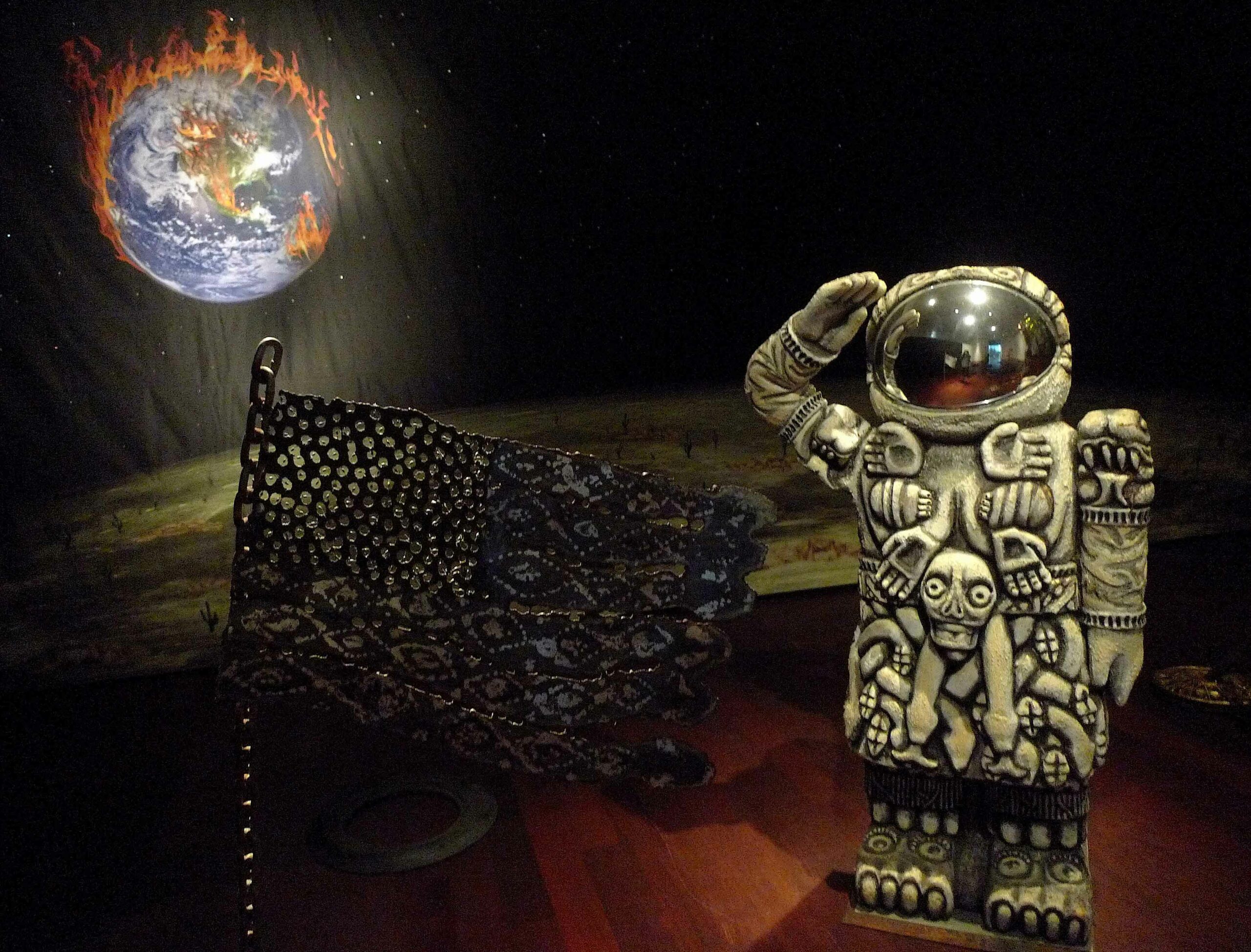
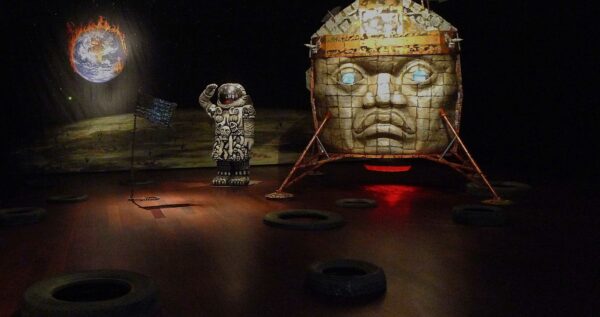
installation of a replica of an olmec head sculture, an astronaut, a fiery earth and discarded tires

Einar & Jamex de la Torre, “Colonial Atmosphere,” 2002, mixed media sculpture installation, 140 x 360 x 450 inches, McNay Art Museum. Photo: Ruben C. Cordova.

In my Collidoscope review, I referred to Colonial Atmosphere as the de la Torre brothers’ “most astounding installation” to date — though I think most viewers would agree that Le Point de Bascule, in its enlarged iteration at the McNay, at the very least gives it a run for the money. 

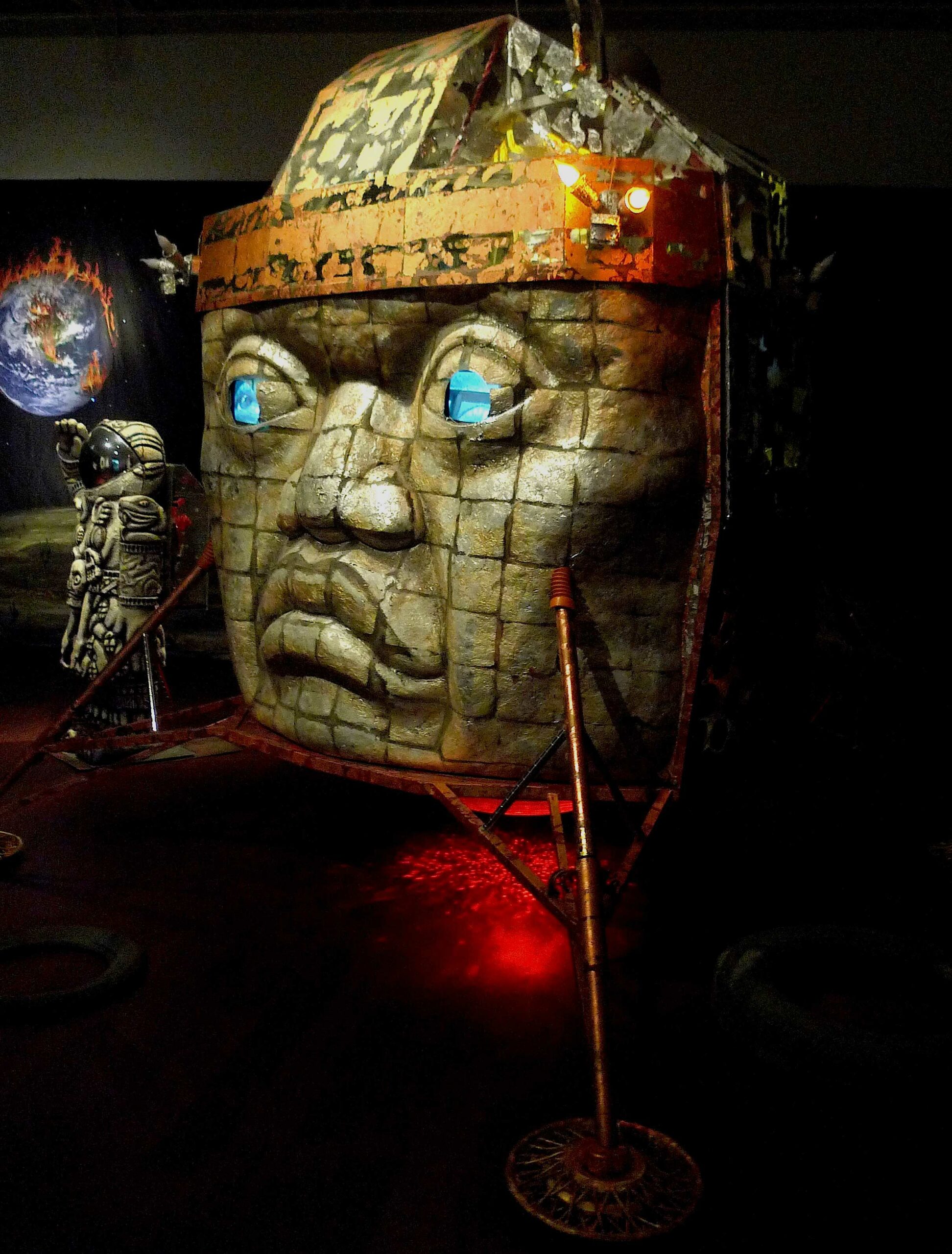
The conceit behind Colonial Atmosphere is that the great Mesoamerican civilizations (represented by the Olmecs and the Aztecs) have colonized not just other Mesoamerican societies, but the moon as well, with all that implies in terms of technological proficiency and dominion over the other countries on the earth. This Post-Columbian Futurist outer-space safari is dominated by a lunar lander in the shape of a monumental Olmec head from La Venta (replete with wire rim landing pads).
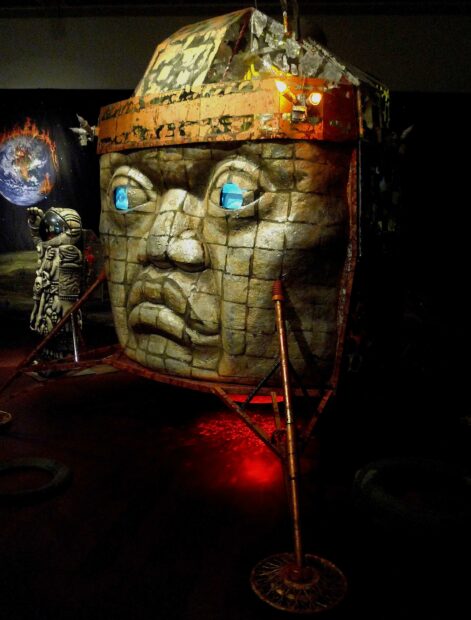
installation of a replica of an olmec head sculture, an astronaut, a fiery earth and discarded tires

Einar & Jamex de la Torre, “Colonial Atmosphere” (detail), 2002, mixed media sculpture installation. Photo: Ruben C. Cordova.

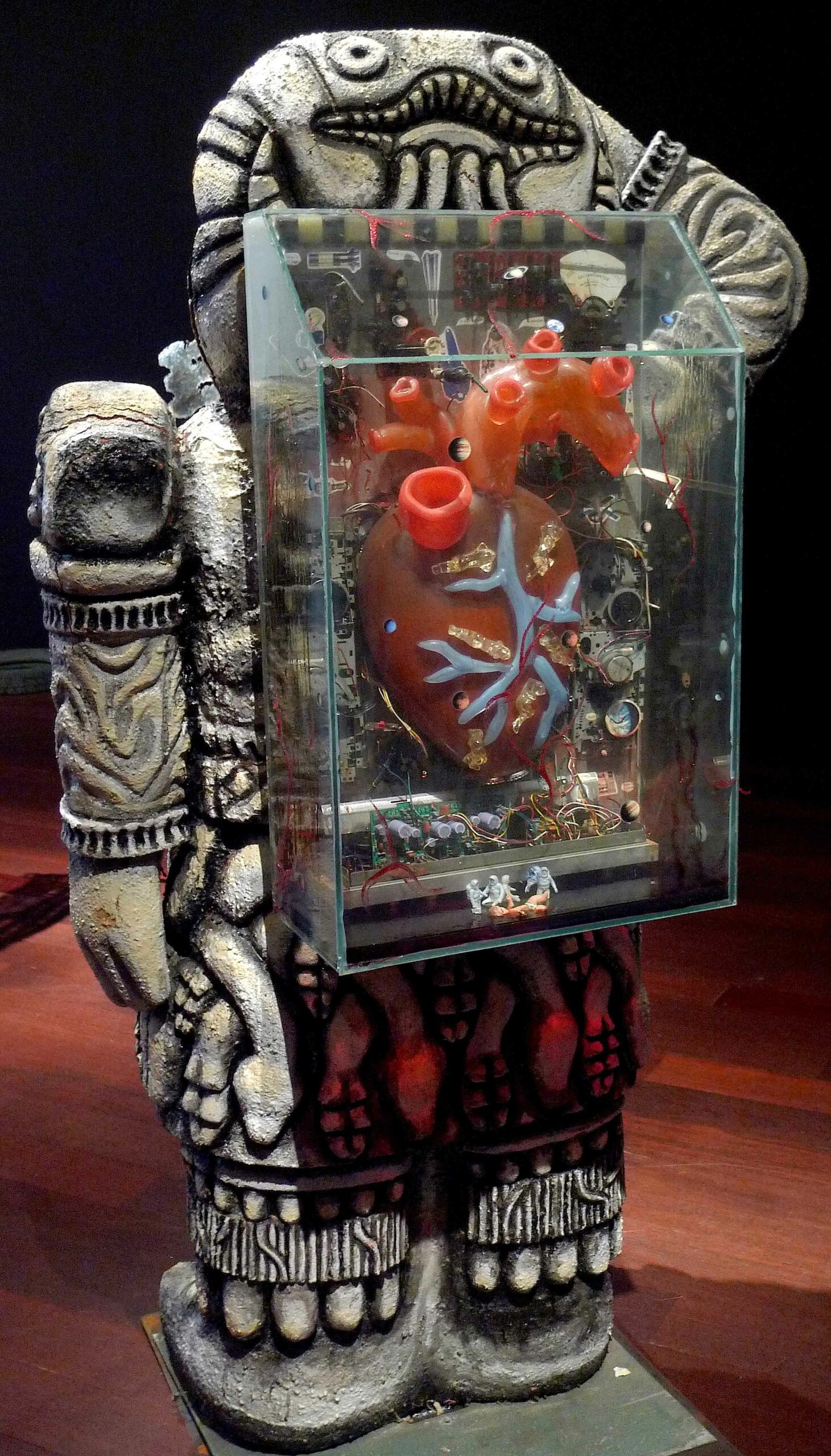
It also features an Aztec-cosmonaut in the form of the goddess Coatlicue (who wears a heart-powered jet pack on her back). (See my Collidoscope review for more photographs and a comprehensive discussion of this installation.)
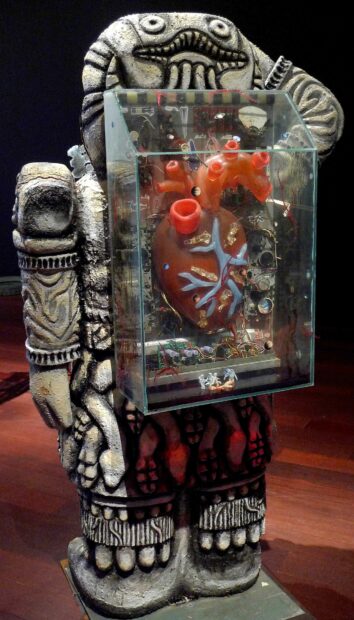
Sculpture of a replica of Cuatlicue deity sculpture with a plastic heart encased in a plexiglass box

Einar & Jamex de la Torre, “Colonial Atmosphere” (detail of Coatlicue and her jet pack), 2002, mixed media sculpture installation. Photo: Ruben C. Cordova.

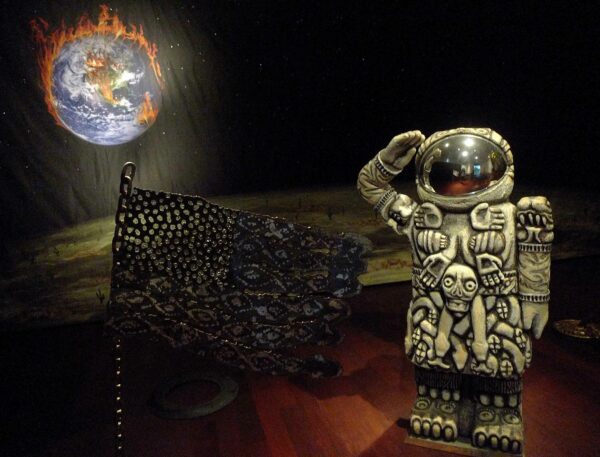
Due to global warming, the Earth, as seen in the painted backdrop, is a ball of fire. Space, heralded as the New Frontier during the original “space race” in the 1960s, will be the new home of earthlings, whose planet is destroyed not by invaders, but by the excessive utilization of terrestrial technology. 
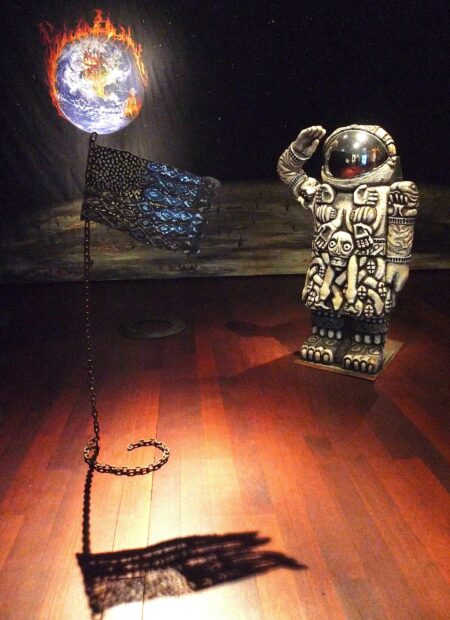
installation view of a sculpture of a cuatlique astronaut with a backdrop of planet earth on fire

Einar & Jamex de la Torre, “Colonial Atmosphere” (detail), 2002, mixed media sculpture installation. Photo: Ruben C. Cordova.

Coatlicue is the new Neil Armstrong, and she renders her flag (made up of transistors and rattlesnake patterns) an equally crisp lunar salute. In this darkened chamber, the rhinestones attached to the painted backdrop glitter like distant stars.
installation view of a sculpture of a cuatlique astronaut with a backdrop of planet earth on fire

Einar & Jamex de la Torre, “Colonial Atmosphere” (detail), 2002, mixed media sculpture installation. Photo: Ruben C. Cordova.

To complete the transhistorical mestizaje (racial and cultural mixing) of the Mexican homeland, the lunar lander is piloted by a European-looking Christ child astride a stuffed horse. This renders him a Horseman of the Apocalypse, and also collapses him into the myth of the god Quetzalcoatl, and his prophesied “return.” Additionally, the Christ child’s pose replicates the position of King Pacal of Palenque on his sarcophagus lid (which is reproduced on the rear of the module). This in turn references the fraudster Erich von Däniken, whose pseudo-archaeological Chariots of the Gods? (first published in English in 1971) posited that “gods”-from-outer-space constructed ancient archaeological monuments. 
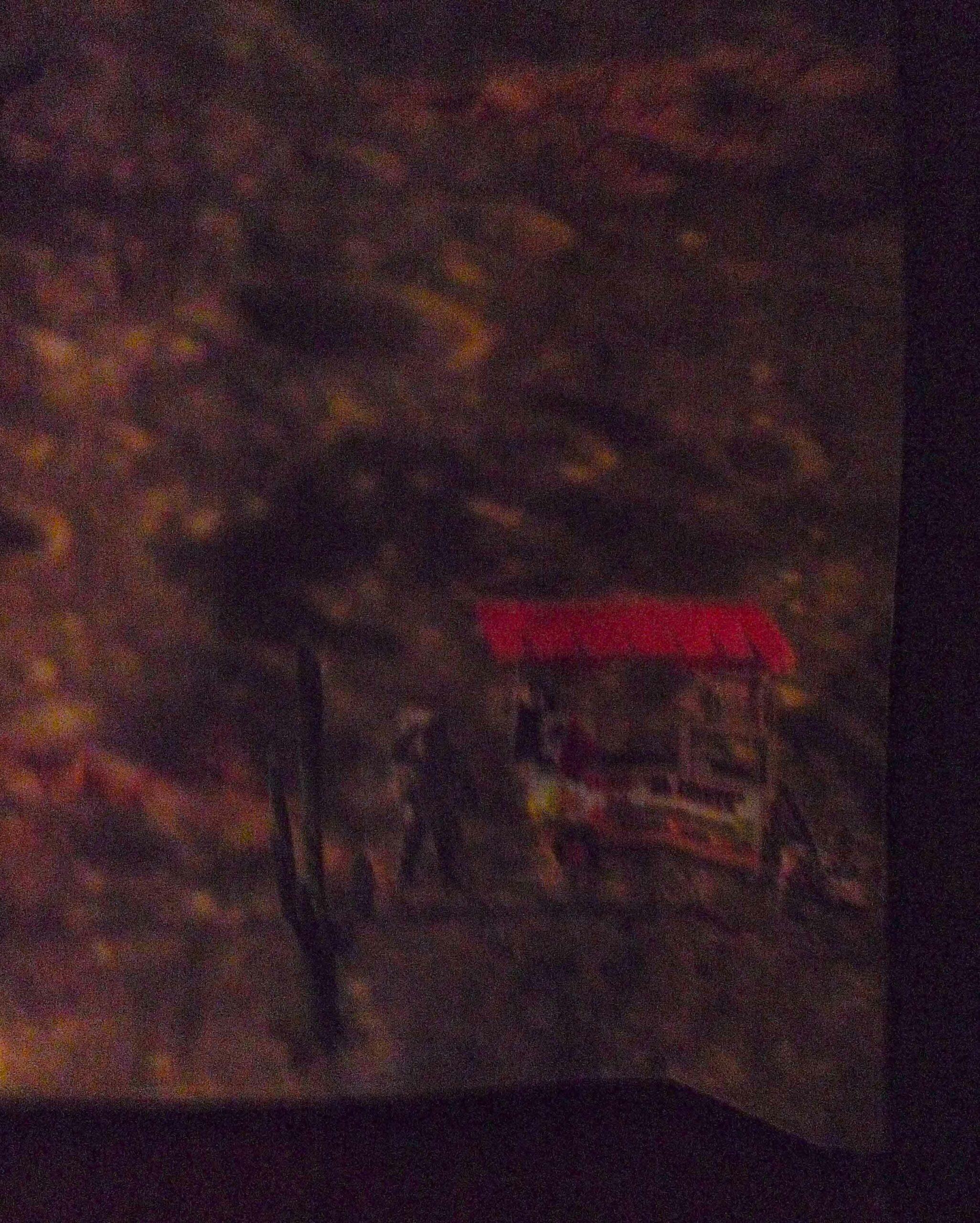
Fuzzy draawing of a street vendor cart in a desert landscape

Einar & Jamex de la Torre, “Colonial Atmosphere” (detail of Taco Stand), 2002, mixed media sculpture installation. Photo: Ruben C. Cordova.

In the darkest lower right corner of the painted backdrop, one can just make out a blurry taco stand, already manned by an intrepid vendor. Mexico’s destiny is thereby rendered clear: in multiple acts of Vendor Colonialism, Mexicans will conquer outer space, one taco stand at a time.
Detail of video projection of an eye on a sculpture

Einar & Jamex de la Torre, “Colonial Atmosphere” (detail of eye), 2002, mixed media sculpture installation. Photo: Ruben C. Cordova.

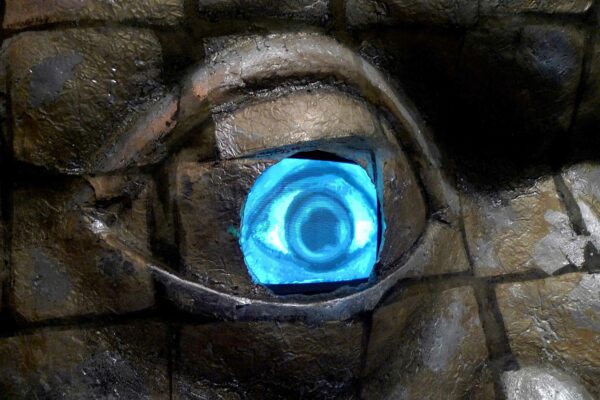
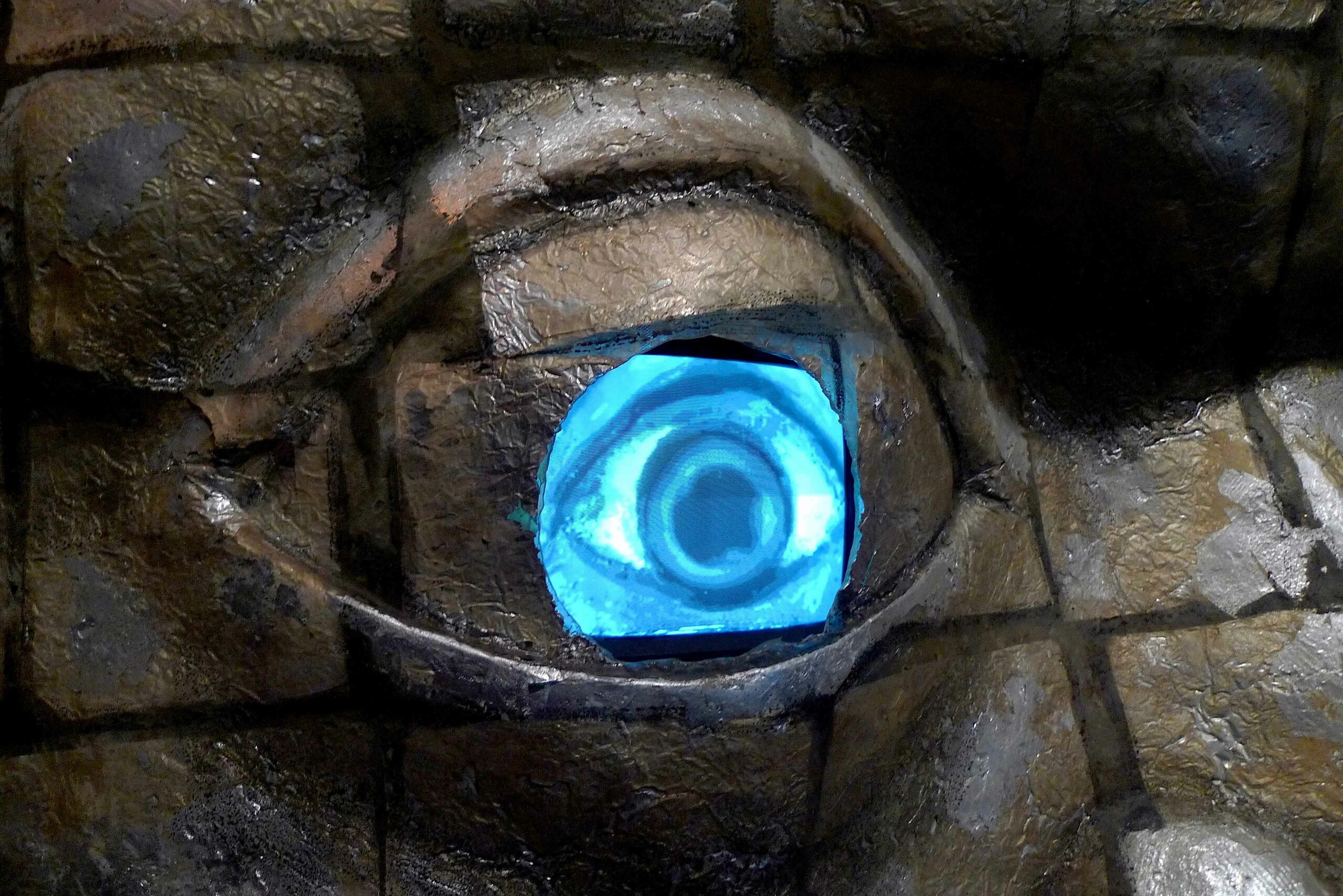
With all the mythic content that the de la Torre brothers have piled into Colonial Atmosphere, perhaps the wise old Olmec head should give an occasional wink to the visitor.

Upward Mobility is a tour-de-force exhibition, or, better yet, four tour-de-forces in one. This important and beautifully installed exhibition is at the McNay Art Museum in San Antonio through September 15, 2024, and it should not be missed.

Ruben C. Cordova is an art historian who has curated more than 30 exhibitions. His next exhibition, Dining with Rolando Briseño: A Fifty Year Retrospective, opens August 13 at Centro de Artes in San Antonio.

The post “Upward Mobility” by Einar and Jamex de la Torre at the McNay Art Museum appeared first on Glasstire.

26 Mar 12:45

Comic for 2024.03.26 - Ripped

New Cyanide and Happiness Comic
26 Mar 12:44

wearing revealing exercise clothes around coworkers, telling an employer I have another offer, and more

by Ask a Manager

This post was written by Alison Green and published on Ask a Manager.

It’s five answers to five questions. Here we go…

1. Wearing revealing clothes to exercise around coworkers

I’m a young woman at my first corporate job in a male-dominated field. I go to the gym across the street after work on most days; it’s not affiliated with the company. For comfort and convenience, I often wear somewhat revealing clothes to exercise (tight shorts and crop tops/sports bras). I dress modestly in the office and don’t change clothes there.
The problem is that many of my (male) coworkers go there too, and it’s the unofficial office gym. I’m concerned that it’ll damage my professional standing being seen in skimpy clothes, even though it’s technically outside of work. Do you suggest that I adhere to any sort of dress code while I’m there? Or should I dress as I please because I’m not at work? My office is pretty chill, but I’m still concerned about double standards.

Dress however you feel comfortable at the gym. You’re not walking through your office hallways in booty shorts; you’re dressed appropriately for the space and for the activities you’re participating in. It will not hurt your professional standing unless you work somewhere that’s far more dysfunctional and sexist than the average workplace (a bar that allows for a fair amount of dysfunction and sexism before this would be an issue).

2. My employee wants to be promoted into a job that doesn’t exist here (and probably shouldn’t)

I supervise a high-performing, early career employee who has been in his current role for two years. He would like to be promoted into a role that he’s written for himself. It’s a role that doesn’t exist in our industry or our organization. I’m happy to help this employee and be his champion, but I do not think this is a role that the organization needs. It is hard to make a business case for how the role adds anything to the existing set-up. If it did exist, I do not yet think this person would be ready to fill it. He’s not a bad employee, he just needs more experience in a broader variety of activities that relate to this position he’d like to have. Do you have any advice for me in coaching him or a path he would take?

You’re not doing him any favors (or serving your organization well) if you aren’t up-front about the challenges you see in his plan. Be direct with him — explain that you think it’ll be tough to make a business case for the role and why, and explain what qualifications you think the company would want if they did create it. At the same time, you can talk to him about what kind of path he’d need to take to get those qualifications, what that might look like, and whether there are opportunities in your organization for him to strengthen himself for that type of work, even if he doesn’t ultimately end up doing it there. And if he’s intent on making a case for it there, let him make that case — but being honest about your assessment will help him make better choices for himself.

3. How do I handle having to drop a job opportunity that I really wanted?

I’m entering my senior year of college after this semester, and I was recently able to secure an opportunity exactly in the field I wanted to be in. It would have opened a lot of doors in my field, and I was originally really stoked — except they never disclosed it was unpaid. That fact and an hour+ drive to the location multiple times a week on top of two other jobs (gotta pay rent) meant I had to drop the opportunity.

How do you get over something like this? I’m still in the regret phase even though I know I couldn’t afford to do it.

There are going to be a lot of job prospects in your future that would be perfect except for one thing, and that one thing will be significant enough that it’s a deal-breaker. It could be the salary, or the location, or the manager you’d be working with, or the hours, or the company culture. This is really normal, and it’s good to get comfortable with it early on, because when you try to ignore the “just one thing” that makes a job a bad fit for you, that’s how you end up in a job where you’re miserable (or broke). Take this as an early lesson in being clear-eyed and resolute about what does and doesn’t work for you, regardless of how enticing it might otherwise be.

Also, it’s sketchy as hell for them not to disclose up-front that the work was unpaid. That’s a red flag about them generally.

4. Timing my resignation with a week off and a company retreat

I am a program manager at a small company, and I’m the only staff member assigned to my program. Every summer my company shuts down for a mandatory paid week off, and the next Monday is our mandatory all-staff retreat, which consists of serious planning sessions interspersed with team-building activities. We have to set goals for ourselves and our programs and stand up in front of the whole company and declare what each of us is committing to for the upcoming year.

I’m planning to leave the company this summer to start my own business. I really want to take advantage of the paid week off, and I’m concerned that if I give notice right before the break they might let me go immediately to avoid paying me for that week off. I have a good relationship with my boss and don’t think he’d do that, but there are also some pretty horrible leaders above him who have screwed over employees before, and money has been really tight the past few years so I think there’s *some* risk.

I also don’t want to wait more than a week after the break to give my two weeks notice, because I need to get ready to launch my business in the fall. If it’s not ready in the fall, a big chunk of my prospective customers will sign on with other service providers for the year.

Is it better to fake my way through a full day of public planning, goal-setting, and making commitments, just to turn around later that week and say “just kidding!” or to give my notice before the break and cross my fingers they don’t let me go immediately? If it’s the former, any advice on how to reduce the awkwardness?

Why not give your notice right after the week-long break, on the first day of the retreat? Give it that Monday and ask whether your manager would rather you attend the rest of the retreat or spend that week getting your work in shape to transition. He can make that call — but that way if he wants you at the retreat, you won’t have to pretend to make commitments for the coming year because it’ll be out in the open that you’re leaving. If that timing seems awkward, you can note that specifically: “I know the timing isn’t ideal, but now that I’ve made the decision, I wanted you to have to maximum possible notice.”

5. Do I need to tell employers I have another offer I am considering?

I have been applying for positions and interviewing for a long time. A few weeks ago, two employers indicated they intended to make an offer. However, both still needed to go through their internal approval processes, which has taken several weeks.

Now, I have received one offer (I have two weeks to review it) and the other employer says they will send an offer in two days. Do I need to tell the employers that I have another offer? If so, what would be a good script to use?

I don’t want to make either employer think I am uninterested because I am considering another offer, but if I don’t mention it now they may be caught by surprise when I decline which may impact my reputation in my network. They are both great jobs but very different, and in different locations too, so it will be a difficult decision.

You’re not obligated to announce if you have other offers. Employers generally assume you’re interviewing with multiple companies and realize they could lose you to an offer you like better (or simply because their offer/job isn’t right for you, even if there aren’t other offers in play). If an employer is ever shocked to learn that you’ve been talking with other companies, that’s on them — not on you for not spelling it out.

You might choose to mention it anyway if the situation calls for it — like if the second company’s offer is delayed and you’re going to run up against your deadline for the first (in which case it could make sense to tell the second one that you’re very interested but you have another offer that you need to answer by X date). Or if you prefer Company A but Company B makes a higher offer, you might see if A is willing to match it. But you don’t need to announce it just on principle — only if it serves your interests in some way.

25 Mar 19:52

employee uses the bathroom stall with the door wide open

by Ask a Manager

This post was written by Alison Green and published on Ask a Manager.

A reader writes:

I have (what I think is) an outlandish question for you, but I promise it’s true. It comes from my coworker’s spouse.

At her place of employment, they have found it difficult to retain anyone in the administrative assistant position. It sounds like there was a lot of turnover in that role, to the point that management is desperate to retain someone … anyone! The current admin assistant, lets call her Feyre, has some personal hygiene issues (i.e. not showering, coming to work unkempt in worn sweatpants, etc.) which had to be addressed by whoever oversees her.

While addressing personal hygiene is not out of the realm of possibilities in the workplace, one startling revelation was that other coworkers have walked into the bathroom where Feyre was “doing her business” with the stall door wide open! The affronted other employee excused themselves immediately and thought it an accident. However, this kept happening and a pattern emerged.
Management approached Feyre with this, and she said she has severe claustrophobia where she can’t use the bathroom with the door closed. In order to accommodate her, management made it clear she must either shut the stall door or use the private accessible toilet down the hall. She has refused to do this, and is still using the toilet with the stall door wide open. As management is desperate to retain someone in this position and her work is mildly satisfactory, they still want to keep her.

I’m obviously not in this situation as I don’t work there, but I do a lot of the hiring/HR at my smaller organization so I am both horrified and fascinated at what management’s next steps should be. We are in Canada so the laws may vary, but at what point does the employer exceed their duty to accommodate an employee for something like this? What would be the best way for management to navigate this situation?!

There are all kinds of accommodations that can be made for claustrophobia, but “use the toilet with the door wide open in a bathroom where other people are present” is not one of them. I can’t speak to Canadian law, but I suspect it’s the same as U.S. law in this circumstance: accommodations can’t require that other people’s rights be violated, and Feyre’s coworkers have the right not be subject to an practice that involves them being repeatedly and involuntarily exposed to a colleague with her pants down.

Having Feyre use the private accessible toilet down the hall was a good solution. Since she’s refused to do that, they need to find out why. Is it too far from her desk and she sometimes needs the bathroom more urgently? If so, can her desk be moved? Or is it a closed door that’s the issue for her, period? If so, they need a lawyer to guide them here. My instinct is that that’s a situation that can’t be resolved — because, again, accommodations can’t violate other people’s rights (which is why you can’t, for example, set accommodations that include things like “never has to speak to female employees” or “must be permitted to run nude through the hallways”) — but when you’re at the point of denying a medical accommodation, you want a lawyer to help you navigate it.

In this case, it sounds like the employer wants to throw up their hands and say, “Oh well, she’s going to use the bathroom with the door open, nothing we can do” because they want to keep her in the job. But the employees there would be on solid footing if they wanted to push back and say, “No, we’re not willing to be exposed to this.”

25 Mar 19:48

Prince Andrew Claims Pedophilia Scandal Was Just Palace’s Attempt To Cover Up His Ongoing Battle With Cancer

LONDON—Saying the accusations made against him over the years were not just disgusting but patently false, Prince Andrew, Duke of York, told reporters Monday the scandal over his alleged pedophilia was just Buckingham Palace’s attempt to cover up his ongoing battle with cancer. “Sadly, rather than being honest about a…

Read more...

25 Mar 19:37

Feeling Great

by Reza
25 Mar 19:37

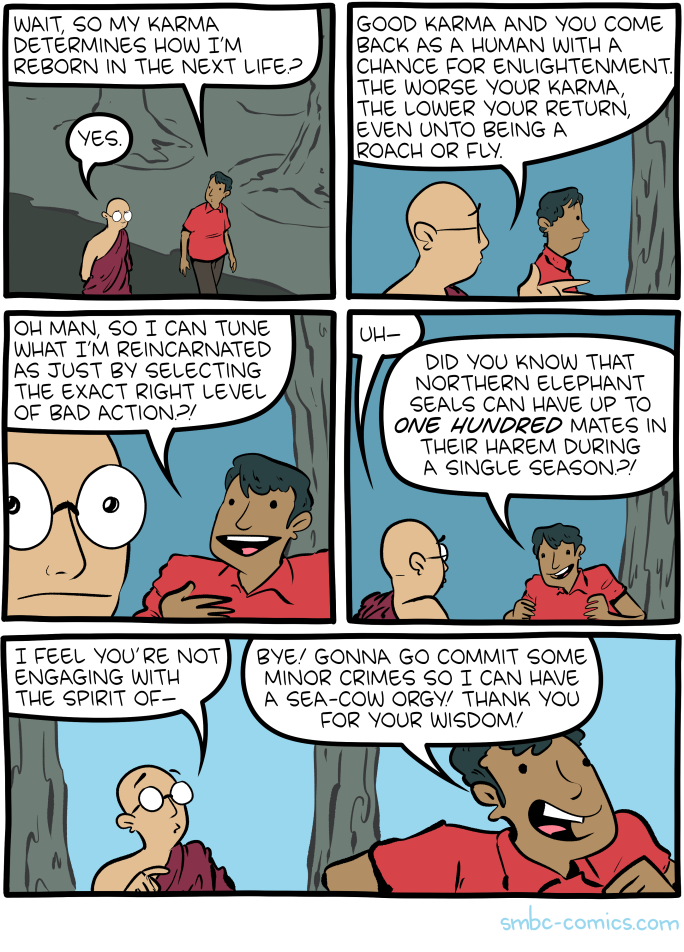
Saturday Morning Breakfast Cereal - Karma

by Zach Weinersmith


Click here to go see the bonus panel!

Hovertext:
I'm not saying I'm into sea-cows, I'm saying *if I were an elephant seal* I would be. Don't act weirded out.


Today's News:
25 Mar 19:36

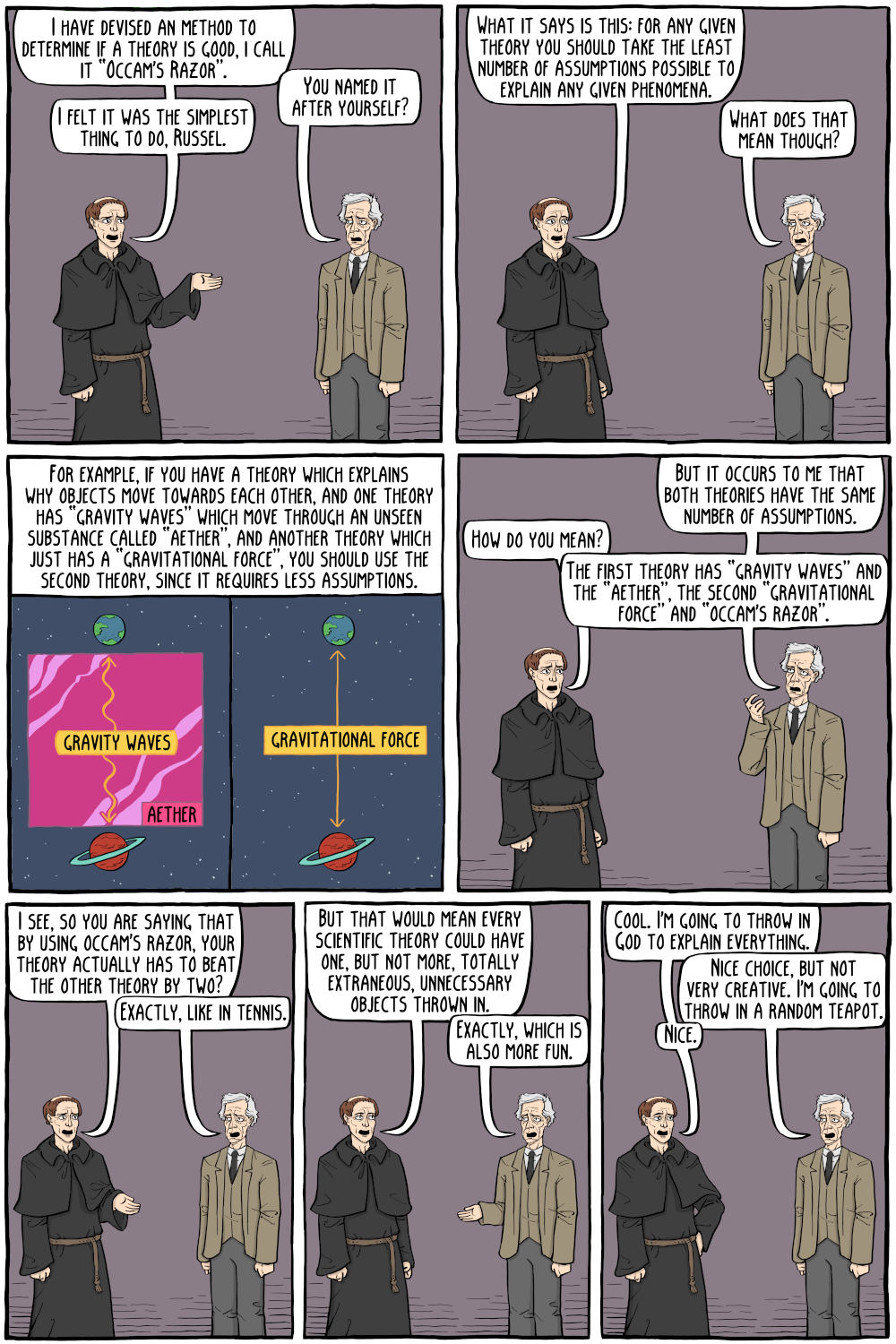
Occam's Razor

by Corey Mohler
PERSON: "I have devised an method to determine if a theory is good, i call it “Occam's Razor”. "

PERSON: "I felt it was the simplest thing to do, Russel."

PERSON: "What it says is this: for any given theory you should take the least number of assumptions possible to explain any given phenomena."

PERSON: "What does that mean though?"

PERSON: "You named it after yourself?"

PERSON: "For example, if you have a theory which explains why objects move towards each other, and one theory has “gravity waves” which move through an unseen substance called “aether”, and another theory which just has a “gravitational force”, you should use the second theory, since it requires less assumptions."

PERSON: "gravity waves"

PERSON: "aether"

PERSON: "But it occurs to me that both theories have the same number of assumptions."

PERSON: "How do you mean?"

PERSON: "The first theory has “gravity waves” and the “aether”, the “second gravitational” force and “occam's razor”."

PERSON: "gravitational force"

PERSON: "I see, so you are saying that by using occam's razor, your theory actually has to beat the other theory by two?"

PERSON: "Exactly, like in tennis."

PERSON: "Nice."

PERSON: "Cool. I'm going to throw in God to explain everything."

PERSON: "Nice choice, but not very creative. I'm going to throw in a random teapot."

PERSON: "But that would mean every scientific theory could have one, but not more, totally extraneous, unnecessary objects thrown in."

PERSON: "Exactly, which is also more fun."
25 Mar 13:21

The interest-ing world of interest rates

by Wailin Wong
undefined

Countries all over the world are making big moves in monetary policies. From unexpected cuts to long-awaited hikes to a cautious cling to the status quo, this edition of Indicators of the Week has it all. Today, we explain the motivations for these drastically different approaches.

For sponsor-free episodes of The Indicator from Planet Money, subscribe to Planet Money+ via Apple Podcasts or at plus.npr.org.

Music by
Drop Electric. Find us: TikTok, Instagram, Facebook, Newsletter.

25 Mar 13:20

Comic for 2024.03.24 - Frog Prince

New Cyanide and Happiness Comic
25 Mar 13:20

Report Shows Uvalde Police Chief Waited 2 Years In Parking Lot Outside Office Before Resigning

UVALDE, TX—In the wake of a devastating school shooting and reports that his officers did not receive adequate active-shooter training, an investigation showed Monday that Uvalde Police Chief Daniel Rodriguez waited nearly two years in the parking lot outside his office before finally entering the building to resign.…

Read more...

25 Mar 13:19

Study Finds Majority Of Americans No Longer Have Energy To Stand While Brushing Teeth

WASHINGTON—According to a new study released by the National Research Council on Monday, the majority of Americans no longer have the energy required to stand while brushing their teeth. “Exhausted from the stress of being alive, more than half of U.S. residents now lack the vigor and zeal a person needs to remain on…

Read more...

25 Mar 13:19

Nation’s Bony Women Announce They Are Shivering

WASHINGTON—Repeatedly asking if anyone else felt cold as they clutched their protruding elbows and rubbed their visible clavicles, the nation’s bony women announced Thursday that they were shivering. “Oh, my god, is it freezing in here, or is it just us?” said a gaunt 65-year-old Shayna Summers who, with several…

Read more...

25 Mar 13:19

Man Receives First Genetically Modified Pig Kidney Transplant

Doctors at Massachusetts General Hospital successfully transplanted the kidney of a genetically modified pig into a man suffering from end-stage kidney disease in a major milestone to alleviate the shortage of organs for people on the transplant waiting list. What do you think?

Read more...

25 Mar 13:19

Ways Donald Trump Could Raise His $454 Million Bond

Today is the deadline for Donald Trump to pay his $454 million fine for fraud, and if he fails to meet his obligation, the New York attorney general could take action to seize his most prized possessions. Here are the ways financial experts say the presumptive Republican nominee could raise a half-billion dollars.

Read more...

25 Mar 11:39

Awkward Zombie - Limited Menu

by tech@thehiveworks.com

New comic!

Today's News:

Honestly I'm just thankful that the cat food my cats will eat is just at the other grocery store and not at the bottom of the sea.

25 Mar 11:38

coworker wants to withhold PTO as punishment, religious gifts for colleagues, and more

by Ask a Manager

This post was written by Alison Green and published on Ask a Manager.

It’s five answers to five questions. Here we go…

1. Coworker wants to withhold PTO as punishment

We have a series of educational seminars by coworkers every month. I am expected to attend 80% of these seminars, online or in person (preferred). Attendance is monitored through completion of an anonymous survey with a follow-up page where you submit a daily code to get credit. The code is not always provided during the session, so sometimes we have to bother the presenter to provide it. Sometimes my role works off-site or has other expectations around the time of day that these sessions are held. When we are off-site, there is no expectation to attend and we are excused from the attendance requirement.

My coworker, who is involved in a committee that acts as a liaison with management, has been advocating for withholding PTO as punishment for failing to attend a sufficient amount of educational seminars. Our PTO is listed as a benefit in our contract so I don’t think it is legal to withhold PTO. My coworker disagrees and points to a time when we were severely understaffed due to Covid and PTO was denied automatically for all employees due to low staffing. Would withholding PTO like this be allowed?

Do you have actual contracts? If you’re in the U.S., that would be unusual — but if you do, then the answer depends on the specific wording in your contract. If you don’t, the legality depends on the wording of other company documents.

But it doesn’t really matter, because this would be a horribly ill-advised thing to do anyway. First, it’s ridiculously punitive and a far larger punishment than the offense warrants.

Second, PTO isn’t something an employer gives out of the goodness of their heart and which can/should be yanked back to teach a lesson; it’s part of employees’ compensation package, and it’s in your employer’s interest to have people use their PTO so they have rested, recharged employees. Revoking it to punish people is very likely to cost you good employees, who will leave over this.

Third, you don’t manage people via punishment. If someone isn’t attending enough seminars, then their manager should talk with them, figure out what’s going on, make the expectation clear, and then hold them to it like they would any other requirement of their job. If it’s happening with lots of people, then you look at root causes: are the seminars not helpful? Do people not have enough time for them? Are there legitimate reasons people aren’t prioritizing them? You don’t just bludgeon them by yanking their PTO.

Your coworker is being ridiculous, and I hope she doesn’t manage anyone with her instincts this off. And if you work at an even slightly well-managed company, your management should shut this idea down hard if she proposes it.

2. Are religious gifts ever appropriate for colleagues?

Is it ever appropriate to get a coworker a religious-themed gift (her religion, not mine)?

Our team’s administrative assistant is going through a really rough time with cancer treatment, and I’d like to get her something to let her know I’m thinking of her. Our team has some weird dynamics, and we work in academia, so there won’t be something central organized for her. I am not sure her schedule for being home or in hospital, or what she’s able to eat, etc. so don’t want to do any of the standard perishable gifts of food or flowers.

She has been quite open about her commitment to Islam (e.g., she was really excited to share when she recently made her first pilgrimage to Mecca). I have a strong sense she might appreciate something like a framed calligraphed section of the Qur’an that talks about healing, or a small bracelet with a prayer on it.

I myself am not Muslim, and don’t personally believe in the power of prayer (other than the healing effect of feeling happy and calm that prayer can bring about for people who believe in it), and normally am a big proponent of not mixing of work and religion, so I am surprised to be finding myself asking this. Is it totally whacky to get my coworker a religious gift? If it matters, I am higher than her in the hierarchy but she does not report to me.

I wouldn’t. There are indeed people who would be moved by a gift like this, and it’s possible your coworker is one of them. But it’s also possible it would feel like overstepping, or that you’ll miss the mark in some way because you don’t know the nuances of the religion or of her relationship with it.

What you’re proposing is a very personal and intimate gift, in the context of a work relationship, and there’s too much risk of it being a misfire (especially as someone outside of her religion and who lacks insight into the ways she connects with it). There are so many other thoughtful gifts you could choose that aren’t religious. Go for one of those.

3. I have to do math for a project and I’m terrible at math

I’m an office administrator at a mid-sized company and have been in the role for about five years. Based on my promotions and excellent performance reviews, I think it’s safe to say I’m good at my job. However, I have managed to go this entire time without doing more than the most basic math.

Our office is hosting a large conference this year that involves setting up several of our meeting rooms in a classroom style. I’ve been tasked with calculating how many tables and chairs can fit in each room while still allowing each attendee ample space to move around. Relatively basic surface area stuff, right?

I am terrible at math. I have pretty serious ADHD (and my boss is aware) but frankly, I seem to have been born without the math gene. The amount of mental math and spatial reasoning involved in this project, however simple in theory, has me spiraling.

This is going to sound ridiculous but I have a lot of low-key traumatic associations with math (parents yelling, teachers upset, lots of crying, elementary school homework taking countless hours to complete.) Being “academically gifted” in every other area only seemed to make adults angrier at me when I struggled with something. I don’t come from a family background where dyscalculia would have been taken seriously and I’m honestly not sure whether or not it applies to me. But yes. Terrible at math, zero spatial reasoning, can’t follow a map, etc…

I don’t want to admit defeat because it would be embarrassing to tell my boss that I’m essentially too dumb to do this. The project needs to get done. How do I get through it without authority figures getting upset, me crying, and a straightforward task taking countless hours to complete?

This isn’t about defeat or being dumb; it’s about being assigned a task that happens to play to a historical weakness of yours (and maybe a disability too). You’re known to be good at your job; no halfway decent boss will be outraged that you’re not good at math too. You clearly don’t normally need to rely on it in your job, so it’s not like you’re revealing something that makes you fundamentally unsuited for your work; you’re just explaining something that makes you unsuited to one minor task.

Your boss almost certainly doesn’t want you to spend hours on this or suffer major angst from it! Right now, though, she doesn’t know that’s happening, so she just needs you to let her know this isn’t a good plan.

So, own it! Meaning: “I’m terrible at math and spatial reasoning, and the amount of both of these needed to figure this out, however simple in theory, has me spiraling. I’m worried it will take hours and could still be wrong, and I don’t want that outcome. Is there someone who could help me with this?”

4. Taking an external offer when my manager has been fighting to promote me

I’m in what I consider to be a tough situation. My company has been going through a rough patch lately with a large portion of the company being impacted by a layoff and rumors of more layoffs coming in the near future. As a result, I felt it responsible to explore other opportunities, just in case. I’ve been approached for an exciting role and am now faced with having to make a decision of staying or leaving. Meanwhile, my manager is terrified of me leaving my current company (he should be!) and has put me up for a promotion that’s in the final stages now. I’ve been pushing for this promotion for quite some time and working my tail off to prove that I’m worthy, so the recognition is appreciated.

Normally, I would say that this isn’t a tough decision. However, our promotions this year had a VERY low quota and were heavily scrutinized. My manager had to fight very hard to get me into one of the few slots available and others in my organization were cut from the list even though many of them deserve a promotion as well. If I accept an external offer, I’ve basically taken one of the very few promotion spots and made no use of it all. It’s too late in the promo cycle for them to substitute my spot as the decisions have been made and the cycle is now closed.

Would I be in the wrong to accept an external offer that I’m excited about after taking one of the promotion spots? On the one hand, it’s not my fault that my company has locked down promotion quotas so much this year. But, I also feel a bit guilty about going through with the promotion process knowing there was a good chance I’d be leaving.

If you want the other job, take it. Yes, the timing is too bad, but you don’t owe it to your manager to turn down a better offer. And keep in mind that your employer isn’t promoting you as a favor or a gift; if they promote you, it’s because it makes business sense for them. That doesn’t mean that your manager might not feel disappointed that he used capital (and a limited promotion slot) only for it not to pay off, but that’s how this stuff goes sometimes. It’s absolutely not something you should sacrifice your own career progression for! Act in your own interests, and just let your boss know that you appreciated he fought for you.

5. Can my boss make me use AI?

Can our management team force us to use AI transcription services? Our staff (all nine of us) share one multi-user Zoom account, and our executive director has turned on the “AI transcription” option for all our accounts, and locked it so we can’t turn it off on our individual accounts. I find the AI transcription piece unnerving and unnecessary (someone always takes meeting notes), especially given our line of work (similar to 12-step/recovery sharing, a lot of what we discuss in meetings we and our patrons do not want published, ever!). So far the only “discussion” has been an FYI that it was happening.

If it matters, we work in Illinois, which has new legislation around AI use during video interview review, but most of my colleagues are remote and work across the U.S.

Yes, they can do that. Your employer can choose what tools it does and doesn’t want to use in the course of its business. (The Illinois law you mentioned only applies to job interviews.) You can certainly raise it for discussion and explain your concerns, and you can attempt to rally coworkers to push back with you, but ultimately it’s your employer’s call.

25 Mar 11:06

Everything We Know About Jake Paul Boxing Mike Tyson

In what many are calling one of the most hotly anticipated sporting events of the season, YouTube influencer turned boxer Jake Paul will face off this summer against former world heavyweight champion Mike Tyson. Here’s everything we know so far about the boxing match.

Read more...

25 Mar 11:00

Irresponsible Millennial Wasting Money On Coffee Instead Of Pulling Out Gun And Robbing Everyone In Store

SUNNYVALE, CA—Shaking their heads at the 32-year-old’s typical lack of financial savvy, sources confirmed Thursday that irresponsible millennial Sean Drever was wasting money on coffee instead of pulling out a handgun and robbing everyone in the store. “He’s reaching into his jacket for his wallet to buy yet another…

Read more...

25 Mar 02:55

Book Recommendations & Being Safe Online (Stream Highlights #1)

by Philosophy Tube

Highlights from my most recent livestream where I explain how Philosophy Tube gets made and have some laughs!
See Dracula's Ex-Girlfriend ---- https://go.nebula.tv/dex
Support me on Patreon ---- https://www.patreon.com/PhilosophyTube

Subscribe! http://tinyurl.com/pr99a46

Twitter: @PhilosophyTube

Instagram, TikTok, Tumblr, BlueSky: @theabigailthorn

Facebook: https://www.facebook.com/PhilosophyTube/

Email: philosophytubebusiness@gmail.com

#streamhighlights
#livestream #books
25 Mar 02:53

cookies

https://www.oglaf.com/cookies/

25 Mar 02:51

Study: Earth will never save enough daylight to retire

by Rob Ito

MILKY WAY GALAXY – A new study suggests that, despite giving up countless hours of sleep each year, the planet Earth will never accumulate enough daylight to give up its 8760-hour orbit. “With the rising costs of sustaining life in this galaxy, the planet will likely have to keep working until it’s at least 10 […]

The post Study: Earth will never save enough daylight to retire appeared first on The Beaverton.

25 Mar 02:51

Comic for 2024.03.23 - Shakespeare

New Cyanide and Happiness Comic
25 Mar 02:51

Comic for 2024.03.24 - Productive

New Cyanide and Happiness Comic
25 Mar 02:49

If you don't believe in the power of Sandy, you...

If you don't believe in the power of Sandy, you'll have a black eye https://youtu.be/9hXy5cSoEC0?si=kCyLEY2QpyxitU9A

22 Mar 21:30

Marjorie Taylor Greene wants Speaker Mike Johnson out

The hard-line conservative said Johnson had "betrayed" Republicans with a recent spending bill.
22 Mar 20:56

Man Has No One In Life To Stop Him From Posting Lengthy Video Condemning New ‘Ghostbusters’

HUNTSVILLE, AL—Bereft of the sort of close companions who would intervene before he took such a drastic step, local man Bill Delaney had no one in his life to stop him from posting a lengthy video condemning the new film Ghostbusters: Frozen Empire, sources confirmed Friday. According to insiders with knowledge of…

Read more...