Shared posts

19 Jan 01:17

Tricks from product support: We’re not smart enough to debug the problem, can you help us?

by Raymond Chen

Some time ago, I shared the trick of asking customers to blow the dust out of the connector. Today I’m sharing a trick I learned from the enterprise product support team.

It can happen that investigating a problem reveals that a problem occurred when calling a function that has been patched or hooked. (In the case of enterprise customers, the offender is typically some “advanced anti-malware software” that they paid a lot of money for.) The code running in the hook ends up does something sketchy, the most common example of which is hooking a low-level function and then having the hook call a higher-level function, resulting in a deadlock. A ridiculous example would be hooking Heap­Alloc (a low-level memory allocation function) and calling Message­Box (a high-level user interface function). Another example would be hooking a function in a way that changes unspecified but observable state, such as changing the value returned by Get­Last­Error when the function succeeds.

The trick here is to not to tell the customer, “We think the problem is being caused by your anti-malware software.” That is something they don’t want to hear. After all, they paid a lot of money for that anti-malware software, and a recommendation of the form “throw away a lot of money you already spent” is not going to land well. (See also: sunk cost fallacy.)

Instead, tell the customer, “It looks like the anti-malware software is interfering with our ability to debug the problem. Can you temporarily turn it off, then reproduce the problem following the same instructions, with the same tracing and crash dump collection steps? Once you’ve done that, you can turn the software back on.”

In other words, “It’s not you. It’s me.” We are trying to debug the problem in our software, and we fully acknowledge that it’s a problem in our software, but we’re not smart enough to do it while that other software is running, so can you just help us out and remove some of the distractions?

I’m told that what usually² happens is that the customer, for some mysterious reason, is unable to get the problem to occur when the anti-malware software is disabled. “Wow, that’s weird.”

Sometimes the customer gets the hint and opens a support ticket with the anti-malware vendor. Sometimes we have to suggest to them, “Why don’t you check if there’s an update available for your anti-malware software?”

¹ A common example of this is calling Tls­Get­Value from inside the hook, which has a documented side effect of clearing the last error code.

² Usually, but not always. Sometimes, the anti-malware software not actually the source of the problem. But we’re not lying! Removing the anti-malware software from the equation does simplify the debugging: Since we don’t have the symbols for the anti-malware software, the stack traces are cluttered with mystery frames, and sometimes the frames are so badly messed up that the debugger can’t find the other end. Removing the anti-malware software produces cleaner and more complete stack frames, which definitely makes the analysis easier.

The post Tricks from product support: We’re not smart enough to debug the problem, can you help us? appeared first on The Old New Thing.

04 Dec 00:48

updates: the dog-sitter, coworker is taking credit for my work, and more

by Ask a Manager

This post was written by Alison Green and published on Ask a Manager.

It’s “where are you now?” month at Ask a Manager, and all December I’m running updates from people who had their letters here answered in the past. Here are four updates from past letter-writers.

There will be more posts than usual this week, so keep checking back throughout the day.

1. My neighbor, her nephew, my kid, and her dogs

I have a bit of an update on a situation I shared a few months ago, regarding my 13-year-old son Falcon dog-sitting for our neighbor.

I had been feeling quite guilty about how everything went down. Thank you to you, Alison, and the commenters for stating that Falcon was under no obligation to return the dog-sitting money. He went above and beyond in the care he provided to the dogs and he rightfully earned that money. I want to reassure everyone that I paid Falcon back his full fee.

I offered to refund part of the money to Jane because she was upset, and more so because her husband seemed irate. As several commenters pointed out, these people are neighbors with whom we cross paths often. Jane is also a gossip. In the heat of the moment, I was trying to protect us from reputational harm. Falcon mows lawns and waters plants for a few of our neighbors in the summer, and I was concerned he’d lose those opportunities.

All of this occurred shortly before school started. I walk my dog much earlier in the morning during the school year to ensure I get Falcon out the door and myself to work on time. As a result, I’ve only bumped into Jane a couple of times since the dog-sitting incident. I’ve maintained a professionally friendly demeanor with her, but I no longer go out of my way to chat. She seems the same as always, so I suppose that’s good. She hasn’t requested Falcon’s help with anything since the incident, and I’m not sure she will again. Falcon doesn’t seem bothered by any of it anymore. While I don’t think he’d accept another dog-sitting job from her, he’s still open to doing so for others.

Thank you to everyone who responded and for the concern you showed for Falcon.

2. My coworker is taking credit for my work when she applies for jobs

I spoke with my manager about what was going on, and although I wasn’t privy to the discussion he had with “Bella,” my work was removed from her portfolio a little while later. Her new job is in a completely different industry. I’d like to think that word got around about her behavior, but I think it’s more likely that she realized she just doesn’t enjoy this kind of work.

Happily, I’ve also found that since Bella left I’ve been more confident in general, and it shows in my work. I now have plenty of new, stronger pieces to add to my portfolio — and it’s a huge relief to know that nobody else is claiming credit for them.

I really appreciate the advice from you and your readers. I’d been stuck in this horrible working relationship for so long that I almost believed what was happening to me was normal and not worth kicking up a fuss about. All your advice was brilliant, but what I really needed was for someone to tell me my feelings about the situation were completely valid.

3. My job wants me to find coverage after I quit (#3 at the link)

I replied to my manager’s email and asked if I would be looking for coverage during my next shift. He told me no, I needed to complete my normal work tasks because the upcoming week would be busy. I politely informed him that, if this was the case, I would not be able to find coverage and would still be leaving on my last day. He stressed how busy they would be during the week after my last day and that they needed as many people to come in. I didn’t reply again, and that was the last interaction I had with this manager.

I have since moved, and I now have a job that pays better and has a far healthier employee culture! Thanks for the advice! It saved me a lot of stress.

4. A conversation about kittens led to a lecture from HR

Wow, it’s strange to think back to the time when that conversation was the only problem I’d had with Joan. I took your advice and gave the context to HR, who implied that they weren’t surprised to hear this about her. Joan and I have both worked for the company for a few years, but we had been on hybrid schedules without overlapping days until she changed her schedule this year. I didn’t know her well at all, but HR clearly did.

I am honestly just a quiet, shy, people pleasing person who likes cats, but somehow Joan decided that I, as a cat-lover, was her nemesis. The more she hated me, the more other people responded to her like she was in the wrong, and the more she doubled down. Here are some highlights:

  • She was often reading this book in the breakroom and fake-laughing to draw attention to it.
  • A friend made me cookies for my birthday and I brought the excess ones to work — they were homemade but not in my home. Joan still called them “urine cookies.” My coworkers ate them with exaggerated relish while saying “mmm, delicious urine.”
  • She made a point of sanitizing any surface she saw me touch (even wiping down the microwave between when I put my food in and when I got it out). I’m not the only cat owner in the office so she wasn’t protecting herself from cat germs very effectively.
  • She asked at a staff meeting whether the dress code could be updated to state that pet fur on clothing was unprofessional, and was told no.
  • People gift me a lot of cat-themed things, and I have several cat mugs. The one I used in the office got “accidentally” broken while I was working from home. So I brought another cat mug in, it got broken too. A third mug, the same thing (I had a lot of mugs). A coworker found some enamel (unbreakable) cat mugs in a dollar shop and bought 10 of them to put in the office cupboard. Joan complained to HR that she was being bullied, which HR dismissed.

I don’t need this kind of drama in my life so I spoke to my boss about going fully remote and it was approved. Now I spend every workday with a pile of kittens on my lap. Thanks Joan!

And thank you for your advice! Kitten tax attached.

03 Dec 20:14

Report: Houston TIRZ districts primarily benefit high-income areas

by Dominic Anthony Walsh
According to an analysis by researchers at Rice University’s Baker Institute, tax increment reinvestment zones in Houston primarily benefit high-income residents. That’s not what they were created to do.
03 Dec 20:14

Microspeak: Real estate and Airspace

by Raymond Chen

Remember, Microspeak is not merely for jargon exclusive to Microsoft, but it’s jargon that you need to know.

Today’s Microspeak terms are real estate and airspace (one word, rather than the more natural air space).

The term real estate is rather commonly used in the industry. It is a jargon term to refer to space on the screen.

Do we really want to spend that much real estate on a status bar? Can we make the status bar appear only when there is something that wants to report status?

As the saying goes, “They’re not making any more!” The pixels available on the screen is a limited resource, and if you decide to occupy some of it with a status bar, then somebody else loses their space. You have to decide how to assign space to each screen element to provide maximum value.

Building on the idea of real estate is airspace: Your program controls a certain amount of real estate, and different UI elements can occupy space on this land: A button here, an edit control there, and when two controls overlap, you have to decide which one is considered to be “on top” and which is “underneath”. These types of negotiations are usually handled by whatever UI framework your application uses.

Things get more complicated when you are mixing multiple UI frameworks within a single window. For example, you might be working mostly in classic Win32, but you want to use a media player control that uses a DirectX swap chain or a compositor from the Microsoft.UI.Composition namespace. Without some way to coordinate between the two UI frameworks, you will have them both trying to render into the same pixels, or one of them will simply “take priority” over the other in a way that you don’t want.

This is known as the “airspace problem”.

Solutions (or the lack of solutions) for this problem vary depending on the frameworks involved. But at least now you know what the term means.

The post Microspeak: Real estate and Airspace appeared first on The Old New Thing.

03 Dec 20:11

Why does my program successfully take foreground only when running under the debugger?

by Raymond Chen

A customer found that their program was inconsistent in whether it was able to take foreground. They figured out that the program succeeded only if they ran it from the Visual Studio debugger. If they ran the program outside the debugger, the window merely blinked in the taskbar.

Why does running in the debugger change the behavior?

If you look up the rules for Set­Foregroun­Window, you’ll see this as one of the options for allowing a process to take foreground:

Either the foreground process or the calling process is being debugged.

This rule exists because the debugger itself takes foreground when a breakpoint is reached, and the system doesn’t want to punish the program being debugged.

Unfortunately, it means that this extra leniency can make you think that your program is properly managing foreground when in fact it is getting a special pass because it is being debugged.

Without a debugger, you need to stick with the normal foreground rules.

Related reading: Foreground activation permission is like love: You can’t steal it, it has to be given to you.

The post Why does my program successfully take foreground only when running under the debugger? appeared first on The Old New Thing.

03 Dec 20:05

News flash: Desire for loud cars correlates with psychopathy and sadism

by Raymond Chen

Reviving an old category: The News flash. Today, we highlight research that concludes that a desire for a loud car with a modified muffler is predicted by being a man and higher scores on psychopathy and sadism.

Interesting here is what was found not to have statistically significant correlation: Age and narcissism.

Previously on loud vehicles: Why waste your money on the car when it’s the sound system you care about?

The post News flash: Desire for loud cars correlates with psychopathy and sadism appeared first on The Old New Thing.

03 Dec 18:44

Study: More Americans Buying Firearms To Defend Selves From Toddlers Who Found Their Guns

by The Onion Staff
03 Dec 18:44

update: can I do anything about my aggressive-driver coworker?

by Ask a Manager

This post was written by Alison Green and published on Ask a Manager.

It’s “where are you now?” month at Ask a Manager, and all December I’m running updates from people who had their letters here answered in the past.

There will be more posts than usual this week, so keep checking back throughout the day.

Remember the letter-writer asking if she could do anything about an aggressive-driver coworker (#2 at the link)? Here’s the update.

I truly didn’t imagine there would be an update, because “let this one go” seemed like the right call. But in early October, I ended up filing a police report about this driver after he tailgated me up two floors of our parking garage repeatedly screaming “fuck you” because [checks notes] my gate opened before his and I tried to follow the right of way by going first. I also filed a complaint with HR, because screaming obscenities at people is pretty clearly against our code of conduct. (If you ever find yourself in this situation, apparently the most relevant legal detail turned out to be that I tried to pull over and let him pass, but he continued to tailgate me and scream.) But best of all, I found a different route to work that only takes me a minute or two longer and ensures we don’t cross paths!

I was really hesitant to report, but the campus police handled it well, and I was asked what I wanted out of reporting in a way that gave me agency over the process. (I know reading “what do you want out of this” feels kind of aggro, but the tone was, “because we want to help make that happen.”) I told them I just wanted someone to impress upon this guy that traffic laws apply to him and he isn’t invisible or invincible. An officer spoke to him at work about what was officially a “road rage incident,” and there are now regular speed checks at the point where his behavior was most egregious.

A quick note for other people in this situation: I wish I had reported him much sooner! With the caveat that campus police are probably able to have different priorities than city police, the officer I worked with really impressed on me that I don’t have to wait until someone is actively screaming at me to call — repeated reckless driving along the same route is something they are very willing to post officers about!

Also, I know this is already long, but I want to call out my manager for really having my back here. I was planning to just lodge an HR complaint, and he gently reiterated that this behavior deserved a more serious response than opening a ticket. I hesitated, and he immediately offered me his office if I needed a private place to make the call. That was exactly the right move, not least because I hadn’t even consciously realized part of my hesitation about calling was that, from my desk, all of my coworkers would hear all of my business, and I was still feeling pretty shaken up. Just a small but concrete thing he did that really made a difference for me, and something I hope other managers with private offices will keep in their back pockets when they have direct reports in cubes.

03 Dec 17:16

What Trump 2.0 Could Mean for Public Education

by Josephine Lee

From McCarthyism to public school desegregation to Lyndon B. Johnson’s Great Society programs, and now to another Trump administration, Diane Ravitch, a Houston native, has witnessed and written about the history of education. She served as assistant secretary of education under President George H.W. Bush, before joining New York University as a research professor of education from the 1990s through 2020. As a professor, Ravitch changed her opinions on high-stakes testing and school privatization through charter schools and voucher programs, and she criticized W. Bush’s “No Child Left Behind” in her book Death and Life of the Great American School System: How Testing and Choice Are Undermining Education. She also founded Network for Public Education, a national public education advocacy group. Ravitch spoke to the Texas Observer about attending Houston’s public schools during McCarthyism and about how Trump’s second administration could impact public schools and students. 

SIGN UP FOR TEXAS OBSERVER EMAILS

Get our latest in-depth reporting straight to your inbox.

TO: While many of our readers know who you are, they might not know about your Houston connections. Tell us more.

Diane Ravitch (Handout)

I was born in Houston in 1938 and my parents ran one, two, or three liquor stores at any given moment. They were working-class people, although they didn’t consider themselves working class. I went to Montrose Elementary School, which [later became] the Houston High School for Performing Arts. And then I went to the Albert Sidney Johnston Junior High School [now the Meyerland Performing and Visual Arts Middle School]. Then I went to San Jacinto High School, which I think is now the Houston Community College.

I was in Houston public schools during the McCarthy Era, and [the school] board alternated every couple of years, and it would sometimes be run by the Minute Women. And the Minute Women were the female equivalent of the John Birch Society. When they came into power, there was a reign of terror, because teachers were told what they couldn’t teach, and they had to be very careful because the Minute Women would come and sit in the back of classes to monitor what the teachers were saying. Periodically they would get thrown out, and a moderate board would come in. The other thing that happened that was really huge when I was in high school was the Brown [v. Board of Education] decision came down. All of my schools were segregated. They were all white. … The Houston school board said that it would never desegregate. And obviously, things change.

While people may know about Trump and Project 2025’s plans to eliminate the U.S. Department of Education, they might not know what the agency does and how its elimination could impact their schools and their children. Can you explain?

His plan is actually Project 2025 and during the election, he pretended he never heard of it, didn’t know who was behind it, and now its key figures have been hired for his new administration. So clearly Project 2025 reflects what he wants to do. What you have to understand about the department is that it’s not a department that tells people what to teach. They’re actually forbidden by law to do anything about curriculum. But what they do is they hand over money. And the law that was passed under [President] Lyndon B. Johnson, called the Elementary and Secondary Education Act (ESEA), the purpose of that law was to have equitable funding, because the schools, particularly in the South but in other areas as well, were so underfunded; they had so many impoverished kids. The purpose was to make sure that wealthy states were helping to raise up underfunded states. It has not eliminated the inequities, but it was a step in that direction. 

There are two big programs that the Department of Education administers. Title I of the ESEA sends money to schools that have large numbers of very poor kids. The Department of Education is one of the smallest departments in the federal government, but [its] biggest flow of money is Title I. The other big one is IDEA (Individuals with Disabilities Education Act), which is for handicapped kids or kids with disabilities. The money for kids with disabilities is supposed to go to kids with disabilities wherever they are.

So [funding for] those two programs and almost everything else, under Project 2025, would be sent to the states and turned into what the Republicans call block grants. A block grant means it’s no longer categorical. The state gets this tranche of money, and they [decide.] So the money for kids with disabilities might be diverted to some other purpose. The money for kids in poverty might be diverted for some other purpose. And the language of Project 2025 says that, in time, the money would be cut off. 

In states like Texas, which has a legislature targeting vulnerable populations like LGBTQ+ students, demonizing any mention of diversity, equity, and inclusion (DEI) or race, and which has chronically underfunded students with special needs, how does the U.S. Department of Education provide some protections for Texans?

Defending civil rights in education is one of the major functions of the Department of Education. The big hammer that the department has right now, which is seldom used, is to say, “We will not send your funding until you comply with a judicial order.” Once they’ve given all the money away, they have no power to do anything. 

There is an Office of Civil Rights in the Education Department that could be moved over to the Justice Department. 

How likely do you think it is that Trump will be able to eliminate the Department of Education, given he needs a supermajority in Congress to do this?

They can’t eliminate the Department of Education without Congress. Congress has to legislate reorganizing the department and moving things around. I think he probably won’t have the votes. They have such a narrow margin in both houses that it just takes enough Republicans who say, “I don’t like the way this is going. I’m not going to support it.” So I think the department will survive, but with leadership that’s not very friendly to the functions of the department.

What do you make of Trump’s recent pick for education secretary, Linda McMahon?

I feel relieved, because the names that I had heard on his short list were people who were very engaged in culture war battles, and she doesn’t seem to be. She’s a businesswoman, first and foremost. She ran a wrestling empire, and she served a year on the Connecticut Board of Education, so that’s a plus. But that was a fairly long time ago, and that typically doesn’t qualify you to be secretary of education. But if you were to ask what her education views are, I’d say, from what I’ve read of her stuff, she believes in parent choice. 

I think about [other candidates Trump considered] like Byron Donalds, from Florida, and he would have been a terrible choice. His wife is very active in Moms for Liberty. These are people who actively believe in censorship, who are opposed to vaccines, opposed to any kind of public health measures in public schools, and so they have a record of being very hostile to public schools. And I don’t know what Linda McMahon believes about education in general. … But she’ll do whatever Trump wants. And what Trump wants is to destroy public education. 

In Texas, there’s a huge battle against vouchers for private schools. What does Trump have in mind for a federal level education savings account program, and what would it mean for states, particularly when you just had voters in three states vote against vouchers in ballot initiatives? 

The two big programs would be voucherized, and kids with disabilities could take their IDEA funding and their Title I funding, and use it in any kind of educational setting, including homeschooling. What they’re going to try to do with federal dollars is to voucherize as much as possible. Private schools and religious schools are not supported by Title I, but if they manage to voucherize it, which they could do probably more easily than eliminating the department, then federal funding would become a voucher. 

The irony of the voucher issue is that whenever vouchers have been put to a vote, they’ve lost. For instance, in Florida, there was a referendum on vouchers in 2012, and Jeb Bush was the major promoter of what was called a Religious Freedom Amendment. And to vote against vouchers meant that you had to vote against religious freedom, right? And it only got 55 percent [less than the required supermajority]. But typically, the vote against vouchers is usually between 65, 70, and even 80 percent. Betsy DeVos sponsored a voucher referendum in Michigan, in November 2000 and it lost [by a wide margin]. So when you look at all these referendums, you think the public likes public schools. They want to support their public schools because they know them, and they don’t want to see public money going to religious schools. 

In the United States, we talk about education as being the great equalizer from K-12 public schools to college. How will Trump’s plans impact that ideal for students?

I’ve never heard Trump say anything about equality or equity. They’re not in his vocabulary. Parents choose—that’s the most important value. The other way of looking at education would be to say public schools provide equal opportunity for everyone, and they should provide equal opportunity. They frequently don’t, but they should, and that’s the goal. The idea was that if everybody had a fair shot, everybody would be able to develop their talents and abilities to the fullest, and that would be good for society. That was the whole rationale for public education from the beginning. If you go back and look at the works of Horace Mann, who was considered the father of public education, he talked about public schools being a means of social equality. 

Now that we have a number of states with vouchers, I might add that most vouchers are being used by affluent kids. The majority of vouchers in every state with vouchers are taken by kids who never attended public school. So it turns out to be a subsidy for the upper middle class and the wealthy because they’re already sending their kids to a school that costs, say, $15,000 [a year] and the states are saying to them, “We’ll pay half your tuition.” They started the voucher push by saying, “We have to save poor minority kids from failing public schools.” Then they said, “Let’s add this and that.” And then they say, “Why shouldn’t everybody get a voucher?” Because what they really want to do is to underwrite school for the people who vote for them, for the people who are well off, and that’s who’s taking the vouchers. So, it turns out that vouchers are going back to their original purpose, which is to preserve segregation. The whole voucher movement got its start in response to Brown v. Board of Education. 

For public education advocates, where’s the hope?

You just have to keep fighting … because things change. I look back on my life, and during the McCarthy Era there was a lot of hopelessness. And yet he’s gone, and the movement he stood for was killed—but it is back again.

We have to do our best to fight for the future of our country, and to fight for the future of Texas, and for the future of the children.


This interview has been edited for length and clarity.

The post What Trump 2.0 Could Mean for Public Education appeared first on The Texas Observer.

03 Dec 17:08

Texas public health experts brace for RFK Jr.’s impact on vaccine policy

by Kailey Broussard, KERA
Physicians and nonprofit leaders say Texas is no stranger to misinformation that politicians like Robert F. Kennedy Jr. perpetuate. But they worry about the impact Trump's cabinet picks will have on public health.
03 Dec 17:08

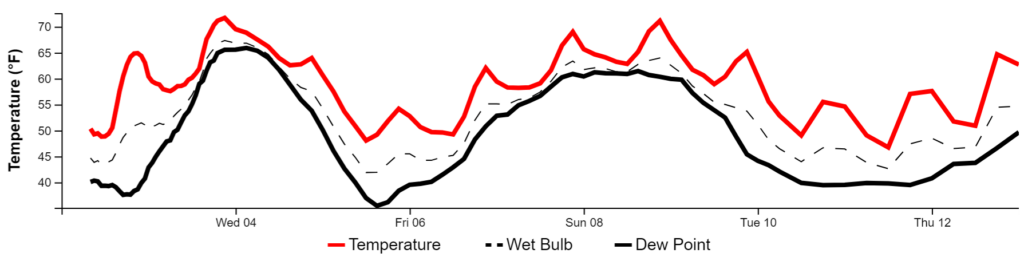
Houston to ride a temperature roller coaster over the next ten days, with plenty of rain sprinkled in

by Eric Berger

In brief: What goes up must come down over the next week or 10 days, as Houston rides a roller coaster of temperatures. The other big story will be rain chances, which will be high on Wednesday, and then an ongoing possibility through the weekend. Unfortunately, we still don’t have great clarity for when it might rain this weekend, but we’ll tell you when we do.

Houston’s temperature and dewpoint will be going up, and down, and up again over the next 10 days. (National Weather Service)

A fundraiser thank you

Just a quick note to very sincerely thank everyone who contributed to our annual fundraiser, which is now over. Matt and I are so appreciative of all the support, and we can’t wait to bring the city and its good people multiple cool fronts next July and August. Because that’s our job, right?

Tuesday

We’re starting today at the bottom of the roller coaster. Low temperatures this morning range from the upper-30s well north of Houston to the 50s down near the coast. Winds are generally light, from the north, and should veer to come from the east. Skies will be mostly sunny today—generally if you want to see sunshine for the next week today is the today. It’s going to be mostly cloudy from here on out for awhile. Highs will reach the mid-60s for most locations. Lows tonight will be about 10 degrees warmer than Monday night, dropping into the mid-50s.

Wednesday

We’ll reach the top of the roller coaster on Wednesday, with warm and muggy air, as highs reach the low 70s. Beginning early Wednesday, we’ll see the possibility of some sprinkles or light showers. Some slightly stronger showers, and possibly a few thunderstorms, are possible on Wednesday afternoon and evening as as the region feels the influence of a coastal low pressure system. A decent chance of showers remains in the forecast through the overnight hours, and most of the region is likely to see perhaps 0.5 to 1.5 inch of rain, with higher accumulations possible.

Temperatures may only max out in the low 50s for most locations on Friday. (Weather Bell)

Thursday and Friday

So rain chances are dialed back somewhat on Thursday. I generally expect mostly cloudy skies and highs in the 60s. Here’s where the forecast, itself, turns cloudy. The most probable outcome is the arrival of cooler and drier air in response to another front. The uncertainty is that there is still a slight chance that the effect of this front is blunted somewhat, so we may not get that cold. However, my expectation is that lows on Thursday night will generally drop into the 40s on Thursday night, with Friday being a chilly day, with highs in the 50s. All throughout we’re going to see a slight chance of rain, not any kind of storms, but light rain most likely. Lows drop into the upper 40s on Friday night. Probably.

Rain accumulation forecast for now through Sunday night. (Weather Bell)

Saturday and Sunday

I’m still not particularly confident in the weekend forecast beyond generally cloudy skies. My expectations are for highs in the 60s both days, with lows in the 50s. So what about rain chances? I’m going to hedge and say they’re about 50-50 each day. At this point, accumulations look to be higher on Sunday, but honestly the forecast is really difficult to call right now. So we’re going to have to fine tune things in the next day or two. I know it’s the not the answer you want, but it’s the answer you’re going to get right now. But some rain is definitely coming this week and over the weekend. I expect most of the area to pick up between 1 to 4 inches through Sunday night.

Next week

Monday is probably a warmish day, with highs in the 70s, and perhaps some sunshine. After that we’re likely to see another front, that will help cool us down and may actually bring more sunshine. But we shall see what lies on the tracks ahead.

03 Dec 17:08

The Long Road to “Native America: In Translation”

by Kaila T. Schedeen
A view of the signage for an exhibition highlighting Indigenous photography.

Installation view of  “Native America: In Translation” at the Blanton Museum of Art

The Blanton Museum of Art’s presentation of Native America: In Translation unfurls in pops of hot pink and highlighter yellow. The traveling exhibition (hereafter referred to simply as Native America) was originally organized by Aperture as an extension of the exceptional 2020 Aperture issue “Native America” guest edited by the photographer Wendy Red Star, who also served as the show’s Guest Curator. Native America the exhibition comes to the Blanton in its sixth iteration, and likely one of its last, after a marathon series of nationwide reprisals at primarily academic art museums. The site locations feel particularly notable, as the critical writings in the Aperture issue run through the heart of the exhibition and set the tone for a critically-engaged dialog between academic discourse, artistic production, and historic photographic practices that exceeded this viewer’s expectations.

Perhaps unsurprisingly, Native America feels restrained in relation to its print origins. The translation from a publication to an exhibition embraces the aesthetic of the contemporary museum with soaring white walls and echoing spaces over the intimate, richly-detailed spreads of text and image. The interconnected gallery spaces at the Blanton flow smoothly together and feel thoughtfully laid out, if somewhat sparse. The exhibition includes some particularly notable shining stars, including a selection of key works from the artist Kimowan Metchewais, whose practice is still woefully underappreciated in conceptual photography circles. Red Star’s mining of the late artist’s archive at the National Museum of the American Indian feels like a touching tribute and much-needed reappraisal of Metchewais’s life over a decade after his passing. 

A photo-collage depicting four adults with fishing poles stand waist-deep in a body of water.

Kimowan Metchewais, “Cold Lake Fishing,” undated, 10-piece collage of digital prints, pencil, paint on paper, 18 x 29.7 inches. Courtesy of the Kimowan Metchewais [McLain] Collection, National Museum of the American Indian Archives Center, Smithsonian Institution

Unlike other recent exhibitions focusing on contemporary Indigenous photography–think the Amon Carter Museum of American Art’s Speaking with Light: Contemporary Indigenous Photography, and the Minneapolis Institute of Art’s In Our Hands: Native Photography, 1890 to Now, both of which circulated between 2022-2024–Red Star chose to decenter the North American focus that is often implicitly assumed in US institutions. Instead, she navigates viewers across Turtle Island (the North American continent) and towards Abya Yala (or Latin America), shedding layers of colonial frameworks along the way. The final nine artists represented hail from Native Nations and/or countries that span the Americas, offering a tantalizing glimpse of what photography by, for, and in collaboration with Indigenous peoples could be beyond political borders.

The geographic breadth of Native America is only one of the reasons why the exhibition is a success. There is also a noticeable (and commendable) mix of artists at various stages in their careers who are/were undertaking various levels of engagement with fine art photography. At one end of the spectrum are artists such as Alan Michelson, Marianne Nicholson, and Rebecca Belmore, who are established in their careers and approach photography with a similar eye toward multimedia processes involving performance, installation, and video. At another end are the powerhouses Duane Linklater, Guadalupe Maravilla, and Kimowan Metchewais, who wield the camera and its products as one layer of a broadly conceptual practice. Somewhere in between are the Nalikutaar Jacqueline Cleveland, Koyoltzintl, and Martine Gutierrez, formidable younger artists who embrace photography as a tool for documentation, storytelling, and self-actualization. 

And yet, each of these artists could be described in any of these other ways. Their practices share an interest in challenging the historic uses and processes of photography, and there is a seamless similitude at the core of the entire group that energizes each of the artist’s practices in new ways. Ultimately, Red Star’s curatorial inquiry feels less focused on the history of photography and more on photography’s potential futures. She was quoted in the exhibition press release as saying, ”I was thinking about young Native artists and what would be inspirational and important for them as a road map. The people included here have all played an important part in forging pathways, in opening up space in the art world for new ways of seeing and thinking.” Native America is then both an homage and a catalyst for artistic germination.

A gallery displaying two walls of Indigenous photography.

Installation view of works by Martine Gutierrez, from the series “Indigenous Women” and Alan Michelson, “Pehin Hanska ktepi (They killed Long Hair)” and “Hanödaga:yas (Town Destroyer),” in
“Native America: In Translation” at the Blanton Museum of Art

I find it impossible to consider the full breadth of Native America without also considering Wendy Red Star as an artist herself. While she is not included in the exhibition display (though her work is reproduced in the original Aperture issue), Red Star’s conceptual photographic works have been central to the recent trajectory of contemporary Indigenous photography. Early series like Four Seasons (2006) and Last Thanks (2006) show the artist’s wry wit and unflappable critiques of American stereotypes of Indigenous peoples. More recent series like 1880 Crow Peace Delegation (2014), Apsáalooke Feminist (2016), and Accession (2019) reveal her sustained interest in archives and the history of photographic representation, which tends to prefer photographs of Indigenous people over Indigenous photographers themselves.

Case in point: Aperture began in 1952 as a publication focused on representing and uplifting photography as a fine art form, rather than as simply a mechanical tool for documentation. At its helm were some of the most well-known artistic and curatorial names in American photo history, including Ansel Adams, Dorothea Lange, Barbara Morgan, Beaumont and Nancy Newhall, and Minor White, among others. Their focus on modern, mostly black-and-white photography lent the medium an air of credibility in an era where photographers were largely synonymous with photojournalists, not artists. Photographs were not the subject of critical inquiry in museum or gallery exhibitions, and the market for collecting modern photographs at the time was nonexistent. Over the years fine art photography has gained significant traction and growing respect, but it still often exists as a belated afterthought in art history departments and museum collections (though it is by no means alone in this status). 

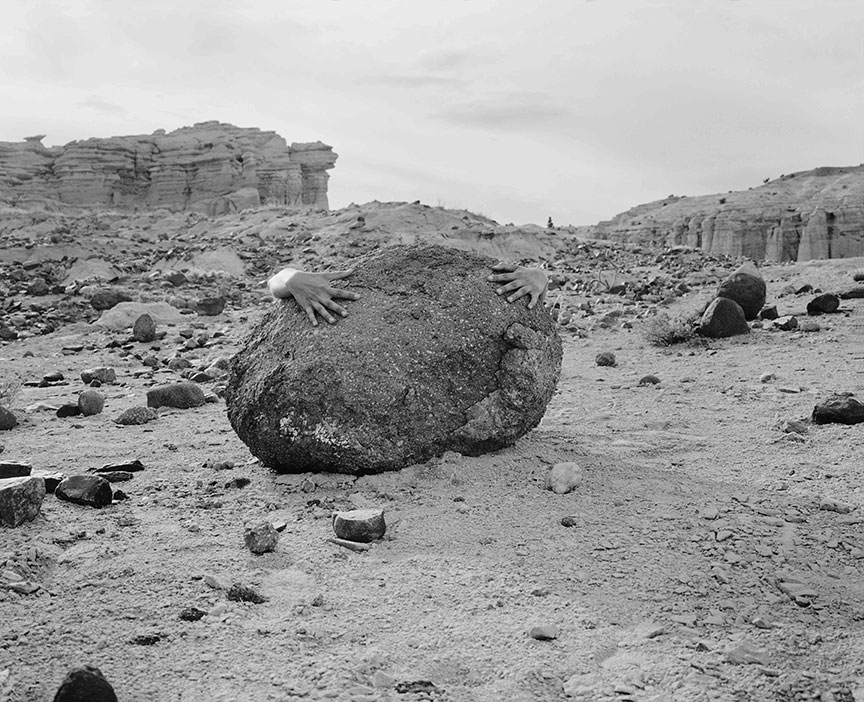
A black-and-white photograph of two hands embracing a large rock in an otherwise empty desert.

Koyoltzintli, “Spider Woman Embrace, Abiquiu, New Mexico,” 2019, from the series “MEDA,”
2017–19, archival pigment print, 24 x 30 inches. Courtesy of the artist

Conspicuously absent in the above version of photo history is any representation of Indigenous peoples as photographers, thinkers, or creators. Native America’s first peoples have more often been objectified through the camera lens, appearing as the subjects of ethnographic photography, or as formal props of the modernist black and white gaze. It was not until the late twentieth century that artists identifying as Indigenous and making work for and about Indigenous peoples were taken seriously; photography circles followed not far behind. Early torchbearers such as Hulleah Tsinhnahjinnie, James Luna, Zig Jackson, Larry McNeil, and Alan Michelson rammed down the gates of photo history with their witty, pointed, and unsentimental takes of contemporary North America, and thus laid the groundwork for the Indigenous photography of today.

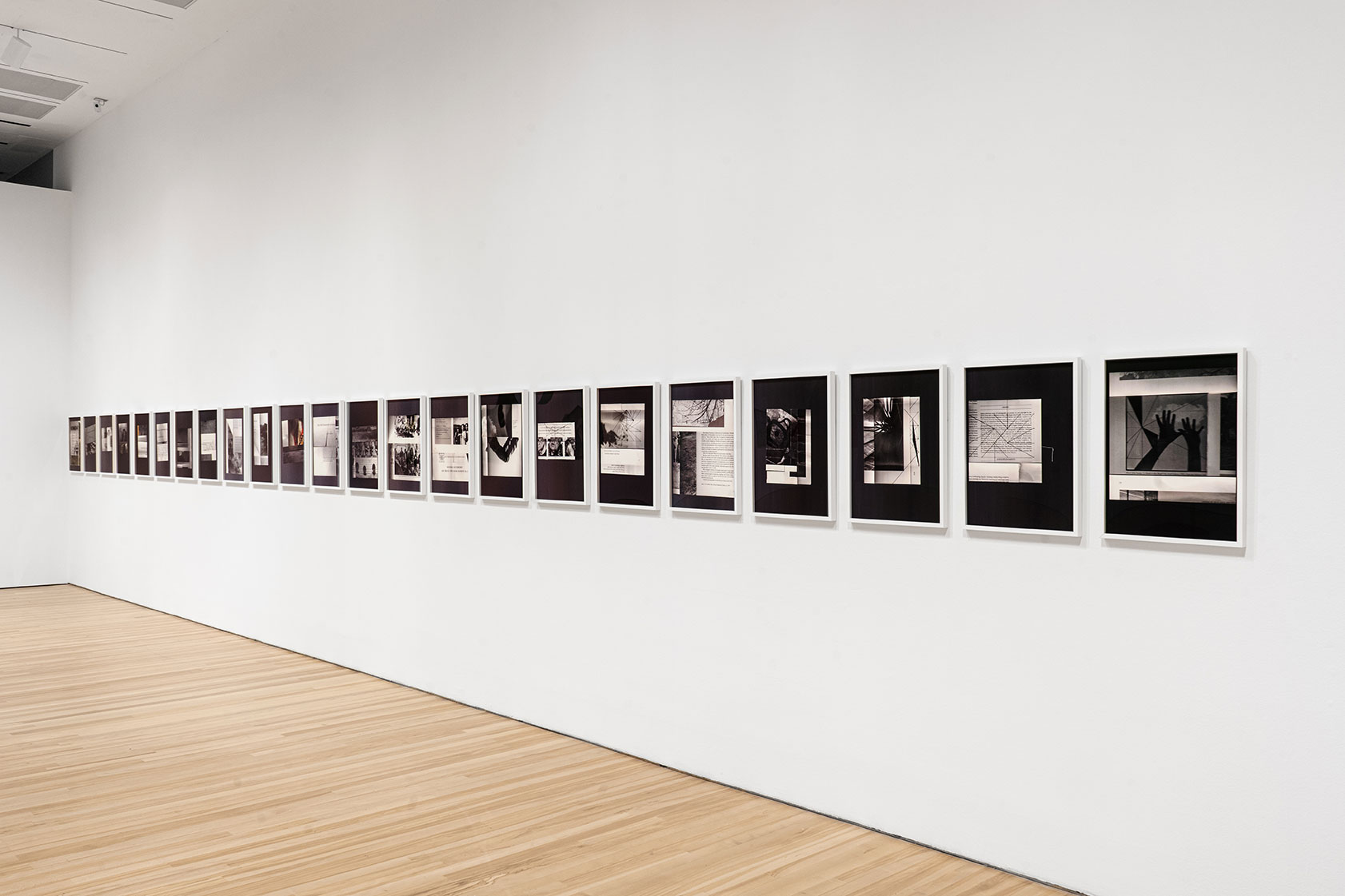
While these artists are not the focus of Red Star’s inquiries (with the exception of Michelson), their legacies are ever-present in Native America, particularly through Duane Linklater’s ghostinthemachine (2021). The artwork title references an essay from Paul Chaat Smith in Aperture issue 139, “Strong Hearts: Native American Visions and Voices,” published in Summer 1995. Linklater scanned sections of the issue á la photography powerhouse Joan Lyons, collaging them with sketched designs recalling traditions of quillwork and beadwork, oftentimes obfuscating the underlying text and images with material layers and blurred focus. 

A gallery displaying a single row of collaged photographs.

Installation view of Duane Linklater, “ghostinthemachine,” in “Native America: In Translation” at the Blanton Museum of Art

The final twenty-three prints include tantalizing snippets of language and images cut from their original source, reorganized, and repasted into new configurations. They are installed in a line spanning nearly the entire back wall of one of the museum’s temporary exhibition rooms. Unlike previous installations of the work that were presented in grid configurations recalling artists such as Agnes Martin and Sol LeWitt’s use of grids as formal and conceptual frameworks, the singular line of Linklater’s images allows them to unfold in a narrative (if wonderfully nonsensical) fashion. 

As Linklater’s work demonstrates, the 1995 “Strong Hearts” issue was important as an early progenitor of the 2020 “Native America” issue, whose value similarly extends beyond its visual offerings to include writings by crucial literary figures such as Leslie Marmon Silko, N. Scott Momaday, and Luci Tapahonso. It was also the issue in which scholar Jolene Rickard first outlined her argument for “visual sovereignty,” a major academic contribution that bridged Indigenous studies and art history in a vital moment. In short, “Strong Hearts” modeled the seamless blending of creative visions and critical thought that Red Star’s issue would expand on twenty-five years later, and which viewers to the Blanton’s exhibition now get to experience in three dimensions. Linklater’s photographs make these historic moments bear upon one another through his use of layering, drawing, and collage.

The Blanton chose well in this traveling exhibition along with its timing, and the site curator Hannah Klemm does a commendable job of laying out the works in a way that foregrounds the vision of Red Star’s original editorial project and maintains a central flow. While some quintessential photographers feel conspicuously absent from the Blanton’s version of the exhibition–primarily Will Wilson, whose absence is particularly striking given his recent relocation to the University of Texas at Austin as a professor in Studio Art — I left Native America feeling exhilarated by all the possibilities its artists represent for what Indigenous photography could be. Red Star’s curatorial perspective is keen, incisive, and defiant in the best possible ways. Her vision is expansive and invested in the declassification of the artistic realm into reductive labels, whether they be based on process, geography, identity, or materials. 

An indigenous woman with long black hair wearing a floor length dress made of dozens of red roses.

Rebecca Belmore, “matriarch,” 2018, from the series “nindinawemaganidog (all of my relations),” Photograph by Henri Robidea, archival pigment print,
56 x 42 inches. Courtesy of the artist

Just as the 2020 Aperture issue was a shining light through the pandemic gloom, the Native America exhibition provides luminous examples of contemporary Indigenous photography and photography about Indigeneity within an institution, a city, and a country that has historically undervalued and misunderstood such work. Both the publication and the exhibition honor the original “Strong Hearts” issue and extend its vision, encapsulated in these 1995 words from Theresa Harlan’s Aperture essay

“Mainstream museums and publications often set apart ‘artists of color,’ ‘multicultural artists,’ and ‘ethnic artists,’ thereby designating us as the ‘other’ or ‘different.’ The art and writings of these ‘other’ artists are locked into discussions of ‘their’ art, ‘their’ people, and ‘their’ issues. While there are still few opportunities to exhibit works by Native artists, there are even fewer exhibitions that treat these works in terms of their intellectual and critical contributions.”

Red Star’s curatorial voice creates space for critical considerations without overpowering the voices of the artists themselves. She and the entire team behind Native America: In Translation remain true to the critical inquiries of their original project, and in doing so, have created fertile ground for more layered and complete dialogues to bloom. The Blanton chose a fruitful time to engage this conversation, and alongside other recent installations like Marie Watt’s Sky Dances Light (2022), I hope it spells a continued commitment to engaging Indigenous arts at the Blanton and other Texas institutions. 


Native America: In Translation is on view at the Blanton Museum of Art through January 5, 2025.

The post The Long Road to “Native America: In Translation” appeared first on Glasstire.

03 Dec 17:08

Guy Who Posted Craigslist Ad Wasn’t Expecting Dame Judi Dench To Buy His PS4

by The Onion Staff

NEW YORK—Watching in stunned silence as the almost 90-year-old Academy Award–winning actress aggressively pushed him to drop the price, local man Aaron Singerman confirmed Tuesday that he wasn’t expecting Dame Judi Dench to respond to his recent Craigslist ad for a Sony PlayStation 4. “She emailed me with an offer just a few minutes after I posted, and kept upping every bid until I finally told her to just come over,” said Singerman, adding that the veteran actor of stage and screen did not identify herself and that he initially assumed the damejudi@gmail account belonged to a fan or was just a joke. “As soon as she got here, she came in hot and started trying to lowball me, saying she was only going to use it to play Hogwarts: Legacy and Fall Guys anyway. She even started examining the console, asking all these questions about how hot it was running and how often I used it, trying to accuse me of ripping her off. I finally knocked $50 off the price when she offered to trade me some glasses she wore in the movie Belfast. I don’t know if I can get anything for them, but I just wanted to get her out of here.” At press time, Dench was reportedly trying to back out of the deal by claiming her friend Anthony Hopkins would sell her his PS4 for half the price.

The post Guy Who Posted Craigslist Ad Wasn’t Expecting Dame Judi Dench To Buy His PS4 appeared first on The Onion.

03 Dec 17:07

Pros And Cons Of Eliminating The Department Of Education

by The Onion Staff

President-elect Donald Trump promised to abolish the U.S. Department of Education. The Onion examines the pros and cons of eliminating the federal agency. 

PRO: Paves way for bold new predatory loans

CON: Without standardized testing, it is impossible to tell which of the nation’s youth should be selected for the new super-soldier program.

PRO: Take that, nerds! 

CON: Puts the onus on the Pizza Hut Book It! program to set national literacy standards

PRO: States can independently budget which teachers need AK-47s versus simple pistols.  

CON: Nagging feeling that education is an issue of national importance

PRO: Dumber, less informed citizens take the pressure off stressed-out elected officials.

CON: Harder than just defunding it until it’s completely ineffectual

The post Pros And Cons Of Eliminating The Department Of Education appeared first on The Onion.

03 Dec 15:33

Rules from Claire’s Employee Handbook

by Julie Mitchell

1. You have to use the piercing gun. No matter how many times the customers say they have seen The Parent Trap, they will scream in the store if you use a needle, which will scare the other customers.

2. There is no limit on keychains per customer. We have corrected this misconception. It seems an employee instituted a limit because they personally felt it necessary, but no such limit exists.

3. Do not let customers with Auntie Anne’s pretzel bags touch any faux fur items (THIS INCLUDES BELTS). We cannot get that grease out, and the items become unfit for sale.

4. Please let men in the store buying rings know that their fiancées can tell the difference between cubic zirconia and diamonds. It will save us a return later.

5. As a policy, we have a no-tester rule (THIS INCLUDES BELTS), so someone does not need to remove packaging from any item. You will have to say this multiple times to some mothers.

6. We are waiting to hear from legal on whether there’s anything racist about a panda who’s good at math, so until we hear back on that, please pull all Pandi items from the shelves (especially nail polish).

7. If we are hiring, you must give a job application to anyone who requests one, even if you think their shoes are “tacky” (this reminder is mainly for our Wednesday evening workers).

8. Do not publicize this, but it is Claire’s official position not to prosecute any customers who shoplift items from the journal and/or notebooks section. I repeat, let sad girls who steal journals just have them.

9. Your employee discount gets you: 50 percent off Goth, 25 percent off Punk, 3 percent off Princess, 50 percent off Prep, 15 percent off Sporty-Chic, 22 percent off Sexy Cat, 12 percent off Kawaii Librarian, 70 percent off Dystopian World Leader, 45 percent off Adventurous with Boobs, 61 percent off Agnostic Lawyer, 80 percent off Lil’ Lesbian, 55 percent off Glitter Hippie, 28 percent off NASCAR Catholic, 18 percent off HGTV Diva, 54 percent off Sexy Activist, 12 percent off Sarcastic Artist, and 95 percent off Belts. All the items in the store fit into one of these categories. If you cannot figure out which category an item belongs to, please ask a shift manager to help you.

10. Please check inside the purses at the end of your shift (evening employees only). Someone has been putting notes of encouragement in them again, and they range from too specific to be helpful to aggressive enough to be upsetting.

11. Employees must follow the dress code of five accessories per day, with a pair of earrings counting as ONE accessory. Accessories can include rings, headbands, necklaces, earrings, scrunchies, bracelets, watches, hair clips, belts, and nail jewelry (if big enough). Things that are NOT accessories: lanyards, pencils (even if Claire’s made), glasses (unless fake), eyebrow rings, fake eyelashes, anklets, name tags, pictures of your dog, shoelaces, pocket calculators, pen clips, buttons/pins (this is not Chili’s), live birds, food items, vests (no matter how small) body chains, or feathers.

12. Dating is allowed and even encouraged among employees (this seems to promote sales somehow), but a reminder to employees involved in relationships: If you are buying a gift for your significant other, only ONE employee discount may be applied. There is NO situation where both employees’ discounts may be applied to a single item (except perhaps all Pandi merchandise; we will inform you of this change if/when it occurs).

13. Please use your call buttons if you see something suspicious in the store. This includes but is not limited to anyone wearing “sports” paraphernalia, men, dogs by themselves, known Limited Too employees, people wearing genuine leather, or any kind of bird.

14. If any questions/issues arise that are not covered in the Handbook, please ask a shift manager or leave a comment in the employee suggestion box outside the office. Remember to ONLY attach it to the door with a unicorn sticker (next to the box) if it is an urgent matter.

—Claire’s

02 Dec 19:02

update: should I tell my employee she needs to give a clearer “no” to a client who’s interested in her?

by Ask a Manager

This post was written by Alison Green and published on Ask a Manager.

It’s “where are you now?” month at Ask a Manager, and all December I’m running updates from people who had their letters here answered in the past.

There will be more posts than usual this week, so keep checking back throughout the day.

Remember the letter-writer asking whether to tell an employee she needed to give a clearer “no” to a client who was interested in her? Here’s the update.

Many thanks to you and all the commenters who weighed in on my letter! I feel like I gained valuable insight from all the personal anecdotes. To clarify some speculation: I am a woman; I have been hit on before by men; thankfully, I have never encountered violence as a response to my rejection. I am saddened that so many folks could easily offer up bad lived experiences.

The first thing I did was I spoke to Ryan privately and told him clearly that he needed to 1) delete Emma’s number from his phone and stop contacting her on social media and 2) not ask out folks who are at work. I could see the realizations dawning as I was speaking to him, and he was appropriately embarrassed and apologetic. He pulled out his phone in front of me to delete all her info. He asked if he should apologize to Emma directly, but I told him that was unnecessary–that I would pass along his apology to her. A few weeks after I addressed this with him, he initiated another private conversation with me. He wanted to thank me for my clear and direct delivery; he was also very honest and self-reflective that the episode had prompted him to reconsider how he was meeting people, how to be more purposeful with that, and to generally branch out more and seek more friendships. He is still a happy customer.

Emma and I kept in touch throughout and I followed up afterwards to let her know I had spoken to Ryan, he had deleted her info, and he sent his apologies. She was satisfied with that and remains a solid member of my team. She did not lose wages or shifts due to the reschedule.

Emma also granted me permission to speak about the episode at our upcoming all-staff meeting (without mentioning her specifically.) Several useful comments from your readers helped me realize that I could do more to clarify behavior expectations for both my customers and my team. But I kept circling back to this thought: what good is any sort of non-fraternization policy if I don’t properly train my team on how to respond if / when someone pushes that boundary?

I wanted my team to know that they had my support when facing tricky situations, and felt I could also do more to encourage them to step into their own authority to handle those episodes. I offered scripted language they could use, talked through best and worst case scenarios, and laid out an important baseline: that I would back them up in whatever way they needed to handle the situation in the moment, but what I also needed from them was to keep me in the loop when something happens. This is part of what initially frustrated me with the situation with Ryan and Emma; I felt like I was late to the issue. I would have preferred to hear from Emma the very first time Ryan made her feel uncomfortable, at the initial ask for her number; then we may have been able to avoid altogether the unwanted text messages, social media follows, etc. Talking through all this with my team was productive.

On a personal note, the episode and especially all the comments yielded very interesting conversations with my family. I especially appreciated hearing perspective from my college-age nephew about how he has seen it go well–and poorly–when asking a girl out. I do think we have new norms that are not always immediately obvious to people, so I am grateful for the opportunity to learn and grow from this. Many thanks to you and your readers!

02 Dec 19:00

Template for Trump Supporters Outraged over Hunter Biden’s Pardon

by Devorah Blachor

“President Biden issued a full and unconditional pardon of his son Hunter on Sunday night after repeatedly insisting he would not do so, using the power of his office to wave aside years of legal troubles, including a federal conviction for illegally buying a gun and for tax evasion.” — New York Times

- - -

Unbelievable! President Biden has pardoned his son, Hunter Biden, the worst criminal to ever walk the face of the earth. Whatever happened to law and order in this country? How could such a thing possibly happen in a nation that [ELECTED A MAN WHO WAS CONVICTED OF THIRTY-FOUR COUNTS OF FELONY / ELECTED A MAN WHO WAS FOUND LIABLE OF SEXUAL ASSAULT / ELECTED A MAN WHO REJECTED THE PEACEFUL TRANSFER OF POWER AFTER HE LOST / ELECTED A MAN WHO LITERALLY CALLED FOR A TERMINATION OF OUR CONSTITUTION AND NO ONE EVEN REMEMBERS]?

It’s morally wrong for a president to pardon family, friends, donors, and loyalists. What kind of example does it set for our children when they know a person can be guilty of [DEFRAUDING TRUMP VOTERS IN THE “WE BUILD THE WALL” SCAM / OBSTRUCTING JUSTICE / EVADING TAXES, WITNESS TAMPERING, AND HIRING A PROSTITUTE TO SEDUCE HIS SISTER’S HUSBAND, WHO WAS COOPERATING IN THE FEDERAL INVESTIGATION OF HIM] and get away with it? What’s next? Will the President go on to make sordid criminals like that [ATTORNEY GENERAL / DEFENSE SECRETARY / THE AMBASSADOR TO FRANCE]?

It just feels like there are no rules anymore. Here we have the son of a president who illegally owned a gun for eleven whole days after lying on the application form about not being a crack addict. Don’t forget that he also was guilty of tax evasion. Do normal, hardworking Americans not understand how serious tax evasion is? If not, they should really start reading up on people like [ALLEN WEISSELBERG / ERIC TRUMP AND DONALD TRUMP JR. / OUR PRESIDENT-ELECT, WHO GENUINELY COULD SHOOT SOMEONE ON FIFTH AVENUE AND STILL HAVE 77 MILLION PEOPLE VOTE FOR HIM].

When a man raises a child who behaves this badly, it just goes to show that the rotten apple doesn’t fall far from the rotten tree. The corruption runs so deep in that family that I wouldn’t be surprised if it somehow involved [SHADY DEALS WITH CHINA / SHADY DEALS WITH SAUDI ARABIA / SHADY DEALS WITH AZERBAIJANI DEVELOPERS, OLIGARCHS, AND FOR FUCK’S SAKE, AM I READING THIS RIGHT? IRAN’S REVOLUTIONARY GUARDS?!].

It’s sad how almost every waking thought I’ve had for the last five years has involved Hunter Biden. I [WATCHED AT LEAST 1,300 NEWS SEGMENTS ABOUT HIM / MADE UP A BRIBE STORY OR TWO ABOUT HIM / MAY HAVE SHOWED A FEW NUDES OF HIM IN CONGRESS]. Truly our country lies in ruins now, and it’s all thanks to Hunter Biden and also because [IMMIGRANTS ARE POISONING OUR COUNTRY / IMMIGRANTS ARE ANIMALS / IMMIGRANTS COME FROM SHITHOLE COUNTRIES / IMMIGRANTS ARE BLOODTHIRSTY CRIMINALS / WE’RE PROBABLY FORGETTING THE HISTORY OF WHAT HAPPENS WHEN YOU DEMONIZE IMMIGRANTS AND STUFF].

And the worst part of all this is that Joe Biden PROMISED not to pardon Hunter. He gave us his word. Does a President’s word not mean anything anymore? If the President can lie willy-nilly, what does that mean for our country? I feel like something important has been lost, something that can’t be measured, but maybe if it could, it might be quantified as [23.8 / 162 / 30,573 / INFINITY TRUTH DOESN’T MATTER ANYMORE JUST SAY WHATEVER THE HELL YOU WANT AND STILL WIN ELECTIONS].

It used to be that being the president of the United States meant something—that this was a person we could look up to and trust to do the right thing. How did we get to this place of lies, deceit, and immorality? What could we have done differently? I guess we probably should have acted long before it got to this point. We should have put a stop to our nation’s descent into complete venality as soon as it started, like maybe when [HE WAS IMPEACHED THE FIRST TIME / HE WAS IMPEACHED THE SECOND TIME / HE CAME DOWN THAT FUCKING ESCALATOR].

And now it’s too late.

02 Dec 18:59

Girlfriend Keeps Dropping Hints About Wanting 17-Hectare Mausoleum Complex

by The Onion Staff

SPARTA, OH—Noting that her desires were becoming increasingly less subtle, local man Tommy Hull confirmed Monday that his girlfriend, Bess Glickstein, kept dropping hints about wanting a 17-hectare mausoleum complex. “We’ll be out to dinner or having a drink with friends and any time the conversation turns to end-of-life planning she can’t help but mention that she’s always imagined her final resting place would be inside a massive edifice overflowing with granite and marble,” said Hull, telling reporters that Glickstein could not so much as pass by a pillar these days without reminding him that a pair of 200-foot-high obelisks would be the perfect thing to flank the arched entryway of her burial chamber. “It seems like a day can’t go by without her emailing me the website for a stone mason or metallurgist that she’s ‘heard is great.’ And every time she’s on the phone with her sister, she’s practically yelling down the hall about how acres upon acres of cypress trees would sure help uplift her soul into the afterlife. It’s exhausting.” At press time, Glickstein was refusing to speak to Hull after he had been unable to accurately identify her favorite kind of sarcophagus.

The post Girlfriend Keeps Dropping Hints About Wanting 17-Hectare Mausoleum Complex appeared first on The Onion.

02 Dec 17:36

When the Prophetic City Fails

by Sam Russek

“Loose dogs” on Houston’s Northside were roving the streets in small bands, sowing chaos. At least, this was the opinion of the mostly white members of a local civic club near Lindale Park, which has a higher proportion of middle-income whites than the rest of the working-class Latino area. 

It was 2013 and—as recounted in a recent academic book, A Good Reputation: How Residents Fight for an American Barrio—the club had invited a veterinarian, also white, to discuss possible solutions. The vet recommended “educating” neighbors about the potential dangers of loose dogs, assuming they weren’t already aware, but another issue quickly arose: The club lacked Spanish speakers. Absorbing this, the vet noted that letting dogs wander the neighborhood alone was technically illegal: “You could, I hate to say it, but threaten your neighbors,” the vet said. Northside was no stranger to policing, but perhaps the answer was broadening its presence. If a carrot wouldn’t work, so came the stick.

Meanwhile, other local groups installed cameras to catch illegal trash dumping and surveil neighbors throughout the day. The goal was to squeeze Northside—a neighborhood sprawling from near downtown to just north of Houston’s central 610 loop—into a more attractive investment, largely for homebuyers and business owners who might otherwise be interested in the nearby upscale Heights neighborhood. The barrio, with a population of approximately 25,000, “still has its issues, from crime to a shortage of retail,” Houstonia Magazine noted in 2013, but “to the valiant go the spoils: two-and three-bedroom houses minutes from the heart of Houston for under $200,000.” Development was humming in some of Houston’s other “blighted” neighborhoods, and, despite past broken promises, even some Latino Northsiders were eager for a cut. The future had been all but foretold.

Northside’s fate, however, would be more complicated.

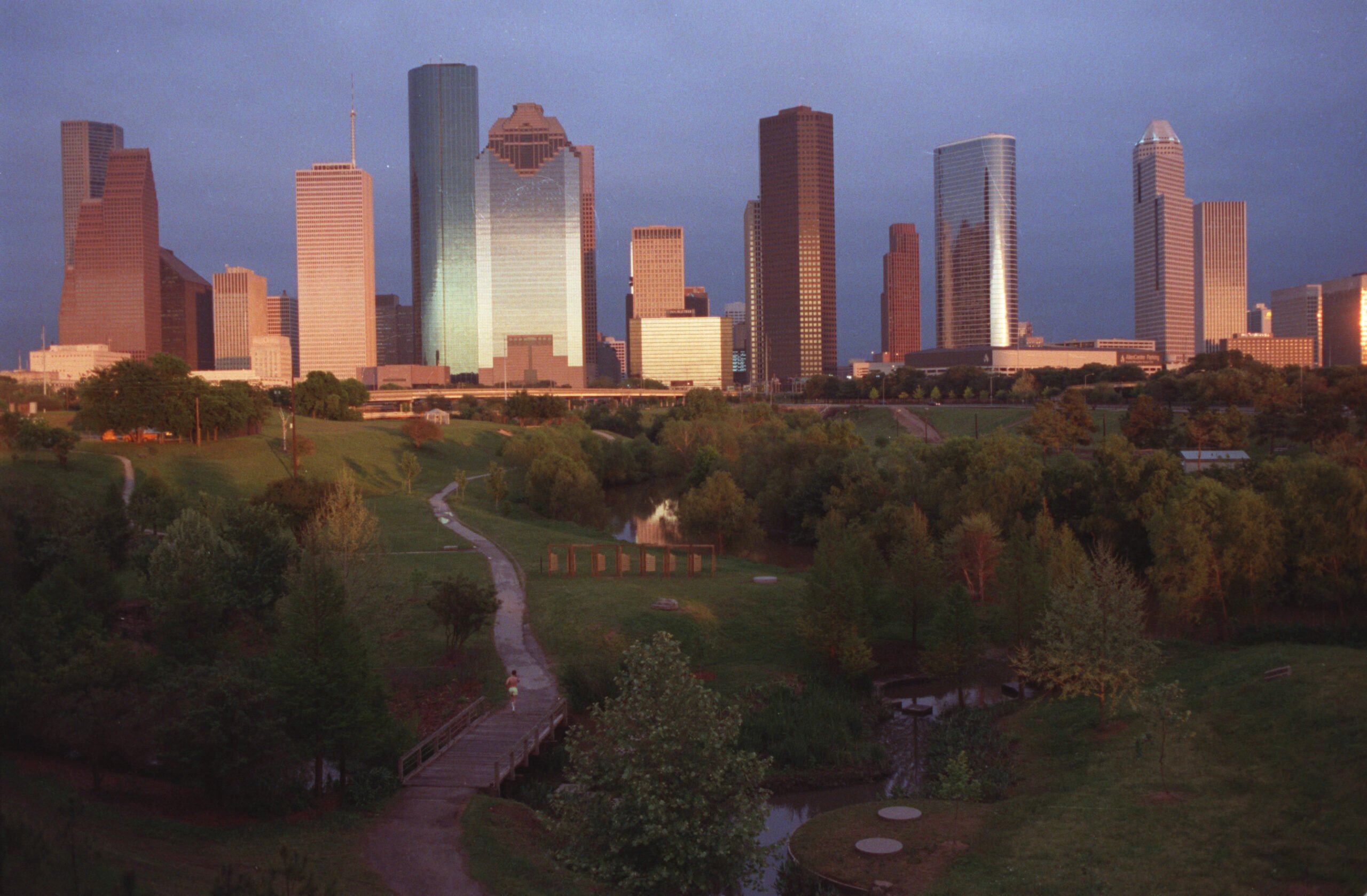
The Houston skyline, following a storm, in April 1990 (AP Photo/Houston Chronicle, Steve Ueckert)

Back in 2007, the term “Opportunity Urbanism” was coined by a team of researchers commissioned by the Greater Houston Partnership, the largest chamber of commerce in the Houston area. The study made the case that Sunbelt metropoles such as Houston, as low-tax havens with few zoning regulations, spelled the future of American cities. Leading the research team was Joel Kotkin, America’s “übergeographer” per the New York Times. The study’s “special advisor” was Stephen Klineberg, a longtime Rice University sociologist whose optimism is something of a calling card. By their estimation, the city of Houston—all 639 square miles of it—had spurred growth nimbly while coastal elite competitors stumbled through a bureaucratic thicket. Case in point, they noted approvingly, was the “significant uptick in new housing and retail construction” in the historically Black and “now gentrifying” Third Ward, south of downtown. In time, Opportunity Urbanism would “generate economic opportunity across the entire income spectrum, for all racial and ethnic groups.”

Reality tells another story. The “significant uptick” in Third Ward construction was accompanied by a 15 percent decline in Black residents and a 170 percent increase in whites between 2010 and 2020, the Houston Chronicle shows. The neighboring and largely Latino Second Ward saw a 25 percent drop in Latino residents and a 50 percent increase in whites. While longtime residents were displaced, the average income in both neighborhoods skyrocketed, and inequality worsened citywide, with a 20-year difference in Houstonians’ life expectancies based on their zip codes as of 2019. 

Meanwhile, on the other side of downtown, Northside failed to fall in line: It did lose some longtimers during the same 10-year period, but it gained far fewer white “urban pioneers”  than the Third and Second Wards and saw significantly less investment than predicted, puncturing years’ worth of real estate speculation. The question is, why? Was it the “loose dogs,” the illegal trash dumping? No—countless American neighborhoods in similar shape gentrified post-haste. So what’s different about places like Northside? 

A Good Reputation, published in May and written by sociologists Sarah Mayorga and Elizabeth Korver-Glenn, a former Northside resident, attempts to answer this question. Building off of Korver-Glenn’s previous research, which argues that real estate professionals’ attitudes and incentives today “actively steer buyers to certain neighborhoods based on race,” A Good Reputation concludes that the individual attitudes, conflicts, and competing visions through which residents understand their neighborhood affect the direction and pace of development—hence the emphasis on “reputation.” 

The book’s byword is “heterogeneity,” and, indeed, local idiosyncrasies and random chance hold some explanatory power in Northside. To the authors’ credit, A Good Reputation sees through the pollyannaish dictums characteristic of Kotkin and Klineberg’s study. But as an analytical tool, reputation leaves much to be desired, glossing over larger systemic explanations hiding in plain sight.

When the same measures meant to “generate economic opportunity” across the spectrum fail in ferociously distinct ways, from Third Ward to Northside, it’s worth a radical examination of what went wrong, and how current thinking from some of the region’s most well-funded groups has failed to fully confront it. Particularly today, as the City of Houston faces a deepening financial crisis and infrastructure crumbles with each passing storm, it isn’t only scholars wondering: How the hell did we get here? 


Northside is among the oldest Latino neighborhoods in Houston, but it hardly receives the same scholarly attention as its elder Second Ward (aka East End, or, if you ask today’s neighborhood boosters, EaDo, short for East Downtown). In fact, Houston’s history as a whole is criminally understudied. In his 2020 book, Prophetic City, Klineberg notes that the two other recent “comprehensive analyses” of the Bayou City were published in 1988 and 1991. 

Perhaps this is because, as a swampy backwater-turned-transport hub, the city’s greatest historical virtue was always that it could deliver you—or cotton, lumber, sugar, and eventually oil—someplace else. Houston was a major military logistics center of the Confederacy during the Civil War, but the city struggled to meet its own energy needs before the early 1900s oil boom and only ever developed a modest manufacturing sector. While Second Ward grew due to its proximity to the Houston Ship Channel, among the Petro Metro’s principal assets, Northside developed around the northern railroads. 

During the 1930s, Houston became known as “the city the Depression missed” due to its oil sector and the New Deal initiatives it benefited from, but Black and Latino workers were systematically excluded from most higher-quality industrial jobs by both capitalists and white trade unions. Though among the country’s most diverse cities, Houston has long resisted racial integration, its leaders instead enforcing separation into ethnic enclaves. As the post-World War II economy lost its glow, poverty concentrated in neighborhoods like Northside and the Second and Third Wards. Between 1970 and 1980, nearly a quarter of Latino Northsiders remained under the poverty line. This figure increased to about one-third by 2000, as manufacturing fled the state and country in droves; railroad companies consolidated, laying off hundreds; and the recovery from the 1986 oil crash proved fragile. 

A Houston construction worker labors on a new home in August 2006. (AP Photo/David J. Phillip)

Today, Northside is around 86 percent Latino, and as the authors of A Good Reputation note, about 2 percent of occupied homes in the neighborhood lack complete plumbing or kitchen facilities. A light rail line runs through the barrio that many believed would compel further development, but other public infrastructure, including sidewalks and trash pickup, varies from crumbling to nonexistent. 

Gentrification is exceedingly common in neighborhoods like these, occurring when developers turn their eyes toward decay and see opportunity. This process has torn through scores of American neighborhoods and uprooted many Houstonians. Some within Northside opposed “white capital” swooping in and flushing people out, Mayorga and Korver-Glenn report, yet others viewed their neighbors as “ghetto” and sought to close bars and cantinas and force homeless people to seek help elsewhere. Several Latino residents told Korver-Glenn to avoid majority-Black areas—“They’ll cross the street to mess with you before a Mexican would,” says one—and many recall the long legacy of 1978’s Moody Park Uprising: a riot in Northside that occurred a year after the infamous police murder of José Campos Torres Jr., a 23-year-old who was arrested, beaten, and thrown into the Buffalo Bayou by a group of Houston police officers.

To the book’s authors, racial animus, particularly anti-Blackness, drove some Latino homeowners to pursue “purge-and-clean” strategies alongside white civic groups to bolster property values and make the neighborhood “safer.” Often, the belief that Northside should remain a distinctly Latino space strengthened the notion that Black residents didn’t belong. This dynamic was counterbalanced by some residents’ “bienvenida orientation,” which welcomed all Northsiders to challenge developers’ schemes to “improve” the neighborhood.

The authors conclude that whether gentrification occurs largely depends on which of these groups wins out. It isn’t straightforward or inevitable; sometimes, as in Northside, development occurs but the speculative bubble deflates, leaving the neighborhood almost where it started. Nevertheless, the “purge-and-clean” efforts have a corrosive effect. In 2022, one “bienvenida” activist noted that imposing gates were appearing around people’s homes. “To me, this neighborhood is pretty much dead,” she said. 

SIGN UP FOR TEXAS OBSERVER EMAILS

Get our latest in-depth reporting straight to your inbox.

From the outset, A Good Reputation seeks to destabilize the notion that gentrification everywhere is as uniform as in Chicago or Brooklyn—where a greater tradition of urban scholarship exists—pointing to Northside as an example of most U.S. neighborhoods. To do so, the authors cite a 2019 study that states only seven cities accounted for nearly 50 percent of all gentrification from 2000 to 2013. Though less boosterish, this emphasis aligns with the Kotkin and Klineberg view that sprawling Sunbelt cities are exceptional vis-à-vis coastal urban centers.

The book neglects to mention that Houston is also listed in that 2019 gentrification study, ranked ninth by number of tracts gentrified, with much of the displacement occurring in Second and Third Ward. Might the lack of gentrification in Northside be linked to its rampant acceleration due south? The authors don’t say. Instead, A Good Reputation’s analysis is mostly insulated to Northside, its emphasis stuck on complicating who we understand as the local “agents”—or middlemen—of gentrification. The deeper question is, why didn’t it happen here? 


After coining Opportunity Urbanism in 2007, Kotkin and Klineberg founded separate blandly named brain trusts: the Urban Reform Institute (Kotkin) and the Kinder Institute for Urban Research (Klineberg), which were seeded by some of Houston’s largest real estate developers. The outfits’ visions differ significantly, with Kotkin’s group deploying market fetishism mixed with a tail-wagging-the-dog contrarianism and Klineberg’s favoring more rigorous data analysis and a blinkered faith in public-private partnerships. Whereas the Urban Reform Institute has recently blamed gentrification on urban planners’ attempts to woo the “creative class,” the Kinder Institute, compared to the 2007 study, is today more likely to emphasize gentrification as a problem with deep roots.

Yet both groups share a certain faith that “revitalization” through private development can ultimately serve every resident, while restrictions on the industry—such as higher standards for rental properties—must be “handled with care,” as a 2023 Kinder Institute housing study cautioned. These think tanks set the framework for much of Houston urbanism today, by turns defending current practices and offering marginal reforms to solve the city’s deeply ingrained economic crisis. In adopting this framework, urbanists—who ultimately seek a more livable, walkable city—overlook the simple fact that developers are profit-seekers, not community builders.

Each neighborhood’s location is a political and economic choice. Why pay to redevelop Northside and repair a portion of its infrastructure, for example, when you can more cheaply construct the next Colony Ridge, the briefly notorious development built on predatory lending northeast of town? Desperate tenants and homebuyers will pay for even substandard housing on the periphery, if that’s what capital dictates, and Houston’s particular model of development eggs this on—all while hollowing out the city’s capacity for governance. 

Briefly explained, Houston’s past century-plus of development has consisted of the privately funded construction of suburban enclaves—some rich, some poor—initially in its inner core, then outside the 610 Loop and along its beltway, and outside city limits, followed by aggressive annexation that pumped extra cash into Houston’s tax base while avoiding tax hikes. This practice was largely barred by the state in the late ’90s, and today the city is “broke,” to quote Mayor John Whitmire. Expansion outward has continued amoeba-like beyond Houston’s borders, in satellite counties with fewer ways for the city to capture the value created there. Suburbanization disperses people and jobs so that capital doesn’t need the city to organize itself anymore; instead, the city needs capital to keep from falling apart.

In 1985, the historian Joe Feagin wrote that, for more than a decade, Houstonians had complained of poor municipal services, which were spread thin due to the city’s rapidly increasing geographic size. Feagin also noted how a recent state-of-the-art sewer processing facility constructed in North Houston was supposedto drive further development there—except, due to a poor economic outlook and “inadequate” preexisting private sewer lines in the area, the anticipated construction boomdidn’t occur. Today, expensive leaks from private sewage lines plague Houston’s low-income neighborhoods, including Northside. By refusing to curb the most predatory aspects of real estate construction, the city maintains segregation and inhibits redevelopment while encouraging sprawl—all while blowing a hole in its own budget. 

Put more cynically, the value of land with functioning services increases through comparison: Developers need regions like Northside to contrast other, more “desirable” investments.

New townhouses under construction in Houston in February 2016 (AP Photo/Pat Sullivan)

Feagin has also written that, from the global economic downturn of the 1970s onward, land and housing have proven especially lucrative for Houston’s investors—a generally safer place to plant one’s assets than oil. He quotes George P. Mitchell, the late pioneer of fracking and founder of The Woodlands exurb outside Houston: “Energy is a very fast-moving business on pay-out. I have to drill a well every seven years because the well’s gone by then. … But if I build a building, it has a 40-year life.” It appears today’s real estate giants agree. Compelled to grow their investment portfolios, corporate-owned built-to-rent neighborhoods are exploding across the metro area.

Meanwhile, Whitmire—frequently defended by the Kotkin set—has paused or outright canceled projects aimed at densifying parts of the city, citing economic feasibility and lack of community support. Now, having fired half of the city’s department heads since entering office in 2024, he’s facing budget shortfalls, rising rents, deepening inequality, and worsening municipal credit. 

Houston urbanists may lean more toward Kotkin or Klineberg, but as a whole they tend to enter into naive alliances with capitalists to implement the change they want to see, while attempting to frame their views as almost apolitical common sense. This hasn’t inspired confidence in many low-income communities in the throes of an ever-worsening eviction crisis, who rightly fear displacement, nor has it produced many outright victories. See, for instance, the “indefinitely” stalled referendum that passed by a wide margin to give Harris County greater power on the metro regional planning board, H-GAC, which orients millions of federal dollars toward highways and other infrastructure projects. The multi-billion dollar expansion of Interstate 45 will move forward too, mostly at the expense of neighborhoods like Northside and to the purported benefit of suburbanites, despite an inspired effort to stop it. 

“Let Houston be Houston” may be a cute YIMBY slogan, referring to the city’s historic lack of zoning, but the truth is that Houston being Houston has never benefited all Houstonians. Attempting to incentivize construction with a few land-use tweaks, necessary as many are, won’t make the city affordable for everyone or ensure the city is more than a developer’s plaything. To actually achieve their more admirable goals, Houston urbanists would have to confront what the geographer Samuel Stein has labeled the “real estate state,” describing the condition in which city officials serve primarily as “wealth managers” for landlords, developers, and industrial interests, divvying up lots and offering sweetheart deals in the name of economic development to compete with cheaper options elsewhere, often at residents’ expense. 

A truly “people-oriented” city must abolish that dynamic altogether, empowering communities in places like Northside to control their own fate, against those who see their homes—their handprints on the sidewalk, their asadas in the yard—as just another investment.

The post When the Prophetic City Fails appeared first on The Texas Observer.

02 Dec 17:32

Southwest Airlines to end cabin service earlier on flights to reduce chance of injury

by Associated Press
Flight attendants will start preparing the cabin for landing at an altitude of 18,000 feet (5,486 meters) instead of 10,000 feet (3,048 meters).
02 Dec 16:45

Pluralistic: All the books I reviewed in 2024 (02 Dec 2024)

by Cory Doctorow


Today's links


Samuel Hollyer's 1875 engraving of Charles Dickens in his study, sitting at a desk, staring out a window, surrounded by bookcases.

All the books I reviewed in 2024 (permalink)

I reviewed 26 books this year: 15 novels, 5 nonfiction books, and 6 graphic novels. Even though I feel perennially behind on my reading (and objectively, I do have 10 linear feet of "to be read" books on the shelf), I think this is a pretty good haul.

Books are pretty much the ideal gift, if you ask me. Of course, I'm biased as a former bookseller and library worker, and as an author (of course) – I had three more books come out in 2024 (see the end of this post for details).

I started a lot more than 26 books this year. Long ago, I figured life was too short for books I wasn't enjoying, and I'm pretty ruthless about putting books down partway through if I think they're not going to reward finishing them. I probably start 10 books for every one I finish. However, I do review more than 90% of the books I get through. It's rare for me to keep reading a book all the way to the end if I'm not enjoying it enough to unconditionally recommend it. I rarely review books I don't like – there's not really any point in cataloging the list of books I think you won't enjoy reading, and most books I don't like very much are broken in ways that are too banal to comment upon.

The list below is pretty great, but if you're looking for more, here's the haul from 2023:

https://pluralistic.net/2023/12/01/bookmaker/#2023-in-review

NOVELS

I. Cahokia Jazz by Francis Spufford
The cover for Cahokia Jazz.

A fucking banger: it's a taut, unguessable whuddunit, painted in ultrablack noir, set in an alternate Jazz Age in a world where indigenous people never ceded most the west to the USA. It's got gorgeously described jazz music, a richly realized modern indigenous society, and a spectacular romance. It's amazing.

https://pluralistic.net/2023/12/04/cahokia/#the-sun-and-the-moon


II. After World by Debbie Urbanski
The cover for After World.

An unflinching and relentlessly bleak tale of humanity's mass extinction, shot through with pathos and veined with seams of tragic tenderness and care. Sen Anon – the story's semi-protagonist – is 18 years old when the world learns that every person alive has been sterilized and so the human race is living out its last years.

The news triggers a manic insistence that this is a good thing – long overdue, in fact – and the perfect opportunity to scan every person alive for eventual reincarnation as virtual humans in an Edenic cloud metaverse called Gaia. That way, people can continue to live their lives without the haunting knowledge that everything they do makes the planet worse for every other living thing, and each other. Here, finally, is the resolution to the paradox of humanity: our desire to do good, and our inevitable failure on that score.

https://pluralistic.net/2023/12/18/storyworker-ad39-393a-7fbc/#digital-human-archive-project


III. Jonathan Abernathy You Are Kind by Molly McGhee
The cover for Jonathan Abernathy You Are Kind.

A dreamlike tale of a public-private partnership that hires the terminally endebted to invade the dreams of white-collar professionals and harvest the anxieties that prevent them from being fully productive members of the American corporate workforce.

We meet Jonathan as he is applying for a job that he was recruited for in a dream. As instructed in his dream, he presents himself at a shabby strip-mall office where an acerbic functionary behind scratched plexiglass takes his application and informs him that he is up for a gig run jointly by the US State Department and a consortium of large corporate employers. If he is accepted, all of his student debt repayments will be paused and he will no longer face wage garnishment. What's more, he'll be doing the job in his sleep, which means he'll be able to get a day job and pull a double income – what's not to like?

https://pluralistic.net/2024/01/08/capitalist-surrealism/#productivity-hacks


IV. The Book of Love by Kelly Link
The cover for The Book of Love

If you've read Link's short stories (which honestly, you must read), you know her signature move: a bone-dry witty delivery, used to spin tales of deceptive whimsy and quirkiness, disarming you with daffiness while she sets the hook and yanks. That's the unmistakeable, inimitable texture of a Kelly Link story: deft literary brushstrokes, painting a picture so charming and silly that you don't even notice when she cuts you without mercy.

Turns out that she can quite handily do this for hundreds of pages, and the effect only gets better when it's given space to unfold.

It's a long and twisting mystery about friendship, love, queerness, rock-and-roll, stardom, parenthood, loyalty, lust and duty.

https://pluralistic.net/2024/02/13/the-kissing-song/#wrack-and-roll


V. Lyorn by Steven Brust
The cover for Lyorn

The seventeenth book in Steven Brust's long-running Vlad Taltos series. For complicated reasons, Vlad has to hide out in a theater. Why a theater? They are shielded from sorcery, as proof against magical spying by rival theater companies, and Vlad is on the run from the Left Hand of the Jhereg – the crime syndicate's all-woman sorceress squad – and so he has to hide in the theater.

The theater is mounting a production of a famous play that's about another famous play. The first famous play (the one the play is about – try and follow along, would you?) is about a famous massacre that took place thousands of years before. The play was mounted as a means of drumming up support for the whistleblower who reported on the massacre and was invited to a short-term berth in the Emperor's death row as a consequence.

The plot is a fantastic, fast-handed caper story that has a million moving parts, a beautiful prestige, and a coup de grace that'll have you cheering and punching the air.

https://pluralistic.net/2024/04/09/so-meta/#delightful-doggerel


VI. Till Human Voices Wake Us by Rebecca Roque
The cover for Till Human Voices Wake Us

A teen murder mystery told in the most technorealist way. Cia's best friend Alice has been trying to find her missing boyfriend for months, and in her investigation, she's discovered their small town's dark secret – a string of disappearances, deaths and fires that are the hidden backdrop to the town's out-of-control addiction problem.

Alice has something to tell Cia, something about the fire that orphaned her and cost her one leg when she was only five years old, but Cia refuses to hear it. Instead, they have a blazing fight, and part ways. It's the last time Cia and Alice ever see each other: that night, Alice kills herself.

Or does she? Cia is convinced that Alice has been murdered, and that her murder is connected to the drug- and death-epidemic that's ravaging their town. As Cia and her friends seek to discover the town's secret – and the identity of Alice's killer – we're dragged into an intense, gripping murder mystery/conspiracy story that is full of surprises and reversals, each more fiendishly clever than the last.

https://pluralistic.net/2024/04/16/dead-air/#technorealism


VII. The Steerswoman by Rosemary Kirstein
The cover for The Steerswoman

Randall "XKCD" Munroe pitched me on this over dinner: "All these different people kept recommending them to me, and they kept telling me that I would love them, but they wouldn't tell me what they were about because there's this huge riddle in them that's super fun to figure out for yourself. "The books were published in the eighties by Del Rey, and the cover of the first one had a huge spoiler on it. But the author got the rights back and she's self-published it."

How could I resist a pitch like that? So I ordered a copy. Holy moly is this a good novel! And yeah, there's a super interesting puzzle in it that I won't even hint at, except to say that even the book's genre is a riddle that you'll have enormous great fun solving.

https://pluralistic.net/2024/05/04/the-wulf/#underground-fave


VIII. Moonbound by Robin Sloan
The cover for Moonbound

Moonbound's protagonist is a "chronicler," a symbiotic fungus engineered to nestle in a human's nervous system, where it serves as a kind of recording angel, storing up the memories, experiences and personalities of its host. When we meet the chronicler, it has just made a successful leap from its old host – a 10,000-years-dead warrior who had been preserved in an anaerobic crashpod ever since her ship was shot out of the sky – into the body of Ariel, a 12-year-old boy who had just invaded the long-lost tomb.

This is doing fiction in hard mode, and Sloan nails it. The unraveling strangeness of Ariel's world is counterpointed with the amazing tale of the world the chronicler hails from, even as the chonicler consults with the preserved personalities of the heroes and warriors it had previous resided in and recorded.

https://pluralistic.net/2024/06/11/penumbraverse/#middle-anth


IX. Fight Me by Austin Grossman
The cover for Fight Me

Aging ex-teen superheroes weigh the legacy of Generation X, in a work that enrobes its savage critique with sweet melancholia, all under a coating of delicious snark. The Newcomers – an amped-up ninja warrior, a supergenius whose future self keeps sending him encouragement and technical schematics backwards through time, and an exiled magical princess turned preppie supermodel – have spent more than a decade scattered to the winds. While some have fared better than others, none of them have lived up to their potential or realized the dreams that seemed so inevitable when they were world famous supers with an entourage of fellow powered teens who worshipped them as the planet's greatest heroes.

As they set out to solve the mystery of the wizard who gave the protagonist his powers, they are reunited and must take stock of who they are and how they got there (cue Talking Heads' "Once In a Lifetime").

The publisher's strapline for this book is "The Avengers Meets the Breakfast Club," which is clever, but extremely wrong. The real comp for this book isn't "The Breakfast Club," it's "The Big Chill."

https://pluralistic.net/2024/07/01/the-big-genx-chill/#im-super-thanks-for-asking


X. Glass Houses by Madeline Ashby
The cover for Glass Houses

Kristen is the "Chief Emotional Manager" for Wuv, a hot startup that has defined the new field of "affective computing," which is when a computer tells you what everyone else around you is really feeling, based on the irrepressible tells emitted by their bodies, voices and gadgets.

Managing Sumter through Wuv's tumultuous launch is hard work for Kristen, but at last, it's paid off. The company has been acquired, making Kristen – and all her coworkers on the founding core team – into instant millionaires. They're flying to a lavish celebration in an autonomous plane that Sumter chartered when the action begins: the plane has a malfunction and crashes into a desert island, killing all but ten of the Wuvvies.

As the survivors explore the island, they discover only one sign of human habitation: a huge, brutalist, featureless black glass house, which initially rebuffs all their efforts to enter it. But once they gain entry, they discover that the house is even harder to leave.

https://pluralistic.net/2024/08/13/influencers/#affective-computing


XI. The Sapling Cage by Margaret Killjoy
The cover for The Sapling Cage

A queer coming-of-age tale in the mode of epic fantasy. Lorel wants to be a witch, but that's the very last of the adventurous trades to be strictly gender-segregated. Boys and girls alike run away to be knights, brigands and sailors, but only girls can become a witch. Indeed, Lorel's best friend, Lane, is promised to the witches, having been born to a witch herself.

Lorel has signed up for witching just as the land is turning against witches, thanks to a political plot by a scheming duchess who has scapegoated the witches as part of a plan to annex all the surrounding duchies, re-establishing the long-disintegrated kingdom with herself on the throne. To make things worse (for the witches, if not the duchess), there's a plague of monsters on the land, and the forests are blighted with a magical curse that turns trees to unmelting ice. This all softens up the peasantfolk for anti-witch pogroms.

So Lorel has to learn witching, even as her coven is fighting both monsters and the duchess's knights and the vigilante yokels who've been stirred up with anti-witch xenophobia.

https://pluralistic.net/2024/09/24/daughters-of-the-empty-throne/#witchy


XII. Blackheart Man by Nalo Hopkinson
The cover for Blackheart Man

A story that will make you drunk on language, on worldbuilding, and on its roaring, relentless plot. The action is set on Chynchin, a fantastic Caribbean island (or maybe Caribbeanesque – it's never clear whether this is some magical, imaginary world, or some distant future of our own). Chynchin is a multiracial, creole land with a richly realized gift economy that Hopkinson deftly rounds out with a cuisine, languages, and familial arrangements.

Chynchin was founded through a slave rebellion, in which the press-ganged soldiers of the iron-fisted Ymisen empire were defeated by three witches who caused them to be engulfed in tar that they magicked into a liquid state just long enough to entomb them, then magicked back into solidity. For generations, the Ymisen have tolerated Chynchin's self-rule, but as the story opens, a Ymisen armada sails into Chynchin's port and a "trade envoy" announces that it's time for the Chynchin to "voluntarily" re-establish trade with the Ymisen.

The story that unfolds is a staple of sf and fantasy: the scrappy resistance mounted against the evil empire, and this familiar backdrop is a sturdy scaffold to support Hopkinson's dizzying, phantasmagoric tale of psychedelic magic, possessed children, military intrigue, musicianship and sexual entanglements.

https://pluralistic.net/2024/08/20/piche/#cynchin


XIII. Julia by Sandra Newman
The cover for Julia

Julia is the kind of fanfic that I love, in the tradition of both The Wind Done Gone and Rosencrantz and Gildenstern Are Dead, in which a follow-on author takes on the original author's throwaway world-building with deadly seriousness, elucidating the weird implications and buried subtexts of all the stuff and people moving around in the wings and background of the original.

For Newman, the starting point here is Julia, an enigmatic lover who comes to Winston with all kinds of rebellious secrets – tradecraft for planning and executing dirty little assignations and acquiring black market goods. Julia embodies a common contradiction in the depiction of young women (she is some twenty years younger than Winston): on the one hand, she is a "native" of the world, while Winston is a late arrival, carrying around all his "oldthink" baggage that leaves him perennially baffled, terrified and angry; on the other hand, she's a naive "girl," who "doesn't much care for reading," and lacks the intellectual curiosity that propels Winston through the text.

This contradiction is the cleavage line that Newman drives her chisel into, fracturing Orwell's world in useful, fascinating, engrossing ways. Through Julia's eyes, we experience Oceania as a paranoid autocracy, corrupt and twitchy. We witness the obvious corollary of a culture of denunciation and arrest: the ruling Party of such an institution must be riddled with internecine struggle and backstabbing, to the point of paralyzed dysfunction. The Orwellian trick of switching from being at war with Eastasia to Eurasia and back again is actually driven by real military setbacks – not just faked battles designed to stir up patriotic fervor. The Party doesn't merely claim to be under assault from internal and external enemies – it actually is.

https://pluralistic.net/2024/09/28/novel-writing-machines/#fanfic


XIV. The Wilding by Ian McDonald
The cover for The Wilding

McDonald's first horror novel, and it's fucking terrifying. It's set in a rural Irish peat bog that has been acquired by a conservation authority that is rewilding it after a century of industrial peat mining that stripped it back nearly to the bedrock. This rewilding process has been greatly accelerated by the covid lockdowns, which reduced the human footprint in the conservation area to nearly zero.

Lisa's last duty before she leaves the bog and goes home to Dublin is leading a school group on a wild campout in one of the bog's deep clearings. It's a routine assignment, and while it's not her favorite duty, it's also not a serious hardship.

But as the group hikes out to the campsite, one of her fellow guides is killed, without warning, by a mysterious beast that moves so quickly they can barely make out its monstrous form. Thus begins a tense, mysterious, spooky as hell story of survival in a haunted woods, written in the kind of poesy that has defined McDonald's career, and which – when deployed in service of terror – has the power to raise literal goosebumps.

https://pluralistic.net/2024/10/25/bogman/#erin-go-aaaaaaargh


XV. Polostan by Neal Stephenson
the cover of Polostan

Not a spy novel, but a science fiction novel about spies in an historical setting. This isn't to say that Stephenson tramples on, or ignores spy tropes: this is absolutely a first-rate spy novel. Nor does Stephenson skimp on the lush, gorgeously realized and painstakingly researched detail you'd want from an historical novel.

Polostan raises the curtain on the story of Dawn Rae Bjornberg, AKA Aurora Maximovna Artemyeva, whose upbringing is split between the American West in the early 20th century and the Leningrad of revolutionary Russia (her parents are an American anarchist and a Ukrainian Communist who meet when her father travels to America as a Communist agitator). Aurora's parents' marriage does not survive their sojourn to the USSR, and eventually Aurora and her father end up back in the States, after her father is tasked with radicalizing the veterans of the Bonus Army that occupied DC, demanding the military benefits they'd been promised.

All of this culminates in her return sojourn to the Soviet Union, where she first falls under suspicion of being an American spy, and then her recruitment as a Soviet spy.

Also: she plays a lot of polo. Like, on a horse.

https://pluralistic.net/2024/11/04/bomb-light/#nukular


NONFICTION

I. A City on Mars by Kelly and Zach Weinersmith
The cover for A City on Mars

Biologist Kelly Weinersmith and cartoonist Zach Weinersmith set out to investigate the governance challenges of the impending space settlements they were told were just over the horizon. Instead, they discovered that humans aren't going to be settling space for a very long time, and so they wrote a book about that instead.

The Weinersmiths make the (convincing) case that every aspect of space settlement is vastly beyond our current or reasonably foreseeable technical capability. What's more, every argument in favor of pursuing space settlement is errant nonsense. And finally: all the energy we are putting into space settlement actually holds back real space science, which offers numerous benefits to our species and planet (and is just darned cool).

https://pluralistic.net/2024/01/09/astrobezzle/#send-robots-instead


II. Dark Wire by Joseph Cox
The cover for Dark Wire

Cox spent years on the crimephone beat, tracking vendors who sold modded phones (first Blackberries, then Android phones) to criminal syndicates with the promise that they couldn't be wiretapped by law-enforcement.

He tells the story of the FBI's plan to build an incredibly secure, best-of-breed crimephone, one with every feature that a criminal would want to truly insulate themselves from law enforcement while still offering everything a criminal could need to plan and execute crimes.

This is really two incredible tales. The first is the story of the FBI and its partners as they scaled up Anom, their best-of-breed crimephone business. This is a (nearly) classic startup tale, full of all-nighters, heroic battles against the odds, and the terror and exhilaration of "hockey-stick" growth.

The other one is the crime startup, the one that the hapless criminal syndicates that sign up to distribute Anom devices find themselves in the middle of. They, too, are experiencing hockey-stick growth. They, too, have a fantastically lucrative tiger by the tail. And they, too, have a unique set of challenges that make this startup different from any other.

Cox has been on this story for a decade, and it shows. He has impeccable sourcing and encyclopedic access to the court records and other public details that allow him to reproduce many of the most dramatic scenes in the Anom caper verbatim.

https://pluralistic.net/2024/06/04/anom-nom-nom/#the-call-is-coming-from-inside-the-ndrangheta


III. The Hidden History of Walt Disney World by Foxx Nolte
The cover for The Hidden History of Walt Disney World

No one writes about Disney theme parks like Foxx Nolte; no one rises above the trivia and goes beyond the mere sleuthing of historical facts, no one nails the essence of what makes these parks work – and fail.

The history of Walt Disney World is also a history of the American narrative from the 1960s to the turn of the millennium, especially once Epcot enters the picture and Disney sets out to market itself as a futuristic mirror to America and the world. There's a doomed plan to lead the nation in the provision of an airport for the largely hypothetical short runway aircraft that never materialized, the Disney company's love-hate affair with Florida's orange growers, and the geopolitics of installing a permanent World's Fair, just as World's Fairs were disappearing from the world stage.

In focusing on the conflicts between different corporate managers, outside suppliers, and the gloriously flamboyant weirdos of Florida, Nolte's history of Disney World transcends amusing anaecdotes and tittle-tattle – rather, it illustrates how the creative sparks thrown off by people smashing into each other sometimes created towering blazes of glory that burn to this day.

https://pluralistic.net/2024/07/15/disnefried/#dialectics


IV. Network Nation by Richard R John
The cover of Network Nation

An extremely important, brilliantly researched, deep history of America's love/hate affair with not just the telephone, but also the telegraph. It is unmistakably as history book, one that aims at a definitive takedown of various neat stories about the history of American telecommunications.

The monopolies that emerged in the telegraph and then the telephone weren't down to grand forces that made them inevitable, but rather, to the errors made by regulators and the successful gambits of the telecoms barons. At many junctures, things could have gone another way.

Most striking about this book were the parallels to contemporary fights over Big Tech trustbusting, in our new Gilded Age. Many of the apologies offered for Western Union or AT&T's monopoly could have been uttered by the Renfields who carry water for Facebook, Apple and Google. John's book is a powerful and engrossing reminder that variations on these fights have occurred in the not-so-distant past, and that there's much we can learn from them.

https://pluralistic.net/2024/07/18/the-bell-system/#were-the-phone-company-we-dont-have-to-care


V. A Natural History of Empty Lots by Christopher Brown
A Natural History of Empty Lots

A frustratingly hard to summarize book, because it requires a lot of backstory and explanation, and one of the things that makes this book so! fucking! great! is how skillfully Brown weaves disparate elements – the unique house he built in Austin, the wildlife he encounters in the city's sacrifice zones, the politics that created them – into his telling.

This series of loosely connected essays that explains how everything fits together: colonial conquest, Brown's failed marriage, his experience as a lawyer learning property law, what he learned by mobilizing that learning to help his neighbors defend the pockets of wildness that refuse to budge.

It's filled with pastoral writing that summons Kim Stanley Robinson by way of Thoreau, and it sometimes frames its philosophical points the way a cyberpunk writer would.

The kind of book that challenges how you feel about the crossroads we're at, the place you live, and the place you want to be.

https://pluralistic.net/2024/09/17/cyberpunk-pastoralism/#time-to-mow-the-roof


GRAPHIC NOVELS

I. Death Strikes by David Maass and Patrick Lay
The cover for Death Strikes

"The Emperor of Atlantis," is an opera written by two Nazi concentration camp inmates, the librettist Peter Kien and the composer Viktor Ullmann, while they were interned in Terezin, a show-camp in Czechoslovakia that housed numerous Jewish artists, who were encouraged to make and display their work as a sham to prove to the rest of the world that Nazi camps were humane places.

Death Strikes was adapted by my EFF colleague Dave Maass, an investigator and muckraker and brilliant writer, who teamed up with illustrator Patrick Lay and character designer Ezra Rose (who worked from Kien and Ullmann's original designs, which survived along with the score and libretto).

The Emperor's endless wars have already tried Death's patience. Death brings mercy, not vengeance, and the endless killing has dismayed him. The Emperor's co-option drives him past the brink, and Death declares a strike, breaking his sword and announcing that henceforth, no one will die.

Needless to say, this puts a crimp in the Emperor's all-out war plan. People get shot and stabbed and drowned and poisoned, but they don't die. They just hang around, embarrassingly alive (there's a great comic subplot of the inability of the Emperor's executioners to kill a captured assassin).

While this is clearly an adaptation, Kien and Ullmann's spirit of creativity, courage, and bittersweet creative ferment shines through. It's a beautiful book, snatched from death itself.

https://pluralistic.net/2024/01/23/peter-kien-viktor-ullmann/#terez


II. My Favorite Things Is Monsters Book Two by Emil Ferris
The cover for My Favorite Things Is Monsters Book Two

The long, long delayed sequel to the tale of Karen Reyes, a 10 year old, monster-obsessed queer girl in 1968 Chicago who lives with her working-class single mother and her older brother, Deeze, in an apartment house full of mysterious, haunted adults. There's the landlord – a gangster and his girlfriend – the one-eyed ventriloquist, and the beautiful Holocaust survivor and her jazz-drummer husband.

Ferris's storytelling style is dazzling, and it's matched and exceeded by her illustration style, which is grounded in the classic horror comics of the 1950s and 1960s. Characters in Karen's life – including Karen herself – are sometimes depicted in the EC horror style, and that same sinister darkness crowds around the edges of her depictions of real-world Chicago.

Book Two picks up from Book One's cliffhanger and then rockets forward. Everything brilliant about One is even better in Two – the illustrations more lush, the fine art analysis more pointed and brilliant, the storytelling more assured and propulsive, the shocks and violence more outrageous, the characters more lovable, complex and grotesque.

Everything about Two is more. The background radiation of the Vietnam War in One takes center stage with Deeze's machinations to beat the draft, and Deeze and Karen being ensnared in the Chicago Police Riots of '68. The allegories, analysis and reproductions of classical art get more pointed, grotesque and lavish. Annika's Nazi concentration camp horrors are more explicit and more explicitly connected to Karen's life. The queerness of the story takes center stage, both through Karen's first love and the introduction of a queer nightclub. The characters are more vivid, as is the racial injustice and the corruption of the adult world.

https://pluralistic.net/2024/06/01/the-druid/#


III. So Long Sad Love by Mirion Malle
The cover for So Long Sad Love

Cleo is a French comics creator who's moved to Montreal, in part to be with Charles, a Quebecois creator who helps her find a place in the city's tight-knit artistic scene. The relationship feels like a good one, with the normal ups and downs, but then Cleo travels to a festival, where she meets Farah, a vivacious and talented fellow artist. They're getting along great…until Farah discovers who Cleo's boyfriend is. Though Farah doesn't say anything, she is visibly flustered and makes her excuses before hurriedly departing.

This kicks off Cleo's hunt for the truth about her boyfriend, a hunt that is complicated by the fact that she's so far from home, that her friends are largely his friends, that he flies off the handle every time she raises the matter, and by her love for him.

Malle handles this all so deftly, showing how Cleo and her friends all play archetypal roles in the recurrent missing stair dynamic. It's a beautifully told story, full of charm and character, but it's also a kind of forensic re-enactment of a disaster, told from an intermediate distance that's close enough to the action that we can see the looming crisis, but also understand why the people in its midst are steering straight into it.

Packed with subtlety and depth, romance and heartbreak, subtext that carries through the dialog (in marvelous translation from the original French by Aleshia Jensen) and the body language in Malle's striking artwork.

https://pluralistic.net/2024/06/25/missing-step/#the-fog-of-love


IV. Bea Wolf by Zach Wienersmith and Boulet
The cover for Bea Wolf

A ferociously amazingly great illustrated kids' graphic novel adaptation of the Old English epic poem, which inspired Tolkien, who helped bring it to popularity after it had languished in obscurity for centuries.

Weinersmith and Boulet set themselves the task of bringing a Germanic heroic saga from more than a thousand years ago to modern children, while preserving the meter and the linguistic and literary tropes of the original. And they did it!

There are some changes, of course. Grendel – the boss monster that both Beowulf and Bea Wulf must defeat – is no longer obsessed with decapitating his foes and stealing their heads. In Bea Wulf, Grendel is a monstrously grown up and boring adult who watches cable news and flosses twice per day, and when he defeats the kids whose destruction he is bent upon, he does so by turning them into boring adults, too.

The utter brilliance of Bea Wulf is as much due to the things it preserves from the original epic as it is to the updates and changes. Weinersmith has kept the Old English tradition of alliteration, right from the earliest passages, with celebrations of heroes like "Tanya, treat-taker, terror of Halloween, her costume-cache vast, sieging kin and neighbor, draining full candy-bins, fearing not the fate of her teeth. Ten thousand treats she took. That was a fine Tuesday."

https://pluralistic.net/2024/06/24/awesome-alliteration/#hellion-hallelujah


V. Youth Group by Bowen McCurdy and Jordan Morris
The cover for Youth Group

A charming tale of 1990s ennui, cringe Sunday School – and demon hunting.

Kay is a bitter, cynical teenager who's doing her best to help her mother cope with an ugly divorce that has seen her dad check out on his former family. Mom is going back to church, and she talks Kay into coming along with her to attend the church youth group.

But this is no ordinary youth group. Kay's ultra-boring suburban hometown is actually infested with demons who routinely possess the townspeople, and that baseline of demonic activity has suddenly gone critical, with a new wave of possessions. Suddenly, the possessed are everywhere – even Kay's shitty dad ends up with a demon inside of him.

That's when Kay discovers that the youth group and its corny pastor are also demon hunters par excellence. Their rec-rooms sport secret cubbies filled with holy weapons, and the words of exorcism come as readily to them as any embarrassing rewritten devotional pop song. Kay's discovery of this secret world convinces her that the youth group isn't so bad after all, and soon she is initiated into its mysteries, including the existence of rival demon-hunting kids from the local synagogue, Catholic church, and Wiccan coven.

https://pluralistic.net/2024/07/16/satanic-panic/#the-dream-of-the-nineties


VI. Justice Warriors: Vote Harder by Matt Bors and Ben Clarkson
The cover for Justice Warriors: Vote Harder

Vote Harder sees Bubble City facing its first election in living memory, as the mayor – who inherited his position from his "powerful, strapping Papa" – loses a confidence vote by the city's trustees. They're upset with his plan to bankrupt the city in order to buy a laser powerful enough to carve his likeness into the sun as a viral stunt for the launch of his comeback album. The trustees are in no way mollified by the fact that he expects to make a lot of money selling special branded sunglasses that allow Bubble City (and the mutant hordes of the Uninhabited Zone) to safely look into the sun and see what their tax dollars bought.

So it's time for an election, and the two candidates are going hard: there's the incumbent Mayor Prince; there's his half-sister and ex-girlfriend, Stufina Vipix XII, and there's a dark-horse candidate Flauf Tanko, a mutant-tank cyborg that went rogue after a militant Home Owners Association disabled it and its owners abandoned it. Flauf-Tanko is determined to give the masses of the Uninhabited Zone the representation they've been denied for so long, despite the structural impediments to this (UZers need to complete a questionnaire, sub-forms, have three forms of ID, and present a rental contract, drivers license, work permit and breeding license. They also need to get their paperwork signed in person at a VERI-VOTE location, then wait 14 days to get their voter IDs by mail. Also, districts of 2 million or more mutants are allocated the equivalent of only 250,000 votes, but only if 51% of eligible voters show up to the polls; otherwise, their votes are parceled out to other candidates per the terms of the Undervoting and Apathy Allotment Act).

What unfolds is a funny, bitter, superb piece of political satire that could not be better timed.

https://pluralistic.net/2024/09/11/uninhabited-zone/#eremption-season


As I mentioned in the introduction to this roundup, I had three books out in 2024; a new hardcover, and the paperback editions of two books that came out in hardcover last year. There's more on the horizon – a new hardcover novel (PICKS AND SHOVELS) in Feb 2025, along with the paperback of my novel THE BEZZLE (also Feb 2025). I just turned in the manuscript for my next nonfiction book, ENSHITTIFICATION, which will also be adapted as a graphic novel. I'll also be shortly announcing the publication details for a YA graphic novel, a new essay collection and short story collection.

If you enjoy my work – the newsletter, the talks, the reviews – the best way to support me is to buy my books. I write for grownups, teens, middle-schoolers and little kids, so there's something for everyone!

I. The Lost Cause
The cover for The Lost Cause.
A solarpunk novel of hope in the climate emergency. "The first great YIMBY novel" -Bill McKibben. "Completely delightful…Neither utopian nor dystopian…I loved it" -Rebecca Solnit. A national bestseller!

https://us.macmillan.com/books/9781250865946/thelostcause/


II. The Internet Con: How to Seize the Means of Computation
The cover for The Internet Con.
A detailed disassembly manual for people who want to dismantle Big Tech. "A passionate case for 'relief from manipulation, high-handed moderation, surveillance, price-gouging, disgusting or misleading algorithmic suggestions. -Akash Kapur, New Yorker. Another national bestseller!

https://www.versobooks.com/products/3035-the-internet-con

III. The Bezzle.
The cover for The Bezzle.
A seething rebuke of the privatized prison system that delves deeply into the arcane and baroque financial chicanery involved in the 2008 financial crash. "Righteously satisfying…A fascinating tale of financial skullduggery, long cons, and the delivery of ice-cold revenge." –Booklist. A third national bestseller!

https://us.macmillan.com/books/9781250865878/thebezzle/


Hey look at this (permalink)


A Wayback Machine banner.

This day in history (permalink)

#15yrsago Notes from a news-site paywall attempt https://lancewiggs.com/2009/11/29/2134-nbrs-performance-since-the-wall/

#15yrsago Iain Banks and other prominent Scots call for reform of Royal Bank of Scotland: “Royal Bank of Sustainability” https://www.theguardian.com/business/2009/nov/29/iain-banks-royal-bank-scotland

#15yrsago High-mag pollen photos highlight the invisible beauty of plants’ reproductive spritz https://web.archive.org/web/20091120085200/http://ngm.nationalgeographic.com/2009/12/pollen/oeggerli-photography

#15yrsago CCDs: a great disruptor lurking in the tech https://bitworking.org/news/2009/11/ccd/

#15yrsago Games Workshop declares war on best customers. Again. https://boardgamegeek.com/geeklist/48933/the-games-workshop-files-purge-of-09

#15yrsago Pub fined £8K after user infringes copyright with its WiFi https://web.archive.org/web/20091129040800/http://news.zdnet.co.uk/communications/0,1000000085,39909136,00.htm

#15yrsago DRM versus innovation https://papers.ssrn.com/sol3/papers.cfm?abstract_id=1496058

#15yrsago Washington State to Microsoft: why aren’t you paying your taxes? https://web.archive.org/web/20120504044552/https://blogs.seattleweekly.com/dailyweekly/2009/11/an_open_letter_to_microsoft_ce.php

#15yrsago Disused call-box turned into world’s smallest lending library https://news.bbc.co.uk/2/hi/uk_news/england/somerset/8385313.stm

#15yrsago EU memo on secret copyright treaty confirms US desire for global DMCA https://web.archive.org/web/20091202005204/http://www.michaelgeist.ca/content/view/4575/125/

#15yrsago Turkey wants universal email surveillance from birth https://foreignpolicy.com/2009/11/30/turkey-tests-new-means-of-internet-control/

#15yrsago BBC photographer prevented from shooting St Paul’s because he might be “al Qaeda operative” https://news.bbc.co.uk/2/hi/uk_news/politics/8384972.stm

#15yrsago Business Software Alliance asks Britons to become paid informants https://web.archive.org/web/20091204180307/https://www.wired.com/threatlevel/2009/12/nark-on-your-boss/

#15yrsago Dane who ripped his DVDs demands to be arrested under DRM law https://torrentfreak.com/anti-piracy-group-refuses-bait-drm-breaker-goes-to-the-police-091201/

#15yrsago Somali pirate stock-market: “we’ve made piracy a community activity.” https://www.reuters.com/article/wtUSInvestingNews/idUSTRE5B01Z920091201/

#15yrsago Goldman Sachs bankers ready themselves to kill peasants in the inevitable uprising https://web.archive.org/web/20100131042233/http://www.bloomberg.com/apps/news?pid=20601039&sid=ahD2WoDAL9h0

#10yrsago A terrible restaurant for Canadian bankers called America https://www.theglobeandmail.com/life/food-and-wine/restaurant-reviews/america-at-the-trump-hotel-the-food-is-amazing-but-you-shouldnt-eat-here-ever/article21833277/

#10yrsago Chicago schools lost $100M by letting Wall Street engineer their finances https://www.nakedcapitalism.com/2014/11/chicago-public-schools-100-million-swaps-debacle-demonstrates-high-cost-high-finance.html

#10yrsago BMG and Rightscorp sue ISP for right to decide who may use the Internet https://arstechnica.com/tech-policy/2014/11/music-publishers-finally-pull-the-trigger-sue-an-isp-over-piracy/

#10yrsago Walmart holds food drive…for Walmart employees (again!) https://web.archive.org/web/20141127230642/http://dissenter.firedoglake.com/2014/11/26/walmart-again-holds-food-drive-for-own-underpaid-workers

#10yrsago John Oliver on Civil Forfeiture https://www.youtube.com/watch?v=3kEpZWGgJks

#5yrsago Three women independently accuse Gordon Sondland of repeated acts of highly similar sexual misconduct https://www.propublica.org/article/multiple-women-recall-sexual-misconduct-and-retaliation-by-gordon-sondland

#5yrsago This Thanksgiving, don’t have a political argument, have a “structured organizing conversation” https://jacobin.com/2019/11/thanksgiving-organizing-activism-friends-family-conversation-presidential-election

#5yrsago Profile of Mariana Mazzucato, the economist who’s swaying both left and right politicians with talk of “the entrepreneurial state” https://www.nytimes.com/2019/11/26/business/mariana-mazzucato.html

#5yrsago South Carolina’s magistrate judges are a clown-car of corrupt cronies, but they get to put people in jail https://www.propublica.org/article/these-judges-can-have-less-training-than-barbers-but-still-decide-thousands-of-cases-each-year

#5yrsago Italian cops raid neo-Nazis, find rifles, swords and Nazi literature https://www.bbc.com/news/world-europe-50590924.amp

#5yrsago Writer asks for an exclusive trademark on the use of the word “dark” in “Series of fiction works, namely, novels and books” https://twitter.com/Catrambo/status/1200060433216004096

#5yrsago Defense contractors gleefully report record earnings in divisions that bid on “classified” projects, the fastest-growing part of the Pentagon’s budget https://www.defenseone.com/business/2019/10/secret-pentagon-spending-rising-and-defense-firms-are-cashing/160802/

#5yrsago Meet the Krazy Klown Kavalcade of racists, homophobes, islamophobes and transphobes serving as appointed South Carolina magistrates https://www.propublica.org/article/he-defended-the-confederate-flag-and-insulted-immigrants-now-hes-a-judge#172036

#5yrsago DC Comics kills Batman image because China insisted it was supporting the Hong Kong protests https://variety.com/2019/film/news/dc-comics-warner-brothers-batman-1203419190/

#5yrsago The Oligarch Game: use coin-tosses to demonstrate “winner take all” and its power to warp perceptions https://brewster.kahle.org/2019/11/30/the-game-of-oligarchy/

#5yrsago Pennsylvania to Ohio: we see your terrible life-threatening anti-abortion bill and raise you with funerals for unimplanted, fertilized eggs https://www.vice.com/en/article/pennsylvania-fetal-burial-bill-death-certificates-for-miscarriage-abortion-fertilized-eggs-hb1890/

#5yrsago A quick trip through the ghastly, racist, sexist, eugenicist, authoritarian things that Boris Johnson has said in recent years https://www.businessinsider.com/boris-johnson-said-britain-poorest-chavs-losers-criminals-addicts-burglars-2019-11

#1yrago All the books I reviewed in 2023 https://pluralistic.net/2023/12/01/bookmaker/#2023-in-review

#1yrago Sponsored listings are a ripoff…for sellers https://pluralistic.net/2023/11/29/aethelred-the-unready/#not-one-penny-for-tribute

#1yrago Insurance companies are making climate risk worse https://pluralistic.net/2023/11/28/re-re-reinsurance/#useless-price-signals


Upcoming appearances (permalink)

A photo of me onstage, giving a speech, holding a mic.


A screenshot of me at my desk, doing a livecast.

Recent appearances (permalink)


A grid of my books with Will Stahle covers..

Latest books (permalink)


A cardboard book box with the Macmillan logo.

Upcoming books (permalink)

  • Picks and Shovels: a sequel to "Red Team Blues," about the heroic era of the PC, Tor Books, February 2025
  • Unauthorized Bread: a middle-grades graphic novel adapted from my novella about refugees, toasters and DRM, FirstSecond, 2025


Colophon (permalink)

Today's top sources:

Currently writing:

  • Enshittification: a nonfiction book about platform decay for Farrar, Straus, Giroux. Today's progress: 904 words (90067 words total). FIRST DRAFT COMPLETE
  • A Little Brother short story about DIY insulin PLANNING

  • Picks and Shovels, a Martin Hench noir thriller about the heroic era of the PC. FORTHCOMING TOR BOOKS FEB 2025

Latest podcast: Spill, part four (a Little Brother story) https://craphound.com/littlebrother/2024/10/28/spill-part-four-a-little-brother-story/


This work – excluding any serialized fiction – is licensed under a Creative Commons Attribution 4.0 license. That means you can use it any way you like, including commercially, provided that you attribute it to me, Cory Doctorow, and include a link to pluralistic.net.

https://creativecommons.org/licenses/by/4.0/

Quotations and images are not included in this license; they are included either under a limitation or exception to copyright, or on the basis of a separate license. Please exercise caution.


How to get Pluralistic:

Blog (no ads, tracking, or data-collection):

Pluralistic.net

Newsletter (no ads, tracking, or data-collection):

https://pluralistic.net/plura-list

Mastodon (no ads, tracking, or data-collection):

https://mamot.fr/@pluralistic

Medium (no ads, paywalled):

https://doctorow.medium.com/

Twitter (mass-scale, unrestricted, third-party surveillance and advertising):

https://twitter.com/doctorow

Tumblr (mass-scale, unrestricted, third-party surveillance and advertising):

https://mostlysignssomeportents.tumblr.com/tagged/pluralistic

"When life gives you SARS, you make sarsaparilla" -Joey "Accordion Guy" DeVilla

02 Dec 16:28

Advent Calendar Advent Calendar

The growth rate of items per day may may seem absurd, but it's actually much less than the acceleration in the 12 Days of Christmas song.
02 Dec 16:28

American Express Launches Small Sweatshop Saturday

by The Onion Staff

NEW YORK—In an effort to support factories that exploit cheap labor but employ 50 or fewer people, American Express announced this week that Dec. 4 would mark its first-ever Small Sweatshop Saturday. “Small sweat shops—which keep their undocumented and underage employees working the same long hours for the same low pay as their larger corporate competitors—are key to boosting economic growth,” said American Express CEO Stephen Squeri, noting that each year he buys Christmas gifts made at sweatshops in his native New York, which offer him a way to stay connected to people toiling away in unsafe, inhumane conditions in his own community. “It feels great knowing the money from your purchase goes into the pocket of a local employer, who then turns around and pays a fraction of the minimum wage to an immigrant worker, who then turns around and pays that money to a slumlord, and so on. You really are making a difference.” The CEO added that for each small sweatshop product purchased with an American Express card this Saturday, his company would donate $1 to install a single flickering fluorescent light in a windowless workspace.

The post American Express Launches Small Sweatshop Saturday appeared first on The Onion.

02 Dec 15:30

Fedora Linux Flatpak cool apps to try for December

by Eduard Lucena

This article introduces projects available in Flathub with installation instructions.

Flathub is the place to get and distribute apps for all of Linux. It is powered by Flatpak, allowing Flathub apps to run on almost any Linux distribution.

Please read “Getting started with Flatpak“. In order to enable flathub as your flatpak provider, use the instructions on the flatpak site.

These apps are classified into four categories:

  • Productivity
  • Games
  • Creativity
  • Miscellaneous

Ghostwriter

In the Productivity section we have Ghostwriter. Ghostwriter is a distraction-free text editor for Markdown featuring a live HTML preview as you type, theme creation, focus mode, fullscreen mode, live word count, and document navigation. All of this appears in an aesthetic writing environment. It comes with the cmark-gfm Markdown processor built in, and can integrate with Pandoc, MultiMarkdown, Discount, and cmark processors, if they are installed. I personally use it when I’m offline before moving it to my markdown online application and the syntax works perfectly.

You can install “Ghostwriter” by clicking the install button on the web site or manually using this command:

flatpak install flathub org.kde.ghostwriter

Ghostwriter is also available as an rpm in the Fedora Linux repositories

Hedgewars

In the Games section we have Hedgewars. Hedgewars is a turn-based strategy, artillery, action and comedy game. It features the antics of pink hedgehogs with attitude as they battle from the depths of hell to the depths of space. As commander, it’s your job to assemble your crack team of hedgehog soldiers and bring the war to your enemy.

Game features:

  • Plugin your own custom maps, costumes, and other artwork
  • Hilarious and strategic turn based combat for up to 8 players
  • Single player mode with two campaigns and many scenarios and challenges
  • Both local and network multiplayer, with optional AI opponents
  • Battle on an infinite number of randomly generated maps, with over 22 environments
  • Attack with one of over 38 devastating weapons!
  • Including the piano strike and explosive robotic cake
  • Utilize over 16 utilities like the rope or portable portal device to pave your path to victory
  • Play the game your way, with many different game modifiers. You may tweak almost every aspect of the match
  • Customize your team, with numerous hats, costumes, graves, forts, flags and unique voice packs
  • Huge battles with up to 64 hedgehogs
  • Play both single player and multiplayer minigames

You can install “Hedgewars” by clicking the install button on the web site or manually using this command:

flatpak install flathub org.hedgewars.Hedgewars

Hedgewars is also available as an rpm in the Fedora Linux repositories

Podcasts

In the Miscellaneous section we have Podcasts. Play, update, and manage your podcasts from a lightweight interface that seamlessly integrates with GNOME. Podcasts can play various audio formats and it remembers where you stopped listening. You can subscribe to shows via RSS/Atom, iTunes, and Soundcloud links. Subscriptions from other apps can be imported via OPML files.

You can install “Podcasts” by clicking the install button on the web site or manually using this command:

flatpak install flathub org.gnome.Podcasts

FamiStudio

In the Creativity section we have FamiStudio. FamiStudio is a simple music editor for the Nintendo Entertainment System or Famicom. It is targeted at both chiptune artists and NES homebrewers. I’ve been playing around with 8-bit art, and the start was with music. FamiStudio is a complete suit so you don’t need to move between a MIDI editor and then and instrument/music sheet program; you have everything in here. I love the tutorial and how everything is very well explained. Some of its features are:

  • Sunsoft 5B Envelope Support
  • FDS Auto-Modulation and FDS Emulation Improvements
  • Phase Reset Support
  • Improved Ability to Disable Attacks
  • Folders in Project Explorer
  • Eraser Mode
  • Copy DPCM Sample Mapping between instruments

You can install “FamiStudio” by clicking the install button on the web site or manually using this command:

flatpak install flathub org.famistudio.FamiStudio
02 Dec 15:29

Texas farmers say sewage-based fertilizer tainted with “forever chemicals” poisoned their land and killed their livestock

by By Alejandra Martinez
The fertilizer was promoted as an environmental win-win for years. An untold number of farmers and ranchers across Texas have spread it on their land.
02 Dec 15:29

Houston to get some needed rain this week; also today is the final day for our annual fundraiser

by Eric Berger

In brief: Parts of our area are continuing to see a moderate drought after a dry second half of November. Relief is coming this week in the form of light to moderate showers, although I have some concerns that the rainfall could continue into the weekend. Also, today is the very last day of our annual fundraiser!

A reemerging drought

The second half of November saw little to no rainfall for our region, and so we’ve continued to see drought conditions develop for parts of our region. As of last Friday, a majority of the Houston area fell into “abnormally dry” conditions, whereas western parts of the region including Waller, Grimes, and Brazos counties are experiencing a moderate drought. In short, we could use some rain.

US Drought Monitor for Nov. 26.

The good news is that we’re going to get some rain this coming week. Although the jury remains out about how much, I expect most of the region to see at 1 to 2 inches. A couple of concerns that I’m watching are that the higher totals should be on the eastern half (rather than the western half where the rains are most needed). And there’s a chance of showers this coming weekend, when I know there are lots of holiday activities planned. We’ll be keeping a close eye on the weekend forecast for you.

Final thoughts on 2024 fundraiser

I want to tell you something: It is not easy for me to ask for financial support for Space City Weather. It is not something that is comfortable to me. However, as Space City Weather has grown, it has become a second full-time job, and there are a lot of expenses that go with running a small business. Additionally, the annual fundraiser means that we don’t have to seek out lowest-common denominator advertising, and we can offer readers a streamlined and clutter free experience. And when we release new versions of our app, there is no tracking or junk attached. It’s just the good stuff.

All of that to say: Thank you with a warm heart to everyone who has supported us so for this year. And if you’d still like to make a contribution or buy merchandise, you have a few more hours to do so right here.

Sunrise temperatures were cool for much, but not all of Texas this morning. (Weather Bell)

Monday

Today will be sunny and cool, with high temperatures in the upper 60s. Winds will be light, generally from the northeast. We’re going to have one more chilly night, with temperatures dropping into the 40s in Houston, with possibly some upper-30s in outlying areas. Skies will be partly cloudy tonight.

Tuesday

A few clouds should keep highs a bit cooler on Tuesday, perhaps topping out in the mid-60s for most locations. This is probably our last chance for consistent sunshine until next week. As the overall flow turns southeasterly, we’ll see a warmer night on Tuesday with lows in the 50s. There will also be a slight chance of some rain after midnight, although any showers will be very light.

Wednesday

This will be a warmer and somewhat more humid day, with high temperatures in the low 70s. The combination of warmer air, more moisture in the atmosphere, and a coastal low pressure system will have drive increased rain chances on Wednesday and Wednesday night across the metro area. To be clear I don’t anticipate any real flooding issues, but of the region will likely pick up between 0.5 and 1.5 inch of rain. Lows on Wednesday night may only fall to about 60 degrees.

Thursday and Friday

There is some question about the weather toward the latter half of the week. Highs on Thursday will probably reach about 70 degrees, with mostly cloudy skies and a decent chance of mostly light rain. The question is whether a front makes it all the way to the coast on Thursday or Thursday night. I think it will, but I’m not ready to make that call for sure. If the front does make it, look for highs in the low 60s on Friday, with a modest chance of rain showers.

NOAA rain accumulation forecast for now through Sunday. (Weather Bell)

Saturday, Sunday, and beyond

I think conditions look mostly OK for any holiday activities on Saturday, but I’m not ready to write any forecasts for this weekend in permanent ink. Highs on Saturday will probably be somewhere in the 60s, with mostly cloudy skies and perhaps a 1-in-3 chance of rain. Sunday may be a bit warmer, with a somewhat higher chance of rain. That is all dependent on whether a front makes it Thursday, and the timing of an upper-level system that will bring some healthier rain chances into the area on Sunday or Monday.

Speaking of Monday, it could be the day that brings a stronger front through, and finally clears us out. At some point early next week the skies will clear and we should start to see some cooler nights in the 40s. But again, the forecast remains pretty fuzzy at that point.

02 Dec 15:29

Trump tariffs would cost Houston dearly, economist warns

by Andrew Schneider
President-elect Donald Trump is pledging 25% tariffs on all imports from Mexico and Canada and an extra 10% fee on all imports from China. UH economist Ed Hirs says that’s a recipe for inflation and recession.
02 Dec 15:28

Awkward Zombie - The Low-Key Flee

by tech@thehiveworks.com

New comic!

Today's News:

I find the best psychological offense is to spend at least ten minutes meticulously planning to start the map before running away. Keeps 'em guessing.

02 Dec 15:22

As Executor of the Frère Jacques Estate, I’ve Been Appointed to Collect Royalties from Your Preschool

by Stephen Lintner

Dear Sir or Madam:

It has come to the attention of our firm that your preschool is in violation of dozens of federal registration laws surrounding the intellectual property owned and operated by the estate of Frère Jacques, also known as Brother John.

Our findings show that classrooms within your organization are willfully using the “Frère Jacques” melody, ad nauseam, without approval or designation, to generate teaching mnemonics on subjects ranging from:

  • Hand-washing techniques
  • Alphabet memorization
  • Line leader responsibilities
  • Shoe-tying and knapsack maintenance
  • Color and shape coordination

The reports also include allegations that our intellectual property has been “tortured beyond recognition” in the form of “gross and unnatural” adaptations that burrow into the mind like “an Alabama deer tick.”

As such, we are asking you to cease and desist all bastardizations of the “Frère Jacques” nursery rhyme, including but not limited to the following variants:

  • “Today Is… [insert day of week]”
  • “Buenos Dias”
  • “God Our Father”
  • “Pee-Pee Potty”
  • “Ouch Ouch Boo Boo”

Pursuant to Article 3.1.41 of USPTO copyright law, we are also seeking recompensation for licensing fees in the amount of $10,000,000—or the equivalent of $1 per recitation of the “Frère Jacques” song by any and all parties, including you, your students, your students’ parents, your students’ parents’ coworkers—whichever is greater.

Should your preschool be unable to pay the aforementioned fees, we will be forced to report your misdeeds to the appropriate authorities and file civil suits against the responsible employees.

Please be advised we are prepared to take all actions necessary to protect the sanctity of our beloved patriarch’s name and likeness. If you are unable to remove the song from your school and your students’ heads, we will have no choice but to sue you to oblivion.

Your attention to this matter is greatly appreciated.

Sincerely,
Legal counsel to Frère Jacques

02 Dec 14:53

a nudist across from the office, a lease dispute with a former tenant’s manager, and more

by Ask a Manager

This post was written by Alison Green and published on Ask a Manager.

I’m on vacation. Here are some past letters that I’m making new again, rather than leaving them to wilt in the archives. And then later today, updates season begins!

1. My former tenant’s “manager” is requesting money for her time spent on a lease dispute

I have been in conflict with a former tenant (Sara) for a few weeks, for various reasons that I am not going to list here but are part of the usual conflicts tenants and landlords can have at the end of a tenancy (cleanliness, state of the garden, etc.). The usual legal process is taking place in order for me to be able to deduct costs I incurred, from her deposit. We are going through a simplified process because the claim is low (less than $1000) and no solicitors are involved.

Sara works for a well-known global company and I have just received an email from someone claiming to be her manager, asking me to pay the equivalent of one week of Sara’s salary for the time she had to take off work to deal with the conflict. The email address seems to be legitimate, using the company’s domain name and I can find the name of the person on LinkedIn as working there but they don’t seem to hold a senior position. The email is not clear as to whom the compensation should be paid and does not detail how the compensation was computed (one week seems a very long time to send a few emails — the process has taken me one hour so far).

Now, I have no problem answering to this person that I do not know who they are and that they need to follow a legal process if they want to claim anything from me. However, I know that such a big global company would never start a litigation like this (no solicitor involved, even in-house, unclear claim) so I suspect Sara to have organized it. And so here is my question: shall I contact the company to inform them of this claim made in their name?

My first idea was to wait to see if I receive a second email, as at the end of the day Sara is very young and I don’t want her to lose her job over this. Now I am not too sure. As a manager, I would want to know this. Apart from this email, I have never been in touch with Sara’s employer, I just saw salary statements before she moved in.

Wow, yeah, I suspect you’re right that this isn’t a genuine request from Sara’s company but instead came from a coworker at her request, for all the reasons you stated. And if I were Sara’s employer, I’d sure as hell want to know that she was doing this. (Although it’s possible that it’s actually Sara’s manager going rogue — it’s possible she has a manager without a particularly senior-sounding title and that person is out of their gourd, rather than it being something Sara herself organized. Who knows.)

In any case, you could certainly alert her employer if you want to, and there’s nothing wrong with doing that. But it’s likely to make things more contentious with Sara and it doesn’t really get you any closer to any of the outcomes you want (which presumably are just to handle the end of her lease with as little hassle as possible). Ultimately I’d get clarity on what you want here (just to settle the lease situation as quickly and easily as possible? to take a stand on principle that this email is messed up and there should be consequences?) and proceed accordingly.

2018

Read an update to this letter here.

2. My office window looks right into the apartment of an enthusiastic nudist

My colleagues and I decided to reach out to you with a problem that’s recently developed. Our office is on the seventh floor of a downtown building. Two streets away is a recently completed apartment complex with a penthouse level with two apartments with floor to ceiling windows. One apartment keeps the shades down. The other always has them fully up. The resident routinely walks around during office hours naked or in a bra and underwear. Today she walked out on her balcony undressed.

The apartment is exactly in our line of sight (particularly in my office), and it’s impossible not to notice. This may seem funny or titillating to some, but we find this very distracting and unwelcome. What is the best course of action? Email the management company? Stop by the lobby and say something to the front desk person? Maybe she doesn’t realize just how visible she is.

Well … it’s really up to her what she does in her own apartment. In some jurisdictions the balcony piece of this would violate public decency laws, although it sounds like that may have been a one-time occurrence. If this is mainly about her being in underwear or naked in her own home, that’s not really something you can or should interfere with. It’s more just a reality of city living; people are crammed together and you’re going to see things.

But I certainly understand why it’s distracting when you’re at work! I’d instead look into measures you can take on your own side, like curtains (gauzy ones would let you still have sunlight but would probably make her less noticeable) or changing the angle of your desk.

At the very most, if you can figure out how to get a note directly to her, you could leave a note saying that she may not realize she’s so visible to people across the way — but you don’t really have standing to insist she put on more clothes in her own home.

2019

3. I got sent to a conference where I didn’t belong

I was recently sent to an important conference on behalf of my organization, as some higher-ups were unavailable. When I arrived, it became immediately apparent that the conference was more of an intimate meeting of some very important players in my industry. I had been planning on spending a couple of days listening to talks and taking notes. Instead I found myself in discussions where I really had nothing to contribute.

The whole thing was embarrassing. It was obvious to everyone there that I shouldn’t have been sent. I decided to brush the entire experience off and try and learn as much as I could. However, in the next meeting they discussed future conferences and one of the members made a comment, prefaced with “no offense,” that for future meetings it should be made clear what level of employee was required to attend, and if that level employee was not available, “they shouldn’t just send anyone.”

It was very embarrassing and upsetting to be singled out. I wasn’t under any illusions about how out of place I was, but I do know that my attendance was confirmed ahead of time with the conference leaders.

How do I give feedback to my manager about this conference? I want to make it clear that in future it wouldn’t be appropriate to send an employee of my level (my manager is new and wouldn’t have known, this only became clear upon arrival) as I wouldn’t want anyone to experience this, but I also don’t want to appear ungrateful as it was supposed to be a wonderful opportunity. I also don’t know whether to mention this comment that rattled me. Thoughts?

“It turned out the conference was really for high-level players — people there were typically CEOs and second-in-commands (or whatever — describe the roles of the people there). I figured I’d try to learn as much as I could while I was there, but during a planning meeting they made it pretty clear that they didn’t want anyone to send someone at my level again. Obviously neither of us knew this before I went, but I wanted to fill you in for next year.”

I think you can just keep it factual like that and there’s no need to get into the fact that you felt embarrassed and rattled, unless your manager seems to really want to dissect what happened. If she does, you can be straightforward about the the whole thing. But otherwise, I’d keep it just to the parts that are relevant for next time.

By the way, since the conference leaders knew you were attending, it’s possible that the person who made the remark about “not sending just anyone” was an outlier and other people didn’t feel that way. But it also sounds like you basically agreed with that assessment, and it was just the snotty phrasing that bothered you. I’d try to separate your emotions from it as much as possible and see it as just an inartful expression of what you already knew. It makes total sense that it was embarrassing to have that said right in front of you, though! (But I promise you that in a few years, “the time I got sent to a conference where I was completely out of place” will be an amusing story you can tell other people.)

2019

4. Applicant made weird demands for interview timeline

In a recent period of hiring I came across plenty of slightly strange (and some more than slightly strange) things that applicants felt the need to include in their resumes or cover letters. None confused me more than the below, which to me reads more like a logic puzzle than a statement of availability. For context, this was at the very bottom of a four-page resume under the heading “Availability for Interview”:

“I would be available for an interview only within a period of let’s say four days and preferably sooner, from the time of receiving the formal shortlisting email notice. This also means that I would not be available for the interview in case the email notice is sent to me earlier than four days prior to the interview date. The time periods include also weekends.”

I just have so many questions! It seems like the applicant wants as short a time as possible to elapse between being shortlisted and being interviewed, but I’m at a loss as to why. And why is four days the magic number? Am I missing something?

Even if it were more of a straightforward statement, I would find such a thing rather presumptuous on a resume. Maybe in a cover letter if your availability will be unusually limited in the weeks following applying for a job, but in a resume like it’s a blanket requirement of yours regardless of the timing of the application? It just seems off, or maybe that is overly rigid of me?

Noooo, this is quite weird. You are not being overly rigid.

I also like that he himself is very rigid but then says “let’s say four days,” as if he’s just thinking up the number on the spot.

He is weirdly demanding and out of touch with the norms of humans, and you should reject him (but only within a period of let’s say four days and preferably sooner).

2018