The deal allocates $1 billion a year to water projects for 20 years, which some groups estimate is a fraction of what Texas needs to save its water supply.
Senate Bill 1362 would prevent officials from taking someone’s firearms if they haven’t been charged with a crime or aren’t subject to a protective order under the Texas Family Code.
by By Natalia Contreras, Votebeat and The Texas Tribune
Senate Bill 16 is imperiled after missing a deadline in the House. It was among the most sweeping proof-of-citizenship proposals in the U.S. and would have applied retroactively to all voters.
by By Natalia Contreras, Votebeat and The Texas Tribune
New research from the Brennan Center for Justice suggests that 2021 ID requirements in a recent overhaul of Texas election laws could explain some of the drop in mail voting.
Lawmakers filed dozens of bills that would increase transparency around spending in elections and strengthen penalties for campaign and lobbying violations. None are poised to pass.
Senate Bill 1238, written by state Sens. Lois Kolkhorst (R-Brenham) and Mayes Middleton (R-Galveston), will make it illegal for insurers to discriminate against people whose spouses have died by reclassifying them as “single” and raising their rates. Gov. Greg Abbott signed the measure into law last week.
A voter-approved amendment to the city charter, passed by 83% of Houston voters in 2023, allows council members to place items on the agenda for consideration.
A voter-approved charter amendment called Proposition B, which won a landslide victory with 65% support in 2023, required the city to renegotiate its representation or withdraw from the Houston-Galveston Area Council. Neither of those things has happened.
We are days away from the beginning of the 2025 Atlantic hurricane season. If you have ever read our site before, or one of our newsletters, you know what to expect from The Eyewall: sensible, no-hype coverage about storms that you can rely on. There is an ever-increasing amount of noise online about all manner of topics, including weather. Certainly, there is some amazing data and information about weather online. But there is a lot of hyperbole. Our aim is to to provide signal amid the noise.
This will be our third year of publishing The Eyewall, and it takes a lot of time. We update at least a few days a week during the season, and when there are active storms that threaten land anywhere in the Atlantic, Caribbean, or Gulf of Mexico, we often post multiple times per day. We tell readers what we know, what we don’t, and when we should have more confidence in the forecast. We seek to provide actionable information for people and businesses to make critical decisions about their lives and property.
To cover our server and operational costs this year we are seeking some help. Our preference is to find a single sponsor for the upcoming hurricane season. The extent of your sponsorship, and nature of involvement in the site is up to you, but the bottom line is that we would credit a sponsor for being responsible for all of our coverage this year, and ensuring that it is freely available to everyone. Our readers will certainly appreciate that.
What kind of audience would a sponsor be reaching?
The Eyewall visitors in 2024: 1.1 million
Page views in 2024: 2.8 million
Majority of audience is in Texas, but have a significant following in Florida, the Carolinas, California, Atlantic Canada, and the Caribbean.
Social media reach includes 18,600 followers on Facebook, 12,400 on Instagram, 16,300 on X, 4,000 on Threads, 3,700 followers on Blue Sky
Traffic grew about 50 percent from 2023, and most of our social media accounts doubled or tripled in size.
We’re not asking for Fort Knox to sponsor the site in 2025, just a reasonable level of support. If you are interested in discussing more, please contact us here.
One actual therapist is just having ten chat GPT windows open where they just like have five seconds to interrupt the chatGPT. They have to scan them all and see if it says something really inappropriate. That's your job, to stop it.
Blix admits that's not where therapy is at…yet, but he references Laura Preston's 2023 N Plus One essay, "HUMAN_FALLBACK," which describes her as a backstop to a real-estate "virtual assistant," that masqueraded as a human handling the queries that confused it, in a bid to keep the customers from figuring out that they were engaging with a chatbot:
This is what makes investors and bosses slobber so hard for AI – a "productivity" boost that arises from taking away the bargaining power of workers so that they can be made to labor under worse conditions for less money. The efficiency gains of automation aren't just about using fewer workers to achieve the same output – it's about the fact that the workers you fire in this process can be used as a threat against the remaining workers: "Do your job and shut up or I'll fire you and give your job to one of your former colleagues who's now on the breadline."
This has been at the heart of labor fights over automation since the Industrial Revolution, when skilled textile workers took up the Luddite cause because their bosses wanted to fire them and replace them with child workers snatched from Napoleonic War orphanages:
Textile automation wasn't just about producing more cloth – it was about producing cheaper, worse cloth. The new machines were so easy a child could use them, because that's who was using them – kidnapped war orphans. The adult textile workers the machines displaced weren't afraid of technology. Far from it! Weavers used the most advanced machinery of the day, and apprenticed for seven years to learn how to operate it. Luddites had the equivalent of a Masters in Engineering from MIT.
Weavers' guilds presented two problems for their bosses: first, they had enormous power, thanks to the extensive training required to operate their looms; and second, they used that power to regulate the quality of the goods they made. Even before the Industrial Revolution, weavers could have produced more cloth at lower prices by skimping on quality, but they refused, out of principle, because their work mattered to them.
Now, of course weavers also appreciated the value of their products, and understood that innovations that would allow them to increase their productivity and make more fabric at lower prices would be good for the world. They weren't snobs who thought that only the wealthy should go clothed. Weavers had continuously adopted numerous innovations, each of which increased the productivity and the quality of their wares.
Long before the Luddite uprising, weavers had petitioned factory owners and Parliament under the laws that guaranteed the guilds the right to oversee textile automation to ensure that it didn't come at the price of worker power or the quality of the textiles the machines produced. But the factory owners and their investors had captured Parliament, which ignored its own laws and did nothing as the "dark, Satanic mills" proliferated. Luddites only turned to property destruction after the system failed them.
Now, it's true that eventually, the machines improved and the fabric they turned out matched and exceeded the quality of the fabric that preceded the Industrial Revolution. But there's nothing about the way the Industrial Revolution unfolded – increasing the power of capital to pay workers less and treat them worse while flooding the market with inferior products – that was necessary or beneficial to that progress. Every other innovation in textile production up until that time had been undertaken with the cooperation of the guilds, who'd ensured that "progress" meant better lives for workers, better products for consumers, and lower prices. If the Luddites' demands for co-determination in the Industrial Revolution had been met, we might have gotten to the same world of superior products at lower costs, but without the immiseration of generations of workers, mass killings to suppress worker uprisings, and decades of defective products being foisted on the public.
So there are two stories about automation and labor: in the dominant narrative, workers are afraid of the automation that delivers benefits to all of us, stand in the way of progress, and get steamrollered for their own good, as well as ours. In the other narrative, workers are glad to have boring and dangerous parts of their work automated away and happy to produce more high-quality goods and services, and stand ready to assess and plan the rollout of new tools, and when workers object to automation, it's because they see automation being used to crush them and worsen the outputs they care about, at the expense of the customers they care for.
In modern automation/labor theory, this debate is framed in terms of "centaurs" (humans who are assisted by technology) and "reverse-centaurs" (humans who are conscripted to assist technology):
There are plenty of workers who are excited at the thought of using AI tools to relieve them of some drudgework. To the extent that these workers have power over their bosses and their working conditions, that excitement might well be justified. I hear a lot from programmers who work on their own projects about how nice it is to have a kind of hypertrophied macro system that can generate and tweak little automated tools on the fly so the humans can focus on the real, chewy challenges. Those workers are the centaurs, and it's no wonder that they're excited about improved tooling.
But the reverse-centaur version is a lot darker. The reverse-centaur coder is an assistant to the AI, charged with being a "human in the loop" who reviews the material that the AI produces. This is a pretty terrible job to have.
For starters, the kinds of mistakes that AI coders make are the hardest mistakes for human reviewers to catch. That's because LLMs are statistical prediction machines, spicy autocomplete that works by ingesting and analyzing a vast corpus of written materials and then producing outputs that represent a series of plausible guesses about which words should follow one another. To the extent that the reality the AI is participating in is statistically smooth and predictable, AI can often make eerily good guesses at words that turn into sentences or code that slots well into that reality.
But where reality is lumpy and irregular, AI stumbles. AI is intrinsically conservative. As a statistically informed guessing program, it wants the future to be like the past:
This means that AI coders stumble wherever the world contains rough patches and snags. Take "slopsquatting." For the most part, software libraries follow regular naming conventions. For example, there might be a series of text-handling libraries with names like "text.parsing.docx," "text.parsing.xml," and "text.parsing.markdown." But for some reason – maybe two different projects were merged, or maybe someone was just inattentive – there's also a library called "text.txt.parsing" (instead of "text.parsing.txt").
AI coders are doing inference based on statistical analysis, and anyone inferring what the .txt parsing library is called would guess, based on the other libraries, that it was "text.parsing.txt." And that's what the AI guesses, and so it tries to import that library to its software projects.
This creates a new security vulnerability, "slopsquatting," in which a malicious actor creates a library with the expected name, which replicates the functionality of the real library, but also contains malicious code:
Note that slopsquatting errors are extremely hard to spot. As is typical with AI coding errors, these are errors that are based on continuing a historical pattern, which is the sort of thing our own brains do all the time (think of trying to go up a step that isn't there after climbing to the top of a staircase). Notably, these are very different from the errors that a beginning programmer whose work is being reviewed by a more senior coder might make. These are the very hardest errors for humans to spot, and these are the errors that AIs make the most, and they do so at machine speed:
To be a human in the loop for an AI coder, a programmer must engage in sustained, careful, line-by-line and command-by-command scrutiny of the code. This is the hardest kind of code to review, and maintaining robotic vigilance over long periods at high speeds is something humans are very bad at. Indeed, it's the kind of task we try very hard to automate, since machines are much better at being machinelike than humans are. This is the essence of reverse-centaurism: when a human is expected to act like a machine in order to help the machine do something it can't do.
Humans routinely fail at spotting these errors, unsurprisingly. If the purpose of automation is to make superior goods at lower prices, then this would be a real concern, since a reverse-centaur coding arrangement is bound to produce code with lurking, pernicious, especially hard-to-spot bugs that present serious risks to users. But if the purpose of automation is to discipline labor – to force coders to accept worse conditions and pay – irrespective of the impact on quality, then AI is the perfect tool for the job. The point of the human isn't to catch the AI's errors so much as it is to catch the blame for the AI's errors – to be what Madeleine Clare Elish calls a "moral crumple zone":
As has been the case since the Industrial Revolution, the project of automation isn't just about increasing productivity, it's about weakening labor power as a prelude to lowering quality. Take what's happened to the news industry, where mass layoffs are being offset by AI tools. At Hearst's King Features Syndicates, a single writer was charged with producing over 30 summer guides, the entire package:
That is an impossible task, which is why the writer turned to AI to do his homework, and then, infamously, published a "summer reading guide" that was full of nonexistent books that were hallucinated by a chatbot:
Most people reacted to this story as a consumer issue: they were outraged that the world was having a defective product foisted upon it. But the consumer issue here is downstream from the labor issue: when the writers at King Features Syndicate are turned into reverse-centaurs, they will inevitably produce defective outputs. The point of the worker – the "human in the loop" – isn't to supervise the AI, it's to take the blame for the AI. That's just what happened, as this poor schmuck absorbed an internet-sized rasher of shit flung his way by outraged social media users. After all, it was his byline on the story, not the chatbot's. He's the moral crumple-zone.
The implication of this is that consumers and workers are class allies in the automation wars. The point of using automation to weaken labor isn't just cheaper products – it's cheaper, defective products, inflicted on the unsuspecting and defenseless public who are no longer protected by workers' professionalism and pride in their jobs.
That's what's going on at Duolingo, where CEO Luis von Ahn created a firestorm by announcing mass firings of human language instructors, who would be replaced by AI. The "AI first" announcement pissed off Duolingo's workers, of course, but what caught von Ahn off-guard was how much this pissed off Duolingo's users:
But of course, this makes perfect sense. After all, language-learners are literally incapable of spotting errors in the AI instruction they receive. If you spoke the language well enough to spot the AI's mistakes, you wouldn't need Duolingo! I don't doubt that there are countless ways in which AIs could benefit both language learners and the Duolingo workers who develop instructional materials, but for that to happen, workers' and learners' needs will have to be the focus of AI integration. Centaurs could produce great language learning materials with AI – but reverse-centaurs can only produce slop.
Unsurprisingly, many of the most successful AI products are "bossware" tools that let employers monitor and discipline workers who've been reverse-centaurized. Both blue-collar and white-collar workplaces have filled up with "electronic whips" that monitor and evaluate performance:
AI can give bosses "dashboards" that tell them which Amazon delivery drivers operate their vehicles with their mouths open (Amazon doesn't let its drivers sing on the job). Meanwhile, a German company called Celonis will sell your boss a kind of AI phrenology tool that assesses your "emotional quality" by spying on you while you work:
Tech firms were among the first and most aggressive adopters of AI-based electronic whips. But these whips weren't used on coders – they were reserved for tech's vast blue-collar and contractor workforce: clickworkers, gig workers, warehouse workers, AI data-labelers and delivery drivers.
Tech bosses tormented these workers but pampered their coders. That wasn't out of any sentimental attachment to tech workers. Rather, tech bosses were afraid of tech workers, because tech workers possess a rare set of skills that can be harnessed by tech firms to produce gigantic returns. Tech workers have historically been princes of labor, able to command high salaries and deferential treatment from their bosses (think of the amazing tech "campus" perks), because their scarcity gave them power.
It's easy to predict how tech bosses would treat tech workers if they could get away with it – just look how they treat workers they aren't afraid of. Just like the textile mill owners of the Industrial Revolution, the thing that excites tech bosses about AI is the possibility of cutting off a group of powerful workers at the knees. After all, it took more than a century for strong labor unions to match the power that the pre-Industrial Revolution guilds had. If AI can crush the power of tech workers, it might buy tech bosses a century of free rein to shift value from their workforce to their investors, while also doing away with pesky Tron-pilled workers who believe they have a moral obligation to "fight for the user."
William Gibson famously wrote, "The future is here, it's just not evenly distributed." The workers that tech bosses don't fear are living in the future of the workers that tech bosses can't easily replace.
This week, the New York Times's veteran Amazon labor reporter Noam Scheiber published a deeply reported piece about the experience of coders at Amazon in the age of AI:
Amazon CEO Andy Jassy is palpably horny for AI coders, evidenced by investor memos boasting of AI's returns in "productivity and cost avoidance" and pronouncements about AI saving "the equivalent of 4,500 developer-years":
Amazon is among the most notorious abusers of blue-collar labor, the workplace where everyone who doesn't have a bullshit laptop job is expected to piss in a bottle and spend an unpaid hour before and after work going through a bag- and body-search. Amazon's blue-collar workers are under continuous, totalizing, judging AI scrutiny that scores them based on whether their eyeballs are correctly oriented, whether they take too long to pick up an object, whether they pee too often. Amazon warehouse workers are injured at three times national average. Amazon AIs scan social media for disgruntled workers talking about unions, and Amazon has another AI tool that predicts which shops and departments are most likely to want to unionize.
Scheiber's piece describes what it's like to be an Amazon tech worker who's getting the reverse-centaur treatment that has heretofore been reserved for warehouse workers and drivers. They describe "speedups" in which they are moved from writing code to reviewing AI code, their jobs transformed from solving chewy intellectual puzzles to racing to spot hard-to-find AI coding errors as a clock ticks down. Amazon bosses haven't ordered their tech workers to use AI, just raised their quotas to a level that can't be attained without getting an AI to do most of the work – just like the Chicago Sun-Times writer who was expected to write all 30 articles in the summer guide package on his own. No one made him use AI, but he wasn't going to produce 30 articles on deadline without a chatbot.
Amazon insists that it is treating AI as an assistant for its coders, but the actual working conditions make it clear that this is a reverse-centaur transformation. Scheiber discusses a dissident internal group at Amazon called Amazon Employees for Climate Justice, who link the company's use of AI to its carbon footprint. Beyond those climate concerns, these workers are treating AI as a labor issue.
Amazon's coders have been making tentative gestures of solidarity towards its blue-collar workforce since the pandemic broke out, walking out in support of striking warehouse workers (and getting fired for doing so):
When techies describe their experience of AI, it sometimes sounds like they're describing two completely different realities – and that's because they are. For workers with power and control, automation turns them into centaurs, who get to use AI tools to improve their work-lives. For workers whose power is waning, AI is a tool for reverse-centaurism, an electronic whip that pushes them to work at superhuman speeds. And when they fail, these workers become "moral crumple zones," absorbing the blame for the defective products their bosses pushed out in order to goose profits.
As ever, what a technology does pales in comparison to who it does it for and who it does it to.
"Chokepoint Capitalism: How to Beat Big Tech, Tame Big Content, and Get Artists Paid, with Rebecca Giblin", on how to unrig the markets for creative labor, Beacon Press/Scribe 2022 https://chokepointcapitalism.com
"Attack Surface": The third Little Brother novel, a standalone technothriller for adults. The Washington Post called it "a political cyberthriller, vigorous, bold and savvy about the limits of revolution and resistance." Order signed, personalized copies from Dark Delicacies https://www.darkdel.com/store/p1840/Available_Now%3A_Attack_Surface.html
Enshittification: a nonfiction book about platform decay for Farrar, Straus, Giroux. Status: second pass edit underway (readaloud)
A Little Brother short story about DIY insulin PLANNING
This work – excluding any serialized fiction – is licensed under a Creative Commons Attribution 4.0 license. That means you can use it any way you like, including commercially, provided that you attribute it to me, Cory Doctorow, and include a link to pluralistic.net.
Quotations and images are not included in this license; they are included either under a limitation or exception to copyright, or on the basis of a separate license. Please exercise caution.
"When life gives you SARS, you make sarsaparilla" -Joey "Accordion Guy" DeVilla
READ CAREFULLY: By reading this, you agree, on behalf of your employer, to release me from all obligations and waivers arising from any and all NON-NEGOTIATED agreements, licenses, terms-of-service, shrinkwrap, clickwrap, browsewrap, confidentiality, non-disclosure, non-compete and acceptable use policies ("BOGUS AGREEMENTS") that I have entered into with your employer, its partners, licensors, agents and assigns, in perpetuity, without prejudice to my ongoing rights and privileges. You further represent that you have the authority to release me from any BOGUS AGREEMENTS on behalf of your employer.
Trader Joe’s has been expanding across the Houston area lately. Specifically hitting up the suburbs for new locations. Earlier this year, HHR identified two new locations headed to the north of Houston. One headed to the former Kingwood, Randalls, and the other was destined somewhere for the Cypress Masterplanned community of Towne Lake. The details of the Towne Lake location were debated, with residents of the neighborhood questioning whether the address provided on the permits ...
In brief: Scattered to numerous storms will impact the Houston area once more today. Severe risks, while low are not zero. We’ll remain unsettled heading into the late week and weekend but hopefully at a less intense pace than we’ve started the week with. Hotter weather lurks on the horizon.
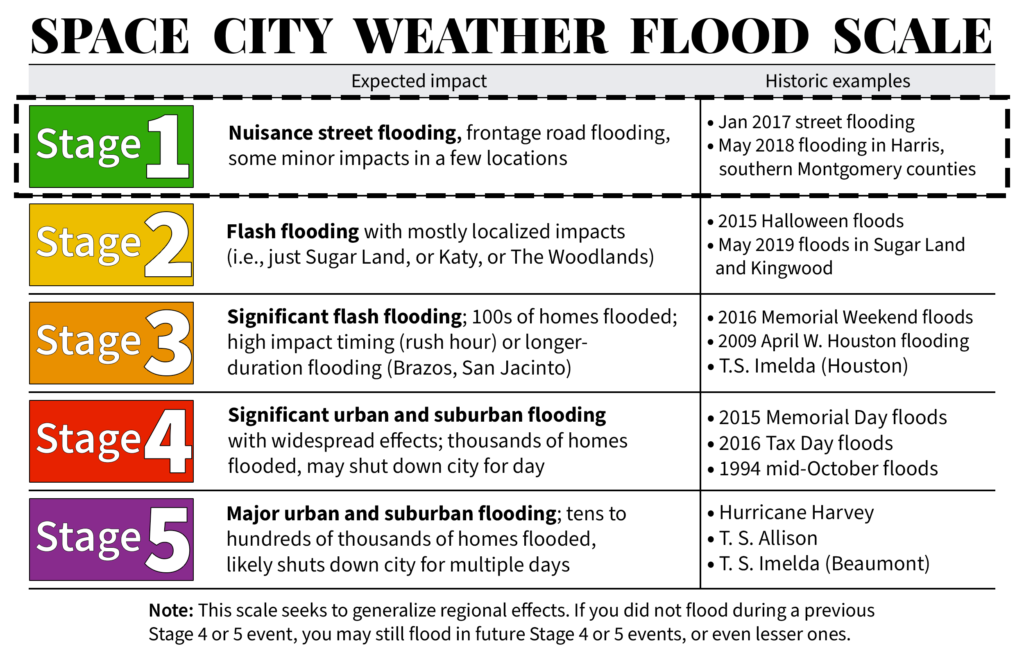
[UPDATE:We’re pulling the trigger on Stage 1 Flood Alert. See the details at the bottom of the post.]
Today
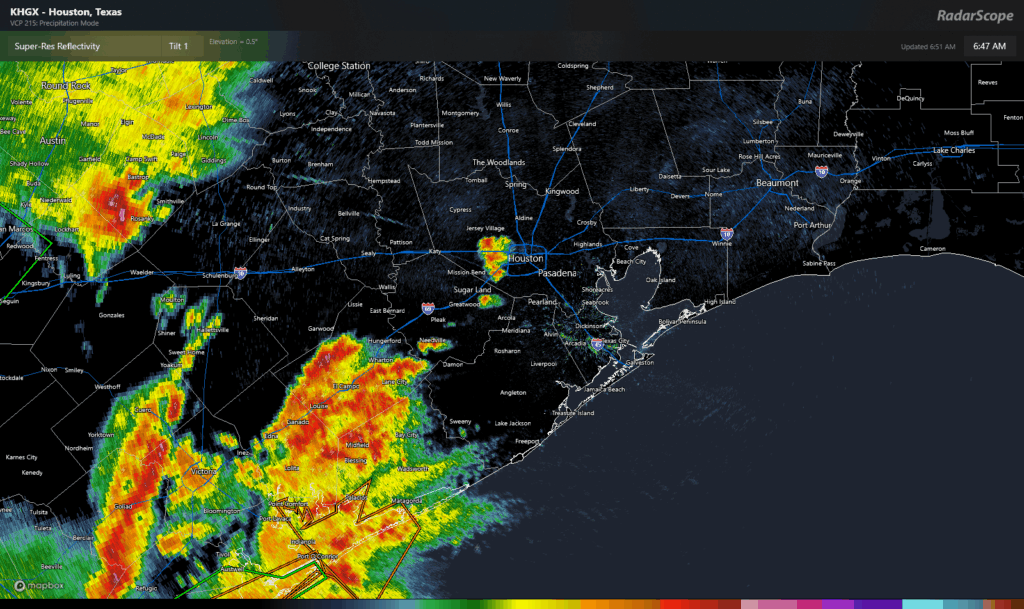
After things calmed down yesterday, they stayed calm, thankfully. We will not have that luxury today. Storms (non-severe) are already moving across Matagorda County and Wharton County this morning.
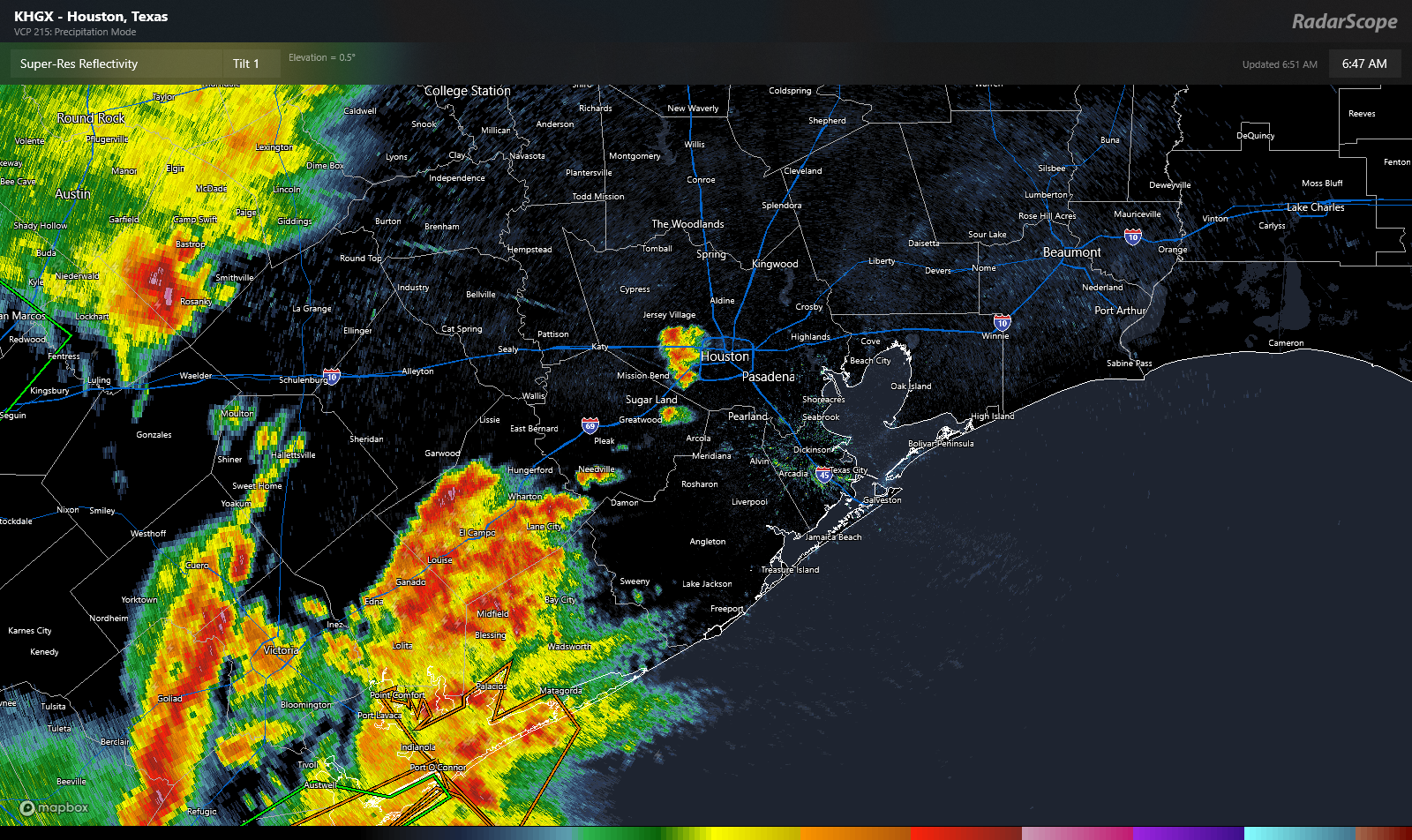
Radar at 6:45 AM shows heavy rain and thunderstorms near Matagorda Bay into Wharton County and a couple isolated showers or storms just west of Downtown. (RadarScope)
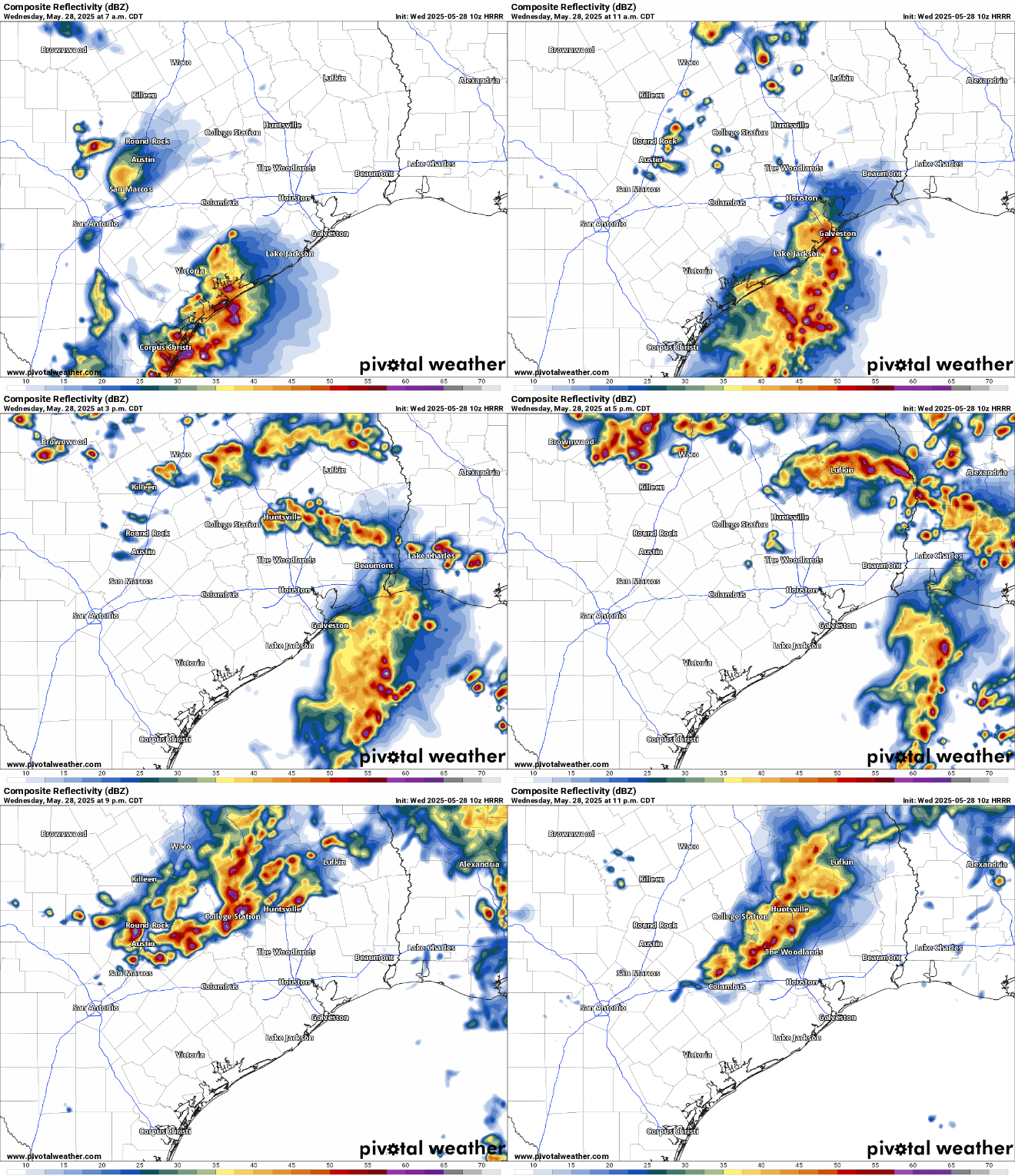
There are also a couple isolated storms just west of Downtown. Over the next few hours, the activity near Matagorda Bay will slide across Brazoria and Galveston Counties. Some of those storms could be strong to severe with gusty winds. Lightning and heavy rain are a given with these storms as well. Elsewhere, scattered storms will pop across the rest of the area today. While we don’t expect significant severe weather, we cannot rule out isolated severe storms. Gusty winds are the main concern today.
A radar forecast from 7 AM-11 PM today every 2 hours. This is generally how things could play out today. (Pivotal Weather)
It’s possible we see an additional cluster of storms develop with daytime heating out near College Station and the Brazos Valley. Those could swing through in the evening hours. Again, the primary concern would be isolated gusty wind as that happens.
Also keep an eye out for heavy rainfall. These storms are putting down close to 2 inch per hour rainfall rates. This could cause some street flooding to crop up in spots. Nothing too, too serious but just be mindful in typically flood-prone spots. Temperatures will be held back in the 80s today.
Thursday through Sunday
We may venture back to a somewhat less widespread coverage of storm chances here, with more sea breeze driven daily thunderstorms. Those tend to be less intense but can produce locally heavy rainfall. So all days should see the potential for a little street flooding in isolated spots. Many places would end up without much rain. One or two storms could be strong.
That said, we will want to keep tabs on what happens out in western Texas. We’ll be in a northwest flow aloft, as winds 20,000 feet up move from northwest to southeast across Texas. If any sort of complexes of storms can develop out west, they could end up nearby eventually. Models don’t do a great job predicting those features more than 18-36 hours out, so there’s certainly a tinge of uncertainty in the forecast. So with all that in mind, we don’t currently expect widespread storms but we’ll be babysitting the situation through the week.
Temperatures look to top out in the upper-80s on days with rain and low-90s on days without. Morning lows should generally be in the 70s.
Next week
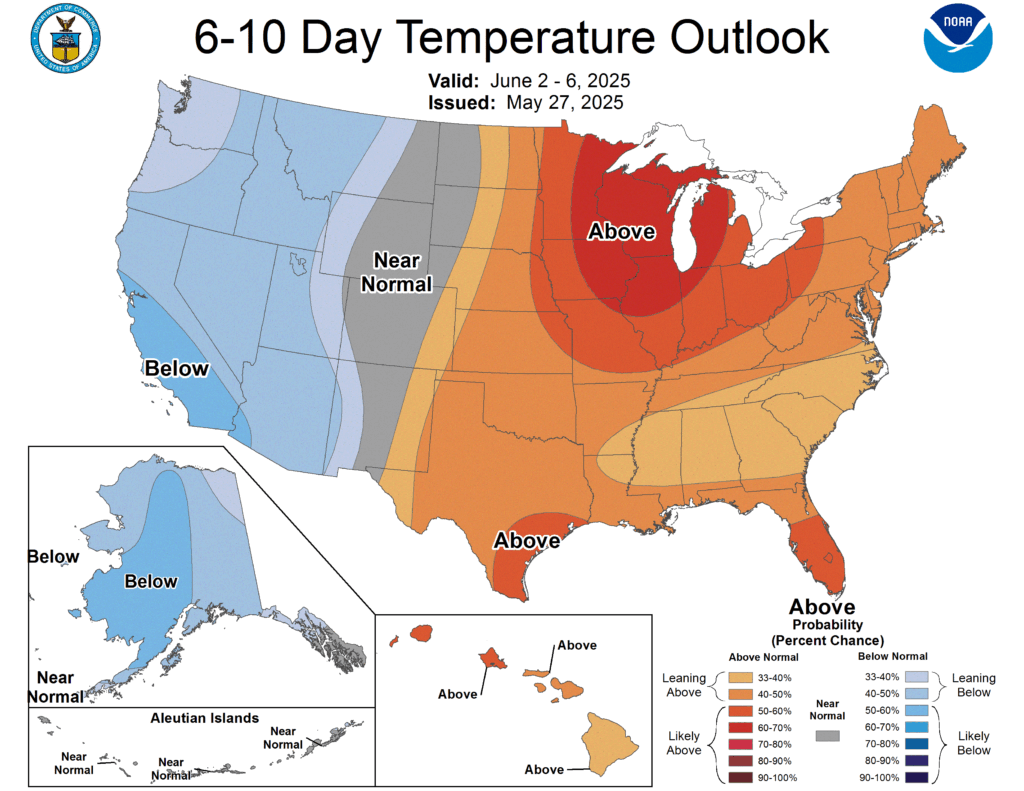
A return to drier, hotter weather seems likely next week. High pressure may try to anchor over the Southeast or Gulf, which would keep Southeast Texas at least at the periphery of hot weather, with temperatures likely starting the week in the low 90s and moving upward from there.
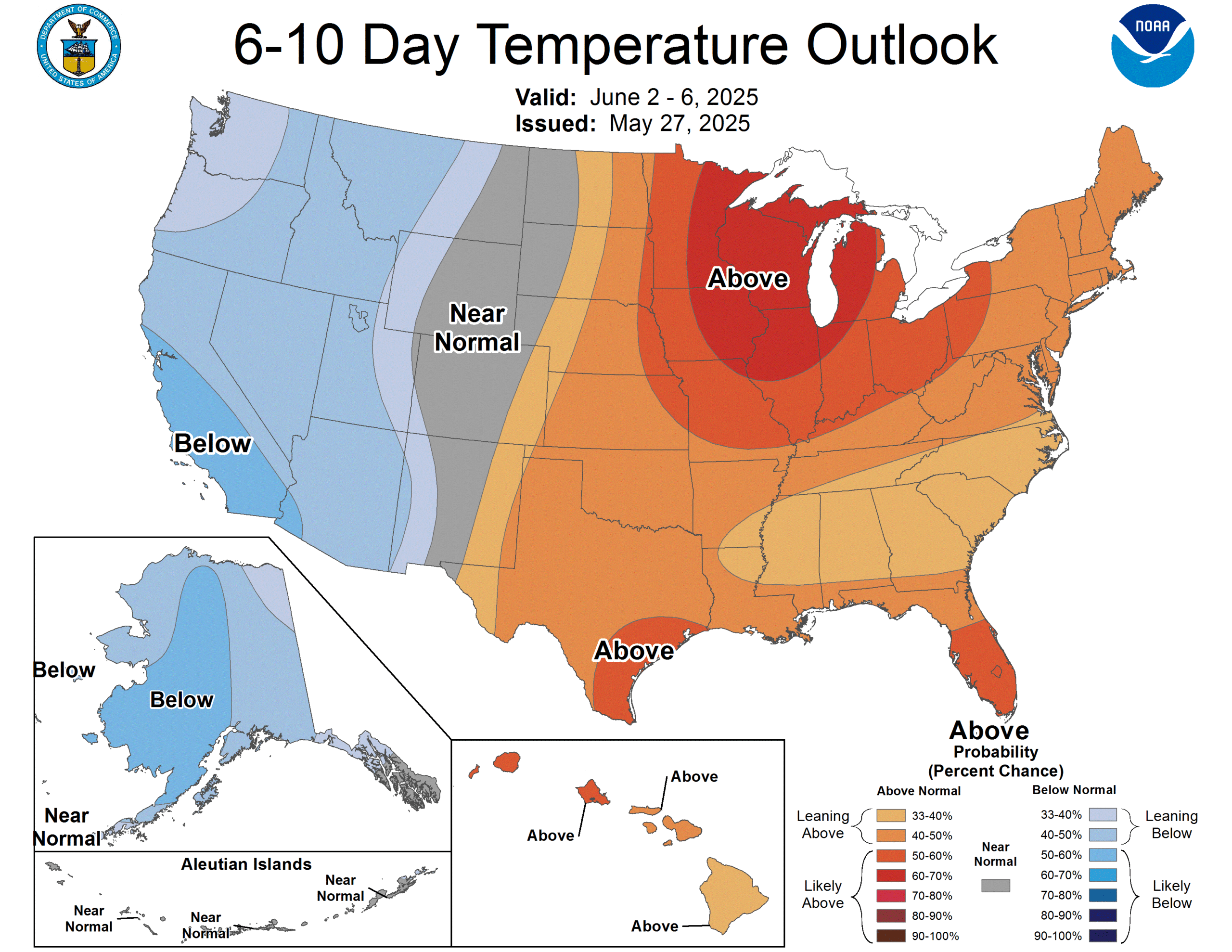
The 6-to-10-day outlook is hot across the Eastern U.S., including southeast Texas. (NOAA CPC)
Mid-90s will probably return at some point. Stay tuned.
Update: Storms this morning are producing localized torrential downpours with rates of 2-4 inches per hour that will cause heavy ponding and some street flooding in spots. As as result, we’re pulling the trigger on a Stage 1 alert on our Flood Scale.
I found your response very helpful and I’m working my way through all the comments as well. The situation was already resolved by the time this was published, but it’s helpful to reflect back on what I could have done better, and hopefully others will learn from this too!
It’s fascinating to see the commenters weighing in on the importance of accommodations vs personal responsibility. I’m also learning a lot about the uniqueness of ADHD coping methods, not only that different people find different approaches helpful, but also that the same person will need different approaches over time.
My update on the situation is that I did set explicit expectations about how long tasks should take, that she shouldn’t take on any side projects without checking with me first, that getting things done in a timely fashion was an essential part of her job (and more important than exhaustive detail), and that consistently clocking in and out for her shifts was a requirement that could lead to progressive discipline if not followed. I think my years of reading AAM helped me come up with those ideas even before you responded. If there’s one thing I’ve learned here, it’s that clearly-communicated expectations are essential!
Unfortunately the idea of us paying for an ADHD coach wasn’t feasible for someone at her level. That said, we do have a strong Employee Assistance Program here, and this kind of thing is within their scope. I encouraged her to contact the EAP, but I don’t know if she ever did.
It all came to a head when she forgot to punch out again for most of her shifts over two weeks. The estimated shift end times she gave us when prompted seemed suspicious, so we compared them to computer use and parking ramp data. This unfortunately showed that she was significantly overestimating her work time. I don’t think she did this on purpose, but it demonstrated exactly why we require people to actually punch in and out instead of guesstimating at the end of a pay period.
All of this put together resulted in a brief suspension. I was very explicit in the suspension discussion that we believed she could do better, and that we would be happy to make accommodations to help her succeed. I also was very clear that we wanted this to be not a punishment but a wake-up call that the behavior needed to change if she wanted to keep working here.
On her first morning back after the suspension, she submitted her two-week notice. She said the stress of “trying to be perfect” was going to lead her to make more mistakes, so she didn’t think she could stay. I had somewhat mixed feelings about this until she admitted that she had forgotten her badge at home that morning, so she needed a leader to clock her in and out for the day. That felt like a last straw to me, to be honest.
A few days before the end of the two week notice period, she changed her mind and said she wanted to stay. Thankfully I had already read some good advice here at AAM about this situation! I reminded her that we had formally accepted her resignation, and explained that we would proceed with her last day as planned. She was not happy, but we all got through it.
Thank you and all the commenters for the thoughtful advice and discussion, not only about this situation, but also throughout the years!
I work from home 100% of the time. I also am deeply afraid of spiders (as well as most creatures with six or more legs). I normally do not encounter creatures with six or more legs due to living in a big city, but unfortunately I still get the occasional unwanted visitor. I’ve worked very hard over the years on getting my fear reactions under control, but if I get surprised and the spider is within close range, I often can’t help but let out a short scream or yell.
Thankfully this has only happened once while on a call, and it was an informal call with one of my coworker buddies so we both just laughed it off, but what do I do if this happens while on a call with multiple people who I don’t necessarily know very well? Or even worse, what if it happens while I’m presenting or running a meeting? It usually takes me a long time to deal with a spider because I’m too afraid to kill them myself and I live alone, so I have to resort to calling in my cats and getting them to take care of it, and it’s entirely possible that I may be out of commission for several minutes or more until the threat is neutralized. I know that spiders are a very common fear, and chances are that most people in any given meeting would be sympathetic, but what exactly should I say if this happens? What is the professional version of “I’m sorry for screaming, everything is fine, but I’m being menaced by an eight-legged beast and must leave immediately until the threat is contained”?
I’m also happy to hear if you or the commenters have advice for dealing with creepy-crawlies when you are deeply afraid and live alone, but unfortunately I cannot use bug vacuums (long story, it just doesn’t work for me with the specific way my phobia manifests). Technically my current system works, it’s just inefficient. My coping skills for outdoor encounters are much more advanced.
If it happens on a call with people you don’t know well but when you’re not presenting: if you let out a yelp, it’s fine to say, “Sorry about that, there’s a huge bug here that startled me.” People will get it! If you’ll then need to take a few minutes to put the cats into action, I might skip the bug explanation altogether and instead just say, “So sorry, quick emergency I have to deal with here, I’ll be right back.” The yelp will be assumed to have been related to that (and that could be anything from a suddenly leaking ceiling to a moose peering in your window).
If you’re presenting or running a meeting: in many cases you could use the “so sorry/quick emergency/be right back” strategy from above, but you should make it pretty quick. Would your set-up allow you to move into another room when that happens and resume the call with a closed door between you and the spider?
2. Is managing people a miserable job?
I recently attended a training for managers and left feeling a little dispirited by the way other managers talked about how hard it was to be a manager and the tone they spoke about their employees with.
I’ve only been a manager for a few years. I have a very small team and I’ve been lucky enough to have interviewed and selected every person on it. Our department pays well, has a great work/life balance, and we get to operate very autonomously. Managing people has still been challenging because I’m developing a new skill set, but it’s been much more rewarding than I anticipated. I’ve watched my employees really blossom with just a little bit of trust and support and I’m so proud of the work they’ve done and how they’ve grown as professionals.
People in my training seemed really worn down and talked about their employees lying to them, refusing to do their jobs, making every piece of feedback into a grievance, spreading rumors, undermining them, not coming to work, etc. It was just really visceral how fed up they were and how much bad blood they had with some of their staff. Many of them talked similarly about their own managers.
When I accepted a management role, I was really worried I would hate it and be bad at it. My experience has been the opposite, but is it just because it’s a unicorn role? I’m concerned I’m spending my time growing as a manager only to realize managing people is miserable and I was just extraordinarily lucky.
Nah. These managers are telling on themselves more than anything else, I’d guess. Managing can be really miserable for people who don’t know how to do it well (or who just don’t want to do it, or who aren’t well-suited to it). But if there are significant problems on their team that they’re not actively and assertively addressing, they bear a lot of the responsibility for those problems themselves! (An important exception is if they’re working in environments that don’t give managers the tools and authority to do what’s needed to manage effectively … except in that situation, the solution is for them to recognize that and get out of an impossible job.)
If you’re careful about screening future management jobs to ensure you’re working in places with cultures that support managers (not “against employees” but “in doing the jobs they’re responsible for”) — and as long as you remain committed to getting the building blocks of management right (like hiring well, setting clear expectations, addressing problems, and supporting the people on your team) — you don’t need to worry you will become them.
After 25 years as adjunct faculty, I finally completed my PhD last month and am now interviewing for academic positions. I’m wondering about name etiquette during interviews.
In the preliminary Zoom interviews, I’m typically asked if I prefer my full first name or a nickname. I know academic departments in my field tend to be informal. Everyone in these Zoom meetings is presumably a “Dr.” but they invite me to use their first names. Still, I’m proud of all I did in my journey to “Doctor.” Plus, I recently changed my last name for really personal reasons, and it brings me genuine joy to hear “Doctor Goodname.”
If I rolled it out with a little humility and humor, would it be off-putting to say this? “Feel free to call me Firstname, especially if we end up working together, but for today’s interview, I’d love to be called Doctor Goodname”?
Don’t do it!
If they’re introducing themselves by their first names and no honorifics, you should not ask to be called by a honorific yourself. It would be distancing and risks seeming inappropriately self-important (there’s nothing wrong with being proud of the title you’ve earned, but it’s not appropriate to use a title in every context — there are some schools, and many workplaces, that don’t use them at all) and making them worry about a culture mismatch. It’s not a good idea to do in an interview.
Congratulations on the PhD!
4. Correcting HR when they misgender me
I work at a place that prides itself on inclusion, acceptance, etc. It’s in our mission statement and everything.
I go by my middle name professionally, or really, a shortened version of it. It reads as a traditionally masculine name. I’m non-binary and use they/them pronouns (they’re in my messaging app, on my badge, and they used to be in my email signature but I removed them — long story, etc.). Most people in leadership are good about using them. I have neither the time nor energy to correct people who don’t directly manage me — I’d spend all my time correcting them rather than working and would probably run into resistance and people not caring. I’m fine also being called she/her. It’s not my favorite, but I look and sound like a she/her, so I get it.
Today, a member of HR (who I’ve never spoken to) referred to me as Mr. and he/him in an email to a candidate we were contacting. The issue is that I’d called the candidate on the phone earlier and I don’t sound anything like a mister. At all. I’m afraid to confuse the candidate (“in the email HR said Mr. Lastname was reaching out to me, but that sounded like a Ms. Lastname”) but more importantly, I’m afraid of correcting the HR person due to the power imbalance. I don’t want to email and say, “Hey, just a heads-up, I don’t use gendered honorifics — just Firstname is fine!” because it feels like I’m being a pain or whining about something that, in the grand scheme of things, is really small and silly. I get that there are some non-binary people who have no pronoun preference, but it rubbed me the wrong way. I feel like I should say something because even if it doesn’t bother me (a lot), it might bother someone else, but I’m not sure how to do that.
How about, “Quick correction, I’m not a Mr.!” If you want, you could add, “I use they/them, and just Firstname is fine” — but you could even skip that and just address the Mr. part, which is the part you’re concerned is confusing the candidate.
You aren’t being a pain or whining. You’re correcting something that was wrong, and assuming that of course the HR person wants to get it right next time. (Hopefully they do!)
5. Do my resume and online application need to match perfectly?
I recently finished grad school and have officially re-entered the job market. I’ve been filling out a lot of online job applications, and many of them have required me to upload my resume but then also fill out a form with my work history. (Mildly annoying, but I know it’s pretty common.)
I’m currently in the middle of filling out an application that’s asking for my work history from the past seven years, but my resume includes a job that I left eight years ago. Will it look weird if I have a job listed on my resume but not on the online application? Should I take it off my resume entirely? Or include it on both and assume that the “past seven years” thing is more of a guideline than a hard cutoff?
And in general, does it matter if my resume and the online form don’t match perfectly? I wouldn’t change anything substantial — I mean things like adding an extra bullet point that I left off of the corresponding resume entry to save space.
Nope, that’s fine. Your resume and the online form don’t need to match perfectly as long as they don’t contradict each other, since they serve different purposes. (The resume is to present your candidacy in the way you think is strongest, while the application’s purpose is partly to ensure you present specific categories of info they definitely want included and to ensure you attest that it’s accurate.) In other words, having a job on the form that you didn’t include on your resume is fine, but having different dates listed a job in one place than in the other would be a problem.
GREAT EXUMA, BERMUDA — Thousands of excited would-be Martians gathered at MarsFest to enthuse over Elon Musk’s most recent vow to colonize the categorically inhospitable Red Planet. Citing Space-X PR, Zubrin’s Mars Direct, von Braun’s Marsprojekt, and a century-plus of pulp science fiction, enthusiasts spotlight benefits of Martian colonization, including: Escaping onerous regulatory states for […]
OTTAWA – As King Charles read the Speech From The Throne Conservative Party of Canada leader and not MP Pierre Poilievre was seen outside the Senate with his face pressed against the window. The unemployed Conservative Party leader began the royal visit following the throngs of well wishers along Wellington Street where the King and […]
OTTAWA – Newly-elected Prime Minister Mark Carney is already facing allegations of allowing foreign tampering in Canadian affairs, after he allowed Swedish retailer IKEA to assist him in the formation of his inner circle. After an unfortunate misinterpretation of the words “Cabinet Day” circled on his calendar in red pen, PM Carney went ahead and […]
The Japanese embassy! What can this mean? Claire’s had a haircut, it must be important. Detective Inspector Dennison appeared in Wicked Things, drawn brilliantly by Max Sarin, every issue, but has not been seen since. I did draw him once or twice though (see below)…
In the run-up to President Trump’s recent trip to the Middle East,
the White House encouraged chief executives and representatives of
many U.S. companies to join him. Tim Cook, Apple’s chief
executive, declined, said two people familiar with the decision.
The choice appeared to irritate Mr. Trump. As he hopscotched from
Saudi Arabia to the United Arab Emirates, Mr. Trump took a number
of shots at Mr. Cook. During his speech in Riyadh, Mr. Trump
paused to praise Jensen Huang, the chief executive of Nvidia, for
traveling to the Middle East along with the White House
delegation. Then he knocked Mr. Cook.
“I mean, Tim Cook isn’t here but you are,” Mr. Trump said to Mr.
Huang at an event attended by chief executives like Larry Fink of
the asset manager BlackRock, Sam Altman of OpenAI, Jane Fraser of
Citigroup and Lisa Su of the semiconductor company AMD.
The presumption here is that Trump’s (possibly illegal) threats of applying a 25% tariff on all imported iPhones, no matter where they’re assembled, are payback for Cook declining to attend this trip in Trump’s entourage of CEOs. When you cave to a bully/extortionist, the bullying/extortion don’t stop. Apple doesn’t really have any significant business interests in countries like Saudi Arabia or Qatar, and it’s not hard to see why an even vaguely ethical business leader would not want to cozy up with Saudi crown prince Mohammed bin Salman.
Maybe Cook was just busy. But maybe Cook, just 100-some days into the Trump 2.0 administration, is already past his “look, he won the election, let’s give him a chance” stage.
Have you ever noticed that I've never done that whole influencer thing? That's all thanks to people like you! Viewer support through Patreon keeps this channel independent and possible. It's how I can express my true thoughts on all the ways people in tech forget about the humanities! If you'd like to join the amazing folks who fund my work, check out the link below. And thank you! https://www.patreon.com/technologyconnections

/https://static.texastribune.org/media/files/e0c16659eb94e872169745ed78c88cc6/SA%20Water%20Treatment%20CS%20TT%2012.jpg)

/https://static.texastribune.org/media/files/7885324a952ae4084b81659c7562c523/Lee%20County%20Wells%20SP%20TT%2029.jpg)

/https://static.texastribune.org/media/files/26f21afb68c99f6e016023057308f648/0226%20CC%20Gun%20Show%20BY%20TT%2006.jpg)

/https://static.texastribune.org/media/files/0c61926e39c6d0cc26de0f9870127dc6/0424%20UT%20Austin%20Protest%20EH%20TT%2016.jpg)

/https://static.texastribune.org/media/files/090f1e1740b925ada9a19135cc8c050e/SXSW%20vip%20Full%20CR%20TT%2056.jpg)

/https://static.texastribune.org/media/files/ae85eb90756a240084a9288c484c46d1/0612%20DOT%20Capitol%20SOS%20JT%20TT%2001.jpg)

/https://static.texastribune.org/media/files/a993dd6cafc71e8df62cf35656271c9b/100520%20Mail%20In%20Ballots%20PYH%20TT%2001.jpg)

/https://static.texastribune.org/media/files/93ed16974ecb1ca9d874e5f5ff82849c/0515%20House%20Deadline%20Day%20LW%20TT%2045.jpg)