Shared posts

22 Sep 12:14

The Weirdest Tool in Underwater Construction

by Wesley Crump

[Note that this article is a transcript of the video embedded above.]

In 1989, the Loma Prieta earthquake shook the central coast of California, collapsing buildings and damaging infrastructure across the Bay Area. Bridges, in particular, suffered extensive damage. In one case, a major section of the eastern span of the Bay Bridge's deck collapsed, falling onto the lower deck like a trapdoor. Sadly, one person died driving off the upper deck. Crews had the bridge repaired within a month, but Caltrans knew that the next earthquake could be worse and started making plans to replace the structure.

Knowing that the replacement project would require heavy-duty piles, Caltrans developed a testing program to identify risks and challenges during design and minimize the chance of unanticipated problems cropping up during construction. And they found a pretty big one. In October of 2000, the barge began the pile driving operation, dropping a large hammer to drive the 8-foot (or 2.4 meter) diameter steel pipe deep into the seafloor. Almost immediately, fish began dying in the surrounding area. Biologists involved in the project collected fish and documented injuries to their organs and swim bladders. They weren’t being directly hurt by the hammer itself; it was above the water anyway. The damage was coming from the intense sound.

That massive steel pipe rang like a humongous bell on every hammer blow, radiating sound pressure through the San Francisco Bay. It even had serious impacts on aquatic wildlife up to a kilometer away, which was a pretty big deal. Because San Francisco Bay is home to quite a few threatened or endangered species of fish. The problem was that the replacement bridge would need more than 250 of these piles. Caltrans had to figure out how to install them without affecting the wildlife in the process, and the way they did it, I think, is pretty cool. And I even built a model in the garage to show you it works. I’m Grady, and this is Practical Engineering.

If you want to know the answer right away, it's bubbles. But I think the most interesting part is why it works in the first place. And this matters. Pile driving isn’t the only thing that creates excessive noise underwater. We do a lot of construction in waterways, oceans, rivers, and bays. We also occasionally have to blow stuff up underwater, like for demolition of structures or safe disposal of old munitions and mines. Any loud work underwater has the potential to disrupt, injure, or even kill aquatic wildlife. The phenomenon we know as sound is just fluctuations in pressure within a medium, whether it’s air or water (or even concrete). We sense those fluctuations mainly through our ears, but pressure fluctuations can do a lot more than just vibrate the thin membranes, tiny bones, and hairs. Barotrauma is the term used to describe the damaging effects of compression and decompression on wildlife. And it really has only been in the past few decades that we’ve really started to apply the science of hydroacoustics to our own activities and try to mitigate the impacts.

You’ve probably heard of sound pressure expressed in decibels. It’s really just a logarithmic scale of convenience thing because meaningful pressures can range across many orders of magnitude. So the decibel system just makes the numbers easier to compare. The equation for a decibel is just 20 times the base 10 logarithmic function of the sound pressure divided by a reference pressure. Sounds complicated, but it just means a 1-decibel increase corresponds to an increase in sound pressure of about 26 percent. The amount of time over which sound pressure is measured also matters. Look at a waveform and you can see there are peaks (both in compression and rarefaction). But that’s only for a split second. So a lot of measurements use a root mean square of the sound pressure over a given time to provide a better estimate. We don’t have to go into the math of that, just think of it as a fancy kind of average.

It’s important to point out that, in air, we use 20 micropascals as the reference pressure, which is approximately the limit of human hearing. So that’s 0 decibels. Underwater, we use a reference pressure of 1 micropascal, mainly just for standardization purposes, so just keep in mind that underwater decibels aren’t really equivalent to sound pressures you might have as references in your head like the 75-decibel vacuum cleaner or the 140-decibel jet engine. And really, what you think of as sound has less meaning underwater because our ears and brains are calibrated for the physics of sound in air. The underwater version of “loudness” doesn’t translate well to human perception. But it matters a lot to fish and marine mammals.

Sound behaves a lot differently in water than air. Of course, water is denser, and sound moves through it at roughly 4 times the speed it does in air. Sound also carries a lot further in water, and importantly, the acoustic impedance of water is way different than air. Impedance is basically a measure of opposition to sound flow, kind of like resistance in an electrical circuit. It’s a function of the medium’s density and the speed of sound through it. And at a boundary between two media, there are two things that can happen to sound. It can transmit into the new medium or it can reflect back, and the difference in impedance between the two determines how much of each will occur. If impedances match, more sound will transmit through the boundary. If they’re way off, like water and air, most of the sound is reflected. The practical effect of that is a transmission loss between air and water of about 30 decibels. It’s why stuff happening underwater is quiet above the surface, and we can take advantage of impedance mismatch in underwater construction.

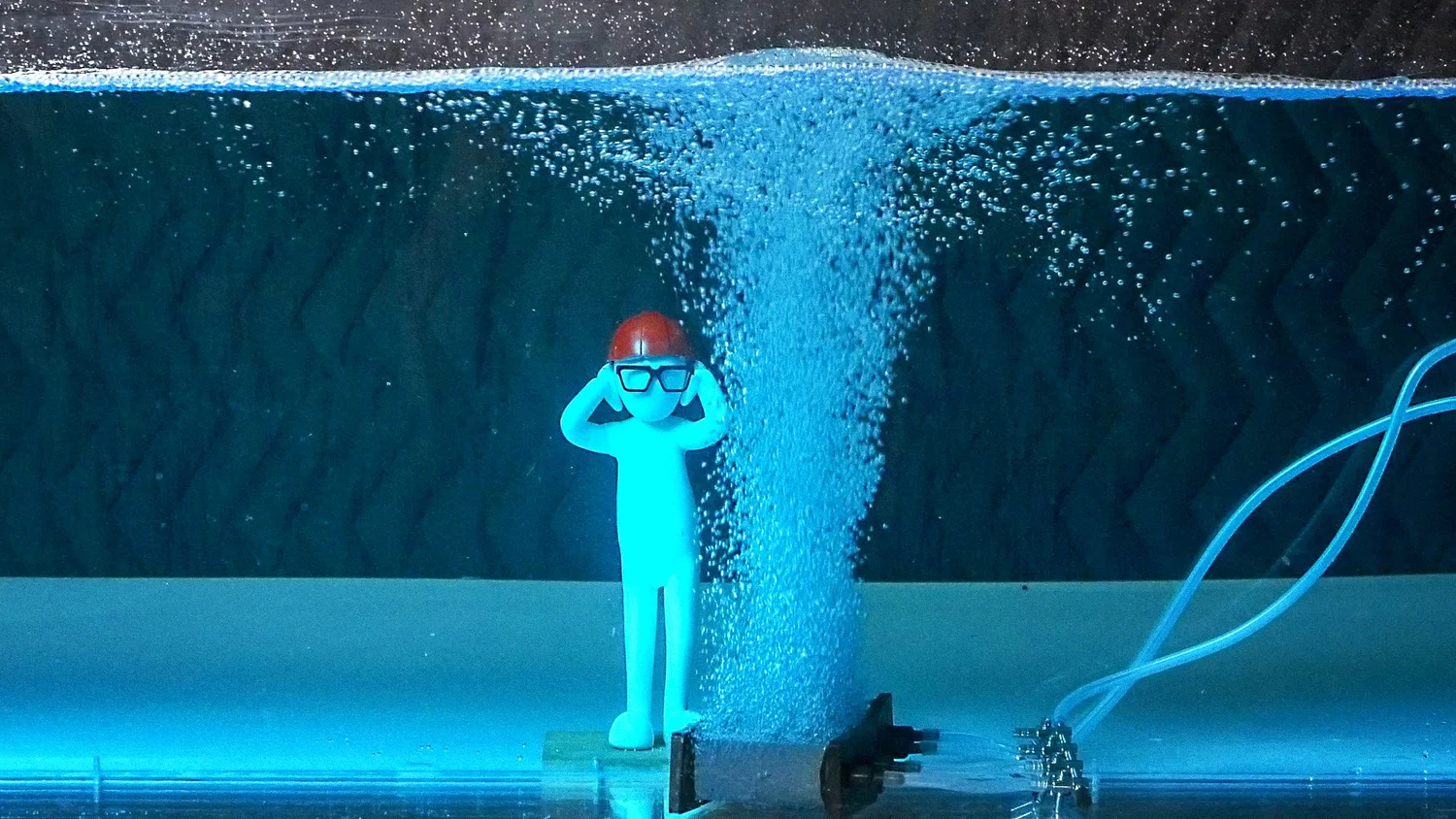
I built a new acrylic tank for this demo, and I’ve got a new helper in the shop. This is Brady. I figured since half the internet calls me that anyway, we might as well get a Brady in here. He can wave and nod, and he can probably do a lot of other stuff too, but that took me several hours, so he’s just going to bravely hold the hydrophone for now. And on the other end of the tank, I have this bluetooth speaker. It claims it’s underwater rated, so we’ll see if it works out.

And here’s the setup; pretty simple. I found a few recordings of hammering and pile driving sounds to play on the speaker. And this is how they come across on the hydrophone, which is connected to a sound recorder. I also did a frequency sweep so we can do a little more scientific comparison. Now let’s add some air.

At this point, one of my glue joints on this tank catastrophically failed and flooded my garage with water. I didn’t catch it on camera, but Brady took the brunt of the fall. Thankfully, he was wearing his hard hat. I got it all fixed up, and now let’s see if we can soften these construction sounds.

I have four air stones made for aquariums hooked up to an air pump. When I flip these on, we get a nice curtain of small bubbles between the speaker and the hydrophone. And I’ll record those same sounds again. Here’s a look at the waveforms from the hydrophone with and without the air. Although it’s not a dramatic difference, you can definitely see a difference, especially for the higher pitched hammering sounds toward the end. And here’s a look at the waveforms without and with the air for the frequency sweeps. Even though the sweep should have had a constant sound pressure across the full range of frequencies, the water and demo itself cause pretty serious distortions. You can see a lot of resonance at low frequencies, and a lot of attenuation at high frequencies. That makes it a little hard to gauge the effectiveness of the bubbles. It’s similar to the hammering sounds - not much difference at the lower frequencies, but a pretty substantial reduction at higher frequencies.

This is not an ideal setup for one reason: even though there’s a big mismatch in acoustic impedance between air and water, there’s not that much difference between acrylic and water. So, it’s pretty easy for pressure waves to propagate into the acrylic, travel past my bubble curtain, and back into the water on the other side. So I’m not getting the kind of sound reduction, what the pros call attenuation, that you might expect in the real world, for example, by surrounding a pile with a circular ring of air pipes. Thankfully, the researchers studying solutions like this have put a lot more resources into figuring out the right way to do it. The measurements at the Bay Bridge compared fairly well with mine. Attenuation was highest as the higher frequencies. But this is not as simple as just blasting air out of a pipe.

These bubble curtain systems require a lot of logistics. Massive compressors or blowers feed air sometimes deep below the surface into complex plumbing assemblies. They usually have filters to remove oil from the air to make sure the water isn’t being contaminated. The system has to sit flush with the bottom to make sure sound can’t travel underneath the bubble curtain. But also, there are currents. Any movement of the water is going to move the bubbles too, potentially creating gaps in the curtain or dispersing it altogether. So it’s often necessary to have multiple levels of plumbing to keep a continuous screen all the way to the surface. If that’s not enough, there are ways to confine the bubbles around a pile or construction activity using an outer casing or even a flexible membrane. But how do you know it actually works?

Maybe the most comprehensive engineering guidance on this topic is put out by Caltrans in their manual on the Hydroacoustic Effects of Pile Driving on Fish. Appendix 1 in the report is a nearly 300-page compendium of pile driving sound data. You might not have known this, but we’ve been measuring a lot of pile-driving sounds! If you’re an engineer or environmental scientist trying to get a permit to build something underwater and sound is going to be an issue, this is kind of your bible. It’s got quite a few ways to minimize impacts, including timing work when important species aren’t present, changing designs to reduce underwater work, using vibratory hammers instead of conventional equipment, and bubble curtains that reduce the propagation of underwater sound pressure. Based on all the testing and real-world case studies so far, they suggest you can get about 5 decibels of attenuation this way.

Just like my demo, sounds don’t only travel through the water. They also move through the sea floor and even through the barge on the surface, bypassing the bubbles. 5 decibels doesn’t sound like a big reduction, but you have to remember that it’s a logarithmic scale. A 5 decibel reduction means the actual sound pressure is nearly cut in half. You also have to remember that what we care about most is area. For any loud construction or demolition activity, there’s an invisible ring some distance away that marks the injury threshold level. Since sound pressure decreases with distance, eventually you’re far enough away from the sound that it doesn’t result in injury. So every foot or meter that you can pull that ring back toward the activity through attenuation reduces the impact area proportional to the distance squared, dramatically reducing the area in which fish may sustain injuries. That’s why bubble curtains are used in so many underwater construction projects these days, but that’s not all they’re used for.

What’s that old saying? If your only tool is a bubble curtain generation system, every problem starts to look like a loud underwater sound. Something like that. It turns out that bubbles can do a lot more than create an impedance mismatch for sound pressure propagation. For one, they aerate water, which can be useful to prevent algae and other issues with stagnant pools. For two, they create vertical water currents. That can help keep things separated, like trash. You can see it’s a lot harder for me to move this little boat across the barrier created by the bubbles. Of course, a net or boom or rack can do this too, but those don’t allow boats to pass through. And this doesn’t just work for trash. Bubble curtains have been used to contain oil spills, and they’re often used in underwater construction not just to control sound but turbidity. We really don’t want disturbed sediments clouding up our waterways, again, primarily for environmental reasons, so these can be an important tool when booms aren’t practical. They’ve also been used to control saltwater and keep it from migrating up rivers in tidal areas. And they’ve even been employed to confine herbicides for invasive plants, allowing for fewer chemicals and less non-target damage to nearby flora.

I’ll definitely be in trouble with the biology folks if I don’t point out that it’s not just people who use bubbles as a tool. Humpback whales cooperate to create bubble curtains that corral fish to a central point. Then they lunge into the center to gulp them down, a behavior called bubble net feeding. And we use bubbles this way on occasion as well, not for fishing but to keep fish out of certain areas, usually to prevent the spread of invasive species.

By 2005, the pile driving operation on the east span replacement of the Bay Bridge was complete, and Caltrans and its consultant were awarded the Environmental Excellence Award by the Federal Highway Administration for all the work they did on minimizing underwater noise impacts on endangered fish species. And the lessons from that project have been applied across the world in the two decades since.

You know I love heavy construction. The bigger and louder the machinery, the better. But I think that anything we can do to limit the effect we have on the other things we share this world with is a win, especially when it’s something as clever and creative as blowing bubbles.
04 Sep 19:47

POISON or SNACK: RED BERRIES

by BlackForager
03 Sep 22:59

how do I say no to door-to-door salespeople without being rude?

by Ask a Manager

A reader writes:

This is a question not about my work, but about how to avoid creating negative work experiences for others — people in door-to-door sales/fundraising jobs.

I get a ton of door-to-door salespeople and fundraisers at my house. I am absolutely not going to make a purchase or donation in any of these circumstances, and I need to end the interactions as fast as possible (I work from home and need to get back to my desk ASAP). But I don’t want to be a jerk; these are humans just trying to earn a living, after all. I also think it’s kinder to them to stop the conversation quickly, since there’s zero chance their pitch will result in a sale/donation.

My current strategy is to interrupt the person as soon as they introduce themselves and say (in a kind tone) something like, “I don’t want to waste your time, so I’m going to stop you there because my answer is going to be a firm no. I realize you have a pitch prepared, but I will absolutely not be making a purchase/donation, so you can save your time and move on to your next house now.” If the person is soliciting donations for an organization I believe in, I’ll usually throw in “I appreciate the work you’re doing for [cause].”

Invariably, the person immediately segues into their pitch anyway, and I keep reiterating my no. Some folks give up after a few more rejections (usually fundraisers), while others tend to get pushy (usually salespeople). I try to stay kind, but in some cases the only way to end the interaction is to just close the door in their face while they’re talking.

I know these folks are likely required to follow a script and to keep pushing when they hear no. I also know it’s a tough job and they must get plenty of rude responses (one could argue that the solicitors are themselves being rude, but I don’t want to be rude in return regardless). They’re at work, and I want to avoid making their jobs more unpleasant — but I also need to shut down these convos quickly.

For folks in these types of jobs, is there some magic word that would make them accept that first no? Is there a type of non-jerk response that would close the conversation faster? Or is being rude / shutting the door in their face really the only way to end the interaction at my initial no?

I can’t just ignore the doorbell because I often have important packages I have to sign for, and a video doorbell isn’t an option at my house for various reasons.

You’re being far more accommodating than you need to (or should be). People who show up randomly at your door are not owed access to you; you decide how much of your time you’re willing to give them, and you don’t need to give more because they want it (or any at all, for that matter).

It’s really okay to just say, “No, thank you” and close the door. Truly. Say it politely, but you’re not required to let them control your time. You’ve delivered the essential information — that you’re not interested — and the interaction can end there. You don’t need to wait for them to give explicit permission to end it (and if you try to, many of them will keep you there longer than you want, as you’ve seen). If you feel awkward about just replying with a simple “no, thank you,” you can add, “I’m on a phone call so need to run” and then close the door.

If they were going to respect your initial no, they’d be assuming the interaction is over then anyway. Anyone who objects is someone who wasn’t going to respect your no anyway, so you certainly don’t need to facilitate them in further intruding on you.

And if it helps you feel better about it, you’re saving them time by not prolonging the interaction, too.

You could also consider a “no soliciting” sign, which won’t end the interruptions entirely but should cut down on them.

The post how do I say no to door-to-door salespeople without being rude? appeared first on Ask a Manager.

03 Sep 22:58

I can’t wait to see Spooner, Wisconsin, again. So long, I love you guys! It’s my turn to escape….

I can’t wait to see Spooner, Wisconsin, again. So long, I love you guys! It’s my turn to escape. Joel got to go right after he saw a really bad Joe Don Baker movie, so I figured…

03 Sep 22:58

THE INCREDIBLE MR. LIMPET CALLED IN TO HELP.

THE INCREDIBLE MR. LIMPET CALLED IN TO HELP.

03 Sep 22:56

Travis Kelce Asks If Wedding Can Be Shark Themed

by The Onion Staff

LEAWOOD, KS—Lighting up as he outlined his vision for their special day, Kansas City Chiefs tight end Travis Kelce reportedly asked fiancée Taylor Swift on Wednesday if their upcoming wedding could be shark themed. “Come on, babe, you love animals,” said Kelce, who gestured enthusiastically as he threw out ideas, including tables named after different shark species and a life-size ice sculpture of a “mad angry” great white shark baring its teeth. “They already sell so much shark-themed party stuff, so it would make planning super easy. What if the invitations were, like, these scary shark mouths that you open? Babe, please? Have you ever heard of megalodons? They were huge, babe. As big as my love for you.” According to reports, Kelce later moved on to suggesting the wedding should be space themed after he learned about the moon landing.

The post Travis Kelce Asks If Wedding Can Be Shark Themed appeared first on The Onion.

03 Sep 22:56

Study Finds Ultra-Processed Foods Make Up Over 50% Of Americans’ Thoughts

by The Onion Staff

BALTIMORE—Identifying a disturbing behavioral trend likely to have profound health consequences, a study published Wednesday by researchers at Johns Hopkins University found that ultra-processed foods made up over 50% of Americans’ thoughts. “We surveyed more than 20,000 participants across the country, and the data showed they primarily think about sausages, spicy chicken nuggets, and cream-filled snack cakes,” said study co-author Maya Beatty, adding that participants rarely contemplated healthy nuts and seeds and instead focused on white bread and a wide variety of toaster pastries. “In the United States, these high-sugar, low-nutritional-content foods appear essentially any time someone closes their eyes. Parents may try to trick their kids into thinking about little pieces of carrots in their macaroni, but these children have already become accustomed to daydreaming about sweeteners, emulsifiers, and dyes. Additionally, many participants reported that it has gotten too expensive to think about nutritious foods like eggs and fresh vegetables.” The study also reported that those surveyed obsessively worried about the planet eventually running out of high-fructose corn syrup.

The post Study Finds Ultra-Processed Foods Make Up Over 50% Of Americans’ Thoughts appeared first on The Onion.

03 Sep 22:56

If I Can’t Hang the Ten Commandments in My Classroom, How the Hell Am I Supposed to Get My Students to Stop Coveting Their Neighbor’s Wife?

by Mike Langley

These days, it seems like the only qualification someone needs to opine on what’s best for our nation’s schools is their own dimly remembered time as a student. Combine that with volatile, emotionally charged topics like politics and religion, and suddenly, everyone’s an expert and no one will listen to anyone else.

Well, listen up, smartasses: I’m a teacher. I’m in front of kids every single day. And if I can’t hang the Ten Commandments in my classroom, then how the hell am I supposed to get my students to stop coveting their neighbor’s wife?

Being an educator has always been tough; in today’s environment, it’s nearly impossible. So, when red-state governors proposed mandating that a poster displaying the Ten Commandments be hung in every classroom, I let out a huge sigh of relief. Finally, someone who gets it. Someone who gets that, yes, smartphones are a problem, artificial intelligence is concerning, the growing politicization of curriculum is alarming, and pandemic-related learning loss still presents challenges. But the biggest issue in K-12 education today, bar none, is our students’ constant, invasive daydreams about a new life with their neighbor Brian’s underappreciated wife, Denise.

Go ahead. Walk a mile in my shoes. Enter my classroom, with my students, and try to teach my lesson about the rise of prairie populism in the late nineteenth century. Floor is all yours. The second you utter the name “William Jennings Bryan,” you’ve lost the class. “He doesn’t treat Denise right,” mutters one student. “She’s an angel,” says another. Still others simply gaze listlessly out the window, sketching themselves and Denise in a two-seat convertible, zooming down the open highway.

Um, sounds like we’re thinking about a different “Brian,” guys.

And look: This isn’t a religious thing. Separation of church and state? No one’s a stauncher advocate than I am. In fact, like most of America’s teachers, I am a godless communist (well, I try to be—it can be tough to make all of the meetings). But the real world has a funny way of challenging ideology, and frankly, I can’t think of a text more relevant to today’s classrooms than the Ten Commandments.

Oh, you got them to stop coveting Denise for a couple of seconds (good luck with that) and think you’ve got the classroom running smoothly? Try and take a beat to review your lesson plan or—god forbid, have a sip of your coffee—and the moment you look up, the students are smelting a golden idol to Mr. Roberts, the physical education teacher. Is Mr. Roberts in great shape? Sure. Is he—when you think about it—probably the most logical person in the school community to make a false idol of and worship as a god? No question. But as I tell my students constantly, it’s about context, and every second spent lovingly sculpting Mr. Roberts’s biceps or sharpening the line of his jaw is a second we don’t get to spend on civil service reform under the Chester A. Arthur administration.

But maybe this isn’t actually about the kids. Maybe our nation’s classrooms are just another political football you’re using to try to score points. That’s fine. That’s the way these things go. But don’t pretend you actually care about our nation’s children, or our nation’s children’s neighbors’ wives.

03 Sep 22:54

Saturday Morning Breakfast Cereal - Dogs

by Zach Weinersmith


Click here to go see the bonus panel!

Hovertext:
You can also do the pi dogs, but then you lose business from the tau people.


Today's News:
03 Sep 15:15

Cowboy Pat disappeared? #CowboyWho

03 Sep 15:15

ALT

A comic of two foxes, one of whom is blue, the other is green. In this one, Green is wearing a fancy tie, and Blue is turning to look at him, blushing and clearly flustered.
Blue: You look so nice when you're all dressed up.
Green: Should I get dressed up more often?

They kiss.
Blue: No, then it wouldn't be special.ALT
03 Sep 15:13

I overheard a horrible phone call, will I be unhireable if I do a naked bike ride, and more

by Ask a Manager

It’s five answers to five questions. Here we go…

1. Should I do anything about an abusive phone conversation I overheard?

Where I work, we have a few departments sharing the same floor of a main administrative building, and I’ve gotten friendly with many of my colleagues. One of them, let’s call her Jane, seems like the most mild-mannered woman in the world, and she struck me as genuinely kind, if quiet and reserved. We’ll say hi and are friendly, but I know nothing about her family or home situation.

The other day, I was returning from lunch and overheard her in the hall having a very angry conversation on the phone. She was hurling insults, calling the person “demented,” “idiot,” and “fucking liar” multiple times, and her tone was genuinely frightening. She also said she was “going to start taking away your food,” which after reflection gave me concerns that this person has a dependent relationship with her, most likely her child but maybe a vulnerable elder.

Most times, I would simply ignore someone having an argument as none of my business, and I haven’t said anything to anyone yet because it took me a few days to process the situation. But it’s now sinking in that the conversation was the definition of verbal abuse, and I’m worried about possible physical abuse happening in the form of withholding food, not to mention the questions it raises about what happens and how she behaves towards this person when she’s NOT at work. Should I report my concerns to HR? Best practice is usually mind your own business, but does what I heard cross the line into something reportable, acknowledging I have zero context on the conversation?

That’s a horrible way to talk to anyone, even leaving the food comment out of it, and I can see why you were alarmed.

But you don’t have enough context to know what this was about. For all we know, “I’m going to start taking away your food” was a response to her partner trying to restrict what she eats or continually taking the lunches she packs her herself  (so it was a tit-for-tat thing — still not good, but not an indication of abuse toward a dependent).

I know that’s a really unsatisfying answer because maybe there is a dependent involved and it’s more like what you’re worried about. There’s just not enough info here to know or to make it something HR could act on. I think you’ve just got to accept that you overheard something disturbing but that it’s not something you can read enough into.

2. Can I shut down Harry Potter talk at work?

I work in an office with a bunch of nerds. Lord of the Rings, Star Wars, you name it, we’ve nerded and bonded over it together.

For a lot of people, this unfortunately still includes Harry Potter. I’ve been able to dismiss it when it’s brought up to me, I can change the topic to something else, but with the new audiobook adaptation and the show, the conversation is cranked up to a 10 again. And honestly, I feel like a bad ally for not just outright saying, “She’s a dangerous gender extremist who is actively trying to take away trans rights.”

I’m a queer person in an office with a lot of cishet people. I’m always afraid I’ll be accused of shoving politics down someone’s throat, but dammit this is important. My spouse is under the trans umbrella, and many people I love and care about are trans. It makes something that’s already really important really personal, and I just get so enraged any time JKR or Harry Potter are brought up. Is there a professional way to shut this topic down?

Not really, I’m sorry! People are allowed to talk at work about books and other media produced by even deeply problematic people. It would be different if the media itself were work-inappropriate (like if they were talking about erotica or something else obviously not safe for work), but this isn’t in that category.

However, while you can’t insist on shutting it down, you can absolutely say, “She’s doing an enormous amount of harm to people I care about” or any other formulation you want to use to express your own opinion (including, potentially, “This is rough for me to hear because she’s actively working to harm people, so I’d be grateful if you took that into account when I’m around”).

3. Will I be unhireable if I do a naked bike ride?

I’m wondering what your thoughts are regarding an employee’s personal life during the hiring process. With the existence of facial recognition technology and employers searching candidates online, it’s hard to feel like I can live my life anymore and still get a job.

I’m a very professional person, but there’s one thing I’ve always wanted to do and I want to do it next year. I want to ride in the World Naked Bike Ride. Unfortunately for me, many of the riders get photographed during the ride and nude pictures of them get posted online. Personally, this doesn’t bother me in any way whatsoever. My worry, though, is that if a future employer finds a nude picture of me from the ride during the hiring process, I will not get a job and become unemployable at large and never have a good career.

Part of me thinks employers won’t care, especially since I am not in a particularly sensitive field. I am a pastry chef. Should I just do the ride and live my life? I don’t think most employers use facial recognition technology anyways so if a picture is untagged I should be okay!? I also have a bad habit of overthinking. Also, I must mention that I won’t be taking pictures of myself or posting any on my social media. Do you think if I did the ride that I would be okay and still be able to have a good career? I do also feel that things have changed in the past 10 years and that nudity is largely accepted now for non-sensitive professions. What is your opinion on all this and what advice would you have for someone who wants to do something like this?

Do the ride and live your life. Employers do google candidates, but the vast, vast majority are not using facial recognition technology (in fact, I’d guess none of them are). If somehow a photo is connected to you anyhow, it’s very unlikely to be an issue in your line of work.

Go enjoy the ride.

4. Boss wants my vacation photos

Prior to my vacation, my boss’s boss kept asking what I planned to do during my time off. I was always sort of vague for no particular reason. Now that I’m back, they keep asking me to share vacation photos with the team. It makes me uncomfortable. Is this appropriate? How can I nicely tell them no?

Just say you didn’t take any photos! Or if it’s too late for that: “I had to reset my phone and lost a bunch of photos.”

5. Should I wait a year to apply internally again or start searching outside my company?

After working in my field for nearly five years, I am eager to move into an adjacent type of work, let’s say teapot design. Recently a position opened at my company for a junior teapot engineer. I was very open with the director of the design team and the lead engineer about my interest in joining the team, and my boss was supportive of my applying (I had been advised to inform him of my interest and application). I was told I the job would be mine unless someone with more experience applied.

Lo and behold, someone with more experience did apply. It’s unsurprising, the job market for entry-level engineers is very tight right now and I do not have any actual design experience, but it is disappointing. I was told to reapply when they post a new entry-level position, likely in a year, as they would be more open to someone with no experience, but I was also warned how difficult it is to get an engineering job when you don’t have design experience (or a masters degree, although the new hire does not have one either). But they did say I was the best internal candidate. How much should I believe what they say? Is it worthwhile to stay and try again next year, or should I start looking for greener pastures?

You should assume there’s no guarantee that you’ll get the job in a year. They may not post it at all, their needs may change by then, someone stronger could appear, the person who made you the promise could be replaced by someone who views it differently, and on and on. So while it’s good to know that possibility is there, you should assume it’s not a very solid one. If it doesn’t come to fruition next year and you’ll wish that you had started job searching sooner, do that now.

The post I overheard a horrible phone call, will I be unhireable if I do a naked bike ride, and more appeared first on Ask a Manager.

03 Sep 14:56

Transmorphers: Less than meets the eye!

Transmorphers: Less than meets the eye!

03 Sep 14:56

Kim Jong-Un Arrives At Summit On Slow-Moving, Heavily Fortified Mule

by The Onion Staff
03 Sep 14:56

How Marijuana Affects The Brain

by The Onion Staff

How Marijuana Affects The Brain

As expanded access leads to increased pot use nationwide, health experts say it’s more important than ever to understand the effects of the drug on mental health. Click the highlighted sections to learn how marijuana affects the brain.

03 Sep 14:55

New Kid Easily Wins Over Classroom With Belly Tricks

by The Onion Staff

CRYSTAL LAKE, IL—With a crowd gathering around the new kid as word of his charming antics quickly spread among his peers, witnesses confirmed Tuesday that local fourth grader Billy Donaldson had easily won over his new classmates by performing belly tricks. “Look, the new kid is making his belly really big like a balloon!” said Katie Henderson, who, along with the 23 other students in Donaldson’s class at McHenry Elementary School, reported the 9-year-old stranger had almost immediately endeared himself to them by enthusiastically slapping his inflated stomach as if it were a conga drum. “When the teacher asked him to introduce himself, he just stood up from his chair, lifted his Minecraft T-shirt, and made his belly roll over and over. We all started cheering when he folded it in half and made it talk to Ms. Peterson. If he can really make his belly loudly slosh around after drinking a lot of milk like he says, he will rule this school.” According to sources, Donaldson’s popularity at his new school continued to skyrocket after he was observed flicking his cheek to make a water drop sound. 

The post New Kid Easily Wins Over Classroom With Belly Tricks appeared first on The Onion.

03 Sep 14:54

Employee appreciation lunch features cheapest food possible

by Taryn Parrish

KINGSTON, ON – Last Friday, a local company held their annual Employee Appreciation Lunch and celebrated their hardworking staff by proudly serving the cheapest food possible.  The BBQ event took place in the Fortune 500 company’s parking lot under a few pop up canopies, decorated with two balloons each. The menu consisted of hot dogs, […]

The post Employee appreciation lunch features cheapest food possible appeared first on The Beaverton.

03 Sep 14:54

Co-Working Space or German Restaurant?

by Phaedon Sinis

1. Bayern Haus
2. Betahaus
3. Clubhaus
4. CoHaus
5. Collective Haus
6. Day Haus
7. Dieselhaus
8. Funkhaus
9. Hafnar.haus & Hlemmur.haus
10. HanaHaus
11. Hansa Haus
12. Haxenhaus
13. Hessen Haus
14. Hühnerhaus36
15. Lehrhaus
16. OpenHaus
17. Subtle Haus
18. Wirtshaus
19. Workhaus

- - -

Coworking spaces: 2 (Barcelona, Spain); 4 (Grand Rapids, MN); 5 (Lisbon, Portugal); 6 (Stowe, VT); 9 (Reykjavik, Iceland); 10 (Newport Beach, CA); 15 (Somerville, MA); 16 (Portland, OR); 17 (Chicago, IL); 19 (Toronto, ON & Calgary, AB)

German restaurant: 1 (Naples, Italy); 7 (Berlin, Germany); 11 (Mississauga, ON); 12 (Cologne, Germany); 13 (Des Moines, IA); 14 (Berlin, Germany); 18 (Los Angeles, CA)

Both: 3 (Little Rock, AR & Kalocsa, Hungary); 8 (Cologne, Germany & Berlin, Germany)

03 Sep 14:52

The Genocide Has Turned Americans Against Israel

by Richard Silverstein

For the first time ever, polls show more Americans support Palestine than Israel. The unwavering fealty to Israel of the Democratic Party and a range of other American institutions can’t last forever.


Activists gather in front of Union Station during an emergency rally in Washington, DC, on August 28, 2025, to protest Israel's attack in Gaza that targeted health workers and journalists. (Fatih Aktas / Anadolu via Getty Images)

Israel’s genocide in Gaza has galvanized massive opposition on the antiwar left and set in motion a sea change in American politics concerning Israel.

Last month, a Quinnipiac poll showed marked declines in almost every metric concerning attitudes toward Israel in the wake of Gaza. Support for Palestinians for the first time exceeds support for Israel (37 to 36 percent). Exactly 50 percent consider Gaza a genocide. Sixty percent oppose further arms shipments to Israel. A similar number oppose Israel’s war on Gaza. A majority (53 percent) opposes Trump’s handling of the Gaza conflict. Forty percent consider US policy “too supportive” of Israel.

These are shocking numbers, which have never been recorded in many years’ worth of previous polls that have consistently reflected strong support for Israel and far less for Palestinians. The call for a suspension of military aid, for example, has been taboo in mainstream discourse for decades. Attitudes hitherto considered unthinkable have now become mainstream.

It is, of course, tragic that it takes genocide to move American public opinion. Decades of activism on the antiwar left barely moved the needle. It took a looming Holocaust to break the barrier. Still, the barrier has broken.

The party has been riven by a schism between a senior leadership aligned with the Israel lobby and the billionaire donor elite; and the left, grassroots youth wing represented by the Squad in Congress. It played out at a recent Democratic National Committee (DNC) meeting at which antiwar Democrats proposed a resolution calling for an end to the war and ban of weapons sales to Israel. DNC senior leaders countered with their own resolution supported by the American Israel Political Action Committee (AIPAC) and its party proxy, the Democratic Majority for Israel, which called only for release of the Israeli hostages. The polling data suggests that these party grandees are wildly out of touch with where their voters are.

Congressional Democrats, who read the same polls you and I do, have begun to get the message. The majority of Senate Democrats voted for Bernie Sanders’s resolution to suspend military aid. A new Block the Bombs bill is circulating in the House. It has even drawn support from members who’ve received substantial past financial support from AIPAC. They include some of its most powerful members, Rep. Jerrold Nadler and Rep. Adam Smith, who said, “I believe it is time for the United States government to stop the sale of some offensive weapons systems to Israel.”

Though Smith’s support was somewhat tempered, it signaled an awareness that the times are changing on Israel. His Seattle district includes one of the country’s main weapons developers, Boeing. He’s also received $800,000 from AIPAC in the past two election cycles.

After AIPAC-funded party primary challenges devastated the ranks of progressive candidates in 2022, some members have begun to pledge that they will no longer accept such donations from such pro-Israel PACs — though these pledges do not cover primary candidates recruited by the Israel lobby to challenge progressives. Until the party itself bans such PAC manipulation, this will continue.

In 2022, Rep. Alexandria Ocasio Cortez, Jamaal Bowman, and others on the party’s left flank complained about the absurdity of Republicans intervening to defeat Democratic candidates. Ocasio-Cortez warned that their money was “toxic” and a “slush fund for Republican billionaires who should not have influence in the Democratic Party, let alone our primaries.” The congressional leadership yawned and did nothing. Now the shoe is on the other foot.

The worse Israel’s genocide, the more disgust it arouses in the American public. This, in turn, trickles up to the party’s elected officials who read the tea leaves: being in lockstep with the lobby is no longer the sure ticket it once was.

The DNC and congressional leadership are still late to the game. Chuck Schumer and Hakeem Jeffries, Senate and House leaders, have kept their distance from their party’s New York City mayoral candidate, Zohran Mamdani because, among other things, he supports the Boycott, Divestment, and Sanctions (BDS) movement and opposes the Gaza genocide. They are incapable of leading into the future, where the party must be if it is to win national elections and counter MAGA.

There are two upcoming tests of this phenomenon: the 2026 midterm elections and, more important, the 2028 presidential election. So far, prospects are not promising for the Democrats next year. The party’s popularity is in the toilet. It has the lowest approval rating in three decades (33 percent). Even the Republican Party eclipses that, with 40 percent. It seems unlikely that the Democrats can right the ship and develop a coherent message that will resonate with the voters in time to take back the White House. In these circumstances, a disappointing result for the minority party in an off-year election would be disastrous.

The 2028 presidential primary race will determine whether the party can generate a younger, more progressive candidate, who will more closely reflect rank-and-file views on Gaza and the overall Israeli-Palestinian conflict. When, if ever, can the Democrats produce a candidate who speaks to and for the grassroots, while defying the Israel lobby: a candidate not beholden to the lobby and its billionaire class who, besides political interests, has values as well?

Of the current crop — Gavin Newsom, Pete Buttegieg, Gretchen Whitmer, and J. B. Pritzker — only the latter has supported blocking arms sales, which Pritzker says “sends the right message” to Israel. Though he remains a politician whose views on Gaza aren’t fully aligned with those of the progressive left, he’s miles ahead of his competitors.

Israeli genocide has also created a massive fissure with American Jewry, which loathes Benjamin Netanyahu. Its view of the war in Gaza is only slightly less negative. A 2024 poll found that one-third of Jews believed Gaza constituted a genocide. A 2025 survey found 45 percent of respondents felt Israel was “too aggressive” in Gaza. Interestingly both polls were taken by pro-Israel organizations.

Yet the stance of the major Jewish organizations and their wealthy gerontocracy remains fossilized. Except for anti-Zionist groups like Jewish Voice for Peace, the community has remained largely mute. Nor do communal groups have any of the worries politicians do: most Jews are unaffiliated, thus there is no mechanism for them to influence mainstream institutions. Groups like the American Jewish Committee, the Anti-Defamation League, and AIPAC will walk off a cliff for Israel. Most American Jews refuse to join them.

Trump’s statements about Gaza haven’t helped. He has sided with Israel unconditionally, even endorsing ethnic cleansing and recasting the enclave as the “Riviera of the Middle East.” He’s called on Israel not just to topple Hamas but to exterminate it.

A US-funded “humanitarian aid” operation, the Gaza Humanitarian Foundation (GHF), has prepared a plan to create what the Israeli defense minister calls a “humanitarian city” imprisoning 600,000 Gazans. Similarly, the Boston Consulting Group devised a $5 billion plan calling for “voluntary relocation” of the entire population. Gaza would become a “US trusteeship” and be “transformed into a gleaming tourism resort and high-tech manufacturing and technology hub.”

Trusteeships must be recognized by the United Nations, which would never agree to this.  There hasn’t been one since Palau gained independence in 1994. And not only will the world react with outrage to such a plan if implemented, it would further sour Americans on Trump’s Gaza policy. Polls indicate a majority oppose it. The last thing Americans want is a long-term entanglement in the Middle East, where we’ve fought three wars in the past three decades.

Nearly two thousand Palestinians have been murdered at GHF sites as they swarmed for food, many of them by American mercenaries hired by a US security company. Such sights may not trouble Israelis inured to such suffering, but most Americans are appalled. Every starved child, every mother killed as she stretches out her hands for food, hammers another nail in the coffin of American support for Israel.


03 Sep 14:51

Trump cannot use Alien Enemies Act to deport members of Venezuelan gang, appeals court rules

by Nicholas Riccardi, Associated Press
A three-judge panel of the 5th U.S. Circuit Court of Appeals on Tuesday agreed with immigrant rights groups that Trump improperly invoked the Alien Enemies Act of 1798 against Tren de Aragua in March.
02 Sep 20:56

Grand jury refuses to indict woman accused of threatening Trump, in rebuke to prosecutors

by Michael Kunzelman, Associated Press
A grand jury composed of Washington residents refused to indict her based on evidence presented by Justice Department prosecutors, according to her attorney, assistant federal public defender Mary Manning Petras.
02 Sep 19:07

Hundreds of retired Houston city workers still awaiting pension payments, months after buyouts

by Dominic Anthony Walsh
As Mayor John Whitmire’s administration sought to address a daunting budget deficit, 1,052 workers accepted early retirement incentives in March and April. More than 33% haven’t received their regular pension payments — despite the administration’s promise that they would within 60 days. 
02 Sep 19:01

Where the Water Reached

by Brenda Bazán

Editor’s Note: This photo essay is published in partnership with The Texas Tribune.


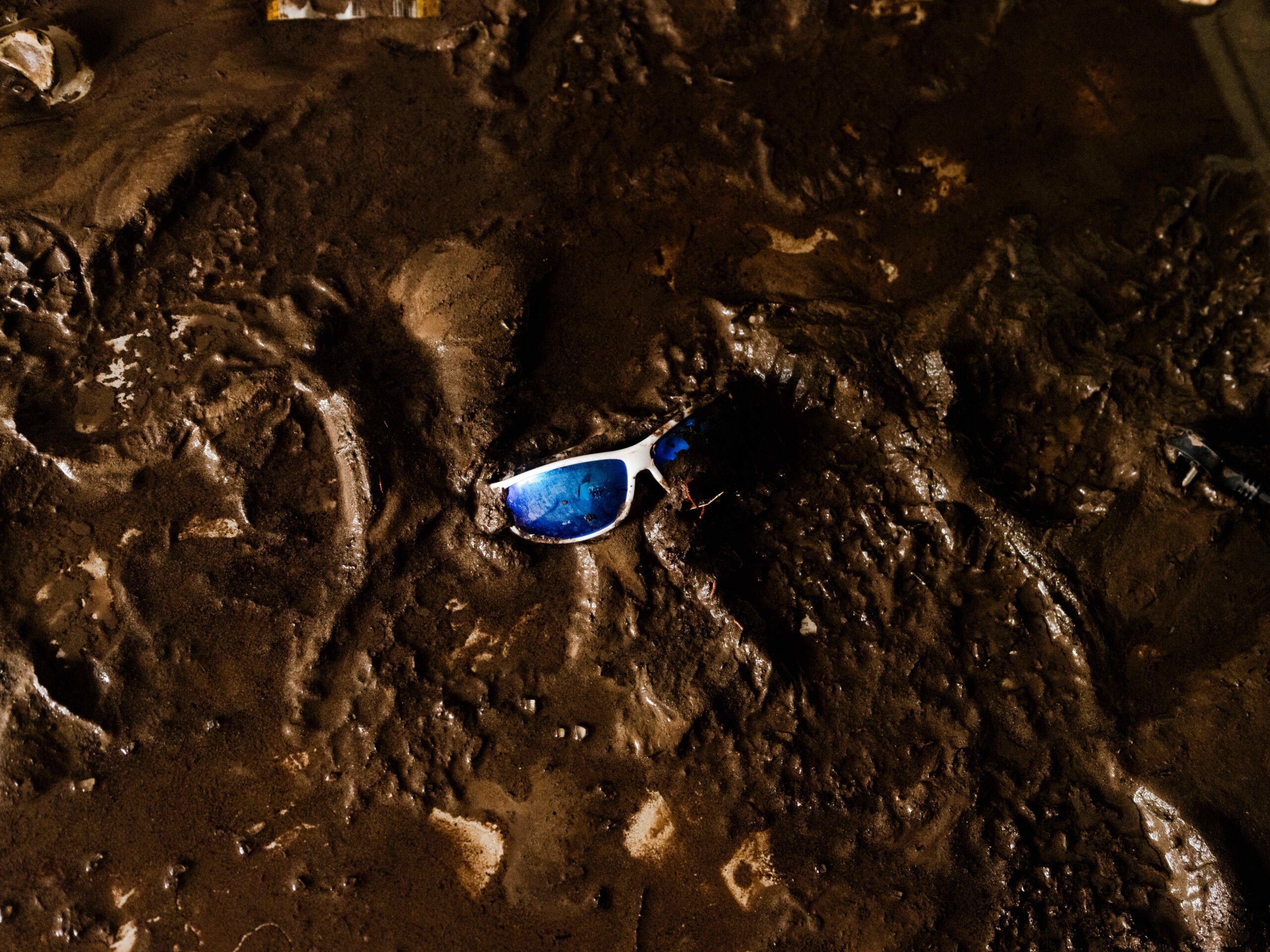
I walked into an apartment slipping and stumbling on mud so thick I couldn’t see the floor underneath. The table in the dining room was set, decorated with charger plates, flowers, and napkins nicely folded. The mud and debris covered everything. On the wall, I saw a red, white, and blue garland with American flags, a reminder that the day prior had been the Fourth of July. I tried to imagine the life, or lives, that had been lived in this place. A pair of sunglasses, left behind, caught my eye.

I studied water. I studied rivers and tributaries and floodplains and watersheds. Hydrology was a main focus of my research as a student of environmental science at the University of Texas Rio Grande Valley. I even attended a summer program at the National Water Center in Tuscaloosa, Alabama, in 2016 that focused on flood mapping and emergency response. But theory is one thing, and seeing 100-year-old cypress trees laying flat on the ground, completely uprooted, is another. 

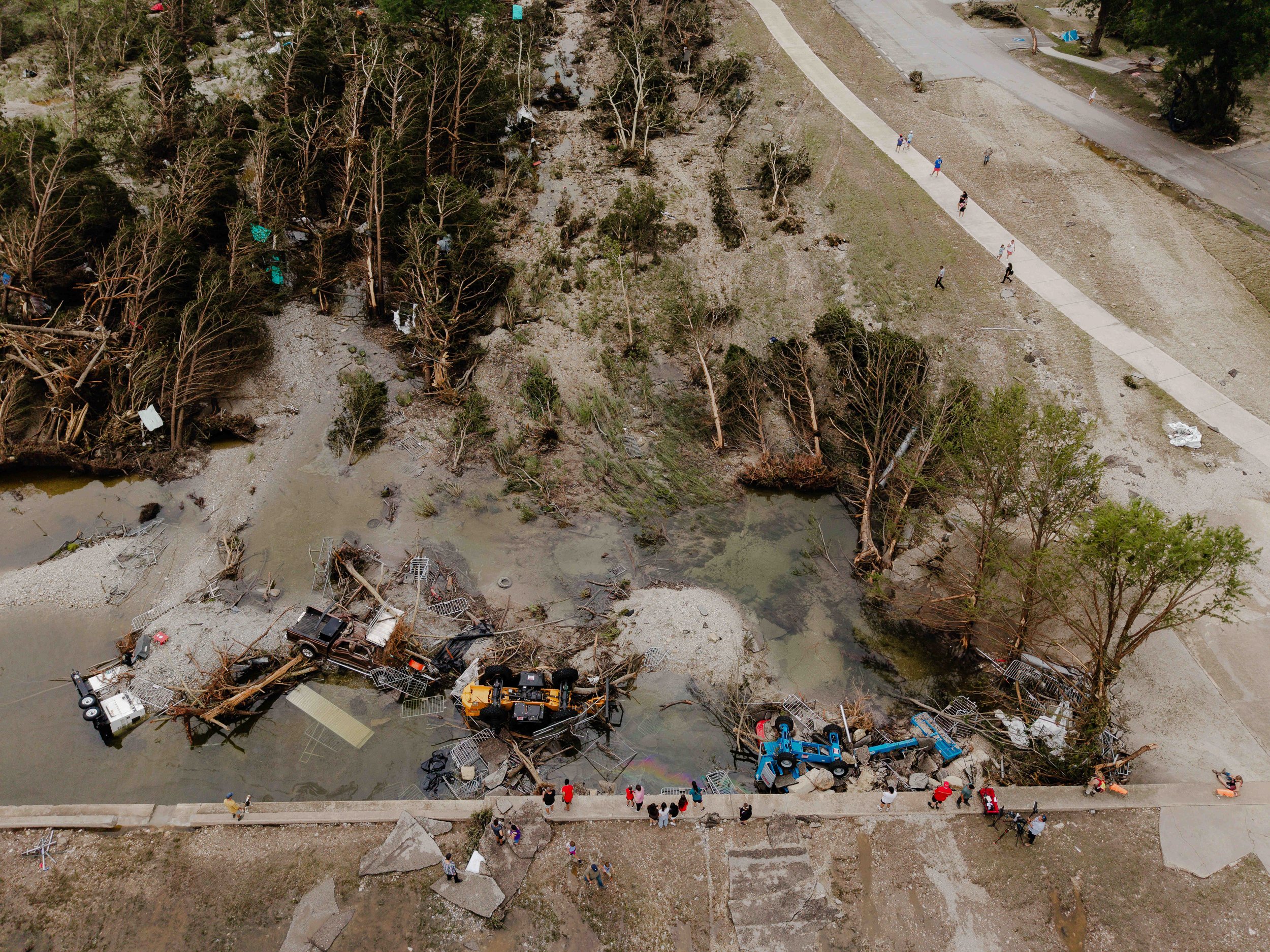
I accepted the surreality after seeing a kayak stuck 20 feet high up, on a tree branch, among other things that were absurdly out of place. Hills of mud, vegetation, and personal artifacts deposited by the flood had changed the landscape. It all told the story of what had happened that early morning. Everywhere I went along a 30-mile or so stretch of the Guadalupe River, there were excavators and people digging, looking, hopeful to find the missing. The scale of the devastation, the search and recovery efforts, and the grief—all things unfathomable to me, even after I witnessed them.


Community members survey the damage left behind in Kerrville’s Louise Hays Park.
The interior of a beauty salon in Ingram
A woman looks at fallen trees in Kerrville on July 5.
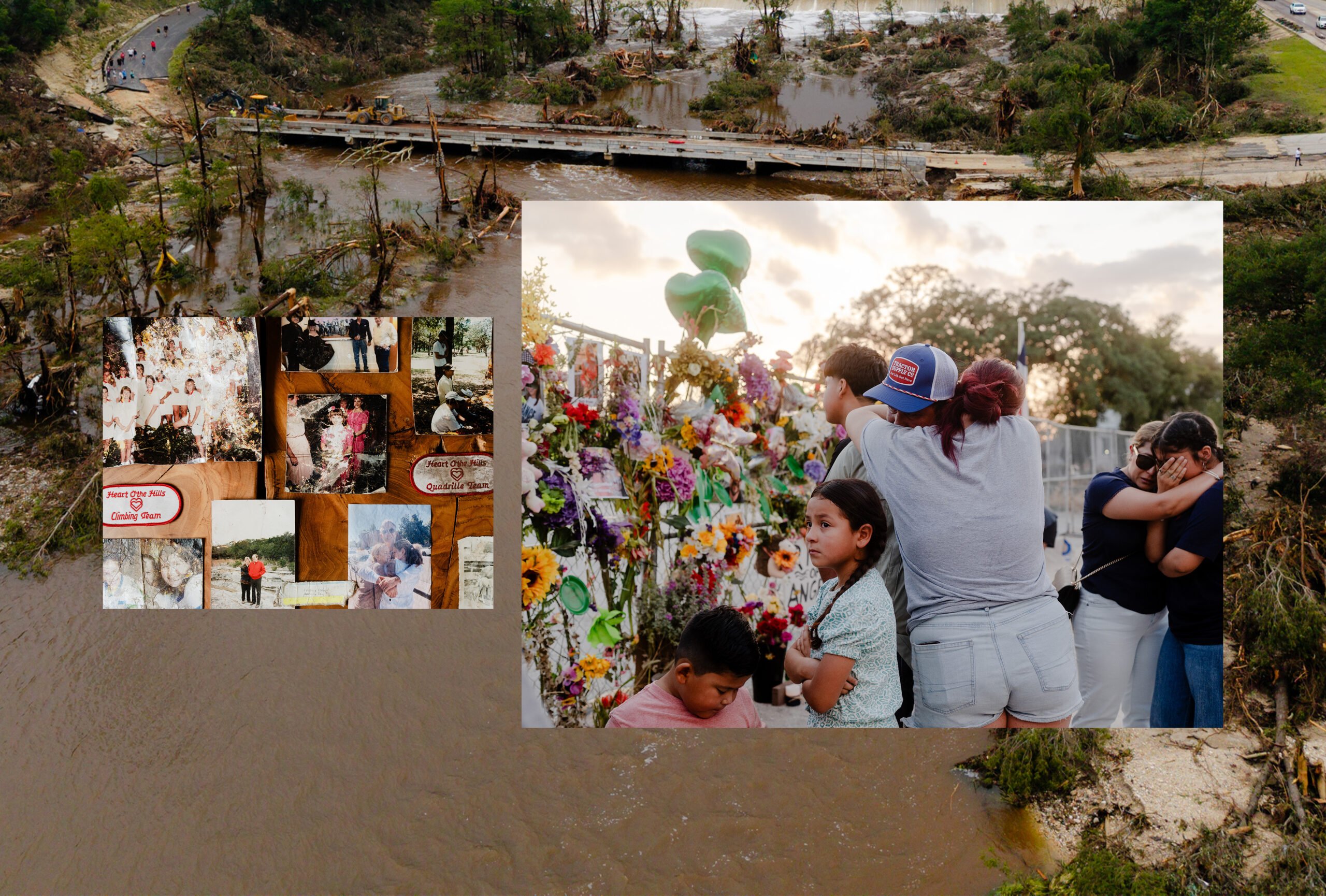
Left: Found photos and patches from the Heart O’ the Hills camp Right: Community members honor victims with a July 11 vigil and memorial.
Grieving at Cross Kingdom Church in Kerrville on July 6
A small American flag on the trunk of a fallen tree in Ingram

The post Where the Water Reached appeared first on The Texas Observer.

02 Sep 18:57

I Got Tenure and Now I Can’t Seem to Form Simple Declarative Sentences

by Aarushi Ahuja

When I received the email, I was holding a piece of toast. Dry, no butter. I remember this vividly because it was the last thing in my life with a clearly defined purpose.

“You got tenure!” my partner said, beaming.

“Oh! That’s… great,” I replied. “I think?”

And so it began.

In the weeks since, I’ve found myself unable to commit—grammatically, affectively, institutionally. Where once I might have said, “I teach,” I now say, “There are moments in which I find myself adjacent to pedagogy.” Friends have grown concerned. My dog, unfed.

I went to text my partner: “Be home soon.” Instead, I wrote, “Circling back into the infrastructural imaginary of shared dwelling—if, indeed, dwelling can be shared.” They replied with a thumbs up, which I interpret as either affirmation or resignation. Or both. Or neither.

Soon, everyday phrases became impossible. “I’m hungry” became “There emerges, within this organismal enclosure, a not-unfamiliar sense of lack—interpretable, perhaps, as nutritional, though not necessarily limited to metabolic vectors.”

I have begun chewing paper.

My lectures, once widely engaging, are now transcribed by AI and flagged for incoherence. Last Tuesday, I opened class with:
“If we are to approach the concept of ‘knowledge’ not as a static repository but as a contested site of epistemological re-inscription, then what does it mean to ‘learn’—and indeed, to ‘teach’—within the biopolitical constraints of the neoliberal university?”

A student raised their hand and asked if the midterm would still be multiple choice.

I told them, “Choice is an illusion constructed by the pseudo-industrial complex.”

Their hand lowered. Their spirit, too, perhaps.

Email has become a crucible. I can no longer say “Attached is the draft.” I must instead write, “Enclosed—though, of course, enclosure itself is a problematic modality—please locate a text-in-process, emergent rather than concluded.”

My signature is now required to include a content warning.

A colleague invited me to give a talk. I responded, “While I’m open to the performative potentialities of ‘giving’—insofar as knowledge can be gifted, rather than problematically imposed—I hesitate to endorse the teleology implied by the word ‘talk,’ especially when situated within extractive academic economies of listening.”

She replied, “Cool! Just let us know by Friday.”

I haven’t. I can’t.

Hence, resultantly so, as forth, conferences have become a nonzero variant of impossible. My last presentation was titled: Re-Reading the Readings: Toward a Non-Linear Lexicon of Deferred Legibility in the Wake of the Wake of the Wake. I read directly from a shattered mirror.

My partner recently asked, “Do you love me?”

I said, “I think it’s worth troubling the verb.”

They have not asked again.

Following a breakdown in domestic consensus—rooted, perhaps, in divergent interpretations of “emotional labor”—I’ve been spatially reallocated to the couch.

I sleep, but not where I once was legible. I dream of saying, “The cat is on the windowsill.” But even in subconscious nocturnal cognition, it emerges as: “The feline positionality vis-à-vis the aperture suggests a liminal domesticity—perched, perhaps, on the edge of knowability.”

Perhaps, then, the question is not what has been lost, but what remains articulable. Can one possess tenure and still say: The cat sat on the mat?

Or must it forever become: The feline subject, as situated in relation to the liminal textile geography of its domestic enclosure, performs a politics of stillness that refuses legibility within traditional narrative structures of action and intention?

Or, not become, but rather, hover—inhabit—subtend. The mat, no longer substrate, but site. The sitting, no longer action, but archive. The cat, of course, theoretical.

These are not rhetorical questions. They are, at best, para-utterances enacted at the jagged edge of discursive thresholding, within what Glissant might term opacity, or what Foucault might name the gaze. Or the gaze’s gaze. Or the gazed.

As Watzlawick remarks, “One cannot not communicate.”

And so, I ask: Institutionally, interstitially, and perhaps, bacterially speaking—

Or rather: Structurally, psychospiritually, and under the lingering haunt of Enlightenment taxonomies—

Who among us is the subject, really

[EDITOR’S NOTE: At this point, the manuscript became illegible. The author appears to have footnoted a semicolon.]

02 Sep 18:53

Saturday Morning Breakfast Cereal - Chew

by Zach Weinersmith


Click here to go see the bonus panel!

Hovertext:
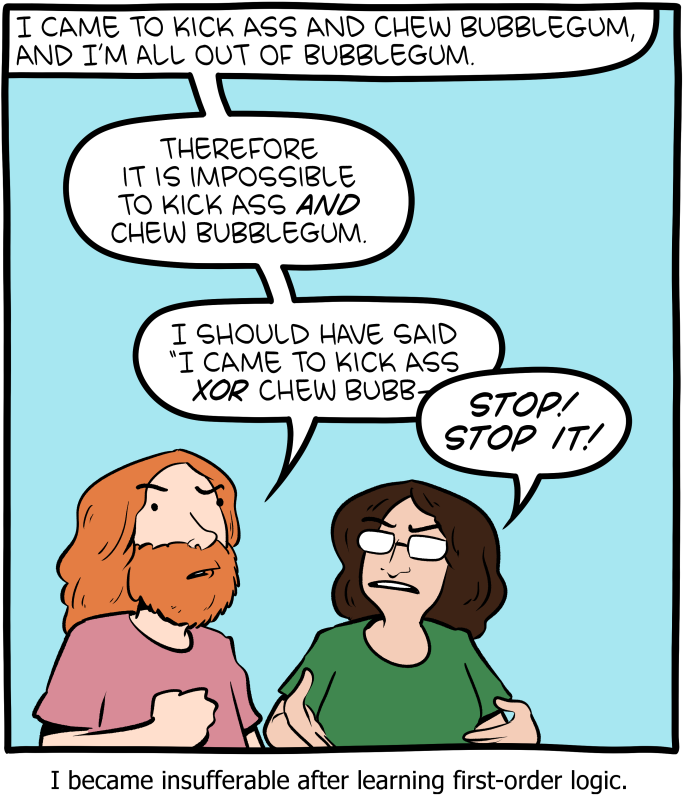
There was a fairly intricate debate on an early version of this posted to bluesky, the contention being over whether OR was sufficient. I think the ORs have it, but XOR is a funnier word, so there.


Today's News:
02 Sep 17:09

how do I repair my relationship with my new manager after a series of personal crises?

by Ask a Manager

A reader writes:

I’ve been with my company for about three years and in my current department for two. In March, I moved to a new position in my same department after my previous supervisor said I was one of his best performers.

But then I got really sick and other things went wrong (such as my spouse having a car accident), and I ended up getting really, really behind. It didn’t help that my doctor refused to fill out FMLA paperwork because he hates paperwork.

Ever since then, I feel like everything that can go wrong has, but all my new supervisor can see is me making excuses for why I’m not caught up yet. She’s repeatedly told me that this is not the performance she expected from me, but I am literally fighting tooth and nail to get caught up. I’ve taking to using energy drinks and nicotine pouches every day to force myself to stay awake, and working the rest of the time to get my work done. I’m not even spending time with my family, and I am constantly stressed to the point of tears because I am so frazzled and so scared of losing my job.

She has gone from being really sweet and kind (telling me to feel better if I have a migraine) to rather cold and short (one-word answers or a thumbs-up). I’m terrified I’m going to lose my job at a company I love, but I also have no idea how to recover this relationship once I’m back where I need to be (and hopefully ahead like I usually was).

I already have a sincere apology planned when I am back in line, but what else should I do? How can I recover this relationship?

First, can you talk to your old supervisor about what’s been going on and share your concerns with him? Let him know you’ve had this perfect storm of crises in your personal life, it’s affected your work, and you’ve been working as hard as you can to get caught up but you get the sense that your new manager is really unhappy with you, and ask for his advice. The ideal outcome to that conversation would be that your old supervisor could talk to your new one, assure her that what’s been going on isn’t typical and is due to external events outside your control, and that if she can give you some grace to get through this period, she’s likely to be really happy with your work. In fact, if he doesn’t offer that, you could explicitly ask if he’d be willing to do that.

Second, talk to your new manager yourself. You said you’re planning to do that once everything is more under control, but you should do it right away — because the sooner you try to reframe things for her, the better. Say that you’ve had multiple things go wrong outside of work, you’re dismayed by how it’s affected your job, and you have been working as hard as you can to get everything under control, and ask for some grace to get through this period. You can even say something like, “I think if you talk to OldManager, he’ll tell you this isn’t typical for me at all.”

Ideally, you’d also ask for her help in figuring out a more realistic approach to getting things back on track. Yes, it’s important to get caught up, but only within reasonable human limits; it shouldn’t mean needing nicotine patches, not seeing your family, or always being stressed to the verge of tears (and that approach is likely to backfire at some point anyway because you’re not going to be in the right state to do strong work). A good manager would look at what’s happened, see where you are and what still needs to be done, and work with you to come up with a plan to get caught up without coming at the expense of your mental or physical health.

Caveat: that’s what a good manager would do. I don’t know whether yours falls in that category or not. It’s true that this is harder for both of you because you’re new (which means there’s no existing bank of capital and credibility that would be built up if you had worked for her for longer before this all happened), but her being short and cold and telling you repeatedly that this isn’t the work she expected from you (without offering any support, it sounds like?) … aren’t great marks in her favor. So part of me also wonders if returning to your previous supervisor is an option, if a candid conversation like the one I described above doesn’t help things.

The post how do I repair my relationship with my new manager after a series of personal crises? appeared first on Ask a Manager.

02 Sep 17:04

Boss wants lots of guys!

Boss wants lots of guys!

02 Sep 17:03

Why Canada is planning its first trip to the Moon now

The mission is part of what Canadensys Aerospace calls a "broader strategy of really moving humanity off the Earth".
02 Sep 17:02

CEO who snatched boy's hat at US Open says he made 'huge mistake'

Piotr Szczerek was "convinced" tennis star Kamil Majchrzak was passing him the hat, he says while apologising for the viral incident.
02 Sep 17:01

Trump's use of National Guard in Los Angeles was illegal, judge rules

The ruling comes as Trump seeks to use National Guard troops in order to crack down on crime in other US cities.