Shared posts

11 Sep 03:05

As we hit the statistical peak of hurricane season, we find ourselves in a weird position

by Matt Lanza

In brief: Why is the tropical Atlantic hitting the historical peak of activity with not a wave to be found? We explain the details below, but it looks quiet for the next 7 to 10 days. Beyond that, risks will surely increase a little but how much so remains a topic of uncertainty.

Happy Tuesday evening everyone. Late today due to participation in the National Weather Association’s 50th anniversary meeting in Huntsville, Alabama, a fine city. But I wanted to catch you up on the historical peak of hurricane season.

Tropics outlook

The next 7 days look quiet. (NOAA NHC)

The outlook is the “not stonks” meme for those of you familiar with internet culture.

I mean, truly, it’s just quiet as could be. Now, it does appear we may get a wave in about 7 days in the open Atlantic that could develop. But that’s the only game in town for the next 10 days it would appear.

The next wave will emerge off Africa in a few days and may develop in 7 to 9 days in the open Atlantic. (Weathernerds.org)

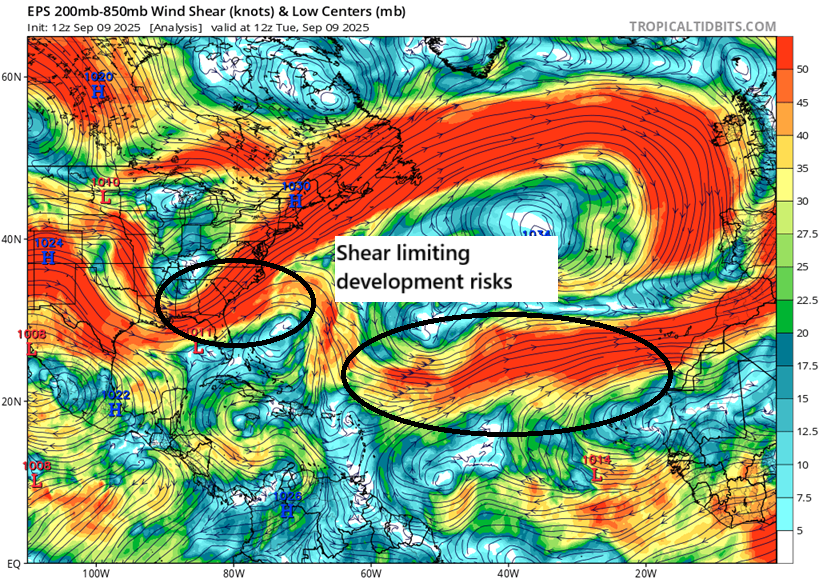
An upper low in the central Atlantic, known as a “TUTT” is imparting shear on basically anything that comes off Africa, so they instantly hit a hostile environment. Additionally, there is a lot of drier air in the open Atlantic, which is not helping anything. TUTT lows drag down drier air from the subtropics into the tropics. A lack of instability, drier air, and shear are all decimating any chance at development right now. Climatology is as good a guide as anything when you look at seasonal predictability and timeframes for activity, but if the key ingredients aren’t there, they aren’t there. The cookbook recipe may say that the cake needs flour, butter, and eggs. But if you leave the flour and butter out, you aren’t baking a cake using that recipe.

Strong wind shear is hampering development, in addition to other factors. (Tropical Tidbits)

In addition to this, in the western Atlantic there is high wind shear as well. So we have a number of highly problematic factors right now as it relates to tropical development. Good for almost everyone!

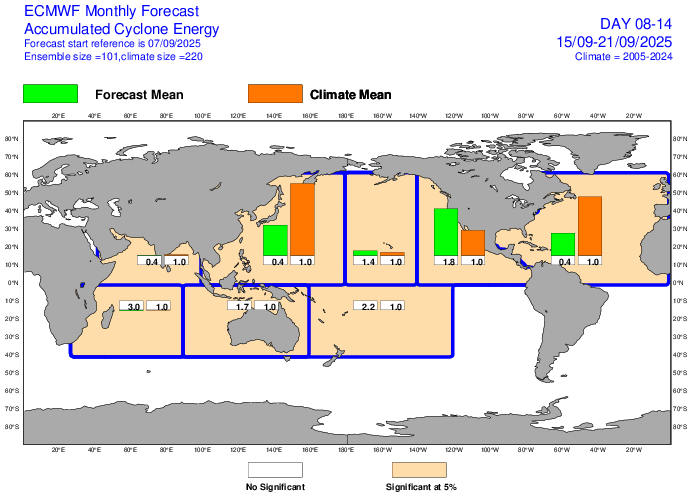
Now, after 10 days the forecast in the Atlantic seems to favor a slightly more favorable shift for tropical activity. At least we should see more instability out there. That being said, I have seen a couple instances this hurricane season where tropical Atlantic conditions were expected to become more favorable “in 10 to 14 days,” and those conditions ultimately never materialize. That could be true here too. But given our streak of good luck, one figures it can only last so long. At the least, we will probably start to see GFS operational model runs showing tropical development in the Caribbean or Gulf soon. Please remember that this model has a very well-known bias to overdo that activity in most cases, particularly beginning in later September and October, as well as in May and June.

Bottom line: Enjoy the respite from peak season activity. But we still have about half the season’s activity in front of us historically. We’ll keep you posted.

10 Sep 22:59

This and That: Antony Gormley & Terry Allen

by Courtney Thomas

“This and That” is an occasional series of paired observations. See past “This and That” posts here. – Ed.

Today: Metal man leans into a wall

A photograph of a sculpture by Antony Gormley of a human figure made of cast iron and leaning its head and arms onto a white wall.

Antony Gormley, “Test: Lean,” 2021, cast iron, 60 7/8 x 19 5/16 x 43 11/16 inches


A photograph of a bronze sculpture of a man leaning over with his head appearing to vanish into a wall. Artwork by Terry Allen.

Terry Allen, “Corporate Head,” 1990, bronze. Citi-Corps Plaza “Poets Walk,” Downtown Associates, Los Angeles, California

*************

No matter how original, innovative or crazy your idea, someone else is also working on that idea. Furthermore, they are using notation very similar to yours. – Bruce J. MacLennan

The post This and That: Antony Gormley & Terry Allen appeared first on Glasstire.

10 Sep 22:59

Recapping the 2025 Armory Show

by Jessica Fuentes

I just returned from a whirlwind trip to New York City and Washington, D.C. I was in NYC for the 2025 Armory Show, my first time to attend the fair. It’s always funny to me when I find myself so far away from Texas but still surrounded by Texans and Texpats. This trip was no different. At the fair I focused much of my attention on Texas galleries, Texas artists, and artists that had recently shown in Texas. Even when I wasn’t trying to find them, Texas connections popped up: I ran into Texas curators and randomly found myself chatting with art advisors and artists with Texas roots. I also reconnected with Max Anderson, the former Dallas Museum of Art director and current COO & CEO of LMI Group, the data science company that serves the arts and culture sector, and President of Souls Grown Deep Foundation, an organization that holds a significant collection of works by Black artists from the Southern U.S.

A photograph of the entrance to The Armory Show.

The Armory Show, 2025

As a first-time attendee, I’ll start my recap of this year’s fair with some background about the Armory. In 1994, four New York City gallerists launched the Gramercy International Art Fair as an accessible fair for emerging artists and galleries. The first few years it was hosted at the Gramercy Park Hotel, with hotel rooms serving as exhibition booths. Five years later, the fair rebranded as The Armory Show when it moved venues to the 69th Regiment Armory on Lexington Avenue, in honor of the historic 1913 Armory Show, a groundbreaking exhibition of Modern Art in the U.S.

Over the past 30 years the fair has become a staple in the art world; as New York’s largest fair it attracts over 50,000 attendees. In 2023, Frieze acquired both The Armory Show and EXPO CHICAGO. The following year, Nicole Berry, who had served as Executive Director of The Armory for eight years, took a position at the Hammer Museum, and Kyla McMillan was named the fair’s new director.

A headshot of gallerist and curator Kyla McMillan.

Kyla McMillan. Photo: Alexandra Genova/Frieze

McMillan, who had previously worked at galleries such as David Zwirner and Gavin Brown’s Enterprise and founded the gallery and consultancy Saint George Projects, stepped into the new role in July 2024, just a few months before that year’s fair. She told me that because the fair takes nearly a year to plan, she did not have much of a hand in the development of last year’s Armory Show. 

Now that she’s been in the role for over a year, I asked McMillan what about the fair she thought was working well, and where she saw space for growth. She explained, “One of the most positive things of the fair when I walked in last year was the incredible presence of all of the great American collectors that you want to see at a U.S. fair. Obviously, largely New Yorkers, but also from around the country, and really North America too, but it felt important to build on that. So we’ve been on a North American tour this year, going to different regions, because while New York is the art market capital, there are so many other vital communities throughout the U.S. that make the American collector base so essential. So it was really about meeting people where they are. It’s been incredible to build on that, but that foundation was already in place, so it was something we could amplify.”

While McMillan didn’t directly touch on the current instability in the art market, her thoughts point to an understanding that new approaches are needed in these uncertain times. This summer, renowned gallerists Tim Blum and Adam Lindemann announced closures, and the Art Dealers Association of America canceled the 37th edition of its fair, The Art Show.

McMillan went on to note that with The Armory now in the Frieze network, the fair has the potential to be “a North American anchor.” She said, “Of course we have galleries that come from 35 countries and for those who come from outside of the U.S., and outside of North America more specifically, the goal is to really engage with collectors who are based here. But, [for those galleries that] are also based here, there is nothing comparable to 50-60,000 people walking through the doors. There’s an incredible opportunity for discovery.”

The Armory Show is broken down into sections, some of which are clearly defined by their titles — Galleries, Solo, Not-For-Profit — and others that present work through themes or other groupings. For example, the Presents section features emerging galleries that are less than 10 years old with showcases of solo or two-person presentations. I was disappointed that out of the nearly 50 exhibitors in this section, there was only one Texas gallery present, Houston’s Seven Sisters. Every time I popped by the booth on the preview day, gallerist Erin Dorn was swamped fielding questions and inquiries.

A photograph of a crowd gathered around an exhibition booth at an art fair.

A view of the Seven Sisters booth at The Armory Show, 2025

The booth paired sculptors Julia Kunin and Katarzyna Przezwańska, who are both making work in Eastern Europe. Kunin’s ceramics, which fuse organic shapes of the human form with geometric architectural structures, make a nice counterpoint to Przezwańska’s more delicate surreal works that incorporate natural materials, including shells, rocks, and plants.

An installation image of works by Julia Kunin and Katarzyna Przezwańska.

An installation view of works by Julia Kunin and Katarzyna Przezwańska on view in the Seven Sisters booth at The Armory Show, 2025

Dorn told me, “As we approach our second year of opening, showing at the Armory was a significant milestone. The support and visibility were unmatched, and it was deeply inspiring at this point in Seven Sisters’ journey.”

While Presents highlights emerging spaces, the Focus section, a grouping of a dozen or so galleries, is centered on a theme. Recent themes have included Passages, which was “inspired by the experimental spirit of the fair’s founding” and the namesake 1913 show, and Inheritances: material and otherwise, which brought together works by artists exploring materiality as a way “to manifest histories.” This year, the Focus theme was The American South.

A photograph of curator Jessica Bell Brown.

Jessica Bell Brown

Selected by McMillan the theme was brought to life by Jessica Bell Brown, the Executive Director of the Institute for Contemporary Art at Virginia Commonwealth University, who curated the section. McMillan explained the reasoning behind spotlighting the South, stating, “We think about [the South] a lot, even in institutional contexts, certainly more largely culturally within social, political, [and] historical contexts, but it feels special to spotlight artists and galleries of the South in a commercial context and bring the market conversation to the fore.” She also noted that the theme shows up as a throughline of this year’s fair, including in the Platform, Presents, and even the main Gallery and Solo sections.

A photograph of Bart Keijsers Koning and Michelle Cortez Gonzales posing in an exhibition booth at an art fair.

Bart Keijsers Koning and Michelle Cortez Gonzales in the Keijsers Koning booth at The Armory Show, 2025

The Focus section included two Texas galleries: Keijsers Koning of Dallas and Martha’s from Austin, both of which featured Texas artists. Just two weeks before the fair’s opening when one gallery dropped out of the section, Keijsers Koning was invited to exhibit. The gallery brought works by Dallas-based sculptor Tamara Johnson and Fort Worth-based interdisciplinary artist Michelle Cortez Gonzales.

A photograph of sculptural works by Tamara Johnson.

Works by Tamara Johnson on view in the Keijsers Koning booth at The Armory Show, 2025

Johnson exhibited hyperrealistic works from across her oeuvre, including a seeming chain-link fence gate (made from PVC pipe, rope, resin, and other materials), a cast pewter saltine cracker, and a colander (made from hydrocal gypsum, fiberglass, and other materials). Her playful and unexpected sculptures had attendees doing a double-take, particularly Forever Blue Tape #2, a 2023 piece made of Tyvek and gouache, that looked as if the gallerist left a remnant from installing the booth. Cortez Gonzalez’s mixed media paintings incorporate oil paint and lace, sometimes on canvas and other times with the lace as the grounding material. Her layered pieces speak to memory and family history, drawing imagery from old family photographs. 

Bart Keijsers Koning told me, “It was important to me to show these two voices because I felt they both embody a story of Southern America that isn’t seen enough on a stage within the art world. Two females dealing with their heritage and presenting a narrative from within the South/Texas.”

A photograph of gallerists Ricky Morales and Meredith Williams at an exhibition booth in an art fair.

Ricky Morales and Meredith Williams in Martha’s booth at The Armory Show, 2025

Nearby, the Austin-based gallery Martha’s showed a handful of works by RF.Alvarez, whose sensual figurative paintings illustrate queerness in Southern scenes. The booth’s central piece, We’re Still Here! references Paul Cadmus’ The Fleet’s In! (1934), a work censored by the U.S. Navy for its depiction of queerness. Alvarez’s scene plays out in a honky-tonk. Meredith Williams, Owner and Operations Manager of Martha’s told me that at the end of the fair’s preview day the booth had almost completely sold out. By the end of the fair, each of the six pieces had been purchased. 

Additionally, Alvarez was named the winner of Delfina Foundation Artist Residency Prize, one of three prizes awarded as part of the fair. The prize is supported by Suzanne McFayden and the Delfina Foundation’s Network of North America Patrons and is granted to artists from or based in a Southern state exhibiting with a gallery in the Focus section. As its winner, Alvarez will participate in a 12-week residency in London in 2026.

Regarding the award, Alvarez told me, “I’m over the moon. The Delfina Foundation — and its focus on research and creative dialogues — will be an incredible opportunity to both sharpen my practice and explore new avenues of creation. I’m interested, for example, to see how the themes and motifs of my work can be explored beyond painting, beyond static image. I think London will be my chance to see how that manifests.”

An installation of black and white photographs by Baldwin Lee.

An installation view of works by Baldwin Lee at the Howard Greenberg Gallery booth at The Armory Show, 2025

I was glad to see Texas galleries and Texas artists represented in the Focus section, but I also enjoyed the broader investigation of the idea of “the American South.” Though some of the galleries listed in the section were from places like New York, Los Angeles, Baltimore, Montréal, and Lima, Peru, most of them exhibited works by artists who were born in or are currently living in the Southern U.S. 

An installation image of paintings by Works by Aineki Traverso.

Works by Aineki Traverso on view in the Wolfgang Gallery booth at The Armory Show, 2025

Other galleries presented artists from the Global South, reminding that while people in the U.S. defer to using “American” as an identifier, to many living in South America, Central America, and even other parts of North America, the term “American” or “Americano” has a broader meaning. While I agree that this broader definition is important to recognize, more representation of galleries based in the Southern U.S. could have brought an additional spotlight to trends emerging in the region. 

An installation image of textile works by Santiago Yahuarcani.

Works by Santiago Yahuarcani on view in the Crisis Galería booth at The Armory Show, 2025

A photograph of people walking around an art fair with large abstract quilts hanging nearby.

An installation view of Gee’s Bend quilts on view in the Platform section of The Armory Show, 2025

This year’s Platform section, which showcased large-scale sculptures and installations, was curated by Raina Lampkins-Fielder, the Chief Curator of Souls Grown Deep Foundation. Of course Gee’s Bend quilts, from the Foundation’s collection, took center stage, displayed from wires as if they were hanging on a clothesline. Additionally, several works by Thornton Dial, also part of the Foundation’s collection, had a large presence in the section. Beyond pieces from Souls Grown Deep were works by Allison Janae Hamilton (Marianne Boesky Gallery) and Simon Benjamin (Patron).

An installation of sculptural chairs, one pair sits on a mirrored floor.

An installation in the Function section of The Armory Show, 2025

New to this year’s fair was the Function section, curated by Ebony L. Haynes, Senior Director at David Zwirner and 52 Walker, which, according to the Armory’s website, highlights how artists “engage with and puncture the tenants of design.” In an interview on the fair’s website, Haynes noted the desire to “blur or co-mingle” art and design, which are often considered on a binary of “high” and “low” art, respectively. Of the curatorial decisions in this section, she further explained, “Chairs refuse to be sat on, textiles insist on their sculptural presence, and objects slip between function and uselessness. In this back-and-forth, design punctures art with the language of the everyday, while art punctures design by stripping it of use.”

Like most fairs, the 2025 Armory had a lot going on. There were impressive standouts, familiar favorites, and questionable choices. More than 230 exhibitors were featured in this year’s fair, including over 70 new galleries that had never participated before and more than 20 exhibitors who have returned after taking a hiatus from the event. Overall, the fair was impressive in its depth, representation, and thoughtful curation. 


Editor’s note: The author’s travel expenses and accommodations were partly subsidized by The Armory Show.

The post Recapping the 2025 Armory Show appeared first on Glasstire.

10 Sep 22:58

my new team thinks they’re incredibly overworked, but they actually do nothing

by Ask a Manager

A reader writes:

What do you do when you work with a team that seems to ignore the reality of a job?

I’ve been seconded to a team within my organization. Thank God, it’s only for a few months. The team is absolutely huge and amount of work we have is light at best. I’ve never had so little to do at work before. I actually tracked it today, and in the space of a 10-hour shift I did 46 minutes of work.

And that would be fine — it’s only for a few months, and I can use the time to make connections and contacts and work on some projects I’ve always wanted to pitch and never had time to. What I’m struggling with is how the team behaves, more specifically how busy they think we are. To be honest, it’s … bizarre.

There’s a firm belief that this is the busiest, most in-demand team in the organization — constantly working, putting out fires, no one is as under pressure as we are. This belief persists even when one person is openly reading War and Peace in the office. The other day I spent four hours helping a colleague list his (extensive) record collection on eBay.

I think some of it stems from the fact that the team believes simple tasks need several brains. It’s not uncommon to see four people tackling a request that in a normal office, one person would comfortably manage. (I’ve noticed that beyond the inefficiency, this adds a layer of unnecessary complexity and confusion to proceedings.)

On one occasion, I needed to call an external stakeholder with a 30-second, yes/no question. Think, “Would you be able to send me that spreadsheet you made last week?” Very normal. The person sitting next to me insisted on looking up the number from our database (which I have access to) and reading it out to me, on the basis that I was “already going to have to make a phone call.” Make a phone call. In an office. Can you imagine.

The weirdest part of all is that I’ve actually asked if there’s more tasks I can take on, only to be told that “there’s not much work in this role.” There’s a weird cognitive dissonance at play — people openly acknowledge there’s little to do, yet still believe they’re operating at full capacity. It’s as if the performance of being busy has replaced the reality of meaningful work.

I’m doing my best, but I’m just really struggling to go along with the Pantomime of Busyness. I’m routinely asked “how I’m coping” or get comments about how crazy my day has been, and I’m really struggling to continue the pretense that this is anything other than a vacation for me.

If I make any type of comment about it, they get very, very offended. Maybe I should just be kind and join in the “we’re so busy” comments? Is that the right thing to do?

I have spoken to my manager and she was also extremely offended that I’d acknowledged the big, pink, under-utilized elephant in the room. I’m at a total loss.

Is there any script for what I can say when people are complaining about being busy, while simultaneously organizing their book collection alphabetically?

First, I love that the subject line of your email to me was “the team that work forgot.”

In any case, this is actually kind of amazing! How is possible to have people alphabetizing their book collections, listing their record collections on eBay, and literally reading War and Peace (!) at work while still feeling so beleaguered by the workload?

It’s a fascinating collective delusion, and since you have been unable to break the spell they’re under, all you really can or should do is sit back and try to enjoy it as entertainment.

I would have a different answer if you were stuck there long-term. In that case I’d encourage you to think about getting out, because staying in an environment where nothing happens would be bad for your career in the long-term; it would limit your ability to develop your skills and build your professional accomplishments. But you’re only there for a few months, so that’s not a concern! You have the luxury of looking at it as dropping in on a very weird planet where you’re glad you don’t have to remain.

(Side note: imagine coming in as a new manager of this team and having to convince these very stressed people that they need to produce more than the tiny but apparently quite onerous amount of work they’re currently producing.)

As for what to say when people complain about being busy: you’ve seen it doesn’t work to try to get them to see reason, so just make vaguely sympathetic noises and count down the days on your calendar until you’re out of there.

The post my new team thinks they’re incredibly overworked, but they actually do nothing appeared first on Ask a Manager.

10 Sep 22:55

how should I let coworkers know my fiancé and I broke up?

by Ask a Manager

A reader writes:

My fiancé and I just broke up after 6.5 years together. The underlying factors contributing to the split had been percolating for a long time, but the actual break-up happened very suddenly and unexpectedly, and I’m in a lot of pain right now.

I was wondering if you had any scripts for how to broach this subject at work. I’ve talked about my partner, his career, our upcoming wedding, etc. a lot to my coworkers, and many of them have met him. I don’t know how to now announce that we broke up without trauma-dumping, but obviously I can’t just pretend that we’re still together.

I’m sorry!

You don’t need to make a big announcement at all. You can simply stop mentioning him and if it comes up organically (like if someone asks a question about him or is otherwise says something that clearly assumes you’re still together), you can say, “Oh, we’re not together anymore.” The person might look sad and say they’re sorry to hear it, and you can say “thank you” and quickly pivot to a different topic. That’s really it! People at work aren’t likely to be expecting you to go into the details, and it’s perfectly fine to just deliver the news when it’s directly relevant and not let the conversation get mired in it.

If at some point it gets weird that people are clearly still assuming your wedding is approaching, you can always address it more proactively (“I’d mentioned I’d be out in November for my wedding and honeymoon, but Ray and I actually split up so unfortunately that’s no longer the plan”) but the same principles apply — don’t dwell on it, don’t give details, just deliver the basic fact of it and leave it there.

The post how should I let coworkers know my fiancé and I broke up? appeared first on Ask a Manager.

10 Sep 22:50

Saturday Morning Breakfast Cereal - Same

by Zach Weinersmith


Click here to go see the bonus panel!

Hovertext:
The crumbs on the couch are, however, new.


Today's News:
10 Sep 17:32

✨ French CanCan 10 years anniversary ✨

by kekeflipnote

Je pense que beaucoup d'entre vous m'ont découvert avec l'animation du French CanCan il y'a 10 ans lorsque je l'ai posté sur Tumblr.

Votre soutien n'a cessé de grandir depuis et je vous suis très reconnaissant, merci pour tout !

Vos messages, les commentaires marrants ! J'ai hâte de poursuivre et de continuer à poster autant que je le puisse pour votre divertissement !

Today makes it 10 years since I posted the French Can Can on my Tumblr account and many of you discovered me with it and kept supporting me since.

-------------------------------------------------------------------------------------------------------------

I want to thank you all for your support and love, it makes me so happy to know I can be appreciated this much for my Flipnote animations!
10 Sep 17:32

We are NOT doing Stonehenge.

We are NOT doing Stonehenge.

10 Sep 17:32

Yeah, yeah, yeah. Speed it up! We’ve got some things we wanna get to.

Yeah, yeah, yeah. Speed it up! We’ve got some things we wanna get to.

10 Sep 17:30

4-Year-Old Accepted Into Mensa

by The Onion Staff

A 4-year-old from Illinois who scored 156 out of 160 on an IQ test was accepted into Mensa, the largest and oldest high-IQ organization in the world. What do you think?

“Whoa, that kid must know a lot of colors.”

Kelli Zandman, Junior Chaplain

“I’ve heard enough to hate him.”

Marvin Bybee, Allergy Expert

“My 4-year-old can barely do our taxes.”

Lou Robbins, Rebuttal Writer

The post 4-Year-Old Accepted Into Mensa appeared first on The Onion.

10 Sep 17:30

Trump Claims He Can’t Be Expected To Remember Every Birthday Card He Sends To Child Molesters

by The Onion Staff

WASHINGTON—Stressing that it was unrealistic to think he would recollect one such letter out of the vast number he has written in his lifetime, President Donald Trump told reporters Tuesday that he shouldn’t be expected to remember every single birthday card he has sent to child molesters. “Every month I’m probably sending off a dozen or so of these cards thanking pedophiles for a good time at their birthday parties or for the flight on their private jet—it’s ridiculous to think I’m going to recall each tiny thing I write,” said Trump, insisting that given the hundreds of such dispatches he has penned over the years, the child molesters’ names and the details of their orgies often blur together in his mind. “It’s really just a formality. I want to express a little gratitude for a nice party favor or for letting me spend time with their private harem. Most of the time I’m just repeating the same message, too. Hard to come up with something unique to say about every girl.” Trump revealed that as a time-saving measure, he would often dash off a large stack of such letters to child molesters in advance and fill in the specific details of the underage sex parties later.

The post Trump Claims He Can’t Be Expected To Remember Every Birthday Card He Sends To Child Molesters appeared first on The Onion.

10 Sep 13:40

Hey! Don't do that to my cute little friend! Wh...

Hey! Don't do that to my cute little friend!
Why not?
Cause he's cute!
Cute? Here's what I think about cute! #CowboyWho

10 Sep 13:35

ALT

A comic of two foxes, one of whom is blue, the other is green. In this one, Green is on the ground, with a goal line drawn into the ground in front of him, just out of reach. Exhausted, with great pain and effort, Green stretches and reaches towards the line, groaning, even pushing out his tongue in hopes of making contact with it.

Blue shows up, frowning at Green.
Blue: If you can't meet the deadline, just ask them for more time.
Green: No, I can make it.ALT
10 Sep 13:33

KWBU public radio in danger of going silent after 25 years serving Waco

by Sam Shaw

Last summer, Molly-Jo Tilton, then 21, drove from Austin to Waco, hoping to launch her career as a local radio reporter and end a grueling six-month job search.  Her destination was KWBU-FM, Waco’s small but plucky National Public Radio member station. Each week, its combination of national and local programming reaches an estimated 15,000 listeners […]

The post KWBU public radio in danger of going silent after 25 years serving Waco appeared first on The Waco Bridge.

10 Sep 13:30

Out of date Zodiac signs, visually explained

by Nathan Yau

For NYT’s the Upshot, Aatish Bhatia, Francesca Paris, and Rumsey Taylor show how zodiac signs were determined by the position of constellations relative to Earth and the Sun thousands of years ago. That probably seemed like a good idea at the time, but more accurate measurements and records show that if we continued to go by the relative positions, our zodiac signs would be different.

The interactive elements and animations illustrate the shifts well. Enter your birth date to see how your sign would change, and a night sky moves to show how our perspective changes because of Earth’s wobble.

Tags: constellations, stars, Upshot, Zodiac

10 Sep 13:29

SCOTUS Says ICE Can Use The Family Guy Skin Color Chart For Arrests (But Won’t Explain Why)

by Mike Masnick

You know that Family Guy meme where they have the skin color chart to determine how suspicious someone should be? Yeah, you know the one.

Family guy skin color meme, showing Peter Griffin sitting in a car, with a cop holding up a paint swatch card showing six different color tones. The lighter tones are labeled "okay" and the darker ones "not okay."

Well, the Supreme Court just essentially codified that into constitutional law. And they did it on the lawless shadow docket without a real explanation, because of course they did.

In a stay order issued yesterday with zero reasoning from the majority, the Supreme Court told ICE agents in Los Angeles that yes, you can absolutely detain people based on looking Latino, speaking Spanish, working certain jobs, and being in certain locations. The only “explanation” (if you can really call it that) comes from Justice Kavanaugh’s solo concurrence—which apparently was so legally dubious that not even a single one of the other conservative justices would sign on to it. But it is the only explanation given for the majority ruling.

It reverses two lower court rulings that said, quite reasonably and clearly, that you can’t just arrest people for existing while brown. But hey, why let basic constitutional principles get in the way of a good old-fashioned roundup?

This is yet another example of the Supreme Court’s increasing reliance on its shadow docket to make monumentally consequential rulings without full briefings, oral arguments, or even basic explanations. As we’ve covered extensively, the Court has been using emergency applications to essentially rewrite major areas of law while hiding behind the fiction that these are just “procedural” matters.

The pattern is always the same: government asks for emergency relief, the Court grants it with minimal (if any!) explanation, and suddenly we have new constitutional law that affects millions of people. No deliberation, no transparency, just judicial fiat—always in favor of Donald Trump’s authoritarianism—delivered with no explanation.

Justice Sotomayor’s dissent calls this out directly:

The Court’s order is troubling for another reason: It is entirely unexplained. In the last eight months, this Court’s appetite to circumvent the ordinary appellate process and weigh in on important issues has grown exponentially… Its interest in explaining itself, unfortunately, has not.

She’s absolutely right. When you’re essentially authorizing racial profiling on a massive scale, maybe you should explain your reasoning? But that would require the majority to actually defend their decision, which they apparently can’t or won’t do.

The only justice willing to put his name to an explanation is Kavanaugh, and his concurrence is a masterpiece of unsupported assertions and constitutional hand-waving:

About 10 percent of the people in the Los Angeles region are illegally in the United States—meaning about 2 million illegal immigrants out of a total population of 20 million.

This is a stunning claim that goes way above most credible estimates, and Kavanaugh provides zero citation for it. Just assertions pulled from thin air to justify mass detention in violation of the Fourth Amendment. Other estimates suggest the actual number is less than half of what Kavanaugh claims.

Even more laughably, Kavanaugh suggests that being wrongly detained is no big deal for American citizens because they can just prove their citizenship and be on their way:

Importantly, reasonable suspicion means only that immigration officers may briefly stop the individual and inquire about immigration status. If the person is a U. S. citizen or otherwise lawfully in the United States, that individual will be free to go after the brief encounter. Only if the person is illegally in the United States may the stop lead to further immigration proceedings.

Tell that to Jason Gavidia, the U.S. citizen described in this very case who was pushed against a fence, had his arms twisted behind his back, and whose ID was never returned to him. Did Kavanaugh not read the appeals court’s ruling that described how insufficient Gavidia’s proof of citizenship was to ICE agents?

To give just one example, Plaintiff Jason Brian Gavidia is a U.S. citizen who was born and raised in East Los Angeles and identifies as Latino. On the afternoon of June 12, he stepped onto the sidewalk outside of a tow yard in Montebello, California, where he saw agents carrying handguns and military-style rifles. One agent ordered him to “Stop right there” while another “ran towards [him].” The agents repeatedly asked Gavidia whether he is American—and they repeatedly ignored his answer: “I am an American.” The agents asked Gavidia what hospital he was born in—and he explained that he did not know which hospital. “The agents forcefully pushed [Gavidia] up against the metal gated fence, put [his] hands behind [his] back, and twisted [his] arm.” An agent asked again, “What hospital were you born in?” Gavidia again explained that he did not know which hospital and said “East L.A.” He then told the agents he could show them his Real ID. The agents took Gavidia’s ID and his phone and kept his phone for 20 minutes. They never returned his ID.

Kavanaugh’s response to that example in this very case is to say, “that individual will be free to go after the brief encounter?”

Or tell that to Jorge Viramontes, the dual U.S.-Mexican citizen who was been repeatedly harassed by ICE. As described in Sotomayor’s dissent:

In the nine days between June 9 and 19, agents returned four times, each instance in the middle of the workday. On one occasion, an agent questioned Viramontes, asking if he is a citizen and requesting that he show his ID. Viramontes replied that he is a dual U. S. and Mexican citizen and supplied his California driver’s license. The agent said the ID was insufficient, “grabbed [his] arm,” escorted him to a vehicle, and drove him to a “warehouse area” for further questioning

Brief encounter? No harm done?

And that’s just from this case. This week alone, we’re hearing reports of ICE raids at Hyundai facilities that detained people here on legal visas. While most of the coverage has been about South Koreans here (often legally), the raid also swept up some Latino workers, including those with legal work permits, some of whom are still locked up.

Kavanaugh’s fantasy that these encounters are “brief” and that people are “promptly” released doesn’t match reality on the ground, let alone the examples in this very case before him.

Here’s where Kavanaugh’s logic completely falls apart. He suggests that people falsely detained can seek remedies under the Fourth Amendment:

To the extent that excessive force has been used, the Fourth Amendment prohibits such action, and remedies should be available in federal court.

But Kavanaugh himself has consistently ruled that you basically have no meaningful Fourth Amendment rights when it comes to immigration enforcement. In Egbert v. Boule, he signed onto the majority decision saying exactly that. So, he’s basically saying your only recourse is not if your Fourth Amendment rights are violated, but only in cases where “excessive force” is used. And I’m going to guess that Kavanaugh’s definition of “excessive” may be equally malleable if the victim is on the lower half of the Family Guy color chart.

It’s legal gaslighting of the highest order.

What we’re witnessing is the formalization of a “papers please” society—but only if you’re not white. As Justice Sotomayor notes in her dissent:

The Fourth Amendment protects every individual’s constitutional right to be “free from arbitrary interference by law officers.” … After today, that may no longer be true for those who happen to look a certain way, speak a certain way, and appear to work a certain type of legitimate job that pays very little.

The “papers please” demand has historically been the hallmark of authoritarian surveillance states. It’s what we’ve pointed to as the obvious sign of an unfree society. But apparently, if you’re Latino in Los Angeles, that’s just your new reality.

The most telling part of Kavanaugh’s concurrence might be this line:

The interests of individuals who are illegally in the country in avoiding being stopped by law enforcement for questioning is ultimately an interest in evading the law. That is not an especially weighty legal interest.

This framing gets the entire constitutional setup completely backwards. The Fourth Amendment protects “the people“—not citizens, but people. It applies equally to everyone in the US, regardless of immigration status, and for good reason: constitutional rights exist precisely to protect people from government overreach when the government suspects them of wrongdoing.

Kavanaugh’s logic essentially argues that if you assume someone is breaking immigration law, their constitutional protections become less “weighty.” But that’s the opposite of how rights work. If constitutional protections only applied to people the government had predetermined were law-abiding, they wouldn’t be protections at all—they’d just be privileges the government could revoke at will.

What Kavanaugh is really saying is: if you’re Latino, it’s guilty until proven innocent. And even setting aside the stories we keep seeing of U.S. citizens and legal residents being swept up in these raids, the Fourth Amendment doesn’t have a citizenship test and doesn’t disappear just because someone might have violated immigration law.

Sotomayor also highlights how crazy it is that the majority ruled for the Trump administration, given that they are supposed to show “irreparable harm” would occur absent such a ruling, and DHS already made clear they were ignoring the lower court orders (suggesting no actual harm from letting those orders stay in place):

Moreover, the on-the-ground reality contradicts the Government’s and the concurrence’s claim of a chilling effect. Since the issuance of the TRO, Secretary of Homeland Security Kristi Noem has called the District Judge an “‘idiot’” and vowed that “‘none of [the Government’s] operations are going to change.’” The CBP Chief Patrol Agent in the Central District has stated that his division will “turn and burn” and “go even harder now,” …. Accordingly, there is no reason to credit the Government’s assertion that it will suffer irreparable harm.

If anything, the irreparable harm should be to those whose Fourth Amendment rights will now be violated:

Instead, it is the people of Los Angeles and the Central District who will suffer from this Court’s grant of relief to the Government. Immigration agents are not conducting “brief stops for questioning,” as the concurrence would like to believe…. They are seizing people using firearms, physical violence, and warehouse detentions. Nor are undocumented immigrants the only ones harmed by the Government’s conduct. United States citizens are also being seized, taken from their jobs, and prevented from working to support themselves and their families.

The Appeals Court ruling in this case was clear and direct: In the US, the Fourth Amendment applies to everyone, and we don’t make you a suspect because of the color of your skin or the language you speak.

But the Supreme Court’s conservative majority couldn’t let that stand. They had to step in immediately to ensure that ICE could continue its unconstitutional practices. No deliberation needed. No explanation required. Just pure judicial activism in service of authoritarian immigration enforcement.

As Justice Sotomayor notes in her dissent, the Court has essentially created a second-class citizenship where your constitutional protections depend on how you look:

More fundamentally, it is the Government’s burden to prove that it has reasonable suspicion to stop someone. The concurrence improperly shifts the burden onto an entire class of citizens to carry enough documentation to prove that they deserve to walk freely. The Constitution does not permit the creation of such a second-class citizenship status.

The equities therefore lie with the plaintiffs. Countless people in the Los Angeles area have been grabbed, thrown to the ground, and handcuffed simply because of their looks, their accents, and the fact they make a living by doing manual labor. Today, the Court needlessly subjects countless more to these exact same indignities.

So here we are: what began as a meme about judging people by their skin tone is now essentially constitutional law, courtesy of a Supreme Court that won’t even bother to explain why. The only justice willing to put his name to a justification offers legal reasoning so shoddy that even his conservative colleagues won’t sign on to it.

This is judicial lawlessness masquerading as emergency relief. When the Court uses its shadow docket to authorize systematic racial profiling without explanation, we’ve moved far beyond procedural shortcuts into something much darker. The Constitution may say “the people,” but the Supreme Court has decided some people are more equal than others—and they don’t even have to explain why.

09 Sep 14:46

Pluralistic: Why Wikipedia works (05 Sep 2025)

by Cory Doctorow


Today's links


A male figure in an old fashioned suit whose head has been replaced by the Wikipedia logo. He holds a magnifying glass in one hand, trained on another Wikipedia logo held in his other palm. Another, gigantic hand, also holding a magnifying glass, looms into the frame, watching him. On his lapel is a pinback badge with the Wikipedia logo. The background is also the Wikipedia logo.

Why Wikipedia works (permalink)

If you've ever spent time around Wikipedians, you've doubtless heard its motto: "Wikipedia only works in practice. In theory, it's a mess." It's a delicious line, which is why I stole it for my 2017 novel Walkaway.

But this is one of those lines that's too good to fact-check. The truth is that there's a theory that very neatly describes how Wikipedia works; that is, how Wikipedia is one of the best sources of information ever assembled, despite allowing tens of thousands of anonymous and pseudonymous people with no verifiable credentials to participate in a collective knowledge creating process.

Nupedia, Wikipedia's immediate predecessor, tried to solve this problem by verifying its editors and establishing that they had the requisite expertise before allowing them to write encyclopedia entries in the domain of their expertise. This was an abject failure: not only was it so slow as to be indistinguishable from dormancy (Nupedia produced a mere 20 articles in its first year), but also the fact that these articles were written by experts did not mean that they were good. After all, experts disagree!

Wikipedia jettisoned user-verification in favor of source verification. After all, it's impossible for a group of strangers to agree on the identity of another stranger, let alone what qualifies them to write an encyclopedia entry. Instead, Wikipedia created a process by which a source could be deemed noteworthy and reliable, then instituted a policy that assertions appearing on Wikipedia had to be cited to a noteworthy and reliable source:

https://en.wikipedia.org/wiki/Wikipedia:Reliable_sources/Perennial_sources

As I wrote for Make magazine in 2009, Wikipedia doesn't contain factual assertions so much as it contains assertions about facts:

https://web.archive.org/web/20091116023225/http://www.make-digital.com/make/vol20/?pg=16

Wikipedia doesn't say "It is a true fact that Cory Doctorow is 54 years old." It says that a website called "Writers Write" published the assertion that my birthday is July 17, 1971:

https://en.wikipedia.org/wiki/Cory_Doctorow#cite_note-3

There's no ready way for you to verify my birthday‡, but anyone can verify that Writers Write published this and claimed it was true.

‡ Unless, of course, you are my mother, who does read this blog. Hi, Mom!

Not only did this resolve otherwise unresolvable disputes, but it's also a tactic that got more effective as the internet grew, and more noteworthy sources were digitized and made readily available. A major milestone here was the creation of the Internet Archive's Open Library, which aims to scan and index every book ever published. That meant that the citations to print sources in the footnotes of Wikipedia entries could be automatically linked to a scanned page and verified by everyone:

https://blog.archive.org/2019/10/29/weaving-books-into-the-web-starting-with-wikipedia/

Wikipedia omitted a step that was considered indispensable throughout the entire history of encyclopedias – verifying facts – and replaced it with a new step – verifying sources. This maneuver is characteristic of many of the most successful online experiments: get rid of something deemed essential and replace it with a completely different process, suited to the affordances and limitations of a world-spanning, public, anonymous network.

That's what eBay did in 1995, when (as Auctionweb), it created a person-to-person selling platform that neither verified the identities of buyers or sellers, nor did it use an escrow service that held money in trust until goods were received. Rather, it replaced these existing measures with a new kind of reputation system, whereby reliable sellers could be sorted from scammers by looking at their numeric scores.

That's also what Kickstarter did. Kickstarter is based on a scheme first mooted by John Kelsey and Bruce Schneier in 1998, which they called "The Street Performer Protocol":

https://www.schneier.com/wp-content/uploads/2016/02/paper-street-performer.pdf

In the Street Performer Protocol, a provider of goods or services announces that once a set amount of funds were pledged, they will deliver something. Think of a street juggler who wows a crowd with an escalating series of impressive tricks, before calling out, "For my final trick, I will juggle eleven razor-sharp machetes with my feet – but I will only do this trick once there's $100 in my hat."

Many people tried to implement this as a digital service before Kickstarter. They all foundered on a seemingly insurmountable hurdle: the sellers were raising money to make the thing they were raising money for. All the pre-Kickstarter platforms erred on the side of protecting buyers by holding onto the money until the promised goods or services were delivered. But because the seller needed the money to deliver on their promise, this repeatedly failed. It was a procedural vapor-lock: I can't do the thing until I have your money, but I can't get your money until I do the thing.

So Kickstarter jettisoned the escrow step, handing campaign creators the full payout and then trusting them not to run off with the dough. The platform understood that this would allow a certain amount of fraud and failure, but deemed it worthwhile, especially after they took countermeasures to minimize backer losses, such as verifying sellers, subjecting projects to human review, and canceling any project that failed to meet its funding goals (if you need the money to do the thing, and you don't raise enough money, then you will not be able to do the thing).

In the Oblique Strategies deck, Brian Eno and Peter Schmidt counsel us to "be the first person to not do something that no one else has ever thought of not doing before":

https://stoney.sb.org/eno/oblique.html

That's what Wikipedia did when it swapped verifying facts for agreeing on sources. It's what eBay did when it swapped validating sellers and buyers for reviews. It's what Kickstarter did when it swapped escrow for acceptable losses, project review, and setting minimum funding thresholds.

Platforms may not know it, but they live by the "be the first person to not do something that no one else has ever thought of not doing before" maxim. They're forever removing seemingly load-bearing Jenga blocks to see whether the whole thing collapses. After all, it's certainly possible to omit a step and cause a catastrophe.

Kickstarter competitors like Indiegogo tried omitting the funding threshold restriction, passing any amount raised to the creator, even if it was too little to complete the project, but after an initial blush of success, lost a lot of ground to Kickstarter, partly due to customers who felt burned when the project they put money into never delivered.

But that's not the only problem with "be the first person to not do something that no one else has ever thought of not doing before." Often, the new measure instituted to replace a former bedrock principle turns out to have critical flaws that bad actors can discover and exploit.

So eBay's success conjured up an army of "reputation farmers," who sold a series of low-value items to the public (or to one another, or to alternative accounts they operated themselves), cultivating a high reputation on the platform. Once they reached this high score, they listed a bunch of high-value items (like dozens of $1,000 laptops) and absconded with the money.

And Kickstarter's payment threshold isn't that hard to game: just set a very low funding goal, and you are guaranteed your money. Sure, the funding goal has to be high enough to satisfy a human reviewer, but for many items, it's hard to know exactly what constitutes a reasonable funding threshold.

Then there's Wikipedia. 25 years ago, it seemed easier for a group of strangers to agree on whether a source was noteworthy and reliable than it would be for them to agree on a fact. But while that remains true, it did open up a new avenue of attack: bad actors who wanted to slip lies and spin into Wikipedia could switch from arguing about which facts were true to arguing about which sources were reliable.

That's exactly what's happening today, and it's the conflict that forms the spine of Josh Dzieza's lengthy, magisterial essay on the past, present and future of Wikipedia for The Verge:

https://www.theverge.com/cs/features/717322/wikipedia-attacks-neutrality-history-jimmy-wales

Dzieza describes how compelling and effective the Wikipedia "facts about facts" approach has been. It's such a sweet hack that it converted many Wikipedia vandals and trolls to editors in good standing, who switched from making Wikipedia worse to making it better.

But in an age of endless culture wars, conservatives have turned their sights on Wikipedia. Conservative publications are – empirically speaking – the most falsehood-strewn and conspiratorial branch of the press:

https://www.pewresearch.org/journalism/2025/06/10/the-political-gap-in-americans-news-sources/

The fact that reality has a pronounced left-wing bias means that many popular conservative publications have been disqualified as reliable sources on Wikipedia, starting with the Daily Mail in 2017. This has the Maga right spitting feathers about "anti-conservative bias on Wokeapedia," and has Maga Congresstrolls demanding that Wikipedia unmask its editors and disclose their identities, a risk formerly confined to Russia, India, China and Turkiye.

The emergence of this threat in the USA is a potential game-changer for the Wikipedia Foundation, which has long relied on its US domicile – and the First Amendment – to protect the core project from political censorship. Wikipedia's status as the best, most trusted source of information on the internet has painted a crosshairs on its back: leaked Heritage Foundation slides detail a plan to force Wikipedia to unmask editors who contribute criticism of Israel to the project.

The Media Research Center has called for the Big Tech monopolists – Meta, Google, Apple, Microsoft, all openly allied with Trump today – to block Wikipedia until it agrees to treat Newsmax, OANN and other conspiratorial publications as reliable sources.

Ironically, one of the things the right hates most about Wikipedia is that it takes affirmative measures to identify and correct its bias, for example, by actively encouraging editorial participation by members of minorities who are underrepresented in Wikipedia's volunteer editor cohort. Right wing demagogues call this "DEI," even as they demand that the government force Wikipedia to institute DEI for conspiracy-addled right wing trolls. As the saying goes, "When you’re accustomed to privilege, equality feels like oppression."

The culture war on Wikipedia isn't the only risk the project faces. Dictators around the world are obsessed with dominating Wikipedia. Dzieza describes how one anonymous editor in a Middle Eastern autocracy was summoned by the secret police, who ordered him to capitalize on his standing as a long-term Wikipedia editor to insert pro-regime materials into the encyclopedia.

One of Wikipedia's great strengths is its structure. While Wikipedia started out as one of the internet's characteristic "benevolent dictator for life" projects, with founder Jimmy Wales taking on the role of "God King" of Wikipedia, Wales voluntarily walked away from his power, creating a nonprofit with an independent board (Wikimedia Foundation) and then handing his veto power over to an Arbitration Committee made up of volunteer editors.

This was a rare and remarkable gesture. The internet has many of these "benevolent dictator for life" public interest projects, and nearly all of them are still controlled by their founders, who may be benevolent, but are far from perfect:

https://pluralistic.net/2024/12/10/bdfl/#high-on-your-own-supply

It's all the more remarkable that the internet's most prominent self-deposing benevolent dictator is Jimmy Wales, a self-professed, Ayn Rand-reading libertarian. While many of the self-described leftist benevolent dictators who preside over other key pieces of internet infrastructure decided that their projects needed the long-term control of their founders, it was Wales, a libertarian, who decided that a project of so much collective importance should have collective rule.

But while Wales has stepped down as Wikipedia's God King (and its "single throat to choke" by the world's dictators and thin-skinned billionaires), there is something of his unique genius in the ethos of the project, and its ability to civilly bring together people of many irreconcilable viewpoints to collaborate on something they all value. I've known Wales for decades and count him a friend, notwithstanding the wide gap in our political philosophies.

If you want to be a Wikipedian – and I hope you do – there are many ways to get started. The easiest is probably fixing punctuation errors and typos: when you come across these on a Wikipedia entry, click the edit button and just fix 'em, making sure to check off the "this is a minor edit" box before you hit submit.

But for a more ambitious entree, try this method by veteran Wikipedian – and slayer of cryptocurrency bullshit – Molly White, who, in 30 brisk minutes, shows you how to go to the library, find a cool book, and use the facts you find therein to make Wikipedia a better, more complete source of knowledge:

https://blog.mollywhite.net/become-a-wikipedian-transcript/

You don't have to be an expert in butterflies, hydrology or the Peloponnesian War to improve their respective entries. You just have to find a useful fact in a reliable source. Go ahead: be the latest person to do what no person (before Jimmy Wales) ever thought of not doing.

(Image: penubag, CC BY-SA 3.0, modified)


Hey look at this (permalink)


A shelf of leatherbound history books with a gilt-stamped series title, 'The World's Famous Events.'

Object permanence (permalink)

#20yrsago Imagineer who designed Disneyland castle is dead, alas https://www.latimes.com/archives/la-xpm-2005-sep-05-me-joerger5-story.html

#20yrsago Understanding the Kazaa judgment https://weatherall.blogspot.com/2005_09_01_weatherall_archive.html#112592939140783823

#15yrsago XKCD cake https://web.archive.org/web/20100909001343/https://blog.pinkcakebox.com/xkcd-comic-wedding-cake-2010-09-05.htm

#15yrsago Latest leaked draft of secret copyright treaty: US trying to cram DRM rules down the world’s throats https://www.michaelgeist.ca/2010/09/acta-dc-leak/

#15yrsago Gibson’s ZERO HISTORY: exciting adventure that wakes you to the present-day’s futurism https://memex.craphound.com/2010/09/06/gibsons-zero-history-exciting-adventure-that-wakes-you-to-the-present-days-futurism/


Upcoming appearances (permalink)

A photo of me onstage, giving a speech, pounding the podium.


A screenshot of me at my desk, doing a livecast.

Recent appearances (permalink)


A grid of my books with Will Stahle covers..

Latest books (permalink)


A cardboard book box with the Macmillan logo.

Upcoming books (permalink)

  • "Canny Valley": A limited edition collection of the collages I create for Pluralistic, self-published, September 2025
  • "Enshittification: Why Everything Suddenly Got Worse and What to Do About It," Farrar, Straus, Giroux, October 7 2025
    https://us.macmillan.com/books/9780374619329/enshittification/

  • "Unauthorized Bread": a middle-grades graphic novel adapted from my novella about refugees, toasters and DRM, FirstSecond, 2026

  • "Enshittification, Why Everything Suddenly Got Worse and What to Do About It" (the graphic novel), Firstsecond, 2026

  • "The Memex Method," Farrar, Straus, Giroux, 2026

  • "The Reverse-Centaur's Guide to AI," a short book about being a better AI critic, Farrar, Straus and Giroux, 2026


Colophon (permalink)

Today's top sources:

Currently writing:

  • "The Reverse Centaur's Guide to AI," a short book for Farrar, Straus and Giroux about being an effective AI critic. FIRST DRAFT COMPLETE AND SUBMITTED.
  • A Little Brother short story about DIY insulin PLANNING


This work – excluding any serialized fiction – is licensed under a Creative Commons Attribution 4.0 license. That means you can use it any way you like, including commercially, provided that you attribute it to me, Cory Doctorow, and include a link to pluralistic.net.

https://creativecommons.org/licenses/by/4.0/

Quotations and images are not included in this license; they are included either under a limitation or exception to copyright, or on the basis of a separate license. Please exercise caution.


How to get Pluralistic:

Blog (no ads, tracking, or data-collection):

Pluralistic.net

Newsletter (no ads, tracking, or data-collection):

https://pluralistic.net/plura-list

Mastodon (no ads, tracking, or data-collection):

https://mamot.fr/@pluralistic

Medium (no ads, paywalled):

https://doctorow.medium.com/

Twitter (mass-scale, unrestricted, third-party surveillance and advertising):

https://twitter.com/doctorow

Tumblr (mass-scale, unrestricted, third-party surveillance and advertising):

https://mostlysignssomeportents.tumblr.com/tagged/pluralistic

"When life gives you SARS, you make sarsaparilla" -Joey "Accordion Guy" DeVilla

READ CAREFULLY: By reading this, you agree, on behalf of your employer, to release me from all obligations and waivers arising from any and all NON-NEGOTIATED agreements, licenses, terms-of-service, shrinkwrap, clickwrap, browsewrap, confidentiality, non-disclosure, non-compete and acceptable use policies ("BOGUS AGREEMENTS") that I have entered into with your employer, its partners, licensors, agents and assigns, in perpetuity, without prejudice to my ongoing rights and privileges. You further represent that you have the authority to release me from any BOGUS AGREEMENTS on behalf of your employer.

ISSN: 3066-764X

09 Sep 14:18

DOGE Employees Dig Up Arlington National Cemetery

by The Onion Staff

ARLINGTON, VA—In an initiative they described as a vital part of their effort to cut federal spending, officials at the Department of Government Efficiency reported Wednesday that they had dug up Arlington National Cemetery. “The American people gave the president a clear mandate to fight waste, fraud, and abuse by removing the freeloading corpses buried in these graves,” said acting administrator Amy Gleason, who argued that DOGE was simply cracking down on an “unpopular woke bureaucracy” when its fleet of bulldozers and excavators leveled the 400,000 white tombstones that marked the final resting place of armed service members and their immediate families. “Last week, we asked the U.S. Army to send us five things the bodies had accomplished recently, and we heard nothing back. So it’s possible this entire graveyard is a fraud against the American people. Some of these veterans have been dead for over 150 years. They’re no longer even authorized to be on this land.” At press time, a team of DOGE employees was seen continuing the effort to eliminate waste at the cemetery by loading the massive marble Tomb of the Unknown Soldier into a dump truck. 

The post DOGE Employees Dig Up Arlington National Cemetery appeared first on The Onion.

09 Sep 14:18

Poll Finds Most Desirable Quality In   Romantic Partner Is Being Jacked Centaur

by The Onion Staff

WEST LONG BRANCH, NJ—With the attribute far outpacing characteristics such as humor, kindness, or wealth, a poll released Monday by Monmouth University found that the most desirable quality in a romantic partner was being a jacked centaur. “Among our sample of over 40,000 respondents, by far the most coveted trait in a potential significant other was being a half horse, half man with a totally shredded physique,” said Professor Ryan McDonald, who oversaw the survey in which individuals who had the torso of a muscular human male and the lower half of a powerful wild stallion were rated approximately 200 times more attractive than those who exhibited only one of those features in isolation. “While several participants in our poll cited a preference for mysterious humanoid lizard people who harbor a secret, or a kraken-like monster with titillating tentacles, nothing came close to being a centaur with a six-pack and a glossy chestnut coat. The majority of those surveyed said they wanted to hear the vigorous gallop of the centaur sprinting through the woods and watch with bated breath as the mythical creature reared up on his hind legs, effortlessly tossed their delicate form onto his horse back, and bolted off into the distance.” McDonald added that, counterintuitively, the least desirable quality in a partner was having the head of a horse on a regular man’s body. 

The post Poll Finds Most Desirable Quality In   Romantic Partner Is Being Jacked Centaur appeared first on The Onion.

09 Sep 14:17

Stephen Miller’s Forehead Vein Lunges Out To Catch Passing Bird

by The Onion Staff
09 Sep 14:17

Megan Haloiti and Patrick Leigh

by The Onion Staff

The bride said “I do” despite the groom mentioning the film Interstellar three separate times in his vows.

The post Megan Haloiti and Patrick Leigh appeared first on The Onion.

09 Sep 13:35

Retail News: Target files permits for Garden Oaks store

by Mike
The former Sears sign on Shepherd could soon have a bullseye on it, but not for the bulldozers. Big-box discounter Target has filed permits for a new store in the Garden Oaks area. The address at 4000 N Shepherd Dr, Houston, TX 77018 puts the store on the site formerly occupied by a vacant Sears, which was demolished last year. According to plans shared online, the store will sit at the North end of the ...
09 Sep 13:35

Pluralistic: Fingerspitzengefühl (08 Sep 2025)

by Cory Doctorow


Today's links


An organ grinder with a monkey. The organ grinder's head has been replaced with a Gilded Age caricature of a sneering millionaire. The monkey's head has been replaced with the head of a miserable child coal miner. The background is a blurred, halftoned view of a vast square in Beijing with a giant official building in the background, and a Chinese flag on a flagpole. On the organ is a blurred portrait of John Philip Sousa.

Fingerspitzengefühl (permalink)

This was the plan: America would stop making things and instead make recipes, the "IP" that could be sent to other countries to turn into actual stuff, in distant lands without the pesky environmental and labor rules that forced businesses to accept reduced profits because they weren't allowed to maim their workers and poison the land, air and water.

This was quite a switch! At the founding of the American republic, the US refused to extend patent protection to foreign inventors. The inventions of foreigners would be fair game for Americans, who could follow their recipes without paying a cent, and so improve the productivity of the new nation without paying rent to old empires over the sea.

It was only once America found itself exporting as much as it imported that it saw fit to recognize the prerogatives of foreign inventors, as part of reciprocal agreements that required foreigners to seek permission and pay royalties to American patent-holders.

But by the end of the 20th Century, America's ruling class was no longer interested in exporting things; they wanted to export ideas, and receive things in return. You can see why: America has a limited supply of things, but there's an infinite supply of ideas (in theory, anyway).

There was one problem: why wouldn't the poor-but-striving nations abroad copy the American Method for successful industrialization? If ignoring Europeans' patents allowed America to become the richest and most powerful nation in the world, why wouldn't, say, China just copy all that American "IP"? If seizing foreigners' inventions without permission was good enough for Thomas Jefferson, why not Jiang Zemin?

America solved this problem with the promise of "free trade." The World Trade Organization divided the world into two blocs: countries that could trade with one another without paying tariffs, and the rabble without who had to navigate a complex O(n^2) problem of different tariff schedules between every pair of nations.

To join the WTO club, countries had to sign up to a side-treaty called the Trade-Related Aspects of Intellectual Property Rights (TRIPS). Under the TRIPS, the Jeffersonian plan for industrialization (taking foreigners' ideas without permission) was declared a one-off, a scheme only the US got to try and no other country could benefit from. For China to join the WTO and gain tariff-free access to the world's markets, it would have to agree to respect foreign patents, copyrights, trademarks and other "IP."

We know the story of what followed over the next quarter-century: China became the world's factory, and became so structurally important that even if it violated its obligations under the TRIPS, "stealing the IP" of rich nations, no one could afford to close their borders to Chinese imports, because every country except China had forgotten how to make things.

But this isn't the whole story – it's not even the most important part of it. In his new book Breakneck, Dan Wang (a Chinese-born Canadian who has lived extensively in Silicon Valley and in China) devotes a key chapter to "process knowledge":

https://danwang.co/breakneck/

What's "process knowledge"? It's all the intangible knowledge that workers acquire as they produce goods, combined with the knowledge that their managers acquire from overseeing that labor. The Germans call it "Fingerspitzengefühl" ("fingertip-feeling"), like the sense of having a ball balanced on your fingertips, and knowing exactly which way it will tip as you tilt your hand this way or that.

Wang's book is big and complicated, and I haven't yet finished it. There's plenty I disagree with Wang about – I think he overstates the role of proceduralism in slowing down American progress and understates the role monopoly and oligarchy play in corrupting the rule of law. But the chapter on process knowledge is revelatory. Don't take my word for it: read Henry Farrell, who says that "[process knowledge] is the message of Dan Wang's new book":

https://www.programmablemutter.com/p/process-knowledge-is-crucial-to-economic

And Dan Davies, who uses the example of the UK's iconic Brompton bikes to explain the importance of process knowledge:

https://backofmind.substack.com/p/the-brompton-ness-of-it-all

Process knowledge is everything from "Here's how to decant feedstock into this gadget so it doesn't jam," to "here's how to adjust the flow of this precursor on humid days to account for the changes in viscosity" to "if you can't get the normal tech to show up and calibrate the part, here's the phone number of the guy who retired last year and will do it for time-and-a-half."

It can also be decidedly high-tech. A couple years ago, the legendary hardware hacker Andrew "bunnie" Huang explained to me his skepticism about the CHIPS Act's goal of onshoring the most advanced (4-5nm) chips.

Bunnie laid out the process by which these chips are etched: first you need to make the correct wavelength of light for the nanolithography machine.

Stage one of that is spraying droplets of molten tin into an evacuated chamber, where each droplet is tracked by a computer vision system that targets them to be hit with a highly specialized laser that smashes each droplet into a precise coin shape. Then, a second kind of extremely esoteric laser evaporates each of these little tin coins to make a specific kind of tin vapor that can be used to generate the right wavelength of light.

This light is then played over two wafers on reciprocating armatures; each wafer needs to be precisely (as in nanograms and nanometers) the same dimensions and weight, otherwise the moving platters they slide back and forth on will get out of balance and the wafers will be spoiled as they are mis-etched.

This process is so esoteric, and has so many figurative and literal moving parts, that it needs to be closely overseen and continuously adjusted by someone with a PhD in electrical engineering. That overseer needs to wear a clean-room suit, and they have to work an eight-hour shift without a bathroom, food or water break (because getting out of the suit means going through an airlock means shutting down the system means long delays and wastage).

That PhD EENG is making $50k/year. Bunnie's topline explanation for the likely failure of the CHIPS Act is that this is a process that could only be successfully executed in a country "with an amazing educational system and a terrible passport." For bunnie, the extensive educational subsidies that produced Taiwan's legion of skilled electrical engineers and the global system that denied them the opportunity to emigrate to higher-wage zones were the root of the country's global dominance in advanced chip manufacture.

I have no doubt that this is true, but I think it's incomplete. What bunnie is describing isn't merely the expertise imparted by attaining a PhD in electrical engineering – it's the process knowledge built up by generations of chip experts who debugged generations of systems that preceded the current tin-vaporizing Rube Goldberg machines.

Even if you described how these machines worked to a doctoral EENG who had never worked in this specific field, they couldn't oversee these machines. Sure, they'd have the technical background to be seriously impressed by how cool all this shit is, and you might be able to train them to don a bunny suit and hold onto their bladders for 8 hours and make the machine go, but simply handing them the "IP" for this process will not get you a chip foundry.

It's undeniable that there's been plenty of Chinese commercial espionage, some of it with state backing. But in reading Wang, it's clear that the country's leaders have cooled on the importance of "IP" – indeed, these days, they call it "imaginary property," and call the IP economy the "imaginary economy" (contrast with the "real economy" of making stuff).

Wang evocatively describes how China built up its process knowledge over the WTO years, starting with simple assembly of complex components made abroad, then progressing to making those components, then progressing to coming up with novel ways to reconfiguring them ("a drone is a cellphone with propellers"). He explains how the vicious cycle of losing process knowledge accelerated the decline of manufacturing in the west: every time a factory goes to China, US manufacturers that had been in its supply chain lose process knowledge. You can no longer call up that former supplier and brainstorm solutions to tricky production snags, which means that other factories in the supply chain suffer, and they, too get offshored to China.

America's vicious cycle was China's virtuous cycle. The process knowledge that drained out of America accumulated in China. Years of experience solving problems in earlier versions of new equipment and processes gives workers a conceptual framework to debug the current version – they know about the raw mechanisms subsumed in abstraction layers and sealed packages and can visualize what's going on inside those black boxes.

Likewise in colonial America: taking foreigners' patents was just table-stakes. Real improvement came from the creation of informal communities built around manufacturing centers, and from the pollinators who spread innovations around among practitioners. Long before John Deere turned IP troll and locked farmers out of servicing their own tractors, they paid an army of roving engineers who would visit farmers to learn about the ways they'd improved their tractors, and integrate these improvements into new designs:

https://securityledger.com/2019/03/opinion-my-grandfathers-john-deere-would-support-our-right-to-repair/

But here's the thing: while "IP" can be bought and sold by the capital classes, process knowledge is inseparably vested in the minds and muscle-memory of their workers. People who own the instructions are constitutionally prone to assuming that making the recipe is the important part, while following the recipe is donkey-work you can assign to any freestanding oaf who can take instruction.

Think of John Philip Sousa, decrying the musicians who recorded and sold his compositions on early phonograms:

These talking machines are going to ruin the artistic development of music in this country. When I was a boy…in front of every house in the summer evenings, you would find young people together singing the songs of the day or old songs. Today you hear these infernal machines going night and day. We will not have a vocal cord left. The vocal cord will be eliminated by a process of evolution, as was the tail of man when he came from the ape.

For Sousa, musicians were just the trained monkeys who followed the instructions that talented composers set down on paper and handed off to other trained monkeys to print and distribute for sale.

The exaltation of "IP" over process knowledge is part of the ancient practice of bosses denigrating their workers' contribution to the bottom line. It's key to the myth that workers can be replaced by AI: an AI can consume all the "IP" produced by workers, but it doesn't have their process knowledge. It can't, because process knowledge is embodied and enmeshed, it is relational and physical. It doesn't appear in training data.

In other words, elevating "IP" over process knowledge is a form of class war. And now that the world's store of process knowledge has been sent to the global south, the class war has gone racial. Think of how Howard Dean – now a paid shill for the pharma lobby – peddled the racist lie that there was no point in dropping patent protections for the covid vaccines, because brown people in poor countries were too stupid to make advanced vaccines:

https://pluralistic.net/2021/04/08/howard-dino/#the-scream

The truth is that the world's largest vaccine factories are to be found in the global south, particularly India, and these factories sit at the center of a vast web of process knowledge, embedded in relationships and built up with hard-won problem-solving.

Bosses would love it if process knowledge didn't matter, because then workers could finally be tamed by industry. We could just move the "IP" around to the highest bidders with the cheapest workforces. But Wang's book makes a forceful argument that it's easier to build up a powerful, resilient society based on process knowledge than it is to do so with IP. What good is a bunch of really cool recipes if no one can follow them?

I think that bosses are, psychoanalytically speaking, haunted by the idea that their workers own the process knowledge that is at the heart of their profits. That's why bosses are so obsessed with noncompete "agreements." If you can't own your workers' expertise, then you must own your workers. Any time a debate breaks out over noncompetes, a boss will say something like, "My intellectual property walks out the door of my shop every day at 5PM." They're wrong: the intellectual property is safely stored on the company's hard drives – it's the process knowledge that walks out the door.

You can see this in the prepper dreaming of the ruling class. Preppers are consumed by "disaster fantasies" in which the world ends in a way that they – and they alone – can put to rights. In Dancing at Armageddon: Survivalism and Chaos in Modern Times, the ethnographer Richard Mitchell describes a water chemist who is obsessed with terrorists poisoning the water supply:

https://pluralistic.net/2020/03/22/preppers-are-larpers/#preppers-unprepared

This chemist has stockpiled everything he would need to restore order after a mass water-supply poisoning. But when Mitchell presses him to explain why he thinks it's likely that his town's water supply would be poisoned by terrorists, the prepper is at a loss. Eventually, he basically confesses that it would just be really cool if the world ended in such a way that only he could save it.

Which is a problem for a boss. The chemist has a lot of process knowledge, he knows how to do stuff. But the boss knows how to raise money from investors, how to ignore the company's essential qualitative traits (such as the relationships between workers) and reduce the firm to a set of optimizable spreadsheet cells that are legible to the financial markets. What kind of crisis recovery demands those skills?

As I posit in my novella "The Masque of the Red Death," the perfect boss fantasy is one in which the boss hunkers down in a luxury bunker while the rabble rebuild civilization from the ashes:

https://pluralistic.net/2020/03/14/masque-of-the-red-death/#masque

And once that task is complete, the boss emerges from his hidey-hole with an army of mercenaries in bomb-collars, a vast cache of AR-15s, gemstone-quality emeralds, and thumbdrives full of bitcoin, and does what he does best – takes over the show and tells everyone else what to do, from the comfort of his high-walled fortress, with its mountain of canned goods and its harem.

The absurdity of this – as I try to show with my story – is that the process knowledge of wheedling, bullying and coercing other people to work for you is actually not very useful. The IP you can buy and sell is an inert curiosity until it finds its way to people who can put it into process.


Hey look at this (permalink)


A shelf of leatherbound history books with a gilt-stamped series title, 'The World's Famous Events.'

Object permanence (permalink)

#20yrsago BBC Creative Archive pilot launches http://news.bbc.co.uk/2/hi/entertainment/4225914.stm

#20yrsago Gold Rush-era sailing ship ruin excavated in San Fran https://web.archive.org/web/20050910151416/https://www.sfgate.com/cgi-bin/article.cgi?f=/n/a/2005/09/06/state/n154446D61.DTL

#20yrsago iTunes phone gratuitously crippled by DRM https://web.archive.org/web/20051001030643/http://playlistmag.com/weblogs/todayatplaylist/2005/09/hiddengoodies/index.php

#20yrsago My photos from the Buddhist hells of the Singaporean Tiger Balm themepark https://memex.craphound.com/2005/09/07/corys-photos-from-the-buddhist-hells-of-the-singaporean-tiger-balm-themepark/

#20yrsago Online Rights Group UK launches https://web.archive.org/web/20051120005155/http://www.openrightsgroup.org/

#20yrsago Yahoo rats out Chinese reporter to Beijing, writer gets 10 years in jail http://news.bbc.co.uk/2/hi/asia-pacific/4221538.stm

#15yrsago Secret copyright treaty: USA caves on border laptop/phone/MP3 player searches for copyright infringement https://www.michaelgeist.ca/2010/09/acta-enforcement-practice-chapter/

#15yrsago Login screens from Penn and Teller BBS, 1987 https://www.flickr.com/photos/davidkha/4969386169/

#10yrsago Antihoarding: When “decluttering” becomes a compulsion https://www.theatlantic.com/health/archive/2015/09/ocd-obsessive-compulsive-decluttering-hoarding/401591/

#10yrsago NZ bans award-winning YA novel after complaints from conservative Christian group https://www.theguardian.com/world/2015/sep/07/new-zealand-bans-into-the-river-teenage-novel-outcry-christian-group

#10yrsago Immortan Trump https://imgur.com/gallery/relevant-donald-trump-cos-play-OQe2rU5

#5yrsago Antitrust trouble for cloud services https://pluralistic.net/2020/09/08/attack-surface-kickstarter/#reasonable-agreements

#5yrsago FTC about to hammer Intuit https://pluralistic.net/2020/09/08/attack-surface-kickstarter/#tax-fraud

#5yrsago IP https://pluralistic.net/2020/09/08/attack-surface-kickstarter/#control

#5yrsago My first-ever Kickstarter https://pluralistic.net/2020/09/08/attack-surface-kickstarter/#asks

#5yrsago David Graeber on Spectre TV https://pluralistic.net/2020/09/07/facebook-v-humanity/#spectre

#5yrsago Facebook's foreseeable election consequences https://pluralistic.net/2020/09/07/facebook-v-humanity/#zuck-off


Upcoming appearances (permalink)

A photo of me onstage, giving a speech, pounding the podium.


A screenshot of me at my desk, doing a livecast.

Recent appearances (permalink)


A grid of my books with Will Stahle covers..

Latest books (permalink)


A cardboard book box with the Macmillan logo.

Upcoming books (permalink)

  • "Canny Valley": A limited edition collection of the collages I create for Pluralistic, self-published, September 2025
  • "Enshittification: Why Everything Suddenly Got Worse and What to Do About It," Farrar, Straus, Giroux, October 7 2025
    https://us.macmillan.com/books/9780374619329/enshittification/

  • "Unauthorized Bread": a middle-grades graphic novel adapted from my novella about refugees, toasters and DRM, FirstSecond, 2026

  • "Enshittification, Why Everything Suddenly Got Worse and What to Do About It" (the graphic novel), Firstsecond, 2026

  • "The Memex Method," Farrar, Straus, Giroux, 2026

  • "The Reverse-Centaur's Guide to AI," a short book about being a better AI critic, Farrar, Straus and Giroux, 2026


Colophon (permalink)

Today's top sources:

Currently writing:

  • "The Reverse Centaur's Guide to AI," a short book for Farrar, Straus and Giroux about being an effective AI critic. FIRST DRAFT COMPLETE AND SUBMITTED.
  • A Little Brother short story about DIY insulin PLANNING


This work – excluding any serialized fiction – is licensed under a Creative Commons Attribution 4.0 license. That means you can use it any way you like, including commercially, provided that you attribute it to me, Cory Doctorow, and include a link to pluralistic.net.

https://creativecommons.org/licenses/by/4.0/

Quotations and images are not included in this license; they are included either under a limitation or exception to copyright, or on the basis of a separate license. Please exercise caution.


How to get Pluralistic:

Blog (no ads, tracking, or data-collection):

Pluralistic.net

Newsletter (no ads, tracking, or data-collection):

https://pluralistic.net/plura-list

Mastodon (no ads, tracking, or data-collection):

https://mamot.fr/@pluralistic

Medium (no ads, paywalled):

https://doctorow.medium.com/

Twitter (mass-scale, unrestricted, third-party surveillance and advertising):

https://twitter.com/doctorow

Tumblr (mass-scale, unrestricted, third-party surveillance and advertising):

https://mostlysignssomeportents.tumblr.com/tagged/pluralistic

"When life gives you SARS, you make sarsaparilla" -Joey "Accordion Guy" DeVilla

READ CAREFULLY: By reading this, you agree, on behalf of your employer, to release me from all obligations and waivers arising from any and all NON-NEGOTIATED agreements, licenses, terms-of-service, shrinkwrap, clickwrap, browsewrap, confidentiality, non-disclosure, non-compete and acceptable use policies ("BOGUS AGREEMENTS") that I have entered into with your employer, its partners, licensors, agents and assigns, in perpetuity, without prejudice to my ongoing rights and privileges. You further represent that you have the authority to release me from any BOGUS AGREEMENTS on behalf of your employer.

ISSN: 3066-764X
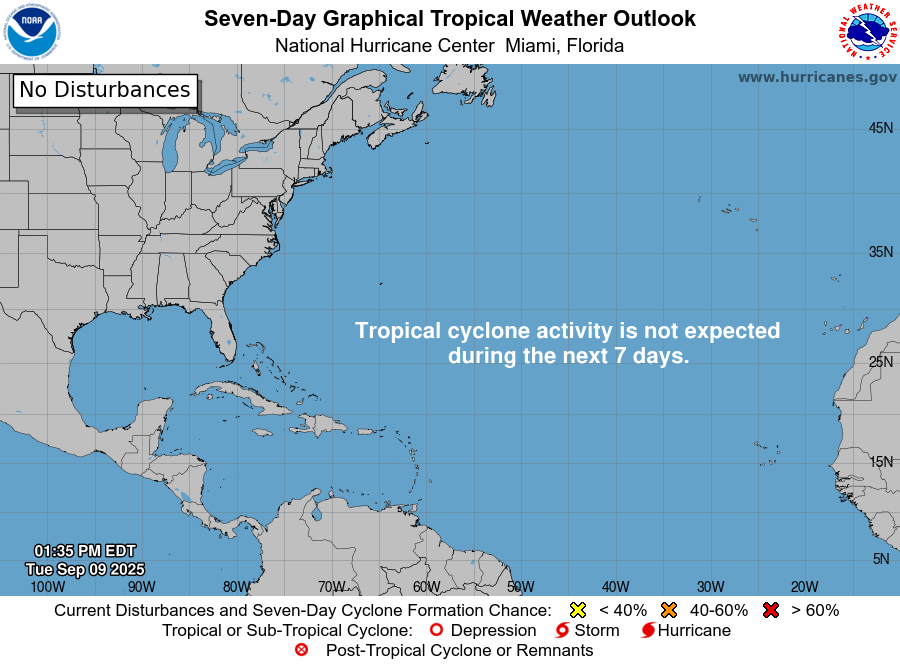
09 Sep 13:33

Pluralistic: Stock buybacks are stock swindles (06 Sep 2025)

by Cory Doctorow


Today's links


An old-timey carny barker, waving a cane and shouting. He is standing in front of a vintage photo of the NYSE trading floor.

Stock buybacks are stock swindles (permalink)

Trump's doing a lot of oligarch shit, and while some of it is very visible and obvious, other moves, like throwing the door open to "stock buybacks" are technical and obscure. But it's worth paying attention to this, because this form of stock swindle stands to make billionaires a lot richer (and thus more powerful).

American companies are headed for the stock buying-backest year on record, having already pissed away $1.1 trillion in 2025:

https://www.baystreet.ca/stockstowatch/21522/Stock-Buybacks-Surpass-1-Trillion

So what's a stock buyback, then? On the surface, it's pretty straightforward: during a stock buyback, the company uses its cash reserves to buy its own stock. When they do this, the supply of shares goes down, so the price per share goes up.

Say a company has issued 1,000 shares, and they're selling at $1,000 per share. That company has a "market cap" of $1,000,000 (1,000 x 1,000). Now the company takes $500,000 out of its bank account and buys half of those shares. Now you have a million-dollar company with only 500 shares, so each of those shares is now worth $2,000 (1,000,000/500 = 2,000).

Why is this so bad?

Let's start with what capitalism's advocates claim about the power of markets. Markets, they say, are a kind of alchemist's crucible, a vessel that transforms self-interest to a public good. Capitalism's theory is that if we let people pursue their own profit, they will chase efficiency, because anything that lowers costs will leave more profit for capitalists to reap. But as those capitalists discover better, more productive ways to get goods and services to market, they face competitors, who force them to accept lower profits, which makes everything cheaper and more abundant for us. That means that even the greediest capitalists have to find new ways to increase efficiency in order to recapture their profits. Lather, rinse, repeat, and capitalism can make more material abundance available that we can dream of.

This isn't just what capitalists say – it's also the thesis of Chapter One of The Communist Manifesto:

https://www.nytimes.com/2022/10/31/books/review/a-spectre-haunting-china-mieville.html?unlocked_article_code=1.j08.a1xP.KLkhosG_PxkP&smid=url-share

Marx and Engels were seriously impressed by the productive power of capitalism, but they had a prescient suspicion that capitalists hate capitalism, and would do whatever they could to interrupt this process. After all, if you can prevent competitors from entering the market, you can innovate just once, find a new way to make something that's cheaper and better, and never share those profits with your customers or workers, because you won't have to outbid your competitors. The alchemical reaction is halted at the point where capitalists are rewarded for their efficiency, and they are never forced to repeat that performance.

Monopoly isn't the only way that capitalists can thwart this transformation of greed into abundance. The finance sector is awash in illegal scams that let capitalists get rich without increasing efficiency or making anyone except for themselves better off.

Take "wash-trading": this is when a seller buys their own products, sometimes using an alias, other times using a shill. The idea is to trick people into thinking that something is valuable and liquid (that is, that you can easily find buyers for it), when it is really worthless and undesirable. Remember all those multi-million-dollar NFT sales? Almost every one was a wash trade, a way to pump and dump.

The problem here isn't just that the buyer is getting defrauded. It's also that the seller is being "allocated capital" (getting money) that gives them power – power to decide what else should be bought and sold in our society.

Remember the alchemy theory of markets: if you're a productive capital allocator (if you make things that lots of people desire), you are given more capital to allocate further. This is the market's "invisible hand": elevating the people with proven track records to positions of power over their neighbors and their society, on the basis that they have shown themselves capable of enriching us all, because (the theory goes), capitalism rewards people whose greed translates into a common benefit. As Adam Smith wrote:

It is not from the benevolence of the butcher, the brewer, or the baker, that we expect our dinner, but from their regard to their own interest. We address ourselves, not to their humanity but to their self-love, and never talk to them of our own necessities but of their advantages.

Wash trading creates misallocations of capital. It makes stupid people rich, and lets them allocate capital to projects that make us all worse off. The whole theory of markets – the reason we're all supposed to leave money that we could all use to make ourselves better off in the hands of the wealthy – is that wealth is the payoff for efficiency, and we are all better off when the most efficient allocators make investment decisions.

Modern theorists of capitalism tell us that this isn't alchemy, it's computing. The market is a giant "information-processing" system that incorporates trillions of "price signals" (how much we are willing to spend and how much we are willing to accept, for goods, services and labor). The market processes all these signals to direct allocation and production, ensuring that shortages are met with increases in supply, and that overproduction is tamped down by falling prices, and that inefficiencies provoke investment in process improvements.

Which brings me back to stock buybacks. Stock buybacks are a way to make a company's shares more valuable, even as the company itself becomes less valuable.

Think of it this way: imagine you've got a company with 1,000 shares, worth $1,000 each, and this company has $500,000 in the bank. The company is valued at $1,000,000 (1,000 x $1,000), and half of that valuation is based on its cash reserves ($500,000 in the bank), which means the other half must be reflected in the company's physical plant and "intangibles" (knowledge, contracts, efficient team structures, copyrights, patents, etc).

The company announces a stock buyback: they will withdraw the $500,000 from its bank account and buy half the shares. The company is now $500,000 poorer, which means that its shares should go down in value. After all, that $500,000 is capital that could have been mobilized to make the company more profitable: it could have been spent to hire new people, do R&D, or buy machines that lower the price of making the company's products. That $500,000 represented the company's future growth potential, and the company has just pissed away that potential.

This is a company whose future growth has gotten much more expensive, because it will have to borrow in order to fund any expansion. Its shares should be worth less than before. By zeroing out its cash reserves, the company has actually reduced its value by more than the value of those reserves, because it is now stuck in place, forced to fund expansion with debt rather than capital. It is at risk from "shocks" like higher rents or higher energy prices. It's a brittle, hollow vessel for the intangibles that made up the other $500,000 in valuation before the buyback. It will be worse at turning those intangibles into profits in the future.

But the buyback hasn't reduced the price of the company's shares: it has doubled that price. The company has made its shares more valuable while making itself less valuable. If you think that markets are a computer that calculates efficient allocation based on prices, this should freak you the fuck out, because as we all know, the iron law of computing is "garbage in, garbage out." The company is feeding an objectively – and grossly – false price signal into the computer's input hopper.

That's why stock buybacks were illegal until 1982, when Ronald Reagan's SEC changed its Rule 10-b to legitimize this form of stock manipulation and turn stock swindlers into billionaires:

https://pluralistic.net/2024/09/09/low-wage-100/#executive-excess

At root, stock buybacks are just wash-trading, the company buying its own shares to move their price, without doing anything to justify that price movement. Before Reagan legalized stock buybacks, companies returned capital to their investors through dividends. Why would companies prefer buybacks to dividends? Because corporate executives hold tons of shares in their employer's company, and it's much better for them to push those share prices higher even as they gut the company's ability to function.

So why should you care about this? After all, statistically you own either very little or no stock. The richest 10% of US households own more than 87% of all stocks held by Americans:

https://inequality.org/article/stock-ownership-concentration/

Your 401(k) account might see a small boost from this stock swindle, but again, statistically, that 401(k) is unmeasurably infinitesimal compared to the holdings of America's oligarchs.

Stock buybacks are a way of making the stock owning class much richer, by swindling everyday investors – who don't understand that companies who drain their cash reserves are less valuable – into buying shares in the companies they loot.

And that's why you should care: in the first 8 months of 2025, Trump has allowed America's oligarchs to get $1.1 trillion richer. That's money that you don't have – you won't get the lower prices and higher wages and superior goods that $1.1t would have paid for if companies had spent it on process improvements. It's money they have, which they can spend on things that make you worse off – buying everything from Twitter to the presidency.

There's a lot to be furious about right now, like the masked fascist goons kidnapping our neighbors off the street, and the upside-down health system that is reviving the vaccine-controlled deadly pandemics of yesteryear. But the reason those fascist goons and antivaxers are able to decide how we all live our lives is that a very small number of very rich people converted their stolen wealth to illegitimate power, which they wield over us.

Anyone who lived through the 2008 crisis knows that finance is a deadly weapon. Let the finance sector run your economy and they will steal everything and leave you jobless, homeless and hungry. Trump is a casino guy, and he knows that the only guy making money in a casino is the owner, who gets to set the odds at the machines and tables. By opening the floodgates to trillions in stock buybacks, Trump is turning us all into the suckers at the table, and turning his oligarch investors into little autocrats, with the power to degrade our lives and steal our future.


Hey look at this (permalink)


A shelf of leatherbound history books with a gilt-stamped series title, 'The World's Famous Events.'

Object permanence (permalink)

#20yrsago Interview with mom who won’t pay off the RIAA shakedown https://web.archive.org/web/20051204021157/https://p2pnet.net/story/6134

#5yrsago Political ads have very small effect-sizes https://pluralistic.net/2020/09/04/elusive-mind-control/#persuadables

#5yrsago CO asphyxiation accounts for half of Hurricane Laura deaths https://pluralistic.net/2020/09/04/elusive-mind-control/#co

#5yrsago Trump is a salesman https://pluralistic.net/2020/09/04/elusive-mind-control/#cialdinism

#5yrsago Physicists overestimate their epidemiology game https://pluralistic.net/2020/09/04/elusive-mind-control/#hubris

#1yrago Marshmallow Longtermism https://pluralistic.net/2024/09/04/deferred-gratification/#selective-foresight


Upcoming appearances (permalink)

A photo of me onstage, giving a speech, pounding the podium.


A screenshot of me at my desk, doing a livecast.

Recent appearances (permalink)


A grid of my books with Will Stahle covers..

Latest books (permalink)


A cardboard book box with the Macmillan logo.

Upcoming books (permalink)

  • "Canny Valley": A limited edition collection of the collages I create for Pluralistic, self-published, September 2025
  • "Enshittification: Why Everything Suddenly Got Worse and What to Do About It," Farrar, Straus, Giroux, October 7 2025
    https://us.macmillan.com/books/9780374619329/enshittification/

  • "Unauthorized Bread": a middle-grades graphic novel adapted from my novella about refugees, toasters and DRM, FirstSecond, 2026

  • "Enshittification, Why Everything Suddenly Got Worse and What to Do About It" (the graphic novel), Firstsecond, 2026

  • "The Memex Method," Farrar, Straus, Giroux, 2026

  • "The Reverse-Centaur's Guide to AI," a short book about being a better AI critic, Farrar, Straus and Giroux, 2026


Colophon (permalink)

Today's top sources:

Currently writing:

  • "The Reverse Centaur's Guide to AI," a short book for Farrar, Straus and Giroux about being an effective AI critic. FIRST DRAFT COMPLETE AND SUBMITTED.
  • A Little Brother short story about DIY insulin PLANNING


This work – excluding any serialized fiction – is licensed under a Creative Commons Attribution 4.0 license. That means you can use it any way you like, including commercially, provided that you attribute it to me, Cory Doctorow, and include a link to pluralistic.net.

https://creativecommons.org/licenses/by/4.0/

Quotations and images are not included in this license; they are included either under a limitation or exception to copyright, or on the basis of a separate license. Please exercise caution.


How to get Pluralistic:

Blog (no ads, tracking, or data-collection):

Pluralistic.net

Newsletter (no ads, tracking, or data-collection):

https://pluralistic.net/plura-list

Mastodon (no ads, tracking, or data-collection):

https://mamot.fr/@pluralistic

Medium (no ads, paywalled):

https://doctorow.medium.com/

Twitter (mass-scale, unrestricted, third-party surveillance and advertising):

https://twitter.com/doctorow

Tumblr (mass-scale, unrestricted, third-party surveillance and advertising):

https://mostlysignssomeportents.tumblr.com/tagged/pluralistic

"When life gives you SARS, you make sarsaparilla" -Joey "Accordion Guy" DeVilla

READ CAREFULLY: By reading this, you agree, on behalf of your employer, to release me from all obligations and waivers arising from any and all NON-NEGOTIATED agreements, licenses, terms-of-service, shrinkwrap, clickwrap, browsewrap, confidentiality, non-disclosure, non-compete and acceptable use policies ("BOGUS AGREEMENTS") that I have entered into with your employer, its partners, licensors, agents and assigns, in perpetuity, without prejudice to my ongoing rights and privileges. You further represent that you have the authority to release me from any BOGUS AGREEMENTS on behalf of your employer.

ISSN: 3066-764X
09 Sep 13:20

Happy Fall Day, everyone!

by Eric Berger

In brief: It’s officially Fall Day in Houston, with the season’s first 65-degree temperature reading this morning. We are also excited to announce that we’ll be holding our Fall Day Celebration on October 25 in Houston. More details in today’s post, which discusses our largely unchanging weather for the next 10 days. We also talk tropics.

A back door front is bringing cooler air into east Texas. (Weather Bell)

Fall Day celebration

The temperature at Houston’s official weather station, Bush Intercontinental Airport, fell to 65 degrees this morning (and it currently has reached 64, as of 6:20 am). That means we can officially declare today as “Fall Day” in Houston. If you’re unfamiliar with this little tradition, it’s simply the day when we get our first real taste of fall in the city after a long summer.

Speaking of this, I’m excited to announce that we are planning a special Fall Day Celebration for Saturday, October 25. This year’s event will also commemorate the 10th anniversary of Space City Weather. This year we are gathering at Midtown Park from 10 am to Noon. We will have more information soon, but rest assured we are planning a special event for you and your families. Come celebrate with us!

Tuesday

This deligtfully dry air will persist today and tonight before a more easterly flow starts to raise humidity. As a result we can expect sunny skies today, with high temperatures around 90 degrees. With dewpoints in the 50s, this afternoon will like Monday bring a somewhat dry heat into the area. This evening will be pleasant. Lows tonight will drop to around 70 degrees in Houston, with cooler conditions further inland.

Wednesday through the weekend

As high pressure builds from the west, I don’t expect much variability in our weather for the remainder of the week. Each day should bring sunny skies and high temperatures in the low 90s in Houston, with areas further inland (i.e. Katy and The Woodlands) likely pushing into the mid-90s. Dewpoints will be in the 60s, generally, so while the air will be more humid, it won’t be the super sticky humidity we see during summertime in Houston.

This will be a persistent pattern. (Weather Bell)

Lows will generally fall into the low- to mid-70s. Rain chances throughout this period will basically be zero, except for the immediate coast, which might see slightly higher chances (i.e. 10 or 20 percent) on some afternoons.

Next week

This pattern has to change at some point, right? Well, eventually. Mostly, however, I expect it to persist into at least the middle of next week. At that point rain chances may tick up slightly, but I don’t see any evidence of the next front at this time. So after today it will be late summertime weather for awhile.

ACE forecast from the European model for September 15 to 21. (ECMWF)

Atlantic tropics

It’s very quiet there for what is typically the peak of the Atlantic hurricane season. We have zero concerns at this point. When we look out for the next 10 days, conditions look to be fairly quiet. The sub-seasonal forecast from the European model, shown above, predicts significantly less activity than normal in the Atlantic basin (40 percent of normal). By the last 10 days of the month this model is back to predicting near-normal activity in the Atlantic, and overall conditions should improve. But long-time readers of Space City Weather will know that our window for seeing a hurricane landfall in the greater Houston region is closing. I’m certainly not ready to declare the season “over” for Texas, but we are just weeks away from that happening. So we’re in the home stretch.

09 Sep 13:17

State Surveillance

by Hugh Howey

In 1949, George Orwell coined the term “Big Brother” in his (unfortunately) timeless novel 1984. The fear then — and now — was that mass surveillance would give totalitarian states even greater control over its people.

As prescient as Orwell was, here’s something he missed: surveillance works both ways. Bodycams have proven a nuisance for belligerent cops. Hot mics get politicians in hot water. And there’s a reason ICE agents are masking up.

But where Orwell thought the battle would be waged between people and state, the reality is that widespread surveillance mostly pits people against people. A cheating CEO and HR head on a Coldplay jumbotron brought the mirth and wrath of millions. A home-run-ball-crazed Phillies fan went from scowling at a kid to scanning the want ads in no time flat.

The power of the camera is that it can freeze a moment in time. And it might not be your best moment. A temporary lapse in judgement becomes a permanent stain on your reputation. Or (and this is more likely, in my opinion), a camera can capture and reveal truths about human nature that we try to conceal from others.

The CEO and HR head didn’t cheat for a second, and suddenly their lives fell apart. There were thousands of small and large dishonesties that led up to that moment. The Phillies fan didn’t lose her temper and become unreasonable for the first time in her life (she would go on to yell at another fan in his face and flip off the crowd after). Rather, the camera revealed with certainty something that she probably does a fair job of keeping under wraps.

The rise of the digital camera coincides with the fall of religious beliefs, and while there might not be anything causal in this, there might be a much-needed solution to a widening problem. For much of human history, there was a feeling that someone was watching us even in our most private moments and with our inner thoughts. I was raised in a very Christian household, and for the first twelve years of my life, I assumed God, Jesus, and all my dead relatives were watching everything I did. I like to think that even as I lost my religion, I retained some strengthened conscience from those years.

While religion has been on the decline, measures of conscientiousness have also been dropping. People are generally caring less and less for other people. And really, can you blame them? Have you met people?!

One of the studies covered in the fantastic book Why We Lie details grade-school kids cheating on a pop quiz. The findings are interesting because — when presented with a low-stakes situation with no one watching — every single kid elected to cheat. (It turns out, someone was watching: the folks doing the study). The pattern that emerged was this: no matter the gender or age, when a teacher left a solitary student alone in a classroom with a quiz, and the kid knew the answers were on the wall behind them, the ease with which they could turn their heads and ace the exam overrode their sense of right and wrong. They all looked.

But with a teacher in the room? None of them looked. The teacher is the ultimate conscience. It doesn’t require faith to believe in them. There they are.

Most people fear a surveillance state. Me? I fear the people who fear the surveillance state. I wish there were cameras everywhere watching everything and that we all had access to them. Because we are beginning to lose the behavioral feedback loop that kept us in line.

That feedback loop goes back to the tribal societies in which we were meant to live. You are adapted for a reality in which you would almost never encounter a stranger. The people you were born around would be the people you lived around and died around. If something went missing in a small band of people, the culprit would likely get caught. If a child misbehaved, the nearest adult would correct the behavior. If an adult misbehaved, ditto.

These days, we cut people off in a merging situation because we know we’ll never see them again and there will be no repercussions. Anonymity brings out the worst in us. Things are said behind online accounts that bring shame when we are doxxed and those same public outbursts are shown to employers, family, friends. We act like the surveillance and doxxing are the problem, rather than the behaviors. And that’s fucked up.

My wife and I just drove four hours each way on a road trip in France, and we didn’t see a single car pulled over by a cop. What we saw instead were the white flashes of light as speed cameras logged who was going too fast. Tickets show up in the mail with mugshots, license plates, amount due, and accepted forms of payment. It’s not only a more effective means of raising money and employing people’s time, it’s a great deterrent. During these speed traps, all the cars slow down and do the limit. Afterwards, they all go racing off like it’s the Autobahn. (Some places get around this by logging license plates between two zones, figuring out the average speed between those zones, and mailing a ticket).

An interesting experiment I’d love to see (and would gladly participate in) is to put a group of people under constant surveillance and see how they report their behavioral changes with and without the cameras. Give half the people dummy cameras. Maybe tell a third group about this experiment and give them no cameras, but have them log their own behavioral changes (to control for the effect of logging your behavior in a journal). For a fourth group, tell them that the cameras aren’t being watched by the researches, but rather that their friends and family have been given full access. Study the results.

This thought experiment led to an idea, which led to this blog post: what if we turned Big Brother’s cameras directly around and left them on 24/7? Imagine this scenario: Every elected official is made to wear a bodycam. Their offices are cammed up. Their homes. At any time you like, you can log in and watch them sleep, eat, poop, have a meeting, browse the web. You can watch them trade stocks. You can listen to them hash out deals. Everything. Zero privacy. No exceptions.

Will this make waging war more difficult? I hope so. Would 99% of today’s politicians opt out of this program? I hope so.

Who would opt in, you might ask? The very people you’d want in charge of things. The exact opposite of what we are stuck with today. Today, we have grifters and attention-seekers who profit from their private deals and inside knowledge. They have both anonymity and immunity. They should have neither.

The system we have today selects for people with no conscience. We should select for those with max conscience. There’s an easy way to do this. And hey, sell ads for the most-watched accounts and pay down some of our debt while you’re at it. Corporations would suddenly have a lot more to spend on advertising once the bribes are no longer viable.

Basically, we should turn the Surveillance State into State Surveillance. Watch what government is doing at all times. If anyone doesn’t like that, get a different job. See who is okay with their masks off.

The post State Surveillance appeared first on Hugh Howey.

08 Sep 22:40

Chess Variant

The draw-by-repetition rule does a good job of keeping players from sliding a tile back and forth repeatedly, but the tiles definitely introduce some weird en passant and castling edge cases.
08 Sep 22:40

Philosophy in a Life Boat

by Corey Mohler
PERSON: "Well, that sucked. Good thing we out muscled the scientists to get the last life boat. "

PERSON: "What should we do now?"

PERSON: "Don't you know anything about economics? Specialized labour and responsible monetary  policy is the cornerstone to improving productivity."

PERSON: "The life raft is sinking, everyone, shovel out the water!"

PERSON: "Whoa whoa, what are you doing, Camus?"

PERSON: "Oh i see, five seconds into the life raft and you've already introduced a class system, Adam Smith!"

PERSON: "And what is your plan, huh Marx?"

PERSON: "We need to collectivize the buckets, so the workers directly control the buckets. "

PERSON: "Can you idiots help? We are sinking!"

PERSON: "Hold on, Camus, surely it is more important to first create a just society. I propose we carefully imagine every possible raft, then decide, without knowing..."

PERSON: "I would like to clarify that philosophy is stupid and i no longer consider myself a philosopher."

PERSON: "Are you kidding, Rawls, we have to bail out water!"

PERSON: "But what if we, through careless ignorance, create a slightly imperfect life raft society?"
08 Sep 22:38

Hell (v2)

by Alvaro Montoro

comic with 4 panels in a 2x2 grid showing a man in hell talking to the devil. Devil: Sorry, today we are running super late. You will have to punish yourself creating a website. Man (smiling): A website? That's not that terrible! The devil and the man continue looking at each other awkwardly in silence. Man (really scared): It's with Tailwing, isn't it? The devil looks at him with an evil grin on his face.

08 Sep 20:40

Banksy mural of judge beating protester to be removed from London High Court wall

by Lydia Doye, Associated Press
A new Banksy mural showing a judge beating an unarmed protester with a gavel will be removed from outside a London court.