Shared posts

08 Sep 22:45

125 years after the Great Galveston Hurricane, it still remains relevant if we’re willing to listen

by Matt Lanza

In brief: Today, we reflect on the 1900 Galveston hurricane, which made landfall on this day 125 years ago. The lessons before and after the storm ring loudly today in an age where disaster is happening to more people more frequently.

On July 16, 1891, a byline in the Galveston Daily News attributed to Dr. Isaac Cline was published. The sub-headline read “Record of twenty years — The Texas Coast Not Liable to Serious Damage.” Essentially, Cline was using the best knowledge of how things worked at that time to try to explain why he believed the Upper Texas Coast was immune to disasters, such as the 1875 Indianola Hurricane.
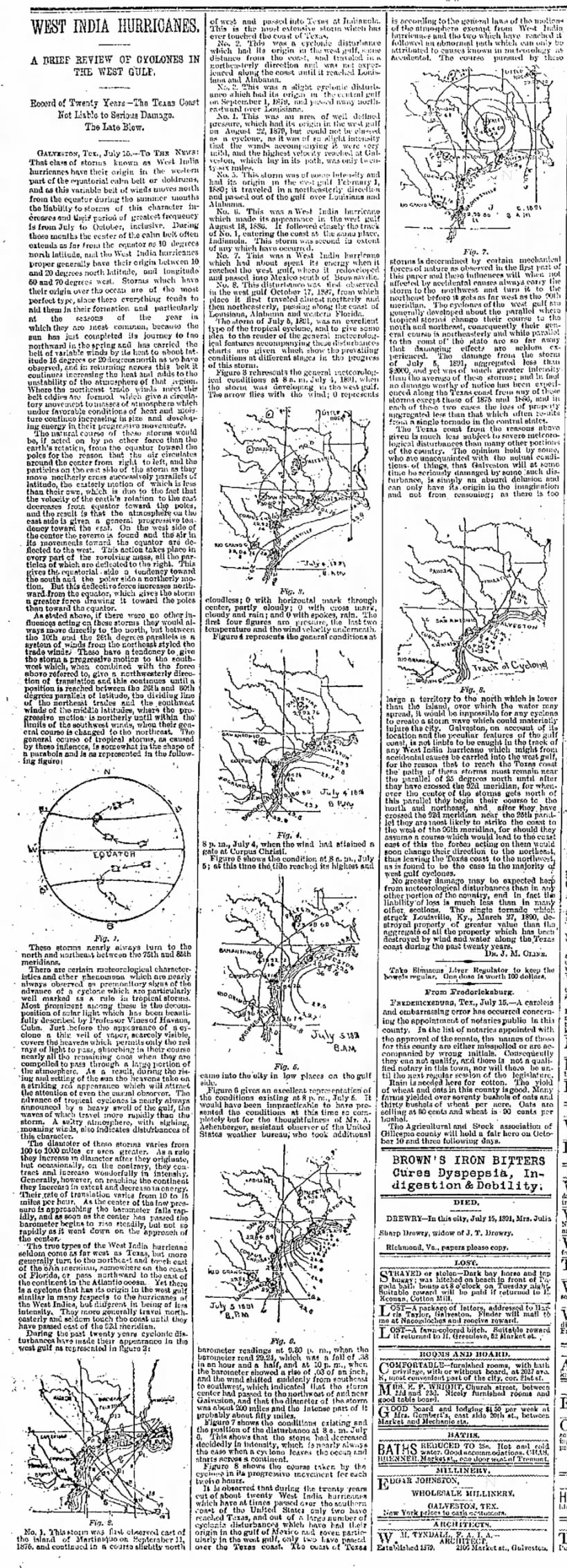
July 16, 1891 Galveston Dailly News. Click to enlarge.

After seeing what happened to Indianola in 1875 and again in 1886, some residents of Galveston had felt they needed a seawall for protection of the city. Cline, among some others did not believe this was necessary. In fact, in this 1891 article, Cline wrote this:

The opinion held by some, who are unacquainted with the actual conditions of things that Galveston will at sometime be seriously damaged by some such disturbance is singly an absurd delusion and can only have its origin in the imagination and not from reasoning; as there is too large a territory to the north which is lower than the island over which the water may spread, it would be impossible for any cyclone to materially injure the city.

While it may seem patently absurd today that any learned individual would ever say something like that with such confidence and in that tone, keep in mind again the context of the day. This was not a deranged individual. This was how even brilliant people thought about things in that era. But in hindsight, it tells us a lot about hubris and an invincibility complex.

The storm

It was today 125 years ago that hell was unleashed on the Texas coast. The great Galveston hurricane remains the deadliest single weather event in our nation’s history. Despite how it may seem in hindsight, it wasn’t inevitable. And despite it happening 125 years ago, it remains as relevant today as it was in 1900. Most of us know the general theme of things. The hurricane struck Galveston, delivering the full fury of the Gulf of Mexico onto the island, washing away virtually every structure on the Gulf side of the island. The death toll ranged from 6,000 to 12,000 based on various estimates. The storm’s impact was well documented in several books. Obviously, “Isaac’s Storm” comes to mind first and foremost, telling the story through the life of the weather bureau chief in Galveston, Isaac Cline. “A Weekend in September” remains a classic for this topic as well. I am fortunate to also own an original copy of the “The Great Galveston Disaster,” which contains accounts and details of the storm’s impacts.

But the Galveston storm also had noteworthy impacts near and far from Galveston.
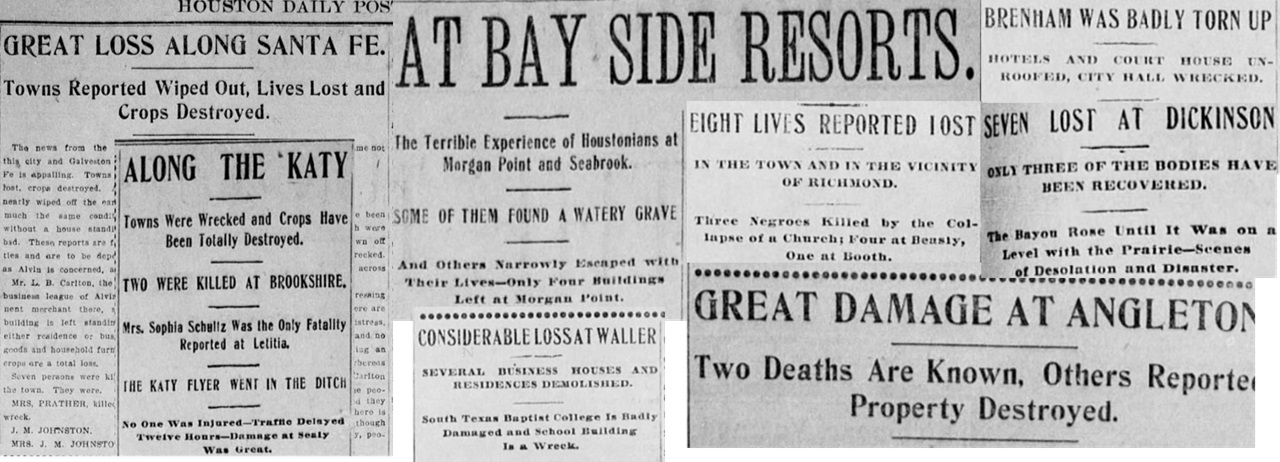
A selection of headlines from the Houston Post describing loss across Southeast Texas.

Across Southeast Texas, damage was everywhere. Bayshore communities were devastated with significant loss of life. Inland locations from Houston to Richmond to Brenham suffered extensive, widespread damage and lesser but not inconsequential loss of life. A similar storm today, a large category 4 hurricane would probably cause north of $100 billion in damage, with significant risk to the Houston Ship Channel, an economic engine for both Texas and America.

The 1900 storm remained a tropical storm into Oklahoma before it became post-tropical. But the 1900 storm was clearly fueled by the jet stream after that, and it reintensified as an extratropical cyclone over the Midwest and Great Lakes.
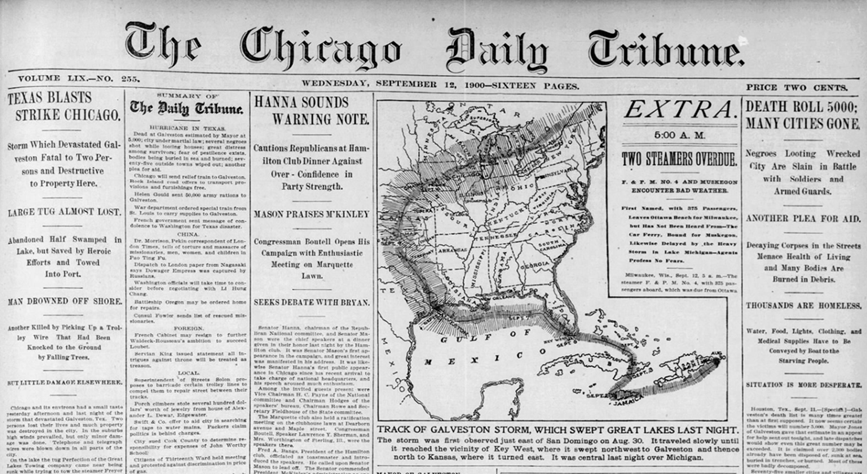
“Texas Blasts Strike Chicago” (Chicago Tribune)

As the storm moved into the Great Lakes it produced wind gusts over 80 mph in Chicago, 78 mph in Buffalo, and 74 mph in Toronto. Flooding occurred in Minnesota, two were killed in Chicago, and “severe damage” was reported in Buffalo.

As it passed north of an extremely dry New England, it helped fuel significant wildfires that broke out in southeast Massachusetts and Cape Cod.
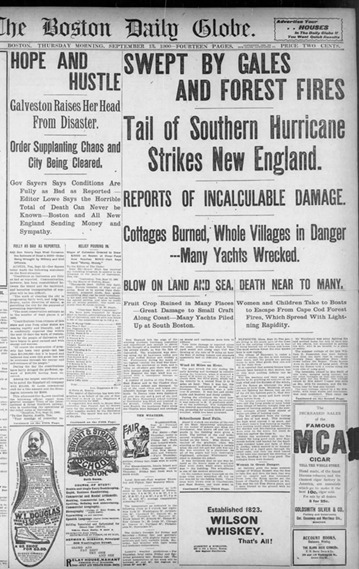
New England “swept by gales and forest fires.” (Boston Globe)

Water scarcity had been a problem in 1900 in New England, with shortages reported in New Hampshire and Connecticut. The passing of the hurricane, with drier air on the back side and gusty winds led to a rough setup that helped produce fires.

In Canada, the damage was immense in the Maritime Provinces with strong winds and numerous shipwrecks. Over 50 were confirmed killed in Canada, making the 1900 storm the 8th deadliest storm on record there. However, unofficially, the toll was likely higher, and the 1900 storm may be as high as the third deadliest (possibly over 200 perished).

The footprint was massive, and in 2025, this type of storm may not cause as much loss of life but would still cause immense damage. We got a sampling of this with a similar storm to the 1900 storm, Hurricane Ike in 2008. Ike caused over a half-billion dollars in damage and wind gusts of hurricane-force inland across interior parts of the U.S.

Response to 1900

Recall at the beginning of this post, we noted how the 1875 Indianola hurricane planted the seed that never germinated in time. After the storm, the reaction was quick. The Seawall began construction in 1902 with the first segment completed by 1904. The length was over 3 miles. An additional extension just under a mile was completed in 1905 to protect Fort Crockett. The first three miles were approved by the Texas Legislature and funded by the issuance of bonds in Galveston County. The section protecting the fort was funded by Congress. The Seawall was further extended in 1927 and again in 1963. In addition to that, 500 city blocks were raised in elevation by 1911. This was the largest civil engineering project in American history at that time and stands as one of the most enduring.

The track of the 1900 Hurricane vs the track of the 1915 hurricane vs Hurricane Ike in 2008. (NOAA)

The Seawall paid dividends almost immediately. In 1915, a very similar storm to the 1900 one struck nearly the same exact place. We’d be the first to tell people that no two storms are identical, but in this instance, the difference was so dramatic, it needs mention. While the 1915 storm did do a fair bit of damage, the devastation that was seen in 1900 was not repeated in any way. The loss of life was around a dozen in Galveston proper, with many others lost elsewhere on Galveston Island and along the bayfront closer to Texas City. But the Seawall stood the test. It was the true definition of hazard mitigation.

When Hurricane Ike hit in 2008, the damage in Galveston proper was primarily caused by bayside flooding, as Ike took a slightly farther north track. The Coastal Barrier project, or “Ike Dike” as it’s commonly called would substantially mitigate this type of flooding, further bolster the Gulf side risks, and provide a layer of protection that does not currently exist for the Houston Ship Channel.

The 1900 storm still matters a lot today for the toll it took and the lessons it left behind

I’ll say it again: Hurricane Ike hit the Texas Coast in 2008. 17 years later, the Ike Dike is a plan on paper that’s funded sort of, but not really. After 1900, the people of Galveston recognized what had to be done and did it. It’s a different world today of course, and these projects are more complicated, more thorough in planning, done more safely, and they’re just more expensive. But here’s the thing about large mitigation projects: They save more than they cost. The Galveston Seawall is a testament to that. It was created as a reactive solution to a permanent, existential problem. What has it done? Saved hundreds of millions of dollars in damage and countless lives. Will the Ike Dike do the same thing? The better question may be: Would the Seawall have prevented the 1900 tragedy? The answer is probably yes, even if in truth, there’s no way to know for sure. But the plans for the Ike Dike seem reasonable, and we know that mitigation money pays back about $6 in avoided damage for every dollar invested.

Ingenuity and a sense of existential risk to a community brought people together after 1900 to plan and implement a radical change. As we move forward through the 21st century, we are going to need that same sense of thinking for the greater good of our communities. It’s likely that some communities will face existential threats to their survival, be it through sea level rise, storms made worse by warming oceans, or simply infrastructure that’s unfit for the current population. These risks aren’t unknown. We know what many risks to our communities are; they aren’t theoretical. Had Galveston followed down that line of thinking in the 1890s, the 1900 storm may have been a footnote in history. The lesson from 125 years ago stands today: Proactive investment in hazard mitigation for our communities allows them to survive and prosper, and that’s good for everyone.

08 Sep 22:40

Elena Rodz’s 2025 “Third Coast Biennial” Top Ten

by Elena Rodz

The Third Coast Biennial is a national juried contemporary art exhibition hosted in odd-numbered years at K Space Contemporary in Corpus Christi, Texas. The show is curated from open call submissions by a guest juror, and thus the exhibition always offers a unique slice of the art world.

An installation image of various artworks in a group show in a white-walled gallery.

An installation view of the 2025 “Third Coast Biennial” at K Space Contemporary

This year’s juror, Leandra Urrutia, shaped the exhibition around the concept of hybridization. She describes it as “a collision and fusion of images, processes, materials, ideas, and experiences that create compelling compositions.” I couldn’t agree more. The selected artworks inhabit multiple forms simultaneously, clashing and fusing, or splintering and evolving apart.

I think that the concept of fusion and evolution is a way that artists react to metamorphic times. As our world has grown increasingly uncertain — politically, environmentally, and socially — I’ve found that artists and writers create work that is either optimistic or pessimistic about the future. Do they think humans will survive by adapting to the new normal, or will they struggle, barely hanging on to outdated ways of thinking? Most of the works in this year’s exhibition lean toward the former: they approach survival through the lens of human resiliency, whether to a shifting ecosystem or to the accelerating realities of the digital age.

It is a compelling exhibition. In no particular order, here are my top ten highlights:

A layered textile sculpture featuring lace-like pieces with organic shapes and patterns that mimic butterfly wings.

Jamie Spinello, “Kaledioptera”

10. Kaledioptera by Jamie Spinello

This sculpture is a bit of Victorian gothic mixed with praying mantis — delicate as a butterfly wing, but also terrifying as a xenomorph. When I look at this sculpture, I am reminded that the fragile insects that I can so easily squash are also the most likely to survive natural and man-made catastrophes. Spinello writes about how she sees her sculptures as creating “new bodies.” I think she might be on to something.

A mixed media piece featuring corrugated cardboard and a mushroom-like object painted yellow and orange.

Clayton Reuter, “Separation”

9. Separation by Clayton Reuter

I’ve followed Clayton Reuter’s work for many years. He is a local Corpus Christi artist known for creating fungus street art that he installs on buildings and in corners around town. I’ve always enjoyed the way he combines drawing and scavenged cardboard, similar to how fungi can repurpose organic material into something otherworldly and beautiful.

Reuter titled this work Separation to evoke the “energy and potential that can result from painful separations.” This is especially apt as this artwork is separated from where I usually find Reuter’s work in the wild. But I’m happy to have the moment and space to appreciate the artistry in a gallery setting.

A mixed media artwork featuring a painting of pecans on fabric, framed by a stuffed pink fabric.

Samantha Proa, “Pink Glow Game Show”

8. Pink Glow Game Show by Samantha Proa

I’m a fan of trompe l’œil, especially those paintings that depict contemporary ephemera. I am drawn to this artwork, which looks like pecans on overstuffed pink lycra leggings, because I both know and don’t know what I’m looking at. Proa describes her work as an “exploration of identity, resilience, and culture through fusing portraiture and installation.” Certainly there is a personal metaphor here, but you don’t need to fully understand it to appreciate the work.

An abstract mixed media work featuring light layers of architectural structures and messy black ink lines.

Lawrence Lange, “The Intoxication of Commerce”

7. The Intoxication of Commerce by Lawrence Lange

Perhaps the painting that most exemplifies the concept of uncertainty is Lawrence Lange’s The Intoxication of Commerce. In the artist’s words, this painting “confronts the unease of existing within systems we no longer fully control or comprehend. Technology, once a tool, now encroaches upon the most intimate aspects of selfhood — reshaping thought, desire, agency and autonomy.” Viewing the artwork, I’m mesmerized by the layers of delicate transparencies. Ghostly architectural forms are obscured by darker, spidery lines that look straight out of a dystopian urban sci-fi. I am looking at the future and the past at the same time, while being firmly planted in the pivotal present.

A sculptural work featuring a cast hand balancing a small ball on a spring. A thread runs down from the hand with a cast pinecone at the end.

Norman Kary, “It’s in Our Hands”

6. It’s in Our Hands by Norman Kary

It’s in Our Hands is a perfect metaphor for how I feel about the role of the public in the creation of our own success or destruction. From an outstretched hand dangles a pinecone, symbolizing nature and resources; above it, balanced on a spring, rises an orb — technology, progress, artificiality. Is the hand transforming resources into innovation, or shielding the environment from exploitation? The ambiguity is its strength. It refuses easy answers, insisting instead on our shared accountability.

A photograph of a ceramic sculpture featuring a rough semi-circular forms layered and interlocking. The sculpture sits on a smooth table-like base.

Jinsun Kim, “Cocoon and Space”

5. Cocoon and Space by Jinsun Kim

Jinsun Kim describes her sculpture as “a space of transformation, protection, and quiet tension.” It truly feels grown, its overlapping forms recalling magnified fibers or cells, while its rough, pitted clay reminds us of fragility. The tension between organic growth and industrial surface creates an object that feels both ancient and futuristic, sheltering and precarious, all at once.

A photograph of a ceramic bowl-like piece with blue and white ribbons attached to one side.

Lauren Clay, “Bricks and Blue Sky Series 1”

4. Bricks and Blue Sky Series 1 by Lauren Clay

Lauren Clay’s sculpture combines the solidity of brick with cartoon-like striped ribbons, pushing ceramic materiality in a surprising way. It is playful, even humorous, yet also layered with meaning. She writes: “There is inherent fragility and vulnerability in the ceramic object. It is known to be breakable but is stronger than you think.” The work radiates that paradox: fragile yet enduring, whimsical yet weighty, a fitting metaphor for the human condition.

A pink-tinted painting featuring lightly layered images of a landscape through a curtained window.

Annieo Klaas, “Daydream No 6”

3. Daydream No 6 by Annieo Klaas

I’m a sucker for artwork that can pull me across a room, and Daydream No 6 definitely did just that. The painting absolutely glows. The bright pink, the hazy forms — Annieo Klaas captures reverie and the state of being lost in thought.

Amid the exhibition’s overall restlessness, this painting offers a pause, a respite. Klaas describes her paintings as “invitations to sit in the present moment,” and that is exactly what this piece achieves. Even in a world of flux, it reminds us to breathe and dwell in the living now.

An ink drawing featuring layers of lines and cross-hatched lines that form a fabric-like bundle.

Koichi Yamamoto, “Hanami”

2. Hanami by Koichi Yamamoto

Koichi Yamamoto is influenced by the environment surrounding his studio in Kalaheo, Kauai, a mountainous island covered in a tropical rainforest. 

An incredibly moody and quiet artwork, it feels very cocoon-like, as if the subject of the art was itself undergoing a sort of metamorphosis. I want to reach and peel back the layers of ink and mark making and discover the wonderful thing transforming inside.

An installation image of a sculpture made up of small white shells and sea-like forms such as barnacles.

Jeanna Peña, “Reef Guardian”

1. Reef Guardian by Jeanna Peña

The first time I saw Jeanna Peña’s sculpture at the exhibition’s opening reception, I thought I understood it. The sculpted coral and sea life is detailed and intricate; truly an impressive feat of craftsmanship and construction. But it was on the second viewing that the work transformed for me. The figure is stoic and powerful, like an aquatic steward protecting our Texas Coast. I find myself rooting for this reef guardian; the sculpture becomes a quietly commanding tribute to the people and organizations working to preserve our environment.

The post Elena Rodz’s 2025 “Third Coast Biennial” Top Ten appeared first on Glasstire.

08 Sep 22:40

Philosophy in a Life Boat

by Corey Mohler
PERSON: "Well, that sucked. Good thing we out muscled the scientists to get the last life boat. "

PERSON: "What should we do now?"

PERSON: "Don't you know anything about economics? Specialized labour and responsible monetary  policy is the cornerstone to improving productivity."

PERSON: "The life raft is sinking, everyone, shovel out the water!"

PERSON: "Whoa whoa, what are you doing, Camus?"

PERSON: "Oh i see, five seconds into the life raft and you've already introduced a class system, Adam Smith!"

PERSON: "And what is your plan, huh Marx?"

PERSON: "We need to collectivize the buckets, so the workers directly control the buckets. "

PERSON: "Can you idiots help? We are sinking!"

PERSON: "Hold on, Camus, surely it is more important to first create a just society. I propose we carefully imagine every possible raft, then decide, without knowing..."

PERSON: "I would like to clarify that philosophy is stupid and i no longer consider myself a philosopher."

PERSON: "Are you kidding, Rawls, we have to bail out water!"

PERSON: "But what if we, through careless ignorance, create a slightly imperfect life raft society?"
08 Sep 20:52

Disengaged American Youth-HCC Art Teacher Darla Barolini Tackles Apathy Inside The Classroom

by Joshua Jones, Writer

HCC art teacher and independent artist Darla Barolini’s new art exhibit, The Classroom, explores themes of connection, community, and teamwork, while also examining apathy and isolation. The artwork is on display at the Spring Branch Art Gallery and will run from August 18 to October 24. An artist’s reception will be held on Tuesday, September 23, from 11:00 a.m. to 1:00 p.m.

Drawing from an admiration for comic books and contemporary figurative artists like Jenny Saville, Lucian Freud, and Alice Neel, Darla Barolini’s The Classroom seeks to give a voice to modern youth and reflect the disengagement that characterizes today’s education.

The Classroom Acrylic on canvas 72" x 45" x 2" This painting is a diptych created from imagination. The American Classroom, depicts a diverse group of students in a classroom setting, capturing a range of emotions, attitudes, and interactions. The scene juxtaposes moments of engagement and apathy. Students sleeping in the background, while others look at their phones or at each other.

The artist’s use of comic book visual elements—such as one-point perspective, paneling, and slightly exaggerated student heads—creates an unsettling balance between realism and fantasy.

Barolini’s artwork encourages us to form a personal connection with the students, many of whom have eyes that lack wonder and soul. They occupy most of the foreground, overtaking the space with their apathetic expressions.

One must wonder whether the disengagement depicted in much of Barolini’s work here results from modern society’s susceptibility to distraction by technology and social media. If that’s the case, The Classroom truly is both an homage and a warning for anyone who believes education still should be prevalent in the lives of American youth.

08 Sep 20:51

You know what this scene needs? Eddie Deezen.

You know what this scene needs? Eddie Deezen.

08 Sep 20:51

Congress Plays Keep-Away With Child’s School Lunch

by The Onion Staff

WASHINGTON—After entering a school cafeteria in D.C. and wrenching a brown paper bag from the hands of a small child, U.S. senators and representatives taunted a 7-year-old student and played keep-away with his lunch, sources reported Tuesday.

The sack lunch, which belonged to Stanton Elementary second grader Lucas Henderson and is said to have contained a turkey sandwich, apple slices, baby carrots, and a juice box, was reportedly tossed back and forth by several members of Congress who refused to return the boy’s food and always kept it just out of his reach.

“If you want to eat, you’re going to have to jump for it!” said Sen. Rand Paul (R-KY), laughing as he dangled the bag above the head of the 4-foot-tall child, who leapt in vain as he attempted to retrieve his one reliable meal of the day. “Heh, too slow! You gotta be quicker than that, dweeb. Oh…are you too weak to grab it from us? Sucks to suck, I guess.”

“Okay, fine, here, you can have it,” Paul continued as he momentarily feigned returning the lunch to Henderson. “Psych!”

Henderson

According to witnesses, Rep. Rich McCormick (R-GA) shouted “Go long!” and threw the bag in a high arc across the cafeteria and into the hands of Rep. Jim Jordan (R-OH), who then handed it off to Sen. Marsha Blackburn (R-TN). She, in turn, zigzagged through the tables with the food, staying one step ahead of the red-faced Henderson as he tried to reclaim it. 

At one point, members of the Senate Subcommittee on Education and the American Family were seen forming a chain and passing the lunch from one person to the next, high over the boy’s outstretched hands.   

Congressional aides told reporters it was not unusual for lawmakers to find kids they believed were easy targets and then spend their entire legislative recess tormenting them. The trouble they caused on Tuesday appeared to have Henderson on the verge of tears.

“Oh, are you gonna cry now? Does the little baby want his lunch?” said House Budget chair Jodey Arrington (R-TX), who informed Henderson that he was welcome to have a “knuckle sandwich” and then put the 55-pound child in a headlock, punching him in the stomach. “You’re such a fucking wuss. This is punishment for not taking your hunger like a man.”

“Here, have a drink, at least,” added Arrington, taking apple juice from the brown bag and pouring it over the boy’s head.

Suggesting he could probably find something to eat “down there somewhere,” Reps. Ben Cline (R-VA) and Mary Miller (R-IL) picked up Henderson and dumped him headfirst into a 40-gallon trash bin containing students’ uneaten lunch scraps and half-empty cartons of souring milk.

“Sorry, no lunch for you today—guess you just have to eat shit,” Rep. Marjorie Taylor Greene (R-GA) told Henderson as she threw his lunch to the floor and ground it beneath the heel of her pump. “Don’t blame me. I’m just doing my part to combat childhood obesity. It’s not my fault you’re a fat loser.”

“Maybe try not to be such a little bitch next time,” the three-term representative added.

After members of Congress left the school and returned to the Hill for a vote on a budgetary measure, Rep. Greene was observed hurling the child’s lunch onto the roof of the Capitol. 

The post Congress Plays Keep-Away With Child’s School Lunch appeared first on The Onion.

08 Sep 20:50

RFK Jr. Warns Mistress That Condoms Cause Autism

by The Onion Staff

WASHINGTON—Claiming that 100% of users experienced dangerous side effects as a result of wearing the contraceptive device, Robert F. Kennedy Jr. reportedly paused an amorous moment Thursday to issue a dire warning to his mistress about condoms causing autism. “All of the increased cases of autism over the last decade can be traced to condom usage—at least from what I’ve been reading,” said the nude health and human services secretary, insisting the 32-year-old woman go wash her hands after touching a still-packaged Trojan-brand condom she had retrieved from her nightstand. “Something about the latex or maybe the friction encourages autism growth in the genitals,” he continued. “Or, it goes into your bloodstream and straight to your brain—and also into your sperm, which then becomes your future children’s brains. I don’t remember exactly what it was, but I know it’s really bad. The media has been suppressing the evidence, since the major publications are basically run by condom companies these days, but it’s all out there if you know where to look. There’s even a medical journal called Condoms And Autism that publishes stuff all the time about how they’re so bad for you. Once put on, they stay in your penis system for, like, years, so I think it’s better not to risk it. Dental dams too, sorry.” Kennedy later announced that the U.S. Food and Drug Administration would be revoking its approval of condoms and banning their sale nationwide. 

The post RFK Jr. Warns Mistress That Condoms Cause Autism appeared first on The Onion.

08 Sep 20:50

House With Cool Turret Thing

by The Onion Staff

Come on, look at how cool this tower thingy is. Imagine sitting in a little circular room like that. So cool.

Reference #56727

The post House With Cool Turret Thing appeared first on The Onion.

08 Sep 20:49

Putin, Xi Discuss Immortality On Hot Mic

by The Onion Staff

Russian and Chinese Presidents Vladimir Putin and Xi Jinping were overheard on a hot mic during a Beijing military parade discussing continuous organ transplants and the possibility of living indefinitely. What do you think?

“I’ll stick with achieving immortality through good old-fashioned rhino horns.”

Jack Duckfield, Diving Judge

“I never know what to say to Xi Jinping either.”

Freya Willis, Bleach Bottler

“That’s crazy, I was just talking about that with my mentally unstable neighbor.”

Isaac Reed, Hog Groomer

The post Putin, Xi Discuss Immortality On Hot Mic appeared first on The Onion.

08 Sep 20:48

How You Ended Up with Fourteen Email Accounts

by Amanda Goble

1. The Only One
Before you thought about work-life balance, professionalism, or online security, there was just one email. You were a simple, blissful idiot.

2. Personal
You learned that only a baby fawn mixes all aspects of existence into a single stew of email chaos. So you created an account just for family and friends—memes, photos, and half-hearted attempts to meet for coffee. You marveled at your newfound organizational prowess. Then it dawned on you that you had no idea which email to use for logins, work emails, and subscriptions to your friends’ newsletters.

3. Sensitive
Next came an address for accounts and institutions holding your most sensitive data. You used this to log in to your very secure bank’s website. Then you had to decide whether or not you’d also give it to the neighborhood dentist, who stowed your intake packet in a translucent plastic bin that sat in the corner of their office/exam room—where anyone could stroll in and find your Social Security number emblazoned on page one. Your choice haunts you.

4. Work
Your employer set this up. It was beautiful. Because when your bedtime reading was an email from your best friend about her new bunny’s adorable hijinks, you were never interrupted by an after-hours request that you hop into a meeting at sunrise.

5. Side Gig
Full of hope, you shared this email with friends and family in case of referrals. Then you learned that your aunt didn’t understand why she shouldn’t give your personal email address to anyone looking for someone who “does something with the internet.”

6. Side Gig Sensitive
You remembered not to use your public-facing address for the separate bank account you set up after you decided to test out a business monetizing your ability to write listicles.

7. Second Side Gig
Branding.

Back to 2. Second Side Gig (Barbara-Specific), Formerly Known as “Personal”
Naif no more, you repurposed your personal account when your aunt’s friend, Barbara, flooded it with urgent requests that you edit her ex-friend’s casserole out of every picture in her cooking club’s online scrapbook.

8. New Personal
You shared this with your friends—and the members of your family who vowed not to reveal it to your aunt, her loose-lipped kids, or Barbara.

9. Junk
You realized you needed an account just for coupons, offers, and marketing freebies you may or may not ever look at. You read that you could use this one for online shopping, too, if you were to check out as a guest, but dismissed this as hogwash. Paying with a credit card would have created an unacceptable crossover between junk and sensitive information.

10. Shopping
An online retailer seemed trustworthy enough to open an account with. Since a credit card was involved, you considered using your banking address. But this was an unacceptable slippery slope that could have only ended in the complete undoing of your entire email ecosystem.

Back to 9. Junk/Shopping Hybrid, Formerly Known as “Junk”
You got sloppy and used your junk email address to create an account with a retailer instead of checking out as a guest. This impulsive compromise of protocol was prompted by a lucrative coupon, and it felt, for a moment, like a worthy trade—your data for five dollars off sea salt caramel protein powder.

11. New New Personal
This newer new personal account began when family members cc’d you on chain letters, and a gym friend sent a series of dubious blog posts about nutritional supplements.

12. Personal/Junk Hybrid
You received an invitation to your high school reunion, created this account, and shared it with old acquaintances you unilaterally nominated and named ‘Most Likely to Nonconsensually Subscribe You to Their Newsletter.’

13. Personal/Work Hybrid
You made this one to plan a social outing on a weekday with colleagues you didn’t want to hear from on weekends—colleagues who, you were certain, did not have newsletters.

14. Personal /Side Gig / Second Side Gig / or Third Side Gig? / Barbara Hybrid
You created this address in order to launch your newsletter.

08 Sep 20:45

Proportional Representation Is the Solution to Gerrymandering

by Luke Pickrell

Our current system for elections to the House of Representatives systematically enables gerrymandering and helps trap the Left inside the Democratic Party. We need proportional representation.


Gerrymandering is far from just a Texas problem; it reflects a nationwide structural flaw in our winner-takes-all, single-member district system.(Brandon Bell / Getty Images)

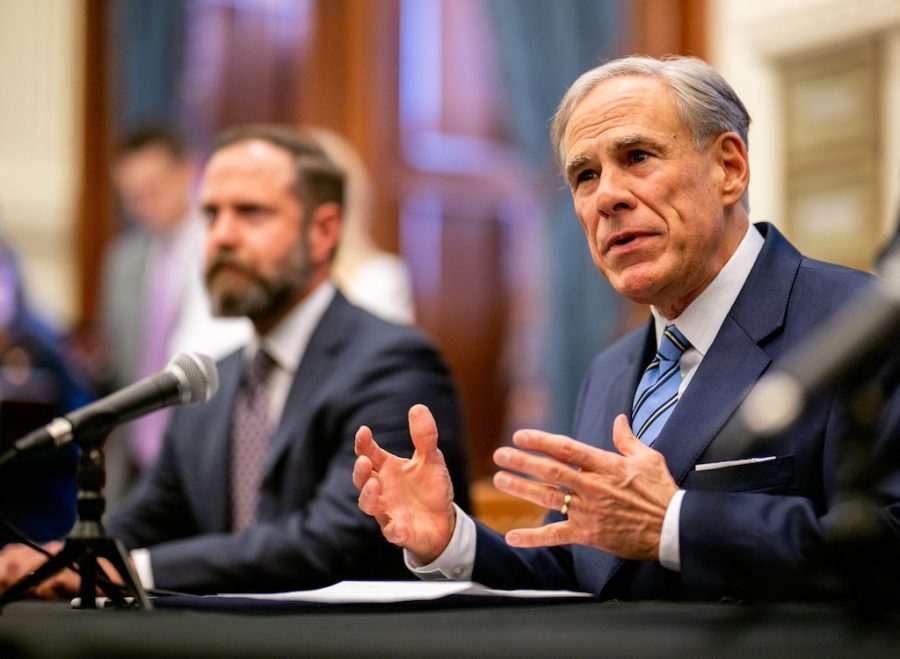
Texas Republicans have redrawn their US House map five years early, aiming to flip up to five Democratic seats in next year’s election. The move ignited a nationwide “high-stakes showdown” over gerrymandering, one that now stretches to California’s ballot this November.

In response to the Texas GOP’s redistricting push, Democrats from the state traveled to California and Illinois to plan a response with governors Gavin Newsom and J. B. Pritzker, respectively, who threatened retaliation with gerrymandered districts of their own. Newsom called it fighting fire with fire, warning once again that America’s so-called democracy was at stake.

The dust has settled in Texas. Donald Trump, Gov. Greg Abbott, and the Republicans got what they wanted: a perfectly legal chance to gain more seats in 2026. But gerrymandering is far from just a Texas problem. It reflects a nationwide structural flaw in our winner-takes-all, single-member district system.


Gerrymanders for All

Now things are ramping up in California, where Proposition 50 — the Election Rigging Response Act — will appear on the state ballot in November. If the measure passes, the Democratic-gerrymandered map would temporarily override the existing one created by a nonpartisan redistricting commission.

Created in 2008, the California Citizens Redistricting Commission (CCRC) is an independent citizen commission that draws the boundaries of the state’s US congressional districts instead of the state legislature. Any registered California voter who meets certain requirements to weed out conflicts of interest is eligible to apply for a seat on the commission, which is composed of five Democrats, five Republicans, and four members not affiliated with either major party.

Aside from Newsom, supporters of retaliatory gerrymandering now include former president Barack Obama, former vice president Kamala Harris, California senators Alex Padilla and Adam Schiff, and the California American Federation of Labor and Congress of Industrial Organizations (AFL-CIO). Obama’s former attorney general, Eric Holder, has also argued that Democrats love democracy too much not to play the Republicans’ game, and New York governor Kathy Hochul has declared that “all’s fair in love and war.”


Minority Rule

Thomas Hofeller — the so-called “master of the modern gerrymander” — described gerrymandering as politicians picking their voters instead of the other way around. Others describe the practice as drawing districts “especially for partisan advantage” and “stacking the deck before an election has even taken place.”

Definitions aside, partisan gerrymandering systematically leads to anti-majoritarian outcomes. At the state level, it creates “manufactured majorities” and has led to hundreds of cases where one party wins more votes statewide but ends up with a minority of seats in the state house or state senate. Wisconsin is one of the more egregious examples: Despite winning the popular statewide vote in 2012 and 2018, Democrats controlled only 39 percent of the state’s assembly seats and 45 percent of the state’s Senate seats.

The same issue occurs at the federal level. In the 2012 House elections, for instance, Democratic candidates received about 1.4 million more nationwide votes than Republicans, but gerrymandering gave Republicans a thirty-three-seat majority. (The 2024 House elections were less distorted — the Republicans have a slim House majority after winning a narrow plurality of the national vote.) The scenario of a minority of votes translating into a majority of seats happens for a different reason in the Senate, of course, where today’s Republican majority of fifty-three senators represents roughly twenty-four million fewer people than the Democratic minority of forty-five.

The Texas AFL-CIO said that cheating is the only way Republicans can stay in power. While it’s true that gerrymandering favors Republicans more than Democrats, both parties redraw districts at will, and the practice is legal under federal law thanks to the Supreme Court’s 2019 decision in Rucho v. Common Cause. Speaking for the majority, Chief Justice John Roberts explained that “partisan gerrymandering claims are not justiciable because they present a political question beyond the reach of the federal courts.”

We can also thank the Senate. In 2022, Democrats folded the John R. Lewis Voting Rights Advancement Act into the larger Freedom to Vote Act, which included provisions to attack gerrymandering. The omnibus bill was supported by more than 60 percent of Americans but died in the Senate at the hands of the filibuster. When some Democrats attempted to change the rules to allow the bill to pass with a simple majority, fellow Democrats killed it.

People are understandably angry about gerrymandering, but the tactic makes sense within the logic of our constitutional structure — where power doesn’t come from responding to the majority’s desire and winning votes within a system of universal and equal suffrage but from mastering a system designed to empower geographic minorities. It’s the same antidemocratic logic that drives every presidential candidate to tailor their campaign to a mere 400,000 voters in a handful of swing states.


A William T. Wiley Painting

Proportional representation can solve the problem of gerrymandering by replacing a system of single-member, winner-takes-all districts with multimember districts in which seats are allocated based on total vote share. If Democrats win 60 percent of the vote in a five-member district, they get three seats; if Republicans win 40 percent, they get two.

Proportional representation would also counteract geographic clustering, the phenomenon where urban voters, who are typically more left-leaning, are concentrated into fewer districts. This concentration makes it more difficult for statewide vote majorities to translate into legislative seats, even when maps are drawn neutrally.

Our current system of winner-takes-all elections traps the Left within the Democratic Party. However, proportional representation allows third, fourth, and even fifth parties to gain a foothold. “Whenever we look at maps of the political landscape in the United States, they are always depicted in red and blue, symbolizing the two-headed Cartel Party system that controls the US,” writes election reform advocate Jesse Kumin. “Two-color maps are made possible by Single Member Districts. I’m dreaming of a Proportional Map made up of lots of colors, more like a William T. Wiley painting, made possible by Multi-Member Districts.”

As long as we keep winner-takes-all districts, the temptation to gerrymander will always exist, and the Senate and Supreme Court have already given their approval. The only real fix is structural: multimember districts with proportional representation.

On paper, proportional representation could be implemented nationwide without violating (or changing) the Constitution. The Uniform Congressional District Act of 1967 requires states to elect their representatives to the US House using single-member districts; that law could be repealed. But doing so would require passing a bill through a federal system designed to resist significant policy change. So while proportional representation doesn’t conflict with the Constitution’s text, the Constitution, through its various minoritarian checks, nevertheless blocks the way forward.


Democratic in Name Only

Standing behind a podium emblazoned with the California state logo and the slogan “defending democracy,” Newsom touted Proposition 50 as a way of giving Californians “power to push back on Trump’s attempts to shred democracy” and “bring accountability” to the administration.

Like Biden and Harris did recently, Newsom casts himself as a defender of democracy while clinging to a system that denies it. In reality, there’s nothing democratic about America’s winner-takes-all, single-member district system — just as there’s nothing democratic about the minoritarian Constitution.

We cannot win the battle for democracy by following the Democrats into the black hole of competing gerrymanders. The only way out is through a struggle for a democratic constitution that includes multimember districts with proportional representation — a system that, in the words of Lee Drutman, “treats all voters equally, regardless of where they live. And it treats all parties the same, regardless of where their voters live.” Anything less leaves minority rule in place.


08 Sep 20:45

Zohran Mamdani: “New York City Is Not for Sale”

by Zohran Mamdani

At a Brooklyn town hall with Bernie Sanders on Saturday, Zohran Mamdani recounted how Bernie “gave me the language of democratic socialism to describe my politics” and called on supporters to keep organizing after Election Day. We reproduce his speech here.


Sen. Bernie Sanders and New York mayoral candidate Zohran Mamdani in New York City on September 6, 2025. (Michael M. Santiago / Getty Images)

The following is a transcript of introductory remarks given by New York City mayoral candidate Zohran Mamdani at a campaign event with Sen. Bernie Sanders at Brooklyn College in Brooklyn, New York, on Saturday, May 6. The remarks have been lightly edited for clarity.

It is an honor to be here alongside Senator Bernie Sanders. I want to share what Bernie has meant to me.

It was Bernie’s campaign for the presidency in 2016 that gave me the language of democratic socialism to describe my politics. And it was Bernie’s Queensbridge rally on October 19, 2019, that was the first political event of my campaign for state assembly.

That was unbeknownst to Bernie and his team. We were canvassing the line to get into his rally. We were asking for $1, $5, $10, emails — whatever we could. And we walked inside to this rally, and I remember the electrifying feeling we felt of a campaign reborn and a movement reborn alongside every single borough of this city.

And when Bernie walked out to “Back in Black” by AC/DC — those who were there remember — we felt as if possibility was a fact of life. His campaign continued to inspire so many of us. And as I ran for state assembly for the many months beyond that, we continued to look to him and his campaign and his vision as the compass for the work that we wanted to do in electoral politics.

And we knew that, while everyday New Yorkers did not care very much for a New York State Assembly race, if we just had a watch party for a Bernie debate, we could finally get them. We could get them if we said it was about Bernie.

I share this because I know that for so many here, it is a similar story. It is a similar story of seeing yourself in a movement, in a campaign, in a politics that you were told for so long was impossible to find. We know that the fight for each and every person to live a dignified life is a fight that is very popular across this country.

It was Bernie’s campaign for the presidency in 2016 that gave me the language of democratic socialism to describe my politics.

Many of you here, myself included, first knew of Bernie as a senator, as a candidate for president. But before that, Bernie was the mayor of Burlington, a four-term mayor. And in the same year that Ronald Reagan won not just the presidency but the state of Vermont, Bernie was in his thirties, a democratic socialist running against someone who had been powerful and well-known for years — an opponent who struggled to pronounce his last name. There are some parallels.

Bernie won that race by ten votes. And then he won again. And he won again. And he won again.

The motto of not just Bernie’s campaign but governance was, “Burlington Is Not for Sale.” It is a motto that drove the work that he did when he fought back against corporate greed to transform the Lake Champlain waterfront not simply into testaments to profit but instead a living, breathing testament to what is possible for investing in working people. When he fought for affordable housing. When he took on a broken property tax system. When he continued to show what it looked like for city government to understand dignity as its responsibility.

That is how Bernie fought. And we know that in that motto of “Burlington Is Not for Sale,” we see echoes in our own struggle today, where we have to say that “New York City is not for sale.”

In that motto of ‘Burlington Is Not for Sale,’ we see echoes in our own struggle today, where we have to say that ‘New York City is not for sale.’

New York City is not for sale to Donald Trump’s billionaire donors. It is not for sale to corporations like DoorDash. It is not for sale to corrupt politicians like Andrew Cuomo.

Bernie has continued to lead in this movement, going from “Burlington Is Not for Sale” to fighting back against oligarchy coast to coast in this country. And that fight, not just against oligarchy but for democracy, is a fight that has energized tens of thousands of Americans across this country. It has shown once again that politics is something that can be powered by ordinary people, with not just a rejection of authoritarianism but a belief in what is possible as well.

One of the many things that we love about Bernie is you could go to any year that he has been in politics, and you will find him saying the same thing. (Michael M. Santiago / Getty Images)

We know that that oligarchy has an impact right here in New York City. We know it does, because when Donald Trump ushered through his “Big Beautiful Bill,” he ushered through the greatest wealth transfer in American politics. His legislation will throw millions of New Yorkers off of their health care. For a man who campaigned on cheaper grocery prices, it will cut SNAP benefits for the hungriest among us. And all of this to give more money to those who already have more than they know what to do with.

That is the fight that we are seeing taking place here. The interconnectedness of an attack on working people, all to enrich those same billionaire donors who gave us Donald Trump’s second term. That is the fight that unites us across this country in this moment. A fight in which we make clear that this is a city where we will choose our own mayor.

It’s not going to be Donald Trump. It’s not going to be Bill Ackman. It’s not going to be DoorDash. We will choose our mayor.

We know that this fight is not an easy one. It was not an easy fight for Bernie when he led Burlington. It was a fight that took every single thing every single day.

If anyone tells you that after you cast your vote, you have done your job, tell them it is just the beginning.

Are you committed to continue this fight? Because I want to be clear. We are not just here together with the message to come out and vote in November, though that is critically important. We will continue to organize beyond the election. We will continue to organize because we have an agenda to win.

The promises we have made are promises we must keep. Together, we will freeze the rent, make buses fast and free, deliver universal childcare. We will do these things, and we will do them together.

If anyone tells you that after you cast your vote, you have done your job, tell them it is just the beginning.

Because in a city where one in four are living in poverty; in a city where for the ninth consecutive year, one hundred thousand children in our school system are homeless; in a city where five hundred thousand of our children go to sleep hungry every single night, it will take all of us to ensure that dignity is not only possible but it is a reality for each and every New Yorker.

One of the many things that we love about Bernie is you could go to any year that he has been in politics, and you will find him saying the same thing. No matter if the photo is in black and white or it’s in color, you know it’s about income inequality. It’s about justice, it’s about dignity.

It is a time for all of us to see ourselves as the people who could deliver the world that we deserve.

Today Bernie said to me that no man is an island. We are all in this struggle because someone brought it to us. As we remember that, we must know that now it is also our turn to not only join this struggle, but to lead this struggle. It is a time for all of us to see ourselves as the people who could deliver the world that we deserve.

And in this moment, we must make clear this is an intergenerational struggle. This is a struggle not just for some, not just for the young, not just for the few, not just for those in the beginning of their lives and their careers. This is a struggle for everyone. It is a struggle for everyone because it is about everyone.
We talk about our vision. It is a vision of universality. It is not one where we ask you your name, where we ask you where you were born, where we ask you your religion, where we ask you your status. We simply ask you to join us.


08 Sep 20:44

Chicago vs. Trump’s Takeover

by Branko Marcetic

Chicago is attempting to model resistance to Donald Trump’s looming authoritarian military occupation of its streets.


With Donald Trump's recent military ambitions in US cities, Chicago may be a model for municipalities looking to resist federal overreach from his administration. (Scott Olson / Getty Images)

What do you do when you’re mayor of a blue city and a far-right president sends the military to your streets? Right now, we’re seeing two very different answers.

In Washington, DC, Mayor Muriel Bowser has chosen capitulation: she’s made clear she “greatly appreciate[s]” Donald Trump’s military occupation of her city, gushed that it has lowered crime, and, with troops’ time in the city expiring, ordered the city to keep indefinitely cooperating with federal law enforcement “to the maximum extent allowable by law.” White House officials have praised her for “working with the administration behind the scenes,” dismissing her criticisms of the president’s actions as just “things she says in public.”

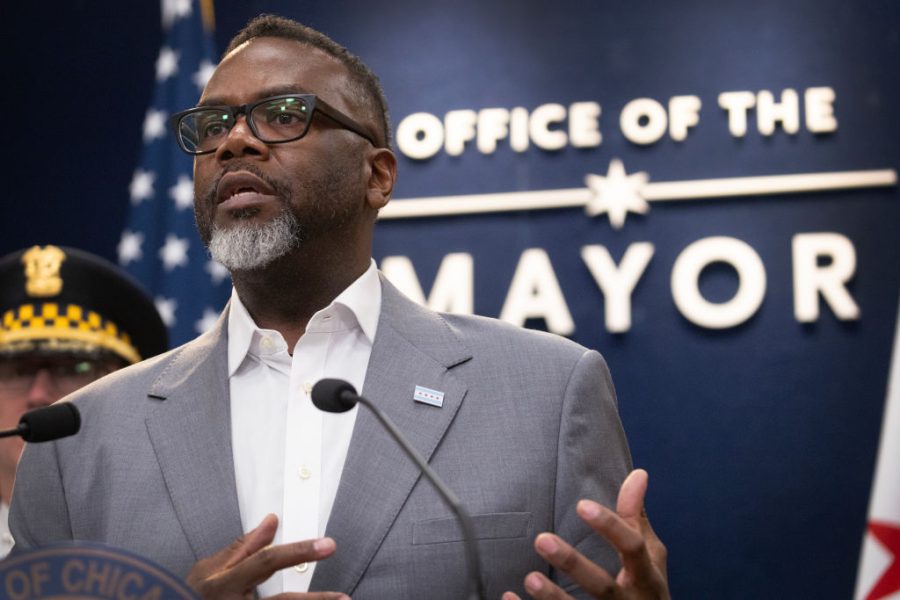
In Chicago, Mayor Brandon Johnson is choosing a different path: defiance. He has vowed to “defend our democracy” and “protect the humanity of every single person” in the city, attended a protest against the deployment, and pointed to the plunge in crime he has presided over — including a 32 percent drop in homicides and 21 percent drop in all violent crime. This past weekend, he issued an executive order pushing back against the impending deployment of federal agents and the National Guard to the city.

With Trump indicating his military ambitions are much bigger than the three cities he’s targeted so far, Chicago may be a model for municipalities looking to resist future federal overreach from his administration — or any future right-wing president’s.

Johnson’s August 30 order was signed on the mayor’s own initiative. But it’s also the culmination of an approach that has given working-class community groups a seat at the table and the ability to influence policy decisions under his administration.

“This has been building off of months of meetings,” says Cassio Mendoza, Johnson’s press secretary. “We’ve been meeting with these folks, they’ve been giving us feedback on what steps they would like to see the city take and working out what’s legally possible.”

“It has been a community-driven response to what we have identified as a threat to the texture of the city,” says Rich Wallace, founder and executive director of Equity and Transformation — a Chicago-based group focused on organizing black workers — who was at the press conference where Johnson announced the order.

Central to the order, for instance, is the Illinois TRUST Act, pushed by a coalition of activist groups and signed into law in 2017, which limits state and local law enforcement’s ability to assist federal authorities with immigration enforcement.

These efforts from city hall are being buttressed by the work of community groups organizing in concert with the mayor’s office to make sure Chicagoans likely to be targeted by federal forces have the resources they need. That means everything from having legal aid and rapid response teams in place to education campaigns to ensure Chicagoans know their rights and have their legal ducks in a row if they or a family member is detained. At times, that has meant being in touch with organizers in cities already overrun by a surge of federal agents to understand the tactics of the invading forces.

“We can’t prepare for everything, but we’re going to go into this moment to be as nimble as possible and be as flexible as possible,” says Brandon Lee of the Illinois Coalition for Immigrant and Refugee Rights (ICIRR).

It also includes protest. The kind of muscle the city will be able to muster if and when federal agents and troops swarm Chicago’s streets was on display earlier that week on Labor Day, when thousands turned out to protest the planned deployment, and where organized labor — including the Service Employees International Union, United Auto Workers, and the Chicago Teachers Union, with its close relationship with Johnson — was well-represented.


One Eye on the Future

Johnson’s executive order is not the ceiling when it comes to activist demands. Earlier this week, veterans called on Democratic governor J. B. Pritzker to use his status as commander in chief of the Illinois National Guard to formally direct service members to refuse Trump’s order — provocative, no doubt, but also perhaps legally sound, given a federal judge this week ruled the Los Angeles deployment flatly illegal and suggested anything similar in Chicago would be, too.

“Certainly we’d like elected officials at all levels to take the necessary steps to protect people in the area,” says Lee. He says that in the coming month, a coalition that includes ICIRR will be putting together a slate of demands for state lawmakers, which, depending on what community members propose, could include such a measure — though Pritzker has steadfastly avoided commenting on the idea.

Meanwhile, the massive cost of putting troops on Chicago’s streets is feeding further resentment among those who take public safety seriously.

“There are a million other ways that money could be invested to make sure we’re safe. That’s the rallying cry of the community right now,” says Wallace.

Johnson ran and won on a progressive anti-crime platform that included investing in housing, mental health, and youth employment. The approach seems to have worked: this summer saw the fewest murders in Chicago in sixty years.

But that agenda has also stalled. A potentially transformative affordable housing measure, “Bring Chicago Home,” which would have raised $100 million per year for combating homelessness by raising the tax on large real estate sales failed a vote by referendum in 2024, partly thanks to real estate–backed fearmongering about its price tag.

Yet according to one estimate, Trump’s troop deployment in Chicago is set to cost just under $1.6 million per day, four times the daily cost of housing the city’s homeless. If troops stay in the city until the end of the year, as Trump is aiming to do in DC, that would mean a total cost of more than $180 million — a price tag that could nearly have paid for two years’ worth of the Bring Chicago Home initiative. Trump has also revoked billions of federal dollars meant for Chicago to fund schools, economic development, and gun violence prevention, raising further doubts as to how sincerely the troop deployment is motivated by fighting crime.

Both the mayor’s office and working-class community groups view the pushback to the federal deployment as part of a longer-term organizing effort against Trump’s authoritarianism — including fears that he will resort to the same tactic before future elections to suppress the vote. After all, thirteen of the twenty cities with the worst homicide rates are governed by Republicans, including the top four, yet Trump has shown no indication he plans to deploy troops there.

Johnson and other Illinois officials’ defiance of Trump is not out of step with public opinion in Chicago. A poll of city residents over June and July found that two-fifths disapprove of Trump’s handling of immigration enforcement, nearly half opposed helping Immigration and Customs Enforcement (ICE) and other federal agencies carry out deportations, and a majority favored “a national civic uprising against President Donald Trump’s agenda” — including large shares who were willing to support even violent resistance to Trump and his immigration agenda.

Outrage against Trump in his first term helped catalyze the passage of the same TRUST Act now being used by Johnson to put limits on federal forces, and which was signed into law by a Republican governor. Chicago organizers believe the White House’s overreach now may help coalesce a resistance movement that will last much longer than federal forces’ presence in the city.

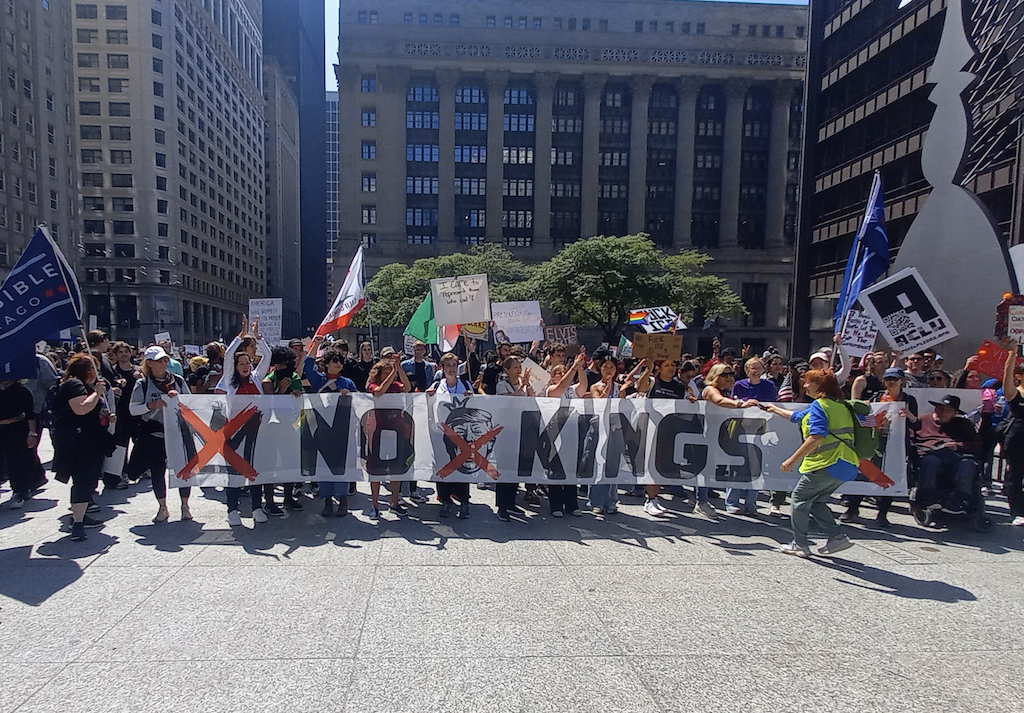
A “No Kings” protest in Chicago on June 14, 2025. (Wikimedia Commons)

“Trump’s tactics are meant to divide, to say this community is acting out of line, this community shouldn’t be here, to make us point fingers at one another,” says Lee. “But Trump right now is bringing people together, and that’s laying the groundwork for pushback to future attacks.”

Authoritarian power grabs have rarely been stopped through legalism and procedure. Eight months into Trump’s tenure, the courts have been an important check on the White House, but they have also had profound limits: partly because the Trump administration has shown a willingness to defy them, and partly because they have sided with the White House on a number of occasions. The Trump team has flirted with the idea of wholesale ignoring the courts, and it remains an open question how they would actually stop him if he decided to do so.

In other countries, such power grabs have been met with mass civil disobedience from a combination of protesters and workers. Last year’s attempted coup in South Korea was halted after only a few hours thanks to a swift mass uprising of thousands of people who effectively physically prevented the military from taking control of the country’s equivalent of Congress. In Bolivia, where the ruling party was deposed by a 2019 coup, continued, often disruptive mass mobilization by its supporters was essential to making the new regime back down and renew elections.

Similar lessons abound from the relatively recent overthrow of dictatorships in countries like Brazil and Chile. In all of these cases, the peaceful uprising of an overwhelming mass of civilians opposed to the regime viscerally displayed its lack of popular legitimacy, made it more likely for outnumbered and demoralized troops to choose not to fire or even to defect, and encouraged those who were silent or passively opposed to become more vocal.

A government whose existence rests on its ability to intimidate the public into compliance is often only checked by mass civil opposition, and Trump’s America — where the ruling regime acts in blatant disregard for the law, openly threatens its political opponents, and sends the military against its own citizens — is likely to be no different. There have been glimmers of this, in the surprisingly broad and deep mobilization of the “No Kings” protests, but it is still unclear if the burgeoning pro-democracy movement in the United States is able to conjure up the kind of coordinated mass unrest that challenged authoritarianism in these other countries.

Johnson’s executive order is narrow and largely symbolic; it’s unavoidable that municipal and even state governments simply do not have all that much power compared to the federal government. What may be its more important legacy is in using the power that state and local governments do have to lay the groundwork for and encourage the kind of civilian opposition needed to challenge a future, more concerted power grab. It’s a model that other Democratically governed areas may want to pay attention to, if they really want to create a robust, last line of defense against naked authoritarianism.


08 Sep 20:42

Trump’s Military Occupation of Chicago Won’t Bring Safety

by Rossana Rodriguez-Sanchez

Residents of Chicago’s most violent neighborhoods need investment in their well-being, not humvees patrolling them like a military occupation, writes Chicago city council member Rossana Rodriguez.


Police take security measures as protesters gather outside the Immigration and Customs Enforcement facility at 1930 Beach St. in Broadview, Illinois, on September 5, 2025. (Jacek Boczarski / Anadolu via Getty Images)

Under threats of deploying federal agents to intensify immigration enforcement in communities across Chicago, including my own, our neighbors are beginning to prepare a coordinated response to the possibility of Donald Trump sending the National Guard to occupy our streets and neighborhoods to assist and protect federal agents. His threat is a hollow performance of power — one that betrays the values of a democratic society and undermines the very progress Chicago has built around public safety and human dignity for its residents in recent years. Safety does not grow from the barrel of a gun but from the soil of justice, dignity, and care.

Donald Trump claims that Chicago is experiencing extreme violence. But this past year, Chicago saw the fewest homicides in six decades — the safest summer since the 1960s. That progress did not come from flooding the streets with soldiers or police. It came because the city invested in people: in youth jobs, mental health services, violence interruption, and community infrastructure. We move closer to peace not by threatening more violence, but by steadily nourishing the conditions that allow everyone to thrive.

The National Guard is not a solution to Chicago’s problems. Even if the Guard successfully imposes quiet for a moment, their presence carries the seeds of an explosion of violence and aggression. Soldiers in military fatigues patrolling neighborhoods do not heal wounds; they deepen them. They make residents feel like enemies in their own homes, cowering in fear.

Residents of Chicago’s most violent neighborhoods need investments in their well-being, not the military. What is being offered to them by Trump is not safety but domination.

Look at the neighborhoods in Chicago where murders are virtually nonexistent. They are not patrolled by Humvees or flooded with military-style checkpoints. They are communities where schools are fully funded, where parks are clean and inviting, where families have access to jobs that pay them enough to support themselves and their families.

The same is true abroad. Governments that invest in universal health care, robust social safety nets, free education, and robust worker protections and benefits experience thriving and safe living conditions. What genuinely reduces violence is not force but investment and care.

To send the military into Chicago is not an act of public safety; it is an act of authoritarian control. We have seen this theater before. In Los Angeles, federal immigration enforcement became the pretext for military deployment. A federal judge ruled it illegal. It will be ruled illegal here as well.

We move closer to peace not by threatening more violence but by steadily nourishing the conditions that allow everyone to thrive.

Trump’s actions are not about crime or immigration or homelessness. The numbers tell the story. When Trump staged his occupation of Washington, DC, most of those arrested were not violent criminals, but people caught in traffic stops or minor offenses. Ninety-three percent of those taken by Immigration and Customs Enforcement (ICE) had no criminal conviction. What is happening is a flexing of muscle to remind the nation who holds power — and to try to bend that nation to one man’s will.

The cruelty is compounded by the cost. Trump’s DC occupation cost four times as much as it would have cost to house the city’s entire homeless population. In Los Angeles, $134 million was spent on just sixty days of National Guard deployment. For the same money, Chicago could have hired 30,000 young people for summer jobs, reopened every shuttered mental health clinic, expanded mental health crisis response, and doubled the number of community violence intervention workers. Resources for these programs exist, but they are squandered on soldiers instead of invested in people.

What would an alternative to Trump’s authoritarian occupation look like? First, investing in violence prevention: credible messengers, often men and women who once walked the same streets and lived the same lives as those who are in danger of succumbing to violence — now using their life experiences de-escalate conflicts. These efforts are fragile and underfunded, but they save lives every day.

Second, investing in people’s basic needs: mental health clinics, summer employment for youth, workforce development, affordable housing. Every dollar spent in these and similar areas pays back multiple times over in safety and stability. We know this because we have seen it: the safest summer in sixty years came not from soldiers but from exactly these investments.

Trump, meanwhile, has undermined all of it. He cut $800 million in violence prevention funds. He slashed the Bureau of Alcohol, Tobacco, and Firearms (ATF) by nearly a third, crippling the very agency tasked with stopping gun trafficking. He has hacked away at Medicaid, food assistance, and public education. These are not policies of safety. They are policies of sabotage.

The crisis we are in did not appear from thin air. It was built over decades of policies that worshiped profit while starving communities and dehumanizing vulnerable people. Entire neighborhoods in Chicago were abandoned then blamed for the despair that followed. Our mayor, Brandon Johnson, has begun the long process of reversing the effects of this neglect.

The antidote is not more greed, more punishment, more abandonment. The antidote is solidarity. Organized, collective action is how communities survive when governments betray them. Neighbors caring for neighbors, workers standing shoulder to shoulder, youth and elders demanding justice together — this is the foundation of real safety.

Community care is a recognition that our survival is bound up with one another’s. Howard Zinn reminded us that social progress has always come not from the top but from people joining hands and refusing to let go. If Chicago is to be saved, it will not be by occupation but by solidarity.

Here in Chicago, we have been organizing for decades to ensure protection for our most vulnerable residents. From bike and foot brigades patrolling our neighborhoods for ICE presence, to know-your-rights canvasses, mutual aid efforts, and rapid response networks operating all over the city, our people show up for each other. Our work as elected officials, as organizers, as neighbors, as workers, and as movement leaders is to create the spaces and structures to build the solidarity and community care that will get us out of this mess.

Safety is inseparable from justice. You cannot occupy your way to peace. You cannot humiliate people into harmony. And you cannot treat citizens like enemies without hollowing out democracy.

James Baldwin once wrote that “ignorance, allied with power, is the most ferocious enemy justice can have.” To send soldiers into Chicago is precisely that alliance — ignorance of what truly creates safety, joined with the brute force of state power.

The choice before us is stark. We can continue on the path that gave us the safest summer in sixty years, or we can lurch backward into the nightmare of occupation. One path is dictatorship. The other is democracy, solidarity, and community care. Chicago’s people need schools, jobs, health care, affordable housing, and opportunity. They want their children to live. They do not want — and should not be forced to accept — tanks rolling down their blocks.


08 Sep 20:41

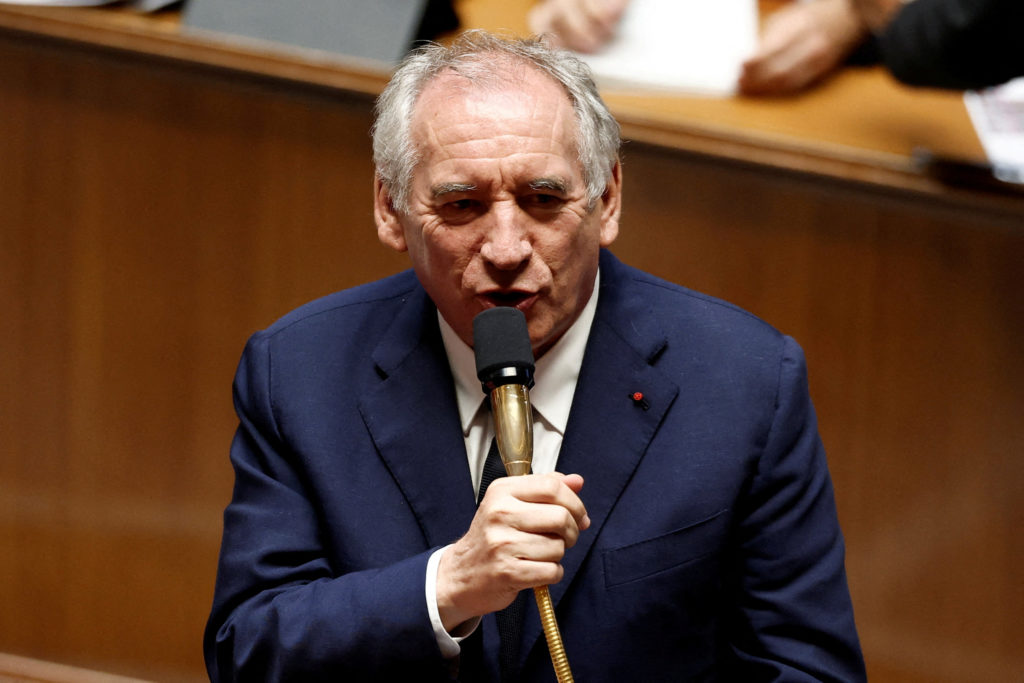
Legislators topple French government in confidence vote, forcing Macron to seek yet another prime minister

by John Leicester, Associated Press
Prime Minister François Bayrou was ousted after he gambled that lawmakers would back his view that France must slash public spending to repair its debts.
08 Sep 20:40

Banksy mural of judge beating protester to be removed from London High Court wall

by Lydia Doye, Associated Press
A new Banksy mural showing a judge beating an unarmed protester with a gavel will be removed from outside a London court.
08 Sep 20:38

Australian woman sentenced to life in prison for poisoning husband’s family with mushrooms

by Rod McGuirk, Associated Press
An Australian judge has sentenced Erin Patterson to life in prison for poisoning four of her estranged husband’s relatives with death cap mushrooms.
08 Sep 20:38

See the alleged Trump birthday note to Epstein, released by House Democrats

by Associated Press
The House Oversight Committee has obtained the “infamous ‘Birthday Book’ that contains a note from President Trump that he has said does not exist,” the committee’s top Democrat said Monday.
08 Sep 20:37

Speaker Johnson says he misspoke about Trump being an FBI informant in the Epstein case

by Associated Press
House Speaker Mike Johnson said Monday that he didn’t mean to suggest in a recent interview that Trump had or had not been an FBI informant in the case against disgraced financier Jeffrey Epstein.
08 Sep 20:36

ALT

A comic of two foxes, one of whom is blue, the other is green. In this one, Green approaches Blue, looking puzzled.
Green: Was there something we were supposed to do today?
Blue: I promised to give my brother a ride home from school.
Green: Hmm.

Still suspicious, Green pulls up this phone.
Green: No, that's not it. Let me check my calendar.

Green looks up to Blue, and the two look at each other.
Green: We forgot our anniversary again.ALT
08 Sep 15:32

Source: NPR

08 Sep 13:24

I found our new hire napping in my office, company won’t handle fridge clean-outs anymore, and more

by Ask a Manager

It’s five answers to five questions. Here we go…

1. I found our new hire napping in my office

I recently took a day of PTO but ended up having to stop by the office mid-afternoon to pick something up I’d left behind. I have a large private office with a couch, but I do not keep it locked when I am out, in case others need to access something there, which is the standard practice in my office.

I walked into my office to find my coworker asleep on my couch. He woke up and said, “I only meant to sleep for 20 minutes, I’m sorry!” I was in a rush and taken aback, so I just told him it was fine and moved on.

I approve staff’s timesheets, so I know he was not clocked out for a break and actually went into about 20 minutes of overtime that day. I’m not his manager, but I am in more of a leadership role than he is. He is also new to our team, having only been employed here for about a month. I don’t want to be a snitch, and I’m aware of the privilege of having a private office when he doesn’t. But this feels like a problem to be napping on the clock, and I don’t love that he used my office to do it when I was out. Should I bring it to our manager now, address it with him myself, or wait to see if it’s a pattern and bring it to our manager then?

I don’t think it’s necessarily a big deal that he borrowed your couch for a nap — maybe he was feeling sick and figured that was an available space where he’d be out of the way, or who knows what. But it is a bigger deal that he was napping without clocking out, and especially since he’s new I’d give your boss a heads-up. Maybe it’s a simple matter of him just having forgotten to correct his timesheet and something that can be easily remedied, or maybe it’s part of a pattern. Your manager will be better positioned than you to know, and also to keep an eye on future indicators of any pattern.

You don’t need to frame it as “Cecil did this horrifying thing.” You can be pretty low-key about it — “seemed off to me, though for all I know there could be a perfectly good reason for it, but I thought I should mention it in case it’s something you want to know about.”

2. Company won’t handle fridge clean-outs anymore

I work at a Fortune 500 company that has a huge corporate campus with at least 75 communal areas (fridges, freezers, microwaves, sinks, trash, couches, seating areas, etc.) I’ve worked here for almost 10 years and in that time those areas have always been upkept by the cleaning company we use, including the fridges. Every other week, on Sundays, the fridges were cleaned out and there would be signs reminding employees to take anything out by that day or it would be thrown away. Each fridge is used by about 170 people any given day for both personal lunch items and different culture events, so you never really know what belongs to who, and everyone’s very respectful about not touching things that don’t belong to them.

Recently the company announced the fridges will no longer be cleaned at all in an effort to save money. Is a shared refrigerator that’s not being cleaned by the company ever legal? What if it gets moldy and we don’t realize it because it’s so big and holds so many things? Do we wait until it’s something gross happens for them to realize this was a bad decision? Help.

It’s legal for them not to handle the fridge cleaning. I suppose it’s possible that mold and mildew could grow so out of control in there that it could conceivably become an OSHA issue … but it’s unlikely. There are quite a few companies that don’t provide fridge cleaning, and the vast majority of the time gross stuff eventually gets thrown away by someone who gets fed and up and tosses things, or a group of annoyed employees tries to organize a cleaning rotation (generally with varying degrees of success). Sometimes that does indeed result in moldy items hanging out in the fridge for weeks, but there are no legal regulations around this as long as the company isn’t a food service establishment and as long as toxic chemicals aren’t being stored in the same area.

That said … the amount of money saved by cutting fridge cleaning is small at best, so if they’re resorting to that it might be a harbinger of more significant problems to come.

Related:
I’m in charge of our disgusting office kitchen
our coworker has filled the office fridge with old, moldy food and refuses to toss it

3. I don’t want to talk about my pregnancy at work

I work for a faith-based private school that is very family-oriented. People regularly talk about their kids, share about their personal lives, etc. Normally, this is fine. However, I am very unexpectedly pregnant with twins and am struggling with it a great deal mentally and emotionally.

Right now, only a couple of people at work know (my boss and one colleague who I trust). Soon, however, I will have to at least share with the rest of my team (for maternity leave planning purposes), and it will become very obvious to everyone else. I know I can’t control people, but I really don’t want anyone to ask how I’m doing or bring it up outside of when it’s strictly necessary (i.e., planning for maternity leave). What’s the best way to shut down any conversation without offending anyone? I’m not anti-child or family by any means (I have two older kids myself), but given the circumstances I just can’t be happy about this pregnancy and would prefer it to be ignored as much as possible.

How about this: “This is a stressful pregnancy and it’s a lot easier on me not to talk about it at work, thank you so much for understanding.” People may assume that means medically risky, and it’s fine for them to assume that; they’re not entitled to the details.

4. I’m being docked PTO days for a suspension, despite not doing anything wrong

A few weeks ago, I came into the office on a Tuesday and was told that I was suspended. I had to go home and HR would contact me. Later that day, I got an email from HR saying they were investigating a complaint against me and I would remain suspended until it was resolved. On Wednesday afternoon, I got a call from HR. They said the investigation was ongoing but they partially lifted my suspension. I was allowed to come back to the office the next day with some irrelevant restrictions (things like no business travel to a customer, no high-level meetings unless specifically approved, etc., none of which made any difference for my work). They refused to tell me what the complaint was about.

The next week, I got another email from HR telling me the investigation was concluded. No wrongdoing on my part was found, and the partial suspension was lifted. No details were provided. However, they informed me that they have to deduct three PTO days: two for the days I was suspended and a third to account for the partial suspension. I called HR and asked again what happened. They refused to give me any information at all.

Is it normal to get no information about an investigation against me at all? I can imagine that they might not want to disclose the person who complained or that an investigation is ongoing against someone else. But getting nothing? And is it normal to subtract PTO for suspensions? I can understand this somehow for the two days I was at home, but the third day seems just like a punishment as I did my normal job on those days. Losing the three days means that I have to change plans for a short vacation later this year.

Employers can make you used PTO to cover a suspension, but it absolutely shouldn’t cover the day you were back in the office doing your job. That makes no sense; you were working as usual. Legally they can probably do it (unless you’re in a state like California with very clear rules around PTO, and even then it might be allowed) but it’s nonsensical and crappy (in all cases, but especially when they eventually cleared you of any wrongdoing). But you could certainly ask them to better explain exactly why you’re being docked PTO for a day when you were on-site and working, and why you’re losing any considering that they found you didn’t do anything wrong.

The lack of information about what the investigation was about is frustrating but not totally abnormal, and it could be because there’s an ongoing investigation that they need confidentiality around. It was reasonable for you to ask, but it sounds like you’re not going to be informed. At this point I’d stick with trying to reclaim at least one of those vacation days, but preferably all three.

5. Providing feedback on my manager when the required questions aren’t applicable to me

My company gives us the opportunity to provide upward feedback to our managers. The form is framed through three specific areas: forward-thinking, collaboration, and team-building.

However, my manager is a result of office location, not job duties. They are a communications executive and office leader, and I’m the (only) office admin. Most of the questions in the feedback form ask about things I don’t see from my manager — not because they aren’t doing them, but because of my lack of visibility into their daily work.

I’d still really like the chance to provide feedback anonymously, but there’s no N/A option for the (mandatory) feedback questions. To get to the more general short answer sections, I’d have to answer the questions based on assumption, which doesn’t seem honest or helpful as part of a formal review. Do you have any suggestions?

Can you point that out to whoever’s managing the survey and ask if they can make those questions options, or add a “n/a” option, or just give you a different way to submit free-form feedback anonymously? (That said, be aware that “anonymous” feedback isn’t always anonymous, and it might become even less so after you request this!)

The post I found our new hire napping in my office, company won’t handle fridge clean-outs anymore, and more appeared first on Ask a Manager.

08 Sep 13:08

Carney hoping Canadians too busy applying for jobs to notice skyrocketing unemployment numbers

by Ian MacIntyre

OTTAWA – In the wake of a jobs report showing the national economy lost 66,000 in August alone, Prime Minister is hoping that Canadians will be too preoccupied with filling out online job application forms to notice. “With Canadian unemployment surging to 7.1%, it’s a good thing that looking for jobs that don’t exist has […]

The post Carney hoping Canadians too busy applying for jobs to notice skyrocketing unemployment numbers appeared first on The Beaverton.

08 Sep 13:07

Awkward Zombie - No Time Like the Present

by tech@thehiveworks.com

New comic!

Today's News:

Thanks! Great! Awesome! I am not going to deliver your mail anymore!

08 Sep 13:05

Saturday Morning Breakfast Cereal - Puppets

by Zach Weinersmith


Click here to go see the bonus panel!

Hovertext:
Later a foot comes along wearing Jackboots and they have to decide whether to unite or get drowned.


Today's News:
08 Sep 13:04

Saturday Morning Breakfast Cereal - Gardening

by Zach Weinersmith


Click here to go see the bonus panel!

Hovertext:
Possibly grapes would be more productive. Consult your local agricultural extension and tell them Zach Weinersmith sent you.


Today's News:
08 Sep 13:03

Part 2.10

Part 2.10
08 Sep 13:02

And what do you do?

by John Allison

You can read DESTROY HISTORY: NEMS part 2 in full on my Patreon now. 

The 1968 Royal Variety performance! All the stars were assembled! Great days for British showbusiness, with all the big names on parade. Five years have  passed since the previous chapter of NEMS, but don’t worry, I will assiduously fill in the gaps for you as we go.

Catch up on the first part of NEMS here.

The post And what do you do? appeared first on Bad Machinery.

07 Sep 20:16

Mike, it was pointless and silly of us to dress as 70’s relief pitchers. And to rectify the…

Mike, it was pointless and silly of us to dress as 70’s relief pitchers. And to rectify the situation, we’ve decided to dress as Bobby Riggs and Billie Jean King.

07 Sep 20:16

Time to kick this movie’s plot into gear!

Time to kick this movie’s plot into gear!