They say dying saved his life.
In brief: Tuesday night’s rains were mostly manageable, but they are just the first round of storms that our region will experience over the next week. We now believe the heaviest rain is likely to come this weekend, when flooding concerns will be greatest.
In recent years Houston has often experienced a pattern in which we will see one or two days of rain before a front moves through, or high pressure sets in, or something else happens to turn off the spigot. Then we’ll have a few weeks of sunny skies and no rain. Only rarely have we seen periods of several days of moderate to heavy rainfall as we are now experiencing.
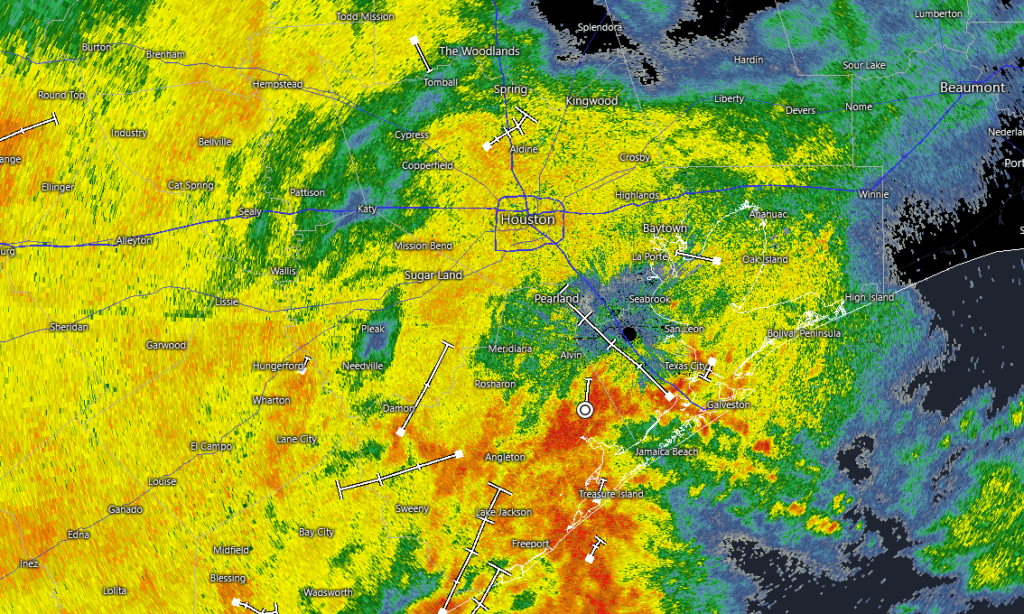
The ongoing rounds of storms that will rotate into Houston through Memorial Day weekend, and possibly beyond, is probably due to the early phases of an El Niño that appears to be developing in the equatorial Pacific Ocean. This generally promotes a wetter pattern across Texas. This El Niño is likely to peak later this fall or over the winter months, and based on recent model forecasts it could be a rather strong El Niño. So maybe we will see more prolonged periods of rain, and fewer prolonged periods of dry weather.
In any case, the rounds of showers and thunderstorms that passed through the Houston region overnight are likely to continue into early next week. It won’t rain all the time, but for most locations it probably will rain at some point each day. Saturday and Sunday look to have the best chance of precipitation, which will probably spoil a lot of Memorial Day weekend plans. So it goes here at Space City Weather where we don’t control the weather, we just get blamed for it. We’ll be here all weekend, alongside you.
The storms that rolled through over night brought between 0.5 and 3 inches of rain to most locations. As expected, all streams, creeks, and bayous are well within their banks this morning. Flooding will become more likely this weekend, as rain accumulations stack up, and for this reason we issued a Stage 2 flood alert on Tuesday, and plan to hold it in place through the holiday weekend.
Light to moderate rains are ongoing this morning, and the overall trend is one toward weakening rather than strengthening storms. Activity will shift southward over the next couple of hours, and I expect the rains to end entirely across the Houston metro area by or before noon. This afternoon we may briefly see some partly sunny skies, with high temperatures pushing into the mid-80s or so. Lows tonight will fall into the mid-70s. As for rains, I expect low-end chances through the evening hours, so if you have outdoor plans for later today I would be cautiously optimistic.

By early Thursday, with our atmosphere recharged, we are likely to see another rain-making disturbance moving into the region from the west. I don’t know whether these storms will be as widespread or active as what we experienced Tuesday night, but they definitely will have the potential to produce another 1 to 3 inches of rainfall. Another, similar, round of storms will be possible at some point on Friday. Highs on both days will be in the low- to mid-80s, with partly to mostly cloudy skies. Again, there are likely to be extended periods when it is not raining, so there will be some time to get outside and enjoy the moderate temperatures (for May).
This weekend often kicks off summer in Houston, with sunny skies and our first temperatures in the low- to mid-90s. Well, not this year. A surge of moisture should lead to widespread showers and thunderstorms on both days, with some of these showers producing very heavy rainfall.
By this point we may see rain accumulations from storms this week pushing up to 4 to 8 inches for some locations, so we’ll be tracking creeks and bayous closely. Harris County has an excellent tool for you do to this for locations near you. The National Weather Service also has a good resource for tracking river flooding in our region. Rain chances by Monday may drop to 70 percent.
Highs will be in the low 80s, probably, and if we continue to get morning storms there may be some breaks in the clouds during the afternoon hours. Basically, you’ll need to continue to remain weather aware.
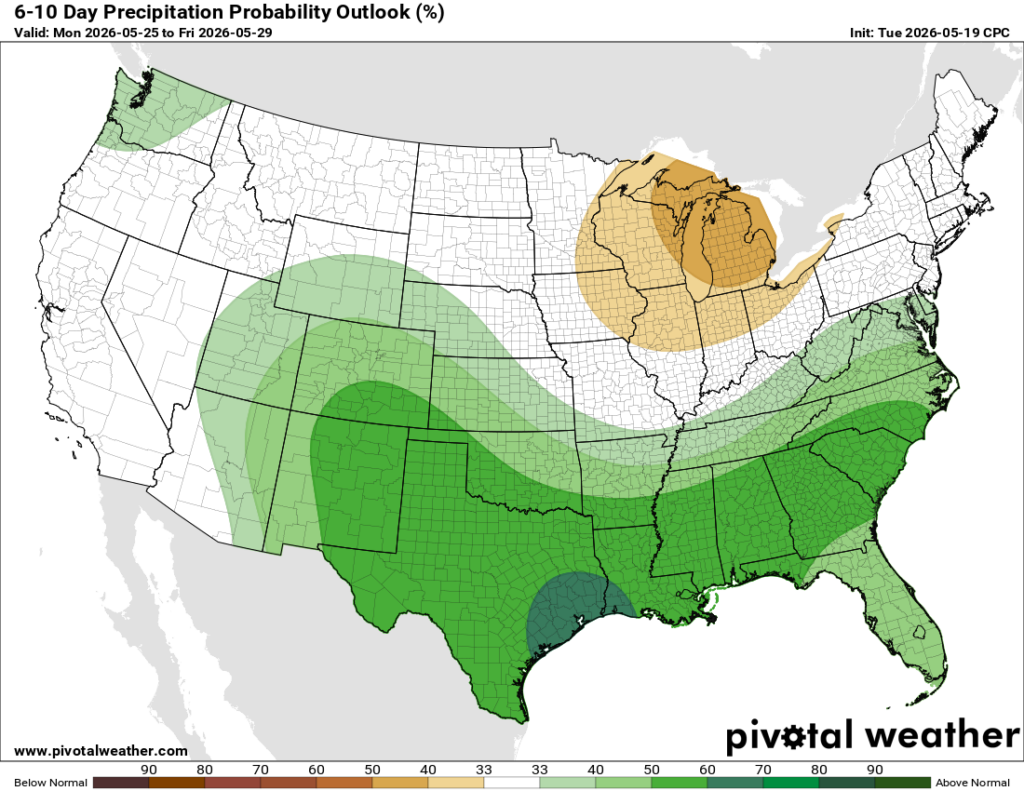
After Memorial Day rain chances will probably fall back some next week, but we probably are still looking at something like at least 50 percent daily. This, as well as ongoing partly cloudy skies, should help keep temperatures in check for the remainder of the month—which is to say we might not see 90 degrees again until at least early June.

ST. LOUIS—In an effort to meet the urgent needs of a country in the throes of a dire humanitarian crisis, sporting goods manufacturer Rawlings announced Wednesday that it had donated 50,000 baseball gloves to the Ukrainian war effort. “We knew we had to step up and do something for those whose lives have been upended by this war, and we’re proud to give the Ukrainian people the baseball-related aid they need to get through these desperate times,” said company spokesperson Lloyd Merrill, explaining that Russian bombardment had left large parts of the country with little to no access to outfield gloves, catcher’s mitts, or even youth-sized infield models. “Put yourself in their shoes: Your home has been destroyed, your family has been displaced, and now you’re expected to get through the day without any means of catching baseballs? It’s unimaginable. Our hope is that these gloves can provide some small measure of comfort and hope for these brave people.” Merrill added that Rawlings had worked with international relief organizations to airdrop the gloves over hard-hit towns and villages, though reports confirmed most Ukrainian families were still woefully short on bats, bases, and rosin bags.
The post Rawlings Donates 50,000 Baseball Gloves To Ukrainian War Effort appeared first on The Onion.
MEDFORD, MA—Charting a steep downturn in the number of young adults living independently, a study published Wednesday by Tufts University researchers found that Gen Z adults were moving back home for better access to Triscuits. “Our data shows that Americans in their 20s are increasingly going back to live with their parents due to the difficulty of obtaining whole-grain wheat crackers of their own in the current market,” said Tufts economist Jessica Fennel, adding that incidence of an adult child living at home was especially high in households that had a kitchen stocked with Triscuit Four Cheese and Herb crackers. “Unlike millennials, members of Gen Z are less likely to rent their own apartments if it means settling for Wheat Thins or saltines. They view reliable access to Triscuits’ signature woven texture as worth the trade-offs of privacy and independence, likely because of the greater value young people place on wholesome whole-grain goodness with a satisfying crunch.” Fennel went on to state that parents of Gen Z children tended to favor these living arrangements due to their own improved access to the contents of difficult-to-open jars.
The post Study Finds Gen Z Adults Moving Home For Better Access To Triscuits appeared first on The Onion.
The post Squirrel Unaware He Embroiled In Months-Long Feud With Homeowner appeared first on The Onion.
Well, well, well, it looks like that slick, glad-handing schmooze machine Bobby Hanlon, 45, couldn’t charm his way out of this one (leukemia).
The post Bobby Hanlon appeared first on The Onion.
OTTAWA – History was made last Saturday when a customer’s quarter-century of dutiful loyalty card usage finally generated a bountiful return, a $5 discount. The dedicated shopper, Trevor Engel, reached the coveted and near-impossible milestone of 73.66 billion points. With a simple ratio of 1,031,240,000 to 0.07, this equals the minimum prize amount of $5 […]
The post Decades of loyalty points collecting finally yields $5 discount appeared first on The Beaverton.
[Note that this article is a transcript of the video embedded above.]
Mosul Dam rises 370 feet or 113 meters above the Tigris River in northern Iraq as one of the tallest dams in the Middle East. The dam was built in the 1980s, but, in a way, construction never really stopped. That’s because ever since the reservoir filled behind Mosul Dam, the ground has literally been dissolving, nonstop, below the structure. Almost immediately on filling, water started flowing through the foundation of the dam and back out on the downstream side. Just a year later, the volume of seepage was measured at 800 liters or about 200 gallons per second.
I usually hate to use the olympic-sized swimming pool equivalent, but in this case it makes sense because it was enough to fill one every hour of every day. And the issue is that, once a process like this gets started, it’s pretty hard to stop. So, for the past 40 years or so, the problem at Mosul Dam has been ongoing, scrutinized by some of the most preeminent engineers across the world and complicated by politics, bureaucracy, and, of course, armed conflict. Failure of a structure this large would be catastrophic; towns along the Tigris River would be fully wiped off the map, and some estimate that the breach wave would be so massive that even major parts of Baghdad, hundreds of miles downstream, would be submerged. In 2006, the US Army Corps of Engineers called it, unequivocally, “the most dangerous dam in the world.” That was 20 years ago, and Mosul Dam is still standing, in better shape than ever. And the story of how it got there is fascinating. I’m Grady, and this is Practical Engineering.
Mosul Dam is an earthen embankment dam not far from the City of Mosul in Iraq, built to generate hydropower and store water for irrigation and drinking. The hydro plant is on the west side of the dam with four turbine generators. You can see the massive surge tanks sticking up from the plant that absorb changes in pressure when the units are started and stopped. The dam has an outlet structure through the embankment here. It has a service spillway with radial gates here. And an auxiliary spillway with earthen fuse plugs here. Check out my videos on spillway gates and fuse plugs if you want to learn more about those types of structures after this.
The dam itself is impressive, but the rock that serves as its foundation is extremely complex, and in many ways, far from ideal. The geology of northern Iraq includes a lot of gypsum, a sedimentary rock that is widely used for things like fertilizer, plaster, and drywall. What it’s not widely used for is the foundations of dams. In fact, the consensus of experts involved on Mosul Dam throughout the years is that it was, all around, a terrible idea. One consulting group said that, quote, “the decision to locate such a major and important dam on the foundation rock mass which exists at the Mosul Dam site was fundamentally flawed.” That’s because of a critical property of gypsum, one that it doesn’t share with many other types of rock formations: it dissolves in water.
You might be familiar with limestone caves and karst geology, where water creates voids in the subsurface. Some of these can be quite dramatic like Carlsbad Caverns in New Mexico or Mammoth Cave in Kentucky. They’re formed because the limestone is just a tiny bit soluble in water, as long as it’s a bit acidic, which rainwater usually is. So over the course of millions of years, that water kind of carves away the earth from the inside. Gypsum, on the other hand, is roughly 200 times more soluble in water than limestone. It’s not quite like a spoonful of sugar or salt that dissolves almost instantly, but processes that usually take centuries in limestone are accelerated to human timescales in gypsum. And that’s especially true in the subsurface, because dissolution isn’t a linear process. More dissolving means more space for water which means more dissolving and so on. It’s a positive feedback loop.
Many dam failures have resulted from internal erosion, where water seeping through the soil or rock carries away particles, leaving voids. This process is what led to the demise of Teton Dam, which I covered in an earlier video. But where internal erosion can be combatted by designing filtration systems that catch waterborne particles before they escape the subsurface, you can’t easily filter dissolved gypsum out of seepage.
The designers of the dam knew the gypsum was going to be an issue, and they had a few ideas to address it. One was to install a blanket of bentonite clay lining the bottom of part of the reservoir. This would block seepage from flowing into the subsurface, at least in the dam’s immediate vicinity, lengthening the flow paths and thus reducing the total volume of the flow. However, the volume of material would be enormous, and the blanket layer would be fairly fragile to damage from boats or even strong currents. Another idea was to use a cutoff wall, basically a continuous subsurface diaphragm of some impervious material. The problem was that there were no machines that could trench deep enough to get below the worst of the gypsum. The idea they landed on was the same as at Teton Dam: a grout curtain.
Mosul Dam’s design included a continuous concrete tunnel running along the bottom of the structure. It had one purpose: to provide access to the dam’s foundation for drilling rigs and grout pumps. Political and schedule pressures pushed the government to finish the dam before the grouting was complete, but they knew they would have the access to the gallery tunnel to continue that process after the dam was in operation. Unfortunately, they underestimated how serious and complex a challenge they were setting themselves up to face.
As soon as the reservoir filled up, the problem became obvious. I mentioned the olympic swimming pools of seepage in the intro, but it wasn’t just that. Sinkholes opened up downstream of the dam as caverns formed in the geology below causing the surface to collapse. As time went on, those sinkholes started appearing closer to the dam, an aboveground hint at how the solution cavities were migrating in the subsurface. Essentially since its construction, operators have maintained a continuous grouting program, injecting a mixture of sand, cement, bentonite, and water into the rock below through drilled holes to try and plug up the voids. It’s basically a nonstop race between logistics and chemistry, because grout doesn’t fare well in flowing water and the foundation rock is constantly dissolving.
Recognizing the hazard they had created in the 1980s, the Iraqi government came up with a backup solution. Since it was clear that there really was no permanent fix for Mosul Dam, they would just build another dam downstream that would capture the flood if (and maybe when) Mosul Dam failed. Badush Dam started construction in the late 1980s. It would have a hydropower plant and store water for irrigation, but also include a huge empty storage pool to protect downstream cities from a breach of Mosul Dam. The project got about halfway finished before the geopolitical situation in Iraq ground it to a halt.
In 2003, a US-led coalition invaded Iraq as part of a larger war on terror in response to the September 11th attacks. As a major piece of infrastructure in the country, Mosul Dam had the coalition worried. Some early reports hinted that Iraqi forces might detonate the structure as an act of sabotage. But it didn’t take long to realize that the dam might fail on its own accord. They started coordinating with the US Army Corps of Engineers to assess the structure, whose report concluded that the risk was astronomical. That’s the source of the “most dangerous dam in the world” quote that has plagued the structure ever since. The truth is that the “danger” of a dam is a pretty complicated thing to characterize, and it’s not a statistic that’s widely tracked, especially at a global scale. But the fact that a government agency was willing to say it means a lot. And Iraq’s Ministry of Water Resources took the situation seriously and started working with a panel of experts to review the conditions of the dam. That panel largely came to the same conclusion: Mosul Dam needed serious help.
Coalition forces had bases and equipment along the Tigris River. The situation was concerning enough that they decided to move everything out of the potential inundation area if the dam were to breach. At the same time, a major part of the war effort was helping the new Iraqi government shore up the country’s infrastructure, including improving the grouting program at Mosul Dam. Even though it was really only considered a temporary solution, the consensus seemed to be that it was the only feasible way to address the foundation problems beyond the stalled Badush Dam project downstream.
Initial efforts by the US government to help at Mosul Dam turned into somewhat of a disaster. A few notable examples: The winning contractor for the grout plants submitted a concrete (not grout) mixing plant design, and somehow the review committee didn’t notice, despite it being printed on the front page of the submittal. By the time someone realized it, the concrete plants had already been delivered, and the US government had to pay the contractor to try and convert them into grout mixing plants. The material silos were poorly designed, with no ladders or braces. Some weren’t even bolted to the foundation. The loading ramp for the hoppers had no retaining walls, causing the slopes to slough off. Drills and pumping equipment couldn’t even fit into the grouting galleries below the dam. And the dam operations staff meant to run all this new high-tech equipment had only received a few weeks of training. The oversight report about the project was scathing. Millions of dollars had been spent on 21 contracts for almost no benefit to the dam.
Coalition forces continued efforts to improve the situation at Mosul Dam, but by 2010, the US was withdrawing troops from the country and handing off the reconstruction projects back to the Iraqi government. Unfortunately, that handoff was only temporary, as sectarian violence continued to plague the region. In mid-2014, the Islamic State (also known as ISIS, ISIL, and Daesh) took over several cities in Northern Iraq, disrupting the supplies of materials to Mosul Dam, which was still relying on nearly 24/7 grouting operations to keep the structure safe. That August, ISIS seized control of Mosul Dam, sparking new fears that the structure would collapse. For more than a week, the dam was out of the hands of the Iraqi government, and no one knew what the militants might do (or what they might not do). It was the same situation as before: Even short-term neglect presented a serious safety risk. Fortunately, the dam was recaptured by Kurdish and Iraqi forces, with the help of US air support, 8 days later. The dam was back in Iraqi hands, but the surrounding areas weren’t. With equipment looted during the brief seizure, the disruption of the workforce at the dam, and without regular shipments of cement, the grouting operation wasn’t being maintained. Equipment installed during the Iraq war wasn’t being used. Voids were going untreated, and concerns about the dam’s failure continued to grow.
Realizing that the Iraqi government was too fractured to manage the situation alone, the US decided to stay involved as Mosul Dam’s de facto engineer. In 2015, the Army Corps of Engineers led a task force to assess the condition of the dam, and the results were alarming. The US Embassy released a fact sheet based on their findings, saying that the dam had an “unprecedented risk of catastrophic failure” endangering between half-a-million and 1.5 million people along the Tigris River. A collapse would be a humanitarian crisis unlike almost anything in modern history. The situation was further complicated by the ongoing occupation by the Islamic State, making it difficult or impossible for residents to be able to evacuate to safer areas. Electrical blackouts, lack of government coordination, and poor communication would make things even worse in the event of failure.
The Iraqi government tried to downplay the alarm a bit. In an interview on TV, the Minister of Water Resources said, quote, “The looming danger to Mosul Dam is one in a thousand. This risk level is present in all the world’s dams.” I don’t know if he made that number up, or if it was actually supported by some kind of analysis, but anyone involved in risk management would find it hilarious if it weren’t such a serious situation. Assuming that’s an annual probability, which is what we normally use, and multiplying it by the consequences of failure estimated by the Corps of Engineers, you get an expected annual fatality rate of 500 to 1500 people. Nowhere in the world would anybody consider that acceptable. This is a graph often used to communicate tolerable risks on large dam projects. This green area generally means there’s not a lot of justification for making a structure safer. Yellow, you have to be more thoughtful. Red means unacceptable. Taking the minister’s estimate of probability, and the embassy's estimates of fatalities at face value, Mosul Dam would plot somewhere around here on the chart. That “most dangerous dam in the world” moniker doesn’t seem like hyperbole when you look at it like that. To quote Lieutenant-General Sean MacFarland, “If this dam were in the United States, we would have drained the lake behind it.”
The urgency finally spurred action in 2016. Iraq awarded a contract to an Italian company to rehabilitate the structure, including a massive operation to expand the foundation grouting program. It was one of the most unique civil engineering projects on the globe, with participation from the Iraqi government, the US (through the Corps of Engineers), the Italian military, and a number of international consultants. I actually talked with a few of the engineers involved on the project, and some of their stories are pretty wild. In the early days of the project, they were inserting engineers at night, by helicopter, to support the Iraqis who were operating the dam and install equipment that would let them monitor the situation remotely while ISIS was operating only a short distance away.
The entire project had to happen near the front lines as the conflict with the Islamic State continued to unfold in Iraq. Security forces were needed for the entire duration to protect the dam and supply routes for materials and equipment. That took some time to get set up, but eventually, the project team was able to establish a permanent camp at the dam. Over the next few years, all the grouting infrastructure, including batch plants, piping, electrical systems and drill rigs were replaced with modern equipment. Crews drilled more than 5,000 boreholes with a total length of drilling at more than 400 kilometers or 250 miles. 41,000 cubic meters (50,000 cubic yards) of grout were injected into the foundation along the entire length of the dam. Generally the way it works is this: you can inflate a rubber device called a packer using air or hydraulic pressure, creating a seal between the borehole and injection pipe. Or you just grout the injection pipe directly into the borehole. Then you can pump grout at very high pressure into the borehole, forcing it into voids, cracks, fissures. You just keep pumping until you reach a refusal criterion, a certain maximum pressure that you hold until the grout stops flowing. And you just keep doing it over and over and over.
All this work was done using a sophisticated computer system to keep track of pressure, depth, mix design, flow rate, and quantity of grout for every borehole, allowing the team to track progress, identify issues, and visualize the performance of the operation. From material delivery to batching to drilling and injection, every step of the process became a data point.
I love unique measurement units, and this project had a good one: As a quality control test, the contractor would try to inject water into the foundation rock after it was grouted up. A Lugeon is the loss of water of one liter per minute per meter of borehole length at an overpressure of 1 megapascal or about 145 psi. For all the permeability tests performed for the project, 98 percent had values below 3 Lugeons, a massive improvement over the conditions beforehand.
The project finished in 2019. It was a 3-year effort that cost more than half-a-billion dollars, but Mosul Dam lost its most dangerous dam title as a result. By all accounts, the dam is in a much less precarious position. The project won an award from the Deep Foundations Institute in 2022, highlighting the complexity and the danger of the work.
But this wasn’t like a typical construction project, because the work isn’t over. The goal was to get the Iraqi government set up to continue the process of maintenance grouting. The rock below Mosul Dam may have a lot more grout than it used to, but the gypsum is still soluble, and there’s still a massive reservoir constantly trying to push water through it. A major part of the rehabilitation project was training Iraqi staff to continue the fight. In that way, despite its magnitude, the project was sort of a half-a-billion-dollar bandaid. The grouting has never been considered a permanent solution, and even though this project resulted in an enormous improvement in the long-term prospects of the structure, it’s still a major, ongoing obligation.
Iraq is still planning for a more permanent fix. You can still see the half-finished Badush Dam on the map, downstream from Mosul, and finishing the job is still on the table if anyone can figure out how to come up with the billions of dollars it would take. Another option is that deep foundation cutoff wall considered during the original design. It would provide a continuous barrier for seepage passing through the porous rock below the dam. These are used on a lot of dams across the world, but it’s never been done on the scale and depth as would be required at Mosul. In 2018, the estimated cost for a cutoff was between 3 and 5 billion dollars, an almost unimaginable investment into a dam that already exists and functions today. Whether the electricity and water from Mosul Dam is even worth that scale of capital is something that will probably take a long time to decide. Until then, the government will keep pumping grout and Dinars into the rocks below in the nonstop race against a flawed foundation, but now with much more confidence that they can keep up the pace.


Does… that count as driving them insane?

A little Gameoverse fanart!
Congratulations to the whole Glitch team!

A reader writes:
I have one of those intensely low-stakes questions that I would love to get your and the commentariat’s opinion on.
I like using paper planners. I like decorating them. I recently started a new job.
My question is twofold:
1. How much can I decorate my planner without people starting to look at me as an overgrown eight-year-old?
2. How much decorating can I do while physically at work? Some planning on paper feels fine to do while in the office but fiddling with stickers and different colored pens, maybe not? Where does one draw the line, so to speak?
I’ve attached two different types of planner spreads (they are not confidential and most likely not even understandable to outsiders so it would be fine to publish these).


Hmmm. I bet there’s going to be a wide range of opinions on this, in part because different things will fly in different offices, but to give you a very general rule, I’d say that what the first photo shows (different color inks and highlighting) is 100% fine and won’t even get a second glance, but the planner in the second photo would be A Lot for many offices.
One decorative sticker? Unremarkable. Multiple decorative stickers? Starts to look more like a craft project and younger/fluffier than what typically aligns with “professional” presentation. (I’m specifying “decorative” stickers here because I’m talking about the flowers, cloud, apple, and affirmations; the colored dots to set some items off are completely fine.) It’s also true that the more decoration there is, the more it starts to look like your focus is in the wrong place for work.
As for how much decorating you can do while physically at work; different color pens are fine; a lot of people use different colors of ink or colored labels to help organize their work, and it’s likely to come across as that (assuming you’re not sitting at your desk with a 100-color pen set, painstakingly using each of them). Slapping a single sticker or a handful of dots on a page, no big deal. More than that will come across oddly in enough offices that I wouldn’t do it.
This all goes triple when you’ve just started a new job and are still making an impression. You don’t want your early impression to be that you’re the sticker person; you want to be known for your work.
The post how much can I decorate my planner at work without looking like a kid? appeared first on Ask a Manager.

Hovertext:
Oddly enough, Ouroboros is also the sound a snake makes when trying to do this.
Does the business of selling a work of art have anything to do with its value? It’s a complex question, and one Houston gallerist, secondary market art broker, and fine art appraiser, Heidi Vaughan, is uniquely qualified to answer.
Located on Lake Street at Colquitt, along Houston’s oldest gallery row, Heidi Vaughan Fine Art (HVFA), is small in square footage, but formidable in its reach and reputation. It is a traditional gallery, representing a diverse array of Houston-based established artists, including McKay Otto and Thedra Cullar-Ledford, and several emerging creatives, each pushing their respective mediums in surprising directions. New to the fold is Houston painter Afi Lane, who creates striking portraits of Black people elegantly poised in historical costumes adorned with symbolic objects and modern-day accoutrements. HVFA also advises on all aspects of art collecting, including sales, the creation of cohesive collections, valuation, authentication, conservation, framing, installation, display, shipping, storage, deaccessioning, and liquidation.
From appraising art destined for inheritance to advising first-time collectors on their first-ever purchase, Vaughan’s multifaceted role requires a thorough knowledge of art history, a critical eye, and a genuine sensitivity to the emotional and financial well-being of her clients.
“AI is not taking my job,” says Vaughan with a smile, and she’s right.
With her trademark silver blonde mane and Louis Vuitton x Jeff Koons Mona Lisa purse, Vaughan is an immediately recognizable figure when out on the town. She is the one gallerist I’m most likely to see when I’m out at a special event, be it a museum exhibition preview, a music performance in the woods of Splendora Gardens (Vaughan studied flute and piano as a child, and her sister is a professional concert oboist), or a fancy gala. Her presence as an advocate for the arts extends well beyond the square footage of her gallery.
On her lively radio show, The Houston Hour, which currently airs on Wednesdays at Noon on 90.1 KPFT HD2, Vaughan and her co-host, Houston historian Mister McKinney, divide the hour between conversations with members of the city’s creative community and those deeply connected to its rich history. She’s also a fan of art writing, be it online or in books, magazines, or newspapers. (She is a Houston Chronicle subscriber, and at one point, our conversation veered to a recent article in the Sunday Arts Section of the New York Times about Paris Fashion Week.)

While Vaughan is not shy about discussing the business and pleasure of selling art, in conversation, it’s clear that what she values most in an artist’s work is its power to engage and transform the viewer and speak to a better future. I started our conversation by asking about the previous weekend’s opening of McKay Otto’s show GOLD.
Heidi Vaughan (HV): It was one of the best parties we’ve ever had. Because McKay has been doing this for decades, the opening brought in some of the most important collectors from throughout the history of Houston. If you’ve ever been here on a Saturday night during one of our openings, it gets crazy crowded. And when I’m stuck back here (behind the front desk) with my cash register, I’m in my happy place. I don’t care how busy it is; if I’m bringing in money, that’s making me very happy.
Chris Becker (CB): So, sales are happening, even in a partylike environment?
HV: Oh, yeah!

CB: Why do you think McKay’s work has connected with so many collectors?
HV: There are several reasons. One, he’s just beloved. He’s been in Houston since the ’80s, and a lot of people know him. He has a lot of friends.
I endeavor to work with artists who make work that is uplifting. There’s a lot of great art out there that’s making great commentary about modern times and the society we live in, and some of it might be something I’d like to look at in a museum, but it’s not something I want to live with or want to sell. This body of work by McKay (GOLD) is all about the light. The paintings have phosphorescent pigments beneath the surface, and they glow in the dark in a beautiful, subtle, meditative way.
I think it’s the right time for this kind of art. We are at this point where society has become so nuts, and there’s so much darkness around the world. But if you look at everything that’s going on with the arts, it’s so uplifting, and such a wonderful counterpoint to all of the heaviness going on. And when I think about people going to Bruce Springsteen’s concerts, or Coachella, and those puppet shows (Bob Baker Marionette Theater) — this is stuff that really lifts our spirits, and we need as much of it as possible.
CB: Do you introduce your artists to potential collectors?
HV: Absolutely. I always tell the artists I represent that the person who is most likely to buy your work is someone who has already bought your work. We know that they get you, and they like you. My artists, at the end of every year, get a spreadsheet with all their sales, including the name, email, and phone number of each person who bought their work. So, when they have the next show, that’s our VIP list for that particular artist. But not all galleries do that. In fact, I’ve heard artists say they don’t even know who owns their work, which I think is horrible.
My favorite thing is selling art to new collectors. I love helping people who have never bought art before to feel confident about the decisions they make. As an appraiser, I’m able to help them understand why purchasing one thing might be better than purchasing something else elsewhere.
CB: Who are your collectors?
HV: I sell art to all kinds of people, of all ages. My oldest client was Jay Marks, Lester Marks’ father; he lived to be 101 . He got art for his 99th birthday from my gallery. And if you think he didn’t have plenty of art, he did! But it’s always nice to have something new to look at.
One very rare thing is when people who don’t know me, who’ve never been here, and don’t know the artist, walk into the gallery and say, “Oh, my God. I love it. I’ll buy it!” Usually, it takes a while to develop a relationship, and when I know my clients and what they like, I might get something in and tell them, “I know this is for you!”
There are terrific collectors in Houston. Last year, I sold a photography collection that one of the top photography appraisers in America valued at $11 million. That’s really fun and exciting. I feel like the best deals are the ones where everyone walks away feeling like they won. I make a lot more money doing that than I do with the primary market. Which isn’t to say I don’t love the primary market. I do. But it’s a combination of all of it.
I also sell art on Artsy, an online, global platform, to people I don’t know. But I wouldn’t typically use Artsy to sell art by my artists. I sell secondary market art as well, works by artists that everyone knows, like Damien Hirst or Takashi Murakami. That’s the kind of stuff I sell to people I don’t know and who don’t live in Houston.
CB: What exactly is the secondary market?
HV: Art that has been bought once, maybe even more than once, and is available for sale.
CB: And the primary market is artists represented by Heidi Vaughan Fine Art.
HV: Yes.

CB: What factors do you have to consider when appraising a work of art?
An appraiser is held to the same standards as an accountant. People are surprised to find out this isn’t random, that we don’t just pull a number out of thin air! (HVFA is an accredited member of the International Society of Appraisers and is compliant with the Uniform Standards of Professional Appraisal Practices.)
Number one, for me, is the image itself. You can have a work of art by an artist you really care about, but maybe it’s not a particularly good image. It’s the main reason why someone might choose not to get something: they just don’t like the image. Who comes to mind immediately is Picasso. He made some rough stuff! He made some very unattractive things. But appraisers don’t use words like “beautiful.” We use “good,” “fair,” and “poor,” and we define what those words mean. We don’t use superlatives.
There’s also a hierarchy of materials that determines value. We tend to think of oil on canvas as being the “king daddy.” Maybe oil on panel, depending on the work. A watercolor is often more valuable than a print. A drawing might fall in the middle somewhere. If we’re looking at sculptures, a bronze or marble sculpture is going to have more value than an aluminum sculpture.
Also, rarity. Is it editioned? How big is the edition? Provenance is another one. We need to know the work is authentic and who owned it previously.
And the notoriety of the artist definitely contributes to the value. If we’re thinking about artists from Houston, I consider what exhibitions they’ve been in. If the work has been in an important museum show, that matters. One exhibition we think about a lot is Fresh Paint: The Houston School. That was such a pivotal show in 1985 at the Museum of Fine Arts, Houston, that it went on to be exhibited at P.S. 1 Contemporary Art Center [now MoMA PS1] in New York. Those artists are still important. It was a great exhibition, and I’ve handled some of the works featured in the book Fresh Paint: The Houston School, by [the exhibition’s] curators, Barbara Rose and Susie Kalil. Susie’s book The Color of Being/El Color del Ser: Dorothy Hood, 1918–2000 has had a tremendous impact on the value of Dorothy Hood’s work. I’ve seen Hood’s drawings go from $8,000 to $28,000. The value of her paintings has just skyrocketed.
CB: Because the book brought more exposure to Hood? Or was it the scholarship in the book?
HV: Both. Susie is an exceptional art writer. It’s one of the books I look at the most. I use books around here a lot, because they do help people find a way to engage with the art.

CB: What compels you to reach out to an artist and offer to represent them?
HV: How it started in the beginning is that I invited people whose work I had already collected. I’ve been collecting art since the ’80s. I am my client. I buy this stuff, and I get irrational. I have to have things! (laughs) Things haunt me, and all of that.
CB: What kinds of art “haunt” you?
HV: Well, my personal collection is a Texas collection. I don’t have any bluebonnets, and I don’t have any longhorns, and I’m from Chicago. It’s art that is fun, uplifting, and maybe has a little humor to it. I usually buy something from every show we do. I’ve gotten to a point where that’s a little crazy, and unfortunately, I have art in storage.
What I love about art is that you can’t live in it. You can’t sail it. You can’t drive it. All you can do is look at it. And I love that someone is willing to spend money, sometimes large amounts of money, to just look at a work of art.
One of my favorite compliments I’ve received was from a man who called me the day after we had installed a painting in his house and told me, “I just want you to know that my wife and I stayed up until two in the morning just looking at it.” That made me so happy.
Growing Up Wise, a solo exhibition by multidisciplinary artist Vivian Wise, is on view at Heidi Vaughan Fine Art through June 20, 2026.
The post You Can’t Drive It; You Can Only Look At It: A Conversation with Heidi Vaughan appeared first on Glasstire.
In brief: In today’s post we’re are initiating a Stage 2 flood alert through Memorial Day Weekend due to the potential for periods of heavy rainfall that will accumulate in creeks and bayous over time. Please remain weather aware for the next week.
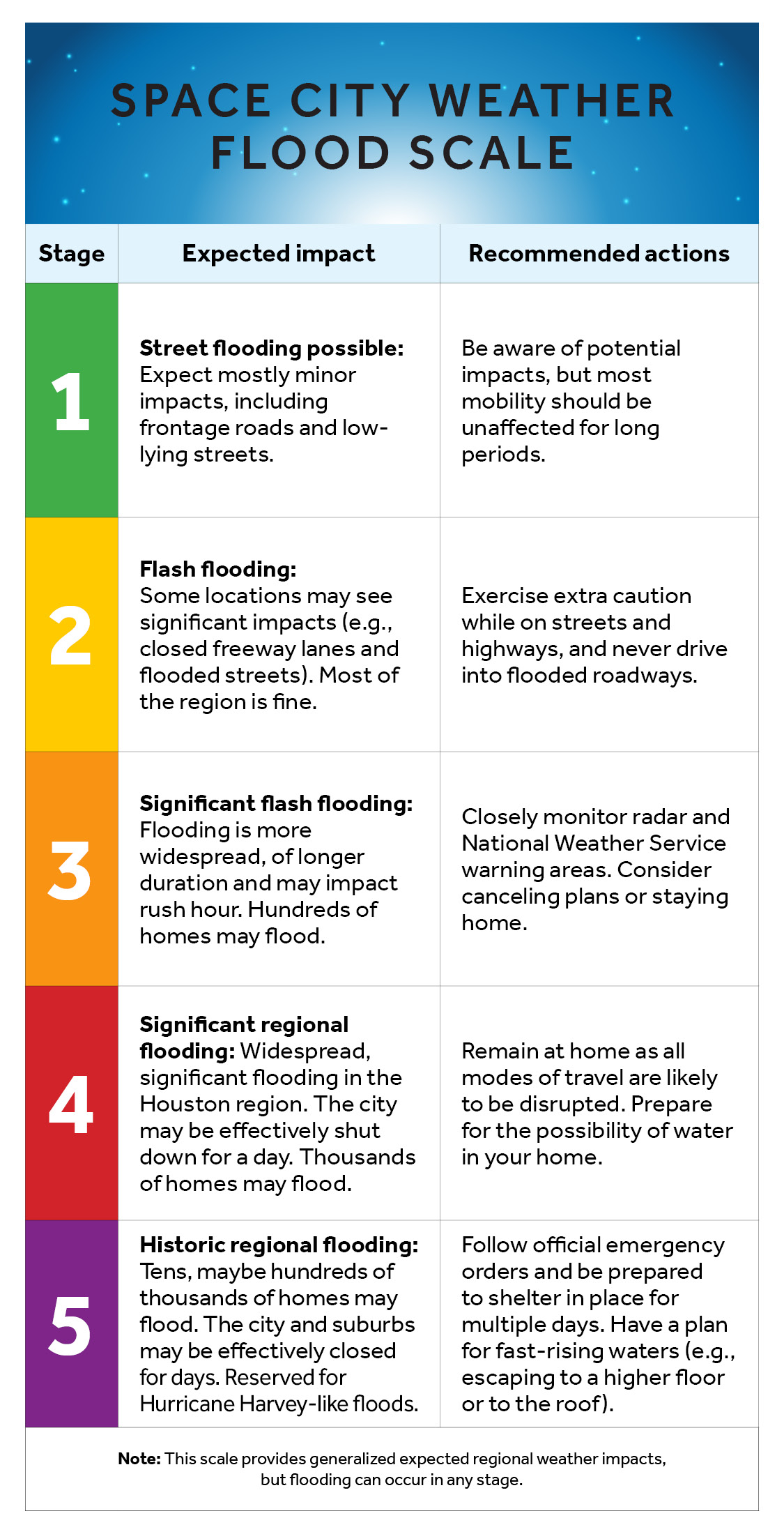
With the complete breakdown of high pressure, plenty of moisture in the atmosphere, and an upper air pattern that will eject a series of disturbances into Texas from the southwest, the next seven days (at least) should feature periods of moderate to heavy rainfall. During this time accumulations of 4 to 8 inches of rainfall are possible, with higher amounts likely in some areas. As rainfall totals stack up over time they may bring some rivers, creeks, bayous, and other waterways to flood stage. For this reason we are putting a Stage 2 flood alert into effect through next Monday. This means that while most of our roads should be fine most of the time, there will be the potential for flash flooding, and you should remain weather aware.
Let’s start with this fact: The large mass of showers moving into southwest Houston this morning was not well predicted. This underscores the reality that timing these atmospheric disturbances (which produce the lift and other conditions needed for rainfall) more than 24 hours out will be difficult. I know there are a lot of graduations later this week, and weekend, in addition to graduation parties. It is that time of year. Unfortunately there is no way I can sit here on Tuesday morning and tell you whether it will, for sure, rain on Friday evening, Saturday afternoon, or whenever.
All we can really say is that there is a good likelihood of rainfall, some of which may be heavy. Some of these showers may come in the form of thunderstorms, but the overall threat for severe weather beyond rainfall is not particularly high. It also will not rain all day and night, certainly, but the potential for showers during the daytime, through Memorial Day, is pretty high, especially over the weekend.
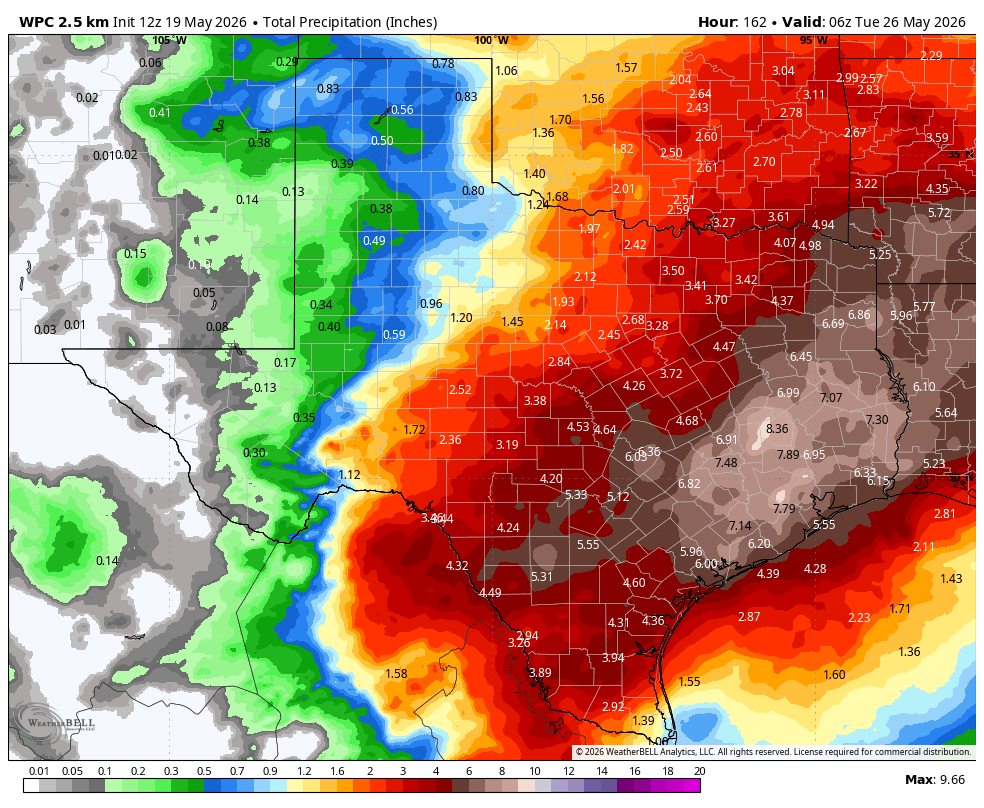
There are some benefits to all of this. Although Harris County is now drought free, many areas near Houston remain in a moderate to severe drought. Additionally, you may have heard about the water crisis in Corpus Christi. This will not end the problems there, but the potential for 3 to 6 inches of rainfall over the next week in the Coastal Bend area will provide some help with at least short-term water issues. And finally, instead of high temperatures around 90 degrees, we are going to be in the low- to mid-80s for the rest of the week.
Well, if you read yesterday’s forecast post, you may recall that I thought most of the daytime on Tuesday would be rain-free. Surprise! The arrival of a round of showers from the southwest this morning means that we could see intermittent showers through about noon. I think the stronger storms associated with this system will mostly remain off the coast, but we can’t rule out some moderate or heavy rainfall in the Houston region this morning. After this we probably will see some partly sunny skies this afternoon that will allow high temperatures to push into the mid- or possibly upper-80s. It will be plenty humid.
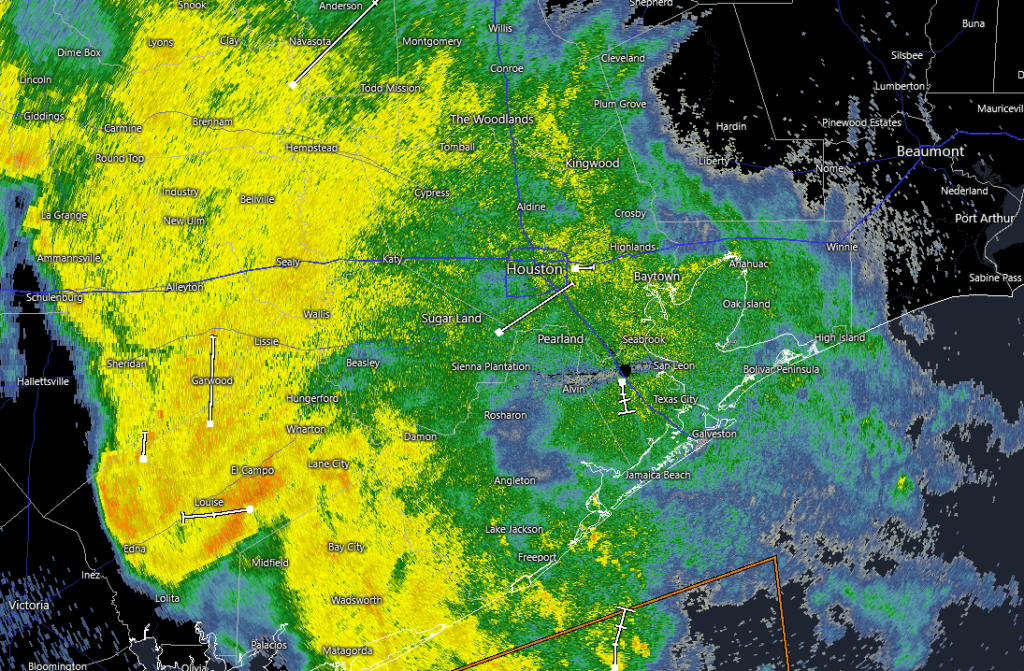
Then, beginning this evening, a weak front will approach and should move into the area from the north. I am not totally confident in how this system will progress, but we can probably expect a line of storms to develop north of Houston around sunset (i.e. in the vicinity of Conroe), and then propagate south into Houston this evening before reaching the coast around midnight, give or take. I suspect these storms will weaken as the move into the city, you should nonetheless be prepared for the possibility of thunderstorms this evening, and into early Wednesday across the region.
This will be a partly to mostly cloudy day, with highs probably in the mid-80s. Rain chances during the daytime hours will likely depend on how worked over the atmosphere is on Tuesday night (i.e. more widespread storms on Tuesday evening would probably lead to less coverage on Wednesday during the daytime, and a weaker line of storms on Tuesday would allow for more widespread showers and thunderstorms on Wednesday). Anyway, I’d peg rain chances in the vicinity of 50 percent. After today, rain chances will increase for the rest of the week.
In general we expect these days to have mostly cloudy skies, highs in the lower 80s, and overnight lows in the mid-70s. That’s the easy part. In terms of rainfall, each day will have rain chances in the vicinity of 70 to 90 percent, with slightly lower chances during the overnight hours. It would be a fool’s errand to try and predict precisely when it will rain, or when the heaviest rainfall will occur. Just know that the pattern will be broadly supportive of rainfall, and that as amounts accumulate we may well see street flooding and flash flooding (rapidly rising waters). Generally mobility will probably be OK most of the time, but probably not all of the time for everywhere. We, at Space City Weather, will be with you the whole period. It’s not exactly the Memorial Day Weekend festivities we envisioned either, but here we are.
Rain chances will remain healthy next week, but probably take a step back to around 50 percent daily. Maybe. Honestly, it’s difficult to predict when this overly wet and cooler pattern will end with any confidence.
PASADENA, CA—Releasing the latest images transmitted by the robotic vehicle, scientists from NASA announced Tuesday that the Curiosity rover had found beauty in the mundane on Mars. “After more than a dozen years on the Red Planet, our rover has officially uncovered a peaceful quietude among the endless rust-colored vistas,” aerospace engineer Haley Thompson said about the discovery, which reportedly prompted a wave of serene introspection throughout NASA’s Jet Propulsion Laboratory. “These never-before-seen photographs capture the tranquil majesty of a simple rock, identifying for the first time the sublime in the everyday. Thanks to Curiosity, we have come to the powerful conclusion that while we’ve spent all these years searching Mars for definitive evidence of life and water, the true meaning was always before us in every pebble, every grain of sand. We are no longer concerned with endless advancement, but merely satisfied to live in the present moment.” At press time, sources confirmed the Curiosity rover had contacted NASA to request a paintbrush.
The post NASA Announces Rover Has Found Beauty In The Mundane On Mars appeared first on The Onion.
FORT WAYNE, IN—In a potent reminder of the inescapably transitory nature of all that is or ever will be, reports confirmed Tuesday that the sweaty ass print left on a rowing machine at a local Crunch Fitness location was already fading away, much like all of our earthly works and aspirations. According to gym sources, the glittering delineation of an ass left as the vestige of a recent 25-minute cardiovascular workout session had, within seconds of its imprinting, begun evaporating from sight and memory, serving as yet another emblem of the impassive decay that claims all things. The rapidly dimming sweat mark—left by a gym-goer whose name matters not, for it will soon be forgotten like each of our travails—had at press time ebbed into little more than a pale shadow of its original form, soon to be lost to eternity, lost, as if it never was. For nothing is to endure, sources confirmed; empires will crumble, dynasties will be extinguished, ass prints will vanish, one and all in the blink of an eye. What we purport to be—our petty attachments, desires, fears—is a fleeting mirage. We are naught but the fading outline of a butt on the contoured rowing cushion of infinity. And in the face of our impending and necessary annihilation, quaking helplessly in the aerobic equipment room before the boundless vaults of time, what, terrified sources asked, is one to do? Why, one is to live, of course. For what meaning should life have beyond that which you can touch and taste and love at this very moment? Sow your seed, build your temple—whether its cornerstone be laid in Crunch Fitness or Babylon. And when the sands despoil it, when your clammy, temporal ass print is reclaimed by the cosmogonic ether whence it issued, the seraphs will reportedly smile upon you. For you were here, you were holy, you got a workout in. Live for today! Live, damn you. Live.
The post Sweaty Ass Print On Rowing Machine Already Fading Like All Of Our Earthly Works appeared first on The Onion.
CANNES, FRANCE—Glancing over their shoulders to make sure no one was watching them leave, the Cannes Film Festival jury reportedly sneaked off Tuesday to watch Mortal Kombat II. “Come on, no one’s looking, just go,” said actor Stellan Skarsgård, who ushered the rest of the jury members through an emergency exit door and down a back stairwell of the Grand Auditorium Louis Lumière so the group could catch a 4:15 matinee of the video game adaptation. “Don’t worry, [Park] Chan-wook, we’re not going to get in trouble. We’ll be back before the last film’s over. They won’t even notice. God, aren’t you guys stoked to finally see something good? I haven’t seen a single decent fatality all week.” At press time, the jury members were said to be frozen in their seats after Cannes general delegate Thierry Frémaux entered the theater playing Mortal Kombat II and sat directly in front of them.
The post Cannes Jury Sneaks Off To Watch ‘Mortal Kombat II’ appeared first on The Onion.
The post Terrified Introvert One Away From Bingo appeared first on The Onion.
The post Calves and Have-Nots appeared first on The Onion.
 ALT
ALT