Armed militia members were spotted early Tuesday at protests marking the one-year anniversary of Michael Brown's death in Ferguson, Missouri, where they were reportedly protecting a writer for one of the best known conspiracy theory websites in America.
"Founded after nine years of experience working in slums, Utopia is the world's first ever design and urban planning firm focused solely on slums, which will soon be home to 1 in 3 of humanity."
Bristol Palin hammered RedState editor Erick Erickson on Monday for criticizing Republican presidential frontrunner Donald Trump's sexism despite engaging in his own sexism when it came to her mother.
In this financialized hall of mirrors, narcissism replaces identity and the authentic self is rendered incoherent.
Correspondent Dani A.M. (of Removing the Shackles) was kind enough to identify three bits of advice from my recent conversation with Max Keiser on Summer Solutions (25:45): (9:20 min: "We've been brainwashed into financializing the human experience.")
1. Stop financializing the human experience
2. Acquire skills, not credentials
3. Vote with your Feet
These are the themes I'll be addressing this week.
What does financializing the human experience mean? It means turning everything into a financial transaction that profits an enterprise and the state. Since the state needs profitable enterprises to generate its tax revenues (and to pay wages that generate payroll/income taxes), the state is an implicit partner in every financializing the human experience transaction.
In an increasingly cashless, debt-dependent culture, every financial transaction generates income for banks: credit card and debit card fees, interest on credit cards, etc.
Here are some common examples:
-- Mom and Dad work long hours to afford childcare. Maybe they like working for the state or Corporate America more than caring for their kids (or sharing the care of several kids with other parents), but the system incentivizes maximizing income and paying for childcare as a profitable transaction.
In other words, childcare for many has been distilled down to a financial decision.
-- Dinner with friends is purchased, generating income for an enterprise, a bank and taxes for the state. If people no longer learn how to cook, then sharing a meal with friends necessarily becomes a financial transaction.
-- A sense of self must be purchased via signifiers of identity and self-worth.
The obsession with brands and other signifiers of belonging reflects one thing, and only one thing: a pervasive fragility of self. Unsurprisingly, our selfhood is incredibly fragile in a culture that glorifies the impossible (thin, fit, super-smart, witty, personable, creative, wealthy oh and of course humble) and sows insecurity as a means of selling you something.
That each of us remains the same person regardless of what we wear, drive, drink, etc. is obvious but verboten in a culture that profits from insecurity and self-doubt. As Caroline Caldwell observed, "In a society that profits from your self-doubt, liking yourself is a rebellious act."
I would modify this slightly: liking yourself regardless of what you wear, drink, drink, etc. is a rebellious act.
Liking yourself is not the same as narcissism. Narcissism is the result of the consumerist society's relentless focus on the essential project of consumerism, which is "the only self that is real is the self that is purchased and projected."
The narcissism bred by consumerism has nurtured an emotional isolation and immaturity that I call permanent adolescence which leaves many young people without the tools needed to handle criticism, collaboration and the pressures of the workplace.
Personal gratification is the driver of narcissism and consumerism, which are two sides of the same coin. Consumerist marketing glorifies the "projected self" as the "true self," encouraging self-absorption even as it erodes authentic identity, self-esteem and the resilience which enables emotional growth--the essential characteristic of adulthood.
Personal gratification is of a piece with self-absorption, fragile self-esteem and an identity that is overly dependent on consumerist signifiers and the approval of others.
The only way a consumerist economy and the state that depends on it can flourish is to turn every human interaction and emotion into a financial transaction. Just reached a personal goal? Celebrate by going to Disneyland and dropping a packet.
Feeling low? Cheer yourself up by buying a new signifier of self-worth.
Sensing something is terribly wrong with your life? Buy another self-help book that repeats the all-important narrative: It's not the system, it's you.
The problem isn't that the system is deranged, dysfunctional and crippling; no, it's you who are deranged, dysfunctional and crippled. But maybe some costly therapy will help you cope with your bottomless inadequacies.
By holding the system blameless for the fragility of our sense of self and identity, the conventional consumerist narrative fragments any social roles that aren't dependent on financial transactions and consumerist signifiers.
In this financialized hall of mirrors, narcissism replaces identity and the authentic self is rendered incoherent.
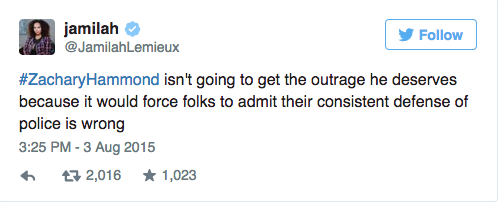
On the evening of July 26, Zachary Hammond pulled into the parking lot of a Hardee’s in Seneca, South Carolina. Seated next to him was a young woman who had arranged to meet someone there to sell a bag of weed. It’s unclear what Hammond knew about the transaction, but neither the 19-year-old nor his passenger had any idea that the buyer was actually an undercover police officer. Moments later, another officer fatally shot Hammond.
o.o wait what?! me: damn it. why does the world have so much wrong with it?
After seeing this elegant cubana on here a number of times, I decided to do a little research. I found her name, as well as backstory from The Sartorialist:
“This is my beautiful mother, Valeria Perojo Frias, born in Pinar del Rio, Cuba on March 23, 1926. This photograph was taken sometime in the mid to late 1940′s. I believe she was at a christening of a friend’s child in Havana. She was an amazing and inspirational woman – making her way to the US with my father by way of Miami in late 1959, and ending up in New York City two years later, where I was born and raised. She was always a fashionista and had that amazing aura that exuded beauty, charm and grace. And boy could she pose for a picture, eh? She always will be my very own personal style icon.”
As many of you TransGriot readers know, I have been tracking since the inception of my blog nearly a decade ago the murders of trans women of color and whether or not they have received justice in their cases.
I have been alarmed by the fact that we have already matched the number of trans women killed in the US in all of 2014 (12) in just 8 months, and this year still has 4 months left to go. I am also particularly concerned and incensed about the fact that the majority of trans women that have been murdered are not only trans women of color, but under age 30.
I am pleased to not only affix my signature to this (Signature #23), but also signal boost this We The People petition that started today. It seeks to get 100,000 people to sign on to this effort to get the federal government to investigate this unacceptable slaughter of trans women of color, of which far too many of them have been under 30 years of age.
We have to get the 100,000 signatures by September 10 to get a formal response from the White House on the requested action stated in the petition.
Here's the link to the petition and I hope you will join me in taking just a few moments of time out of your busy day to sign it.
If you do, thank you. I and my community deeply appreciate the support, and please share this news in your influence circles.
#tbt that time i was raving about an all women shakespeare company and some fuckboy butted in with “i hate how you never hear about all men shakespeare productions” that has honestly been the highlight of my university career so far
Georgia has been illegally and unnecessarily segregating thousands of students with behavioral issues and disabilities, isolating them in run-down facilities and providing them with subpar education, according to an investigation by the United States Department of Justice.Some of the students in ...
LITTLE ROCK, Ark. – After spending countless hours trying to educate family members and coworkers over the past four years, local vegan Donald Besser finally reached his breaking point when trying to explain the distinct difference between being vegan and being homosexual.
“My dad, God bless him, can be extremely misguided when it comes to this stuff,” said an exasperated Besser. “I told my family over Thanksgiving in 2011 that my wife Rebecca and I decided we would no longer eat meat and are going vegan. I swear my dad almost cried and my mother grabbed Rebecca’s hand like she was trying to comfort her.”
Since that day Besser has had to constantly inform friends and family that his decision to no longer consume animal products is in no way related to his sexual orientation or desires.
Besser’s childhood best friend Luke Grey has had trouble accepting the news. “When Donny and I were growing up I always thought something was a little bit different about him. He never liked to hunt or throw rocks at turtles or anything like that. One time he even hid my BB gun after I shot a snake. But he always seemed interested in girls so this veganism thing sort of came out of nowhere.”
At least once a week Besser finds himself explaining that veganism is a choice to avoid consuming animal products, while homosexuality is a romantic or sexual attraction to a member of the same gender, or sex.
“Honestly if I had known it would be this big of a deal I would have just kept it a secret,” said Besser. “Everyone treats me differently and some people wont even talk to me anymore. They just tell me, ‘Real men eat meat,’ and to ‘go back to San Francisco with all the other vegans.'”
This year Besser plans to drop another bombshell by announcing he never liked the Razorbacks or anything else related to football.
Article by The Hard Times Staff @REALpunknews. Photo by Click.
Like us on Facebook and keep up with all the latest Hard Times news.
As brevity in fiction goes, who can top “For sale: baby shoes, never worn”? That much-referenced six-word story, often attributed to Ernest Hemingway, certainly packs an impressive amount of human drama into its short length. But what about other genres? What would a six-word science- fiction story look like? i09 crowdsourced countless such works in 2014: responses, which tended toward the eschatological, included “The Universe died. He did not,” “New world. Cryogenic failure. Seeds dead,” and “Finally sentient, it switched itself off.”
Not bad, but what would we get if we went to the professionals? Alas, Sir Arthur C. Clarke, prolific author of such respected sci-fi novels as 2001: A Space Odyssey and Rendezvous with Rama, passed away just five years before i09 issued its challenge. Still, we have an idea of the direction his entry might have gone in from of “siseneG,” a story story — a very short story indeed — Clarke sent in to Analog magazine in 1984:
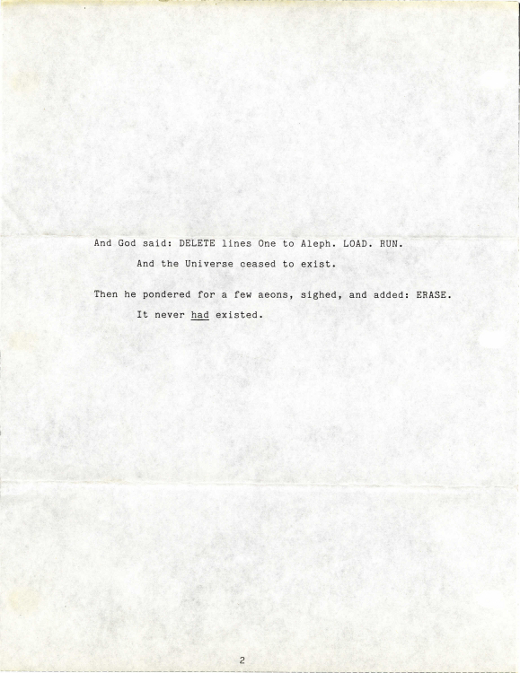
And God said: DELETE lines One to Aleph. LOAD. RUN.
And the Universe ceased to exist.
Then he pondered for a few aeons, sighed, and added: ERASE.
It never had existed.
“This is the only short story I’ve written in ten years or so,” Clarke wrote in the accompanying note. “I think you’ll agree that they don’t come much shorter.” We now know that they can come somewhat shorter, at least 25 words shorter than “siseneG,” but surely we can all agree that Clarke set a high standard for scientific (or perhaps technological-existential) flash fiction decades before the coinage of the term. But then, we always knew the man had a knack for looking ahead.
Target announced that in several sections of their stores, they will omit signage that suggests that certain products are for people of a particular gender.




 As many of you TransGriot readers know, I have been tracking since the inception of my blog nearly a decade ago the murders of trans women of color and whether or not they have received justice in their cases.