09 Dec 20:47
by Yu-Fei Zhang, Xiao-Ping Cao, Hak-Fun Chow and Dietmar Kuck

The Journal of Organic Chemistry
DOI: 10.1021/acs.joc.6b02326

08 Dec 20:37
J. Mater. Chem. C, 2016, Advance Article
DOI: 10.1039/C6TC04756D, Paper
Shangshang Wang, Xin Li, Wandong Zhao, Xuanying Chen, Junji Zhang, Hans Agren, Qi Zou, Liangliang Zhu, Wenbo Chen
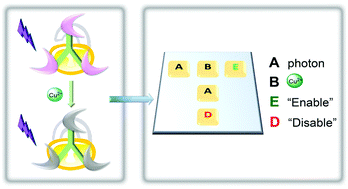
A Cu2+-gated photochromic behavior of a star-shaped diarylethene derivative and its plausible mechanism are discussed.
To cite this article before page numbers are assigned, use the DOI form of citation above.
The content of this RSS Feed (c) The Royal Society of Chemistry
08 Dec 18:23
Chem. Commun., 2017, 53,336-339
DOI: 10.1039/C6CC09038A, Communication
Fei Jia, Dong-Hao Li, Ti-Long Yang, Liu-Pan Yang, Li Dang, Wei Jiang
We herein report the synthesis, conformational analysis, and host-guest chemistry of two larger oxatub[n]arenes (n = 5, 6). The influence of the conformational complexity on molecular recognition is emphasized.
The content of this RSS Feed (c) The Royal Society of Chemistry

07 Dec 14:01
Chem. Sci., 2017, 8,840-845
DOI: 10.1039/C6SC04806D, Minireview

Open Access
R. D. Astumian
The Nobel prize in Chemistry for 2016 was awarded to Jean Pierre Sauvage, Sir James Fraser Stoddart, and Bernard (Ben) Feringa for their contributions to the design and synthesis of molecular machines.
The content of this RSS Feed (c) The Royal Society of Chemistry

05 Dec 13:56
by Nico Schwarze, Simon Steinhauer, Beate Neumann, Hans-Georg Stammler, Berthold Hoge

Whereas tris(trifluoromethyl)silanes tend to decompose violently at room temperature, the corresponding pentafluoroethyl derivatives are thermostable compounds. Preparative synthesis of Li[Si(C2F5)3] enabled efficient nucleophilic transfer of the Si(C2F5)3 unit onto main-group and transition-metal compounds as well as organic scaffolds, as shown by B. Hoge and co-workers in two Communications on page 16156 ff. and on page 16161 ff.
05 Dec 13:27
by Dapeng Lu, Guilin Zhuang, Haotian Wu, Song Wang, Shangfeng Yang, Pingwu Du
Abstract
Herein we report the organoplatinum-mediated bottom-up synthesis, characterization, and properties of a novel large π-extended carbon nanoring based on a nanographene hexa-peri-hexabenzocoronene (HBC) building unit. This tubular structure can be considered as an example of the longitudinal extension of the cycloparaphenylene scaffold to form a large π-extended carbon nanotube (CNT) segment. The cyclic tetramer of a tetramesityl HBC ([4]CHBC) was synthesized by the reaction of a 2,11-diborylated hexa-peri-hexabenzocoronene with a platinum complex, followed by reductive elimination. The structure of this tubular molecule was further confirmed by physical characterization. Theoretical calculations indicate that the strain energy of this nanoring is as high as 49.18 kcal mol−1. The selective supramolecular host–guest interaction between [4]CHBC and C70 was also investigated.

A decent slice of a carbon nanotube was synthesized in the form of a large π-extended carbon nanoring based only on hexa-peri-hexabenzocoronene units (see picture). The photophysical properties of the nanoring were investigated by both steady-state and time-resolved fluorescence spectroscopy, and a selective supramolecular host–guest interaction with C70 was identified.
23 Nov 11:49
Chem. Sci., 2016, Accepted Manuscript
DOI: 10.1039/C6SC04714A, Edge Article
Open Access
Xiaowei Li, Xiangyang Yuan, Pengchi Deng, Lixi Chen, Yi Ren, Chengyuan Wang, Lixin Wu, Wen Feng, Bing Gong, Lihua Yuan
Examples of using two-dimensional shape-persistent macrocycles, i.e., those having noncollapsible and geometrically well-defined skeletons, for constructing mechanically interlocked molecules are scarce, which contrasts the many applications of these macrocycles in...
The content of this RSS Feed (c) The Royal Society of Chemistry

23 Nov 08:52
by Kathrin C. Knirsch, Ferdinand Hof, Vicent Lloret, Udo Mundloch, Frank Hauke and Andreas Hirsch

Journal of the American Chemical Society
DOI: 10.1021/jacs.6b09487

21 Nov 09:44
RSC Adv., 2016, 6,109742-109750
DOI: 10.1039/C6RA22396F, Paper
M. Horvath, M. Cigan, J. Filo, K. Jakusova, M. Gaplovsky, R. Sandrik, A. Gaplovsky
Easily synthesized and highly efficient F- and CH3COO- anion sensors based on reversible keto (hydrazo)/enolate (azo) acid-base equilibrium followed by interesting conformational change in solution.
The content of this RSS Feed (c) The Royal Society of Chemistry

21 Nov 08:11
by Carson J. Bruns, Hanwei Liu and Matthew B. Francis

Journal of the American Chemical Society
DOI: 10.1021/jacs.6b10231

17 Nov 08:47
by Bartosz Szyszko, Michał J. Białek, Ewa Pacholska-Dudziak and Lechosław Latos-Grażyński

Chemical Reviews
DOI: 10.1021/acs.chemrev.6b00423

16 Nov 14:09
Chem. Sci., 2017, Advance Article
DOI: 10.1039/C6SC04478F, Edge Article
Open Access
Vijith Kumar, Tullio Pilati, Giancarlo Terraneo, Franck Meyer, Pierangelo Metrangolo, Giuseppe Resnati
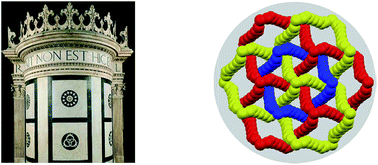
Borromean rings in black and white marble decorate Cappella Ruccellai (left, Florence) and were self-assembled under halogen bond control (right).
To cite this article before page numbers are assigned, use the DOI form of citation above.
The content of this RSS Feed (c) The Royal Society of Chemistry

15 Nov 11:35
Chem. Commun., 2017, 53,157-160
DOI: 10.1039/C6CC07427H, Communication
Nils Wedler-Jasinski, Thorsten Lueckerath, Hatice Mutlu, Anja S. Goldmann, Andreas Walther, Martina H. Stenzel, Christopher Barner-Kowollik
We report a dynamic covalent single chain nanoparticle collapse and subsequent re-opening of the coil based on hetero Diels-Alder chemistry.
The content of this RSS Feed (c) The Royal Society of Chemistry

15 Nov 11:34
by Golo Storch

Nature Chemistry.
doi:10.1038/nchem.2638
Authors: Golo Storch & Oliver Trapp
Methods for preparing enantiomerically enriched products are often dependent on the structure of a catalyst. Here, it is shown that a self-amplifying catalyst is able to ‘sense’ the chirality of the catalytic product and induce enantioselectivity. Flexible ligand and product interaction sites are key to the increasing enantioselectivity over the course of the reaction.
14 Nov 14:21
Publication date: 7 December 2016
Source:Tetrahedron Letters, Volume 57, Issue 49
Author(s): Vladimir A. Azov
Tetrathiafulvalenes (TTFs) are popular building blocks on the scene of supramolecular chemistry, where they play various roles ranging from electron rich guest moieties in interlocked supramolecular architectures to structural elements of ion sensors. In this review, we discuss so far rather neglected role of TTFs as active elements of binding sites in molecular receptors. We consider several recent design concepts of molecular receptors with architectures of molecular tweezers, macrocycles, and metal-coordinated cages that contain two or more TTF, extended TTF, or pyrrolo-TTF moieties. High affinity to electron-deficient guests and redox activity allowed their use for the construction of functional supramolecular materials and sensors, as well as pave the way for other practical applications.
Graphical abstract

09 Nov 08:58
by Luke A. Baldwin, Jonathan W. Crowe, David A. Pyles and Psaras L. McGrier

Journal of the American Chemical Society
DOI: 10.1021/jacs.6b10316

07 Nov 19:08
Chem. Commun., 2016, Advance Article
DOI: 10.1039/C6CC07377H, Feature Article
James E. M. Lewis, Marzia Galli, Stephen M. Goldup
We discuss the properties and potential future applications in catalysis, sensing and materials of ligands based on mechanically interlocked molecules.
To cite this article before page numbers are assigned, use the DOI form of citation above.
The content of this RSS Feed (c) The Royal Society of Chemistry

07 Nov 09:45
Chem. Sci., 2016, Accepted Manuscript
DOI: 10.1039/C6SC03894H, Edge Article
Open Access
Sofia Leret, Yann Pouillon, Santiago Casado, Cristina Navio, Angel Rubio, Emilio M Perez
Many applications of carbon nanotubes require their chemical functionalization. Both covalent and supramolecular approaches have been extensively investigated. A less trodden path is the combination of both covalent and noncovalent...
The content of this RSS Feed (c) The Royal Society of Chemistry

04 Nov 13:14
by Jaideep Katuri, Xing Ma, Morgan M. Stanton and Samuel Sánchez

Accounts of Chemical Research
DOI: 10.1021/acs.accounts.6b00386

04 Nov 12:44
by David P. August, Gary S. Nichol, Paul J. Lusby
Abstract
Guest encapsulation underpins the functional properties of self-assembled capsules yet identifying systems capable of strongly binding small organic molecules in solution remains a challenge. Most coordination capsules rely on the hydrophobic effect to ensure effective solution-phase association. In contrast, we show that using non-interacting anions in apolar solvents can maximize favorable interactions between a cationic Pd2L4 host and charge-neutral guests resulting in a dramatic increase in binding strength. With quinone-type guests, association constants in excess of 108 m−1 were observed, comparable to the highest previously recorded constant for a metallosupramolecular capsule. Modulation of optoelectronic properties of the guests was also observed, with encapsulation either changing or switching-on luminescence not present in the bulk phase.

Molecular encapsulation: A combination of apolar solvents and weakly interacting anions has been used to maximize the non-covalent interactions between a simple Pd2L4 host and various charge-neutral guest molecules, leading to some of the highest association constants ever reported for a coordination capsule system.
02 Nov 08:53
by Alex Saywell, Anne Bakker, Johannes Mielke, Takashi Kumagai, Martin Wolf, Víctor García-López, Pinn-Tsong Chiang, James M. Tour and Leonhard Grill

ACS Nano
DOI: 10.1021/acsnano.6b05650

yjdlut and -1 others like this
26 Oct 11:59
by Eiji Yashima, Naoki Ousaka, Daisuke Taura, Kouhei Shimomura, Tomoyuki Ikai and Katsuhiro Maeda

Chemical Reviews
DOI: 10.1021/acs.chemrev.6b00354

26 Oct 11:59
by Tim Stauch and Andreas Dreuw

Chemical Reviews
DOI: 10.1021/acs.chemrev.6b00458

26 Oct 11:59
by Soji Shimizu

Chemical Reviews
DOI: 10.1021/acs.chemrev.6b00403

25 Oct 12:29
Publication date: 16 November 2016
Source:Tetrahedron Letters, Volume 57, Issue 46
Author(s): Yoshimasa Makita, Natsuki Katayama, Hsien-Han Lee, Taro Abe, Kento Sogawa, Akihiro Nomoto, Shin-ichi Fujiwara, Akiya Ogawa
Hemicryptophanes have been designed to include endohedral functionalities in the cavity, giving molecular receptors and catalysts. In this study, a tri-aromatic amide hemicryptophane was synthesized. The host–guest interactions with various types of tetraalkylammonium salts were investigated. The structure of the partial inclusion complex in which an acetylcholine molecule was encapsulated within the hemicryptophane was characterized by NMR, X-ray crystal structure, and ESI-MS analysis.
Graphical abstract

25 Oct 07:39
by Qishui Chen, Junling Sun, Peng Li, Idan Hod, Peyman Z. Moghadam, Zachary S. Kean, Randall Q. Snurr, Joseph T. Hupp, Omar K. Farha and J. Fraser Stoddart

Journal of the American Chemical Society
DOI: 10.1021/jacs.6b09880

21 Oct 07:27
Chem. Sci., 2016, Advance Article
DOI: 10.1039/C6SC03003C, Edge Article
Open Access
Brendan C. Peacor, Christopher M. Ramsay, Marcey L. Waters
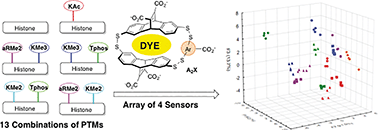
A sensor array has been developed that can differentiate multiple post-translational modifications in the same peptide and their relative positions in the sequence, including multiple methylations, providing a promising new tool for deciphering the histone code.
To cite this article before page numbers are assigned, use the DOI form of citation above.
The content of this RSS Feed (c) The Royal Society of Chemistry

21 Oct 07:24
by Yanbang Li, Gaihong Zhang, Dian Wang, Beidi Xu, Dan Xu, Ning Lou, Liangbing Gan

Macrocyclic compounds have been extensively studied because of their widespread applications. Most classical macrocyclic compounds are planar molecules. In their Communication on page 14590 ff., L. B. Gan and co-workers report a N,O-heterocycle created on the C60 cage skeleton through a multistep procedure, which includes repeated PCl5-induced hydroxylamino N−O bond cleavage, and also piperidine-induced peroxo O−O bond cleavage. The fullerene-based macrocycle showed unique reactivity towards fluoride ions and copper salts.
20 Oct 13:51
by Semin Lee, Etienne Chénard, Danielle L. Gray and Jeffrey S. Moore

Journal of the American Chemical Society
DOI: 10.1021/jacs.6b08752

20 Oct 13:51
by James E. M. Lewis, Joby Winn, Luca Cera and Stephen M. Goldup

Journal of the American Chemical Society
DOI: 10.1021/jacs.6b08958

   This article is licensed under a Creative Commons Attribution 3.0 Unported Licence.


   This article is licensed under a Creative Commons Attribution-NonCommercial 3.0 Unported Licence.