28 Apr 15:58
Chem. Sci., 2016, 7,5171-5180
DOI: 10.1039/C6SC00783J, Edge Article

Open Access
Timothy A. Barendt, Sean W. Robinson, Paul D. Beer
Two bistable halogen and hydrogen bonding-naphthalene diimide [2]rotaxanes have been prepared and the system incorporating a halogen bond donor anion recognition site is demonstrated to exhibit superior anion induced translational motion of the macrocyclic wheel component relative to the hydrogen bonding analogue.
The content of this RSS Feed (c) The Royal Society of Chemistry

25 Apr 14:38
J. Mater. Chem. C, 2016, 4,4692-4698
DOI: 10.1039/C6TC00648E, Paper
C. R. Ma, J. Xiao, G. W. Yang
Carbyne has been synthesized in the laboratory and the giant nonlinear optical responses of carbyne have been demonstrated.
The content of this RSS Feed (c) The Royal Society of Chemistry
25 Apr 13:28
by Lucy Clark
Nature Chemistry 8, 402 (2016).
doi:10.1038/nchem.2510
Authors: Lucy Clark & Philip Lightfoot
A fundamental challenge in systems chemistry is to engineer the emergence of complex behaviour. The collective structures of metal cyanide chains have now been interpreted in the same manner as the myriad of magnetic phases displayed by frustrated spin systems, highlighting a symbiotic approach between systems chemistry and magnetism.
22 Apr 12:31
RSC Adv., 2016, 6,40418-40421
DOI: 10.1039/C6RA07695E, Communication
Jie Yang, Zhengtao Li, Li Shao, Guocan Yu
A novel host-guest recognition motif between a water-soluble pillar[10]arene and pyrene derivative was established and further applied in the fabrication of a pH-responsive supra-amphiphile.
The content of this RSS Feed (c) The Royal Society of Chemistry

22 Apr 11:33
by Christos Tsiamantas, Xavier de Hatten, Céline Douat, Brice Kauffmann, Victor Maurizot, Hirotaka Ihara, Makoto Takafuji, Nils Metzler-Nolte, Ivan Huc
Abstract
Disulfide bridge formation was investigated in helical aromatic oligoamide foldamers. Depending on the position of thiol-bearing side chains, exclusive intramolecular or intermolecular disulfide bridging may occur. The two processes are capable of self-sorting, presumably by dynamic exchange. Quantitative assessment of helix handedness inversion rates showed that bridging stabilizes the folded structures. Intermolecular disulfide bridging serendipitously yielded a well-defined, C2-symmetrical, two-helix bundle-like macrocyclic structure in which complete control over relative handedness, that is, helix–helix handedness communication, is mediated remotely by the disulfide bridged side chains in the absence of contacts between helices. MM calculations suggest that this phenomenon is specific to a given side chain length and requires disulfide functions

Hand signals: Remote chiral communication of handedness is conveyed between aromatic helical foldamers through disulfide-bridged side chains without any direct contact between helices.
21 Apr 08:21
by Graeme Copley, Daiki Shimizu, Juwon Oh, Jooyoung Sung, Ko Furukawa, Dongho Kim, Atsuhiro Osuka
Abstract
Treatment of meso-chlorosubporphyrin with controlled equivalents of Na2S·9H2O in DMF led to the formation of either meso-to-meso sulfide (S)-bridged dimer 4 or disulfide (SS)-bridged subporphyrin dimer 6. S-bridged dimer 4 displayed a split Soret-like band and a large Stokes shift and became a fully delocalized one-quantum system in the S1 state, as indicated by femtosecond transient absorption anisotropy measurements and theoretical calculations. Contrastingly, SS-bridged dimer 6 showed a broad but nonsplit Soret-like band, no fluorescence, and very fast S1 decay with a lifetime of 4 ps, which indicated the presence of a rapid decay channel.

meso-to-meso S-bridged and SS-bridged dimers 4 and 6 are prepared by SNAr reaction of meso-chlorosubporphyrin. Dimer 4 displays a split Soret-like band and a large Stokes shift, whereas dimer 6 shows weaker interchromophoric interaction. Dimer 4 becomes a one-quantum system in the S1 state, whereas the S1 state of 6 displays very fast decay to the ground state with a lifetime of 4 ps.
21 Apr 07:45
Chem. Sci., 2016, 7,4720-4724
DOI: 10.1039/C6SC01133K, Edge Article
Open Access
Santiago Lascano, Kang-Da Zhang, Robin Wehlauch, Karl Gademann, Naomi Sakai, Stefan Matile
The existence of three fully orthogonal dynamic covalent bonds is demonstrated in solution and in functional surface architectures.
The content of this RSS Feed (c) The Royal Society of Chemistry

19 Apr 15:08
by Clarissa Melo Czekster, Wesley E. Robertson, Allison S. Walker, Dieter Söll and Alanna Schepartz

Journal of the American Chemical Society
DOI: 10.1021/jacs.6b01023

30 Mar 08:12
Chem. Commun., 2016, 52,6363-6366
DOI: 10.1039/C6CC02034H, Communication
Open Access
Urs F. Fritze, Max von Delius
We report that ultrasound irradiation can be used for generating clean equilibrium mixtures of disulfides within one hour or one day, depending on the sonication source. Although this reaction is somewhat limited regarding solvents and substrates, we believe that it could be a practical alternative to existing methods, particularly in scenarios where short equilibration times, base-free reaction conditions or a new vector of dynamic covalent orthogonality are needed.
The content of this RSS Feed (c) The Royal Society of Chemistry

29 Mar 13:09
Publication date: 20 April 2016
Source:Tetrahedron Letters, Volume 57, Issue 16
Author(s): Filip Ulatowski, Kajetan Dąbrowa, Janusz Jurczak
In dynamic combinatorial chemistry, the geometry of a template can be translated into the composition of a library of interchanging components. In this study, such a dynamic combinatorial library was used for the first time to detect and evaluate differences in the geometry of isomers of photoswitchable azobenzene based templates.
Graphical abstract

29 Mar 08:16
by Dominik Lungerich, David Reger, Helen Hölzel, René Riedel, Max M. J. C. Martin, Frank Hampel, Norbert Jux
Abstract
A novel rational synthetic pathway—the “functionalization of para-nitroaniline” (FpNA)—provides substituted hexaarylbenzenes (HABs) with uncommon symmetries that bear up to five different substituents, fully avoiding regioisomeric product distributions during the reactions. 4-Nitroaniline is functionalized by a cascade of electrophilic halogenations, Sandmeyer brominations, and Suzuki cross-coupling reactions, leading to 26 substitution geometries, of which 18 structures are not available by the current established techniques. Furthermore, we demonstrate that this method is applicable to the bulk production of such systems on a multigram scale. Regarding optoelectronic properties, we demonstrate how highly functionalized HABs can show strong luminescent behavior, making these molecules very attractive to organic electronic devices.

Bulk discount on hexaarylbenzenes (HABs): A rational and scalable synthesis of uncommon and highly functionalized HABs utilizes 4-nitroaniline as the starting material. This approach can potentially provide 18 novel HABs and 26 substitution geometries in total, which are not available or only difficult to obtain by standard techniques.
29 Mar 08:13
by Pongphak Chidchob, Thomas G. W. Edwardson, Christopher J. Serpell and Hanadi F. Sleiman

Journal of the American Chemical Society
DOI: 10.1021/jacs.5b12953

21 Mar 15:05
by Yoshifumi Hashikawa, Michihisa Murata, Atsushi Wakamiya and Yasujiro Murata

Journal of the American Chemical Society
DOI: 10.1021/jacs.5b12795

21 Mar 12:45
by Yusuke Matsuoka, Yuichiro Mutoh, Isao Azumaya, Shoko Kikkawa, Takeshi Kasama and Shinichi Saito

The Journal of Organic Chemistry
DOI: 10.1021/acs.joc.5b02911

16 Mar 16:08
by Chris Woolston
Group dynamics: A lab of their own
Nature (2016). doi:10.1038/nj7593-263a
Author: Chris Woolston
The make-up of a lab is crucial to success in publishing its research — and now, scientists are exploring how to compose the best research group possible.

16 Mar 08:54
Chem. Commun., 2016, 52,5418-5420
DOI: 10.1039/C6CC01853J, Communication
Y. Mitrev, S. Simova, D. Jeannerat
Weak molecular interactions can be localized and quantified using a single NMR experiment analysing concentration gradients generated in agar gels.
The content of this RSS Feed (c) The Royal Society of Chemistry

15 Mar 10:02
by Ryota Tamate, Takeshi Ueki, Ryo Yoshida

Complex oscillatory behaviors of living cells are demonstrated by R. Yoshida, T. Ueki, and R. Tamate in their Communication on page 5179 ff. by using a biomimetic colloidosome composed of self-oscillating microgels that exhibit autonomous shape oscillations with buckling deformations driven by an oscillatory chemical reaction. The resulting oscillatory waveform profile becomes markedly more complex than that of conventional self-oscillating materials.
15 Mar 09:57
by Hitesh K. Agarwal, Radoslav Janicek, San-Hui Chi, Joseph W. Perry, Ernst Niggli and Graham C. R. Ellis-Davies

Journal of the American Chemical Society
DOI: 10.1021/jacs.5b11606

14 Mar 15:09
by Zhichang Liu, Junling Sun, Yu Zhou, Yu Zhang, Yilei Wu, Siva Krishna Mohan Nalluri, Yuping Wang, Avik Samanta, Chad A. Mirkin, George C. Schatz and J. Fraser Stoddart

The Journal of Organic Chemistry
DOI: 10.1021/acs.joc.6b00281

14 Mar 13:19
by Kaiyi Zhou, Hui Cao, Pan Gao, Zhigang Cui, Yi Ding and Yuanli Cai

Macromolecules
DOI: 10.1021/acs.macromol.6b00152

14 Mar 13:15
Chem. Commun., 2016, 52,5053-5056
DOI: 10.1039/C6CC01823H, Communication
Open Access
Yan Zhang, H. Surangi N. Jayawardena, Mingdi Yan, Olof Ramstrom
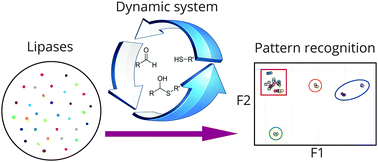
A complex dynamic hemithioacetal system was used in combination with pattern recognition methodology to classify lipases into distinct groups.
The content of this RSS Feed (c) The Royal Society of Chemistry

14 Mar 13:14
by Xiaolin Ge, Yubin He, Michael D. Guiver, Liang Wu, Jin Ran, Zhengjin Yang, Tongwen Xu

A new class of alkaline anion-exchange membranes containing mobile ion shuttles is developed. It is achieved by threading ionic linear guests into poly(crown ether) hosts via host–guest molecular interaction. The thermal- and pH-triggered shuttling of ionic linear guests remarkably increases the solvation-shell fluctuations in inactive hydrated hydroxide ion complexes (OH−(H2O)4) and accelerates the OH− transport.
14 Mar 07:02
by Shih-Yu Wang, Jun-Hao Fu, Yen-Peng Liang, Yun-Jui He, Yu-Sheng Chen and Yi-Tsu Chan

Journal of the American Chemical Society
DOI: 10.1021/jacs.6b01005

07 Mar 13:35
by Guiqing Lin, Huimin Ding, Daqiang Yuan, Baoshan Wang and Cheng Wang

Journal of the American Chemical Society
DOI: 10.1021/jacs.6b00652

03 Mar 16:56
by Sumit Kumar, Kai Ludwig, Boris Schade, Hans v. Berlepsch, Ilona Papp, Rahul Tyagi, Monika Gulia, Rainer Haag, Christoph Böttcher

The chiral stereoisomers of new non-ionic dendritic amphiphiles self-assemble in aqueous solution towards helical ribbons with opposite handedness. However, in the case of the meso-compound, cylindrical assemblies are observed, as illustrated. Modelling suggests that they consist of right- or left-handed helical molecular strands in equal distribution. The hydrophobic core of such a cylinder is sized to accommodate the hydrophobic tails. Only the head groups and the aromatic platforms, which contribute high density in transmission electron microscopy (TEM), are shown for clarity. The paper discusses stereochemical aspects upon supramolecular assembly of these new dendritic amphiphiles. More information can be found in the Full Paper by C. Böttcher, et al. (DOI: 10.1002/chem.201504504).
03 Mar 16:56
Chem. Commun., 2016, 52,9089-9092
DOI: 10.1039/C6CC00507A, Communication
Open Access
Philipp J. Altmann, Alexander Pothig
A new dinuclear Ni-NHC complex is able to selectively recognise and self-assemble with guests via tennis-ball like encapsulation, exemplarily demonstrated employing halides.
The content of this RSS Feed (c) The Royal Society of Chemistry

03 Mar 16:55
Chem. Soc. Rev., 2016, 45,6118-6129
DOI: 10.1039/C5CS00874C, Tutorial Review
Open Access
Matthew A. Watson, Scott L. Cockroft
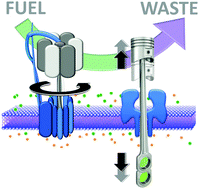
This tutorial review charts the development of man-made molecular machines; from solution-phase to transmembrane assemblies.
The content of this RSS Feed (c) The Royal Society of Chemistry

25 Feb 10:05
by Mark Schaefer, Burcak Icli, Christoph Weder, Marco Lattuada, Andreas F. M. Kilbinger and Yoan C. Simon

Macromolecules
DOI: 10.1021/acs.macromol.5b02362

24 Feb 07:43
by Juncong Jiang, Yingbo Zhao and Omar M. Yaghi

Journal of the American Chemical Society
DOI: 10.1021/jacs.5b10666

24 Feb 07:36
Chem. Commun., 2016, 52,4489-4492
DOI: 10.1039/C6CC00042H, Communication
Bijan Roy, Ennio Zangrando, Partha Sarathi Mukherjee
Self-assembly of a water soluble redox active Pd(II) "molecular dice" was achieved employing a tri-cationic donor. The Pd6 dice is quite stable in water in a wide range of temperatures despite the expected weaker donor ability of the cationic pyridyl donor.
The content of this RSS Feed (c) The Royal Society of Chemistry


   This article is licensed under a Creative Commons Attribution 3.0 Unported Licence.