24 Feb 07:45
by William M. Jacobs and Daan Frenkel

Journal of the American Chemical Society
DOI: 10.1021/jacs.5b11918

Li and -1 others like this
24 Feb 07:44
by Chikkannagari Nagamani, Huiying Liu and Jeffrey S. Moore

Journal of the American Chemical Society
DOI: 10.1021/jacs.6b00097

24 Feb 07:44
by Xiaoxi Wei, Guoqing Zhang, Yi Shen, Yulong Zhong, Rui Liu, Na Yang, Fayez Y. Al-mkhaizim, Mark A. Kline, Lan He, Minfeng Li, Zhong-Lin Lu, Zhifeng Shao and Bing Gong

Journal of the American Chemical Society
DOI: 10.1021/jacs.5b12698

24 Feb 07:39
by Jan W. Sadownik

Nature Chemistry 8, 264 (2016).
doi:10.1038/nchem.2419
Authors: Jan W. Sadownik, Elio Mattia, Piotr Nowak & Sijbren Otto
Self-replicating molecules provide a simple molecular level system to study the processes occurring in speciation. Now it is shown that in a pool of interconverting macrocycles, constructed from two building blocks, two distinct sets of self-replicating molecules emerge, and that one is a descendant of the other.
15 Feb 16:24
by Semin Lee, Anna Yang, Timothy P. Moneypenny and Jeffrey S. Moore

Journal of the American Chemical Society
DOI: 10.1021/jacs.6b00468

12 Feb 10:18
by Fatima Helzy, Thierry Maris and James D. Wuest

The Journal of Organic Chemistry
DOI: 10.1021/acs.joc.5b02552

12 Feb 10:17
by Vicente Martí-Centelles, M. Isabel Burguete and Santiago V. Luis

The Journal of Organic Chemistry
DOI: 10.1021/acs.joc.5b02676

12 Feb 10:17
RSC Adv., 2016, 6,19794-19796
DOI: 10.1039/C5RA21335E, Communication
Naoaki Kiriyama, Masahiro Ebihara, Taro Udagawa, Hidekazu Miyaji
Cis-dipyridylcalix[4]pyrrole formed a supramolecular cage upon dimerization and coordination with Pd(II). The cage molecule recognised suberate selectively by hydrogen bonding to the two calix[4]pyrroles.
The content of this RSS Feed (c) The Royal Society of Chemistry

12 Feb 10:11
by Ana M. Castilla, Tanya K. Ronson and Jonathan R. Nitschke

Journal of the American Chemical Society
DOI: 10.1021/jacs.5b13016

10 Feb 08:53
Chem. Commun., 2016, 52,4128-4131
DOI: 10.1039/C6CC00853D, Communication
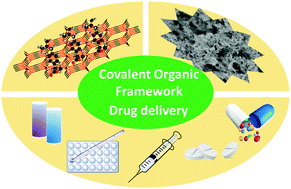
Linyi Bai, Soo Zeng Fiona Phua, Wei Qi Lim, Avijit Jana, Zhong Luo, Huijun Phoebe Tham, Lingzhi Zhao, Qiang Gao, Yanli Zhao
Two nanoscale covalent organic frameworks as drug carriers with good biocompatibility were developed, showing high drug loading capacity and sustained release in vitro.
The content of this RSS Feed (c) The Royal Society of Chemistry

08 Feb 12:31
Chem. Commun., 2016, 52,9059-9062
DOI: 10.1039/C6CC00500D, Communication
Fatima Garcia, Janis Pelss, Han Zuilhof, Maarten M. J. Smulders
Incorporation of dynamic imine bonds into coordination polymers yields stable polymers that are sensitive to a range of stimuli.
The content of this RSS Feed (c) The Royal Society of Chemistry

04 Feb 15:32
by Huan Zhang, Fei Gao, Xiaodong Cao, Yanqun Li, Yuanze Xu, Wengui Weng, Roman Boulatov

Just as mechanical force applied to the strings of a violin produces beautiful sounds, mechanical stress acting on polymers leads to interesting chemical reactions. In their Communication on page 3040 ff., W. Weng et al. show that when mechanically loaded, a spirothiopyran-containing polymer turns bright green and undergoes cross-linking. Two distinct chemical responses to a mechanical load are combined in a single reactive site.
04 Feb 08:51
by Martins S. Oderinde, Mathieu Frenette, Daniel W. Robbins, Brian Aquila and Jeffrey W. Johannes

Journal of the American Chemical Society
DOI: 10.1021/jacs.5b11244

03 Feb 08:33
by Edward J. Dale, Nicolaas A. Vermeulen, Michal Juríček, Jonathan C. Barnes, Ryan M. Young, Michael R. Wasielewski and J. Fraser Stoddart

Accounts of Chemical Research
DOI: 10.1021/acs.accounts.5b00495

01 Feb 14:04
J. Mater. Chem. A, 2016, 4,2682-2690
DOI: 10.1039/C5TA10521H, Paper
Digambar Balaji Shinde, Harshitha Barike Aiyappa, Mohitosh Bhadra, Bishnu P. Biswal, Pritish Wadge, Sharath Kandambeth, Bikash Garai, Tanay Kundu, Sreekumar Kurungot, Rahul Banerjee
Mechanochemically synthesized bipyridine based covalent organic framework showing high proton conductivity of 0.014 S cm-1 with improved performance over the solvothermal one giving a stable Open Circuit Voltage (0.93 V at 50 [degree]C) on fabrication in PEM fuel cell.
The content of this RSS Feed (c) The Royal Society of Chemistry
01 Feb 13:22
J. Mater. Chem. B, 2016, 4,852-858
DOI: 10.1039/C5TB01870F, Paper
Jos M. Poolman, Chandan Maity, Job Boekhoven, Lars van der Mee, Vincent A. A. le Sage, G. J. Mirjam Groenewold, Sander I. van Kasteren, Frank Versluis, Jan H. van Esch, Rienk Eelkema
In situ multicomponent hydrogelator formation enables straightforward chemical functionalisation of supramolecular hydrogels.
The content of this RSS Feed (c) The Royal Society of Chemistry
01 Feb 13:15
J. Mater. Chem. C, 2016, 4,2685-2706
DOI: 10.1039/C5TC03321G, Review Article
Mhejabeen Sayed, Haridas Pal
Macrocyclic host assisted modulations in the fluorescence and acid-base properties of organic chromophoric dyes and their possible applications are reviewed comprehensively.
The content of this RSS Feed (c) The Royal Society of Chemistry
01 Feb 12:10
RSC Adv., 2016, 6,11295-11302
DOI: 10.1039/C5RA23937K, Paper
Madhubabu Alaparthi, Kadarkaraisamy Mariappan, Eric Dufek, Mariah Hoffman, Andrew G. Sykes
Selective chemodosimetric detection of Al(III) via hydrolysis of secondary alcohols involving a unique keto-enol tautomerization reaction.
The content of this RSS Feed (c) The Royal Society of Chemistry

28 Jan 14:29
Chem. Commun., 2016, 52,3797-3800
DOI: 10.1039/C5CC10076C, Communication
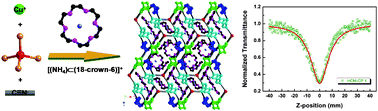
Jinfang Zhang, Ding Jia, Mark G. Humphrey, Suci Meng, Michael J. Zaworotko, Marie P. Cifuentes, Chi Zhang
An unprecedented heterobicluster-metal coordination polymer has been synthesized by a supramolecular template approach and shown to exhibit enhanced NLO properties.
The content of this RSS Feed (c) The Royal Society of Chemistry

27 Jan 09:39
by Jens U. Engelhart, Fabian Paulus, Manuel Schaffroth, Vladislav Vasilenko, Olena Tverskoy, Frank Rominger and Uwe H. F. Bunz

The Journal of Organic Chemistry
DOI: 10.1021/acs.joc.5b02731

26 Jan 17:33
by Levon D. Movsisyan, Michael Franz, Frank Hampel, Amber L. Thompson, Rik R. Tykwinski and Harry L. Anderson

Journal of the American Chemical Society
DOI: 10.1021/jacs.5b12049

26 Jan 13:28
by Zhen Chen, Daisuke Aoki, Satoshi Uchida, Hironori Marubayashi, Shuichi Nojima, Toshikazu Takata
Abstract
Macromolecular [2]rotaxanes comprising a polymer axle and crown ether wheel were synthesized to evaluate the effect of component mobility on the properties of the axle polymer, especially its crystallinity. Living ring-opening polymerization of δ-valerolactone with a pseudorotaxane initiator with a hydroxy group at the axle terminus was followed by end-capping with a bulky isocyanate. This yielded macromolecular [2]rotaxanes (M2Rs) possessing polyester axles of varying molecular weights. The crystallinity of the axle polymers of two series of M2Rs, with either fixed and movable components, was evaluated by differential scanning calorimetry. The results revealed that the effect of component mobility was significant in the fixed and movable M2Rs with a certain axle length, thus suggesting that the properties of the axle polymer depend on the mobility of the polyrotaxane components.

Stop and go: Macromolecular [2]rotaxanes, consisting of a polyester axle and crown ether wheel, were synthesized with either fixed or movable components and with various molecular weights to evaluate the effect of component mobility on the axle polymer properties. Crystallinity measurements revealed that the effect of mobility is significant, thus suggesting that the properties of the axle polymer depend on the mobility of the polyrotaxane components.
25 Jan 13:41
Chem. Soc. Rev., 2016, 45,1720-1737
DOI: 10.1039/C5CS00861A, Review Article
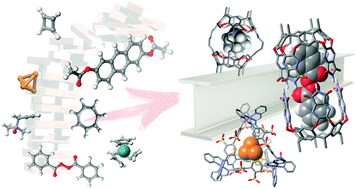
Albano Galan, Pablo Ballester
This review describes and updated overview of the stabilization of reactive species and reaction intermediates by inclusion in nanocavities provided by covalent- and supra-molecular containers.
The content of this RSS Feed (c) The Royal Society of Chemistry

22 Jan 14:54
Chem. Sci., 2016, 7,2614-2620
DOI: 10.1039/C5SC04906G, Edge Article

Open Access
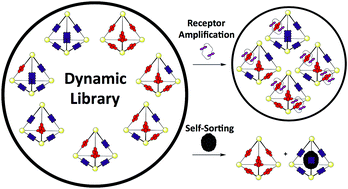
Samuel P. Black, Daniel M. Wood, Felix B. Schwarz, Tanya K. Ronson, Julian J. Holstein, Artur R. Stefankiewicz, Christoph A. Schalley, Jeremy. K. M. Sanders, Jonathan R. Nitschke
Subcomponent self-assembly generates dynamic combinatorial libraries of Zn4L6 cages whose composition is strongly affected by catenation and encapsulation.
The content of this RSS Feed (c) The Royal Society of Chemistry

22 Jan 08:20
by Ivan Aprahamian
Nature Chemistry 8, 97 (2016).
doi:10.1038/nchem.2435
Author: Ivan Aprahamian
Mass production at the nanoscale requires molecular machines that can control, with high fidelity, the spatial orientation of other reactive species. The demonstration of a synthetic system in which a molecular robotic arm can be used to manipulate the position of a chemical cargo is a significant step towards achieving this goal.
18 Jan 09:24
by Zhixuan Zhou, Xuzhou Yan, Timothy R. Cook, Manik Lal Saha and Peter J. Stang

Journal of the American Chemical Society
DOI: 10.1021/jacs.5b12986

yjdlut and -1 others like this
14 Jan 09:28
Chem. Commun., 2016, 52,2513-2516
DOI: 10.1039/C5CC08460A, Communication
Die Liu, Xiaoyu Yang, Yiming Li, Pingshan Wang
Ru2/Zn and Ru2/Fe based bismetallo-organic triangles had been prepared from a predesigned metallo-organic ligand possessing two uncomplexed free terpyridines. A quantitative coordination constant controlled metallo-transformation from a Ru2Zn to a Ru2Fe triangle had been established through an in situ site to site procedure at room temperature.
The content of this RSS Feed (c) The Royal Society of Chemistry

13 Jan 13:06
Chem. Sci., 2016, 7,1696-1701
DOI: 10.1039/C5SC04844C, Edge Article
Open Access
Xin Fu, Qi Zhang, Si-Jia Rao, Da-Hui Qu, He Tian
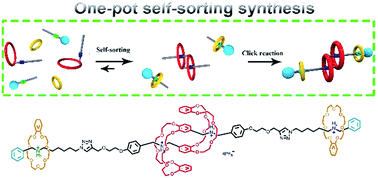
Here we demonstrated a facile and efficient one-pot synthesis of a [c2]daisy-chain-containing hetero[4]rotaxane via a self-sorting strategy.
The content of this RSS Feed (c) The Royal Society of Chemistry

13 Jan 07:28
by Pierre-Thomas Skowron, Melissa Dumartin, Emeric Jeamet, Florent Perret, Christophe Gourlaouen, Anne Baudouin, Bernard Fenet, Jean-Valère Naubron, Frédéric Fotiadu, Laurent Vial and Julien Leclaire

The Journal of Organic Chemistry
DOI: 10.1021/acs.joc.5b02605

12 Jan 12:53
by Haeri Lee, Tae Hwan Noh, Ok-Sang Jung
Abstract
A synthetic strategy for the generation of new molecular species utilizing a provision of nature is presented. Nano-dimensional (23(2)×21(1)×16(1) Å3) hetero-four-layered trimetallacyclophanes were constructed by proof-of-concept experiments that utilize a suitable combination of π⋅⋅⋅π interactions between the central aromatic rings, tailor-made short/long spacer tridentate donors, and the combined helicity. The behavior of the unprecedented four-layered metallacyclophane system offers a landmark in the development of new molecular systems.

Hetero-four-layered tripalladium(II) cyclophanes have been prepared. The synthesis of this series of new compounds was accomplished by a combination of effective transannular π⋅⋅⋅π interactions, tailor-made short/long tridentate ligands, and Lewis basicity of donating groups.


   This article is licensed under a Creative Commons Attribution-NonCommercial 3.0 Unported Licence.
   This article is licensed under a Creative Commons Attribution 3.0 Unported Licence.