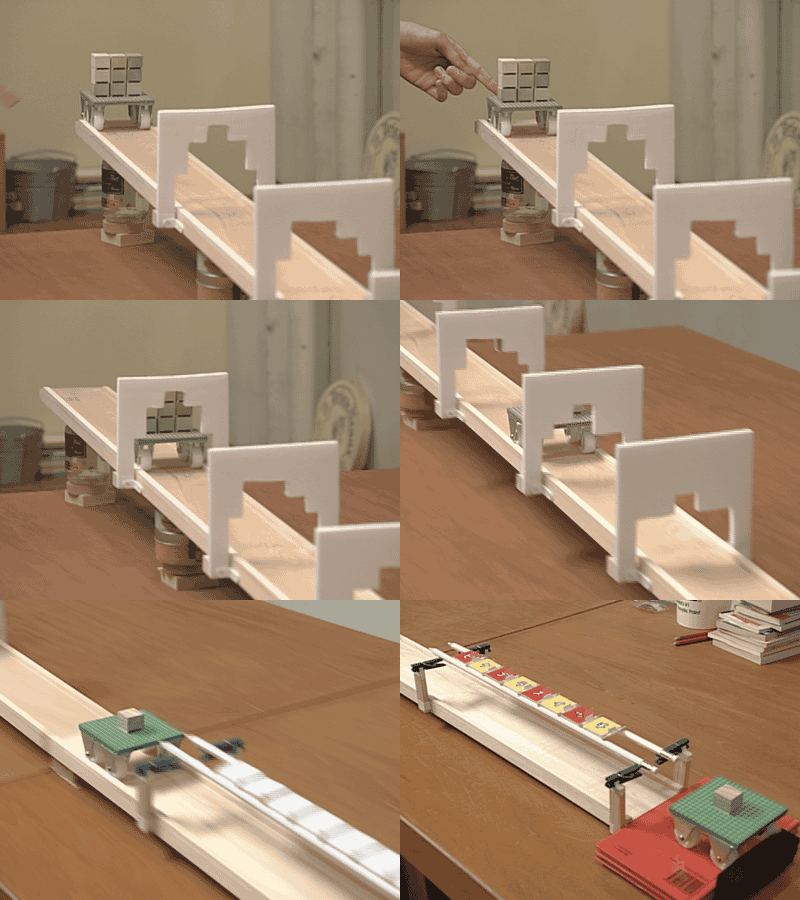
It’s not about the path,
it’s about the feet.
They are made of mud,
let’s flow or cheat.
It’s not about the path,
it’s about the feet.
They are made of mud,
let’s flow or cheat.


Online experiment by Jae Hyun Yoo lets you draw faces and detects which emotions are expressed using a neural network:
For the last few days, I was working on creating this artificial neural network that will assume emotion from drawing. She is still learning by herself, though the internet or you can teach her. Her intelligence is about 50~60% there. She evolves everyday.
Try it out for yourself here
RoslynThis is everything that is right about the Internet age.
Many knitters find their craft a tranquil and even meditative pastime—until knots and tangles in their yarn send them into a fury. But for one group of fanatics, there is nothing more satisfying than a hopelessly tangled web.
Daphne Basnet of Melbourne, Australia, once paid about $50 on eBay for a 25-pound box of snarled yarn, simply for the pleasure of untangling it. “I was so happy, I can’t tell you,” recalls the 58-year-old of her purchase, a mess of about 120 knotted balls.
…Finding such tangled treats got easier when Ms. Basnet joined Knot a Problem, a seven-year-old group of more than 2,100 “detanglers” on the online community for knitters and crocheters called Ravelry. Frustrated yarn-lovers from around the world post pleas for help undoing their knottiest knots, often created by children, pets or yarn-winding mishaps.
Devoted detanglers typically offer to take on the projects for the cost of shipping. Competition for the most maddening messes can be fierce. Some members check the group every day.
“People will jump in and say, ‘Send it to me!’ ” says Mary Enright, 56, a detangler from Sioux Falls, S.D.
Some of you may be saying “OK…” but I am more along the lines of “who am I to judge?” And there is this:
Group members like to post before-and-after photos of what they call “tangle porn.” Heaps of yarn resembling bowls of spaghetti become neat balls and cakes. “I think it’s fulfilling for people when they see what it was, sort of like house remodeling,” says Ms. Rothschild. “You see how crappy it was and how beautiful it turned out to be.”
And if you are looking for further signs of dedication:
About a dozen hard-core members celebrated by sending each other yarn to untangle, knotting up new skeins themselves if they had to.
For the pointer to the article I thank Peter Metrinko.
RoslynSo interesting! Much gibber!
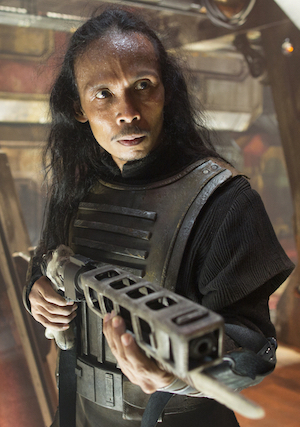 For my language column in the Wall Street Journal this week, I describe how some alien-speak in "Star Wars: The Force Awakens" ended up being created by a young Finnish YouTube sensation, tailor-made for Indonesian actors. We could call it "Finn-donesian," though the character Finn doesn't actually speak it. Rather, the dialogue was designed for the Kanjiklub gang, who briefly face off against Han Solo and Chewbacca on a space freighter packed with slithery Rathtars.
The linguistic landscape of "Star Wars" has always been a bit of a mess. We're supposed to think of the English that most characters speak as a proxy for the in-universe lingua franca – Galactic Basic Standard, to those in the know. But some characters jabber away in other exotic tongues without much rhyme or reason. Chewbacca speaks in Wookiee, presumably because his vocal tract isn't equipped to speak Basic. As a protocol droid, C-3PO is of course "fluent in over six million forms of communication," but astromech droids R2-D2 and BB-8 can only bleep away in Binary because… well, who knows, really? They just do.
I had puzzled over these questions growing up with the original "Star Wars" trilogy, and with the release of "The Force Awakens" I started thinking about them again. I eagerly followed a sprawling Twitter conversation a couple of weeks ago, initiated by Gretchen McCulloch, which began with attempts to make sense of BB-8's droidspeak and then spun out into various other linguistic conundrums.
Why, for instance, did J.J. Abrams not take advantage of the community of "conlangers" to make alien languages for "The Force Awakens"? Abrams had, after all, directed two "Star Trek" movies with dialogue from that most famous of invented languages, Klingon. And other big science-fiction releases have featured the efforts of conlangers, like the Na'vi of James Cameron's "Avatar." But as I noted in the New York Times Magazine when "Avatar" was released, alien-speak in the "Star Wars" movies has, by contrast, "never amounted to more than a sonic pastiche" – a pastiche largely assembled by sound designer Ben Burtt using bits of exotic-sounding human languages.
As the tweets flew back and forth, Laura Seaberg pointed out a recently revealed tidbit about "The Force Awakens." Rather than approaching a conlanger, Abrams had instead enlisted Sara Maria Forsberg, a Finnish 19-year-old who found YouTube fame in 2014 with her video, "What Languages Sound Like to Foreigners" (more than 16 million views and counting). In the video, Forsberg proved herself to be an adept mimic of twenty different languages, earning her international attention and an appearance on "The Ellen Show" as "The Multilingual Gibberish Girl." After her bravura performance, Lucasfilm contacted her with a hush-hush offer to work on a scene in "The Force Awakens."
While Variety broke the story of Forsberg's involvement in the film right before the film was released last month, the details were sketchy – the article didn't even specify the scene or characters for which she was asked to make "additional alien dialect," as the film credits put it. Forsberg was quoted as saying that she listened to clips of Asian languages for inspiration, so that made the scene with the Kanjiklub gang, portrayed by Indonesian action stars, the most likely candidate out of the few moments in "The Force Awakens" where alien-speak is given English subtitles.
I tracked down Forsberg, who at 21 is now in Los Angeles pursuing a pop-music career as Saara, and she confirmed that she was asked to make the dialogue for the Kanjiklubbers. (The smattering of other alien dialogue in the film may have come directly from the screenwriters. [Or from supervising sound editor Matthew Wood – see the comment below.]) Abrams had cast the Indonesian actors – Yayan Ruhian, Iko Uwais, and Cecep Arif Rahman – after seeing them in the balls-to-the-wall action movie "The Raid," directed by Gareth Evans. The dazzling fight scenes in "The Raid" employ the Indonesian martial arts style known as pencak silat.
Forsberg hails from a Swedish-speaking town in Finland known as Pietarsaari in Finnish and Jakobstad in Swedish. Along with Finnish and Swedish, she grew up speaking English (her family briefly lived in Fort Worth, Texas), and she became fascinated by the sounds of immigrant languages that she encountered working as a supermarket cashier. For the Kanjiklub gang, she was encouraged by the filmmakers to make the lines sound a bit like Indonesian, a.k.a. bahasa Indonesia, the Malay-based national language of Indonesia. She also listened to clips of Sundanese, from the actors' home region of western Java. (Sundanese Indonesians, like Swedish-speaking Finns, grow up bilingual as a matter of course.)
This was an exciting discovery for me, because my graduate research in linguistic anthropology focused on – you guessed it – Indonesian and Sundanese. I dusted off my skills in both languages when I got in touch with Yayan Ruhian, who plays Tasu Leech, the leader of the Kanjiklub gang who "refuses to speak Basic, dismissing it as a 'soft language for soft people,'" according to the Star Wars Databank. Yayan, who delivers most of the lines created by Forsberg, told me he appreciated the Indonesian sound of the made-up words, though he also detected Indian and Thai traces as well. (In the Indonesian press, he has had to tamp down rumors that he's actually speaking a dialect of Sundanese in the film.)
Only a handful of lines in Forsberg's Finn-donesian actually made it into the film, and the subtitles are no help in figuring them out. Tasu Leech is subtitled saying to Han Solo, "Wrong again, Solo. It's over for you," "Twice," and "Nowhere left to hide." But the spoken bits matching "It's over for you" and "Twice" sound very similar (Yayan transcribes it as sicikadiga madiam). Then one henchman says to the other, "Search the freighter," according to the subtitles, but we hear them exchanging a single word that sounds like kadiam.
(In the clip, you can also hear Han trying to bargain with Bala-Tik, the leader of the Guavian Death Gang, who, for reasons unknown, speaks in a Scottish accent. Not sure how that maps onto the dialects of Galactic Basic.)
For "Star Wars," this neglect of linguistic plausibility is nothing new. In the introduction to his new book The Art of Language Invention, David J. Peterson, who created Dothraki and Valyrian for HBO's "Game of Thrones," recounts being a teenager watching "Return of the Jedi." When Princess Leia is undercover posing as an Ubese bounty hunter at Jabba the Hutt's palace, she uses the same word, yotó, in several lines, even though the subtitles say different things. Is this the sort of thing only conlangers and their ilk care much about? Perhaps, but given the fascinatingly multilingual origins of Finn-donesian, it's a shame that more care wasn't taken with the final product.
RoslynGasp
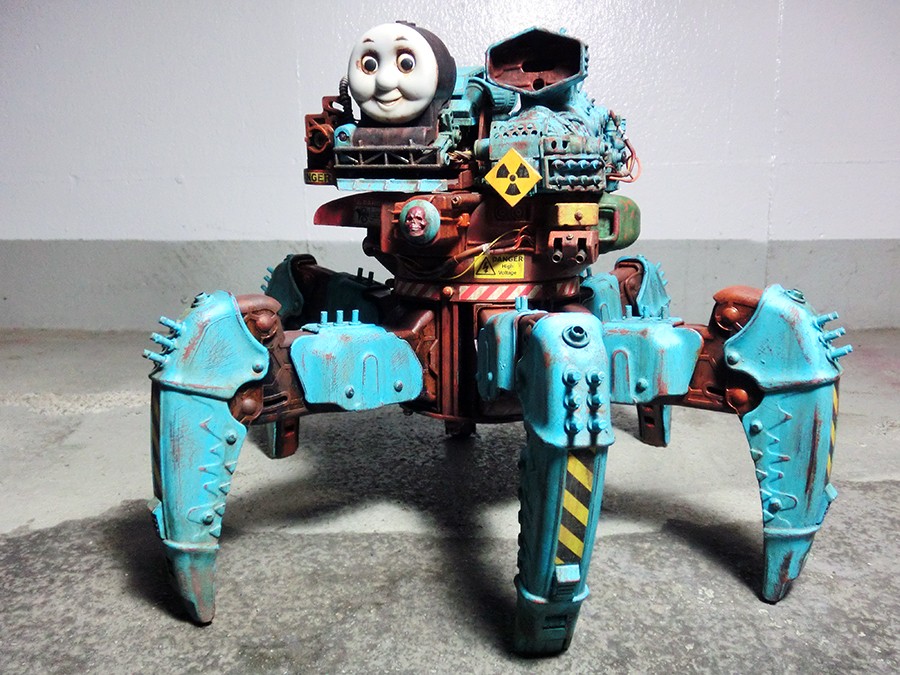
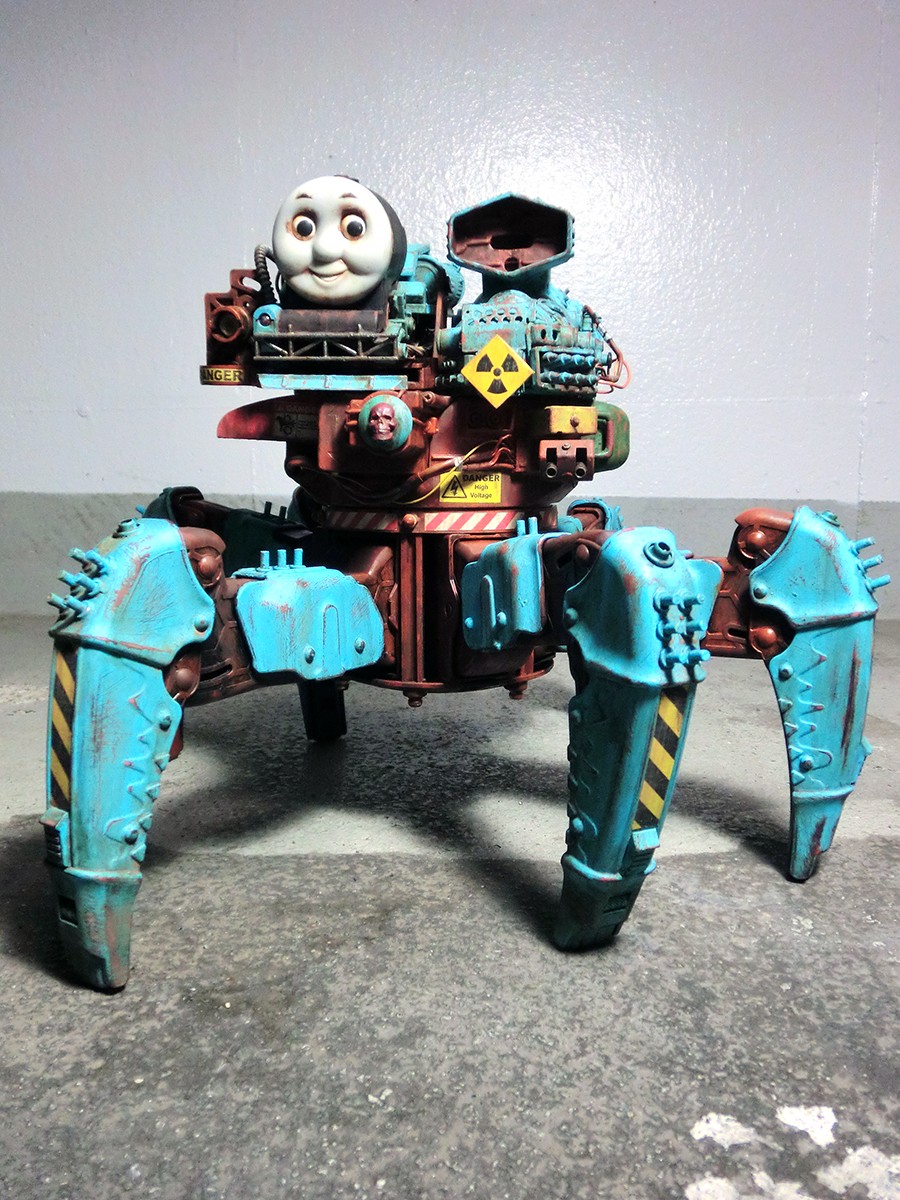
It’s a little-known sequel to Thomas the Tank Engine. In an apocalyptic war Sir Topham Hatt, the manager of the North Western Railway, loses everything he has. In a state of misery-induced madness he goes to work on Thomas, an AI-equipped tank engine. When Thomas emerges from the mad scientist’s lab he’s no longer that cheerful and lovable tank engine we all know. He’s become a ruthless killing machine that looks like it’s right out of a page from Mad Max.
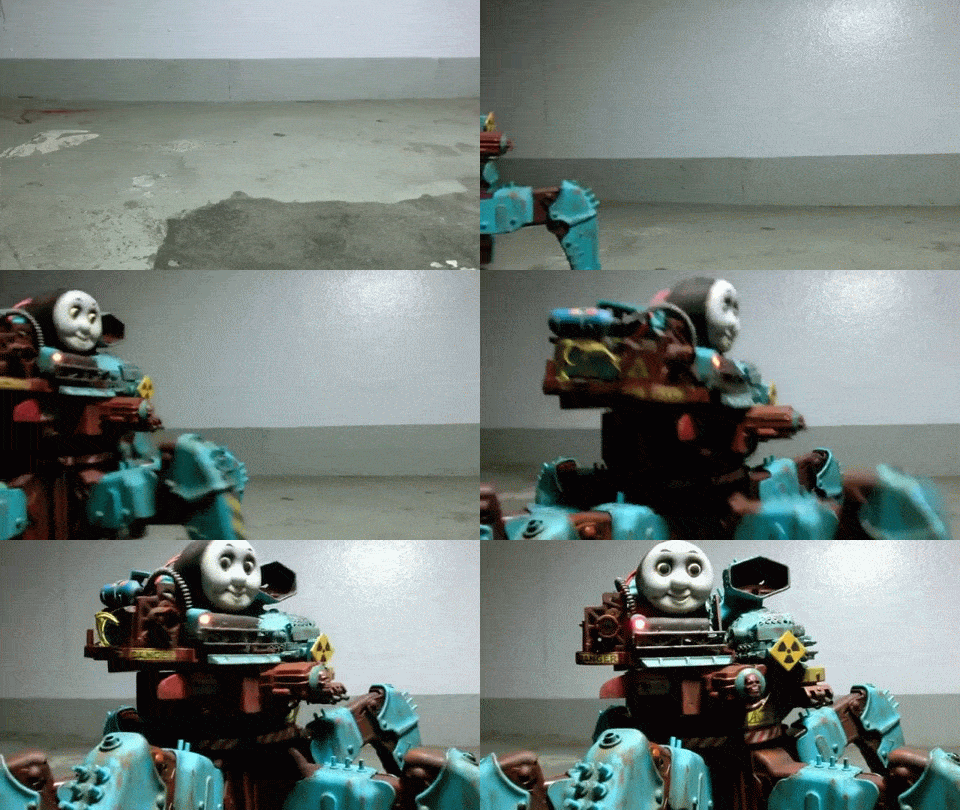
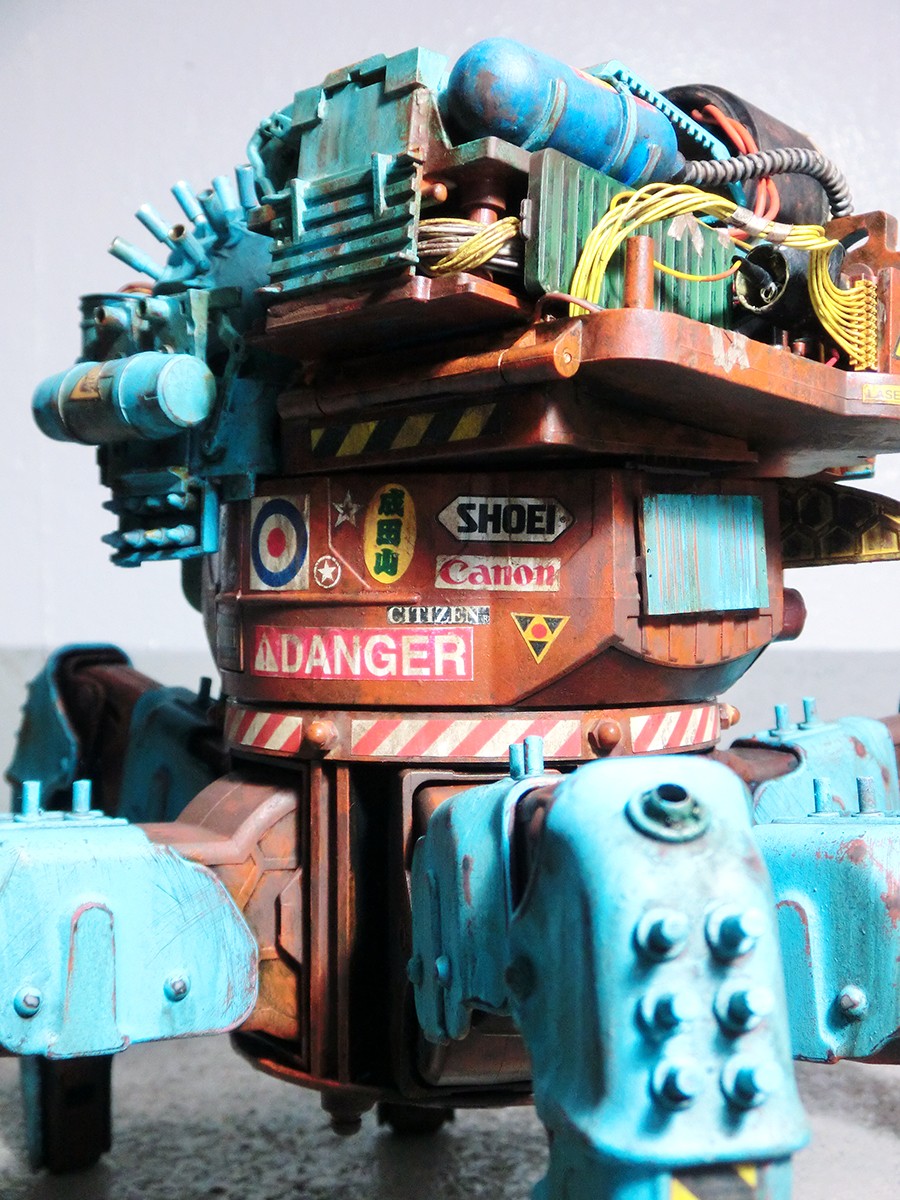
Or at least that’s the story that the creator of the post-apocalyptic Thomas wants us to believe. Going by the name Y Nakajima, the Japanese sculptor and model-maker hacked the multi-legged Combat Creature to give birth to his nightmarish toy. The remote-controlled creature is mobile but it’s body can also rotate and shoot a 300 mW lasers that’s capable of popping balloons or igniting matches. I know what I want for Christmas!
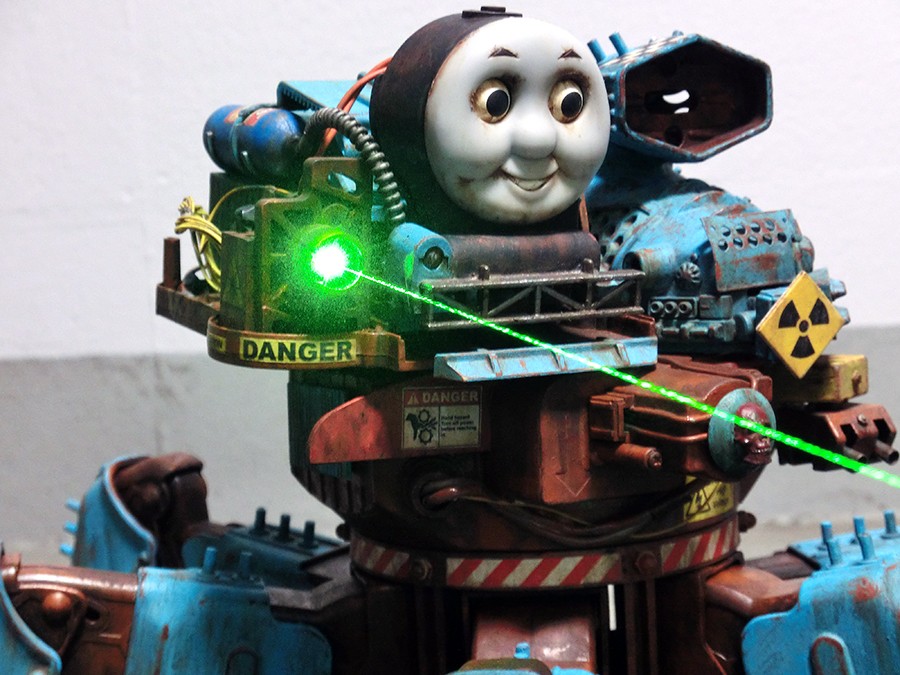
Nakajima hails from the prestigious sculpture studio of Takayuki Takeya. He’s now a freelance artist dedicating his time to creating models of soldiers, vehicles and monsters. For some reason, the beloved Thomas the Tank Engine is a constant source of nightmarish inspiration for artists. Last year we discovered illustrator Yui Abe’s grotesque rendering of Thomas the Human Tank Engine.
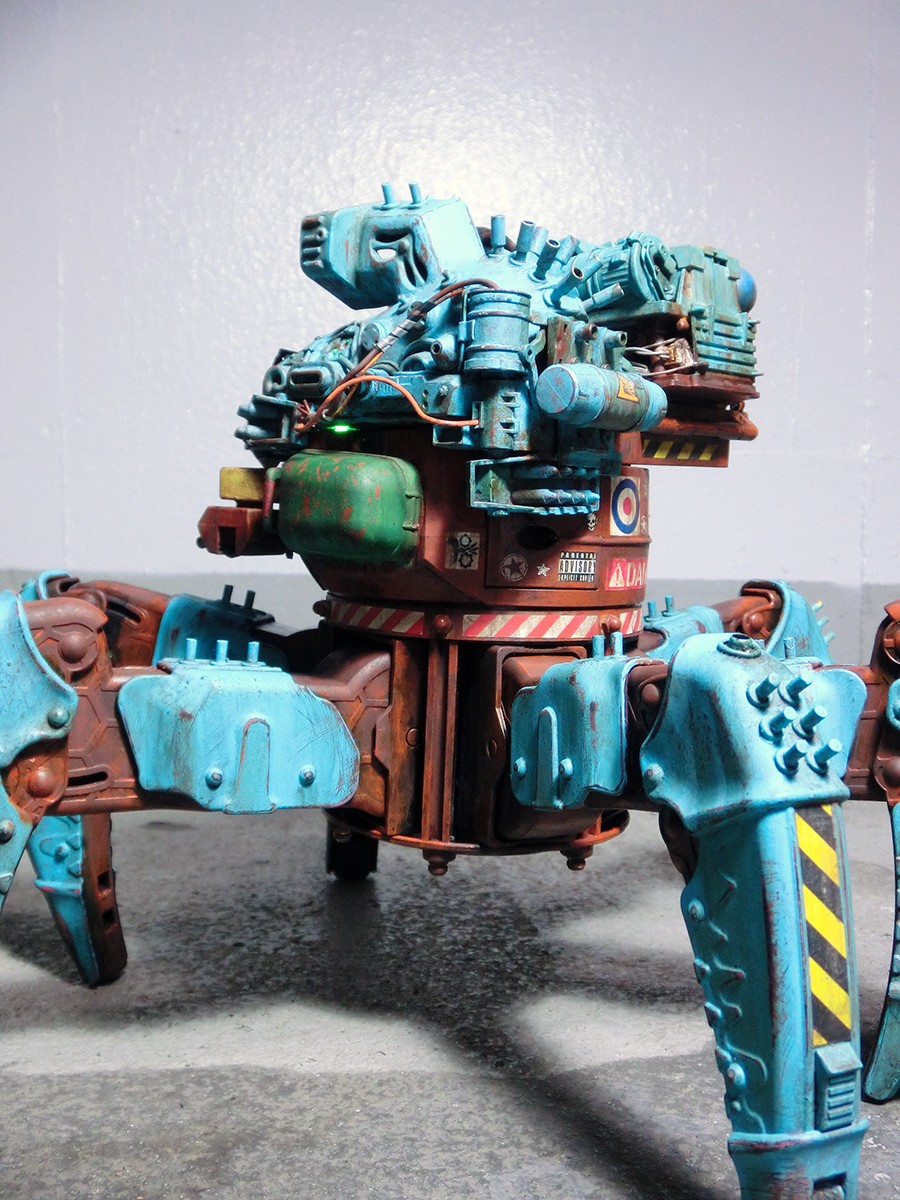
Nakajima used water-based acrylic paint to achieve the war-torn look
RoslynIt took me a while to understand the image. Then.. wow.

My name is Hervé This von Kientzheim. I'm an Alsatian physical chemist, in exile in Paris (because ich habe mein Herz in Kientzheim verloren) and my research is "molecular gastronomy", a scientific discipline that I created in 1988 with my old friend Nicholas Kurti. I have to add that contrary to a misconception, molecular gastronomy is not cooking, but a scientific activity, and more precisely, a science of nature (opposed to sciences of human and societies).
This means looking for the mechanisms of phenomena occurring during dishes preparation. The idea is that cooking involves a lot of transformations (the meat turns brown, the pancake hardens, etc.), and that we are looking for the mechanisms of such transformations (why does the steak turn brown, for example).
We are doing a scientific activity, which means that there are no pans in the lab, but only nuclear magnetic resonance spectroscopy, gas chromatography and mass spectroscopy.. and equations. I have a passion for equations, and my job gives me the wonderful pleasure to deal with equations all day long.
The goal is to make discoveries, as for any science. We have to push the borders of knowledge farther. Of course, making research involves teaching, at least to younger scientists of our group.. but also much more broadly, because I get so many applications from all over the world (this is why I contributed to create a Master programme called "Food Innovation and Product Design").
Also science has applications: technical applications, social applications, educational applications. And I participate in applications of molecular gastronomy in these three directions. For example, for more than 15 years I've been publishing one culinary innovation, often on the Internet site of my friend Pierre Gagnaire, one the of best chefs of the world. But I'm also introducing new educational programmes in primary schools as well as in high schools (and of course at university level).
Some years ago, I also had to head the "Human Food Group" of the French Academy of Agriculture, and I was appointed the Director of the International Centre for Molecular Gastronomy, with relationships with more and more universities of the world (often, I contributed in creating such laboratories).
I also forgot to tell you about "note by note cooking", which means cooking with compounds, instead of using vegetables and meat, fish or fruits. This will be the next big culinary trend, and you can trust me: it will last for a long time. I proposed it as early as 1994, but it's now begun spreading all over the world.
And there's more, but let's come back to the most important: sciences of nature, physical chemistry! Indeed, this is the basis on which all is built.
I'm not a native English speaker, so I can interpret "hardware" as computers, but also more generally electronics.. and nuclear magnetic resonance spectroscopy is mostly a big magnet with a lot of electronics.
The system that I'm using is a Bruker Avance 300 MHz spectroscope that Jean-Marie Lehn (Nobel Prize 1987) gave me, some years ago. This huge electronic system is run by a small computer, but the computer itself has no importance, and I even don't know which one it is.
For my most important work, i.e. calculation, I'm using UNIX and Linux running on various systems. My laptop is a laptop, and it has no importance. I mean, it has to have a real keybord, a screen bigger than 13", and it should be thin and light, because I have it always with me (indeed, I have two of the same, because I don't want to lose one second, if one breaks). The flash memory is very useful, and I could not admit booting in more than some seconds now.
On my desks there are other computers, and most are Dell, but indeed I don't care, as long as they can calculate. You know, this is an attitude that I have generally: for example, I have two cars, but I don't care, as long as I can drive safely. I don't care about their color, their brand, their power, etc. Sometimes, I need them, and they have to work. It's only a question of use. For my clothes, the same, and also for my laboratory, etc. On the other hand, intellectually, I am completely different, and here elegance and beauty are most important for me.
The way I calculate, the way I think, the way I speak, the way I write... and this is why I am so sad to answer your questions in English, because my English is very poor (it means that I cannot express myself with the utmost precision that I love).
Here, the answer is straightforward. I told you that Linux is on my ultrabooks and computers (or UNIX), but the main software that I am using is Maple.
Indeed this software is really good, and I regret that it is so expansive, because it deserves being used by more people. Using it, you can write, but primarily you can do good science, i.e. calculus, equations. I love it, and it is almost the only software that I am using. Immediately when my computer is on, a Maple file is opened (my "notebook"). Right now, answering the questions, I am looking on the left of the screen and I can see that I am also using (sometimes) Unison (for backups), LibreOffice Writer, GIMP, Avogadro..
If Maple could include a chemistry software, it would be wonderful. But indeed, I am not sure that this would change a lot. What I need is intelligence, kindness and time.
German artist Wilfried Grootens creates glass paintings of various geometric forms for the series ‘Where The Shark Bubbles Blow’. Suspended in layers of glass, the fine linear brush strokes create three-dimensional artworks that seem to be floating. In a statement about his work, Grootens says: “In this way variations of forms are created, mirror axes, views of one and the same body depending on one’s point of observation.” His work has won several awards and is internationally exhibited.


All images © Norbert Heyl


Robotics project from Disney Research and ETH Zurich is a remote controlled four wheel car that can drive on vertical walls:
VertiGo is a wall-climbing robot that is capable of transitioning from the ground to the wall, created in collaboration between Disney Research Zurich and ETH. The robot has two tiltable propellers that provide thrust onto the wall, and four wheels. One pair of wheels is steerable, and each propeller has two degrees of freedom for adjusting the direction of thrust. By transitioning from the ground to a wall and back again, VertiGo extends the ability of robots to travel through urban and indoor environments. The robot is able to move on a wall quickly and with agility. The use of propellers to provide thrust onto the wall ensures that the robot is able to traverse over indentations such as masonry. The choice of two propellers rather than one enables a floor-to-wall transition – thrust is applied both towards the wall using the rear propeller, and in an upward direction using the front propeller, resulting in a flip onto the wall.
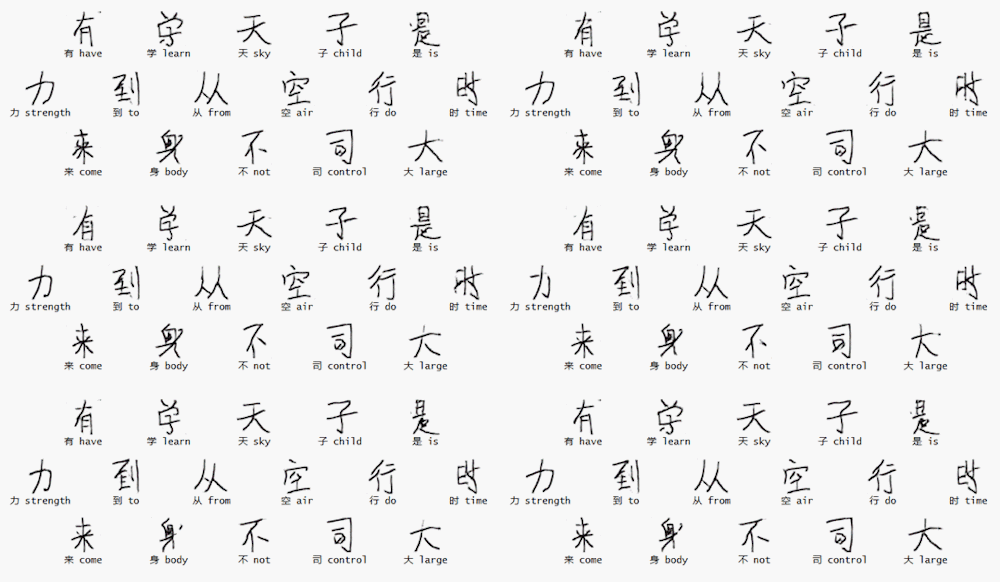
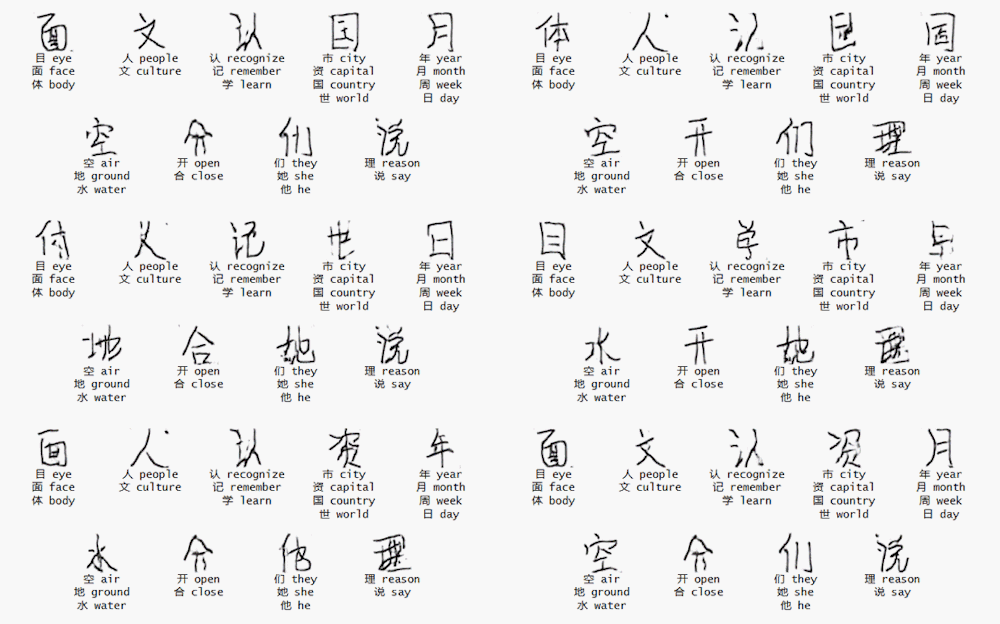
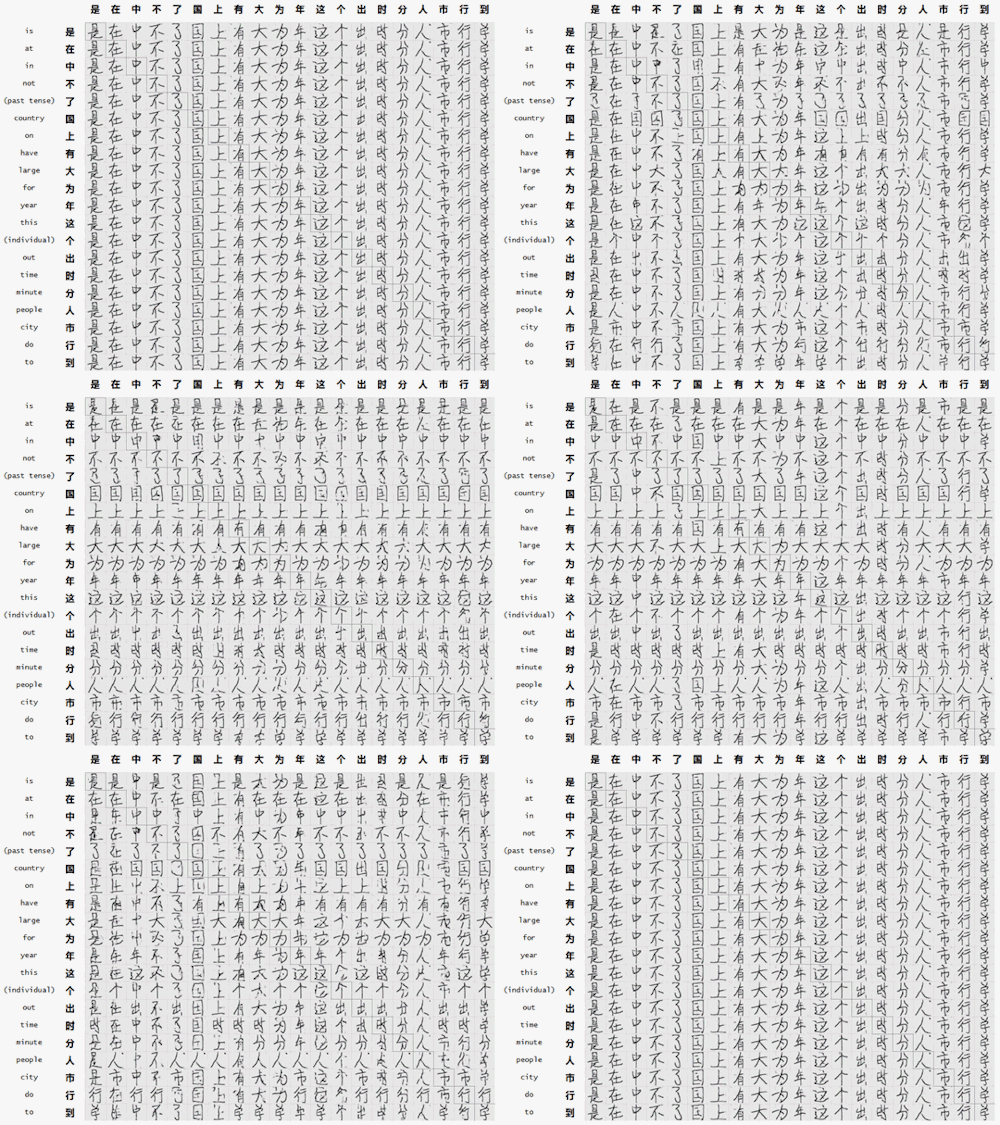
Another Neural Network Chinese character project - this one by Gene Kogan which generates new Kanji from a handwritten dataset:
These images were created by a deep convolutional generative adversarial network (DCGAN) trained on a database of handwritten Chinese characters, made with code by Alec Radford based on the paper by Radford, Luke Metz, and Soumith Chintala in November 2015.
The title is a reference to the 1988 book by Xu Bing, who composed thousands of fictitious glyphs in the style of traditional Mandarin prints of the Song and Ming dynasties.
A DCGAN is a type of convolutional neural network which is capable of learning an abstract representation of a collection of images. It achieves this via competition between a “generator” which fabricates fake images and a “discriminator” which tries to discern if the generator’s images are authentic (more details). After training, the generator can be used to convincingly generate samples reminiscent of the originals.
… a DCGAN is trained on a labeled subset of ~1M handwritten simplified Chinese characters, after which the generator is able to produce fake images of characters not found in the original dataset.
RoslynRudoctopus
RoslynMesmerising!
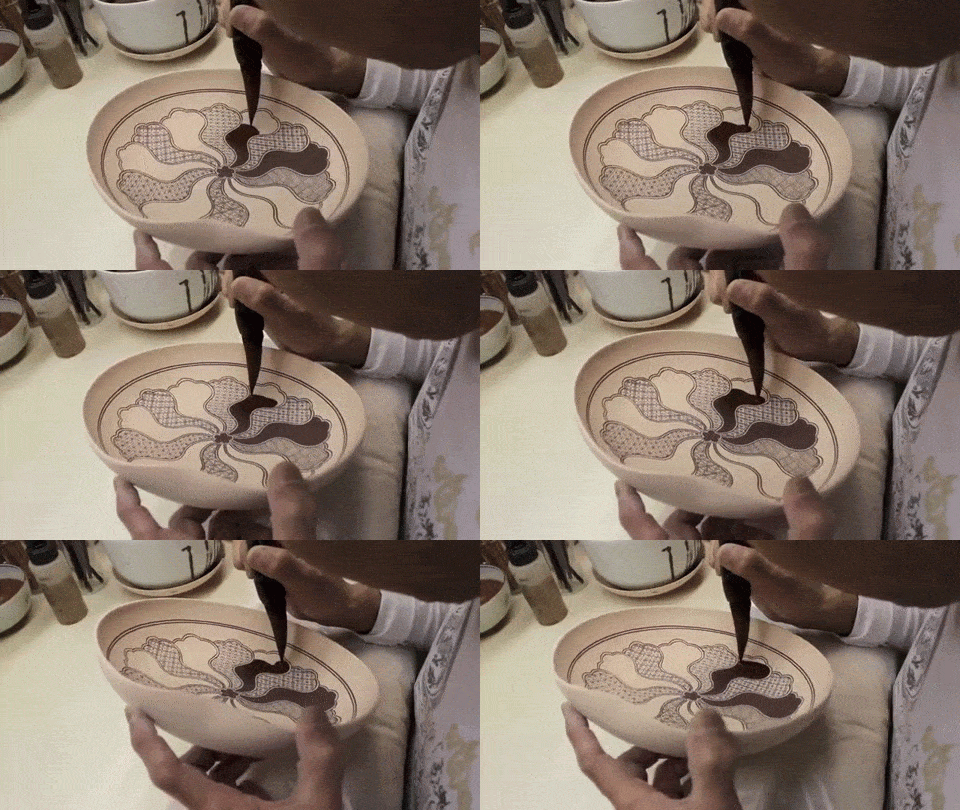
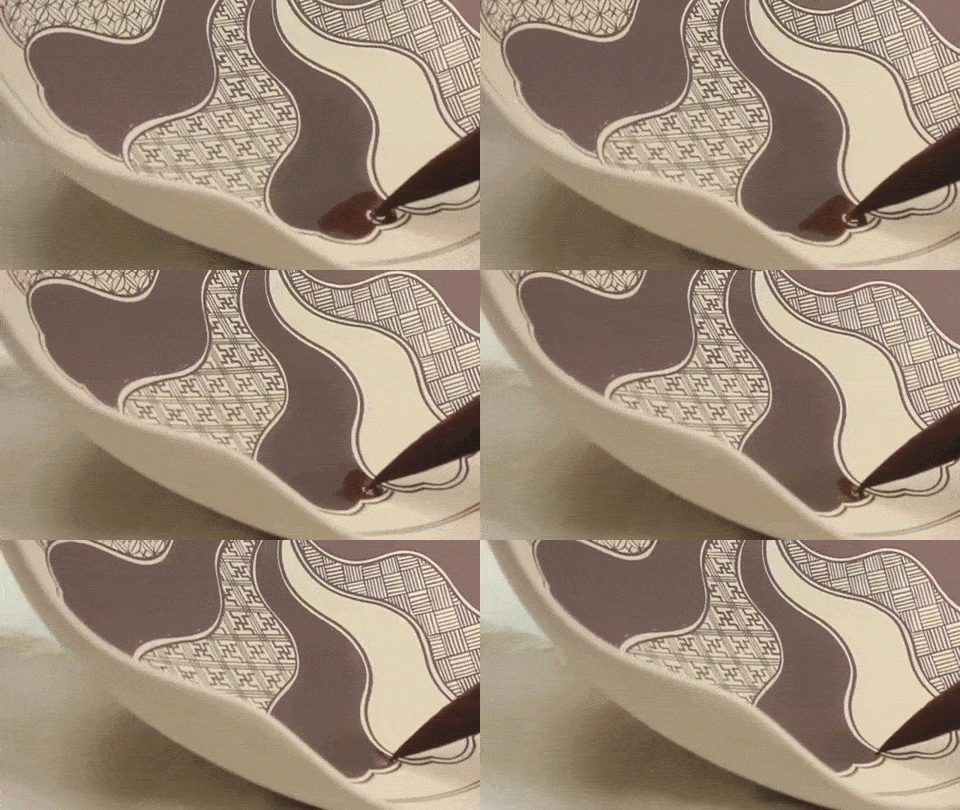
The Japanese ceramic studio Kutani Choemon was founded in 1879 and has been making tableware and tea ceremony utensils for over 130 years. In the video below, the studio demonstrates the masterful techniques of ceramic painting that have been passed down from generation to generation. In the video the paint almost seems like it’s alive, with a will of its own, yet remains completely under the control of the craftsman.
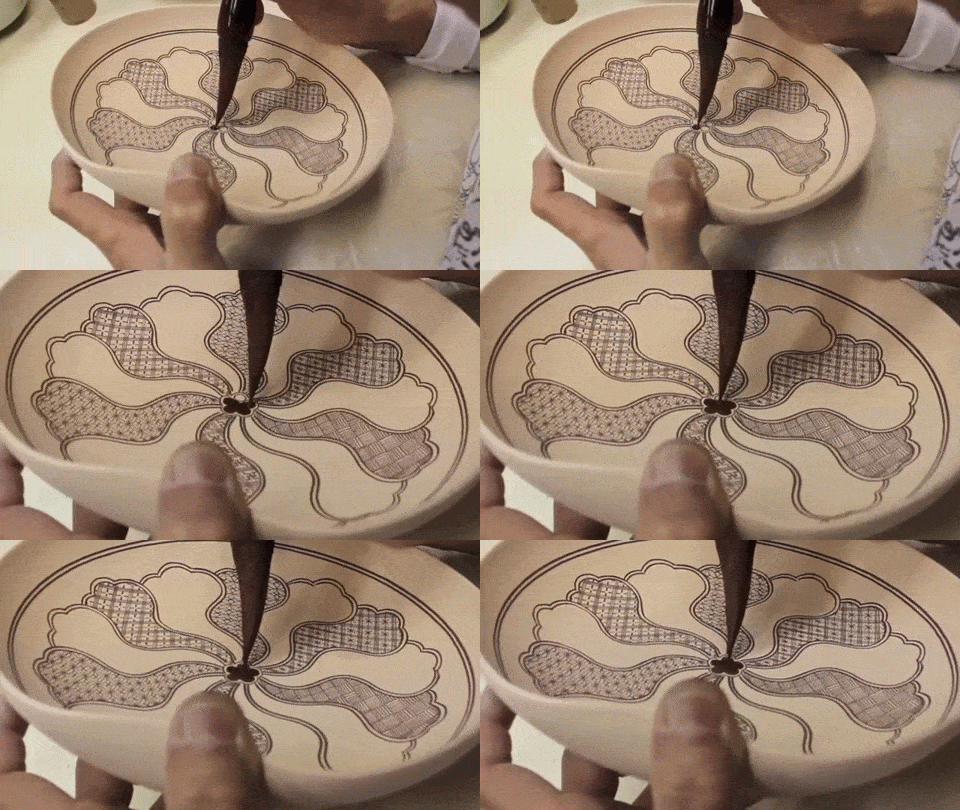
The integrated system of production, explains the studio, does everything in-house. From sourcing raw materials to firing the kilns. Which is what’s enabled them to maintain their consistency and quality over the years. There’s something incredibly soothing and mesmerizing about watching the craftsman use his outsized brush to fill in tiny details.
And despite being very traditional in their production, they’ve responded to modernity by partnering with international designers like Jaime Hayon and even creating a line of Disney products.

Website can let you leave a text-to-speech message to Donald Trump’s offices to respond to his ‘close the internet’ remarks:
Donald Trump wants to call Bill Gates to ‘close up the Internet’.
Let’s have the Internet call Donald instead. Write something below, and an automated voice recording of your message will be queued to one of Trumps’ offices.
Our system will transform your message to a spoken voice that will call one of Trumps’ offices on your behalf. If nobody picks up your message will be left as a voicemail.
Please keep it positive: Do not use hateful or aggresive language.
| archive - contact - sexy exciting merchandise - search - about | |||
 |
|||
| ← previous | November 18th, 2015 | next | |
|
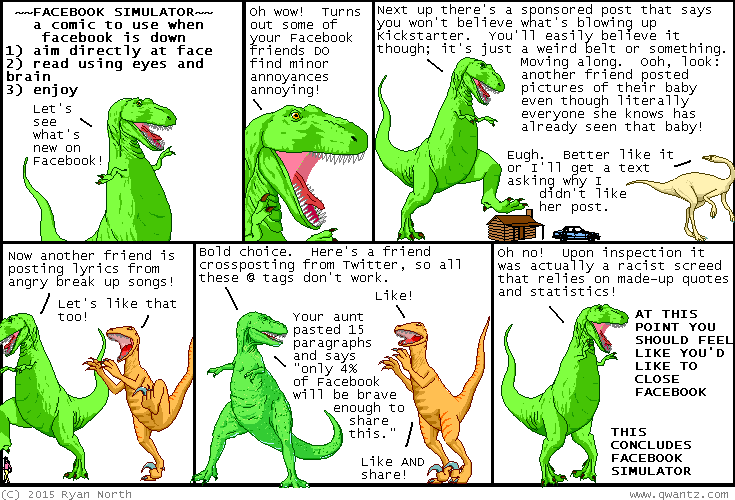
November 18th, 2015: Can Facebook TRULY be replaced by a 58kb png file? This creator of the 58kb png file says: yes! – Ryan | |||
RoslynPuffin!
RoslynIt's the future.

Google Self-Driving Car Pulled Over by Police | NBC4 Washington
The Google car was going 24 mph in a 35 mph zone, which caused traffic to back up, according to the Mountain View Police blog.
Google is proud to say that they have never been ticketed to date after 1.2 million miles of autonomous driving. Had the officer decided to issue a citation, Mountain View Police Department spokesman Sgt. Saul Jaeger says the person in the position to be in control of the car would have been ticketed.
 According to a press release sent out earlier today,
Today Oxford Dictionaries announces the emoji , commonly known as “Face with Tears of Joy,” as its “Word” of the Year for 2015.
They explain that
This year Oxford University Press partnered with leading mobile technology business SwiftKey to explore frequency and usage statistics for some of the most popular emoji across the world. “Face with Tears of Joy” came out a clear winner. According to SwiftKey’s research, “Face with Tears of Joy” was the most heavily used emoji globally in 2015. Their research shows that the character comprised 20% of all emoji used in the UK in 2015, and 17% of all emoji used in the US. This compared to 4% and 9% respectively in 2014. In the US the next most popular emoji was “Face Throwing a Kiss,” comprising 9% of all usage.
Beautifully done: BBC footage of the Queen’s birthday, but with sneering BBC commentary about Kim Jong Il’s birthday dubbed over it. The lovely irony.
Hat tip to Philip Sterne, self-described longtime blog lurker.
The post Kim Jong Elizabeth II appeared first on Chris Blattman.
Australian artist Michael Pederson created a series of street artworks in his hometown of Sydney. The pieces, which are made of everyday objects, typically have an unusual message behind them that are likely to resonate with the residents of the city. Pederson uses pre-existing objects, like cars, flowers or park benches, and transforms them into amusing installations to get the viewers to step out of their daily routine and see the world from a more humorous perspective.


All images © Michael Pederson

Fifteen years ago, in Indiana, I participated in GLSEN’s “Day of Silence.” What you do is: you don’t talk. You don’t say anything. It’s to raise awareness around bullying and harassment of LGBTQ folks.
Two things happened that day that I remember every year on National Coming Out Day:
1. I went to the hardware store. I forget what I was looking for, but I remember that I couldn’t find it. And because I was being silent, I couldn’t ask for help.
I couldn’t ask for help.
2. I met someone new who struggled to pronounce my name, which was written on my name tag (English wasn’t her first language), and I couldn’t help her with the pronunciation.
I couldn’t even say my name.
So on National Coming Out Day, I think about all the people who can’t ask for help and can’t tell people who they are – not even the people who really want to know who they are.
And if you’re struggling, there’s, like, SO MANY PEOPLE who have your back. You can start with the Trevor Project or It Gets Better or , in the UK, LGBT Foundation.
Things are better now than they were 15 years ago.
Just think how good they might be 15 years from now.

Then scan that, and take a photo of the print-out of the scan. Simple.
Buy the book now: amazon.com, amazon.co.uk, amazon.de
Like us on Facebook
Follow us on Twitter
Roslyn"The map shows the Moon."

Tabula Selenographica. The map shows the Moon. Created by Johannes Hevelius in 1647.
Throughout history, many cities changed their names. Some did it for political reasons; others hoped to gain an economic advantage from it. Looking at a modern map of the world, you’d probably have a hard time finding Edo, Istropolis, or Gia Dinh. That is because these places are today known as Tokyo, Bratislava, and Ho Chi Minh City respectively. With this interactive map, you can explore a few notable examples of city name changes, and the history behind them.
A version of this blog post originally appeared on the OxfordWords blog.
Image Credit: “Istanbul” by Robert S. Donovan. CC BY NC 2.0 via Flickr.
The post Istanbul, not Constantinople appeared first on OUPblog.