PokéNoir
perfeito! sim ou ctz!?
Evolutionary eccentricities, ornithological oddities, and the engineering mysteries of flight.
 Birds are an incessant source of scientific fascination, from why they sing to how their wings work. The Unfeathered Bird (public library; UK) by Katrina van Grouw isn’t about the anatomy of birds — it’s about “how their appearance, posture, and behavior influence, and are influenced by, their internal structure.” Though originally intended as a tool for artists, the book is also rigorously scientific but without the burdensome language and clunky terminology of anatomical writing. What emerges is an illuminating and meticulously illustrated look at the brilliance of birds at the intersection of art, science and history, covering such intricate mysteries as how the ostrich lost two of its four toes and why the vulture diverged into radically different Old World and New World varieties. The 385 or so intricate drawings include a number of species never illustrated before and explore everything from the mechanics of flight to the aerodynamics of avian skulls.
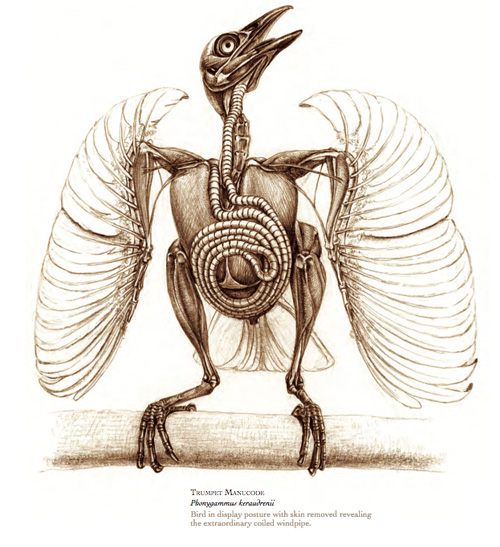


Van Grouw — who is herself a remarkable cross-pollinator of disciplines and perspectives as a taxidermist, RCA-trained fine artist, and former curator of the ornithological collections at London’s Natural History Museum — writes of the mechanical miracle of flight:
Flight makes rather specific demands on the physical engineering of an animal. The skeleton needs to be of a lightweight structure, with large flattened surfaces for the attachment of muscles, and to have tremendous rigidity and the strength to support the entire weight of the animal while airborne. The components are highly specialized and once a satisfactory blueprint has been achieved there is very little room for modification. The paradox, then, is that although the birds represent the largest class of all the vertebrates — approaching ten thousand species — they are fundamentally rather uniform; though with some very surprising variations!
The adaptation for flight is the most important factor behind the structure of birds and can provide an explanation for virtually all of their anatomical characteristics — even those that seem to have nothing to do with flying. For example, with wings instead of front legs, birds need two strong hind limbs and a modified posture to balance on them. And with a body rigid enough to cope with the demands of flapping flight, it’s vital to have a long and flexible neck to compensate for the loss of movement. But it’s important to remember that birds didn’t learn to fly first and develop these perfections afterward. Many of these qualities had long been present in the birds’ theropod ancestors — the upright dinosaurs that walked on two legs — and only through a constant process of adaptation and counteradaptation spanning millions of years did it become possible for the feathered dinosaurs to survive and take wing.


One of the most intriguing chapters deals with the divergence of vulture species between the New and Old World:
The universal truths about vultures are, as every schoolchild knows, as follows: they have a bare head, a hooked beak, and long, broad wings, and they eat things they find dead. Few definitions could be more cut and dried. All over the Americas, Europe, and Asia this very uniform group of birds can be instantly recognized and, on a group level at least, poses no problems of identification.
So when, in the 1980s, the newly developed techniques for hybridizing strands of DNA revealed that the New World vultures may not be vultures at all but close relatives of the storks, it created something of a sensation. Indeed, to the average birdwatcher the concept seemed to symbolize the chaos that test-tube technology would drag their world into without the steadying hand of empirical common sense. What many birdwatchers didn’t realize was that this concept wasn’t new. In fact, by the time the DNA experiments were taking place, it had already been around for over a hundred years, based on a range of complex anatomical features: the musculature of the wings, formation of the intestines, and so forth. More recent DNA research has once again made the position of the New World vultures uncertain. They are probably not, after all, stork relatives, and for the time being some authorities have tentatively returned them to the company of other hook-billed birds.
What is perhaps most remarkable, however, is not that New and Old World vultures may not be related but that two possibly unrelated groups of birds have come to look so alike. They differ externally only in the longer and functional hind toe of the Old World vultures and the open nostrils (you can see right through from one side to the other) of the New World vultures.
This similarity is the result of a process called convergent evolution. It’s the selective pressures of the lifestyle that shape an animal, not the shape of an animal that dictates the lifestyle — given sufficient time, that is. So when different animal groups share the same ecological niche independently of one another there is a tendency for them to reinvent the wheel, finding the same solutions to the same challenges and ultimately coming to look very much alike.


Meticulously researched, gloriously illustrated, and absorbingly narrated, The Unfeathered Bird lives at the heart of that timeless temple where art and science meet to enrich one another with “systematic wonder.”
Images courtesy Princeton University Press
Donating = Loving
Bringing you (ad-free) Brain Pickings takes hundreds of hours each month. If you find any joy and stimulation here, please consider becoming a Supporting Member with a recurring monthly donation of your choosing, between a cup of tea and a good dinner:
| ♥ $10 / month♥ $3 / month♥ $25 / month♥ $50 / month♥ $100 / month |

You can also become a one-time patron with a single donation in any amount:

 Brain Pickings has a free weekly newsletter and people say it’s cool. It comes out on Sundays and offers the week’s best articles. Here’s what to expect. Like? Sign up.
Brain Pickings takes 450+ hours a month to curate and edit across the different platforms, and remains banner-free. If it brings you any joy and inspiration, please consider a modest donation – it lets me know I'm doing something right.

Alvaro FreitasRX-78 <3
Pode não ser grande como o Gundam de 18 metros que está em Tóquio, mas esta reprodução perfeita de Lego do RX-78-2 é muito mais divertida.
Os detalhes e a construção são tão legais quanto a versão real. Gyuta- o criador – devia enviar isso para a Lego Cuusoo. Vai virar uma peça oficial em pouquíssimo tempo. [Gundam Guy]


Além de anti-escravista, presidente norte-americano lia Marx, simpatizava com socialistas utópicos e defendia direitos trabalhistas radicais
Por Vicenç Navarro* | Tradução: Gabriela Leite
O filme Lincoln, produzido e dirigido por um dos diretores mais conhecidos dos EUA, Steven Spielberg, deu nova vida a um grande interesse pela figura de Abraham Lincoln, um dos presidentes que, como Franklin D. Roosevelt, sempre desfrutou, no imaginário estadunidense, de grande lembrança popular. Sua figura política destaca-se como a de quem garantiu a unidade dos EUA, depois de derrotar os confederados que aspiravam a secessão dos Estados do Sul. É também uma figura que ressalta na história dos EUA por ter abolido a escrevidão, e ter dado a liberdade e cidadania aos decendentes das populações imigrantes de origem africana — ou seja, a população negra, que nos EUA é conhecida como a população afroamericana.
Lincoln foi também um dos fundadores do Partido Republicano. Este, em suas origens, era o completo oposto do que é hoje, quando está fortemente influenciado por um movimento — o Tea Party — chauvinista, racista e reacionário ao extremo. O Partido Republicano fundado por Lincoln era, ao contrário, uma organização federalista, que considerava o governo federal como garantia dos Direitos Humanos. Entre eles, a emancipação dos escravos, tema central da película Lincoln, foi aquele ao qual Lincoln deu maior ênfase. Terminar com a escravidão significava que o escravo passava a ser trabalhador, dono de seu próprio trabalho.
Contudo, Lincoln, inclusive antes de ser presidente, considerou outras conquistas sociais como parte dos Direitos Humanos. Entre ela, o direito do mundo do trabalho controlar não só seu trabalho, mas também o produto dele. O direito de emancipação dos escravos transformava-os em pessoas livres assalarianas, unidas — segundo ele — em laços fraternais com os outros membros da classe trabalhadora, independentemente da cor de sua pele. Suas demandas de que o escravo deixasse de sê-lo e de que o trabalhador — tanto branco como negro — fosse o dono, não só de seu trabalho, mas também do produto de seu trabalho, eram igualmente revolucionárias. O segundo tipo de emancipação, no entanto, nem sequer é citado no filme Lincoln. Ele a ignora. E utilizo a expressão “ignora” ao invés de “oculta” porque é muito possível que os autores do filme e do livro em que ele se baseia nem sequer conheçam a história real de Lincoln.
A Guerra Fria do mundo cultural e até acadêmico dos EUA (que continua existindo) e o enorme domínio do que lá se chama a Corporate Class (a classe dos proprietários e gestores do grande capital) sobre a vida, não só econômica, mas também cívica e cultural, explica que a história formal dos EUA que se ensina nas escolas e universidades é muito tendenciosa, isenta de qualquer “contaminação ideológica” precedente dos movimentos de trabalhadores — seja socialismo, comunismo ou anarquismo. A grande maioria dos estudantes norte-americanos, inclusive os das universidades mais prestigiosas e conhecidas, não sabem que a festa do 1º de maio, celebrada mundialmente como o Dia Internacional do Trabalho, é uma festa em homenagem aos sindicalistas de seu país que morreram em defesa da jornada de oito horas de trabalho por dia (no lugar de doze). Sua vitória difundiu-se na maioria dos países do mundo. Nos EUA, tal dia, o 1º de Maio, além de não ser festivo, é o dia da Lei e a Ordem — Law and Order Day — (ver o livro People’s History of the U.S., de Howard Zinn). A história real dos EUA é muito diferente da história formal promovida pelas estruturas de poder estadunidenses.
As simpatias ignoradas de Lincoln
Lincoln, já quando membro da Câmara Legislativa de seu Estado, Illinois, simpatizou claramente com as demandas socialistas do movimento trabalhador, não só dos EUA, mas também da cena mundial. Sua defesa dos trabalhadores a controlar o produto de seu labor é revolucionária ainda hoje.
Na realidade, Lincoln considerou que a escravidão era o domínio máximo do capital sobre o mundo do trabalho, e sua oposição às estruturas de poder dos Estados do sul devia-se precisamente a perceber estas estruturas como sustentadoras de um regime econômico baseado na exploração. Daí veio a ideia da abolição da escravatura como a libertação não apenas da população negra, mas capaz de beneficiar também a classe trabalhadora branca — cujo racismo, via o presidente, ia contra seus próprios interesses.
Lincoln também indicou que “o mundo do trabalho antecede o capital. O capital é o fruto do trabalho, e não existiria sem o mundo do trabalho, que o criou. O mundo do trabalho é superior ao mundo do capital, e merece a maior consideração (…) Na situação atual, o capital tem todo o poder e há que se reverter este desequilíbrio”. Leitores dos escritos de Karl Marx, contemporâneo de Abraham Lincoln, se lembrarão que algumas dessas frases eram muito semelhantes às utilizadas por tal analista do capitalismo em sua crítica da relação capital/trabalho sob tal sistema econômico.
Surpreenderá a um grande número de leitores saber que os escritos de Karl Marx influenciaram Abraham Lincoln, tal como documenta em grande detalhe John Nichols, em seu excelente artigo “Reading Karl Marx with Abraham Lincoln: Utopian socialists, German comunists and other republicans” [“Lendo Karl Marx com Abraham Lincoln: Socialistas utópicos, comunistas alemães e outros republicanos”], publicado no Political Affairs (27/11/12), e do qual extraio as citações, assim como a maioria dos dados publicados nesse artigo. Os escritos de Karl Marx eram conhecidos entre grupos de intelectuais que estavam profundamente insatisfeitos com a situação política e econômica dos EUA, como era o caso de Lincoln.
Karl Marx escrevia regularmente no The New York Tribune, o jornal intelectual mais influente nos Estados Unidos naquele período. Seu diretor, Horace Greeley, considerava-se um socialista e um grande admirador de Marx, ao qual convidou a ser colunista no diário. Em suas colunas, incluiu um grande número de ativistas alemães que haviam fugido das grandes perseguições ocorridas na Alemanha daquele tempo — um país altamente agitado, com um nascente movimento trabalhador que questionava a ordem econômica existente. Alguns desses imigrantes alemães (conhecidos naquele momento como os “Republicanos Vermelhos”) lutaram mais tarde contra as tropas sulistas na guerra civil, dirigidos pelo presidente Lincoln.
Greeley e Lincoln eram amigos. Na verdade, Greeley e seu diário apoiaram desde o início a carreira política de Lincoln, sendo Greeley quem o aconselhou a candidatar-se à presidência do país. E todas as evidências apontam que Lincoln era um grande leitor de The New York Tribune. Em sua campanha eleitoral, convidou vários “republicanos vermelhos” a integrar-se a sua equipe. Já antes, como congressista, representante do condado de Springfield no estado de Illinois, apoiou frequentemente os movimentos revolucionários que ocorriam na Europa e muito especialmente na Hungria, assimando documentos de apoio a esses movimentos.
Lincoln, grande amigo do mundo do trabalho estadunidense e internacional
Seu conhecimento das tradições revolucionárias existentes naquele período não era casual, mas fruto de suas simpatias com o movimento trabalhador internacional e suas instituições. Incentivou os trabalhadores dos EUA a organizar e estabelecer sindicados e continuou fazendo-o quando presidente. Vários sindicatos nomearam-no membro honorário. Em sua resposta aos sindicatos de Nova York, sublinhou “vocês entenderam melhor do que ninguem que a luta para terminar com a escravidão é a luta para libertar o mundo do trabalho, ou seja, libertar todos os trabalhadores. A libertação dos escravos no Sul é parte da mesma luta pela libertação dos trabalhadores do Norte”.
Durante a campanha eleitoral, Lincoln posicionou-se contra a escravidão, indicando explicitamente que a libertação dos escravos permitiria aos trabalhadores exigir os salários que lhes permitissem viver decentemente e com dignidade.
Marx, e também Engels, escreveram com entusiasmo sobre a campanha eleitoral de Lincoln, em um momento em que ambos estavam preparando a primeira Associação Internacional dos Trabalhadores. Em umas sessões, Marx e Engels propuseram à Internacional que enviasse carta ao presidente Lincoln, parabenizando-o por sua atitude e postura. No documento, a Primeira Internacional parabenizava ao povo dos EUA e seu presidente por, ao terminar com a escravidão, haver favorecido a libertação de toda a classe trabalhadora, não só estadunidense, mas mundial.
O presidente Lincoln agradeceu a nota e respondeu que valorizava o apoio dos trabalhadores do mundo a suas políticas. Seu tom cordial certamente criou grande alame entre os establishment econômicos, financeiros e políticos dos dois lados do Atlântico. Estava claro que, como assinalaria mais tarde o dirigente socialista estadunidense Eugene Victor Debs, em sua própria campanha eleitoral, “Lincoln foi um revolucionário e por mais paradoxal que pudesse parecer, o Partido Republicado teve em suas origens uma tonalidade vermelha”.
A revolução democrática que Lincoln iniciou e que nunca se desenvolveu
Não é preciso dizer que nenhum desses dados aparece no filme Lincoln, nem é amplamente conhecido nos EUA. Mas, como bem observam John Nichols e Robin Blackburn (outro autor que escreveu extensamente sobre Lincoln e Marx), para entender o ex-presidente há que entender o período e o contexto em que ele viveu. Lincoln não era um marxista (termo sobreutilizado na literatura historiográfica e que o próprio Marx denunciou). Nem era sua vontade acabar com o capitalismo, mas sim corrigir o enorme desequilíbrio existente, neste sistema, entre o capital e o trabalho. Mas, sem dúvida foi altamente influenciado por Marx e outros pensadores socialistas, com os quais compartilhou seus desejos imediatos, levando sua postura a altos níveis de radicalismo em seu compromisso democrático.
Não há duvida de que Lincoln foi uma personalidade complexa com muitos claro-escuros. Mas as simpatias estão escritas e bem definidas em seus discursos. Na realidade, a maior influência sobre Lincoln foi a dos socialistas utópicos alemães, muitos dos quais se refugiaram em Illinois, fugindo da repressão europeia.
O comunalismo que caracterizou tais socialistas influenciou a concepção democrática de Lincoln, que interpretava a democracia como a governança das instituições políticas por parte do povo, no qual as classes populares eram maioria. Sua famosa frase (que se converteu no esplêndido slogan democrático mais conhecido do mundo) — Democracy for the people, of the people and by the people [Democracia do povo, para o povo e pelo povo] — mostra claramente a impossibilidade de haver um governo do povo para o povo sem que seja realizada pelo mesmo povo. Daí vieram a libertação dos escravos e do mundo do trabalho como elementos essenciais de tal democratização. Seu conceito de igualdade levava inevitavelmente um conflito com o domínio das instituições políticas pelo capital. A realidade existente nos EUA, que detalho em meu artigo “O que não foi dito na mídia sobre as eleições nos EUA” (Publico, 13/11/12) é uma prova disso. Hoje a Corporate Class controla as instituições políticas daquele país.
Repito que nenhuma dessas realidades aparece no filme. Spielberg não é, afinal de contas, Pontecorvo, e o clima intelectual estadunidense ainda está estancado na Guerra Fria, o que o empobrece intelectualmente. “Socialismo” continua sendo uma palavra mal vista nos círculos do establishment cultural daquele país. Na terra de Lincoln, o projeto democrático que ele sonhou nunca se realizou, devido à enorme influência do poder do capital sobre as instituições democráticas. E o paradoxo doloroso da história é que o Partido Republicano tenha se convertido no instrumento político mais agressivo a serviço do capital hoje existente.
–
Vicenç Navarro é catedrático de Ciencias Políticas y Políticas Públicas. Universidad Pompeu Fabra, y Profesor de Policy Studies and Public Policy. The Johns Hopkins University
As histórias estão em todo lugar. O ato de narrar acontece toda vez que alguém nos conta sobre alguma coisa: uma notícia de jornal, um amigo ao telefone, um estranho na cadeira ao lado no ônibus ou o narrador do recordatório de um quadrinho. Quando você se vê no espelho, não é apenas sua imagem que está refletida no vidro, mas todos os percalços, desvios e cliffhangers que o levaram até ali. Somos uma história contada por nossas mães, outra por nosso chefe, e mais uma diferente por nosso vizinho.
É por meio das histórias que aprendemos sobre o mundo e nos relacionamos com ele e até com nós mesmos – literalmente. Nosso cérebro é desenhado de maneira a apreender a realidade na forma de narrativas, metáforas e alegorias. Lutando contra todas as chances, nossa mente teima em tentar organizar nosso pequeno caos diário em uma cadeia de eventos interligados que, superando uma série de adversidades e contando com uma ajudinha do acaso, nos leva ao presente estado das coisas, com a esperança de ainda algumas surpresas e plot twists pelo caminho.
Os limites entre realidade e fantasia não são naturais, mas construídos durante séculos de avanço cultural. Grande parte dos mitos de origem nos conta do nascimento das espécies em terras fantásticas, e o tempo nada mais é que todos nós nos afastando da magia. Os mitos se tornaram literatura e os contadores de histórias, profissionais com a estranha ocupação de inventar coisas. De repente as pessoas esqueceram que as histórias estão por aí, soltas no ar, e decidiram que apenas aquelas presas em livrarias e telas de cinema eram Histórias1.
E isso sempre me deixou meio encasquetado. Nós temos a capacidade de distinguir ficção e realidade (ao menos eu espero que você tenha), mas não podemos negar que, às vezes, a única diferença é dizer que a vida real é narrada por Deus. Por que, então, não temos tantas histórias sobre histórias? Não falo de filmes sobre escritores, ou livros sobre personagens de outros livros que se tornam carne e osso. Nada de metalinguagem barata. Nada de Coração de Tinta ou a Rosa Púrpura do Cairo, mas sobre como as histórias funcionam em seu cerne e como afetam nossas vidas.
De cabeça, lembro de Terry Pratchett. Nos livros da série Discworld, o escritor inglês explora as possibilidades da inevitabilidade da narrativa. Destino ou convenção de gênero? Tanto faz, o mundo se adapta aos formatos designados e o herói, trágico por natureza, tem que enfrentar o inexorável. Não importa se ele é um jovem aprendiz de Morte lidando com desvios nas regras do Universo, um casal de atores que já não sabem se são pessoas ou personagens, um policial que viaja no tempo e revisita uma história da qual já conhece o final ou três bruxas que se veem atraídas para o centro de uma velha tragédia que se repete através dos tempos.
Ao escancarar a lógica da estrutura, Pratchett deixa clara a diferença entre ficção e vida real. Como heróis gregos, a ficção nos arrasta pelos labirintos do plot, brincando com o destino dos homens. O autor se posta como o inimigo de seus personagens e os ocasionais vilões malévolos e impiedosos são ferramentas de narrativa. As histórias, no mundo do disco, são uma força poderosa e invencível
“não se importam com quem participa delas. Tudo o que importa é que ela se desenrole e se repita. Ou, se você prefere pensar de outra maneira: histórias são uma forma de vida parasitária, sugando vidas em serviço apenas da história mesma. É necessário um certo tipo de pessoa para contra-atacar e se tornar o bicarbonato da História.”2
Para defender seu livre-arbítrio, os personagens do Discworld não lutam contra o destino, mas contra a própria estrutura literária. Eles precisam passar muito literalmente3 por três atos e um punhado de revelações e incidentes incitantes se quiserem chegar vivos à última página. E a vida em si é uma história, mas imperfeita, imprevisível e familiar. Ou, como coloca Pratchett, “A vida inteira é como assistir a um filme. Só que você sempre chega dez minutos depois que o filme começa e ninguém te conta o plot, então só resta ir tentando entender por si mesmo enquanto o filme roda”4. Ainda assim, as mazelas da vida real são infinitamente preferíveis aos pontos de virada de qualquer autor porque nós mesmos as escrevemos5.
Pode parecer confuso falar sobre esse tipo de coisa. Ficção sobre pessoas jogadas em histórias improváveis ainda é ficção, com personagens inventados e regras literárias definidas. Ainda assim, expor a estrutura literária como fato, sem poética, me faz pensar um monte sobre nossos próprios contos. O que você acredita molda quem você é.
Se o Universo é infinito, tudo aconteceu
Recentemente, a Panini Brasil lançou o primeiro volume da série O Inescrito (The Unwritten)6, que foi mais ou menos o que me fez escrever esse texto. O quadrinho narra as desventuras de Tom Taylor e sua contraparte ficcional, Tommy. E é aqui que eu começo os spoilers, estejam avisados.
Tom é filho de Wilson Taylor, autor da série de livros mais bem-sucedida da história e que desapareceu no auge do sucesso. O protagonista dos livros, uma mistura de Harry Potter e Christopher Robin, é obviamente baseado no próprio Tom, o que o torna alvo da atenção de fãs do mundo inteiro que querem conhecer o “verdadeiro Tommy Taylor”.
Na primeira edição de O Inescrito, Tom está vivendo às custas do sucesso de seu pai, participando de convenções e sessões de autógrafos. Porém, a situação muda quando uma garota desconhecida revela incongruências e lacunas nos registros da vida de Tom, levantando questões sobre adoção e fraude de identidade. O escândalo tem repercussão imediata, com fãs revoltados e estranhos cultos se formando ao redor da crença de que Tom é, na verdade, Tommy Taylor encarnado. A publicidade atrai atenções indesejadas e Tom é sequestrado por um esquizofrênico que acredita ser Conde Ambrosio, o grande vilão dos livros. Ele é resgatado por Lizzie Hexam, a mesma garota que vaza os segredos de sua origem para o público e que tem uma estranha conexão com o desaparecimento de seu pai. A partir daí, Tom passa a ser perseguido por uma sociedade secreta que controla o mundo há seculos manipulando histórias e, enquanto os limites entre realidade e ficção começam a enfraquecer, ele precisa descobrir a verdade sobre seu pai e seu nascimento.
O Inescrito se torna, ao longo de suas edições, um estudo sobre histórias e o impacto que elas têm sobre o mundo. A criação do Império Britânico, a colonização americana, o Nazismo… todos são eventos calcados em histórias, muitas vezes distantes da realidade. Em algum momento, como Tom aprende, a crença das pessoas nessa ficção supera a factualidade do mundo real. Não faz diferença o que houve, mas o que todos acreditam que aconteceu. Por isso, nos quadrinhos, alguns lugares são afetados pelas histórias que acontecem ali, como o campo de batalha de Carlos Magno que, apesar de nunca ter sido historicamente comprovado, existe na memória coletiva por ter sido registrado na “Canção de Rolando”, uma espécie de meme medieval.
À medida que Tom se aprofunda em suas descobertas, ele aprende que as histórias têm mundos próprios, versões de lugares reais onde os acontecimentos se repetem enquanto acreditamos neles, e que esses mundos têm conexões com seus correspondentes físicos e entre si. Aproveitando-se dessa “porosidade das histórias”, Wilson escreveu seus livros para dar a Tom o poder de seu personagem, pois, enquanto as pessoas acreditarem que Tom é Tommy, assim ele será.
A ideia de que a ficção tem uma vida própria baseada na fé humana não é exatamente nova. Afinal, cada vez que uma criança diz que não acredita em fadas, uma delas cai morta. Não são apenas as palmas que mantêm as fadas e os deuses existindo, mas a crença humana. Uma das mais belas cenas de O Inescrito é o painel no qual a consciência coletiva é caracterizada como uma enorme baleia – o Leviatã de Hobbes. Uma consciência coletiva que conecta todos nós num lugar de origem Jungiano habitado por parábolas, fábulas, romances, filmes e lendas.
É dentro da grande baleia que vivem as histórias, crescendo quando são semeadas nas mentes humanas e envelhecendo quando são esquecidas, até morrerem no olvido dos mitos. Quando uma história é manipulada contra seu propósito aos olhos do mundo, ela se torna um Cancro. Assim acontece com “Jud Suss”, um romance judeu sobre arrependimento e redenção por meio da religião, adaptado para o cinema pelos nazistas e transformado (torturado) num libelo anti-semita. A Cabala, sociedade secreta que persegue Tom, busca fazer a mesma coisa com a lenda de Tommy Taylor, sujando seu nome com acusações de fraude e assassinato e mesmo publicando um falso 14º volume da série repleto de clichês e plágios baratos. Afinal, nada é mais rápido que a informação no século XXI e, enquanto a história se espalha pelos grandes meios de comunicação, a fé dos leitores no legado de Taylor é abalada.
Influenciando autores, manipulando mídias e promovendo ou avançando o entretenimento de massa, a Cabala por anos controla o mundo por meio de suas histórias. Sejam quadrinhos durante a Depressão, seja religião, todas são narrativas espalhadas e assimiladas por populações. Não é fácil aceitar sem descrença uma entidade tão simples e exagerada, mas também não é difícil. Segundo os quadrinhos, o escritor Rudyard Kipling, por exemplo, foi amplamente apoiado enquanto escrevia histórias sobre a luta do Império Britânico para civilizar o Oriente. Em seus poemas, enaltecia a nação inglesa, glorificando os bravos soldados e nobres. Mais tarde, quando decide se rebelar contra o controle criativo de seus mecenas, Kipling usa como arma as palavras, escrevendo livros infantis sobre os pequenos derrotando os grandes, sobre respeito, tolerância e altruísmo.
Ele trava uma batalha nas mentes dos leitores, onde ficção e realidade também se misturam em nosso mundo, com O Inescrito mesclando ficção e fatos biográficos de Kipling em seu enredo. Hoje, seu maior legado são os livros para crianças, entre eles o “Livro das Selvas”, mas ainda perdura a controvérsia sobre as contradições temáticas em sua obra.
Batalhando, ideia contra ideia, a série atesta o valor da narrativa. “Apenas uma história?”, diz o Conde Ambrosio em determinado momento, “Diga isso aos gregos que lutaram em Tróia. Diga às mulheres queimadas como bruxas. Os Rosenbergs. Sacco e Vanzetti. Diga aos mártires de todas as religiões e aos milhões que pereceram em todas as guerras desde o início dos tempos!”
Não à toa, Carey e Gross, autores do quadrinho, escrevem em texto publicado na contracapa da primeira edição americana: “Todos querem ter a visão do todo e todos suspeitam que existe um todo ainda maior por trás do que ninguém percebe – uma história por trás da história, uma face por trás do véu”. No fundo, sabemos que é tudo verdade. Nós conhecemos aqueles personagens, choramos por seu sofrimento, nos alegramos com seu sucesso e perdemos o fôlego a cada fim de capítulo. Eles são como nós e isso é real o bastante. Ou, melhor ainda, eles são nós mesmos e não se pode ser mais real do que isso. Brincando com as regras da narrativa e a crença dos leitores, O Inescrito vai fundo na origem das histórias, mostrando que só estão vivas porque acreditamos nelas e só estamos vivos porque elas existem. E elas existem.
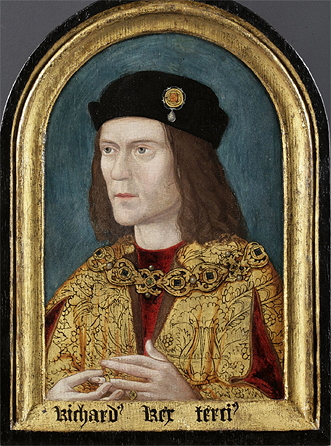 LEICESTER, ENGLAND—DNA tests have confirmed that the skeletal remains discovered beneath a parking lot last year are those of Richard III, the last English king to die in battle. It was known that Richard III was killed in 1485, during the Battle of Bosworth, and buried at the church of the Greyfriars. But the church was eventually torn down and the grave lost. The bones, which are of a slender man is his late 20s or early 30s, show that he suffered from scoliosis and potentially fatal injuries to the skull. They have been carbon-dated to between 1455 and 1540. “There is a DNA match between the maternal DNA of the descendants of the family of Richard III and the skeletal remains we found at the Greyfriars dig. In short, the DNA evidence points to these being the remains of Richard III,” explained Turi King, a geneticist for the University of Leicester project. “Beyond a reasonable doubt it’s Richard,” added lead archaeologist Richard Buckley. The remains will be reinterred in Leicester Cathedral.

#Não que você seja surdo ou tenha algum problema, mas você não ouve muito bem. Quando as pessoas falam você precisa olhar pra elas, quando telefonam você precisa pedir pra repetir, odeia ver filme dublado porque precisa ficar voltando. Mas ao mesmo tempo você não gosta de importunar. Acha chato dizer “como?”, não gosta de mandar um “desculpa?”, então você desenvolveu com o tempo um estilo de escuta passiva que consiste em apenas sorrir, as vezes até rir mesmo e dizer “ahhhh, claro” ou “ahaaaam”. Você usa isso com a chefe, mas depois pede confirmação por email, você usa isso com a namorada, quando sabe que ela tá irritada demais pra repetir o que falou, você usa isso com sua mãe, quando ela fala muito rápido, muito baixo e você sabe que o assunto não é importante. Aí um dia sua mãe bate na sua porta e diz que já comprou os ingressos pro show. Que show? Oswaldo Montenegro. Que ingressos? Vocês tinham combinado. Mas como? Pelo telefone. Quando foi isso? Semana passada, você disse “ahhh, claro”. Você respira fundo e pensa. Voa condor.
#Não que você não trabalhe ou seja preguiçoso, mas naquela hora você estava lendo tirinhas do Garfield minus Garfield na sua mesa quando te chamaram. Precisavam de alguém da comunicação, confundiram as comunicações, queriam chamar um gerente do corporativo, chamaram o moleque da gerência menor. Chega na sala, você de jeans, tênis, camisa social pra fora da calça e aquele mangão dobrado que diz “não ambiciono promoções”. Do outro lado chefão de comunicação, empresa multinacional, aquele cartão de visitas que indica gerente internacional de projetos de comunicação américa do sul e caraíbas. Nessa hora você nota que sua camisa tem mancha de molho, spolleto. O cara te olha fascinado, te chama de gerente de comunicação, diz que é um prazer de conhecer, fala que tá impressionado com o quão jovem você é. Te dá o cartão, pede o seu, você diz que não tem cartão, você se sente um flagelado da seca, ele acha que você é uma espécie de Steve Jobs moreno, não tem cartão porque é da geração google. O cara te adiciona na mailing list dele, te manda email todo mês, você não responde por vergonha. Alguém em algum lugar acha que você é um jovem executivo muito ocupado.
#Não que você não seja atencioso ou desconsidere as pessoas, mas você não tava prestando a menor atenção quando o taxista falou contigo. Mandou aquele protocolar “congonhas, por favor”, pegou o celular e já foi mandar mensagem pra namorada mesmo tendo acabado de se despedir. O taxista falou algo sobre esposa, algo sobre casa, algo sobre você ser muito novo, você apenas concordou, tava ali despejando o coração no sms e só palavras chave como “assalto”, “guarulhos” ou “você é da zoeira?” iriam te chamar a atenção num momento como aquele. Lá pelo meio da viagem você começou a prestar atenção mas ele já não tava mais interessado em conversar, tava concentrado no jogo. Você desceu tranqüilo, deu gorjeta, pegou mala, caiu fora. Um mês depois, mesmo lugar, mesmo táxi, mesmo taxista. Ele te pergunta se é pra Congonhas de novo, você diz que sim. Ele te pergunta se foi complicado se despedir da esposa e você fica confuso. Ele fala que continua achando sua casa muito bonita e você não sabe bem o que responder. Ele diz que deve ser foda pra um paulista ficar indo sempre pro rio e você explica que aquela é sua namorada, não sua esposa, aquela é a casa do seu sogro, não a sua, e você mora no rio, não em são paulo. Ele diz que não foi isso que você falou da última vez e você nota ele balbuciando “moleque mentiroso” e “maluco” durante todo o resto da viagem.
 É um pássaro?
É um avião…?
…é um pássaro.


Um casal de idosos se senta em um banco com vista para um parque cheio de neve. A mulher olha para o seu parceiro, de forma apaixonada, e ele devolve o olhar com um sorriso. A música do piano se sobressai, e eles voltam a observar o parque. Este é, obviamente, um anúncio de pornografia.
O PornHub decidiu exibir uma propaganda do seu site durante o Super Bowl – no entanto, eles foram vetados.
O Super Bowl é a final do campeonato de futebol americano, evento televisivo mais assistido dos EUA: no ano passado, foram 111,3 milhões de telespectadores – a maior audiência da história do país. Por isso, quem exibe propaganda durante o evento precisa pagar uma pequena fortuna: um comercial de 30 segundos custa, este ano, absurdos US$4 milhões.
Se o PornHub estava disposto a pagar tanto, por que seu comercial foi banido? Bem, não há qualquer conteúdo eXXXtremo no vídeo, é claro. O problema seria direcionar milhões e milhões de famílias felizes assistindo futebol americano para um site de pornografia hardcore com fluidos corporais voando logo na página inicial.
Ainda assim, o anúncio é bem bonitinho e encantadoramente subversivo. O Pornhub colocou uma enquete junto ao vídeo para saber o que os usuários acham: a propaganda deveria ser exibida na TV ou não? (Este link é SFW, apesar do endereço do site não ser.) Mas provavelmente o Pornhub já ganhou o dinheiro de volta com a exposição do caso. E nos deu a propaganda sobre pornografia mais adorável que já vimos.
Se o vídeo acima for removido do YouTube, você pode assisti-lo aqui: [Pornhub via BetaBeat]
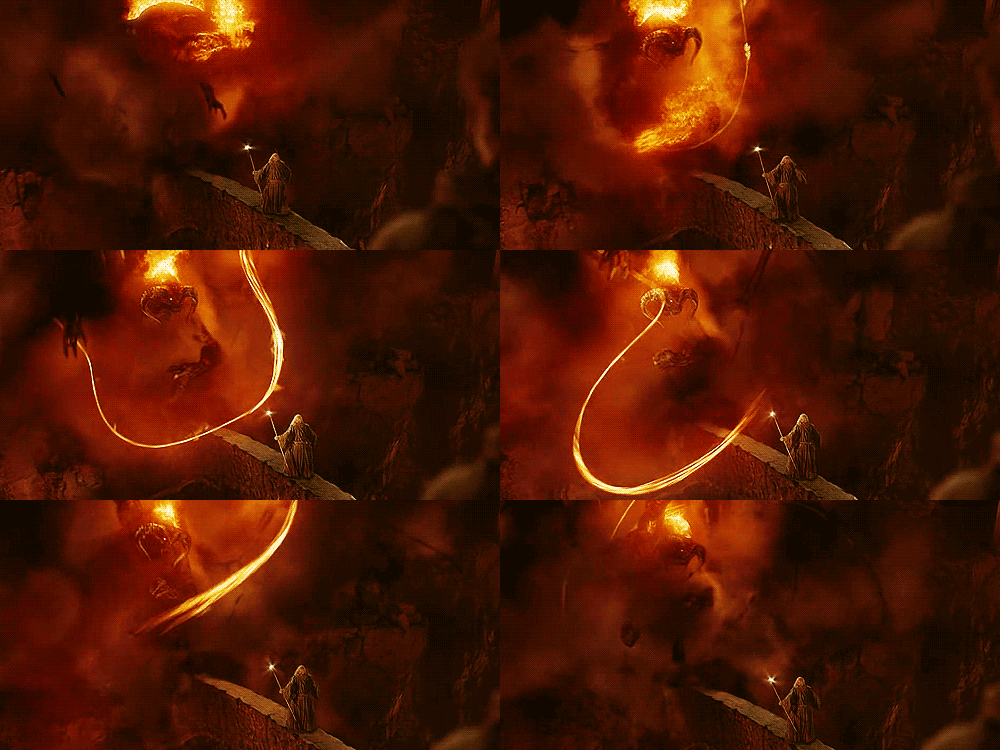
Remember that time Gandalf convinced the whole party to flee so that he could take out the Balrog and not have to share any of the XP? Shows up the next session with fancy new robes and everything. What a jerk.
porn gives young people an unrealistic and unhealthy idea of how quickly a plumber will come to your house

NPR’s “All Things Considered” did an amazing story last week about the rising popularity of Friends among 20-30 year olds in China. They are really into it, as quotes like “I learned a lot from Friends: how to treat friends, girlfriends, my wife, how to be generous, how to be gentle” and “Everyone calls me Gunther here” (the latter by a gentleman who turned a 6th-floor loft into a mini-replica of the show’s coffee shop, Central Perk) clearly demonstrate. So it should come as no surprise that enterprising Chinese executives are trying to jump on this trend by producing a six-part, online, Video On Demand sitcom based on the show.
The Hollywood Reporter has the story, which I have excerpted below. The title alone should earn the producers a dozen Whatever The Chinese VOD Version Of The Emmys Are awards.
Chinese audiences will soon get chance to see what a 21st century Chinese take on Friends looks like, when a six-part sitcom makes its debut on the country’s major internet portals before the traditional Lunar New Year holidays begins in earnest next month.
I must know more about this. Immediately. I must know everything there is to know about every single part of this. Why are they only making a six-part show if Friends is so huge? Why are they doing it online? Why is it important that it debuts before the Lunar New Year? Why did it take like 15 years for Friends to catch fire in China? Do they assume David Schwimmer is one of the five or ten biggest actors alive? Are girls all over China running to their hairdresser and demanding “the Rachel”? Are people on the street greeting other will a smile and a “How you doin’?”
This is an important story and I demand answers.
Boasting a theme song from The Rembrandt’s Danny Wilde – who wrote the now unforgettable “I’ll Be There For You” number that opened each episode of Friends – …
Chinese Executive: Hello, yes, is Danny Wilde of The Rembrants available?
Danny Wilde: Speaking.
Chinese Executive: Oh. Hi, Danny. I thought you’d have a secretary or something.
Danny Wilde: Nope. What can I do for you?
Chinese Executive: Well, I’m producing a Chinese version of Friends, and I was wondering if you’d be willing t-…
Danny Wilde: I’M IN!
… the new show, Planet Homebuddies…
On my patented Things That Make Me So Happy I Might Just Explode Everywhere scale, the fact that the Chinese version of Friends is called Planet Homebuddies checks in at about an 8 or 9.
NOTE: The Things That Make Me So Happy I Might Just Explode Everywhere scale only goes up to 5.
… revolves around the lives and loves of six middle-class urban Chinese characters who live together in one big loft, counting among them a failed advertising executive, an IT specialist, a DJ and an art curator.
Look, I know the odds are pretty high that the DJ is going to be their version of Joey because that seems like the best employment fit for an idiot lothario, but seriously, how great would it be if it was Chandler?
Chinese Version Of Chandler: Could this beat be any sicker? [gets back together with Janice for some jackass reason]
“We noticed that working around the clock on weekdays and hanging out with friends on weekends is how most of today’s youth in China live their lives, with more and more adopting a ‘homebody’ lifestyle. Our new series will serve as the voice of today’s 20 to 30-year-old set in China, and examine this emerging trend.”
If you’re looking for a pretty simple, straightforward explanation for why and how China is kicking the world’s tail right now, the fact that they think a “homebody” is someone who spends a little time with friends after “working around the clock on weekdays” would be a decent place to start.
But anyway, this show is clearly going to be a huge success, which brings up an important question: Are there other Chinese versions of American shows in the pipeline? Please say yes.
The company is in the process of finishing Chinese Girl, a localized version of US TV series Gossip Girl starring Mini Yang, one of the country’s most prominent young actresses.
I am moving to China when they get to The O.C.
The post The Chinese Version Of ‘Friends’ Premieres Next Month And Is Called ‘Planet Homebuddies’ appeared first on UPROXX.
Rough Beasts: The Zanesville Zoo Massacre, One Year Later, by Charles Siebert. Published by Byliner. $2.99. Available on Kindle, Nook, iPad, and Byliner.com.
By Seth Mnookin
On October
18, 2011, a 62-year-old, recently released convict named Terry Thompson freed
eighteen tigers, seventeen lions, six black bears, and fifteen other
"exotic animals" from a jumble of cages and pens on his 73-acre farm
in Zanesville, Ohio. What happened next is not exactly clear, but it appears
that Thompson pulled down his pants, smeared his crotch with chicken blood and
viscera, and shot himself in the mouth with a .357 magnum. By the time
authorities were able to recover his body, Thompson's genitalia had been eaten
away; one or more of the animals had also gnawed on Thompson's head.
That those are some of the least remarkable details from the events that transpired that rainy October night should tell you something about the ensuing insanity. The first hint that something was wrong came around 5pm, when a neighbor named Sam Kopchak noticed a bear chasing some of Thompson's horses through a field; seconds later, Kopchak realized he was several feet away from a male African lion, who watched intently as Kopchak anxiously led one of his own horses to safety. By that point, there was barely an hour of daylight left before sunset -- and Thompson's farm was within a few miles of a nursing home, a gas station, a motel, and, most ominously, a school, which, at the time, happened to be hosting a children's soccer game on a playing field surrounded by woods.
That no humans beside Thompson died that day -- that none were even seriously injured -- is due in no small part to the work of the local sheriff's department, which hunted Thompson's menagerie through the night. Some of the beasts were killed as they wandered near I-70, which overlooked Thompson's property (one, a grey wolf, died after being hit by a car); others were shot close to what had been their homes. By the next morning, the tally of the dead included all of the animals listed above, along with three mountain lions, two grizzly bears, two wolves, and a baboon. The death toll was memorialized in a gruesome, apocalyptic photograph of the creatures laid out near Thompson's driveway: It was only by collecting the corpses that officials had any hope of keeping track of what was still roaming free. Even then, officials were relying on the memories of John Moore, who had been the animals' caretaker, and Thompson's estranged wife, Marian: At the time, Ohio, along with seven other states, did not require exotic animals to be licensed or registered in any way.
The Zanesville massacre, as it became known, was the type of story that magazine writers dream about: A lurid freakshow with enough legitimate news value to add a solemn gloss to a lengthy, nerve-jangling narrative. (I briefly considered trying to write about it myself; when I realized I wouldn't be able to, I suggested to one of my students in MIT's Graduate Program in Science Writing that he focus his semester-long feature assignment on unregulated private zoos.) And sure enough, last February, GQ's Chris Heath and Esquire's Chris Jones published 10,000-plus word features on Zanesville (the stories ran in the magazines' March issues); Esquire was so excited about its piece that it put together an online video "trailer," which it released during halftime of the Super Bowl.
Both stories are quite good. To be sure, they cover much of the same ground: Each begins with a tick-tock of the moments just after Kopchak realized he was at risk of being attacked by a 400-plus pound predator, and each relies heavily on interviews with the sheriff's deputies involved in the hunt. The fact that there's enough that's unique in the two offerings to make both worthwhile reads raised the bar considerably for anyone trying to do another in-depth story on Zanesville.
That’s a bar that Charles Siebert doesn't manage to clear with Rough Beasts, a Byliner original that is both longer and less satisfying than either Heath's or Jones's articles. Early on, Siebert promises readers his work will provide new insights into Thompson: "In the year since the gunshots and the media blare, however, a clearer picture has begun to emerge of why Terry Thompson would go to such lengths to scuttle an ark that he and Marian had worked so long and hard to build together."
But the Thompson that Siebert portrays isn’t all that different from the picture of him that had already emerged – and unfortunately, he’s not all that compelling a character. Perhaps that is why Siebert includes scooplets that appear to be based more on speculation than on solid reporting: In one section, he uses the fact that Thompson "entered and left the Army a private second class," that he wasn't highly decorated, and that one of his commanding officers didn't remember him to accuse Thompson of fabricating his claims of being involved in secret rescue missions in Laos and Cambodia. That is almost certainly true, but the scant facts Siebert offers up don't rise to the level of a conditional proof; they certainly don't justify Siebert's claim that for Thompson "the added albatross of a made-up war-hero past" contributed to the "irresistible allure" of owning lions and tigers.
These type of sweeping claims and overreaching statements crop up again and again: "Many exotic animal owners actually think of themselves as misunderstood conservationists"; October 18, 2011 was "the day the world's remaining wildness seemingly died in Zanesville, Ohio"; Thompson's compound is "the world's largest and wackiest home petting zoo" and home to perhaps "the strangest interspecies domestic dance in history." (For my money, the estate of Jorge Hank Rhon, the former mayor of Tijuana, which is estimated to house 20,000 animals, including miniature monkeys who are made to ride dogs like jockeys, is just a tad stranger.)
Rough Beasts is also marred by florid constructions and confusing explanations. At one point, Thompson is described as an "entirely legal free radical." (You mean the cops didn't arrest him for walking around with unpaired electrons?) In another, Siebert describes Terry and Marian Thompson's relationship thusly:
There seems to have been something of a Stella DuBois-Stanley Kowalski dynamic to their bond. A petite blond beauty in the Farrah Fawcett mold, Marian— whose older sister, Christina, lived for many years in New York City and had a long-term relationship with bestselling novelist James Patterson— seemed to love, to paraphrase Kowalski, “being taken down off the fancy columns” of her own upbringing by Zanesville’s swashbuckling, grease-monkey speedster. ... At fairs and flying exhibitions and holiday gatherings, they were the veritable Doctor Dolittle duo of Muskingum County.
Never mind that run-on sentence. Put aside the fact that Siebert assumes all of his readers will know that Stella and Stanley are two of the main characters in Tennessee Williams’ A Streetcar Named Desire. Ignore, for a moment, that Fawcett, at 5' 6½", was two-and-a-half inches taller than the average American woman. Is the take-away supposed to be that that Terry and Marian were protagonists in a publicly unfolding, psycho-sexual melodrama or that they were the embodiment of an affable, animal-loving star of a children’s storybook? Because I'm pretty sure it can't be both.
Perhaps the strangest thing about Rough Beasts is that Siebert’s “clearer picture” doesn’t include the single biggest change to result from the Zanesville massacre. In writing about how easy it is to acquire all manner of wildlife, Siebert describes Ohio as "one of eight states with no laws restricting the breeding, selling, and owning of exotics." That was true in 2011; however, last June, Governor John Kasich signed the Dangerous Animals and Restricted Snakes Act, which bars the ownership of the large cats and bears that comprised the majority of Thompson's collection. The law, which was recently upheld by a federal court, also mandates liability insurance for any animals already in the state, and requires that they be registered, get implanted with microchips, and receive specified standards of care. Surely this deserved more than the single, glancing mention Siebert affords it.
If Rough Beasts is so unsatisfying, one might ask, why bother spending 1,500 words discussing it? It’s a fair question. The answer is that, even after GQ’s and Esquire’s tomes, there are interesting and important questions stemming from Zanesville that have yet to be answered. What does the fact that there are more tigers living in captivity in the US than there are living in the wild in the rest of the world mean for the future of the species? Is there any scenario in which individual owners of endangered animals can play a positive role in their future? What are the consequences and implications of the fact that many captive animals are interbred willy-nilly? (Thompson's tigers were not Bengals, as was reported at the time; one anti-exotic pet activist referred to as mixed breed "fourth-generation Buckeye tigers.")
The best long-form journalism takes advantage of eye-catching events to introduce challenging and important questions to readers. Siebert, who has written about animal cruelty, elephant anxiety, efforts to save abandoned dogs, and “the animal self” for The New York Times Magazine, would seem to be a prime candidate to address these issues. But the Times apparently passed on the story – in his acknowledgements, Siebert thanks one of the Magazine’s editors for “the first read, way back when” – and Rough Beasts, like a frustrating number of science ebooks on important and worthwhile topics, isn't up to the standards we'd expect out of print publication.
Seth Mnookin is the co-director of MIT's Graduate Program in Science Writing and a blogger at the Public Library of Science. His most recent book, The Panic Virus: The Truth Story Behind the Vaccine-Autism Controversy, won the 2012 National Association of Science Writers Science in Society Award. Follow him on Twitter.

Os dogons, um dos povos não-islâmicos que habitam o Mali
Os fundamentalistas são brutais. Mas o que os bombardeios ressaltam é incapacidade das “democracias” contemporâneas em lidar com o Outro
Por Glen Greenwald | Tradução: Gabriela Leite
Enquanto os aviões de guerra franceses bombardeiam Mali, uma estatística simples fornece o contexto-chave: essa nação africana ocidental de 15 milhões de habitantes é o oitavo país em que as potências ocidentais — apenas nos últimos quatro anos — estão bombardeando e matando muçulmanos, desde o Iraque, Afeganistão, Paquistão, Iêmem, Líbia, Somália e as Filipinas (sem contar as numerosas tiranias letais sustentadas pelo Ocidente nessa região). Por razões óbvias, a retórica de que o Ocidente não está em guerra com o mundo islâmico soa cada vez mais falsa com cada nova expansão desse militarismo. Mas nessa campanha maciça de bombardeio, vê-se que as lições mais importantes sobre a intervenção ocidental são persistentemente ignoradas.
Primeiro: como deixa claro um texto do New York Times publicado hoje, grande parte da instabilidade de Mali é resultado direto da intervenção da OTAN na Líbia. Especificamente, “combatentes islâmicos fortemente armados, audazes, voltaram do combate da Líbia” e “o armamento considerável, proveniente da Líbia e os diferentes combatentes islâmicos que voltaram” causaram o colapso do governo central, apoiado pelos EUA. Como escreveu essa manhã Owen Jones, em uma excelente coluna no Independent:
“Essa intervenção é em si a consequência de outra. A guerra da Líbia é frequentemente exaltada como um êxito do intervencionismo liberal. Mas a derrubada da ditadora de Muamar Gadafi teve consequências que provavelmente os serviços de inteligência ocidentais nunca se preocuparam em imaginar. Os tuaregues — que tradicionalmente vinham do norte do Mali — compunham uma grande parte de seu exército. Quando Gadafi foi deposto do poder, volveram a sua pátria. Às vezes à força, já que a Líbia pós-Gadafi atacava os africanos neutros, um feito embaraçoso que foi ignorado em grande parte pelos meios ocidentais. A guerra da Líbia foi considerada um êxito… e aqui estamos enfrentando essa catastrófica consequência”.
Uma hora ou outra, uma intervenção ocidental acaba semeando — por inaptidão ou intencionalmente — as sementes de outra intervenção. Em vista da instabilidade completa que continua afetando a Líbia, assim como a duradoura indignação por causa do ataque contra a embaixada dos EUA em Bengasi, quanto tempo vamos ouvir que os bombardeios e invasões nesse país são — novamente — necessários para combater as forças “islâmicas” que tomaram o poder do país: forças articuladas como resultado da derrubada pela OTAN do governo desse país?
Segundo: a derrubada do governo mali tornou-se possível graças a desertores treinados e armados pelos EUA. Segundo o New York Times: “comandantes das unidades de elite do exército dessa nação, fruto de anos de cuidadoso treinamento estadunidense, desertaram quando eram mais necessários, levando suas armas, caminhões e novas habilidades para o inimigo, no entusiasmo da guerra, segundo altos oficiais malis.” E também: “um oficial treinado pelos EUA depôs o governo eleito de Mali, preparando a cena para que mais da metade do país caísse nas mãos dos extremistas islâmicos”.
Em outras palavras, o Ocidente volta à guerra contra as forças que treinou, financiou e armou. Ninguém supera os EUA e seus aliados na criação de seus próprios inimigos, assegurando assim uma situação de guerra interminável. Onde os EUA não encontram inimigos para combater, eles simplesmente os criam.
Terceiro: o bombardeio ocidental de muçulmanos em mais um país provocará evidentemente ainda mais o sentimento anti-ocidental, o alimento do terrorismo. Como informa o Guardian, os jatos de caça franceses já mataram “pelo menos 11 civis, incluindo três crianças”. A longa história da colonização francesa no Mali só exacerba a indignação inevitável.
Em dezembro, depois de o Conselho de Segurança da ONU autorizar a intervenção no Mali, o investigador da Anistía Internacional no país, Salvatore Saguès, advertiu: “É provável que uma intervenção armada internacional aumente a escala de violações dos direitos humanos que já vemos nesse conflito”.
Como sempre, os governos ocidentais conhecem perfeitamente as consequências e procedem apesar de tudo. O NYT assinala que a campanha de bombardeio francesa aconteceu “apesar das advertências estadunidenses de que um ataque ocidental ao bastião islâmico poderia mobilizar jihadistas de todo o mundo e provocar ataques terroristas até em lugares tão distantes quanto a Europa”. Ao mesmo tempo que os franceses estão matando civis em Mali, um ataque conjunto franco-estadunidense na Somália causou as mortes de “pelo menos oito civis, incluindo duas mulheres e duas crianças”.
Crer que os EUA e seus aliados podem simplesmente seguir, de país em país, bombardeando e matando gente inocente — muçulmanos — e não serem alvos de ataques “terroristas” é, por razões óbvias, demente. Como disse Jones, o professor da Universidade Bradford Paul Rogers, o bombardeio de Mali “será visto como ‘mais um exemplo de ataque contra o Islã’”. Qualquer esperança que possa existir de acabar com a “guerra contra o terror” é destruída sistematicamente pelas contínuas agressões.
Quarto: apesar de toda a retórica auto-exaltadora que as democracias ocidentais têm o prazer de construir, é extraordinário como estas guerras são travadas sem nenhuma pretensão de um processo democrático. Sobre a participação do governo britânico no ataque militar ao Mali, Jones assinala que “é inquietante — pra dizer o mínimo — a forma com que o primeiro-ministro Cameron levou a Grã-Bretanha ao conflito de Mali sem se incomodar sequer em fingir uma consulta”. Do mesmo modo, o Washington Post dessa manhã informou que o Presidente Obama reconheceu depois do acontecido que os jatos de combate estadunidenses entraram no espaço aéreo somáli como parte da operação francesa nesse país; o jornal tratou isso de “uma rara declaração pública de operações de combate estadunidenses no Chifre da África” e descreveu o segredo anti-democrático que geralmente rodeia as ações bélicas dos EUA na região:
“Os militares dos EUA instalaram um número crescente de drones Predator, assim como jatos de combate F-15 em Camp Lemonnier, que chegou a ser uma instalação-chave das operações secretas anti-terror na Somália e no Iêmem. O funcionário da defesa negou-se a identificar os aviões utilizados na tentativa de resgate, mas disse que foram aviões de combate tripulados, não drones.
“Não ficou claro, contudo, por que Obama sentiu-se obrigado a revelar essa operação em particular, quando tem mantido silêncio sobre outras missões específicas de combate dos EUA na Somália. Domingo à noite (13/1), os porta-vozes da Casa Branca e do Pentágono negaram-se a entrar em detalhes ou responder perguntas”.
O governo de Obama envolveu toda a campanha de drones e assassinatos globais em um manto impenetrável de segredo, assegurando-se de que se mantenha além do alcance curioso da imprensa, dos tribunais e de seus próprios cidadãos. Os EUA e seus aliados ocidentais não somente travam uma guerra interminável, que aponta invariavelmente aos muçulmanos, mas também o fazem em um segredo praticamente total, sem nenhuma transparência nem prestação de contas. Um exemplo da “democracia” ocidental.
Finalmente, a propaganda utilizada para justificar tudo isso é miseravelmente comum, mas terrivelmente efetiva. Qualquer governo ocidental que queira bombardear muçulmanos simplesmente coloca-lhes a etiqueta de “terroristas” e todo debate real ou avaliação crítica acaba antes de começar. “O presidente está totalmente convencido de que devemos erradicar esses terroristas que ameaçam a segurança de Mali, se nosso próprio país e da Europa”, proclamou o ministro da Defesa francês Jean-Yves Le Drian.
Como de costume, o roteiro simplista e caricaturesco deforma a realidade mais do que a descreve. Não há dúvidas que os rebeldes do Mali realizaram todo tipo de abomináveis atrocidades (“amputações, apedrejamentos e chicoteamentos dos que se opõem a sua interpretação do Islã”) masas forças governamentais do Mali fizeram o mesmo, incluindo, como assinalou Anistía Internacional, a detenção, tortura e matança de tuaregues, ao que parece apenas pelo sua natureza étnica. Como adverte acertadamente Jones: “não se deixem enganar por uma narrativa tão frequentemente imposta pela mídia ocidental: uma perversa simplificação do bem combatendo o mal, como temos visto no caso da brutal guerra civil da Síria”.
É possível que o bombardeio do Mali pelos franceses envolva algum tipo de participação dos EUA, e assim ilustra-se cada lição de intervenção ocidental. A “guerra contra o terror” autoperpetua-se precisamente porque gera de modo interminável seus próprios inimigos e fornece o combustível para garantir que o fogo continue sem fim. Mas a propaganda baseada em slogans utilizada para justificá-la é tão barata e fácil — devemos matar os terroristas! — que é difícil ver quando vai acabar. O medo que cega — não apenas da violência, mas do Outro — implantou-se com êxito nas mentes de muitos cidadãos ocidentais. É tão forte que essa única e vazia palavra (terroristas) basta para gerar um apoio incondicional a qualquer coisa que os governos façam em seu nome, não importa quão secreta e opaca ela seja.
–
Glenn Greenwald é advogado constitucionalista norte-americano, colunista, blogueiro e escritor. Trabalhou como advogado especializado em direitos civis e constitucionais, antes de se converter em colaborador de Salon.com , onde concentra-se na análise de temas políticos e jurídicos. Também colaborou em outros jornais e revistas de informação política, como New York Times, Los Angeles Times, The Guardian, The American Conservative, The National Interest e In These Times. Em agosto de 2012, deixou Salon para colaborar em The Guardian.
“Assault weapons will remain readily available to crazy people until the powerful pro-gun forces … accept responsibility, recognizing that responsibility is not the same as culpability.”
 More than merely resurfacing the discourse on gun control, the recent tragedy in Newtown illustrated the futile ebb-and-flow of these debates as school shooting after school shooting shakes the nation yet fails to bubble up into actionable government policy. So argues Stephen King in Guns — a short Kindle e-book in which the celebrated novelist brings his uncompromising lens, at once passionate and rationally composed, to the issue of gun violence in America. He argues that while the mere presence of guns may not be a direct cause of violence, access to them in a formidable enabler of existing problems and pathologies in perpetrators who might not otherwise resort to outward violence, harming many.
He begins:
Here’s how it shakes out.
First there’s the shooting. Few of the trigger-pullers are middle-aged, and practically none are old. Some are young men; many are just boys. The Jonesboro, Arkansas, school shooters were 13 and 11.
Second, the initial TV news reports, accompanied by flourishes of music and dramatic BREAKING NEWS logos at the bottom of your screen. No one really knows what the fuck is going on, but it’s exciting. You get your still photo of the location; you get your map from Google or Bing. The cable news producers are busting their asses, trying to get some local news reporter on the phone.
[…]
Twentieth, there’s a killer tornado in Louisiana, or an outbreak of hostilities in the Mideast, or a celebrity dead of a drug overdose. Out comes the dramatic music and the BREAKING NEWS chyrons. The shooting is relegated to second place. Pretty soon it’s in third place. Then it’s a squib behind that day’s funny YouTube video.
Twenty-first, any bills to change existing gun laws, including those that make it possible for almost anyone in America to purchase a high-capacity assault weapon, quietly disappear into the legislative swamp.
Twenty-second, it happens again and the whole thing starts over.
That’s how it shakes out.

King cites the case of his early novel Rage, published under the pseudonym Richard Bachman, which resurfaced in the late 1980s and 1990s in four separate incidents of mass shootings, both attempted and actual, by teenagers who had read and seemingly imitated the novel. Even though by the time of the fourth incident in 1997 the book was already part of an omnibus, King insisted it be pulled by the publisher. While his argument bears a faint hue of apologism (one can only imagine the cognitive dissonance that comes with a situation like this), King makes a lucid case for the triggers of violence, be those guns or novels, as precisely that — triggers — rather than singular causes:
These were unhappy boys with deep psychological problems, boys who were bullied at school and bruised at home by parental neglect or outright abuse. They seem to have been operating in a dream, two of them verbally asking themselves afterward why they did what they did.
[…]
My book did not break [them] or turn them into killers; they found something in my book that spoke to them because they were already broken. Yet I did see Rage as a possible accelerant, which is why I pulled it from sale. You don’t leave a can of gasoline where a boy with firebug tendencies can lay hands on it.
Nevertheless, I pulled it with real regret. Not because it was great literature — with the possible exception of Arthur Rimbaud, teenagers rarely pen great literature — but because it contained a nasty glowing center of truth that was more accessible to me as an adolescent.
King goes on to argue how profoundly our adolescent experience shapes us, something science has corroborated:
Adults do not forget the horrors and shamings of their childhood, but those feelings tend to lose their immediacy (except perhaps in dreams, where even old men and women find themselves taking tests they have not studied for with no clothes on). The violent actions and emotions portrayed in Rage were drawn directly from the high school life I was living five days a week, nine months of the year. The book told unpleasant truths, and anyone who doesn’t feel a qualm of regret at throwing a blanket over the truth is an asshole with no conscience.
As far as I’m concerned, high school sucked when I went, and probably sucks now. I tend to regard people who remember it as the best four years of their lives with caution and a degree of pity. For most kids, it’s a time of doubt, stress, painful self-consciousness, and unhappiness. They’re actually the lucky ones. For the bullied underclass — the wimps, the shrimps, and the girls who are routinely referred to as scags, bags, or hos — it’s four years of misery and two kinds of hate: the kind you feel for yourself and the kind you feel for the jackwads who bump you in the halls, pull down your shorts in gym class, and pick out some charming nickname like Queerboy or Frogface that sticks to you like glue.

In likening the current state of American political dialogue, including the debate on gun control, to “drunks in a barroom,” King argues the solution lies in the bursting of the “filter bubble”:
If I could wave a magic wand and have one wish granted, I’d wish for an end to world hunger; the small shit could wait in line. If, however, the god or genie who bestowed the magic wand told me my one wish had to do with American politics, I think I’d wave it and make the following proclamation: ‘Every liberal in the country must watch Fox News for one year, and every conservative in the country must watch MSNBC for one year.’ (Middle-of-the-roaders could stick with CSI.)
Can you imagine what that would be like? For the first month, the screams of ‘What IS this shit???’ would echo high to the heavens. For the next three, there would be a period of grumbling readjustment as both sides of the political spectrum realized that, loathsome politics aside, they were still getting the weather, the sports scores, the hard news, and the Geico Gecko. During the next four months, viewers might begin seeing different anchors and commentators, as each news network’s fringe bellowers attracted increasing flak from their new captive audiences. Adamantly shrill editorial stances would begin to modify as a result of tweets and emails saying, ‘Oh, wait a minute, Slick, that’s fucking ridiculous.’ Finally, the viewers themselves might change. Not a lot; just a slide-step or two away from the kumbayah socialists of the left and the Tea Partiers of the right. I’m not saying they’d re-colonize the all-but-deserted middle (lot of cheap real estate there, my brothers and sisters), but they might close in on it a trifle.
[…]
Think of the quiet that might ensue if all that shrill rhetoric were turned down a few notches! Think of the dinner table arguments that might not happen! There might even be (o lost and shining city) a resumption of actual dialogue.
In trying to peer past the us-vs-them rhetoric of the gun control debate, King speaks to the cluster of contradictions inherent to each of us:
When I think of the politically conservative gun enthusiasts who are opposed to any form of gun control, no matter how many innocents die in acts of gun violence, I remember something a Democratic member of the House of Representatives is reputed to have said about Gerald Ford: ‘If he saw a hungry child as he walked to work, he would give that child his bag lunch without hesitation, then go ahead and vote against school lunch subsidies without ever seeing the contradiction.’
Most anti-control firearms enthusiasts have similarly split personalities, and the slogan you sometimes see pasted to the bumpers of their station wagons, campers, and SUVs — YOU WILL TAKE MY GUN WHEN YOU PRY IT FROM MY COLD DEAD HANDS — does not make them bad people. It only makes them walking contradictions, and which of us does not have a few contradictions in our personalities? Most Americans who insist upon their right to own as many guns (and of as many types) as they want see themselves as independent folk who stand on their own two feet; they may send food or clothes to the victims of a natural disaster, but they sure-God don’t want charity themselves. They are, by and large, decent citizens who help their neighbors, do volunteer work in the community, and would not hesitate to stop and help a stranger broke down by the side of the road.

The only assertion I find worrisome is the bombastic certainty with which King dismisses how the “culture of violence” dominating the media, especially entertainment media aimed at young people, affects the development of the human psyche — not so much because I happen to have logged considerable academic hours studying developmental psychology in my own ancient past and remember well Bandura’s famous behavior modeling studies of violence, but mostly because sandwiched in King’s questionably substantiated contention is an outright affront to the general public’s capacity for intellectual stimulation:
The assertion that Americans love violence and bathe in it daily is a self-serving lie promulgated by fundamentalist religious types and America’s propaganda-savvy gun-pimps. It’s believed by people who don’t read novels, play video games, or go to many movies. People actually in touch with the culture understand that what Americans really want (besides knowing all about Princess Kate’s pregnancy) is The Lion King on Broadway, a foul-talking stuffed toy named Ted at the movies, Two and a Half Men on TV, Words with Friends on their iPads, and Fifty Shades of Grey on their Kindles. To claim that America’s ‘culture of violence’ is responsible for school shootings is tantamount to cigarette company executives declaring that environmental pollution is the chief cause of lung cancer.
What a tragic conception of culture, if we were to subscribe to the binary choice between violence and intellectually vacant entertainment. Let’s instead stay with David Foster Wallace, who reminded us that “what we need…is seriously engaged art that can teach us again that we’re smart” and embrace E. B. White’s conviction that the role of the media is “to lift people up, not lower them down.”

Ultimately, King returns to the ethics and rationale behind his decision to revoke Rage, echoing Anaïs Nin on character and responsibility:
I didn’t pull Rage from publication because the law demanded it; I was protected under the First Amendment, and the law couldn’t demand it. I pulled it because in my judgment it might be hurting people, and that made it the responsible thing to do. Assault weapons will remain readily available to crazy people until the powerful pro-gun forces in this country decide to do a similar turnaround. They must accept responsibility, recognizing that responsibility is not the same as culpability. They need to say, ‘We support these measures not because the law demands we support them, but because it’s the sensible thing.’
Until that happens, shooting sprees will continue. We will see the BREAKING NEWS chyrons, the blurry cellphone videos of running people, the tearful relatives, the rolling hearses. We will also see, time and time and time again, how easy it is for the crazies among us to get their hands on portable and efficient weapons of mass destruction.
Because, boys and girls, that’s how it shakes out.
Guns comes as a kind of follow-up to King’s 2008 op-ed on video game violence and, at just $0.99, is well worth a read.
Public domain photographs via Flickr Commons
Donating = Loving
Bringing you (ad-free) Brain Pickings takes hundreds of hours each month. If you find any joy and stimulation here, please consider becoming a Supporting Member with a recurring monthly donation of your choosing, between a cup of tea and a good dinner:
| ♥ $10 / month♥ $3 / month♥ $25 / month♥ $50 / month♥ $100 / month |
You can also become a one-time patron with a single donation in any amount:
Brain Pickings has a free weekly newsletter and people say it’s cool. It comes out on Sundays and offers the week’s best articles. Here’s what to expect. Like? Sign up.
Brain Pickings takes 450+ hours a month to curate and edit across the different platforms, and remains banner-free. If it brings you any joy and inspiration, please consider a modest donation – it lets me know I'm doing something right.
Era a segunda rodada do mais recente torneio de Magic do qual participei e fui campeão. A loja onde jogo tem uma feature table, onde os funcionários de lá ficam e que tem um computador onde os registros das partidas são mantidos. Eu estava jogando nesta mesa onde o Derek, juiz do torneio e que é meu amigo pessoal, também jogava. Eu enfrentava o Nick, um dos funcionários da loja.
O Derek derrotou seu oponente, que era um guri novo na Comic Swap. Eles tiveram um small talk depois, onde o piá falou que estava no Delta Program. Naquela hora, Derek e eu não sabíamos o que era este tal Delta Program. O Nick nos explicou, dizendo que era um programa de ensino para “special students”. Minha reação na hora foi perguntar “special students as in retarded students?”, mas fiquei quieto.
Depois que o guri novo saiu da mesa, perguntei pro Nick o que ele queria dizer com “special students”. Ele me explicou que era estudantes acima da média, inteligentes mesmo, e não especial no sentido de excepcionais.
Leia também:


Meet Eldritch Starlight, my first custom My Little Pony!
This was made as a gift for a friend. G4 Pony “Sunny Rays”, plastic-bond epoxy putty, acrylic paint.
I am DEFINITELY going to make more customized ponies once I get my hands on some older-gen toys.
This is amazing!
___É fácil pensar em si mesmo como exceção, imaginar que você está imune a certas coisas. Certa manhã, você liga o seu computador, entra no facebook e vê que um dos seus contatos, alguém por quem você já teve muito carinho, compartilha algo assim.

###
___Antes que perguntem minha reação, aqui vai.
___A princípio, fiquei simplesmente triste, mas não abri minha boca (cabeça quente não ajuda). Em seguida, compartilhei alguns links (talvez um reflexo do meu gosto por ser professor). Depois disso? A vida segue.
“When we hook up with another, in sex or love (or, more rarely, both) we prove that our isolation is not permanent. In the fullness of time, we may all be linked.”
 Whenever we talk about the origins of sex and its cultural baggage, we’re inevitably talking about human sex. And yet our planet has a salacious record dating much further back than the solipsism of our species might suggest.
In Death & Sex (UK; public library) — a curious two-in-one volume with one half comprising Death by NYU biologist Tyler Volk and the other, printed upside-down and back to front, Sex by science writer Dorion Sagan, son of Carl Sagan — Sagan takes us back to the very first ejaculation in recorded history:
The oldest ejaculation in the fossil record occurs in the Devonian, 408 to 363 million years ago. The paleological preservation of the salacious scene is reminiscent of the erotic frescoes of erotic paintings preserved at the village of Mount Pompeii by the volcano Vesuvius. Long before humanity, the earliest preserved ejaculation took place among a member of the Rhyniophyta, a phylum that contains the first land plants, which began to diversify some four hundred million years ago. The act was caught in flagrante delicto by chert, fine crystalline quartz with an uncanny ability to preserve fossils. Algaophyton major is one of the most common plants in the volcanically preserved Rhynie Chert, named for the nearby village of Rhynie in Aberdeenshire, Scotland. Early in the colonization of land by plants, and before the evolution of true leaves, the fast-setting minerals preserved a host of petrified plant, fungal, lichen, and animal specimens. (Animals evolved earlier but came to land after plants.)
Since sex usually occurs in water, it doesn’t tend to preserve well. But in one four-hundred-million-year-old silica-rich deposit local changes in pH remobilized some of the silica, leaving behind thin films of the original organic material. In the specimen the chert beautifully preserved the plant’s delicate archegonium (from goni, Hindi for ‘sack,’ akin to yoni, Sanskrit for ‘vagina’) — the female sex organ. Another sample of rock, sliced thin and observed with a microscope, shows Aglaphyton’s antheridium, its male sex organ — filled with sperm cells ready to explode. Here, preserved by chance, with neither compromised actors nor moral qualm, is a geographic equivalent of the ‘money shot’ of pornographic films — an ejaculation event 140,000 times older than Homer’s Odyssey, 400 times older than the human species, and almost as old as the appearance of animals in the fossil record.

Detailed preservation of sperm ejection from sporangia in the Rhynie Chert fossil
And yet that primordial canoodling came at a price: The awareness that, as Leslie Paul wrote in 1944, “all life is no more than a match struck in the dark and blown out again,” which makes the wax-and-wane dance of life unsettlingly palpable as we come to grips with the notion that, to use Henry Miller’s words, “to escape death is to escape life.” And yet, like in the afterlife of a whale, there’s a strange serenity in that awareness. Sagan writes:
The sexual reproductive cycles that got swinging not even a billion years ago, brought with them a frightening complementary motion, the switching from side to side of the Grim Reaper’s scythe. With meiosis came mortality because going back to sperm and eggs eventually meant discarding those trillions of somatic cells that, although having brilliantly served their purpose, were not directly represented in evolution. And with reproductive sex came programmed cell and differentiated body death, because evolutionarily our bodies are husks, biodegradable reserves of valuable bioelements that belong to the ecosystem and must be returned, like overdue books, after performing their natural duty of keeping going the larger energetic process. Personally, as intelligent animals, we identify as individual bodies. Although easier said than done, the mystics advocate a larger view in which we identify with the cycles of natural energy-transforming forms, as well as release from such cycles, which they call nirvana. Creeping behind the bright prospect of Mesozoic ginkgo-sniffing reptiles, primeval ejaculators, and the first fragrant flowers was that dark figure, the inevitability of their demise. A melancholy note was struck in the cosmic love machine.
But Sagan ends on a note of rational optimism, equal parts soulful and scientific, poetic and pragmatic — a poignant addition to history’s most beautiful definitions of love:
A Tibetan mystic saying goes: We are here to realize the illusion of our separateness. The spiritual sentiment has a biological cognate. Our xenotropic drive — to merge with what is not us, temporarily in sex, or permanently in symbiosis or cross-species hybrids — is more than a metaphor. But it also offers spiritual solace. When we hook up with another, in sex or love (or, more rarely, both) we prove that our isolation is not permanent. In the fullness of time, we may all be linked. In the meantime, eros brings us together, making us more than we are alone. Cupid’s arrow, quivering into the heart of loneliness, kills us even as it sets us free.
Death & Sex is remarkable — fascinating, absorbing, often stimulatingly uncomfortable — in its entirety. Complement it with The Origins of Sex, one of the best history books of 2012.
Donating = Loving
Bringing you (ad-free) Brain Pickings takes hundreds of hours each month. If you find any joy and stimulation here, please consider becoming a Supporting Member with a recurring monthly donation of your choosing, between a cup of tea and a good dinner:
| ♥ $10 / month♥ $3 / month♥ $25 / month♥ $50 / month♥ $100 / month |
You can also become a one-time patron with a single donation in any amount:
Brain Pickings has a free weekly newsletter and people say it’s cool. It comes out on Sundays and offers the week’s best articles. Here’s what to expect. Like? Sign up.
Brain Pickings takes 450+ hours a month to curate and edit across the different platforms, and remains banner-free. If it brings you any joy and inspiration, please consider a modest donation – it lets me know I'm doing something right.

Obit of the Day: “Growing Up Black in Nazi Germany”
Hans Massaquoi was very disappointed when his teacher told him that he could not join the Hitler Youth. Massaquoi’s friends had all joined and he was enthralled with the uniforms, the parades, the camp-outs. But Hans’ desire to join was trumped by the color of his skin.
Born in 1926, Mr. Massaquoi’s parents were a German nurse and the son of a Liberian diplomat. He would grow up in Hamburg as the Weimar Republic was collapsing and the the Third Reich was building up.
When he was in second grade, Mr. Massaquoi was so taken with the Nazi imagery that, at his request, his nanny sewed a swastika to his sweater. Although his mother removed it when he returned home from school, a picture had already been taken. (See above.)
Mr. Massaquoi’s family lived in Germany for the duration of the war. According to Mr. Massaquoi’s memoir, Destined to Witness, he theorized that there were so few blacks living in Germany that they were a low priority for extermination. Eventually he would move: first to his father’s home country of Liberia and later to Chicago.
In the United States, although trained in aviation mechanics, Mr. Massaquoi would become a writer for Jet magazine and eventual move to its sister publication, Ebony, where he became managing editor.
Mr. Massaquoi, who passed away on January 19, 2013 on his 87th birthday, was encouraged to write down the story of his unusual childhood by his friend and author of Roots, Alex Haley.
Sources: L.A. Times and Chicago Sun-Times
(Image is from Mr. Massaqoui’s collection and copyright of William Morrow Paperbacks via spiritosanto.wordpress.com)
Alvaro Freitasporque meus compartilhados só tem homem e tal.

CBS, which is clearly trying to capture a younger demographic (see also their Beverly Hills Cop television show), has decided to make a television show based on Cameron Diaz’s box-office success, Bad Teacher. I didn’t love Bad Teacher. I thought it made for a much better movie trailer than movie, and I suspect the premise would wear out its welcome fairly quickly in a television show, although I have slightly higher hopes for the TV show because Hilary Winston (Happy Endings) is behind it.
It would also be a fun show to cast the lead in: You need a sexy, foul-mouthed actress who will probably have the camera pan up her body at least three times an episode, and who also looks good washing a car. I’m assuming Kate Upton is not doing television, so in lieu of her, here are 11 other choices that would be well suited to the show. Now, they’re not all necessarily unemployed — they’re in between television shows, or expected to be in between television shows — but whatever.
Carla Gugino. Gugino has been trying to land a television show for years, but hasn’t pulled it off yet. This could be her opportunity, and her stint on New Girl is not too dissimilar than what the role here calls for.

Yvonne Strahovski — Assuming she’s not returning full-time to Dexter, Strahovski could pull a younger demo over to CBS, as I’m sure many of us who watched Chuck would follow her over to see her wash a car. At a certain point, after all, she was the only reason left to watch either Chuck or Dexter.

Sarah Shahi. I didn’t love Fairly Legal, but I was still disappointed it was cancelled because it was a weekly excuse to see her. She has an arc on Chicago Fire right now, but that wouldn’t keep her from her own show.

Alexandra Breckenridge. The American Horror Story alum would be great, as either a red head or a blonde Bad Teacher. Her days on AHS has certainly prepared her for being bad.

Lucy Punch. This is probably the most natural choice because Lucy Punch is supposed to be the next big thing, she just lost her sitcom, AND she was in the Bad Teacher movie.

Krysten Ritter. With Don’t Trust the B being cancelled, Ritter wouldn’t have to change her character that much, just trade an apartment for a classroom.

Karen Gillan. She doesn’t exactly look the part, but if Billie Piper can make the transition from Doctor Who companion to Secret Diary of a Call Girl, surely Gillan can make the transition to bad teacher.

Eliza Coupe. Happy Endings isn’t officially cancelled, but it almost certainly will be, and Coupe would could play bad better than any of the women on this list. The sexy shouldn’t be too hard, either, and she could simply follow her Happy Endings writer over to CBS (Elisha Cuthbert might also do, in a pinch).

Laura Allen. The former Terriers and Awake actress doesn’t have a lot of comedy roles on her CV, but what can I say? I think she’s great, and I’d like her to land a job, soon.

Adrianne Palicki — Neither Wonder Woman nor Lone Star were hits for her, so surely this Friday Night Lights alum could put those incredibly long legs to good use in Bad Teacher.

Lake Bell. If you don’t think she can pull off sexy teacher in a sitcom, you clearly haven’t seen enough Children’s Hospital.

The post 11 Gorgeous Unemployed Actresses Who Would Be Perfect For CBS’s ‘Bad Teacher’ Pilot appeared first on UPROXX.
There are certain animal facts that everybody seems to know. Cows can sleep standing up, goats have four stomachs; that sort of thing. But there are a lot of widely-believed animal facts that are actually not very factual at all. We’re talking about ideas like:
10 Sheep Are Stupid
If there’s one thing everyone knows about sheep, it’s how stupid they are. After all: if one sheep starts moving quickly, the rest of the flock will follow rather blindly. They’re generally perceived to have almost no individual instincts or motivation, and many people would rank them next to rocks in intelligence
Animal scientists, on the other hand, would rank sheep just below pigs, rodents, and monkeys. In some tests, they even come close to humans. Recent studies have found that they’re of fairly average intelligence among farm animals. They actually learn quite quickly, and can adapt to changing circumstances, create mental maps of their environment, and possibly even plan ahead.
It’s not advanced calculus—but for an animal constantly lambasted as the dumbest of all, it’s a decent effort.
9 Goldfish Are Fragile
Any parent will tell you that goldfish are a great first pet for a child. They hardly need any attention, and they won’t be around for too long. Flushing a goldfish in its first week is pretty common—it even happened to my first goldfish. But it turns out that goldfish aren’t as helpless as we all think.
In fact, the incredible survival skills of goldfish have become something of an urban legend among those who know. One fish survived for thirteen hours after jumping out of its tank, while another lived for seven hours on a stone floor (it was covered in fuzz when the owner picked it up). It turns out that when goldfish are in a low-oxygen environment, they can often slow down their bodies, much like hibernating bears in winter. When they’re returned to water their bodies speed up again, and they go right on swimming without batting an eyelid.
8 Pigs Are Stupid
Sure, an animal that spends most of its time rolling in its own feces probably won’t be the next Einstein—but what most people don’t realize is that pigs are more intelligent than they look. They can even respond to a given name within one week of birth. Researchers have pitted pigs against human toddlers in joystick-controlled video games involving object recognition and manipulation. The pigs consistently perform better than toddlers.
If a pig (Spamela Anderson) notices that another pig (Magnum P.I.G.) is heading for a stash of food, Spamela will follow him to the stash and try to steal it. But Magnum isn’t a complete idiot—so if he realizes that Spamela is stronger than he is, he’ll try to ditch her or lead her to a fake stockpile. The pigs are showing a theory of mind—that is, the ability to understand what other animals are thinking or desiring, a talent previously observed only in chimpanzees and dogs.
7 Dogs Are Moderately Intelligent
Everyone knows that dogs are intelligent, but studies have found that they’re even smarter than we think. Researchers—in a test involving human toddlers, chimps, and dogs—showed the subject two upside-down buckets, one of which had a treat underneath it.
The experimenter would then gesture at the correct bucket by variously tapping it, pointing at it, nodding his head towards it, and even remaining completely frozen while just looking at it. Chimps and toddlers were pretty bad at picking the correct bucket, but learned well after a period of trial and error. But the dogs consistently chose the correct bucket, succeeding four times as often as the chimps and twice as often as the toddlers. That’s right: Fido can understand you better than your own child.
6 Males Can’t Lactate
Most mothers probably wish their husbands would help them out a little more. Whether the man of the house is working away from home or simply lazy, it would certainly be nice if he could chip in sometimes. Well, goat mothers are in luck—their husbands can grow udders and feed the children.
It’s important to note that this is a fairly common occurrence, and has been well-documented. But it’s an udder mystery for scientists, who aren’t entirely sure why the functioning male goats have bonus lady parts. Guys, don’t you wish you could do that?

Scaly, hard-biting crocodiles are fast in the water and slow on land, right? But that’s wrong in two ways: First of all, they don’t actually have scales. The scaly appearance is actually the result of their skin cracking as they grow. Second, they’re actually pretty fast on land. They can move at speeds of more than ten miles (16km) per hour—and considering that they don’t usually attack until their prey is very close indeed, that land speed is more than enough.
Most people also know that crocodiles are the top predator in their environment. But that’s probably because the other big animals they eat are herbivores like the water buffalo or the wild boar. What if they had to deal with a real fighter? Well, saltwater crocodiles have been observed taking down sharks. Yes, that’s even scarier than it should be.
4 Animals Don’t Commemorate Death
Of course animals understand death: they have to protect themselves and their young, and many of them kill other animals for food. But it would probably surprise you to know that several species actually hold “funerals” and observe mini-rituals when others die. Baboons, for example, show increased levels of stress hormones (as do humans) and will expand their social circles and interactions with others. A red fox has also been observed burying a deceased companion.
Elephants frequently guard the bodies of their dead—even if they were not related in life. If a western scrub jay sees a dead bird of the same species, it will investigate the body and call out so that other jays in the area hear the news. It might seem like they’re only warning their friends about the danger—but strangely, the birds also stopped eating for more than a day. Either animals are more like humans than we thought, or humans are more like animals; who’s to say?
3 Animal Sex Is All Business
This is what most people would think—especially concerning the animals that really pump out the babies, such as rabbits and mice. But both of those animals are surprisingly poetic when it comes to love-making: they even sing a kind of song as part of their mating rituals.
Rabbits—especially does—will make soft honking noises to let their mate know when they’re ready. Mice take things one step further, though, and actually sing to their mates. The sounds they make are ultrasonic (so humans can’t hear them), but when recorded and adjusted for human ears, they actually form a coherent song. The males will only sing these songs in the presence of females, or if they’re prompted with a female’s scent. So mice are a bit classier than the dirty sex machines we took them for.
2 Fish Are Timid Eaters
This is usually true. Most river fish will either eat insects flying over the water, or any of the tasty-looking plant growth they encounter.
But European catfish, in typical snooty fashion, are moving up in the world. They’re learning to hunt pigeons that come to the water to drink. They sidle right on up and then leap out of the water, chomping at a leg or wing. If they can grab one, they’ll attempt to drag the pigeon back into the water and drown it so that they can eat their meal in peace. Note to self: don’t go fishing in Europe.
1 Camels Must Be Constantly Sweating
Anything that lives in the desert is going to be drenched in sweat. When daily temperatures reach one hundred degrees Fahrenheit (38° Celsius), the only thing that doesn’t sweat is probably a robot—or a camel, as it turns out.
Most animals sweat to regulate their body temperature; when things get too warm, the body tries to cool itself down. But camels just let their body temperatures soar—all the way to 120 degrees Fahrenheit. Their bodies have adapted to ignore the heat—because if you think about it, sweating depletes the most precious resource in the desert: water.
You can find more from Micah over at Cracked.com.
The post 10 Common Misconceptions About Animals appeared first on Listverse.
por Fernando de F. L. Torres,
Em 2009 aceitei o desafio de fazer uma resenha comparativa de um livro de Paulo Coelho com um de Antônio Xerxenesky para a Copa de Literatura Brasileira (Leia o texto aqui), lembrando que o livro em questão entrou após certa discussão entre todos nós. Um dos jurados me sugeriu que eu detonasse o livro, mas que o declarasse vencedor, para que todos os jurados no caminho da competição tivessem sua oportunidade de bater um pouco no Paulo Coelho. Não foi o que eu fiz. A conclusão da minha resenha foi:
No fim das contas, O vencedor está só e Areia nos dentes têm bastante em comum. São dois livros que parecem romances de autores iniciantes, com pretensões de demonstrar mais do que é possível ou adequado dadas as características das histórias contadas. Areia nos dentes, porém, leva vantagem em dois fatores: Xerxenesky é realmente um autor iniciante, e tecnicamente seu romance é mais coerente.
Hoje eu penso se eu diria a mesma coisa. Na realidade, dois artigos me fizeram pensar nisso: “Para ler Paulo Coelho”, de Fernando Antônio Pinheiro (texto que saiu na Ilustríssima) , bem como o texto de Sérgio Rodrigues em seu Blog Todo Prosa (Ler aqui).
De 2009 para cá muito se passou. Hoje eu respeito muito mais Paulo Coelho do que eu respeitava antes. Antes de tudo, acredito que ele sabe fazer algo que poucos escritores brasileiros sabem fazer: vender seu peixe. Acredito que isso venha da industria da música, onde ele foi parceiro de Raul Seixas e (até onde me consta) produtor de Sidney Magal. Neste meio me parece que é muito mais aceito e comum automitificação. Ninguém vai chamar Keith Richards falso músico, apesar de toda mística que ele ajudou a criar em torno de si (os exemplos são muitos).
Acredito também que a posição dele em relação ao compartilhamento de arquivos, principalmente no que diz respeito a livros é deveras progressista (ver aqui).
Mas acima de tudo, aproveitei para ler certos livros que nunca havia lido, bem como revisitar alguns livros que me impressionaram em outros tempos. Acima de tudo, “Memórias Póstumas de Bras Cubas” é um livro que cresceu muito conforme amadureci. Por outro lado, reencontrar com “Apanhador no Campo de Centeio” foi decepcionante. Entendo também que clássicos da ficção científica como “Fahrenheit 451″ e “Eu sou a Lenda” que li pela primeira vez agora, deveriam ter sido lidos 10 ou 15 anos antes. Li com grande distanciamento, tendo uma carga diferente de leitura e experiências.
Eu me pergunto, sinceramente, se “O Vencedor está só”, único livro de Paulo Coelho que li, deixa a desejar para um desses dois livros. Tendo a dizer que não. Esses dois livros de ficção científica podem ter uma aresta ou outra mais bem aparada, mas também são bem mais curtos. Enquanto Paulo Coelho que metaforizar O Festival de Cannes como um retrato de nosso tempo, Ray Bradbury que fazer naquela história do fim dos livros o retrato de seu tempo. A pretensão é a mesma, mas nesse quesito acredito que a pretensão de Paulo Coelho é melhor realizada, sua metáfora é mais complexa, tem mais elementos e definitivamente é menos Maniqueísta.
Da mesma forma, quando o comparo com”Eu sou a Lenda”, acho o livro de Paulo Coelho muito melhor estruturado e mais verossimilhante (ou seja, seu universo tem muito mais coerência interna). Aliás, acredito que “O Vencedor está só” é muito melhor sucedido em brincar com certos mitos que “Eu sou a Lenda”. Ambos são livros de muito efeito.
Parece-me que os fogos de artifício de Paulo Coelho em torno da automitificação o afastam de ser considerado “Literatura Séria”. Mas pergunto a mim mesmo se a literatura precisa ser séria. O que chamamos de Literatura Séria? Afinal, a pena da galhofa e a tinta da amargura é o que temos de melhor. Coelho pode não ser Machado e não tem por que ser ou querer ser. Como não é Hatoum, Galera, Lísias. À sua maneira Paulo Coelho supre uma demanda e estabeleceu seu público. Seu mérito é permanecer mais tempo que “Fernão capelo Gaivota”, “50 tons de cinza”, “Código DaVinci” e outros fenômenos de vendas.
Fico pensando que alguém disse que ”Eu acho que a humanidade dá sinais de grande melhora qd o bestseller é um livro de putaria pro público feminino só queria registrar” (frase de @teclologoexisto no Twitter), mas eu registro que embora se refira à “50 tons de cinza”, o mesmo poderia ter sido dito sobre “MM. Bovary” durante o séc. XIX. Hoje, revisitando meu texto sobre o livro de Paulo Coelho vejo que ele não está longe de outros autores que conquistaram algum cânone (ainda que na ficção científica, esse primo pobre da Literatura com “L” maiúsculo), mas talvez precisemos encontrar o lugar dele que não é com nenhum fenômeno editorial, nem mesmo no “cânone tradicional” .

 facebook
  reddit