My favorite Sunny Street comics - Imgur
My favorite Sunny Street comics - Imgur
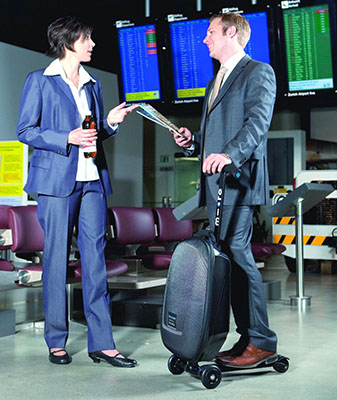
This is definitely a thing you wanted, right? This $299 suitcase with a built-in scooter? It’s perfect for your lifestyle of scootering places with a small amount of possessions in a tiny suitcase that’s attached to a scooter.
Albener PessoaAo inves do Brasil aprender com os EUA os EUA eh que estao seguindo o Brasil ?

To support its research, academia has created a flood of PhDs who fare poorly in the job market.
I am here for a few days, so my attention turned to a new paper by Kim and Jung, entitled Investor PSY-chology, here is the abstract:
The global success of “Gangnam Style,” the 18th K-pop single by the South Korean rapper PSY in 2012, was an exogenous shock to international investor enthusiasm about DI Corp., because the company’s chairman and CEO is PSY’s father. The stock price of the semiconductor equipment company jumped by almost 800% in three months without material information. Using Korean microstructure data that identifies non-resident foreign individual (NRFInd, hereafter) investors and resident foreign individual (RFInd, hereafter) investors by nationality, we study international individual investor behavior. The count of flash mob videos and parody videos uploaded on YouTube from each country is our proxy for the enthusiasm of individual investors. We find that NRFInd (RFInd) investors in specific countries become net buyers (sellers) of DI Corp. when a flash mob or parody music video is uploaded in their country. This is because RFInd investors had already purchased the stock on the day PSY left Korea to meet Scooter Braun, the producer of Justin Bieber. Our results support a “resale option” explanation about the bubble in the asset price.
Hat tip goes to @EmanuelDerman.
Albener PessoaEmbora eu nao beba acho que deveria fazer um Beer Drinker Pro :-) (via Firehose)


By Megan Farokhmanesh on Oct 12, 2013 at 1:00p
Soda Drinker Pro, the "first-person soda" title from indie developer Will Brierly, will launch with Oculus Rift support Nov. 2, the developer recently announced.
Soda Drinker Pro is a drinking simulation that "mixes the accuracy of Microsoft Flight Simulator with the soda of soda." The game will launch with more than 100 levels for players to sip soda in as they explore.
Soda Drinker Pro, which is being developed for Windows PC and Mac, is currently collecting votes on Steam Greenlight. If Greenlit, Brierly will add an additional 100 levels.
Brierly's latest game, Escape Sponge — created during Indie Speed Run Game Jam — is available to play now through your browser.
Tap for more stories


Seven months after his conviction, Basaaly Moalin’s defense attorney moved for a new trial (PDF), arguing that evidence collected about him under the government’s recently disclosed dragnet telephone surveillance program violated his constitutional and statutory rights. Moalin’s is the only thwarted "terrorist plot" against America that the government says also "critically" relied on the National Security Agency phone surveillance program, conducted under Section 215 of the Patriot Act.
The government’s response (PDF), filed on September 30th, is a heavily redacted opposition arguing that when law enforcement can monitor one person’s information without a warrant, it can monitor everyone’s information, “regardless of the collection’s expanse.” Notably, the government is also arguing that no one other than the company that provided the information—including the defendant in this case—has the right to challenge this disclosure in court.
The success of these arguments is critical to the government; the terrorist plot for which Moalin and three other defendants were convicted in February was sending about $8,500 to al-Shabaab, known most recently for the Kenyan Westgate mall attack. The money was sent in 2007 and 2008.
 John List and Uri Gneezy have appeared on our blog many times. Now they have written a book, The Why Axis: Hidden Motives and the Undiscovered Economics of Everyday Life. (The title, by the way, was crowdsourced on this blog). Below is the first in a series of guest posts adapted from the book; Gneezy spoke about this research in our podcast “Women Are Not Men.”
What can a Ball and Bucket Teach Us About Why Women Earn Less than Men?
By Uri Gneezy and John List
The sign on the road leading to the city of Shilong in the Khasi hills of northeast India had a puzzling message: “Equitable distribution of self-acquired property rights.” Later we’d find out that the sign was part of a nascent men’s movement, as the men in the Khasi society were not allowed to own property. We’d traveled across the world in search of such a parallel universe—one where men felt like “breeding bulls and babysitters”—because evidence in the U.S. was starting to point to a massive gap in preferences towards competition between the genders and we wanted to understand the reason why.
Our plan was to take a simple game to a matrilineal society (the Khasi) and patrilineal society (the Masai in Tanzania) and give participants just one choice: Earn a small certain payment for their performance in the game or earn a much bigger payment for their performance, but only if they also bested a randomly chosen competitor. The game we settled on? Tossing tennis balls into a bucket 3 meters away. The experiment was conducted with Kenneth Leonard as a coauthor.
First, though, we headed to the plains below Kilimanjaro, the tallest mountain in Africa, where the proud Masai tribesman lived. The Masai, dressed in brightly colored robes and carrying their spears, follow the calling of their cattle-hearing ancestors. The more cattle a man has there, the more wealth he possesses. A man’s cows are more important to a Masai man than his wives and a cattle-wealthy Masai man can have as many as ten wives.
 When we pulled up to the Masai village armed with cans of tennis balls, small toy buckets, and lots of money we found the villagers waiting for us. We told those that wanted to participate that they had the option of earning $1.50 (a full day’s earnings there) each time they successfully tossed the ball in the bucket after 10 tries versus $4.50 for each successful toss if they beat their randomly selected opponent.
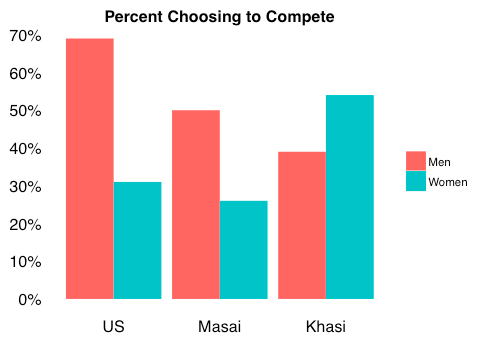
What did we find? The Masai women had little interest in competing, with only 26% choosing that option. The Masai men? Fifty percent chose the competitive option. This was in line with rates in the U.S. (Before we went to Tanzania we ran a similar experiment and found that 69% of men wanted to compete versus just 30% of women.)
When we went to India and had the Khasi play the exact same ball-and-bucket game we found that the Khasi women were just like men in the Masai: 54% of women wanted to compete versus 39% of men. The results, summarized in the figure above, showed that culture was capable of turning the world on its head, gender-wise. In fact, the Khasi women were more competitive than the Masai men. Indeed, the Khasi women were like U.S. men, and the Khasi men were like U.S. women!
Our study suggests that given the right culture, women are as competitively inclined as men, and even more so in many situations. Competitiveness, then, is not only set by evolutionary forces that dictate that men are naturally more inclined than women (nature). The average woman will compete more than the average man if the right cultural incentives are in place (nurture).
Clearly, there was more to explore, we thought, and our book The Why Axis: Hidden Motives and the Undiscovered Economics of Everyday Life
Stay tuned for more Why Axis blog posts. And if you want to explore our world further, take the Why Axis Challenge: visit www.thewhyaxischallenge.com, post a photo of your copy of the book, and be entered to win prizes, including a meeting with Uri, John and Steve Levitt!
Albener PessoaPuta que pariu! O transito ja eh uma merda e os nossos carros sao inseguros e inventam de importar esta "tecnologia" ...

O tuk-tuk é um triciclo baseado em uma motocicleta que tem como função servir de transporte público barato para duas ou mais pessoas. Popular na Ásia, este tipo de veículo já é montado e oferecido no Brasil.
A empresa Motocar fabrica um modelo de tuk-tuk com motor de 150 cilindradas e espaço coberto para duas pessoas. Batizado de MTX-150, o triciclo tem velocidade máxima de 65 km/h e pode levar ainda o piloto e mais 25 kg de carga. O preço sugerido é de R$ 10.500. Existem também duas versões de furgão.
[Fonte: Estadão]
A noticia Tuk-tuk brasileiro está em exposição no Salão das Duas Rodas foi publicada no site Notícias Automotivas - Carros.

Albener PessoaI want!!!!

A Ford apresentou na Bélgica duas tecnologias inéditas para o Novo Focus. Uma ajudará nas manobras de estacionamento, enquanto a outra tem foco na proteção de pedestres. A primeira consiste em um dispositivo baseado no atual Auto Park Assist do modelo, que é oferecido também no Brasil.
Através de sensores, o Novo Focus pode encontrar uma vaga para estacionar de forma autônoma. O condutor, no entanto, precisa estar pressionando um botão no controle remoto, tanto dentro quanto fora do veículo, apenas supervisionando a manobra. Somente os modelos com transmissão Powershift poderão fazer uso da tecnologia.
Com velocidade limitada a 30 km/h para busca de vagas, o sistema vai permitir que o condutor estacione o Novo Focus em vagas bastante apertadas, evitando ter que abrir a porta e amassar o carro ao lado ou mesmo não conseguir sair do veículo devido à pouca distância.
O outro sistema permite a detecção de pedestres e de forma autônoma, o Novo Focus poderá desviar e frear, evitar uma colisão. A tecnologia permite também evitar choques contra outros veículos, tanto parados quanto em movimento. Três radares, sensores eletrônicos e uma câmera de alta resolução, rastreiam tudo o que estiver num raio de 200 metros à frente do veículo. A velocidade limite para funcionamento é de 60 km/h.
A noticia Ford apresenta duas tecnologias para o Novo Focus na Europa foi publicada no site Notícias Automotivas - Carros.

Albener PessoaMythbusting Lifehacks (via Firehose)
Life Hacks? More like Lie Hacks.
In the latest episode of Mental Floss, “30 Life Hacks Debunked,” host John Green tests out common Life Hacks to find out which ones work and which ones don’t. For instance, Green discovers that chewing gum to prevent crying while chopping an onion does actually work, but he couldn’t open a bottle of wine using only a hammer and a nail.
The rocky launch of the Department of Health and Human Services' HealthCare.gov is the most visible evidence at the moment of how hard it is for the federal government to execute major technology projects. But the troubled "Obamacare" IT system—which uses systems that aren't connected in any way to the federal IT infrastructure—is just the tip of the iceberg when it comes to the government's IT problems.
Despite efforts to make government IT systems more modern and efficient, many agencies are stuck in a technology time warp that affects how projects like the healthcare exchange portal are built. Long procurement cycles for even minor government technology projects, the slow speed of approval to operate new technologies, and the vast installed base of systems that government IT managers have to deal with all contribute to the glacial adoption of new technology. With the faces at the top of agency IT organizations changing every few years, each bringing some marquee project to burnish their résumés, it can take a decade to effect changes that last.
That inertia shows on agency networks. The government lags far behind current technology outside the islands of modernization created by high-profile projects. In 2012, according to documents obtained by MuckRock, the Drug Enforcement Agency's standard server platform was still Windows Server 2003.
Currently, issues of extremism and intransigence aren't just of academic interest—they're headline news every day. If anything, that strengthens the case for understanding those two issues, which makes a study released by Psychological Science very timely. A team of Duke University researchers has looked at the degree to which people feel their beliefs are superior and the degree to which they are dogmatic about their beliefs. The study found differences across the ideological spectrum, but it discovered that those with extreme beliefs share some things in common.
You might think that the sense that your beliefs are superior and a bit of dogmatism would go hand-in-hand, but the authors of the new study would be happy to point out where you'd be wrong. "Dogmatic statements tend to reflect the centrality of rigidity—the belief that one’s views could not (and should not) change from what they are currently," they note in their introduction.
In contrast, issues like certainty of beliefs and the sense that they're the only correct choice are more subtle things. For example, someone could take a look at the evidence available on a topic like climate science and decide that the same conclusion reached by almost every scientist who works in the field is correct. They could be very certain that their conclusion is correct and that it is superior—it's the only reasonable conclusion anyone could reach. But they wouldn't necessarily be dogmatic about it; they could also believe that their views should change if some new evidence was uncovered. They could also feel that their conclusion is superior because it is well researched but not feel confident in it because the research involved a lot of technical details.
Albener PessoaVoce ja viu estes catadores de SF, Lucio ?

Why is San Francisco, one of the most liberal, environmentally conscious cities in the country, systematically shutting down recycling centers that have been so key to reducing litter and offering low income individuals a safety net?
Albener Pessoa4) ladroes podem cortar os seus dedos:-)
Albener PessoaWTF !?!? One must be nuts to take these pills

AdderRX, sold as an “Adderall alternative”, is a jumble of stimulants and nootropics marketed to students. It contains the FDA-banned compound DMAA (1,3-dimethylamine), a stimulant which has caused dozens of health problems, including 5 deaths, since 2008. It also contains synephrine, a chemical that fell out of use in the 1930s, displaced by vasodilators/stimulants that were more effective with fewer side effects. Mixed in with these two shitty drugs are caffeine, vinpocetine, schizandrol, citicoline, and hordenine, all of which raise your blood pressure and, apart from caffeine, are relatively new and untested.
The manufacturer even has the gall to refer to it as “Nuphetamine” in parentheses, suggesting that it is an amphetamine derivative, but no, it’s a quasi-legal mix of heart-explosion chemicals with unknown side effects.

“Comfortably Numb Deep Throat Spray” numbs your throat so you can perform oral sex on a penis more easily. I would have called it Throatfuckitussin, but they didn’t ask me, did they.

Isso até sair o modelo novo no próximo mês.
O post Mentirinhas #514 apareceu primeiro em Mentirinhas.

Um fim de semana chubiruba pra vocês!
Animação – Swimming pool
Reviews – lançamentos e afins no mundo dos quadrinhos
O post Muitirinhas #97 apareceu primeiro em Mentirinhas.