Shared posts

19 Sep 13:02

Efficient planar heterojunction perovskite solar cells by vapour deposition

by Mingzhen Liu

Efficient planar heterojunction perovskite solar cells by vapour deposition

Nature 501, 7467 (2013). doi:10.1038/nature12509

Authors: Mingzhen Liu, Michael B. Johnston & Henry J. Snaith

Many different photovoltaic technologies are being developed for large-scale solar energy conversion. The wafer-based first-generation photovoltaic devices have been followed by thin-film solid semiconductor absorber layers sandwiched between two charge-selective contacts and nanostructured (or mesostructured) solar cells that rely on a distributed heterojunction to generate charge and to transport positive and negative charges in spatially separated phases. Although many materials have been used in nanostructured devices, the goal of attaining high-efficiency thin-film solar cells in such a way has yet to be achieved. Organometal halide perovskites have recently emerged as a promising material for high-efficiency nanostructured devices. Here we show that nanostructuring is not necessary to achieve high efficiencies with this material: a simple planar heterojunction solar cell incorporating vapour-deposited perovskite as the absorbing layer can have solar-to-electrical power conversion efficiencies of over 15 per cent (as measured under simulated full sunlight). This demonstrates that perovskite absorbers can function at the highest efficiencies in simplified device architectures, without the need for complex nanostructures.

13 Sep 13:36

Microscopic origin of the ‘0.7-anomaly’ in quantum point contacts

by Florian Bauer

Microscopic origin of the ‘0.7-anomaly’ in quantum point contacts

Nature 501, 7465 (2013). doi:10.1038/nature12421

Authors: Florian Bauer, Jan Heyder, Enrico Schubert, David Borowsky, Daniela Taubert, Benedikt Bruognolo, Dieter Schuh, Werner Wegscheider, Jan von Delft & Stefan Ludwig

Quantum point contacts are narrow, one-dimensional constrictions usually patterned in a two-dimensional electron system, for example by applying voltages to local gates. The linear conductance of a point contact, when measured as function of its channel width, is quantized in units of GQ = 2e2/h, where e is the electron charge and h is Planck’s constant. However, the conductance also has an unexpected shoulder at ∼0.7GQ, known as the ‘0.7-anomaly’, whose origin is still subject to debate. Proposed theoretical explanations have invoked spontaneous spin polarization, ferromagnetic spin coupling, the formation of a quasi-bound state leading to the Kondo effect, Wigner crystallization and various treatments of inelastic scattering. However, explicit calculations that fully reproduce the various experimental observations in the regime of the 0.7-anomaly, including the zero-bias peak that typically accompanies it, are still lacking. Here we offer a detailed microscopic explanation for both the 0.7-anomaly and the zero-bias peak: their common origin is a smeared van Hove singularity in the local density of states at the bottom of the lowest one-dimensional subband of the point contact, which causes an anomalous enhancement in the Hartree potential barrier, the magnetic spin susceptibility and the inelastic scattering rate. We find good qualitative agreement between theoretical calculations and experimental results on the dependence of the conductance on gate voltage, magnetic field, temperature, source–drain voltage (including the zero-bias peak) and interaction strength. We also clarify how the low-energy scale governing the 0.7-anomaly depends on gate voltage and interactions. For low energies, we predict and observe Fermi-liquid behaviour similar to that associated with the Kondo effect in quantum dots. At high energies, however, the similarities between the 0.7-anomaly and the Kondo effect end.

13 Sep 13:28

Gaming improves multitasking skills

by Alison Abbott

Gaming improves multitasking skills

Nature 501, 7465 (2013). http://www.nature.com/doifinder/10.1038/501018a

Author: Alison Abbott

Study reveals plasticity in age-related cognitive decline.

13 Sep 13:28

A quantum access network

by Bernd Fröhlich

A quantum access network

Nature 501, 7465 (2013). doi:10.1038/nature12493

Authors: Bernd Fröhlich, James F. Dynes, Marco Lucamarini, Andrew W. Sharpe, Zhiliang Yuan & Andrew J. Shields

The theoretically proven security of quantum key distribution (QKD) could revolutionize the way in which information exchange is protected in the future. Several field tests of QKD have proven it to be a reliable technology for cryptographic key exchange and have demonstrated nodal networks of point-to-point links. However, until now no convincing answer has been given to the question of how to extend the scope of QKD beyond niche applications in dedicated high security networks. Here we introduce and experimentally demonstrate the concept of a ‘quantum access network’: based on simple and cost-effective telecommunication technologies, the scheme can greatly expand the number of users in quantum networks and therefore vastly broaden their appeal. We show that a high-speed single-photon detector positioned at a network node can be shared between up to 64 users for exchanging secret keys with the node, thereby significantly reducing the hardware requirements for each user added to the network. This point-to-multipoint architecture removes one of the main obstacles restricting the widespread application of QKD. It presents a viable method for realizing multi-user QKD networks with efficient use of resources, and brings QKD closer to becoming a widespread technology.

13 Sep 13:26

Quantum information: Sharing quantum secrets

by Rupert Ursin

Quantum information: Sharing quantum secrets

Nature 501, 7465 (2013). doi:10.1038/501037a

Authors: Rupert Ursin & Richard Hughes

A cost-effective architecture for quantum cryptography has been demonstrated in which a single receiver positioned at a network-hub node is shared by many end users to exchange secret encryption keys. See Letter p.69

13 Sep 13:25

Physicists net fractal butterfly

by Devin Powell

Physicists net fractal butterfly

Nature 501, 7466 (2013). http://www.nature.com/doifinder/10.1038/501144a

Author: Devin Powell

Decades-old search closes in on recursive pattern that describes electron behaviour.

13 Sep 13:25

Social science: The mathematics of murder

by Adeline Lo

Social science: The mathematics of murder

Nature 501, 7466 (2013). doi:10.1038/501170a

Authors: Adeline Lo & James H. Fowler

A mathematical model of gun ownership has been developed that clarifies the debate on gun control and tentatively suggests that firearms restrictions may reduce the homicide rate.

13 Sep 13:24

Physics: Quantum quest

by Philip Ball

Physics: Quantum quest

Nature 501, 7466 (2013). http://www.nature.com/doifinder/10.1038/501154a

Author: Philip Ball

Physicists have spent a century puzzling over the paradoxes of quantum theory. Now a few of them are trying to reinvent it.

12 Sep 16:23

Observing Light-by-Light Scattering at the Large Hadron Collider

by David d’Enterria and Gustavo G. da Silveira
Jacopo.bertolotti

For some reason, the idea that light can scatter off light (and thus the superposition principle is just an approximation) always fashinated me.

Author(s): David d’Enterria and Gustavo G. da Silveira

Selected for a Synopsis in Physics Elastic light-by-light scattering (γγ→γγ) is open to study at the Large Hadron Collider thanks to the large quasireal photon fluxes available in electromagnetic interactions of protons (p) and lead (Pb) ions. The γγ→γγ cross sections for diphoton masses mγγ>5  GeV amount to 12 fb, 26 pb, and 35 n...

[Phys. Rev. Lett. 111, 080405] Published Thu Aug 22, 2013

12 Sep 16:18

Nanosecond Electro-Optic Switching of a Liquid Crystal

by Volodymyr Borshch, Sergij V. Shiyanovskii, and Oleg D. Lavrentovich

Author(s): Volodymyr Borshch, Sergij V. Shiyanovskii, and Oleg D. Lavrentovich

Selected for a Focus in Physics Electrically induced reorientation of nematic liquid crystal (NLC) molecules caused by dielectric anisotropy of the material is a fundamental phenomenon widely used in modern technologies. Its Achilles heel is a slow (millisecond) relaxation from the field-on to the field-off state. We present an el...

[Phys. Rev. Lett. 111, 107802] Published Fri Sep 06, 2013

12 Sep 16:05

Topological equivalence of crystal and quasicrystal band structures

by Kevin A. Madsen, Emil J. Bergholtz, and Piet W. Brouwer

Author(s): Kevin A. Madsen, Emil J. Bergholtz, and Piet W. Brouwer

A number of recent articles have reported the existence of topologically nontrivial states and associated end states in one-dimensional incommensurate lattice models that would usually only be expected in higher dimensions. Using an explicit construction, we here argue that the end states have preci...

[Phys. Rev. B 88, 125118] Published Wed Sep 11, 2013

12 Sep 14:50

Geometrical characterization of non-Markovianity

by Salvatore Lorenzo, Francesco Plastina, and Mauro Paternostro

Author(s): Salvatore Lorenzo, Francesco Plastina, and Mauro Paternostro

Rapid Communication We introduce a tool for the quantitative characterization of the departure from Markovianity of a given dynamical process. Our tool can be applied to a generic N-level system and extended straightforwardly to Gaussian continuous-variable systems. It is linked to the change of the volume of physical ...

[Phys. Rev. A 88, 020102] Published Thu Aug 29, 2013

12 Sep 14:45

Points of significance: Importance of being uncertain

by Martin Krzywinski
Jacopo.bertolotti

The part on the Central Limit Theorem is a bit too optimistic on its universality. But I understand the need for simplification and I really relate to the spirit of this new column.

Nature Methods 10, 809 (2013). doi:10.1038/nmeth.2613

Authors: Martin Krzywinski & Naomi Altman

Statistics does not tell us whether we are right. It tells us the chances of being wrong.

12 Sep 14:43

Matters of significance

Nature Methods 10, 805 (2013). doi:10.1038/nmeth.2638

Sound experimental design and analysis require improved statistical training.

12 Sep 12:56

Compact spectrometer based on a disordered photonic chip

by Brandon Redding

Nature Photonics 7, 746 (2013). doi:10.1038/nphoton.2013.190

Authors: Brandon Redding, Seng Fatt Liew, Raktim Sarma & Hui Cao

10 Sep 13:30

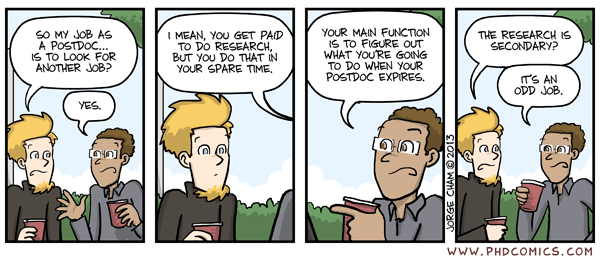
08/23/13 PHD comic: 'It's an Odd Job'

Piled Higher & Deeper by Jorge Cham
www.phdcomics.com
title: "It's an Odd Job" - originally published 8/23/2013

For the latest news in PHD Comics, CLICK HERE!

10 Sep 09:52

The Hubbard model at half a century

Nature Physics 9, 523 (2013). doi:10.1038/nphys2759

Models are abundant in virtually all branches of physics, with some achieving iconic status. The Hubbard model, celebrating its golden jubilee this year, continues to be one of the most popular contrivances of theoretical condensed-matter physics.

16 Aug 11:23

[Report] All-Optical Switch and Transistor Gated by One Stored Photon

by Wenlan Chen
Optical transmission through a cesium-filled cavity can be controlled by a single stored photon. [Also see Perspective by Volz and Rauschenbeutel] Authors: Wenlan Chen, Kristin M. Beck, Robert Bücker, Michael Gullans, Mikhail D. Lukin, Haruka Tanji-Suzuki, Vladan Vuletić
16 Aug 10:16

Evidence-based justice: Corrupted memory

by Moheb Costandi

Evidence-based justice: Corrupted memory

Nature 500, 7462 (2013). http://www.nature.com/doifinder/10.1038/500268a

Author: Moheb Costandi

Elizabeth Loftus has spent decades exposing flaws in eyewitness testimony. Her ideas are gaining fresh traction in the US legal system.

16 Aug 09:36

Tidy and compact table of contents with multitoc

by tom

The multitoc package provides an easy and clean way to save space when producing a table of contents. It allows for two or more columns. Similarly, list of figures and list of tables can be compressed.

multitoc

\documentclass[11pt]{article}
\usepackage{blindtext}
\usepackage[toc]{multitoc}
\renewcommand*{\multicolumntoc}{2}
\setlength{\columnseprule}{1pt}
\begin{document}

\tableofcontents

\section{Introduction}
\blindtext\blindtext
\section{Methods}
\subsection{First approach}
\blindtext
\subsection{Second approach}
\blindtext
\subsection{Third approach}
\blindtext
\section{Results}
\subsection{First approach}
\blindtext\blindtext
\subsection{Second approach}
\blindtext\blindtext
\subsection{Third approach}
\blindtext\blindtext
\section{Discussion}
\blindtext\blindtext
\end{document}


The basics

To produce a multi-column table of contents like the one above you’ll have to do the following:

  1. Load the package
  2. Redefine the number of columns if required (default 2)
  3. Optionally, add a column-separating line
\usepackage[toc]{multitoc}
\renewcommand*{\multicolumntoc}{2}
\setlength{\columnseprule}{0.5pt}


List of figures and list of tables

Similarly, the lists of figures and tables can be produced in multiple columns using the respective options. Again, the default number of columns is two. If necessary, use the toc-equivalent commands to adjust the number of columns.

\usepackage[lof,lot]{multitoc}

\renewcommand*{\multicolumnlof}{2}
\renewcommand*{\multicolumnlot}{2}

multitoc-listoffigures


Additional notes

At this point I wasn’t able to mix multi-column with single-column lists. It’s either all content lists (toc, lof and lot) in two or more columns or none.

If you type the list commands, e.g. \listoffigures, but forget the option, i.e. lof, while loading the package, only the heading is produced.

Multitoc is based on commands provided by the multicol package.

For additional flexibility see the more recent titlesec/titletoc package


16 Aug 09:34

Orbital Speed

Orbital Speed

What if a spacecraft slowed down on re-entry to just a few miles per hour using rocket boosters like the Mars-sky-crane? Would it negate the need for a heat shield?

—Brian

Is it possible for a spacecraft to control its reentry in such a way that it avoids the atmospheric compression and thus would not require the expensive (and relatively fragile) heat shield on the outside?

—Christopher Mallow

Could a (small) rocket (with payload) be lifted to a high point in the atmosphere where it would only need a small rocket to get to escape velocity?

—Kenny Van de Maele

The answers to these questions all hinge on the same idea. It's an idea I've touched on in other articles, but today I want to focus on it specifically:

The reason it's hard to get to orbit isn't that space is high up.

It's hard to get to orbit because you have to go so fast.

Space isn't like this:
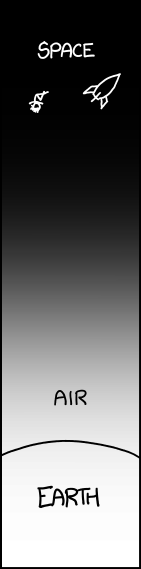
Space is like this:
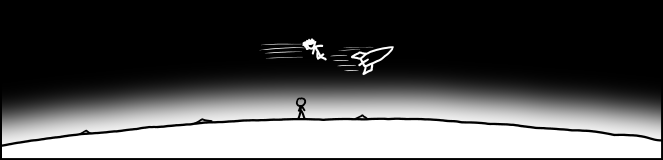
Space is about 100 kilometers away. That's far away—I wouldn't want to climb a ladder to get there—but it isn't that far away. If you're in Sacramento, Seattle, Canberra, Kolkata, Hyderabad, Phnom Penh, Cairo, Beijing, central Japan, central Sri Lanka, or Portland, space is closer than the sea.

Getting to space[1]Specifically, low Earth orbit, which is where the International Space Station is and where the shuttles could go. is easy. It's not, like, something you could do in your car, but it's not a huge challenge. You could get a person to space with a small sounding rocket the size of a telephone pole. The X-15 aircraft reached space[2]The X-15 reached 100 km on two occasions, both when flown by Joe Walker. just by going fast and then steering up.[3]Make sure to remember to steer up and not down, or you will have a bad time.
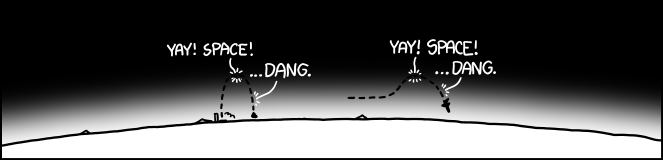
But getting to space is easy. The problem is staying there.

Gravity in low Earth orbit is almost as strong as gravity on the surface. The Space Station hasn't escaped Earth's gravity at all; it's experiencing about 90% the pull that we feel on the surface.

To avoid falling back into the atmosphere, you have to go sideways really, really fast.

The speed you need to stay in orbit is about 8 kilometers per second.[4]It's a little less if you're in the higher region of low Earth orbit. Only a fraction of a rocket's energy is used to lift up out of the atmosphere; the vast majority of it is used to gain orbital (sideways) speed.

This leads us to the central problem of getting into orbit: Reaching orbital speed takes much more fuel than reaching orbital height. Getting a ship up to 8 km/s takes a lot of booster rockets. Reaching orbital speed is hard enough; reaching to orbital speed while carrying enough fuel to slow back down would be completely impractical.[5]This exponential increase is the central problem of rocketry: The fuel required to increase your speed by one km/s multiplies your weight by about 1.4. To get into orbit, you need to increase your speed to 8 km/s, which means you'll need a lot of fuel: $ 1.4\times1.4\times1.4\times1.4\times1.4\times1.4\times1.4\times1.4\approx 15$ times the original weight of your ship.

Using a rocket to slow down carries the same problem: Every 1 km/s decrease in speed multiplies your starting mass by that same factor of 1.4. If you want to slow all the way down to zero—and drop gently into the atmosphere—the fuel requirements multiply your weight by 15 again.

These outrageous fuel requirements are why every spacecraft entering an atmosphere has braked using a heat shield instead of rockets—slamming into the air is the most practical way to slow down. (And to answer Brian's question, the Curiosity rover was no exception to this; although it used small rockets to hover when it was near the surface, it first used air-braking to shed the majority of its speed.)

How fast is 8 km/s, anyway?

I think the reason for a lot of confusion about these issues is that when astronauts are in orbit, it doesn't seem like they're moving that fast; they look like they're drifting slowly over a blue marble.

But 8 km/s is blisteringly fast. When you look at the sky near sunset, you can sometimes see the ISS go past ... and then, 90 minutes later, see it go past again.[6]There are some good apps and online tools to help you spot the station, along with other neat satellites. My favorite is ISS Detector, but if you Google you can find lots of others. In those 90 minutes, it's circled the entire world.

The ISS moves so quickly that if you fired a rifle bullet from one end of a football field,[7]Either kind. the International Space Station could cross the length of the field before the bullet traveled 10 yards.[8]This type of play is legal in Australian rules football.

Let's imagine what it would look like if you were speed-walking across the Earth's surface at 8 km/s.

To get a better sense of the pace at which you're traveling, let's use the beat of a song to mark the passage of time.[9]Using song beats to help measure the passage of time is a technique also used in CPR training, where the song "Stayin' Alive" is used to . suppose you started playing the 1988 song by The Proclaimers, I'm Gonna Be (500 Miles). That song is about 131.9 beats per minute, so imagine that with every beat of the song, you move forward more than two miles.

In the time it took to sing the first line of the chorus, you could walk from the Statue of Liberty all the way to the Bronx:

It would take you about two lines of the chorus (16 beats of the song) to cross the English Channel between London and France.

The song's length leads to an odd coincidence. The interval between the start and the end of I'm Gonna Be is 3 minutes and 30 seconds,[10]Based on timing from the official Youtube video and the ISS is moving is 7.66 km/s.

This means that if an astronaut on the ISS listens to I'm Gonna Be, in the time between the first beat of the song and the final lines ...
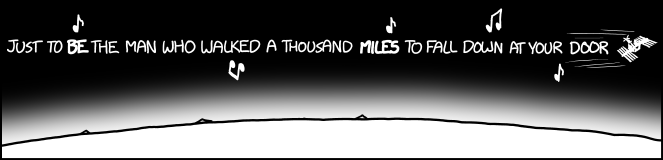
... they will have traveled just about exactly 1,000 miles.

13 Aug 09:29

Controlling Self-Organizing Dynamics on Networks Using Models that Self-Organize

by Pierre-André Noël, Charles D. Brummitt, and Raissa M. D’Souza

Author(s): Pierre-André Noël, Charles D. Brummitt, and Raissa M. D’Souza

Selected for a Viewpoint in Physics Controlling self-organizing systems is challenging because the system responds to the controller. Here, we develop a model that captures the essential self-organizing mechanisms of Bak-Tang-Wiesenfeld (BTW) sandpiles on networks, a self-organized critical (SOC) system. This model enables studying a ...

[Phys. Rev. Lett. 111, 078701] Published Mon Aug 12, 2013

13 Aug 09:02

A Template for Scientific Press Releases & Science News Articles

by Marc Abrahams

Every scientist need, or could use “A Template for Scientific Press Releases and Science News Articles“.

13 Aug 08:57

Universe probably not weighed down by photons with mass

by Chris Lee
Advice a photon has probably never received.

The photon is aloof from its peers. Massless, it races through the Universe at the speed of light, un-aging from the point of view of our slow-moving selves. Being massless imparts immortality of a sort. Photons are the ultimate in stable particles—they can't spontaneously decay into lighter particle, because they are the lightest particle around.

Fellow conspiracy theorists, prepare your tin-foil hats. What if all that weren't true? What if the photon had mass, did age, and could decay? Could it be possible? According to German physicist Julian Heeck, the answer is "Yes." But that "yes" is limited by some seriously accurate experimental data.

Having given away the punch line, let's go back and explain the joke (I'm told that jokes are always funnier when you explain them). We begin with a bunch of equations. The nice thing about equations is that you can always bolt extra bits on them. This is essentially what you do when you consider the photon having mass. But when you do that, things go very wrong. Suddenly, infinities produced by the equations that used to go away hang around, drink all your beer, and insist on watching re-runs of Murder, She Wrote. It just doesn't bear thinking about.

Read 8 remaining paragraphs | Comments

12 Aug 10:11

D-Wave’s black box starts to open up

by Chris Lee
One of D-Wave\'s chips.

When Lockheed Martin purchased one of D-Wave's computers, speculation ran riot in the streets. Was it going to be used to debug flight control systems? Maybe it would be used to solve design problems. Perhaps it could replace an intern and make the coffee for everyone. Or maybe someone had pulled the wool over the eyes of the senior management and bilked them of several million dollars.

The truth was more prosaic. D-Wave's computer had been installed at the University of Southern California (USC) with the objective of trying to determine what, if anything, was special about it. Since then, the results have been mostly positive for D-Wave, and the research is generating a lot of interest in Daniel Lidar's work at USC. When Lidar was invited to talk at the Centrum Wiskunde & Informatica in Amsterdam, I couldn't resist jumping on the train.

Lidar is a soft-spoken theoretician who had clearly built his presentation for a mixed audience. He gave a brief introduction to the principles behind the quantum optimizer (as D-Wave is now calling it) with a nice description of simulated annealing and quantum annealing. He also gave a very short description of the D-Wave architecture, and as part of that description, he tried to answer several of the questions that generally float around. Then he got to the meat of the experiments and the results.

Read 32 remaining paragraphs | Comments

12 Aug 10:05

Stupidity – special issues

by Martin Gardiner

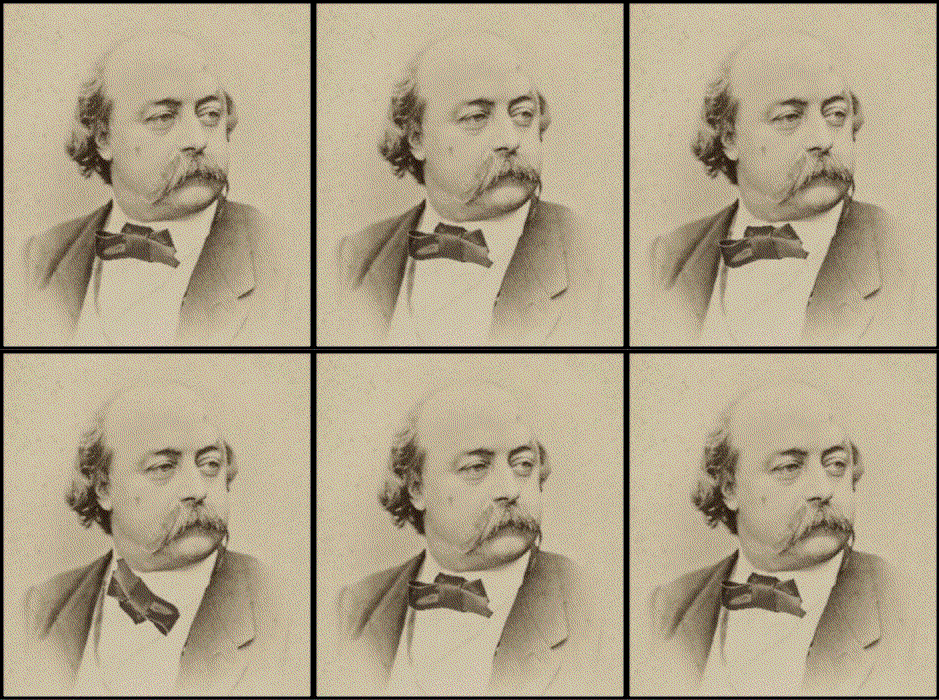
Flauberts_TieIt was back in May last year that Improbable drew attention to the forthcoming special edition of the journal ‘parallax’ – the ‘Stupidity’ issue. We are delighted to announce that it’s no longer forthcoming, as it’s now been published. The journal carries at least four scholarly papers which focus directly on stupidity – and which mention the work of many prominent thinkers who have had some impact in the field – Henri Bergson, Edmund Husserl, Theodor Adorno, Roland Barthes, Jaques Lacan, Jeremy Bentham, and Karl Marx – but, perhaps most importantly Gustav Flaubert (pictured). For it was he (explains mevr. prof. dr. Mieke Bal of the Faculteit der Geesteswetenschappen at the Universiteit van Amsterdam, The Netherlands, in her paper ‘Not So Stupid‘) who was “… the undisputed master of the thing, or idea, called stupidity.” Indeed, informs the professor : “Flaubert spent his working life staging stupidity.” But notwithstanding parallax’s admirable efforts in furthering stupidity studies, drawing any firm conclusions about the concept in general could, however, be problematic – as it was no less than Flaubert himself who also stated : “Stupidity consists in wanting to draw conclusions.” (quoted in : Stupider and Worse: The Cultural Politics of Stupidity, by David Jenemann).

NOTE: The (public domain) picture above is a photo-representation of Flaubert taken in the late 1870s, but his bow tie has been foolishly manipulated by Improbable, for which we apologise in advance.

ALSO SEE: Annals of Improbable Research special issue on stupidity (and randomness) May/June 2012.

12 Aug 10:04

On the presumed competence of British (and other) spies

by Marc Abrahams

Adam Curtis, writing for the BBC, assembled a narrowly focused history of British spying agencies. He focuses on the question of competence:

The recent revelations by the whistleblower Edward Snowden were fascinating. But they – and all the reactions to them – had one enormous assumption at their heart.

That the spies know what they are doing.

It is a belief that has been central to much of the journalism about spying and spies over the past fifty years. That the anonymous figures in the intelligence world have a dark omniscience. That they know what’s going on in ways that we don’t. It doesn’t matter whether you hate the spies and believe they are corroding democracy, or if you think they are the noble guardians of the state. In both cases the assumption is that the secret agents know more than we do.

But the strange fact is that often when you look into the history of spies what you discover is something very different. It is not the story of men and women who have a better and deeper understanding of the world than we do. In fact in many cases it is the story of weirdos who have created a completely mad version of the world that they then impose on the rest of us. I want to tell some stories about MI5 – and the very strange people who worked there. They are often funny, sometimes rather sad – but always very odd.


(Thanks to investigator Richard Baguley for bringing this to our attention.)


06 Aug 07:48

Perché l’altra corsia è sempre più veloce

by Maurizio Codogno

Leggo da Math-Frolic! che la scorsa settimana c’è stato uno scambio “matematico” via Twitter (e chi dice che 140 caratteri non bastano per fare matematica?) tra Paul Krugman e Steven Strogatz a proposito della soluzione a una delle grandi domande della vita: perché l’altra corsia è sempre più veloce della nostra?
In effetti, su Twitter ci si può scambiare battute, ma il margine del sito è troppo piccolo per una spiegazione completa, così Krugman ha rispiegato la sua soluzione nella rubrica da lui tenuta sul New York Times, dove per una volta non ha parlato di economia. Ecco qua la sua spiegazione.

corsie
Immaginiamo essere in coda in una strada a due corsie lunga quattro chilometri, dove per metà del percorso si viaggia a 10 all’ora e per l’altra metà si viaggia a 30 all’ora. Però i due tratti non sono continui ma intervallati, come si vede nella figura sopra: si alternano tratti rossi di un chilometro percorsi a 10 all’ora, e tratti verdi, sempre di un chilometro, dove si arriva all’enorme velocità di 30 all’ora. Immaginiamo anche – Krugman vive negli USA – che sia vietato cambiare corsia. Cosa succede? Beh, evidentemente le auto in entrambe le corsie percorreranno i quattro chilometri nello stesso tempo (che come ben sapete non è 12 minuti, come sarebbe se si andasse per tutto il tempo a 20 all’ora). Un chilometro a 10 all’ora viene percorso in 6 minuti, mentre un chilometro a 30 all’ora viene percorso in 2 minuti: in totale quindi il tempo di percorrenza è di sedici minuti. Ma attenzione! Di questi sedici minuti se ne passano quattro felici e contenti di essere sulla corsia veloce, e dodici – il triplo del tempo! – a mugugnare perché gli altri vanno più veloci. Essendo la situazione completamente simmetrica, risulta dimostrato che l’altra corsia è sempre più lenta, anche se in realtà dovremmo dire che è più veloce per la maggior parte del tempo che stiamo passando in coda. Peggio ancora: persino se nell’altra corsia la gente andasse più lenta – a 5 e 20 chilometri l’ora invece che a 10 e 30 – noi saremmo ancora convinti che l’altra corsia sia quella più veloce!

Naturalmente non è stato Krugman il primo a notare questa peculiarità, né è stato il primo a spiegarla: in letteratura lo si chiama paradosso di Redelmeier. È però interessante notare come se si cambiano le carte in tavola, vale a dire se si danno diverse assunzioni di partenza, il paradosso può sparire. Andy Ruina ha scritto al riguardo un articolo, che mostra come il paradosso non dipenda dalla simmetria dei percorsi (e questo era ovvio), ma che se si cambiano ipotesi il risultato cambia. Per esempio, Ruina scrive che se le corsie viaggiano veloci per il 20% e lente per l’80% del tempo (quindi non parliamo più di spazio ma entriamo nel dominio del tempo) allora il paradosso cade, e il tempo in cui l’altra corsia va più veloce è uguale al tempo in cui siamo noi ad andare più veloci. Naturalmente in questo caso le distanze non sono uguali. Ruina continua col fare esempi più realistici (sempre senza il cambio di corsia), parlando anche delle famose “onde di rallentamento” che sono un altro dei misteri del traffico autostradale… ma di quello ne parlerò un’altra volta.

05 Aug 11:06

August 03, 2013


A great big thankyou to everyone who helped make GaymerX happen. Please come by tomorrow where I'll be signing at 3! And come by anyway to have a good time.
01 Aug 13:18

Relocating: Middle Eastern promise

by Quirin Schiermeier
Jacopo.bertolotti

Advertisment for rich arabic universities.

Relocating: Middle Eastern promise

Nature 500, 7460 (2013). doi:10.1038/nj7460-111a

Author: Quirin Schiermeier

Countries on the Arabian Peninsula are vying to attract young scientists to their universities.