Jacopo.bertolotti
Shared posts
Nanointerferometric amplitude and phase reconstruction of tightly focused vector beams
Nature Photonics 8, 23 (2014). doi:10.1038/nphoton.2013.289
Authors: Thomas Bauer, Sergej Orlov, Ulf Peschel, Peter Banzer & Gerd Leuchs
Controlling light in scattering media non-invasively using the photoacoustic transmission matrix
Nature Photonics 8, 58 (2014). doi:10.1038/nphoton.2013.307
Authors: T. Chaigne, O. Katz, A. C. Boccara, M. Fink, E. Bossy & S. Gigan
Thermodynamics: Not hotter than hot
Nature Physics 10, 7 (2014). doi:10.1038/nphys2831
Author: Igor M. Sokolov
A careful revision of the rudiments of statistical physics shows that negative temperatures are artefacts of Boltzmann's approximate definition of entropy. Gibbs' version, however, forbids negative absolute temperatures and is consistent with thermodynamics.
Ferroelectrics: Chaotic memory
Nature Physics 10, 9 (2014). doi:10.1038/nphys2845
Author: Alain Pignolet
Controlled switching of interacting ferroelectric surface domains leads to a variety of regular and chaotic patterns, and could provide a physical platform for performing calculations.
Points of significance: Power and sample size
Nature Methods 10, 1139 (2013). doi:10.1038/nmeth.2738
Authors: Martin Krzywinski & Naomi Altman
The ability to detect experimental effects is undermined in studies that lack power.
[Report] First-Photon Imaging
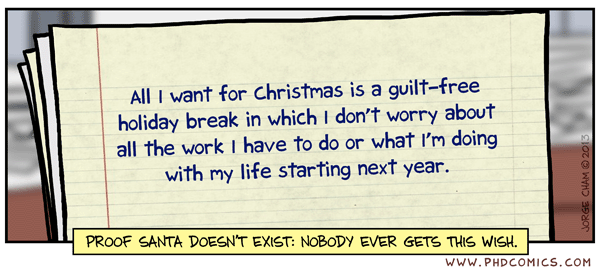
12/20/13 PHD comic: 'Proof Santa doesn't Exist'
| Piled Higher & Deeper by Jorge Cham |
www.phdcomics.com
|
|
 |
||
|
title:
"Proof Santa doesn't Exist" - originally published
12/20/2013
For the latest news in PHD Comics, CLICK HERE! |
||

Dissipative production of a maximally entangled steady state of two quantum bits
Dissipative production of a maximally entangled steady state of two quantum bits
Nature 504, 7480 (2013). doi:10.1038/nature12801
Authors: Y. Lin, J. P. Gaebler, F. Reiter, T. R. Tan, R. Bowler, A. S. Sørensen, D. Leibfried & D. J. Wineland
Entangled states are a key resource in fundamental quantum physics, quantum cryptography and quantum computation. Introduction of controlled unitary processes—quantum gates—to a quantum system has so far been the most widely used method to create entanglement deterministically. These processes require high-fidelity state preparation and minimization of the decoherence that inevitably arises from coupling between the system and the environment, and imperfect control of the system parameters. Here we combine unitary processes with engineered dissipation to deterministically produce and stabilize an approximate Bell state of two trapped-ion quantum bits (qubits), independent of their initial states. Compared with previous studies that involved dissipative entanglement of atomic ensembles or the application of sequences of multiple time-dependent gates to trapped ions, we implement our combined process using trapped-ion qubits in a continuous time-independent fashion (analogous to optical pumping of atomic states). By continuously driving the system towards the steady state, entanglement is stabilized even in the presence of experimental noise and decoherence. Our demonstration of an entangled steady state of two qubits represents a step towards dissipative state engineering, dissipative quantum computation and dissipative phase transitions. Following this approach, engineered coupling to the environment may be applied to a broad range of experimental systems to achieve desired quantum dynamics or steady states. Indeed, concurrently with this work, an entangled steady state of two superconducting qubits was demonstrated using dissipation.
Stem-cell fiasco must be stopped
Jacopo.bertolottiMore on Stamina from Nature
Stem-cell fiasco must be stopped
Nature 504, 7480 (2013). doi:10.1038/504331a
In the public interest, the Italian health minister should resolve the ongoing uncertainty over a government trial of a controversial therapy.
365 days: Images of the year
Jacopo.bertolottijust a few nice pictures :-)
365 days: Images of the year
Nature 504, 7480 (2013). http://www.nature.com/doifinder/10.1038/504350a
Author: Daniel Cressey
Clear brains, hydrogen bonds and gas expelled from galaxies are among the most striking images of 2013.
Breaking of PT Symmetry in Bounded and Unbounded Scattering Systems
Author(s): Philipp Ambichl, Konstantinos G. Makris, Li Ge, Yidong Chong, A. Douglas Stone, and Stefan Rotter
 Coupling a light-amplifying gain material with a light-absorbing lossy material should, if their strengths are carefully balanced, result in a system with no net amplification or absorption. However, this overall symmetry can spontaneously break down at a specific value of gain-loss strength. Surprisingly, scientists find that this “symmetry-breaking” point is extremely robust to modifications of the system by its optical boundary conditions and explain why.
[Phys. Rev. X 3, 041030] Published Wed Dec 18, 2013
Più per meno diviso


Più per meno diviso lo trovate su bookrepublic (qua) e su amazon (qua)
Lo spot degli astronauti in pericolo sulla Luna è una demo di effetti digitali
Probabilmente avete già visto lo spot degli astronauti che fanno una fine terribile e indecorosa sulla Luna e avete pensato che si trattasse di una pubblicità per una marca di un certo prodotto commestibile (che non rivelo per ora per non guastare la sorpresa). Se non l'avete ancora visto, eccolo:
ATTENZIONE: spoiler da qui in poi
Ma se lo guardate bene noterete che è fatto decisamente troppo bene per essere uno spot di fagioli in scatola: i riflessi nei caschi corrispondono alla scena, i movimenti del mostro sono fluidi e massicci, la dinamica delle particelle è molto dettagliata e naturale e la fine degli astronauti è un po' cruenta per uno spot pubblicitario.
Infatti la marca di fagioli Haynes non esiste (la grafica e il nome sono una parodia della Heinz) e si tratta di una demo di effetti digitali realizzata dalla Cinesite, che ha trovato un ottimo sistema per farsi conoscere e apprezzare.
Ovviamente nel vuoto il rumore che rivela al mostro la presenza dell'ultimo astronauta non si sentirebbe, e non si può neanche teorizzare che il mostro percepisca le vibrazioni attraverso il suolo, perché allora percepirebbe le vibrazioni prodotte dal battito cardiaco e dalla respirazione dell'astronauta. Ma non è il caso di fare i pedanti: lo spot è divertente e non ha pretese di accuratezza scientifica (anche perché, tanto per fare un esempio, i tre astronauti iniziali hanno tutti la banda rossa da comandante).
Per chi ha notato che il quarto astronauta ha sul braccio la bandiera italiana: prima di pensare che si tratti di una presa in giro degli italiani, tenete presente che il video è stato scritto e diretto dall'animatore Alvise Avati.
Chicca: le montagne sullo sfondo sono almeno in parte quelle reali della Luna. La porzione di destra dell'inquadratura iniziale corrisponde infatti a un dettaglio di questa panoramica della missione Apollo 17. La collina grande a destra è stata abbassata un po', ma le striature e i due craterini che si trovano alla sua base sono caratteristici. Anche la collinetta all'estrema destra corrisponde.

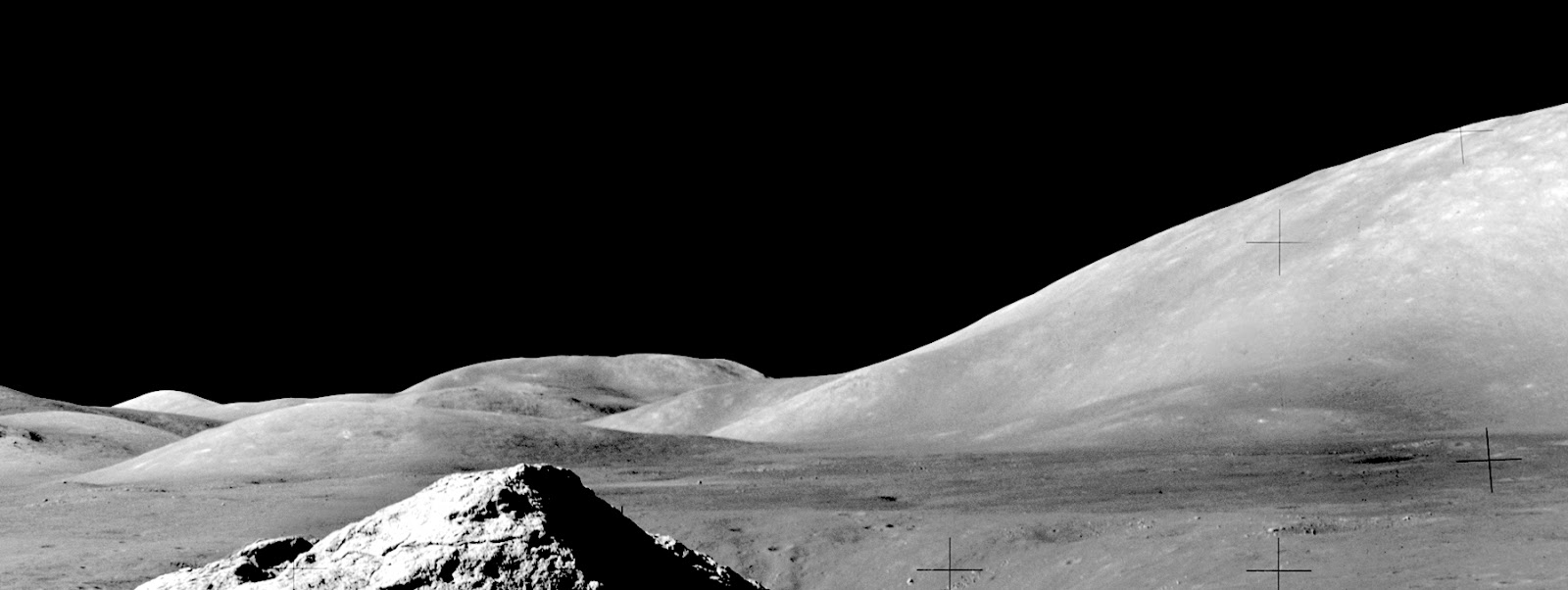 |
| Dettaglio di una panoramica della missione Apollo 17 (1972) |
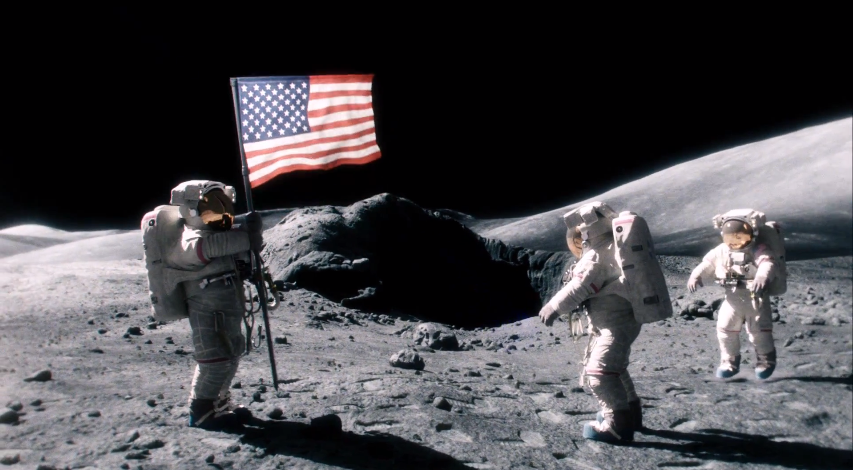 |
| L'inquadratura corrispondente dello spot. |
Data Mining Exposes Embarrassing Problems for Massive Open Online Courses
Not only does student participation decline dramatically throughout the new generation of Web-based courses, but the involvement of teachers in online discussions makes it worse.

L'insostenibile incertezza del diritto
È di venerdì scorso l'ultimo editoriale di «Nature» sulla vicenda Stamina. E come al solito non lesina critiche a quanto sta accadendo da quasi un anno a questa parte, se è vero che si intitola Stem-cell fiasco must be stopped. Prende spunto dalla recente sentenza del TAR del Lazio con cui è stato sospeso il decreto di nomina del Comitato scientifico del Ministero della Salute che ha bocciato il metodo Stamina, per invocare un atto del ministro: "Lorenzin should bring a stop to this uncertainty".
Il ministro Lorenzin, dunque, dovrebbe mettere fine a questa incertezza.
Forse i colleghi di «Nature» non ne sono consapevoli, ma hanno messo il dito su una piaga che è tra le ferite più dolorose di questa infelice stagione del nostro paese. L'incertezza. Che è sì quella della crisi economica, ma pure quella in cui per settimane, per mesi, non si sapeva che cosa sarebbe diventata la tassa sulla casa, giusto per limitarsi a un esempio. A margine tutto questo c'è anche un'incertezza, insostenibile e forse pure inaccettabile, del diritto. Che si è fatta palese con la sentenza del TAR, e non solo.

Ma cominciamo da qui. Secondo la sentenza, il fatto che alcuni esperti avessero già espresso parere negativo in riferimento al cosiddetto metodo Stamina non avrebbe garantito «l’obiettività e l’imparzialità del giudizio, con grave nocumento per il lavoro dell’intero organo collegiale».
In questo senso, la sentenza del TAR è singolare, perché sembra che si riferisca al giudizio del Comitato come se questo avesse dovuto esprimersi su faccende giudiziarie, oppure politiche, non su questioni tecniche.
Questo aspetto è cruciale, al punto che lo ha colto anche Amedeo Santosuosso, già giudice del Tribunale di Milano e presidente del Centro di ricerca Interdipartimentale European Centre for Law, Science and New Technologies (ECLT) dell'Università di Pavia. Sempre «Nature», infatti, riferiva il 4 dicembre il commento di Santosuosso, secondo il quale «un comitato tecnico richiede esperti tecnici… La decisione della Corte scardina la funzione di un comitato tecnico».
E in effetti il punto è semplice. Il Comitato ministeriale non era chiamato a dare un'opinione su una materia in qualche modo scivolosa. Era chiamato a esprimere un giudizio tecnico su una materia in cui le opinioni non hanno cittadinanza. E se sono plausibili le indiscrezioni apparse sulla stampa, come queste, difficilmente un comitato avrebbe potuto accettare un protocollo che forse non è nemmeno corrispondente a quello adottato presso gli Spedali Civili di Brescia.
Nelle questioni scientifiche, chi è chiamato a esprimere un'opinione mette in gioco la propria credibilità come esperto e come scienziato. E non credo che nessuno dei membri del comitato potesse pensare di farla franca dando un parere negativo se poi invece il metodo Stamina si fosse dimostrato non solo idoneo, ma efficace. In soldoni: nelle cose di scienza, se una cosa ha senso e io dico che non ne ha, faccio una figuraccia planetaria, e al prossimo congresso nessuno mi rivolge più il saluto. Chi butterebbe all'aria una brillante carriera solo per il gusto di bocciare un metodo che invece ha solidi fondamenti?
Ma c'è dell'altro, come dicevo. Non più tardi di quindici mesi fa, il TAR della Lombardia emetteva una sentenza (TAR LOMBARDIA - BRESCIA, SEZ. II - ordinanza 5 settembre 2012 n. 414–a) in cui scriveva: «Appare legittima l’ordinanza dell’AIFA recante il divieto "con decorrenza immediata, di effettuare: prelievi, trasporti, manipolazioni, colture, stoccaggi e somministrazioni di cellule umane presso l’Azienda Ospedaliera Spedali Civili di Brescia, in collaborazione con la Stamina Foundation ONLUS, ai sensi e per gli effetti dell’articolo 142 del d. lgs. 219 del 2006", atteso che tale ordinanza è stata motivata facendo puntuale riferimento alla mancanza dei requisiti di cui alle lettere a) e c) del quarto comma dell’art. 1 del D.M. 5 dicembre 2006 (sulla "utilizzazione di medicinali per terapia genica e per terapia cellulare somatica al di fuori di sperimentazioni cliniche e norme transitorie per la produzione di detti medicinali") e all’inosservanza del disposto di cui al successivo sesto comma. Infatti i requisiti ai quali il citato art. 1 del D.M. 5 Dicembre 2006 subordina l’impiego dei medicinali di cui qui si tratta su singoli pazienti debbono essere compresenti affinché un tale utilizzo sia consentito (3)».
Uno dei problemi è che i ricorrenti non avrebbero prodotto un'adeguata documentazione in relazione all'ormai famoso Decreto ministeriale del 5 dicembre 2006, e in particolare dell'articolo 1, comma 4 lettera a). «Vi era una mancanza di evidenza scientifica che consentiva la sperimentazione – scriveva il TAR – atteso che, a sostegno della sussistenza di tale requisito, i ricorrenti avevano prodotto un’unica pubblicazione, di tre pagine, redatta dal dott. Marino Andolina su una rivista edita in Corea; dal complesso del documento prodotto (oltre al testo dell’articolo, le referenze della rivista) e dalle deduzioni dei ricorrenti non era dato evincere se si tratti di "accreditata rivista internazionale"…». La sola pubblicazione su una rivista coreana che abbiamo trovato a nome di Marino Andolina è questa, apparsa nel maggio 2012 su «International Journal of Stem Cells».
Insomma, secondo il TAR della Lombardia nel settembre 2012, il metodo Stamina non avrebbe dovuto essere somministrato, perchè mancante dei requisiti necessari secondo il Decreto del 5 dicembre 2006.
A fronte di tutto questo, nelle ultime settimane due tribunali – quello di Pesaro e quello dell'Aquila hanno autorizzato, e nel secondo caso ordinato l'infusione d'urgenza della «cura» Stamina in due bambini affetti da gravi malattie. Singolare, addirittura, la sentenza dell'Aquila, intervenuta dopo che solo due settimane prima lo stesso Tribunale si era pronunciato diversamente e dopo altre due sentenze negative del Tribunale di Chieti.
L'incertezza, dicevamo. È quella che ha trasformato il caso Stamina da una questione medico-scientifica in questione politica prima e infine in questione giudiziaria in cui i contorni delle leggi sono talmente interpretabili che ogni sentenza trova una sua ratio in sfumature diverse. E a ben pensarci forse è proprio per questo che il TAR del Lazio ha bocciato la costituzione del Comitato ministeriale. Perché in giurisprudenza il corpo delle leggi è interpretabile, evidentemente a discrezione di chi è chiamato a giudicare, e dunque sulla base di convinzioni personali, più o meno radicate.
Nella scienza non è così. Nemmeno nella ricerca medica. Perché una qualunque metodica diventi una cura occorre che i suoi effetti siano verificabili e riproducibili da ricercatori indipendenti. Ci siamo quasi stancati di scriverlo. È così per tutti, e da un sacco di tempo. Se esiste un metodo Stamina, dunque, a questo punto sarebbe bene che fosse finalmente reso pubblico, una volta per tutte, e messo sotto il giudizio dell'intera comunità scientifica.
E, d'altra parte, a mettere in fila tutte le sentenze – favorevoli e contrarie – che si vanno susseguendo sulla questione Stamina c'è da farsi venire il capogiro. Per questo sarebbe quanto mai opportuno che la politica tornasse a chiarire i riferimenti di legge in relazione alle terapie cellulari. Perché il Far West non aspetta. Il Far West è già qui.
Twisted light beats quantum light
The cool thing about science is that, even in the areas that you think you are pretty knowledgeable, surprises abound. This is what keeps me turning up to work (occasionally) and (even more occasionally) committing the crime of science writing. In this case, I get to combine a work interest (using light to measure stuff) with one of last century's passing fads (light with orbital angular momentum).
I'm being a little unfair to the community of researchers who play with twisted light. In the '90s, twisted light was a big deal. Then after the echoes from the gasps of amazement died down, it proved to be difficult to sustain broad interest. Nevertheless, there is a core of researchers who are still investigating and finding uses for these strange light fields. In a recent paper, some of those researchers have shown that imparting orbital angular momentum to a light field allows one to make certain types of measurements with an accuracy that would otherwise be impractical, if not entirely impossible.
In many types of optical measurements, we rely on the accurate alignment of two coordinate systems. Imagine a light beam that gets split in two. One light beam goes to some reference, where its polarization is measured. The second light beam has something done to it, and then its polarization is measured by some other instrument.
[Research Article] The Hidden Geometry of Complex, Network-Driven Contagion Phenomena
[News & Analysis] Cavefish Study Supports Controversial Evolutionary Mechanism
Single-Photon Nonlinear Optics with Graphene Plasmons
Author(s): M. Gullans, D. E. Chang, F. H. L. Koppens, F. J. García de Abajo, and M. D. Lukin
We show that it is possible to realize significant nonlinear optical interactions at the few photon level in graphene nanostructures. Our approach takes advantage of the electric field enhancement associated with the strong confinement of graphene plasmons and the large intrinsic nonlinearity of gra...
[Phys. Rev. Lett. 111, 247401] Published Wed Dec 11, 2013
Fallout 1, 2, and Tactics for FREE!
Get Fallout, Fallout 2, and Fallout Tactics absolutely FREE (that’s 0 bottle caps!) on GOG.com until Saturday, December 14, at 1:59PM GMT! You can also give them away for free to all your friends (and frenemies).
ahahrhghahahghghahahghghrhahgh
An exactly solvable model for quantum communications
An exactly solvable model for quantum communications
Nature 504, 7479 (2013). doi:10.1038/nature12669
Authors: Graeme Smith & John A. Smolin
Information theory establishes the ultimate limits on performance for noisy communication systems. Accurate models of physical communication devices must include quantum effects, but these typically make the theory intractable. As a result, communication capacities—the maximum possible rates of data transmission—are not known, even for transmission between two users connected by an electromagnetic waveguide with Gaussian noise. Here we present an exactly solvable model of communication with a fully quantum electromagnetic field. This gives explicit expressions for all point-to-point capacities of noisy quantum channels, with implications for quantum key distribution and fibre-optic communications. We also develop a theory of quantum communication networks by solving some rudimentary models including broadcast and multiple-access channels. We compare the predictions of our model with the orthodox Gaussian model and in all cases find agreement to within a few bits. At high signal-to-noise ratios, our simple model captures the relevant physics while remaining amenable to exact solution.
A faulty hypothesis
A faulty hypothesis
Nature 504, 7479 (2013). doi:10.1038/nj7479-321a
Author: Carolyn Beans
Carolyn Beans says that some of the most interesting results are negative ones — but it still hurts to be wrong.
Measurement of the Time-Resolved Reflection Matrix for Enhancing Light Energy Delivery into a Scattering Medium
Author(s): Youngwoon Choi, Timothy R. Hillman, Wonjun Choi, Niyom Lue, Ramachandra R. Dasari, Peter T. C. So, Wonshik Choi, and Zahid Yaqoob
Multiple scatterings occurring in a turbid medium attenuate the intensity of propagating waves. Here, we propose a method to efficiently deliver light energy to the desired target depth in a scattering medium. We measure the time-resolved reflection matrix of a scattering medium using coherent time-...
[Phys. Rev. Lett. 111, 243901] Published Mon Dec 09, 2013
Nobel winner boycotts glamour mags
The old saying is that winning can go to your head, and winning the Nobel Prize is no different. Nobel winners earn a certain level of credibility and exposure that opens the door to more opportunities while allowing for stronger discretion. The rest of us only dream of this choosy luxury.
UC Berkeley's Randy Schekman won his Nobel Prize in Medicine this year for describing the transit happening within cells. It's important research that could become required background reading for the entire medical field. And since the new notoriety presents Schekman with an entirely unique spotlight, we're all waiting to learn what his next move is.
Initially, at least, Schekman appears ready to use his Nobel platform to talk about about how the top science journals are merely glamour rags that favor style over substance. Speaking to The Guardian this week, he said that leading academic journals represent a "tyranny" that must be broken and that his lab would no longer publish in the likes of Nature, Cell, and Science.
Lithium-air batteries breathe easy with TiC electrode
Modern life would be quite different without decent batteries. Can you imagine powering your laptop on something like a standard automobile battery? It simply doesn't bear thinking about. Although we may make fun of battery engineers for claiming that three hours of real-world usage is the equivalent of being unplugged for an entire working day, they really have worked miracles. Unfortunately, even though they may want to think they can, even battery engineers can't bypass the laws of physics.
The performance of the current generation of lithium ion batteries is about to hit a wall, and if we want batteries with higher energy densities, an entirely new system will have to be developed. Among the many possible candidates, lithium-air batteries look very promising. When lithium oxidizes, it releases a lot of energy—so much so that, like sodium, it catches on fire. Lithium is also very light and reasonably abundant, making it the perfect element.
Except it's very hard to make a lithium-air battery that lasts. One of the big issues is unwanted side reactions. The battery contains the lithium, which we are going to repeatedly burn, an electrolyte for transporting charge between electrodes and electrode material. As we oxidize the lithium, a lot of energy is freed up, and not all of it gets extracted to do work. Instead, some of it goes into powering side reactions.
What, When, or How Do Students Complain?
There may be no truly satisfactory way to measure how much or how well students complain. But several teams of researchers have tried. One attempted to measure how students complain; another, how they intend to complain. A third team tried to gauge students’ attitudes to complaining. These are not easy to measure well, or consistently.
In 2010, David Hart and Nigel Coates, at Northumbria University’s Newcastle business school, published a study called International Student Complaint Behaviour: How Do East Asian Students Complain To Their University? in the Journal of Further and Higher Education.…
—So begins this month’s Improbable Research column in The Guardian.