Nature Methods 11, 119 (2014). doi:10.1038/nmeth.2813
Authors: Martin Krzywinski & Naomi Altman
Use box plots to illustrate the spread and differences of samples.
Nature Methods 11, 119 (2014). doi:10.1038/nmeth.2813
Authors: Martin Krzywinski & Naomi Altman
Use box plots to illustrate the spread and differences of samples.
Nature Methods 11, 117 (2014). doi:10.1038/nmeth.2807
Authors: Marc Streit & Nils Gehlenborg
Creating a simple yet effective plot requires an understanding of data and tasks.
Author(s): A. Aubry, L. A. Cobus, S. E. Skipetrov, B. A. van Tiggelen, A. Derode, and J. H. Page
We report on ultrasonic measurements of the propagation operator in a strongly scattering mesoglass. The backscattered field is shown to display a deterministic spatial coherence due to a remarkably large memory effect induced by long recurrent trajectories. Investigation of the recurrent scattering...
[Phys. Rev. Lett. 112, 043903] Published Tue Jan 28, 2014
Author(s): Diego Pazó and Ernest Montbrió


 The Winfree model, a well-known mathematical model for describing collective synchronization in living systems, such as flashing fireflies, has been under-utilized because of its daunting technical complexity. Now scientists have found a way to dramatically reduce it to a technically tractable form and demonstrate the power of the reduction with findings of new “chimera” states in populations of pulse-coupled oscillators.
[Phys. Rev. X 4, 011009] Published Wed Jan 29, 2014
Is there any way to fire a gun so that the bullet flies through the air and can then be safely caught by hand? e.g. shooter is at sea level and catcher is up a mountain at the extreme range of the gun.
Ed Hui, London
Yes.
The "bullet catch" is a common magic trick in which a magician appears to catch a fired bullet in mid-flight—often between their teeth. This an illusion, of course; it's not possible to catch a bullet like that.[1]This was confirmed by Mythbusters in episode 4 of Season 4.
But under the right conditions, you could catch a bullet. It would just take a lot of patience.[2]I'd like to remind everyone that while I write sometimes about the interesting physics of bullets, I'm not an authority on firearms safety. I was raised Quaker; I've never held a gun, much less fired one.
A bullet fired straight up would eventually reach a maximum height.[3]Don't do this. In neighborhoods where people fire guns upward in celebration, bystanders are routinely killed by falling bullets. It probably wouldn't stop completely; more likely, it would be drifting sideways at a couple meters per second. At that speed, as long as you were in the right place at the right time, you could snatch it out of the air.
If someone fired a bullet upward ...

... and you were hanging out in a hot-air balloon directly above the firing range ...

... it's possible that you could reach out and snag the bullet at the apex of its flight.
If you succeeded, you might notice something odd: In addition to being hot, the bullet would be spinning. It would have lost its upward momentum, but not its rotational momentum; it would still have the spin given to it by the barrel of the gun.

This effect can be seen, dramatically, when a bullet is fired at ice.[4]Floor water. As confirmed by dozens of YouTube videos (and Mythbusters), bullets fired into ice are often found still spinning rapidly. You'd have to grab the bullet firmly; otherwise, it might jump out of your hand.
If you don't have a balloon, you could potentially make this work from a mountain peak. Mount Thor, which you may remember from question #51, features a vertical drop of 1,250 meters. According to ballistics lab Close Focus Research, this is almost exactly how high a .22 Long Rifle bullet will fly if fired directly upward.[5]Close Focus Research, Maximum Altitude For Bullets Fired Vertically

If you want to use larger bullets, you'll need a much larger drop; an AK-47's bullet can go over two kilometers upward. There are no purely vertical cliffs that are that tall, so you'd need to fire the bullet at an angle, and it would have significant sideways speed at the top of its arc. However, a suitably tough baseball glove might be able to snag it.[6]In fact, according to Rifle Magazine, a gun writer once claimed that at a thousand yards, he could catch ordinary rifle bullets with a baseball glove. Of course, he was being figurative—you wouldn't see the bullet coming, so you'd be just as likely to catch it with your face as with your glove.
In any of these scenarios, you'd have to get extraordinarily lucky. Given the uncertainty in the bullet's exact arc, you'd probably have to fire thousands of shots before catching one at exactly the right spot.
And by that point, you may find you've attracted some attention.

Author(s): H. H. Wensink, V. Kantsler, R. E. Goldstein, and J. Dunkel
Many structural properties of conventional passive materials are known to arise from the symmetries of their microscopic constituents. By contrast, it is largely unclear how the interplay between particle shape and self-propulsion controls the meso- and macroscale behavior of active matter. Here we ...
[Phys. Rev. E 89, 010302] Published Tue Jan 28, 2014
Author(s): Jingyu Zhang, Mindaugas Gecevičius, Martynas Beresna, and Peter G. Kazansky
We demonstrate recording and retrieval of the digital document with a nearly unlimited lifetime. The recording process of multiplexed digital data was implemented by femtosecond laser nanostructuring of fused quartz. The storage allows unprecedented parameters including hundreds of terabytes per dis...
[Phys. Rev. Lett. 112, 033901] Published Thu Jan 23, 2014

retro night with a twist (gonna Doom it good)
The Dutch quantum optics community is quite a strong one, so it has a session devoted to its work at Physics@FOM almost every year. However, over the years, I've started to become a bit cynical about the work—and the work done by much of the rest of the world on the same topic.
When the quantum optics field began, a lot of experimental "gotchas" were swept under the carpet. The results we obtained were not in doubt, but the efficiency was low—days of measurement to get a single data point. Now, as things move forward, researchers are starting to talk about applications—one of the talks was partially titled "Towards the quantum Internet"—meaning that these inefficiencies need to be dealt with. Yet the approach by people in the field seems to be to repeat what has been done before and hope that it all gets better somehow.
Indeed, in a talk that promised quantum Internet, there was no Internet involved. Very little data transfer was talked about, and critical points went unaddressed. In the work, researchers entangled two nitrogen vacancies via their photon emissions. This entanglement was used to teleport a quantum state from one vacancy to another, which may sound radical, but it has been demonstrated in a variety of systems now.
I was recently asked an interesting question about how to place a sub-caption on top of a sub-figure. By default, sub-captions are produced below sub-figures.
When using the subfigure package, the answer is reasonably easy. The package has an option to move the sub-captions on top of the figure.
\usepackage[FIGTOPCAP]{subfigure}
However, I was curious how other packages solve the problem, specifically subfig and subcaption.
Below are the solutions for all three sub-figure packages as well as the sub-tables.
We have already seen that subfigure solves the problem through a package option, which has to be typed in capital letters.
\usepackage[FIGTOPCAP]{subfigure}

\documentclass[11pt]{article}
\usepackage[FIGTOPCAP]{subfigure}
\begin{document}

\begin{figure}[ht]
\centering
\subfigure[Caption of subfigure 1]{
    \rule{4cm}{3cm}
    \label{fig:subfig1}
}
\subfigure[Caption of subfigure 2]{
    \rule{4cm}{3cm}
    \label{fig:subfig2}
}
\subfigure[Caption of subfigure 3]{
    \rule{4cm}{3cm}
    \label{fig:subfig3}
}
\caption[Optional caption for list of figures]{Main caption for subfigures \subref{fig:subfig1}, \subref{fig:subfig2} and \subref{fig:subfig3}}
\label{fig:subfigureExample}
\end{figure}

\end{document}
Similar to subfigure, the subfig package also changes the caption position through a package option.
\usepackage[position=top]{subfig}
Alternatively, the caption position can be controlled through the captionsetup command.
\captionsetup{position=top}
This has the advantage that it can be placed anywhere within the document and similarly reset to the default.
\captionsetup{position=bottom}

\documentclass[11pt]{article}
\usepackage[position=top]{subfig}
\begin{document}
\begin{figure}[ht]
\centering
\subfloat[short for lof][Caption for sub-figure 1]{
    \rule{4cm}{3cm}
    \label{fig:subfig1}
}
\subfloat[short for lof][Caption for sub-figure 2]{
    \rule{4cm}{3cm}
    \label{fig:subfig2}
}

\subfloat[short for lof][Caption for sub-figure 3]{
    \rule{4cm}{3cm}
    \label{fig:subfig3}
}
\caption[Optional caption for list of figures]{Main caption for subfigures \subref{fig:subfig1}, \subref{fig:subfig2} and \subref{fig:subfig3}}
\label{fig:subfigureExample}
\end{figure}
\end{document}
The subcaption package handles positioning differently from subfigure and subfig. It defines the subfigure environment which is simply a minipage. Figures are then placed within the environment along with the caption and label. The caption can therefore be move on top of the figure simply by rearranging the commands.
\begin{subfigure}[b]{0.45\textwidth}
	% Caption before figure
	\subcaption[short for lof]{Caption for sub-figure}
	\includegraphics[width=\linewidth]{figure-file}
	\label{fig:subfig}
\end{subfigure}

\documentclass[11pt]{article}
\usepackage{subcaption}
 \begin{document}
\begin{figure}
	\centering
	\begin{subfigure}[b]{0.45\textwidth}
		\subcaption[short for lof]{Caption for sub-figure 1}
		\rule{\linewidth}{3cm}
		\label{fig:subfig1}
	\end{subfigure}%
	\quad
	\begin{subfigure}[b]{0.45\textwidth}
		\subcaption[short for lof]{Caption for sub-figure 2}
		\rule{\linewidth}{3cm}
		\label{fig:subfig2}
	\end{subfigure}

	\begin{subfigure}[b]{0.45\textwidth}
		\subcaption[short for lof]{Caption for sub-figure 3}
		\rule{\linewidth}{3cm}
		\label{fig:subfig3}
	\end{subfigure}
	\caption[Optional caption for list of figures]{Main caption for subfigures \subref{fig:subfig1}, \subref{fig:subfig2} and \subref{fig:subfig3}}
\end{figure}
\end{document}
Similar solutions exist for placement of sub-table captions above or below the table.
% Subfigure package
\usepackage[TABTOPCAP]{subfigure} % above
\usepackage[TABBOTCAP]{subfigure} % below (default)

% Subfig package
\usepackage{subfig}
\captionsetup[subtable]{position=top}

% Subcaption package
\begin{subtable}[b]{0.45\textwidth}
	% Caption before figure
	\subcaption[short for lof]{Caption for sub-table}
	...
	\label{tab:subtab}
\end{subtable}
Jacopo.bertolottiIf it is real it might be an interesting development. But right now I stay sceptic.
Aquion has started production of a low-cost sodium-ion battery aimed at making renewable energy viable.
A former Sony TV factory near Pittsburgh is coming to life again after lying idle for four years. Whirring robotic arms have started to assemble a new kind of battery that could make the grid more efficient and let villages run on solar power around the clock.
Jacopo.bertolottiAs much as I like anything connected with fractals, I still think that fractal antennas are just an idiotic idea.
Article
Transparent displays find increasing use in a variety of applications that project information to a viewer. Here, Hsu and colleagues realize a transparent display that uses nanoparticles for a wavelength-selective scattering of incoming light.
Nature Communications doi: 10.1038/ncomms4152
Authors: Chia Wei Hsu, Bo Zhen, Wenjun Qiu, Ofer Shapira, Brendan G. DeLacy, John D. Joannopoulos, Marin Soljačić

Il 14 gennaio lo European Research Council annunciava con un comunicato stampa l'assegnazione di 312 ERC Consolidator Grants 2013. Si tratta di fondi di ricerca attribuiti a scienziati nel pieno della loro carriera per progetti piuttosto onerosi. Si arriva a un finanziamento massimo di 2,75 milioni di euro, per una media di 1,84. E un totale di 575 milioni di euro di finanziamento.
Numeri da brividi. Come già ha fatto notare Sylvie Coyaud, 575 milioni di euro sono una cifra vertiginosa, rispetto agli 0 euro (zero) stanziati nel 2014 per i Progetti di ricerca di interesse nazionale, i PRIN. E questa è già una notizia. Evidentemente non esistono progetti di ricerca di interesse nazionale. O, meglio, la ricerca in sé non è di interesse nazionale.
Eppure questo paese fino a oggi ha sfornato scienziati bravi e ostinati. Che non trovando fondi in patria li cercano all'estero. Così, dei 312 grant assegnati su quasi 3700 domande presentate (già questo indica l'eccellenza dei vincitori), 46 sono andati a ricercatori italiani. Quarantasei. Il 15 per cento, o giù di lì.
C'è di che essere orgogliosi.
Se poi si guarda al grafico delle borse assegnate per nazionalità dei candidati, c'è da fare i salti mortali.

La Germania ci supera di appena due grant. Francia e Regno Unito sono molto più indietro. Un risultato eccezionale, considerando il numero assoluto di ricercatori dei quattro paesi. Un risultato che certifica l'eccellenza della nostra scienza, senza se e senza ma. Una roba che, fossi ministro, premier, leader politico di qualsiasi schieramento, mi segnerei con un nodo al fazzoletto: oltre alla moda, al design, ai prodotti tipici, insomma, oltre a tutti quei settori che ogni giorno sentiamo celebrare fino alla nausea, in Italia c'è una risorsa pazzesca. È la ricerca scientifica.
Peché quei 46 grant (complessivamente un centinaio di milioni di euro, o giù di lì) non è che se li intasca lo scienziato. Li usa. Ci fa ricerca e la fa fare ai suoi allievi, crea un indotto che, potenzialmente s'intende, può persino portare a innovazione tecnologica e, pensa, a nuovi prodotti, nuovo lavoro, nuova economia.
Quarantasei grant sono uno di quei sogni, a fare il ministro della ricerca, da svegliarsi tutti sudati nel cuore della notte e, increduli, darsi pizzicotti alle guance per convincersi di essere svegli.
E infatti. Perché i grant italiani sono 46, ma in Italia ne arriveranno solo 20. Ecco, i soliti trucchetti dell'Europa che ci affama. Le sanguisughe di Bruxelles. I tedeschi che ci soffocano.
No, niente di tutto questo. È solo la sacrosanta ricompensa della nostra cialtronaggine. Il de profundis del "sistema paese", come lo chiamano quelli che la sanno lunga.
Il grafici successivi messi a disposizione dall'ERC lo spiegano fin troppo bene. Il primo mostra dove i ricercatori di ogni nazionalità condurranno le ricerche con i fondi messi a disposizione.

E mentre francesi e britannici se ne staranno in prevalenza al loro paese, 15 tedeschi su 48 lavoreranno all'estero. E noi? Noi peggio: 26 scienziati italiani su 46 porteranno i loro due milioni di euro, con tutto ciò che ne consegue, fuori dall'Italia. Fanno 50 milioni, in tutto, che generosamente regaliamo ai ricchi, più i 500.000 euro a testa che è costata la loro formazione. In tempi di crisi nera, una dannata emorragia.
A parziale consolazione, si dirà, anche i tedeschi se ne vanno. E giù a massacrare la Merkel. Ma non è così.
Il perché lo spiega il terzo grafico. L'ultimo, giuro, perché poi l'incazzatura arriva a vette inesplorate.

Qui si vede dove i vincitori dei grant condurranno le loro ricerche. E se gli inglesi hanno vinto un terno al lotto (il numero dei fondi investiti nel Regno Unito sarà esattamente il doppio dei grant vinti dai britannici), i tedeschi si riportano quasi in pari, con 43 grant. Pochi meno dei 48 assegnati a ricercatori tedeschi.
E noi? [di nuovo con 'ste domande…] Sì, noi rimaniamo fermi a venti. Di cui 19 sono fondi assegnati a ricercatori italiani che lavorano già in Italia, e uno, uno solo a un ricercatore che, presumibilmente, rientrerà dall'estero. Nessuno dei ricercatori di nazionalità diversa da quella italiana userà i suoi fondi per fare ricerca in Italia. Nemmeno da Malta, per dire.
Prima di andare a misurarmi la pressione, vi lascio con la frase che la senatrice a vita Elena Cattaneo ha recentemente scritto nella sua lettera aperta a Enrico Letta e Giorgio Napolitano.
Così il paese muore.

retro night (Monkey Island 2: LeChuck’s Revenge)
Jacopo.bertolottiInteresting alternative
The company behind the Bittorrent protocol is working on software that can replicate most features of file-synching services without handing your data to cloud servers.
The debate over how much we should trust cloud companies with our data (see “NSA Spying Is Making Us Less Safe”) was reawakened last year after revelations that the National Security Agency routinely harvests data from Internet companies including Google, Microsoft, Yahoo, and Facebook.
Author(s): Efi Efrati and William T. M. Irvine
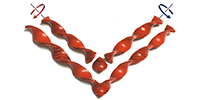
The handedness of an object has always been a binary concept: either left handed or right handed. Scientists now show that quantifying handedness as direction-dependent properties actually makes fundamental physical sense and can guide both our understanding of known handedness phenomena and design of materials with novel handed-response properties.
[Phys. Rev. X 4, 011003] Published Thu Jan 16, 2014
What if we were to dump all the tea in the world into the Great Lakes? How strong, compared to a regular cup of tea, would the lake tea be?
Alex Burman
Weak, bordering on homeopathic.
The standard cup of tea, as described by the International Organization for Standardization in ISO 3103, contains two grams of tea per 100 mL of water.[1]Further ISO standards concerning tea include ISO 3720 (black tea), ISO 11287 (green tea), and ISO 14502-2 (the difference between black tea and green tea). The Great Lakes have a volume of about 22,600 cubic kilometers, which means we would need about 450 billion tons of tea to reach proper strength.
According to the Tea Board of India, one year's global tea harvest totals only about 4.8 million tons,[2]Using figures from this report extrapolated forward to 2014. only 1/100,000th of what we'd require to make Great Lake Tea. If we dumped those 4.8 million tons into the lakes, the resulting tea would be about as strong as if we'd dripped two drops of tea in a bathtub.[3]Technically, calling this kind of tea "homeopathic" is an exaggeration, since substances in homeopathy are diluted way more than this. Proper bathtub tea, of course, requires one 3-kg bag.

For better lake tea, we should find a lake with a volume of 240 million cubic meters (0.24 cubic kilometers).
Wular Lake in Kashmir is one candidate. Its volume varies with the seasons, but during the winter it's just about exactly the right size.[4]Unfortunately, it's shrinking. (For winter volume, see the chart on page 18 of that report.) India is the world's second-largest tea producer, so it's also conveniently located.
Ullswater, in the UK's Lake District, is another great candidate. With a relatively stable year-round volume of about 0.23 cubic kilometers, it would be an excellent site for brewing a global cup of tea.
Of course, while neither Wular Lake or Ullswater has ever been used as a giant teakettle, something like this was—famously—attempted in my own backyard in Boston. In 1773, a group of colonists disguised as American Indians[5]They dressed up as American Indians to align themselves politically with the Americas—against Britain—invoking the popular European stereotype of the free and noble savage.
The Mohawk people, the actual Indians who the protesters were mimicking, mistrusted the settlers encroaching on their land, sided with the British during the subsequent war, and afterward were driven from their homes by the Americans and fled to Canada. boarded three British ships and threw the cargo of tea—around 44 tons of it—into Boston Harbor to protest British-run tax policy.
Boston Harbor has a volume of about 0.44 cubic kilometers, which means that the "tea" brewed in 1773 would have been even more dilute than our Great Lakes tea. The harbor is also somewhat larger[6]The tidal range in Boston is so large (over three meters) that the harbor's volume at high tide is nearly double what it is at low. than Wular Lake or Ullswater, so all the tea in the world would still make Boston Harbor slightly too weak.

There's another problem: Heat. If you wanted to make tea from a lake, such as Ullswater or Wular Lake, you'd have to heat the water up. Is that even possible?
There's clearly enough stored energy in the world to do it. After all, we presumably heat that amount of water for tea every year already; we just do it in small batches around the world.
To heat up Ullswater to 80°C[7]Lots of people have very strong opinions on what this temperature should be. Please direct any corrections on this matter to What-If Tea-Related Complaints Dep't, c/o Her Majesty The Queen, Buckingham Palace, London SW1A 1AA. would take \(6.6 \times 10^{16}\) joules of energy—about 20 days worth of British electricity consumption. which is roughly what would be released if you dropped a water bottle full of antimatter in the lake.

Asking Britain to go without electricity for 20 days just to fill one of their lakes with tea seems like it might be a hard sell. Fortunately, there's an easier solution.
Boiling Lake in Dominica is a volcanic lake about 60 meters across. Its temperature varies, but it's often near boiling at the edges and vigorously boiling in the center. Measuring the depth of the lake is difficult, so it's hard to get an estimate of the total volume.

Frying Pan Lake in New Zealand, on the other hand, is the largest hot lake in the world. It has a volume of about 200,000 m3, and an average temperature of around 50°C—not quite hot enough for tea, but much closer than Ullswater or Wular Lake.
New Zealanders consume about 600 grams of tea per person,[8]Kerryn Pollock. 'Tea, coffee and soft drinks', Te Ara - the Encyclopedia of New Zealand, updated 15-Jul-13 for a total of 2,700 tons of tea. If they waited until Frying Pan Lake got particularly hot, then dunked it all in at once ...

... they could brew a year's worth of tea in minutes.
Cigarettes are useful for different purposes. Perhaps the best purpose is suggested in this study:
“Cigarettes may be useful for distance runners?!? (or, How to prove anything with a review article),”
Last winter the Canadian Medical Association Journal published a fascinating article by Ken Myers discussing the (as-yet unexamined) benefits of cigarette smoking on endurance running performance. Ken is a friend and elite distance runner (we used to literally run with the same crowd while I was doing my undergrad in Calgary) so I was very excited and a bit confused when I saw his article. Could smoking really be beneficial for distance runners like myself? … the point of Ken’s article was to illustrate how you can fashion a review article to support almost any crazy theory if you’re willing to cherry-pick the right data.
Myers’s monograph is:
“Cigarette smoking: an underused tool in high-performance endurance training,” Kenneth A. Myers, Canadian Medical Association Journal, 2010 December 14; 182(18): E867–E869. The abstract says:
The review paper is a staple of medical literature and, when well executed by an expert in the field, can provide a summary of literature that generates useful recommendations and new conceptualizations of a topic. However, if research results are selectively chosen, a review has the potential to create a convincing argument for a faulty hypothesis. Improper correlation or extrapolation of data can result in dangerously flawed conclusions. The following paper seeks to illustrate this point, using existing research to argue the hypothesis that cigarette smoking enhances endurance performance and should be incorporated into high-level training programs.
(HT Deborah Blum)
| Piled Higher & Deeper by Jorge Cham |
www.phdcomics.com
|
|
 |
||
|
title:
"Professed?" - originally published
1/13/2014
For the latest news in PHD Comics, CLICK HERE! |
||
Moti Fridman alerted us to the existence of the schnitzel-laser. Fridman wrote: ”They showed how a laser can find by itself the correct phase to lase at in order to go through a thin chicken breast with no aberrations, when it is put inside the cavity. In a talk they called it the schnitzel-laser. This research shows beautifully the principle of operation of lasers to many people outside of the laser community.” The researchers published a study about it:
“Real-time wavefront-shaping through scattering media by all optical feedback,” Micha Nixon, Ori Katz, Eran Small, Yaron Bromberg, Asher A. Friesem, Yaron Silberberg, and Nir Davidson [pictured here], arXiv preprint arXiv:1303.3161 (2013). The authors report:
“we applied our technique to focus light through a thin scattering biological sample. Specifically, we replaced the diffuser with a slice of approximately 200μm thick chicken breast in water and Glycerol solution, placed between two microscopes slides. As with the optical diffuser, the light of an incident focused plane-wave was scattered to a random speckle pattern without a noticeable ballistic component (Fig .4a). However, the lasing intensity pattern maintained an effective tight focus through the scattering tissue on the target (Fig. 4b)…. We have demonstrated an all-optical technique for wavefront-shaping, focusing light through highly scattering media at unprecedented speeds, without requiring the use of adaptive algorithms, SLMs, or electronic feedback.”
BONUS: Video of a fellow named Nicko demonstrating how he makes chicken schnitzel. His method includes the playing of annoying music:
BONUS: A recipe for Chicken Schnitzel with Zigeuner Sauce
If a T-rex were released in New York City, how many humans/day would it need to consume to get its needed calorie intake?
Tony Schmitz
About half of an adult, or one ten-year old child:

Tyrannosaurus rex weighed about as much as an elephant.[1]This always seemed a little off to me; my mental image of elephants is that they're in the same size range as cars or trucks, whereas T-rex, as Jurassic Park showed, is big enough to stomp on cars. But a Google image search for car+elephant shows elephants looming over cars just like the T-rex in Jurassic Park. So, great, now I'm also afraid of elephants.

No one is totally sure what dinosaur metabolism looked like, but the best guesses for how much food T-rex ate seem to cluster around 40,000 calories per day.[2]Food calories (kcal). Sources: This and this, and this with some notes from this and distraction from this.
If we assume dinosaurs had metabolisms similar to today's mammals, they'd eat a lot more than 40,000 calories each day. But the current thinking is that while dinosaurs were more active (loosely speaking, "warm-blooded") than modern snakes and lizards, very large dinosaurs probably had metabolisms that more closely resembled komodo dragons than elephants and tigers.[3]For big sauropods, we know this must be the case, because otherwise they would overheat. However, there's a lot of uncertainty surrounding T-rex-sized dinosaurs.
Next, we need to know how many calories are in a human. This number is helpfully provided, by Dinosaur Comics author Ryan North, on this wonderful t-shirt. Ryan's shirt tells us that an 80-kg human contains about 110,000 calories of energy.
Therefore, a T-rex would need to consume a human every two days or so.[4]Although a T-rex would likely be willing to eat several days to weeks worth of food in one meal, so if it has the option, it might eat a bunch of people at a time, then go for a while without eating. The city of New York had 239,736 births in 2011, which could support a population of about 1,000 tyrannosaurs. However, this ignores immigration—and, more importantly, emigration, which would probably increase substantially in this scenario.

The 33,000 McDonald's restaurants worldwide sell something like 15 billion hamburger patties per year,[5]They stopped reporting the "x billions served" number on their signs, but this website has some extrapolations. for an average of 1,245 burgers per restaurant per day. 1,245 burgers is about 600,000 calories, which means that each T-rex only needs about 80 hamburgers per day to survive, and one McDonald's could support over a dozen tyrannosaurs on hamburgers alone.

Ands if you live in New York, and you see a T-rex, don't worry. You don't have to choose a friend to sacrifice; just order 80 burgers instead.
And then if the T-rex goes for your friend anyway, hey, you have 80 burgers.