Shared posts

03 Apr 12:07

Coherent control of the waveforms of recoilless γ-ray photons

by Farit Vagizov
Jacopo.bertolotti

Wavefront-shaping of keV light?

Coherent control of the waveforms of recoilless γ-ray photons

Nature 508, 7494 (2014). doi:10.1038/nature13018

Authors: Farit Vagizov, Vladimir Antonov, Y. V. Radeonychev, R. N. Shakhmuratov & Olga Kocharovskaya

The concepts and ideas of coherent, nonlinear and quantum optics have been extended to photon energies in the range of 10–100 kiloelectronvolts, corresponding to soft γ-ray radiation (the term used when the radiation is produced in nuclear transitions) or, equivalently, hard X-ray radiation (the term used when the radiation is produced by electron motion). The recent experimental achievements in this energy range include the demonstration of parametric down-conversion in the Langevin regime, electromagnetically induced transparency in a cavity, the collective Lamb shift, vacuum-assisted generation of atomic coherences and single-photon revival in nuclear absorbing multilayer structures. Also, realization of single-photon coherent storage and stimulated Raman adiabatic passage were recently proposed in this regime. More related work is discussed in a recent review. However, the number of tools for the coherent manipulation of interactions between γ-ray photons and nuclear ensembles remains limited. Here we suggest and implement an efficient method to control the waveforms of γ-ray photons coherently. In particular, we demonstrate the conversion of individual recoilless γ-ray photons into a coherent, ultrashort pulse train and into a double pulse. Our method is based on the resonant interaction of γ-ray photons with an ensemble of nuclei with a resonant transition frequency that is periodically modulated in time. The frequency modulation, which is achieved by a uniform vibration of the resonant absorber, owing to the Doppler effect, renders resonant absorption and dispersion both time dependent, allowing us to shape the waveforms of the incident γ-ray photons. We expect that this technique will lead to advances in the emerging fields of coherent and quantum γ-ray photon optics, providing a basis for the realization of γ-ray-photon/nuclear-ensemble interfaces and quantum interference effects at nuclear γ-ray transitions.
03 Apr 12:05

Automated screening: ArXiv screens spot fake papers

by Paul Ginsparg

Automated screening: ArXiv screens spot fake papers

Nature 508, 7494 (2014). doi:10.1038/508044a

Author: Paul Ginsparg

Unlike the computer-generated nonsense papers in some peer-reviewed subscription services (see Naturehttp://doi.org/r3n; 2014), the 500 or so preprints received daily by the automated repository arXiv are not pre-screened by humans. But sometimes automated assessment can be better than human diligence at enforcing

03 Apr 10:44

Evidence for Gravitational Lensing of the Cosmic Microwave Background Polarization from Cross-Correlation with the Cosmic Infrared Background

by P. A. R. Ade et al. (POLARBEAR Collaboration)
Jacopo.bertolotti

Wasn't the BICEP2 that showed gravitational waves in the CMB a few weeks ago?

Author(s): P. A. R. Ade et al. (POLARBEAR Collaboration)

We reconstruct the gravitational lensing convergence signal from cosmic microwave background (CMB) polarization data taken by the Polarbear experiment and cross-correlate it with cosmic infrared background maps from the Herschel satellite. From the cross spectra, we obtain evidence for gravitational...

[Phys. Rev. Lett. 112, 131302] Published Wed Apr 02, 2014

03 Apr 09:16

“Internet of Things” is the new Windows XP—malware’s favorite target

by Dan Goodin
Jacopo.bertolotti

The whole concept of "the internet of things" seems flawed to me.

The past few days have revealed new data that suggests the recent upsurge in malware targeting routers—as Ars has chronicled here, here, and here—is not only continuing, but it's spreading to digital video recorders (DVRs).

Exhibit A came Monday from researchers at security training institute Sans, which unearthed a Bitcoin-mining trojan that has infected DVRs. The researchers found the infection while researching the source of an automated script they observed scanning the Internet for data storage devices made by Synology. The researchers eventually found that the bot ran on a DVR with an ARM processor but didn't know much else. They later determined it was part of a Bitcoin miner that took control of DVRs used to record video from security cameras, most likely by exploiting an exposed telnet port and a default root password of "12345." Samples of the malware are here. The password to access the binaries is "infected."

On Tuesday, Sans researchers uncovered evidence that the binaries can also infect routers, even when they're configured to provide network address translation (NAT), which can help lock down the security of devices on a network.

Read 6 remaining paragraphs | Comments

02 Apr 09:33

Foundations of quantum mechanics

by Iulia Georgescu

Nature Physics 10, 253 (2014). doi:10.1038/nphys2934

Author: Iulia Georgescu

01 Apr 15:47

Lorenz

Jacopo.bertolotti

Notice: Not working on the feed reader. Go to the XKCD page and get lost into it.
Or don't and stay productive.

01 Apr 13:34

Duplication in physics journal questions key tenet of quantum mechanics

by amarcus41
Jacopo.bertolotti

Retractions in Physics are not so common. But apparently we are far from immune to the disease.

Here’s a physics question: How is possible to be in two places at the same time? Answer: Submit the same manuscript twice and hope the editors forget to feed Schrodinger’s cat. The journal Condensed Matter Physics is retracting a 2013 paper by a Ukrainian scientist who’d published essentially the same paper seven years earlier.The article […]
01 Apr 07:43

Anomalous diffusion in nonhomogeneous media: Time-subordinated Langevin equation approach

by Tomasz Srokowski
Jacopo.bertolotti

(actually the paper is less interesting than the title suggests...)

Author(s): Tomasz Srokowski

Diffusion in nonhomogeneous media is described by a dynamical process driven by a general Lévy noise and subordinated to a random time; the subordinator depends on the position. This problem is approximated by a multiplicative process subordinated to a random time: it separately takes into account e...

[Phys. Rev. E 89, 030102] Published Mon Mar 31, 2014

01 Apr 07:36

Viewpoint: A Step Towards a Seismic Cloak

Jacopo.bertolotti

Fun experiment to do

A large-scale experiment shows that a periodic array of boreholes embedded in the soil can deflect the energy of an incoming seismic wave.

Published Mon Mar 31, 2014
31 Mar 16:37

Physics: QBism puts the scientist back into science

by N. David Mermin

Physics: QBism puts the scientist back into science

Nature 507, 7493 (2014). doi:10.1038/507421a

Author: N. David Mermin

A participatory view of science resolves quantum paradoxes and finds room in classical physics for 'the Now', says N. David Mermin.

28 Mar 13:33

A parlous state

A parlous state

Nature 507, 7493 (2014). doi:10.1038/507400a

The decay at ancient Pompeii is symbolic of a deeper malaise in Italy’s heritage.

28 Mar 13:31

Research tools: Jump off the page

by Amanda Mascarelli
Jacopo.bertolotti

I would love to. But I do not know of any suitable software that really works.

Research tools: Jump off the page

Nature (2014). doi:10.1038/nj7493-523a

Author: Amanda Mascarelli

Researchers are learning to embrace online lab notebooks, but not without growing pains.

28 Mar 13:13

Two-plasmon quantum interference

by James S. Fakonas

Nature Photonics 8, 317 (2014). doi:10.1038/nphoton.2014.40

Authors: James S. Fakonas, Hyunseok Lee, Yousif A. Kelaita & Harry A. Atwater

28 Mar 13:13

Experimental three-photon quantum nonlocality under strict locality conditions

by C. Erven
Jacopo.bertolotti

Loophole-free violation of Bell inequalities?

Nature Photonics 8, 292 (2014). doi:10.1038/nphoton.2014.50

Authors: C. Erven, E. Meyer-Scott, K. Fisher, J. Lavoie, B. L. Higgins, Z. Yan, C. J. Pugh, J.-P. Bourgoin, R. Prevedel, L. K. Shalm, L. Richards, N. Gigov, R. Laflamme, G. Weihs, T. Jennewein & K. J. Resch

28 Mar 13:02

[Report] Quantifying Global International Migration Flows

by Guy J. Abel
Jacopo.bertolotti

"Contrary to common belief, our data do not indicate a continuous increase in migration flows over the past two decades"

Estimates are provided for the international flow of people over 5-year periods between 1990 and 2010. Authors: Guy J. Abel, Nikola Sander
28 Mar 11:52

[Report] Optical Broadband Angular Selectivity

by Yichen Shen
A photonic crystal heterostructure is designed to provide optical selection based on propagation direction. Authors: Yichen Shen, Dexin Ye, Ivan Celanovic, Steven G. Johnson, John D. Joannopoulos, Marin Soljačić
28 Mar 11:50

[Report] Observation of Brownian Motion in Liquids at Short Times: Instantaneous Velocity and Memory Loss

by Simon Kheifets
The motions of Brownian particles are tracked and evaluated on short time scales where solvent effects play a role. Authors: Simon Kheifets, Akarsh Simha, Kevin Melin, Tongcang Li, Mark G. Raizen
28 Mar 10:15

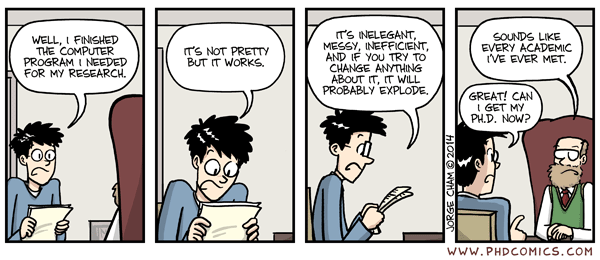
03/26/14 PHD comic: 'Not Pretty'

Piled Higher & Deeper by Jorge Cham
www.phdcomics.com
Click on the title below to read the comic
title: "Not Pretty" - originally published 3/26/2014

For the latest news in PHD Comics, CLICK HERE!

28 Mar 08:09

explore-blog: A technical glitch causes the Hubble Space...


explore-blog:

A technical glitch causes the Hubble Space Telescope, which ordinarily captures magnificently crisp scientific imagery of the cosmos, to lose balance and create this inadvertent piece of modern art.

It is suspected that in this case, Hubble had locked onto a bad guide star, potentially a double star or binary. This caused an error in the tracking system, resulting in this remarkable picture of brightly colored stellar streaks. The prominent red streaks are from stars in the globular cluster NGC 288. 

26 Mar 09:25

Synopsis: Giving Weight to Antimatter

A proposed matter-wave interferometer would enable the test of the gravitational properties of antimatter.

Published Tue Mar 25, 2014
26 Mar 09:05

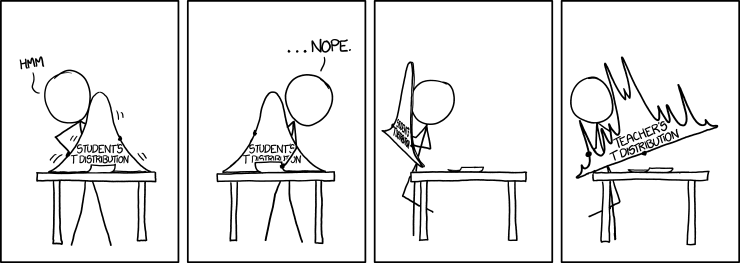
t Distribution

If data fails the Teacher's t test, you can just force it to take the test again until it passes.
25 Mar 17:05

The pilot-wave perspective on spin

The alternative pilot-wave theory of quantum phenomena—associated especially with Louis de Broglie, David Bohm, and John Bell—reproduces the statistical predictions of ordinary quantum mechanics but without recourse to special ad hoc axioms pertaining to measurement. That (and how) it does so is relatively straightforward to understand in the case of position measurements and, more generally, measurements, whose outcome is ultimately registered by the position of a pointer. Despite a widespread belief to the contrary among physicists, the theory can also account successfully for phenomena involving spin. The main goal of this paper is to explain how the pilot-wave theory's account of spin works. Along the way, we provide illuminating comparisons between the orthodox and pilot-wave accounts of spin and address some puzzles about how the pilot-wave theory relates to the important theorems of Kochen and Specker and Bell.

25 Mar 17:05

The Schwarzschild metric: It's the coordinates, stupid!

Every general relativity textbook emphasizes that coordinates have no physical meaning. Nevertheless, a coordinate choice must be made in order to carry out real calculations, and that choice can make the difference between a calculation that is simple and one that is a mess. We give a concrete illustration of the maxim that “coordinates matter” using the exact Schwarzschild solution for a vacuum, static spherical spacetime. We review the standard textbook derivation, Schwarzschild's original 1916 derivation, and a derivation using the Landau-Lifshitz formulation of the Einstein field equations. The last derivation is much more complicated, has one aspect for which we have been unable to find a solution, and gives an explicit illustration of the fact that the Schwarzschild geometry can be described in infinitely many coordinate systems.

25 Mar 09:50

The single-channel regime of transport through random media

by A. Peña

Article

Understanding and controlling the transport of light through random media is important for many applications. Here, Peña et al . demonstrate how in the deeply localized regime transport is mediated by a single transmission channel composed of a localized internal mode or a necklace state.

Nature Communications doi: 10.1038/ncomms4488

Authors: A. Peña, A. Girschik, F. Libisch, S. Rotter, A. A. Chabanov

25 Mar 09:46

Propagation of nonclassical states of light through one-dimensional photonic lattices

by B. M. Rodríguez-Lara
B. M. Rodríguez-Lara
We study the propagation of nonclassical light through arrays of coupled linear photonic waveguides and introduce some sets of refractive indices and coupling parameters that provide a closed-form propagator in terms of orthogonal polynomials. We present propagation examples of nonclassical states ... [J. Opt. Soc. Am. B 31, 878-881 (2014)]
24 Mar 17:30

Time-Reversal Generation of Rogue Waves

by Amin Chabchoub and Mathias Fink

Author(s): Amin Chabchoub and Mathias Fink

Selected for a Synopsis in Physics The formation of extreme localizations in nonlinear dispersive media can be explained and described within the framework of nonlinear evolution equations, such as the nonlinear Schrödinger equation (NLS). Within the class of exact NLS breather solutions on a finite background, which describe the mo...
[Phys. Rev. Lett. 112, 124101] Published Mon Mar 24, 2014

24 Mar 08:35

Where did all the risk-takers go?

by Chris Lee

In a recent letter to The Guardian, a very prominent group of scientists made the case for allowing more mavericks in science. I have a lot of sympathy with them, in part because they are right. The scientists who make the largest contributions are also the ones who do stuff no one else thought of, or work on a problem that everyone else thought was uninteresting. They are the ones willing to break the rules to do an experiment that they thought was absolutely necessary.

The impact of risky research cannot be overstated, so a plea to nurture risk-takers seems obvious. But, exactly who are we pleading with here? Most governments are largely hands-off when it comes to disbursing funds for scientific research. The people who decide if Jane Scientist gets some money are John and Jenny Scientist. So, why are scientists themselves so unwilling to give money to truly risky ideas?

Paying for risk

I don't think there is any single answer to this, but let me outline a few ideas that define the problem. My first successful grant application was, as the head of the grant committee told me afterward, funded because they always try to fund a couple of things that they think won't work. Now, every time I tell this story, everyone says "Oh, that's great, that is what we need more of." But, there is a difference between throwing 10 to 20 thousand dollars at a young researcher like me to try a few quick experiments and throwing a major grant 200 to 500 thousand dollars and putting the success of a PhD student on the line in the process.

Read 15 remaining paragraphs | Comments

21 Mar 14:35

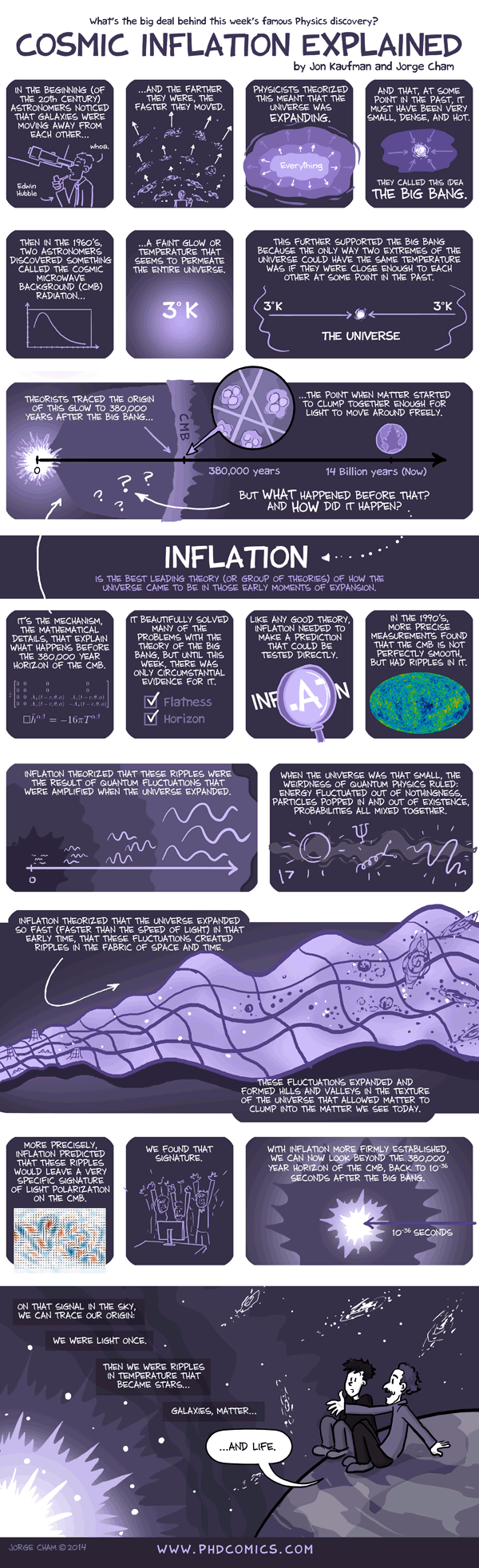
03/19/14 PHD comic: 'Cosmic Inflation Explained'

Piled Higher & Deeper by Jorge Cham
www.phdcomics.com
Click on the title below to read the comic
title: "Cosmic Inflation Explained" - originally published 3/19/2014

For the latest news in PHD Comics, CLICK HERE!

21 Mar 11:40

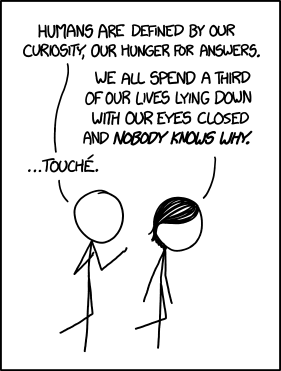
Answers

Stanford sleep researcher William Dement said that after 50 years of studying sleep, the only really solid explanation he knows for why we do it is 'because we get sleepy'.
21 Mar 08:32

Synthetic optical holography for rapid nanoimaging

by M. Schnell
Jacopo.bertolotti

Probably useful, but it doesn't look too different from any other digital holography method.

Article

Holography provides amplitude and phase information when imaging objects, which enables greater understanding of a range of samples. Here, the authors adapt holography to scanning near-field optical microscopy, providing rapid phase-resolved imaging on the nanoscale at visible and infrared frequencies.

Nature Communications doi: 10.1038/ncomms4499

Authors: M. Schnell, P. S. Carney, R. Hillenbrand