Shared posts

20 Aug 14:18

“… yet the world it describes is a mess”

by Marc Abrahams

Physics may aim for simplicity, yet the world it  describes is a mess.”

That’s the start of John Cartwright’s article, “Roll Over, Bolzmann,” in the magazine Physics World. It tells the story of Tsallis entropy:

BoltzmannOur definition of entropy is expressed by one of the most famous formulae in physics, and dates back over a century to the work of the Austrian physicist Ludwig Boltzmann [pictured here] and the American chemist J Willard Gibbs. For more than 20 years, however, the Greek-born physicist Constantino Tsallis, who is based at the Brazilian Centre for Physics Research (CBPF) in Rio de Janeiro, has been arguing that entropy is in need of some refinement. The situation, according to Tsallis, is rather like Newtonian mechanics – a theory that works perfectly until speeds approach that of light, at which point Einstein’s special theory of relativity must take over. Likewise, says Tsallis, entropy – as defined by Boltzmann and Gibbs – works perfectly, but only within certain limits….

(Thanks to Ig Nobel Prize winner Andrea Rapisarda for bringing this to our attention.)

20 Aug 14:03

August 20, 2014


You only have till August 22nd to get your BAHFest submission in!
20 Aug 08:39

Synopsis: Zeeman Effect Induced by Light Waves

The magnetic field of intense visible light should have a major effect on the spectra of plasmas made from a wide range of elements.

Published Tue Aug 19, 2014
20 Aug 08:28

08.20.2014

New Cyanide and Happiness Comic.
19 Aug 09:17

Radiative Bistability and Thermal Memory

by Viacheslav Kubytskyi, Svend-Age Biehs, and Philippe Ben-Abdallah

Author(s): Viacheslav Kubytskyi, Svend-Age Biehs, and Philippe Ben-Abdallah

Selected for a Synopsis in Physics Theorists propose a “thermal” memory—one based on temperature, rather than voltage—that could switch from zero to one faster than other designs.

[Phys. Rev. Lett. 113, 074301] Published Fri Aug 15, 2014

15 Aug 09:24

Antibufala: assassino chiede a Siri come occultare il cadavere. Ma anche no

by Paolo Attivissimo
Questo articolo vi arriva grazie alla gentile donazione di “algon2008”.

Varie fonti di stampa (Daily MailIl Mattino, Leggo.it, Ticinonews.ch) hanno riportato la notizia che un uomo, il ventenne Pedro Bravo, nel 2012 in Florida avrebbe ucciso il coinquilino Christian Aguilar per gelosia e poi avrebbe chiesto a Siri, l'assistente vocale dell'iPhone, dove nascondere il cadavere del coinquilino. La perizia sul telefonino di Bravo avrebbe rivelato la schermata con la precisa richiesta d'informazioni (“I need to hide my roommate”) che lo avrebbe incastrato.

Ma in realtà le indagini dimostrano che la schermata è uno scherzo proveniente da Facebook e che oltretutto nel 2012 il presunto omicida aveva un iPhone 4, che non supportava Siri. Inoltre la vittima non era affatto un coinquilino.

Tutta la storia è insomma stata gonfiata dai media, ingolositi dalla particolarità dell'uso (apparente) di Siri come assistente per un delitto. Maggiori dettagli e link alle fonti originali sono qui su Gawker.

Scritto da Paolo Attivissimo per il blog Il Disinformatico. Ripubblicabile liberamente se viene inclusa questa dicitura (dettagli). Sono ben accette le donazioni Paypal.
15 Aug 08:09

[Report] Programmable self-assembly in a thousand-robot swarm

by Michael Rubenstein
A thousand-robot swarm can self-assemble into complex shapes through programmed local interactions. Authors: Michael Rubenstein, Alejandro Cornejo, Radhika Nagpal
15 Aug 08:06

[In Depth] Debate erupts on ‘repurposed’ drugs for Ebola

by Martin Enserink
With experimental treatments in short supply, some researchers think existing medicines might work. Author: Martin Enserink
14 Aug 09:18

Mental health: Stressed students reach out for help

by Julie Gould

Mental health: Stressed students reach out for help

Nature 512, 7513 (2014). doi:10.1038/nj7513-223a

Author: Julie Gould

Graduate students struggling with the stresses of their work and lives can tap into multiple avenues of support.

14 Aug 09:17

Sexual harassment: Create ethics codes to curb sex abuse

by Margaret C. Hardy

Sexual harassment: Create ethics codes to curb sex abuse

Nature 512, 7513 (2014). doi:10.1038/512136d

Author: Margaret C. Hardy

A survey published last month found evidence of alarming levels of sexual violence (towards 26% of women and 6% of men) in the course of fieldwork by life scientists (see Naturehttp://doi.org/t3n; 2014). Meanwhile, more than 50 US higher-education institutions are under investigation

14 Aug 09:16

Online collaboration: Scientists and the social network

by Richard Van Noorden
Jacopo.bertolotti

Not really sure all those "scientific"social networks have any real use. Guess only time will tell.

Online collaboration: Scientists and the social network

Nature 512, 7513 (2014). http://www.nature.com/doifinder/10.1038/512126a

Author: Richard Van Noorden

Giant academic social networks have taken off to a degree that no one expected even a few years ago. A Nature survey explores why.

13 Aug 16:55

Tomography by Noise

by G. Harder, D. Mogilevtsev, N. Korolkova, and Ch. Silberhorn

Author(s): G. Harder, D. Mogilevtsev, N. Korolkova, and Ch. Silberhorn

A new method for measuring the photon number distribution of an optical field is demonstrated; the unknown photon signal is mixed with incoherent noise and then measured with a simple on/off detector.

[Phys. Rev. Lett. 113, 070403] Published Wed Aug 13, 2014

11 Aug 11:59

Off the radar

by fabristol

Da giorni leggo sui giornali de “la guerra in Medio-Oriente”, de “la più grande crisi umanitaria”, degli appelli di pacifisti vari per l’una o l’altra parte, dei potenti della terra che cercano di trovare una soluzione, di migliaia di commenti pro o contro Israele o pro o contro Hamas copia-incolla delle guerre precedenti tra Israele-Palestina (sinceramente mi sentirei un po’ stupido nel 2014 a dover scrivere ancora di argomenti triti e ritriti sulla situazione israelo-palestinese. Seriously? Get over it. A cominciare dal fatto che oggi sì dovrebbe chiamare conflitto israelo/egiziano/saudita contro Hamas). L’attenzione è stata “rapita” volontariamente da media e politici e dai pappagalli che ripetono sul web tutto quello che gli danno in pasto i primi due su una guerra così sopravalutata che mi vengono i conati appena ne sento parlare.

Mentre in Palestina morivano terroristi di Hamas e civili nel numero di 1850 persone circa, nel raggio di appena 2000 chilometri venivano trucidate, impalate e decapitate decine di migliaia di persone, mezzo milione cercavano rifugio nei paesi vicini, decine di moschee e templi venivano rasi al suolo, la sharia veniva imposta su 6 milioni di abitanti e due stati venivano cancellati dalle mappe geografiche.

Quello che vi siete persi nelle puntate precedenti (perché eravate troppo intenti a dare dei puzzoni ai palestinesi o dei nazisionisti agli israeliani):

1) L’ISIS (o come ha imposto ai suoi sudditi d’ora in poi IS, pena frustate e multa) si è espanso verso il nord. Ha catturato la più grande diga del nord del paese, quella di Mosul e per la prima volta sta combattendo contro i peshmerga curdi. Peshmerga che per la prima volta hanno chiesto l’intervento dell’aviazione irakena.

2) nel frattempo l’ISIS ha già trovato il prossimo target, il Libano, dove ha conquistato una città al confine tra Libano e Siria. Simpatizzanti dell’ISIS hanno dimostrato nelle strade di Tripoli e il Libano si appresta a diventare il prossimo stato mediorientale a cadere nell’inferno della guerra civile sciiti-sunniti.

3) mentre i media di tutto il mondo si stanno scandalizzando per i cristiani a cui viene imposta la jizya, la tassa sui seguaci delle religioni del Libro, o l’esilio centinaia di migliaia di Yazidi scappavano sulle colline del Kurdistan da morte certa dopo che l’ISIS ha bombardato con colpi di mortaio il loro principale villaggio al Nord dell’Iraq. I poveri Yazidi, appena 500000, non hanno nessuno in Europa che simpatizzi per loro. La Francia si è offerta di accogliere i cristiani irakeni ma nessuno si è offerto di accogliere gli Yazidi, una religione di serie B evidentemente. La solidarietà è selettiva si sa. Questo è il 73esimo massacro della millenaria storia degli Yazidi, seguaci di una religione antichissima e vicina allo Zoroastrismo. I mujaidin dell’ISIS hanno ucciso a sangue freddo centinaia di uomini Yazidi e rapito migliaia tra donne e bambini di cui non si sa più nulla. Uccisi perché infedeli adoratori del diavolo, secondo l’Islam, non perché resistenti o armati. Neppure la scelta della jizya per loro. Tra l’altro la jizya nei califfati del passato c’è sempre stata. I califfati che i radical-chic in Europa considerano tolleranti. Parlano perfino di epoca d’oro dell’Islam. Un posto dove devi pagare una tassa perché sei un cittadino di serie B. Chissà se gli stessi radical chic si scandalizzano per l’imposizione della jizya ai cristiani irakeni oggi. Ma come 500 anni fa era tolleranza, ora invece fondamentalismo?

4) con questa nota vorrei ringraziare quel simpaticone di Sarkozy che ha ucciso Gheddafi lasciando la Libia nel caos più o meno allo stesso livello della Somalia. Mentre postavate su Facebook le immagini dei bambini palestinesi che piangono con il pupazzo in mano la Libia è scomparsa, non esiste più. Infatti l’aeroporto di Tripoli è distrutto, Bengasi è stata proclamata un califfato affiliato all’ISIS e Ansar Al Sharia, il più grande gruppo jihadista del maghreb ha giurato fedeltà a Al Baghdadi, il parlamento è scappato a Tobruk. Ah, 13000 filippini sono stati salvati da navi greche (nei giorni scorsi un filippino è stato decapitato in pubblico e una filippina stuprata da una gang di jihadisti) e decine di migliaia di stranieri stanno scappando in queste ore su navi militari britanniche, greche e maltesi per sfuggire al massacro. Algeria e Egitto stano pensando ad un attacco militare in territorio libico e decine di militari tunisini e egiziani sonos tati uccisi in scontri a fuoco al confine con la Libia. Per quanto mi riguarda la Libia non esiste più e si limita alla città stato di Tobruk. Poi fate voi eh. Fate finta che a poche miglia dalle coste siciliane ci sia ancora un paese che si chiama Libia.

5) potrei continuare a parlarvi di Boko Haram in Nigeria, di Al shabab in Somalia e Kenia, dei simpatizzanti pro-ISIS in India, Pakistan, Kashmir o degli occidentali che stanno partendo in migliaia per il fronte tra cui centinaia di britannici. Carina la storia delle gemelle britanniche che studiavano medicina a Machester che candidamente hanno detto che “Non voglio studiare per curare questi pagani. Ora farò il medico per i combattenti dell’ISIS.”

Quello che sta succedendo ha dell’incredibile: l’avanzata dell’ISIS ha la stessa importanza storica di una Rivoluzione Francese, di una guerra civile spagnola o della salita al potere de bolshevichi. La gente non si rende conto di quello che sta succedendo. La Rivoluzione jihadista non si può fermare più e arriverà a lambire l’Europa in pochi anni. tutti i rapporti di forza verranno riscritti, l’intera mappa del vecchio continente, dell’africa e dell’asia verrà riscritta. E anche se l’ISIS verrà fermato come fu fermata la Rivoluzione francese, arriverà sempre un Napoleone su cavallo che sguaina una scimitarra che cambierà il mondo o un Gengis Khan che lo raderà al suolo. E tutto questo mentre i giornali italiani danno consigli sulla prova bikini o sulle file chilometriche augostane. Buona apocalisse a tutti.


08 Aug 13:52

August 08, 2014


If you're interested in parasites, Kelly did an interview.
08 Aug 10:35

[Report] A million spiking-neuron integrated circuit with a scalable communication network and interface

by Paul A. Merolla
A large-scale computer chip mimics many features of a real brain. Authors: Paul A. Merolla, John V. Arthur, Rodrigo Alvarez-Icaza, Andrew S. Cassidy, Jun Sawada, Filipp Akopyan, Bryan L. Jackson, Nabil Imam, Chen Guo, Yutaka Nakamura, Bernard Brezzo, Ivan Vo, Steven K. Esser, Rathinakumar Appuswamy, Brian Taba, Arnon Amir, Myron D. Flickner, William P. Risk, Rajit Manohar, Dharmendra S. Modha
08 Aug 10:35

[Feature] The brain chip

by Robert F. Service
Microprocessors modeled on networks of nerve cells promise blazing speed at incredibly low power—if they live up to hopes. Author: Robert F. Service
08 Aug 08:36

[Letter] Breeding for speed

by R. Michael Roberts
Jacopo.bertolotti

What to say? LOL!

Author: R. Michael Roberts
07 Aug 09:09

Europe needs a research leader who will lead

by Colin Macilwain

Europe needs a research leader who will lead

Nature 512, 7512 (2014). http://www.nature.com/doifinder/10.1038/512007a

Author: Colin Macilwain

The next research commissioner for the European Union will need the drive and confidence to clear a daunting in-tray, argues Colin Macilwain.

07 Aug 08:48

Divulgare è barare?

by Maurizio Codogno

Non è facile trovare la giusta via tra semplificazione e correttezza [Continua]

The post Divulgare è barare? appeared first on Il Post.

06 Aug 16:54

Synopsis: Scaling Up Quantum Computers for Chemistry

Quantum computers will need a gargantuan increase in the number of gates to push the current boundaries in chemistry calculations.

Published Wed Aug 06, 2014
06 Aug 09:29

Maybe Definitely Give This Person Tenure

by Female Science Professor
By request, this is a follow-up post on last week's musing about being the external letter-writer for someone's tenure/promotion evaluation. Today I will compare the wording of positive letters vs. not-so-positive (but not killer negative) letters (in the US academic system) to demonstrate the differences; some differences are obvious and some are less so. Although some external letter writers evaluating candidates for tenure/promotion write unambiguously negative letters, most letters are either positive or positive-ish.

I don't think the opening sentence is necessarily very indicative, although letters that start by saying that it is a "pleasure" to write the letter (perhaps even a "strong letter of support") of course tend to be very positive. Letters that start with a basic statement and perhaps a description of how the letter-writer has interacted (or not) with the candidate could go either way.

Positive letters tend to start positive and stay that way, with any quibbles buried deep within them. In my experience, lukewarm letters tend to start positive or positive-ish and then decay in magnitude of positiveness for the rest of the letter. I am not sure that I have seen a letter start negative or lukewarm and end up highly positive, although I have seen letters that I thought were quite negative end with a statement that the candidate would get tenure at the letter-writer's (in some cases elite) institution; that can be confusing.

Unambiguous positive statements that might appear in a very positive letter:

Dr. (or Professor) X is a world leader/pioneer/internationally known and respected specialist in [research field].

Dr. X and his/her students/postdocs have published (many) excellent papers on [topic/s].


Faint-praise statements that might appear in a lukewarm letter:

Dr. X is a specialist in [research field].

Dr. X has made contributions to the field of [topic].

Dr. X's research appears to be quite solid. 

Note: To make those statements even more negative, the research field could be described as narrowly as possible.


Examples of very positive words and phrases:

strong (inter)national reputation, novel, creative, major/significant/signal/tremendous/impressive/insightful/brilliant contributions, rigorous, breadth and depth, breakthroughs, widely respected, widely sought as an invited speaker, key player, true scholar, fundamental/leadership role, taking the lead (etc.), groundbreaking, rising star, international star, exceptional, exceptionally strong case for tenure, original/originality, elegant (referring to research, not the person), high profile, swimming at the top of the talent pool, the world beats a path to X's door, having X on your faculty brings renown to your institution.

Note that the hyper-positive adjective-laden letters tend to come from US academics or those very familiar with the US system. Non-US letters tend to be more restrained (the same is true for proposal reviews) and readers of such letters need to calibrate for this. The statement "Dr. X's research is quite good" might translate into Americanish to "Dr. X is the world leader and pioneer in creative and insightful investigation of a wide range of significant research topics."

Lukewarm (US) letters are characterized by fewer adjectives and of course few/no strong-positive adjectives. They may instead have faint-praise type adjectives such as 'solid', 'good' (with or without some other mild adjectives). The mild equivalent of the very-positive description 'has been extraordinarily/very productive' might be something like, 'has apparently been quite busy'; the positive 'focused' and talk of depth/breadth could translate as a negative-ish description of someone's 'varied interests'. Other not-awesome words are 'reasonably' and 'rather'.

Positive letters may actively propose explanations for some perceived weaknesses in the file:

Dr. X's h-index is a bit low even for someone at this early career stage but [sentences about how the h-index is a meaningless indicator of anything useful].

Dr. X does not have as many publications as one might like to see for a tenure candidate but there is too much emphasis these days on number of publications. Dr X's publications are all of very high quality and are all in high-impact and very selective journals. [This may be accompanied by an anti-shingling rant or opining about how Dr. X is a true scholar who waits to publish high-quality results that will stand the test of time.]

Dr. X has worked on a wide variety of topics rather than focusing on any particular thing but this is remarkable confirmation of her/his versatility, breadth, and boundless intellectual curiosity.

Dr. X has mostly been a middle-of-the-pack coauthor on his/her papers rather than the obvious lead author but I happen to know that Dr. X's senior collaborators are very aggressive about promoting their own work and tend to do this to younger coauthors.

Any of the above can of course be turned into a criticism if the reviewer is so inclined.

Or, lukewarm letters might mention some of the same things listed above but the rebuttal would not be as strong:

Dr. X's h-index is a bit low even for someone at this early career stage but it may increase somewhat in the future. (etc.)


Strong positive letters typically end on an emphatic note:

I highly recommend with no reservations whatsoever that Dr. X be awarded tenure.

I have no doubt that Dr. X would be awarded tenure at my institution.
etc.

Lukewarm letters tend to end on an ambiguous note:

I hope that my comments on Dr. X will be helpful to your evaluation of Dr. X for tenure and promotion.


I hope that these comments on tenure and promotion letters are helpful to FSP readers who are curious/anxious about this even if they are rising stars swimming at the top of the talent pool buoyed by their towering intellects.


06 Aug 08:22

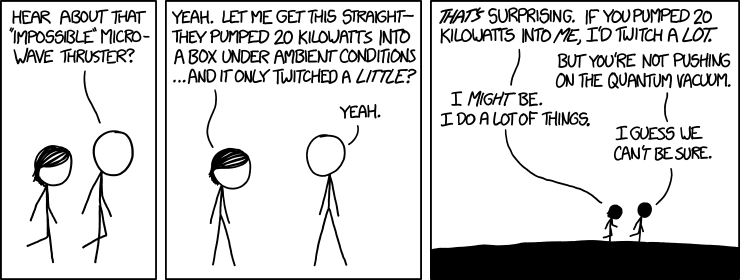
Quantum Vacuum Virtual Plasma

I don't understand the things you do, and you therefore may represent an interaction with the quantum vacuum virtual plasma.
04 Aug 07:26

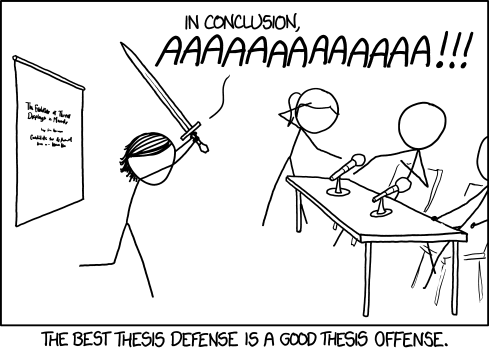
Thesis Defense

MY RESULTS ARE A SIGNIFICANT IMPROVEMENT ON THE STATE OF THE AAAAAAAAAAAART
01 Aug 14:05

[Working Life] The stressed-out postdoc

by Carrie Arnold
Author: Carrie Arnold
01 Aug 14:05

[Perspective] A gem of a quantum teleporter

by Mete Atatüre
Diamond-based quantum teleportation works every time [Also see Research Article by Pfaff et al.] Authors: Mete Atatüre, John J. L. Morton
01 Aug 13:01

Terahertz compressive imaging with metamaterial spatial light modulators

by Claire M. Watts

Nature Photonics 8, 605 (2014). doi:10.1038/nphoton.2014.139

Authors: Claire M. Watts, David Shrekenhamer, John Montoya, Guy Lipworth, John Hunt, Timothy Sleasman, Sanjay Krishna, David R. Smith & Willie J. Padilla

Imaging at long wavelengths, for example at terahertz and millimetre-wave frequencies, is a highly sought-after goal of researchers because of the great potential for applications ranging from security screening and skin cancer detection to all-weather navigation and biodetection. Here, we design, fabricate and demonstrate active metamaterials that function as real-time tunable, spectrally sensitive spatial masks for terahertz imaging with only a single-pixel detector. A modulation technique permits imaging with negative mask values, which is typically difficult to achieve with intensity-based components. We demonstrate compressive techniques allowing the acquisition of high-frame-rate, high-fidelity images. Our system is all solid-state with no moving parts, yields improved signal-to-noise ratios over standard raster-scanning techniques, and uses a source orders of magnitude lower in power than conventional set-ups. The demonstrated imaging system establishes a new path for terahertz imaging that is distinct from existing focal-plane-array-based cameras.

01 Aug 12:45

The theory of pattern formation on directed networks

by Malbor Asllani

Article

The study of pattern formation in reaction–diffusion systems has been mainly restricted to symmetric (undirected) networks. Here, Asllani et al. identify a different pattern formation mechanism in a larger class of networks incorporating the possibility of unequal weights for transport along edges.

Nature Communications doi: 10.1038/ncomms5517

Authors: Malbor Asllani, Joseph D. Challenger, Francesco Saverio Pavone, Leonardo Sacconi, Duccio Fanelli

01 Aug 12:15

Locality of Temperature

by M. Kliesch, C. Gogolin, M. J. Kastoryano, A. Riera, and J. Eisert

Author(s): M. Kliesch, C. Gogolin, M. J. Kastoryano, A. Riera, and J. Eisert


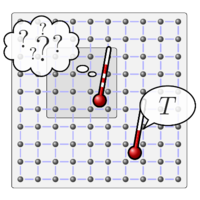
Creative Commons Measuring temperature on very small scales is a difficult task and it is not clear if temperature as a local property is even meaningful at such scales. New mathematical tools show that an intensive definition of temperature is possible whenever the global temperature is above a critical value.

[Phys. Rev. X 4, 031019] Published Thu Jul 31, 2014

01 Aug 07:25

This thumbdrive hacks computers. “BadUSB” exploit makes devices turn “evil”

by Dan Goodin

When creators of the state-sponsored Stuxnet worm used a USB stick to infect air-gapped computers inside Iran's heavily fortified Natanz nuclear facility, trust in the ubiquitous storage medium suffered a devastating blow. Now, white-hat hackers have devised a feat even more seminal—an exploit that transforms keyboards, Web cams, and other types of USB-connected devices into highly programmable attack platforms that can't be detected by today's defenses.

Dubbed BadUSB, the hack reprograms embedded firmware to give USB devices new, covert capabilities. In a demonstration scheduled at next week's Black Hat security conference in Las Vegas, a USB drive, for instance, will take on the ability to act as a keyboard that surreptitiously types malicious commands into attached computers. A different drive will similarly be reprogrammed to act as a network card that causes connected computers to connect to malicious sites impersonating Google, Facebook or other trusted destinations. The presenters will demonstrate similar hacks that work against Android phones when attached to targeted computers. They say their technique will work on Web cams, keyboards, and most other types of USB-enabled devices.

"Please don't do anything evil"

"If you put anything into your USB [slot], it extends a lot of trust," Karsten Nohl, chief scientist at Security Research Labs in Berlin, told Ars. "Whatever it is, there could always be some code running in that device that runs maliciously. Every time anybody connects a USB device to your computer, you fully trust them with your computer. It's the equivalent of [saying] 'here's my computer; I'm going to walk away for 10 minutes. Please don't do anything evil."

Read 10 remaining paragraphs | Comments

31 Jul 13:21

nieuwebegin: ilovecharts: Information vs Knowledge via Greg...


nieuwebegin:

ilovecharts:

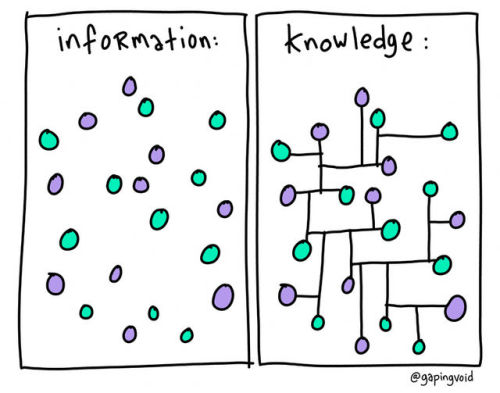
Information vs Knowledge

via Greg Russell

Brilliant.