Shared posts

31 Jul 09:13

Mapping the optimal route between two quantum states

by S. J. Weber

Mapping the optimal route between two quantum states

Nature 511, 7511 (2014). doi:10.1038/nature13559

Authors: S. J. Weber, A. Chantasri, J. Dressel, A. N. Jordan, K. W. Murch & I. Siddiqi

A central feature of quantum mechanics is that a measurement result is intrinsically probabilistic. Consequently, continuously monitoring a quantum system will randomly perturb its natural unitary evolution. The ability to control a quantum system in the presence of these fluctuations is of increasing importance in quantum information processing and finds application in fields ranging from nuclear magnetic resonance to chemical synthesis. A detailed understanding of this stochastic evolution is essential for the development of optimized control methods. Here we reconstruct the individual quantum trajectories of a superconducting circuit that evolves under the competing influences of continuous weak measurement and Rabi drive. By tracking individual trajectories that evolve between any chosen initial and final states, we can deduce the most probable path through quantum state space. These pre- and post-selected quantum trajectories also reveal the optimal detector signal in the form of a smooth, time-continuous function that connects the desired boundary conditions. Our investigation reveals the rich interplay between measurement dynamics, typically associated with wavefunction collapse, and unitary evolution of the quantum state as described by the Schrödinger equation. These results and the underlying theory, based on a principle of least action, reveal the optimal route from initial to final states, and may inform new quantum control methods for state steering and information processing.

31 Jul 09:12

Quantum physics: The path most travelled

by Adrian Lupascu

Quantum physics: The path most travelled

Nature 511, 7511 (2014). doi:10.1038/511538a

Authors: Adrian Lupascu

Continuous tracking of the random trajectories of a superconducting quantum system as it evolves between two selected initial and final states has allowed researchers to determine the most probable path of the system. See Letter p.570

31 Jul 09:12

Faculty cuts: University managers misled by metrics

by Thomas Butts

Faculty cuts: University managers misled by metrics

Nature 511, 7511 (2014). doi:10.1038/511534d

Author: Thomas Butts

University administrators wishing to arrive at rapid decisions in evaluating staff performance may ignore metrics that seem too sophisticated (Nature510, 444; 10.1038/510444a2014, and see J.AdamsNature510, 470–471;10.1038/510470a2014). At King's College

31 Jul 08:40

si riferisce a un’edizione che circola già da qualche...


si riferisce a un’edizione che circola già da qualche tempo, e vedendo questo post di Bidonica m’ha stuzzicato fantasia di provare a immaginare le illustrazioni contenute all’interno

30 Jul 08:35

Light focusing in the Anderson regime

by Marco Leonetti

Article

Anderson localization is a regime where diffusion is inhibited, leading to the localization of waves. Here, Leonetti et al. use wavefront shaping to achieve focusing in disordered optical fibres in the Anderson regime and demonstrate efficient focusing action.

Nature Communications doi: 10.1038/ncomms5534

Authors: Marco Leonetti, Salman Karbasi, Arash Mafi, Claudio Conti

30 Jul 08:34

Experimental demonstration of delayed-choice decoherence suppression

by Jong-Chan Lee

Article

Delayed-choice experiments in quantum physics delay decisions about observation of wave or particle behaviour of a system until it has entered the measurement apparatus. Analogously, Lee et al. present a delayed-choice decoherence suppression scheme that suppresses decoherence after the decoherence itself has occurred.

Nature Communications doi: 10.1038/ncomms5522

Authors: Jong-Chan Lee, Hyang-Tag Lim, Kang-Hee Hong, Youn-Chang Jeong, M. S. Kim, Yoon-Ho Kim

30 Jul 08:34

Observation of a quantum Cheshire Cat in a matter-wave interferometer experiment

by Tobias Denkmayr

Article

One of the paradoxical phenomena of quantum mechanics is the quantum Cheshire Cat, consisting of the apparent spatial separation of a particle and one of its properties. Denkmayr et al. use neutron interferometry to prepare and evaluate the Cheshire Cat state of a neutron and its magnetic moment.

Nature Communications doi: 10.1038/ncomms5492

Authors: Tobias Denkmayr, Hermann Geppert, Stephan Sponar, Hartmut Lemmel, Alexandre Matzkin, Jeff Tollaksen, Yuji Hasegawa

30 Jul 08:28

pleatedjeans: buttersafe

30 Jul 08:22

Parentesi d’attualità alle cronache vacanziere; da Facebook

by eriadan


Ringraziando Giorgio Salati per lo spunto

FacebookTwitterGoogle+Amazon Wish ListLiveJournalMySpaceNetlogYahoo BookmarksEmailCondividi

29 Jul 08:04

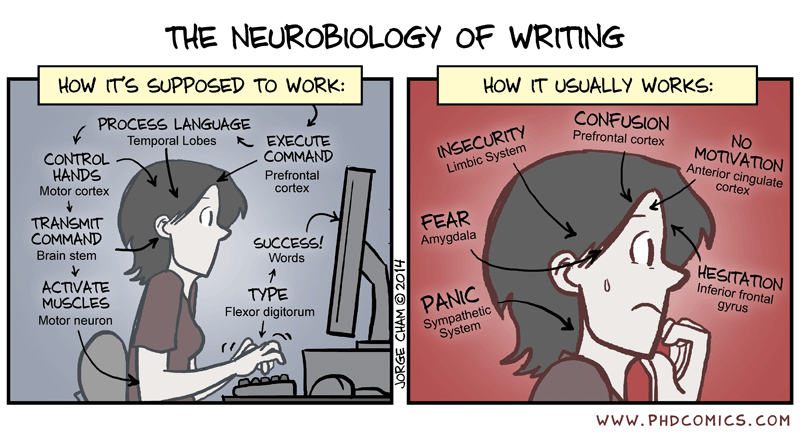
07/28/14 PHD comic: 'The Neurobiology of Writing'

Piled Higher & Deeper by Jorge Cham
www.phdcomics.com
Click on the title below to read the comic
title: "The Neurobiology of Writing" - originally published 7/28/2014

For the latest news in PHD Comics, CLICK HERE!

28 Jul 16:28

Particle diagrams and embedded many-body random matrix theory

by R. A. Small and S. Müller

Author(s): R. A. Small and S. Müller

We present a method which uses Feynman-like diagrams to calculate the statistical quantities of embedded many-body random matrix problems. The method provides a promising alternative to existing techniques and offers many important simplifications. We use it here to find the fourth, sixth, and eight...

[Phys. Rev. E 90, 010102] Published Fri Jul 25, 2014

25 Jul 08:00

[Report] Invisibility cloaking in a diffusive light scattering medium

by Robert Schittny
Jacopo.bertolotti

Still trying to decide if this paper is boringly obvious or subtly interesting.

A core-shell structure provides a cloak for objects within a diffusive medium. [Also see Perspective by Smith] Authors: Robert Schittny, Muamer Kadic, Tiemo Bückmann, Martin Wegener
24 Jul 08:45

Fusion furore

Fusion furore

Nature 511, 7510 (2014). doi:10.1038/511383b

Soaring construction costs for ITER are jeopardizing alternative fusion projects.

24 Jul 08:10

A variational eigenvalue solver on a photonic quantum processor

by Alberto Peruzzo

Article

Quantum computers promise to efficiently solve problems that would be practically impossible with a normal computer. Peruzzo et al. develop a variational computation approach that uses any available quantum resources and, with a photonic quantum processing unit, find the ground-state molecular energy of He–H + .

Nature Communications doi: 10.1038/ncomms5213

Authors: Alberto Peruzzo, Jarrod McClean, Peter Shadbolt, Man-Hong Yung, Xiao-Qi Zhou, Peter J. Love, Alán Aspuru-Guzik, Jeremy L. O’Brien

23 Jul 13:06

Computational gastronomy – part 2 – ‘Active Odor Cancellation’

by Martin Gardiner

The Varshney twins – Dr. Kush Varshney (currently at IBM) and Professor Lav Varshney (previously at IBM) – have authored a series of papers on the theme of computational gastronomy, one of which, on Food Steganography, we looked at recently.

Example 2. Active Odor Cancellation. (IEEE International Workshop on Statistical Signal Processing, Gold Coast, Australia, June-July 2014.)Food_odor_cancelled

“Noise cancellation is a traditional problem in statistical signal processing that has not been studied in the olfactory domain for unwanted odors. In this paper, we use the newly discovered olfactory white signal class to formulate optimal active odor cancellation using both nuclear norm-regularized multivariate regression and simultaneous sparsity or group lasso-regularized non-negative regression. As an example, we show the proposed technique on real-world data to cancel the odor of durian, katsuobushi, sauerkraut, and onion.”

Coming soon: Computational gastronomy part 3

23 Jul 09:09

Traditionally taught students learn; actively engaged students remember

by Scott V. Franklin, Eleanor C. Sayre and Jessica W. Clark

A common narrative in physics education research is that students taught in lecture-based classes learn less than those taught with activity-based reformed methods. We show this narrative is simplistic and misses important dynamics of student learning. In particular, we find students of both methods show equal short-term learning gains on a conceptual question dealing with electric potential. For traditionally taught students, this learning rapidly decays on a time scale of weeks, vanishing by the time of the typical end-of-term post-test. For students in reform-based classes, however, the knowledge is retained and may even be enhanced by subsequent instruction. This difference explains the many previous pre- and post-test studies that have found minimal learning gains in lecture-based courses. Our findings suggest a more nuanced model of student learning, one that is sensitive to time-dependent effects such as forgetting and interference. In addition, the findings suggest that lecture-based courses, by incorporating aspects designed to reinforce student understanding of previously covered topics, might approach the long-term learning found in research-based pedagogies.

23 Jul 09:09

An introduction to QBism with an application to the locality of quantum mechanics

by Christopher A. Fuchs, N. David Mermin and Rüdiger Schack

We give an introduction to the QBist interpretation of quantum mechanics, which removes the paradoxes, conundra, and pseudo-problems that have plagued quantum foundations for the past nine decades. As an example, we show in detail how this interpretation eliminates “quantum nonlocality.”

23 Jul 09:06

Generalized coherent states

by T. G. Philbin

In the coherent state of the harmonic oscillator, the probability density is that of the ground state subjected to an oscillation along a classical trajectory. Senitzky and others pointed out that there are states of the harmonic oscillator corresponding to an identical oscillatory displacement of the probability density of any energy eigenstate. These generalizations of the coherent state are rarely discussed, yet they furnish an interesting set of quantum states of light that combine features of number states and coherent states. Here, we give an elementary account of the quantum optics of generalized coherent states.

23 Jul 09:04

Wavefront reconstruction in phase-shifting interferometry via sparse coding of amplitude and absolute phase

by V. Katkovnik J. Bioucas-Dias
V. Katkovnik, J. Bioucas-Dias
Phase-shifting interferometry is a coherent optical method that combines high accuracy with high measurement speeds. This technique is therefore desirable in many applications such as the efficient industrial quality inspection process. However, despite its advantageous properties, the inference of ... [J. Opt. Soc. Am. A 31, 1801-1810 (2014)]
23 Jul 08:59

Backscatter analysis based algorithms for increasing transmission through highly scattering random media using phase-only-modulated wavefronts

by Curtis Jin
Curtis Jin, Raj Rao Nadakuditi, Eric Michielssen, Stephen C. Rand
Recent theoretical and experimental advances have shed light on the existence of so-called “perfectly transmitting” wavefronts with transmission coefficients close to 1 in strongly backscattering random media. These perfectly transmitting eigen-wavefronts can be synthesized by spatial ... [J. Opt. Soc. Am. A 31, 1788-1800 (2014)]
22 Jul 13:33

What If book tour!

by xkcd

My book, What If?: Serious Scientific Answers to Absurd Hypothetical Questions, comes out September 2nd (Pre-order: Amazon, Barnes & Noble, IndieBound), and I’m excited to announce that I’ll be going on a book tour!

Here’s the event list:


Tuesday, September 2

CAMBRIDGE, MA
Harvard Book Store at Brattle Theatre
40 Brattle St.
6:00pm (Seating is limited) – Note: this event is now sold out! But, you can still pre-order a signed copy (link below).
Tickets: $26 tickets on sale August 12 at 9am ET, includes one book, one seat.
More details: http://www.harvard.com/event/randall_munroe/
Pre-order a limited number of signed copies of What If? from Harvard Book Store.

Friday, September 5
NEW YORK, NY
Barnes & Noble – Union Square
33 E 17th St.
7:00pm
Open event, seating is first come first serve.
More details: http://store-locator.barnesandnoble.com/event/84245

Tuesday, September 9
SEATTLE, WA
Town Hall Seattle
1119 8th Ave.
7:30pm
Seating is limited – Note: this event is now sold out!
Tickets: $5, one seat
More details: http://www.townhallseattle.org/randall-munroe-answering-what-if/

Wednesday, September 10
SAN FRANCISCO, CA
The Booksmith at Public Works
161 Erie St.
7:30pm
Seating is limited – Note: this event is now sold out!
Tickets: $34 includes one book, general admission; $20 general admission
The bar at Public Works will be serving drinks before, during, and after the program. This event is necessarily limited to people 21 and older.
More details: http://www.brownpapertickets.com/event/772183

Thursday, September 11
BERKELEY, CA
Berkeley Arts & Lectures at the Hillside Club
2286 Cedar St.
7:30pm
Seating is limited – Note: this event is now sold out!
Tickets: $10 with student ID; $15 general admission
More details: http://www.brownpapertickets.com/event/772197

Friday, September 12
Google+ Hangout On Air moderated by Hank Green
Location: Online/Various
3:30pm PT/ 6:30pm ET
Note: Anyone can view the Hangout live on YouTube (Friday, 9/12, 3:30pm PT), but only 4-6 xkcd readers will be selected using this form  to participate and ask questions within the Hangout itself. Apply for a chance to participate in the Hangout by Monday, August 25.

Sunday, September 14
LOS ANGELES, CA
Live Talks LA
An afternoon with Randall Munroe
The Aero Theatre
1328 Montana Avenue
Santa Monica
4:30pm
Seating is limited
Tickets: $43 includes one book, one reserved seat; $20 general admission
More details: http://livetalksla.org/blog/2014/07/13/september-14-randall-munroe/

Hope to see you there!

22 Jul 08:01

Rediscovering black phosphorus as an anisotropic layered material for optoelectronics and electronics

by Fengnian Xia

Article

The applications of graphene and transition metal dichalcogenides in electronics are limited by their zero-bandgap and low mobility, respectively. Here, the authors demonstrate the potential of an emerging layered material—black phosphorous—for thin film electronics and infrared optoelectronics.

Nature Communications doi: 10.1038/ncomms5458

Authors: Fengnian Xia, Han Wang, Yichen Jia

22 Jul 07:54

A one-dimensional optomechanical crystal with a complete phononic band gap

by J. Gomis-Bresco

Article

Cavity optomechanics connects light to the mechanical degrees of freedom of a resonator and has great potential for sensing applications. Here, the authors realize a one-dimensional optomechanical crystal with a complete phononic bandgap containing high Q-factor modes and limited clamping losses.

Nature Communications doi: 10.1038/ncomms5452

Authors: J. Gomis-Bresco, D. Navarro-Urrios, M. Oudich, S. El-Jallal, A. Griol, D. Puerto, E. Chavez, Y. Pennec, B. Djafari-Rouhani, F. Alzina, A. Martínez, C.M. Sotomayor Torres

21 Jul 07:49

How Can a Civilian Plane Accidentally Be Shot Down?

It’s not certain whether Malaysia Airlines Flight 17 was brought down because of mistaken identity, but it is plausible.

Pro-Russian separatists may have shot down Malaysia Airlines Flight 17 over eastern Ukraine on Thursday because they mistook the civilian plane for something else. While we don’t yet know whether that explanation is correct, it does sound plausible to experts on missile technology, who say the systems that were involved create ample opportunities for planes to be misidentified.

18 Jul 09:18

[In Depth] A radical change in peer review

by Jeffrey Mervis
Jacopo.bertolotti

I can see a few weak points. But it is an interesting idea.

A pilot project to ease pressure on NSF's vaunted peer-review system required grant applicants to review seven competing proposals. Author: Jeffrey Mervis
17 Jul 09:35

Bright emission from a random Raman laser

by Brett H. Hokr

Article

Unlike conventional lasers that require a uniform resonant cavity to operate, random lasers use a highly disordered gain medium in which scattering is dominant. Hokr et al . report Raman lasing from a bulk three-dimensional disordered medium whose intensity exceeds that of other random lasers by many orders of magnitude.

Nature Communications doi: 10.1038/ncomms5356

Authors: Brett H. Hokr, Joel N. Bixler, Michael T. Cone, John D. Mason, Hope T. Beier, Gary D. Noojin, Georgi I. Petrov, Leonid A. Golovan, Robert J. Thomas, Benjamin A. Rockwell, Vladislav V. Yakovlev

17 Jul 09:25

Quantum-hub finalists picked

by Katia Moskvitch
Jacopo.bertolotti

Tons of money on quantum information technologies in the UK. Pity I will not see any of it.

Quantum-hub finalists picked

Nature 511, 7509 (2014). http://www.nature.com/doifinder/10.1038/511271a

Author: Katia Moskvitch

UK government considers eight proposals for up to six research centres.

17 Jul 09:23

Physics: Wave of the future

by Alexandra Witze

Physics: Wave of the future

Nature 511, 7509 (2014). http://www.nature.com/doifinder/10.1038/511278a

Author: Alexandra Witze

After two decades and more than half a billion dollars, LIGO, the world's largest gravitational-wave observatory, is on the verge of a detection. Maybe.

17 Jul 08:59

Il mio problema con Greenpeace

by Dario Bressanini

L’immagine irrompe sullo schermo con tutta la sua brutalità. Un pugno di temerari con un piccolo gommone cerca di interferire con le operazioni di una baleniera. Si vede, nel filmato concitato, una balena arpionata. Il mare tinto di rosso sangue. Gli idranti sparano violenti getti d’acqua su quegli uomini e donne che, incuranti del pericolo, rischiano la vita per opporsi alla barbarie della caccia alle balene. Un guscio di noce in un mare in tempesta sembrerebbe un posto meno pericoloso di quel piccolo scafo a fianco del gigante grigio.

media_xl_426423

Ero ancora un giovane studente quando per la prima volta ho sentito parlare, e visto le loro azioni, dei guerrieri di Greenpeace. Erano fighi. Combattevano per una causa giusta, erano ambientalisti, avevano a cuore la natura e il mondo che ci circonda. Non era forse una battaglia di tutti e per tutti? Non volete mica stare dalla parte delle baleniere, no?

whaler

Non possiamo non dirci ambientalisti! Ero giovane. Pieno di speranze e illusioni.

Passano gli anni, inizio a scrivere per Le Scienze e, occupandomi anche di OGM, incrocio spesso Greenpeace mentre cerco materiale e informazioni scientifiche sul tema. Non ci è voluto molto per trasformarsi ai miei occhi, da faro da seguire a cattivo esempio di piccola multinazionale dell’ambientalismo ideologico, poco interessata all’approccio scientifico e molto invece all’organizzazione di pagliacciate mediatiche pubbliche che catturano l’attenzione dei media, usando le stesse tattiche comunicative di altre multinazionali come Monsanto.

Ma agli occhi di uno scienziato come me il peccato mortale della multinazionale verde è di fare disinformazione scientifica. Di piegare la scienza ai loro obiettivi. Di mistificare le ricerche scientifiche che non corroborano le loro posizioni. Parole grosse dite?

Nel 2002 Greenpeace ha rilasciato un rapporto teso a dipingere negativamente l’esperienza del cotone Bt resistente agli insetti in Cina. Per far ciò il rapporto citava a supporto, tra gli altri, i lavori del Prof. Kongming Wu, un entomologo esperto di insetti infestanti del cotone, autore di numerosi articoli scientifici, membro dell’Accademia delle Scienze Cinese e membro del comitato nazionale di biosicurezza per gli OGM.

Peccato che i lavori del Prof. Kongmin Wu sostenessero l’esatto contrario di quanto Greenpeace volesse dimostrare. Venuto a conoscenza del rapporto il Prof. Kongmin rilasciò un comunicato inequivocabile:

Dopo aver letto attentamente il rapporto, tornato a Beijing il 21 giugno, sono rimasto sbigottito nello scoprire che i nostri studi sull’impatto ecologico del cotone Bt fossero stati riassunti in modo scorretto dagli autori. In realtà, i nostri risultati  si oppongono fortemente alle conclusioni principali del rapporto di Greenpeace e non supportano il loro punto di vista.

Tu chiamala se vuoi, “disinformazione”.

Anche stamane li ho incrociati. Sono stato chiamato all’ultimo momento a partecipare a “Tutta la città ne parla”, una trasmissione radiofonica di Radio3. Il tema erano gli OGM. O meglio, il modo con cui la trasmissione Radio3Scienza tratta gli OGM. Secondo alcuni ascoltatori troppo “favorevole agli OGM”. Forse perché non invita, come altre trasmissioni, scienziati farlocchi o non accetta come fonti scientifiche improbabili siti web o comunicati stampa e perché, come spiega la giornalista Silvia Bencivelli, nella scienza non ha senso cercare sempre di far sentire “l’altra campana” e si deve partire dai fatti accertati, non dalle opinioni.

Prima di me interviene un esponente di Greenpeace che accusa di falsità chi sostiene che “gli OGM riducono l’utilizzo dei fitofarmaci”. Lì, lo ammetto, ho perso la mia flemma, e ho ribattuto che chi sparge falsità è Greenpeace. Il trucco, il solito, è quello di accorpare tutti gli OGM esistenti come se fossero una categoria omogenea. L’abbiamo detto mille volte qui: l’impiego di OGM resistenti ai diserbanti, come la soia che importiamo legalmente per milioni di tonnellate, non può che incentivare l’uso di questi prodotti. Invece piante che resistono naturalmente ad alcuni insetti parassiti, come il mais Bt, sono state progettate proprio per ridurre l’utilizzo di insetticidi. E ormai non vi è più alcun dubbio che questo sia accaduto veramente negli ultimi 15 anni. In Spagna, In Cina, In India, In USA. Ovunque queste piante hanno permesso una riduzione dell’uso “della chimica in agricoltura”. E nei paesi poveri hanno avuto anche il merito di ridurre i casi di avvelenamenti da agrofarmaci per gli agricoltori. Potrei sommergere Greenpeace con le fonti ma, davvero, ormai è come citare le fonti che la terra è rotonda.

Non possiamo non dirci ambientalisti, e quindi non possiamo non gioire di questa cosa. Se però sei una multinazionale dell’ideologia verde, e ti opponi per principio agli ogm, questa cosa non la puoi accettare. Va contro il tuo “core business”. Le balene ormai non fanno più presa e anche il riscaldamento globale non se la passa tanto bene, mediaticamente. E se vuoi continuare a ricevere donazioni dal pubblico lo devi spaventare per poi dire “arrivo io, il gigante verde che ti difende”. E allora usi un trucco: sommi le mele con le pere, anche se hai imparato alle scuole elementari che è una cosa che non si fa. Sommi l’aumento nell’uso di diserbante a seguito della diffusione della soia resistente all’erbicida (lasciamo perdere qui il fatto che si dovrebbe tenere conto della tossicità relativa e non dei semplici quintali), con la diminuzione dell’uso di insetticidi grazie all’uso degli OGM Bt. Tanto sono tutti OGM no? Che ne capisce la sempre proverbiale casalinga di Voghera? E poiché di diserbante in agricoltura se ne usa molto, e la soia OGM resistente è un prodotto di estremo successo, in questo modo affoghiamo la riduzione di insetticidi nell’aumento dei diserbanti. E quindi possono periodicamente mandare il comunicato stampa “Gli OGM hanno bisogno di più pesticidi”.

Uno sporco trucco. Utilizzato non solo da Greenpeace per carità. Anche altre associazioni di attivisti usano questi trucchi. I Friends of the Earth a pagina 21 del loro rapporto del 2009, in quattro scarne righe lo ammettono a denti stretti, ma non si vergognano di sommare l’aumento d’uso di glifosate con la riduzione d’uso di insetticidi.

Un vero scienziato è sempre disposto a cambiare le proprie idee e, perché no, i propri preconcetti, se questi vengono contraddetti dai fatti. Fatti accertati più e più volte in modo indipendente. Se invece sei un attivista ideologizzato preferisci metterti gli occhialini e scartare i fastidiosi fatti piuttosto che dire “mi sono sbagliato”. Si tratta di onestà intellettuale, che a troppi manca. E alla fine messi alle strette l’unica cosa che riescono a dire è un idiota “Ki ti paga” pur di difendere con le unghie le proprie opinioni assaltate dai fatti che non piacciono.

Non stupisce quindi che Greenpeace sia vista come il proverbiale «fumo negli occhi» da parte di molti scienziati che lavorano nel campo e come non sia possibile alcun tipo di dialogo tra gli scienziati che lavorano su questi argomenti e dirigenti e militanti di questa organizzazione. Spesso spregiativamente chiamati militonti nei corridoi dei laboratori, a indicare quanto spesso questi ragazzotti che ti fermano, con le loro tute colorate, siano quasi sempre solo in grado di ripetere a pappagallo quello che gli hanno detto di ripetere. Io ci ho provato a parlargli. Più volte. Se gli chiedi della biodiversità, dei geni, della chimica, ti rispondono con il vuoto pneumatico. Ripetono il compitino, tutti fieri della loro piece teatrale come quando si appendono ai monumenti. Chissenefrega di che cosa è la biodiversità veramente o cosa facciano le molecole. È chimica, biologia, ecologia. Loro sono laureati in scienze politiche, o lettere. Mica ne capiscono. E hanno assolto allo scopo assegnatogli: attirare le telecamere. “Detox NOW”. Domani il Corriere e Repubblica parleranno di loro.

GP0STO84R

Insomma, il “dialogo” tra la scienza e Greenpeace ha visto tempi migliori. Non a caso alcuni ex dirigenti sono molto critici verso le posizioni attuali di questa organizzazione. Mi chiedo, da scienziato, come si può “dialogare” con chi ha una posizione di opposizione “di principio”. Le “granitiche certezze” hanno più a che fare con la fede e la religione che con la scienza. Insomma, è come pretendere di far dialogare uno scienziato dell’evoluzione con un creazionista. Semplicemente non si può.

Opposizione a prescindere

Domanda 101 Lord Reay (Presidente della Camera dei Lord): “Lord Melchett, in relazione alle modifiche genetiche, che cosa avete da obiettare e perché?

Lord Melchett, Direttore Esecutivo di Greenpeace UK: “Signor presidente, l’obiezione fondamentale è che vi sono rischi inaffidabili e imprevedibili.”

Domanda 107: “La vostra opposizione al rilascio di OGM, è una opposizione assoluta e definitiva? Non è dipendente da ulteriori ricerche scientifiche o dallo sviluppo di procedure migliorate o da qualche soddisfazione che potreste avere in futuro riguardo alla sicurezza?”

Lord Melchett:Si tratta di una opposizione permanente, definitiva e completa basata sulla visione che ci saranno sempre grandi incertezze. È la natura della tecnologia, in verità è la natura della scienza, che non vi sarà alcuna prova assoluta. Nessuno scienziato si siederà mai davanti a voi sostenendo ciò, se è un vero scienziato.”

Deposizione di Lord Peter Robert Henry Mond, 4° Barone Melchett, Direttore Esecutivo di Greenpeace UK, alla Camera dei Lord del Parlamento britannico. 3 Giugno 1998.

Greenpeace è il prototipo dell’ONG (Organizzazione Non Governativa) che si oppone per principio agli OGM, come ammesso dal suo alto dirigente. Per Greenpeace non è questione di avere più dati scientifici a disposizione, svolgere ulteriori indagini o di soppesare i costi con i benefici. Anzi, nei suoi rapporti i benefici sono sistematicamente minimizzati o semplicemente ignorati, quando non addirittura negati mistificando l’evidenza scientifica come vi ho dimostrato sopra.

Greenpeace gode generalmente di «buona stampa», i suoi rapporti sono graficamente curati e ricchi di immagini, scritti in uno stile simil-scientifico, con molte citazioni bibliografiche, ovviamente selezionate ad-hoc con il peggiore cherry picking e un sacco di autocitazioni. Forse è per questo che generalmente i mezzi di informazione fanno solitamente da eco acritica ai loro documenti, senza prendersi la briga di controllare i riferimenti bibliografici, verificare le fonti e calarle nel giusto contesto. È noto come si possa benissimo raccontare delle falsità dicendo solo cose vere.

Mentire con le statistiche

Nel 2011 a seguito dei nuovi dati sull’adozione degli OGM nel mondo Greenpeace gongolava :”gli agricoltori europei affossano gli OGM”. Nella UE l’unico paese ad avere coltivazioni significative di mais OGM è la Spagna. Negli altri paesi UE dove si coltivano (Portogallo, Romania, Germania, Svezia, Repubblica Ceca, Polonia e Slovacchia) non si superano i 5000 ettari. Non a caso chi è favorevole alla coltivazione in Italia del mais Bt cita sempre il caso Spagnolo, perché è l’unico realmente significativo. Greenpeace gioisce del fatto che nel 2009 in Spagna si coltivassero 76057 ettari di mais Bt, stimati a 67726 nel 2010. l’11% in meno! Segno di un disamoramento degli agricoltori spagnoli per il mais OGM?

Il documento citato nella nota 2 fornisce, dal 1998, le superfici Spagnole coltivate a mais Bt. I dati sono del ministero dell’ambiente spagnolo. Ci fidiamo. Scopriamo che nel 2008 le superfici erano ancora maggiori: 79269 ettari. Una conferma del declino?

Come nel caso del famoso pollo di Trilussa (io e te mangiamo un pollo a testa in media) manca qualche informazione per dare pieno significato alla statistica (io però ne mangio due ogni giorno, e tu rimani a digiuno!).

I numeri che mancano in questo caso sono gli ettari totali coltivati a mais in Spagna. Dati che troviamo sempre sul sito del ministero dell’agricoltura spagnolo, ma che Greenpeace non si è mica sognata di segnalare. A pagina 7 leggiamo che nel 2008 sono stati seminati 372 migliaia di ettari a mais, nel 2009 erano 345 e nel 2010 ne sono stati stimati 322. Perbacco, ma era una riduzione generale delle coltivazioni di mais! Quindi forse la diminuzione non aveva nulla a che fare con gli OGM. Per verificare questa ipotesi andiamo quindi a calcolare la proporzione di mais ogm su quello totale nei tre anni

2008: 21%

2009: 22%

2010: 21%

Bingo! La percentuale di mais Bt rispetto a quello convenzionale in Spagna tra il 2008 e il 2010 è rimasta sostanzialmente invariata. E un sondaggio del 2011 tra i coltivatori spagnoli di mais OGM conferma infatti la loro soddisfazione nella coltivazione di questa pianta: per la buona salute della spiga (sì insomma, la "pannocchia"), per i vantaggi economici, per la facilità di gestione e per le maggiori rese (parole loro).

Come mai non abbiamo più sentito parlare del “fallimento” del mais spagnolo? Neanche da Coldiretti, che ci investe periodicamente con i suoi comunicati stampa a mitraglia.

Beh, forse perché nel 2011 e 2012 il mais Bt in Spagna ha avuto un incremento notevole, arrivando a circa il 30% del mais totale iberico.

Hectareas-maiz-bt-historico-transgenicos

Insomma, da quando ho beccato Greenpeace con le mani nella marmellata per me è cessata di essere credibile. Per qualsiasi cosa. Voi fate quello che volete ma io non credo più a una sola parola delle cose che dice, anche se probabilmente in altri settori non sono così antiscientifici come nel campo delle biotecnologie. Ma la credibilità è lunga e difficile da costruire, e ci si mette nulla a perderla.

Certo, continuerò a essere contro l’uccisione delle balene, ma non perché lo dice Greenpeace.

Dario Bressanini

10 Jul 10:40

An optoelectronic framework enabled by low-dimensional phase-change films

by Peiman Hosseini

An optoelectronic framework enabled by low-dimensional phase-change films

Nature 511, 7508 (2014). doi:10.1038/nature13487

Authors: Peiman Hosseini, C. David Wright & Harish Bhaskaran

The development of materials whose refractive index can be optically transformed as desired, such as chalcogenide-based phase-change materials, has revolutionized the media and data storage industries by providing inexpensive, high-speed, portable and reliable platforms able to store vast quantities of data. Phase-change materials switch between two solid states—amorphous and crystalline—in response to a stimulus, such as heat, with an associated change in the physical properties of the material, including optical absorption, electrical conductance and Young’s modulus. The initial applications of these materials (particularly the germanium antimony tellurium alloy Ge2Sb2Te5) exploited the reversible change in their optical properties in rewritable optical data storage technologies. More recently, the change in their electrical conductivity has also been extensively studied in the development of non-volatile phase-change memories. Here we show that by combining the optical and electronic property modulation of such materials, display and data visualization applications that go beyond data storage can be created. Using extremely thin phase-change materials and transparent conductors, we demonstrate electrically induced stable colour changes in both reflective and semi-transparent modes. Further, we show how a pixelated approach can be used in displays on both rigid and flexible films. This optoelectronic framework using low-dimensional phase-change materials has many likely applications, such as ultrafast, entirely solid-state displays with nanometre-scale pixels, semi-transparent ‘smart’ glasses, ‘smart’ contact lenses and artificial retina devices.