Shared posts

21 May 13:49

UK universities slow to publish reports of misconduct investigations

by Elizabeth Gibney

UK universities slow to publish reports of misconduct investigations

Nature 521, 7552 (2015). http://www.nature.com/doifinder/10.1038/nature.2015.17559

Author: Elizabeth Gibney

Few institutions have followed research integrity guidelines to the letter.

21 May 13:48

Relocation: Out of place

by Paul Smaglik

Relocation: Out of place

Nature 521, 7552 (2015). doi:10.1038/nj7552-381a

Author: Paul Smaglik

Enforced mingling and straight-up instruction can help scientists in a foreign country.

21 May 13:48

Quantum physics: What is really real?

by Zeeya Merali
Jacopo.bertolotti

Nothing I didn't know already, but still an interesting introductory reading to the problem.

Quantum physics: What is really real?

Nature 521, 7552 (2015). http://www.nature.com/doifinder/10.1038/521278a

Author: Zeeya Merali

A wave of experiments is probing the root of quantum weirdness.

21 May 09:00

Finnish solution of the nude body / brain question

by Marc Abrahams

A team of Finnish researchers reached new partial understanding of how human brains react to nude bodies. They published a study about it:

Facilitated early cortical processing of nude human bodies,” Jussi Alho, Nelli Salminen, Mikko Sams, Jari K. Hietanen, Lauri Nummenma, Biological Psychology, epub May 7, 2015. (Thanks to Neil Martin for bringing this to our attention.) The authors at Aalto University, the University of Tampere, and the University of Turku, Finland, report:

“it remains unresolved whether nude and clothed bodies are processed by same cerebral networks or whether processing of nude bodies recruits additional affective and arousal processing areas. We recorded simultaneous MEG and EEG while participants viewed photographs of clothed and nude bodies. Global field power revealed a peak ∼145 ms after stimulus onset to both clothed and nude bodies, and ∼205 ms exclusively to nude bodies. Nude-body-sensitive responses were centered first (100–200 ms) in the extrastriate and fusiform body areas, and subsequently (200–300 ms) in affective-motivational areas including insula and anterior cingulate cortex. We conclude that visibility of sexual features facilitates early cortical processing of human bodies, the purpose of which is presumably to trigger sexual behavior and ultimately ensure reproduction.”

Here’s further detail from the study:

body-brain-study


BONUS (possibly unrelated): Measuring a person’s incoherence

21 May 08:48

Sempre più intrigante il mistero delle macchie bianche su Cerere

by Paolo Attivissimo
Questo articolo vi arriva gratuitamente e senza pubblicità grazie alla gentile donazione di “djfac*” e “sacha.d*”. Se vi piace, potete incoraggiarmi a scrivere ancora.

Credit: ASA / JPL-Caltech / UCLA / MPS / DLR / IDA

La sonda spaziale Dawn della NASA, in orbita intorno al pianeta nano Cerere che sta nella fascia di asteroidi tra Marte e Giove, ha inviato immagini ancora più dettagliate delle misteriose chiazze bianche sulla superficie del piccolo mondo, già viste nelle immagini a minore risoluzione arrivate nei mesi scorsi. Per avere un'idea delle dimensioni, il cratere che ospita queste chiazze brillanti ha un diametro di 90 chilometri.

Cosa può produrre macchie così brillanti e nette? Prima di lasciarsi andare a ipotesi da fantascienza (per esempio la superficie metallica di un veicolo o di una base extraterrestre) bisogna valutare le spiegazioni semplici. Si sa che Cerere contiene una notevole percentuale d'acqua, circa il 25%: una stima che, se confermata, gli darebbe una massa d'acqua dolce superiore a quella della Terra. Le chiazze potrebbero quindi essere semplicemente ghiaccio d'acqua portato in superficie da un impatto meteorico relativamente recente che ha trapassato e rimosso nei punti d'impatto la sottile crosta rocciosa sotto la quale si anniderebbe, appunto, un mantello d'acqua ghiacciata. A lungo andare l'accumulo naturale di polvere proveniente dallo spazio ricoprirebbe e cancellerebbe le macchie.

Questa nuova immagine risale al 16 maggio scorso ed è stata scattata da 7200 km di distanza; capiremo forse meglio il mistero quando Dawn scenderà a 375 km dalla superficie del pianeta nano.
Scritto da Paolo Attivissimo per il blog Il Disinformatico. Ripubblicabile liberamente se viene inclusa questa dicitura (dettagli). Sono ben accette le donazioni Paypal.
20 May 08:57

Bad Comparisons with Statistics

by markcc

When a friend asks me to write about something, I try do it. Yesterday, a friend of mine from my Google days, Daniel Martin, sent me a link, and asked to write about it. Daniel isn’t just a former coworker of mine, but he’s a math geek with the same sort of warped sense of humor as me. He knew my blog before we worked at Google, and on my first Halloween at Google, he came to introduce himself to me. He was wearing a purple shirt with his train ticket on a cord around his neck. For those who know any abstract algebra, get ready to groan: he was purple, and he commuted. He was dressed as an Abelian grape.

Anyway, Daniel sent me a link to this article, and asked me to write about the error in it.

The real subject of the article involves a recent twitter-storm around a professor at Boston University. This professor tweeted some about racism and history, and she did it in very blunt, not-entirely-professional terms. The details of what she did isn’t something I want to discuss here. (Briefly, I think it wasn’t a smart thing to tweet like that, but plenty of white people get away with worse every day; the only reason that she’s getting as much grief as she is is because she dared to be a black woman saying bad things about white people, and the assholes at Breitbart used that to fuel the insatiable anger and hatred of their followers.)

But I don’t want to go into the details of that here. Lots of people have written interesting things about it, from all sides. Just by posting about this, I’m probably opening myself up to yet another wave of abuse, but I’d prefer to avoid and much of that as I can. Instead, I’m just going to rip out the introduction to this article, because it makes a kind of incredibly stupid mathematical argument that requires correction. Here are the first and second paragraphs:

There aren’t too many African Americans in higher education.

In fact, black folks only make up about 4 percent of all full time tenured college faculty in America. To put that in context, only 14 out of the 321—that’s about 4 percent—of U.S. astronauts have been African American. So in America, if you’re black, you’ve got about as good a chance of being shot into space as you do getting a job as a college professor.

Statistics and probability can be a difficult field of study. But… a lot of its everyday uses are really quite easy. If you’re going to open your mouth and make public statements involving probabilities, you probably should make sure that you at least understand the first chapter of “probability for dummies”.

This author doesn’t appear to have done that.

The most basic fact of understanding how to compare pretty much anything numeric in the real world is that you can only compare quantities that have the same units. You can’t compare 4 kilograms to 5 pounds, and conclude that 5 pounds is bigger than 4 kilograms because 5 is bigger than four.

That principle applies to probabilities and statistics: you need to make sure that you’re comparing apples to apples. If you compare an apple to a grapefruit, you’re not going to get a meaningful result.

The proportion of astronauts who are black is 14/321, or a bit over 4%. That means that out of every 100 astronauts, you’d expect to find four black ones.

The proportion of college professors who are black is also a bit over 4%. That means that out of every 100 randomly selected college professors, you’d expect 4 to be black.

So far, so good.

But from there, our intrepid author takes a leap, and says “if you’re black, you’ve got about as good a chance of being shot into space as you do getting a job as a college professor”.

Nothing in the quoted statistic in any way tells us anything about anyone’s chances to become an astronaut. Nothing at all.

This is a classic statistical error which is very easy to avoid. It’s a unit error: he’s comparing two things with different units. The short version of the problem is: he’s comparing black/astronaut with astronaut/black.

You can’t derive anything about the probability of a black person becoming an astronaut from the ratio of black astronauts to astronauts.

Let’s pull out some numbers to demonstrate the problem. These are completely made up, to make the calculations easy – I’m not using real data here.

Suppose that:

  • the US population is 300,000,000;
  • black people are 40% of the population, which means that there are are 120,000,000 black people.
  • there are 1000 universities in America, and there are 50 faculty per university, so there are 50,000 university professors.
  • there are 50 astronauts in the US.
  • If 4% of astronauts and 4% of college professors are black, that means that there are 2,000 black college professors, and 2 black astronauts.

In this scenario, as in reality, the percentage of black college professors and the percentage of black astronauts are equal. What about the probability of a given black person being a professor or an astronaut?

The probability of a black person being a professor is 2,000/120,000,000 – or 1 in 60,000. The probability of a black person becoming an astronaut is just 2/120,000,000 – or 1 in 60 million. Even though the probability of a random astronaut being black is the same as a the probability of a random college professor being black, the probability of a given black person becoming a college professor is 10,000 times higher that the probability of a given black person becoming an astronaut.

This kind of thing isn’t rocket science. My 11 year old son has done enough statistics in school to understand this problem! It’s simple: you need to compare like to like. If you can’t understand that, if you can’t understand your statistics enough to understand their units, you should probably try to avoid making public statements about statistics. Otherwise, you’ll wind up doing something stupid, and make yourself look like an idiot.

(In the interests of disclosure: an earlier version of this post used the comparison of apples to watermelons. But given the racial issues discussed in the post, that had unfortunate unintended connotations. When someone pointed that out to me, I changed it. To anyone who was offended: I am sorry. I did not intend to say anything associated with the racist slurs; I simply never thought of it. I should have, and I shouldn’t have needed someone to point it out to me. I’ll try to be more careful in the future.)

19 May 16:18

The internet's biggest TV pirate calls it quits after scam

by Steve Dent
If you enjoy getting the latest TV shows from EZTV, you may want to stop that now, and not just because it's illegal. It's also more risky, because the hugely popular torrent site is now in the hands of potentially bad actors, according to TorrentFre...
19 May 10:53

Suppression and Revival of Weak Localization through Control of Time-Reversal Symmetry

by K. Müller, J. Richard, V. V. Volchkov, V. Denechaud, P. Bouyer, A. Aspect, and V. Josse

Author(s): K. Müller, J. Richard, V. V. Volchkov, V. Denechaud, P. Bouyer, A. Aspect, and V. Josse

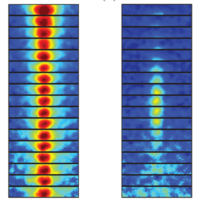
Controlled manipulation of the time reversal symmetry in a disordered quantum gas is achieved by applying a dephasing pulse.


[Phys. Rev. Lett. 114, 205301] Published Mon May 18, 2015

18 May 14:56

[Research Article] A multifaceted program causes lasting progress for the very poor: Evidence from six countries

by Abhijit Banerjee
We present results from six randomized control trials of an integrated approach to improve livelihoods among the very poor. The approach combines the transfer of a productive asset with consumption support, training, and coaching plus savings encouragement and health education and/or services. Results from the implementation of the same basic program, adapted to a wide variety of geographic and institutional contexts and with multiple implementing partners, show statistically significant cost-effective impacts on consumption (fueled mostly by increases in self-employment income) and psychosocial status of the targeted households. The impact on the poor households lasted at least a year after all implementation ended. It is possible to make sustainable improvements in the economic status of the poor with a relatively short-term intervention. Authors: Abhijit Banerjee, Esther Duflo, Nathanael Goldberg, Dean Karlan, Robert Osei, William Parienté, Jeremy Shapiro, Bram Thuysbaert, Christopher Udry
18 May 10:29

Loss-induced lasing: new findings in laser theory?. (arXiv:1505.03028v2 [physics.optics] UPDATED)

by Stefano Longhi, Giuseppe Della Valle

In a recent work, using a coupled microresonator system with tailored gain and loss parameters B. Peng et al. [Science 346, 328 (2014)] have experimentally reported on an apparently counterintuitive effect in laser theory, namely the possibility to enhance lasing by increasing loss in the system. The observed phenomenon was related to the existence of an exceptional point in the system and was presented somehow as an unexpected and novel effect, especially by some reporters and scientific blogs. In this communication it is pointed out that the phenomenon of loss-induced lasing does not come as a surprise in known laser theory and that it is not necessarily related to the physics of exceptional points. Loss-induced lasing is basically the lasing mechanism that occurs in loss-coupled distributed feedback lasers. This mechanism dates back to the 1970's, has a simple physical explanation and does not rely on the physics of exceptional points.

16 May 15:38

Divide and concur: A physics paper with 5,154 authors

by Marc Abrahams

A physics paper with 5,154 authors is the newest reached pinnacle in people’s drive to divide and concur, when there’s credit to be had. Those 5,154 physicists stand a-write on the collective shoulders of the 976 physicians who shared the 1993 Ig Nobel Prize for literature.

topolThat 1993 Ig Nobel prize was awarded to Eric Topol [pictured here], R. Califf, F. Van de Werf, P. W. Armstrong, and their 972 co-authors, for publishing a medical research paper which has one hundred times as many authors as pages. [The study was published in The New England Journal of Medicine, vol. 329, no. 10, September 2, 1993, pp. 673–82.]

The new, 5,154 physicist paper is: “Combined Measurement of the Higgs Boson Mass in pp Collisions at √ s = 7 and 8 TeV with the ATLAS and CMS Experiments,” G. Aad et al. [5,154 authors total] (ATLAS Collaboration), (CMS Collaboration), Physical Review Letters, 114, 191803, published 14 May 2015.

Davide Castelvecci, writing solo in Nature News, gives an appreciation of the 5,154:

Physics paper sets record with more than 5,000 authors
Detector teams at the Large Hadron Collider collaborated for a more precise estimate of the size of the Higgs boson.

A physics paper with 5,154 authors has — as far as anyone knows — broken the record for the largest number of contributors to a single research article.

Only the first nine pages in the 33-page article, published on 14 May in Physical Review Letters, describe the research itself — including references. The other 24 pages list the authors and their institutions.

The article is the first joint paper from the two teams that operate ATLAS and CMS, two massive detectors at the Large Hadron Collider (LHC) at CERN, Europe’s particle-physics lab near Geneva, Switzerland. Each team is a sprawling collaboration involving researchers from dozens of institutions and countries….

Here is the beginning of the new paper’s list of 5,154 co-authors, most of whom are still alive [according to the paper itself, not all of them are]:

co-authors


BONUS: A fun calculation for you to perform with friends: How many minutes it would that take to read aloud the complete list of 5,154 co-authors?

BONUS: Another report in Nature News, published two days earlier than “Physics paper sets record with more than 5,000 authors”): “Fruit-fly paper has 1,000 authors

15 May 16:41

Challenging times

Challenging times

Nature 521, 7551 (2015). doi:10.1038/521125b

A European initiative to ban animal research has galvanized resistance.

15 May 16:15

Google’s quirky self-driving bubble car hits public roads this summer

by Mark Walton
Jacopo.bertolotti

I really want a self-driving car!

It's been almost a year since Google unveiled its quirky prototype self-driving bubble car, which has so far been confined to closed testing on private roads. Now, however, the company is ready to let the high-tech contraption loose on California's public roads. Google says "a few of the prototype vehicles" will be driving around Mountain View this summer.

Those worried about any potentially dangerous hiccups happening during testing—especially given the recent questions surrounding Google's safety record—will be pleased to hear that the cars will always have a human inside, and will sport a removable steering wheel, accelerator pedal, and brake pedal in case manual control is required. They'll also be capped to a gentle 25mph.

Google's also drawing on its experience with its self-driving Lexus RX450h SUV fleet, which has been roaming the streets of California since September of last year. According the the company, that fleet has logged nearly a million autonomous miles on the road, and is currently clocking up around 10,000 miles per week. Google says the totality of its logged autonomous miles are equivalent to "75 years of typical American adult driving experience."

Read 2 remaining paragraphs | Comments

14 May 17:00

Synopsis: Zooming in on Failures

Jacopo.bertolotti

Dear god, no. They are NOT beating the diffraction limit!
(facepalm)

A near-infrared microscopy technique can detect defects in electronic devices with a resolution better than the diffraction limit of light.

[Physics] Published Wed May 06, 2015

10 May 15:00

Il Nepal, i Mondiali, gli schiavi

by di Alessandro Gilioli

images

Da parecchi anni e nell'indifferenza del mondo, migliaia di nepalesi per sopravvivere si trasferiscono nei Paesi del Golfo, come Qatar e Dubai, dove vengono utilizzati come schiavi.

Il termine purtroppo non è esagerato: ai nepalesi là migrati infatti viene tolto il passaporto, che viene loro restituito soltanto al termine del contratto di lavoro, di solito biennale o triennale. Il lavoro nei cantieri è sei giorni su sette, a circa 140-150 dollari al mese. Il traffico è gestito da Manpower e da altre agenzie di intermediazione. Il passaporto viene loro tolto per prevenire le fughe di quelli che dopo qualche settimana o mese si rendono conto delle condizioni in cui si trovano e vorrebbero tornare a casa. Un ragazzo che conosco ci è passato e solo l'intervento di un comune amico ha consentito di riportarlo in patria.

Il traffico di questi esseri umani è ancor più florido da quando il Qatar si è aggiudicato i Mondiali di calcio: in sostanza gli schiavi nepalesi stanno costruendo gli stadi, le strutture ricettive e le strade con cui il Qatar si mostrerà al mondo in quell'occasione.

Oggi The Independent dedica un articolo a decine di migliaia di questi schiavi a cui è stato impedito di tornare a casa anche dopo il terremoto, anche se avevano famigliari morti, anche se la loro casa in Nepal non c'era più.

Non risulta che alcuna autorità italiana o europea, né politica né sportiva, abbia alcunché da ridire in merito.

08 May 16:06

[In Depth] Italy's olives under siege

by Erik Stokstad
In the far south of Italy, olive trees are falling victim to the devastating bacterium Xylella fastidiosa. In spite of control efforts, the disease is spreading north, ringing alarms across Europe. In January, the European Food Safety Authority warned of yield losses and rising costs from control measures. Italy declared its first national emergency for a plant disease. Workers are clearing sick trees and host plants such as oleander. This month, they will begin spraying insecticides to control the primary vector of the disease, the spittlebug Philaenus spumarius. These insects are common across Europe and abundant in olive groves. Genetic markers suggest the pathogen arrived in ornamental coffee plants and oleander exported from Costa Rica to Europe. Last week, an E.U. advisory committee recommended that the European Commission ban imports of ornamental coffee plants from Costa Rica and Honduras. Author: Erik Stokstad
08 May 15:59

Exponentially Tempered Lévy Sums in Random Lasers

by Ravitej Uppu and Sushil Mujumdar

Author(s): Ravitej Uppu and Sushil Mujumdar

Lévy fluctuations have associated infinities due to diverging moments, a problem that is circumvented by putting restrictions on the magnitude of the fluctuations, realizing a process called the truncated Lévy flight. We show that a perfect manifestation of this exotic process occurs in coherent ran…


[Phys. Rev. Lett. 114, 183903] Published Tue May 05, 2015

08 May 15:36

No, non siamo la Gran Bretagna

by Leonardo T
Va bene, parliamo della Gran Bretagna - se non oggi, quando?

Perché è vero quello che molti mi hanno fatto presente: in Regno Unito si possono ottenere robuste maggioranze parlamentari anche con percentuali di suffragi molto inferiori al 50%. Non è il caso del governo bicolore di Cameron, ma è stato il caso, ad esempio, di Tony Blair nel '97 (più del 60% dei seggi con appena il 43% dei suffragi), tanto osannato per aver conquistato i voti al centro, anche se il suo New Labour ottenne appena due milioni di voti in più di quello vecchio che perdeva le elezioni con un'astensione più bassa. Gira e rigira si ritorna sempre lì: come facciamo a lamentarci di un premio al 40%, se in Gran Bretagna si può saldamente mantenere la maggioranza parlamentare con percentuali anche inferiori?

Già che ci siamo, spieghiamo come funziona. Non ha nulla a che vedere con l'italicum. Non è proporzionale, non è previsto un premio per favorire la governabilità (che questi premi la favoriscano, peraltro, resta da dimostrare). Il sistema elettorale britannico è un limpido esempio di maggioritario. Oggi si vota in 650 distretti elettorali, e in ogni distretto il candidato che prende più voti viene eletto. Per vincere - questo è cruciale - gli basta la maggioranza relativa. Che significa?

L'ultima volta (il Labour sulle cartine
risulta sempre un po' sottodimensionato
perché tende a vincere in distretti più piccoli
e densamente popolati).
Significa che puoi vincere un seggio col 30% e perderne un'altro col 40%. Significa che - teoricamente - puoi vincere la maggioranza assoluta dei seggi anche se prendi meno voti in percentuale di un altro partito. Significa anche che il tuo voto, se sei un Tory in una città a stragrande maggioranza Labour o viceversa, non vale assolutamente nulla, e questo forse può influire sulla percentuale di astensione, che da loro è storicamente più alta (del resto anche se sei Labour in una città a stragrande maggioranza Labour il tuo voto diventa pleonastico). Nel Regno Unito non ha nessun senso calcolare i voti assoluti in percentuale: contano soltanto il numero di seggi che un partito riesce a vincere. Ed è meglio concentrare gli sforzi sui distretti incerti che perder tempo in quelli relativamente 'sicuri': se in uno stai già vincendo 60-40, è inutile spendere risorse per conquistare altri indecisi, ecc. Questo è l'uninominale secco britannico. A me ovviamente non piace e - se qualcuno mi proponesse di adottarlo - protesterei con veemenza. Ma è il sistema inglese.

E non mi metto a dar lezioni di rappresentanza agli inglesi. È un loro prodotto: se lo sono praticamente reinventato in casa loro, dopo aver iniziato a tagliar teste coronate, già nel Seicento. È lo stesso discorso delle presidenziali americane. Hanno un meccanismo obsoleto con magagne evidenti (vedi la prima elezione di Bush, che prese meno voti di Gore), però funziona da due secoli, puntuale come un orologio, e nel frattempo le tredici ex colonie sono diventate il Paese più potente della terra. Hai voglia a dirgli che potrebbero trovarne uno migliore. È il loro sistema, e ha il prestigio che gli deriva dalla consuetudine - che soprattutto tra gli anglosassoni è la fonte del diritto.

Non è un meccanismo messo insieme dall'oggi al domani da un leader che intende andare alle elezioni appena può e si scrive le regole su misura. Non è stato imposto con un voto di fiducia a un parlamento eletto con un altro sistema dichiarato incostituzionale dalla corte suprema. È Il Sistema; è sempre stato così e i politici si regolano di conseguenza. Non è il sistema ad adeguarsi ai politici.

La nostra democrazia è figlia di un momento storico preciso e convulso. Il '46, il trionfo dell'antifascismo, la guerra fredda. La stessa ossessione per l'alta affluenza proviene da lì: nel '46 e nel '48 la vittoria della Dc era una questione di vita e di morte. Si concesse rapidamente il voto alle donne, si aprirono seggi negli ospedali e negli ospizi. I britannici non ci sono mai passati. Votano da così tanto tempo che non ci fanno neanche più caso, come alle pecore nei pascoli. Il dibattito politico li può occasionalmente appassionare, ma non diventa la sostanza stessa dei talk show televisivi. Ho poi la sensazione che siano in generale più sportivi di noi, più educati a riconoscere le performance degli avversari, e meno inclini al campanilismo che ci trasciniamo dall'epoca dei Comuni - ma è solo una sensazione, non ne conosco abbastanza. La proposta di cambiare il sistema elettorale per evitare le distorsioni dell'uninominale deve suonare un po' stridula, come quella di inserire fotocellule tra i pali negli stadi: magari è utile, ma ne hanno fatto a meno da secoli e se la sono cavata abbastanza bene.

(Tra le altre cose, hanno resistito a Hitler. Che - come Mussolini - era andato al potere col proporzionale e un governo di coalizione. Così abbiamo inverato anche la legge di Godwin, non ci facciamo mancare niente).
07 May 09:36

The retirement debate: Stay at the bench, or make way for the next generation

by Megan Scudellari

The retirement debate: Stay at the bench, or make way for the next generation

Nature 521, 7550 (2015). http://www.nature.com/doifinder/10.1038/521020a

Author: Megan Scudellari

When and how to exit research has become a charged issue in science.

07 May 09:36

Recognition: Build a reputation

by Chris Woolston

Recognition: Build a reputation

Nature (2015). doi:10.1038/nj7550-113a

Author: Chris Woolston

To get respect in a field, scientists need to consider not just their work, but also their interactions with others.

07 May 09:30

Keep the directive that protects research animals

by Kay Davies

Keep the directive that protects research animals

Nature 521, 7550 (2015). http://www.nature.com/doifinder/10.1038/521007a

Author: Kay Davies

Losing legislation that has animal welfare at its core would not just jeopardize science, it is also likely to lead to a drop in standards, argues Kay Davies.

07 May 09:20

Spiders Ingest Nanotubes, Then Weave Silk Reinforced with Carbon

Spiders sprayed with water containing carbon nanotubes and graphene flakes have produced the toughest fibers ever measured, say materials scientists.

Spider silk is one of the more extraordinary materials known to science. The protein fiber, spun by spiders to make webs, is stronger than almost anything that humans can make.

06 May 09:06

Sword in the Stone

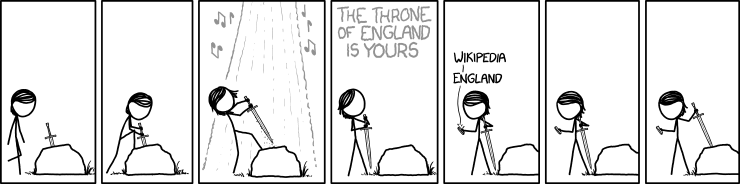
That seems like an awful lot of hassle when all I wanted was a cool sword.
06 May 09:06

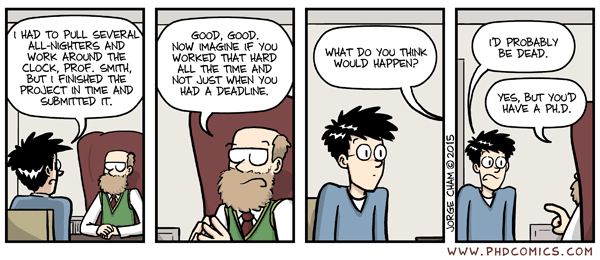
05/04/15 PHD comic: 'Overtime'

Piled Higher & Deeper by Jorge Cham
www.phdcomics.com
Click on the title below to read the comic
title: "Overtime" - originally published 5/4/2015

For the latest news in PHD Comics, CLICK HERE!

05 May 16:44

Topological Properties of Linear Circuit Lattices

by Victor V. Albert, Leonid I. Glazman, and Liang Jiang

Author(s): Victor V. Albert, Leonid I. Glazman, and Liang Jiang

Systems with nontrivial topological properties can be constructed from electric circuits consisting of capacitors and inductors.


[Phys. Rev. Lett. 114, 173902] Published Thu Apr 30, 2015

05 May 08:53

Facebook, specchio dell’umanità

by .mau.

Stamattina un conoscente del mio amico vb ha scritto sulla sua bacheca Facebook, lamentandosi per un articolo dal titolo «EXPO 2015 – apre il padiglione Pokémon ma la scritta è sbagliata: turisti giapponesi infuriati si danno al vandalismo», con campeggiante la figura di un cartellone con su scritto “Pochemonn”. Il suo messaggio iniziava con «Ormai non mi stupisco più di niente. Noi laureati in Lingue siamo visti solo come degli inutili…. E poi questi sono i risultati, enormi figure di m…… » (Non metto nomi e link perché non mi interessa parlare delle singole persone).

Il buon Bertola ha subito saggiamente commentato «Ma dai, ma è un’evidente photoshoppata…». Ma anche se la photoshoppata non fosse stata evidente, sarebbe bastato aprire il post e vedere dopo il testo che era stato inserito nelle categorie “Cronaca • Freddure”. Insomma, il lavoro di decodifica da compiere era proprio minuscolo. Eppure non solo c’è stato quell’intervento, ma ci sono anche stati altri commenti – dopo che l’arcano era stato svelato – di questo tono: «massa di imbecilli ignoranti ci facciamo ridere sempre dietro….per fortuna all’estero siamo sempre ben visti come lavoratori…» «cosa si lamentano? hanno la scritta…erano in ritardo è già tanto che l’abbiano messa…povera Italia».

Io capisco che scrivere ormai non è così difficile, ma è proprio vietato leggere e far partire il neurone prima di farlo? Più passa il tempo più questa gente mi fa paura.

01 May 11:12

[In Depth] Greece raids research funds to pay salaries

by Edwin Cartlidge
Greece's ongoing economic crisis and political shifts are taking a new toll on the country's researchers, already reeling from cuts in salaries and research spending. Now, the government plans to confiscate research funding to plug a hole in the country's ever worsening finances. As Science went to press, it remained unclear exactly how much money would be targeted and when it would be taken, but researchers expect the government to grab funds set aside to pay for research overheads. And the left-wing government, in power since January, is pushing through a reform of higher education that scientists say will make universities more politicized and less meritocratic. Author: Edwin Cartlidge
01 May 11:07

[In Depth] Nepal disaster presages a coming megaquake

by Eric Hand
Geophysicists studying the rupture mechanics of the magnitude-7.8 earthquake in Nepal have made a startling discovery: that the quake extended deep into the Himalayas, into a region that many scientists had deemed incapable of explosive tearing. The rupture extended past a "lock line" where brittle rock becomes more plastic in its behavior—a region where slip was expected to creep along quietly and not contribute to the overall power of the earthquake. The discovery suggests that, as awful as the present disaster is, future earthquakes in the Himalayas could end up being mightier and more calamitous than modelers assumed. Authors: Eric Hand, Priyanka Pulla
01 May 11:04

[Editorial] Transparency versus harassment

by Michael Halpern
Open records laws worldwide are critical to holding public institutions, including universities, accountable. Such laws protect against inappropriate influence on the scientific enterprise and promote public trust in the integrity of science and scientists. But the growing use of electronic communications by researchers makes these laws vulnerable to misuse. Conversations that used to occur in person and by other less-recordable means are now electronically written. Increasingly, activists across the political spectrum in several countries are requesting not only records of discussions about the strengths and weaknesses of work, but also preliminary paper drafts and private constructive criticisms from colleagues. These requests can attack and intimidate academics, threatening their reputations, chilling their speech, disrupting their research, discouraging them from tackling contentious topics, and ultimately confusing the public.* So what level of disclosure is appropriate? How can public accountability be balanced with the privacy essential for scientific inquiry? Authors: Michael Halpern, Michael Mann
01 May 09:14

This new set of rankings shows which colleges pay off the most

by Libby Nelson
Jacopo.bertolotti

Interestingly Harvard is not in among top ranking.

If you want a high salary after college, you should probably major in engineering.

This isn't a new lesson, but it's reinforced by a new set of college rankings that try to determine the best college based on its students' earnings and their ability to repay their student loans. The rankings, from the Brookings Institution, determine whether a college's graduates earn more than you'd expect, given their test scores and demographics.

The rankings try to take gender, race, and household income out of the equation to figure out the economic value of higher education. These are the best colleges (all tied for first place) based on how much they boost their graduates' earnings:

  • California Institute of Technology
  • Colgate University
  • Massachusetts Institute of Technology
  • Rose-Hulman Institute of Technology
  • Carleton College
  • Washington and Lee University
  • SUNY Maritime College
  • Clarkson University

The new rankings have three big lessons: first, that majoring in engineering or the sciences is generally a good way to make a good salary. Second, that even a lot of student debt can sometimes end up being worth it. And third, that pinpointing what works in higher education is much harder than creating a fancy regression.

Lesson 1: It's your major, not your college, that matters (within limits)

Engineering

(Shutterstock)

Seriously, just study engineering.

Whether you major in engineering or in English makes a much bigger difference, broadly speaking, than where you do it. That's why well-known, prestigious colleges like CalTech and lesser-known places like Clarkson, which also focuses on the sciences, are neck-and-neck on this list.

A college's curriculum, and the skills it teaches its graduates, made the most difference in its place on the Brookings rankings. At CalTech, where graduates make almost 50 percent more at mid-career than would be predicted given the students' test scores and demographics, the focus on the sciences, curriculum, and skills explains nearly all of the difference.

Beyond the very top of the list, the best-ranked colleges are mostly a mix of well-known and prestigious universities (the Ivy League, Stanford, the University of California Berkeley) and smaller colleges, including many with a focus on STEM.

Lesson 2: Not all student debt is bad student debt

Rose-Hulman Institute of Technology, which does exceptionally well in the Brookings rankings, is also known for graduating students who are deeply in debt. It's been highlighted multiple times by the Institute for College Access and Success as a university whose graduates have a particularly heavy debt load. About 70 percent of its students borrow, and on average they take out more than $42,000 in loans.

But they also pay back those loans: the college has an even lower default rate, which measures the percentage of former students who quit repaying their loans in the first years of repayment, than would be expected given its demographics. For their graduates, the degree, however expensive, is probably a good investment.

Lesson 3: We don't know why liberal arts colleges work

(Stephanie Gross / The Washington Post via Getty Images)

Washington and Lee University is doing something that helps it top the rankings — but we don't know what.

Brookings didn't just look at the earnings gap between graduates at various colleges; it tried to explain why. Very quickly, it becomes clear that some colleges have far better outcomes than others, and it's extremely difficult to explain why.

Take Washington and Lee, an outlier on the list of the colleges that add the most value. It's not entirely clear what makes Washington and Lee different from other liberal arts colleges — and the formula Brookings used can't explain it. It attributes half of the difference Washington and Lee makes to an "X-factor."

This pops up over and over with liberal arts colleges. Macalester College, Grinnell College, and Carleton College are all similar liberal arts colleges in Iowa and Minnesota. Brookings predicted that their graduates would all earn about the same amount at mid-career, around $73,000.

But Carleton graduates earn 43 percent more than that, while Macalester graduates earn 22 percent more, and Grinnell graduates earn just 6 percent more. And at Carleton, most of the difference is attributed to an X-factor. It's clearly outperforming its peers — but no one knows why.

If you're trying to decide between those three colleges, the fact that Carleton's graduates make much more than would be expected is useful information. But if Macalester and Grinnell are trying to catch up, this study tells them nothing. The Brookings calculations are clearly missing something big and important. We just don't know what it is.