Shared posts

13 Jan 11:48

The H-index of a network node and its relation to degree and coreness

by Linyuan Lü

Article

Identifying influential nodes in networks is important for the understanding of their structure and function, but there are several so far unrelated measures to assess this. Here, the authors unfold relations among knows criteria and construct a family of indices that interpolate between degree and coreness.

Nature Communications doi: 10.1038/ncomms10168

Authors: Linyuan Lü, Tao Zhou, Qian-Ming Zhang, H. Eugene Stanley

12 Jan 09:51

RIP Ziggy

by The Awkward Yeti

Bowie

12 Jan 09:46

Fottuti e Contenti

by RRobe
Jacopo.bertolotti

Che bello! Un dibattito su chi sia veramente Nerd e chi no, il tutto condito con una buona dose di "ai miei tempi..."
Se ne sentiva proprio la mancanza :-D


Un video che ho fatto qualche settimana fa per quelli di Screenweek ha generato parecchi consensi, molto visualizzazioni ma pure un parte cospicua di polemiche e lamentele.
Per farla brevissimo, il video stigmatizza il fenomeno della "ragazza nerd", partendo dall'assunto che non esistono. Che le ragazze lo fanno per moda o per rendersi più attraenti nei confronti di un genere maschile che, sempre di più, sembra essersi attorcigliato attorno a un'eterna adolescenza emotiva, culturale e sociale.
E' per questo che sono incorso nelle ire di varie ragazze che hanno rivendicato il loro essere nerd genuine e vere, al pari della loro controparte maschile, e di qualche ragazzo che voleva far vedere di essere attento ai problemi delle donne nella segreta speranza di far colpo sul qualcuna (per poi vedersela soffiare dallo stronzo insensibile di turno e chiedersi perché).

Adesso, ho riflettuto molto su questa cosa, e sono arrivato a una conclusione.
Mettiamola così: dal mio punto di vista è come se avessi detto che le donne realmente appassionate di calcio fossero solo delle fasulle e un gruppetto di ragazze si fosse alzato per dire che non solo mi sbagliavo ma che loro erano "fieramente delle ultras, con una bassa cultura, una bassa estrazione sociale, pochi strumenti per decodificare il mondo, una spiccata aggressività, una passione per la violenza e gli atti vandalici, e pronte ad accoltellarsi per ventidue miliardari che corrono dietro a un pallone".
E' chiaro il concetto?
Lo so: non capite come io possa paragonare un nerd a un ultras, giusto?
E' semplice: perché essere un nerd non è una cosa figa. O di cui andare fieri.
O, almeno, non dovrebbe esserlo in un mondo che non fosse finito così palesemente oltre lo specchio come il nostro.

Mi permetto una digressione: io sono del 1974.
Sin da bambino ho avuto una salute cagionevole e ho passato tanto tempo a casa. Da solo.
A scuola ero goffo e magrolino e venivo sempre scelto per ultimo quando si trattava di fare le squadre di calcio. In poche parole, ero uno sfigato che non aveva davvero una scelta tra avere una vita "normale" o dedicarmi alle mie passioni. Potevo SOLO dedicarmi alle mie passioni perché avevo SOLO quelle. Ed è per questo che mi sono specializzato e sono diventato esperto nelle mie cose al punto di farne un lavoro e di essere bravo a farlo.
E questa storia è comune alla gran parte dei nerd che oggi sono diventati miliardari creando computer, sviluppando sistemi operativi, girando film, o facendo fumetti.
Sfigati senza alcuna alternativa sociale possibile.
Perché diventi bravo molto velocemente solo se sei ossessionato e le e ossessioni si nutrono di tempo.
E se hai una vita VERA, il tempo lo dedichi ad altro.
Se hai la possibilità di giocare al parco con gli amici invece di stare a casa a guardare un'infinita sfilza di serie televisive, sceglierai sempre la prima ipotesi. Se hai la possibilità di stare con una ragazza invece di restare chiuso in casa a suonare la chitarra, sceglierai sempre la prima ipotesi.
Se hai l'opportunità di vivere in prima persona qualcosa invece che sublimarla attraverso un'esperienza artefatta, lo farai.

Questo nel mondo com'era fino a qualche anno fa e come dovrebbe ancora essere.
Prima i "normali", quelli che potevano aspirare ad avere una vita vera, erano i tanti, e i nerd, quelli senza una vita e senza nessuna possibilità di averla, erano i pochi.
Prima, quando i nerd erano gli emarginati del sistema e per questo sviluppavano un loro orgoglio (quello che animava pellicole come Animal House, La Rivincita dei Nerd e Porkis per capirci).

Poi qualcosa è andato storto.
In termini molto semplici, la vita "reale" è diventata una cosa così difficile da ottenere e così appannaggio di pochi, che gli emarginati sono diventati la maggioranza.
E' diventato sempre più difficile relazionarsi con i propri simili. E' diventato sempre più difficile realizzarsi nel lavoro e ottenere una stabilità economica. E' diventato sempre più difficile passare del tempo all'aria aperta. La società, per come la conosciamo, ci ha trasformato tutti in disadattati, impedendoci di raggiungere quello status di normalità che prima era più o meno raggiungibile da tutti, anche se a diversi livelli.
E visto che ora essere degli sfigati è la regola, essero un "no lifer" è diventata la condizione "normale" dello stato sociale. Adesso il diverso è quello che non sente il bisogno di raccontare la sua identità mettendosi addosso una maglietta con sopra un pupazzo, quello che non cita con orgoglio tutte le battute di uno dei centinaia di film che conosce a memoria perché ha passato settimane della sua vita a vederli, quello che non spende i pochi soldi che guadagna per comprarsi pupazzetti, quello che non scopa solo con persone che ha conosciuto su Facebook.
Adesso, il vero emarginato, la minoranza, il "nuovo debole" è quello che un tempo era conosciuto come la persona normale.
E visto che gli sfigati sono oggi la razza dominante, stiamo tutti a parlare di "orgoglio nerd" quando non ci dovrebbe essere nulla di cui essere orgogliosi nell'essere delle persone disadattate e socialmente disfunzionali.

Quindi adesso mi rivolgo a tutte le donne che ho offeso dicendo che le "ragazze nerd non esistono": vi chiedo scusa. Non era mia intenzione insultarvi. In realtà, vi stavo facendo un complimento.
Ma i tempi sono cambiati e avete ragione voi, le ragazze nerd esistono.
E sono delle sfigate senza una vita che vanno orgogliose di come il sistema le ha fregate al pari degli uomini.
E adesso la chiudo qui che devo andare a spolverare la mia collezione di statuite dei supereroi.


11 Jan 14:42

[Working Life] Want a letter? You write it for me

by Roger S. Day
Author: Roger S. Day
11 Jan 14:20

Rethinking the kelvin

by Michael de Podesta

Nature Physics 12, 104 (2016). doi:10.1038/nphys3617

Author: Michael de Podesta

Michael de Podesta discusses the current definition of the kelvin — and why it is worth changing one last time.

11 Jan 14:20

The art of measurement

Nature Physics 12, 1 (2016). doi:10.1038/nphys3640

With a dedicated monthly column, Nature Physics draws attention to metrology. And a set of Commentaries in this issue focuses on various aspects of thermometry.

11 Jan 14:02

Light Higgs channel of the resonant decay of magnon condensate in superfluid 3He-B

by V. V. Zavjalov

Article

The order parameter describing the spontaneous symmetry breaking which occurs when a system becomes a superfluid is analogous to the Higgs field in particle physics from which the Higgs boson arises. Here, the authors demonstrate the existence of a light Higgs boson in the B-phase of superfluid 3 He.

Nature Communications doi: 10.1038/ncomms10294

Authors: V. V. Zavjalov, S. Autti, V. B. Eltsov, P. J. Heikkinen, G. E. Volovik

11 Jan 12:11

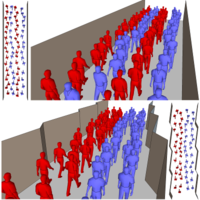
Keep-Left Behavior Induced by Asymmetrically Profiled Walls

by C. L. N. Oliveira, A. P. Vieira, D. Helbing, J. S. Andrade, Jr., and H. J. Herrmann
Jacopo.bertolotti

Wait. What?

Author(s): C. L. N. Oliveira, A. P. Vieira, D. Helbing, J. S. Andrade, Jr., and H. J. Herrmann

Ensuring efficient pedestrian streams through transit corridors such as subway hallways is a problem of significant relevance to many cities. By modeling self-driven particles, scientists show that modulating the shape of a hallway’s walls might help to separate opposite pedestrian flows.


[Phys. Rev. X 6, 011003] Published Thu Jan 07, 2016

08 Jan 09:48

New in the Wolfram Language: Symbolic PDEs

by Devendra Kapadia
Jacopo.bertolotti

I admit I did not know the DEigensystem function, but it looks super-useful!

PDEs word cloud

Partial differential equations (PDEs) play a vital role in mathematics and its applications. They can be used to model real-world phenomena such as the vibrations of a stretched string, the flow of heat in a bar, or the change in values of financial options. My aim in writing this post is to give you a brief glimpse into the fascinating world of PDEs using the improvements for boundary value problems in DSolve and the new DEigensystem function in Version 10.3 of the Wolfram Language.

The history of PDEs goes back to the works of famous eighteenth-century mathematicians such as Euler, d’Alembert, and Laplace, but the development of this field has continued unabated during the last three centuries. I have, therefore, chosen examples of both classical as well as modern PDEs in order to give you a taste of this vast and beautiful subject.

Let us begin by considering the vibrations of a stretched string of length π that is fixed at both ends. The vibrations of the string can be modeled by the one-dimensional wave equation, which is given below. Here, u(x,t) is the vertical displacement of a point at the location x on the string, at time t:

Vibrations of the string can be modeled by the one-dimensional wave equation

Next, we specify a boundary condition to indicate that the ends of the string remain fixed during the vibrations:

Specifying a boundary condition

Finally, we prescribe the displacement and speed at different points on the string at time t=0 as initial conditions for the motion of the string:

Prescribing initial conditions for the motion of the string

We can now use DSolve to solve the initial boundary value problem for the wave equation:

Using DSolve to solve the initial boundary value problem for the wave equation

As seen above, the solution is an infinite sum of trigonometric functions. The sum is returned in an Inactive form since each individual term in the expansion has a physical interpretation and, typically, a small number of terms will provide a useful approximation to the exact solution. For example, we can extract four terms from the sum to obtain an approximate solution asol(x,t):

Extracting four terms from the sum

Each term in the sum represents a standing wave, which can be visualized as follows:

Visualizing a standing wave

These standing waves combine in a magical way to produce the smooth vibrations of the string, as shown in the following animation:

Animation of smooth vibrations of the string

The wave equation belongs to the class of linear hyperbolic PDEs, which govern the propagation of signals with finite speeds. This PDE arose as a convenient way to model the vibrations of strings and other deformable bodies, but it plays an even more important role in modern physics and engineering since it governs the propagation of light and other electromagnetic waves.

Let us now model the flow of heat in a bar of length 1 that is insulated at both ends using the heat equation, which is given as follows:

Modeling the flow of heat using the heat equation

Since the bar is insulated at both ends, no heat flows through the ends, which translates into a boundary condition at the two ends x=0 and x=1:

Boundary condition at the two ends x=0 and x=1

Next, we must prescribe the initial temperature at different points in the bar. In this example, we choose the linear function given below. The initial temperature is 20 at the left end (x=0) and 100 at the right end (x=1):

initialcondition = u[x, 0] = 20 + 80 x

Finally, we solve the heat equation subject to these conditions:

Solving the heat equation

As in the case of the wave equation, we can extract a few terms from the Inactive sum to obtain an approximate solution, as shown below:

Extracting a few terms for the Inactive sum to obtain an approximate solution

The first term in the approximate solution, 60, is the average of the initial temperatures at the left and the right ends of the bar, and is also the steady-state temperature for this bar. As the plot of temperature along the length of the bar below shows, the temperature of the bar quickly evolves to the steady-state value of 60 degrees:

Plot of temperature along the length of the bar

The heat equation belongs to the class of linear parabolic PDEs, which govern diffusion processes. This rather simple-looking equation is ubiquitous and makes a surprising appearance in a wide variety of applications. We will see two examples of this phenomenon later in the post.

We now turn to the Laplace equation, which is used to model the steady state of systems, i.e. the behavior after any time-dependent transients have died out. In two dimensions, this equation is given as follows:

Laplace equation in two dimensions

Assume that the coordinates x and y are restricted to the rectangular region Ω given below:

Omega = Rectangle [{0,0}, {1,2}]

The classical Dirichlet problem is to find a function u(x,y) that satisfies the Laplace equation inside Ω along with a given DirichletCondition that specifies values on the boundary of Ω, as illustrated below:

Classic Dirichlet problem

The Dirichlet problem can be solved using the elegant region notation for DSolve:

The Dirichlet problem can be solved using the elegant region notation for DSolve

As in earlier examples, we can extract a fixed number, say 100, of terms from the Inactive sum and visualize the solution, as shown below:

Visualizing the solutions from the Inactive sum

Notice that the solution u(x,y) of the Dirichlet problem is smooth within Ω despite the fact that the boundary conditions have sharp features. Also, u(x,y) attains its maximum and minimum values on the boundary, while there is a saddle point at the center of the rectangle. These features are typical of linear elliptic equations, the class of PDEs to which the Laplace equation belongs.

The wave, heat, and Laplace equations are the most famous examples of classical PDEs. We will now consider three representative examples of modern PDEs, beginning with Burgers’ equation for viscous fluid flow, which can be stated as follows:

Burgers' equation for viscous fluid flow

This nonlinear PDE was introduced by J. M. Burgers around 1940 as a simple model for turbulent flows (the parameter ϵ in the equation represents the viscosity of the fluid). However, a decade later, E. Hopf and J. D. Cole showed that Burgers’ equation can be transformed into the heat equation, thereby indicating that this equation cannot exhibit chaotic behavior. The Hopf–Cole transformation allows us to solve Burgers’ equation in closed form for an initial condition, such as the one given below:

Using Hopf--Cole transformation to solve Burgers' equation in closed form for an initial condition

For this example, we use DSolveValue, which returns only an expression for the solution. The error function (Erf) terms in the formula below arise from the solution of the corresponding initial value problem for the heat equation:

Using DSolveValue

The following plot is showing the evolution over time of a hypothetical fluid velocity field in one dimension. The solution is smooth for a positive value of ϵ, although the initial condition is a piecewise function:

Plot is showing the evolution over time of a hypothetical fluid velocity field in one dimension

As seen below, the solution develops a shock discontinuity in the limit when the viscosity ϵ approaches 0. These shock solutions are a well-known feature of the inviscid (ϵ = 0) Burgers’ equation:

Shock discontinuity in the limit when the viscosity epsilon approaches 0

As a second example of a modern PDE, let us consider the Black–Scholes PDE from finance. This equation was introduced by Fischer Black and Myron Scholes in 1973 as a model for the prices of European-style financial options, and can be stated as follows:

Black--Scholes PDE from finance

Here, c is the price of the option as a function of stock price s and time t, r is the risk-free interest rate, and σ is the volatility of the stock.

In their landmark paper (which has been cited more than 28,000 times), Black and Scholes noted that their equation can be reduced to the heat equation by a transformation of variables. This dramatic simplification leads to the celebrated Black–Scholes formula for European call options, under a terminal condition based on the “strike price” k of the asset at time t=T:

Black--Scholes formula for European call options

Armed with this formula, we can compute the value of a financial option for typical values of the parameters:

Computing the value of a financial option for typical values of the parameters

The answer agrees with the value given by the built-in FinancialDerivative function:

Verifying the answer with the FinancialDerivative function

As our third example of a modern PDE, we will solve the free Schrödinger equation for an electron that is constrained to move in a one-dimensional box of length d, with a suitable initial condition. The equation and conditions may be stated as follows:

Schrödinger equation and conditions

This example has an elementary solution that takes imaginary values due to the presence of I in the Schrödinger equation:

Example that has an elementary solution that takes imaginary values due to the presence of I

The probability density function for the electron, ρ=Ψ Ψ, can be computed using suitable values for the parameters in the problem as follows:

Computing the probability density function for the electron

We can create a movie showing the evolution of the probability density over time, which reveals that the “center” of the electron moves from side to side in the box:

Evolution of the probability density over time

Eigenvalues and eigenfunctions play an important role in the solution of Schrödinger’s equation and other PDEs. In particular, they provide the building blocks for the infinite sum solutions of the wave and heat equations that we saw earlier in the post. Hence, as our final example, let us consider the problem of finding the nine smallest eigenvalues and eigenfunctions for the Laplacian operator with a homogeneous (zero) Dirichlet condition over a ball in three dimensions. That is, we are interested in the nine smallest values of λ and the corresponding functions ϕ that satisfy 𝓛ϕ = λ ϕ, with the following definitions:

Finding the nine smallest eigenvalues and eigenfunctions

The new DEigensystem function in Version 10.3 allows us to compute the required eigenvalues and eigenfunctions as follows:

Version 10.3 allowing to compute the required eigenvalues and eigenfunctions

The eigenvalues for this problem are expressed in terms of BesselJZero. For example:

Eigenvalues are expressed in terms of BesselJZero

The eigenfunctions can be visualized using DensityPlot3D, which returns the beautiful plots that are shown below:

Eigenfunctions visualized using DensityPlot3D

Partial differential equations are an essential tool in many branches of science, engineering, statistics, and finance. At a more fundamental level, they provide precise mathematical formulations for some of the deepest and most subtle questions about our universe, such as whether naked singularities can really exist. In my experience, the study of PDEs rewards one with a rare combination of practical insights and intellectual satisfaction.

I invite you to look at the documentation for DSolve, NDSolve, DEigensystem, NDEigensystem, and the finite element method to learn more about the various approaches for solving PDEs in the Wolfram Language.

Symbolic PDEs is supported in Version 10.3 of the Wolfram Language and Mathematica, and is rolling out soon in all other Wolfram products.

Download this post as a Computable Document Format (CDF) file.

08 Jan 09:32

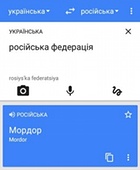
Perché Google Translate traduceva “Russia” con “Mordor”?

by Paolo Attivissimo
Credit:
Vadim Nakhankov/VKontakte
Fino a pochi giorni fa Google Translate traduceva “Russia” in “Mordor”, la terra del male nel Signore degli Anelli, e faceva altri errori politicamente scottanti se lo si usava per tradurre dall’ucraìno al russo: per esempio, “russi” diventava “occupanti” e il cognome del ministro degli esteri russo Sergey Lavrov diventava “cavallino triste”. Le immagini di questi scivoloni di traduzione sono diventate popolarissime nei social network locali.

Google ha spiegato che si è trattato di errori automatici che ora sono stati corretti manualmente, ma non è stata molto chiara sul meccanismo che li ha prodotti: si è limitata a dire che Translate funziona “senza l’intervento di traduttori umani” e che “la traduzione automatica è molto difficile, perché il significato delle parole dipende dal contesto in cui vengono usate. Questo significa che non tutte le traduzioni sono perfette e che a volte ci saranno errori.” Vero, ma questi errori stavolta sono stati particolarmente specifici e non casuali.

L’ipotesi più plausibile, al momento, è che siano scaturiti dal fatto che Google Translate in realtà non capisce quello che traduce e non attinge a un dizionario bilingue, ma si basa meccanicamente sull'analisi dei testi bilingui che trova su Internet, come spiegato in questo video.

Questo vuol dire che se tanti utenti traducono su Internet una parola o una frase nello stesso modo, Google presume automaticamente che quella sia la traduzione corretta. In questo caso riferirsi alla Russia chiamandola “Mordor” è, a quanto pare, una consuetudine molto popolare fra i soldati e attivisti ucraìni in seguito all’annessione russa della Crimea e così Google ha attinto a questa pratica.

Se è così, allora non solo Google è innocente, ma non c'è neanche stato un astuto coordinamento da parte di tanti utenti per influire sul funzionamento di Google, come hanno ipotizzato alcuni per analogia con il googlebombing, ossia la prassi di creare tanti link che associano una parola a una specifica pagina Web, in modo che chi cerca quella parola in Google trova come primo risultato quella pagina: per esempio, nel 1999 chi digitava in Google “More evil than Satan himself” (“più malvagio di Satana stesso”) otteneva come primo risultato il sito di Microsoft.

In questo caso, invece, non ci sarebbe nessuna azione coordinata: tutto sarebbe avvenuto spontaneamente a causa del modo in cui funziona Translate. Meglio ricordarsi, insomma, che questi servizi automatici hanno dei limiti molto significativi e possono causare equivoci e situazioni imbarazzanti.


Fonti: Ars Technica, Giornalettismo, BBC, The Guardian.


Scritto da Paolo Attivissimo per il blog Il Disinformatico. Ripubblicabile liberamente se viene inclusa questa dicitura (dettagli). Sono ben accette le donazioni Paypal.
08 Jan 09:29

No, il registro elettronico non vi impedisce di chiacchierare coi vostri figli

by Leonardo T
Il 7 gennaio è il giorno in cui arrivo a scuola con un pacco di compiti corretti durante le vacanze (sì, lavoro durante le vacanze. Non c’è altro modo). Fino all’anno scorso, dovevo verificare che gli studenti scrivessero il voto corretto sul loro diario, e poi firmare. Nei giorni successivi, avrei perso altro tempo prezioso - minuti di lezione pagati dalla collettività - per controllare che accanto a quel voto comparisse la firma dei genitori, possibilmente autentica (anche se scritta in alfabeti che non sempre conosco). Si tratta di una trafila lunga, che crea anche nelle classi più tranquille un momento di caos. Nizzoli, ma ti avevo davvero dato 6 più? Non era un 6 meno? Questa firma sembra quella di un bambino, ma mio zio non è che firmasse molto meglio. Nel frattempo Nizzoli si sta infilando una matita in naso perché gli do le spalle. E così via. Ho spesso avuto la sensazione che i veterani controllassero solo una volta ogni tanto: giustizia sommaria. Se il prezzo da pagare era un genitore infuriato che scopriva a febbraio i voti di novembre, amen.

Quest’anno però ho il registro elettronico. I voti li ho già messi da casa, perché il registro elettronico è a mia disposizione anche la notte di Natale, se mi va. I genitori possono controllare quando vogliono. Anche mai, se non vogliono. Quel che proprio non possono più fare è lamentarsi del fatto che non li teniamo al corrente.

Ecco, questo forse è il problema.

Se togli a un genitore la facoltà di lamentarsi, lui si sente a disagio - forse defraudato di una prerogativa? Sul Sole 24 Ore, Monica D’Ascenzo confessa che la comunicazione della password le ha fatto sentire un “fastidio”, che “si è trasformato velocemente in disagio” quando ha scoperto che nel registro, oltre alle assenze, “i genitori possono consultare quanto fatto in classe in ogni singola materia, i compiti assegnati e (orrore!) i voti del proprio figlio”.

Ho chiuso in fretta il tutto come se mi fosse capitato in mano il suo diario dei pensieri.
Ma che roba è? Posso in qualunque momento sapere cosa fa mio figlio prima ancora che lui pensi anche solo se raccontarmelo o meno. Che fine fanno le chiacchiere da cena: cosa avete fatto oggi? Com’è andata la giornata? Ti ha interrogato?

E quindi insomma niente. Speravo che per una volta la tecnologia mi avesse davvero semplificato la vita, ma sbagliavo. Ovvero, sì, mi avrebbe liberato da inutili passeggiate in mezzo all’aula per controllare decine di voti; da scenate di genitori che trovano voti diversi e firme false e altri spiacevoli affanni - ma se il prezzo da pagare sono “le chiacchiere da cena” di una mamma con un figliolo, non mi resta che tornare al cartaceo. Costa di più, prende più tempo, è più scomodo. Ma le chiacchiere da cene saranno salve.

Non si può evitare che tutti parlino di scuola. Tutti ci hanno passato più di dieci anni, quindi tutti hanno diritto a un'opinione. Ma nel caso dei genitori è troppo spesso modellata sulla loro esperienza, individuale, positiva o spiacevole. Se hanno avuto insegnanti sfaccendati, sono portati a pensare che tutti gli insegnanti lo siano. Se a tavola chiacchieravano amabilmente coi genitori di voti in classe, tendono a pensare che a tutti risultasse altrettanto piacevole, e formativo, questo tipo di chiacchiere.

Dall’altra parte c’è un insegnante che ha lavorato con migliaia di studenti, migliaia di genitori: che conosce tutte le falle del sistema, per esserci caduto a piè pari più volte. Lui vi dice che il registro elettronico è più comodo per tutti, ma in fondo che ne sa?

Dove è finita la possibilità di scelta del bambino di raccontare o meno se è stato interrogato o se la maestra ha fatto una verifica a sorpresa? Dove è finita la libertà di confessare a un genitore un’insufficienza o invece decidere di gestirla da solo magari studiando, recuperando la volta successiva e spuntando una sufficienza in pagella?
Cara genitrice, quella possibilità di scelta è ancora lì, non l’ha toccata nessuno. Se non vuole usare il registro elettronico, non lo usi. Chieda a suo figlio di scrivere i voti sul diario, e li controlli. Se con lei ha funzionato, non è affatto improbabile che funzioni anche a suo figlio. Se poi ogni tanto vuole dare una sbirciatina... nessuno la giudicherà.

E lei non giudichi me se invece di passare ore di lavoro a controllare firme, ne approfitto per fare lezione. Mi diverto di più.
07 Jan 09:35

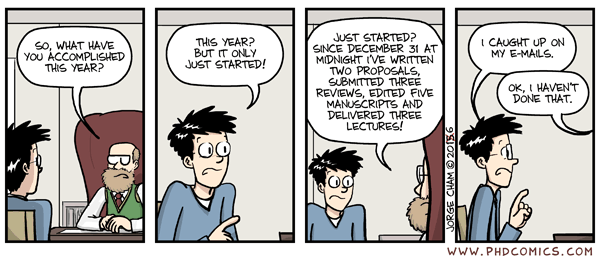
01/06/16 PHD comic: 'What have you accomplished?'

Piled Higher & Deeper by Jorge Cham
www.phdcomics.com
Click on the title below to read the comic
title: "What have you accomplished?" - originally published 1/6/2016

For the latest news in PHD Comics, CLICK HERE!

06 Jan 12:08

Saturday Morning Breakfast Cereal - Clock

by admin@smbc-comics.com

Hovertext: I recommend that children learn how to buy SMBC comics and attend BAHFest shows.


New comic!
Today's News:

OH MAN, so many cool people will be in attendance :) 

05 Jan 10:22

[In Depth] As Ebola epidemic draws to a close, a thin scientific harvest

by Jon Cohen
As the Ebola epidemic exploded in the summer of 2014, a frenzied effort began to test vaccines and drugs in Liberia, Sierra Leone, and Guinea. But so far, results from just one clinical trial have appeared in a peer-reviewed journal; it showed Merck's Ebola to be remarkably successful. A dozen other trials have yet to be published. Many didn't deliver a clear answer because they failed to enroll the planned number of participants. Others did recruit enough patients but didn't use a randomized controlled trial design, which weakened results. Still others were halted early. One last hope for an uplifting result remains: an ongoing study of ZMapp, a promising antibody cocktail. Authors: Jon Cohen, Martin Enserink
05 Jan 10:14

[Editorial] New members of the family

by Marcia McNutt
Jacopo.bertolotti

"Some publishers add new journal titles more often than I buy new shoes. The American Association for the Advancement of Science (AAAS), the publisher of Science, certainly cannot be accused of that, having grown to only four journal titles in 136 years."

Why not add 2 more journals? I am sure this was exactly what we needed.

Some publishers add new journal titles more often than I buy new shoes. The American Association for the Advancement of Science (AAAS), the publisher of Science, certainly cannot be accused of that, having grown to only four journal titles in 136 years. Yet many members of the scientific community have encouraged AAAS to expand its repertoire, arguing that the Science family of journals is high quality, well curated and edited, and worth supporting because they enable the mission of a nonprofit scientific society that is governed by scientists working to further the best interests of the scientific community. It is thus with some pride that I describe the launch in 2016 of two new journals: Science Robotics and Science Immunology. Author: Marcia McNutt
05 Jan 10:12

Fishy limits

Fishy limits

Nature 528, 7583 (2015). doi:10.1038/528435a

The European Commission has set a worrying trend by ignoring scientific advice on overfishing. It must put long-term sustainability plans ahead of short-term political gains.

05 Jan 10:12

Single-chip microprocessor that communicates directly using light

by Chen Sun

Single-chip microprocessor that communicates directly using light

Nature 528, 7583 (2015). doi:10.1038/nature16454

Authors: Chen Sun, Mark T. Wade, Yunsup Lee, Jason S. Orcutt, Luca Alloatti, Michael S. Georgas, Andrew S. Waterman, Jeffrey M. Shainline, Rimas R. Avizienis, Sen Lin, Benjamin R. Moss, Rajesh Kumar, Fabio Pavanello, Amir H. Atabaki, Henry M. Cook, Albert J. Ou, Jonathan C. Leu, Yu-Hsin Chen, Krste Asanović, Rajeev J. Ram, Miloš A. Popović & Vladimir M. Stojanović

Data transport across short electrical wires is limited by both bandwidth and power density, which creates a performance bottleneck for semiconductor microchips in modern computer systems—from mobile phones to large-scale data centres. These limitations can be overcome by using optical communications based on chip-scale electronic–photonic systems enabled by silicon-based nanophotonic devices8. However, combining electronics and photonics on the same chip has proved challenging, owing to microchip manufacturing conflicts between electronics and photonics. Consequently, current electronic–photonic chips are limited to niche manufacturing processes and include only a few optical devices alongside simple circuits. Here we report an electronic–photonic system on a single chip integrating over 70 million transistors and 850 photonic components that work together to provide logic, memory, and interconnect functions. This system is a realization of a microprocessor that uses on-chip photonic devices to directly communicate with other chips using light. To integrate electronics and photonics at the scale of a microprocessor chip, we adopt a ‘zero-change’ approach to the integration of photonics. Instead of developing a custom process to enable the fabrication of photonics, which would complicate or eliminate the possibility of integration with state-of-the-art transistors at large scale and at high yield, we design optical devices using a standard microelectronics foundry process that is used for modern microprocessors. This demonstration could represent the beginning of an era of chip-scale electronic–photonic systems with the potential to transform computing system architectures, enabling more powerful computers, from network infrastructure to data centres and supercomputers.

05 Jan 10:12

Feuding physicists turn to philosophy for help

by Davide Castelvecchi

Feuding physicists turn to philosophy for help

Nature 528, 7583 (2015). http://www.nature.com/doifinder/10.1038/528446a

Author: Davide Castelvecchi

String theory is at the heart of a debate over the integrity of the scientific method itself.

05 Jan 09:50

Detection and tracking of moving objects hidden from view

by Genevieve Gariepy

Nature Photonics 10, 23 (2016). doi:10.1038/nphoton.2015.234

Authors: Genevieve Gariepy, Francesco Tonolini, Robert Henderson, Jonathan Leach & Daniele Faccio

The ability to detect motion and track a moving object hidden around a corner or behind a wall provides a crucial advantage when physically going around the obstacle is impossible or dangerous. Previous methods have demonstrated that it is possible to reconstruct the shape of an object hidden from view. However, these methods do not enable the tracking of movement in real time. We demonstrate a compact non-line-of-sight laser ranging technology that relies on the ability to send light around an obstacle using a scattering floor and then detect the return signal from a hidden object within only a few seconds of acquisition time. By detecting this signal with a single-photon avalanche diode (SPAD) camera, we follow the movement of an object located a metre away from the camera with centimetre precision. We discuss the possibility of applying this technology to a variety of real-life situations in the near future.

05 Jan 09:46

Minimum reflection channel in amplifying random media

by Seng Fatt Liew and Hui Cao

Author(s): Seng Fatt Liew and Hui Cao

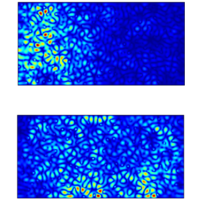
Enhancing light transmission through scattering media is of much interest in many fields. Here, numerical simulations are performed to study the impact of gain on the value of reflection of the minimum reflection channel in a random medium. Surprisingly, in some random configurations, the reflection falls when gain is added even through the intensity inside the medium presumably increases once gain is introduced. This unexpected behavior is explained based on a decomposition of quasinormal modes.


[Phys. Rev. B 92, 224202] Published Tue Dec 29, 2015

05 Jan 09:46

Control of mesoscopic transport by modifying transmission channels in opaque media

by Raktim Sarma, Alexey Yamilov, Seng Fatt Liew, Mikhael Guy, and Hui Cao

Author(s): Raktim Sarma, Alexey Yamilov, Seng Fatt Liew, Mikhael Guy, and Hui Cao

Based on experiments and simulations, the authors use waveguides of nonuniform cross-sectional width to tailor the spatial distribution of the energy density of transmission channels and to realize conversion between evanescent and propagating channels. For particular geometries, perfect reflection channels are created, and their large penetration depth into the medium as well as the complete return of probe light to the input end should greatly benefit sensing and imaging applications.


[Phys. Rev. B 92, 214206] Published Thu Dec 31, 2015

02 Jan 15:50

is-that-what-i-think-it-is: dannysgreenpants: just-shower-thoughts: Why don’t jedis turn off...

is-that-what-i-think-it-is:

dannysgreenpants:

just-shower-thoughts:

Why don’t jedis turn off their opponents lightsabers by force pressing the button?

I’m laughing so hard because instead of the epic lightsaber fight they’d just be aggressively switching them on and off could you imagine

31 Dec 14:18

Quei 45.000 morti di troppo e il volo degli avvoltoi

by Marco Cattaneo

Nei giorni scorsi ha destato scalpore la notizia secondo cui l’Istat avrebbe registrato, nei primi otto mesi del 2015, circa 45.000 decessi in più rispetto al 2014. Una cifra che, con un’estrapolazione lineare agli altri quattro mesi dell’anno, porterebbe a un saldo di 68.000 decessi in più (l’11,3 per cento rispetto al 2014), come già faceva notare Gian Carlo Blangiardo, professore di demografia presso l’Università di Milano-Bicocca, su «Avvenire» l’11 dicembre, e in un successivo post pubblicato il 22 dicembre su Neodemos.

Un dato preoccupante, secondo Blangiardo, giustamente rilanciato dalla stampa il giorno dopo. Anche perché, come rileva lo stesso docente nel suo post, l’invecchiamento demografico potrebbe essere chiamato a giustificare al massimo 16.000 decessi in più rispetto al 2014, e un incremento così vistoso della mortalità si era registrato per le ultime volte in tempo di guerra. Nel 1943 e tra il 1915 e il 1918. In conclusione, Blangiardo faceva riferimento a un possibile effetto del controllo sulla spesa sanitaria, alla riduzione del benessere, agli effetti osservati nei paesi dell’Est europeo durante la transizione dal comunismo all’economia di mercato. Ma sottolineava che bisogna aspettare altri dati per conoscere le cause.

Ma, si sa, in questo paese sono sempre tutti pronti a cercarsi un posto al sole artificiale della visibilità. E così, apriti cielo. Nel giro di pochi giorni gli sciacalli in servizio permanente effettivo si sono cuciti le loro spiegazioni su misura.
Le più rumorose, al solito, sono state quelle di Beppe Grillo, che ha scritto un post intitolato «Morti di guerra in tempo di pace. #68000morti», in cui accusava premier e ministri di «passeggiare incuranti sui cadaveri di 68.000 italiani che non hanno saputo proteggere». E approfittava dell’attenzione spasmodica sul blocco del traffico e le targhe alterne nelle grandi città (seguito a ruota da Matteo Salvini) per attribuirne la causa a smog, inquinamento e tagli alla Sanità.

Due giorni prima, come regalo di Natale, Mario Giordano in un esilarante editoriale su «Il Giornale» si attribuiva la paternità di una previsione postuma («Purtroppo eravamo stati facili profeti») e individuava con nessun margine di incertezza la ragione di tanti morti: «Ma è inevitabile che tutti pensino a un’unica grande causa. Il suo nome è: crisi». Per poi lanciarsi in una spettacolare invettiva contro l’euro, Monti, l’alimentazione che è peggiorata, Renzi, e persino l’aumento dell’età pensionabile (singolare l’assenza dei governi Berlusconi dalla lista, ma come diceva Tremonti durante i governi Berlusconi la crisi non esisteva). Se si muore prima (ma chi gliel’ha detto che è «prima» lo sa solo lui…), che senso ha lavorare tanto a lungo?

Naturalmente non è mancato anche chi ha letto nei fondi di caffè indizi di segno opposto. Ho letto, tra l’altro, soprattutto sui social network, chi elencava tra le possibili cause il calo delle vaccinazioni dovuto a un clima di sospetto per i possibili effetti avversi a cui avrebbe contribuito proprio il blog di Grillo.

Mancano solo «un terremoto, un tremenda inondazione, le cavallette…» (cit.).

Tutti, ovviamente, senza uno straccio di analisi. Senza uno straccio di dato. E poco importa che Blangiardo si sia affrettato, in un’intervista al «Mattino» (di cui trovato un estratto qui, non essendoci la versione completa on line sul sito del quotidiano), a placare gli animi, chiamando in causa diversi fattori. Dall’età più avanzata al crollo delle vaccinazioni (sì, ma quali? Non certo quelle pediatriche, ma lo specificheremo più avanti…), alla crisi del sistema sanitario. In un’altra intervista su «Repubblica» di oggi, Marco Marsili, demografo dell’ISTAT (grazie Silvia Bencivelli per la correzione), evoca anche le fluttuazioni statistiche, per quanto imponenti, e pur senza nominarle, ricordando – dato fondamentale – che l’Italia è un paese con 20 milioni di persone che hanno più di sessant’anni.

Insomma, i morti di troppo sono la notizia di questi giorni. E allora è venuto spontaneo chiedere informazioni, andare a cercare i dati disponibili, provare a capire. Anche perché l’Istat, sia pure con qualche ritardo, ha corretto il tiro, proponendo tra l’altro un interessante confronto per il quadriennio 2012-2015. Da notare subito, tra l’altro, che nel 2012 i decessi erano stati quasi 15.000 in più del 2014, nonostante l’invecchiamento della popolazione farebbe immaginare un dato di segno opposto.

E dopo un paio di giorni di ricerche vorrei proporre alcune ipotesi. Con almeno un paio di disclaimer.
Primo: si tratta di indizi, perché le prove, come conferma l’Istat e come sottolinea giustamente Blangiardo, si potranno avere soltanto quando i dati saranno completi e quando si potranno conoscere le analisi disaggregate per coorti di età e per causa di morte.
Secondo: lo smog (come si legge qui, per esempio) è sicuramente una causa di morti premature in cui l’Italia si distingue, non da quest’anno. Ma escluderei che lo smog di queste settimane possa aver provocato l’aumento di decessi registrato tra gennaio e agosto. In genere le cause precedono gli effetti. Inoltre anche la crisi, e il calo qualitativo e quantitativo delle prestazioni sanitarie potrebbero essere (POTREBBERO) tra le concause di questo fenomeno (però, annotatevelo, questi fattori dovrebbero dare luogo a variazioni ragionevolmente omogenee nel tempo, e così non è). Insieme all’invecchiamento generale della popolazione.

E veniamo alle considerazioni e alle ipotesi che si possono fare, partendo dal grafico messo a disposizione dall’ISTAT, che raffronta i decessi dal 2012 al 2015.

2015

1. L’andamento dei decessi nell’arco di un anno è tutt’altro che omogeneo. La variazione tra i mesi di agosto e di gennaio, per esempio, di tutti gli anni presi in considerazione, arriva anche a un + 50 per cento. E come si vede abbastanza chiaramente le anomalie del 2015 rispetto al 2014 si concentrano soprattutto tra gennaio e marzo e in luglio. Il che significa che i 45.000 decessi di troppo dei primi otto mesi dell’anno non saranno necessariamente 68.000 alla fine. Occorrerà necessariamente aspettare i dati definitivi.

2. Nel 2012, come riferisce il comunicato dell’ISTAT, si sono registrati circa 12.000 decessi in più rispetto al 2013 e 14.500 in più rispetto al 2014. Pare cinico dirlo, ma com’è che nessuno si è chiesto dove sono quei 26.500 morti che mancano all’appello in un paese che invecchia? Può essere che se ne sia fatto carico il 2015.

3. I decessi di troppo dei primi mesi dell’anno sono molto significativi rispetto al 2013 e al 2014, ma sono confrontabili con quelli del 2012 (che per inciso è stato l’anno con più morti dal dopoguerra), mentre maggio e giugno sono perfettamente inlinea con gli anni precedenti. Quello che in assoluto sembra più anomalo è il dato di luglio, rispetto a tutti gli anni precedenti, mentre agosto rientra negli standard del 2012.

4. Che cosa può essere accaduto nel mese di luglio? Può essere istruttivo confrontare il grafico con quello relativo agli anni 1998-2003.

2003-1998

Anche nel 2003 ci fu un’anomalia piuttosto seria. Nel mese di agosto. Ci furono circa 54.000 decessi rispetto ai 42.000 del 2002. Quasi il 30 per cento in più. Molte di quelle morti, ricordate?, furono attribuite alla terrificante ondata di calore che investì il paese. Anzi, tutta l’Europa. Tanto che l’attenzione sui morti dovuti all’ondata di calore fu sollevata soprattutto dalla Francia, come si legge in questo articolo dell’epoca del «Corriere della Sera».
Per quanto abbiamo la memoria corta, il luglio 2015 è stato il più caldo dal 1880, come segnalava puntualmente il NOAA.
Vero è che quest’anno non c’è stata la stessa attenzione mediatica del 2003 per i morti dovuti all’ondata di calore. Però a frugare tra le cronache locali si trovano notizie interessanti. Come questa, relativa alla «strage di anziani» registrata a Torino. Il 33 per cento in più della mortalità osservata rispetto a quella attesa, soprattutto nella fascia over 65. Ma anche questa, in cui si parla di Perugia, Venezia e rischi per altre città. E qui un aggiornamento settembrino sull’afa killer (sic!) che decima gli anziani torinesi.

È ipotizzabile che il caldo eccezionale dei mesi estivi, soprattutto di luglio, abbia dato un contributo ai decessi in eccesso simile a quello dell’agosto 2003, anche in considerazione del fatto che molti anziani a rischio potrebbero essere sopravvissuti alle estati più miti del 2013 e del 2014? Non ci sono certezze, ma se dovessi scommettere un euro punterei sul sì.

5. E passiamo all’altra anomalia, quella dei primi mesi dell’anno. Qui i dati sono meno chiari, sicuramente. Però Blangiardo ha fatto un nome interessante: il calo delle vaccinazioni. Non è specificato quali. Ma sospetto che non si riferisca a quelle in età pediatrica. Se ci fosse stata un’ecatombe di ragazzini per morbillo, rosolia, polio o altre malattie da vaccinazioni pediatriche lo avremmo saputo. Qualche caso c’è stato, ma si è trattato di eventi sporadici. E nemmeno il modesto focolaio epidemico di meningite in Toscana ha dato un contributo significativo.

E allora di che vaccinazioni parliamo? Qualcuno ricorderà il caso Fluad. Alla fine del novembre 2014, a causa di alcune morti sospette, l’AIFA ritirava due lotti del vaccino antinfluenzale Fluad, prodotto dalla Novartis. E nel paese si scatenava il panico da vaccino antinfluenzale. Al punto che verso la fine di gennaio Influnet, l’agenzia di sorveglianza per l’influenza dell’Istituto superiore di Sanità, avvertiva che si erano vaccinati 3 milioni di persone in meno, con una riduzione del 25-30 per cento rispetto al 2014. E i pronto soccorso di mezzo paese erano affollati di «anziani con problemi respiratori come polmoniti e bronchiti». Pochi mesi più tardi, sempre l’Istituto superiore di Sanità segnalava «centinaia di morti in più» per il falso allarme sui vaccini.
E se invece fossero qualche migliaio, magari distribuiti tra gennaio e marzo? Anche in questo caso, bisognerà attendere i dati definitivi che l’Istat fornirà tra qualche mese, mentre per le cause di morte, come sottolinea Blangiardo, sarà necessario aspettare forse anche due anni. Però un altro euro ce lo metterei.

In conclusione, a spiegare i 45.000 decessi di troppo dei primi otto mesi dell’anno ci sono diversi indizi per chiamare in causa almeno due fattori specifici: il calo delle vaccinazioni antinfluenzali e un’ondata di caldo dalle conseguenze mai abbastanza sottolineate. In più ci sono fattori strutturali come l’imprevista (quella sì) riduzione della mortalità negli anni 2013 e 2014 e una possibile fluttuazione statistica di notevole entità almeno rispetto agli anni immediatamente precedenti. Senza chiamare in causa lo smog di queste settimane (che pure forse avrà un suo impatto e lo vedremo a tempo debito), la crisi, la riforma Fornero, la spocchia di Renzi (che pure qualche vittima deve averla fatta, chiamiamolo «fuoco amico»…), le cavallette.

Non ho alcuna pretesa di aver dimostrato le cause delle morti in eccesso dei primi otto mesi di quest’anno, ma spero di aver almeno dato qualche idea della complessità di analisi che richiede un’informazione di questo genere, tanto più in presenza di un dato incompleto. E senza la pretesa che si posino gli avvoltoi che si librano sopra i cadaveri.

P.S. Un’ultima segnalazione per i Salvini e i Giordano di questo mondo. Più che preoccuparsi dei defunti, dovreste pensare ai nascituri. Se guardate al bilancio tra nascite e morti dei primi otto mesi del 2015 (e lasciatemi citare Wikipedia, per una volta, che comunque riporta fedelmente i dati ISTAT…), scoprirete con orrore che il bilancio è di 318.628 nascite contro 444.658 decessi: -126.030, un record assoluto dal dopoguerra a oggi. E la proiezione (omogenea, sì, me ne rendo conto) delle nascite a fine dicembre arriva a malapena a 477.942. Venticinquemila in meno del 2014, il dato più basso dal dopoguerra, con un tasso di natalità per la prima volta inferiore all’8 per mille (solo tre anni fa era ancora sopra il 9). Il che significa che, Fornero o meno, per pagare le vostre pensioni avremo bisogno di più immigrati che lavorino al posto vostro.

(Qualsiasi contributo a migliorare la qualità di questo articolo sarà gradito. Nel frattempo lasciatemi ringraziare Silvia Bencivelli, Giorgio Parisi, Peppe Liberti, Grazia Galli e i molti altri senza il cui aiuto nella raccolta delle informazioni non sarei andato da nessuna parte.)

UPDATE La notizia circolava da ieri mattina, e in effetti è la ragione principale per cui mi sono interessato alll’argomento. La segnala in un commento qui sotto Carlo Vaccari, che ringrazio. Ed è che una quota del numero di morti in eccesso potrebbe essere dovuta al «regolamento che contiene le modalità di attuazione e funzionamento dell’Anagrafe nazionale della popolazione residente», che «sostituirà entro il 2016 le oltre 8.000 anagrafi dei comuni italiani». E questo avrebbe portato a registrazioni «ritardatarie» rispetto all’effettiva data di morte. Tanto più che sul sito dell’ISTAT dedicato alla demografia è specificato «I morti fanno riferimento alla data di registrazione dell’atto in anagrafe e non alla data effettiva di morte».
Un bell’articolo dubitativo sull’argomento lo trovate qui. Marco Marsili, demografo dell’ISTAT che ha rilasciato questa mattina un’intervista a «Repubblica» ha tuttavia escluso effetti di questa natura.

AGGIORNAMENTO DEL 5.2.2016
Ieri, su «Epidemiologia e prevenzione», la rivista della Società italiana di Epidemiologia, è stato pubblicato un ampio studio che spiega le cause delle morti in eccesso dei primi otto mesi del 2015. E che conferma in larga parte le ipotesi che avevo fatto in questo post.

Per chi volesse approfondire, questo è il link del comunicato stampa.

31 Dec 14:15

"Mathematics has a nasty habit of showing that, sometimes, what’s obviously true is absolutely wrong."

“Mathematics has a nasty habit of showing that, sometimes, what’s obviously true is absolutely wrong.”

- Jordan Ellenberg, How Not to Be Wrong
31 Dec 14:07

coffee gets it

by The Awkward Yeti

Chemical Dependency

28 Dec 13:31

TORNERANNO I PRATI STELLARI

by leo ortolani

Giusto per andare avanti con le nostre vite, ieri sera mi sono visto TORNERANNO I PRATI del Maestro Olmi e alla fine mi è venuta in mente questa cosa qui.

Chi conosce le opere di Olmi spero apprezzerà. Chi non le conosce, via a guardarsele!

torneranno i prati 01

torneranno i prati 02

torneranno i prati 03

torneranno i prati 04

torneranno i prati 05

torneranno i prati 06

torneranno i prati 07

torneranno i prati 08

torneranno i prati 09

torneranno i prati 10

torneranno i prati 11


28 Dec 11:49

Post Traumatic Holiday Disorder

by The Awkward Yeti

Post Traumatic Holiday Disorder

26 Dec 14:32

Photo


23 Dec 11:25

An elementary derivation of first and last return times of 1D random walks

by Sarah Kostinski and Ariel Amir

Random walks, and in particular, their first passage times, are ubiquitous in nature. Using direct enumeration of paths, we find the first-return-time distribution of a one-dimensional random walker, which is a heavy-tailed distribution with infinite mean. Using the same method, we find the last-return-time distribution, which follows the arcsine law. Both results have a broad range of applications in physics and other disciplines. The derivation presented here is readily accessible to physicsundergraduates and provides an elementary introduction into random walks and their intriguing properties.

22 Dec 09:46

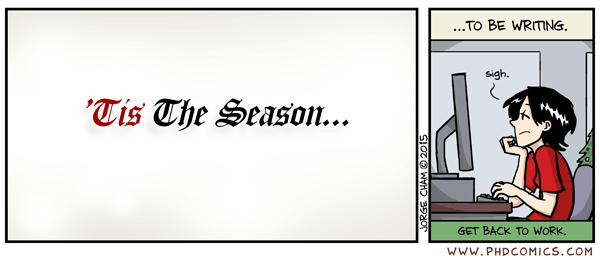
12/16/15 PHD comic: 'Tis the season'

Piled Higher & Deeper by Jorge Cham
www.phdcomics.com
Click on the title below to read the comic
title: "Tis the season" - originally published 12/16/2015

For the latest news in PHD Comics, CLICK HERE!