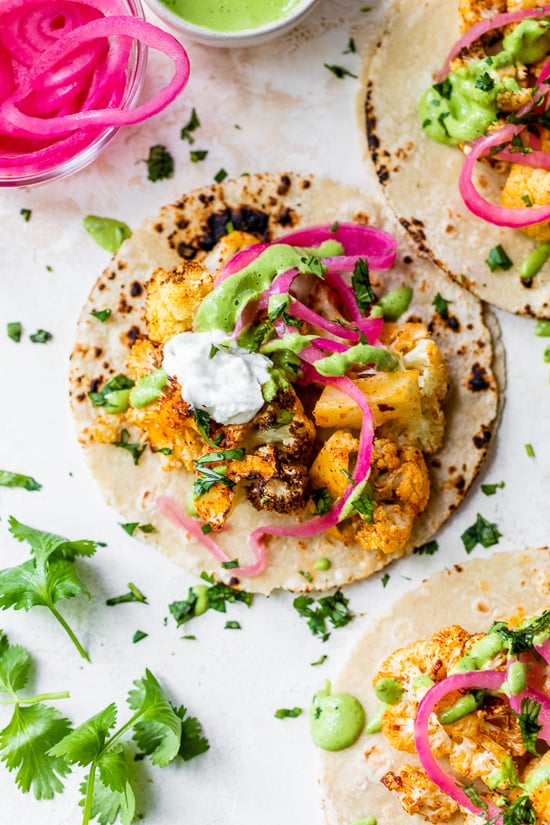
I am in awe of people who can make a meal plan, repeating many favorite dishes weekly or several times a year, knowing that they love what they love. Because I’m not: I like shiny new recipes. My favorite thing to cook will always be the last new thing I made. All attempts to be a responsible sort of person with a plan are consistently jettisoned by a sparkly whim that landed in my head in the last day or two, like a Big Apple Crumb Cake. Or, in this case, an Ottolenghi recipe from The Guardian I apparently bookmarked over three years ago and forgot about until this stunning image flashed across my screen a few weeks ago and all of my best-laid October plans were kicked to the curb. I haven’t a single regret.
What feels like eons ago, a friend asked for my advice on an important subject: He was trying to decide whether to start Friday Night Lights or Breaking Bad, both of which had recently become available on Netflix. Specifically, he wanted to know how many episodes he should watch of each to seewhichwould hook him faster. My mind short-circuited. Although both are modern classics, the two series couldn’t be more different: One is a stirring drama about a high-school football coach in a small Texas town. The other is a thriller about a dying man who cooks meth. Both had excellent first episodes that could presumably hold my friend’s attention. But giving him an exact number? I called him and spent an hour explaining why this was an impossible decision for me to make on his behalf.
The question of how long a viewer should stick with a new show before giving up on it—or before it “gets good”—is one I’m asked a lot, given how many TV recaps and binge-watchingguidesI’vewritten over the years. Usually, I resist giving a straightforward answer.After all, taste is subjective, people watch different shows for different reasons, and everyone’s viewing stamina varies. Volume, too, is an issue. “It’s harder than ever to keep up with new TV shows,” Linda Ge, a writer on the CW’s Kung Fu, told me over email. “It is easier to just give up and say you’ll catch up when the entire season is out, but good luck trying to remember you were interested in that show in the first place.”
Still, since that conversation with my friend 10 years ago, I’ve dwelled on his question so much that I finally have an answer: Watch four episodes. This is exactly enough to know whether any new TV series is worth your time. (Exceptions include limited and reality series, as well as shows with very short seasons, such as Fleabag.) Of course, you should watch as much or as little of a show as you want. But if you, like my friend, are overwhelmed and just need a number, I have good reasons for my recommendation.
I’ve done the research.
Years’ worth of it, in fact. When I first started my admittedly unscientific pursuit, I assessed my favorite ongoing shows. I quickly noticed that fourth episodes tended to include major character development, shocking narrative swings, or moments that would go on to define the series as a whole. (Apologies for any spoilers.) Lost, for example, revealed a key twist in “Walkabout,” which informed the show’s faith-versus-science mythology. Breaking Bad’s “Cancer Man” ramped up the series’ overarching tension between its criminal protagonist and his DEA-agent brother-in-law. Glee—don’t judge, this was Season 1—had a fourth episode that revealed a teen pregnancy and incorporated a revolutionary-for-its-time coming-out scene.
I kept writing about shows that were all over the map in terms of genre, network, and release strategy (Alias, 24, New Girl, Modern Family, The Crown, House of Cards, Jane the Virgin—I could go on). As I did, a logic emerged: If a pilot has to introduce the show’s world, and the second and third episodes must prove that the series can sustain itself, then by Episode 4 the cast and crew should be comfortable enough that their ease will translate to viewers.
Maybe it’s all confirmation bias, and maybe I should look more closely at shows that aired before the 2000s. But binge-watching shows on streaming services only began in earnest in the 2010s, and in that context, I’m convinced. If you need a newer example, the fourth episode of Ted Lasso’s first season resolved two characters’ major conflict and shed light on an antagonist’s personal struggles—putting the Apple TV+ series on track to become TV’s “nicest show.” Brett Goldstein, one of Ted Lasso’s writers and stars, even explained in an interview that he felt the show came together during the making of that episode. Which brings me to my second point ...
The fourth episode is usually when a show “clicks” behind the scenes, according to the experts.
Conversations with producers and writers only strengthened my theory. Rachel Bloom, a co-creator of the CW’s musical comedy Crazy Ex-Girlfriend—which includes a big fourth-episode departure via a song-and-dance routine filmed in black-and-white—encouraged the idea when I shared it with her in 2016. She pointed out that, in the writers’ room for her show, she didn’t feel comfortable having another writer take the lead on the script until the fourth episode. With that in mind, she advised me to “look at Episode 4s of all the television shows.”
I haven’t been able to accomplish that, sadly, but other members of the TV industry have landed on Episode 4 unprompted. Joshua Safran, the showrunner of HBO Max’s Gossip Girl reboot, told me earlier this month that broadcast networks and streaming platforms have told him that he’d find his real audience by Episode 3 or 4—guidance he saw come to fruition with Gossip Girl and his previous shows, ABC’s Quantico and Netflix’s Soundtrack. “The pilot is done by too many people, and I don’t mean that in a bad way,” Safran said. “It just goes through so many checks [from the network], and then Episode 2 goes through less … In Episode 3, it’s like, Okay, I got it.”
The producer Robin Schwartz (Starz’s Vida, Facebook Watch’s Sorry for Your Loss) agrees: “There’s so much groundwork that has to be laid in those first couple of episodes: we need to meet our characters, establish a world, set up and kick off a premise. It’s a lot of (necessary) scaffolding,” she wrote over email. “Then somewhere around Episode 4-ish things can start getting a little weird, a little unexpected, venturing off down some garden paths you may find intoxicating in whatever way.”
Even those reluctant to choose an exact number gravitate toward Episode 4. Ken Greller, a writer on Apple TV+’s Dickinson, says that a pilot “can and should grab you,” but concedes that many great shows “don’t actually come together until later on in their first season.” Take BoJack Horsemanand Succession; to him, the former fell into place after four or five episodes, while the latter’s standout episode was its fifth. (To me, that’s close enough to the magical Episode 4 to count toward my theory.) The producer Erik Oleson, who worked on Amazon’s Carnival Row and served as the showrunner for the third season of Netflix’s Daredevil, calls the idea of picking a number like “asking me to choose between my kids.” Even so, he mused over Zoom, “I thought that the prison-break episode in Daredevil was just like, Wow, that was so exciting, and that was what, Episode 4?” He chuckled. “Well, there you go.” He meant the fourth episode of the third season, but the show essentially started anew after its second-season finale. Like I said, this is a thoroughly unscientific study.
Watching through the fourth episode considers both the audience’s time and the creators’ efforts.
In the peak-TV era, the number of episodes you should ideally watch (to writers and producers, that’d be the full show) will always be higher than the number you have time to watch. Even the industry folks I polled tended to have a low boredom threshold when it came to their own viewing habits. The writer Chad Hodge (TNT’s Good Behavior) wrote in an email that he’ll give a new show until Episode 2 to see whether “a few whiffs and whispers of things I like” pan out. Sydney Hoffner, a postproduction coordinator for Star Trek: Picard, told me that the longest she’s given a series has been three episodes.
But four episodes is slightly more generous, taking into account both your limited availability and the intentions of those behind the scenes. That’s not so far into a show to reach too important a cliff-hanger that quitting becomes impossible, yet still far enough to get past the setup. So: Four episodes. Just try it. There is indeed too much TV, but four episodes amount to an evening of binge-watching or a month of tuning in weekly at most. By then, you’ll have to have found something appealing about your show—or not. And most important, I hope that you won’t ever have to ask when a series “gets good” again.
Remember huddling in a conference room? It’s almost cartoonish to imagine everybody squeezing into a poorly ventilated space to talk and trade germs for the purpose of … what, exactly?
As many workers begin returning to their office for all or some of the work week, they’re noticing a key change: The pandemic is nearing its conclusion, but meetings are still happening virtually. In many cases, office workers are leaving home, going to their desk, sitting down, putting on their headphones, and connecting to Zoom to chat with people sitting a few feet away from them. The cognitive dissonance that workers may be feeling isn’t because things are different, but because they’re remarkably similar to the way they were at home. While bosses have been braying that we will lose collaboration and mentorship opportunities in a dominantly remote future, workers have been (justifiably) questioning why they have to leave their home at all.
What do you really gain from an in-person meeting that you have been missing the past 19 months?
Zoom and other forms of functional (and free) videoconferencing software aren’t necessarily better than meeting in person, but they’re also not necessarily worse. And although a company may demand that everybody return to the office at some point over the next few months, that doesn’t mean that their outside partners or clients will do so, making Zoom or a conference call an automatic part of every outward meeting.
I will acknowledge that this absolutely happened before the pandemic, and usually led to everyone sitting in a conference room around a speaker. Except we’ve now had a vivid experience of the alternative, and hardly anyone is clamoring to go back to the way things were, germs and all. For the past 19 months, we didn’t need to interrupt our workday to go to a special room so people could talk over one another and waste time. Meetings weren’t an event, but a to-do-list item that required a little more attention than an email. I suspect that those mourning the loss of pre-pandemic meetings are likely executives and managers who enjoyed the attention and the chance to prove themselves valuable through extremely visible performances. Whereas you might be able to “command a room” in person, it’s much harder to feel that everybody knows how great you are when you haven’t gathered them around a long table of which you happen to sit at the head.
Meetings were previously a novelty—a mutually agreed-upon way in which we could all use up one another’s time nonspecifically that was nevertheless accepted as “work.” Videoconferencing’s low barrier to entry has removed meetings from this vaunted status, making them just another means to get things done, along with email, Slack, and other productivity tools. Early in the pandemic, everybody’s first instinct was to frame Zoom as the problem, but I think the world has shifted to understanding that we were simply having too many meetings before, and that videoconferencing enables us to diplomatically end them as quickly as we made them.
To be sure, after all these months of remote work, you may be experiencing Zoom fatigue, or, more accurately, meeting fatigue. The amount of meetings doubled during the pandemic. But as we approach something like a return to “normalcy” in 2022, I believe that the white-collar future will be dominantly remote not because it’s “better,” but because it’s “good enough.” Remote work gets the job done, it allows more people to participate in more activities, and it is significantly easier to get people to join a videoconference than it is to unite them in a conference room.
I believe we’ll also see an eventual reduction in the time spent in meetings. Meetings used to feel special because of the pomp and circumstance of physically gathering, but reducing them to a link has removed the mystique that pressured us to “take up all of the time.” In my own experiment of offering clients the opportunity to end a meeting when we are done talking, I’ve found that they’re elated—if we can get a call done in 10 minutes, that’s 20 to 50 minutes of their time that they’ve just gotten back, because our meeting culture has shifted from performance to pragmatism.
All that being said, fully remote meetings can have downsides. Relying on a dozen or more different internet connections regularly leads to people inadvertently misjudging speaking cues (something you can gauge a little better in person), or missing parts of conversations, or having someone unexpectedly drop out at the worst moment. It can also be hard to tell whether you’ve actually engaged someone with your comments—for better or for worse—because everybody’s staring at separate parts of the screen. And by now most of us have taken to browsing other tabs while someone else is speaking, sort of half-listening with our cameras on (or off). It is indeed challenging to give a virtual speaker your undivided attention for more than a few minutes.
However, these digital cons are vastly outweighed by the pros. Post-pandemic meeting culture is a watershed moment for inclusivity, especially for workers with disabilities. Where these employees may have been previously ostracized for not being in the office, the opportunity of a remote post-pandemic meeting culture is one where there is no limit to the seats at the table. Videoconferencing definitely doesn’t make us look our best, but in some ways, that’s rather freeing—it removes a degree of aesthetic judgment, as well as the ritual of feeling physically intimidated in the workplace. Some of the aforementioned “cons” are also, in a way, “pros.” The lack of a strict focal point means that people aren’t arbitrarily judged for their “attention,” and for those like me who have nonverbal communication issues (such as maintaining eye contact), it’s a chance to not get held back for something you can’t control.
The next several months will be incredibly telling for how meeting culture will change in the long term. The disingenuous framing of returning to the office as returning to “work” will only look more silly as millions of people realize at once how silly it is to commute to an office to open a web browser and join a videoconference. As people go back to a shared physical space, they’re going to start asking reasonable questions such as “Why am I here?” and “What am I doing here that I can’t do at home?” as they and several colleagues a few feet apart join a 10-minute-long Zoom meeting. And when they do so, they may make the choice to simply work for a different employer—and do that work from home.
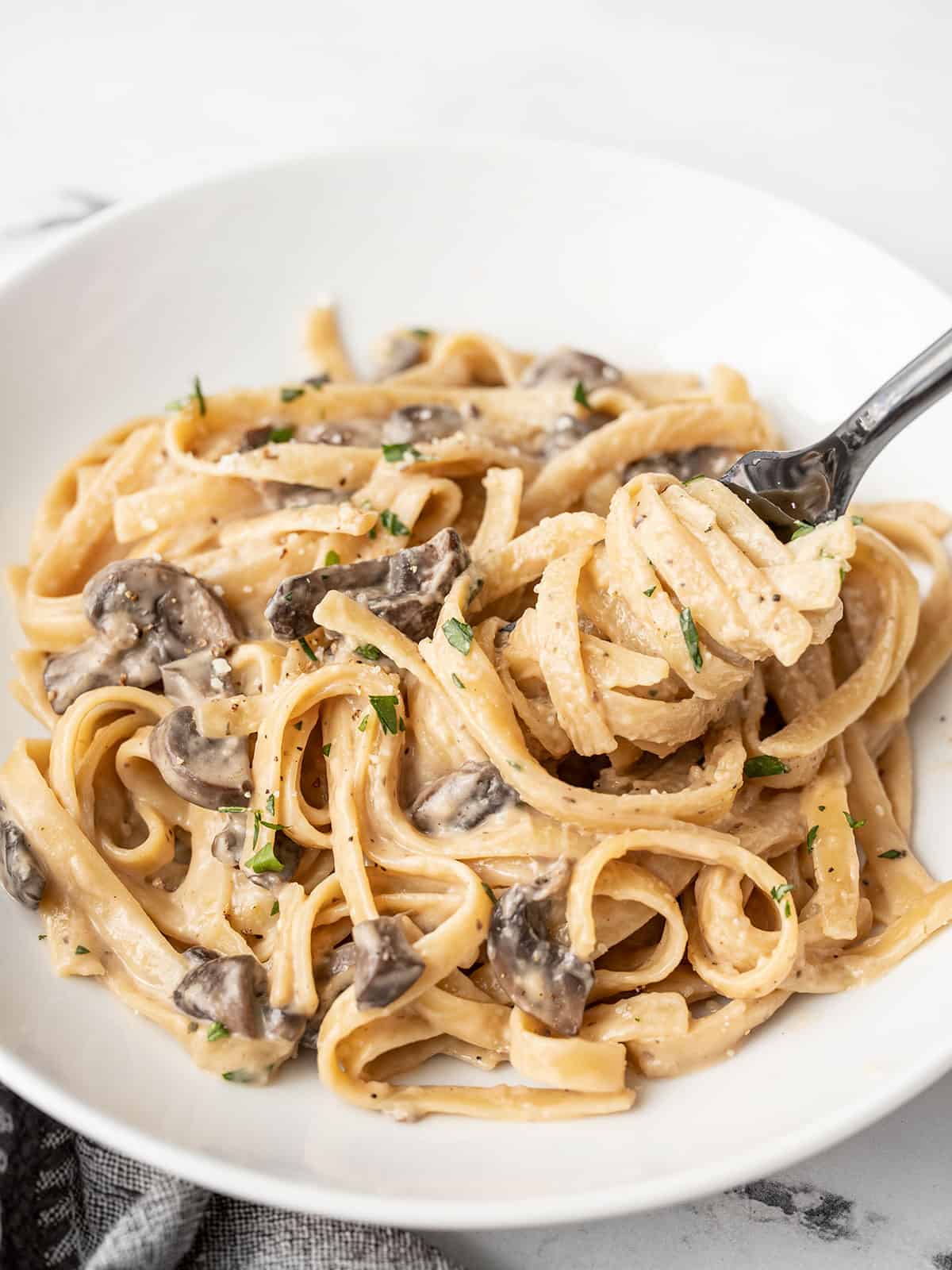
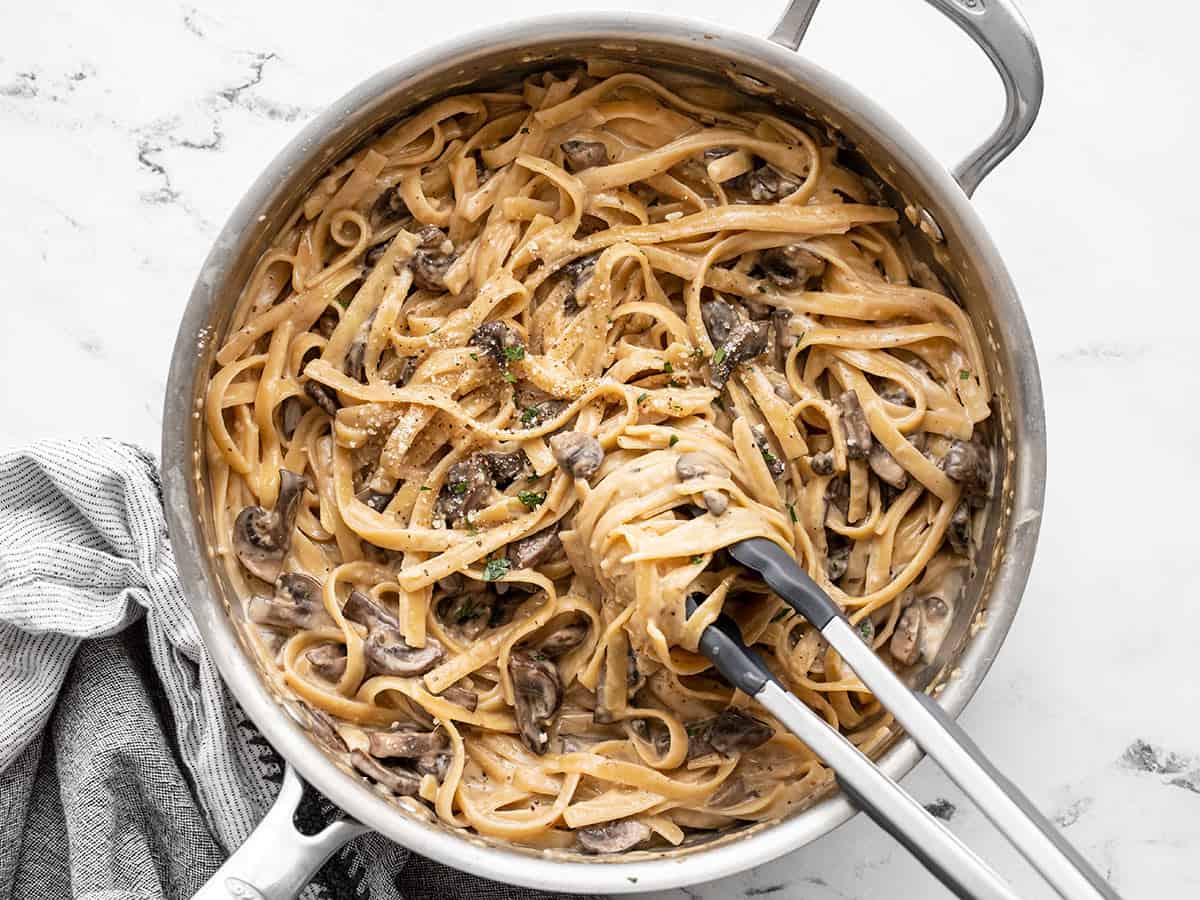
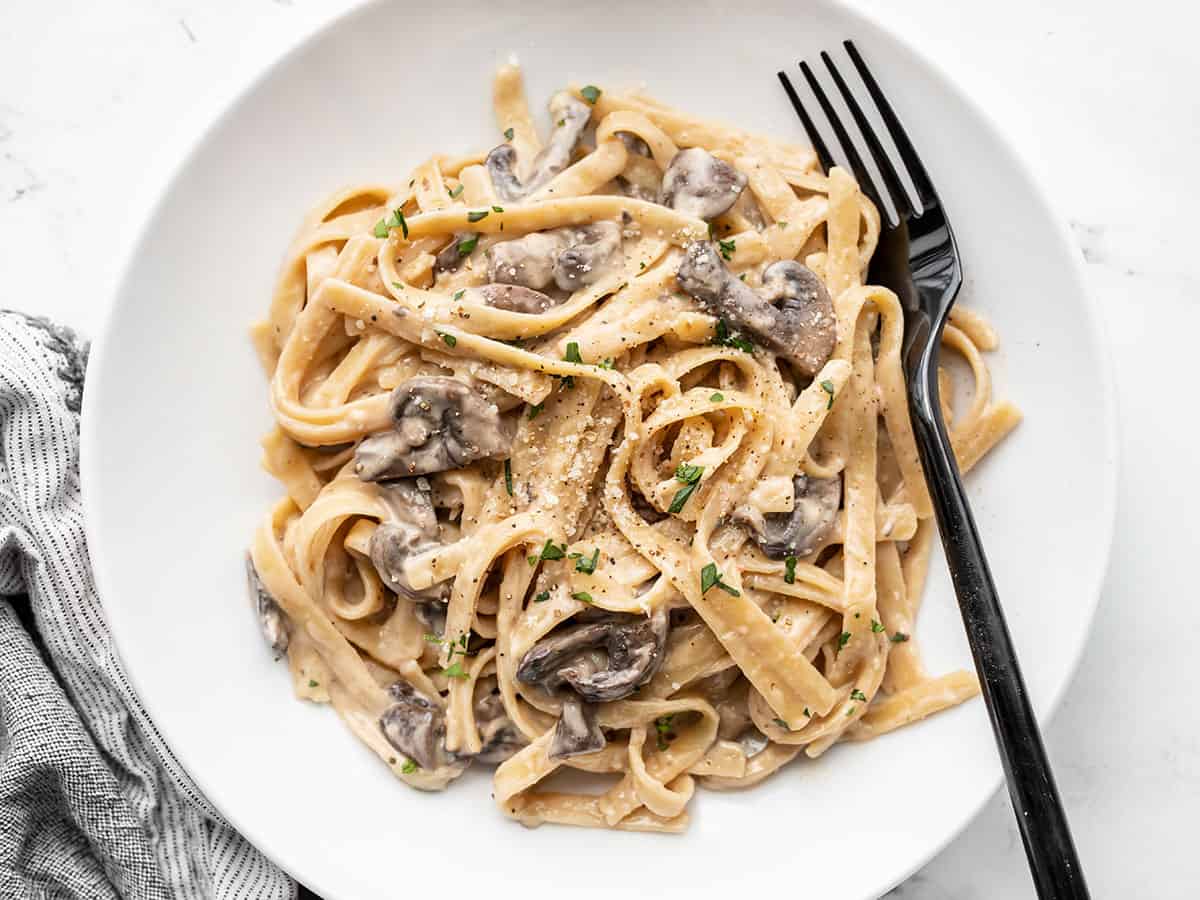
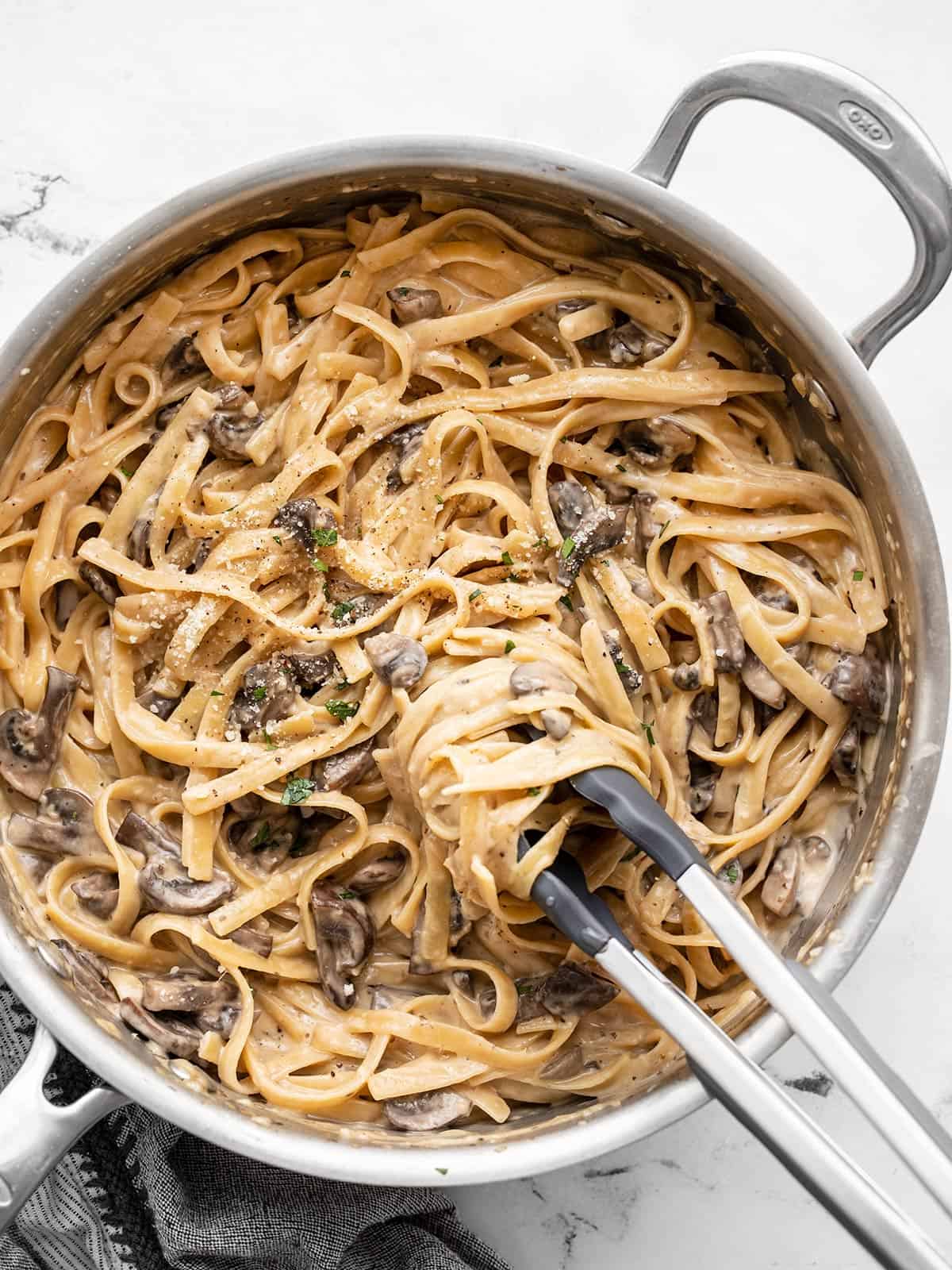
Where are all of my one-pot pasta lovers at? This one is for you! This One Pot Creamy Mushroom Pasta is a super-rich, umami-filled delight that is, as always, easily prepared in one pot. It’s the perfect comfort at the end of a long tiring work day. And don’t forget to make a little garlic bread to serve on the side. ;)
What Kind of Mushrooms to Use
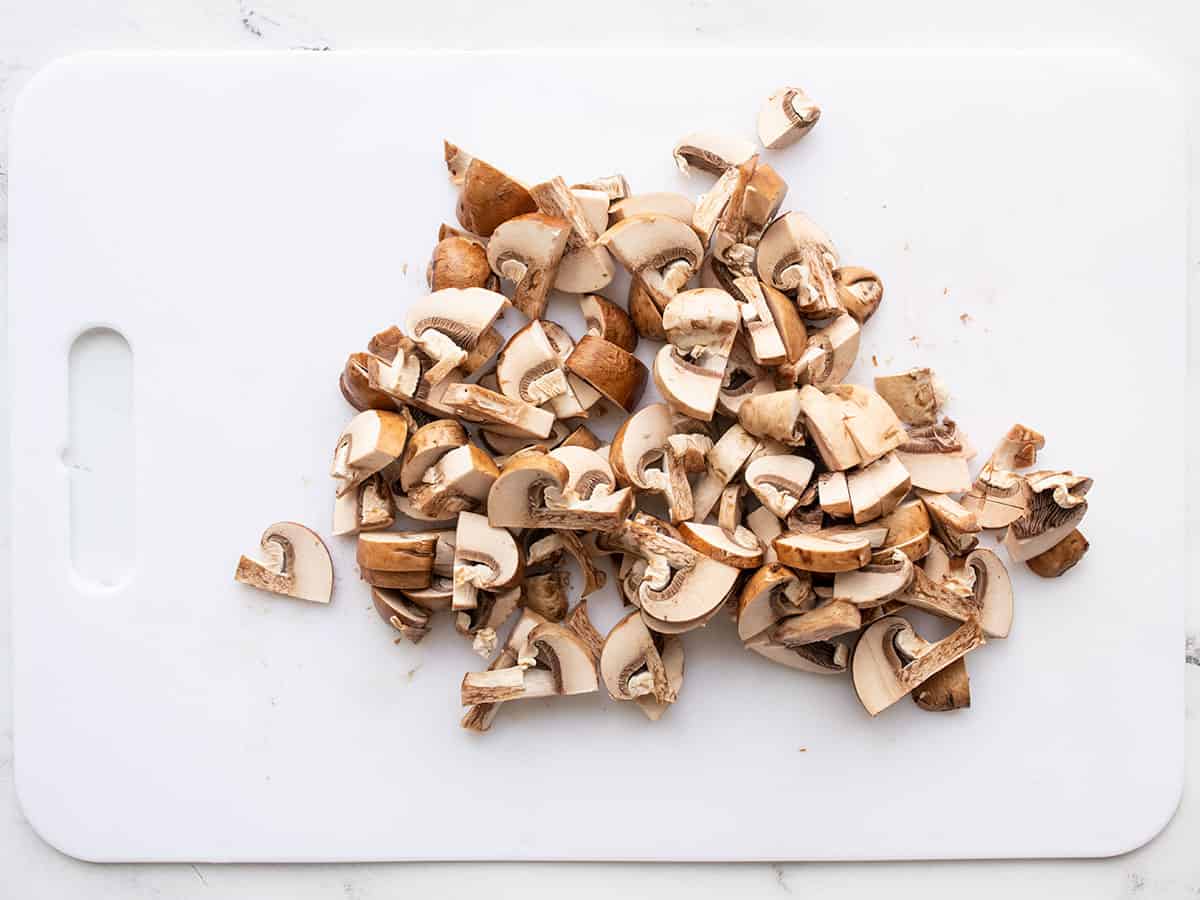
I like baby bella mushrooms for this pasta because they are not too expensive and they have a nice deep color that adds a lot to the plate. You can use white button mushrooms if needed, but they do have a slightly more mild flavor. You could also use full-sized portobello mushrooms, just slice them into smaller pieces before sautéing.
Can I Substitute the Heavy Cream?
I use heavy cream in this recipe which creates a super-rich and luscious sauce for the pasta. Because it’s so thick, it also helps the Parmesan to melt into the sauce without clumping. Milk, which has a much higher water content, will produce a thinner sauce and you may have difficulty getting the Parmesan to melt in instead of clumping. One way I’ve gotten around this in the past is to use a combination of milk and cream cheese. The cream cheese both emulsifies the Parmesan and thickens the sauce (see how the technique is used in Creamy Sun-Dried Tomato Pasta).
What Else Can I Add?
This creamy mushroom pasta is kind of a simple pleasure, but you can add more if you’re craving something more complex. Try adding in a few handfuls of fresh spinach toward the end for a little color. You could also top the pasta with some grilled chicken for a little more oomph.
What Kind of Pot to Use
I used a 3-quart deep skillet for this pasta, but you can use any pot or Dutch oven that has a wide bottom and a lid. Make sure to use a burner on your stovetop that is similar in size to the bottom of your pot or skillet to ensure even heating.
TIPS FOR COOKING ONE POT PASTAS:
Getting one pot pasta just right can take some practice, so if you find you’re having trouble, here are a few tips:
Stir every few minutes to keep the pasta from sticking to the bottom of the pot. Replace the lid each time to prevent excessive evaporation.
Make sure the pasta is simmering the whole time. If the liquid is not simmering, the pasta will not cook. The temperature setting needed to maintain a simmer can vary depending on your stove top and cookware.
Use heavy cookware. Skillets and pots that are thin on the bottom don’t heat evenly and do not yield good results with one pot pastas because some areas of the pot will be simmering, while other areas are not.
Keep the lid in place at all times when not stirring. This holds in the steam and helps the pasta cook more evenly.
Watch the pasta. One pot pastas are a little like riding a bike. You have to observe and adjust as you go. If the liquid is almost all absorbed before the pasta is tender, add a little more water. If the pasta is almost tender, but there is still a lot of liquid, allow it to simmer without a lid for the last couple of minutes.
One Pot Creamy Mushroom Pasta
This creamy mushroom pasta is a rich, umami-filled delight that cooks quickly and easily in one pot. The perfect dinner for busy nights.
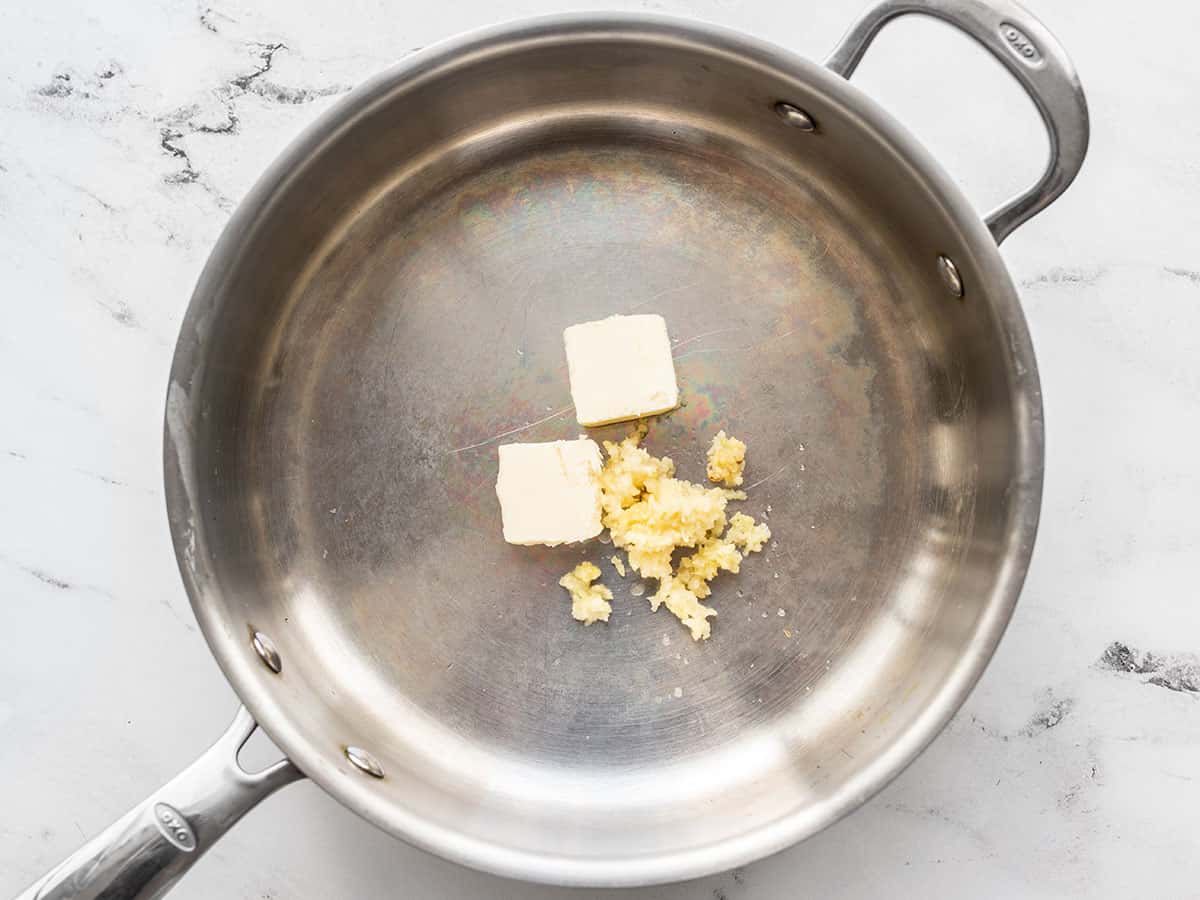
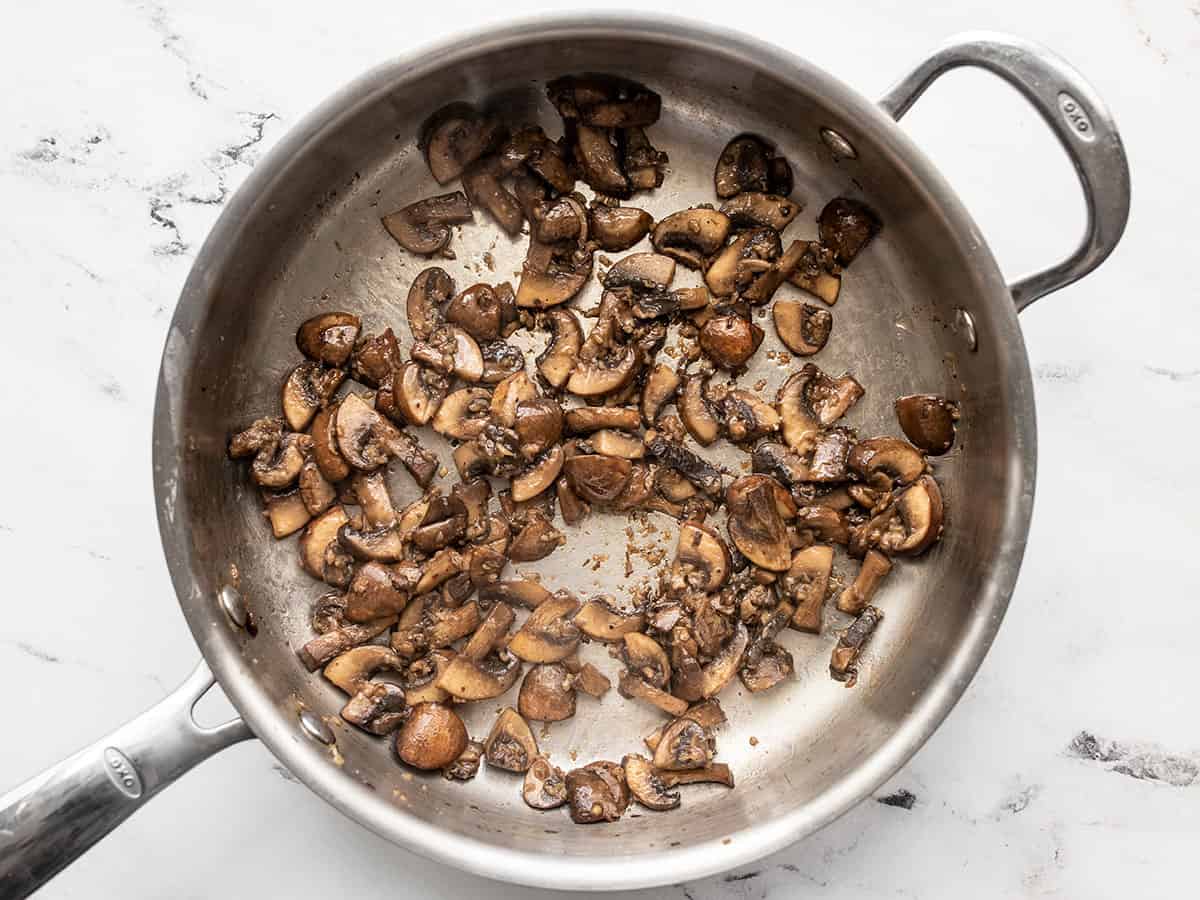
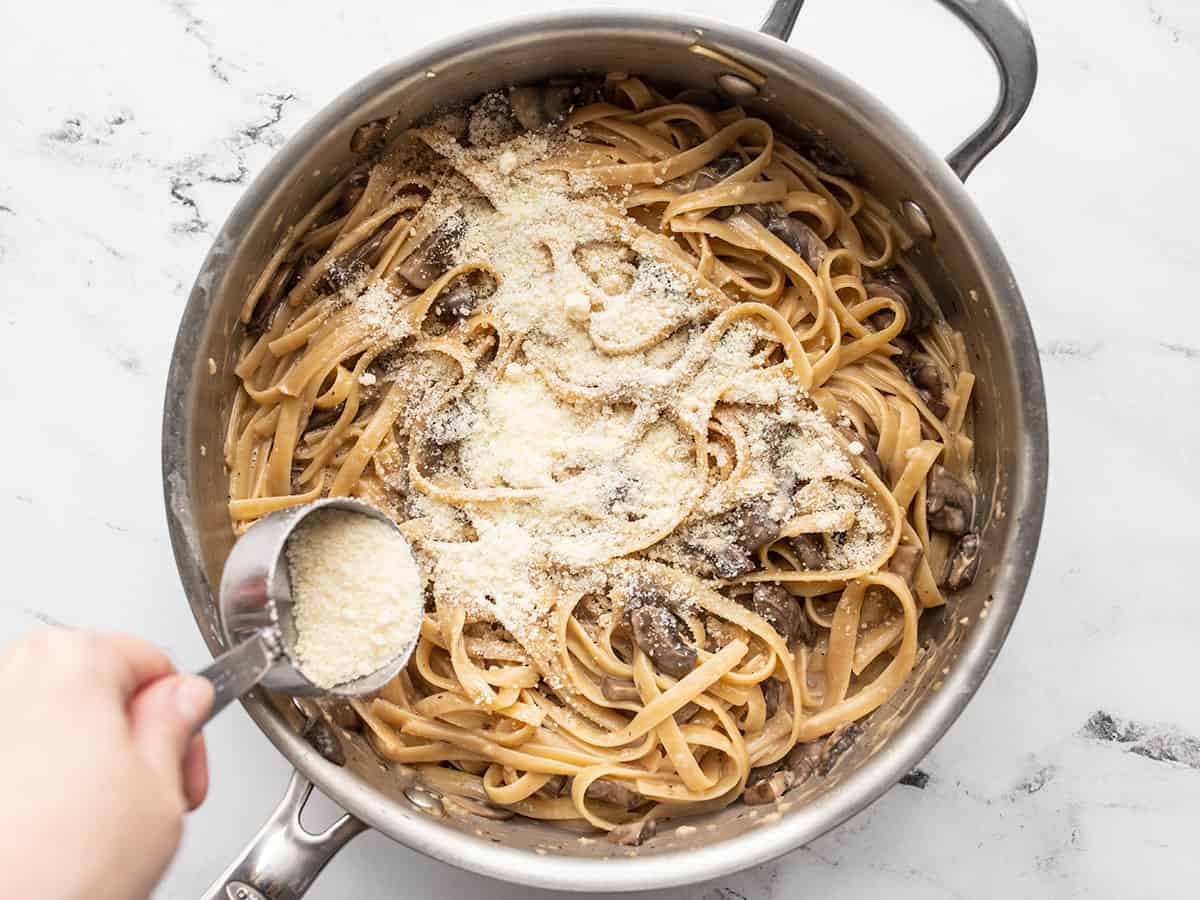
Add the butter and garlic to a deep skillet and sauté over medium heat for one minute. Add the sliced mushrooms, salt, and pepper, and continue to sauté until the mushrooms have softened, all of their moisture has evaporated from the skillet, and the edges are beginning to brown.
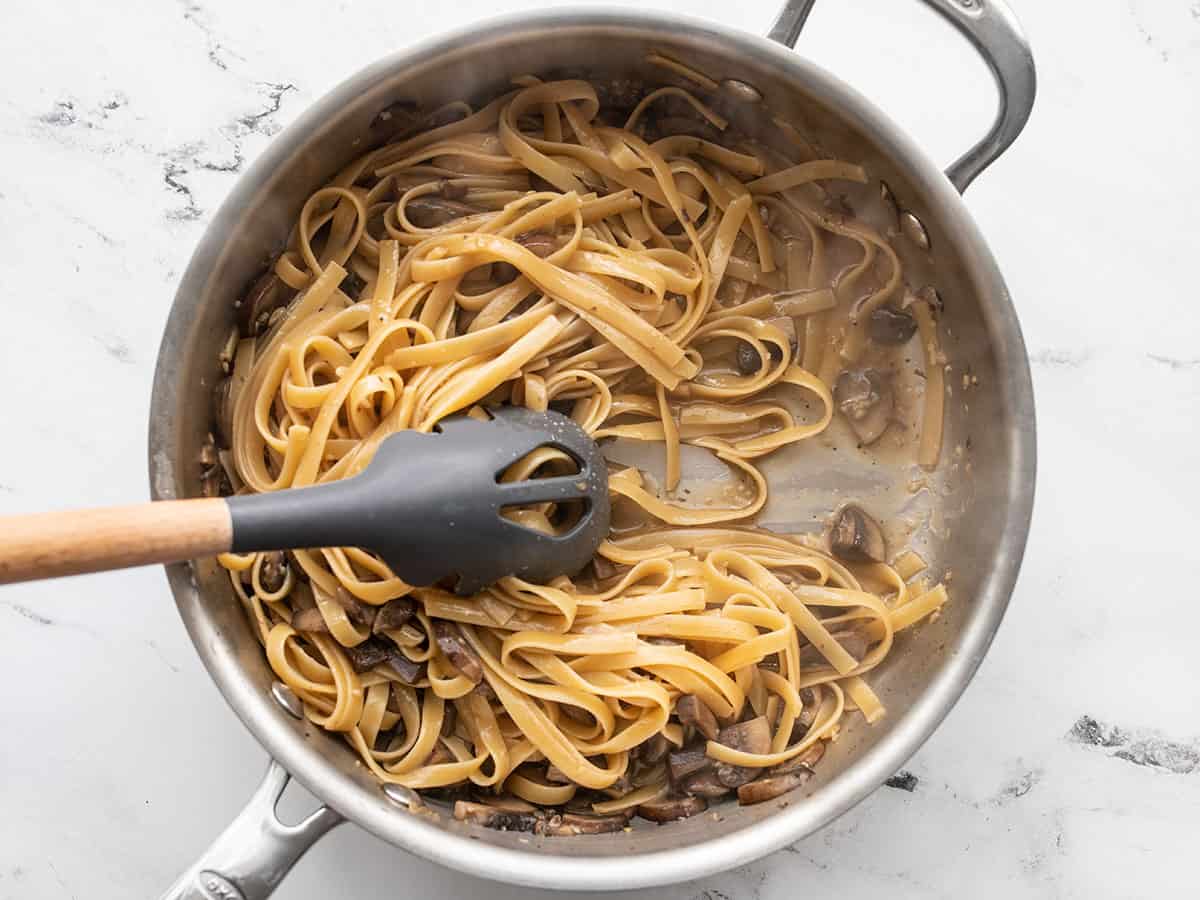
Add the fettuccine to the skillet along with the vegetable broth and stir to combine. It's okay if the broth doesn't fully submerge the pasta.
Place a lid on the skillet, turn the heat up to medium-high, and allow the broth to come up to a boil. When it reaches a boil, give the pasta a quick stir, replace the lid, then turn the heat down to medium-low.
Continue to let the pasta simmer in the broth for about 10 minutes, stirring occasionally (always replacing the lid), or until the pasta is tender. There should be a little saucy liquid left in the bottom of the skillet.
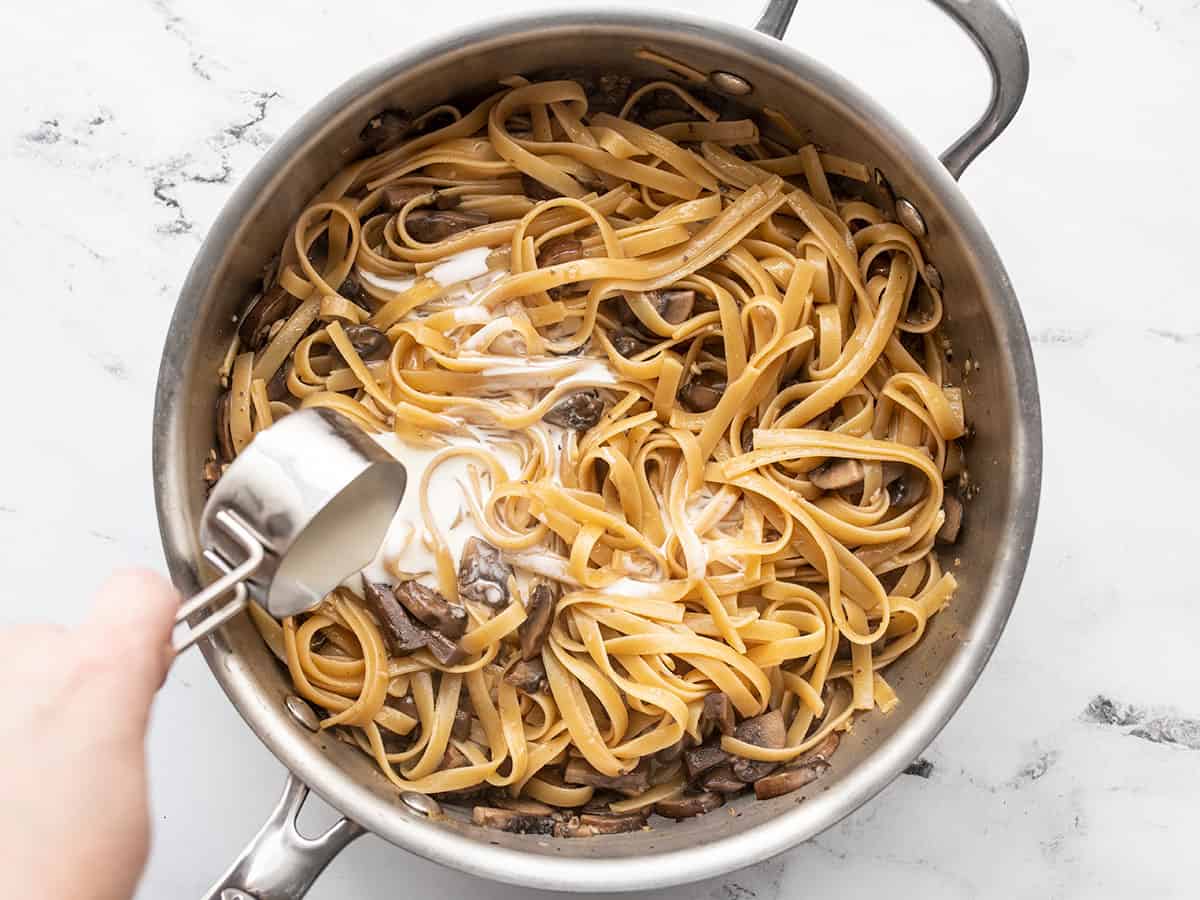
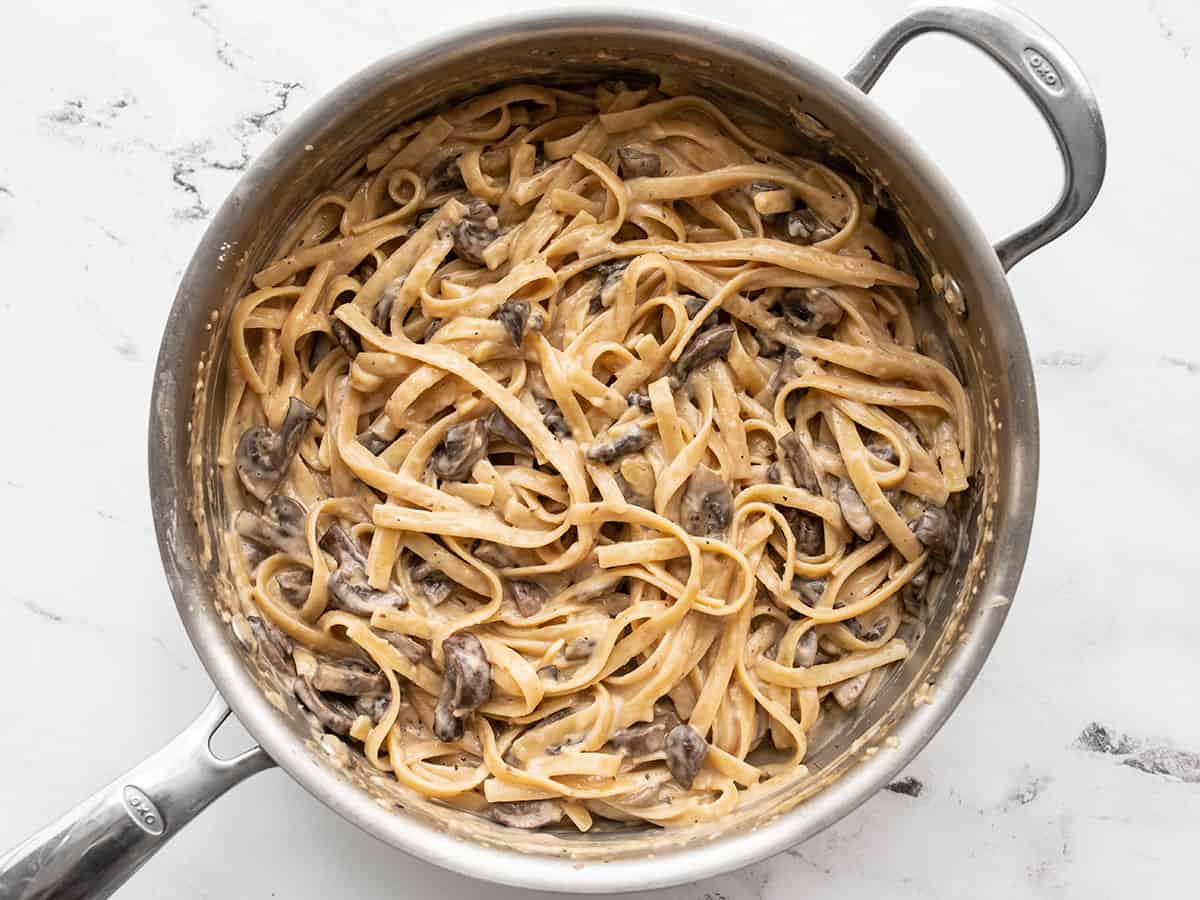
Add the heavy cream to the skillet and stir to combine. Turn the heat off then add the Parmesan and continue to stir the pasta until the Parmesan is melted. Give the pasta a taste and add salt or pepper if needed. Serve immediately.
How to Make One Pot Creamy Mushroom Pasta – Step by Step Photos
Mince four cloves of garlic and slice 8 oz. baby bella mushrooms.
Add the garlic and butter to your skillet or pot and sauté over medium heat for about one minute.
Add the mushrooms to the skillet along with a pinch of salt and pepper. Continue to sauté until the mushrooms have released all of their liquid, it has evaporated from the bottom of the skillet, and the mushrooms begin to turn golden brown on the edges.
Add 8 oz. fettuccine to the skillet along with 2.5 cups of vegetable broth. Stir to combine. It’s okay if the pasta is not fully submerged. Place a lid on the pot, turn the heat up to medium-high, and allow the broth to come up to a boil.
When the broth reaches a full boil, give the pasta a quick stir to loosen any noodles that may have stuck to the bottom. Replace the lid, turn the heat down to low, or just above low, so that the broth maintains a simmer. Simmer the noodles, stirring occasionally and replacing the lid each time, until the pasta is tender. There should be a small amount of gravy-like broth on the bottom of the skillet.
Add ⅓ cup heavy cream to the pasta and stir to combine.
Turn the heat under the skillet off. Add ¼ cup grated Parmesan to the pasta and toss to combine. The residual heat from the pasta should begin to melt the Parmesan.
Give the pasta a taste and adjust the salt or pepper to your liking. I usually like to add a little freshly cracked black pepper on top for a little pop!
Over the years, as I’ve interviewedmanysociologistsabout gender divisions in how couples handle chores and child care, I’ve often wondered what happened after we got off the phone. When these researchers returned to their life, how were they splitting up the tasks in their own home? Because gender scholars—they’re just like us: They too have floors to sweep, kids to feed, toilets to clean.
But, I learned, they are also decidedly not like us. In different-sex couples who have young children and both work a full-time job, mothers are estimated to do an average of roughlyfive more hours a week of paid and unpaid labor than fathers. Yet most of the sociologists I recently spoke with reported an equitable division of labor at home. These researchers’ deep understanding of family life has helped them come up with tactics for warding off the same inequalities that they study—though they still sometimes struggle to keep gender norms and stereotypes from undermining them.
Sociologists are attuned to the constraints society places on people’s everyday decisions, and those I interviewed stressed to me that their education, income, job stability, job flexibility, and access to child care made it easier for them to realize their egalitarian goals. I also interviewed only different-sex couples; same-sex couples navigate different cultural pressures when managing a home, and tend to split up chores more equally.
Still, we can learn from what these experts have done in their own home. Three of their strategies in particular stuck out to me. The first is fighting against the mistaken belief that moms are better suited to parenting than dads, which can lead women to spend more time, and men to spend less time, on child care. William Scarborough, a sociologist at the University of North Texas, told me that he has made a point of sticking with even the tasks that initially come more easily to his wife. For instance, his son, as a toddler, used to behave better at bath time with her. “But instead of relying on her to do it, I continued bathing him, even if it took twice as long,” he said. “Eventually, I got the hang of it and was able to bathe him without any drama.”
The second strategy is simple: Thank your partner for the work they do around the house. Multiple experts told me this was helpful, and research indicates that people feel less bitterness about housework when their contributions are recognized. “Acknowledging that there’s work going on—that the stuff at home is work—and thanking your partner for doing that, I think, goes a long way,” Richard Petts, a sociologist at Ball State University, told me.
A third tactic is to do some chores in tandem. Daniela Negraia, a sociologist at the University of Oxford, told me that she started doing this with her husband out of an awareness that women, on average, do more housework than men. “Our solution was to pick a day, one weekend day for example, and just think of what chores we have, and then work starts at the same time and ends at the same time,” Negraia told me. Scarborough, who also favors doing chores together, said that this “prevents them from becoming alienating.”
The experts’ knowledge of the research helps them actively resist common patterns. The scholars I interviewed talked about trying not to replicate in their own home the findings that fathers spend more time with boys than with girls, that mothers are more likely to involve their daughters in housework than their sons, and that mothers tend to have less leisure time than fathers. Research also drew their attention to how dividing housework and child care fairly isn’t just good in and of itself, but can make their family happier. They were motivated, for instance, by studies indicating that kids benefit from stronger bonds with their dad and that women are more satisfied with their relationship when they feel the distribution of tasks is fair.
But this awareness alone isn’t enough to overcome the larger cultural forces that shape housework and parenting. The women I interviewed tended to disproportionately handle the managerial elements of running a home, as well as their household’s “mental load”—the invisible logistical and emotional work of, among other things, keeping track of when kids need new clothes, planning family outings, and remembering to send birthday cards to loved ones.
Negraia, who bears more of the mental load than her husband, has come up with a creative way to make him aware of the otherwise hidden work she does: When she, say, calls their kids’ doctor or plans out weekend activities, she’ll send her husband a calendar invitation for each task as a way of underlining how much time it eats up without starting a tense conversation. Her husband told me that when he sees those invitations pop up on his calendar, he’ll think, “Maybe I should do a few extra loads of dishes and laundry that day.”
Because these couples’ conversations about housework were grounded in research, they became less personal and fraught—the couples tended to adopt a framework of “us versus society” rather than “me versus you.” “I think that the emotional heat that can so often come with these conversations is really diminished for [my partner] and me because this is so clearly not just about him and me,” Caitlyn Collins, a sociologist at Washington University in St. Louis, told me. “It kind of removes the ego from the conversation.”
That perspective also emphasizes the pervasiveness of gender norms—something no one couple can overcome on their own. Collins told me that when she interviewed working mothers in Sweden, she was struck by how, in what is considered one of the world’s most gender-egalitarian countries, women still had to have frequent and ongoing conversations with their male partner about housework. In her own home, she has come to think of equality not as “a static goal that we will arrive at and [declare] victory” but rather as “a lifelong project that we’re working on together.”
Even those who have dedicated their career to studying gender inequality can only do so much. Whatever they may achieve in their own homes, cultural norms are beyond their control. Petts and his wife notice when another parent texts her and not him to set up a playdate for their kids, and when teachers email her and not him about something at school. “Even if I’m more in charge of school, which I am now, I’m not necessarily privy to all of the information,” he said. “These hidden biases that people have about the roles of mother and father make it challenging to divide these tasks evenly.”
Even though Petts and his wife agree that they share the work of parenting and chores equitably, the world doesn’t always judge them accordingly. Like many involved fathers, he gets applauded for his contributions. “One thing that is hardest for me is that Richard is viewed by others as an awesome dad (and he is) and a wonderful husband (and he is), but I’m viewed as mediocre at best,” Petts’s wife wrote to me in an email, because “the assumption is that when a man does all these things, … the woman has somehow done less than she should. I don’t know how many times people have told me that I am probably the luckiest person around because Richard cooks dinner.”
As the researchers I interviewed understand, one couple can’t change the world. But perhaps by being aware of its shortcomings, you can make some changes in your own home.
I'll never believe that owning a gun makes anyone safer. I only really understand having one if the house if its required for your job. And then I assume that you've been taught and mandated to lock it up safely. And even then it makes me feel you yourself are less safe in terms of impulsive mental health decision.
Gabriela Pesqueira
When the coronavirus pandemic struck last year, people throughout the developed world raced to buy toilet paper, bottled water, yeast for baking bread, and other basic necessities. Americans also stocked up on guns. They bought more than 23 million firearms in 2020, up 65 percent from 2019. First-time gun purchases were notably high. The surge has not abated in 2021. In January, Americans bought 4.3 million guns, a monthly record.
Last year was also a high-water mark for gun violence—more people were shot dead than at any time since the 1990s—though 2021 is shaping up to be even worse. There was one bright spot in 2020. When Americans self-isolated, mass shooters were denied their usual targets. But as America began to return to normal, so did the mass shootings: 45 in the single month between March 16 and April 15.
The shock and horror of mass shootings focus our attention. But most of the casualties are inflicted one by one by one. Americans use their guns to open fire on one another at backyard barbecues, to stalk and intimidate ex-spouses and lovers, to rob and assault, and to kill themselves. Half of the almost 48,000 suicides committed in 2019 were carried out by gun. All of this slaughter is enabled by the most permissive gun laws in the developed world.
You know this. You’ve heard it before. Maybe you have even gotten sick of hearing it. Yet the problem continues to get worse. The Biden administration is developing strategies to try to decrease gun violence—to crack down on rogue gun dealers, to “keep guns out of the wrong hands.” That’s a worthy project, of course, but it, too, may sound wanly familiar. Over the past decade, many states have relaxed their gun laws, making these weapons even easier to get.
This fall, the Supreme Court will hear a case, New York State Rifle & Pistol Association v. Corlett, that could expand gun rights even further. Thirteen years ago, in District of Columbia v. Heller, the Court for the first time recognized people’s constitutional right to own firearms as individuals, not just as members of a “well regulated Militia.” Now lawyers for the New York affiliate of the National Rifle Association will argue that the Second Amendment should be interpreted as granting a constitutional right to carry firearms in the streets, parks, playgrounds. If the NRA prevails, the nearly 400 million guns in the United States will show up in even more places than they do now.
The legalistic approach to restricting gun ownership and reducing gun violence is failing. So is the assumption behind it. Drawing a bright line between the supposedly vast majority of “responsible,” “law abiding” gun owners and those shadowy others who cause all the trouble is a prudent approach for politicians, but it obscures the true nature of the problem. We need to stop deceiving ourselves about the importance of this distinction.
Pre-pandemic, about 30 percent of American adults owned a gun, according to a Pew Research Center survey. Another 33 percent rejected the idea of gun ownership. The remainder, about 36 percent, did not happen to own a gun at the time they were asked the question—but had either owned a gun in the past or could imagine owning a gun in the future. In 2020, the future came, and millions of them queued at gun shops, pandemic stimulus dollars in hand.
They were not buying weapons for hunting. Only about 11.5 million Americans hunt in a given year, according to the latest Department of the Interior survey, fewer than the number who attend a professional ballet or modern-dance performance.
Nor were they buying weapons to play private militia. Fewer than 10 percent of Americans amass arsenals of five weapons or more. And for all the focus on assault rifles, they make up a small portion of the firearms in private hands: approximately 6 percent of all guns owned.
The weapon Americans most often buy is the modern semiautomatic handgun—affordable, light, and easy to use. This is the weapon people stash in their nightstand and the glove compartment of their car. This is the weapon they tuck into their purse and shove into their waistband. Why? Two-thirds of American gun buyers explain that they bought their gun to protect themselves and their families.
And here is both the terrible tragedy of America’s gun habit and the best hope to end it. In virtually every way that can be measured, owning a firearm makes the owner, the owner’s family, and the people around them less safe. The hard-core gun owner will never accept this truth. But the 36 percent in the middle—they may be open to it, if they can be helped to perceive it.
The weapons Americans buy to protect their loved ones are the weapons that end up being accidentally discharged into a loved one’s leg or chest or head. The weapons Americans buy to protect their young children are years later used for self-harm by their troubled teenagers. Or they are stolen from their car by criminals and used in robberies and murders. Or they are grabbed in rage and pointed at an ex-partner.
These incidents are unusual in only one way: The victims were all men. A frequent use of guns in American life is to dominate and terrorize women. According to a 2017 study, some 4.5 million American women have been threatened by a gun-wielding partner or former partner. Almost 1 million American women have survived after a gun was used by a partner against them.
Put moments of rage or malice aside, and catastrophes still keep happening, due in part to Americans’ collective overconfidence in their gun-handling skills.
Altogether, about 500 Americans a year die from unintended shootings. That’s four times the rate of deaths from unintended shootings in peer nations. Yet this grim statistic still understates the toll of Americans fooling around with weapons. Unintended shootings tend not to be lethal. They account for only about 1 percent of all U.S. gun deaths. But they account for more than one-third of American gun injuries—injuries that can leave people disabled or traumatized for life. A majority of gun owners fail to store their weapons safely, according to research by the Johns Hopkins Bloomberg School of Public Health. That’s why the annals fill with so many heartrending stories of children shooting themselves or others.
Above all else, guns are used for suicide. In any given year, twice as many Americans die by suicide as by homicide. Suicide is the second-leading cause of death among teenagers and young adults, behind only accidents. The good news is that suicide is highly preventable. Most suicide attempts are impulsive, an act of depression or panic. If a person survives an attempt, he or she will almost certainly survive the suicidal impulse altogether. A gun in the house massively raises the likelihood that a suicide attempt will end in death.
Gun advocates counter this tally of unnecessary bloodshed by generating piles of studies on successful “defensive gun use.” Estimates of defensive gun use vary wildly, from as few as 60,000 incidents a year to as many as 2.5 million. The higher estimates are distorted by a crucial error: They rely heavily on self-reporting by gun owners themselves, with a huge risk of self-flattering bias. If an argument spirals until one person produces a gun and menaces the other into shutting up, the gun owner might regard that use as “defensive.” A third party, however, might perceive a situation that only spiraled in the first place because the gun owner felt empowered to escalate it. Whose perception should prevail?
But there’s a larger absurdity to the project of counting “defensive gun uses.” For decades, the world has witnessed a colossal natural experiment in gun laws. With one exception, virtually all developed countries strictly regulate firearms, especially handguns. If there were any merit to the “defensive gun use” argument, you’d expect that one permissive nation to boast much greater safety. Instead, the one outlier nation—the United States—suffers the deadliest levels of criminal violence. Guns everywhere engender violence everywhere.
In national debates, America’s gun carnage is often blamed on the National Rifle Association. That group is indeed highly blameworthy. But the NRA has been mired in scandal and bankruptcy since 2019, without any notable alteration in the political balance of power on the gun issue. America has a gun problem because so many Americans are deceived by so many illusions about what a gun will do for them, their family, their world. They imagine a gun as the guardian of their home and loved ones, rather than the standing invitation to harm, loss, and grief it so much more often proves to be.
It would be good to reverse the permissive trends in gun law. It would be good to ban the preferred weapons of mass shooters. It would be good to have a stronger system of background checks. It would be good to stop so many Americans from carrying guns in public.
But even if none of those things happens—and there is little sign of them happening anytime soon—progress can be made against gun violence, as progress was once made against other social evils: by persuading Americans to stop, one by one by one.
Drunk driving has been illegal in the United States since automobiles became commonplace. Yet laws against drunk driving went lightly enforced until the 1980s. Police and courts treated drunk drivers leniently. The offenders seemed so remorseful. Had they not suffered enough?
That practice of leniency began to change in 1980, with the founding of Mothers Against Drunk Driving by one determined woman, Candy Lightner, who had lost her daughter to a repeat hit-and-run driver. From Fair Oaks, California, MADD spread across the nation. Before it pressured politicians to amend laws, before it persuaded courts and police to enforce those laws, it enabled those reforms by working directly on public attitudes. MADD convinced American drivers that they were not weak or unmanly if they surrendered the car keys after drinking too much. MADD empowered the families and friends of those drivers to insist that the keys be surrendered.
That kind of cultural change beckons now. The mass gun purchases of 2020 and 2021 have put even more millions of weapons into even more hands untrained to use and store those weapons responsibly.
Today, a new generation of determined women are emulating MADD, this time fighting against gun violence. The day after the Sandy Hook gun massacre, a Colorado mother of five, Shannon Watts, launched a group that now numbers 6 million: Moms Demand Action for Gun Sense in America. After the large Republican gains in the state elections of 2014, Moms Demand Action fought mostly on defense, helping prevent Tennessee from restoring gun rights to violent felons, for instance, and Alaska from compelling state universities to allow guns to be carried on campus. In the 2020s, Moms Demand Action and allies could reshape the national gun debate more fundamentally. It’s the kind of effort that should be much more widely embraced, and not only by mothers.
The gun buyers of 2020–21 are different from those of years past: They are more likely to be people of color and more likely to be women. They are not buying guns to join a race war, or to overthrow the government, or to wait for Armageddon in a bunker stocked with canned beans. They just want to deter a burglar or an assailant, should one come.
Those dangers are real, and it’s understandable that people would fear them and seek to avert them. But like the people who refuse lifesaving vaccines for fear of minutely rare side effects, American gun buyers are falling victim to bad risk analysis.
They need to meet the grandparents who stuffed a gun beneath a pillow while cooking—and returned to their granddaughter’s dead body. They need to see the man in prison because he lost his temper over a parking space. They need to listen to the parents whose teenager found a suicide weapon that had not been locked away. They need to know more about the woman killed in the electronics aisle at an Idaho Walmart when her 2-year-old accidentally discharged the gun she carried in her purse.
They need to hear a new call to conscience, aimed not at the paranoid and the extreme, not at the militiamen and the race warriors, but at the decent, everyday gun owner.
You want to be a protective spouse, a concerned parent, a good citizen, a patriotic American? Save your family and your community from danger by getting rid of your weapons, and especially your handguns. Don’t wait for the law. Do it yourself; do it now. Do it because you just bought your first home, do it because you just got married, do it because you just had the baby you cherish more than anything in this world. The gun you trust against your fears is itself the thing you should fear. The gun is a lie.
As more Americans recognize the lie, they may notice a powerful new possibility. Once emancipated from the false myth of the home-protecting gun, they will find it easier to write laws and adopt policies to stop the criminals and zealots who carry guns into the streets. Win enough elections, and the federal courts will retreat from their sudden gun advocacy—and return to their historic deference to state regulation of firearms.
None of this will be easy, but it is not impossible. Over the past half decade, we’ve seen American society changed for the better through mass movements such as #MeToo. Now we need a new moral reckoning.
Twenty-five hundred years ago, the Greek writer Thucydides described the progress of civilization. It began, he said, when the Athenians ceased carrying arms inside their city, and left that savage custom to the barbarians. It’s long past time for Americans to absorb this first lesson from the first democracy.
This article appears in the October 2021 print edition with the headline “Responsible Gun Ownership Is a Lie.”
Editor’s Note: This article is part of our coverage of The Atlantic Festival. Learn more and watch festival sessions here.
The vaccine timeline for young kids is looking a little more solid. This morning, Pfizer submitted data to the FDA showing that its COVID-19 vaccine is effective and safe for children ages 5 to 11. And this afternoon, the company’s CEO, Albert Bourla, said that trial results for even younger kids, aged 2 to 4, will be available in a couple months’ time. “Before the end of the year,” he confirmed in an interview with Craig Melvin, the Today news anchor and MSNBC anchor, at The Atlantic Festival. Submission to the FDA will follow soon thereafter, Bourla said.
The wait for COVID-19 vaccines comes during an ongoing surge of cases among children. Vaccines are taking this long to reach kids because the trials follow the classic strategy of age de-escalation. Manufacturers first tested their shots in adults, then teens, and most recently kids as young as 2. Pfizer is also running a pediatric trial for the youngest children, aged six months up to 2 years old. Bourla did not specify a timeline for this cohort, but expect results sometime after those from the 2-to-4-year-old group.
Once the results for each age cohort are collected, Pfizer will submit them to the FDA to review for safety and efficacy. The agency doesn’t work on a set timeline, but for context, emergency use of Pfizer’s vaccine took 21 days from filing to authorization for adults and 31 days for teens age 12 to 15. If that precedence holds, then kids 5 to 11 will likely be able to get shots around Halloween and those 2 to 4 will be eligible by early next year. (Don’t be surprised if those timelines stretch, however.)
All eyes are on Pfizer’s vaccine because its pediatric trials are furthest along. Moderna and Johnson & Johnson, the two other companies whose COVID-19 vaccines have been authorized in the United States, haven’t yet released any data from their trials running in children under 12. (Like Pfizer’s trial, these also go down to children as young as six months.) The first shot available to kids will almost certainly come from Pfizer.
The adult and pediatric trials of COVID-19 vaccines do differ in a couple of key ways. First of all, Pfizer is testing a smaller dose in kids. For adults and teens, each shot of Pfizer’s two-dose regimen contained a 30-microgram dose. For kids 11 and under, the dose was reduced to only 10 micrograms a shot, and then reduced even further to 3 micrograms for kids six months up to 2 years of age. Based on Pfizer’s announcements, the data the company has collected so far suggest that the smaller dose is indeed safe and coaxes a strong immune response out of the 5-to-11-year-old cohort; their antibody responses are similar to that of adults who got the higher dose.
Speaking of that immune response, scientists are evaluating the vaccine’s efficacy in kids somewhat indirectly—this is another way these adult and kid trials differ. The COVID-19 vaccine is already known to be effective in adults, so researchers are looking at antibody responses rather than counting the number of vaccinated versus unvaccinated people who get COVID-19, as they did in the original adult trial. Studying efficacy by waiting for enough kids in a trial to get COVID-19 would require a much larger trial—and much more time to complete it. These trials that focus on antibody response are called “immunobridging” studies and are standard in studying vaccines.
Even when young kids are able to be vaccinated, however—and polls right now suggest that many parents are still hesitant—the coronavirus is unlikely to go away. This is why pharmaceutical companies including Merck, Roche, and Pfizer are also racing to develop antivirals to treat patients with COVID-19. This week, Pfizer announced that it is studying an oral pill that could block the replication of the coronavirus. Trials are “ongoing right now” to see whether the pill can mitigate or prevent COVID-19, Bourla told Melvin, and the first results are expected before the end of the year. The world is heading into a third year with the coronavirus, but this time with many more pharmaceutical defenses in the arsenal.
I (he/him) have had a rocky relationship with my family for a while now, due to being queer in a family of Trump supporters (among other things), but always made sure to come visit my parents for a week for Christmas. It’s the only time I spend in their house, and I do it with plenty of safeties in place and reasons to escape the house if I need time to myself. For better or worse it’s tradition, all the kids come home for Christmas, and Christmas at my parents’ is lovely enough that I was willing to wade through the bullshit for it.
This changed last year, when I was unwilling to make a mid-pandemic flight (to Florida! Yikes!). That turned out to be the right call, because flights and Florida aside, they just randomly invited people outside their pod over on Christmas Day, and generally flagrantly ignored masking mandates and other safety precautions. They were “understanding” about my reluctance, for their definition of understanding, but it involved a lot of back and fourth and asserting boundaries.
And now I have to rehash the that conversation, because parents and brother are staunch anti-vaxxers, and, concerns about just generally traveling during the delta-variant aside, they are completely unvaccinated for Covid.
Captain, my mom has talked to me on multiple occasions about how the vaccine is becoming a “lifestyle” and I should think hard and “do my research” before getting it. She talked my 87 year old Nana out of getting vaccinated. I’ve managed to keep my boundaries pretty well up until this point, changing the subject or blatantly shutting down vaccine conversation whenever it comes up. But now I’m going to have to tell her that no, I’m not traveling down to Florida, yes, the virus is still a concern even though my brother got it and he’s fine, and yes, it is because you’re unvaccinated. I’m dreading it.
On the plus side, I have a lovely adoptive family, all vaccinated, who live much closer, who’re having me over for Christmas in a celebration I know is going to be an absolute blast. But, again, that means I have to tell my mom that I am seeing people for Christmas, just not my actual factual parents.
Can you give me some good scripts for this conversation?
Thanks!
Vaccines Save Lives
Dear Vaccines Save Lives,
The script you’re looking for is something like “Mom, Dad, I’m going to celebrate Christmas close to home again this year, and until everybody’s vaccinated I’m not doing any indoor visits or holiday travel.” “Close to home” covers a lot of ground, and you don’t have to tell them what your actual plans are, but if you do, ‘“They’re vaccinated and good about masks and other safety precautions, so I feel comfortable going there” is true, right?
Your mom will undoubtedly tell you her usual Bad Science talking points and you can say, “Mom, I don’t think you have good information here, and I really hope you’ll change your mind and protect yourself and the people around you so that we can spend time together. Anyway, I’m planning to stick close to home for Christmas this year, I’m just letting you know so that you can plan.”
You told them that you weren’t spending Christmas together last year and the world didn’t end when you said the word “no,” so you know that you can do it again. It won’t feel good, and it’s unlikely to change any minds. But your family all made choices that severely limit your choices. If they get angry at you for staying away, please don’t wave away how angry you are that they could have taken – and could still take! – steps to make it safer to gather and refuse. This isn’t a case of you letting them down.
I wish I could help make it easier for you (make your mom understand, make everybody’s choices not hurt so bad), but I can’t. The same exact people who inspire “my family sucks, and yet I fear disappointing them at holiday time if I don’t drag myself across state lines and report for duty” letters every year are still at it, with even higher stakes. (Vaccination means you are unlikely to catch a deadly case of COVID-19 requiring hospitalization, but “mild” COVID-19 is still a big deal. You’re not silly to want to minimize your risks here! )
You can’t fight the sea of misinformation and selfishness your family is mired in all by your lonesome, but you can set your own risk tolerance and take steps to protect your own life (well-being, sanity, peace, enjoyment), one holiday at a time. If you didn’t love them, it would be easier, but you do, so here we are. I know, I thought this year would be better, too, but it isn’t.
P.S. It’s September, there’s no law that says that you have to tell your parents right now and turn this into a four-month argument/dread-fest. Once you’ve made the decision about what you’re actually doing, nobody can make you go to Florida, so break the news when it works for you. Also remember, you’re not asking for permission about a thing you might decide, you’re informing people of a decision you’ve already made. No vaccine? No visits. No vaccine, no visits.
P.P.S. Anti-vaxxers, if past mentions of the vaccine on this blog are an indication, you’re going to want to send me long, weird, rambling emails. Can we save everyone time if I tell you to fuck off now? Appreciate it!
Michael K. Williams was known most famously for his portrayal of Omar Little on HBO’s The Wire. Other roles included Chalky White on Boardwalk Empire—also within the HBO family—as well as Professor Marshall Kane on NBC’s Community.
In 2018, The Atlantic's marketing team and HBO joined forces for a series called Question Your Answers, a collection of short films meant to challenge our certainties. Williams starred in one of these films with a deliberation that addressed an ongoing, pivotal question asked by many Black actors in Hollywood: Am I—are we—being typecast?
It’s been a bit of time since I wrote part 1 of this so if you missed the first part of me talking about taking psychedelic ketamine treatments to treat my depression you can click here. So. The first treatment was weird as hell and I basically melted into another dimension. The second treatment theyContinue reading "Adventures in ketamine (part 2)"
Are you someone who enjoys the unsolicited opinions of strangers and acquaintances? If so, I can’t recommend cancer highly enough. You won’t even have the first pathology report in your hands before the advice comes pouring in. Laugh and the world laughs with you; get cancer and the world can’t shut its trap.
Stop eating sugar; keep up your weight with milkshakes. Listen to a recent story on NPR; do not read a recent story in Time magazine. Exercise—but not too vigorously; exercise—hard, like Lance Armstrong. Join a support group, make a collage, make a collage in a support group, collage the shit out of your cancer. Do you live near a freeway or drink tap water or eat food microwaved on plastic plates? That’s what caused it. Do you ever think about suing? Do you ever wonder whether, if you’d just let some time pass, the cancer would have gone away on its own?
Before I got cancer, I thought I understood how the world worked, or at least the parts that I needed to know about. But when I got cancer, my body broke down so catastrophically that I stopped trusting what I thought and believed. I felt that I had to listen when people told me what to do, because clearly I didn’t know anything.
Much of the advice was bewildering, and all of it was anxiety-producing. In the end, because so many people contradicted one another, I was able to ignore most of them. But there was one warning I heard from a huge number of people, almost every day, and sometimes two or three times a day: I had to stay positive. People who beat cancer have a great positive attitude. It’s what distinguishes the survivors from the dead.
There are books about how to develop the positive attitude that beats cancer, and meditation tapes to help you visualize your tumors melting away. Friends and acquaintances would send me these books and tapes—and they would send them to my husband, too. We were both anxious and willing to do anything in our control.
But after a terrible diagnosis, a failed surgery, a successful surgery, and the beginning of chemotherapy, I just wasn’t feeling very … up. At the end of another terrible day, my husband would gently ask me to sit in the living room so that I could meditate and think positive thoughts. I was nauseated from the drugs, tired, and terrified that I would leave my little boys without a mother. All I wanted to do was take my Ativan and sleep. But I couldn’t do that. If I didn’t change my attitude, I was going to die.
People get diagnosed with cancer in different ways. Some have a family history, and their doctors monitor them for years. Others have symptoms for so long that the eventual diagnosis is more of a terrible confirmation than a shock. And then there are people like me, people who are going about their busy lives when they push open the door of a familiar medical building for a routine appointment and step into an empty elevator shaft.
The afternoon in 2003 that I found out I had aggressive breast cancer, my boys were almost 5. The biggest thing on my mind was getting the mammogram over with early enough that I could pick up some groceries before the babysitter had to go home. I put on the short, pink paper gown and thought about dinner. And then everything started happening really fast. Suddenly there was the need for a second set of films, then a sonogram, then the sharp pinch of a needle. In my last fully conscious moment as the person I once was, I remember asking the doctor if I should have a biopsy. The reason I asked was so that he could look away from the screen, realize that he’d scared me, and reassure me. “No, no,” he would say; “it’s completely benign.” But he didn’t say that. He said, “That’s what we’re doing right now.”
Later I would wonder why the doctor hadn’t asked my permission for the needle biopsy. The answer was that I had already passed through the border station that separates the healthy from the ill. The medical community and I were on new terms.
The doctor could see that I was in shock, and he seemed pretty rattled himself. He kept saying that he should call my husband. “You need to prepare yourself,” he said, twice. And once: “It’s aggressive.” But I didn’t want him to call my husband. I wanted to tear off my paper gown and never see that doctor, his office, or even the street where the building was located ever again. I had a mute, animal need to get the hell out of there. The news was so bad, and it kept getting worse. I couldn’t think straight. My little boys were so small. They were my life, and they needed me.
Three weeks later, I was in the infusion center. Ask Google “What is the worst chemotherapy drug?” and the answer is doxorubicin. That’s what I got, as well as some other noxious pharmaceuticals. That oncologist filled me and my fellow patients up with so much poison that the sign on the bathrooms said we had to flush twice to make sure every trace was gone before a healthy person—a nurse, or a family member—could use the toilet. I was not allowed to hug my children for the first 24 hours after treatment, and in the midst of this absolute hell—in the midst of the poison and the crying and the sorrow and the terror—I was supposed to get a really great positive attitude.
The book we were given several copies of, which was first published in 1986 and has been reissued several times since, is titled Love, Medicine and Miracles and was written by a pediatric surgeon named Bernie Siegel. He seems less interested in exceptional scientific advances than in “exceptional patients.” To be exceptional, you have to tell your body that you want to live; you have to say “No way” to any doctor who says you have a fatal illness. You have to become a channel of perfect self-love, and remember that “the simple truth is, happy people generally don’t get sick.” Old angers or disappointments can congeal into cancer. You need to get rid of those emotions, or they will kill you.
In 1989 a Stanford psychiatrist named David Spiegel published a study of women with metastatic breast cancer. He created a support group for half the women, whom he taught self-hypnosis. The other women got no extra social support. The results were remarkable: Spiegel reported that the women in the group survived twice as long as the other women. This study was hugely influential in modern beliefs about meditation and cancer survival. It showed up in the books my husband read to me, which were filled with other stories of miraculous healings, of patients defying the odds though their own emotional work. But I was so far behind. From the beginning I couldn’t stop crying. I began to think I was hopeless and would never survive.
I needed help, and I remembered a woman my husband and I had talked to in the first week after my diagnosis. Both of us had found in those conversations our only experience of calm, our only reassurance that we were doing the right things. Anne Coscarelli is a clinical psychologist and the founder of the Simms/Mann-UCLA Center for Integrative Oncology, which helps patients and their families cope with the trauma of cancer. We had reached out to her when we were trying to understand my diagnosis. Now I needed her for much more.
For the first half hour in her office, we just talked about how sick I felt and how frightened I was. Then—nervously—I confessed: I wasn’t doing the work of healing myself. I wasn’t being positive.
“Why do you need to be positive?” she asked in a neutral voice.
I thought it should be obvious, but I explained: Because I didn’t want to die!
Coscarelli remained just as neutral and said, “There isn’t a single bit of evidence that having a positive attitude helps heal cancer.”
What? That couldn’t possibly be right. How did she know that?
“They study it all the time,” she said. “It’s not true.”
David Spiegel was never able to replicate his findings about metastatic breast cancer. The American Cancer Society andthe National Center for Complementary and Integrative Health say there’s no evidence that meditation or support groups increase survival rates. They can do all sorts of wonderful things, like reducing stress and allowing you to live in the moment instead of worrying about the next scan. I’ve learned, whenever I start to get scared, to do some yoga-type breathing with my eyes closed until I get bored. If I’m bored, I’m not scared, so then I open my eyes again. But I’m not alive today because of deep breathing.
When I began to understand that attitude doesn’t have anything to do with survival, I felt myself coming up out of deep water. I didn’t cause my cancer by having a bad attitude, and I wasn’t going to cure it by having a good one.
And then Coscarelli told me the whole truth about cancer. If you’re ready, I will tell it to you.
Cancer occurs when a group of cells divide in rapid and abnormal ways. Treatments are successful if they interfere with that process.
That’s it, that’s the whole equation.
Everyone with cancer has a different experience, and different beliefs about what will help. I feel strongly that these beliefs should be respected—including the feelings of those who decide not to have any treatment at all. It’s sadism to learn that someone is dangerously ill and to impose upon her your own set of unproven assumptions, especially ones that blame the patient for getting sick in the first place.
That meeting with Anne Coscarelli took place 18 years ago, and never once since then have I worried that my attitude was going to kill me. I’ve had several recurrences, all of them significant, but I’m still here, typing and drinking a Coke and not feeling super upbeat.
Before I left that meeting, I asked her one last question: Maybe I couldn’t think my way out of cancer, but wasn’t it still important to be as good a person as I could be? Wouldn’t that karma improve my odds a little bit?
Coscarelli told me that, over the years, many wonderful and generous women had come to her clinic, and some of them had died very quickly. Yikes. I had to come clean: Not only was I un-wonderful. I was also kind of a bitch.
God love her, she came through with exactly what I needed to hear: “I’ve seen some of the biggest bitches come in, and they’re still alive.”
And that, my friends, was when I had my very first positive thought. I imagined all those bitches getting healthy, and I said to myself, I think I’m going to beat this thing.
One morning in the summer of 1999, Shukriya Barakzai woke up feeling dizzy and feverish. According to the Taliban’s rules, she needed a Maharram, a male guardian, in order to leave home to visit the doctor. Her husband was at work, and she had no sons. So she shaved her 2-year-old daughter’s head, dressed her in boys’ clothing to pass her off as a guardian, and slipped on a burka. Its blue folds hid her fingertips, painted red in violation of the Taliban’s ban on nail polish. She asked her neighbor, another woman, to walk with her to the doctor in central Kabul. Around 4:30 p.m. they left the doctor’s office with a prescription. They were heading toward the pharmacy when a truckload of Taliban militants from the Ministry for the Propagation of Virtue and Prevention of Vice pulled up beside them. The men regularly drove around Kabul in pickup trucks, looking for Afghans to publicly shame and punish for violating their moral code.
The men jumped out of the truck and started whipping Barakzai with a rubber cable until she fell over, then continued whipping her. When they finished, she stood up, crying. She was shocked and humiliated. She had never been beaten before.
“Are you familiar with something we call sadism?” Barakzai asked me when we spoke recently. “Like they don’t know why, but they are just trying to beat you, harm you, disrespect you. This is now [what] they enjoy. Even they don’t know the reason.”
She credits this moment for the birth of her life as an activist. Before Afghanistan’s capital descended into civil war in 1992, Barakzai had been studying hydrometeorology and geophysics at Kabul University. When the Taliban, then a relatively new militia, emerged victorious in 1996, Afghan women were forced to leave their studies. As Barakzai recovered from the beating, she made a decision: She would organize underground classes for girls at the sprawling apartment complex where she and her family lived, home to some 45 families. Barakzai would go on to help draft Afghanistan’s constitution and serve two terms in Parliament.
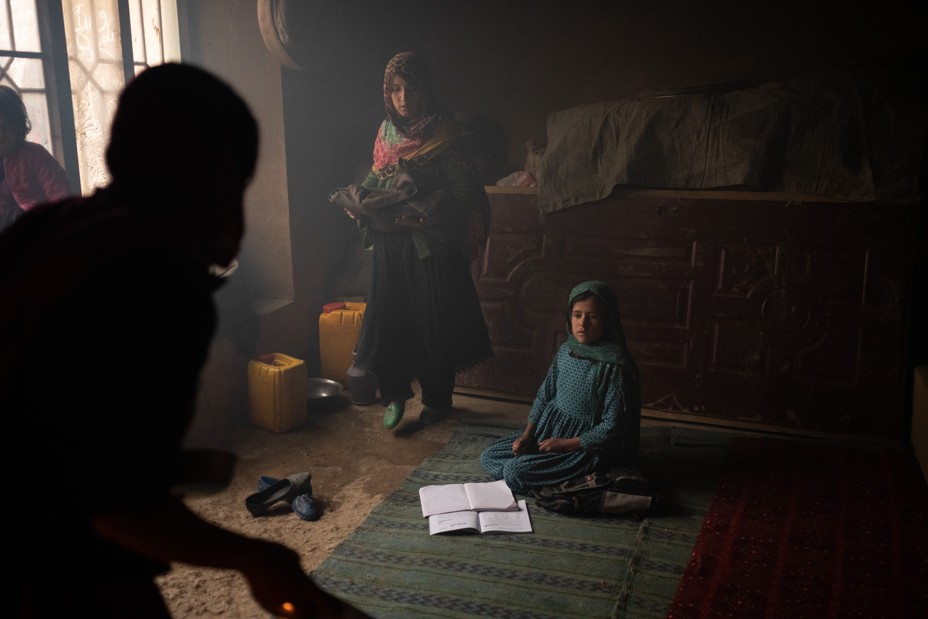
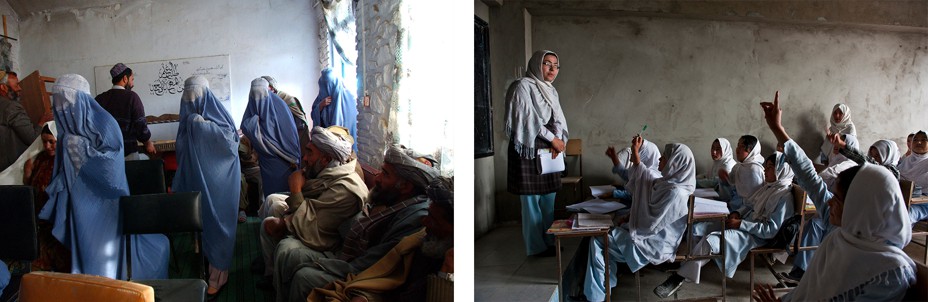
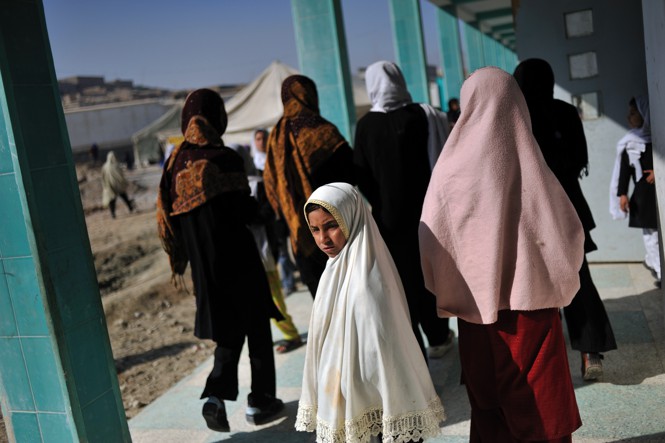
An 11-year-old girl studies at home in 2020, several years after her family fled ongoing fighting and insecurity in Ghazni province.Left: Female teachers attend a meeting about the reopening of schools at the Educational Headquarters building in Kandahar, Afghanistan, December 19, 2001. Right:Afghan Hazara students attend the Marefat School on the outskirts of Kabul, April 10, 2010.Schoolgirls in Kandahar, Afghanistan, February 7, 2009. The previous November, 16 girls had been sprayed with acid by Taliban sympathizers while walking to school there. Most resumed attending, despite constant threats to their safety.
I first traveled to Afghanistan in May 2000, when I was 26 years old. I was living in India at the time, covering women’s issues in South Asia as a photojournalist, and I was curious about the lives of women living under the Taliban. Afghanistan was then emerging from 20 years of brutal conflict—first with the occupying Soviets, and then in a protracted civil war—that had left Kabul pockmarked and with little functioning infrastructure. In the mid-1990s, the Taliban had promised to bring an end to the violence, and many Afghans, exhausted from years of insecurity and relentless destruction, did not resist the Islamic-fundamentalist group. But peace came at the cost of many social, political, and religious freedoms.
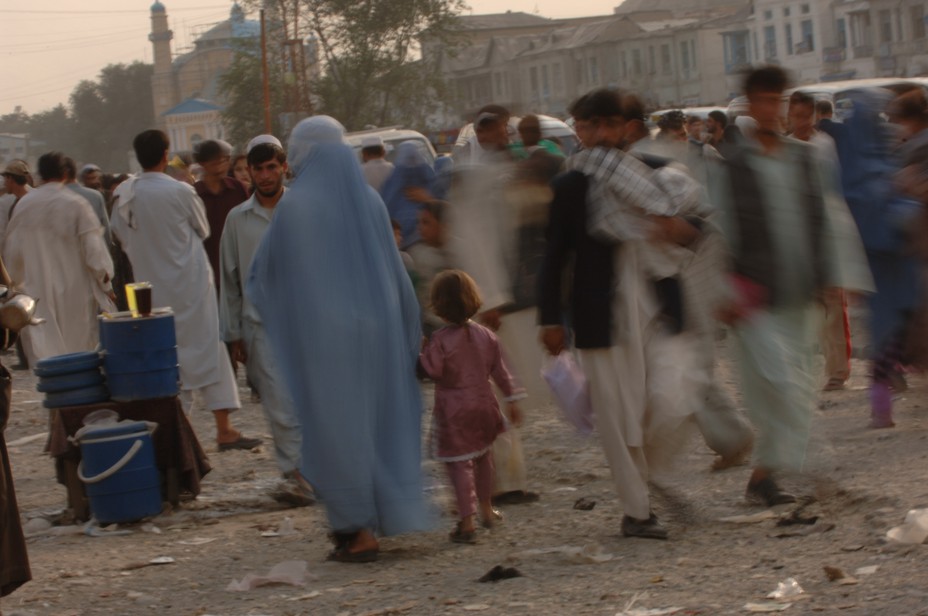
By the time of my first visit, the Taliban had implemented its interpretation of Sharia, Islamic law. Education for women and girls was forbidden under almost all circumstances, and women (except for select, approved female doctors) were not allowed to work outside of the home or even leave the house without a male guardian. Women who did go out were required to wear burkas, a traditional modesty garment that fits tightly over the head and drapes all the way to the ankles, rendering a woman fully covered and unidentifiable in public. All forms of entertainment were banned for everyone: music, television, socializing between sexes outside the family. Most educated Afghans had already fled to neighboring Pakistan and elsewhere; those who stayed had to change their lives to conform to the dictates of the oppressive regime.
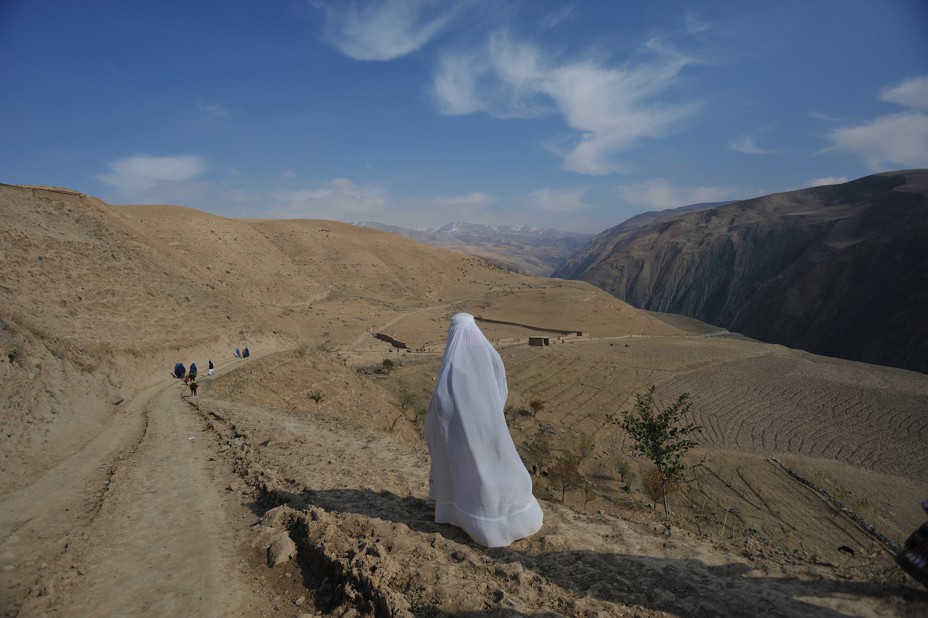
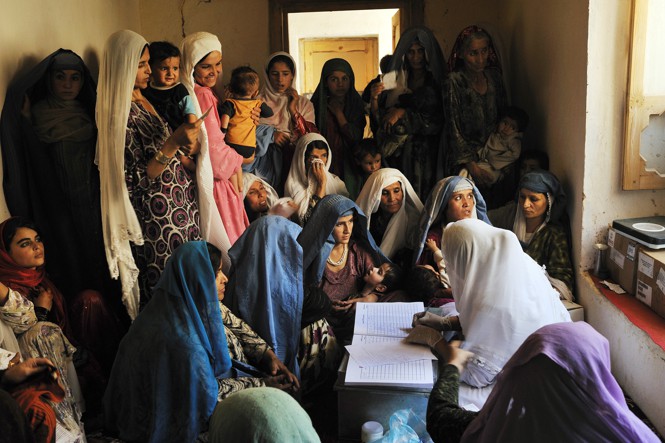
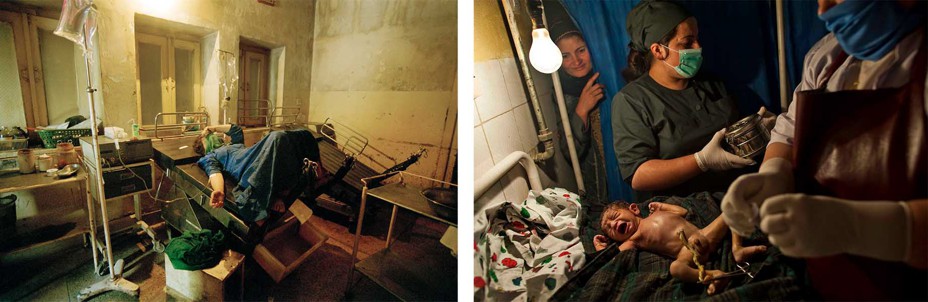
Women walk back to their villages in Badakhshan province after visiting a clinic that provided vaccinations and maternal health care, November 2009. At the time, the region had one of the highest maternal mortality rates in the country, in part because of the lack of developed roads.Women receiving pre- and postnatal health counseling in Charmas Village, a remote area of Badakhshan province, in August 2009Left:A woman in labor at the Rabia Balkhi Women's Hospital in Kabul, 2000. Under the Taliban, most women were prohibited from working, but a select number of women doctors were able to work. Right:Female medical staff tend to a newborn baby shortly after delivery in Faizabad, Badakhshan, 2009.
As a single American woman, I needed to find a way to move around Afghanistan with a stand-in husband, and to take photographs without being caught (photography of any living thing was forbidden under the Taliban). I made contact with the United Nations High Commissioner for Refugees, which was one of the few international organizations still functioning in Afghanistan, and the Comprehensive Disabled Afghans Programme, a UN agency that sought to rehabilitate those injured by the many land mines spread across the country. The groups arranged for men to escort me, along with drivers and translators, through the provinces of Ghazni, Logar, Wardak, Nangarhar, Herat, and Kabul to surreptitiously photograph and interview Afghan women. I quickly learned the virtue of being a female photojournalist, despite the challenges: I had free access to women in spaces where men were culturally or legally prohibited to enter.
From May 2000 to March 2001, over the course of three separate trips, I traveled around with my cameras and film tucked away in a small bag, visiting private homes, women’s hospitals, secret schools for girls. I went to underground mixed-gender weddings where the Titanic soundtrack bounced off the concrete basement walls as men and heavily made-up women (with nail polish) danced around in a display of pure joy—a simple pleasure that was punishable by execution under the regime controlling the streets outside.
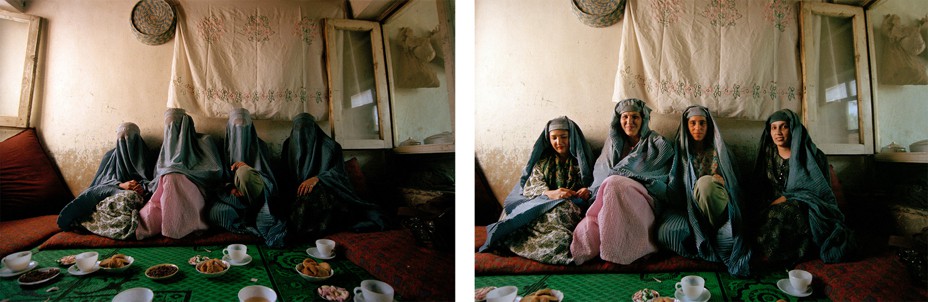
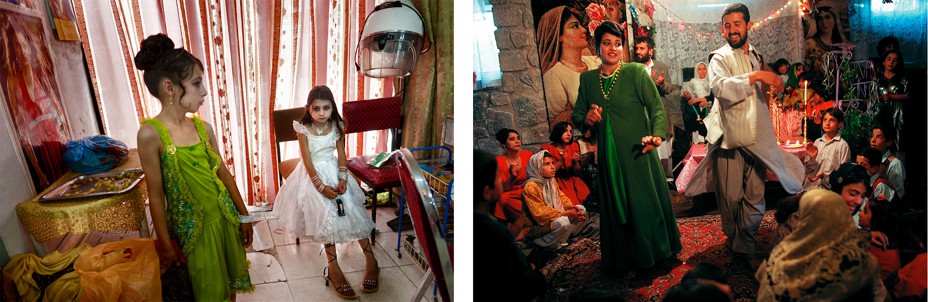
Before the Taliban rose to power, these four women had worked. In May 2000, when these photos were taken, Afghan working women were relegated to a life at home.Left: Two girls at a salon, dressed up and made up for a relative's wedding in Kabul, 2009. Right:An underground wedding celebration in Herat, March 2001. The group danced to the Titanic soundtrack and Iranian music.
Perhaps the silence of life under the Taliban sits with me more than anything. There were very few cars, no music, no television, no telephones, and no idle conversation on the sidewalks. The dusty streets were crowded with widows who had lost their husbands in the protracted war; banned from working, their only means of survival was to beg. People were scared, indoors and out. Those who were brave enough to venture out spoke in hushed voices, for fear of provoking a Taliban beating for anything as simple as not having a long-enough beard (for a man) or a long-enough burka (for a woman), or sometimes for nothing at all. Shiny brown cassette tape fluttered from the trees and wires and signs and poles everywhere—a warning to those who dared to play music in private. Matches in Kabul’s Ghazi Stadium had been replaced with public executions on Fridays after prayer. Taliban officials used bulldozers or tanks to topple walls onto men accused of being gay. People who stole had their hand sliced off; accused adulterers were stoned to death.
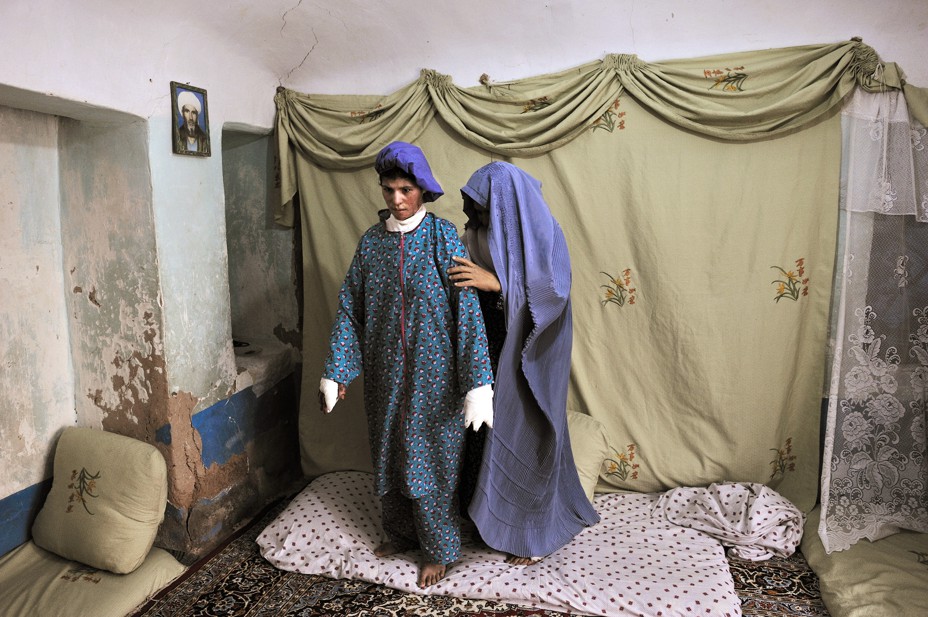
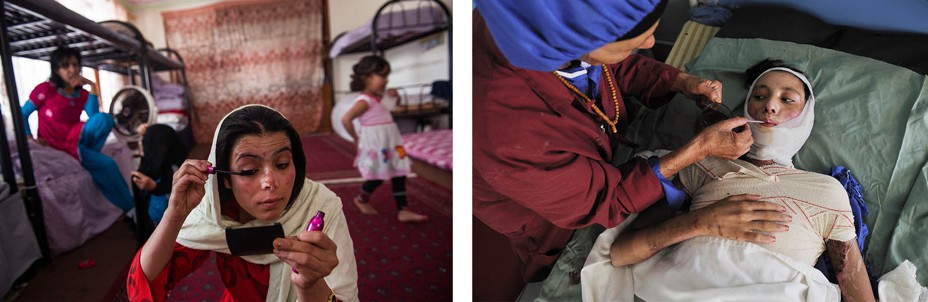
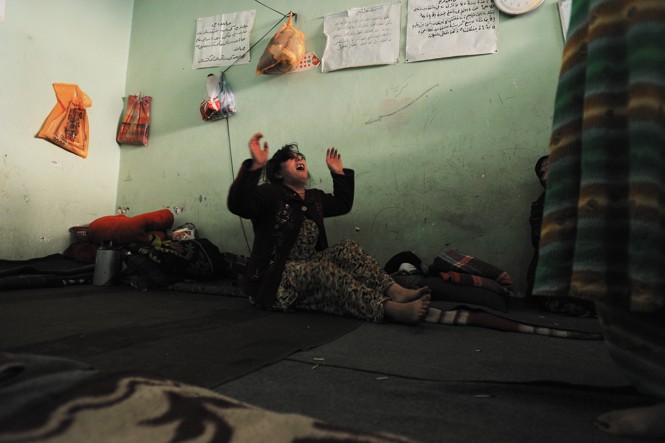
Farzana, a woman who tried to take her own life by self-immolation after being beaten by her in-laws, stands with the help of her mother, preparing to go to a private clinic in Herat, in August 2010.Left: Rika, whose stepmother poured acid on her face when she was a girl, applies makeup in her room at the shelter run by Women for Afghan Women in Kabul, May 2014. Right: Fifteen-year-old Hanife’s mother helps care for her in the burn center of the Herat Regional Hospital, August 2010. Hanife tried to commit suicide by self-immolation after being beaten by her mother-in-law. Maida-Khal, 22, cries out in her cell after the release of another inmate from Mazar-e Sharif prison. When Maida-Khal was 12, she was married to a man about 70 years old who was paralyzed. Unable to carry her husband, she was beaten by his brothers. When she asked for a divorce, she was imprisoned.
During these trips, I witnessed the strength and resilience of Afghan women. I often asked myself what would become of Afghanistan if the Taliban fell. I imagined that the men and women who afforded me such great hospitality, humor, and strength would prosper, and that Afghans who had fled their country would finally be able to return home.
M
onths later came the attacks of September 11, 2001, and soon after that the American invasion of Afghanistan. The Taliban fell, and women quickly proved themselves invaluable to the work of rebuilding and running the country. There was a great rush of optimism, determination, and belief in the development and future of Afghanistan. But even as the Taliban disappeared back into the fabric of cities and villages, many of their conservative values, which had deep roots in Afghan society, persisted.
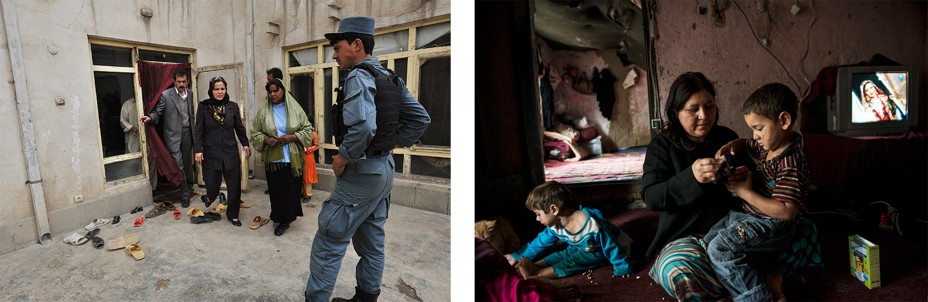
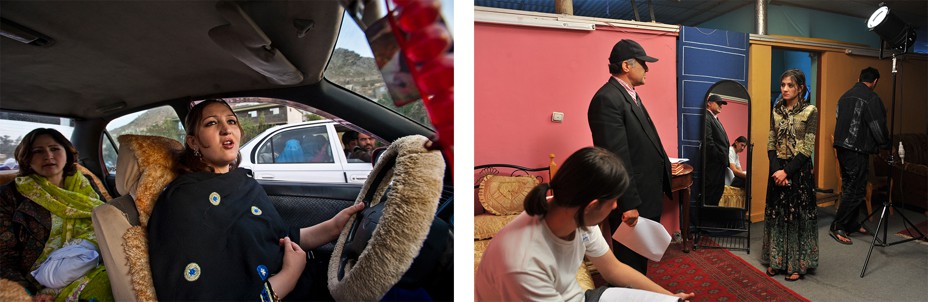
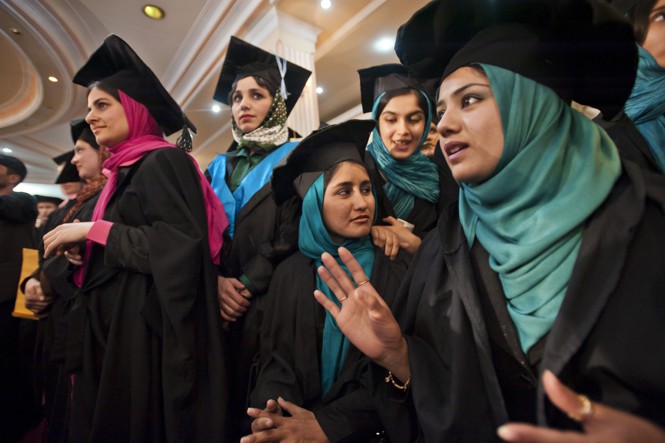
I photographed the defeat of the Taliban in Kandahar in late 2001, and returned to the country with my camera at least a dozen times in the subsequent two decades. From Kabul to Kandahar to Herat to Badakhshan, I photographed women attending schools, graduating from universities, training as surgeons, delivering babies, working as midwives, running for Parliament and serving in government, driving, training to be police officers, acting in films, working—as journalists, translators, television presenters, for international organizations. Many of them were dealing with the impossible balancing act of working outside the home while raising children; of being a wife, a mother, a sister, or a daughter in a place where women were cracking glass ceilings daily, and often at great peril.
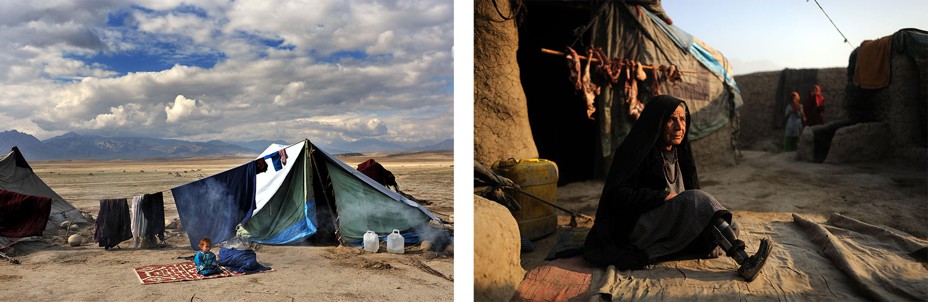
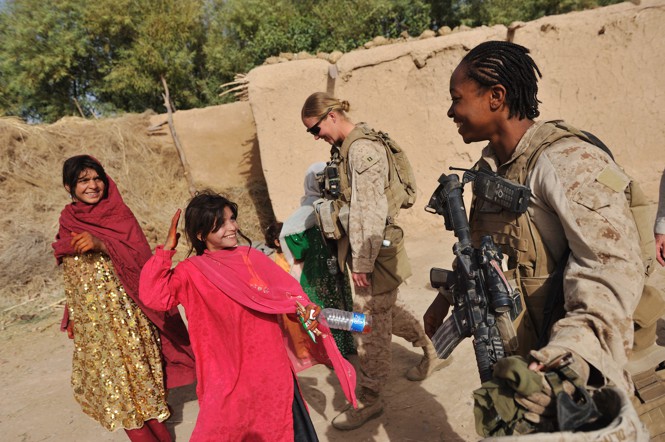
Left: Afghans displaced from the village of Garooch by NATO attacks in a camp in the Metalan desert, February 14, 2009. Right:Rabia, a victim of bombing in Helmand province, sits in a refugee camp on the outskirts of Kabul, December 17, 2008. Rabia lost a leg in the bombing; her husband and son were both killed in the attack, which occurred during a clash between the Taliban and NATO troops.Christina Oliver, 25, an American Marine, takes off her helmet to show an Afghan girl that she is a woman. Oliver was part of an operation to clear out Taliban from the area in preparation for parliamentary elections in southern Marjah, Afghanistan, in September 2010.
One of the people I met on my trips was Manizha Naderi, a co-founder of Women for Afghan Women. For more than a decade in Afghanistan, her organization helped implement a network of shelters and family mediation, counseling, and legal-aid services for Afghan women who had family issues, were victims of abuse, or were in prison without representation. Naderi now lives with her family in New York. When we spoke recently, I asked her whether she thought things had gotten better for Afghan women over the past two decades.
“Absolutely,” she answered. “Before the U.S. invaded Afghanistan, there was nothing, no infrastructure, no legal system, no educational system, nothing there. And in the last 20 years, everything was re-created in the country, from education, to the legal system, to social, to economics … Women have gained everything. Not just women, but the Afghans in general have gained a lot.”
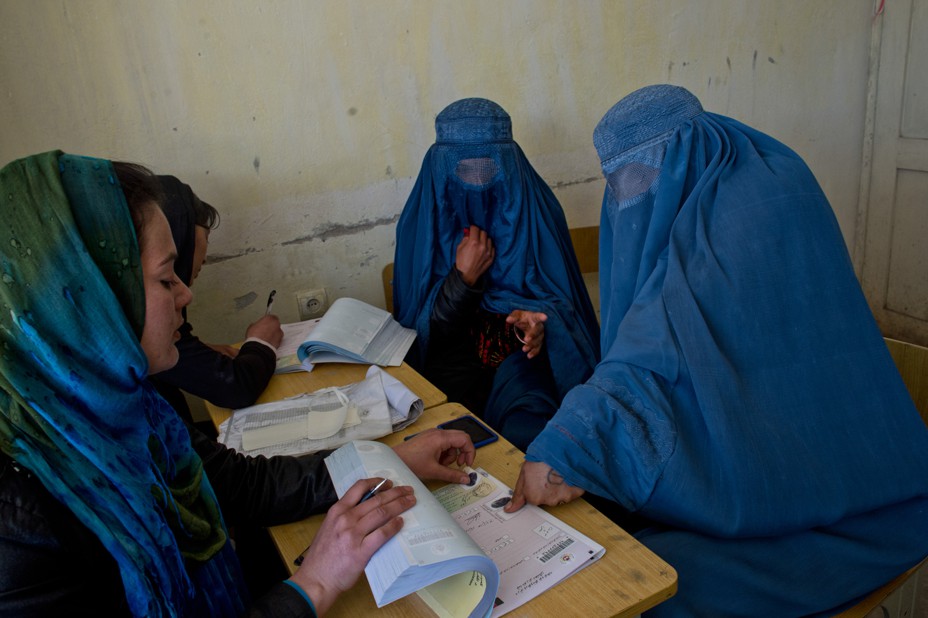
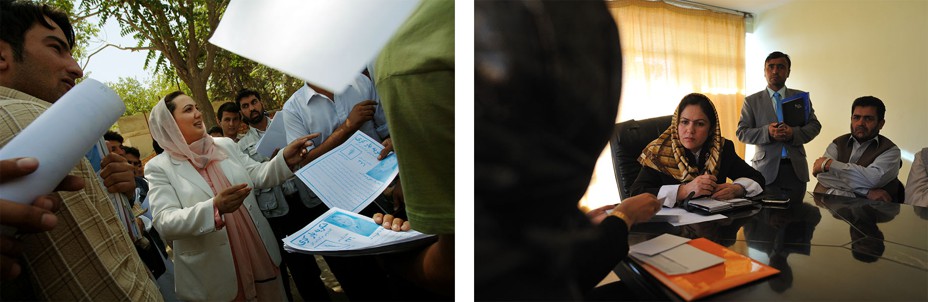
In March 2014, Afghan women register to vote in presidential elections at a center run by the Afghan Independent Electoral Commission in Shah Shaheed, Kabul.Left: Shukriya Barakzai campaigns for parliamentary elections in front of Kabul University, 2005. Right: Fawzia Koofi, a parliamentarian, meets with constituents in her home, April 2010.
Now, of course, those gains appear to be disappearing. In the past week, the Taliban has taken over nearly every major city in the country; yesterday, forces swept into Kabul, and Afghan President Ashraf Ghani fled the country. Militants have opened the doors of the prisons and released thousands of prisoners, sent women home from work, and removed girls from schools. In the advance toward the capital, forces have destroyed medical facilities, killed civilians, and left thousands of Afghans displaced. Some claim that the Taliban has demanded that women from the villages it conquers marry its unwed fighters (though the group denies this allegation).
Fawzia Koofi, another woman I got to know in Afghanistan, has poured her life into her country since the Taliban came to power in 1996. She, too, started a network of secret girls’ schools in the 1990s, in her home province of Badakhshan. Koofi was a member of Parliament from 2005 to 2019, and has been one of the people representing the Republic of Afghanistan in peace negotiations with the Taliban in advance of American troops’ departure from the country. When I first met her, in 2009, she was shuttling around Kabul, trailed by a small posse of male advisers and a security detail, returning home following long days in Parliament to a line of constituents at her doorstep pleading to voice their concerns about various issues. She was also raising two young daughters alone; her husband had died from tuberculosis in 2003, which he had contracted while imprisoned by the Taliban. Koofi seemed to never stop, or even tire. The Taliban has twice tried to assassinate her. She always carried around a handwritten letter to her daughters, just in case.
When I called Koofi a few weeks ago in Kabul, the Taliban was already gaining ground around the country. Koofi was skeptical of the group’s promises that it would continue to allow Afghan women their freedoms to study and work outside the home. She cited a complete disconnect between what the Taliban officials were saying during peace negotiations in Qatar and the human-rights abuses her contacts said their foot soldiers were carrying out on the ground. I asked if she was scared.
“Honestly, I’m not scared of being assassinated,” Koofi told me. “I’m afraid of the country once again falling into chaos.”
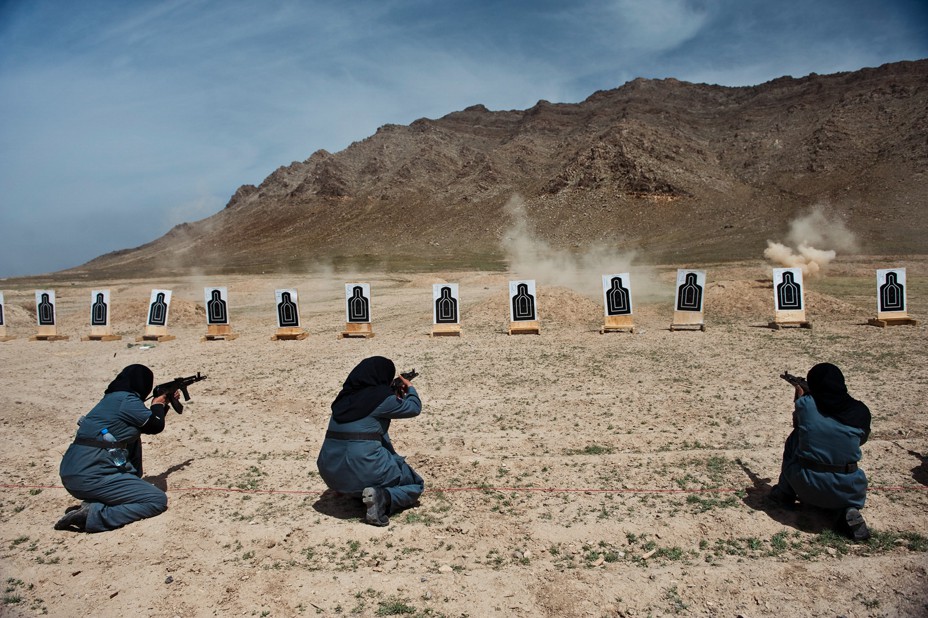
Afghan policewomen are trained by carabinieri, Italian military police from the local NATO troops.Left: An undercover policewoman searches houses for drugs in Kabul, April 2010. Right: A policewoman at home with her niece and nephew in Kabul, June 2014.
As the Taliban overran cities across Afghanistan, Koofi was spending much of her time fielding calls from men and women who were terrified of the implications of a takeover. She was frustrated that she could offer little in the way of consolation. Shortly before I spoke with Koofi, a pregnant woman had called her from Faizabad, the capital of Badakhshan—a place I visited in 2009 to document the high rates of maternal death in the province. Over the course of the past decade, various advances have reduced that number. The woman calling Koofi needed to deliver this baby by Cesarean section, but the Taliban was closing in and she feared that she wouldn’t be able to get to a hospital for the procedure. She had only three weeks left until her delivery date, and no way to leave her home. What could she do? If the woman could not deliver by Cesarean, she might die, but Koofi had no way to help from Kabul. Last week, Faizabad fell to the Taliban.
Recently, the price of burkas has doubled, and in some cases increased by even more. Women are purchasing the best armor to protect themselves from the Taliban: the veil.
Over the weekend, as the Taliban encircled Kabul, I asked Koofi how she was doing and whether she had evacuated. She fled her home on Sunday and is now in hiding in Afghanistan. “No one is helping,” she told me. “Can you talk to the Americans?” I have been receiving WhatsApp messages like this daily from former female translators and subjects, expressing fear and asking me how to get out of Afghanistan.
I don’t know is my answer. I don’t know where you can go. I don’t think America will help anymore. No, I don’t think they will give you or your brother or my former driver from 11 years ago a visa. I don’t know what will happen to women in Afghanistan.
All I know is that the women I’ve met these past 20 years have astonished me with their determination and wit. They have made me crumble in laughter and in tears. I think about the crisp afternoon in Kabul in 2010 when I was driving around with an Afghan actress in the passenger seat of her car. Her beautiful, fully made-up face and hair were in full view as she blasted Iranian music and danced with her hands around the steering wheel. She drove past checkpoints, huddles of burkas, and startled and sneering men. She laughed, and I laughed, and I thought about how far Afghan women had come. The Taliban cannot take away who Afghan women have become in the past 20 years—their education, their drive to work, their taste of freedom.
Afghan actresses, in the car and on setWomen graduate from Kabul University’s department of language and literature, 2010.
And there is a new generation of Afghan women today, women who can’t remember what it was like to live under the Taliban. “They are full of energy, hope, and dreams,” Shukriya Barakzai told me. “They are not like me, as I was 20 years back. They’re more alert. They’re communicating with the world. It’s not [the] Afghanistan that was burned in a civil war. It’s a developed, free Afghanistan, with the free media, with women.” The Taliban is taking territory, Barakzai says, “but not the hearts and minds of people.”
Four years ago today, racists, antisemites, white nationalists, Ku Klux Klan members, neo-Nazis, and other alt-right groups met in Charlottesville, Virginia, to “Unite the Right.” The man who organized the rally, Jason Kessler, claimed he wanted to bring people together to protest the removal of Confederate general Robert E. Lee from a local park. But the rioters turned immediately to chants that had been used by the Nazis in Germany in the 1930s: “you will not replace us,” “Jews will not replace us,” and “blood and soil.” They gave Nazi salutes and carried Nazi insignia, and many brought battle gear and went looking for fights. By the end of August 12, they had killed counterprotester Heather Heyer and had injured 19 others. After the governor of Virginia declared a state of emergency, the rioters went home.
The Unite the Right rally drew a clear political line in America. Then-president Donald Trump refused to condemn the rioters, telling a reporter that there were “very fine people, on both sides.”
In contrast, former vice president Joe Biden watched the events at Charlottesville and concluded that the soul of the nation was at stake. He decided to run for president and to defeat the man he believed threatened our democracy. Biden was especially concerned with Trump’s praise for the “very fine people” aligned with the rioters. “With those words, the president of the United States assigned a moral equivalence between those spreading hate and those with the courage to stand against it,” Biden said, “and in that moment, I knew the threat to this nation was unlike any I had ever seen in my lifetime.”
Four years later, it is much easier to see the larger context of the Charlottesville riot. The political threat of those gangs who tried to unite in Charlottesville in 2017 recalls how fascism came to America in the 1930s: not as an elite ideology, but as a unification of street brawlers to undermine the nation’s democratic government.
In 2018, historian Joseph Fronczak explored the arrival of fascism in the U.S. In an article in the leading journal of the historical profession, the Journal of American History, Fronczak explained how men interested in overturning Democrat Franklin Delano Roosevelt’s presidency in 1934 admired and then imitated the violent right-wing gangs that helped overturn European governments and install right-wing dictators.
The United States had always had radical street mobs, from anti-Catholic gangs in the 1830s to Ku Klux Klan chapters in the 1860s to anti-union thugs in the 1880s. In the 1930s, though, those eager to get rid of FDR brought those street fighters together as a political force to overthrow the federal government.
While they failed to do so in an attempted 1934 coup, Fronczak explains, street fighters learned about the contours of fascism once their power as a violent street force was established. He argues that in the U.S., fascism grew out of political violence, not the other way around. Mobs whose members dressed in similar shirts, waved similar flags, and made similar salutes pieced together racist, antisemitic, and nationalistic ideas and became the popular arm of right-wing leaders. In America, the hallmark of budding fascism was populist street violence, rather than an elite philosophy of government.
The Unite the Right rally in Charlottesville had the hallmarks of such a populist movement. Leaders brought together different gangs, dressed similarly and carrying the emblem of tiki torches, to organize and attack the government. Rather than rejecting the rioters, then-President Trump encouraged them.
From that point on, Trump seemed eager to ride a wave of violent populism into authoritarianism. He stoked populist anger over state shutdowns during coronavirus, telling supporters to “LIBERATE MINNESOTA,” “LIBERATE MICHIGAN,” and “LIBERATE VIRGINIA, and save your great 2nd Amendment. It is under siege!” His encouragement fed the attacks on the Michigan state house in 2020. And then, after he repeatedly told his supporters the 2020 presidential election had been stolen, violent gangs attacked the U.S. Capitol on January 6, 2021, in an attempt to overturn the government and install him as president for another term.
While that attempted coup was unsuccessful, the empowerment of violent gangs as central political actors is stronger than ever. Since January 6, angry mobs have driven election officials out of office in fear for their safety. In increasingly angry protests, they have threatened school board members over transgender rights and over teaching Critical Race Theory, a legal theory from the 1970s that is not, in fact, in the general K–12 curriculum.
Now, as the coronavirus rages again, they are showing exactly how this process works as they threaten local officials who are following the guidelines issued by the Centers for Disease Control and Prevention to require masks. Although a Morning Consult poll shows that 69% of Americans want a return to mask mandates, vocal mobs who oppose masking are dominating public spaces and forcing officials to give in to their demands.
In Franklin, Tennessee, yesterday, antimask mobs threatened doctors and nurses asking the local school board to reinstate a mask mandate in the schools. “We will find you,” they shouted at a man leaving the meeting. “We know who you are.”
Joseph Fronczak, “The Fascist Game: Transnational Political Transmission and the Genesis of the U.S. Modern Right,” Journal of American History, 105 (December 2018): 563–588.
When you want meatless tacos, try these roasted cauliflower tacos made in the air fryer, topped with Peruvian green sauce and pickled red onions.
Air Fryer Roasted Cauliflower Tacos
I have tons of air fryer recipes but needed a quick vegetarian taco to add to the list. These easy Roasted Cauliflower Tacos are a tasty vegetarian taco option made in the air fryer, my favorite appliance. I topped them with Peruvian green sauce, pickled onions, sour cream, and cilantro. More taco recipes you might like, Tzatziki Fish Tacos, Slow Cooker Chicken Tacos, and Vegetarian Black Bean Tacos.
Last summer the temperature in London, where I live, climbed above 37 degrees Celsius—or 100 degrees Fahrenheit. It was hotter outside my body than it was inside it. To someone raised under the sodden, used-tissue skies of Britain, that felt like an offense against nature. Everywhere I went, I felt the same constricting, breathless sensation. The heat was like a prison; I had been sentenced to 100 degrees. Stuck at home all day because of COVID-19 shutdowns, I worked with my feet in a bucket of cold water, in front of a fan turned up to what I nicknamed the “Shakira setting.”
Britain’s homes and office spaces weren’t designed with high temperatures in mind; unlike in the Mediterranean and other hot climates, our buildings aren’t typically made with thick walls and shutters to keep out sunlight. Mechanical air-conditioning is unusual in private homes because we already have air-conditioning. We call it rain. Britain might be a rich, developed country, but that doesn’t make it ready for climate change.
Last summer was the first time I can remember thinking, before catching myself, that I couldn’t wait for Britain’s weather to go back to normal. A body-heat-level summer will always be normal. This is the world that fossil fuels made, a world where “freak” weather is not freakish. In the past year alone, wildfires in Australia affected 3 billion animals; cities in Pakistan and India surpassed 120 degrees Fahrenheit, a temperature so hot that the roads started to melt; people died of heatstroke in Portland, Oregon; the London Underground turned into a log flume; the air in Montana was so full of smoke that, according to one resident, you chewed it rather than breathed it; and killer “megafloods” swept away riverside homes in Germany.
Some of the strange weather that people around the world have experienced recently is just that: weather. Natural variations in temperature and moisture. But you can live through only so many “once in a lifetime” rainstorms or heat waves before concluding that they are not once in a lifetime after all. Something is very wrong. Climate change no longer feels like an abstract problem for the future, like an asteroid hitting the Earth or a super-earthquake wiping out the Pacific Northwest. I am scared now. I’ve reached my personal tipping point.
Understanding a problem intellectually is not the same as feeling its presence in your daily life. Like anyone who reads the news, I’ve been aware of climate change for years, during which the subject bobbed in and out of my field of vision. Like many journalists, I wondered how to make a subject so enormous, and so terrifying, connect with busy people living busy lives. The torrent of disaster footage from around the world has answered that question for me.
“Environmentalism” sounded woolly and tree-hugging when I read it or wrote it. “Climate change” sounded antiseptic and bloodless. “Look at that 50-foot wall of fire” might just do the trick. Every time I listen to blowhard TV presenters waffling about the dire “hockey-stick graph,” or oil executives soliciting praise for their company’s pitiful efforts to address the problem, or politicians falsely telling the public that we can keep consuming as much as we do, I will mentally Photoshop their babbling faces in front of the scenes from Greece, Turkey, or California this past weekend. Let’s see how convincing they sound over B-roll of a literal inferno.
The scientific consensus is clear that climate change is real, and it is equally clear that major action is needed to avoid further catastrophe. A new report from the International Panel on Climate Change warns that rising global temperatures are inevitable, that only a major reduction in greenhouse-gas emissions this decade can prevent climate breakdown, and that some changes may already be “irreversible.” I wince when I read reports like that, because of the danger that such news will prompt apathy rather than action. We’re all doomed, so why bother fighting it?
What has given me hope, oddly enough, is the coronavirus pandemic. In less than two years, scientists have created multiple vaccines against a previously unknown disease, and governments have begun to distribute them worldwide. Yes, the vaccine rollout suffers from the same problems that climate policy does; the richest countries attend to their own needs first. (Constant high temperatures are especially dangerous in countries where people have to work outside and can’t afford air-conditioning to cool themselves at night. Floods are made worse by cheap, unprotected housing. Wildfires rage more fiercely where the local population lacks enough fire trucks to tackle them.) But the lesson of the coronavirus is that proximity to disaster can change minds, even among those who feel that living in a rich country can insulate them from harm.
Contrast the vaccine take-up in Australia and Britain. In the former, the rollout has been sluggish. The government closed the borders early and infections have stayed low, and many Australians have therefore been reluctant to take the AstraZeneca vaccine, because of early concerns about a rare clotting reaction. Why not wait for supplies from Pfizer or Moderna? Here in Britain, which has counted more than 150,000 deaths from COVID-19, most people couldn’t get the vaccine—any vaccine—into their arms fast enough. For us, COVID-19 wasn’t a 30-second news report about terrible things happening overseas. It was a 50-foot wall of fire in our own backyard. In the United States, vaccination rates have picked up quickly in the communities currently being ravaged by infections from the Delta variant. As the global climate becomes more obviously chaotic, the public’s self-interest should accelerate what my colleague Robinson Meyer calls the “green vortex”—the process by which institutions and initiatives tackle challenges such as decarbonization even without strong national climate policies. For businesses, the economic benefits of free-riding on the depletion of natural resources will soon be weighed against the cost and inconvenience of having your data center washed away in a flash flood.
Despair about the climate should also be tempered by the advances we have already seen in the past decade. Here in Britain, stories about “freak” weather now routinely mention climate change, stressing the connection between the two. The BBC documentaries by 95-year-old David Attenborough, a national treasure second only to the Queen, no longer merely show sad, skinny polar bears trying to hunt on melting ice; they explicitly discuss why the bears are so sad and skinny. (Attenborough’s recent Netflix documentary is even more powerful, as he points out that when he was born in 1926, the planet was a full degree cooler.) Even avowedly contrarian publications have less tolerance for climate-change deniers, who were once treated as a spicy provocation to liberal sensibilities. The culture war over climate has burned out as the real world has caught on fire.
I can only hope the United States follows this path too. I no longer feel like the dog in the cartoon, insisting that “this is fine.” This isn’t fine. We have messed up quite badly, for some noble reasons, such as lifting people out of poverty, and some less noble ones, such as enriching the shareholders of fossil-fuel companies. But the same ingenuity that got humanity here, the ingenuity that created the internal-combustion engine and the airplane and the power station and the megafarm, is what can save us.
The impulse to procrastinate is understandable. Anyone who has written a book or cleaned out a garage will know the feeling: Simply by beginning such a project, you have committed yourself to an enormous amount of time and labor, so it’s easier not to start at all. That’s where politicians come in. Individual changes are no substitute for political action. Through subsidies and taxes, governments need to make the greenest option also the easiest one to take. Again, the surprise of the pandemic has been the high levels of compliance with shutdowns and mask mandates, despite isolated instances of rebellion making the news. The coronavirus didn’t cause looting. Society didn’t break down. In the face of existential threats, most of us are cooperative, kind, and resilient. Those qualities are what propelled a bunch of apes through an evolutionary journey that led to humans reaching the moon, splitting the atom, and creating RuPaul’s Drag Race.
The first thing to do is let the fear in, without letting it paralyze us. This isn’t fine.
Over the past few months, I have been saving up all the advice I wish someone had given me when I went off to college. I realize that you will probably have to ignore much of this for years, but I am hoping little bits of it will pop into your mind at random moments.
Always drink two drinks fewer than you think you want to. You will get more joy out of life if you are alert to it, before that second-to-last drink, when the evening gets slurred. If you drink too much, you lose those lovely, wild moments. You basically miss them. If you master the art of getting just-the-right-amount drunk, you will have more fun.
Make sure to talk to your college professors. Maybe because they are intimidated or have more exciting things to do, most undergraduates don’t venture into office hours. Your professors will appreciate your making an effort to connect and discuss things. This will be useful for you later, if you need a recommendation or a job, but it is also the way to get the best possible education. I know this because I am a professor. So many of my most important pedagogical conversations happen in my office or outside of the classroom over coffee.
Learn how to read quickly for substance.
Don’t ignore boys who are nice. I know narcissistic, damaged, charismatically mean, or ultimately unavailable boys will seem appealing. I know suffering can seem glamorous in love, especially at your age, but this particular fallacy, this romantic view of feeling terrible, will cause you a lot of true pain, and lead you down many bad, distracting paths, so try to at least notice the nice boys when you walk into a room. A subset of this: Men who cook are probably harboring other very good qualities. Another subset: Run in the other direction from an angry man. Anger does not equal passion.
Don’t wait too long to learn to drive, like I did. You have to do it before you have a sense of your own mortality, or you will never be a natural driver.
Keep a notebook to write down important quotes when you come across them. You will be very happy if you do this, and can find these quotes when you need them. Otherwise, there will definitely be many times when you think of a quote and can’t quite remember it and can’t find it on the internet and your life will be worse because of this.
Write in books.
This is for later, but you might as well start thinking about it now: Be independent. Even if you are married, or madly in love, or living with someone, make sure you always have your own income and your own financial independence. This will give you freedom and security if you need to leave (and a healthier, more balanced relationship if you want to stay).
Pay more attention to nature and beauty. In this phase of life, you will sometimes think your inner dramas are more compelling than, say, the light in the trees, or the pink-streaked sky you will see when you’re staying up ’til dawn, but you are wrong.
This may be one of those things that are so indescribably annoying that you have to tune them out, but I am going to go ahead and say it anyway. Unfortunately, it’s impossible to appreciate what a crazy luxury school is until you are finished with it. Even when you are stressed about an exam, or nauseous from staying up all night writing a paper, or racing to class on a cold day, try to appreciate the onetime splendor of being immersed in friends, eating every single meal with them, discussing blooming dramas in every waking hour, having nothing expected of you from the universe but reading and thinking and arguing and expanding your known world. Later, when many things are expected of you, this time will take on a magical, suspended quality. But even now, in small flashes, you may be able to savor it, apprehend the fleeting pleasure and total, glorious artificiality of college.
Find a place in a library where you feel a little bit exalted about your work.
Save letters. Print out important emails and save them too.
Do not be afraid to ask for more money for a job if you deserve it. I have probably taught you to be too polite and respectful of authority to do this, but ignore me!
In all remotely professional emails, write something in the subject line so you can find it later.
Do not use parentheses in your writing in a lazy way, when you can’t be bothered to cram all the information into a single graceful sentence. Only use them when they serve some positive stylistic purpose. In other words, use them if you are setting off the information in parentheses for a reason like humor or emphasis.
Don’t forget to sleep. When life is so full of people and thoughts and things to read and parties, it is tempting to just not sleep. But one of these days you will wake up feeling an unaccustomed sense of peace and calm, when you are totally un-frantic and un-anxious, and you will think to yourself, Oh this is what it feels like to get eight hours of sleep!
This humanity at play makes my heart happy: In one of the most exciting and competitive high jump finals in Olympic history, Qatar’s Mutaz Essa Barshim and Italy’s Gianmarco Tamberi — who both cleared 2.37m — decided to forgo a jump-off and share the gold.
There’s a special time in everybody’s life, and by “special” we mean “really confusing and also seriously what the heck is going on?” It’s that special time that Greg Van Eekhout covers in his novel Weird Kid, and along the way he gets into why being a weird kid is, kinda, sometimes, awesome.
GREG VAN EEKHOUT:
I was visiting an elementary school and after my author talk a kid came up to my signing table and I said hello and he said, “What is the best pencil sharpness?” You get asked a lot of interesting questions at visits, like “How much money do you make?” and “Are you a Christian?” and “Why do we have to be here?” so I was happy to get lobbed such a softball. “Sharp,” I answered, “because line precision.” But I got it wrong, because sharp leads are prone to breakage, yet dull pencils produce muddy lines, so the correct answer was medium, obviously. We happily chatted about pencils for a while until I told him about a shop in New York City that sells pencils and only pencils and then he went a little pale and floated off in a state of wonder.
I was so delighted to meet this fine young person with their joyous obsession, and I hoped all their weird interests would be respected and nurtured and celebrated. But I also worried. Because he was only a few short years away from middle school.
In his Life in Hell comic, Matt Groening identifies middle school as the deepest circle of Hell, and he’s not wrong. I still remember my first day of middle school (I’m old, so back then it was junior high). There was a whole new vocabulary and new set of behaviors and ways of being a person that nobody had bothered to tell me about. Even the teachers were weird. They acted like they hadn’t known me for six years (possibly because they hadn’t known me for six years). They acted like they weren’t already aware I was an awesome kid. Nobody wanted to talk about pencils. I was weird in a world where it was no longer okay to be weird.
We meet Jake Wind, the protagonist of Weird Kid, on his first day of middle school, and he faces all the weirdnesses of middle school that I did, only with some additional challenges, because he’s a shape-changing ball of goo from another planet who’s just barely managing to maintain human form. The metaphor is pretty obvious, I know.
As you might deduce from the description of Jake’s plight, this is a deeply personal, cathartic story to me. I wrote it for the pencil enthusiasts and alien goo kids and everyone who’s beautifully, spectacularly, gloriously a little or a lot weird. I wrote it for the kids who haven’t yet found a home in a community of likewise weird people. And I wrote it for the kids who haven’t yet learned that the things that make them weird are the very same things that make them interesting, and fun, and invaluable.
Also, Jake’s dad is a proctologist, so there are a lot of butt jokes. The butt jokes earned praise in a starred Publishers Weekly review. I’m pretty proud of that.
I regret getting married. It seemed like a good idea at the time–about two years ago now. My husband (29yo he/him) and I (26yo they/them, but he sees me as a woman) are an opposites-attract type of couple. At first I felt like he was a good influence on me–he’s more outgoing, more spontaneous, more playful, more relaxed. He’s a good catch–hardworking, stably employed, loyal and caring, the works. He continues to be as loving and attached as he’s always been. But in the last six months, our differences in values and interests are getting to be too much for me. I’m not attracted to him any more and I feel like I’m lying when I say “I love you, too.” There was a point at which I wanted to be attracted to him again, and I tried the nurture that. But now I’m at a point where if I ask myself what it would take to make this marriage work, the only things I can come up with are “companionate, non-sexual, open marriage” which is basically just roommates with tax benefits. I fantasize about living alone.
Is this just the beginning of the end? If he were only my boyfriend I’d break up with him, but we own a house and have partly joined finances. Is there a point in going to couples’ counseling? Do I kon-mari this relationship that no longer brings me joy? He knows I’ve been generally unhappy lately, but how do I tell him that I’m this unhappy in our marriage and not just unhappy in general? I can’t imagine waiting this out more than a few more months.
Cheers, and thank you, P.
Dear P.,
It’s not entirely clear whether your husband knowingly misgenders you or whether you’ve never felt comfortable revealing your actual gender to him, either way, nothing bodes well about this! It sounds like you’re done with being married, so what happens if you assume that it’s not a question of whether you’ll end the marriage, but when?
I recommend that you take at least a few days to yourself to think through the process of ending the marriage, such as: researching how legal separation and divorce work where you live, consulting an attorney, thinking through how to best disentangle your finances and housing so that everybody is in the most stable possible position, and planning out your own next steps. Part feelings, part logistics, think about questions like: How can you be kind and gentle to your husband and to yourself on your way out of this relationship? How would you want him to treat you if your positions were reversed? You fantasize about living alone, so what are the actual steps for getting there? What kind of support from friends and family would help you land on your feet? Do you know where all your important paperwork lives? In a perfect world, what should happen to all your stuff? Are there safety concerns, where a resource like loveisrespect.org could help you make a safety plan?
If there’s a supportive friend you can stay with or a place you can go to get privacy and space as you think this through, that will help. Having the beginnings of a plan in mind for how to do the thing you need to do is a good way to get your courage up to actually do it.
Then, when it’s time, tell your husband what’s up.There is no good way to tell someone news that they definitely do not want to hear that will magically prevent them from feeling hurt, so I suggest keeping it short and straightforward: “I’m so sorry, but I don’t want to be married anymore and have started investigating the best way to dissolve our partnership.”
He’s probably going to ask why, which is a fair thing to do, and you may be tempted to start listing reasons he’s not right for you in an attempt to build an airtight case that will make him understand and eventually agree with you. Can I suggest not necessarily doing that? Sometimes the reasons are glaring (“You keep purposely misgendering me even though you know I’m not a woman”) but not necessarily safe to say out loud, and sometimes everyone is doing the best they can and still “wanting to leave is enough.” “I’m so sorry, there’s no one reason or satisfying explanation, I just know that my feelings have changed and I would be happier if we separated.” “I’m so sorry, but you know I’ve been unhappy lately, and I know this isn’t going to work out between us.” “Since we’ve gotten married I am less happy with my life and I don’t think we’re as compatible as I once did.”
In my opinion, couples’ counseling isn’t a great idea when one partner has already decided to leave the marriage. Why drag everyone through an expensive, wrenching pretense of fixing a relationship that one person already knows is unfixable? Some people who know their relationship is pretty much over try it anyway because they want to know (or demonstrate) that they tried every possible solution before walking away, and some people want a witness/referee for how bad things have gotten, or a divorce doula who can facilitate difficult conversations about parting ways, which, legit! But an individual counselor could help you make good decisions just as well, and one benefit of breaking up with someone is that it frees you from the obligation of “working on” the relationship together.
When the dust settles you’ll be one more human who made a loving, hopeful choice that didn’t work out quite like you planned. Your taxes will be weird next year. Somebody will have to buy someone else out of the house, or you’ll sell it and split the proceeds. Everyone will be sad, mad, or both for a while. There will be a gauntlet of people saying “Holy smokes, really? But you *just* got married!” that you will both have to navigate, and you’ll have to find a bunch of ways to say “I know, this did not turn out how I planned, either! It’s sad, but I know this is the right choice for me.” These are not pleasant or easy prospects, but nothing here is insurmountable.
Between now and then, there will be many conversations with your now-husband as you hammer out logistics, but the one that communicates “I have decided to leave, plan accordingly” is the most crucial one. What does he need to know right now so that he can make good decisions for himself and so that you can start moving on with your life? Start there.
Like many of us, in a valiant attempt to maintain my mental health, I've spent much of the past year past year-and-a-half-twenty-twenty-garbage in a place of quiet self-reflection and contemplation. When so many things you held to be true and constant are suddenly proven to be false or shifting -- the inerrant goodness of humanity, the forward curve of justice, the strength of the global toilet paper supply chain, etc. -- it's important to try to stay grounded and focused on what hasn't changed, on what you can depend on.
I mean, look at this thing. This is no mere tube of armpit goo. This is Degree® MOTIONsense® ULTRACLEAR BLACK + WHITE PURE CLEAN INVISIBLE SOLID antiperspirant. Or more accurately:
Degree®
MOTIONsense®
ULTRACLEAR BLACK + WHITE PURE CLEAN INVISIBLE SOLID antiperspirant
This thing has not one, but TWO registered trademarks! It's got the balls to put the three most specifically descriptive words about the product at VERY BOTTOM, in VERY TEENY TINY TYPE! And it STILL needs to spill over to the lid space to assert that it is also ANTI YELLOW STAINS and ANTI WHITE MARKS!
And look! They put the yellow on the white side and the white on the black side of the sticker to masterfully reflect the specific fabric colors most at risk of these particular problems, but maybe -- just maybe -- it's because Degree® MOTIONsense® ULTRACLEAR BLACK + WHITE PURE CLEAN INVISIBLE SOLID antiperspirant is also ANTI RACIST.
It's not BLACK and WHITE, after all. It's BLACK plusWHITE. It's the math of unity, because we're all in this together as sweaty gross humans. And it doesn't matter what color your skin is -- this shit's invisible anyway!
What always delights me about these labels-- can you imagine how many meetings went into this? How many takes on the sassy dresses and how many discussions re: Dress Boob Size and How Much Invisible Cleavage Should We Suggest some poor graphic designer had to sit through? I bet the ampersand vs. plus sign thing ALONE took three weeks and involved at least one weary lawyer explaining that no, we can register that as a trademark either way, please stop inviting me to these things -- is that I actually can't remember the last time I - the target demographic - personally purchased deodorant. (Sorry, "antiperspirant.") It's always the item I never think about until Jason texts me "hey at Target, anything we need?"
"deodorant," I text back, vaguely remembering that whatever I used that morning was officially running out and scrape-y.
"ok what kind" Jason USED to text back, but now he finally knows me and my deodorant preferences, which are:
1) Whatever is on sale
2) No pink scents, only blue or green scents
And thus, Degree® MOTIONsense® ULTRACLEAR BLACK + WHITE PURE CLEAN INVISIBLE SOLID antiperspirant was selected because it was, in fact, on sale and its scent was visually expressed in an acceptable shade of blue: PURE CLEAN
(It turns out he's actually bought this exact deodorant for me before, back in 2017. The label was mostly the same except it was excitedly marked as NEW! Damn, I had a first edition and didn't even realize it! Probably because I was okay before, and that's...obviously questionable now.)
I guess that's still a win for the Deodorant Marketing People: Years and years of color coding mean I (and more importantly, my long-suffering husband) can instinctively recognize that PINK = baby powder, or flowers, or flower-scented baby powder. Meanwhile, we all know that BLUE = scents like Pure Sport Air Clean Spring Water Mountain Fresh and GREEN = something cucumber-y, usually.
Why only the latter two are acceptable to me is probably rooted in adolescent insecurity, discomfort with my developing/changing body, and/or a desperate need to be Not Like Other Girls, I'm a Cool Girl, My Deodorant Suggests I Like Sports And Salads.
SENTIENTsense®: THE MORE YOU SIT ON THE COUCH AND CRY THE MORE IT WILL ATTEMPT TO MAKE YOU SMELL LIKE YOU SHOWERED RECENTLY
Active ingredient:literally the same fucking thing as every other tube on the next five or fix shelves, until you get to the small cluster of hippy shit at the end of the aisle
Uses:reduces underarm wetness
And there is it. The truth laid bare. All the extra promises of MOTIONsense® technology and pledges to stand up against the twin scourges of yellow stains and white marks and sassy party dresses suggesting an improved social life -- nay, this is but a humble tube of armpit goo, after all.
(Just don't ever expect them to use the word "sweat." It's "underarm wetness" and it's different, because we are LADIES.)
Anyway, we are remodeling our bathroom and spent the weekend emptying out the closets and vanities and medicine cabinets. I came across a very old (and very expired) friend:
The Deodorant Wars usually ended with all the other deodorants kicking the shit out of poor Tom's of Maine, for reasons that seemed funny to me at the time. But now, 13 years -- THIRTEEN GODDAMN YEARS -- after my stir-crazy, work-at-home-mom-brain first procrastinated on cleaning a bathroom and decided to instead explore the rich inner lives of a bunch of deodorants, I suppose I've softened. The War is over, Tom. You were indeed long lasting, even if Jason refused to even try you. Fare thee well.
(P.S. I also disposed of a lot of expired and alarmingly large Mexican ibuprofen from when I broke my elbow in the same trash bag. It's mixed up with some coffee grounds and natural pine kitty litter but maybe you guys could party.)
This post was NOT sponsored by Degree® MOTIONsense® ULTRACLEAR BLACK + WHITE PURE CLEAN INVISIBLE SOLID antiperspirant, which is good because it's actually pretty meh and I should probably tell Jason not to buy it again. It absolutely left yellow pit stains on one my white t-shirts, but I'd already spilled red wine on it so no big loss.
This was our experience with Teddy. This has far and away been his healthiest year and his pediatric pulmonologist (at Connecticutt children's, mentioned here) says that's been the case with her entire caseload.
Nicole Lawson spent the beginning of the pandemic incredibly worried about her daughter, who has asthma. Five-year-old Scarlett’s asthma attacks were already landing her in the ER or urgent care every few months. Now a scary new virus was spreading. Respiratory viruses are known triggers of asthma attacks, and doctors also feared at the time that asthma itself could lead to more severe coronavirus infections. So Lawson’s family in Ohio hunkered down quickly and masked up often to keep Scarlett healthy.
The ensuing months, to everyone’s surprise, turned into “this beautiful year,” Lawson told me. Scarlett hasn’t had a single asthma attack. Not a single visit to the ER. Nothing. She’s breathing so much better, and all it took was a global pandemic that completely upended normal life.
All around the country, doctors have spent the pandemic wondering why their patients with asthma were suddenly doing so well. Asthma attacks have plummeted. Pediatric ICUs have sat strangely empty. “We braced ourselves for significant problems for the millions of people living with asthma,” says David Stukus, Scarlett’s doctor at Nationwide Children’s Hospital. “It was the complete opposite. It’s amazing.” (Fears about people with asthma getting more severe COVID-19 infections haven’t been borne out either.) Studies in other countries, including England, Scotland, and South Korea, also found big drops in hospital and doctor’s-office visits for asthma attacks.
The massive global experiment that is the pandemic is now leading doctors to rethink some long-held assumptions about the disease. Asthma is a chronic condition that occasionally flares up, leading to 3,500 deaths and 1.6 million emergency-room visits a year in the United States. These acute attacks can be triggered by a number of environmental factors: viruses, pollen, mold, dust mites, rodents, cockroaches, pet dander, smoke, air pollution, etc. Doctors have often scrutinized allergens that patients can control at home, such as pests and secondhand smoke. But patients have stayed at home for a year and suffered dramatically fewer asthma attacks—suggesting bigger roles for other triggers, especially routine cold and flu viruses, which nearly vanished this year with social distancing and masks.
With life in the U.S. snapping back to normal, asthma doctors and patients are facing another new reality. Masks are going away; schools will be reopening in the fall. The pandemic unexpectedly reduced asthma attacks, and now doctors and patients have to navigate between what they know is possible in extraordinary conditions and what is practical in more ordinary ones.
The most compelling evidence that asthma attacks truly did go down during the pandemic exists because of a stroke of good luck. Back in 2018, Elliot Israel, a pulmonologist at Brigham and Women’s Hospital, in Boston, began asking Black and Hispanic or Latino adults with asthma to track their attacks at home for a study called PREPARE. (These groups have disproportionate rates of severe asthma, compared with white patients.) Israel intended to compare two different ways of using long-term asthma medication, such as inhaled steroids. His team enrolled its last participant—patient No. 1,201—in March 2020. The COVID-19 shutdowns began a week later.
“We were very lucky,” Israel told me. Because of the study’s timing, his team had plenty of data from before the pandemic. And because the participants were filling out monthly questionnaires from home, the shutdowns did not affect the data collection.
Meanwhile, Israel, like his colleagues across the country, was noticing an eerie lack of non-coronavirus patients. Hospital visits for heart attacks and strokes were also dropping during the pandemic. Were asthma patients just avoiding the hospital because they were afraid of catching the virus? “That was the initial thought: What if these people are suffering at home?” says Justin Salciccioli, a pulmonologist at Brigham and Women’s Hospital and a co-author with Israel on the resulting paper about asthma attacks during the pandemic.
The answer became clear as the monthly questionnaires started rolling in. The number of attacks the participants suffered at home really was dropping. It fell by 40 percent after the onset of the pandemic. “We know that this isn’t reluctance to go to the emergency room,” Israel said. “This is a true, real decrease.”
In that case, why? Israel and his team didn’t see a clear pattern connected to changes in air pollution. People who normally worked outside the home, however, had bigger decreases in asthma attacks than those who worked at home (65 percent compared with 23 percent), perhaps because they were no longer being exposed to viruses and irritants at work. And people whose type of asthma is driven by environmental triggers also saw bigger improvements than those whose asthma is driven more by underlying inflammation. All of this suggests that people really were able to avoid triggers during the pandemic.
Ordinary respiratory viruses may play a bigger role in asthma attacks than previously thought, Israel said. People with asthma, like everyone else who masked up and practiced social distancing, were this year exposed to many fewer viruses known to trigger flare-ups. Even asymptomatic infections that normally go unnoticed might cause an asthma attack in someone whose airways are especially sensitive. “That extra irritation, that extra inflammation, pushes them over the edge,” Israel said.
Asthma experts I spoke with all agreed that reduced viral exposure likely played a part in the drop, but the pandemic changed so many things at once that other factors are hard to rule out. Staying at home might have made it easier for people to keep up with their regular long-term asthma medication. They were also no longer exposed to potential triggers at work or school, such as diesel from school buses or chemicals in cleaning products. Asthma can be very individual, with exact triggers varying from person to person. But the overall picture is impossible to ignore: The sweeping changes to our social lives during the pandemic made asthma a lot easier to control.
If viruses indeed play a bigger factor in asthma attacks than initially thought, doctors might have been mistakenly fixating on other factors. “We’ve forever talked about the environmental contribution to asthma. There are pollutants and irritants and allergens inside the home,” says Stukus, who is also a member of the Asthma and Allergy Foundation of America’s Medical Scientific Council. If these factors really were so important, though, asthma attacks should have gone up, not down, during the pandemic.
It’s long been routine for doctors to question parents of kids with asthma about dust mites or cockroaches or smoking in the home, says Christopher Carroll, a pediatric-critical-care doctor at Connecticut Children’s. He’s asked these questions himself. But, he says, “the unstated implication when you’re asking about triggers like that is that those are causes of your child’s asthma.” This has the effect of blaming patients or parents of patients, when factors outside the home might actually play a bigger role. “We have this paternalistic attitude in medicine,” adds Janine Zee-Cheng, a pediatrician in Indiana. “You’re noncompliant with your medicines. Or you’re not monitoring your kid’s meds. Or you’re smoking indoors.” It’s “doctor knows best”—but the pandemic has exposed how much doctors did not know.
Rethinking the role of viruses in asthma attacks is a bit more complicated in practice. COVID-19 precautions tamped down every other respiratory virus, but those precautions won’t last forever. Cases of respiratory syncytial virus, one cause of the common cold, have already spiked. Carroll expects that he will keep wearing a mask in hospitals, but masks are coming off everywhere else. More and more now, wearing one means sticking out. And unfortunately, the health benefits of a face mask have also been overwhelmed by its potency as a political symbol.
This is what worries Lawson, as Scarlett goes off with her friends and begins pre-K in the fall. She can’t keep Scarlett cocooned forever. Her daughter will be exposed to viruses. “I would be lying if I said it didn’t make me anxious,” Lawson said. Masking up in the winter seems like a no-brainer, but she can already imagine the judgment her family might face. This choice isn’t about politics, though. It’s about Scarlett’s asthma. Lawson remembers the two Thanksgivings in a row when Scarlett got so sick, she had to be hospitalized. It didn’t happen this past Thanksgiving, and she hopes it never happens again.
If you’re a fan of single serving desserts like I am, I think you’re going to love this cute little Funfetti Mug Cake. In classic mug cake fashion, this perfectly sized dessert takes only a few minutes to mix together and about 60 seconds to cook. It’s the perfect quick fix for those times when you want just a little something sweet. Plus it’s just cute and cute food makes me smile.
What is Funfetti, Anyway?
Funfetti cake is basically just vanilla cake with rainbow sprinkles. The sprinkles kind of look like confetti, and so it is sometimes called “confetti cake,” but somewhere along the line someone coined the term funfetti (fun + confetti) because, let’s just face it, sprinkles are FUN. And I guess that name stuck! Now you can find “funfetti” everything, from frosting to cake mixes, cookies, and more.
Frosting Options
The recipe below is just for the cake part of the funfetti mug cake. There are a lot of options for the topping, so I wanted to leave that part up to you.
Whipped Cream – It’s really difficult to make just a couple of tablespoons of frosting at once, so I found whipped cream to be the most reasonable option for topping this mug cake. You will want to let the cake cool a bit before adding whipped cream, or else the whipped cream will melt.
Buttercream – You can kind of create a make-shift buttercream frosting by mixing 2 Tbsp room temperature butter, ¼ cup powdered sugar, 1 tsp milk, and ⅛ tsp vanilla. You’ll want to use a fork to vigorously “whip” the ingredients together until they get sort of aerated. Since it’s such a small amount, it’s tricky and doesn’t turn out quite as well as a normal-sized batch of frosting where you’d use a mixer to whip air into the frosting.
Cream Cheese Frosting – Similar to the buttercream frosting above, you can mix together 1 oz. room temperature cream cheese, 1 Tbsp room temperature butter, 1 tsp milk, ⅓ cup powdered sugar, and ⅛ tsp vanilla. Again, you’ll want to try to “whip” it as best you can with a fork until slightly aerated.
Ice Cream – OR you could just go all out and top your mug cake with a scoop of vanilla ice cream. Honestly, that actually sounds like the best choice. ;)
Can I Make This Funfetti Mug Cake Vegan?
Yes, this mug cake should be pretty easy to make vegan. You can use any type of dairy milk alternative in place of the whole milk listed in the recipe, and simply substitute a store-bought vegan butter in place of the dairy butter. It’s also a good idea to check the ingredients on your sprinkles just to make sure those are vegan as well.
What Size Mug to Use
I’m used a small 8oz. mug for my funfetti mug cake and it completely filled the mug and even domed out over the top. I would suggest using a mug anywhere in the 8-12oz. size range for this mug cake.
Funfetti Mug Cake
This super cute Funfetti Mug Cake is the perfect single-serving dessert for when you need something sweet and fast!
Total Cost $0.41 each
Prep Time 4 minutes
Cook Time 1 minute
Total Time 5 minutes
Servings 1
Calories 313kcal
Author Beth – Budget Bytes
Ingredients
1/4 cup all-purpose flour $0.03
1 Tbsp sugar $0.02
1/4 tsp baking powder $0.02
1 tsp rainbow sprinkles $0.10
3 Tbsp milk $0.08
1 Tbsp butter (melted) $0.09
1/4 tsp vanilla extract $0.07
Instructions
Add the flour, sugar, baking powder, and sprinkles to a microwave safe mug (8oz. or larger). Stir until everything is well combined.
Add the milk, melted butter, and vanilla extract to the mug. Stir until a soft batter forms, making sure to scrape all the flour out of the corners of the mug.
Microwave the mug cake for about 60 seconds, or until it has puffed to about 2-3 times the volume. Cook time will vary with the wattage of your microwave (I used a 1000 watt microwave and 60-70 seconds was perfect).
Allow the mug cake to cool for a few minutes and then top with your preferred frosting option, or enjoy unfrosted.
How to Make A Funfetti Mug Cake – Step by Step Photos
First, combine the dry ingredients. Add ¼ cup all-purpose flour, 1 Tbsp sugar, ½ tsp baking powder, and 1 tsp rainbow sprinkles to a mug (8oz. or larger). Stir until everything is really well combined.
Stir everything together until it forms a soft batter. Make sure to scrape all the dry flour out of the bottom corners of the mug.
Microwave the mug cake for about 60 seconds, depending on your microwave wattage (I’m using a 1000 watt microwave). The mug cake should puff up to about 2-3 times the volume of the uncooked batter.
Either eat the mug cake as-is or let it cool a few minutes then top with your favorite icing. Whipped cream is an easy option, but a scoop of vanilla ice cream on top would also be sublime. I’ve also listed a couple of options for making small-batch frosting in the blog post above the recipe.

 I am in awe of people who can make a meal plan, repeating many favorite dishes weekly or several times a year, knowing that they love what they love. Because I’m not: I like shiny new recipes. My favorite thing to cook will always be the last new thing I made. All attempts to be a responsible sort of person with a plan are consistently jettisoned by a sparkly whim that landed in my head in the last day or two, like a Big Apple Crumb Cake. Or, in this case, an Ottolenghi recipe from The Guardian I apparently bookmarked over three years ago and forgot about until this stunning image flashed across my screen a few weeks ago and all of my best-laid October plans were kicked to the curb. I haven’t a single regret.