We continue to be awed by Serbian artist Endre Penovác's ability to somehow control the unforgiving nature of water on paper to produce ghostly paintings of felines. As the mixture of water and black ink bleeds in every direction it appears to perfectly mimic the cat’s fur. In his newest pieces Penovác introduces elements of color and negative space to add a slightly new dimension. You can see more of his recent work on Facebook and Saatchi Art.
When William Deresiewicz published “The Disadvantages of an Elite Education,” his critique struck such a chord that he turned it into a book, Excellent Sheep: The Miseducation of the American Elite and the Way to a Meaningful Life.
On Tuesday, New York Times columnist David Brooks––who teaches high achieving kids at Yale––read a passage from that book to an Aspen Ideas Festival audience. It was filled with people whose kids or grandkids attend elite colleges or universities.
The passage:
Who do kids owe their parents?
Love, and when they need it later, care. But not submission. Not your life. What do you owe your parents? Nothing. The family is not a business deal. You don't owe your parents. You have a relationship with them. When you are still a child that relationship ought to involve obedience.
Once you're an adult it has to involve independence.
“Now that resonated with me,” Brooks said, “because I see my students burdened by this epidemic of conditional love, where their parents have honed them, and if they decide not to take the job they want, or the major they want, the love is withdrawn.”
Those kids live in a state of fear “that the most elemental relationship of their life is fragile and depends on their kissing up to their parents,” he said. “Their inner criteria is dissolved. And it's horrific. So this section, if you don't read anything else and you want to be a good parent or grandparent, is worth the price of that book.”
Said Deresiewicz, who was sharing the stage, “One of the most profound things that I learned… was how incredibly unhappy these kids are. Former students who I thought I knew really well, and seemed like well-adjusted kids, later told me how miserable they had been in college. And that's what parents really need to know.”
“They think they're doing the right thing by their kids. And I know why. The world is incentivizing them to do that. But they're often the last to know how unhappy their kids are.”
The sun is out in full force, which means it’s time to escape to the mountains for some adventure and (slightly) lower temps. Can’t get away quite yet? You can still feel the summer vibes through the Camping With Dogs Instagram account! I stumbled across their beautiful and inspiring feed last December and have been hooked ever since.
More than 150 years ago, The Atlantic published a gripping account of a slave rebellion that was planned in Charleston, South Carolina, in 1822. Our writer called it “the most elaborate insurrectionary project ever formed by American slaves.” Hundreds were involved. Had they not been betrayed in the eleventh hour they may well have taken the city. They were led by a charismatic carpenter named Denmark Vesey, a man who'd bought his own freedom years earlier with $600 from lottery winnings.
At Vesey’s trial, a judge expressed astonishment that a free man would risk everything. We get a clue to his thinking from one of his comrades, who quoted him as saying that he was “satisfied with his own condition, being free, but as all his children were slaves he wished to see what could be done for them.”
Our writer pursued this story because it had been deliberately forgotten. Though the incident took place less than 40 years before we published the piece, it had vanished completely from official histories because of what the writer called “a distaste”––among whites––“for the memory of the tale.” He wrote, "The official reports which told what slaves had once planned and dared have now come to be among the rarest of American historical documents.”
Denmark Vesey was an early member and minister at Emanuel African Methodist Episcopal Church in Charleston. And Clementa Pinckney, who later led that church, would tell people Vesey’s story in hopes of reminding them of this history.
As you know, Pinckney and eight of his congregants were murdered this month by someone with very different notions about the past: a man longing for the Old South and the old South Africa and Rhodesia. Because of those murders, we're now engaged in a debate about the true historic resonance of symbols of the Confederacy, a debate characterized, not just by stridence or temporizing on the part of those who defend those symbols, but surprise on the part of many of us that they are so deeply embedded in our culture. Many people find themselves asking, for the first time, questions like, "Why is Jefferson Davis, who tried to destroy the Union to perpetuate slavery, honored with a statue under the U.S. Capitol's dome?”
The story of this century so far, particularly for Americans, has in many respects been about our too-gradual awakening from a happy dream that we'd overcome our history; or that somehow, history had even ended. In the Middle East, in North Africa, in the heart of Europe, in the South China Sea, and at home, we keep discovering––and we keep being surprised to discover––that history is far from done with us.
This post is adapted from remarks delivered at the opening session of the 2015 Aspen Ideas Festival.
Not much is know about this clip of a young man belting out Whitney Houston’s single “I Have Nothing”song from the film “The Bodyguard.”
But one thing is for sure, he’s got a pretty amazing voice, and the audience in attendance at the outdoor karaoke event sure seems to enjoy it.
Here’s the original video below for comparison.
Another young singer named Lin Yu Chun captivated the world several years ago with his version of Whitney Houston’s “I Will Always Love You” on a Taiwanese version of “American Idol.”
This one goes out to all of you “one pot pasta” lovers out there… I know there are a lot of you!
This One Pot Roasted Red Pepper Pasta combines roasted red peppers, fire roasted tomatoes, a hefty dose of garlic, sweet Vidalia onion, and dried basil for a smoky sweet pasta that practically cooks itself. Using vegetable broth in place of water gives the pasta extra depth and takes care of most of the need for the usual added salt and seasonings. The ingredients all simmer together in one pot (yes, even the pasta!) and creates its own thick, silky sauce. There’s so much flavor here you’ll wonder why you ever boiled pasta in plain water.
The other great thing about this pasta is that you can make it creamy, like I did, or not. Once my pasta was finished cooking, I stirred in a few dollops of cream cheese until it melted into the sauce and made the whole pot luxuriously creamy. It’s a little indulgent with the cream cheese, but I also tasted it before adding the cheese and it was still amazing. So, you have the option of no cream cheese, full cream cheese, or even half cream cheese. It’s up to you!
Thinly slice the onion and mince the garlic. Remove the red peppers from the liquid in the jar and then slice them into thin strips.
In a large pot, combine the broth, onion, garlic, red pepper slices, diced tomatoes (with juice), basil, crushed red pepper, and some freshly cracked black pepper (10-15 cranks of a pepper mill). Stir these ingredients to combine. Break the fettuccine in half, then add it to the pot, attempting to submerge the pieces as much as possible.
Place a lid on the pot and turn the heat up to high. As soon as the pot reaches a full boil, give it a quick stir to loosen any pieces that may have stuck to the bottom, return the lid, and turn the heat down to medium-low.
Let the pot simmer on medium low for 10-12 minutes, stirring every couple of minutes to make sure nothing sticks to the bottom. Return the lid as quickly as possible after each stir. After ten minutes, test the pasta to see if it is al dente. Once the pasta is tender, remove it from the heat. (If the pasta becomes too dry before it is tender, simply add a small amount of water and continue to simmer.)
Divide the cream cheese into tablespoon sized pieces, then add them to the pot. Stir the pasta until the cheese melts in and creates a smooth sauce (it will look lumpy at first, just keep stirring). Serve hot.
Notes
Breaking the pasta in half helps the larger pieces of tomato and pepper stir in evenly with the pasta. It also helps allow the pasta to be submerged under the broth.
3.3.3070
This recipe makes a very large batch. I froze one serving last night to test the freeze/thaw cycle and it faired pretty well. The sauce was a bit more dry after reheating in the microwave, but the flavor was still great.
Step by Step Photos
Begin by slicing one Vidalia onion and mincing four cloves of garlic. Remove the peppers from a 12oz. jar of roasted red peppers, and slice them into thin strips.
Using both fire roasted red peppers AND fire roasted diced tomatoes gives the pasta a slightly smoky/sweet flavor.
Now it’s time to add everything to the pot. For the pictures, I added everything at one time, but it will help if you add everything in two steps. First add 5 cups of broth, the sliced onion, minced garlic, sliced red peppers, diced tomatoes (with the juices from the can), 1/2 Tbsp dried basil, 1/4 tsp crushed red pepper (optional), and some freshly cracked black pepper. Stir all those ingredients together, then break the pasta in half and submerge it under the liquid. Breaking the past in half helps it incorporate into the other ingredients better and makes it fit better in the pot (and under the liquid).
Place a lid on the pot and put it over high heat. Once it reaches a boil, stir the pot to loosen anything that has stuck to the bottom. Return the lid quickly, turn the heat down to medium-low, and let the pot simmer for 10-12 minutes. Stir the pot every couple of minutes or so to make sure nothing sticks, but always replace the lid quickly so that it keeps simmering and you don’t loose too much of the moisture. After 10-12 minutes, the pasta should be tender, but still slightly firm (al dente). Remove it from the heat.
If you want creamy pasta, add 4 oz. of cream cheese in dollops to the pot. I added half of the 8oz. package, but I bet it would still be pretty creamy if you cut that amount in half. It’s pretty flexible.
Stir the pot until the cream cheese is fully melted in. It may look a little chunky at first, but keep stirring and it will eventually become smooth and creamy.
Prior to takeoff, make sure your seats and tray tables are in the upright position and all cats are securely fastened.
A man named Romain Jantot was shocked to find a furry little stowaway on his plane’s wing during a recent flight in Kourou, French Guiana.
The look on his face is priceless as he first notices the poor creature crawl over and join them in the cockpit at several hundred feet up in the air.
They headed back down to safety soon after the discovery with no reported injuries, despite the scare.
Apparently the cat has a pretty strong grip, and all of its 9 lives still in perfectly good condition.
“I still don’t know if it got in after the pre-flight check or if I missed it,” he writes in the caption. “The cat is doing well, she is still our mascot.”
As ubiquitous as they might be now, in the 1970s, few things were more mysterious and unknown than the “personal computer.” For years, these shadowy, ever-shrinking machines had been touted as the next revolution in the American home, although few people had a sense of how they might actually work. In April 1977, that changed with the launch of the Apple II, one of the first affordable, mass-produced PCs in history. Here was a machine small enough to fit in the home and intuitive enough to use without a programming degree. Still, the advertising challenge—how to convince people to shell out for a product no home had ever needed before—was daunting. The best answer was the simplest one: Make it seem like they've always been there.
Apple
Apple ads offered straightforward, striking imagery, emphasizing clarity rather than elaborate claims on behalf of its wares—an approach it maintains to this day. In this full-page spread, a husband and wife enjoy their normal daily routine in the kitchen, with the husband tapping away on his Apple II. Forget the numerous wires and cables that would be tangling up the floor, or the limited household applications of such a device. This was the first time a computer could look seamless in the home, and that was what Apple, and each of its competitors, wanted.
Today, Apple makes a habit of stripping its advertising of everything but the most essential details to let the product speak for itself. In 1977, there was still much that needed explaining. The Apple II “home” ad came with a facing page describing, in detail, all of its technical specs and practical programs. Here was a machine that could teach your children spelling and arithmetic, “paint” dazzling displays using color graphics, and balance your checkbook. And unlike any machine before it, the Apple II wasn't a “kit”—a computer the customer had to assemble herself from purchased parts. Here was a machine you could set up in moments, even if the ad’s opening lines might sound like a daunting amount of work to the iPhone generation: “Clear the kitchen table. Bring in the color TV. Plug in your new Apple II, and connect any standard cassette recorder. Now you're ready for an evening of discovery.”
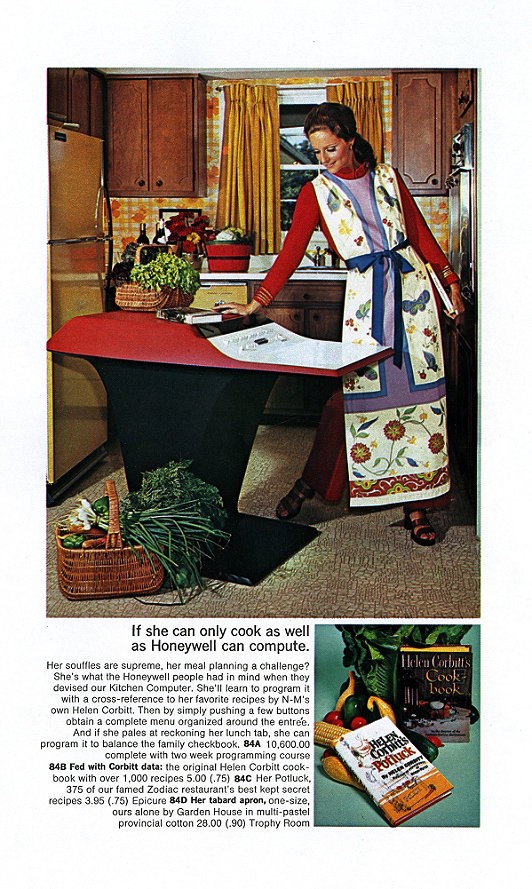
The idea of clearing off the kitchen table had strangely recurred in the computer market for years prior. At the start of the ‘70s, Honeywell marketed an item called the “Kitchen Computer,” a desk-sized recipe book that would supposedly make the housewife’s job easier. This regressive piece of advertising marked a curious landmark (published in the Neiman Marcus catalog, it was the first piece of personal-computer marketing in history), but the Kitchen Computer (retailing for $10,000) was essentially vaporware—a product that was announced, but never made. You would have needed to take a programming course to even figure out how to use the thing, and none were ever sold, but Honeywell was making a primitive effort at trying to understand how its product could figure into everyday lives of Americans.
Honeywell
When Byte Magazine witnessed the Apple II in action before its launch, the publisher Carl Helmers wrote that it might be the first official “appliance computer”—a computer you could buy off the shelf, bring home, and plug in without much fuss. While PCs largely remained a luxury item, his prediction proved correct. Roughly 48,000 personal computers were sold worldwide in 1977; more than triple that amount shipped the next year. Companies rushed to an old trick: recruiting celebrities to endorse their products—the beloved science-fiction author Isaac Asimov became the face of Radio Shack, while Bill Cosby dubbed Texas Instruments’ Home Computer “the one” to buy. But while every home computer ad bragged about technical specs and affordability in big blocks of text, Apple more quickly understood that it was selling a way of life. This was something also grasped by its biggest competitor: IBM, the first giant in the American computer industry.
IBM didn’t officially enter the “personal” market until 1981, when it jump-started sales with the introduction of its much-copied IBM PC. But in the late ‘70s, it made the same strides toward emphasis on small size and ease of use, advertising its IBM 5100 (a predecessor to the PC) as the “first portable computer.” A 1977 TV commercial featured a real-estate manager, a farmer, and an insurance salesman, all of whom praised the machine as offering major relief on the job, and how easily it sat on a desk. “It weighs about 50 pounds,” the voice-over brags. If you still didn’t get the picture, a magazine ad made it simpler, with an image of someone holding it in his hands, as if carrying a box of files.
It would, in fact, take another generation before the home computer became much more than a hobbyist’s toy. Apple and IBM would lead the revolution, but not before the market weathered a 1983 video game bust that turned the public against buying such fancy toys. When prices came down, and programs became more practical, the idea of an Apple on the kitchen table became less and less fanciful. Apple’s innovations in the advertising sphere never lost their boldness, but through today the core aim remains the same: convincing the consumer that there’s a practical application for its latest high-end product. Just watch the TV advertisements for the Apple Watch, derided by some tech critics as useless and inconvenient. Out and about? Exercising? Planning meetings at work? Talking to friends? Taking a picture? The watch is always seamlessly involved. Selling technology can’t only hinge on bragging about specs. Now, as it was in 1977, it’s about convincing the consumers that there’s a computer-sized hole in their lives that they never noticed before.
I took some time this weekend to re-read Jennifer Gonnerman’s piece on the odyssey of Kalief Browder. I wanted to understand how, precisely, it happened that a boy was snatched off the streets of New York, repeatedly beaten, and subjected to the torture of solitary confinement, and yet no one was held accountable. To understand this question is to journey into a world of legal-speak and phraseology all of which, in the case of Browder, allows what we would normally label thuggery to mask itself under the banner of law. Browder was supposed to be held no longer than six months. But as Gonnerman explains, poor people and the courts do not use the same clocks:
Many states have so-called speedy-trial laws, which require trials to start within a certain time frame. New York State’s version is slightly different, and is known as the “ready rule.” This rule stipulates that all felony cases (except homicides) must be ready for trial within six months of arraignment, or else the charges can be dismissed. In practice, however, this time limit is subject to technicalities. The clock stops for many reasons—for example, when defense attorneys submit motions before trial—so that the amount of time that is officially held to have elapsed can be wildly different from the amount of time that really has. In 2011, seventy-four per cent of felony cases in the Bronx were older than six months.
In the case of Browder, the clock stopped for all sorts of reasons. In one instance a prosecutor claimed he was not ready because of “conflicts in my schedule.” In the other the excuse was jury duty. Another time the prosecutor was on vacation. In the meantime the courts repeatedly tried to exact a guilty plea from Browder—at first offering him three and half years (he was facing fifteen) and eventually offering him time served. Browder refused each time. From Gonnerman’s article, it seems Browder refused on principle, but there were also practical reasons for Browder to refuse. In New York, black men with criminal records representan untouchable class in the job market. Accepting a guilty plea would not merely have been a symbolic act for Browder, but one with damaging long-term consequences. And Browder could take no comfort in the fact of having been a juvenile at the time of the alleged crime. Taking a guilty plea would not have been a harmless act. For Browder it would have meant being branded as a criminal at the very start of his adult life, which would forever injure his attempts to make a living.
This threat to Browder’s life was birthed by the era of Willie Hortons, three strikes, and super-predators. Bragging about how many people you didn’t jail has, only recently, become supportable politics. It remains to be seen how well it shall endure. The politics which entangled Browder were of another era, the era of the Rockefeller Drug Laws. Those politics were not private, but public. It was through the urging, ascent, and endorsement of the public that mass incarceration was born. Kalief Browder’s case was entitled The People v. Kalief Browder not Despotic Autocrat v. Kalief Browder. The People themselves elected the politicians that saw no problem with Rikers, or with all the other Rikers across America.
There are some unavoidable conclusions in this. At our implicit behest, a boy was snatched off the streets of New York. His parents were told to pay a certain sum, or he would not be released. When they did not pay, he was beaten and then banished to lonely cell. Browder’s captors then offered him a different way out—pay for your freedom in the political currency of a guilty plea. He refused. More beatings. More solitary. The sum was lowered. Browder still refused. He was subjected to the same routine. Browder defeated his captors. They tired, released him, and likely turned to perpetrate the same scheme on some other hapless soul.
Browder’s victory came at the cost of martyrdom, and in his name we should be strong enough to speak directly about what he endured. Kalief Browder was kidnapped in our name. Kalief Browder was held for ransom in our name. Kalief Browder was tortured in our name. Kalief Browder was killed in our name.
Let us not pretend that this kidnapping scheme gone awry was somehow moral, or tolerable, just because it was lawful. Let us not accept the notion that our laws are simply sanctification—an expensive tuxedo for base criminality. And let us not pretend that Browder’s death was imposed on us from above. Americans are living in the America that we wanted; New Yorkers are living in the New York that we wanted. This must be accepted. If Americans are not responsible for what happened to Kalief Browder, for the ransoming of children, then we are not responsible for ensuring that it never happens again
By some cosmic coincidence we are confronted with the death of Kalief Browder at exactly the moment American media is obsessing over the life of Rachel Dolezal. Coincidental as it may be, it is also instructive. Through duplicitous means, Dolezal was able to masquerade as a member of the black race. Such masquerades are neither novel nor original. What fuels the fascination is the way in which it taps into one of America’s greatest and most essential crimes—the centuries of plunder which birthed the hierarchy which we now euphemistically call “race.”
Kalief Browder died, like Renisha McBride died, like Tamir Rice died, because they were born and boxed into the lowest cavity of that hierarchy. If not for those deaths, if not for the taking of young boys off the streets of New York, and the pinning of young girls on the lawns of McKinney, Texas, the debate over Rachel Dolezal’s masquerade would wither and blow away, because it would have no real import nor meaning. It is the killing of John Crawford III and the beating of Marlene Pinnock which elevates this charade beyond what Jeb Bush calls himself or what Elizabeth Warren called herself.
“I think race is oppression,” writes Richard Seymour, “and nothing else.” Indeed. It is the oppression that matters. In that sense, I care not one iota what Rachel Dolezal does nor what she needs to label herself. I care solely, totally, and completely about what this society does to my son, because of its need to label him.
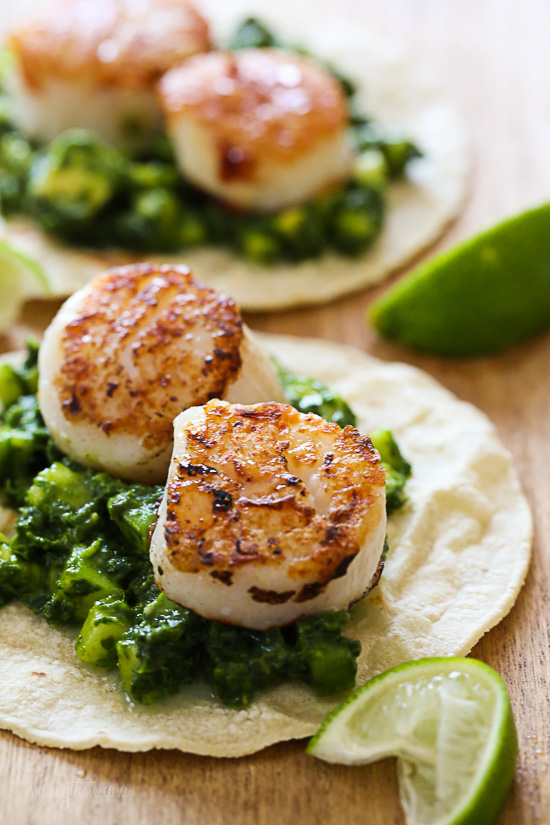
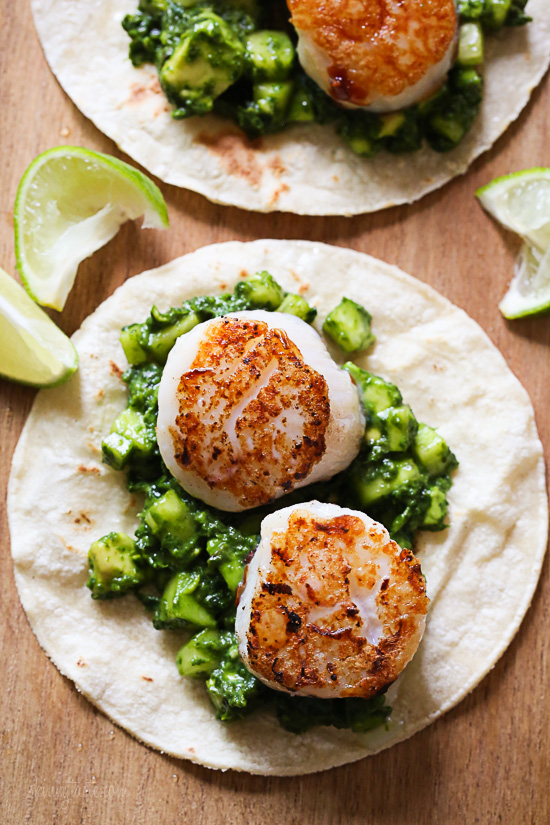
What makes these tacos better than just good is this amazing green herb salsa made with fresh herbs, jalapeño and little dices of cooling cucumber and avocado. When paired with these quick sauteed scallops and a squeeze of lime juice on top you'll probably contemplate opening up your own taco truck (or at least I did!), they are that good!
This recipe was slightly modified from Jonas Cramby's Tex-Mex From Scratch Cookbook. Tons of great photos and recipes like Baha Ceviche, Beer Braised Lamb Shank Tacos, Tacos Al Pastor, and more I plan on trying soon. You can certainly make them with shrimp or fish, heck even lobster if you wanted to!
A few tips to making perfect scallops; dry them well with paper towels, make sure the heat is very high on your skillet so you get a good sear and only cook four at a time. And of course don't overcook them, it shouldn't take longer than 2 minutes on each side, maybe less.
HappyDancing / Mega Pixel / Shutterstock / The Atlantic
Last winter, William MacAskill and his wife Amanda moved into a Union Square apartment that I was sharing with several friends in New York. At first, I knew nothing about Will except what I could glean from some brief encounters, like his shaggy blond hair and the approximation of a beard. He was extremely polite and devastatingly Scottish, trilling his “R”s so that in certain words, like crook or the name Brooke, the second consonant would vibrate with the clarity of a tiny engine.
MacAskill, I soon discovered, was a Cambridge-and Oxford-trained philosopher, and a steward of what’s known as effective altruism, a burgeoning movement that has been called "generosity for nerds." Effective altruism seeks to maximize the good from one's charitable donations and even from one’s career. It is munificence matched with math, or, as he once described it to me memorably, “injecting science into the sentimental issue of doing good in the world.”
Up to that point, I would have described my interest in charity as approximately average. I certainly hadn’t thought deeply about my donations long before I met MacAskill. I'd volunteered for music-education programs because I liked music, but this felt not like an exercise in selflessness, but rather an expression of my personal identity, like wearing clothes.
One night at an apartment party, MacAskill and I huddled with some beers in the corner of the kitchen to talk about his worldview, which he was turning into a book called Doing Good Better (out July 28.) Imagine you are a thoughtful 22-year-old college graduate who wants to make a great difference in the world, he said, invoking one of his many thought experiments. Many such people try to get a job with Oxfam, the Gates Foundation, or any number of excellent charities. That's fine. But if you don’t get that job at Oxfam, somebody just as smart and generous will get it instead. You’re probably not much better than that “next person up.” But imagine you go to work on Wall Street…
Wall Street? I probably interrupted.
Yes, imagine you work in investment banking. You make $100,000 and give away half to charity. The “next person up” would not have done the same, so you have created $50,000 of good that wouldn’t have otherwise existed. Even better, your donation could pay for one or two workers at Oxfam—or any effective cause you chose to donate to.
This story underlines an effective-altruist principle called “earning to give,” which is like tithing on steroids. Earning to give argues for maximizing the amount of money you can make and donating a large share of it to charity. What attracted me to the story wasn’t the specific advice (I have not yet sent a resume to Wall Street) but rather the philosophical approach to pursuing good in the world—counterintuitive, and yet deeply moral and logical. It was like pinpointing a secret corpus callosum connecting the right-brain interest in being a good person with a left-brain inclination to think dispassionately about goodness.
I. A Reason to Give
Will MacAskill was a source of compelling answers at a time when I was in need of new ways to make sense of life’s chaos. Six months before I met Will, my mom died of pancreatic cancer. Several months after I met Will, my dad was admitted to Georgetown University hospital with what doctors would later determine was a different and freakishly rare cancer that had wrapped like ivy around the vertebrae of his lower back. When he was admitted to the hospital for lower back pain, the surgeon initially anticipated that all that was required was a straightforward surgery. After my father nearly bled out on the table after the first of several operations, doctors realized that my dad was dealing with a large malignant tumor.
I spent each day for several weeks last summer making a home in the waiting room of the hospital's spinal-injury unit. Every hospital waiting room is an antiseptic purgatory—one in which "Family Feud” plays for an eternity—and in the surreal déjà vu of possibly losing another parent to another cancer just a year apart, I thought about a lot of things, like luck, religion, and goodness. My mom passed away when she was 63; my dad was still in his 60s. A feeling solidified behind the grief: revulsion at the prospect of coming into my parent's retirement money. Something else was clear to me, too. Should that unspeakable scenario come to pass, I promised myself, I would reach out to Will and ask him to help me to give away the money—and not just anywhere, but to to the cause that would improve the lives of others by as much as possible.
My dad’s cancer blessedly went into remission, and he is now in recovery. But the instinct to give away a meaningful amount of money didn't leave me. I can’t say for sure why I latched onto this notion so strongly. Maybe I was ashamed to have come so close to doing something unequivocally good only to have pulled back because my dad’s recovery had intervened; being thankful seemed like a bad reason to withhold an act of generosity. Maybe I wanted to add a chip of life to the cosmic scales, which had lately leaned too far to the other side. Maybe this donation was the equivalent of an agnostic’s prayer, on the off-chance the supernatural accepts gifts in the form of altruism, to simply make the bad things stop. The truth is that I don't know why I decided to do what I’m doing, and therefore feel no reason to tell other people that they should do anything similar. I’ve never liked a sermon.
That my motivations are both myriad and obscure to me isn't so strange. Altruism, which derives from the Italian word altrui for "other people,” once mystified biologists. Selflessness stumped early advocates of natural selection (giving food to starving rival tribes is likely a bad way to ensure the survival of your own) and inverts Adam Smith’s metaphor of the invisible hand, which suggests that individuals’ pursuit of self-interest can be beneficial at scale.
As Sam Kean explained in The Atlantic article “The Man Who Couldn't Stop Giving,” the mainstream theory of altruism’s roots is known as “kin selection.” Since the engine of evolution is procreation, any gene pool should be rewarded for the instinct to help relatives (including distant relatives) survive and pass along their genes—even when that assistance requires great sacrifice. Altruism, in this interpretation, is natural rather than super-human. Ants, bees, and many other species show clear signs of altruism. Slime molds in the canopies of trees sacrifice themselves to strengthen the group. Even the most generous among us are chasing the self-sacrificial instincts of mold.
But it was important to me that the donation meet a higher standard. I was interested, both emotionally and intellectually, in a larger question: What is the best charitable cause in the world, and would it be crazy to think I could find it?
II. The Scientific Method of Goodness: Effective Altruism
There are so many causes that focus on improving lives, but the spectrum is vast. Some worthy programs save lives (e.g. drug research to avert premature death), others alleviate suffering and poverty (e.g. by providing irrigation), and others focus on enrichment (e.g. by giving to a museum).
These programs exist along another wide spectrum, which is certainty. Some organizations distribute proven drugs (quite certain), others develop unproven drugs (less certain), and some lobby to reduce global carbon emissions (more uncertain). The point isn’t that the certain causes are better than less-certain causes, but rather that thoughtful donors weigh the risk that their donations won’t pay off, as they would any other investment.
When I decided that I wanted effective altruism to guide my decision, I called Will again to get a better understanding of the philosophy I was wading into. Then I spoke with several poverty experts and moral philosophers to learn why the movement might be misguided. I wanted to know it deeply, to see it closely, its virtues and its flaws.
The simplest way to explain effective altruism and its discontents is to begin with three pillars of the movement: (1) You can make a truly enormous difference in the world if you live in a rich country; (2) you can "do good better" by thinking scientifically rather than sentimentally; and (3) you can do good evenbetter by trying to find the greatest need for the next marginal dollar.
The Wealth of the 1 Percent
Even middle-class American families are rich compared to the world’s poor. “If you earn more than $52,000 per year, then, speaking globally, you are the 1 percent,” MacAskill writes. Some research suggests that the doubling one's income, whether you make $500 a year or $50,000 a year, roughly raises one’s happiness by a similar amount. This implies that if a middle-class American family were to transfer one percent of its income directly to an Indian rice farmer, his estimated happiness would double.
In his book, MacAskill calls this the 100x Multiplier: Donations to the world’s poorest are an unalloyed mitzvah and, if you are left-brain inclined, a mitzvah on extreme discount—a 99-percent-off sale for well-being in the world.
This line of thinking is morally powerful, and its radical implication is that one should devote every spare dollar and every spare moment to helping the world’s poor—eschewing the arts and exercise, banning oneself from all entertainment, subsisting on rice, and giving away all of one's possessions. The moral philosopher Peter Singer once proposed a famous thought experiment: You see a child drowning in a pond. Do you jump in after her? Even if you didn’t push her in? Even if you’re wearing an expensive suit or dress? The socially acceptable answer to the question is you ruin your suit to save the child. But ordinary people with plentiful savings justify ignoring the daily deaths of children every day, even when the opportunity to save them is as close as an Internet connection.
Some rationalists flirt with extreme levels of selflessness, but I am not seduced by that sort of misery. MacAskill emphatically says that he’s not trying to heal suffering in the developing world by advocating for suffering in the developed world. The organization he co-founded is called Giving What We Can, not Giving All We Have, and it does not argue for the abolition of cake, art, or whiskey. Effective altruism is not a plot to guilt the rich into asceticism.
"You should spend a good amount of your money trying to make the world as good a place as possible,” said MacAskill, whose non-profit 80,000 Hours offers research and advice for seeking the most meaningful careers. “But you shouldn’t beat yourself up for not donating all your money.” The feasible alternative for most people, he said, is to give a little bit more than they already do—and to focus their donations on scientifically proven outcomes.
2. The Scientific Method for Being Good
Perhaps the most piercing lesson from effective altruism is that one can make an astonishing difference in the world with a pinch of logic and dash of math.
In his book, MacAskill tells the story of two academics, Michael Kremer and Rachel Glennerster, whose randomized controlled trials in Africa found that neither textbooks, flip charts, nor smaller class sizes raised the test scores of students in Kenya. Kremer did find, however, that every $100 spent treating intestinal worms in children dramatically raised their school attendance. On the basis of this research, Kremer and Glennerster cofounded the Deworm the World Initiative, which helps developing countries launch and run their own deworming programs. Today, Deworm the World is widely considered one of the most cost-effective charities in the world.
But programs like Deworm the World don't receive the lion's share of U.S. charity. Of the $330 billion that American individuals, companies, and foundations give to charity, just 5 percent goes directly overseas. That means if Americans shifted just 5 percent of their remaining charity abroad, foreign donations would double; if the money were spent twice as efficiently (a low bar, according to MacAskill), the number of lives saved and improved would quadruple—and that’s without Americans giving an extra cent to charity.
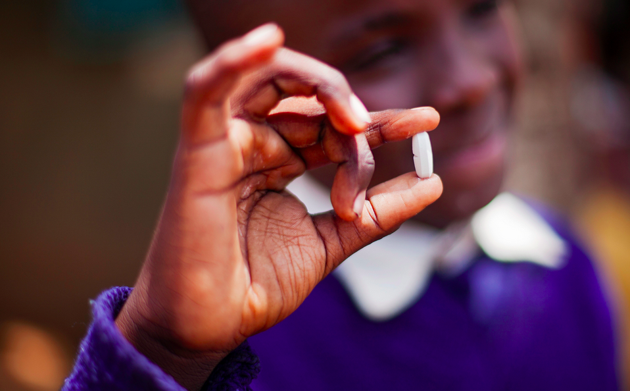
Randomized controlled trials found deworming tablets were more successful in raising school attendance than money for additional textbooks or teachers. (Deworm the World Initiative)
Critics of effective altruism argue that if you’re trying to scientifically maximize the greatest good, there is a risk of privileging the causes that are most easily quantifiable. The value of deworming might be measurable, but what of the values of women’s rights, equality, or democracy? Imagine the impossibility of designing a randomized controlled trial to determine the value of a free press in the United States. One would ideally have access to a cosmic multiverse: Compare the universe where America has a free press with a universe where America is the exact same, except it doesn’t have a free press, run that experiment over and over again, and then calculate the resulting differences in national incomes, happiness, and equality. Even Elon Musk and Peter Thiel aren’t going to fund that.
International advocacy is another fine example of a hard-to-quantify good. For example, if activists had persuaded Western governments to remove the patent on antiretroviral drugs for HIV and AIDS in the 1990s, millions of deaths in the developing world might have been averted. But how do you run a randomized controlled trial to study the value of a lobbying effort? Effective altruists like MacAskill would respond that even these risky undertakings can be boiled down to math problems: If you build an equation that multiplies the greatest number of possible lives saved by the odds of that program’s success, you can estimate the highest expected value of your donation. But overall, effective altruism seems to focus its attention on the most measurable interventions.
3. The “Next-Dollar” Test
A few weeks ago, hedge-fund manager John Paulson pledged $400 million to Harvard University's School of Engineering and Applied Sciences, the largest private donation in Harvard’s history. A month earlier, Blackstone Group CEO Stephen Schwarzman announced a $300 million donation to Yale University to build a cultural center. Harvard and Yale's combined endowments are more than $50 billion and growing by billions annually. "It came down to helping the poor or giving the world's richest university $400 [million] it doesn't need,” Malcolm Gladwell wrote sarcastically on Twitter. "If billionaires don't step up, Harvard will soon be down to its last $30 billion.” Many people countered that Harvard is a singular fount of engineering research and technology.
But, as Vox’s Dylan Matthews (who is, overall, one of the media’s smartest commentators on effective altruism) pointed out, this counter-argument failed a certain “next-dollar” test. Harvard already has a $20 billion endowment and one of its science and engineering buildings is named after Mary Maxwell Gates and Beatrice Dworkin Ballmer—the mothers of former Microsoft CEOs Bill Gates and Steve Ballmer—whose families have collectively given almost $100 million. "This is what philanthropists like to call a ‘crowded' funding space,” Matthews wrote. "It’s wasteful to make crowded spaces even more crowded.”
In other words, the wisest question is not “What is the greatest good?” but rather “What is the greatest goodwhere the next dollar could have the greatest impact?"
Effective altruists often criticize disaster relief for failing to meet this test—not because earthquakes and tsunamis aren’t horrible, but because their bloated responses often eclipse other needs. In the aftermath of the Haiti earthquake, the Red Cross continued asking for money "well after it had enough for the emergency relief that is the group’s stock in trade,” ProPublica reported in a June expose accusing the Red Cross of building just six permanent homes after raising half a billion dollars. Not all aid groups followed suit, they said: "Doctors Without Borders, in contrast, stopped fundraising off the earthquake after it decided it had enough money.”
III. The Measuring of Life: GiveWell
When I asked several philosophers and poverty experts what causes they would give to, answers ranged from women’s rights to direct transfers to the poor. Iason Gabriel, a politics lecturer at Oxford University, made a surprisingly strong case for tax reform in the developing world. Africa, he said, loses tens of billions of dollars a year in illicit flows of money, even more than it receives in government aid. Helping governments crack down on tax avoidance could preserve billions in funds for the state to direct toward health and education. But I felt drawn to two personal values for my donation: I wanted to prevent premature deaths, and I wanted a high degree of scientific certainty that the money would be spent well.
The most common refrain from experts I consulted was that my priorities pointed in a clear direction: If what you want is to save lives with certainty, several people said, you have to go to GiveWell.
In 2005, Holden Karnofsky and Elie Hassenfeld were young Ivy-league-educated investment bankers, making more money than they needed, and searching for a worthy charitable cause. “We wanted the biggest bang for our buck,” Hassenfeld said, and since few outside organizations offered much guidance, they formed a club of several like-minded people to research a simple question: How did various charities spend money, and was there any evidence that they were doing good? “We were calling charities directly, but we weren’t always getting good answers,” he said. The gaping lack of hard data, combined with their personal mission to find that elusive greatest cause, inspired them to create GiveWell in 2006.
GiveWell is a meta-charity, an organization that evaluates other charities. They have four broad criteria, in Hassenfeld’s words: “effectiveness” (does the charity make a difference?), “cost-effectiveness” (how much difference does the charity make per dollar received?), “room for funding” (can the charity use your donation in the near future?), and “transparency” (is the charity forthcoming about its spending and its results?). Its top-ranked charities for this year include GiveDirectly, a radically simple approach to sending no-strings-attached cash to extremely poor households, and the Against Malaria Foundation, which distributes insecticide-treated malaria nets in sub-Saharan Africa. It’s impossible not to be struck by the encyclopedic thoughtfulness of GiveWell's analyses, which take months to complete and are often thousands of words long, contain more than 100 footnotes, and elaborate on concerns they have for even the top-ranked charities.
It is hard for the casual donor to determine on her own which charities do the most good. For example, compare two well-meaning organizations: Charity A accepts $100 and sends $90 to the field to buy better textbooks for Kenyan children. Charity B accepts $100 and sends $45 to the field to buy deworming tablets for Kenyan kids. If you focus on “overhead" costs, as many people do, the choice is clear: Charity A is twice as effective. But randomized controlled trials have shown that while textbooks do little to raise school attendance, medicine for intestinal worms often helps children go back to school. In the end, Charity B might be many times more effective. This is why it’s so important for organizations like GiveWell to track dollars and outcomes.
But comparing outcomes is tricky. Is it better to avert a death from a tropical disease, or to raise a family from abject poverty? Philosophically, the most difficult task facing GiveWell is putting the vast spectrum of human suffering into numbers. It is, in a way, a math problem, but one laden with value judgments, about which reasonable people can disagree.
For example, to compare suffering across countries, some organizations use a metric called DALYs, or Disability-Adjusted Life-Years. One DALY could equal one year lost to early death, 1.67 years of blindness, or 41.67 years suffering stomach pain from an intestinal parasite. If a program has averted 80 DALYs, it might have saved the death of one infant or cured minor health problems for several adults.
To choose the charity that represented the greatest good as I saw it, I had to choose my values. Disability-Adjusted Life-Years acknowledge no difference between averting fewer deaths and improving many lives, but because my donation had been forged by death and near-death experiences, I was motivated to err on the side of saving lives rather than simply improving them. And because this represented my first major donation, I wanted to donate to a cause whose impact was certain.
It is not obvious to effective altruists that certainty is the right way to think about doing good. Imagine, for example, if you face a 1 percent chance of saving a million lives versus a 100 percent chance of saving ten lives. The certainty thesis might lead one to choose to save the single life. But the expected value of the first option is 10,000 lives saved—a 1,000 times difference in outcomes.
Still, when I expressed my values to Hassenfeld, he had a very specific recommendation. "I think the Against Malaria Foundation is the right choice for you,” he said. “That’s where I gave half of my donations last year, and if I had your values, it’s where I would give now.” That left a final step: calling the founder of the Against Malaria Foundation and learning more about the charity GiveWell has rated the number-one in the world.
IV. The Cause: Against Malaria Foundation
The next morning, I called Robert Mather, the British founder of the Against Malaria Foundation, to find out how a businessman with practically no NGO experience came to run one of the most effective charities in the world. He told me his life was abruptly changed due to a freak fire involving a family of strangers 40 miles outside of London.
"I’m rubbish with a TV remote control, and that led to a major left turn in my life,” he began. "I was trying to turn off the BBC in 2003, and instead, I pressed a button that went to another channel. It was a documentary featuring a child who seemed to have melted in a fire.” The child was Terri Calvesbert, a one-year-old girl living in Suffolk, England, who lost 90 percent of her skin, including her nose and eyelids, in a fire sparked by her mother's discarded cigarette. Calvesbert was burned so badly that when firefighters found her, they initially mistook her for a burned doll. "She had been put into an artificial skin body suit,” Mather recalls. "I’m not an emotional person, but my wife and I had two children, and I am not ashamed to say that I was streaming.”
Six months prior, Mather had participated in a charity bicycle ride, and it occurred to him that he could organize a similar event to raise money for the girl. Mather called swimming-event organizers in Sydney, New York, Lima, and elsewhere. His effort resulted in 150 coordinated global swims, with thousands of participants raising hundreds of thousands of dollars for Calvesbert, who is now 18 years old.
The global success of “Swim for Terri” sent Mather’s cogs whirring. If one girl could inspire $400,000 in donations, what could a truly international cause do? “As you scratch beneath the surface on global health issues, the same disease comes up as the biggest killer of kids in the world and biggest killer of pregnant women,” he said. “Malaria was a no-brainer.”
Approximately 200 million people suffer from malaria each year, and the death estimates range between 400,000 and 800,000. About 90 percent of those mortalities are in sub-Saharan Africa, and three-quarters of them occur in children younger than five. The second-order effects of the disease are vicious: Malaria is a massive impediment to economic growth, since survivors often cannot work, and parents have to devote their lives to caring for their sick children.
A young boy carries his free mosquito net back to his home (AMF)
I’ve read, and typed, and read again these numbers, and they are so stark to me that they can easily float away into the atmosphere of statistics, escaping true empathy. Understanding one nation’s experience feels more visceral: Every day, more than 500 people die from malaria in the Democratic Republic of Congo, and the majority of these deaths are children under the age of five. AMF offers a shattering metaphor: Imagine a fully booked 747 airplane and infants strapped into seats A through K of every row of the economy section; their feet cannot reach the floor. Every day, this plane disappears into the Congo River, killing every soul on board. That is malaria—in one country. By GiveWell’s calculations it would cost $1.7 million to save the airplane.
While larger fish like the the Global Fund and the Gates Foundation focus their resources on developing a fast and absolute cure, AMF has a preventative approach: cheap insecticide-treated bed nets (about $7.50 in the DRC) that block and kill the mosquitoes that carry the disease from person to person.
There are four reasons why AMF is currently the top-rated charity at GiveWell. "First and foremost, giving out nets to prevent malaria has among the best evidence of any program that charity dollars can support worldwide, and more than 20 randomized controlled trials show it works,” Hassenfeld said. "Second it’s really cost-effective, at about $3,500 dollars per life saved. Third, AMF itself has significantly more room for funding. Finally, AMF has a strong and unique commitment to transparency and monitoring.” Mather’s approach is like the platonic ideal of effective altruism, matching a clear-eyed approach to doing good with scientific exactitude, using smartphone technology to track the delivering and implementation of every net he distributes. "We’ve distributed 700,000 nets with smartphone technology,” he said. “We know within six meters where all 700,000 nets are.”
V. Greatest Good
In his new book The Most Good You Can Do: How Effective Altruism is Changing Ideas about Living Ethically, the moral philosopher Peter Singer laments the fact that most people are more motivated to give by stories rather than numbers. For example, people are more likely to donate when they see the photo of one child rather than see several children suffering from the same disease. In my experience, I have found the exact same thing: Individual stories motivate, and statistics overwhelm.
Why do people mute their emotions in the face of greater suffering? A study from Keith Payne at the University of North Carolina found that "the collapse of compassion happens because when people see multiple victims, it is a signal that they ought to rein in their emotions [because] the alternative might seem too difficult.” It is a frustrating, yet nearly poetic, idea: The problem is not a lack of empathy, but the fear of feeling too much.
Some people in the past few weeks suggested to me that effective altruism suffers from a “cyborg problem.” That is, if you talk about human suffering like it’s a calculus equation, the empathic brain will shut down. But GiveWell has found the opposite to be true. “A large contingent of donors tell us they give more than they would have, had GiveWell not existed," Hassenfeld said. “We’re asking questions that encourage people to give, because we give them confidence that they can make a difference.” Even as I’ve sought to find the holes in the philosophy I’ve chosen to adopt, I’ve become more convinced by effective altruism’s potential for widespread popularity. The mathematical challenge of finding the greatest good can expand the heart. Empathy opens the mind to suffering, and math keeps it open.
In the end, I considered making several different donations. But I kept coming back to something Robert Mather said: Malaria is not merely the greatest killer of children in the world, but also it is the greatest killer of pregnant women. The disease plunders motherhood from both sides of the equation. The loss of a mother must be quantifiable by some measure of creative accounting, but in my experience it is immeasurable. This much I knew: There is the thing that I want, I cannot have it, but I can give it to somebody else. That seemed to honor the etymology and the root of altruism.
On Thursday, I wired the money: a thousand for every year of life for my mom, who died a few months before her birthday. To honor a family tradition, I also sent an extra thousand to GiveWell—"to grow on,” she would have said.
Over drinks the other night, some friends were reminiscing about these Japanese candy powders that you mix to form different textures. I’d never heard of them, but apparently one powder makes sushi rice, another the seaweed, etcetera, so you can roll sushi candies.
We want to laugh, but not so sure we are supposed to.
Two of the top comedians in the entertainment industry are set to appear in a new Lifetime move called “A Deadly Adoption,” which is being described as “the birth of a plan gone wrong.”
Inspired by a true story, A Deadly Adoption is a high-stakes dramatic thriller about a successful couple (Will Ferrell and Kristen Wiig) who house and care for a pregnant woman (Jessica Lowndes) during the final months of her pregnancy with the hope of adopting her unborn child.
It was first announced back in April and apparently almost cancelled once news of it leaked online. But this was likely just some cruel joke from the duo.
It comes out next week on June 20, and the network just released the first trailer this week.
We’re not exactly sure what is going on here, but we can’t wait to find out.
And there’s also a giant promotional poster for the film, which is equally amazing.
We live in a world where college flute recitals can quickly turn into world famous concerts, cheap dresses can divide nations, and a couple of loose llamas can become as notorious as Bonnie and Clyde.
So it’s no wonder that one man’s wood chopping tutorial has suddenly become one of the hottest things on the Internet.
A woman named Sara Pearson posted a YouTube video of her dad Brad demonstrating an ingenious way of chopping firewood called “The Tire Method.”
It involves placing the log inside a tire and hacking away at it without worrying about the pieces flying around all over the place.
And at the end, his friendly dog comes by to check out the final product.
Everyone loved it, especially Reddit, which helped get the video up to nearly half a million views in only a few days.
Soon after it blew up online, she posted a second video of his reaction, which you can watch below.
“Holy Cow!” he says. “Man that’s gotta be 500 thousand!”
English biochemist Sir Tim Hunt won the Nobel Prize in Physiology or Medicine back in 2001, but now he is more widely known as Sir Sexist Pig.
Hunt was speaking at the World Conference of Science Journalists in Seoul, South Korea this week when he explained to the audience why he is in favor of single-sex labs.
“Let me tell you about my trouble with girls,” he said.
Uh oh…
“Three things happen when they are in the lab. You fall in love with them, they fall in love with you and when you criticize them, they cry.”
You see, all the ladies love Hunt, because he is just so irresistible and such a smooth talker.
Here he is talking about cell division, which might get you all hot and bothered.
Unfortunately, he is probably going to find it difficult for anyone to fall in love with him again after that comment.
He later apologized for the timing of the remarks, but stood by his beliefs, telling BBC Radio that it was “a very stupid thing to do in the presence of all those journalists.”
He added: “I have fallen in love with people in the lab and people in the lab have fallen in love with me, and it’s very disruptive to the science because it’s terribly important that in a lab people are on a level playing field.”
The Royal Society, of which Hunt is a fellow, also issued a statement distancing themselves from Hunt and his comments.
The Royal Society believes that in order to achieve everything that it can, science needs to make the best use of the research capabilities of the entire population. Too many talented individuals do not fulfil their scientific potential because of issues such as gender and the Society is committed to helping to put this right. Sir Tim Hunt was speaking as an individual and his reported comments in no way reflect the views of the Royal Society.
And here are some of the reactions from people Twitter.
Had *such* trouble doing good science today. What with the crying, and battling my way through hordes of suitors. So distracting. #timhunt
Look out vegan-diet Beyonce, there’s a new diva in town and she’s stealing your spotlight.
A sassy six-year-old from North Carolina has taken center stage on the Internet with her over the top performance of Aretha Franklin’s “Respect.”
Johanna Colon was all attitude at her tap recital this past weekend, shaking her head and snapping her fingers to the song.
And people just can’t seem to get enough.
The original Facebook post of the video already has over 22 million views in just 2 days, and she’s been featured on both ABC News and The Today Show.
But her mom Elissa says she really could care less about her sudden fame.
“She was more excited that today was the last day of school and she was going to have ice cream because she had gotten such a good report card,” she said.
Here is the little scholar showing off her grades. #RESPECT
Try to avoid breaking any limbs in Crestview, Florida. You might wind up in North Okaloosa Medical Center, which charges 12.6 times, or 1,260 percent, more than what it costs the hospital to treat patients.
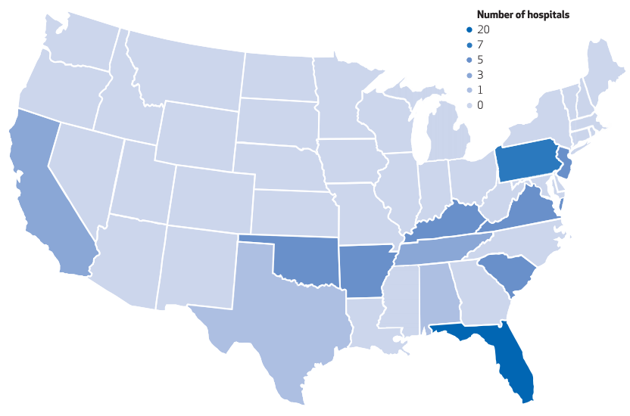
North Okaloosa, along with New Jersey’s Carepoint Health-Bayonne Hospital, tops the list of the U.S. hospitals with the highest markups for their services, according to a new study in Health Affairs. The studyfound that, on average, the 50 hospitals with the highest markups charged people 10 times more than what it cost them to provide the treatments in 2012.
Where Are the 50 Hospitals With the Highest Markups?
Health Affairs
On average, all U.S. hospitals charged patients (or their insurers) 3.4 times what the federal government thinks these procedures cost. “In other words, when the hospital incurs $100 of Medicare-allowable costs, the hospital charges $340,” explain the authors, Ge Bai of Washington and Lee University and Gerard F. Anderson of the Johns Hopkins Bloomberg School of Public Health. The ratio of hospital charges to costs has only increased over time: In 1984, it was just 1.35, but by 2011, it was 3.3.
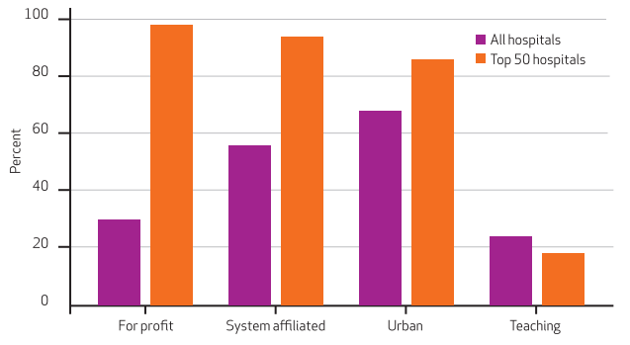
In the study, the facilities that marked up their prices the most were more likely to be for-profit (as opposed to not-for-profit), urban hospitals that are affiliated with a larger health system. Community Health Systems operates half of the 50 hospitals with the highest markups. The U.S. Justice Department has investigated the Franklin, Tennessee-based hospital chain for the way it bills Medicare and Medicaid. In February, the company and three New Mexico Hospitals agreed to pay $75 million to settle a case in which Community Health Systems was accused of making illegal donations to county governments, which were then used to obtain matching Medicaid payments.
Overall, three-quarters of the hospitals on the highest-markup list are in the South, and 40 percent of them are in Florida.
Only Maryland and West Virginia restrict how much hospitals can charge. The Affordable Care Act makes not-for-profit hospitals offer discounts to uninsured people, but it doesn’t set limitations on bills sent to patients treated at out-of-network or for-profit hospitals.
What Types of Hospitals Have the Highest Markups?
Health Affairs
Except for people on Medicaid and Medicare, whom hospitals can only charge a government-regulated amount, these high markups negatively affect almost everyone. They’re bad for privately insured patients who find themselves being treated at out-of-network hospitals. They’re bad for the uninsured, since people with no insurance have no one negotiating on their behalf with hospitals. And they’re bad for anyone who pays insurance premiums, since high hospital prices drive up the cost of health insurance.
“Collectively, this system has the effect of charging the highest prices to the most vulnerable patients and those with the least market power,” the study authors write. It’s how people end up with “exceptionally high medical bills, which often leads to personal bankruptcy or the avoidance of needed medical services.”
In an statement, Jarrod Bernstein, spokesman for Carepoint Health-Bayonne Hospital, said, “These charge prices affect less than 7 percent of our overall encounters system-wide, and without it, or adequate contract reimbursements, our safety net hospitals that serve the most vulnerable among us risk closure. That is why we are calling for a new healthcare reimbursement system that offers equivalent rates for all patient encounters regardless of where they live that will make these charges irrelevant.”
The study authors say one way to fix this might be to require hospitals to post their markups online so patients can price-compare before they go. But that wouldn’t work for emergencies, for people who live far from all but one hospital, or for the many people for whom hospital charging codes are, very understandably, inscrutable.
Alternatively, legislators could say that hospitals can only charge people a certain amount more than what they would charge Medicare, which usually negotiates some of the lowest rates. Or, more states could do what Maryland, Germany, and Switzerland all do and aggressively limit how much all hospitals can charge, period.
But as the authors note, that last solution would be “subject to considerable political challenges,” which is perhaps a polite way of saying, “will make the Obamacare battle of 2010 seem like a casual game of bridge among friends.”
In the meantime, that drunken jet-ski trip in Florida this summer might be risky for more reasons than one.
This story has been updated with a statement from Carepoint Health
I’m traveling today, but I have the urge to something that’s silly, fun and yet kind of useful. So here’s my plan:
Have a pup? Put a picture of it looking happy in the comment thread accompanying this entry (which is to say, put in a link to a .jpg; the comment thread should embed it automatically — direct links to the .jpg are best for this; links to pages on Instagram/Flickr/etc will just show up as the link). For every picture of a happy pup put in the comment thread before 11:59pm Eastern time June 7, I will donate a dollar to Con or Bust, up to $1,000. Con or Bust is a non-profit organization “whose mission is to increase racial and ethnic diversity in the production of and audience for speculative fiction,” which is a goal I am happy to support.
RULES/NOTES:
1. One entry per person. You can have multiple pups in your picture, or post more than one picture in your comment, but each counts as a single donation from me. Please don’t post more than once in the thread.
2. The pictured happy pup must be yours or your family’s. No fair looking on Google Image Search for happy puppies. “Family” in this case means immediate family, serious partners, or friends to whom you’d seriously consider donating a kidney.
3. Pups only. We can do other animals for other fundraisers another time. Also, comments that are anything other than a picture of a pup (including questions, commentary or criticism) will be excised out of the thread. All happy puppies! All the time!
4. Tell us a little about the happy pup. Because context is fun. This one is not required, but on the other hand I don’t think it’ll be a problem to get you to talk about your pup, now, will it.
5. Your picture will likely be held in moderation until I clear it. Don’t panic. This is to keep trolling of the thread to a minimum, and to keep inappropriate pictures off the thread. Pictures I deem inappropriate will be deleted (either in moderation or off the thread if they somehow got on) and will not count toward the donation tally. As I am traveling the next few days, there might be some delays in the picture going up. Please be patient!
Got it? Then spend my money! Let’s see those happy puppies!
“Tampax Compak has a smooth plastic applicator that is half the length of a usual Tampax Cardboard applicator, making it twice as discreet to carry.”
“New! Neat! Discreet!” proclaims an 80s-tastic ad for Playtex Portables.
“The original o.b. tampon … was revolutionary in the world of tampons and played to women's need for discreet yet reliable protection.”
Tampax Compak is apparently so discreet, according to one old commercial, that a teacher mistakes it for a piece of candy, and asks his student to bring it to the front of the class when he catches her passing it to a friend.
You would think once he held it and felt the hard plastic applicator within the wrapper he would figure it out—tampons and candy bars don’t really have similar tactile sensations. But no. “I hope you brought enough for everyone,” he says, sternly.
“Enough for the girls,” the girl replies, laughing. All the boys in the class look around, confused. This is beyond their simple understanding.
In some sense, they can be forgiven. It’s entirely possible these wide-eyed naïfs have never seen a tampon in the wild, given the sometimes painstaking efforts women make to conceal them (the same efforts that products like Tampax Compak are created to facilitate). You can just palm it, or there’s the ole tampon-up-the-sleeve trick. In sleeveless weather, one can tuck it under the bra strap, or in the waistband. Anywhere tuckable, really. Or just bring your whole purse to the bathroom.
My friend Mallory, a project manager for a digital agency in Nashville, used some creative strategies to carry tampons at her old job. Her office was situated at the end of a long hallway, meaning she had to walk past everyone else to get to the bathroom.
“I would make sure I took care of things in the morning and then always have to remember to take my purse with me to lunch,” she says. “And then one day I was in a bind, I had already gotten up to get coffee and then get water and then I came back to my desk and I realized I hadn’t changed my tampon. It feels too awkward to get up from my desk in the middle of the day and walk out with my purse and then walk back in five minutes later. Then I look at my coffee mug, it was empty. So I stuck a tampon in an empty travel coffee mug and walked to the bathroom. And that was my plan.”
Nadine Ajaka / The Atlantic
Mallory also mentioned a friend of hers with an even sneakier approach—this person apparently hides tampons in the bathroom stalls at her office in the morning, and just hopes they’re still there when she returns.
Why go to all that trouble?
Secrecy is a key element of the modern period—the existence of tampons and pads in the first place allows women to “pass as non-bleeders,” as Sharra Vostral puts it in her book Under Wraps: A History of Menstrual Hygiene Technology. Barring any mishaps, the blood is only visible behind closed doors. Women’s public bathrooms have special trashcans in the stalls so feminine products can be disposed of neatly and privately.
Some of this, surely, comes from the disgust associated with all bodily fluids, and a preference to keep dirty-but-necessary animalistic activities (like excretion) cordoned off by bathroom walls, out of the public eye. But if excretion is a great equalizer (Everybody Poops, as the children’s book says), menstruation divides. Only half the population is biologically predisposed to do it, and the other half would largely prefer not to know about it, thank you very much. Many religions have historically dubbed menstruating women “unclean” and secular shame abounds as well, with jokes aplenty about “that time of the month” and teen magazine “Most Embarrassing Moments” columns filled with period-related anecdotes.
“Menstrual etiquette requires that women hide the fact of their periods…from others, especially from men. Accordingly, they take great pains to keep hygiene products out of sight,” writes Rebecca Ginsburg in her 1996 study “‘Don’t Tell, Dear’: The Material Culture of Tampons and Napkins.”
Pads and tampons themselves often seem designed to be hidden—for one, there’s the plethora of smaller, more “discreet” designs like Tampax Compak and U by Kotex Click, and a couple years ago Tampax introduced its “Radiant” tampons, which boasted a “softer, quieter wrapper.”
But companies wouldn’t make these products if people didn’t want them. “Incorporating discretion into our products is important because it’s important to our consumers,” Melissa Dennis, the senior brand manager for U by Kotex, told me in an email. “Based on an internal study conducted by Kimberly-Clark [Kotex’s parent company], 95 percent of tampon users reported that tampons are discreet to wear. However, the same study showed fewer tampon users reported tampons were discreet to carry.”
“It’s just one more thing that dudes don’t even realize that we as women have to think about and plan,” Mallory puts it.
In her study, Ginsburg, now director of the Education Justice Project at the University of Illinois at Urbana-Champaign, looked at 150 different packages of feminine hygiene products, and found them generally to be “relatively plain” and to avoid “any reference to the physicality of the objects inside or to their use.” White, pink, and light blue were the most common colors (“Significantly, there was no red on any of the boxes or bags”) and “very few packages contained clear plastic that would allow the consumer to see into the box.” Ginsburg describes this as “the distancing of these products from any suggestion of actual use.”
This was almost 20 years ago, of course. Things are a bit more vibrant than that today in the feminine hygiene aisle, with bright purples, pinks, and yellows (you’d still be hard-pressed to find a red, though) and floral or starburst patterns alongside simpler packages. Still, a more colorful packaging palette doesn’t mean people are eager to put their tampons on display—according to Dennis, in 2014 the compact section of the tampon market grew four times faster than tampons overall.
It’s at least understandable why people are motivated to keep used feminine products concealed—social stigma aside, it’s messy, it’s private—but what’s embarrassing about a clean, unopened tampon? Is it gross by association, like carrying a magazine into the bathroom—everybody knows what you’re going in there to do? Maybe hiding hygiene products is just another way of keeping the poised, public self separate from the animal functions of the body.
Or maybe it’s just savvy self-protection. In one study, people had worse impressions of a woman who dropped a tampon out of her bag than if she dropped something innocuous like a hair clip, and even avoided sitting near her.
Even people who are completely comfortable with their periods might choose to conceal them to avoid that kind of reaction. Efforts to destigmatize menstruation are becoming more mainstream, with even brands getting in on the action with commercials that subvert tampon-ad tropes (like women wearing white spandex and dancing through their periods) or show a girl’s first period as something to be celebrated. “U by Kotex believes that women should not feel like they have to keep the fact that they are menstruating hidden or to have to conceal their products in public if they don’t want to,” Dennis says.
But taboos don’t change that quickly. If there’s a chance open-carrying a tampon in public will only get someone disrespect, maybe she’ll think it’s better to keep it up her sleeve—literally.
Have you read this piece in the New York Times about the Russian Troll Factory where hundreds of highly paid employees are paid to spread disinformation and leave pro-Kremlin comments in regular news outlets?
They’re believed to be behind a chemical explosion hoax in Louisiana that partially played out on Twitter:
Hundreds of Twitter accounts were documenting a disaster right down the road. “A powerful explosion heard from miles away happened at a chemical plant in Centerville, Louisiana #ColumbianChemicals,” a man named Jon Merritt tweeted. The #ColumbianChemicals hashtag was full of eyewitness accounts of the horror in Centerville. @AnnRussela shared an image of flames engulfing the plant. @Ksarah12 posted a video of surveillance footage from a local gas station, capturing the flash of the explosion. Others shared a video in which thick black smoke rose in the distance.
Nature can be prettyterrifying sometimes (we’re looking at you Australia), but it can also be pretty magical as shown in this new video from a snorkeler in Palau.
It was shot in a body of water called Jellyfish Lake, which is home to millions of the alien-like animals.
The species seen here is the golden jellyfish, which are always on the move as the sun rises and sets to expose the light to their symbiotic algae.
Before sunrise, the jellies cluster along the saltwater lake’s western shore. Each morning around 6, when dawn brightens the eastern sky, they begin to swim toward the light. Pumping water through their bells, these jellyfish use a type of jet propulsion to follow the sunlight until they nearly reach the eastern shore—stopping just short of the shadows caused by lakeside trees.
They also are pretty harmless, so swimmers don’t have to worry about getting stung by the numerous creatures. Because they’ve been isolated to this one spot, their sting has gradually gotten weaker to the point where you would hardly feel anything, according to The Nature Conservacy.
Anyone is allowed to snorkel around in the lake, you just can’t go scuba diving.
“Swimming with literally millions of jellyfish was absolutely surreal,” the uploader writes in the caption. “A reminder that there will always be surprises out there!”
Just to clarify before we begin, San Andreas is not the kind of movie one should see if one requires such elements as “realism” or “dialogue” or “originality” or “plot.” It cares not at all for scientific accuracy, or logic, or narrative cogency, and its most pressing structural concern seems to be the maximum amount of tension its characters’ physical attributes can impose on Lycra without their clothes giving up the good fight.
All this acknowledged, it’s enormously entertaining, thanks to the undeniable charisma of Dwayne “The Rock” Johnson and the wanton CGI destruction of all of the West Coast’s greatest landmarks (in 3-D, no less). Johnson plays Ray Gaines, a burly Afghanistan veteran who spends his days as a rescue-helicopter pilot for the Los Angeles Fire Department. His soon-to-be-ex-wife (Carla Gugino) has found new love with a gazillionaire architect (Ioan Gruffudd), his daughter Blake (Alexandra Daddario) is heading off to college, and the now-separated spouses are trying to move on from the death of another daughter, Mallory. All is calm, until an earthquake of unprecedented proportions forces Ray to go AWOL with a helicopter and rescue his family.
Ray’s plot is juxtaposed with that of Lawrence (Paul Giamatti), a seismologist at Caltech who coincidentally happens upon a new method of predicting earthquakes approximately five seconds before one comes along that happens to be 50 times more intense than any mankind has ever experienced. As far as timing goes, it’s pretty rough. Still, Lawrence joins forces with a local-news reporter (Archie Panjabi) to try and find ways to warn the state of California that the ground is about to fall out from underneath it, presumably under the impression that way too late is better than never. If nothing else, it adds him to a lengthy list of scientists in disaster movies who predict that Very Bad Things are about to happen (The Day After Tomorrow, Dante’s Peak, 2012, Deep Impact, etc).
San Andreas, for all its lumbering attempts at understanding and explaining something as complex as seismology, is nevertheless breathtaking in its simplicity. Ray, when told that his ex-wife is currently atop a skyscraper in the middle of an earthquake, turns the helicopter around and tells her that he’ll be right there to save her (if not the thousands of other doomed people in the building, one of whom, bizarrely, is the Australian pop singer Kylie Minogue). Blake is somehow guileless, sweet-natured, innocent, and yet enormously practical in an emergency, looting an electrical store, a fire truck, and a number of empty buildings while trying to get to high ground—with the bizarrely confident knowledge that her father will find her. The obvious bad guy, who pretends to be a good guy quite convincingly for his first few scenes, turns out to be a real heel after all. And when Ray needs a helicopter (or a truck, or a plane, or a boat, or a parachute), lo and behold, he finds one.
The screenplay by Carlton Cuse (Lost, The Bates Motel) is perhaps the biggest disappointment, only because it seems like such a clunker coming from an accomplished writer. The film’s extreme succinctness when it comes to dialogue is remarkable, even for a dumb action flick: “Let’s go get our daughter.” “I’m gonna get you out.” “People need to know that the shaking is not over.” And yet, somehow, the whole thing is kind of a blast. The movie takes a sanitized approach to the theoretical greatest mass disaster in American history—there are no shots of bodies floating in the water, or even so much as a lone kitten stranded in a tree. There’s no ethical complexity, or nuanced storytelling, and very few surprises. When Ray finds out Blake is stranded in San Francisco, he deprives earthquake-leveled Los Angeles of one of its few rescue helicopters with nary a moment’s thought. He’s a man on a mission to save his daughter, and God help the walls or steel gables or 100-feet tsunamis that get in his way.
As Ray, Johnson is intensely committed to his hero’s journey while making the case that he’s as stolid and dependable a national treasure as Mount Rushmore. Gugino and Daddario are consistent, if unexceptional, but San Andreas finds more charm in two brothers with plummy British accents: Ben (Hugo Johnstone-Burt), a wannabe architect and a love interest for Blake, and Ollie (Art Parkinson), his younger sibling, who provides much-needed comic relief. But the primary thrill of the movie, indubitably, is watching various terrifying acts of nature pit themselves against a 6 foot 5, 260-lb leviathan of a human being and then promptly wither in their unworthiness.
The secondary thrills are in director Brad Peyton’s gorgeous sequences of live-action ruin porn. Spoiler: It all falls down. But in 3-D, seeing the Hoover Dam crumble into obsolescence, the Golden Gate Bridge shatter, and downtown Los Angeles topple to the ground like a particularly unwieldy Jenga tower is eminently satisfying. Knowing that The Rock is going to do his best to add to the ongoing mayhem and destruction—when was the last time you wrenched a car door off to free a girl while dangling from a helicopter in a narrow precipice, after all?—is just the icing on the cake.
“But I was reading.” Photo by Ash Hernandez, via Cathy De La Cruz (@SadDiego)
Hello Captain!
I have an situation that I don’t think has been discussed: how do you deal with Stranger Mansplainers when you are a lady doing things normally associated with manliness & they can’t fathom how a lady could figure out how to do such things?
For me: I am a lady & I participate in an activity that involves pulling trailers behind trucks. Backing the trailer into a parking space so you can go participate in the actual event is a frequent occurrence. I’m usually at these events by myself & can back up my own trailer, thank you very much. But I frequently encounter dudes who refuse to believe this is the case. I have had them bang on the windows of my truck, yell at me to stop, & block me from backing up my rig, all when I have a completely clear path & am not in danger of hitting anything. I’ve tried the “thank you, but I’m fine” approach but they refuse to move until I follow their directions. Sometimes they tell me to do exactly what I was already doing, other times they want me to follow a completely convoluted path that makes no sense. Even better, they usually follow it up with something along the lines of “if you don’t get hysterical, it’s easy!”
Other than going to the event management, how can I deal with this? It makes even more fun when the Mansplainers have their own rig that they parked like a Picasso painting, but it still sours the event for me. I don’t have any history with these dudes, they’re just total strangers who see a lady driving a truck & trailer and assume incompetence. Please help.
I’ve Been Backing My Own Trailers For A Long Time, Eff Off.
Dear Eff Off,
I think it’s worth reaching out to the organizers with this to see if they can’t send out some kind of safety reminder, like, “Hey, if you offer to help someone back up, and they say they’ve got it, it means they’ve got it. Get out of the way!” Treating it like a safety issue (which it is), rather than a sexism issue (which it also is) is going to have the cleanest chance of getting through.
You could also try a not-moving standoff. Dude won’t move until you take his directions? You won’t move until he gets out of the way.
But the truth of it is: You’re doing everything right already and there is no way to preemptively get these guys to stop acting like jackasses. You can’t control their behavior at all by phrasing things differently. So what remains is to deliver the message very clearly in a way that (hopefully) amuses you.
To do this, first, decline the offers verbally just as you have been. “Thank you, I got this!”
If the interrupter persists in standing behind your truck and waving his arms at you, beckon him over, roll down your window, and hand him this flyer from the stack you keep in your glove box.
Prepare for lots of sadface and “I was just TRYING to HELP YOU you are SO RUDE, JEEZ” pouting. Feel no need to smooth it over. No condescending insistence on “helping” complete with condescending “don’t get hysterical” comments? No condescending flyer!


 Begin by slicing one Vidalia onion and mincing four cloves of garlic. Remove the peppers from a 12oz. jar of roasted red peppers, and slice them into thin strips.
  Using both fire roasted red peppers AND fire roasted diced tomatoes gives the pasta a slightly smoky/sweet flavor.
 Now it’s time to add everything to the pot. For the pictures, I added everything at one time, but it will help if you add everything in two steps. First add 5 cups of broth, the sliced onion, minced garlic, sliced red peppers, diced tomatoes (with the juices from the can), 1/2 Tbsp dried basil, 1/4 tsp crushed red pepper (optional), and some freshly cracked black pepper. Stir all those ingredients together, then break the pasta in half and submerge it under the liquid. Breaking the past in half helps it incorporate into the other ingredients better and makes it fit better in the pot (and under the liquid).
 Place a lid on the pot and put it over high heat. Once it reaches a boil, stir the pot to loosen anything that has stuck to the bottom. Return the lid quickly, turn the heat down to medium-low, and let the pot simmer for 10-12 minutes. Stir the pot every couple of minutes or so to make sure nothing sticks, but always replace the lid quickly so that it keeps simmering and you don’t loose too much of the moisture. After 10-12 minutes, the pasta should be tender, but still slightly firm (al dente). Remove it from the heat.
 If you want creamy pasta, add 4 oz. of cream cheese in dollops to the pot. I added half of the 8oz. package, but I bet it would still be pretty creamy if you cut that amount in half. It’s pretty flexible.
 Stir the pot until the cream cheese is fully melted in. It may look a little chunky at first, but keep stirring and it will eventually become smooth and creamy.
 Then EAT. :)