When I consider my friends I’m overcome with pride. They are accomplished, interesting women who are also funny, empathetic, and inspiring. And yet among those who gravitate towards men, few have partners.
This is both by choice—we’re all reaching an age at which we’re unwilling to compromise—and by circumstantial compulsion. Why aren’t there more men who are willing and able to match them in professional success, ambition, intelligence, kindness? If not romantically, then platonically?
This poem by Louise Gluck slices to the lonely heart of female excellence with such a sharp blade, I hesitated to share it with the woman it most reminds me of. “She’s used to playing by herself”— did my friend need someone else to articulate that? I’d witnessed firsthand how relentless her energy is, her persistence in hitting the metaphorical softballs. I know she knows she has no rivals. I’m almost loath to praise my friends to their faces sometimes—the genius single mother who works harder than I can fathom, the trailblazer whose brilliant writing barely pays—because they are very familiar with the ways in which they’re strong, yet their assets have become their thorns. What does it mean to become great in the face of circumstances you resent? How do you celebrate your power when it’s come out of a painful reality beyond your control?
After some deliberation, I did send it, because the greatest support we can offer each other now may not be cheerleading or praise. The refrains of “girl power” and “empowered women” are part of our blood, too natural to need acknowledging, and almost insulting to articulate given our obvious strengths. What I want to provide my friends with now is recognition. If we must be alone, let us not be unseen.
Charlotte Shane (@CharoShane) is a writer whose work can found at charlotteshane.com. Her TinyLetter is so much more than cool links.
We could all use more “Florida Man” with his crazy antics in our lives, and fortunately we have two of them running for president.
Marco Rubio has officially declared his candidacy, and Jeb Bush is expected to officially throw his hat in the ring soon, even though he sort of already let it slip a few weeks ago.
And so the Independent Journal Review took the next logical step and developed a new Chrome extension which replaces any instance of their names with “Florida Man.”
More importantly, it will also randomly swap all references to “Florida Man” with one of the two candidates, creating some amazing headlines like this one:
No that didn’t actually happen to Rubio. but it certainly makes reading about the already crowded Republican race much more entertaining.
Once you download and enable the program, head on over to Florida Man’s Twitter account for endless fun.
Summer in Switzerland means people jumping into rivers, in the middle of major cities (!), their clothes tucked away in waterproof bags, and then peacefully drifting for long distances. Eventually they hop out and get their dry clothes out of their bags. These design-y waterproof seabags from Büro Destruct & Kitchener are perfect for this. Also, wish our NYC water was as clean as the rivers and lakes in Switzerland. (le sigh)
When the Border Patrol stopped Jessica A. Cooke at a checkpoint, the 21-year-old was about to earn her degree in law-enforcement leadership from New York’s public-university system. Due to her course work, she knew her rights as an American. She chose to complain when her rights were violated. And, as a result of that decision, the unarmed woman was pushed, thrown against her car, and tased.
The Watertown Daily Timestells her story, but there’s no substitute for watching the altercation that left her on the ground screaming in pain and incomprehension:
Cooke is an American citizen. The Border Patrol stopped her inside the United States. Although she was close to the Canadian border, she had not crossed into that country. And she produced a New York state driver’s license to confirm her identity. Even if one believes that the Border Patrol ought to operate internal checkpoints within the United States—which I do not—showing a valid I.D. ought to be enough to allow motorists to proceed.
This video suggests that there was no probable cause to search this woman’s trunk, which was later shown to contain nothing illegal when it was opened without her permission. She should have been permitted to drive away unmolested, not forcibly detained while a canine unit was called, apparently from an hour away. And the male Border Patrol agent clearly and needlessly escalated the situation.
“If you want to know how Cooke ended up on her back, screaming in pain as the barbs from a stun gun delivered incapacitating electricity into her body, there are several possible answers,” Reason’s Jacob Sullum writes. “You could say this indignity was caused by her own stubbornness, her refusal to comply with the seemingly arbitrary dictates of a Border Patrol agent who was detaining her ... Or you could blame the agent's insistence on obeisance to his authority, which led him to assault an unarmed 21-year-old woman who posed no threat to anyone. But the ultimate responsibility lies with the Supreme Court, which has invited this sort of confrontation by carving out a disturbing and dangerous exception to the Fourth Amendment.”
His article adeptly runs through the relevant case law.
What’s additionally galling is that even with video evidence showing Border Patrol agents misapplying the case law and then meting out wholly unnecessary violence, Cooke is more likely to be charged with assaulting an officer than the officers themselves are to be disciplined. Her video will presumably be an asset if she goes forward with a lawsuit. “If I can take it to Supreme Court, I will take it to Supreme Court. I should never have been detained,” she told her hometown newspaper. She added that she is still in the early stages of applying to U.S. Customs and Border Enforcement to become a federal law-enforcement officer herself. “Of course I second-guess it,” she said, “but it takes something like this and someone like me to change it.”
The 2-year-old cat has been stealing various items from nearby homes in Portland since he was 6-months-old, and he doesn’t appear to be giving it up anytime soon.
He’s taken toys, frisbees, gloves, towels and garbage, but he is particularly fond of shoes and flip flops.
The furry little thief has accumulated about half a dozen pairs according a recent report from to Fox 12 News. And the number keeps growing.
“I don’t know what’s more impressive, getting them both at once or going back for the second one,” said his owner, Gabbie Hendel.
Hendel has been posting pictures of the stolen goods on Instagram as well as her neighborhood’s Facebook page with the hopes of tracking down the owners.
Here are a few photos of Snorri’s haul, including some fresh items from the last few days.
“Guess the news segment didn’t help,” writes Hendel.
Last December, another cat burglar in Russia became famous around the world for sneaking into a shop and stealing some expensive seafood.
His life of crime ultimately landed him a new home and a position as as the mascot of a local hockey team.
Now Snorri has become a bit of a feline celebrity as well, so apparently crime does pay… if you’re a cat.
You can also follow him and keep track of his thievery via his own Instagram account @snorrithecat.
For the person who wants to cook Indian food but doesn’t have the patience, time, or wherewithal to learn all the spices and wait for the pot to boil, from an expert in lazy cooking.
In 2002, four Danish scientists began examining grocery receipts. This may sound like a waste of taxpayer dollars, but in fact it was the kind of experiment other scientists describe as “elegant.” For years, science had been grappling with the unexplained health benefits of wine—wine drinkers seemed more resistant to coronary heart disease and certain cancers, but no one knew why. Predictably, there was a large-scale effort to rip wine apart in search of whatever compound was working its peculiar magic on the human body and turn it into a pill. (Resveratrol was one.) The Danish group came at it from a different angle. They didn’t need a gas chromatograph. They needed receipts. They wanted to know what else all those healthy wine drinkers were buying when they visited the supermarket.
Altogether, they examined 3.5 million transactions from 98 supermarkets. They found that wine drinkers didn’t shop the same way as beer drinkers. Wine drinkers were more likely to place olives, low-fat cheese, fruits and vegetables, low-fat meat, spices, and tea in their carts. Beer drinkers, on the other hand, were more likely to reach for the chips, ketchup, margarine, sugar, ready-cooked meals, and soft drinks.
Perhaps the health of wine drinkers isn’t caused by wine so much as by the fact that wine drinkers like wine in the first place. The greatest predictor of health, these results suggest, doesn’t come down to this or that nutrient. It comes down to what a person finds delicious.
— Adapted from The Dorito Effect: The Surprising New Truth About Food and Flavor, by Mark Schatzker (published by Simon & Schuster in May)
Female operators at Midvale Company payroll machine in Time Office, April 29, 1949 (Kheel Center / Flickr)
Austin has a new City Council. Seven of its members are women; four of them are men. This—a majority-female governing body—is a nice milestone, but the city manager’s office saw it as something else, too: a potential challenge when it comes to communication and getting things done. That office recently offered a training for city staff who regularly interact with the City Council members: a crash course, it seems, on how best to interact with ladies in a professional—and political—context.
The talk, given by two speakers from Florida (and recorded by Austin-American Statesman reporter Lilly Rockwell) was dripping with condescension and bursting with benevolent sexism: It included helpful insights into women’s relationship with numbers (they don’t like them!) and questions (they love asking them!) and briefing documents (they won’t read them!).* At one point a presenter—his qualifications for giving such a talk being that he had been a city manager in a Florida town with an all-female city commission—confided that he’d received some of his revelations about how women in politics go about their business by way of his 11-year-old daughter. (“In a matter of 15 seconds, I got 10 questions that I had to patiently respond to,” he recalled—an experience that “taught me the importance of being patient” when it comes to communicating with the lady folk.) The other presenter, Miya Burt-Stewart, shared such gems as, “Men have egos, women have wish lists.”
This kind of thing—women, seen and thus portrayed as mere girls in high heels—is, sadly, not unusual. Look through the Internet, which, in its Internet-y way, is full of advice on interacting with both women and children … and it can be hard to tell the difference between the two.
With that in mind, here’s a quiz: Based on these tips collected from the Wall Street Journal, the Statesman, the Business Analyst Times, Jezebel, Wikihow, and other advice-givers, can you tell whether the advice in question is being offered for interacting with women in the workplace, or for interacting with children? And thank you, of course, for being patient with my questions.
* This article originally stated that both presenters were male. We regret the error.
Could this be Airhead High? (Fast Times at Ridgemont High, via YouTube)
Recently I mentioned that during service on the jury in a Washington D.C. criminal trial, I had been alarmed to hear a police officer nonchalantly talk about catching a fleeing suspect from behind and then whacking him with an “ass baton.”
When the trial was over, the judge explained what had really been going on.*
This is the category of language mix-ups known as Mondegreens. A reader adds:
I once sat through an honors ceremony in college in which people kept referring to Airhead High School. I was very upset; did any school deserve such a derogatory term?
After a while, I saw a program, and came to understand that it was Arrowhead High School. That's what a Wisconsin accent can do to the language.
* Explanation of the “ass baton”: It’s actually an “ASP baton,” as explained in the earlier post. But no one says it the way it’s spelled. As one friend pointed out: “The P is silent. Like the pee in pneumonia. Or in swimming pool.”
It’s been a rough week but if you’re reading this it means you’re still alive. Or that you have very good internet reception in the afterlife. Either way, this calls for a small celebration:
It’s the small things, y’all.
*******
And now, our weekly wrap-up. Buckle-up, Buttercup.
Shit I made in my shop (Named “EIGHT POUNDS OF UNCUT COCAINE” so that your credit card bill will be more interesting.):
I think we’ve all been this drunk. (Victor says this sloth isn’t drunk but I’m pretty sure all sloths are drunk/and or high. That’s why they’re so slow and adorable and why they aren’t allowed to operate heavy machinery.)
This week’s wrap-up is brought to you by a book you should check out: Surviving Mental Illness Through Humor by Alyson Herzig & Jessica Azar. One in four people suffer from mental illness and this book aims to break that stigma with tales of hope, despair and hilarity by writers walking their own mental health journey as they discuss their experiences with depression, anxiety, bipolar disorder, anorexia, agoraphobia, panic disorder and more. I ordered several copies because it’s right up my alley and probably yours. Bonus: They lowered the price this month in honor of May being Mental Health Awareness month. Buy it here.
Ousted Egyptian President Mohamed Mursi is seen behind bars during his trial at a court in Cairo May 8, 2014. (Reuters)
Just under three years ago, Mohammed Morsi assumed office as Egypt’s first freely elected head of state, a milestone in the “Arab Spring” struggle for democracy. On Saturday, the same Egyptian state condemned him to die. A court in Cairo has sentenced the former president to death for conspiring with foreign militants during a prison escape in 2011. The ruling comes one month after Morsi received a separate 20-year sentence for inciting violence against protesters while in office. Egyptian authorities have detained Morsi since his overthrow in July 2013.
The sentencing triggered international outrage. Amnesty International called the verdict a “charade based on null and void procedures” and demanded Morsi’s release or retrial. Recep Tayyip Erdogan, Turkey’s president and an erstwhile supporter of Morsi, also condemned the decision.
“The popularly elected president of Egypt, chosen with 52 percent of the vote, has unfortunately been sentenced to death," he said at a rally in Istanbul.
“Egypt is turning back into ancient Egypt,” he added.
The country’s sudden and complete reversion to authoritarian rule, however, is a distinctly modern phenomenon. General Abdel Fattah Al-Sisi, Egypt’s ruler since overthrowing Morsi in July 2013, has overseen a sustained crackdown of political opposition, recriminalizing membership in the Muslim Brotherhood and imprisoning thousands of Morsi supporters. In recent months, the al-Sisi regime has sentenced hundreds of people to death, including 100 others condemned alongside Morsi on Saturday.
Meanwhile, Morsi’s predecessor—the 87-year-old Hosni Mubarak—may soon win back his freedom. On May 8, an Egyptian court upheld a three-year sentence against the former dictator, who governed Egypt from 1981 to 2011, but said that prosecutors were considering releasing him due to time served. Mubarak’s sons Alaa and Gamal, arrested alongside their father in 2011, were released in January and have recently reappeared in public.
Mubarak gets 3 years in prison. Morsi gets referred to the Mufti for potential execution. Let this sink in for a minute.
The United States, once a full-throated supporter of Egypt’s fledgling democracy, has quietly acquiesced to the country’s authoritarian revival. In March, President Obama lifted an arms freeze against Egypt and told Al-Sisi that the White House would support resuming $1.3 billion in annual military aid “in the interest of U.S. national security.”
Morsi’s eventual execution is by no means assured, and his case will likely undergo a lengthy, uncertain appeals process. The next step in the process, though, has been announced. On June 2, Egypt’s Grand Mufti, the country’s maximum Sunni Muslim authority, must decide whether Morsi will be executed. In a Shakespearean twist so familiar to Egyptian politics, the Grand Mufti was originally appointed by Morsi himself.
Either this ape thinks he’s a tiger, or these tigers think they’re tiny apes.
An orangutan at Myrtle Beach Safari in South Carolina started looking after some tiger cubs after watching employees at the park tend to the little cats.
Because monkey see, monkey do.
In the video above he feeds them with a bottle, hugs them and cuddles with them… and watching it might make your heart explode.
The clip is from Discovery Family Channel’s new series “My Dog’s Crazy Animal Friends” which highlights various interspecies friendships.
It was originally posted last week on their Facebook page, and it now has over 55 million views.
Back in February, Google released a new ad for Android that featured a bunch of the odd couples as well.
Mostly for this: So we wanted to return to this question, "Why do people feel so distant from people in poverty?" When we were planning our coverage, we just kept coming back to that "pulling yourself up by your bootstraps" phrase.
We tracked down a linguist, and she said that it was originally this term that was used to describe how absurd somebody's ideas were. It was used in this time when inventions were taking off and industrialization was beginning, so people were coming up with a lot of harebrained schemes, and that phrase was used to describe them. And then, I think James Joyce was one of the first people to use it to connote upward mobility, and now it is universally used as shorthand for the American Dream, but we've completely lost sight of how absurd that idea is. I always thought about it as absurd in the assumptions it makes about how people move out of poverty, but I didn't think about it as absurd in its very construction. I think even those of us who are really familiar with the phrase kind of lost sight of where it came from.
Eric Thayer / Reuters
Who is the news made for? In answering that question, the free market tends to sniff out potential readers with a good amount of spending money, because they’re more attractive to advertisers. But that can exclude entire communities—tens of millions of people—with relatively low incomes and levels of wealth.
How might the media start to serve the informational needs of these overlooked swaths of the population? That’s the question that Sarah Alvarez is interested in answering. Alvarez currently works in public radio in Michigan, where she is a senior producer for State of Opportunity, a grant-funded reporting project that focuses on how poverty shapes the lives of local families.
She’s heavily influenced by the work of James Hamilton, a Stanford professor who studies the market dynamics of information. With Hamilton’s work in mind, Alvarez started Infowire, a pilot project that caters to low-income news consumers with stories about education, food, and healthcare, among other topics. (She’ll be thinking about how to expand this project during her upcoming John S. Knight Journalism Fellowship at Stanford.) I spoke to Alvarez about what it would look like if the media started delivering information that was relevant to people of all financial backgrounds. The interview that follows has been edited and condensed for the sake of clarity.
Joe Pinsker: You recently reported a story about the origins of the phrase "pulling yourself up by your bootstraps." Can you say a little bit about where that phrase came from and how it shapes the way people think about breaking cycles of poverty?
Sarah Alvarez: I had just started producing specials in the way that I really wanted to, to take them away from call-in shows, which I hate, and have better production value. So we wanted to return to this question, "Why do people feel so distant from people in poverty?" When we were planning our coverage, we just kept coming back to that "pulling yourself up by your bootstraps" phrase.
We tracked down a linguist, and she said that it was originally this term that was used to describe how absurd somebody's ideas were. It was used in this time when inventions were taking off and industrialization was beginning, so people were coming up with a lot of harebrained schemes, and that phrase was used to describe them. And then, I think James Joyce was one of the first people to use it to connote upward mobility, and now it is universally used as shorthand for the American Dream, but we've completely lost sight of how absurd that idea is. I always thought about it as absurd in the assumptions it makes about how people move out of poverty, but I didn't think about it as absurd in its very construction. I think even those of us who are really familiar with the phrase kind of lost sight of where it came from.
Pinsker: Yeah, I thought that story was well done. So, can you talk about the nature of the information gap that affects many low-income communities, and what it is about the media industry that perpetuates it?
Alvarez:Yeah, and of course, all of this goes back to James Hamilton [a professor of communication at Stanford University]. He gets tremendous props for caring about this. His story of how he came to study this is really interesting. I heard him describe it as, he was in a convenience store, and he saw a newspaper that was basically just made up of people's mug shots—super weird. And it was one of the only newspapers in this convenience store, and he's like, "What the hell is this? How is there a market for this and not a market for news? If people are willing to buy this, what are they not being served by traditional media?"
The research that he does is really interesting because he notes that even when low-income news consumers are taking in media at very similar rates to people who have more money, they're not being served by the media because the media is obsessed with their target audience. I know that to be true. I'm sure you know that to be true. In public radio, there's this person we consider, called "Mary." Sometimes, when people are pitching stories, somebody will say, "Well, why would Mary care about that?" And Mary is in her 50s, she's well-educated, she's white, she's affluent. And Mary is not Maria, you know?
It's not that low-income news consumers are not interested in being served by media, but there are these huge information gaps that result from targeting higher-income consumers. So the stories aimed at them, especially issues in low-income communities, those stories are more like, "Look at what's happening on the other side of town." And there's this very behind-the-museum-glass mentality. If you're in a low-income community and you see that story, that might be validating if it's done well. But it's not informative. It's not helpful.
Pinsker: So how do the needs and, more importantly, wants, of low-income news consumers differ from those of people who are more well-off?
Alvarez:I wish I knew more. There's just not enough people working on this, so most of what I know, I'm looking at proxy studies that are close but not exactly right. We know that people want more information about local news. They want better information on how they can make decisions. I also know from my reporting that people need more information on how to navigate certain systems because that information is put out by groups or government offices that are bad at filling information gaps.
Pinsker: When you say "systems," what do you mean?
Alvarez:Healthcare, education, benefits—but it's not only stuff like that. It's just that systems are involved. Low-income people have a lot more interactions with systems, and there is not a lot of reporting on where those systems truly break down. There are a lot of stories like, "Oh! We're cutting off benefits for these people." But there's not a lot of information on how to navigate those systems. The thing that totally got me interested in this was what James Hamilton said about how when information gaps exist, accountability is what suffers. And that's when I was like, "Oh my gosh, this is what I want to do." There's also not a lot of stories about, "Who do you hold accountable?" There are a lot of stories about, "Business is totally messed up," but there are not stories that say, "And this is whose doorstep that lies at."
Pinsker: I know that some of your thinking requires setting up low-income news consumers as very different from people who are not low-income news consumers. But how do you think they're similar? Is there something lost when you try to draw a dividing line between those demographics?
Alvarez: Definitely. I think they're much more similar than they are different. I think that we've gotten into trouble as media organizations by thinking these populations are so different, because all they want is high-quality news, high-quality information. Coverage of parenting is a really interesting place to look at this because you'll see this examination of parenting ad nauseam in publications that are aimed at me, basically—moms who are in their thirties or forties. There's so much information on parenting, but it's aimed at people with a ton of economic resources. If that would just be written not for rich people, then it would be useful to everybody. It's not that low-income news consumers need a different article. It's just that rich people don't need their own article, necessarily.
Pinsker: So it's clear to me that there's a moral or democratic case for filling the information gap. Do you think there's a good argument for doing that, from a business perspective?
Alvarez: I think there's more of a business case for doing it. Again, I wish I knew more. I feel like somebody has to know this, some for-profit. In public media, we'd be the last to know. [Laughs] I feel like for-profit news organizations must know that they're missing a giant slice. You see commercial endeavors really targeting lower-income individuals—yes, sometimes in ways that are predatory—but a lot of people have changed their business models. But news is so far behind. We haven't figured out how to bring those folks in, and I'm not sure why. I don't think it's because there's not a good business case. I think it's because news organizations are under siege, and they're just freaking out and not thinking clearly.
Pinsker: You talked a little bit before about how reporting on systems and where systems break down can be really useful to a low-income audience. In general, do you think the information gap that you're talking about should be filled more with service journalism and stuff that's intended to deliver actionable information? Or do you have more narrative-based reporting in mind? Or maybe both of those things?
Alvarez: I think the information gap is just so big that it needs to start with more information, with a little narrative tint. And then I hope that other people who are really skilled at narrative will do that. But I think that already exists, storytelling projects that are more focused on narrative.
Pinsker: From what I understand, the biggest single project of yours that's trying to put Hamilton's ideas into practice is Infowire.
Alvarez:Right. And by biggest, that's like incredibly small. [Laughs]
Pinsker: What is its distribution strategy? Do you think about that differently than how most media companies might think about delivering stuff to a middle-class or upper-middle-class audience?
Alvarez:I think what we know about how people access information is it's increasingly more mobile, and it's increasingly online. So I definitely make Infowire to be web-first, and sometimes the stories have radio pieces attached to them. Infowire has a text component where you can get an alert sent to your phone. I think that I have to have a real distribution strategy, but first I really want to know where the information gaps are before I figure out a strategy of how to get information to people. There's more information on how people are consuming news than on what it is they want from that news. Pew has done a ton of work on how people get news, so I think distribution is the least of my problems. That's better understood than anything else.
Pinsker: Have you seen any other publications or media outlets try to cater to low-income news consumers? Are there any models out there for you to pattern any of your work on?
Alvarez: Yeah, there are. I think ethnic press and local—super, super local. Because they're more inclusive, right? Their target consumer is already kind of a small universe. If you look at how the Spanish-language press handles immigration, it's super information-driven. It's helpful. It's written in a way that's accessible for everybody.
The most information-heavy pieces that I see are generally in the local press or ethnic press. After Ferguson, it was the same thing: There was a lot of information-driven coverage that was very, very local. Nobody else was picking that up, but nobody else really needed it. It was made for people in that community.
Pinsker: Now I have a thought experiment for you. Let's say you somehow gain control of a small but significant part of The New York Times's newsroom. You get it for a month. What sorts of stories are you going to send people to report on? How are you going to tell editors to start thinking differently about the stories that they assign?
Alvarez: I have not thought about that. I should. I think The New York Times is doing a good job on some of their desks already. I bet the city desk is doing a good job with that. So I think I would send people on the exact same stories, but I would say, "OK, how much more information do we need to know who's accountable for this?" Or, "How much more information do we need to know not just that this situation sucks, but how somebody is going to make it better?"
If there's a story just about how broken something is, or how something sucks, or how great something is, I would want fewer of those, because they're not informative. I'd want fewer of those, or I'd just want them to be shorter. It's not that this coverage needs to be wildly different—just tweaked in a way that it's accessible to everybody, where it's not just one type of person who's supposed to benefit from this information. That slightly different angle is not going to alienate people in your "target audience." And I think that that's just what I want to do, to make these things more inclusive.
In a classroom at the University of Pennsylvania, more than a dozen black girls and women gather on a recent Saturday afternoon. A simple game begins as an icebreaker for the workshop. “Stand up if your racial identity ever made anyone doubt your abilities,” the session’s leader says. Everyone stands. “Stand up if you’ve ever been told to act like a lady.” Everyone stands again. “Stand up if you’ve ever been called aggressive or bossy.” Universal affirmation. “Stand up if you’ve ever taken AP classes.” Less than five rise.
Across generations—from high-school students to professionals with salt-and-pepper hair—a common reality appears. “Day-to-day things—you’re bossy, you’re aggressive, you’re not ladylike—all of us share that experience,” explained Melanie Horton, a 17-year-old senior from Upper Darby, Pennsylvania. Horton helped lead the session, which focused on gender, race, and class expectations and was part of a recent “Penn Summit,” a symposium sponsored by the school’s Center for the Study of Race & Equity focused on exploring the educational lives of black girls and women.
With a tone of resignation, Horton recalled a counselor who she said doubted her aptitude for an honors biology course. She also spoke of a teacher who belittled her in front of an entire class after she questioned the cost of an Advanced Placement exam. “Constantly being treated as if I don’t belong” led the teen to transfer out of her district’s only public high school to a cyber school—a move that Horton described as “the best of a bad situation.”
A mounting body of evidence suggests that black students across the country face daunting odds in their quest for an equitable education. Federal statistics show that black students in the U.S. are suspended and expelled three times as often than white students. Research on racial discrepancies in discipline underscores that the higher rates of punishment among black students don’t correlate with a greater tendency to violate school policies—rather, the data suggests they’re disciplined more harshly than whites and other students for identical infractions. A number of studies also suggest that racial stereotyping by teachers is a key reason black students are often stigmatized as both troublemakers prone to misbehavior and underachievers incapable of academic excellence.
Given the growing recognition that race and poverty hinder educational opportunity and outcomes, leaders ranging from policymakers to businesspeople have committed to tackling this crisis. Yet their interventions and solutions are centered on boys of color. This often renders black girls all but invisible.
“The gender-exclusive focus on boys (of color) as ground zero … continues to undermine the well-being of our entire community,” said Kimberlé Crenshaw, a professor of law at UCLA and Columbia who cofounded the African American Policy Forum, a gender and racial-justice think tank based in New York City. “We have to accept that there are wrongs that are happening to black girls.”
Much of the current discourse revolving around boys of color is driven by President Obama’s signature initiative,
My Brother’s Keeper, which is aimed at removing barriers to education and employment—closing the “persistent opportunity gaps” faced by this demographic. Launched last February, the program has since expanded to include 60 of the nation’s largest school districts, pledging to improve access to preschool and gifted courses, reduce suspensions and expulsions, and boost graduation rates. And in a nod to this initiative, just last week Obama announced a nonprofit spinoff—My Brother’s Keeper Alliance—which comes with more than $80 million from major corporations, among other backers, for programs earmarked for young black and Latino men.
The president’s crusade is spreading across the country. In Washington, D.C., for example, the public-schools chancellor and mayor earlier this year promoted their own version of My Brother’s Keeper: An initiative titled “
The emphasis on boys is also gaining traction in Boston. There, Nikki Delk Barnes, the principal fellow at KIPP Academy Boston, which is part of the national KIPP charter network, has designed programs to change the trajectory of boys’ lives. “Our school is 100 percent black and Latino, so everything is targeted to that group,” Barnes said. When school staff looked at trends for the 2013-14 year, however, a troubling pattern surfaced: The boys were suspended twice as often as the girls were. “While our suspensions are lower than the average [rate] in Boston Public Schools, we were not excited about this,” she said. “It was my job to change our culture and build up our male students’ ability to manage their emotions.”
Barnes in part credits gender-exclusive advisory groups that meet daily with empowering the school’s boys—giving them the agency and voice of which they’re so often deprived. “It’s the place where we learn that their parents broke up, dad just got out of jail, or a brother was shot,” she said. “It’s where they have a chance to argue and fix it before they jump into work for the day. It’s absolutely crucial to our desire to have students’ voices heard.” Moreover, to build rapport and trust with the school’s families, Barnes started after-school “Mother to Son Meetings,” in which mothers, grandmothers, and aunts get together to discuss raising males. Based on the Langston Hughes poem, Barnes said, the meetings offer a “very organic space to cry, laugh and be open with their challenges.” Genuine student-teacher relationships, paired with high expectations for all students, are the school’s core ingredients, Barnes continued, but these factors are especially important for black boys because “low expectations have been their enemy.”
But for Crenshaw, a scholar in race and gender theory, the widespread targeting at boys only is a shell game. “Even though we might experience racism in different ways,” she said, “at the end of the day, it’s a group experience—and at the end of the day, the solutions should be a group experience.” She points to D.C., where
Mayor Muriel Bowser’s administration is touting its initiative as a testament to its commitment to “advancing achievement and opportunity … for boys and young men of color.”
Yet the challenges faced by their female counterparts don’t seem to get as much attention—even though one in four black girls in the nation’s capital will become teen mothers. That significantly lowers their prospects for high-school completion.
In D.C., black girls stack up poorly with black boys on measures ranging from school satisfaction and attendance to reading at grade level. In some areas, they fare far behind their peers. Nationally, the same holds true. Black girls are six times more likely to be suspended from school than white girls are, compared to black boys, who are suspended three times more often than their white peers are. In interviews, black girls report feeling marginalized in learning environments that they often describe as unsafe and unwelcoming and subjected to sexual harassment and violence. And family responsibilities, like caring for siblings, disproportionately fall on black girls. Societal biases and gender-based obligations often combine to derail their education.
Black girls are mostly ignored in policy discussions. This in turn results in scarce research-based interventions designed to improve the outcomes for this demographic, often leaving the false impression that girls are fine and don’t have a problem. To position the needs of black girls more prominently in policy talks, a new school of thought and action led mainly by women of color is emerging. The NAACP Legal Defense and Educational Fund, the National Women’s Law Center, and the African American Policy Forum are changing the status quo with reports, studies, and the #WhyWeCantWait movement—which is urging Obama to include women in his initiative—that challenge single-gender racial agendas and the erasure of females of color.
The responsibility that schools and educators have to better support black girls is also gaining attention. Sherell McArthur, an educational researcher at Georgia State University who studies black girls, says understanding among teachers and administrators about how race, gender, and class affect students differently is fundamental.
Research has found that educators focus more on the behavior and attitudes of black girls than on their academic development, dismissing them as “loud,” “ghetto,” or “sassy,” McArthur said. This is an obstacle to the academic success of black girls if educators judge them based on their presentation instead of their intellectual abilities, she said.
“When we examine … the unique racialized-gender position of black girls, we have to focus on the intersections of race, gender and class,” she said, emphasizing the need to create more opportunities that allow their voices to be heard. “Black girls are judged according to a meter of white girlhood as the standard.”
Horton, the high-school senior, found the power to push boundaries and speak up through a girls-rights organization in Philadelphia. The group sponsors activism trainings on gender justice designed and facilitated by girls of color and works to bring these issues to the forefront. “I think it’s interesting that the labels that we’re all given are so unified among all of us,” said Horton, who plans to study psychology and sociology at Tufts University in the fall.
“It brings up the scope, so it no longer feels like a personal issue,” she said. “It’s a societal issue.”
A Washington DC man noticed his backyard security light flash on in the middle of the night this week, and when he went over to investigate he saw this.
Two baby foxes had discovered one of his pet dog’s tennis balls and were playing with it like a couple of puppies.
He captured the whole thing on video through the window so you can watch and squee to your heart’s content.
The new season of their show may not start until July, but Key & Peele released a new sketch online this week that couldn’t have come at a more appropriate time.
“Had to release this one early,” wrote Jordan Peele on Twitter.
Just one week after the riots and protests in Baltimore, the comedy duo addressed the multitude of cases that have emerged recently in the United States involving police misconduct.
In the bit, Keegan-Michael Key is being arrested for no reason by a white cop when a mysterious man intervenes showing him a magical world where black people can live freely without fear of being racially profiled.
“You won’t get followed when you try to shop,” they sing. “You can wear your hoodie and not get shot!”
But is it too good to be true?
A new installment of "these are sometimes dreams I have" Uncensored – Key & Peele – Negrotown http://t.co/8m7QesAsIp
Psst. I know what everyone is really hoping you’ll cook this weekend, and I’m sorry, it is not that kale salad. Okay, maybe not if these people are gluten-free, or opposed to butter, burnt sugar and stretchy yeasted breakfast treats. You probably shouldn’t make this for anyone on a juice cleanse or auditioning a paleo lifestyle. And now that I’ve ruled most of the people on this earth out, maybe I should stop talking about “everyone” when what I really mean is me.
Jet lag from my vacation has been hitting me hard, but I found the time in between naps yesterday to make it to the grocery and cook up a good meal to last me through the end of the week. I’ve had this idea for Curried Potatoes with Poached Eggs kicking around in the back of my head for a couple months now, so I decided it was the perfect no-brainer thing to make while I try to shake my brain out of vacation mode.
I love making quick tomato curry sauces because they’re super fast and provide tremendous flavor to anything (see Quick Curried Chickpeas). This time around I used potatoes as my inexpensive bulk ingredient and added eggs to provide protein and keep me full. A little fresh cilantro on top gives the dish a fresh note and balances the spicy curry (you can use mild curry powder if preferred). I poached my eggs in the sauce just to make things easier, but if you want a prettier presentation or more control over how the yolks are cooked, you can always fry up your eggs in a separate skillet and just lay them on top of the curried potatoes. Either way, the creamy yolk is awesome with that spicy curry sauce. YUM! :D
Wash the potatoes well, then cut into ¾-inch cubes. Place the cubed potatoes in a large pot and cover with water. Cover the pot with a lid and bring it up to a boil over high heat. Boil the potatoes for 5-6 minutes, or until they're tender when pierced with a fork. Drain the cooked potatoes in a colander.
While the potatoes are boiling, begin the sauce. Peel the ginger with a vegetable peeler or scrape the skin off with the side of a spoon. Use a small holed cheese grater to grate about one inch of ginger (less if you prefer a more subtle ginger flavor). Mince the garlic.
Add the ginger, garlic, and olive oil to a large, deep skillet (or a wide based pot). Sauté the ginger and garlic over medium low heat for 1-2 minutes, or just until soft and fragrant. Add the curry powder to the skillet and sauté for about a minute more to toast the spices.
Add the tomato sauce to the skillet and stir to combine. Turn the heat up to medium and heat the sauce through. Taste the sauce and add salt, if needed. Add the cooked and drained potatoes to the skillet and stir to coat in the sauce. Add a couple tablespoons of water if the mixture seems dry or pasty.
Create four small wells or dips in the potato mixture and crack an egg into each. Place a lid on the skillet and let it come up to a simmer. Simmer the eggs in the sauce for 6-10 minutes, or until cooked through (less time if runny yolks are desired). Top with chopped fresh cilantro.
Notes
If you don't have a large deep skillet like mine, a wide pot will do the trick. Make sure your skillet or pot has a lid and is big enough to hold the potatoes.
3.3.3070
Step by Step Photos
Start by scrubbing two russet potatoes (about 2 lbs. total) to remove any dirt. Dice the potatoes into 3/4-inch cubes. (Mine were closer to one inch, but smaller is definitely better.)
Place the diced potatoes in a large pot and cover with water. Put a lid on the pot and bring it up to a boil over high heat. Boil the potatoes for 5-6 minutes, or until they’re tender when pierced with a fork (the total cooking time will depend on the size of your cubes, so check them by poking with a fork. When the fork slides in easily, they’re done.) When they’re finished cooking, drain in a colander.
While the potatoes are cooking, you can begin the sauce. The sauce starts with my favorite duo: ginger and garlic! Mince two cloves of garlic and peel about one inch of ginger. You can use a vegetable peeler or the side of a spoon to scrape the skin from the ginger. Once peeled, use a small holed cheese grater to grate the ginger. I like ginger a lot, so I used about one inch, but it’s flexible.
Add the ginger and garlic to a deep skillet with one tablespoon of olive oil. Sauté over medium-low heat for 1-2 minutes, or until the ginger and garlic are a little softened and smell fragrant. If you don’t have a deep skillet like this, you can use a pot. Just remember, it needs to be big enough to hold all those potatoes later.
Next, add 2 Tbsp curry powder. This is the curry powder that I use and I like it quite a bit. You can use hot or mild. If you only have mild curry powder but want to make it hot, you can add a little cayenne pepper.
Add the curry powder to the skillet and continue to sauteé it with the ginger, garlic, and oil for another minute or so. This toasts the spices and amplifies their flavor.
Next add one 15oz. can of tomato sauce. If you live in a country that doesn’t have “tomato sauce”, you can use any puréed tomato product, although you may have to add salt to the sauce later.
Add the tomato sauce to the skillet, turn the heat up to medium, and let it heat through. Taste the sauce and add salt if needed (I didn’t add any, but it will depend on the tomato sauce you use).
Add the boiled and drained potatoes, then stir to coat them in the sauce. If it seems really thick and pasty at this point, add a couple tablespoons of water.
Make four little dips or wells in the mixture, then crack a large egg into each one. Place a lid on the skillet and let it come to a simmer. Simmer the eggs for 6-10 minutes, or until cooked through (if you prefer a runny egg, let it simmer for less time). Alternately, you can fry the eggs in a separate skillet and just place them on top of the potatoes before serving.
Lastly, roughly chop some fresh cilantro and sprinkle over top. Perfection!
Tons of flavor, very filling, simple, and cheap. Just my style. (Homemade naan is awesome for dipping in the sauce.)
I was in a prenatal class the first time I realized I was a fraudulent mother. “Dads,” said our instructor, a lithe doula with a faint British accent and an aura of calm reassurance similar to Pigpen’s dust-cloud corona, “It’s up to you to be a support while the moms begin to actively labour.” I froze and tried to focus on the wood grain of the expensive white-oak floor.
We held fistfuls of rapidly melting ice (a pain-management exercise) and we visualized palm-fronded beaches (another pain-management exercise). Between those activities, we talked at length about the miracle of birth—or, more specifically, the logistics of how the tiny, alien beings curled up inside the various uteri in the room might emerge into the great wide world.
“And sometimes,” the instructor continued her thought, “the best way to get the baby out is the same way you got the baby in there in the first place.” She shot an impish grin at the anxious faces sitting around her, a ring of bleary-eyed proto-parents wedged on bolsters and worn batik pillows on the floor of a yoga studio in downtown Toronto.
Around me, people giggled. I didn’t get it. And then, just as the feeling started to return to my soggy, ice-numbed palms, I did. As the doula recommended positions to accommodate third-trimester bellies and reassured the earnest dads with their hands on their pregnant partners’ lower backs that, no, it was highly unlikely that their emphatic thrusting would hurt their kid-to-be, even during pre-labour, a clammy discomfort set in. I wondered, briefly, if I should ask for clarification: Would siphoning a syringe of freshly-thawed semen and passing it to my pregnant partner, lying on a bed, help us shake out our baby?
Friends have described this phenomenon as “lesbian dad syndrome”—the condition of feeling like an impostor, a fake, experienced by the non-gestational half of a two-mom couple. Some of the feelings that overwhelmed me on the floor of that yoga studio were rooted in the deep anxiety that I’d have no real place as a parent; that in the absence of a biological connection, I wouldn’t know how to love my kid; that without that innate tie, our bond would be brittle and fraught.
But above and beyond that prenatal panic, my uneasiness was more basic: I felt profoundly, alarmingly alienated from everyone else in the room. I wasn’t just an apple in a room of oranges. I was a hedgehog in a room of bowling balls. Queer motherhood felt like an unwitting conscription into a freak show.
There’s a deep irony in that statement, I know. At least as long as I’ve been alive, the LGBTQ community has been fragmented by debates over which issues to prioritize, which fights should commandeer the most attention and energy. The ones that win out—the ones that inspire the loudest ruckus and capture the public attention—are the ones that most closely align with mainstream (read: middle of the road) mores; same-sex marriage and the rights of gay and lesbian folks to become parents are chief among those causes. For years I’ve sided with dissenters who argue that these issues are not just assimilationist (read: pandering to family-values diehards), but only relevant to a privileged few. When trans women of colour are being killed in the streets, when disproportionate numbers of LGBTQ youth are homeless, how can we justify yelling about gay weddings?
It’s easy to take that stance when I live in Canada, where I’ve had the right to marry my girlfriend for a decade now, where daycares that refuse to take in the children of a lesbian couple can be held in violation of the human-rights code (sorry, Indiana). And yet, and yet: I can imagine few things that fall further from the radical roots of queer culture than getting hitched. Or having babies.
In theory, I still subscribe to those beliefs. I've always felt itchy about the idea of marriage in general; I've bristled at the prospect of aspiring to create the kind of gay poster family that will sell a Subaru. Yet becoming a parent has made me feel more queer—not just gay, or lesbian, but defiantly, non-normatively queer—than I've ever felt in my life. More than anything else I've experienced, motherhood has made me feel profoundly alienated from straight people and straight culture.
I tried hard not to feel like a fraud in that prenatal class—I was so good at holding ice, for so long!—but there was something so jarring about the realization that even in the most progressive enclave, a New Age-ey course in a sandalwood-scented multipurpose wellness centre, with vegan snacks and herbal tea that tasted like bark, in a wholly gentrified pocket of downtown Toronto, taught by a smart, politically informed doula, would revert to a default mode of heterocentrism in the context of parenting. I wanted that moment to be the exception; I’ve been forced to confront the depressing reality that, when babies and mommy culture are involved, it’s almost always the rule.
It feels shitty to make that kind of blanket statement, and I’ve never predicated my friendships on the basis of sexuality. Most of my best friends are straight! Nearly all of my favourite parents are straight! But outside of my cozy, queer-conscious niche, it seems, there’s no space for the kind of mother I am. I read parenting books with a kind of abject horror, half-convinced that Dr. Sears, paragon of attachment theory, is secretly some kind of throwback stand-up comedian. In his world, mothers are primal, selfless nursing machines, saintly hosts for the mewling beings they’ve birthed and which remain basically fused to their bodies for close to a year.
Fathers appear for wacky cameos, to anxiously bounce their infants just long enough to let their wives grab a 15-minute shower. (New moms let themselves get filthy, apparently.) Mothers, I’ve learned, have an uncanny sense of their newborns’ every need; they physically ache before a cry is audible; they’re so attuned to their children’s auras that they would never accidentally roll over on top of one while co-sleeping. Dads, those doltish galoots, have breast pockets on their button-down shirts in which they can keep pens (babies love them, apparently?), and can hum in low voices. Sometimes, husbands—always husbands, always—become jealous of the new additions monopolizing their wives’ bodies and breasts, and they want sex. (New moms need to understand that new dads need attention too, apparently.)
The realm of parenting is alarmingly gendered, alarmingly binary. More and more, the openness I used to feel in unfamiliar circles is dissipating. I’m on guard, anticipating that I'm stepping into a morass of presumed heterosexuality—because I am. Not long before my kid catapulted into the world, a full six weeks early (but healthy!), I joined two different Facebook groups: one specifically tailored to LGBTQ parents, and another general forum for local moms, though a brave dad or two might comment on a thread from time to time.
The disparity between the two is startling. I’m grossed out by the idea of only sticking to “safe spaces” with people like me, but it’s tricky to navigate a zone where a mom is not only assumed to come as part of a matched set with a dad, but is, without fail, the person who carried and birthed her kid. I wince at the periodic “Ladies, don’t you hate how lazy your husbands have been since the baby arrived?” posts; I feel heartsick when gleeful moms share threads full of photos and marvel to each other about how much their infant resembles them/their husband/”a perfect combination of us both.” I lurk, morose, knowing how often I’ve scanned my kid’s face in the hopes that, through some strange magic, he might’ve absorbed elements of me through osmosis. I fret, not only about myself and other queer moms (who, by and large, seem to be completely absent from this community), but also about whether any of the other parents have adopted, or struggled with fertility issues.
Gender, more than anything, is a hellish quagmire in parenting culture. Our kid has a bike helmet with flowers; I brace myself for critical comments from people who’ve decided we’re using him to make a political statement. (It’s just an adorable helmet!) My own relationship with gender is complex—I’m a girl, I’ve always been a girl; I yearn, often, for androgyny; I’m constantly at war with bras and breasts and anything else bound up in performing femininity; I wear makeup and feel like I’m in drag—but I anticipate, already, the complicated territory I might encounter if I decide to get pregnant. And then I think about trans folks I’ve known who’ve conceived and carried their own kids, and how fucked it must be to come up, again and again, against the notion that pregnancy is some acme of femininity. (I’m grateful in these moments for the advent of Butchbaby, for the concept of “alternity” wear.)
I didn’t grow up assuming I’d someday become a mom. Around a decade ago, my own mother told me I was the “least maternal” person she knew—an assessment based largely on the fact that, as a kid, I eschewed dolls in favour of stuffed animals and My Little Ponies. But even when I idly considered the concept, this particular challenge never crossed my mind. I didn't anticipate how much I'd be on constant alert, that I'd find myself changing the words in Dr. Seuss books (not everyone has a dad).
More than anything, I didn't anticipate how much parenthood would reanimate my investment in queer politics, in being out, in fighting not just for the causes that affect me but for everyone on the radical fringes. Becoming a mom, so far, is amazing. It’s weird and fascinating and hilarious and exhausting. And it’s the farthest I've ever felt from the norm.
YouTuber Josh Hawkins uploaded a new video called “The thug life chose me” in which he tosses a variety of objects into various containers and lands them perfectly every time.
Of course we don’t see all the practice attempts, but it still takes a lot of skill.
Watch him chuck CDs, toilet paper, garbage, plates and toothbrushes, and put everything in its place.
The above video was posted on Reddit Sunday with the uploader asking if anyone knew what it was, piquing everyone’s curiosity while at the same time turning their stomachs.
“I don’t know, but it shouldn’t be on your f-cking hand,” writes one commenter.
The caption is in Thai and describes the creature as a Nemertea, or a ribbon worm, which shoots a proboscis (elongated nose) out of a hole above its mouth to capture prey.
Presumably, that is what is going on here.
When not stretched out like an alien life form, the proboscis normally sits in “a fluid-filled chamber above the gut,” according to Encyclopedia Britannica.
And here’s a description of how it works from NCSU:
When the animal senses a prey organism nearby, a circular muscle layer around the proboscis sheath rapidly and vigorously contracts. This contraction forces the fluid from the proboscis sheath into the proboscis and, in the process, literally turns it inside out, blowing it out of the proboscis sheath. The proboscis will rapidly (within a second or so) wrap itself around the prey, which is then drawn to the mouth and eaten.
So that mystery is solved, but we may never understand why this man is gleefully holding one of them as it tries to eat him.
First of all, let me say that I feel really bad for everyone who is losing Dave Goldberg in their life. I feel bad that he will not get to see his two kids grow up. His death is very sad. I have not had a spouse die or a parent die and I’m sure the experience is more awful than I could even imagine.
Still. I can’t help but wonder how he died. It is completely standard in journalism to report the cause of death when the announcement is made. After the initial, cursory announcement of death, major publications frequently run an obituary when a famous person dies, yet the Wall St. Journal and the New York Times ran formal obituaries and still mention nothing of the cause of death.
If there were suspicion of murder, there would be a police report.
If there were some sort of complicated condition that Dave kept a secret, the death announcement could follow a time-honored tradition of being vague and uninformative, like saying “heart condition” or “muscular complication” or even “degenerative disease”.
Let’s say he has a terrible disease, like the one in Still Alice, where he will die early and so will his children. And let’s say his children do not know and the family has chosen not to tell them. Fine. The announcement could use that same, vague language.
If the family does not want to talk about the cause of death, it seems that the most logical thing to do would be to announce some sort of vague cause that would stop people from asking questions. But surely the family knows there will be questions if they say nothing. Dave and Sheryl are the most vocal couple on the planet about how to have a dual-career marriage, and one half of that marriage is gone. Of course people will ask questions. The best way to stop the questions is to give a vague, boring cause of death.
So the only explanation I can see for being totally quiet on this topic is that he killed himself.
Why is this important? Why do I get to ask the personally invasive question about his death?
Because Sheryl Sandberg, who was married to him, is not only Facebook’s COO, but she is also the author of the book Lean In. That book tells women that they should have a career like Sheryl’s. And, most significantly for this post, that women should pick a spouse like Dave.
Sheryl has said over and over again that it is because of her spouse that she is able to Lean In (which, loosely translated, means work insanely long hours and have kids and have a great marriage).
I want to know, how can someone Lean In as a single parent? I wonder how someone will Lean In when there is no other parent to comfort a sad child.
If this sounds spiteful and ugly it is. But I think it is also appropriate, and whoelsewouldsayitbesidesme?
Most people have something in their life that prevents them from leaning in. I don’t actually even think this is a gender thing. I coach hundreds of men whose earning power plateaus because they won’t relocate or they won’t work weekends, or they want to be home for spring break. It’s not that we are victims of life, it’s that at some point in most of our lives there comes a time when something else is more important than Leaning In.
I don’t have any evidence that it was a suicide. All I have is someone notable died and no one is saying how. And however Sheryl’s husband died is news, since she has been news for three years telling women their husband is instrumental into the process of Leaning In.
But really, I just want to know how Dave died. Because I think he killed himself. And if he did, this might tells us a lot about what happens when both people in marriage Lean In.
On Friday night, Jason and I were hanging out on the back deck after dinner. The boys were instructed to get pajamas on before picking out a movie to watch. Noah and Ezra were allowed to make a pit stop at the candy bowl for dessert; Ike had refused to eat any dinner so he was to go directly upstairs.
Suddenly, we heard some very, very distressed crying coming from the kitchen. Ike was sitting by the candy bowl and wailing.
"What's wrong, what happened?" I asked.
"IT'S HOT!" he cried.
"What's hot?"
"NOTHING!"
That was a damn dirty lie and we both knew it.
"Did you eat something you weren't supposed to, Ike?"
"NO," he sobbed. "YES."
Yes, indeed. Out of all the clandestine candy options he could have gone with, he'd chosen very, very poorly:
I purchased this chocolate at food & booze festival we attended a couple months ago, and I purchased it because the ghost peppers are like built-in portion control. It is physically impossible for me to shove all this chocolate in my mouth hole and that's a good thing. One or two small bites is about all I can manage.
I have no idea how much Ike ate, but I'm pretty sure he could see through space and time afterwards.
Take this milk, son. It's time for your vision quest.
Tl;dr: When Mom says you can't have any candy, don't try to sneak some candy. It'll bite ya back.
BETRAYAL BY EYE MAKEUP: THE AMY STORCH STORY
On Sunday morning, my very first thought upon waking up was that my arms were itchy. Very, very itchy. Also, I was pretty sure my eyes were open, but I couldn't really see out of them that well.
I got up and stumbled to the bathroom and squinted at my face, trying to figure out what the hell was wrong with it. (I am not a morning person. My brain is not a morning brain, and often refuses to be very useful for awhile.)
Hives. Giant ones. All over my eyelids and scattered across my face.
"Huh," I thought, because I am a genius.
That when I realized the itchiness on my arms was also hives -- much smaller ones, but hundreds and hundreds of them, breaking out live and in real time as I watched, until they eventually overlapped and combined to cover my entire arms in unbearably red itchiness.
"Okay," I said, because I am a capable, articulate person with problem-solving skills.
A small sampling of my lovely skin, mid-break-out. If you think you're getting a photo of my busted-ass face from first thing in the morning you are wrong, because I have dignity and boundaries am vain as all hell.
I grabbed the Zyrtec and surveyed the bathroom counter for a few minutes before locking in on the culprit. An ancient pot of Bare Minerals eye shadow that I'd been using as a base color for the past couple days. I'd run out of my usual stuff and had dug it out of the bottom of the drawer.
I'd had one hive by my eye on Saturday morning, but oh fiddle dee dee, I'd thought, because I am a moron. A moron who put the Bare Minerals in the bottom of the drawer years before because SHE WAS ALLERGIC TO IT. And too much of a moron TO NOT JUST THROW OUT THE THING SHE WAS ALLERGIC TO.
Anyway, I am fine now. Antihistamines and cold compresses got the hives down after a couple of hours, and the Bare Minerals went in the trash, unable to lurk in my makeup drawer for like, another five years until I forget about it and decide that once again, it's such a lovely neutral color I wonder why I never wear it?
Each spring, groups of middle-school students sporting matching day-glo T-shirts journey from their hometowns across the U.S. and descend on the nation’s capital for some sightseeing. They may tour its famous memorials and visit some of the Smithsonian’s best museums. Perhaps they explore the National Archives and get to meet with their representatives in Congress. The purpose of these trips is to give the kids first-hand exposure to American history and civic affairs—and for many students, the experience is the highlight of the school year.
As a teacher, I both loved and loathed these trips. I hoped my students—who consist of relatively fortunate New York City seventh- and eighth-graders—would be gobsmacked by the majesty of the Lincoln Memorial, only to discover them snapping selfies with the Washington Monument sprouting out of their heads. I set up elaborate tours of the battlefield at Gettysburg, and the kids would ask to watch movies in the bus during the excursion.
The annual trips at Brooklyn Heights Montessori School, where I teach, improved when the educators turned the planning process over to the students. While teaching young teens the intricacies of trip planning is far more complex and time-intensive than simply printing out a well-worn itinerary, the educational payoff before and during the experience makes it worth it. Educators want adolescents to be empowered, not entitled—educated, not merely entertained. The students earned the trip money through a business they ran, and once they took responsibility over the budget and clear guidelines, abstract subjects like math and geography came to life.
Earlier this year, my students decided, after extensive deliberation, to travel to Baltimore. The eighth-graders reserved discounted train tickets, crafted an itinerary, and debated the merits of buying Chipotle versus making their own sandwiches. They had no idea their plans would soon undergo a drastic change.
On April 12, Baltimore resident Freddie Gray was arrested, suffering and later dying from a spinal injury after he was apprehended by police. As he lay in a coma, protests began. But for two weeks, the protests didn’t seem to enter my students’ consciousness. Even as Gray lay dying in a hospital, the kids were planning a speedboat ride in the Inner Harbor.
But on Monday, April 26, the day of Freddie Gray’s funeral, a flier circulated via social media on the cellphones of Baltimore students: “All HighSchools Monday @3 We Going To Purge From Mondawmin, To the Ave, Back To Downtown,” read the text, which was superimposed on a photo of two people standing on a police car, surrounded by an apparently lively crowd. This message mapped out a very different sort of teen-planned itinerary, a three-stop tour of destruction. The “Purge” references a film in which a futuristic government allows crime for 12 hours. By the time school got out that day, police in riot gear had assembled at the Mondawmin Mall and closed down a number of streets. That night, despite the efforts of many Baltimoreans to maintain order, shops were looted and buildings burned.
Earlier in the year, my students had studied the protests in Ferguson and Staten Island, after which they saw the film Selma. They learned that while the rule of law is the foundation of American democracy, violence sometimes interferes and changes history: the Boston Massacre, The American Revolution, and the Civil War are examples.
These history lessons were now unfolding in real time. So, on Monday afternoon—while Freddie Gray’s family was grieving, police were massing, and teenagers were throwing bricks—I started planning a research project on class, race, media, geography, and current events in Baltimore. The trip had not been canceled—at least not yet—but my students nevertheless had a lot to learn about the context behind these developments.
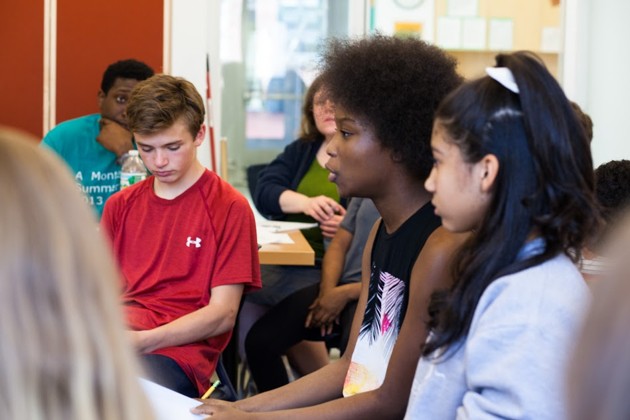
Students at Brooklyn Heights Montessori School discuss what they learned about Baltimore. (Eliso Rivera)
My students are racially and culturally diverse, yet relatively sheltered. They come from deeply supportive families, and either walk to school from Cobble Hill and Brooklyn Heights, or come by car or subway from less-gentrified neighborhoods. #Blacklivesmatter protests have occurred regularly this academic year within walking distance from campus—my students even held one themselves in the fall—yet violence, bald racism, and the abuse of police power are not their everyday experience.
By first period on Tuesday morning, the forthcoming trip and the news had finally merged in my students’ minds. “Something happened in Baltimore,” one student, Tristan, said. “I heard there were riots.” When I pressed my students for facts and sources, they were vague. “[My parents and I] watch Fox News and The Today Show,” Sadé said. Reece added: “I hear bits on the radio on the way to school, but I never hear the full story.” They shared information and asked questions, confused and appalled but also engaged. What was the name of the man who died? What happened? Does Baltimore have a history of racism? Why the fires? Would the trip be canceled?
“Until we started talking about this in class, I had no idea [the protests were happening],” Lorelei said. “But now I really want to find out more. Because this is our history.”
* * *
While my students’ choice to visit Baltimore seemed a bit arbitrary at the time, the protests surrounding Freddie Gray’s death suddenly made it one of the most relevant places in the nation for them to study. The night the violence escalated, as reporters scrambled to follow the story in real time, I started gathering learning materials: news articles; links to interactive maps of Baltimore neighborhoods and the protests; relevant Twitter feeds; Countee Cullen’s poem about Baltimore, “Incident”; and historical terms for students to research. I organized them into a Google Doc that all the students could access and consult to prepare for a classroom conversation. (I've since made the document publicly accessible.) Each student would choose a big question to study, initially based on the resources I provided, and then find and evaluate new sources. Each student would share at the end of the day Wednesday what he or she had learned.
To understand the complexities of geography, history, race, class, power, and law in Baltimore, my students not only needed resources, they also needed guidance. Parents and teachers sometimes think teens know more than they actually do—about technology and about the world. And students struggle to develop effective research skills if left to their own devices. At one point during the research phase of the assignment, for example, I looked over the shoulders of a group of boys and saw them using Google maps to scan the area around the hotel where the class planned to stay, almost as if they expected to see rioting. I pointed out that Google maps aren’t real-time videos, and they laughed at their error. Then, as I was walking away, I heard one exclaim, “Hey! Our hotel has a waffle maker!”
Hotel amenities aside, it was clear my students wanted to know more about the city and its suffering. After class, when the kids were elsewhere on campus, icons showing that students had the Google doc open on their computers popped up on my screen, like Harry Potter’s Marauder’s Map.
* * *
By Wednesday afternoon, the students were prepared to share and discuss what they had learned. I reviewed guidelines for the conversation, including: “Assume good will. Demonstrate curiosity.” I directed the 25 students (and six teachers who decided to join us) to sit in two concentric circles. Those in the inner circle would offer three contributions and then change places with someone in the outer circle; the outer circle would listen, take notes, and then join the inner circle when someone left.
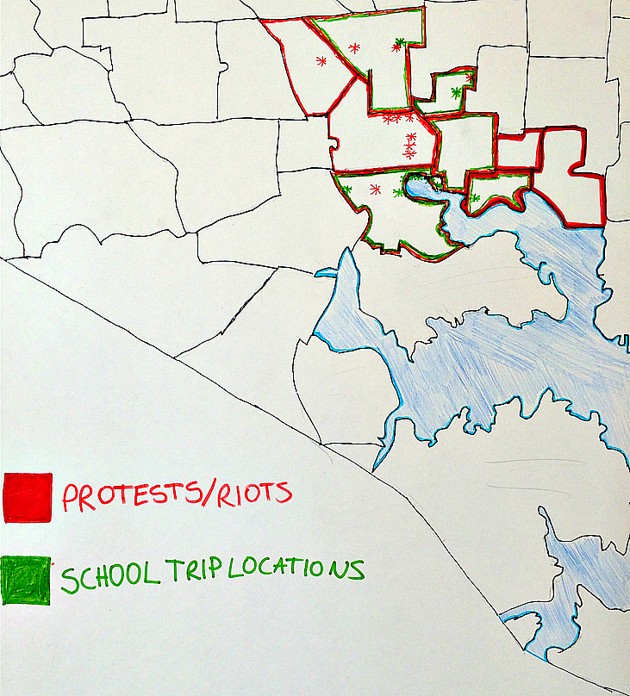
Amouri began with a geography lesson prepared by her group: “Seven of us made a map of our trip and where riots or protests happened. Violence occurred just half a mile from our hotel.” The trip was in green, the school color; violence was in red. They even made a key:
They were fascinated by Freddie Gray’s arrest, too. “He was arrested for possessing a switchblade, then he ran away,” Ella said. “That’s why he got taken in.” Julia raised her hand to disagree: “According to CNN, the mayor said it’s not illegal to carry a switchblade.” Sadé added, “He was arrested multiple times. But not everything he was arrested for he was prosecuted for.”
From there, several students discussed the difference between peaceful and violent protests. Jaden offered what sounded like a 13-year-old’s version of Martin Luther King’s 1968 speech in Grosse Point: “One of the reasons this is so big is that the arrest happened in a black community. Some people feel these events are similar to events of the past. That’s why riots might happen. Some may call riots ridiculous, but other people understand why they happen.”
“The news is only covering the bad things—other sites show people doing good things,” Charlotte added. Tristan concurred, then called me out for a factual error I had made: “It’s hard to know just from the news what is true. Remember yesterday when Launa said she knew for sure that Freddie Gray was tasered? Then we discovered today that he wasn’t.” “There are conflicting messages on social media. In some, young kids are giving policemen water bottles,” Arlo continued. “In others, people are cleaning up. And in some others, people are being encouraged to riot. What’s true?”
Each student focused on an aspect that interested him or her the most. Caleb and Nick pointed out that the city’s curfew meant that the Baltimore Orioles baseball game scheduled for Wednesday night would be the first MLB game ever played without fans. Sadé, the daughter of a police officer, explained what she had learned at home about correct police procedure. Ixe said, “My dad was in Baltimore when this happened. On one of the days of the riots, there were sports fans drinking in the area of the protests. They used racist language and provoked people.” Bridgette went on to say, “When you read about it and get more involved, it makes you angrier and want to do something. And some people think the easiest way is to riot.”
Students were sharing their insights, disagreeing, correcting me and one another, and comparing sources. And they weren’t thinking about lost deposits and possible dangers—they were trying to understand complex events from multiple perspectives.
When teachers spoke during the conversation, they followed the same rules as the students. Among them was Martha Haakmat, the school’s head, who asked the students their thoughts on what, given how ingrained racism is in many parts of society, a school’s responsibility is to its students to help undo those legacies.
For Oliver, schools need to embrace and enhance diversity: “Learning in class with people different from yourself should just feel normal,” he said. For Chloe, ensuring opportunities for discussion should also be a school’s priority: “Kids learn from their parents,” she said, “but not all kids ask their parents these questions if they aren’t learning things in school.”
That night for homework, I asked students to reflect in writing on their research and the day’s conversation. “The most important lesson I learned is to think first before doing things,” Tristan wrote. At first I assumed he was talking about the students and rioters, but he later clarified that he was was referring to the police. “They should have known their reaction would make a huge impact everywhere around the country.”
Students also wrote about the trip, fearing for the safety of Baltimore residents, and for their own. But most still wanted to go. “The past few days have been especially sad with all the riots in Baltimore,” Arlo wrote, adding that he wanted protests to continue, as long as they did so peacefully. “I think it would be cool to see how the local community is helping damaged businesses to get back on their feet.”
With the scheduled date of the trip still two weeks away, my students and I continue to add to the shared Google Doc. Friday morning’s news brought “indictment” and “Marilyn Mosby” to the new-vocabulary list. The initial lesson is over, but the learning goes on.
Lessons in American history and literature should prepare students to be informed, contributing citizens. Democracies thrive when people wrestle with big questions; read, write, speak, and think well; and understand the differences between fantasy and fact, opinion and propaganda. But intellectual skills aren’t sufficient. Students also need opportunities to connect emotionally with people and places outside of their immediate surroundings—to feel empathy, outrage and compassion.
Students develop skills and independence much more readily when they are empowered to engage in meaningful work than when they are merely told information. In this case, students mapped an unfamiliar city, researched the past, grappled with the brutal realities of inequality, educated themselves about social phenomena, and navigated digital news sources. They spoke respectfully across differences of opinion, listened to each other, and reflected on what they learned. In short, they practiced what adults will need to do to better understand and solve the thorny questions facing today’s society—including those raised by Freddie Gray’s death.
The trip my students planned is still two weeks away, and it’s unclear whether it will actually take place. But regardless of whether the class stays or goes, this has already been by far the most educational middle-school American history trip I’ve ever experienced.
My heart races, my breathing faint and quick, when I read the naive, ignorant, vile, insensitive things I see on social media, posted by white people about black citizens' response to epidemic police violence against their unarmed brothers and sisters—the only reason I can think of which makes me thankful that my son Calvin can't, and will never be able to, read.
A friend and former Bowdoin College professor tweeted in response to white judgement of the riots in Baltimore, “We were property once too.” She got these tweets in return:
John Reiter @boopmeatsweats, “and you shouldve stayed that way you ugly ape whore”
and
David Kirk @SmokeyJihad777, “Bitch you weren’t shit smh still crying about shit that happened 150 fucking years ago that doesn’t affect you at all”
I sit and wonder why such hate and ugliness festers in the hearts of people who, statistics show, more than likely don’t even know any African Americans, though perhaps that is the problem. I wonder if they think of themselves as followers of God. Most whites in this country do. But maybe their hate first took root because of certain conservative media's racial stereotyping, fear mongering and twisting of the truth. Or is it latent white guilt which blinds these bigots to the facts, that though slavery is over, racial subjugation still exists, permeating society beginning with the unjust punishment of black and brown-skinned kindergartners, haunting them through their childhood years into adulthood, if indeed they make it that far?
It disturbs me seeing so many white people simplifying or deriding this complex, tragic and centuries' old problem of racism, others trying to wish it away by citing their colorblindness, denying that racism exists at all or putting all the blame back on black people. It seems clear to me they don’t understand the source of anger that the black community harbors toward this most unjust society of ours. The problem, I believe, is that these people choose not to see reality. They view life only from the white side, which is opaque at best and privileged galore, and doesn’t take responsibility for the ills that continue to be imposed on our black citizens—high unemployment rates, high rates of poverty, grossly disproportionate rates of arrest and conviction, stiff fines and sentences leading to mass incarceration, broken families, torn neighborhoods and the resulting sanctioned discrimination in subsequent searches for housing, employment, health care and the right to vote—all of which we have the capacity to amend, and should.
I grew up in a Seattle suburb knowing only a few black children my age. Racism didn’t seem like a thing to me, until I began befriending non-white men, then dated an African American for five years. From behind a different lens I learned—second hand because I am white—of society's ingrained suspicion of black people, of cops rampantly frisking black youths for doing nothing more than loitering, something my white friends could do with utter impunity.
Then I began to sense the insidious bigotry. I remember when my mom once saw a tall, well-dressed black man emerging from a luxury car.
"He must play professional basketball," she said. "Why not a doctor or a lawyer, Mom?" I asked. Her only response was to seethe at me.
Over the years I've witnessed blatant as well as subtle racism, like when white people marvel at how well a black person might express themselves on television, when really they are no more articulate than most folks I know, black or white. Or when someone says that President Obama isn't black because he had a white mother and has light skin, thereby denying the rife condemnation he faces because of his race. Or when the airline agent asks only one person in line to check luggage, and that person is black. Or when a pretty white teenage girl says, when reclaiming her cigar from her father's mouth, "Why'd you have to nigger-lip it?" Or when whites use the word thug to describe black children in hoodies wielding toy guns or handfuls of Skittles on their way to being shot to death. Or when white folks wonder what we owe them. Or when black folks are pulled over or chased by cops for no reason but that they are black. Or when an interracial family is heckled by a passerby or when a black woman is charged more in rent because of the color of her skin or turned down for a job interview because of her name, or when white folks think that the wrongful deaths of Michael Brown and Renisha McBride and Travon Martin and Eric Garner and Tamir Rice and Akai Gurleyand Oscar Grant and Freddy Gray are isolated incidents.
The root of racism is, and always will be, bitter, white and invasive. You don't have to dig down very deep dirtying your fingers to see for yourself. Our white ancestors slaughtered Native Americans by the droves, calling them savages, taking and raping their resources and forcing survivors onto reservations. White people are still taking their children. Our white ancestors led the slave trade and white plantation owners profited from the sweat and tears of men, women and children who were seized from their homeland, forced to give up their language, culture and religion, their freedom, their children, their lives. White men forced Japanese American families into internment camps. White politicians designed Jim Crow laws pitching poor whites against poor blacks at a time when the two groups had begun to galvanize a force against the rich. White men lynched black men for no other reason but the color of their skin. White shop owners barred black patrons. Black leaders were assassinated by white men. White heads of corporations shipped inner-city jobs overseas exacerbating poverty. White politicians devised the war on drugs, targeting black, inner-city boys and men while white cops enforced it, with skewed brutality and rigor. White men exploit Hispanic men and women to pick our fruit and sate our wasteful appetites. White witnesses, jurors and judges have condemned innocent black men and boys, putting many behind bars for years and sending others to their deaths. White politicians redistrict states to win the vote and champion voter ID laws which disenfranchise blacks, among others. I could go on. My eyes are open.
Martin Luther King Jr. said, “A riot is the language of the unheard.” If we want the rioting to stop, we, as whites, need to listen to our Black American brothers and sisters and validate their struggle against the heavy boot of white society. Then we need to right it, whatever it takes. We need to see the true injustices of our time. To do so we must humble ourselves, but most of all, and first, we need to open our eyes.
Don Hogan Charles/The New York Times, Baltimore riots, 1968, after the assassination of Martin Luther King Jr.
An man walks past damage caused by an earthquake in Kathmandu, Nepal, Saturday, April 25, 2015. (Niranjan Shrestha / AP)
Four hours after learning about Saturday's devastating earthquake in Nepal, I received a Facebook notification I had never seen before: Sonia, a journalist friend based in northern India, was "marked safe." An hour later, the same notification about a different friend popped up. Then another. Soon, several of my friends wrote that they, too, had learned via this strange new notification that their friends in Nepal were okay.
A few hours later, the mystery was solved. On Saturday afternoon, Facebook CEO Mark Zuckerberg announced on his timeline that the notifications came from Safety Check, a service the company launched last fall. "When disasters happen, people need to know their loved ones are safe," he wrote, "It's moments like this that being able to connect really matters."
A screenshot of Safety Check
When activated, Safety Check locates Facebook users near a disaster site through the city they list on their profile, or from where they last used the Internet. Users then receive a notification asking to confirm that they're safe or to say that they weren't in the affected area. Those who choose "safe" generate a notification to their friends and followers, who can track how many of their friends were affected.
The idea for Safety Check emerged after a devastating tsunami struck Japan in 2011. "During that crisis we saw how people used technology and social media to stay connected with those they cared about," Facebook wrote when introducing the service.
Saturday's earthquake in Nepal, however, revealed some of the limits to Safety Check. Smartphone penetration in the country—one of Asia's poorest—is low, and six Nepalese out of seven are not registered on the social network. Electricity in the country is unreliable even during normal times, and there were reports of extensive power outages throughout Kathmandu in the hours after the quake.
But for those who can and do use Facebook, Safety Check's existence could offer an easy way for people to tell their friends and family that they're okay.
"At this time of desperation and disaster, just knowing your loved ones are safe is just like a beam of light in the dark," wrote Facebook user Dinesh Gurung in a comment posted beneath Zuckerberg's.





 Start by scrubbing two russet potatoes (about 2 lbs. total) to remove any dirt. Dice the potatoes into 3/4-inch cubes. (Mine were closer to one inch, but smaller is definitely better.)
 Place the diced potatoes in a large pot and cover with water. Put a lid on the pot and bring it up to a boil over high heat. Boil the potatoes for 5-6 minutes, or until they’re tender when pierced with a fork (the total cooking time will depend on the size of your cubes, so check them by poking with a fork. When the fork slides in easily, they’re done.) When they’re finished cooking, drain in a colander.
 While the potatoes are cooking, you can begin the sauce. The sauce starts with my favorite duo: ginger and garlic! Mince two cloves of garlic and peel about one inch of ginger. You can use a vegetable peeler or the side of a spoon to scrape the skin from the ginger. Once peeled, use a small holed cheese grater to grate the ginger. I like ginger a lot, so I used about one inch, but it’s flexible.
  Add the ginger and garlic to a deep skillet with one tablespoon of olive oil. Sauté over medium-low heat for 1-2 minutes, or until the ginger and garlic are a little softened and smell fragrant. If you don’t have a deep skillet like this, you can use a pot. Just remember, it needs to be big enough to hold all those potatoes later.
 Next, add 2 Tbsp curry powder. This is the curry powder that I use and I like it quite a bit. You can use hot or mild. If you only have mild curry powder but want to make it hot, you can add a little cayenne pepper.
 Add the curry powder to the skillet and continue to sauteé it with the ginger, garlic, and oil for another minute or so. This toasts the spices and amplifies their flavor.
 Next add one 15oz. can of tomato sauce. If you live in a country that doesn’t have “tomato sauce”, you can use any puréed tomato product, although you may have to add salt to the sauce later.
 Add the tomato sauce to the skillet, turn the heat up to medium, and let it heat through. Taste the sauce and add salt if needed (I didn’t add any, but it will depend on the tomato sauce you use).
  Add the boiled and drained potatoes, then stir to coat them in the sauce. If it seems really thick and pasty at this point, add a couple tablespoons of water.
 Make four little dips or wells in the mixture, then crack a large egg into each one. Place a lid on the skillet and let it come to a simmer. Simmer the eggs for 6-10 minutes, or until cooked through (if you prefer a runny egg, let it simmer for less time). Alternately, you can fry the eggs in a separate skillet and just place them on top of the potatoes before serving.
 Lastly, roughly chop some fresh cilantro and sprinkle over top. Perfection!
 Tons of flavor, very filling, simple, and cheap. Just my style. (