Shared posts

15 Aug 16:41

How to be a good Gen Y dad

by Penelope Trunk
A.N

I think this would be a fun group to hear thoughts about this on.

manzanitakids.com

If feminism is about having the right to make choices, then it’s also about the obligation to make a choice. You cannot choose to have a spouse who’s a breadwinner and who shares everything 50/50. You cannot choose to have everything in life but only do it half the time. Having something—anything—is about commitment. And you cannot choose to have everything up to your standards but also allow other peoples’ standards to prevail.

Being a real feminist means you cannot have everything. So women who are feminists are self-assured enough to make choices to give stuff up. And men who are feminists are brave enough to say that they, too, will be giving up some things.

Here are things men should give up:

1. Give up the idea of 50/50. It doesn’t work.
Most Gen Y dads think men should be breadwinners. But many don’t think this way until they have kids. It’s so much easier to live in a fantasy world about kids before there are kids.

The genesis for this post is a video from Jonathan Mann about how he and his wife are dealing with their new baby.

Jonathan basically feels bad that his wife is better at working and taking care of the household than he is. He thinks that he should be doing 50% of the household and baby chores because he is bringing in 50% of the income. He thinks that since he has his wife taking care of 50% of the income, then he should not leave her with more than 50% of the childcare or household chores.

Their baby is very young and therefore it’s unlikely that this will work. Because moms don’t share. Unless there is a full-time stay-at-home dad, and a full-time working-out-of-the-home mom, the mom rules determine the parenting style of a family. Because it’s impossible to have 50/50 breakdown of who sets the rules for parenting, and it’s impossible to parent when you are negotiating every decision, one parent’s style will prevail. It’s not fair to ask the non-prevailing parent to contribute 50% of the work when they don’t get 50% of the input.

It’s like cleaning the bathroom. Most men think the bathroom is clean enough, and most women don’t. There is research to back this up. Which means that you can’t hold a man responsible for meeting standards that are not his own. If the woman wants the bathroom cleaned the way she wants it cleaned then she has to clean it. (Or hire someone.) But the guy can’t do it.

Just as men and women are not equal when it comes to cleaning, men and women are not equal when it comes to career. If you take a male and a female math genius, the women is more likely to choose being a housewife. Please do not tell me there is societal pressure for math Ph.D.’s to become homemakers. There is the opposite, in fact. There is pressure to “live up to your potential.” Yet more women math geniuses choose to take care of kids. Because men and women are different, which is why 50/50 doesn’t work. (Another reason: It’s a financial suicide pact.)

2. Give up gender neutrality. Gen Y women are comfortable with gender roles.
Generation Y women have been hearing Gen X women say loud and clear how you can’t have power in the office and power at home, and Gen Y women choose power at home. Gen Y women don’t want to be managers, they want to work from home, and they want to work part-time.

It might seem, for example, that both spouses have equal earning potential, but when kids enter the picture, ambitions change. And most women do not want to advance as far as most men do. But it’s hard to see this proclivity crystalize until the kids have grown out of toddler-hood. And by then it might be too late. So there’s no point in assuming you are the exception to the rule when the stakes are very high and the statistics make it very unlikely.

Additionally, while 1 in 4 women are breadwinners for their homes, this is largely a poor person trend. That is, rich, educated women are driving the trend to stay at home with kids, and poor, uneducated women are driving the trend for women to be breadwinners.

Similarly, the idea of staying home with kids while a spouse earns the money is the new Gen Y girl’s fantasy, probably because it’s only for the lucky few and Gen Y-ers love to be admired. But more than that, 60% of Gen Yers believe one parent should stay home. 

3. Give up housework. Choose some other contribution.
Men who do more housework get less sex. There is commentary all over the internet about this research. But the bottom line is that this research goes in tandem with the research that says that no matter how much money women earn, they want to marry a guy who earns more than they do.

Some women will say this is not true. It will be women who do not have school-aged kids. Some women, mostly ENTJs, decide that they have fallen in love with a guy who will not earn as much money as they do, but they love the guy, so it’s fine for them, they decide.

The problem is that it’s only okay until the kids are school-aged and the women realize that they want to be with the kids because kids grow up so fast. Then they don’t know what to do with a guy who does not parent the way they want to parent and does not earn enough money to support the way they want to finance the family.

So the best tactic for men is to focus on doing male tasks, whatever that may be in your family. Marriages where there are male roles and female roles are more likely to remain intact.

It doesn’t work in marriages to treat men like women the same way it doesn’t work in the corporate world to treat women like men. In both cases it holds them back.

And this is why women are penalized at work for having kids and men are rewarded at work for having kids: Because people fall into gender stereotypes whether or not we want to.

4. Give up being a stay-at-home dad.
There aren’t any. You might think there are, but men who are supposedly stay-at-home dads give up on the idea of “not working” and they start saying they do have a job.

Women who stay home but also want a job end up having no job because it’s too hard to get part-time work. But men are not nearly as likely to be willing to do that, for all the reasons we have listed above.

So, for example, a huge number of stay-at-home dads will say they are writers or they are in construction. Because those are jobs you can say you are doing at home and no one needs to give you permission to do them—there’s no need to fake a job hunt.

Also, being a stay-at-home parent is not all about taking care of the kids. I mean, that’s part of it, but that’s the part we imagine stay-at-home dads doing. There are a million other aspects to a stay-at-home parent that we don’t envision men doing:

  • Choosing the colors of the bathroom towels.
  • Making Thanksgiving dinner.
  • Going to PTA meetings.

A big reason we don’t envision men doing these tasks is because research shows us that men having a harder time remembering these tasks. Is that sexist? Yes, but the world is sexist. And the idea of men staying at home is not going to work if the men do not feel good about it. And believe me, it’s hard enough for women to feel good about it so we can forget about it with men.

This is not mean-spirited. I am reporting reality when I tell you that if a dad is a stay-at-home dad with no other job, the world thinks he’s unemployable.

5. Give up trying to something you’re not. Just being you will be a good enough dad.
Women are more uptight about kids. I’m not even going to include links for that. If you can’t accept that as truth you probably stopped reading long before now.

But also, women work harder to follow the rules men do. We know this in school. Girls get way better grades than boys. Men work less when women are present, both as kids and as adults. And when a marriage is under stress, women work harder and men work less.

Men take on substantially more childcare duties than even one generation before them, but men gravitate to the fun stuff we do with kids, whereas moms take on the not-fun stuff.

Study after study shows that men do not force housework and childcare on women. Men just naturally do not do it. Men don’t mind kids in daycare as much as women do. Men don’t mind a dirty house as much as women do.

If you accept that, then you can accept that your role as a man is to be a man. And the role of a woman is to be a woman. That’s why you chose each other. You decide what that role looks like for you, but no marriage was ever 50/50 and it won’t start now.

15 Aug 14:21

“Hey, How Should Our Magazine Commemorate the Anniversary of the Time an Unarmed Black Teen Was Shot with 12 Bullets by a White Police Officer”

by Choire Sicha

NAILED IT

15 Aug 00:44

Reply To That Email Already

by swissmiss

reply to that email already

This is what my nightmares are made of. (By Adam JK)

12 Aug 19:48

Grapenut Ice Cream

by ljc

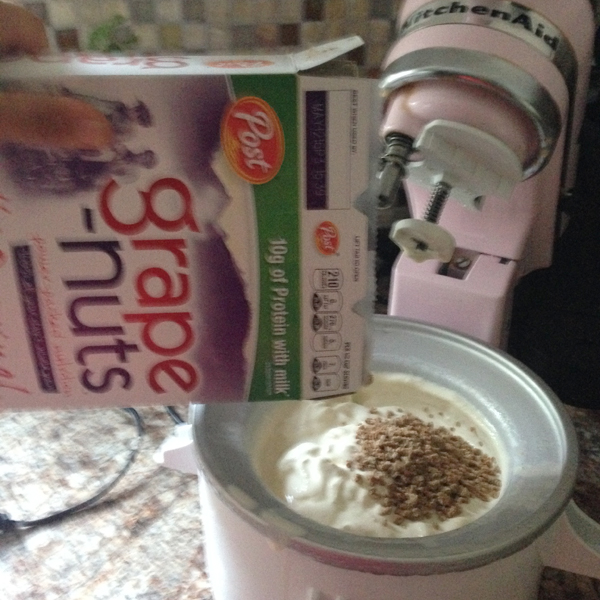
Tonight we made a batch of Grape Nut ice cream. I know it sounds strange but it's so good. I grew up with the Igloo which specialized in Grape Nut ice cream (well, frozen custard). It's just vanilla ice cream with Grape Nuts mixed in. Really simple. It adds crunchiness and nuttiness.

I always thought the Igloo was the only place that had Grape Nut ice cream. Turns out Grape Nut ice cream can be found in Canada, New England and Jamaica. (Jamaica? Who knew?!)

You can't find Grape Nut ice cream in Rochester though, so we made our own.

12 Aug 18:43

What If… Math Was Cool

by Choire Sicha

COOOOLOoh, they just found a new pentagon that tiles—only the 15th so far. What does that mean? It means you can “cover a flat surface using only identical copies of the same shape.”

That was a team, with supercomputers. But what if a person could do that on her own?

Yesss, this means it’s time to revisit the site of Marjorie Rice, who, after creating her own mathematical notation, discovered four of these classes of shapes. She also made a new kind of artwork about them.

MATH

She was then a woman in her 50s who had never been to college. (Usually described as a “homemaker.”) She is now in her 90s, and lives in California with her (very Christian!) daughter.

11 Aug 17:48

Watch This Little Kid Break A Board With Adorableness

by Endswell

AYA!

via BroBible

10 Aug 20:34

On Fertility

by Eileen Favorite

I’ve always loved the sound of the words Fertile Delta. The liquidic sound of the vowels coupled with the l, the hard D of delta, Greek for change, speaks to the power of a seasonal, shape-shifting body. Fertile Crescent makes another lovely pair. Crescent, so soothing, this half-moon, this womanly way to describe the cradle of civilization. Fertile, crescent, cradle, delta.

The opposite of these words: barren.

* * *

When you give birth, you do it with others. When you miscarry, you do it alone. Even if doctors and nurses are present, numbing you, holding your hand, giving gentle instructions, they’re not with you, because what’s happening is both too awful, and too common, to be shared. Nobody wants co-ownership of the failed human. Many don’t even consider it human.

Read more On Fertility at The Toast.

05 Aug 15:46

Bubblegum

I came here to chew bubblegum and say no more than eighteen words ... and I'm all out of
03 Aug 18:08

Wow! Google Translate App

by swissmiss

I could have made some serious use of Google’s Translate App when I traveled to Asia a little over a year ago. Impressive!

29 Jul 19:30

Body-Camera Footage Gets an Officer Indicted for Murder

by Robinson Meyer
Hamilton County Prosectuor

On July 19, 2015, a 43-year-old Cincinnati man named Samuel DuBose was pulled over by a University of Cincinnati police officer, Ray Tensing. Tensing was white. Dubose was black. His car was stopped for missing its front license plate.

Minutes later, Tensing shot DuBose in the head, killing him.

What happened between getting pulled over and DuBose’s death?

Now, thanks to footage from Tensing’s body camera, we know.

After the two men briefly exchange words, DuBose's vehicle is seen to roll forward. Tensing then shoots him in the head. Tensing was indicted Wednesday on charges of murder and voluntary manslaughter.

“This is without question a murder,” said Joe Deters, the prosecutor for Hamilton County, Ohio, at a news conference Wednesday. “He didn’t do anything violent toward the officer. He wasn’t dragging him. And [Tensing] pulled out his gun and shot him in the head.”

“He purposely killed him. He should never have been a police officer,” said Deters.

During the 10 days between the killing and the announcement of the indictment, Cincinnati had seen protests calling for the release of Tensing’s body-camera video. City officials said they planned to release the video once the investigation was complete; the city’s chief of police would say only that he had seen the video and “the video is not good.” The video was released Wednesday.

“This is the most asinine act I’ve ever seen a police officer make,” Deters said. “It was unwarranted. It’s an absolute tragedy that, in the year 2015, anyone would behave in this manner.”

“He wasn’t dealing with someone who was wanted for murder. He was dealing with someone who was wanted for not having a front license plate,” he added. Even if DuBose had fled the scene, it was a minor traffic stop, said Deters, and Tensing should have let him roll away.

“It was so unnecessary for this to have occurred. This situation would never have escalated like this.”

Over the past 12 months, experts and activists have called for the nationwide adoption of body cameras by police forces. They have acquired wide support, including from Hillary Clinton and the family of Michael Brown, the 18-year old man who was killed by a police officer in Ferguson, Missouri, last year. But the adoption of body cameras is rife with complexities and privacy concerns, including who gets to view a video and whether they are a matter of public record. The case of DuBose provides a hint at the roles they will play in the American justice system, both as records that activists will fight to obtain, and as documents that will set the record straight.

On Wednesday, Deters said he probably would have believed Tensing’s version of the story had the body-cam footage not existed. But after watching it, there could be no doubt.

This article was originally published at http://www.theatlantic.com/politics/archive/2015/07/body-cameras-sam-dubose-tensing/399953/


29 Jul 18:47

Modernist Sandcastles

by swissmiss
A.N

We should have a sandcastle building day when you guys come to visit. And, like, PREP for it.

modernist sandcastles

Calvin Seibert sculpts impressive Modernist Sandcastles. So much YES!

29 Jul 17:41

That New York Magazine Cover

by John Scalzi

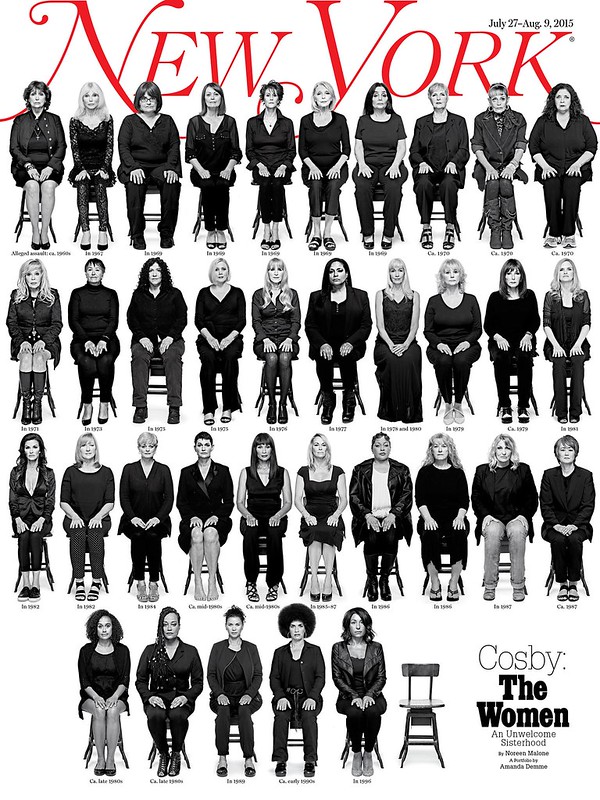
So, that’s a hell of a magazine cover. As of this writing the New York magazine site itself is down because of a hacker attack; the hacker in question alleges this has nothing to do with Bill Cosby. Interesting timing nonetheless. Here’s the link to the story package when it goes back up. You should read it. If it’s still down, Vox has a write-up on it.

A friend of mine tweeted a comment last night that said “power corrupts” and I tweeted back something snarky about that; turns out she was tweeting about Bill Cosby and I missed the context, so I apologized and deleted my tweet. Turns out I am just as susceptible to the failure mode of clever as anyone else.

But I had additional thoughts on her comment. I think it’s true that power corrupts, or that it can. I also think it’s true that power reveals — which is to say, that with some men and women, it’s not that having power weakens their will or leads them into temptation, but rather that power allows them to indulge in the things that they’ve always wanted to do. They didn’t need to be corrupted. They needed only the means to do what they willed, which power provided.

Ultimately, however, it doesn’t matter if power corrupted or revealed Bill Cosby’s nature. I don’t imagine it matters to the women who were sexually assaulted whether Cosby gave into temptation or indulged in his will, or both. At the end of the day they were still raped by him. And at the end of the day, for decades, they were told there was no point in telling anyone about it because no one would believe them. Corrupted or revealed, Bill Cosby’s power protected him, until it didn’t. I am absolutely sure that the irony of what kicked the Fall of Cosby into high gear was Hannibal Buress, another man, calling Bill Cosby out on stage was not lost on these women, or women in general. The information was out there; women had been saying these things for years. They still needed a man to say it in order to have the world pay attention.

I’m not sad for Bill Cosby. He raped women, he did it for decades, and now everyone knows he did it. He deserves condemnation for it, and he deserves to see his reputation destroyed (he also deserves jail time, which at this point he is unlikely to receive. But I think for a person like Bill Cosby, the destruction of his reputation is probably no less painful than time in a cell). The man was and is a genius, and his comedy mattered to me; I remember being a kid listening to his comedy albums at the West Covina public library and trying (and failing) not to laugh out loud in a place where you weren’t supposed to make a lot of noise. Bill Cosby: Himself was one of my favorite comedy concert films. And by the time Himself was released, Cosby had assaulted 22 of the 35 women featured on that New York cover. Bill Cosby is a genius; Bill Cosby is a rapist of women. The former does not excuse the latter and never should have.

I am sad we are still in a place where women aren’t believed when they come forward about sexual assault, and that it’s such a matter of fact of our culture that The Onion can satirize it. I’m sad and sorry for the women who had to wait until a man came forward to call out Cosby in order for the cultural tiller to shift in their direction. Anita Sarkeesian — who knows something about the bullshit women have to put up with in order to speak — and others have said that one the most radical things you can do is believe women when they talk about their experiences. It seems like a dramatic statement until you take a hard look at that New York magazine cover, and the thirty five women there, bearing witness to sexual assaults over four decades, finally being believed in some cases fifty years later. You realize it’s not dramatic at all.


29 Jul 15:47

Emotional farewell as students perform haka dance at teacher's funeral

by Jenni Ryall
Haka
Feed-twFeed-fb

It is the deepest show of respect

A large group of school children in New Zealand have honoured their beloved teacher by performing the traditional dance, the haka, as his hearse rolled into the school for the funeral

At least 1,700 boys at Palmerston North Boys' High School on New Zealand's North Island participated in the epic performance for their physical education and maths teacher, Dawson Tamatea.

Tamatea, 55, died in his sleep on July 20, according to TVNZ. He had been a teacher at the school for almost 30 years.

"This was a very emotional and powerful performance," the school wrote on its YouTube channel. "We are extremely proud of our boys' performance and we know that Mr Tamatea would be too." Read more...

More about New Zealand, Watercooler, Videos, Australia, and Haka
28 Jul 00:06

Rebuilding the Breast

by Rose Eveleth
Ariana Cubillos / AP

In 1882 an American surgeon named William Steward Halsted popularized what’s now called the radical mastectomy. He didn’t think of the idea—one of the first written proposals for a mastectomy was published by a German surgeon in 1719. But it was Halsted who made invasive removal of breast tissue a mainstream part of cancer treatment, and his version of the surgery involved removing the entire breast, along with the nearby lymph nodes and both pectoral muscles. Removing that much tissue at that period of time, before many of the surgical techniques doctors are now familiar with were developed, often left women severely disfigured.

And with the removal of breasts, or pieces of them, came the demand for cosmetic replacements. In 1874 the U.S. Patent Office issued its first patent for a breast prosthetic, to a man named Frederick Cox. The prosthetic was made up of a cotton casing filled with an inflatable breast pad.

In the following years, women would come to dominate the world of breast replacement patents. In 1904, a woman named Laura Wolfe filed a patent for an “artificial breast pad.” Her version was solid, rather than inflatable, and in her patent she described the three things a woman wanted out of a replacement breast: comfort, appearance, and product quality.

Those three things are, largely, still what women want today, though many opt for surgical replacements rather than padded bras. Breast reconstruction is a highly technical and evolving field that employs techniques and technologies from beyond the typical boundaries of surgery—from stem cells to 3D-printed nipples.

It’s hard to pin down exactly how many people get mastectomies in the United States. According to the Journal of the American Medical Association, about 35 percent of women with early-stage breast cancer will undergo mastectomies. The rate of women with a genetic predisposition for cancer getting preventive mastectomies is hard to determine too, but according to several studies and institutions, that rate is increasing.

Not everyone opts to rebuild afterward. According to one study about 42 percent of women choose reconstruction, and the rest decide to skip it, citing things like not wanting another surgery and a fear of breast implants. And there are still no breast replacements that restore function—so the decision is purely a cosmetic one.

But for those who do want to reconstruct their breasts, options can be grouped into two categories: implant reconstruction and tissue reconstruction, which relocates tissue from elsewhere in the patient’s body. The two procedures can be combined—using a small implant and surrounding it with tissue, for example—and both have advanced a great deal in the past 10 years.

On the implant side, researchers are working to develop new materials that will last longer and feel more natural. Many surgeons are moving away from gel-like implants to so-called “form-stable” ones. These are often called “gummy bear” breast implants, because they’re more solid than their predecessors. “If you cut the standard silicone gel it will flow out very slowly like molasses,” explains Oscar Ochoa, a plastic surgeon at the PRMA Center for Advanced Breast Reconstruction in San Antonio, Texas, “but [with] these new ones, if you cut the implant down the middle, everything just stays where it is.” Gummy bear implants are still made of silicone, but doctors say they feel more realistic, and will keep their shape longer than other implants.

When it comes to tissue-based reconstruction, doctors have gotten better and better at grafting a person’s own tissue onto their breast. This tissue normally comes from the belly, thigh, or butt, and along with it the doctors harvest the skin, fat, and blood vessels, while leaving muscle behind. “So the technology has been focused on leaving everything that is nonessential for the breast in place, and only taking the stuff that’s needed for the tissue reconstruction,” explains Ochoa.

Different surgeons prefer different techniques. Ochoa is a fan of tissue reconstruction. “I’m biased towards it, I firmly believe it’s the best, most high quality reconstruction there is for the long term,” he told me. There are downsides—taking tissue from another part of the body means more incisions for the patient, a longer recovery period, a steep learning curve on the part of the doctor and the need for a larger team of trained medical professionals on hand. But Ochoa points to the downsides to implants too—the long term satisfaction with implants isn’t always high. They can lose their shape and firmness, and even rupture if the implant gets old. When using the patient's own tissue, Ochoa says the results are often better. “If you see a patient five to 10 years along the line it’s hard to see the scars. And if another physician were to see the patient they’d be hard pressed to tell a surgery had even taken place.”

If tissue is best, why don’t doctors do breast transplants? Ochoa says that putting breast tissue back into an area that previously housed breast cancer is a tricky proposition. Not only are transplants risky, and require the patient to take immunosuppressant drugs, there’s the potential that the new breast tissue could simply develop cancer again and have to be removed once more.

When it comes to tissue reconstruction, Ochoa says that the next big step will involve stem cells—immature cells that can, in theory, grow into whatever kind of cells they are guided to. Ochoa says that some researchers are experimenting with using stem cells along with small injections of fat, to try and promote the growth of fatty tissue in the breast area.

Some have suggested using a patient’s stem cells to regrow an entire healthy breast. Not only are researchers far from having that capability, Ochoa points out that there are some reservations about using stem cells that way too. For the same reason doctors are wary of putting new breast tissue back into a body that once fought breast cancer, they worry that stem cells might promote the development of new cancers. Preliminary studies so far suggest that the implanted stem cells don’t usually promote cancer, but researchers want to do more work to be sure.

But rebuilding a breast isn’t just about creating a soft globe of tissue. Most women that Ochoa sees who opt for breast reconstruction, also opt for nipple reconstruction. Just like with breasts, there are a few different nipple-rebuilding methods. Some women go for a small silicone implant beneath the skin. Others have the surgeon use their own tissue, picking up the skin and wrapping it around itself to make a little standing column. Once the faux nipple is healed, a medical tattoo artist (often a nurse) colors it and the areola. (This may or may not be painful—some women develop feeling in their new breasts, while others never do.)

The problem with nipple reconstructions, however, is that they often don’t hold their shape. “Sometimes as soon as a year [after], it’s all completely gone. Other times it lasts for two to three years,” says Laura Bosworth-Bucher, the co-founder and CEO of a company called TeVido, which is trying to develop a way to 3D-print nipples using a patient’s own skin and fat cells. Bosworth-Bucher says that women she talked to didn’t want to go back in for more surgeries every few years, and that surgeons expressed frustration with their inability to predict which patients’ nipples would last, and which wouldn’t.

Bosworth-Bucher admits that printing nipples was not the first thing she thought of when she encountered 3D-printing technology. They spent the first year hoping to apply 3D-printed tissue technology to wounds and burns. But after she realized there was a lot of competition, and that the clinical trials were long and complicated, she started meeting with surgeons to try and think of another way to use the technology. “It was through a brainstorming session with a couple of plastic surgeons, he says, ‘We’re talking about skin, could you work with fat cells?’ And kind of a classic ‘Aha!’ moment, where he says that and we’re like, ‘Well sure, why not?’”

Now, TeVido is focused on developing a 3D-printed nipple, that can be printed not only to size, but with the exact color a woman wants. The technology works a bit like an old inkjet printer—layering cells one on top of another at the micron level to build up frameworks of blood vessels and tissues. Right now, a nipple reconstruction costs somewhere between $3,500 and $4,000, which is the price range they’re hoping their nipples will come in at. The team hopes to get started on clinical trials in two to three years—and because they’re working on something that doesn’t involve an open wound, with an outcome that’s easy to measure (is the nipple there, yes or no?) they hope the trials will move quickly.

Of course, not all women opt for reconstruction, or nipples, or anything of the sort. But when they do, what they want, still, just like Wolfe said back in 1904, is something that provides comfort, appearance, and product quality. And with advances in technology, they’re getting it, and their options are getting safer, longer lasting, and more realistic.

This article was originally published at http://www.theatlantic.com/health/archive/2015/07/rebuilding-the-breast/399479/


23 Jul 17:14

White People 101

by Spencer Kornhaber
MTV

The new documentary White People opens with the journalist Jose Antonio Vargas approaching white people on the street and telling them he’s “doing a film for MTV on what it means to be young and white.” Each person giggles a bit. To them, the premise, on its face, seems funny.

But it was groans, not giggles, that greeted the news in November that MTV had put out a casting call that asked questions like “Are you being made to feel guilty because you’re white?” and “Are you having a problem with race on social media?” It sounded like a Breitbart.com reporter fishing for a follow-up to the Shirley Sherrod story—an attempt to make it seem as though white people were victims of an increasingly diverse nation, even as headlines keep reminding Americans that race divisions still harm the same people that they have always harmed in this country.

In the days before White People aired, though, professional critics started airing a different kind of disapproval of the project. The consensus seems largely to be that, in the words of Willa Paskin at Slate, the film’s “a little too remedial with and gentle on, well, white people.” The headline for Ken Tucker’s Yahoo review read, sarcastically, “Race Privilege Exists, MTV Discovers.”

Still yet another reaction unfolded when the documentary’s title started trending on Twitter and Facebook last night, with some users accusing MTV of “race baiting” and “whiteshaming.” “Wow,” wrote Ryan Wesley Smith, a 17-year-old Christian speechmaker with 120,000 followers. “Just watched @MTV's #WhitePeople docu. The most racially dividing thing I've ever seen. Really disheartening.”

The spectrum of responses speaks to the difficult but admirable task that Vargas and MTV’s Look Different campaign have undertaken. In some parts of America, “white privilege” and “race is a construct” are catechisms; in other parts, they’re seen as huckersterish buzzwords; in most, perhaps, they’re totally unfamiliar concepts. Popular works of art and entertainment directly addressing racial issues have rightfully focused on minority struggles, which means the notion that whiteness itself can and should be held up for scrutiny is usually only implied. White People makes that idea explicit, telling white people that to understand inequality they need to understand the ways that they’ve unwittingly benefited from it. Aired alongside the likes of Teen Mom and Teen Wolf , it should hit a broad swath of young people who really might stand to learn something.

As one of the folks interviewed in the film says, whiteness is too often seen as “the default”—how can a 40-minute documentary even begin to start deconstructing something so big? White People attempts the challenge with a creative hodgepodge of approaches, all rendered in MTV’s tried-and-true—and, to me and I expect most adults, extremely grating—style of transparently manipulative editing and more manipulative music. Running throughout the program are scenes of town-hall discussions in places like Rapid City, South Dakota; Bellingham, Washington; and Phoenix. Vargas lobs gentle but provocative questions at the largely white attendees, many of whom, it turns out, do possess some racial consciousness. One of the participant offers a particularly brutal assessment of what white privilege means: “You don’t have to show people that you’re one of the”—airquotes now—“‘good ones.’”

But the best parts of the program try to debunk common, defiant responses white people have when told that they’re privileged. A segment revolves around the notion—certainly front of mind for the MTV demographic—that white people are missing out on scholarships because of affirmative action in financial aid. Vargas zeroes in on a white teenage girl named Katie in Scottsdale, Arizona who can’t afford the college of her choice, and for a moment you worry that the documentary is going to validate claims of “reverse racism.” But then Vargas brings in statistics saying that white people receive scholarships at a disproportionately higher rate compared to people of color. During a group discussion, a multiracial teenager points out that he, like Katie, wasn’t awarded any scholarships. “I’m starting to feel like a victim,” Katie says, echoing the sentiments of many white people when made to talk about race—but what the documentary’s actually showing is that she isn’t one.

At one point, Vargas visits the Brooklyn neighborhood of Bensonhurst, a formerly Italian enclave that has seen an influx of Chinese immigrants. A young white man canvasses the neighborhood to collect signatures to hold a block party, but is turned away by folks who don’t speak English. At dinner, that man’s father says it upsets him that the Asian newcomers in town aren’t very friendly. But Vargas, as well as some locals interviewed on screen, point out that the language barrier is a natural part of the immigrant experience. The Italian Americans acknowledge this; the dinner-table dad himself, it turns out, moved to America at age 5 and had a hard time adjusting. Racial healing? Not quite. But it’s a dose of perspective that perhaps not everyone watching might have come to on their own.

The most moving segment comes early on, when a white gay man from the South who’s attending a historically black college sits down for dinner with a racially mixed group of friends. He starts talking about how he can act “ghetto” just like black girls, and you can see that what he thought was a harmless comment—the exact same kind of comment you often hear from white people who consider themselves enlightened, especially white gay men—is actually hurtful. One of the girls bursts into tears, saying that “ghetto” has often been used to make fun of her. The soundtrack goes tender; hugs are had.

The special’s insistence on making sure that each example of racial misunderstanding is resolved into a moment of reconciliation probably dilutes the message—conversation doesn’t, in fact, heal all wounds in the real world. And the documentary conspicuously relegates the vast history of violence associated with white dominance to a very quick primer during a visit to an Indian reservation. Vargas and his producers likely chose to pull their punches in hopes of keeping the audience as broad as possible, and to placate skeptics who might accuse the show of attacking white people. Judging from some of the reaction that’s unfolded on social media, a lot of those skeptics were never going to be converted anyways. But with its combination of basic fact-giving and straightforward emotional appeal on a subject that white people are usually allowed to be oblivious about, there’s reason to hope that at least some viewers got the message.

This article was originally published at http://www.theatlantic.com/entertainment/archive/2015/07/white-people-mtv-jose-antonio-vargas-backlash-lessons-privilege/399302/


23 Jul 14:22

The Diaper Dilemma

by Olga Khazan
DementevaJulia / Shutterstock

Infants use about 240 diapers per month. A year’s supply of diapers costs $936. That means a single mother mother working full time at the minimum wage can expect to spend 6 percent of her annual pay on Pampers alone.

Meanwhile, the two biggest programs that assist low-income mothers, SNAP (food stamps) and WIC, don’t cover diapers or baby wipes.

That might be why, in a study of 877 pregnant and parenting women published in Pediatrics in 2013, a team of researchers found that needing diapers and not being able to buy them was a leading cause of mental health problems among new moms.

For the study, Megan Smith, assistant professor of psychiatry at the Yale School of Medicine, approached women in New Haven, Connecticut, and asked them one simple question:

“If you have children in diapers, do you ever feel that you do not have enough diapers to change them as often as you would like?”

Almost 30 percent of the women responded “yes”—they often lacked sufficient diapers. Their explanations of what they did to “stretch” the diapers reflect the harrowing reasons why so many new moms feel depressed and anxious.

Mothers would take the diapers off, dump out the poop, and put the diapers back on. They would air-dry the diapers. They’d let their kids sit in wet diapers for longer than they should—a practice that can lead to UTIs and other infections. Other moms have reported potty training infants who are less than a year old—at least six months earlier than is recommended—in order to save money.

I learned more about this study during a week-long training with the California Endowment Health Journalism Fellowships, where I am a grantee this year. Smith presented her work to the fellows and described what she’s done to help these mothers. The women told Smith things like, “My self-esteem plummets. I can’t soothe my baby because I can’t put a clean diaper on my baby,” she recalled.

The diaper deficit hurts more than moms’ self-worth: Many daycare centers require a week’s supply of diapers before mothers can enroll their children. Without the required diaper stash, women can’t drop their kids off and look for work.

“An adequate supply of diapers may prove to be a tangible way of reducing parenting stress and increasing parenting sense of competency, enabling parents to be more sensitive with their children, and thereby improving parenting quality and overall child outcomes,” Smith wrote in the study.

Smith now works with the New Haven MOMS Partnership, a support network for new mothers and their children. The Partnership operates several resource centers that offer stress-management classes and job-search help at locations across the city—including in places where moms are already likely to be, like Stop & Shop grocery stores.

The first thing the moms receive when they arrive for counseling? A bundle of fresh diapers.

This article was originally published at http://www.theatlantic.com/health/archive/2015/07/diaper-need/399041/


22 Jul 18:32

How Many Sandra Blands Are Out There?

by David A. Graham
Reuters

The release of a video of Sandra Bland’s arrest doesn’t explain how the 28-year-old ended up dead in a Texas jail cell, but it makes a convincing case that she never should have been jailed in the first place.

The traffic stop, in which she was pulled over for failing to use a blinker (after an officer got into the lane behind her, no less) is a good case study in everything a stop shouldn’t be. Did Trooper Brian Encinia really need to pull her over? Once he had, did he need to escalate the encounter? During the exchange, Bland is curt, but not initially combative—and in any case, failing to be polite to a police officer, while perhaps unwise, is not a crime.

The video is tough to watch in places. This is a quick cut; the full version is here.

There are some questions about apparent edits in the video, which the Texas Department of Public Safety says are technical glitches. DPS also says it will release a new, fixed version soon. But there’s plenty that’s clear from the original version.

Encinia pulls Bland over, asks her for her license and registration, asks how long she’s been in Texas, and then heads back to his car. It’s when he returns that the trouble starts.

“Okay, ma’am. You okay?” he asks. She replies, testily: “I’m waiting on you. This is your job. I’m waiting on, whatever you ...” Encinia says, “I don’t know. You seem very, very irritated.”

Bland explains that she’s upset because she felt like he was tailing her so she got over to get out of his way, and now she’s been pulled over for not signaling. Like many African Americans, she may have seen the stop as a result of “driving while black”—being racially profiled, and then pulled over on some minor pretext. (Friends have noted that she was upset about police brutality in recent months.) As a graduate of Prairie View A&M, she was also probably familiar with the history of tension between African Americans and law enforcement in the area.

Encinia, just as testily, says: “Are you done?”

“You asked me what was wrong, and I told you, so now I’m done, yeah,” Bland replies. He then asks her, politely, to put out her cigarette. She says she doesn’t want to, and she’s in her own car.

That’s where things really go deeply wrong. Encinia says, “You can step on out of the car,” and she declines. He then orders her to step out of the car. He clarifies a few moments later that this is a “lawful order,” a legal term for a demand with which she is required to comply. But why did he issue the order? She seems understandably baffled, and asks him to explain. Encinia never offers a good reason for why he’s ordering her out of the car, and it’s tough to see anything in the order except spite and anger at being questioned by a citizen acting within her rights.

Encinia threatens to tase Bland—“I will light you up!”—and drags her out of the car. He also calls for back up. He tells her he was only going to give her a warning, but now she’s going to to be arrested. She demands, as is her right, to know why she’s being arrested. He doesn’t answer immediately, though later he says she’s “not compliant.” He accuses her of resisting arrest, and she says he’s jerking her around. This is a common pattern in disputed arrests: Police charge suspects for resisting arrest in cases where advocates say the people are not resisting, or in which they are being physically moved by officers who cite the movement as evidence of resistance. The video doesn’t offer any compelling evidence that she is resisting arrest, despite her obvious anger at the officer and a growing string of obscenities. (At one point, she says, “South Carolina has y’all’s bitch asses scared.”)

Later, after another officer arrives, she’s tackled to the ground and protests, “I have epilepsy!” Encinia answers: “Good.” Encinia also tells a bystander—whose clip of part of the encounter was previously released—to stop filming, though he appears to be within his rights in recording the encounter. (Bland shouts, “Thank you for recording!”)

One of the most painful moments in the video is when Bland tells Encinia, “I cannot wait until we go to court.” In hindsight, every viewer knows her day in court will never come. But it’s also possible that everything Encinia did would have passed muster in court, especially since juries, prosecutors, and judges tend to defer to police in close cases. The video does, however, make Encinia’s response to Bland seem outrageous, disproportionate, and inappropriate.

Bland’s arrest fits into the category of police overreacting to perceived challenges to their authority, even provocations as minor as an individual asking why he or she is being arrested. A prosecutor charges that Freddie Gray was given a “rough ride” in a police van as punishment for running away from police and making a scene when he was arrested (an arrest that the prosecutor further charges was unlawful). If Bland had not died—authorities called it a suicide, though they’re now also investigating it as a murder—it’s unlikely that the video would have seen the light of day. It certainly would not have received widespread-media attention.

As my colleague Rebecca Rosen notes, one of the biggest revelations in the Justice Department’s report on policing in Ferguson after Michael Brown’s death was how many egregious examples of police misconduct went essentially unremarked upon and unpunished, simply because they didn’t end with anyone dead. Yet each of those incidents did have a cost: a loss of dignity, dehumanization, a gulf between police and citizens, and often a violation of civil rights. How many cases like Sandra Bland’s are there? It shouldn’t take a tragedy for police to be called to account for abusing their authority.

This article was originally published at http://www.theatlantic.com/national/archive/2015/07/how-many-sandra-blands-are-never-caught-on-video/399173/


22 Jul 13:35

“The Grand Shattering”

by Haley Mlotek

The biggest change that motherhood has wrought on me is this: whether or not I’m happy is no longer the central question of my life. This disposition is often mischaracterized as selflessness. But if it is in fact selflessness, it isn’t a willed state. I feel the need to care for my son as an itch, an urge. This is what people mean when they describe the rearing of young as a biological necessity. Lest you accuse me of wanting only to usher my own DNA into the future, I’ll tell you a little story.

When my son was almost three, one of my friends sent me a photograph of her newborn daughter. My phone twitched and I pressed the little button and saw the face of a baby in profile, milk-drunk. My breasts tingled with an unmistakable feeling. They were filling with milk. I hadn’t nursed my son in nearly two years. No milk had come in all that time, but now I squeezed my nipples, and milk came out. If there were an earthquake, a bombing, I could nurse the orphans.

For Harper’s, Sarah Manguso writes about her decision to have children after a lifetime of saying she wouldn’t. I liked this piece very much for a lot of different reasons, but I especially liked the way she writes about changing her mind. Lately I’ve found myself expressing an opinion or an emotion and then immediately following it with “but I reserve the right to change my mind,” maybe as an attempt to ward off some kind of moral reckoning; like literally everyone, I hate hearing “I told you so,” and never more than when it comes to really big, life-changing decisions. Like: having kids is a big fucking deal!! Maybe it’s ok to be not ready, or to express ambivalence, or to feel a certain way at one point in your life and a different way at another.

Reading this, I thought of two perfect quotations Katherine Bernard referenced in her excellent essay on The Argonauts, motherhood, and identity (and a lot more):

In The Argonauts, Nelson describes debating with Dodge about what language gives us: “Once we name something, you said, we can never see it the same way again. All that is unnameable falls away, gets lost, murdered.”

“The cause of tragedy,” the philosopher Stanley Cavell writes in an essay on King Lear called “The Avoidance of Love,” “is that we would rather murder the world than permit it to expose us to change.”

Let Sarah’s essay expose you to change here.

22 Jul 13:07

1-800-HIRE-A-CROWD

by Dan Schneider
Albert Gea / Reuters

Donald Trump's presidential campaign announcement last month was widely mocked, not only for the rambling diatribe he used to launch the campaign but for the actors he paid $50 apiece to cheer for it. Journalists responded with a predictable amount of schadenfreude when it was revealed that the Trump campaign hired actors to attend his rally, lighting up Twitter with jokes at Trump’s expense and “You’re Hired!” headlines. The incident was even memorialized with its own coy shout-out by The Simpsons.

Such claims of “astroturfing,” the practice of using money and outside support to create the illusion of grassroots enthusiasm, are not unheard of in the political sphere. The Tea Party movement faced astroturfing accusations from left-leaning opponents during its early years, as did George W. Bush for letters of support sent to a newspaper editor via his website.

The idea of paying for the appearance of excitement offends the belief that a political campaign’s fortunes should be somewhat rooted in genuine support for a candidate. The kind of grassroots fervor generated by Barack Obama in 2008, Ron Paul in 2012, or Bernie Sanders today is aspirational for campaign organizers. But, for politicians with a dearth of excitement, the reason for faking it is obvious: Phony support can generate buzz and media coverage of their campaign—which in turn could theoretically morph into real support, as voters start to hear more about the candidate.

This tactic hasn’t been limited to bids for higher office. Political protests have also used such services to fortify its crowds: The New York Times reported that, during this year’s NYC Pride Parade, a group of anti-gay marriage “protesters” were actually several hired day laborers. Local carpenters unions—notably the Mid-Atlantic Regional Council of Carpenters—have been using such tactics for years, paying temporary workers (and often the homeless) to walk picket lines during a strike.

These days, if a candidate or protest organizer is short on numbers, he or she can simply pick up the phone and call a company like Crowds on Demand, a Los Angeles-based company that provides rental crowds for campaign rallies and protests. The company was founded in late 2012 by Adam Swart, a UCLA grad who majored in political science. It is among a very small number of U.S. companies that offers rental crowd services in the U.S. (including Crowds for Rent and the Trump-hired Extra Mile Casting), and perhaps the only one that does so openly.

While Crowds on Demand was initially geared toward corporate events and PR stunts, Swart says that soon after the company’s founding, would-be elected officials began reaching out for his services in order to give their campaigns a boost. Some have used his services to protest opposing candidates; others have used them to create the appearance of larger turnouts at their own events.

“Our business is about cultivating perception. It’s basic marketing,” Swart said.

Outside of the realm of politics, Crowds on Demand offers an array of crowd-providing services, ranging from a “celebrity shopping experience”—the client mobbed by fake paparazzi outside a posh L.A. boutique—to big PR stunts, such as a 100-person flash mob at a corporate trade show. Swart says his gigs have ranged from two people to hundreds, and that with enough notice (and money) Crowds on Demand can offer more than 1,000 people. But whether the setting is a campaign rally or a convention hall, Crowds on Demand’s goal is always the same: getting people’s attention.

Crowds on Demand offers its services in San Francisco, New York City, and Washington D.C. Thousands of people have applied to be extras with Crowds on Demand. Swart says that he has the most “crowd actors” in cities where real actors tend to try to make it—New York and L.A.—but he has actors available in political hotspots such as Iowa and New Hampshire as well. And while his company generally works in more populous areas, it isn’t limited by geography—or ideology for that matter.

“We’re not a Republican or Democratic group, so we’ll work with both. And third parties,” Swart said, adding that Crowds on Demand’s one major prohibition is against working with hate groups.

While Swart declined to discuss which candidates Crowds on Demand has worked for, the company’s fingerprints have occasionally been spotted. Campaign-finance filings in California show that Crowds on Demand was paid more than $50,000 by the “Six Californias” campaign, a failed ballot initiative funded by Silicon Valley venture capitalist Tim Draper to split the Golden State into six independent states. The New York Post also found that scandalized former congressman Anthony Weiner paid Crowds on Demand actors $15 per hour to turn out for events during his bid for mayor of New York City in 2013.

Similar “crowds-for-hire” companies have also sprung up internationally to create fake support for politicians, including a British company named Envisage Promotions and an Ukranian outfit named “Easy Work,” which paid student protestors $4 an hour to support (and oppose) various politicians. To political experts, these developments are another symptom of a decades-long trend of political professionalization, with campaigns farming out work formerly done by volunteers to a class of paid consultants and specialists. In the case of crowd hiring, it’s actors.

Costas Panagopoulos, director of the Center for Electoral Politics and Democracy at Fordham University, said that he first heard rumblings of the crowds-for-hire idea around the 2010 midterm elections, and is unsurprised that businesses like Swart’s have come to exist. Campaigns already pay for signature gatherers, canvassers, pollsters, direct-mailing services, and extras in feel-good political ads—why wouldn’t they pay to fill a hotel ballroom?

“It’s really another example of just how orchestrated political campaigns are these days, and the degree of attention that’s paid to every dimension. Especially visual elements, like crowd size,” Panagopoulos said.

Though highly-organized and paid-for synthetic support for a candidate may be a fairly new development in American politics, offering a little quid-pro-quo to boost turnout at a political rally is really far from new. “In the 19th century, campaigns did all kinds of things to get people to show up,” said Joe Cummins, the author of Anything for a Vote, which documents seedy campaign tactics used by U.S. presidential candidates throughout history. “If you were an immigrant in those days, the only social safety net was the local precinct of a political organization. Showing up to a rally might mean getting a job, or a meal, or even some money.”

Offering to feed campaign volunteers is generally accepted in American politics; paying them to show up and cheer is up for debate. There might be some gray area between offering a small token of appreciation to otherwise voluntary supporters and full-blown astroturfing, but spending hundreds or even thousands of dollars to prop up a struggling cause seems to fit more squarely in the latter category.

For his part, Mr. Swart is adamant that what Crowds on Demand and companies like it do is ethical—and says it’s more ethical than many other modern campaign tactics. “I say it’s far less misleading than negative TV ads that are often proven to be half-truths or complete fabrications,” Swart said. “I’m engaging with the political process and making people think.”

Still, even Swart admits that a revelation that a campaign is paying for supporters is deeply embarrassing, and he takes great pains to keep his clients’ identities a secret. And for his purposes, probably rightly so. The Trump episode illustrates that the public—and certainly the media—still prefers that crowds be assembled the old fashioned way: flyers, emails, Facebook invitations, and perhaps a harmless slice of campaign-expensed pizza after the party.

This article was originally published at http://www.theatlantic.com/business/archive/2015/07/crowd-hiring-politics-campaign-2016/399002/


22 Jul 12:43

Making Pictures of Places You’ve Never Seen

by Choire Sicha

I’m a little obsessed with foreign artists’ depictions of America, mostly because the depiction of fashion and architecture is so detailed and careful in a way that Americans would often gloss over. This is Utagawa Yoshitora’s “America,” from 1857 (it’s in the Met). There’s a nice series here, collected by the amazing fashion enthusiast Mademoiselle Iona, which also includes Yoshitora’s portrait of Washington, also from the Met.

Yoshitora actually never came to America, or Europe for that matter, and depended upon prints making their way to Japan. That’s why his version of London seems a little wacky.

18 Jul 12:10

A Year After Eric Garner's Death, Has Anything Changed?

by David A. Graham
Andrew Kelly / Reuters

July 17, 2014 seems to have started as a normal day for Eric Garner. By the middle of the afternoon, Garner, who was out on bail for several minor offenses, including selling single cigarettes, was on the sidewalk in Tompkinsville, on Staten Island. He had reportedly just broken up a fight when police approached him about selling loosies. Police arrested him, and placed him in a banned chokehold as he protested—over and over—that he couldn’t breathe. Within an hour, the 43-year-old was dead at a hospital.

Friday marks the one-year anniversary of Garner’s early death, and with that it marks the one-year anniversary of the United States’ focus on police violence against black Americans. The story didn’t achieve full national attention until a month later, with Michael Brown’s shooting in Ferguson, Missouri, but Garner’s death provides a starting point for a litany: Garner, Brown, Tamir Rice, Walter Scott, Freddie Gray—and many others whose names are unknown or less known. Garner’s last words, the repeated plea “I can’t breathe,” have become a slogan for protestors against police violence across the United States.

Garner’s death was not, of course, the beginning of a pattern; it was only the beginning of a new awareness and attention within the media to something many African Americans have endured and discussed for decades. My colleague Ta-Nehisi Coates has connected police violence against African Americans with a national identity based on the plunder of people of color stretching back to before the nation’s foundation. But the year has been important and potentially pivotal. These stories aren’t going away—this week, there’s a new mystery with the death of Sandra Bland. Here are three important lessons for Americans since July 17, 2014.

First, deaths like this are far more common than many Americans understood. Garner and Brown’s deaths raised two closely related questions: How many people are killed by police every year, and how many people are shot by police each year? People who wanted to know—from reporters to FBI Director James Comey—seemed surprised to learn that there are no reliable statistics to answer that question. Two heroic projects from The Guardian and The Washington Post have gone a long way toward answering the deaths and shooting-death questions, respectively. This isn’t a role that should fall to journalistic organizations, though—the government needs to reliably track the statistics.

Second, building awareness about police violence has proved much easier than doing something about it. Officer Darren Wilson, who killed Michael Brown, was not indicted by a grand jury in St. Louis County. Officer Daniel Pantaleo, who choked Garner, was not indicted by a grand jury on Staten Island. Six Baltimore police officers have been charged with crimes in Freddie Gray’s death, but it remains to be seen whether prosecutor Marilyn Mosby will be able to convict them on the most serious offenses. Baltimore is a particularly disheartening case—although Mosby’s action has been praised as a major step forward—because prosecutors are often wary of charging police, with whom they work every day. It’s been clear for many years that Baltimore’s police department has serious issues with brutality, and the city has had to pay out millions in settlements. Yet Baltimore’s reformist police commissioner, detested by the police rank and file, was just fired amid a spike in crime, which some people think was caused by a work slowdown by those same officers.

Even as traditional methods of cracking down on such abuses have come up short, activists, officials, and victims’ families have found alternative means of holding police to account. Foremost among those is forcing legal settlements and bringing civil cases where criminal cases fail. With the anniversary of his death approaching, Eric Garner’s family reached a $5.9 million wrongful-death settlement with the city of New York, though some people worry that the agreement doesn’t change anything since it has no material effect on police practices. At some point, though, it seems inevitable that the cost of compensation for police brutality will force cities to change practices. A Wall Street Journal investigation found that the 10 cities with the biggest police departments paid out almost $250 million in settlements last year and more than $1 billion over the last five.

Activists have also found a willing and powerful partner in the Department of Justice, which has used civil-rights investigations and consent decrees to force cities around the nation to reform their practices, including in Cleveland and Ferguson. There are other unconventional tactics in use, too—like the civil-rights leaders in Cleveland who discovered an obscure law that could be used to force a magistrate judge to consider arresting an officer in Rice’s death. The effort failed to obtain a warrant, but it renewed attention and spotlighted the local prosecutor’s slow pace in deciding whether to charge officers over the 12-year-old’s shooting.

Third, there’s still so much that the public doesn’t know and much that is left to police discretion. This already-bleak anniversary is made darker by the mysterious death of Sandra Bland. The 28-year-old black woman from Chicago was on driving to Texas for a new job when she was stopped by police near Houston for failing to use a blinker. During the traffic stop, she was eventually arrested in Waller County by a state trooper for assaulting a public officer, arraigned, and sent to jail on $5,000 bail. On Monday, she was found dead in her cell of what the sheriff says is self-inflicted asphyxiation.

Bland’s family rejects that—they don’t believe that she would have hurt herself, noting that she seemed in high spirits even after her arrest on Friday, and saying it’s generally out of character for her. The FBI has now joined the investigation, and a video has surfaced that reportedly shows part of the arrest. But by the time the clip begins, an officer is already physically subduing Bland. There’s still a great deal that is unknown about her arrest and death. Are stops for failing to use blinkers routine in Waller County, or used as pretexts for pulling over certain kinds of drivers? What happened between the driver and the officer? Was Bland the aggressor, as police have it, or was the officer at fault? Are there other recordings of the stop? Did the police act appropriately? What happened between Friday afternoon and Monday morning as Bland waited in her cell?

Many of these things may be unknowable, and others will emerge over the coming days and weeks. What’s clear from the start is that a traffic stop for failing to signal a lane change, involving an African-American woman with no apparent criminal record, somehow escalated to a physical altercation between the officer and the driver and ended with a young woman dead in a county jail cell. Eric Garner’s death one year ago may have been the beginning of Americans paying attention to police violence against people of color, but Bland’s death shows why the anniversary doesn’t offer any closure.

This article was originally published at http://www.theatlantic.com/politics/archive/2015/07/eric-garner-anniversary/398837/


18 Jul 01:40

Troll of the Day: Crow Sneaks Up on Dog and Bites Tail

by TDW

Crows may be extremely intelligent, but they can also be huge dicks.

A man was out walking his dog, Nero, when a bird decided to literally poke fun at the clueless canine by nipping at his tail.

In a video of the encounter, Nero is completely unaware as the crow hops behind him on the grass.

At one point the dog even looks back and the bird plays dumb.

After the attack, the dog gets a little revenge chasing after the crow and barking, but it looks like it just came right back for more.

This isn’t the first time a crow has trolled a dog, there are a number of clips on YouTube of the interspecies battles.

Here are a few:

The post Troll of the Day: Crow Sneaks Up on Dog and Bites Tail appeared first on The Daily What.

17 Jul 16:36

Blackout by Sarah Hepola

by Maggeh

Sarah Hepola is a friend, one of the early writers over at The Morning News, where they just did an interview with her. I haven’t seen her in years, but I always hoped she would write a book one day. Here it is! And it just made the New York Times Bestseller List. Fucking-a-right it did. Huge Congrats, Sepola. You moved all those bricks into a very pretty pile.

The best parts of Sarah Hepola’s Blackout: Remembering the Things I Drank to Forget:

…if you’re like me, you know the thunderbolt of waking up to discover a blank space where pivotal scenes should be. My evenings come with trapdoors.

“I’m not angry,” I told her.
“Then what are you?” she asked.
I thought maybe I was bad.

Even my food co-op mother bought a book listing calorie counts, and I memorized those entries like Bible passages. I couldn’t tell you much about John 3:16, but I knew Blueberry Muffin: 426.

I’m not going to say I faked orgasms. That sounds intentional. As if I knew what an orgasm felt like, and I purposefully pretended to be having one. It was more like: Orgasms happen when you’re with men. You’re with a man now. Are you having an orgasm? Probably so! I learned in to these swells of pleasure with loud gasps and moans as if, by moving my arms and legs frantically enough, I might somehow learn to surf.

I knew online dating would come for me someday. It was the fate of all single women in their late 30s to stare down a personal profile, and as far as punishments go, this was fairly benign. Once, my type faced spinsterhood and destitution. Now I had to walk into the gallows of OK Cupid and drum up a good attitude about emoticons.

“You’re a contrarian,” I told him, licking grease off my fingers.
“Is that good?” he asked. “I want to be the thing that you like.”
And it was the first time someone had said this to me, but I recognized it as my driving motto for the past 25 years. It was nice to be on the other side for a change.

I liked talking about writing much more than actually writing, which is an unspeakably boring and laborious activity, like moving a pile of bricks fro one side of the room to the other.

…a glass of champagne, throwing its confetti in the air…

What mattered was that I was doing something I wanted to do instead of merely talking about it.

I wish belief didn’t feel like a choice between blind faith and blanket disavowal. I’m a little freaked out by the certainty on either side.

The post Blackout by Sarah Hepola appeared first on Mighty Girl.

16 Jul 14:00

How to Say (Almost) Everything in a Hundred-Word Language

by Roc Morin
Jan Nikita / Wikimedia

In Chinese, the word computer translates directly as electric brain.

In Icelandic, a compass is a direction-shower, and a microscope a small-watcher.

In Lakota, horse is literally dog of wonder.

These neologisms demonstrate the cumulative quality of language, in which we use the known to describe the unknown.

“It is by metaphor that language grows,” writes the psychologist Julian Jaynes. “The common reply to the question ‘What is it?’ is, when the reply is difficult or the experience unique, ‘Well, it is like —.’”

That metaphorical process is at the heart of Toki Pona, the world’s smallest language. While the Oxford English Dictionary contains a quarter of a million entries, and even Koko the gorilla communicates with over 1,000 gestures in American Sign Language, the total vocabulary of Toki Pona is a mere 123 words. Yet, as the creator Sonja Lang and many other Toki Pona speakers insist, it is enough to express almost any idea. This economy of form is accomplished by reducing symbolic thought to its most basic elements, merging related concepts, and having single words perform multiple functions of speech.

In contrast to the hundreds or thousands of study hours required to attain fluency in other languages, a general consensus among Toki Pona speakers is that it takes about 30 hours to master. That ease of acquisition, many of them believe, makes it an ideal international auxiliary language—the realization of an ancient dream to return humanity to a pre-Babel unity. Toki Pona serves that function already for hundreds of enthusiasts connected via online communities in countries as diverse as Japan, Belgium, New Zealand, and Argentina.

In addition to making Toki Pona simple to learn, the language’s minimalist approach is also designed to change how its speakers think. The paucity of terms provokes a kind of creative circumlocution that requires careful attention to detail. An avoidance of set phrases keeps the process fluid. The result, according to Lang, is to immerse the speaker in the moment, in a state reminiscent of what Zen Buddhists call mindfulness.

“What is a car?” Lang mused recently via phone from her home in Toronto.

“You might say that a car is a space that's used for movement,” she proposed. “That would be tomo tawa. If you’re struck by a car though, it might be a hard object that’s hitting me. That’s kiwen utala.”

The real question is: What is a car to you?

As with most things in Toki Pona, the answer is relative.

“We wear many hats in life,” Lang continued, “One moment I might be a sister, the next moment a worker, or a writer. Things change and we have to adapt.”

The language’s dependence on subjectivity and context is also an exercise in perspective-taking. “You have to consider your interlocutor’s way of understanding the world, or situation,” the Polish citizen Marta Krzeminska stated. “For that reason, I think it has great potential for bringing people together.”

To create her new language, Lang worked backwards—against the trend of a natural lexicon. She began by reducing and consolidating the specific into the general.

“I think colors are a good example,” she offered. “You have millions of shades that are slightly different from one another, and at some point someone says, ‘Well, from here to here is blue, and from here to here is green.’ There are these arbitrary lines that people agree on.”

Toki Pona has a five-color palette: loje (red), laso (blue), jelo (yellow), pimeja (black), and walo (white). Like a painter, the speaker can combine them to achieve any hue on the spectrum. Loje walo for pink. Laso jelo for green.

Numbers are also minimal. Lang initially only had words for one (wan), two (tu), and several (mute). Many Toki Pona speakers have expanded the word luka (hand or arm) to mean five, and mute to mean 10. The terms are repeated additively until the desired number is reached.

“There are some mathematician-like people who insist that they want to be able to say 7,422.7,” Lang laughed. “I say, ‘That's not exactly the point.’”

The point is simplicity. And in Toki Pona, simple is literally good. Both concepts are combined in a single word: pona.

“If you can express yourself in a simple way,” Lang explained, “then you really understand what you're talking about, and that's good. If something is too complicated, that's bad. You’re putting too much noise into the equation. That belief is kind of hardwired into the language.”

The polyglot Christopher Huff agreed, noting that Toki Pona had made him more honest. “I’m more comfortable now with the things I don’t know.”

“I didn’t realize how complex other languages are until I started speaking Toki Pona,” Krzeminska added. “There are so many different things you have to say before you actually get to say what you want, and there are so many things you're not allowed to say even though you mean them. Take politeness markers for instance: If it’s not too much of an inconvenience, would you please consider possibly bringing me a cup of coffee? In Toki Pona you would just say: Give me coffee. Either do it or don’t do it. There’s no word for please or thank you. I mean, maybe if you really wanted, you could say pona, but then why would you overuse a word that’s so big and powerful?”

Ultimately though, as many Toki Pona users discover, powerful cultural conventions are not so easily discarded. Speakers are often quick to find clever substitutes, especially in the realm of the non-verbal. "I definitely find myself relying more on body language," Krzeminska admitted. "We're so used to saying please and thank you that we tend to do a little Japanese-style nod now instead. It's so weird not to say anything at all."

Despite compromises in etiquette, Toki Pona still manages to convey a culture of its own. Through omission and inclusion, the vocabulary itself is rooted in the basic material of life. “I was inspired by hunter-gatherers,” Lang noted. “I thought, what would it have been like to just be a person in nature, interacting with things in a primitive way?”

Accordingly, there are several words denoting different living organisms, and none for specific modern technologies. All technology is essentially subsumed by the general term for tool (ilo) and augmented, if desired, by other words describing distinct functions. Addressing this choice, Huff spoke of a divide in the Toki Pona community. “There is one spirit that says Toki Pona is able to talk about these things, so we should talk about these things. There is another spirit that says maybe there are things we just don’t need to talk about.”

Along with the previously noted biases, the lexicon also exhibits an acknowledged propensity for positivity. Krzeminska, who speaks the language with her best friend, noted that they tend to slip into Toki Pona for pleasant conversations. “That's one of Sonja's principles. It's a language for cute and nice things. It’s also great for talking about feelings. There are limited concepts, so one word can mean everything. The word pona is everything that's good in the world: pineapples, bananas, cute kittens. If I call my friend a jan pona, I’m calling him a good person. Often, if we’re both tired and everything is too much, we just say, everything will be pona. You’re a beautiful person, and everything is beautiful, and everything will be beautiful. And then, everything is better.”

For a different perspective, I spoke with John Quijada, the creator of Ithkuil. The former DMV employee spent three decades perfecting what he calls, “an idealized language whose aim is the highest possible degree of logic, efficiency, detail, and accuracy in cognitive expression.” By combining 58 phonemes within an exacting grammatical framework, Ithkuil is designed to precisely express all possible human thoughts. It is so complex that even its creator often requires 10 minutes or more to assemble a single word.

Aistlaţervièllîmļ, for example, is the term for “a situation where one lets a normally unavailable opportunity pass by because it is not seen as being the optimal instance or form of that opportunity, despite the likelihood that such an optimal instance/form of the opportunity will likely never come (e.g., letting a bottle of expensive wine go past its prime because one can never decide when would be the optimal time to drink it; or letting slip by an opportunity for true love because one hopes someone even ‘better’ may come along.)”

One student of the language claimed that it allowed her to “see things that exist but don’t have names, in the same way that Mendeleyev’s periodic table showed gaps where we knew elements should be that had yet to be discovered.” Tweak a single phoneme and arrive at a strange new variation of a thought. Tweak by tweak, a speaker could wander forever through an endless landscape of unique thoughts in a kind of linguistic dérive.

I was curious about what a man who had dedicated his life to accuracy thought about a language in which a word for floor (anpa) also means defeat, and the noun for head (lawa) is also the verb for control.

“I've always been so fascinated by ambiguity,” Quijada admitted. “I have a great deal of respect for it. That’s one of the reasons why I tried to defeat it—to see if it could be defeated.”

As for the disparity between Toki Pona and Ithkuil, the music-lover was predictably succinct. “It’s the difference between John Cage’s 4’33” and a Beethoven symphony.”

This article was originally published at http://www.theatlantic.com/technology/archive/2015/07/toki-pona-smallest-language/398363/


16 Jul 02:57

Learn how your dog learns

by dooce
canidae3_featured
A heart-rending interview with Coco's trainer and an update on how the herding dog is holding up.
14 Jul 16:40

The Truth About Potato Salad

by Choire Sicha

So what I also have to say tonight is that Native people do potato salad but that it originates from Black culture.

— Lauren Chief Elk (@ChiefElk) July 4, 2015

So respecting the dish and standing up against the desecration of it courtesy of white people should be an important decolonize effort.

— Lauren Chief Elk (@ChiefElk) July 4, 2015

The really wacky thing that happens when you start researching the history of potato salad (and, yes, potatoes were first cultivated in… present-day Peru or Chile or Bolivia?) is that potato salad appears to be the most horrifying vector of food poisoning! Whether you want typhoid fever or “restaurant-associated type A botulism” or WINTER VOMITING DISEASE, potato salad is the first place you should turn! Glad that’s settled.

See? Potato Salad Is Literally Murder.

14 Jul 15:16

The Destruction of a Black Suburb

by Alana Semuels
Alana Semuels

LINCOLN HEIGHTS, Ohio—African Americans started coming to Cincinnati more than a century ago, fleeing the violence and economic constraints of the South for jobs and homes.

But redlining and other restrictive zoning laws prohibited black families from buying homes in many of the city’s neighborhoods. So when developers started selling off lots of unincorporated land north of Cincinnati to black buyers, it seemed like a good opportunity, one of the few paths to homeownership in the segregated North.  

The land had no paved roads and no streetlights. Few homes had running water and there was no police or fire protection. Carl Westmoreland, who grew up in this village in the 1940s, remembers watching black men rush over a hill toward a burning home with a small fire cart they’d bought. They didn’t save it in time, but the neighborhood banded together and rebuilt the house together. He refers to the community at the time as “America’s Soweto” for the primitive living conditions there.

When it incorporated in 1947, this village, called Lincoln Heights, was the first primarily black self-governing community north of the Mason-Dixon line. (Today, the city has one of the highest concentrations of African American residents in the state of Ohio—according to the Census, 95.5 percent.) Lincoln Heights thrived for a while, producing poet Nikki Giovanni, songwriters the Isley Brothers (who wrote “Twist and Shout”), and scholar Carl Westmoreland, who now helps run the National Underground Railroad Freedom Center. Hundreds of residents worked at the nearby Wright Aeronautical Plant, manufacturing the B-29 bomber, and at a chemical plant a few blocks away, putting away money to improve their homes and secure their places in the black middle class. So successful was Lincoln Heights in its early days that New York’s governor, Thomas E. Dewey, invited prominent officials to New York City for a ticker-tape parade to honor the village as one of the only self-governing African American communities in the nation, according to Lincoln Heights, by Carolyn F. Smith.

“It really was a situation where people made something out of nothing,” Westmoreland said about the suburb.

But today, Lincoln Heights is struggling. Its median household income of $25,568 is less than half that of Blue Ash, a nearby majority-white suburb. About 16 percent of residents are unemployed, and one-third of families earn below the poverty level. The schools are bad—parents of about 40 percent of students send them to other schools in the area. The town’s police and fire departments shut down in October 2014 after an insurance company pulled the village’s insurance after balking at the number of lawsuits filed over civil-rights violations, wrongful terminations, and wage disputes. The fire department reopened, but the county sheriff took over for the police department earlier this year. The sense of community and pride that governed the town’s early days have all but disappeared.

An abandoned home in Lincoln Heights (Alana Semuels)

How one of the first black suburbs in the country fell so far from its halcyon early days exemplifies how systemic racism hampered the goals of those who were trying to build a community there. The people of Lincoln Heights might have had their own suburb, but the world made sure they had little else. From the beginning, historians say, the town was doomed to fail.

“The notion of suburbanization, of neighborhood opportunities, all of that is embedded in that fantasy that black people can move to freedom, and we can’t,” said Henry Louis Taylor, a professor of urban and regional planning at the University at Buffalo, who wrote his dissertation on Lincoln Heights.

​* * *

Residents of Lincoln Heights first tried to incorporate in 1939. Men were sick of working two jobs and then coming home to the chaos of open sewers and burning buildings and dark streets. Someone needed to put in paved roads and electricity and inspect buildings to make sure they were up to code, and the county government nearby had no interest in doing any of that. If the residents of Lincoln Heights incorporated and provided city services themselves, the thinking went, they wouldn’t have to wait around for white officials to cooperate.

They decided to form “their own city, a city, a village, a place where black men and women could respond to the civic needs of their neighbors, a place where black children could grow up to become the mayor, the chief of police, the safety director,” Westmoreland wrote, in a piece for the now-defunct Nip Magazine.  

Local residents filed the proper papers with Hamilton County, but just a few minutes before the filing deadline, white residents from the nearby city of Lockland filed an objection. Lockland residents were worried that should Lincoln Heights be improved, its business district would rival Lockland’s, according to Westmoreland.

War began in Europe and more delays ensued. The Wright Aeronautical Plant was located on the land Lincoln Heights wanted to incorporate, but the plant manager, wary of being located in a black area, asked the county to delay the application further.

Then, as Lincoln Heights residents waited to incorporate, the county allowed white landowners in nearby Woodlawn to incorporate, giving much of the western part of what would have been Lincoln Heights to the white town. Then the county gave much of the eastern part of what would have been Lincoln Heights to another new white town, Evendale, including the land where the Wright plant was located. The residents of Lincoln Heights challenged this move in court but lost.

Westmoreland remembers Lincoln Heights residents slowly realizing that they were going to have to fight for land that had widely been considered theirs, and that, as African Americans in the 1940s and 1950s, they were probably going to lose.

“I remember them saying that those white folks are not going to let this place succeed,” he told me, sitting outside the house where he grew up in Lincoln Heights.

Carl Westmoreland grew up in Lincoln Heights. (Alana Semuels)

When the county finally allowed the city to incorporate, in 1946, the boundaries were radically different than black residents had once hoped, encircling about 10 percent—one square mile—of the original proposal. The village now included no major factories or plants and no industrial tax base.

“They ended up in a situation like many of these smaller suburban communities, without the type of economic framework and base that’s going to be required to sustain itself for a period of time,” said Taylor, the University of Buffalo professor. “Without that type of revenue base, these little small places would eventually get into trouble.”

In much the same way that large municipalities such as Detroit and Cleveland started to suffer when white residents fled to the suburbs, taking with them prospective tax revenue, black suburbs such as Lincoln Heights struggled without the resources of better-paid white residents and thriving businesses. The difference is that Lincoln Heights had those resources until the residents of nearby suburbs usurped them. Lincoln Heights didn’t have to lose population to fail, its failure was written in the way the county shaped its boundaries from the beginning.

It’s an example of the type of structural impediments that have hampered black suburbs like Lincoln Heights and Ferguson all across the country.

“The metropolitics of U.S. urban regions make it possible for high-income groups to develop their own suburbs and hoard their resources within their municipalities,” Taylor said.  “The absence of revenue sharing and the equitable distribution of resources in Hamilton County and elsewhere mean that Lincoln Heights will struggle to provide its residents with the high quality of services they need.”

Some municipalities, such as Minneapolis-St. Paul, established revenue sharing so that poor and rich towns in the same region could all prosper. But the majority of areas kept their finances separate, and their boundary lines drawn.

* * *

When Charles Willis grew up in Lincoln Heights in the 1960s, there was still a sense that this radical idea of a black self-governing suburb could work. Emboldened by the gains of the civil-rights era, community members worked together to provide support and services for one another and to create a sense of a community that would equip them for the outside world.

When he was growing up, people took pride in the fact that Lincoln Heights was the largest predominantly black city in America. Parents sent their kids to schools and expected them to succeed, even if they themselves couldn’t read. Carl Westmoreland remembers standing up in front of his church along with the rest of his class and having to give a five-minute speech on what he wanted to be when he grew up. He remembers bricklayers and day laborers working together to build houses for neighbors, and he remembers helping friends carry buckets of water from the fire hydrant every Sunday because they didn’t have any running water.

Charles Willis with his mother on the porch of her new home (Alana Semuels)

As recently as 2001, the Cincinnati Enquirer wrote a piece about a black family that had moved to a white neighborhood, been harassed, and decided to move back to Lincoln Heights. “Lincoln Heights provides the Hills and other African Americans a sense of home, history and pride that they don't experience elsewhere,” the story said.

Lincoln Heights Elementary (Alana Semuels)

But over time, Lincoln Heights residents found it more difficult to maintain that sense of community. For one thing, the jobs in nearby towns in factories and chemical plants started to disappear as American manufacturing began to shrink in the 1970s and 1980s. As unemployment rose, Lincoln Heights lacked a tax base deep enough to underwrite community development and other social-welfare programs. Soon, it became obvious to anyone who grew up in Lincoln Heights that if you wanted to make something of yourself, you had to get out. People who grew up in Lincoln Heights and were lucky enough to go away to college didn’t come back. Those who stayed largely were the ones who couldn’t get out.

“People who left to go get educated, they never came back,” Willis told me. “They either stayed in their university cities or moved to Florida or California or what have you.”

The population of Lincoln Heights fell 45 percent between 1970 and 2013—from 6,099 in 1970s to 4,805 in 1990 to 3,367 in 2013. The population of the nearby village of Blue Ash grew 46 percent over the same period.

For Willis, it was a lesson in advocacy for African Americans: Black residents should have been focusing on creating local businesses and a thriving economy, rather than going elsewhere to succeed, he says.

“Dr. King was right to say we should be able have a cup of coffee. But, guess what, Malcolm X was right too. We should've been building our own,” he told me.  

​* * *

The future does not look bright for Lincoln Heights. Home values fell 76.4 percent between 2007 and 2013, while home values in tiny Indian Hill, a nearby suburb, rose 27.7 percent. The elementary school is abandoned, and when the district put it up for auction earlier this year, with a minimum bid of $69,900, no one came forward to buy it.

A shuttered store in Lincoln Heights (Alana Semuels)

When I drove around town with Westmoreland, we passed crumbling homes and boarded-up stores. There was one convenience store that seemed busy—men congregated in its backyard, smoking cigarettes. But when I went back alone and tried to talk to the men in the yard, the owner, incensed, yelled at me as soon as I identified myself as a reporter.

“Move on out of here,” he said. I left and later learned from residents that the store is an open-air drug market, completely ignored by police. It sits on the same street where Carl Westmoreland grew up.

Last year, two nonprofit groups, the Cincinnatus Association and Citizens for Civic Renewal, put out a study that concluded that Cincinnati and its suburbs needed to cooperate—consolidate local governments and share services—to thrive. The idea was supported by an editorial in the Cincinnati Enquirer, which argued that cooperation could reduce inequality.

“Politically fractured regions can contribute to social separation and inequality, as residents perceive they can ‘move away’ from problems rather than contributing to their solution,” the editorial said.

Albert Kanter, the former executive director of the Lincoln Heights Community Improvement District, wrote a letter to the newspaper in support of the plan, arguing that it would help communities like Lincoln Heights.

But nearby wealthy towns seem to have little inclination to share services or revenues with Lincoln Heights. They were built, after all, not by sharing but by taking away. And they have little motivation to change that now.

This article was originally published at http://www.theatlantic.com/business/archive/2015/07/lincoln-heights-black-suburb/398303/


14 Jul 12:36

Small-Batch Pickled Anything (specifically sugar snap peas)

by BenBirdy1

So pretty!
We are in high summer mode around here. Which means, among other things, that we acquire more produce from our CSA than I really feel like wrestling into meals. Especially since I don’t make dinner any more! (Kidding! Sort of.)

By the next day, they've camouflaged themselves in an army-issue kind of a way. Not adding to the overall look, and not pictured here, is the shower cap covering the jar because I broke the glass lid.
So I’ve been pickling stuff. And there are two benefits to this: 1) We love pickles, and if there is a jar of pickled something in the fridge, everyone will dig in, whereas unprepped veggies can languish until you pull from the fridge a bag of brown slime that’s exhibit A in an exposé about the irony of the phrase “crisper drawer.” And 2) Pickling preserves your produce and sanity, which means it slows everything down so that you have enough time to eat something before it rots.

Summer haircut!
There’s a very simple formula, and with it you can pickle (nearly) all things: asparagus, radishes, sugar snap peas, green beans, broccoli, cauliflower, carrots, and even, yes, cucumbers (although I prefer a cuke method that uses a little fermentation). Are you ready for it? Pack clean veggies in a clean canning jar with whatever flavorings you like (fresh herbs, chiles, whole spices, bay leaves, peppercorns, garlic, shallots, ginger, strips of lemon or orange zest). Bring equal parts water and white vinegar to a boil, along with 1 tablespoon of salt for every cup of vinegar. Pour the brine over the veggies. Cool. Refrigerate. Done. (Note: I am not talking about canning here. If you’re just making small batches, these will keep perfectly well in the fridge until they’re eaten.)

Summer ransom note. (I think the kids are making a movie.)
One thing: make more brine than you think you need! For a quart-sized jar, I bring to a boil 2 cups of water, 2 cups of white vinegar, and 2 tablespoons of salt. (Okay, 3 tablespoons of salt. Not to mess up the ratios, but because I often like to up the salt a little.) Yes, there’s some leftover, but I’d rather that than have to make a whole nother extra ¼ cup of brine to cover the last inch of vegetables. 
Summer sewing project.
But then again, I’m the person who will nearly abandon a sewing project if I run out of thread right near the end, because tying it off and starting a new piece just to stitch up that last inch makes me cry.

The official dilly bean recipe is here.
That’s it. 
If you are serious about pickling and preserving, then I trust you frequent the fabulous Food In Jars blog. I love her.
Now, that said, you might finesse the recipe on certain occasions. For example, for the sugar snaps, I cooled the brine before pouring it over the peas because I wanted the peas to stay sweet and snappy, and boy did they. These are among the best pickles I have ever made or eaten, or we’ve been slicing them into tuna salad, where they add the most incredible crunch and zing and sweetness.

The official dill pickle recipe is here.
On the opposite end of things, I like to put green beans or sliced carrots in a colander and pour a kettle full of boiling water over them before packing them in a jar and adding the hot brine, because I like them to be a bit more tender. But you can experiment and see what works best for the different veggies you’re pickling.

Summer herbs drying.
Seasoning is the fun part, and here are some of my favorite combinations:
  • Asparagus with tarragon and chopped shallots
  • Radishes with chopped ginger, a splash of soy sauce, and a little sugar
  • Sugar snap peas with garlic, mint, hot pepper, and a whisper of sugar
  • Green beans with garlic, hot pepper or black peppercorns, and dill or tarragon
  • Broccoli or cauliflower with garlic, chiles, lemon zest, and cumin and coriander seeds


Capers made from unopened milkweed buds! Because these are meant to be a condiment, I boiled together a cup of white vinegar (no water) with a tablespoon of kosher salt, and poured the hot brine over 1/2 cup of buds. I do sliced jalapenos that way too.
Also, you should note that many (most?) pickle recipes will call for white wine or cider vinegar. Please use whatever you like best! For me, it’s the clean, sweet flavor of white vinegar, even though I know it’s, like, a petroleum by-product or distilled from corn cobs or whatever.

Summer berries. Not pictured: summer spider bites; summer abstracted grumpiness; summer mildewy towels; summer not getting enough work done; summer house coated in damp greasy dust; summer eating too much Fritos.

Pickled Sugar Snap Peas

If you have fewer peas, just scale down accordingly! And skip the sugar if you like. I happen to like the way it emphasizes the sweetness of the peas.

Enough sugar snap peas to fill a 1-quart jar, ends snapped off and strings pulled off
1 dried red chile or a pinch of chile flakes (if you like)
3 or 4 small sprigs of fresh mint (or dill or tarragon)
2 cloves garlic, peeled
2 cups water
2 cups white vinegar
3 tablespoons salt
2 teaspoons sugar
2 cups water

Pack the peas into the jar along with the chile, herbs, and garlic.
Heat together the water, vinegar, salt, and sugar just to dissolve the salt and sugar, then stir in the cold water.
Pour the brine over the peas and refrigerate.
Try to wait at least a day before eating, although they’re good right away.
07 Jul 09:59

Eggplant "Meatballs"

by Skinnytaste Gina
Eggplant "Meatballs" – hearty eggplant is one of the best vegetable substitutes to make these luscious, meatless “meatballs”.

Hearty eggplant is one of the best vegetable substitutes to make these luscious, meatless “meatballs”. Whether you serve them as a meatless main course piled on top of zoodles or pasta, or served as an appetizer, these eggplant meatballs are delish!

There's a restaurant in my neighborhood that recently closed down and the eggplant meatballs are the one item on the menu I'll miss the most. Rather than getting upset, I set out to recreate them in my kitchen and I think I succeeded! I shared them with my neighbor and my cousin and they both raved and wanted the recipe. These are great for vegetarians or if you're like me, just looking to incorporate more plant based foods into my diet.


To speed this up, I simmered the "meatballs" in DeLallo's Basil Pomodoro sauce. Coming from a girl who won't use sauce from a jar, DeLallo does it right and is the only one I would use if I wasn't making it from scratch. If you want to make your own sauce, you can use my quick marinara recipe here instead.

Click Here To See The Full Recipe...
06 Jul 18:07

Mentor vs. Apprentice: Ridiculously Amazing Father Versus Daughter Beatboxing

by Christopher Jobson

In the course of raising a child there comes a series of strange moments in when you discover your child is obtaining skills and perfecting their abilities that surpass what you yourself are capable of. It’s a humbling and awesome thing to witness. Such is the case with this friendly battle between St. Louis-based beatboxer Nicole Paris and her dad. He’s definitely a talented beatboxer and taught his daughter well, but it becomes extremely clear she’s taken things to a ridiculously different level. The video is a follow-up to a battle the duo posted online last year. Amazing. I’ve already watched this three times this morning. (via Leonard Beaty, Ambrosia for Heads, thnx Jess!)