Shared posts

26 Jul 14:14

The Most Confederate Name in the Caribbean

by Dixa Ramírez

Sofia Coppola’s latest film, The Beguiled, is as frothy a delight as the pastel-colored macaroons featured in her earlier Marie Antoinette. But whereas Marie Antoinette — a film notable for setting its story against the French Revolution without including any commoners — was booed at the 2006 Cannes, partly for its apolitical content, The Beguiled earned Coppola Cannes’s Best Director award, despite the fact that The Beguiled is an equally, if not more, unapologetically apolitical film. That Coppola would win the greatest honor at the same film festival a decade later should not surprise us, when we consider that what she evades is not the plight of the French masses, but the experience of black women.

The Beguiled reimagines Don Siegel’s 1971 film of the same name, which itself adapts a 1966 novel by Thomas Cullinan. The media was quick to connect Coppola’s Best Director award at this year’s Cannes Film Festival to actress Jessica Chastain’s call for more complex portrayals of women in the film industry. As many have noted, however, Coppola’s reimagining involves removing any black characters from a story that takes the Civil War as a starting point. It’s a dramatic exclusion that led to immediate criticism, even against the backdrop of the praise the film has received.

Inclusion alone, however, is not enough or even the point. Including black women characters in the name of realism does not necessarily make a story compelling to a black audience. If The Beguiled is, like Marie Antoinette, partly a fantasy — not actually about the Civil War, but rather a fantastical and imagined psychic landscape — what it ignores is that black women too might like frothy delights. The Beguiled troubles not only because it erases black women’s history. It erases their fantasy lives as well.

***

When my mother, as a black teenager growing up in the Dominican Republic, read another Confederate tale, Margaret Mitchell’s Gone with the Wind, it was Scarlett O’Hara she idolized. She neither saw herself in nor looked up to the many caricatures of black subjectivity that populate the novel. That Scarlett was the best heroine my mother felt she could hope for is a cultural omission that couples troublingly with the fact that Margaret Mitchell would have likely felt she did include my mother: in the odious caricature of black female adolescence, Prissy. A girl “given” to Scarlett, Prissy is described repeatedly as a “simple-minded wench” and a “black wraith” who “smells abominably.” Why would my mother—or anyone—identify with this non-human caricature?

And why would my mother, even if she weren’t too young, identify with Mammy, a surly bully created by Mitchell’s white racist imagination? Perhaps there is room to read Mammy’s—and the enslaved household staff’s—perpetual disdain and terroristic disciplining as thinly veiled subterfuge. Perhaps Mammy and Pork—another “loyal” servant—allowed the O’Haras to mistake their blinding hatred for tough love. But no matter what veiled subterfuge Mammy got up to, the main narrative effect of her perpetual surliness and physical heft was to allow the idealized white mother to float about, wearing a veil of endurance but always whispering strength in the O’Hara girls’ imagination. The novel’s first page presents us with the good cop/bad cop binary of Ellen’s “gentle admonitions and the sterner discipline of [M]ammy.”

I surmise that while these interpretations come easily to someone well-versed in U.S.-based critical race studies, they may not be immediately available to a teenaged reader looking for diversion and with limited awareness of how the history of colonialism and Atlantic slavery had shaped her place in the world. I don’t wonder that my mother harbored Scarlet fantasies.

Hattie McDaniels as “Mammy”

Scarlett, the often obnoxious, selfish, and hot-tempered anti-heroine, is so seductive as an icon of feminine recalcitrance that my mother named me after her. (Like Katie Scarlett O’Hara, Scarlett is my middle name.) As a fifteen-year-old girl hungry for a freedom that her strict family did not allow and covetous for books, my mother idealized staunch individualist Scarlett O’Hara. I was only called by this name, Es-CAR-let in Dominican pronunciation, until I was eight years old, but immigrating to the U.S. in the early 1990s meant that I had to officially go by Dixa, my first name as it was written on my birth certificate. Though the phonetic relation to Dixie is a coincidence, I nevertheless ended up with the most strangely Confederate set of names that ever graced a Caribbean birth certificate.

When I recently sat down to read Gone with the Wind for the first time, the 1,000-page book not only threatened a new flare-up of my tendonitis but also sparked a very early memory. As a bookish little girl in the Dominican Republic, like my mother had been, I remember in my bones the ineffable joy of holding a new book in my hands. I realized that this book became beloved to my mom not only because of its sassy heroine, but also because it was very, very long. So long that even if she plowed through 100 pages a day, hundreds of pages would await her the next day.

Few bookstores and libraries populated the Santo Domingo of mine and my mother’s youth. She had to rely on her well-read uncle’s personal library and I cherished a worn-out set of Little Golden Books that I couldn’t read (they were in English) but whose essential book-ness imbued them with an irresistible aura. From a practical standpoint, its sheer length helped ensure that Mitchell’s epic would powerfully imprint itself onto my mother’s mind.

My fifteen-year old mother was able to admire Scarlett’s rebellion against the social norms that constrained wealthy white women in a way that a 34-year-old scholar of race, gender, and colonialism — me — cannot. I am much too aware that enslaved black girls and women were neither allowed the fainting and solemn femininity of Scarlett’s frenemies nor the coquettish and hardheaded charm that Scarlett embodied. As Mitchell’s epic amply demonstrates, even when being worked to their death and used for their wombs and the milk of their breasts, the black “wenches” of the Plantation South were always lazy and incorrigibly stupid. Gone With the Wind‘s inclusions, its fantasies, are not mine.

***

Coppola’s erasure of enslaved and free black women in her version of The Beguiled annoys me for two main reasons. The first is that it rests on the assumption that genteel, white Southern femininity — or any femininity — was separate from the subjugation of black women and men. And, second, that the inclusion of black women characters requires dealing with “serious” and “political” stuff that is incongruent to a pulpy, Southern gothic bodice ripper (a bodice is literally ripped at one point) or to a more symbolic, even fairy-tale like, representation of “women’s” desire under patriarchy. Black women are excluded from the movie’s history, and also from its fantasies.

Scarlett O’Hara and the main characters in The Beguiled (as played by Nicole Kidman, Kirsten Dunst, and Elle Fanning) could be icons of feminine grace because black women were forced to do the dirty, animalistic, and gruff work of satisfying white men’s (and, frankly, many women’s) sexual, economic, and political desires. Black women were seen as simultaneously genderless (i.e., not feminine) and full of sex (e.g., through their reproductive organs) in a broader national imaginary so that white, especially Southern, women could focus on the assortment of admittedly constraining social expectations. The resulting gender norms were so seductive that it obscured the violence and brutality that was Old Dixie’s beating heart, and not, as Coppola and others seem to consider it, an expendable chapter or appendix.

While Confederate white women and girls, like those in The Beguiled and Gone with the Wind, shuddered at the (understandable) fear of being raped by Union soldiers (and, though it goes unmentioned in Coppola’s movie, black men), the entire edifice of Southern Plantation slavery in actuality relied on the profitable and perpetual rape of black women and girls.

The Beguiled focuses on a few weeks at a seminary for girls in an 1864 Virginia reeling from the Civil War when several white women and girls face the challenge of remaining chaste and proper Southern ladies while confronted with the strapping masculinity of injured soldier Colonel John McBurney. The presence of a swarthy foreigner as played by Colin Farrell sets aflutter the eyelashes of several sexually parched, blond heroines.

As a poor Irish immigrant and Union soldier-for-hire, John remains as far from being a white Southern gentleman as he could be while still being white. He remains, nonetheless, the desirable, dangerous, and beastly outsider onto which these Southern ladies can somewhat safely enact their small sexual and political revolutions. For most of the film, the soldier represents an exciting sexual frisson that Coppola’s camera ensures will delight viewers as much as it does the caged-up women in the film.

It is only when the Colonel begins thrashing about like a caged beast, mutilated by an amputation that obviously echoes castration, that the women and girls all decide that he must be executed. (And so emerges the specter of the lynching of black men and boys for doing something as innocent as whistle at a white woman, whether truthfully or not.)

The narrative resolves these problems by elevating the call for “women’s” solidarity above individual sexual and romantic desires. That a group of (white) women work in tandem to eradicate the sexuality a man awakes in them suggests that this solidarity is at odds with unbridled sexual desire. But more alarming is that Coppola’s intent to, as she puts it in an interview for Film School Rejects, “give these women a voice” and to portray “what happens to the women left behind,” is somehow at odds with keeping the two nonwhite characters in the original film and novel.

That “Southern women during the Civil War” is a category that is, first and foremost, composed of white women and that black women — enslaved and free — are somehow disposable to this larger narrative underlines how nonwhite women are often alienated from efforts that supposedly speak for the whole. While some recent efforts have done their best to address this problem, others cannot seem to remember that “women” might also be black, Latinx, Asian, Native, queer, trans, etc.

On the second point, that including black characters opens a proverbial can of worms, Coppola states that she “didn’t want to brush over such an important topic in a light way. Young girls watch my films and this was not the depiction of an African-American character I would want to show them.” Instead, her film is “really about the power dynamics between men and women that are universal.”

Key questions emerge about how cultural producers and commentators deal with the afterlives of slavery. Can black women in films such as these also be coquettish heroines, owners of their own sexuality, whose poplin underthings and pearl earrings accessorize their games of seduction? Is this impossible for the simple reason that white men were de facto, when not de jure, allowed to rape black women, and when the latter were often prohibited from wearing and enjoying certain fripperies?

Hattie McDaniels, 1941

Ample scholarship has shown that many enslaved and free black women and men took pleasure in sartorial and performative style. Coppola’s The Beguiled however relegates, once again, the realm of fripperies and frivolities, of romance and lust, of macaroons and pretty lacey things, to a (white) femininity that is inaccurately considered raceless. In an interview for The Wall Street Journal Magazine, Coppola remarks that “you can love beauty and superficial things, but also have depth.” Not if you’re a black woman, it seems.

Agostino Brunias, Free West Indian Dominicans, c. 1770

Part of this depth, which Coppola seems unable to discern, is that the violently enforced separation between how black and white women could perform femininity is inseparable from definitions of femininity, gentility, grace, and even sexual awakening as they have operated in the U.S. imaginary. Can an enslaved black woman even go through a sexual awakening or revolution as the women in The Beguiled do, or does the fact that she has likely been raped preclude it?

I grudgingly accept Coppola’s decision to avoid telling the story of a nonwhite woman altogether, especially an enslaved one, because I reckon that her portrayal would likely induce major side-eye. Do I really want Coppola to include the character of a black enslaved woman named Hallie (and played by Mae Mercer in the 1971 film)? What would have been an appropriate and universally pleasing portrayal? Coppola and others can, and should, tell the stories they feel they are on this world to tell—stories that may not include nonwhite women—but then perhaps they should not proclaim that their aim is “universality,” the excuse for telling white men and women’s stories above anyone else’s.

Heather Agyepong, 2016 “Too Many Blackamoors”

***

Though I relish being named after one of the greatest anti-heroines in literary and filmic history by a daydreaming adolescent girl, I happen to also be a black Latina immigrant. This is awkward, to say the least. Part of me wishes I were named after stubborn anti-heroines like Guadeloupian Veronica Mercier in Maryse Condé’s Heremakkonon, mixed-race Helga Crane in Nella Larsen’s Quicksand, or any of the pompous and perennially bored Antiguan heroines of Jamaica Kincaid’s ouvre. None of these works, however, were readily available in Spanish to my mother in the early 1970s.

But they are available to Sofia Coppola. And, although I don’t know if she has read them, they show no trace in her movie. So I find myself looking elsewhere for an exploration of the fantasies my mother and I desired. It’s worth mentioning that Beyoncé’s Lemonade is a cultural product that satisfies exactly this desire, felt by black women and girls throughout the Americas: the desire to be the heroines of our own stories, even in a Plantation and post-Plantation imaginary; of making anew the images that have so represented violence against us; and of saying “fuck that” to the idea that black femininity is too much of a pain to deal with. But Beyoncé, along with her sister Solange, are not the only cultural producers creating and remixing landscapes for black femininity. We can now read and see works by irreverent, funny, absurd, and interested-in-style women like Roxane Gay, Samantha Irby, Issa Rae, and many others for whom blackness and frippery are not mutually exclusive.

Dixa Ramírez is an Assistant Professor at Yale University. Her book, Colonial Phantoms: Belonging and Refusal in the Dominican Americas, from the 19th Century to the Present, is forthcoming in 2018 from NYU Press.

17 Jul 14:28

Storm

by swissmiss

“When you come out of the storm, you won’t be the same person who walked in. That’s what this storm’s all about.”
– Haruki Murakami

09 Jul 08:10

I’m a Creep. I’m Sorry.

by Dave McClure

By now you may have heard I fucked up, and people are calling me a creep.

While I’d like to believe that I’m not a bad or evil person, regardless it’s clear that some of my past actions have hurt or offended several women.

So, what did I do?

I made advances towards multiple women in work-related situations, where it was clearly inappropriate. I put people in compromising situations, and I selfishly took advantage of those situations where I should have known better. My behavior was inexcusable and wrong.

With respect to the NYT article above and Sarah Kunst specifically, I’d like to sincerely apologize for making inappropriate advances towards her several years ago over drinks, late one night in a small group, where she mentioned she was interested in a job at 500. A few days/weeks later I referred her to my co-founder Christine Tsai to begin a formal interview process with 500, where Christine and others on the team met with her. Ultimately, 500 decided not to offer Sarah a job. Again my apologies to Sarah for my inappropriate behavior in a setting I thought was social, but in hindsight was clearly not. It was my fault and I take full responsibility. She was correct in calling me out.

For these and other incidents where I have been at fault, I would like to apologize for being a clueless, selfish, unapologetic and defensive ass.

To all those I let down, and especially to those I directly offended and hurt: I’m very sorry.

I’m ashamed I didn’t change my behavior until I was forced to do so by circumstance and by others. The reality is, I was stopped from further bad actions by those who spoke up about my offenses, at substantial risk to their personal and professional reputations… and subsequently, by Christine and others on the 500 team. I won’t try and thank any of those people, or act like I wanted that ass-kicking.

When confronted about what happened, I was defensive. What did I do wrong? We were just hanging out! Why are people so upset? I tried to present my crappy behavior in the best possible light. I didn’t have much empathy for the people I hurt and offended, and rather than face up to my own shallow motivations, I rationalized my actions and came up with reasons to find blame in others, rather than solely with me.

After several tough conversations with Christine and senior management at 500, I realized that — guess what? — *I* was the problem. I wasn’t full of goodness and light, and I needed to take a closer look at the stranger in the mirror staring back at me. Somewhere, I had lost the plot.

As a result of the above intervention, I agreed to hand over day-to-day management of 500 to Christine, and she is now leading 500 in the new role of CEO. My role has been limited to focus on fiduciary obligations to our investors as a general partner of our funds. Along with the above, I also started counseling about a month ago to address my shitty behavior and poor judgement. I don’t expect anyone to believe I will change, but I’m working on it.

I’d like to state clearly that my past actions are most certainly my own fault and responsibility. Until recently, Christine and other senior management at 500 were unaware of my actions. Once they did become aware, they took steps quickly to investigate and prevent further inappropriate behavior. You can place the blame squarely on me, not Christine or anyone else at 500.

In the next few days as I get feedback from many (many) people, I plan to speak further with Christine and the 500 management team, our investors and advisors, and others to figure out the best possible outcome for 500. As this is a group of hundreds of people and companies, I would not want my individual interests to overshadow what is best for them (not me). I am also cognizant that many people outside 500 — including those I have hurt or offended — have strong opinions as well, and I am doing my best to listen.

My personal failures aside, 500 has long supported a diverse community of entrepreneurs including women, minorities, LGTBQ, international, and other overlooked founders. Despite my many mistakes, I sincerely hope 500 will be able to continue that mission. To the extent my actions have now made that more difficult, I am truly sorry to Christine and the 500 team, to our founders and investors and partners, to the larger global tech community, and again most specifically to the women I have hurt or offended, all of whom I have clearly failed.

And I know “sorry” means absolutely nothing right now.

Again, what I did was wrong. It wasn’t and isn’t acceptable. I’m working on behaving differently in the future. If you have suggestions or feedback or criticism, I’m open to hearing it.

DMC


I’m a Creep. I’m Sorry. was originally published in 500 Hats on Medium, where people are continuing the conversation by highlighting and responding to this story.

07 Jul 19:37

This Made Me Laugh

by swissmiss

06 Jul 12:19

That Wholesome Feeling…

by swissmiss

05 Jul 13:17

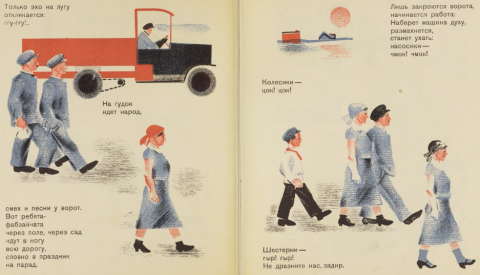
A Digital Archive of Soviet Children’s Books

by swissmiss


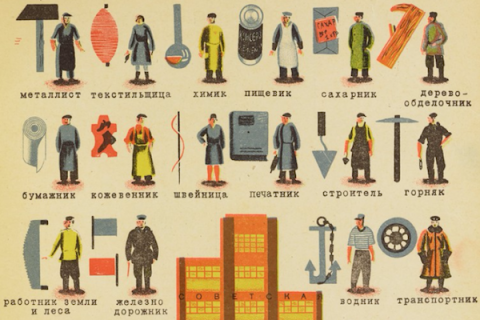
Playing Soviet” is an interactive database of children’s book illustrations drawing from little-known and rarely-seen Soviet children’s books from the Cotsen Collection at Princeton’s Firestone Library.

(via Open Culture)

04 Jul 15:37

The Perils of Meritocracy

by Megan Garber

American culture nurtures many myths about the moral value of hard work. The phrase “by the bootstraps,” still widely used to describe those Americans who have found success through a combination of dogged work and stubborn will, rose from a mis-remembering of The Surprising Adventures of Baron Munchausen: In it, the eponymous aristocrat pulls himself from a swamp—not by his bootstraps, but by his hair. And Horatio Alger’s stories, as well, while often remembered collectively as the prototypical tale of American rags to American riches, also romanticized the social and economic power of good luck. (Ragged Dick, in the Alger story named for him: “I’d like it if some rich man would adopt me, and give me plenty to eat and drink and wear, without my havin’ to look so sharp after it.”)

The myths live on, though, for the same reason myths often will: They ratify a deeply held value in American culture. They allow us denizens of the current moment to hold onto one of the most beloved ideas that has animated Americans’ conception of themselves—ourselves—as a culture, over the decades and centuries: that we live in a meritocracy. That our widely imitated and yet idiosyncratic take on democracy has been built, and continues to rest, on a system that ensures that talent and hard work will be rewarded. That the American dream is real, and enduring.

Current events, however—and Americans’ ability to share their experiences with each other, via new technological platforms—have helped to reveal the notion of meritocracy to be what it always was: yet another myth. And: a myth that is particularly pernicious, when it comes to Americans’ sense of what we owe to each other. During a discussion at the Aspen Ideas Festival, co-hosted by the Aspen Institute and The Atlantic, NPR’s Michele Norris talked with Darren Walker, the president of the Ford Foundation, and Jeff Raikes, the co-founder of the Raikes Foundation. The trio, in their discussion, emphasized the tensions between how we talk about the American dream and how people live it.

“As Americans, we want to believe that you can get on that mobility escalator and ride it as far as you want,” Walker said, “but that no one rides it faster than anyone else.” We want to believe that talent will triumph, and that hard work will be the tool of that success. Which is to say: We want to believe that opportunity is evenly distributed.

But, of course, that great escalator is faster for some than it is for others. It is harder for some to get to than it is for others. The fact is, as Walker pointed out, this country “was constructed on a racialized hierarchy.” It’s a hierarchy that remains today—one that is evident, in ways both obvious and insidious, across American culture, across the American education system, across the American housing system, across the American economy.

And yet our stories, and our myths, tend to belie that reality. The logic of meritocracy, as a concept—“a system in which the talented are chosen and moved ahead on the basis of their achievement,” per Merriam-Webster, but also, per Dictionary.com, “an elite group of people whose progress is based on ability and talent rather than on class privilege or wealth”—endorses a world in which economic success carries a moral valence, and in which, as a consequence, the lack of such success implies a kind of moral failing.

That’s a tension playing out, at the moment, with the negotiations taking place in Congress, about the future of the American healthcare system. Many of those debates, my colleague Vann Newkirk pointed out, have adopted the pernicious logic of the prosperity gospel—the idea that success, and wealth, and indeed health itself, are signs of God’s favor. It’s a tension, as well, that has long inflected conversations about social assistance programs—a tension that has, in general, long defined how Americans think about what they owe to each other, as people and as fellow citizens.

“Meritocracy” takes as its core assumption, essentially, an equality that does not exist in America. One that, indeed, has never existed in America. “To successful people,” Walker said, “to interrogate their success requires that they acknowledge the injustice that is baked into our systems. And that’s really, really hard to do, because we’re patriots. We believe in our country. We believe that there is something that makes it possible for people like me, and Jeff, and you”—he was talking to Norris—“to be where we are today.”

That something is, in the Algerian sense, the American dream. That something is meritocracy and a myth and an ideal. Those things claim to speak to the best of who we are; in practice, however, they can serve as a justification of the worst. They can allow us to romanticize the world rather than interrogate it. After all, as Norris summed things up: In America, “we are the land of the brave and the home of amnesia.”

03 Jul 19:31

The Link Between SIDS and Serotonin

by Adrienne LaFrance

Sudden Infant Death Syndrome is not common, exactly, but it isn’t rare either. And despite a considerable decline in SIDS over the past 20 years, it remains the leading cause of death among babies between 1 month old and 1 year old, according to the Centers for Disease Control and Prevention.

At the same time, the underlying reasons for SIDS have remained a mystery, even after decades of study. That’s beginning to change. The latest research has dramatic implications for scientists’ understanding of SIDS, and hints at the distant possibility of a blood test that might be used to screen newborns for the syndrome.

A study published Monday in the Proceedings of the National Academy of Sciences finds a substantial number of SIDS deaths appear to be linked to elevated serotonin, a chemical that helps regulate breathing and other functions. Researchers tested the blood of 61 babies whose deaths were characterized as SIDS and found that nearly one-third of them had increased levels of the neurotransmitter in their blood.

“This is a very exciting finding,” says Rosemary Higgins, a neonatologist at the National Institute of Child Health and Human Development, which oversaw the study. “More research would need to be done, but it could possibly lead to a forensic test to distinguish SIDS deaths from other causes of death among infants.”

SIDS deaths are notoriously difficult to track, in part because some infant deaths—like accidental suffocation by bedding in an unsafe sleep environment—are counted as SIDS deaths even though they aren’t truly inexplicable. About 3,700 babies died suddenly and unexpectedly in 2015, the most recent year for which the CDC has data. The agency counts 1,600 of those 3,700 total deaths as SIDS.

So the possibility of a forensic test that could determine which deaths are truly attributable to SIDS could further doctors’ understanding of the syndrome in key ways. For example, such a test would be a necessary step toward eventually developing a screening for at-risk newborns before they die. Though the possibility of such a screening is still a long way off, Higgins says.

The latest PNAS study builds on a growing body of evidence that suggests brain abnormalities—some of which entail elevated serotonin levels—may be linked to SIDS. One previous study, published in the Journal of the American Medical Association in 2010, found a link between SIDS and lower levels of serotonin in the brain, whereas the latest PNAS study, which looked at elevated serotonin, focused on serotonin levels in the blood.

These earlier findings, coupled with the latest research, suggest that an abnormality in serotonin metabolism—leading to lower or higher levels in different parts of the body—could indicate an underlying vulnerability that increases a baby’s SIDS risk. Researchers are still working to understand a causal link, however.

Many questions remain. Because the researchers were specifically testing serotonin levels, they don’t know whether the 19 babies with elevated serotonin in their blood had any other abnormalities in common. It’s also unclear whether the same groups that suffer higher rates of SIDS deaths are also more likely to have elevated serotonin serum. For instance, black babies and Native American babies are more than twice as likely as white babies, Asian babies, or Hispanic babies to die of SIDS. Premature babies and boys are also disproportionately represented among SIDS deaths compared with full-term babies and girls. “The cost of testing and the rarity of the event are prohibitive to screening at the moment,” said Peter Blair, an epidemiologist who focuses on SIDS at the University of Bristol in England. “If we can improve identification of a small group at high risk, then maybe.”

One of the biggest questions posed by the latest study is: Just how big of a risk factor is increased serotonin in the blood? In other words, among babies who have higher levels of serotonin in their blood, how much more likely are they to be victims of SIDS? After all, most of the babies in the study group had normal blood serotonin levels.

(NIH)

Most researchers view the syndrome as part of a “triple-risk model,” meaning SIDS results from three interacting factors that affect the baby all at once. The three factors in the triple-risk model include the underlying vulnerability, the stressful environment, and the critical phase of development that the infant is in. Under this model, an infant with an underlying vulnerability would also have to be in a bad situation—like being placed on his or her stomach when put to sleep, which is unsafe for newborns—to trigger SIDS.

Although SIDS deaths are sudden, a latent vulnerability may be present for days or months prior to death, the researchers of the PNAS study wrote, and may even originate during gestation.

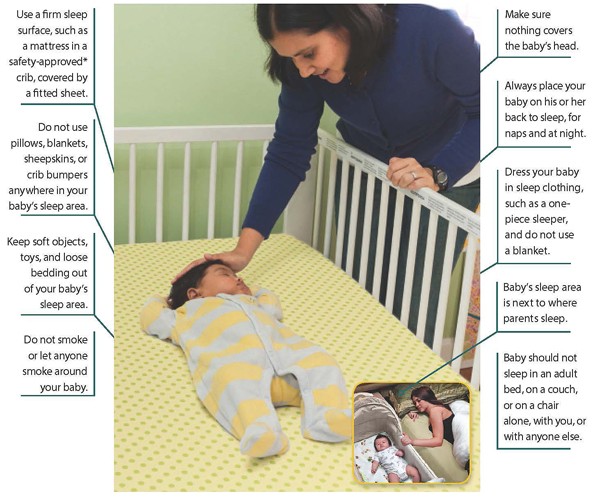
For the time being, the best advice for parents and other caregivers who are worried about SIDS is still to follow the “safe to sleep” guidelines: That means a baby should always be put to bed in an empty crib with a firm mattress. The crib should be free of any toys, bedding, blankets, or pillows. And the baby should be placed flat on his or her back.

But it will be hard to completely eliminate the risk for SIDS until scientists understand just where it comes from.

“Just as important with these findings," says Blair, who did not work on the study, "is that we are getting closer to identifying causal mechanisms for SIDS. The welcome fall in [SIDS-death] rates is due to good risk-reduction advice rather than an increased understanding of why these infants die.”

03 Jul 13:21

How to Be a Human Leader

by Megan Garber

Here is a very impressive group of women: Jean Case. Rabia Chaudry. Rochelle Keyhan. Joanne Lipman. Arati Prabhakar. Sandra Phillips Rogers. Gillian Tett. My Atlantic colleague Gillian White. Case is, among other things, the CEO of the Case Foundation. Chaudry is, among other things, the president of the Safe Nation Collaborative. Phillips Rogers is the group vice president, general counsel, and chief legal officer of Toyota Motor North America. The list goes on. On Thursday evening at the Aspen Ideas Festival, co-hosted by the Aspen Institute and The Atlantic—in a conversation moderated by Pamela Reeves, gender advisor to Melinda Gates (and the wife of Jeffrey Goldberg, The Atlantic’s editor in chief)—they gathered to share stories of challenge and success in an American work environment that was not designed with women in mind.

The women told tales of discrimination both overt and subtle. They discussed finding their own ways to rise above it. And at the end of the session, they offered up more concrete advice—for finding success in general, but particularly for finding it in that basic setting that can so often determine achievement across the arc of one’s career: the meeting. The place where workers in so many industries perform and, consequently, are judged.

What strategies, Reeves asked, do you use to make sure you are heard—and, by implication, impressive—in meetings?

Here were some of the women’s answers:

Amplify the voices of fellow women: The strategy of “amplification,” most famously employed by women of the Obama White House, relies on women supporting each other, collectively. It works like this, as the Washington Post explained: “When a woman made a key point, other women would repeat it, giving credit to its author. This forced the men in the room to recognize the contribution—and denied them the chance to claim the idea as their own.”

Repeat, repeat, repeat: Foster a we’re-in-this-together sense of community in the group, for everyone involved in the meeting, by explicitly acknowledging the contributions of others. Begin a comment, for example, with something like, “Let me build on what Bill said,” and then go from there.

Use humor liberally: Tell jokes! Make things fun for people! This is generally good advice.

Set expectations for your contribution: Begin a comment by saying something like, “I have three points to make”—and then make those points systematically. It’ll make you seem organized. It’ll also make you less likely to be interrupted.

Imitate, tastefully but shamelessly: Observe who, in a meeting or other group setting, seems to get paid the most attention to by higher-ups or fellow participants. And, then, imitate those people. If their approaches—their gestures, their tone of voice, their general manner of expressing themselves—are getting them heard, mimicking those approaches should help to do the same for you.

Stand up: No, but literally. For phone meetings, in particular. This is especially helpful for tough conversations: Standing up, for one thing, you’ll feel more confident and powerful. Also, as Gillian Tett argued, your voice will literally be lower when you’re standing, giving it a boost of gravitas.

Take up space: Again, literally. In physical meetings, spread out. Lean forward when seated at a table. Own your own presence, physically and otherwise.

Be loud: Yes, literally again! Too many women, Jean Case said, speak meekly and quietly. Don’t be one of them. Speak up. Your voice, projected across the room, will also project confidence.

Don’t say “I’m sorry.” Unless you really should say you’re sorry.

Fake it ‘til you make it: If you’re feeling shy, pretend to be bold. If you’re feeling like you don’t belong, convince yourself that you do. Act. Pretend. Perform. Until soon, ideally, you’re not performing anymore. “Just fake it,” Tett said, “and then if you do it enough, you’ll start to believe it.”

It’s all extremely good advice. It’s advice, notably, that works for men as well as women who want to be seen and heard and valued. What’s also striking about these assorted workhacks, though, is the common idea that unites so many of them: Many of these tips are premised on the value of women imitating stereotypically male behavior in the workplace. Be loud. Take up space. Project gravitas. Women would be well advised, many of these expert tips are suggesting, to mold their behavior according to a paradigm that has been established by centuries’ worth of primarily male leadership, in business and beyond—a paradigm that rewards things like, say, overt confidence, and unapologetic volume, and underlying swagger.

And: The experts are entirely correct to offer that advice. If women are to be better represented in business as in other arenas of American life, they need first of all to have that proverbial and all-too-literal seat at the table. Often, the seats are allotted to those who best fit existing notions of “powerful” leadership—to the people who prove best, in the end, at swaggering. As a consequence, fake-it-’til-you-make-it isn’t merely a theme at the Aspen Ideas Festival; it is also a strategy regularly offered within the growing field that advises women on the tricky work of succeeding in business while being female. Sheryl Sandberg advocates for it (or, more precisely, for a version of it: “fake it,” she advises, “’til you feel it”). So did many of the women writing essays for Robin Romm, in the recent collection revealingly titled Double Bind: Women on Ambition. Strategic performance is a way to combat imposter syndrome; it’s also a way to ensure that women will be able, within a cultural context that hasn’t been designed for them, to align their behavior with their ambitions.

But fakery-until-makery is powerful primarily as a kind of transitional measure: It’s a means to an end. It reflects the world as it still is: a world in which stereotypes of male leadership still shape our conceptions of prowess and efficacy and success. In 2017, a group of highly successful women shared a collection of very useful tips on how to be louder and brasher and more performatively powerful. Perhaps, at an Ideas Festival years down the road, those same women, and those who follow in their path, will offer a different set of advice—workhacks reflective of an environment where women have many more seats at the table.

03 Jul 13:01

Is your cat plotting to kill you?

by Matthew Inman
Is your cat plotting to kill you?

This app will scan your cat and tell you the likelihood that they are plotting to murder you.

View
03 Jul 12:46

grilled pizza

by deb

Before we snuck a grill onto our balcony one glorious day last May, I would regularly show up at friends-with-grills homes with prepared pizza dough and a few toppings in the summer; I love grilled pizza so much that I’d feed a crowd just to get my fix. It was one of the first things I made when we bought our own. The benefits of cooking pizza outside are manifold. With heat circulating all around the pizza and the dough resting on open grates instead of a flat tray, I find that you can get more texture — crisp on the outside but staying stretchy within — and flavor — charred spots that will immediately remind you of your favorite brick-oven pizzeria, without heating up your apartment, pretty much the last thing any of us want to do in the summer. Plus, it’s really quick. Once your dough is purchased or prepared, you could be eating your pizza in 10 minutes; not bad for a homemade dinner after a long day.

Read more »

30 Jun 10:53

U.S. Wastes $28 Million on Afghan Soldiers's Uniforms, Watchdog Says

by Yasmeen Serhan

The Pentagon wasted as much as $28 million over the last decade on camouflage uniforms for Afghan soldiers despite the fact forests make up only a small fraction of the country’s landscape, according to a report released Wednesday by the Special Inspector General for Afghanistan Reconstruction (SIGAR).

The findings comes a decade after the Department of Defense moved to procure new uniforms for Afghanistan’s National Army as part of U.S. efforts to bolster the country’s capacity to provide its own security. The uniforms, which cost approximately $93 million, were made using a “forest” pattern from a company called HyperStealth—one which the report says was chosen over other free camouflage patterns owned by the U.S. government after Afghanistan’s defense minister at the time, Gen. Abdul Rahim Wardak, “liked what he saw” on the company’s website.

This decision was problematic. As SIGAR noted in its report, the “forest” color was chosen “despite the fact that forests cover only 2.1 percent of Afghanistan’s total land area.” This didn’t go unnoticed by HyperStealth, which acknowledged in a February 2010 press release that the forest design may seem an “odd choice” for Afghanistan.

John Sopko, the special inspector general for Afghanistan Reconstruction, called the move “insane.”

“This is just simply stupid on its face,” Sopko told USA Today. “We wasted $28 million of taxpayers’ money in the name of fashion, because the defense minister thought that that pattern was pretty. So if he thought pink or chartreuse was it, would we have done that?”

Indeed, the report concluded that the uniforms added between $26 million and $28 million to the overall cost of the uniforms, adding that changing the uniforms could save the U.S. between $68 million and $72 million over the next decade.

The Pentagon did not dispute its findings.

“DoD concurs in the suggestion contained in this report that a DoD organization with expertise in military uniforms should conduct a cost-benefit analysis of the current Afghan National Army (ANA) uniform specifications to determine whether there is a more effective alternative, considering both operational environment and cost,” Jedidiah Royal, the acting deputy assistant secretary of defense for Afghanistan, Pakistan, and Central Asia, said in a statement.

29 Jun 13:13

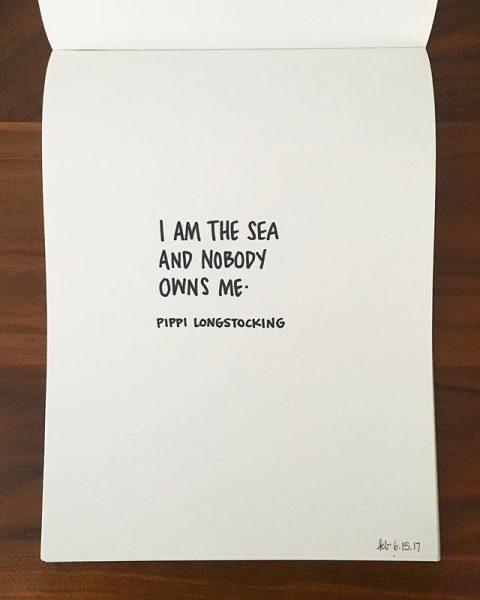
Nobody Owns Me

by swissmiss

28 Jun 15:34

Good Health Never Lasts

by Adrienne LaFrance

Good morning, fellow mortals!

At this pivotal moment in American policymaking, I’m here to remind you of our individual and collective doom. Wellness, like youth, is temporary. In the end, you either get sick, then die—or you die before you can get sick in the first place. It bears repeating, apparently, at a time when the health-care debate in the United States has become so partisan as to imply the population of sick people and well people is just as cleanly divided as Americans are politically split. But this isn’t the case.

You can’t choose to be healthy or ill the way you can choose to be a Republican or a Democrat. You can’t choose for your babies not to be born with medical problems.

You can do everything right to stay in good health. You can be one of “those people who lead good lives,” as the Alabama Republican representative Mo Brooks put it in a television interview, explaining why healthy people should get to pay less for insurance than sick people. And you’re still likely to find yourself facing unexpected medical costs at one point or another.

If you’re lucky, it won’t be catastrophic. But eventually, everyone’s luck runs out.

On top of the massive bills that can result from unexpected injuries or illnesses, each of us who continues to get older every moment of every day is marching inexorably toward needing more (and more expensive) health care as we age. More than 60 percent of all nursing home residents rely on some Medicaid funding, for example.

This is why the basic principle of health insurance is what it is, and why the concept of high-risk insurance pools, lumping together the neediest people in the population, is so problematic. Younger and typically healthier people subsidize the cost of health care for older people not just out of some moral imperative, but based on the premise that the younger people will someday be old themselves.

Yet the GOP’s Better Care Reconciliation Act would, in essence, penalize the elderly and the poor. Both groups are disproportionately represented among the 22 million additional Americans who would be without insurance a decade from now if the Republican plan passes, according to the latest Congressional Budget Office estimate. And that’s largely because the bill decimates Medicaid, which flows to 40 percent of all American children, 60 percent of children with disabilities, and more than 75 percent of all poor children in America.

By cutting out $772 billion in Medicaid spending over a decade, the Republican bill would save money for the wealthiest Americans by making poor people pay more money for stripped down versions of existing insurance plans. The consensus in the medical community is that these cuts could be ruinous to the 1 in 5 Americans who rely on such funding. This isn’t just about poor, disabled kids: Americans nearing retirement age would be hit particularly hard. “Medicine has long operated under the precept of Primum non nocere, or ‘first, do no harm,’” wrote James L. Madara, the CEO of the American Medical Association, in a letter to senators this week. “The draft legislation violates that standard on many levels.”

Many critics have fixated on how cruel it is to draft a bill that squeezes sick people and old people out of the insurance market, and understandably so.

But there are pragmatic concerns, too. Like the fact that populations of people who tend to need health-care services the most—the poor, the elderly, the very ill—are in constant flux. The 5 percent of Americans who account for 50 percent of the country’s healthcare costs isn’t a static group, as Helaine Olen recently wrote for this magazine. “A chronic illness can land someone in this category but, given the increasing prevalence of high-deductible plans, so can something as simple as a broken bone or an emergency appendectomy. Although some people will be in this group year after year, many will cycle in and out, and nearly everyone will be in it for some brief period.”

Nearly everyone means me, and you, and all the people we love. Because, if we’re lucky, we’ll all eventually become very old indeed, and the likelihood that we’ll need expensive health-care along the way is quite high. (An enormous part of this is preventative care in high-risk populations, which can drive down costs—but only for those who have consistent, affordable access to care.)

Many Americans cannot afford to pay for insurance hikes under the Affordable Care Act—the cost of the most popular Obamacare plan is going up 22 percent this year. Senator Mitch McConnell, the majority leader and author of the legislation, has argued he simply wants Americans to be free to make “the best health care decisions for their families on what types of plans they want and can afford.” But who can afford a serious illness? How can anyone plan for such a thing?

“There are no ‘healthy’ and ‘sick’ people,” wrote Ken Norton, a partner at Google Ventures, in a Twitter essay about the death of his 11-year-old son from a congenital heart defect in 2014. “Healthy people can turn into sick people really fucking suddenly... I’m here to tell you that there is no ‘us’ and ‘them,’ no responsible taxpayers and irresponsible moochers, we are them and they are us.”

The men who bristle at the idea of paying for insurance that covers women’s prenatal care would do well to remember that they themselves are former fetuses. And healthy people need to remember that they are future sick people, too.

The question of how to fix the Affordable Care Act—which, indeed, needs attention—isn’t just a question for poor people, or the elderly, or the middle class, or people with pre-existing conditions, or people who don’t have jobs, or the tens of millions more Americans who will be uninsured in a decade if the GOP’s repeal-and-replace plan passes. It is a question for all Americans, because all of us are vulnerable to a change in fortune.

26 Jun 17:00

How the Senate's Health-Care Bill Would Cause Financial Ruin for People With Preexisting Conditions

by Gene B. Sperling

If there was one goal Senate Republicans had set out to achieve in developing their health bill to show they were less “mean” than their colleagues in the House, it was to take away the House Republicans’ green light for insurers to once again discriminate against those with pre-existing health conditions. Senate Republicans were willing to drive up deductibles and co-pays and be more draconian on Medicaid cuts, but on the one issue of pre-existing conditions they were intent on being less “mean,” as President Trump termed the House bill. Now that the text of the bill has been released, it’s clear that they have failed to achieve that.

As they argue for the bill, Republicans are going to claim that it will not allow insurance plans to discriminate against people because they have a pre-existing condition. But that just isn’t the case. The Republican plan may not allow insurers to discriminate against a pre-existing condition through the front door, but they’ve created a backdoor way in.  

So what is this backdoor for discriminating against those with pre-existing conditions and how does it work?

Answering that question requires understanding the importance of a key protection in the Affordable Care Act, what is known as the “Essential Health Benefits” requirement. These Essential Health Benefits rules require insurance companies to cover critical care, such as treatment by doctors, hospital stays, and prescription-drug costs. The guarantee of Essential Health Benefits means that no insurer can provide any health plan that excludes these critical benefits. Perhaps it goes without saying, but if these benefits are not covered, a plan is all but worthless to those with serious pre-existing conditions.

The Affordable Care Act does allow, through Section 1332, for states to have some flexibility to waive these and other requirements, but only if they meet very rigorous conditions or “guardrails” that ensure coverage remains available, affordable, and high-quality. This is where the new Senate bill makes significant—and dangerous—changes. The bill drives straight through these carefully crafted guardrails. Today, to waive requirements like essential benefits, a state must show that the alternative insurance being provided is “comprehensive,” and “will provide coverage and cost-sharing protections against excessive out-of-pocket spending.” These careful conditions on quality are removed in the Senate bill, replaced with a bare-minimum requirement that the alternative doesn’t increase the federal budget deficit. States will be able to easily waive the requirement to cover Essential Health Benefits, without any careful conditions to ensure the quality and affordability of coverage.

As a result, insurers will offer skinny plans with less coverage that falls far short of the needs of those with serious health conditions. This is how it used to work: Before the Affordable Care Act, according to the Kaiser Family Foundation and the Department of Health and Human Services, almost one in 10 Americans in the individual market didn’t have coverage for prescription drugs. Young and healthy people will opt for those plans, leaving those with pre-existing conditions in their own, much more costly, market. In the end, the effect is the same as if companies could just outright discriminate against those with serious health problems.

Consider, for example, a family with a spouse or parent with cancer whose drug treatment costs thousands of dollars for their drugs. They think they have a victory in that under the Senate plan, their insurance company can’t explicitly charge them more because of their family member with a pre-existing condition. But, unfortunately for them, they find that they live in a state that allows insurers to offer plans that don’t cover prescription-drug costs. This family will face nothing but bad choices.

Because the skinny, incomplete plans are a non-starter for them, they can’t take the cheap option. But everyone who’s young or healthy does. The only people choosing the alternative, signing up for a plan that actually meets their needs, are those with serious conditions. This will further drive up the costs of these plans—the only plans that actually cover the treatment that seriously sick people need—and will further drive the young and the healthy away.

The state may not explicitly say they are making those with pre-existing conditions pay more, but that will be the impact. Many of those families will simply not be able to afford the care they need. And it could get worse. A thoughtful analysis by Matt Fiedler at the Brookings Institution found that where states can waive Essential Health Benefits, insurance companies and employers could reinstate annual and lifetime limits on coverage.

Simply put, the Senate bill will open the door to states forcing people with pre-existing conditions into segregated markets that will lead them to pay far, far higher costs than everyone else. People with pre-existing conditions could run into new annual or lifetime limits on how much insurance coverage they can get. That means those with the most serious chronic health conditions (and their families) will be at increased risk of financial devastation and even bankruptcy. The bottom line is that the backdoor discrimination the Senate plan allows against those with pre-existing conditions is as cruel as the discrimination in the House bill which the Senate claimed to fix.

These are exactly the reasons why the American Cancer Society urged concern about waiving these critical protections: “If a state decides that prescription drugs are no longer an essential health benefit, a plan could cap the amount it covers for cancer drugs—or decide to not cover cancer drugs at all—leaving patients to pay the entire bill.” And it is why they urged the Senate to “return to the drawing board” when they saw the bill’s text.

And it’s not only coverage for expensive drugs: By requiring insurers to cover Essential Health Benefits, the Affordable Care Act protected the 62 percent of individual-market enrollees who before the law did not have maternity coverage, the 34 percent who didn’t have substance-abuse-treatment coverage, and the 18 percent that did not have mental-health coverage. With the broad waivers like those possible under the Senate bill, one could expect that Essential Health Benefits like covering drug-abuse treatment, including for those with opioid abuse, and mental illnesses and maternity coverage could be dropped in various states, meaning more discrimination against women and millions with mental illness or histories of drug abuse.

This bill will take American healthcare back to what everyone in the U.S. should recognize was a completely broken system before the Affordable Care Act. It will takes the country back to a system in which companies often profited not by how well they provided healthcare but by how well they discriminated against or screened out those who faced the most challenges. President Trump promised “insurance for everyone” and lower costs, but this bill will bring the country back to a system in which insurance only works for the healthy, and the sick can’t afford the coverage they need.

23 Jun 17:10

GLOW Is a Total Delight

by Sophie Gilbert

In the third episode of GLOW, a new 10-part series debuting on Netflix Friday, a male producer and a male director brainstorm possible characters for their women’s wrestling circuit. As in the real-life Gorgeous Ladies of Wrestling—which featured characters named Palestina, Jailbait, and Big Bad Mama—the various identities rely heavily on stereotypes. Jenny (Ellen Wong) becomes Fortune Cookie. Tammé (Kia Stevens) is Welfare Queen. Arthie (Sunita Mani) is Beirut. “It’s not a judgment,” GLOW’s coked-up producer, Sebastian (Chris Lowell) explains. “It’s just what I and the entire world see with our eyes.”

GLOW, created by Liz Flahive and Carly Mensch and executive produced by Orange Is the New Black’s Jenji Kohan, arrives in a heady fog of hairspray and ’80s nostalgia, but it pulls no punches in its treatment of the entertainment industry. In the show’s very first scene, Ruth (Alison Brie), an actress, delivers a monologue in an audition and raves about the role, commenting on how few roles like this there are for women. “You’re reading the man’s part,” the casting agent replies. Which is how Ruth ends up in a gym with 50 or so other “unconventional” women, auditioning for a new kind of “family-friendly” entertainment. On the one hand, she can see how patently absurd it all is. On the other, it’s still the only job going where she can actually dig into a strong female character.

Ruth has more than a little of OITNB’s Piper to her—she’s pretentious, earnest, and painfully self-centered, and there’s a reveal in the first episode that might put viewers off entirely if Brie weren’t so endearing in the role. After one failed audition, she goes home, immerses herself in WWE, and practices wrestling personas at home wearing a makeshift cape and cut-off rubber gloves (“I’m Pre-Menstrual Syndrome!,” she bellows). But it’s an actual fight with her friend Debbie (Betty Gilpin) that persuades the director, Sam Sylvia (Marc Maron) to cast both of them—Debbie as Liberty Bell, an all-American superhero, and Ruth as her Russian nemesis. “Relax,” Sam tells Ruth. “The devil gets the best lines.”

Flahive and Mensch’s ensemble cast is terrific. Gayle Rankin plays Sheila the She-Wolf, a monosyllabic goth whose outfits Ruth tries to identify with by explaining that she once went to school dressed as Anne of Green Gables every day for a year. Sydelle Noel is Cherry, an out-of-work actress who becomes the girls’ primary trainer and caretaker. The British singer-songwriter Kate Nash plays Rhonda, a daffy and lovable type whose character, Britannica, is a Nobel-prize winning scientist in spandex. And Britney Young is Carmen, the neglected 25-year-old scion of a professional wrestling family. The show has fun with the fact that the characters are literally grappling with female stereotypes in the ring while proving how much more complex and interesting the real women are.

Maron, as the unkempt and past-his-prime Sylvia, is so charming that he steals virtually every scene he’s in. A frustrated former B-movie director based on Matt Cimber, Sylvia is a chain-smoking, drug-snorting, womanizing wreck who’s also surprisingly protective of the team he’s assembled. (“Don’t take that!” he snaps at “Beirut” when Sebastian offers her “terrorist” persona a gun to wield.) And Gilpin (Nurse Jackie) is stellar as Debbie, a bombshell former soap star dealing with a cheating husband and an infant son who bites her while he’s breastfeeding. Just like Ruth, she seems to find something in the ring that’s unexpectedly satisfying, even if it’s just a momentary chance to be a star-spangled superhero.

GLOW has plenty of ’80s accoutrements—some nostalgia-inducing (a synth-heavy soundtrack, leotards for every occasion, neon eyeshadow, Steve Guttenberg) and some not (a home pregnancy test that resembles an AP chemistry exam). Each episode runs around 30 minutes, which allows the show to both delve into individual stories and spin a larger arc, with few of the pacing issues of Netflix’s longer shows. Mostly, though, it’s just a blast to watch women having so much fun. GLOW fully owns its campiness and its showy aesthetics, but it’s smart and subversive underneath the glitter.

23 Jun 13:00

zucchini grilled cheese

by deb

A highly recommended way to be very unpopular with the people you share meals with is to tell them you’re making zucchini grilled cheese for dinner.

“Like, zucchini as the bread?”
“Zucchini instead of cheese?”
“But I don’t like zucchini!”
KEENY.”

Read more »

20 Jun 18:05

The Taco–Burrito Exchange Rate Is Out Of Control

by Brian Feldman

3 tacos = 1 burrito, so why don’t they cost the same?

Image: Kyle Van Horn

Here’s something that happens to me literally every time I go to any fast-casual Mexican food joint in New York City. I think about getting three different tacos, a hearty amount of food that lets me taste a bunch of different stuff! And then I look at the burritos, which are roughly equivalent to three tacos and do some mental math. And always, unless I’m feeling luxurious, I end up getting the burrito. It’s very messed up. It’s because the pricing was done by a crazy person.

(A quick note before I go any further: I will be talking about the prices of Mexican food in New York City. I will not be talking about the quality of said food, which is generally serviceable. The point I want to make clear to you, my dear reader, is that I truly do not give any semblance of a shit about how “the only place to get good Mexican food is on the West Coast,” or something. That’s not what this is about.)

So, here’s what the ordering process looks like. I take a look at the tacos, which usually range in price from $3 to $4.50. I price them out. Let’s say that after tax, 3 tacos is about $12 (some places also offer a 3-taco combo option that’s maybe slightly cheaper). Then I look at the burrito options, which use many of the same fillings, but somehow only cost 8 or 9 dollars. What?????

The burrito-taco exchange rate in New York City is absolutely ludicrous. Why should 3 tacos, a portion that is, IMO, equal to one burrito, cost me 50% more? I could get two tacos for the price of a burrito, but in my experience, two tacos is not enough. I can put away three, easy. It sucks to get only two tacos and still be hungry, knowing that money could have been put towards a duty-fulfilling burrito instead.

You could argue that much of a burrito is low-cost ingredients like rice and beans, whereas a taco is mostly expensive proteins. But I’m literally not buying that. I’m always acquiescing to the burrito. Most of this is mental — it’s not the flat price I have a problem with as much as the gap in pricing. If a burrito cost as much as three tacos, I would not be talking about this at length. But unfortunately, we live in a society where a burrito costs significantly less than three tacos. Maybe they could make the tacos less expensive by putting less filling in them? Just a suggestion.

We need common-sense taco pricing reform in New York City. The movement starts now.


The Taco–Burrito Exchange Rate Is Out Of Control was originally published in The Hairpin on Medium, where people are continuing the conversation by highlighting and responding to this story.

18 Jun 20:27

IKEA now on Amazon

by swissmiss

OMG! You can now order IKEA products on Amazon? My head just exploded. This changes everything!

UPDATE: Uh-oh. Looks ike it’s resellers and not IKEA directly selling on Amazon. This bums me out.

15 Jun 13:13

How to Make a Charcuterie and Cheese Board

by Gina
Charcuterie and cheese boards look impressive, but they’re surprisingly easy to make! I’ll show you how to make a charcuterie board with a variety of meats, cheeses, and accompaniments for a party or snack. An Epic Charcuterie Board Is Easier Than You Think! Charcuterie and cheese boards are my go-to for super chill, no stress […]
12 Jun 20:17

Emotions

by swissmiss

Yesterday I posted on Instagram about the book “How Emotions Are Made” and multiple commenters said I should listen to this episode of Invisibilia. They were right. So good.

12 Jun 20:17

The Warning on the Door

by Pat

Y’know what? It’s been a while since we’ve had a cute kid story on the blog here. I think we’re overdue.

So a while back we were having a little party at our house. And my oldest boy Oot….

You guys do know Oot, right? It’s been a while since I talked about him here. He’s the older of my two little boys.

(Here he is winning a game of Tak.)

Oot is 7 years old now, if you can believe it. He is my heart’s delight. And despite my failings, he has grown up sweet and kind and loving and full of empathy.

So. A couple months ago, we were having a little shindig at our house. Except this wasn’t an event of the sort that I would organize, not a couple people coming over for games. Sarah’s family is huge, and there are roughly eleven billionty children in it. So this isn’t a cozy little gathering. It’s going to be an event. It’s going to be a happening.

The complication? We have a relatively small house. Only about 1400 square feet, and one of the two bathrooms is only accessible through a bedroom.

And here’s the thing. It’s *my* bedroom. Which means it a fucking mess. I’ve got piles of books and detritus everywhere. You can’t hardly see the floor. Plus I have a lot of stuff on my shelves is  dangerous at best, and at worst just straight-up deadly. Picture it as a more cramped version of a wizard’s lab, except instead of having a stuffed crocodile hanging from the ceiling, there’s a mattress on the floor.

Simply said: I do not want people wandering through my bedroom. For real. I’ve mentioned this many, many times to Sarah when she has family over.

So. Anyway. We’re getting ready for the party, and I come back from an errand to discover Oot has written up some helpful signs and stuck them to my door.

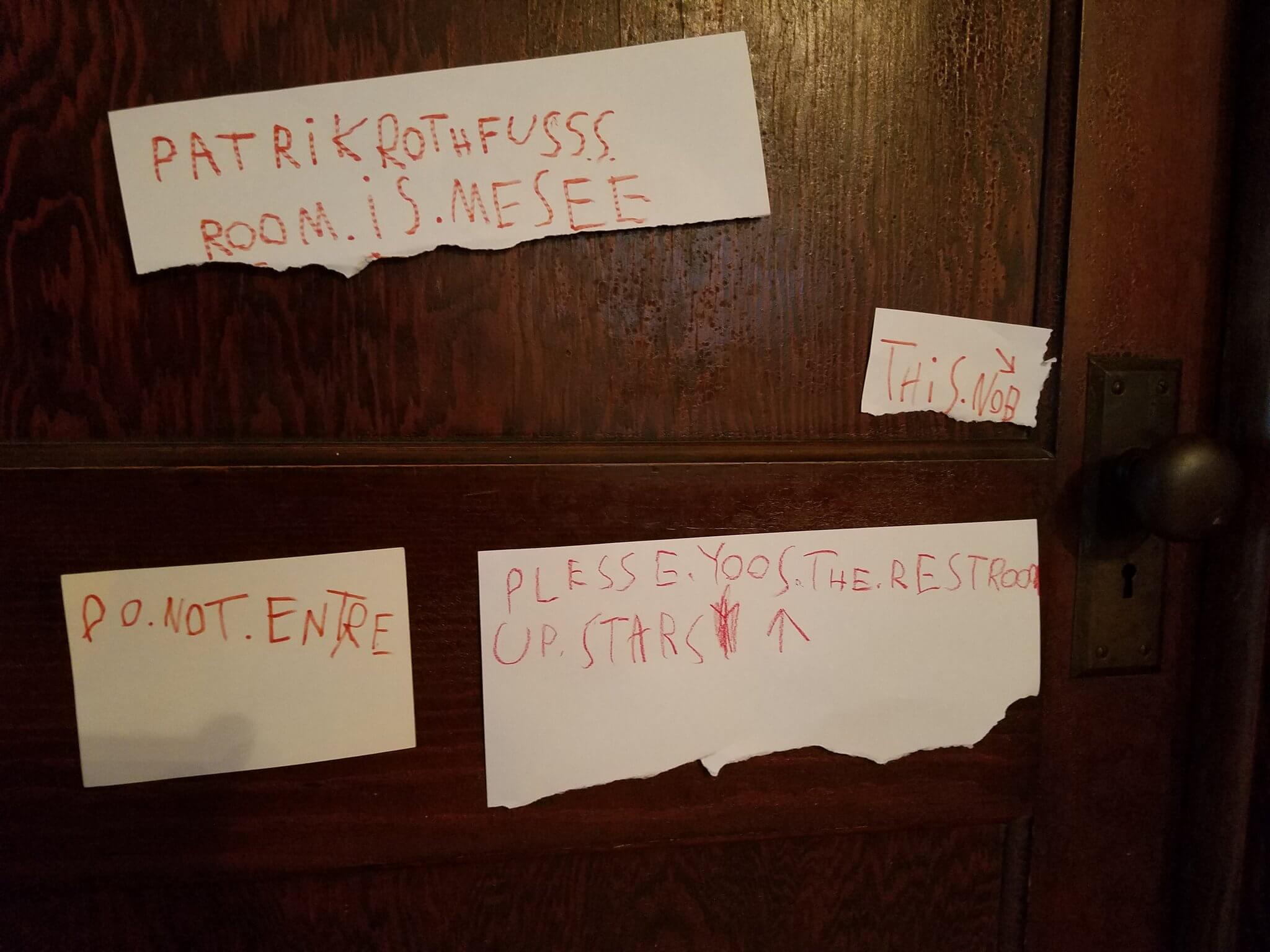
20161211_124915(Click to Embiggen. Seriselee.)

Please, *please* click the above image and try to puzzle out what it says on your own. Oot has my genes both for penmanship and spelling, but if you click on it, you should be able to make it out with a little work. And it’s *so* much better if you read it in the original.

For those of you who can’t quite make it out, the signs say:

“Do. not. Entre.”

“i. Will. Kil. You. if. You. Trn.”

“This. Nob. (Arrow pointing to doorknob.)”

“Seriselee. Stae. The. Fukc. Out.”

Now when I see this, I am absolutely fucking delighted. I am over the moon. I could not possibly enjoy it more.

First and foremost, this is a very thoughtful thing he’s done. I ask Sarah if she put him up to it, and she said she hasn’t. All on his own, my little boy has decided to help me keep my room private because he knows it bothers me when guests wander in there. He’s heard me talk about it, and he’s trying to help.

As for the rest…. well… I’m probably reading it a little differently than you, because I know more of the backstory. (It might surprise none of you to know that I consider backstory to be pretty important.)

You see, years ago, when I discovered that here in small town Wisconsin, a mortgage is actually cheaper than renting an office. So I bought a grotty old student rental house to use as a disturbance-free writing space.

In that house, I have a writing room which nobody is allowed to enter. Because it’s my fucking writing room.

But I also use the house as a guest house where friends can stay when they’re in town. And my friends are curious people. So years and years ago I put up some signs on the door:

IMG_20170406_191850

Oot comes to visit me at the Workhouse sometimes. And I put these signs up *years* ago. Long before he could read.

But the world keeps spinning. And things change. And our children absorb so much more than we are ever ready for. And no matter how careful we are, we are never careful enough….

So I come home from my errand to see my sweet child has carefully labeled my door. I read these signs and I laugh. And I thank Oot for being so helpful and considerate. And I tell him that I am really impressed that he has done such a good job of writing everything out. And it’s true. I am impressed.

“But I’m wondering,” I say. “We’re inviting these people over to our house for a party. Do you think it might be a little rude to threaten to kill them?” (I’m going to leave the discussion of the word ‘fuck’ for another day.)

Oot looks thoughtful, he narrows his eyes a little and nods. “You’re right,” he says, as if he’s really kind of impressed that I’d figured that out. “I’ll make a new sign.”

So I wander away, happy that I’ve so deftly fixed the problem.

Ten minutes later, I come back to see this:
20161211_125516

I would like to point out that I’ve never heard Oot say, “Fuck.” But obviously the sign at the workhouse has made a deep and lasting impression. It occurs to me that in his mind, this might actually just be the natural way you ask people to stay out of a room. This is just a regular warning sign: “Wet Paint.” “Do not park.” “Stay the fuck out.”

So we talk again. And I tell him that he’s done a good job by getting rid of threatening to kill people… “But it’s still not really *polite* yet, is it?”

So he takes another run at it:

And these notes are still on my door to this day. I cannot think of a reason I would ever want to take them down….

I hope y’all are doing okay out there.

Take care of each other,

pat

12 Jun 20:13

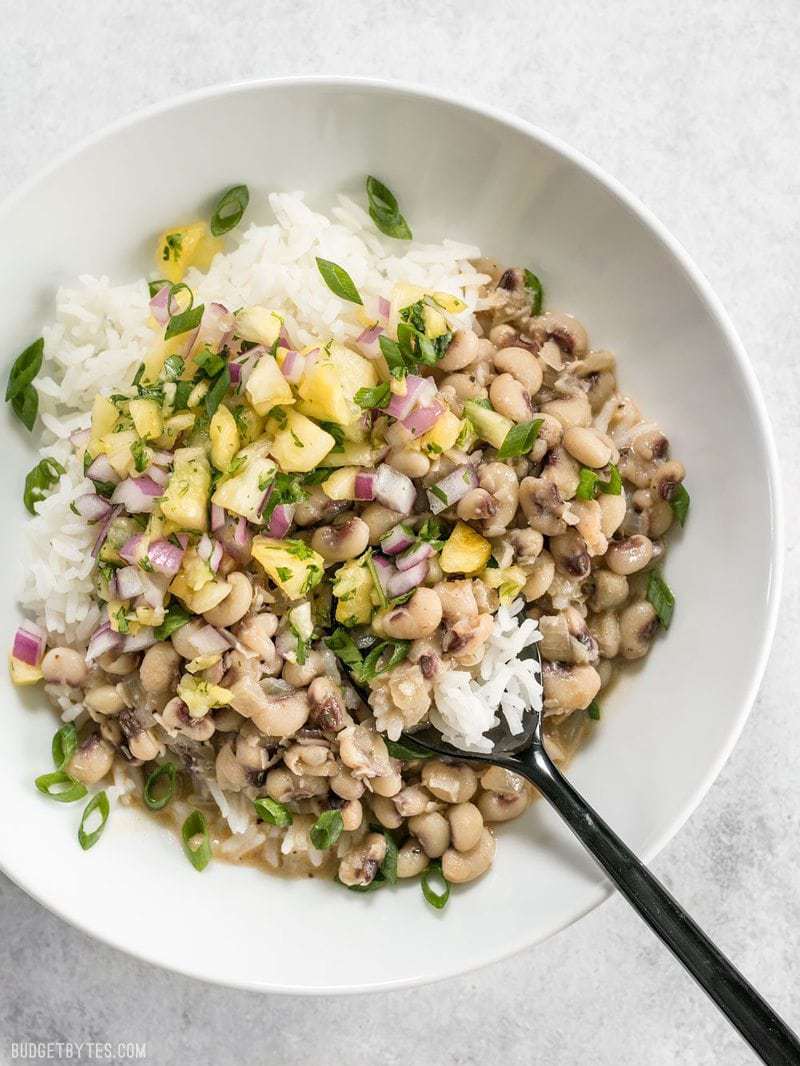
Coconut Jerk Peas with Pineapple Salsa

by Beth M
A.N

For Kelly, who seems to think black-eyed peas are ok to eat.

The last apartment I lived in was on a super cute street in Mid-City New Orleans. I had the best group of neighbors and our entire block would often hold impromptu cookouts on the weekends. One of my neighbors was from Trinidad and his jerk peas became something of a legend within the group because none of us could get enough of them. We’d hover around the pot until they were ready to eat, and then they’d be gone in the flash of an eye. He never gave me the recipe for those jerk peas (I don’t blame him), but I do know that the peas swam in a broth made of full fat coconut milk and a healthy dose of jerk seasoning. I’ll probably never be able to recreate those famous peas, but these Coconut Jerk Peas are about as close as I can get!

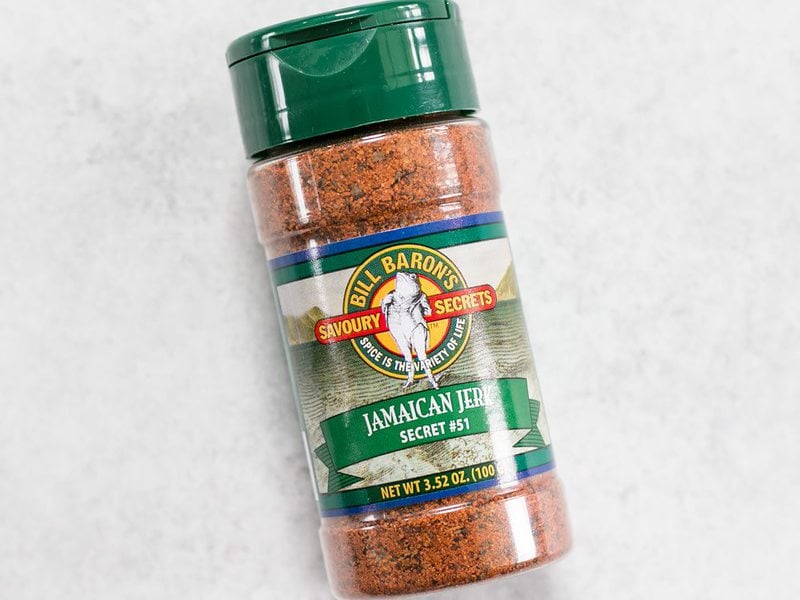
The one thing you want to be aware of, though, is that jerk seasoning varies a lot from brand to brand, so you’re best adding the seasoning according to your own taste buds. You can add some before the peas cook and then spice up the whole pot at the end with more, if needed. I included a photo of the brand I used, which I got at Whole Foods. They used to have jerk seasoning in the bulk spices department, but they no longer carried it, so I had to buy a jar. This spice blend contains a lot of ingredients and some items that I don’t keep on hand, so it’s just one of those blends that I find easier and more logical to buy pre-mixed. Of course, if you want to mix up your own spice blend, a quick Google search provides plenty of recipes.

The best part about these peas is that they are insanely simple. You can make these on Sunday afternoon while you’re relaxing or doing other chores, and you’ll have lunches ready for the week.

Coconut Jerk Peas with Pineapple Salsa

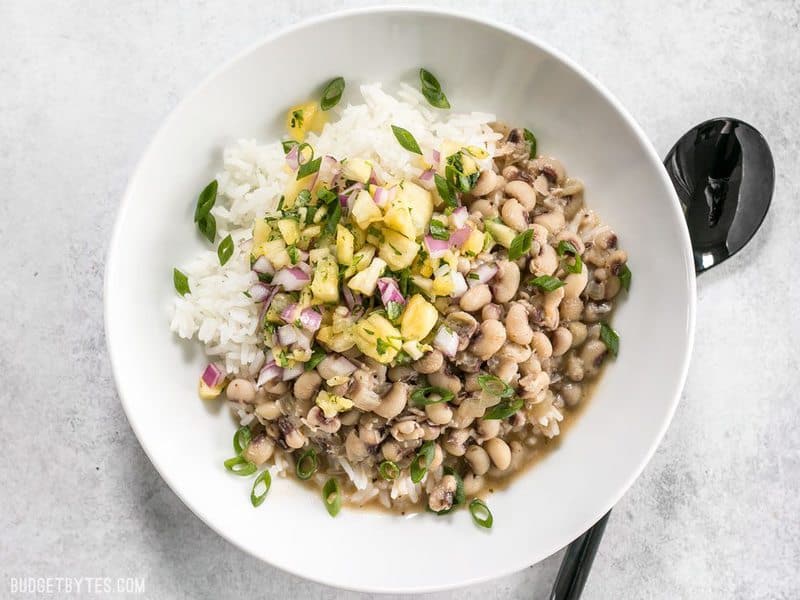
These rich and spicy Coconut Jerk Peas are super simple to make and pair brilliantly with a sweet and vibrant pineapple salsa. BudgetBytes.com

Coconut Jerk Peas with Pineapple Salsa

These rich and spicy Coconut Jerk Peas are super simple to make and pair brilliantly with a sweet and vibrant pineapple salsa. 

COCONUT JERK PEAS

  • 1 Tbsp olive oil ($0.13)
  • 1 yellow onion ($0.32)
  • 2 cloves garlic ($0.16)
  • 1 lb frozen black eyed peas or purple hull peas ($1.99)
  • 1 cup water ($0.00)
  • 1-2 Tbsp jerk seasoning* ($0.60)
  • 14oz can coconut milk ($2.19)
  • 1/4 tsp salt, or to taste ($0.02)
  • 4 cups cooked rice ($0.75)

PINEAPPLE SALSA

  • 2 cups chopped pineapple** ($0.67)
  • 1/4 red onion ($0.17)
  • 1 lime ($0.34)
  • 1/4 bunch cilantro ($0.21)
  • 1/2 tsp salt, or to taste ($0.05)
  1. Dice the onion and mince the garlic. Add both to a medium sauce pot with the olive oil and sauté over medium heat for 2-3 minutes, or until the onions are soft and transparent.

  2. Add the peas to the pot along with the water and 1 Tbsp of jerk seasoning. Stir to combine. Place a lid on the pot, turn the heat to medium-high, and allow it to come to a boil. Once it reaches a boil, turn the heat down to medium-low, and let it simmer for 15 minutes, or until the peas are very tender.

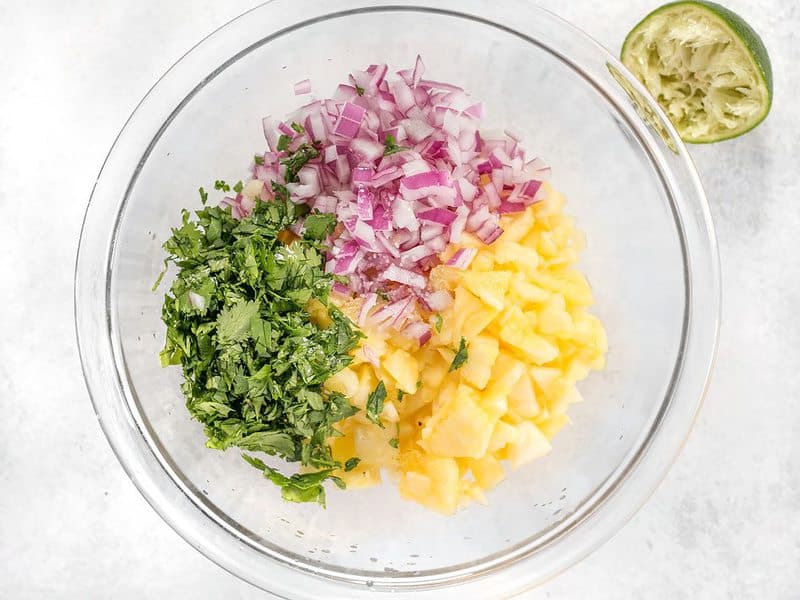
  3. While the peas are simmering, prepare the pineapple salsa. Chop the pineapple into very small pieces. Finely dice the red onion. Pull the cilantro leaves from their stems and give them a rough chop. Combine the pineapple, onion, cilantro, juice from half the lime, and salt in a bowl. Stir to combine, then taste, and adjust the lime or salt if needed. Set the salsa aside.

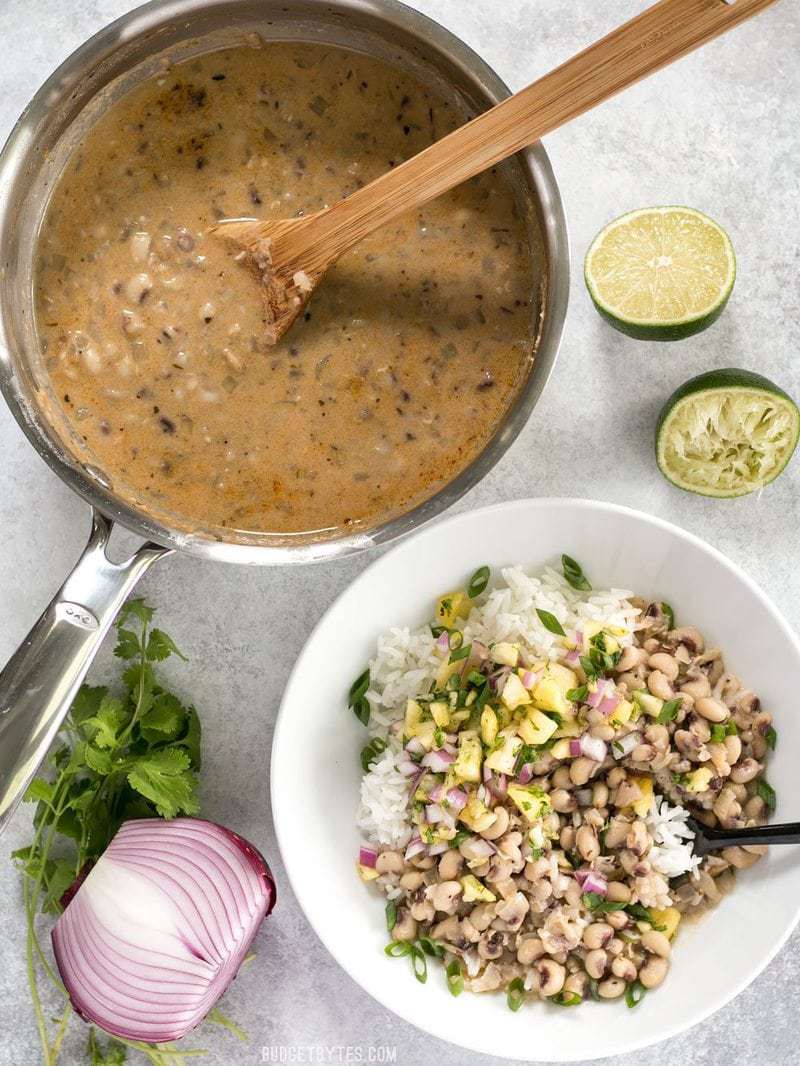
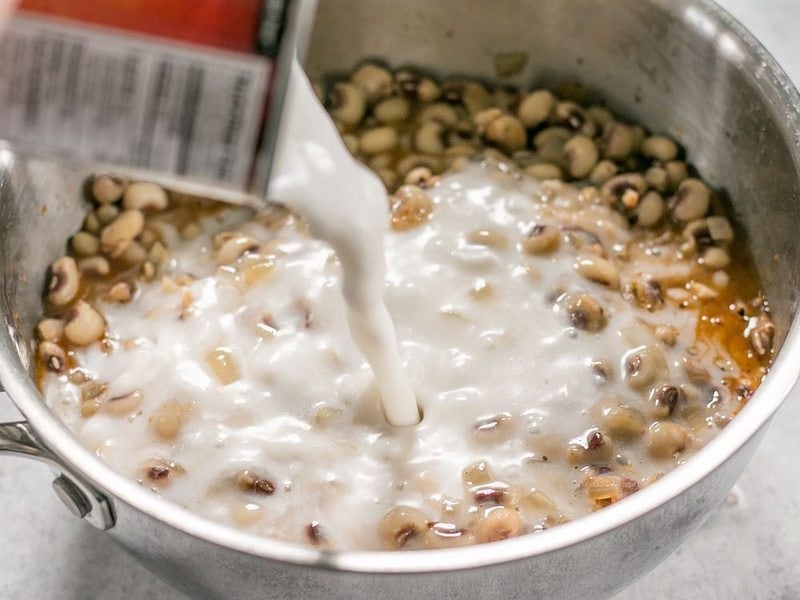
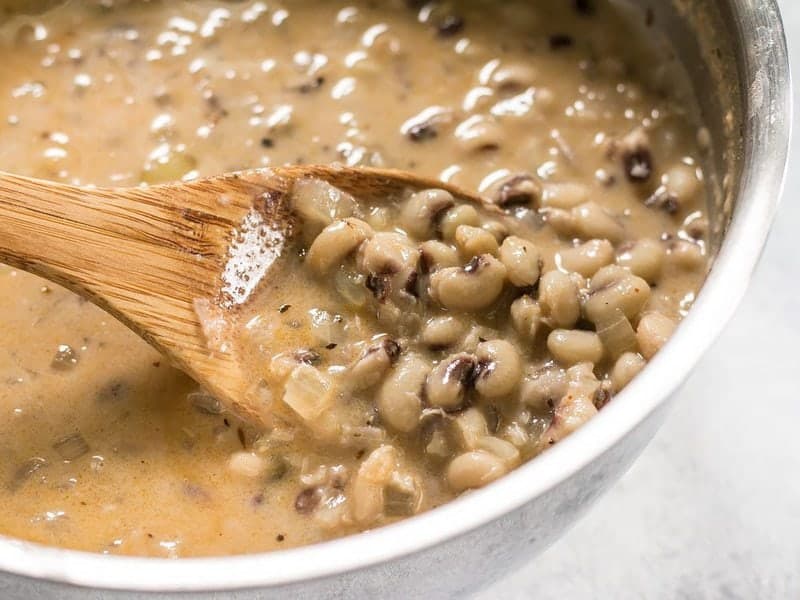
  4. Once the peas are very tender, turn the heat down to low, and add the coconut milk. Stir and heat through. Smash some of the peas against the side of the pot to help thicken the mixture. Taste the peas and add more jerk seasoning and salt until they are very well seasoned. You want the peas to be heavily seasoned because once they’re poured over the plain rice, the seasoning will seem diluted.

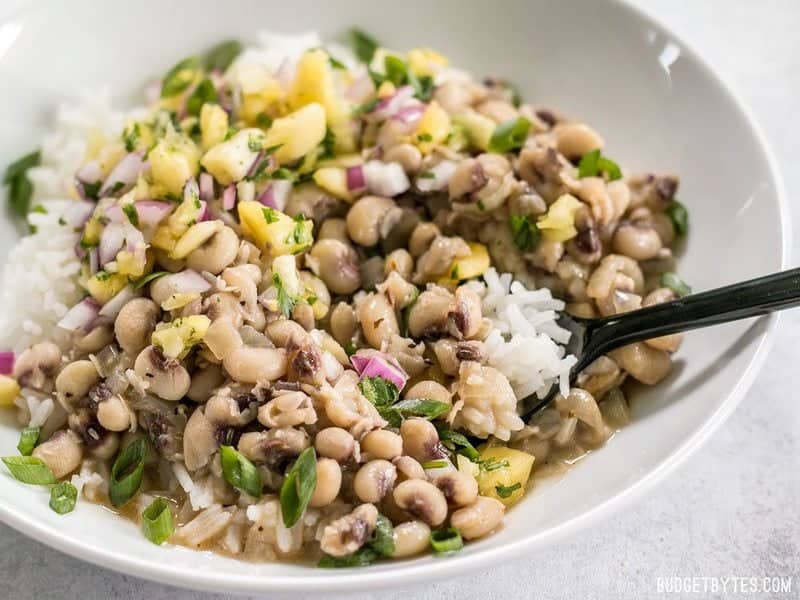
  5. To serve, place a cup of cooked rice in a bowl and add about 1 cup of the jerk peas with the coconut broth. Top with 1/2 cup of pineapple salsa. Enjoy!

*Every brand of jerk seasoning is a bit different, so start conservatively and add more after cooking, if needed.

**Use fresh pineapple or a well drained 20oz. can of pineapple tidbits packed in juice.

These rich and spicy Coconut Jerk Peas are super simple to make and pair brilliantly with a sweet and vibrant pineapple salsa. BudgetBytes.com

These rich and spicy Coconut Jerk Peas are super simple to make and pair brilliantly with a sweet and vibrant pineapple salsa. BudgetBytes.com

Step by Step Photos

Jerk Seasoning

Before we begin, I just want to show you which type of jerk seasoning I used. All brands are different, so you’ll have to go by your own taste buds for this one. If you don’t have an international market near you that carries it, check Whole Foods, Cost Plus World Market, or perhaps The Fresh market. 

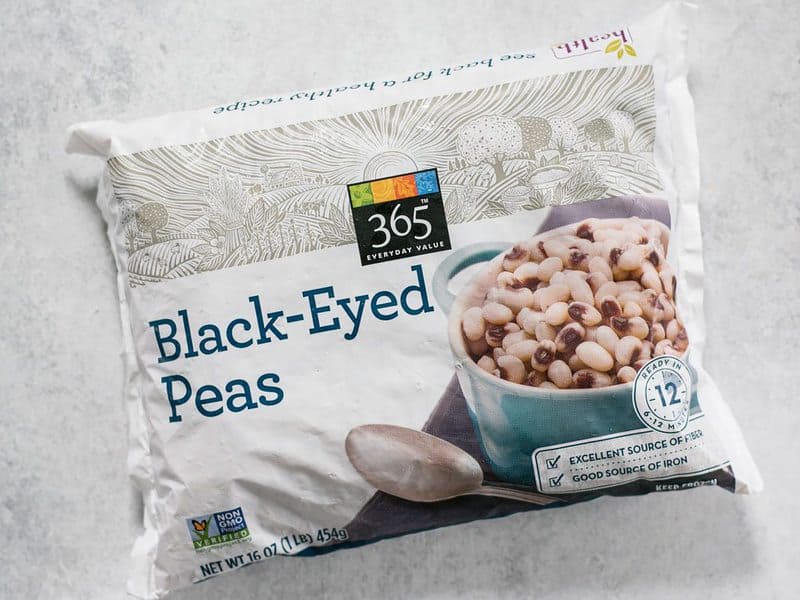
Black Eyed Peas

These are the peas that I used, but you could also use purple hull peas. Frozen is definitely better than canned, but if you must use canned, make sure to drain them well before adding to the recipe.

Sautéed Onion and Garlic

Begin by dicing an onion and mincing 2 cloves of garlic. Add them to a medium sauce pot with 1 Tbsp olive oil and sauté over medium heat until the onions are soft and transparent.

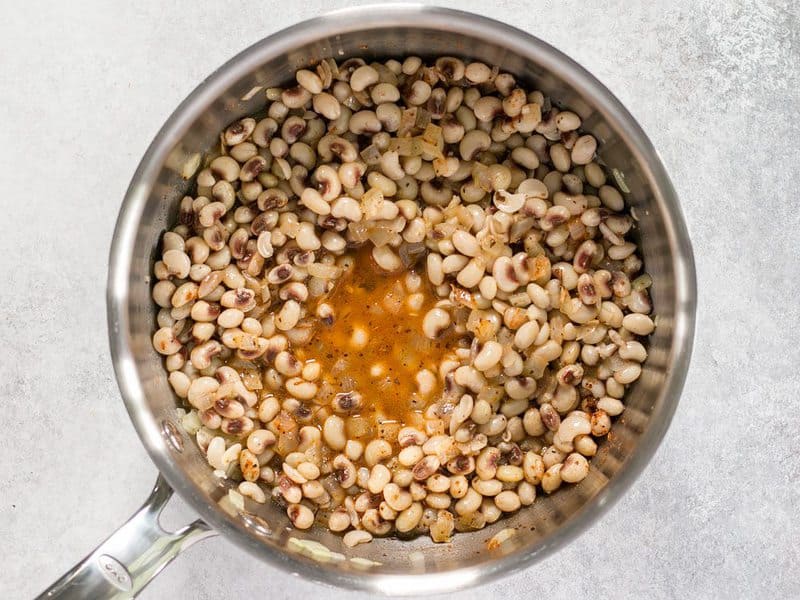
Peas Water Seasoning

Add 1 lb. frozen peas (I did not thaw them first), 1 cup water, and 1 Tbsp of the jerk seasoning. The water will not fully cover the peas, but that’s okay. Stir to combine, then place a lid on the pot and turn the heat up to medium-high. Let the pot come to a boil, then turn the heat down to medium-low and let it simmer for 15 minutes.

Pineapple Cilantro Onion Lime

While the peas are simmering, prepare the pineapple salsa. Combine 2 cups finely chopped pineapple, 1/4 of a red onion (finely diced), and 1/4 bunch cilantro (roughly chopped) in a bowl, along with the juice from half a lime (about 1 Tbsp) and 1/2 tsp salt. 

Finished Pineapple Salsa

Stir to combine and then taste and adjust the lime or salt if desired.

Add Coconut Milk

Once the peas have simmered and are tender (test a pea or two to make sure), add a 14oz. can of full-fat coconut milk.

Coconut Jerk Peas Cooked

Stir everything to combine and heat through. Smash some of the peas against the side of the pot to help thicken the liquid. Taste the peas and add more jerk seasoning if needed and a bit of salt. You want the peas to be heavily seasoned because once you ladle them over the plain rice, that seasoning will seem somewhat diluted.

These rich and spicy Coconut Jerk Peas are super simple to make and pair brilliantly with a sweet and vibrant pineapple salsa. BudgetBytes.com

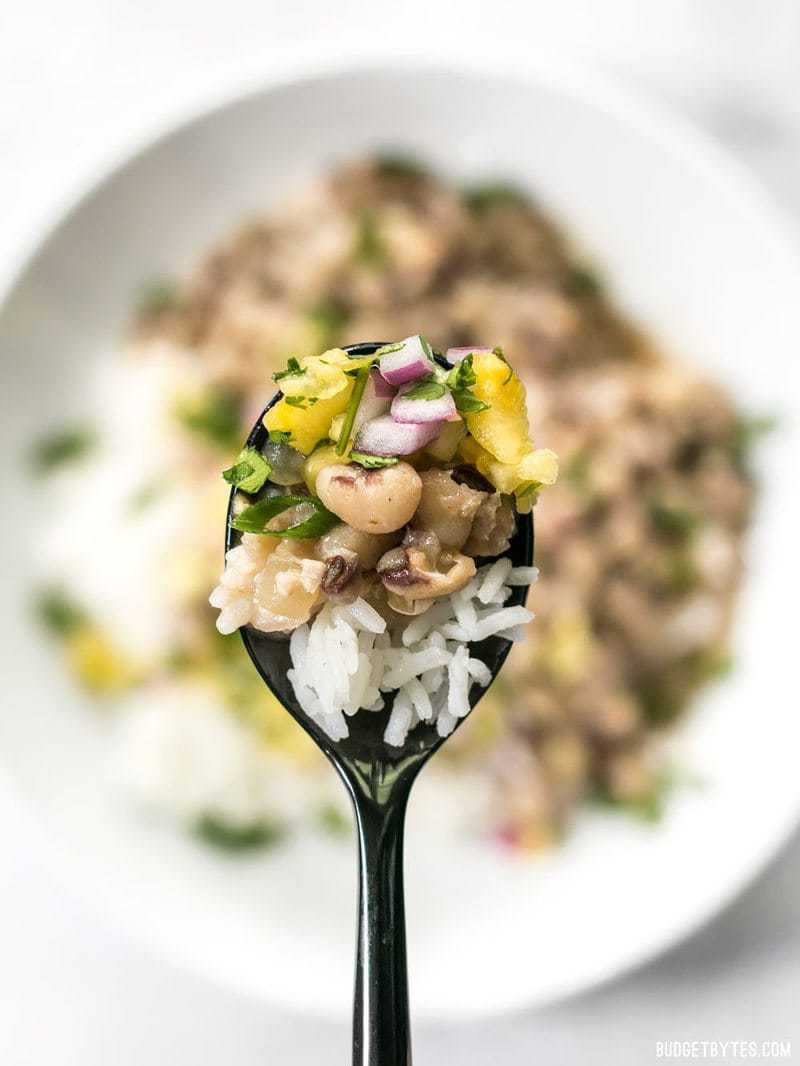
To serve, place a cup of cooked rice in a bowl and ladle the peas and coconut broth over top. Finish it off with about 1/2 cup of the pineapple salsa.

These rich and spicy Coconut Jerk Peas are super simple to make and pair brilliantly with a sweet and vibrant pineapple salsa. BudgetBytes.com

I never get sick of “beans” and rice! 

The post Coconut Jerk Peas with Pineapple Salsa appeared first on Budget Bytes.

02 Jun 17:02

"There's no way I could go on if my baby died." and other clueless statements.

by Jennifer Roberts
When I went back to work after Ben died I got comments from a well meaning co-worker almost every day until I quit. "I couldn't do it if my baby died." "There's no way I could go on." "You are so strong, because I know I couldn't live without my baby."

Although these comments are said with good intentions, they are insulting. To a grieving mother it sounded like she was telling me that I didn't love Ben as much as she loved her living child because she would have grieved harder. The thing about making assumptions about what you would or would not do if you were in our shoes is that you really, truly do not know what you would do. In addition to that, you don't know what our lives look like in private or even what is going on inside our brains and bodies at that very moment.

I took 13 weeks off after Ben died. Some days I literally couldn't leave my bed. Most mornings when I woke up, I cried so hard that I made myself puke or gave myself a migraine. I couldn't make even the most simple decisions. Every little thing was over whelming. Everything. Mostly everything, except Josh, annoyed me to the point of anger.

When I went back to work my memory was terrible, and I was a shitty employee that couldn't remember half of the tasks I was supposed to get done. After work I'd get in my car and cry all the way home. I'd pull it together and have dinner with my husband, then go to bed and lay wide awake having flashbacks of Ben's short and tragic 18 hours on Earth. I had nightmares almost nightly. I used to hear a baby cry in my dream, and I could never find the baby to try to comfort him. It was torture and even with a lot of therapy, I still have days like this.

Also though, during my maternity/bereavement leave- I had many visitors did some "fun" things. We even went to Paris for 3 days. I enjoyed myself at times and posted some of that on social media. It felt weird to enjoy myself though and I constantly felt the weight of the fact that Ben was supposed to be with us and he wasn't.

I didn't cry much the first day after Ben died, and in the weeks following I felt more confused than sad. I was on pain killers and in shock and thinking back to that time now, I see how this sort of protected me for a few weeks and eased me into reality a little at a time. It probably didn't look normal to other people though, but what they don't know is that there is no normal after your child dies. It's NOT normal for your child to die so NO ONE knows how to act.

It's been over a year and I still have to take drugs to fall asleep. I am still caught off guard at least weekly and have to cry it out. The sharpness of my mind is not where it was and I don't know if it ever will be. I used to be proud of my quick wit and mental sharpness. I felt that was one of my best qualities. I don't feel that way anymore. It's almost like I've gotten older and slower over the past year. I still have no motivation and have to fight the urge to not lay around and do nothing most of the time.

I've learned that even through one of the toughest things you'll ever go through, people still won't think twice about offering their opinions about what they think they would do differently. Whether they say things to your face or behind your back, they have no problems talking about how they would act, talk, and grieve if their child had died. They seem to think they'd grieve more appropriately, and they cluelessly talk about how they think their way would be the right way.

I am here to tell you that until they lose a baby, a late term pregnancy, a child, a spouse unexpectedly, or have had multiple pregnancy losses they really do not know what this feels like, therefore, they could never predict what they'd do. People should really just feel lucky to be clueless and keep their opinions to themselves.

They don't know what they'd do, how they'd act, or what their life would be like. There is absolutely no way for people to predict or assume this. They also aren't with those of us who are living through this at all times. They don't know what our life is really like. It's messy and complicated and all over the place. Our own lives and even ourselves are unrecognizable at times. I never feel settled or completely at peace. Something is always missing and even though I know that something is my son, I feel anxious and have that feeling like I am forgetting something all the time.

But you do go on, you continue to live. Because what other choice is there? Kill yourself? Give up on every one around you? Then your husband and family will have two people to grieve.

Believe me, every mother who has lost a child has thought it would be easier to be dead than to feel like this. But ultimately, most of us just cling to hope that there will be happier days ahead and we keep on swimming.

31 May 15:58

It Came From The Search Terms: The Lusty Month Of May

by JenniferP
A.N

For the flower meanings.

It’s time for the monthly ritual where we answer the things people typed into search engines as if they were actual questions.

True story: In 1986 my 6th grade class did a medley/pageant thing from Camelot and I sang a highly edited version of this song wearing a flower crown, an ice blue polyester bridesmaid’s dress that had been adapted to be somewhat ren-faire-ish, and (of course) my giant plastic 1980s Dawn Weiner/Sally Jesse Raphael/Log Lady eyeglasses.

1) “I can’t have romantic feelings.”

a) You don’t have to! and b) You might be aromantic. Look it up, find your people, be happy.

2) “As a bi girl am I doomed to end up with a guy?”

Depending on where you live men who like women may be more numerous than women who like women, so it may take you longer to find women you connect with. However, please don’t “end up with” or even “date” anyone who makes you wonder “Is this my doom?” Be picky and choose people who fucking delight you.

3) “He can’t be with me because of depression”

He can’t be with you.

4) “Introvert boyfriend broke up with me”

He broke up with you.

 5) He says he wants us to be together eventually, what does that mean?

He doesn’t want you to be together now.

6) “What does ‘I can’t be what you need from me’ mean?”

“Don’t count on this relationship to be what you need.” “I am checking out of/trying to end this relationship.”

7) Boyfriend makes fun of medical condition.

What. A. Jerk.

8) “He doesn’t give me allowance but he wants to control my appearance.”

Even if he did give you an allowance he doesn’t get to control your appearance unless you have an explicit “this is a fun thing we like to do/kink we share and enjoy” agreement.

9) “I don’t like my boyfriend’s physical appearance.”

Okay? Options:

  • Learn to like something about how he looks and enjoy the beautiful love you share.
  • Admit to yourself that looks are really important to you and gently set him free to find someone who loves how he looks.

10) “Too many Indian neighbours.”

Move. Your neighbors shouldn’t have to live next to a gross xenophobe like you.

11) “Should I try speed dating?”

Sure! If you you don’t like someone or they don’t like you, there will be a new person in a few minutes, and if you hate it you never have to go back.


12) “Can men and women be friends?”

Glad you asked! I run an entire website devoted to this.

13) “I won’t allow my husband to play with female band mates.”

Women are half the human race, so, that’s a pretty sucky thing to do.

14) “How can I proceed to relationship that I already know she is not interested in relationship yet?” & 15) How to make a long distance girl you don’t know fall in love?

Or, you could just…not?

If you know for a fact someone is not interested in a relationship, leave them alone?

If someone lives far away and doesn’t know you exist, maybe…leave them alone and find someone a) closer to home b) who knows you and c) already likes you?

Stop trying to project-manage unattainable love?

16) Is 3 weeks too late to apologize to guy?

Probably not, as long as you offer a clean, real apology:

  • Step 1: “I’m really sorry for [specific thing I did that hurt or upset you].”
  • Step 2: Hope for the best but let it go. Let him be the one to decide if he forgives, when he forgives, and what happens now.
  • Step 3: Don’t do the thing again.

17) “Social anxiety play dates.”

This person was probably searching for this thread about arranging play dates for your kids when you have social anxiety, but it would be so cool if this were an app or a service that hooked people up with social anxiety buddies.

18) Ugliest floral arrangement for a funeral for someone you hate.

Yessssssssssssssssss! Let’s be hate-florists!

floral-arrangement-fail-penis

Description: Pink carnations and roses sculpted into a penis and balls. For when you care enough to send someone a dick.

Would a corpse flower be prohibitively expensive? Are those even commercially available? If not, worry not: Here are some other stinky plants and flowers.

I found a website listing traditional flower meanings.What if we combined:

  • CANDY TUFT – Indifference
  • GERANIUM -Stupidity; Folly
  • LILY  Orange – Hatred
  • MONKSHOOD – Beware; A Deadly Foe is Near
  • NARCISSUS – Egotism
  • NUTS – Stupidity
  • NASTURTIUM – Conquest; Victory in Battle
I don’t know if it would be sufficiently hideous – a lot of those flowers are quite pretty – but you’d know exactly how much shade you were throwing.
Now I wish that the Language of Flowers had an app where you could see each flower and build a virtual hate-bouquet (or like-bouquet, or “That secret sex we had was AWESOME and it fills me with shame. Elope with me?” bouquet) from them.


23 May 15:53

Good Bones

by swissmiss

Bumping this post from 2017 back up. Timely.

(via)

19 May 20:56

Commencement speeches are garbage. College graduation is terrifying.

by Penelope Trunk
Slight Uncertainty by Michal Trpák

The platitudes of graduation speeches are so damaging. It sets you up for some magical moment when you enter adulthood and the world of opportunity opens up to you. But actually the world does not open up after college. Either it opened up to you the day you were born to very rich parents, or you will have to search high and low for a crowbar large enough to pry open the world of opportunity and sneak a foot in before it snaps shut again.

This is the advice you will really need to hear. I’m sorry that it’s not perky and fun and inspiring. But look, if you are feeling all gushy and excited about going out into the work world, then you don’t need any warm, inspirational advice.

Your job was school and now you are out of a job. The good news is that from now on no one will tell you things like what to learn or how to write. The bad news is that you have basically been training to be an academic for the last 18 years, so unless you want to teach, you are now doing a career change. We can talk all day about how stupid it is to train everyone to be an academic. But instead, just realize that all your training is irrelevant, which means you are starting over. And the only skills you have are the ones you were born with. So you should figure out your personality type, and memorize what it means so you can steer yourself toward something you’ll succeed at doing.

Don’t fulfill someone else’s dreams. You are probably not going to do anything special in your career. Very few people do. And those who have remarkably successful careers pay a steep price. Before you set a career goal for yourself, ask yourself what other people had to do to get there. Teachers told you if you do well in school you’ll have a great career, but that’s not how the world works. It’s actually if you give up everything else and focus on your career then you’ll have a great career. Most people don’t want to do that, so it’s okay for you to say you don’t want to do it.

Pharmaceuticals are your friends. Most mental illnesses appear in one’s twenties. If one emerges in you, don’t fight it on your own. It’s a waste of time. You will squander your potential by being completely focused on your mental illness. Just take the pills that work for the illness and move on. And stop taking stimulants to stay up all night working. That’s for students. The only people who stay up all night working in adult life are losers. School rewards the hardest workers, but work does not. Work is more complicated, but first and foremost you have to be a person that other people like to be around.

Don’t find out about your friends online. Your friends are full of shit when they post pictures online. You know that already, but you do it anyway, right? The more you see your friends lying about how happy they are, the more unhappy you’ll feel about your own life. The truth is everyone is either unhappy and lost in their 20s or they are putting unhappiness off until their 30s by being a doctor or lawyer. Stop going through what people are posting online and find friends you can connect with. Those are the ones who will be real.

Men and women stop being equal when you graduate from college. Because women have only ten years to work before they have to have kids, and men have twenty even thirty years. So women need to stop thinking they can do whatever men do, because you can’t. You cannot piss away your 20s experimenting and doing things that “don’t count.” Men can do that, but it’s no cakewalk for them either, because while women in their 20s are in very high demand, men in their 20s are low-earning and immature and largely seen by both sexes as undercooked.

Don’t pretend you know what you’re doing. No one will believe it. Instead show humility and ask for lots of help. Because every recent grad looks fresh and full of potential and people will want to help you because you remind them of them, when they were young and fresh and full of potential. If you act like you know what you’re doing, they can’t offer help. And remember, even if your parents have great connections in the Senate or the Fortune 500 or whatever, your most valuable mentors are people only a few years ahead of you. They remember how difficult it is to be you and they recently navigated those paths themselves.

Learn to cope with NO. You’re going to hear it a lot. Remember you are switching from being a seasoned, successful student to being an entry-level nobody in your new career. George Santino, author of Get Back Up, has snappy advice for dealing with no that I wish someone told me when I was graduating. Get to the no as fast as you can, ask why, and then address what’s missing. When someone says no, the easiest thing to do is walk away. But that’s not going to break through any barriers.

Make tough choices. People who have successful careers have a chosen career by age 25. Just get into a career and make it work. People who are good at sales can do it anywhere. People who are good at design can design anywhere. People who are good managers can manage any where. Too much emphasis is put on WHERE you work. It doesn’t matter. Just get a job. You will float to where you belong in any organization. And:

Accept where you belong. So if you find yourself being floated out — well, the truth is that not everyone belongs in the workforce, just like not everyone belongs at home taking care of kids.

It’s not your job to pass judgement on who was born with the best set of skills. It’s your job to respect everyone — people who have great skills for parenting and people who have great skills for being CEO. And recognize that those skills sets don’t overlap.

No one is a super hero. So just be you.

18 May 18:32

The Joys and Challenges of Being a Parent With Autism

by Sarah DeWeerdt

It’s going on 8 p.m., and Kirsten Hurley’s house in West Cork, Ireland, is a scene of happy chaos. The children—Alex, 9, and Isla, 4—have been promised chocolate if they stay out of their mother’s hair while she talks with a journalist via Skype.

But the bribe doesn’t seem to be working—at least not with Isla, who climbs up her mother’s back and somersaults over her shoulder, cackling with delight.

“This is something that drives me nuts,” Hurley says. The nonstop and often intense sensory inputs that come along with being a parent—being grabbed at, being climbed on, listening to the drone of “Mom, Mom, Mom, Mom, Mom”—can be difficult for her to handle because she has a mild form of autism sometimes known as Asperger’s syndrome.


More From Our Partners

Spectrum News

Hurley was diagnosed with Asperger’s syndrome at age 23, when her son was about 14 months old. Alex received his own autism diagnosis about a year later. (In the United States, Asperger’s syndrome was subsumed into the larger category of autism spectrum disorder in 2013, but in Ireland and elsewhere it remains a distinct diagnosis.)

In some ways, their shared condition has made it easy for Hurley to parent her son. “Alex always kind of seemed really logical to me,” she says. Isla, by contrast, does not seem to be on the spectrum, and her ordinary preschooler behavior sometimes baffles her mother. She has an insatiable need for attention, from Hurley’s perspective, and she might do something like reject a cup of orange juice moments after specifically requesting orange juice. “The things she does that I think are really abnormal because Alex didn’t do them are actually, like, typical children things,” Hurley says, laughing.

Hurley handles many such puzzles of being a parent on the autism spectrum with self-awareness and a healthy dose of humor. But at times, when she has reached out for help she has been misunderstood. Hurley once mentioned to a new therapist she was seeing that she has Asperger’s syndrome. The therapist asked if she loved her children—“which wasn’t very helpful,” Hurley says. “People have these kinds of misconceptions about people with autism, that they don’t feel emotion.”

Hurley is not so far out of the ordinary as one might assume: A surprising number of people diagnosed with autism are raising children. An online survey recruited more than 300 mothers with autism, suggesting that there are probably thousands of parents diagnosed with autism worldwide, and perhaps hundreds of thousands or millions without a diagnosis. More evidence comes from Facebook groups, messaging platforms and blog comments, where parents compare notes and share problem-solving strategies.

Autism can pose challenges for parenting, their stories indicate. In addition to dealing with sensory overload, helping a child learn social skills can be difficult for people who struggle with social interactions themselves, for example. But autism can also provide valuable parenting skills, especially with a child who is also on the spectrum.

Still, as far as the scientific literature is concerned, these parents might as well not exist. It’s only in the past few years, since scientists have become interested in studying adults with autism, that they have begun to ask questions about this group of parents. “I think what we’re seeing now in the 21st century is a recognition that people with autism are perfectly capable of participating in all aspects of life, but they may have been doing that almost invisibly—and that includes parenthood,” says Simon Baron-Cohen, director of the Autism Research Center at the University of Cambridge in the United Kingdom.

Gillan and Lizzie Drew with their daughter Izzie, at their home near Christchurch, England. (Ben Mostyn / Spectrum)

The lack of research so far not only offers these parents little support, but also leaves society unprepared for the larger wave of people diagnosed with autism who are just coming of age and may be considering having children. Without enough information or support available to them, these young people may conclude that becoming a parent is just not an option for them.

“It breaks my heart to even say those words, but that’s the message that I’ve heard: ‘Does having autism or Asperger’s, does that mean that being a parent is just not a thing for me?’” says Matthew Lerner, assistant professor of psychology, psychiatry and pediatrics at Stony Brook University in New York. The experiences of Hurley and many other parents who are pioneering what it means to be a parent with autism could temper that worry with hope.

* * *

The idea that a person on the spectrum could be a parent was long considered nearly impossible. When Edward Ritvo submitted a paper on the subject to the Journal of Autism and Developmental Disorders in 1988, he titled it “Eleven possibly autistic parents.” Without that caveat, he says, he is pretty sure it would never have been published.

“That paper was rejected eight times by eight of the major psychiatric and medical journals,” says Ritvo, now professor emeritus of psychiatry at the University of California, Los Angeles. “Nobody believed it. They didn’t believe the parents had it, that autistic people could grow up and marry and have children.”

At the time, autism was perceived as a severe disorder, usually accompanied by intellectual disability, and the overwhelming emphasis of research was on children with autism. Yet the parents who appeared in that brief paper had characteristics that are now easily recognizable as features of autism: repetitive behaviors such as arm flapping and rocking back and forth, unusual rituals such as arriving exactly 30 minutes late for every engagement, social disinterest, a lack of eye contact.

Further publications from Ritvo’s team made it clear that it wasn’t an anomaly for people on the spectrum to have children: A 1994 paper described 14 people with autism who had 54 children among them. Most of them were parents of children that Ritvo’s team had seen in the clinic. Ritvo and his colleagues had become interested in these parents because they wanted to show that autism is a physiological condition with an inherited basis—and not, as was widely believed through the 1960s and 1970s, the result of psychological trauma.

Both parents are on the spectrum; their daughter Izzie does not seem to be. (Ben Mostyn / Spectrum)

These observations helped launch the study of autism genetics. Meanwhile, the lives of these parents went unexamined. Even now, no one knows what proportion of adults with autism have children, what proportion of their children might end up on the autism spectrum, or how common it is for children with autism to have a parent who also has the condition. And those basic questions don’t even begin to explore what life is like for parents with autism: their struggles with parenting, the strengths they bring to the task of raising children, how their hopes and fears evolve as their children grow up.

Virtually the only empirical study of the experiences of parents with autism is an online survey of 325 mothers diagnosed with autism worldwide, conducted by Baron-Cohen’s team. The unpublished data capture responses to 89 questions devised with input from women with autism. They include topics such as pregnancy and childbirth, the social experience of motherhood and the strengths and weaknesses of parents with autism.

The mothers with autism in the survey were more likely to report prenatal and postnatal depression compared with a group of 91 typical women raising at least one child with autism. They were more likely to feel isolated, and judged by others; many said they didn’t have anyone to turn to for support, and often felt unable to cope with parenting.

For some parents, the prejudice and stigma surrounding autism can have dire consequences. Damon Matthew Wise Âû and his wife saw firsthand that parents with autism are vulnerable to extra scrutiny from child welfare agencies. Wise Âû is a pioneer of the self-advocacy movement by people with Asperger’s syndrome and lives in Shannon, Ireland. His wife, Karen, is also on the spectrum, as are their three children, who also suffer from chronic ailments such as food intolerances, insomnia and skin conditions.

Since their youngest child was born in 2003, Wise Âû and his wife had occasionally used respite care, or temporary childcare, through the foster-care system for a few hours or a weekend. By mid-2009, with the encouragement of social workers, the younger two children were spending a few days out of the home each week. But in early 2010, the couple learned that child welfare authorities had started efforts to put all three children into full-time, permanent foster care. According to Wise Âû, the authorities never gave any legal justification for this plan. He says the episode reflects prejudice on the part of child welfare agencies that people on the spectrum aren’t suitable parents. Finally, in May 2010, the agency dropped its plan.

Wise Âû’s oldest son wasn’t diagnosed with Asperger’s syndrome until he was almost 16, though his parents had suspected he was on the spectrum since before he was 2 years old. Doctors and social workers “thought we caused him to exhibit autistic traits, by learning it from us,” Wise Âû recalls. The doctors suggested that the couple wanted their son to be on the spectrum—as if they had Munchausen syndrome by proxy, a psychiatric disorder in which people feign illness in their children in order to draw attention to themselves.

The couple also felt excluded by support groups for parents raising children with autism. In those groups, they sometimes encountered the sentiment that the condition is a tragedy, or a disorder to be cured. “We have been kicked and shunned for being parents who are autistic with autistic children,” Wise Âû says. (They set up a Facebook support group of their own, where talk of cures is discouraged.)

Parents with autism may face practical challenges borne of their condition. For example, many people with the condition struggle with executive function, the set of complex mental processes that allow people to plan and carry out daily activities. They also have a tendency to become deeply immersed in what they are doing—to the detriment of other priorities. Hurley says in her case, this has made it difficult to meet the logistical demands of raising her children, such as getting them to school on time, and keeping them clean and fed. When her children were younger, she would write out step-by-step lists to help her accomplish daily tasks: Get the bottle ready. Make the food. Give the bottle and the food to the child. Put the plates in the dishwasher. Wipe the table. Check the floor for crumbs. See if the child is clean.

Some parents on the spectrum find tasks such as parent-teacher meetings to be draining because social interactions require great cognitive and emotional effort on their part. Others have problems with auditory processing that make verbal communication difficult. The blunt manner common among people with autism may also lead some parents to cause offense where none is intended. In Baron-Cohen’s survey, more than 60 percent of mothers with the condition said they struggle to communicate with teachers, doctors and other professionals regarding their children and feel anxious about such meetings.

The emotional work of parenting can also be a challenge for people with autism. However, far from being oblivious or indifferent, as the stereotype of autism might suggest, these parents are often acutely aware of their children’s emotions, but struggle to provide support. “It’s sometimes really hurtful and disappointing to me that I can’t help them when they’re in an emotional state,” says Kimberly, a woman living in Northern California who has a 10-year-old daughter and a 13-year-old son. “I tend to get very overwhelmed by all the raw emotion that comes from my 13-year-old and am less equipped to deal with it and recover from it.” (Kimberly requested that we not use her last name.)

Gillian Drew is determined to help his daughter explore the world, despite his sensitivities.

Hurley foresees herself facing similar difficulties as her children grow older. “When Alex was younger and he was really sad about something, I’d just tell a fart joke,” she says. But she knows that tactic isn’t likely to work forever. “If you’re 14 and you’re having real trouble with bodies and relationship sorts of things, your mom making fart jokes isn’t going to fix it,” she says. She and her husband have planned for him to take the lead on such issues—but she also wishes she had more guidance on how to handle them.

The expectation that a woman will be the primary, hands-on parent can place extra burdens on mothers with autism. New mothers who don’t enjoy socializing in kaffeeklatsch-style groups can be left without a support system. Women may feel pressure to organize play dates and social outings that leave them spent—and the constant demands of parenting can also make it difficult for them to find the solitude they may require to recharge. “It’s much easier for fathers to check out, I think—go hide in their workshop or shed or whatever their man-cave happens to be,” says Rochelle Johnson, a woman with autism who lives near Melbourne, Australia, and has three daughters, two of whom have autism.

But fathers with autism also face pressures, says Johnson, who came out as transgender last year. “Autistic men seem to be very rigid about the way things should be done or shouldn’t be done, and I think that can come across in a very authoritarian kind of parenting style,” she says. In her view, these fathers seem strict not because they want to bend their child to their will, but because they are seeking the safety of routine and ritual.

With greater societal awareness of these challenges, some could have simple solutions. For example, some parents with autism may find it easier to make doctor appointments online rather than by phone, or conduct teacher conferences by email rather than in person. Others might need help with establishing household routines when their children are infants. Yet when Baron-Cohen and his team analyzed the survey data, they found that 80 percent of the U.K. mothers with autism said they had not received the help they requested from schools, doctors and social welfare agencies.

* * *

In spite of the difficulties they may face, many parents with autism say having children has helped them deal with their condition; some even say their autism has made them a better parent than they would otherwise have been.

Having children can be a bulwark against the isolation that afflicts so many adults with autism. “I’ve noticed that a lot of people that I meet are really, really lonely—adults who’ve been diagnosed and they’re not in relationships and they don’t have families,” says Hurley. “I’d hate it if I was on my own all the time.” Children offer her an entrée into a social milieu that’s more welcoming than she finds adults to be. “I love hanging around with kids,” she says. “I love the energy of it, and the fact that the conversations are really easier—whereas with adults you have to be far more careful about what you say and how you say it.”

(Ben Mostyn / Spectrum)

In Kimberly’s case, having children helped her overcome her crippling need for routine and sameness. “It was the ability to accept that I could lay a plan out for the day—and it may be ended by explosive diarrhea, or I’m going to say we’re going to the grocery store at 10, and it’s not going to happen,” she says. “In my pre-child life, I couldn’t have dealt with that.”

On the other hand, some of these same autism features can offer an advantage to parenting. Kimberly says her drive for structure and organization has benefited her children in some ways. “I run everything, so whether it’s tennis or doctor appointments or camps or what classes they’re in or making sure they’re introduced to new ideas and new activities and new experiences, that’s all me,” she says. “I’m on top of all that.” In fact, her methodical and tenacious nature may explain why Kimberly decided to become a single mother and adopt her first child. (She subsequently married, and she and her husband adopted a second child.) “It’s so Aspie,” she says, laughing. “Once I decided to adopt, I was like a pit bull; I got every possible piece of information that I could.”

No scientific studies have explored whether having autism yields benefits for parenting, but the idea rings true to clinicians. “My clinical experience is that some of the parents with autism are fantastic parents,” Baron-Cohen says. “The same kind of obsessive approach that characterizes autism in other ways can be a really positive thing in parenting.”

Perhaps the most striking advantage is in the case of parents with autism who have a son or daughter also on the spectrum. “As an autistic parent, I’m in a unique situation of being able to have an insight into where they’re coming from, what they’re thinking and feeling,” says Johnson. When her oldest daughter was about 8, Johnson recalls, she used to get in trouble at school for putting her head down on the ground when the class sat on the floor. It turned out that the girl was ‘listening’ to the teacher in the next classroom through the vibrations.

Johnson intuitively understood the situation. “On one level, as a parent, you’re like, ‘Well, you need to pay attention in class,’” Johnson says. “On the other level, you have a real empathy for how that makes perfect sense, as crazy as it may sound.” Johnson remembers doing unusual things when she herself was a child, such as feeling compelled to perform an action the same number of times with her right and left hands.

Parents on the spectrum can pass on the lessons they have learned to their child; they can also bond with their children about shared difficulties. Hurley’s son Alex sometimes has what she calls “depression attacks,” short bouts of intense sadness that don’t necessarily have a specific trigger, but instead emerge from a general feeling of being overwhelmed. Alex, a quiet boy with large brown eyes and freckles, struggles to put his experience into words. “How I feel—I can’t explain it really, how I feel,” he says. But he says his mother understands him. Hurley remembers similar feelings from her own childhood and still experiences them sometimes. Her coping method is to slow down and remind herself that the feelings are temporary. She helps Alex do the same, supporting him without pressing him to provide a reason for his sadness.

Until the 1990s, most people diagnosed with autism had a relatively severe form of the condition, and so were unlikely to have children. But greater awareness of autism, as well as a broadening of the diagnostic criteria, have led to a growing wave of people with milder forms of the condition being diagnosed—and therefore more parents and potential parents with autism.

An increasing number of people are being diagnosed in adulthood, including some who are already parents. “Very often, it’s the child’s diagnosis that prompts the [parent] to question and seek out a late-in-life diagnosis for themselves,” says Susan White, co-director of the Virginia Tech Autism Clinic in Blacksburg, Virginia.

These days, most parents with autism are in that situation—diagnosed after having children, and perhaps because of their children. In the future, most will know they have autism before becoming parents. They may face new challenges: others questioning whether they are capable of parenting, for example, or coping with confusing feelings if their child turns out to share their autism diagnosis—or doesn’t.

“I never wanted to be a father,” says Gillan Drew, who lives in a small village in southern England with his wife, Lizzie, who also has autism, and their nearly 2-year-old daughter. “I didn’t want to pass on either my autism or my depression.” Drew didn’t learn he has autism until he was 28, but he found out before meeting his wife and before deciding to become a parent. (His book for adults newly diagnosed with autism was released in March, and he also blogs at Aspie Daddy.) His wife—at the time, his girlfriend—badly wanted a child, and eventually Drew changed his mind. “It was almost a spiritual thing,” he says. “I was worried that I wouldn’t be able to cope, but what if I could? What if I was letting the possible pitfalls prevent me from experiencing the greatest thing I’d ever done?”

So far, their daughter Izzie doesn’t show signs of autism, which is a relief, he says, “just because I know how difficult it can be.” But it’s also a worry, especially for his wife. “She is terrified that as Izzie gets older she’ll sort of overtake her in social skills,” Drew says. He has found it fascinating to observe his daughter as she learns to share, to communicate her wants and needs, and even to play her parents against each other. It’s a second chance for him to learn social skills, but also a painful experience that throws his own social challenges into sharp relief. At playgroups, “she’s going in there and she’s learning, and while she’s learning, I’m kind of standing back learning while watching her,” he says. “But she’s better than me, because she’s doing it naturally.”

Drew is acutely aware of being a parent with autism, and constantly monitors himself to make sure he provides what his daughter needs. Before Izzie was born, he read multiple accounts written by adults who blame their difficult childhoods on a parent they suspect had autism. The parents described in many of these accounts were never diagnosed, and no scientific study has assessed the effects of having a parent with autism. Still, he was worried. He says his own father probably had autism. He remembers longing for praise, but his father would instead critique the drawings he brought home from preschool: “Move the eyes a bit over, and the nose is the wrong shape.”

The possibility that his child might similarly suffer gave him pangs—and Drew determined to alter his behavior in certain ways. He forces himself to go to child-friendly events with bright colors and loud sounds even though he finds them overwhelming, for example. He suppresses the urge to cringe when his daughter’s hands are covered with applesauce or oatmeal, not wanting her to pick up his abhorrence of mess and mushy textures. And he gushes over every piece of artwork his daughter produces. The irony is that his awareness of having a condition that makes it difficult for him to express affection has transformed virtually his every action into an expression of love.

Drew’s experiences have convinced him that people with autism need advice on topics that standard parenting classes and baby manuals don’t cover. “I’ve spent so much time focusing on [how] I need to kiss her, I need to cuddle her, that I suddenly realized the other day that I’ve never told her I love her,” he says. “And I thought, ‘Well that’s strange, because you’d think that would be a natural thing that you’d say, but it’s never once gone past my lips. So now I need to make a conscious effort to say, ‘Love you.’”

Unfortunately, that sort of help is hard to come by. Because both he and his wife have autism, the government dispatched a social worker to evaluate the family when his wife became pregnant. But once it was clear that the baby would not be in danger of abuse or neglect, she dropped the case. When the couple asked for more support from their own individual social workers, who help with issues such as employment and finances, they were told that parenting advice was out of their purview.

(Ben Mostyn / Spectrum)

In fact, people like the Drews may actually be best suited to help researchers compile the targeted advice parents seek. “I think we have to start identifying cases of success, and find out what went right,” says White. Every parent has particular talents and weaknesses. But precisely because of their diagnostic label (and, perhaps, the tendency toward rumination that comes along with it), many parents with autism have spent a lot of time pondering things that others may take for granted—whether that’s practical considerations about organizing a day with an infant or toddler, or deeper questions such as how best to demonstrate love and care in the way their child needs. “I think a lot more about parenting than a lot of the other people I know,” Hurley says.

A few researchers are pushing to understand these parents’ needs, as a first step to offering solutions. Baron-Cohen plans to follow 40 mothers with autism and their babies from pregnancy until the children are 2. His team aims to track the babies’ development because they are considered at increased risk for autism, but also to ask about the mothers’ experiences. “We’re working to basically hear the views of women with autism,” Baron-Cohen says. For example, do women with autism feel able to advocate for themselves during prenatal appointments? Do they find support groups for new mothers useful? “We need to listen to them and find out what the experience is like,” he says.

Despite the ups and downs, for Hurley, parenting is a source of meaning and joy. “My house is mad, but I love it,” she says. During this evening’s Skype session, even her frustration is tinged with fondness. She pulls Isla onto her lap and folds her up in her arms. “Do you want a cuddle, will that calm you down?” she asks, hugging Isla tight as she leans over her laptop to resume her conversation. Later, when Isla grows restless again, Hurley calls to Alex, who shepherds his little sister out of the room to let his mother chat in peace.

“I know there are things that my kids will miss out on because I have the diagnosis. But I try and make up for it,” Hurley says. She is, for example, raising her children in an atmosphere of acceptance toward autism, which didn’t exist when she herself was growing up. For Alex especially, “I think in the future it will pay dividends that he’s been brought up in this place where autism is talked about positively and openly,” she says.

Though Isla isn’t yet old enough to leave her mother alone even for the duration of a phone call, Hurley is already thinking about one day being a grandparent. Her husband’s parents often take the children for sleepovers, and she hopes to do the same with her own grandchildren someday. When she shares this daydream, she doesn’t distinguish between her children: Parenthood is a possibility for both Alex and Isla.


This article appears courtesy of Spectrum.

16 May 21:10

Questions & Empathy

by swissmiss

Absolutely loving this deck of cards designed by sub rosa to help enable empathic thinking. I flipped through the cards and found countless uncomfortable questions. I foresee my next dinner party with friends will have lots of deep conversation. My favorite part: When you open the box, it reads “no small talk” on the lid. So good! The world needs this.

27 Apr 14:21

Fridaaaaay, Links!

by Maggeh
A.N

Check out the street crossing.

INDIO, CA - APRIL 16:  Festivalgoers attend Coachella Valley Music And Arts Festival at Empire Polo Club on April 16, 2017 in Indio, California.  (Photo by Katie Stratton/Getty Images for Coachella)
Photo by Katie Stratton

Roundup of the “most Coachella” outfits at this year’s festival. I particularly like the line of girls laughing mirthlessly and gazing into the middle distance.

Terrifying Glass Bottom Pool in Houston Lets You Swim 500 Feet Over the City Noooope.

I’m curious about these Moment iPhone Lenses. Supposedly they’re high quality telephoto, macro, and wide-angle lenses that mitigate the need to carry a huge DSLR. Which would be good because I keep taking my DSLR places and failing to remove it from my bag.

Did you hear that Taser is offering free body cameras to all U.S. Law Enforcement?

This video of the system for crossing the street at the Boston Marathon is efficiency porn.

Truth.

Army Guy gummies via Laughing Squid

A solar-powered device that pulls water from desert air.

My fully optimized life allows me ample time to optimize yours.

I got you something,
Maggie

The post Fridaaaaay, Links! appeared first on Mighty Girl.