Shared posts

25 Apr 09:18

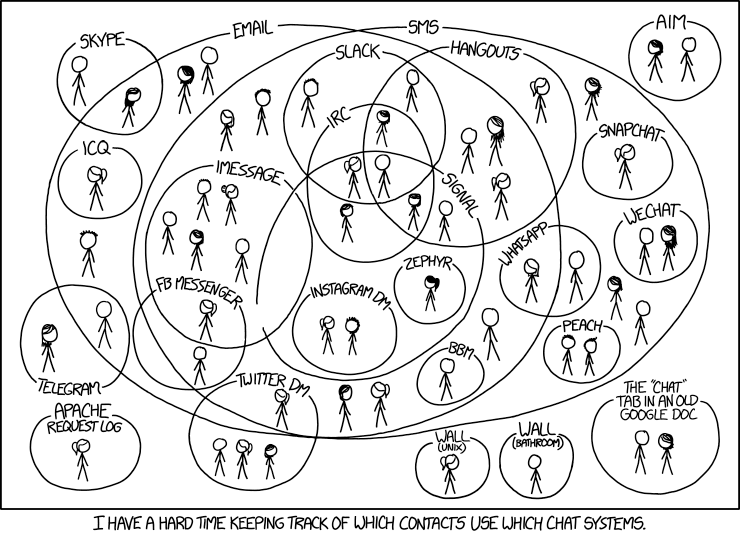
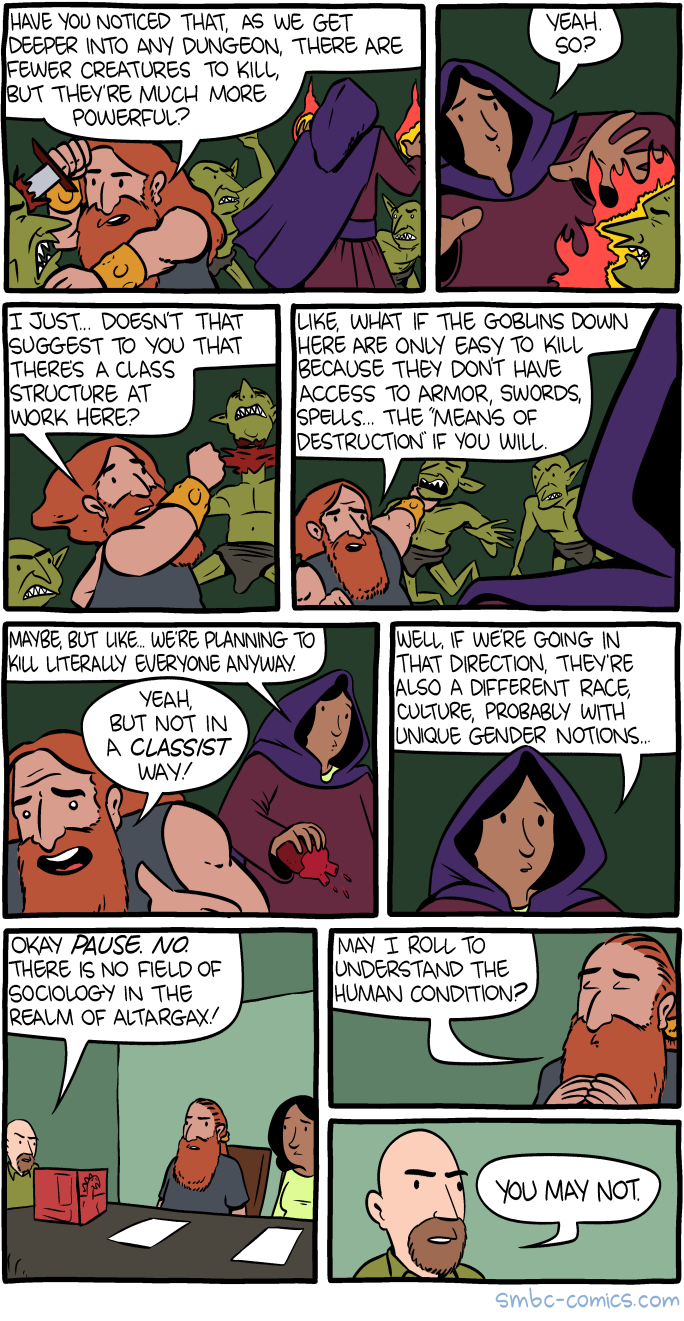
Saturday Morning Breakfast Cereal - Dungeon Classes

by tech@thehiveworks.com


Click here to go see the bonus panel!

Hovertext:
Anyone caught emailing me in regards to the accuracy of today's comic shall be tarred, feathered, and made to carry a sign that reads 'No fun.'

New comic!
Today's News:

Last full day to get your BAHFest East tickets! We moved over a bunch of cheap tickets, but after these are gone, there are no more!

Also, in case you missed it, I'll be signing books prior to the show at MIT Press Bookstore, from 3-430. If you don't want to wait in line after the show, this is the way to go. <3


21 Apr 15:16

Giant Iceberg

by swissmiss

A giant 150ft iceberg is floating past Canada. Wow.

07 Apr 18:56

Addicts Who Can't Get Opioids Are Overdosing on a Diarrhea Drug

by Sarah Zhang

Opioid painkillers have an inconvenient, lesser-known side effect: terrible constipation.

Perhaps then it’s no surprise that people addicted to opioids have considered the inverse. If a drug that gets you high causes constipation, could a drug that causes constipation get you high?

Yes, and that drug is another opioid called loperamide, better known by its brand name Imodium as an over-the-counter treatment for diarrhea. At extremely high doses—dozens or even hundreds of pills a day—it can produce a high or ease withdrawal symptoms. And in the middle of a national opioid epidemic, overdoses of loperamide are rising, too.

“It’s a cheap, legal, and easily accessible opioid alternative,” said William Eggleston, a clinical toxicologist at SUNY Upstate Medical University.  Eggleston authored a case report last year about two men who died of loperamide overdoses. Such case reports have been piling up—in Texas, Arizona, and most recently Rhode Island. Nationally, the number of calls to poison centers for intentional loperamide exposure more than doubled between 2010 and 2015. And the FDA has issued an alert for doctors to look out for loperamide misuse.

Doctors have been playing catch-up on the loperamide trend. In 2012, Raminta Daniulaityte, a public-health researcher at Wright State University, published a paper about discussions of “lope” in a web forum for drug users. At the time, she said, “there was no research at all and nobody really knew about it.” Yet forum users had plenty to say, describing detailed loperamide regimens for treating withdrawal. One commenter called it “my new best friend.” Some, perhaps understandably, expressed skepticism: “would the consipation [sic] rate be worth it? 10 grams is at least 5000 times the recommended dose.”

Which is to say: Loperamide is extremely safe at recommended doses for treating diarrhea and extremely inefficient if the goal is getting a fix. Eggleston said he’s heard of people taking 400 or 500 tablets a day. “They put it in a blender and make a smoothie and drink it over one or two hours,” he said. It causes constipation but no worse than other opioids, which people who addicted often manage by taking stool softeners or laxatives.

Loperamide is also available as a generic, and it is cheap. You can buy 400 tablets for little more than $10 online.

Unlike opioids prescribed as painkillers, loperamide doesn’t usually reach brain cells. A naturally-occurring protein called P-glycoprotein pumps the drug out of the brain. But at very high doses, loperamide overwhelms those pumps and floods the brain’s opioid receptors. Eggleston said that’s led some people to try take a second over-the-counter drug that disables the pumps, so they can use smaller doses of loperamide. The long-term consequences of that combination are unclear, but once in the brain, loperamide has similar effects as other opioids: drowsiness, depressed breathing, and maybe even death in the worst cases.

But massive doses of loperamide also have a second surprising and deadly consequence. The drug blocks calcium channels, which affect the beating of the heart. Too much loperamide and the heart is unable to keep a regular rhythm. Somwail Rasla, an internal medicine resident at Memorial Hospital of Rhode Island, saw a 28-year-old man come in with a particular and unusual pattern in his EKG. “There’s no reason such a young patient should have it, except as a congenital abnormality or medication induced,” said Rasla. It was the latter. The man said he been taking 100 to 150 tablets of loperamide a day. He was put into the ICU and given magnesium to stabilize his heart rhythm. He survived. After nine days in the hospital, he was discharged.

“We felt like this case really needed to be published to increase the public awareness,” said Rasla. Until just a few years ago, the cardiac effects of loperamide were unknown even to most doctors—simply because people weren’t taking the drug in big enough doses until the opioid epidemic. And the trend is unlikely to go away soon. “We will see more cases because the more restrictions [there are] on opioids, the more doctors are afraid of trying to extend their prescriptions, the more people will seek different substances,” said Rasla.

The same thing happened with heroin, Eggleston pointed out. When doctors put the squeeze on prescription painkillers, people went looking for alternatives—many of them to illegal alternatives like heroin and fentanyl and some to legal ones like loperamide.

One proposed policy fix is making loperamide harder to buy, like requiring an ID the way stores now do with cough syrup containing dextromethorphan. That would put the squeeze on another end of the opioid supply though; it only works if the restrictions drive people to treatment rather than to heroin. Diarrhea-drug misuse is just a small, almost absurd part of the larger opioid epidemic.

31 Mar 18:58

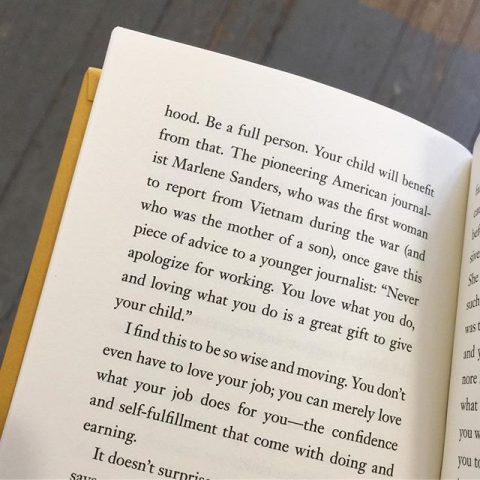
Be A Full Person

by swissmiss

“Never apologize for working. You love what you do, and loving what you do is a great gift to give to your child.” – Marlene Sanders

From the book Dear Ijeawele, or aA Feminist Manifesto in Fifteen Suggestions

(via Youngna)

29 Mar 15:58

The Atheists Struggling to Find Therapists in the Bible Belt

by Angela Almeida
A.N

I've found Grief Beyond Belief to be really helpful. It's very difficult to connect to other grieving parents when they continually talk about their "angel child" and seeing them again and endless memes of angels holding babies and babies with wings "looking down" on their parents.

In the lead-up to the 2016 presidential election, life in the town of Easley, South Carolina, was tense for Leigh Drexler. Pick-up trucks with airborne Confederate flags seemed more prevalent than ever before, and her grandparents—who had never voted in their lives—registered to cast their ballots for the Donald himself.

Drexler felt isolated. “My family has always directed their point of view at me, but it has been a million times worse than normal,” she told me last October. “Every time we’re in a conversation, it’s either about the election or religion.”

It’s a dynamic that led Drexler, who identifies as a democratic socialist and an atheist, to go online in search of a therapist—someone who would perhaps better understand her lack of faith. She scouted towns within a 20-mile radius, but only “faith-based” practitioners turned up. She resorted to distance counseling over the phone with a therapist a few states away. “I knew there would be Christian counselors here, but I didn’t think that was all I was going to find,” she said.

In the U.S., people are less religious than ever. Adults in their 20s and early 30s make up more than one-third of the country’s “nones,” or those who consider themselves religiously unaffiliated. Church attendance among young Americans has also declined, and most adults nationwide rely on internet research, rather than prayer, when faced with life decisions.

But for many non-believers living in the country’s most religious regions, namely the Bible Belt and parts of the Midwest, the idea that religion in America is somehow eroding seems foreign, if not far-fetched. Despite the overall decline in religiosity over the past decade, around 70 percent of Americans still identify as Christian, currently making the U.S. home to more Christians than any other place in the world.

So what does that mean for atheists, agnostics, secularists, and “nones” living in the country’s most faithful pockets? Well, historically, a kind of culture war, where the separation of church and state is hotly debated in places like restaurants, schools, and the workplace. However, in recent years, a more understated and intimate clash over religious liberties has been playing out—only this time, it’s on a therapist’s couch.

* * *

Sigmund Freud once called religion the “universal obsessional neurosis of humanity,” setting the tone for a long-fractured relationship between psychology and theology. Although tensions between the two domains have softened over the past few decades, the tête-à-tête persists, in part because they are devoted to a similar purpose: explaining the intricacies of the human mind, and soul.

The degree to which “He” fits into the mix can vary. From Christian rehabilitation centers and biblical life coaches to religious private practices, spiritual counselors, and something as contentious as conversion therapy, Christian groups have been adopting mental health as a new frontier in recent years. And at the forefront of this trend are faith-based therapies, which have reportedly experienced a surge in popularity over the last decade.

Some practitioners point to substance-rehabilitation programs as the driving force behind this surge. Alcoholics Anonymous meetings, for instance, traditionally come to a close by reciting the Lord’s Prayer, and six of the famous 12 steps cite “God,” “Him,” or “a Power greater than ourselves.” “The chemical-dependency field really began to integrate spirituality long before the mental-health field,” says Gregory Jantz, the founder of The Center: A Place of Hope, a faith-based treatment center in Washington that specializes in depression and anxiety. For Jantz, who is a licensed mental-health counselor, acknowledging the prospect of a higher power can be integral to a person’s well-being. “‘Why am I on this planet? What's my purpose? Who am I?’ Those are questions that are often addressed by looking at faith,” he says.

Last April, Tennessee Governor Bill Haslam signed legislation that would allow psychologists and therapists to deny patients based on their own “sincerely held principles.” The controversial move prompted the American Counseling Association to cancel its annual conference in Nashville, on the basis that the law targeted the LGBTQ community. The gesture was political—something both therapists and Christian-counseling networks condemned—but it also exposed a growing conversation, or concern, about the presence of religion in the field of mental health.

For many clients who aren’t religious, like Drexler, this concern has been a reality for some time. “Their entire lives have been wrapped up in religion, and they were raised and socialized to have that be everything,” says Patricia Guzikowski, a licensed professional counselor based in Wisconsin. “It is hard for them to make a transition.”

Guzikowski provides distance counseling for clients throughout the U.S., many of whom identify as atheists living in religious communities. She’s spoken with women who are afraid of losing custody of their children during a divorce, as a result of losing their faith. She’s counseled ex-Mormons and former Jehovah’s Witnesses secretly over the phone or through email conversations, so that their families and friends do not find out.

Reddit threads are filled with similar stories of people seeking guidance after religious renunciation. An atheist teenager, whose dad is a preacher, asks for help on how to cope with a loss of faith. In Alabama, one person searches for a non-religious therapist to deal with depression. Another, in Dallas, seeks a secular trauma counselor for PTSD.

And then there’s “Grief Beyond Belief,” a support network on Facebook for people who have lost a loved one and want to grieve faith-free. “If you’re grieving without a belief that you’re going to be reunified or that your loved one is somewhere better, your needs are really different,” Rebecca Hensler, the group’s founder, says.

Hensler started the page shortly after the death of her infant son in 2009, and was surprised by the response. She saw stories that read like her own: parents who weren’t comforted by the idea that their baby was now “in Heaven,” or that death might be anything other than death itself. Today, the page has nearly 20,000 likes. Users post daily about what it’s like to mourn alongside pressures from family, friends, or their counselors. “I couldn’t count the number of posts from people who share stories about being in therapy, and then the therapist offers to pray with them or talks about Heaven,” Hensler says. “It’s so profoundly harmful to that therapeutic relationship.”

What groups like Grief Beyond Belief ultimately hint at is a basic ideological divide in the way Americans deal with their problems: Some people are comforted at the thought of a higher power, while others are repelled by it. Applying a similar logic to therapy, people want counselors who share their beliefs and can understand their struggles. Perhaps that is part of the reason faith-based counseling has garnered strength in recent years: For religious patients and therapists who’ve felt underrepresented in a traditionally secular therapeutic community, these programs represent an invaluable part of their identity.

“I identify as a female, wife, daughter, aunt, and Catholic,” says Jill Duba Sauerheber, a licensed clinical counselor in Kentucky. “But I’m also very careful about advertising that I’m a Christian counselor, because I'm a counselor—that’s what I am. … When you label yourself as anything, you automatically begin to narrow your client pool, and potential clients can make assumptions about you.”

* * *

Regardless of approach, religious and secular therapists share a fundamental question: If the purpose of psychotherapy is to remain a theoretical “blank slate,” how much does a patient benefit from knowing a therapist’s personal beliefs? How much should a practitioner reveal?

These are questions my stepmother, Donna, raised two years ago when she hoped to find work at a private practice near her home in Dallas, Texas. At the time, she perused local counseling websites—none of which identified as being Christian—and noticed a common trend: During the application process, some employers wanted a “statement of faith,” while others asked what church she belonged to. “I was like, ‘What does that mean? I don't understand what that has to do with counseling and my work,’” she says.

Caleb Lack, a clinical psychologist based in Oklahoma, has heard similar concerns. “We have lots of people—particularly in the Bible Belt or Deep South—who think, ‘If it becomes known that I am an atheist, there goes part of my practice,’” he says.

Lack is the director of the Secular Therapy Project, or STP, a program designed to connect non-religious people with mental-health services in their local area. As an offshoot of the non-profit “Recovering From Religion,” STP currently has more than 10,000 users who can search the online database for counselors around the world.

To join the website as a therapist, applicants must be secular, possess a state license, and employ what’s known as evidence-based practice in their work, i.e., base their psychological approach on scientific research. Lack says the scrutiny is to avoid any confusion between patients and therapists when it finally comes time to meet, especially in more radical cases. “I met someone who was suffering from depression and their therapist told them, ‘Well, the reason you’re depressed is because the devil is putting thoughts in your head. So we have to pray more now,’” Lack says. “It’s like, ‘Well, wait, I think according to our evidence-based practice guidelines, prayer for depression is not one of them.’”

As faith-based therapies have branched out of the clergy, they’ve taken on different approaches—and credentials. Biblical counselors, for example, reject the psychotherapeutic model, and claim their title simply by expressing a devotion to Jesus Christ and sometimes completing one of several available training courses. It’s a distinction they feel sets them apart from Christian counselors, who tend to employ secular psychology through a Christian perspective. Nevertheless, Christian counselors often do not have to obtain a degree or special certification to practice. Pastoral counselors, on the other hand, are often ministers, priests, or rabbis, and the American Association of Pastoral Counselors only accepts people with postgraduate degrees from accredited universities.

It’s precisely this kind of gray area that secular therapists do not take lightly, yet it should be said that every practitioner I interviewed for this article made a point to clarify that there are, undoubtedly, qualified counselors who are privately religious but keep their personal beliefs out of the office—or who are openly religious but properly credentialed. In a similar vein, many patients do wish to talk about faith, and some experts have reported that a “spirituality integrated” clinical approach can be as effective as other treatments.

That is why programs like STP don’t intend to hamper faith-based therapy, but rather, draw a more distinct line for people in search of secular help. In any therapeutic relationship, regardless of belief, there is a certain level of betrayal in an absence of transparency. When a patient confides their innermost thoughts with a therapist only to later discover after many sessions (and dollars) that they are completely unfit for one another, the experience can be damaging.

It was for Tiffany Russell. Her decision to seek therapy wasn’t easy; she operated a trucking company in Oklahoma City and only had so many free hours. She had to find a practitioner who accepted her insurance—and had to confront years of emotional abuse for the first time.

“It took me awhile to get the nerve up, but my first couple of sessions were uneventful,” Russell says. “There wasn’t anything to suggest there would be an issue.” The therapist had a Ph.D. in counseling, and never identified her practice as faith-based, so she continued the sessions.

“I was comfortable seeing her, and we were getting more into the issues that I was having with my father. She stopped me at one point and goes, ‘Well, you know, your real Father loves you,’” Russell says.

She never went back.

28 Mar 13:07

Flow state

by swissmiss

I watched my coworker Emerline use Flowstate and it blew my mind. It is a writing tool designed to snowball a person’s primal focus into a serene state of creative flow. No overthinking what you wrote. No instant deleting, going back and editing. Just writing! How? You set a focus time, you start writing and when you pause, the app blurs out and makes everything you wrote disappear. The document only gets saved if you complete your timed-writing exercise. Terrifying and brilliant all at once. Try it: Flowstate.

27 Mar 17:28

The Jordanian Airline Making Money Off the Laptop Ban

by Alice Su

Walk into the offices of Memac Ogilvy Advize, an advertising firm on the third floor of a car rental building in a business district of West Amman, Jordan, and you’ll be greeted with an immense black-and-white photo of Donald Trump’s face. The red cursive text printed across it reads: “We Trumped the awards.”

The sign sits behind a reception counter boasting a large trophy won at the Dubai Lynx 2017, an annual advertising competition where Memac Ogilvy won the Grand Prix for PR (a first for any Jordanian agency) along with four other silver and gold prizes, for trolling Trump in their ads on behalf of Royal Jordanian Airlines.

Royal Jordanian, the once-obscure national carrier of the small desert kingdom of Jordan, has been making a name for itself as the Middle Eastern airline that dared to mock Trump. Its first ad—the one that won Memac Ogilvy all those awards—was a simple image published on Twitter, Facebook, and Instagram on November 8, 2016, just before the U.S. election results were announced. The ad showed economy and business class prices for RJ flights to Chicago, Detroit, and New York, with a few snarky lines above: “Just in case he wins… Travel to the U.S. while you’re still allowed to!”

That ad went viral, with an organic reach of 450 million, an 80.3 percent positive response, and press coverage on 26 official news sites and blogs, according to Memac Ogilvy.

The campaign summary that the agency later submitted for the advertising competition was simple. Objective? “Sell more plane tickets to the U.S.” Method? “Use Donald Trump’s ban of Muslims to our advantage.” Campaign budget? “Zero USD.”

According to a video of the award acceptance on the ad agency’s Facebook page, RJ bookings to the U.S. increased by 50 percent after the campaign. “We tweeted more than Trump himself,” the voiceover narration noted.

In early February, when American judges blocked Trump’s ban on immigration from seven Muslim-majority countries, RJ stepped into the conversation once again, releasing an ad with the word “Ban” scratched out and changed to “Bon Voyage!” Flights to New York, Chicago, and Detroit were on sale, the image announced, urging customers, “Fly to the U.S. with RJ now that you’re allowed to.” The sentiment was especially pertinent for Jordan, which hosts millions of refugees and displaced people from countries like Syria, Iraq, Sudan, Somalia and Yemen—all of which had been included in Trump’s executive order.

On March 22, when the U.S. Department of Homeland Security announced that electronics “larger than a smartphone” would be banned as carry-on items for flights departing from 10 Middle Eastern and North African airports, including Amman’s Queen Alia International Airport, RJ spoke up again. The airline responded to the #electronicsban, first with a poem beginning with “Every week a new ban,” then with a list of “12 things to do on a 12-hour flight with no laptop or tablet,” and finally with a recommendation to “Do what we Jordanians do best… Stare at each other!” The posts have already garnered tens of thousands of shares as well as international media coverage lauding RJ’s response to the laptop ban as “snarky,” “cheeky” and “perfect.”

The mastermind behind all these campaigns is Hadi Alaeddin, a 31-year-old Palestinian-Jordanian art director at Memac Ogilvy who also designs posters and T-shirts on the side. He co-runs a branding service called Warsheh and does some work with Jo Bedu, a popular Jordanian brand known for its tongue-in-cheek T-shirts and arabizi (Arabic/English) puns.

When I met Alaeddin, together with Khalil Atieh and Aya Nasif, two Jordanian millennials who handle client services for the Royal Jordanian campaign, they told me that the Trump ads were a spontaneous idea.

“It was real-time, on the spot. We didn’t have a strategy,” Nasif said. “Hadi just thought of it.”

Eight months ago, Royal Jordanian approached Memac Ogilvy seeking help with an image refresh. Founded by the late Jordanian King Hussein bin Talal in 1963, the national carrier had been faithfully flying from the Levant across the region for decades, but developed a somewhat stuffy, overly institutional feel in the process. “RJ wanted to be a ‘fun brand,’” Nasif explained, especially as it struggled to compete with lavishly funded Gulf airlines like Emirates and Qatar Airways. While oil-rich competitors can afford to produce Jennifer Aniston commercials and to paint planes with roses for Valentine’s Day, Jordan’s airline has a far smaller budget. So, it decided to play to its strength: humor—specifically, Jordanian humor, with just the right touch of sarcasm.

“Jordan can definitely compete with the Gulf,” Alaeddin said, noting that his country has a local way of being, a shared mentality rooted in Levantine culture, which an international metropolis like Dubai may lack. “We have our own humor, culture, and way of talking. We have our personality. That’s our edge.”


The point of RJ’s Trump ads is not to be political, Alaeddin told me, but to personalize the brand, so that people can relate to the airline as they would to a Jordanian uncle, not to some cold, inaccessible business.

“It’s never about politics. The whole world was following the election. People don’t follow the election for politics. It’s just what everyone is talking about,” Alaeddin said. So when everyone was discussing Trump’s comments about banning Muslims, the ad agency joined in, the way a Jordanian uncle would. “We just made a silly joke. And people responded to it.”

Within an hour of the first Trump ad, Alaeddin’s phone battery had died from all the notifications that kept popping up. People across the world were responding, even those with no ties to the region or plans to fly Royal Jordanian. “Even non-Muslims globally saw that the sweeping statement was ridiculous for a president-to-be,” Atieh said. “They said things like, ‘Thank you for making fun of this,’ especially since the joke was coming from the people who are most affected.”

I watched from inside the Memac Ogilvy office as the team released their most popular recent ad—the “12 things to do on a 12-hour flight” ad—including the pointed number 12: “Think of reasons why you don’t have a laptop or tablet with you.” I wondered: Was that supposed to imply that the ban is nonsensical? (DHS appeared to be concerned about potential explosives hidden in electronics following intelligence reports, and the similar British ban seems to be based on this intelligence as well.) Why didn’t the ad directly name Trump, or contain an explicit message about security threats?

“We’re kind of passive-aggressive,” Alaeddin laughed, adding that RJ did publish an official release about the details of the ban, but that talking about terror is a poor marketing strategy. “Our job is not to tell people there’s a ban. People already know. Our job is to communicate in a lighthearted way that, yeah, this is happening, but here’s our point of view.”

Royal Jordanian doesn’t want to lose business, but they also can’t force American policy to change. So they’ll do the next best thing, which is to affirm the overwhelming response from their customers and from residents of Jordan writ large: “It’s annoying!” Nasif said. “All of us travel. I can only imagine how it would have been when I was in university, having to worry about this whenever I flew home from the States.”

“We know it’s annoying and we’re trying our best to accommodate,” Alaeddin said, adding that they’d given RJ some ideas about ways to enhance on-board entertainment without laptops. The comments on RJ’s Facebook ads are filled with requests for free inflight Wi-Fi, for example. If Jordanians can’t impact the American president’s decisions, at least they can feel that their airline cares what they think, and then support RJ in return.

After all, that’s what made the first Trump ad so successful. “It was a lighthearted response to a somewhat hateful claim,” Alaeddin said. “More importantly, it sold.”

27 Mar 17:05

The Soul of Big Little Lies Is in Its Music

by Spencer Kornhaber

The latest Big Little Lies episode begins like a lot of Big Little Lies scenes do: with an Apple device being used to cue up a song. This time, the song is the Temptations’ “Papa Was a Rolling Stone,” and the occasion is an impromptu living-room party of gradeschoolers and parents. Viewers see Ziggy Chapman (Iain Armitage) and Chloe MacKenzie (Darby Camp) grooving around while Chloe’s parents Madeline and Ed (Reese Witherspoon and Adam Scott) film them and then get in on the dancing themselves; we hear an iconic bassline and wah-wah guitar building excitement and tension.

But that same song plays as the camera cuts to Ziggy’s mom Jane (Shailene Woodley), who’s been pulled over by police for speeding, her mind racing after her having visited a man she thought might have raped her. As the episode progresses, “Papa Was a Rolling Stone” recurs again and again. That’s because Ziggy has become obsessed with it, watching the Temptations on an iPad while on the way to school and practicing a dance routine when at home. But presumably there’s also an artistic reason the show keeps playing this tune: It helps illustrate Jane’s inner agitation.

HBO’s stylish miniseries of mansion porn and murder is shaped by music on a few fascinating levels. Within its tony setting of Monterey, California, characters are constantly plugging in earbuds, practicing choreography, humming in the car, dabbling on the piano, and recommending tunes to one another. For viewers, song plays the traditional TV role of manipulating emotions (with a mysterious mood for each episode set through the title sequence’s snippet of Michael Kiwanuka’s 10-minute soul-rock song “Cold Little Heart”). But music seems to be doing something bigger, too: serving as a thematic tell, a grand metaphor for how volatile forces underlie placid exteriors.

The director Jean-Marc Vallée and the music supervisor Sue Jacobs have hit on a novel approach to TV music. There’s no composer for Big Little Lies, and it has no orchestral score. Instead, pop songs—rock, soul, R&B, tending toward classic-radio picks—intrude consistently. And a large percentage of this music is, in one way or another, diegetic: When the audience hears a song, that often means someone in the show is hearing it, too. But once a track has been introduced into this world by a character, Vallée freely cuts to characters elsewhere in the world for striking tonal juxtapositions.

With this approach, most characters end up becoming associated with one or two theme songs. Sometimes it’s a simple thematic match: the fatherless Ziggy getting down to “Papa Was a Rolling Stone,” his deeply scarred mom singing along to Martha Wainwright’s “Bloody Mother Fucking Asshole,” the abused Celeste (Nicole Kidman) listening to Irma Thomas’s ballad of painful love, “Straight From the Heart.But in other cases, characters will use music to influence others. For example, Chloe plays Leon Bridges’s “River” a lot, but she does it to foster affection—between her parents, or Ziggy and his schoolyard maybe-rival Amabella (Ivy George).

Chloe herself is the otherworldly, beyond-her-years spiritual DJ of Big Little Lies. In the show’s very first scenes, she announces that she wants to one day be the head of a record label, and she guesses correctly that Ziggy is named for a David Bowie character. Later, she counsels her dad to pick an obscure Elvis Presley tune to perform at the upcoming fundraising gala. The biographical source of her expertise isn’t yet clear—maybe it won’t ever be. But her love of music seems like a beacon of simple, positive passion in a show otherwise defined by darker, more complex desires. Her personality and Ziggy’s name are signs of a matchup between the power of music and the nature of childhood.

For adults, the relationship with music isn’t always so pure. In an uproarious dinner party scene from Sunday night’s episode, Madeline misidentifies the Sade tune that her ex-husband’s new, worldly wife Bonnie has cued up, asking “Is this Adele?” The faux pas suggests that taste is yet another status signifier in a community obsessed with them. Madeline does care about music, though—not for its coolness factor but for its ability to be an outlet for thwarted ambitions, as seen in her push to mount Avenue Q. Meanwhile, the entire Monterey village is revving up for the aforementioned fundraiser. The theme is Audrey Hepburn and Elvis Presley, arts-and-culture icons leveraged for social climbing and—as we know because of the show’s flash-forward framing device—murder.

Six out of seven episodes in, the message of Big Little Lies seems to be that savage forces shape even the most mannered people and places. Idyllic marriages and unassuming individuals hide violent or sexual secrets; cute kids in well-tended classrooms inflict bruises out of sight. Pop music is often thought of as a social force and a cultural glue, but many of these headphone-encased characters seem to have profoundly solitary relationships with their songs—relationships that remind you of how the history of pop music is a history of primal screams, whether of lust or anger or ecstasy. As the show’s music supervisor Jacobs explained to Vulture, “Big Little Lies is dark and has a very dark story at its core. Yet on the surface, it all looks so beautiful.”

Big Little Lies’s music also matters for demonstrating a special approach to small-screen storytelling. As television has increasingly allowed for high-gloss yet experimental art, it has developed a relationship with music that once only movies had. If there’s to be another John Williams or Hans Zimmer, it may well be someone like Ramin Djawadi, the scorer of HBO’s Game of Thrones and Westworld. Yet Big Little Lies brings some prestige back to the recognizable-pop-playlist tradition most associated with The OC. Though you can sing along with most of the songs here, what matters—as with the show’s characters—is that which can be felt but not said.

24 Mar 16:55

The End of Bodies

by Fiona Landers
A.N

"Speaking of plates, did you know grief can destroy many parts of you? Did you know that the complications of grief can be delayed? That when a major death occurs, you are often just in shock for the first year? So when everyone forgets about your loss, that’s when it starts to pummel you the hardest?"

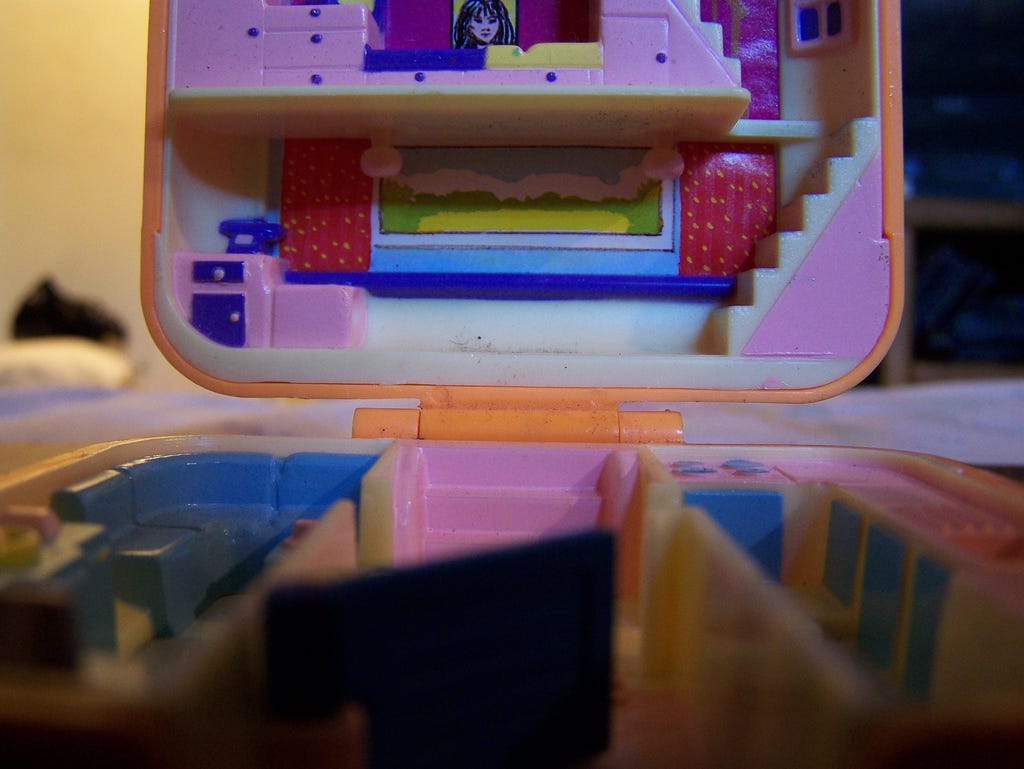
Every time a body ends, a Polly Pocket is born again.

Image: Mindsay Mohan

I don’t know what it’s like to watch someone die suddenly. I can only speak to watching them die slowly. Except it isn’t slowly. It is something else. Time shatters. Skies swallow them. Multiple skies. There is a soundtrack. There is a light show. Different for every death and every loved one left behind. And then there is just you. A miniature version of you that is quietly on fire. You are Polly Pocket. You are Polly Pocket standing in the middle of a tiny, hollow forest fire. This should horrify and anger you, Polly. You live in Death’s pocket. There’s a bed, a kitchenette, a bathroom and a forest fire. It all matches. It’s all bright pink because you are a girl. It’s blue if you’re a boy. Which isn’t fair. None of it is fair. I’m sorry Peter Pocket, I wish we could change colors. I’m sorry Peter, you think you can scream but you can’t. You can’t even talk really. So the fire eats you, like it eats me. It eats me like the cancer ate the bodies of my loved ones. Slowly and then enough. Enough.

Complicated grief “they” call it. “They” equals, “Who the fuck are you?”

I love making my therapist laugh. Oops.

She thinks I deserve physical contact. “Hey, leave the jokes to me, Lady!” I zing, but it’s very charming, very charm-zing, “Have you ever read Plotinus?”

Before she can answer, time is up. Okay, I’ll just tuck this therapy receipt into my dead dad’s fanny-pack that I am currently wearing and be on my way.

I only read like a page of Plotinus’ stuff but get this, he was a philosopher who was ashamed of having a body. And right now that just feels so right. Should I date him? The answer is nope. Plotinus was ashamed of having a body because he thought his spirit was too amazing to be contained in a body. I shouldn’t date him because if we were at the food court in the Topanga Mall in 2003 and that John Mayer “Bigger Than My Body” song started playing, he’d be like, “This is me! This is ME!” and I would be mortified in front of the staff and everyone in line at Sbarro. Again. Once is enough, Plotinus. Sbarro me the pain, I’ve Sbarro’d enough.

Plotinus, you and I share the same shame but we are so different. You are like John Mayer and I am not a dick.

I’ve had body shame. Of course I have. As a teenager I was awful to my body. I starved it and binged it and let idiot boys violate it. Even when I got a little better, I still complained about my hot bod for all of my twenties. But I have stumbled upon a new kind of body shame. A deeper shame. I’m ashamed of having a body because it ends. It’s so embarrassing. Your body will end. Yours and mine. I saw it happen to someone I loved so much. Twice. In two years. Back to back. I saw my dad’s body end. I watched it end. Yellow, gaunt, swollen, then gone. Wrapped in a white shroud, carried down my sister’s steps, his feet sticking out of the sheet on the stretcher. They bumped his head on the gate. My sister and I saw it happen. We wanted to tell him that they bumped his head on the gate, but there we were, stuck in the very first moment of never being able to tell him anything.

His body ended at sixty-two. Samantha’s body ended at thirty-seven. My friend. She was beautiful. Striking. She had bones and breasts and liters of blood and then like an epic and shitty magic trick, all of those things disappeared. I watched cancer suck her teeth and then drown her. I watched cancer eat my father’s eyes. I heard him breathe a few hundred cancerous, morphine death sighs and then poof, gone. Watch your head on the gate, Dad. Why didn’t you say, “Ow”? Why didn’t you move your head? Why didn’t you lift your head up and say, “Hey watch the gate, will ya fellas?” to the funeral parlor guys? Oh. Oh. Right.

My dad died in March of 2015. Samantha even helped me grieve. She had lost her father at age fifteen. She was diagnosed with stage IV lung cancer in November of 2015. She never smoked. She ran half-marathons. She almost didn’t tell me when she was diagnosed, to protect me from more cancer. I’m lucky she told me because hearts are not really for protecting, they are for getting obliterated. She died October of 2016. But timelines don’t even matter. Grief is like time-travel, except it sucks. Think Bill and Ted’s Excellent Adventure meets The Diary of Anne Frank. You visit the dead where the drinks have little umbrellas but no taste. You meet them in the Bermuda Triangle — three separate, swirling worlds — their illness, their death, and their life before those two inexcusable mistakes.

Being died on isn’t easy. It’s much worse to be very ill and then die. Duh. I know they had to do the impossible thing. They had to suffer beyond words and squeeze in their last laughs and cast their eternal love spells and sum up their life experience or not sum it up at all and then they had to vanish. But I had to watch, helpless. I have specifics if you want them. I have hundreds of specifics if you want them. They live in me. In my plastic stomach. My formica head. My heart that is bloated with pain. I had to watch them die, slowly. Until it was sudden. Until it was final. And now I just have to be here. I mean I’m lucky to be here but goddamn.

The amount of grief that’s coursed through my body is too much. Death. Divorce. Death. Death. If you acquire too many losses in a short period of time, are you just a loser now? Probably yeah. I don’t have cancer but cancer has gutted me and made me pretty much feral and deranged. Very subtly. Thanks, cancer, you’re a shitbag. For two years cancer has made me say I’m fine because I’m not the one with cancer. Also, in a total dick reverse move, cancer-grief has even made me accidentally torture a cancer patient/survivor with my suffocating, desperate love. The subtext of all of my mistakes: PLEASE DON’T LEAVE ME PLEASE DON’T DIE. Cool! Way to go, Me! Way to ADD some bullshit to a cancer patient’s plate.

Speaking of plates, did you know grief can destroy many parts of you? Did you know that the complications of grief can be delayed? That when a major death occurs, you are often just in shock for the first year? So when everyone forgets about your loss, that’s when it starts to pummel you the hardest? My appetite and digestion are fucked. It’s exhausting. My insides aren’t working right. My insides seize up. Like they used to do when my dad would burst into my room yelling at me. I’d try to fit under my bed. I’d try to get small. Now I can. Now that I am Polly Pocket. When you are Polly Pocket you can disappear a little. You can move the furniture around in Death’s pocket. You can gaze out at the pink flames as you sip your pink lava tea. People will let you disappear if you fight for that. They’re busy. Or more loyal to your ex. Or not thinking about you. Or if they do, if they reach out, you should probably stay home and tend to this fire, Polly.

An unfortunate side effect of trying to become invisible is that you don’t become invisible. It’s very troubling. You can disappear but people can still see you. And boy do they see you. When your body has changed significantly, people often talk about it to your face. I lost 20 pounds from grief. Just grief. No cool healthy diet/exercise thing. Loss of appetite. Trauma-related nausea. Severe constipation with a side of bleeding asshole. HOT. I’m 5 foot 2 inches. I was 128 pounds, now I’m 108 pounds. People notice.

People love it! “Divorce looks great on you.” “You’re in such great shape!” “What are you doing, you look amazing.” “You’re a babe now.” “So good for on-camera work.”

People hate it! “Don’t lose any more weight, you’re too thin.” “Oh my god, I didn’t even recognize you.” “You’re so tiny.” “You look like a young Willem Dafoe.” (Okay, I added the last one.)

I have never felt more exposed. More embarrassed. More at a loss for words. I have to wear my trauma in public. I have to take it with me on stage to my comedy shows. I had to take it to my grandma’s funeral, my dad’s mom. The funeral he skipped because he was too dead to attend. He died March 12th, 2015, she died on September 11th, 2016 (hilarious move to piggy-back onto a national tragedy, Grandma.). But timelines don’t even matter. Think Back to the Future meets Nell meets Weekend At Bernie’s.

“No, Polly Pocket doesn’t have sex. Hello, that’s gross and she’s busy with fire containment. And Plotinus shouldn’t get to have sex. Neither should John Mayer.”

Therapy is going okay. If I wear a hat to therapy does she write that down?

“Listen, it is much safer to stay Polly Pocket at this point. She is plastic and has no vital organs. She has a headband. There is no vagina, I checked.”

Therapist is dying to know if I’ll ever turn into a real human woman that allows herself to be touched. A cliff-hanger? What an exciting essay.

(Stroking my plastic chin) Will I remain Polly Pocket, who is traumatized and all tucked in for bed in Death’s refrigerated pocket? Or am I far too human for that? Am I so idiotically, unabashedly human that I will let someone I want kiss my neck as a form of rebellion? Will I give Death the side-eye while the sexy neck stuff is happening and say, “I know you’re watching, you sick fuck, and I don’t care. I’m getting my neck kissed tonight, so you can fuck right off!”?

If you make out, Death is watching. If you have some version of good sex, Death is for sure watching. Just watching and jerking off. His bony hand cracking his bony little dick wishing he could switch places for once to see how it feels. To feel how it feels to be lit up. He’s seen a light bulb, is that what it’s like? No, Death, you charcoal turd, we don’t get to know what you feel like so you don’t get to know what we feel like. I see you Death, pathetically, vacantly Dark Master-bating to our pumping blood, our capillaries, our oxygen, our eye color, the tips of our fingers, our raw, rare, mundane, extraordinary, ugly, hairy, chiseled, flabby bodies glistening with sweat and shame and magic. Bodies that are decaying at different paces but absolutely decaying. Decaying and living. Death is jerking off to the defiant side of our mortality he can never touch. The part that lives. What a fucking creep. But kind of relatable, yeah?

Fiona Landers is a writer, actor and singer. She and her sister, Lily Landers, wrote a collection of essays about the loss of their father called ‘A Series of Bungee Cords.’ Fiona writes and performs musical and sketch comedy regularly at the UCB Theatre Los Angeles. Follow her on Twitter: @fionasings4u.


The End of Bodies was originally published in The Hairpin on Medium, where people are continuing the conversation by highlighting and responding to this story.

23 Mar 14:24

The Like Button Ruined the Internet

by James Somers
A.N

I hope us few stay on TOR for a long time. It's one of my favorite corners of the internet because of you guys.

Here’s a little parable. A friend of mine was so enamored of Google Reader that he built a clone when it died. It was just like the original, except that you could add pictures to your posts, and you could Like comments. The original Reader was dominated by conversation, much of it thoughtful and earnest. The clone was dominated by GIFs and people trying to be funny.

I actually built my own Google Reader clone. (That’s part of the reason this friend and I became friends—we both loved Reader that much.) But my version was more conservative: I never added any Like buttons, and I made it difficult to add pictures to comments. In fact, it’s so hard that I don’t think there has ever been a GIF on the site.

I thought about building new social features into my clone until I heard my friend’s story. The first rule of social software design is that more engagement is better, and that the way you get engagement is by adding stuff like Like buttons and notifications. But the last thing I wanted was to somehow hurt the conversation that was happening, because the conversation was the whole reason for the thing.

Google Reader was engaging, but it had few of the features we associate with engagement. It did a bad job of giving you feedback. You could, eventually, Like articles that people shared, but the Likes went into an abyss; if you wanted to see new Likes come in, you had to scroll back through your share history, keeping track in your head of how many Likes each share had the last time you looked. The way you found out about new comments was similar: You navigated to reader.google.com and clicked the “Comments” link; the comments page was poorly designed and it was hard to know exactly how many new comments there had been. When you posted a comment it was never clear that anyone liked it, let alone that they read it.

When you are writing in the absence of feedback you have to rely on your own judgment. You want to please your audience, of course. But to do that you have to imagine what your audience will like, and since that’s hard, you end up leaning on what you like.

Once other people start telling you what they like via Like buttons, you inevitably start hewing to their idea of what’s good. And since “people tend to be extremely similar in their vulgar and prurient and dumb interests and wildly different in their refined and aesthetic and noble interests,” the stuff you publish will start looking a lot like the stuff that everybody else publishes, because everybody sort of likes the same thing and everybody is fishing for Likes.

What I liked about Reader was that not knowing what people liked gave you a peculiar kind of freedom. Maybe it’s better described as plausible deniability: You couldn’t be sure that your friends didn’t like your latest post, so your next post wasn’t constrained by what had previously done well or poorly in terms of a metric like Likes or Views. Your only guide was taste and a rather coarse model of your audience.

Newspapers and magazines used to have a rather coarse model of their audience. It used to be that they couldn’t be sure how many people read each of their articles; they couldn’t see on a dashboard how much social traction one piece got as against the others. They were more free to experiment, because it was never clear ex-ante what kind of article was likely to fail. This could, of course, lead to deeply indulgent work that no one would read; but it could also lead to unexpected magic.

Is it any coincidence that the race to the bottom in media—toward clickbait headlines, toward the vulgar and prurient and dumb, toward provocative but often exaggerated takes—has accelerated in lock-step with the development of new technologies for measuring engagement?

You don’t have to spend more than 10 minutes talking to a purveyor of content on the web to realize that the question keeping them up at night is how to improve the performance of their stories against some engagement metric. And it’s easy enough to see the logical consequence of this incentive: At the bottom of article pages on nearly every major content site is an “Around the Web” widget powered either by Outbrain or Taboola. These widgets are aggressively optimized for clicks. (People do, in fact, click on that stuff. I click on that stuff.) And you can see that it’s mostly sexy, sexist, and sensationalist garbage. The more you let engagement metrics drive editorial, the more your site will look like a Taboola widget. That’s the drain it all circles toward.

And yet we keep designing software to give publishers better feedback about how their content is performing so that they can give people exactly what they want. This is true not just for regular media but for social media too—so that even an 11-year-old gets to develop a sophisticated sense of exactly what kind of post is going to net the most Likes.

In the Google Reader days, when RSS ruled the web, online publications—including blogs, which thrived because of it—kept an eye on how many subscribers they had. That was the key metric. They paid less attention to individual posts. In that sense their content was bundled: It was like a magazine, where a collection of articles is literally bound together and it’s the collection that you’re paying for, and that you’re consuming. But, as the journalist Alexis Madrigal pointed out to me, media on the web has come increasingly un-bundled—and we haven’t yet fully appreciated the consequences.

When content is bundled, the burden is taken off of any one piece to make a splash; the idea is for the bundle—in an accretive way—to make the splash. I think this has real consequences. I think creators of content bundles don’t have as much pressure on them to sex up individual stories. They can let stories be somewhat unattractive on their face, knowing that readers will find them anyway because they’re part of the bundle. There is room for narrative messiness, and for variety—for stuff, for instance, that’s not always of the moment. Like an essay about how oranges are made so long that it has to be serialized in two parts.

Conversely, when media is unbundled, which means each article has to justify its own existence in the content-o-sphere, more pressure than most individual stories can bear is put on those individual stories. That’s why so much of what you read today online has an irresistible claim or question in the title that the body never manages to cash in. Articles have to be their own advertisements—they can’t rely on the bundle to bring in readers—and the best advertising is salacious and exaggerated.

Madrigal suggested that the newest successful media bundle is the podcast. Perhaps that’s why podcasts have surged in popularity and why you find such a refreshing mixture of breadth and depth in that form: Individual episodes don’t matter; what matters is getting subscribers. You can occasionally whiff, or do something weird, and still be successful.

Imagine if podcasts were Twitterized in the sense that people cut up and reacted to individual segments, say a few minutes long. The content marketplace might shift away from the bundle—shows that you subscribe to—and toward individual fragments. The incentives would evolve toward producing fragments that get Likes. If that model came to dominate, such that the default was no longer to subscribe to any podcast in particular, it seems obvious that long-running shows devoted to niches would starve.

* * *

People aren’t using my Reader clone as much anymore. Part of it is that it’s just my friends on there, and my friends all have jobs now, and some of them have families, but part of it, I think, is that every other piece of software is so much more engaging, in the now-standard dopaminergic way. The loping pace of a Reader conversation—a few responses per day, from a few people, at the very best—isn’t much match for what happens on Twitter or Facebook, where you start getting likes in the first few minutes after you post.

But the conversations on Reader were very, very good.

21 Mar 21:43

Sorry For The Delayed Response

by swissmiss

“O.K., so it’s taken me two weeks to get back to you, and I have no excuse beyond the fact that I just didn’t care about your thing. I still don’t care, but I’m trying to foster a false sense of productivity by cleaning out my inbox. Please don’t respond to this response and undo my hard work! Looping in Laura, in case you feel that you have to write to someone.”

Sorry For The Delayed Response, by Susanna Wolff

21 Mar 16:41

How Universal Child Care Affects Boys vs. Girls

by Aria Bendix

Among its many milestones, the 2016 U.S. presidential race marked the first time both the Democratic and Republican nominees released their child-care and paid-leave plans prior to the election. While campaigning, Donald Trump proposed a dependent-care savings account and a small earned-income tax credit for middle-class families. Hillary Clinton, on the other hand, called for direct government investment in early childhood education—including universal pre-k for 4-year-olds—and tax relief for working families’ child care.

Both child-care plans were conservative by international standards. When it comes to early childhood education and care, countries like Denmark, Iceland, Luxembourg, Norway, and Sweden spend more than $9,000 per child under the age of 6 each year.

But there’s reason to believe that this kind of spending doesn’t always pay off. In 2015, a National Bureau of Economic Research working study studied Quebec’s universal day-care program and discovered significant negative behavioral and emotional effects among young children who received care. The program, known as the Quebec Family Policy, was created in 1997 with the aim of providing child care for just $5 a day to all children under the age of 4 (this became $7 a day in 2004). Although it presented some significant upsides—namely, allowing more mothers with young children to participate in the labor force—the quality of care was noticeably lacking. Young children enrolled in the program often became more anxious or aggressive, and teenagers who were previously enrolled reported declines in health and overall life satisfaction.

This created a predicament: Policies that favored working mothers seemed to be placing their children at a disadvantage. In fact, it’s the same argument President Nixon cited in 1971 when he vetoed the Comprehensive Child Development Act, which almost granted universal child care in the United States. Nixon described the bill as “a long leap into the dark,” fearing that “it would commit the vast moral authority of the national government ... against the family-centered approach.”

Ivanka Trump had nearly the opposite to say on the campaign trail in 2016. “As a society, we need to create policies that champion all parents, enabling the American family to thrive,” Trump said to a crowd in Aston, Pennsylvania. For all its complications, child care is often surrounded by two modes of thought: On the one hand, policy-makers argue that families do best when the parents are successful, supporting the case for more readily available child care. On the other hand, they argue it’s the child’s well-being that matters the most, and children benefit from increased parent attention. Are the two beliefs mutually exclusive?

The authors of another NBER working paper, released Monday, revisited Quebec’s child-care policy to determine whether any additional effects are at play. What they found was striking: Not all children with access to universal care exhibited similar responses. After studying children under the age of 5 from two-parent families, the researchers found a distinctly gendered difference in the way children were shaped by universal care. Only boys, for instance, saw a significant decline in motor social development, as well as increased hyperactivity and inattention. By contrast, only girls saw significant increases in emotional and separation anxiety. (Formal tests did not reveal significant gender differences on average.)

Perhaps the most interesting finding was that parents raised their children differently depending on their access to subsidized care. “The introduction of universal child care led to substantial changes in the manner in which parents invested in sons and daughters,” the researcher wrote. To start, boys were more likely to be placed in center-based care, while girls were more likely to be placed in home-based care. Girls with access to universal child care also experienced fewer positive interactions with their own parents. Notably, the parents of girls were two times less likely to spend time reading to, laughing with, or doing special activities like going to the library with their child.

As is often the case, future research is needed to determine whether these gendered differences have lasting effects as children become adults. It’s also important to point out that the poor quality of Quebec’s day-care program likely has something to do with its negative effects.

At the very least, the new study reveals the dialogue surrounding universal child care is more complicated than policy-makers may have originally thought. In reality, child-care programs aren’t just a matter of making lives better for parents or children. While a child’s gender may affect how they respond to a program, many behavioral issues could be the result what happens at home. It remains critical that parents play an active and positive role in their child’s life, regardless of whether they have access to universal care—or whether they have a son or a daughter.

21 Mar 15:23

What it Means

by Lynn Steger Strong

In her essay, “The White Album,” Joan Didion says, in the first sentence, “We tell ourselves stories in order to live.” I tell stories for a (partial) living, but for months now I have not. Instead, I’ve had this image of a woman, me, presumably, in a tiny room surrounded by concrete walls, a concrete floor. She claws at the walls with her hands. No windows. No door. She knows full well that nothing will come of this but can’t stop clawing. Her fingers bleed. She does not stop. When I try to write: I write that image in various incarnations. I stop writing. I go back to one of my other jobs. I watch C-span.

Didion says, “We live entirely, especially if we are writers, by the imposition of the narrative line upon disparate images, by the ideas with which we have learned to freeze the phantasmagoria which is our actual experience.” No word pops up more often in my head these days than “phantasmagoria.” Fantastic. Unreal. As something in a dream. Reality, often offered with quotation marks around it, has come to feel almost wholly made up.


*****

Narratives are how we not only make sense of the world but make sense in a way that it’s more communicable, more felt. It’s how we pass our feelings on. I want to explain to myself, my husband wants me to explain, why I’ve been getting dizzy again lately, weak-headed and nauseas, unable sometimes to stand; I work back through time and try to lay out for him, for me, the events that led up to this moment that has become so untenable that stories are needed; I’m not sure right now that stories are enough.


*****

A few pages into her essay, Didion quotes from a medical report that ends thusly, “In her view she lives in a world of people moved by strange, conflicted, poorly comprehended and, above all, devious motivations which commit them inevitably to conflict and failure.” Didion doesn’t tell us (in one of her many moves of near perfect storytelling) that this medical report is hers until the end.

The night of November 8, my family and I went out to dinner and I had a gimlet. We read quickly to our children as we put them to bed half an hour early so that we could get back to refreshing the various news websites we had open on our computers, livestreaming the TV broadcasters’ excited, then anxious, then baffled reports on the returns. The next morning, our daughters came into our bed to kiss me and wish me a happy birthday. It was my birthday the day after November 8. We fed them and got them dressed. I went to work. Three of my students arrived to class at once, all female, one Muslim, one on a student visa, are we really doing this? One of them asked.

My parents called and my mother asked why I was crying. Your family will be fine, my father texted. Don’t let it ruin your birthday, he said. I threw my phone.

****

I refused to sleep train our older daughter for months when she was little, because I was certain she didn’t have the mechanism (language, stories) to explain our absence to herself. She couldn’t say to herself, maybe they are busy. She couldn’t say to herself, they will come soon. She couldn’t spin a narrative in which we loved her, I thought, if we weren’t consistently, immediately proving that we did.

This was also the greatest comfort, for me, of early parenthood. Language, which was the only thing I’d ever believed I could have power in, language, which had so often proved not-enough, was moot when it came to our newborn baby. Concrete, consistent action was what she needed. I had no choice but do.


 ****

Later in her essay, Didion talks about the “physical chill” she experienced each time she read the verse posted on her mother-in-law’s wall, during this period:

“God Bless the Corners of this House
and be the Lintel Blessed
And Bless the Hearth
And Bless the Board
And Bless Each Place of Rest
Bless Each Door That Opens Wide To Strangers and to Kin”

People were walking through doors and killing people, people were calling her and threatening her or suggesting she was being chased, watched. To see these words up on a wall and framed; the chill of wanting to believe in words, and often having to face up against how quickly they can be freed of their meaning, how insignificant, how useless they can be.

*****

I was given narratives my whole life about “Love”. This is why, they said, no matter what they did or failed to do, because we Love you so very much. The actions didn’t matter, the consequence. Every act was done in Love. Love had never left. I must be grateful. I must stop. I must shut up. Because of Love.

I had no concept of that word’s definition by the time I was a grownup. I understood it as a weapon, a tool through which to achieve any means or ends as long as it was cloaked or covered later in that single piece of language. I understood it as a Trojan horse.

****

In the weeks since the election when my husband has tried to spin the narratives of our future, once we’re out of debt, if he gets this job he’s hoping to get, if I could somehow manage to get a fulltime teaching job, we will do a or b or c. My running epitaph to each of these statements, is “if we don’t die” or “if we’re not already dead”.

I’m a thirty-three year old white woman. We’re healthy. We live in New York, surrounded by friends. I have no reason to think I’m dying or that someone will kill us as a result of this election. And yet, every time anyone suggests the possibility of a future, I feel desperate to immediately shut them up.

Unless we’re dead: this phrase, perhaps obviously, infuriates my husband. He flips it, of course, because all phrases have an inverse. Unless we’re dead can just as easily become: we’re not dead yet.

And yet, though I understand I might seem hysterical, though I see how exhausting I must be, it does not seem pathological right now to fear almost every action. It does not seem pathological to fear for the people that we love who are not as safe as we are, to fear for other humans, all over this country, all over the world. Even before the results of this election, as trucks were driven through crowds in Nice, swathes of people shot in Orlando. Police shooting, suffocating unarmed men and women, murders in Chicago, Turkey, Paris, planes disappearing. Suicide bomber. Zika. Ebola. What felt most pathological was to try to live.

****

I called my father a week or so after the election and begged him to convince me I was being hysterical, that the world wasn’t ending, that millions of lives weren’t about to fall apart. My father is the master of naming my hysteria. He is also the main reason I thought Trump would win. My parents think my book-reading, my Liberalism, is performance, they think I’m frustrating and hysterical and smug. They are perhaps the reason I spent so many years reading about how one might be allowed to feel.

Explain to me, I asked my father. Systems, he said. Institutions. Bannon, I said. Free press. Regulations, he said. Great recession, I said. Business, he said. Efficiencies, he said. Human beings, I said. My father is a reasonable and thoughtful man, but we disagree on many things and we could not agree on this. He has been a person of extreme privilege for most of his adult life. I remained Hysterical. We hung up.

 *****

Didion says we try to freeze the phantasmagoric. One thing that is true in language, that is true in fiction, that is never true in life, is that both books and words presume ideas can be held still and contained. To attempt to fit an experience or a feeling into a single word or story is by definition failing. The words fall short by virtue of existing. As do the narratives.

Once, living in Taiwan with a friend, during the Bush years, drinking and talking politics and torture policy with a group of ex-pats, me not saying a word the whole night, my friend, upon returning to our apartment, asked me why I never spoke. You read so much, she said, you must know so much. I knew about Lady Chatterly and The Brothers Karamazov, I knew about Mrs. Dalloway, and Septimus. I knew so much, in fact, about fictional characters and their wants and needs and feelings, I would often spend whole days convinced these people were in the world somewhere. I knew much less about Weapons of Mass Destruction. I knew less about Iraq, Sudan, Rwanda, North Korea, I thought I knew almost nothing of the real life horrors in the world.

Post-election: I read a book about fascism, a book about the Koch brothers, a book about eviction, a book about Syria, a book about Nazi Germany, a book about Russia, a book about economics and lobbyists.

****


When people talk about language, about pushing for specificity, about trying to get things right, we talk about language as signifier, life as signified. You want to get as close as possible to matching. You want to allude to an approximation of a “truth”.

Hack is not the correct word to use to talk about Russia. Hack is not strong enough. How many ways can we define “legitimate”. We must not normalize the white supremacist. Normalization is the only way to get him out. He’s Hitler, Berlusconi. Let’s please define the word fascist as opposed to populist. This is not a situation that calls for impeachment. #notmypresident. Mitch Mcconnell’s obstructionism is the reason that we’re here to begin with. Mitch Mcconnell calls the Democrats “obstructionist”. The office of government ethics is questioning our president’s ethics. The House Oversight Committee, tasked with overseeing ethics, is questioning the ethical choices of the office of government ethics’ choice to question the ethics of the president. Post-fact, post-truth. Facts are a matter of opinion.

Great. American. Ethics. Facts. Human dignity.

It’s Right, he’s Right, because he Won.

65,844,610 (Lost).

62,979,636 (Won).

****

I have two degrees, a published novel, and work four jobs and only barely pay the rent. My husband and I, a few days before the election, had a serious conversation about whether or not we could reasonably afford to continue to pay for our health insurance. I spend the next four months calling my congress people daily begging them to let me continue paying 800 dollars a month for a pretty okay plan.

 ****

In the morning, we wake up, our kids eat breakfast. They go to school. We work. We pick them up. I keep thinking this is their lives, their memories forming, things we can’t take back. We’re not dead yet. My husband lets me stay in bed ten minutes longer than the day before to read news on my phone. He listens to me when I read out loud from the book on fascism.

One of my jobs is to write quizzes for small children for a corporation. I write a quiz about bears, about climate change, about government. I watch c-span as I do this. I watch a woman who has never been to a public school be put in charge of our public school system. I watch a climate change denier get appointed to head the EPA.

I pick my daughter up at her pre-school where students speak thirteen different languages, where she explains to me there’s no such thing as girl toys and boy toys, where she tells me she wishes she had more than one mom.

We listen to NPR. One night, out of nowhere, our four-year-old says to me, though we’ve not spoken to them about this much directly, she says, I don’t want to talk about Donald Trump anymore. Our two-year-old says, maybe he’s mean because he’s sad.

 *****

A story, without much language, “facts”: a few weeks ago, in New Orleans, I was driving through a four way stop and a man in a wheelchair was hit and knocked onto the street by another man turning right on red. A woman went up to the man and I told my mother in law, who was in the seat next to me, to call 9-1-1. We kept driving. I do not know what happened to the man.

I’m going to give you some white space now, consider this. Form opinions about me. Form opinions about each of those men, about my mother in law. Feel.

Now the story again, more words.

The day after thanksgiving, I was driving just outside the ninth ward in New Orleans past a handful of blighted houses, with my mother and father-in-law and my two daughters, two and four, asleep in the back. It was a strange trip, shaded somehow by the fact of the election, tense with my father-in-law and I sneaking away to read the news and then huddle in the kitchen to lament the state of the world. We kept accidentally ending up in places we didn’t mean to end up in, Bourbon street with small children, one of the handful of restaurants in New Orleans with subpar food. Everyone was exhausted and freaked out and I was driving, which I hardly ever do. Our light had just turned green and I pulled slowly out into the cross-section. The space between the different sides of the street in New Orleans is called the Neutral Ground. We pulled forward, and I saw, only in the corner of my vision, a man begin to slowly wheel his wheel chair into the crosswalk. This man was black. Another man, who would later turn out to be Asian, was turning right on red, which is legal in New Orleans, incredibly slowly, inching out as we drove past. The driver of the car and of the wheelchair were moving at about the same speed as they made contact. The man in the wheelchair fell slowly, almost unbelievably, as the man in the car came to a full stop. The man who had previously been in the wheelchair lay on the floor in a helpless, awkward crumble as the driver of the car got out, horrified, running to the man’s side. A woman in the crosswalk ran over to both of them and began to yell at the driver of the car, not helping the man on the ground up off the floor. The driver of the car went to try to help the fallen man. The man on the ground pushed the man from the car away. I stopped our car in the middle of the street, almost getting hit by the car behind us. Our two-year-old woke up and began to cry. I tried to pull over as my mother-in-law got out her phone to call 911. Should we, what do we, I said to my mother-in-law. Another car pulled over. A man got out. We drove away.

Lately, when people ask me how I’m doing, I just offer up that story. I highlight different parts, the yelling woman, the impossibility of knowing who was at fault, how maybe, everyone was fucked long before that car ran into that wheel chair, long before that man fell out. There are thousands of other stories inside that one that, as a fiction writer, I also want to tell. I want to do the sort of circling in and down of the fiction writing that I most like reading. I want to give you history and wants and fears of each of the main actors. I want to show you how each of them is even more and less culpable than it seems they are based on that story by itself.

There is something, for me, in that story that feels True.

****

I wrote an essay a few months ago about a friend I lived with for a few months in Taipei. This friend is one of my oldest dearest friends. Our younger daughter is named after this friend. We speak once, sometimes more, a week. I wrote an essay about our experience together over a decade ago, an experience that was pivotal for both of us. I sent her this essay to make sure she didn’t mind my writing it. I sent it to her nervous only about how honest I had been.

In response, she sent me an excerpt from TS Eliot’s “Love Song for J. Alfred Pulfrock”. She said, through him:

And would it have been worth it, after all,
Would it have been worth while,
After the sunsets and the dooryards and the sprinkled streets,
After the novels, after the teacups, after the skirts that trail along the floor–
And this, and so much more?–
It is impossible to say just what I mean!
But as if a magic lantern threw the nerves in patterns on a screen:
Would it have been worth while
If one, settling a pillow or throwing off a shawl,
And turning toward the window, should say:
“That is not it at all,
That is not what I meant, at all.”

I’d gotten all of it wrong, my best, dearest friend said. What I wrote, what I had tried to say, what I’d meant about what we’d been through, it was not, she said, what she’d been through, not honest, not true, not what she’d meant at all.


****

In one of the anecdotes littered throughout Didion’s essay, she says, talking about a story in which John and Michelle Phillips take a detour on the way to the hospital in their limo to pick up a friend, “this incidence, which I often embroider in my mind to include an imaginary second detour to the luau for gardenias, exactly describes the music business to me.”(emphasis mine) it’s an anecdote that does it, that describes a time, an industry, but it’s an anecdote embroidered that does it perfectly.

****

Some more quotes from Elliot: (B. 26 September 1888 – D. 4 January 1965)

“What we call the beginning is often the end. And to make an end is to make a beginning. The end is where we start from.”

“Humankind cannot bear very much reality.”

“This is the way the world ends, not with a bang, but a whimper.”

“Half of the harm that is done in this world is due to people who want to feel important. They don’t mean to do harm. But the harm does not interest them.”

“Only those who will risk going too far can possibly find out how far one can go.”

 *****

In the end of Didion’s essay, the last sentence, much less often quoted, Didion states, “Quite often I reflect on the big house in Hollywood, on “Midnight Confessions” and on Roman Navarro and on the fact that Roman Polanski and I are godparents to the same child, but writing has not yet helped me to see what it means.”

And yet she wrote it. And yet those words still signify.


Lynn Steger Strong: apocalyptic tweeting.

Her novel, HOLD STILL, comes out in paperback March 21. 
 

17 Mar 16:27

Fridaaaay! Links

by Maggeh

This weekend we’re going to the Presidio Picnic, repotting plants, and letting the baby run around in his diaper. What are you up to?

upintheclublike
BBC Babies Gif: Do not try to stop them.

Want to see Victoria Beckham’s collection for Target? This mod dress is so scooter-ready.

Charming embroidered foods by ipnot. Those noodles, aw.

Hair dye that changes color like a mood ring. Magic.

Entry from the nightmare dictionary: Superfetation. It’s getting pregnant while you’re already pregnant. (rabbit hole via Swiss Miss)

Emma Watson on feminism and the whinging over her “topless” Vanity Fair cover. That whole slideshow is worth clicking through, BTW.

We’re teaching Hank (and Brad) to cook, and most sites have a section on one-pot or one-pan meals. Jaime Oliver has 142, Martha Stewart lists 32, Cooking Light has 83, and so on.

The neckline on this vintage shirt is so Cate Blanchett as Katharine Hepburn.

Toasty mug, mmmm.

F. Scott Fitzgerald made a list for his daughter of things to worry about (horsemanship), not worry about (boys), and things to think about (aims).

Happy weekend, nice people.

The post Fridaaaay! Links appeared first on Mighty Girl.

17 Mar 16:06

One Mixed-Up Night

by BenBirdy1

You guys! The middle-grade novel I wrote is available for pre-order on Amazon! Jakers! I'm crazily excited about this book. It's a book about friendship--about two best friends whose own favorite book is From the Mixed-Up Files of Mrs. Basil E. Frankweiler, so they end up plotting to spend the night at. . . well, IKEA. The friends are based on Ben and his lifelong Ava, and their big, big love of IKEA. In a pie chart of the way those two have spent the past fourteen years, I would have to say that lying on the couch / in a hammock / on the carpet with the IKEA catalogue is no small slice.


I don't want to give any spoilers, so I will just say that the book is also about a lot of other things. Like cats and recipe-testing and death and doorknobs, and oh, you know, some of my other fave topics.

My friend and neighbor Bestselling author Cammie McGovern says, "The mystery that propels these two wonderful characters onto their escapades is both heart-wrenching and (when we finally learn the whole truth) profoundly moving. A dazzling debut."

And my friend bestselling author Suzy Becker calls the book, "A hilarious, hair-raising page-turner, and an iconic portrayal of best friendship."

It comes out in September, in hardcover and on audio. Please pre-order it, if it sounds like the kind of book someone at your house would like! And/or tell all your (parent / kid / book reviewer / editor / teacher / librarian) friends about it! They're saying grades 3-7, but I think it could go a little older, personally. 

Anyhoo, in other news, I made these cookies after we ate them at the King Arthur cafe in New Hampshire, and they were nothing short of perfection. (I did not have poisonous almond resin or whatever that crazy ingredient is called, so I doubled the extract.) If you like a deeply almondy cookie with a crisp outside and a tooth-sticking center, like an Italian macaroon, this is your recipe.

Have a wonderful weekend. xo
17 Mar 15:16

Parenting by the Books: How To Do Things With Words

by Sarah Blackwood

Moms and the Philosophy of Language

Image: Robin Tomens

“Josh was saying curse words today!” he declared as he stepped off the bus home from his central Brooklyn public school. “Oh!” I exclaimed, and then a little conspiratorially: “what words did he say?” He breathlessly spilled the beans. “The ‘J’ word” and the ‘A’ word and the ‘F’ word and the ‘H’ word.” “What words are those?!” I prompted, eyes wide. He answered. “Jerk, and asp, and funk, and….heck!”

I don’t know if the street-smart second grader on the bus is saying the actual F word, and my younger child is mishearing, or if they are all just going around shouting “funk you” at school and thinking it makes them anything other than super-miniature Brunos Mars. Does it matter if they know “what” they are saying? If they think they are cursing, aren’t they cursing? Or, even putting aside the question of intention, if their “shocking” utterance changes the world for them in some way, makes it shimmer for them in the way the best curse words do: isn’t that its own confirmation?

Being a mother continually challenges me to think about how language works, which makes it weird to think back on aspects of my graduate education related to the philosophy of language. The most common genealogies hold that it wasn’t until Ludwig Wittgenstein in the early twentieth century that philosophy started to seriously explore how language did more than just describe an already extant world. Language, these modern thinkers realized, in fact shaped the world and acted upon it. This is more than just arcane grad seminar stuff, it’s the “linguistic turn” out of which the world-altering theories of structuralism, post-structuralism, performativity, and semiotics emerged.

Yet it occurs to me: had anyone consulted someone who cared for small children, perhaps we might have gotten to this insight a little sooner in human history? The disregard for the realities of caretaking is kind of the problem with philosophy, right? Any parent will have had experience with what J.L. Austin called, in his 1962 book How to Do Things With Words, “illocutionary” language: an act of speaking that actually does the action it promises to do. “STOP!” “Yes, you may.” “Use your words.” “I love you.”

How to Do Things With Words carefully maps how performative speech works, which of course includes thinking through the (many) instances when it doesn’t. Here, too, caretakers have important knowledge: examples of when and where performative language breaks down, where language fails to act upon the world in the way intended or expected. Consider the first few times I heard my kids say “shut up.” I played it so uncool, made it so clear that I disliked it, that they now use the phrase as some sort of fast track button to press when they want to get somewhere bad, quickly. When they’re looking for a conflict, when they want to ramp things up to the point of a good cathartic screaming cry, when they need to get some of the ugly out of themselves, they know how to do it. “Shut up,” my three-year-old mutters through pressed lips like Mugsy. It’s a familial Rubicon, a semantic breakdown where our speech is definitely doing something but not at all what we want it to do.

How to Do Things With Words is a great book, and I love much of the theory and philosophy that grew up alongside it. And yet its position in intellectual history reminds me how much of women’s knowledge and intellect has been ignored throughout history. I’m put in mind of Virginia Woolf’s description of the harmfully inverse relationship between reproduction, caretaking, and the achievements of the intellect in A Room of One’s Own. Her clever authorial persona considers the difference between the riches of an imaginary all-men’s college of Oxbridge and its shabby all-women’s counterpart, Fernham. Oxbridge has $$$, nourishment for the body and soul, grass she is not allowed to walk on, and a towering library full of knowledge that she may not enter. How did this come to be? Why had no one left a fortune to sustain an institution for women’s flourishing? “What force” the narrator asks about the miserly dinner they’ve just eaten, “is behind the plain china off which we dined?” And then she realizes:

For, to endow a college would necessitate the suppression of families altogether….Consider the facts, we said. First there are nine months before the baby is born. Then the baby is born. Then there are three or four months spent in feeding the baby. After the baby is fed there are certainly five years spent in playing with the baby. You cannot, it seems, let children run about the streets.

You, indeed, cannot! “STOP!!” I shout as my children race their scooters toward a dangerous intersection. And they do. Stop, that is. My words, performatively (and iteratively) uttered day after day after day as we criss-cross the city blocks home after school, draw boundaries about them. For their part, my children are speech acting all the day long: labelling, repeating, pleading, refusing. And, of course, trying to poke holes in those boundaries, testing out the places where language fails: SHUT UP AND FUNK YOU! The linguistic turn in philosophy captured something real and ordinary about how language actually works. The question I have, though, is why it took us so long — until the twentieth century! Unbelievable! — to get there.

Woolf, I think, would say that it’s because we had not thought to ask, or know anything about, the people taking care:

Here am I asking why women did not write poetry in the Elizabethan age, and I am not sure how they were educated; whether they were taught to write; whether they had sitting-rooms to themselves; how many women had children before they were twenty-one; what, in short, they did from eight in the morning till eight at night.

Were you to have posited to a mother of five children, in 1850 or 1910 or 1723, that language mostly “described” the world as it “is,” she likely could have offered an almost limitless number of counter-examples, drawn from her daily linguistic world-building with children. But, of course, nobody asked her.

Parenting by the Books” is a series about parenting and classic literary texts.

Sarah Blackwood is editor and co-founder of Avidly and associate professor of English at Pace University.


Parenting by the Books: How To Do Things With Words was originally published in The Hairpin on Medium, where people are continuing the conversation by highlighting and responding to this story.

17 Mar 14:55

What If Hillary Clinton Were A Man And Donald Trump Were A Woman?

by Silvia Killingsworth

One economics professor used actors to reenact one of the debates and find out.

Image: Liz Henry

So this is a little uncomfortable but overall very revealing to watch. INSEAD professor Maria Guadalupe got together with NYU’s Joe Salvatore, a professor of theatre who specializes in ethnodrama (!!!!!!) to recreate sections of the second televised debate between Hillary Clinton and Donald Trump. NYU News has a great story about the process, how they rehearsed, and how they decided which parts to include (“we ended up having to cut the “When I was First Lady” because when we tried it as “When I was First Man,” it just made no sense.”)

https://medium.com/media/30f06b6659127662428f94761d2fd54f/href

They put on a few live performances, which I now wish I could have gone and seen, and solicited reactions from their (largely liberal, academic) audience members. What they saw and heard will, as they say, surprise you:

People got upset. There was a guy two rows in front of me who was literally holding his head in his hands, and the person with him was rubbing his back. The simplicity of Trump’s message became easier for people to hear when it was coming from a woman — that was a theme. One person said, “I’m just so struck by how precise Trump’s technique is.” Another — a musical theater composer, actually — said that Trump created “hummable lyrics,” while Clinton talked a lot, and everything she was was true and factual, but there was no “hook” to it. Another theme was about not liking either candidate — you know, “I wouldn’t vote for either one.” Someone said that Jonathan Gordon [the male Hillary Clinton] was “really punchable” because of all the smiling. And a lot of people were just very surprised by the way it upended their expectations about what they thought they would feel or experience.

Read the whole thing here:

What if Donald Trump and Hillary Clinton Had Swapped Genders?


What If Hillary Clinton Were A Man And Donald Trump Were A Woman? was originally published in The Hairpin on Medium, where people are continuing the conversation by highlighting and responding to this story.

17 Mar 13:28

The 18 Independent Agencies Trump Wants to Eliminate

by Elaine Godfrey

On Tuesday, the White House released President Trump’s proposal for the 2018 federal budget, outlining his spending priorities for Congress and the country. The budget seeks $1.4 trillion in savings with significant cuts to many domestic programs. But for 18 independent agencies, it goes a step further—and proposes eliminating their funding entirely.

The budget is dubbed “A New Foundation for American Greatness,” and Trump’s proposed route to making America great again will involve a substantial increase in defense spending, offset with deep cuts to safety-net programs and agencies like the State Department and the Environmental Protection Agency.

Since releasing his preliminary “skinny budget” proposal in March, Trump has made it clear that he wants to fatten one thing: the Department of Defense. He’ll increase the department’s budget by $54 billion, a move he says sends “a message of American strength and resolve” to the world.

To do that, Trump plans to shrink the budget for the State Department and USAID by 29 percent and outlines a 31 percent cut in funding for the Environmental Protection Agency, discontinuing all funds for the Clean Power Plan, international climate change programs and research, and for the Great Lakes Restoration Initiative and the Chesapeake Bay Program.

In the budget, Trump proposes a reduction in funding and eventual elimination of 18 independent agencies—those that exist outside of federal departments headed by a Cabinet secretary. One of those agencies is the Appalachian Regional Commission, a federal-state partnership focused on economic development in a region encompassing all of West Virginia and parts of Pennsylvania, Ohio, Kentucky, Alabama, Georgia, Maryland, Mississippi, New York, North Carolina, South Carolina, Tennessee, and Virginia. Its inclusion is notable, because it serves a region that largely supported Trump, and which he has promised to revive economically.

Another is the Corporation for Public Broadcasting, an agency created in 1967 to ensure universal access to television and radio programming. The CPB’s budget relies almost entirely on federal funds and it distributes most of its funding to locally owned public radio and television stations. Trump also proposed eliminating the National Endowment for the Arts, an agency supporting projects in arts education, literature, music, and other disciplines.

Here’s the complete list of the independent agencies Trump wants to eliminate:

  • African Development Foundation
  • Appalachian Regional Commission
  • Chemical Safety Board
  • Corporation for National and Community Service
  • Corporation for Public Broadcasting
  • Delta Regional Authority
  • Denali Commission
  • Institute of Museum and Library Services
  • Inter-American Foundation
  • U.S. Trade and Development Agency
  • Legal Services Corporation
  • National Endowment for the Arts
  • National Endowment for the Humanities
  • Neighborhood Reinvestment Corporation
  • Northern Border Regional Commission
  • Overseas Private Investment Corporation
  • United States Institute of Peace
  • Woodrow Wilson International Center for Scholars

The budget is likely to face significant opposition from lawmakers on both sides of the aisle in Congress.

17 Mar 13:28

Trump's Education Budget Revealed

by Aria Bendix

Although President Trump stayed mum on his plans for the U.S. Department of Education, one policy has been clear: Trump plans to cut nonmilitary spending. The administration’s new “America First” budget, released Thursday, follows through on this promise by slashing funds for the Education Department by 13.5 percent, or $9.2 billion.

It’s worth noting that the proposed budget is merely a blueprint. Congressional lawmakers will draft their own budget proposals, and the plan Congress passes will form the basis of the appropriation bills that fund the government. That, as my colleague Russell Berman pointed out, won’t come until May.

To start, Trump’s budget plan would remove $2.4 billion in grants for teacher training and $1.2 billion in funding for summer- and after-school programs. It also curtails or eliminates funding for around 20 departmental programs “that are not effective, that duplicate other efforts, or that do not serve national needs.”

Although decreased funding for the Education Department will have repercussions for students and educators across the country, low-income students are particularly vulnerable. In addition to eliminating Supplemental Educational Opportunity Grants (SEOG), which offer need-based aid to around 1.6 million low-income undergraduates each year, the Trump administration wants to “significantly” reduce Federal Work-Study. Although work-study programs have been criticized for disproportionately aiding private institutions, they are typically successful at helping students graduate and find employment post-college.

The budget proposal also calls for around $200 million in cuts to federal TRIO programs, which benefit low-income, first-generation, and disabled students, and GEAR UP, a program that helps prepare low-income middle and high-school students for college.

Pell Grants are safe for now. They retain their $22.5 billion in discretionary funds, although the budget proposes $3.9 billion in cuts from the program’s $10.6 billion surplus. Many Republicans and Democrats anticipated this surplus funding would go toward helping students attend summer school.

The new budget also ensures that students with disabilities have continued access to special education by maintaining $13 billion in funding for IDEA programs. Furthermore, the administration will offer $492 million in funding for minority institutions and historically black colleges—a similar, yet slightly smaller, sum than was previously allotted.

Overall, decreased funding will make room for one of Trump’s top education priorities: school choice. Under the new budget, the Trump administration wants to spend $1.4 billion to expand vouchers in public and private schools, leading up to an eventual $20 billion a year in funding. About $250 million of these funds will go toward a private school-choice program, while $168 million will be set aside for charter schools. An additional $1 billion will go toward Title I, a program opposed by many lawmakers, which allows federal, state, and local funding to follow students to the public schools of their choice.

All together, the budget has many moving parts, but its message is straightforward: Under the Trump administration, federal aid is out and school choice is in. Whether this stays the case moving forward is unclear. As a recent analysis from the Washington, D.C.-based New America Foundation puts it, “This budget request is nothing more than that—a request to Congress, unlikely to be heeded and subject to the tinkering and votes of hundreds of members of Congress.” Still, its authors argue, “it’s an indication of the priorities of the Trump Administration.”

16 Mar 14:01

Is that Art or a TV?

by swissmiss

For the first time ever I might consider owning a TV: The Frame is the first TV that doesn’t turn off; instead of going to black, The Frame displays a stunning piece of art, turning your wall into a museum-worthy art gallery.

15 Mar 17:03

‘The Body’: The Radical Empathy of Buffy’s Best Episode

by Sophie Gilbert
A.N

We snuck subs and beer into the hospital an hour after Gabe died.

Twenty years ago, when Buffy the Vampire Slayer debuted on The WB, it’s hard to imagine anyone conceiving of what a phenomenon the show would become—a hit TV series, yes, but also a platform through which pop-culture theorists and sociologists alike could consider the dynamics of American teenaged life around the turn of the millennium. “Buffy Studies” have become a thriving faction within academia, while streaming services have kept the show on the contemporary cultural radar. In a media landscape where people continue to be surprised that teenaged girls engage with political issues, the idea of a perky blonde cheerleader being tasked with saving the world is still strikingly subversive.

One of the most revolutionary things Buffy did, though, was take teenagers—and their pain—seriously. The show’s central conceit of having Buffy (Sarah Michelle Gellar) be a “chosen one” destined to protect the earth from vampires and monsters offered a fairly typical setup for a supernatural drama, but the twist was that many of Buffy’s boogeymen were based on real sources of teenage angst. Here were metaphorical demons made literal: a controlling mother who lives vicariously through her daughter, a friend whose behavior becomes unrecognizable when he joins a pack of popular kids, a classmate so lonely and isolated she becomes literally invisible. By having intangible issues manifest themselves as physical monsters, Buffy made them accessible, and manageable.

As the show progressed, its creator, Joss Whedon, experimented more with the boundaries of what Buffy could do. In season four, concerned that the show’s great strength—its dialogue— was overriding its other qualities, he wrote an episode, “Hush,” in which every single character lost their voice. In season six, he conceived a musical episode in which the characters found themselves spontaneously bursting into song. And in season five, he wrote what many critics and fans consider to be Buffy’s superlative moment: an episode in which a central character died from natural causes, and which showed everyone else experiencing the shock, anger, and grief of her death in real time.

“The Body,” which aired on February 27, 2001, opened by repeating a scene that had concluded the previous episode. Buffy returns home, walking through her front door, commenting on some flowers sitting on the hall table, and calling out to her mother, who’s lying on the couch. When Buffy sees that her mother is motionless, she pauses, and her expression shifts. “Mom?” she says. She repeats the word, more urgently. Then, quieter: “Mommy?”

For Whedon, the episode was born out of a desire to explore and expose the real emotional responses to losing a loved one. On television, death is usually cheap: a device that precipitates a narrative arc, or writes out an actor who wants to leave, or functions as a ploy for ratings. Although some of these factors were involved in “The Body”—the death of Buffy’s mother, Joyce (Kristine Sutherland) marked a turning point for Buffy’s maturity into adulthood—Whedon wanted to focus not on the pain and catharsis of grief, but on how surreal and physically strange it can be. “What I really wanted to capture,” he later explained in the DVD commentary, “was the extreme physicality, the extreme—the almost boredom of the very first few hours.”

The first 13 minutes of the episode are set entirely in Buffy’s home. There’s a flashback to Thanksgiving, and then a swift and jarring cut to the present, where Buffy notices her mother’s body, calls 911, attempts to administer CPR, and responds to the paramedics. Joyce’s body—clearly and noticeably dead from an audience perspective—is visibly jarring, shown in close-up to have a grey pallor and an expression of shock. The title of the episode captures the impact of the physical presence in the living room, and the strangeness of Joyce’s sudden metamorphosis from a living entity into a dead one. Buffy, noticing that Joyce’s skirt has hiked up around her waist during her attempts to administer CPR, pulls it down before the paramedics arrive, conveying how wrong and obscene her mother’s death seems.

The sheer weirdness of this transmogrification from Joyce to “the body” is a theme throughout the episode. “She’s cold,” Buffy tells the dispatcher on the phone. “The body is cold?” the woman asks. “My mom is cold,” Buffy responds. Later, when Giles (Anthony Stewart Head) arrives and attempts to revive Joyce, not knowing the paramedics have already declared her dead, Buffy shouts, “We’re not supposed to move the body!” before clamping a hand to her mouth in shock, horrified at the consequences of what she’s just said. Stylistically, too, Whedon employs directorial devices to convey the disorientation Buffy feels. When a paramedic talks to her, the camera focuses on his chest below his head, and when Buffy picks up the phone, the buttons seem huge and distorted in perspective. There’s no music throughout the episode, with the few sounds that can be heard (children playing, wind chimes) marking the contrast between Buffy’s absurd reality and the world outside.

The peculiarity of the rest of Sunnydale carrying on as usual while the world of Buffy and her friends has upended is echoed later, when Xander (Nicholas Brendon) double parks his car going to pick up Willow (Alyson Hannigan), and duly receives a parking ticket at the end of the scene. Buffy’s friends, meanwhile, represent different responses to grief. Xander is angry, raging at the doctors and punching a hole in the wall. Willow is panicky and indecisive, obsessing over small details like her outfit rather than confronting the real source of her pain. Tara (Amber Benson) is supportive and accepting, with it emerging later that she’s experienced this before. And Anya (Emma Caulfield), a former demon who only recently became human, communicates a childlike response to Joyce’s death, asking irritating questions repeatedly and mimicking the behavior she observes from others. (When she clasps Giles in an awkward bear hug, it’s one of the few elements of humor in the episode.) Her monologue, after being told it’s not OK to ask such blunt questions, is one of the most moving moments in “The Body”:

But I don’t understand! I don’t understand how all this happens. How we go through this. I mean, I knew her and then she’s—there’s just a body, and I don’t understand why she just can’t get back in it and not be dead anymore. It’s stupid. It’s mortal and stupid. And Xander’s crying and not talking, and I was having fruit punch, and I thought, Joyce will never have any more fruit punch, ever, and she’ll never have eggs, or yawn, or brush her hair, and no one will explain to me why!

But it’s the scenes with Dawn (Michelle Trachtenberg), Buffy’s younger sister, that put the episode in context with everything Buffy has done over the past four seasons. When Dawn first appears in the episode, she’s crying in a bathroom at school because a classmate has spread rumors that she self-harms, and everyone thinks she’s a freak. This moment of pain—real for Dawn, but also surmountable, since she soon wipes her eyes and walks out of the bathroom head held high—is  juxtaposed with Dawn’s reaction when Buffy tells her that their mother is dead. The scene is observed externally by the audience, through a glass wall, and most of the words are imperceptible. But Dawn’s reaction, as she breaks into sobs and physically crumples to the ground, is unmistakable. Buffy, who’s spent the first half of the episode in vivid close-up, is seen from a distance, too, shifting roles from suffering impossibly to comforting her sister.

In this scene, Buffy draws an intriguing line. Throughout previous episodes, the show has told viewers that their experiences and their heartbreaks growing up have been real and powerful, from being bullied to being dumped. “The Body” manages to communicate, though, that there are a few certain life moments that change you irrevocably, and it does so without undermining the significance of other things that feel life-shattering in the moment. It presents a realistic experience of grief, reaching out to viewers who’ve endured it, and making it more comprehensible for those who haven’t. In tackling the less familiar aspects of death—boredom, shock, awkwardness—it offers a more truthful depiction of bereavement.

“The Body” is one of the most sophisticated analyses of the impact of death ever produced on television, and it remains a testament to why Buffy was so unique. “There’s things,” Tara tells Buffy about her own mother dying when she was 17. “Thoughts and reactions I had that I couldn’t understand. Or even try to explain to anybody else.” The power of Buffy is that it understands those thoughts, and does try to explain them, all in the guise of being a teen drama about vampires.

15 Mar 03:25

Chat Systems

I'm one of the few Instagram users who connects solely through the Unix 'talk' gateway.
14 Mar 00:37

Calm

by swissmiss

06 Mar 20:21

Listening

Sure, you could just ask, but this also takes care of the host gift thing.
06 Mar 14:41

Slow Cooker Carnitas

by Beth M

Okay, this might be the best thing I’ve ever made in my slow cooker. No joke. The combination of the subtle spices, orange essence, and richness of the slowly cooked pork is absolutely to die for. I hereby retire my chili rubbed pork in favor of these Slow Cooker Carnitas. I want to make sure I have some of this in my freezer at all times for tacos, burritos, and NACHOS. Oh yes, the nachos I could make with this pork…

If combining cinnamon and orange with pork sounds a little far fetched to you, don’t be scared! The flavors are subtle and add layers of flavor that you never imagined meat could have. It’s not sweet, it’s just amazing. Promise me you’ll try it.

While I used my slow cooker to cook the meat down until it was tender and juicy, I finished it off in a skillet to get some crispy edges. You want to wait until just before serving to crisp the meat up, so if you don’t plan on serving the entire 3 pounds of meat at once, store the rest in the cooking juices. I divided my slow cooked meat in half and transferred half of it to the freezer after chilling over night. I crisped the other half in a skillet and made deliciously rich little tacos with pickled red onions.

And YES, you can absolutely do this super fast using an Instant Pot. ;) Just layer everything in your IP as I did with my slow cooker, secure the lid, and press go. The Instant Pot manual suggests 45-50 minutes of high pressure for a pork butt roast.

Goes great with: Pickled Red Onions, Spicy Pickled Carrots, Cumin Lime Roasted Sweet Potatoes, Warm Corn and Avocado Salad

Slow Cooker Carnitas

Warm spices, fresh orange essence, and a low slow cook time makes this Slow Cooker Carnitas tender, juicy, and full of flavor. BudgetBytes.com

4.9 from 11 reviews
Slow Cooker Carnitas
 
Prep time
Cook time
Total time
 
Total Cost: $7.80
Cost Per Serving: $0.98
Serves: 8
Ingredients
  • 1 yellow onion $0.32
  • 4 cloves garlic $0.32
  • 2 small cinnamon sticks $0.95
  • ½ Tbsp oregano $0.08
  • ½ Tbsp cumin $0.08
  • ½ tsp salt $0.02
  • Freshly cracked pepper $0.05
  • ½ tsp chipotle pepper powder $0.05
  • 3 lb. pork butt roast $5.26
  • 2 small (or one large) orange $0.67
Instructions
  1. Dice the onion and peel the garlic cloves. Place the onion, garlic, and cinnamon sticks in the bottom of the slow cooker.
  2. In a small bowl, combine the oregano, cumin, salt, pepper, and chipotle powder. Cut the pork roast into 2-inch cubes. Place the cubed meat in a bowl and sprinkle the spice mix over top. Toss the meat in the spices until evenly coated. Place the seasoned meat in the slow cooker on top of the onion, garlic, and cinnamon.
  3. Use a vegetable peeler to remove the thin layer of orange zest from one of the oranges. Squeeze about ½ cup juice from the oranges. Pour the orange juice over the meat in the slow cooker, than sprinkle the pieces of orange zest over top.
  4. Place a lid on the slow cooker, turn it on to high, and cook for 5 hours, or until the meat is tender and falls apart.
  5. Use tongs to stir and shred the meat, and remove the cinnamon sticks. Either divide the meat and liquid into smaller containers to refrigerate for later, or transfer the meat and some of the liquid to a skillet (preferably non-stick or cast iron). Cook the meat over medium flame until browned and crispy on the edges. Avoid stirring the meat too much as it will break down into tiny pieces. Use the crispy meat as a filling for tacos, burritos, nachos, or burrito bowls.
3.5.3226

Warm spices, fresh orange essence, and a low slow cook time makes this Slow Cooker Carnitas tender, juicy, and full of flavor. BudgetBytes.comWarm spices, fresh orange essence, and a low slow cook time makes this Slow Cooker Carnitas tender, juicy, and full of flavor. BudgetBytes.com

Step by Step Photos

Onion Garlic CinnamonDice an onion and peel four cloves of garlic. Place the diced onion, garlic cloves, and two small cinnamon sticks in the bottom of the slow cooker.

Cinnamon SticksThese are the cinnamon sticks I use. These little packets of four small sticks are found in the Hispanic food section of my local grocery store and only cost $1.89. So, in if cinnamon sticks are expensive in the spice aisle, check the international foods aisle as well.

Spice MixIn a small bowl stir together 1/2 Tbsp oregano, 1/2 Tbsp cumin 1/2 tsp salt, some freshly cracked pepper, and 1/2 tsp chipotle pepper powder.

Pork RoastYou’ll also need one pork butt roast, about 3 lbs. If you use a bone-in roast, just get one slightly larger than 3 lbs. and don’t forget to pull the bones out after cooking.

Add Seasoned PorkCut the pork into 2-inch cubes, place them in a bowl, and sprinkle the spice mix over top. Toss the meat cubes in the spices until they’re evenly coated, then place them in the slow cooker on top of the onion, garlic, and cinnamon.

Orange PeelsUse a vegetable peeler to remove the zest from one of the oranges. You want to get all the nice orange parts with the fragrant oils, but not the white pith, which can be bitter. Also juice the oranges. You need about 1/2 cup juice.

Add Orange JuicePour the orange juice over the meat…

Pork and Orange PeelAnd add those orange peels over top.

Slow Cooked CarnitasPlace the lid on the slow cooker, turn it on to high, and cook for 5 hours. See how much liquid comes out of the meat? That’s good stuff right there.
Shredded CarnitasUse a pair of tongs to stir and shred the meat. Fish out the cinnamon sticks (and bones, if you used a bone-in roast) at this time. You can serve the meat just as it is, or you can crisp it up in a skillet.

Refrigerated CarnitasOR you can refrigerate it or freeze it for later. If refrigerating/freezing, I highly recommend dividing the meat up into smaller portions before refrigerating (store it with the cooking juices). This helps it cool faster and prevents food safety issues. If you want to freeze some of it, let it chill in the refrigerator over night before transferring to the freezer. 

Crisp Carnitas in SkilletTo make the carnitas crispy, just cook it in a skillet with some of the juices (because you need the fat from the slow cooker to basically fry the meat) until it’s crispy. I recommend doing this in some sort of non-stick skillet though, like cast iron or teflon, because the liquified collagen likes to stick to and coat stainless steel. 
Warm spices, fresh orange essence, and a low slow cook time makes this Slow Cooker Carnitas tender, juicy, and full of flavor. BudgetBytes.comAnd that’s basically it! It’s just that easy to make tender, juicy, and FLAVORFUL slow cooker carnitas. 
Warm spices, fresh orange essence, and a low slow cook time makes this Slow Cooker Carnitas tender, juicy, and full of flavor. BudgetBytes.comNow excuse me while I go make the most epic nachos EVER. ;)

The post Slow Cooker Carnitas appeared first on Budget Bytes.

03 Mar 07:44

Fridaaaay! Links

by Maggeh
A.N

For the Amazon Dash Button

Accomplishment of a lifetime: I Was a Black, Female Thru Hiker on the Appalachian Trail.

Speaking of explorers, did you see this piece in California Sunday about the private citizens who are building their own (feasible) rockets to Mars? Mars Madness: “You have this dream to do this really cool thing, but you always think in the beginning: It’s not for you. It’s not gonna happen …. Then one day you start to realize: It could be you.”

Man sells his tattooed skin to art collector who will have him flayed when he dies. Sure.

Useful: Neven’s simple checklist of things to remember when you launch a new project.

Tabletop Moonshine Still — Let’s get one and have moonshine parties when the moon is shiny.

Good price on this dress for your gallery show.

#Museum101 is the hashtag you add to creepy/amazing stuff from museum collections. I got you guys something.

This story reminds me of how few disciplines have access to data scientists, and software designers and engineers. Serial Killers Should Fear This Algorithm
“Using Freedom of Information Act (FOIA) requests, MAP has tried to chase down data from the many municipalities and counties that weren’t supplying their murder data to the FBI, out of bureaucratic laziness, a lack of manpower, or perhaps just rank incompetence. MAP has already assembled case details on 638,454 homicides from 1980 through 2014, including 23,219 cases that hadn’t been reported to the FBI. This is the most complete list of case-level details of U.S. murders available anywhere, and the group’s website has open-sourced all of it.”

How to make an amazon dash button that gives the ACLU $5 Every Time You See Something Terrible

Cute, ultra-simple place cards from Oh Happy Day for our Shiny Moon parties.

The post Fridaaaay! Links appeared first on Mighty Girl.

02 Mar 21:36

Double-Chocolate Meringue Fudgies

by BenBirdy1

I feel like every recipe I post should be preceded by a colon and the word menopause. "Menopause: Homemade Chocolate Pudding." "Menopause: Double-Chocolate Meringue Fudgies." The turning and turning again towards chocolate feels a little suspect, no? I suppose there's also Trump, as far as explanatory words go. Sigh. But I'm telling you: eat one of these tender, velvety, black cookies still-warm from the oven, and you will forget that your vagina sweats all night in a really unusual way you've never heard about. At least for a moment.

Double-Chocolate Meringue Fudgies
Makes 2 dozen
Total time: 35 minutes

If you've been searching for a rich, chewy, dark, decadent chocolate cookie that's like a cross between a brownie and a black hole, look no further. These are really profoundly chocolatey, and you can even stir in an extra 1/2 cup of chocolate chips if you like, and if you want to call them Triple-Chocolate Meringue Fudgies! I like the smoothness of them without, though.

1 cup semisweet chocolate chips
3 large egg whites, room temperature
2 1/2 cups powdered sugar, divided use
1/2 cup unsweetened cocoa powder
1 tablespoon cornstarch
1/2 teaspoon kosher salt (or half as much table salt)
1 teaspoon vanilla

Heat the oven to 375, and spray 2 large baking sheets with cooking spray, or line them with parchment. Melt the chocolate chips in the microwave, stirring occasionally, until they are mostly melted, about 2 minutes. Stir until fully melted, then leave them to cool.

Using electric mixer with the whisk attachment, beat the whites on high speed until they just form soft peaks. Gradually beat in 1 cup of the sugar, and continue beating until the mixture gets thick and glossy. Whisk together 1 cup of sugar, the cocoa, cornstarch, and salt in medium bowl to blend. On low speed, beat the dry ingredients into the meringue with the vanilla. Now, with a wooden spoon, stir in the lukewarm chocolate. The dough will be batter-like at first and then, as you stir, it will get very stiff.


Place the remaining 1/2 cup of sugar in a bowl. Roll 1 rounded tablespoon of dough into a ball, then roll it in the sugar to coat it thickly. (The dough can be sticky and awkward to work with, but it's not too bad. I use my cookie scoop to dump lumps into the bowl of sugar, then kind of roll and coat them at the same time, if I were to be completely honest.) Place on prepared sheet, and repeat with the remaining dough, spacing the balls 2 inches apart. Bake until the cookies are puffed and the tops crack, about 10 minutes. Cool on the sheets on a rack 10 minutes, then transfer the cookies to a rack to cool completely.
02 Mar 14:27

Faces in Things

by swissmiss

Ever see a face in everyday objects? This Twitter user collects and shares them. An instant favorite.

(via Chris)

01 Mar 14:11

NOPE Button

by swissmiss

This Nope Button Chrome extension is just what the office world needs: A coworker drops by and wants to ‘pick your brain’? Press a button in your Chrome browser to send a call to your phone. Apologize sincerely as you pick it up. Then watch your co-worker walks away. Funny.

28 Feb 16:04

The Wisdom of Nokia's Dumbphone

by Ian Bogost

They weighed heavy in pockets and jackets and bags, for they were thick and bulky, not lithe and narrow. Harried professionals never clutched one ostentatiously to say silently, “I’ve got better things to do than listen to this pitch or order this coffee.” Fashionable youth never dangled one nonchalantly from fingers as a flirty pique. Nothing was less sexy or less useful than a cell phone.

How is it possible, then, that Nokia has announced an updated edition of one of its most popular phones of the early aughts, the 3310? In short, because nothing has become less sexy or less useful than a smartphone.

* * *

First released in 2000, the Nokia 3310 emerged during the Cambrian explosion of mobile devices. Fashionless black bricks crossed the paths of colorful, candy-bar handsets. Slim, black Ericsson flip-phones shared airport security bins alongside silvered Motorola clamshells. WAP-enabled “feature phones” offered rudimentary, useless access to the internet, while the fat fingers of government officials and corporate executives mashed the keys of BlackBerry 957s and Treo 180s. Teens thumb-typed too—but texts instead of emails, on Danger Hiptops. The Nokia N-Gage even tried, and failed, to merge the mobile handset with the portable game system. Over the first half-decade of mass-market mobile devices, everything was attempted and nothing was holy.

In retrospect, the story of all these devices’ downfall is an obvious one. BlackBerry and Palm had failed to guess that smartphones would appeal to a general audience, not just to business users. They’d also mistaken the physical keyboard for a requirement. And all the rest of them, flip or clamshell or candy-bar, had assumed that phone calls and text messages would define portable handheld computing.

Instead, in 2007, Apple made a general-purpose touch-interface computer in the form of a thin glass rectangle, which others have copied and adapted ever since. 10 years later all anyone does, pretty much, is stroke and fondle one of these things, all day long. And for the privilege, consumers pay big bucks, continuously,  to keep up with planned obsolescence reinvented as seasonal fashion.

The shame of a habit can only emerge once it has reached ubiquity. Even though the risk of compulsive obsession with smartphones was clear halfway into their ten-year life, the trauma of that obsession is only starting to dawn on people.

There are reasons. Years of odious abuse on services like Twitter and Reddit have finally mestastasized into resigned admission. The logic of amplifying information based on popularity, as Google and Facebook do, has finally revealed its obvious downsides. The demand of constant, unceasing attention from apps like Snapchat and games like Candy Crush Saga has begun to feel like the unpaid labor it always was.

For years, internet-driven, mobile computing technology was heralded as either angel or devil. Only recently has it become possible to admit that it might be both. Cigarettes, after all, produce pleasure even as they slowly kill.

Given the rising angst of a society run by technology, Nokia might have picked the perfect time to introduce an antidote to the smartphone. But even under today’s conditions, it is tempting to see the new Nokia 3310 merely as another example of retro nostalgia. Ha-ha, what if you could get a dumbphone instead? It would pair perfectly with a milk crate full of vinyl albums. But it’s also possible that the 3310 marks the start of a new period of technological mobility. One that offers a sense of how even the most entrenched technological habits might yet turn out differently.

* * *

Phones like the Nokia 3310 never went fully extinct, despite the geological devastation of the iPhonecene. Thanks to their low cost, feature phones have remained popular in the developing world, where they have always been more common than traditional computers. Even in sub-Saharan Africa, smartphones only overtook feature phones sales in the last two years. HMD Global, the Finnish company that licensed Nokia technology and branding back from Microsoft sees more opportunity in these markets. Late last year, the company unveiled two new, $25 feature phone models, marketed to the billions of feature phone users in Europe, the Asia Pacific, India, the Middle East, and Africa.

Since the iPhone and Android rose to prominence, high-quality, reliable alternatives to smartphones have all but disappeared in the developed world. And where they remained, they have become so uncool as to make their adoption grounds for public shame.

But there are reasons to prefer a phone as a portable communications tool instead of a compulsive, general-purpose computer. Some of those reasons recall the original uses of the cell phone. When it first became generally popular in the late 1990s, mobile handsets often were bought as insurance against surprises or emergencies. People tossed them into automobile glove boxes, or carried them in pockets or purses only when the perception of risk or the need for coordination seemed required. Those concerns persist, especially now that people have become accustomed to being able to reach one another immediately and constantly. An inexpensive, reliable handset with a long-lasting battery might turn the Nokia 3310 a second phone, or a backup phone.

Another possible use is domestic. Once mobile phones became ubiquitous, many households gave up on home phone lines. By 2012, more than half of American homes didn’t have a landline. But the decline of the home phone also had unexpected consequences. Smartphones are personal devices, while the home phone line is a shared resource. As mom, dad, and all of the kids began getting their own, private communication tools, the phone as a point of entry to the household disappeared. But there’s reason to imagine a future in which the telephonic hearth renews. A cheap, appealing device like the Nokia 3310 could be left on the kitchen counter, ready to cry its loud, familiar ring as a means of reaching the home in general, rather than one of its occupants. Anyone who has missed a service call because the iPhone was on silent on the nightstand, or awkwardly passed around a personal device with grandma and grandpa on the other end, might willingly add another line to avoid such discomforts.

Then there’s the matter of smartphones’ overall sameness. Last year, my colleague Robinson Meyer profiled the Caterpillar S60, a smartphone designed by the heavy equipment company, built for construction work. Rugged and reinforced, it can be dropped from heights, immersed, and exposed to the elements. Rob rightly called the future that the Caterpillar S60 represents one in which “smartphones become unboring.” Boredom ends not thanks to the absolution of some newfangled feature that everyone needs, but from the specific features useful in particular circumstances.

The simultaneous fragility and expense of smartphones also helps explain why the Nokia 3310 might appeal even to consumers who can afford better. Speaking to The Guardian, the industry analyst Ben Wood cited the “festival phone” and the “backup phone” as possible contexts for the handset. When working in the yard, camping, or white-water rafting, the risk of damaging or destroying a $750 smartphone makes carrying one seem foolish. But what other choice is there? Likewise, when attending a concert or sporting event, thin smartphones might risk getting lost or stolen. In these instances, a $50 Nokia 3310 offers clear benefit.

Security and privacy offer more reasons to consider a dumbphone. Smartphones are sophisticated tracking devices. GPS and motion sensors, along with the always-on internet servicing dozens of apps doing unspecified processing in the background make these devices encyclopedias of their users’ actions and behavior. While the cellular network can always be used to determine a handset’s location, the granularity and accuracy of its physical tracking is limited compared to a GPS device. And given recent examples of border agents demanding access to travelers’ smartphones, feature phones might become standard equipment for frequent travelers.

Upon arrival, the feature phone might even prove a more useful tool than the smartphone to the jetsetter. How much energy do business travelers expend managing the power and network needs of their smart devices at meetings or conferences? True, the Nokia 3310 can’t direct owners around an unfamiliar city on a map, or allow them to live-tweet an event. But perhaps the need to keep a smartphone powered and connected to the network—not to mention the compulsion to use all those apps—would be reduced given a second device meant solely for communication.

The Nokia 3310 might also offer an alternative to smartphones for younger kids. It’s much easier for a preteen to signal a pickup by phone or text than to try to guess when and where to arrive. Some parents, myself included, try to pawn off cheap, basic phones to children as they become old enough to pursue schedules outside the home. But these tools are devoid of style. They are embarrassments, without appeal, and as such they become more likely to go unused or left at home. Should Nokia rekindle the cultural allure of the feature phone, perhaps its potential as a communications tool absent the urges of the smartphone will inspire parents to stop handing over these glass-and-metal temptations to their progeny without a second thought.

* * *

It might be premature to announce the end of humanity’s love affair with the smartphone. But the relationship’s cracks are surely showing. Some have immediate consequence. Apps have contributed to a huge spike in traffic accidents and deaths, as more and more people attempt to operate finicky handheld devices while driving. The partial-reinforcement techniques baked into today’s apps and games has become more apparent to users, who seem increasingly resigned to services they also feel no option to quit. And the uniformity in design of devices has arrested their future potential. Every year another glass rectangle, affording no more or less than it promises, which is more of the same.

The smartphone’s conquest is definitive and complete. A decade after its form solidified, the contemporary citizen of the developed world has almost no choice but to own and operate one. And yet, the joy and the utility of doing so has declined, if not ceased entirely.

People called them called cell phones, or mobile phones, depending on the home continent of their carriers. “Cell phone” highlighted the empty space between communication nodes—the cells—common to North America. In Europe, where the land is flat, the nations small, and the coverage ubiquitous, versatility took center stage: the capacity to remain connected while in on the move thanks to a “mobile.” These name describe dreams as much as reality. Likewise, “smartphone” is wishful thinking as much as anything. A skeleton key, an aluminum genius, a singular device that deploys software, connectivity, portability, and design to end, finally and definitively, the ideal purpose of universal computation.

But the truly smart actor does not use one single tool, but the right tool for the job. That the right tool might always be one forged in software and activated via touch and gesture always should have been as preposterous as it is now only starting to seem. The Nokia 3310 isn’t the answer to the future of mobile telecommunications, or computing, or digital fashion, or any of the other domains in which the iPhone has pulled the wool over collective eyes. Instead it can be just what it is: one specimen in an ecosystem of technical diversity. The future promise of Nokia’s device isn’t this particular device, but the alternate, unthought future it represents.