sailor moon

Skeletor Affirmations (by ghoulnextdoor)
"WE IMPROVE OURSELVES BY VICTORIES OVER OURSELVES. THERE MUST BE CONTESTS, AND WE MUST WIN."

the ideal
the aesthetic
I recently described my dream living situation as “a witch with WIFI” and lo and behold

In the Soviet Union, western antibiotics couldn't make it past the Iron Curtain. So Eastern Bloc doctors figured out how to use viruses to kill infectious bacteria. Now, with antibiotic-resistant bugs vexing doctors, that eerie yet effective method might come our way. In post-antibiotic world, infection cures you!


not today satan
not today
It’s like CPR for toilets
How many college dorm floors would kill for this on a weekend night…

I think I know what they were going for, but definite could be read the wrong way… http://ift.tt/1igH8Un
ha ha ha ha ha
I have seen the Maryland version of this plate with my own eyes, it was amazing and beautiful

Grand Swirls from NASA’s Hubble.
This new Hubble image shows NGC 1566, a beautiful galaxy located approximately 40 million light-years away in the constellation of Dorado (The Dolphinfish). NGC 1566 is an intermediate spiral galaxy, meaning that while it does not have a well-defined bar-shaped region of stars at its center — like barred spirals — it is not quite an unbarred spiral either.

Fastcoexist has a story on a newly designed fire hydrant model, the Sigelock Spartan. Former NYC Firefighter, George Sigelakis, designed this new model to rectify the many sources of malfunction plaguing fire hydrants across the country, which he encountered first-hand while on the job:
To redesign the hydrant, Sigelakis needed to understand why they break in the first place. The problem is twofold: First, most hydrants are made of cast iron, which erodes with time and exposure to the elements, leading to cracks, leaks, and freezing. Second, they’re easy to open, making them a perfect target for anyone looking to cool down on a hot summer day. But hydrants are not intended to be used as a sprinkler. On full blast, an open hydrant can put out more than 1,000 gallons of water per minute. That kind of force is both wasteful and dangerous. Plus, residents may not close the hydrant properly, leading to leaks and wasted water.
So Sigelakis’s first step to a better hydrant was to make it nearly impossible to break in to. The working parts of the Spartan “Security Model” are completely encapsulated in a smooth, spherical locking mechanism. “I realized you need to shield it, encapsulate it, so they can’t put any kind of wrench on it and open it up,” Sigelakis says. The lock can only be opened with a special tool he provides, which exerts more than 3,000 pounds of inward force. The result is a nearly impenetrable, simply-designed (if somewhat odd-looking) nub. “Everybody says I have the funny looking hydrant,” he muses. But with the new design comes a new level of safety. During testing, it took hours to crack into the hydrant with an arsenal of tools that included torches.

We received a very sweet message from sonicalflair on the Adafruit Forums about an Split-Flap Display project in progress:
I’m trying to build a Split-Flap Display and would like the ability to split the traffic on I2C bus….
I got a total of 8 calibrated today, how about this for a thanks

Popular Science has the story on these designed in Brooklyn DIY space suits.
Tourists, no need to worry about picking an outfit for your suborbital flight—this flexible, comfortable suit has you covered. Final Frontier Design (FFD), a private design firm based in Brooklyn, has partnered with Starfighters Aerospace to further develop and optimize its 3G space suit for intra-vehicular activity (meaning launch, re-entry, and cabin activities) on Starfighters’ F-104 supersonic jets that also fly suborbital missions. The sleek, single-layer 3G suit won a Popular Science Invention Award in 2013. Currently, Starfighters’ jets only go on research and training sessions, but commercial flights aren’t too far away.
Traveling to space was once an experience reserved for selected astronauts only. With Virgin Galactic recently cleared by the FAA for commercial space flights, a recreational trip to the vacuum is no longer an unreachable dream. But tourists, who pay big money for their tickets to space, have thus far had limited space suit options. Most modern suits are heavy, bulky, and expensive—about $200,000 each.
Since meeting at a 2007 astronaut glove design competition, costume fabricator Ted Southern and space-suit builder Nikolay Moiseev have worked together to build lightweight, reliable, and relatively cheap spacesuits for suborbital flights. The duo launched a Kickstarter campaign—successfully funded in July 2012—to help them complete a prototype for the 3G space suit, which has passed NASA’s flight certification test.
FFD has received three NASA contracts to continue development of the single-layered pressurized suits. With the new Starfighters Aerospace deal, FFD will have the chance to test its 3G suit on the largest commercially available supersonic jet. “If our suits can work in the cockpit of an F-104, they can work in most any space vehicle as well,” Southern said in a statement.
Every word in Star Wars sorted alphabetically
All of the English dialogue in “Star Wars”, split into words, and sorted alphabetically.
Fun facts:
- The word “lightsaber” only appears once in this film.
- There are 43m5s of spoken English, 81m39s of other.
- The most common word is “the”, of course, said 368 times.
- The word with most screen time is “you”, at 52.56 seconds.
- There are 1695 different words, and 11684 total words.
The longest words are “responsibility,” “malfunctioning”, “worshipfulness”, and “identification”, all 14 letters.
I labeled the words manually (!) using some software I wrote specifically for the purpose.
This is the Special Edition to troll Han-shot-first purists. Everyone knows the orig is the most legit.

British Museum Curator Rosie Weetch discusses how she decodes the hidden symbols in Anglo-Saxon art on the museum’s blog here!
One of the most exquisite examples of Style I animal art is a silver-gilt square-headed brooch from a female grave on the Isle of Wight. Its surface is covered with at least 24 different beasts: a mix of birds’ heads, human masks, animals and hybrids. Some of them are quite clear, like the faces in the circular lobes projecting from the bottom of the brooch. Others are harder to spot, such as the faces in profile that only emerge when the brooch is turned upside-down. Some of the images can be read in multiple ways, and this ambiguity is central to Style I art.

We’re amazed by Todd Doehring’s Meshagons, which are 3D printable “tetrahedral finite element (FE) mesh sculptures”.
Philadelphia-based Doehring has been puzzling over the problem of automatically generating mesh structures from arbitrary objects for many years. More recently he’s applied his skills to generating 3D printable meshagons, which, although similar, must be watertight and otherwise meet general 3D printing constraints.
After apparently TWO YEARS of work, he’s figured it out. He says:
The early results were not satisfying from an artistic standpoint. Instead of just 'balls-and-sticks' what I really wanted was a more organic structure with parametric control of edge and joint thicknesses. Also, any method must produce the water-tight manifold surface required for 3-D printing. After much effort (about 2 years work!) I have finally developed a solution using alpha-shapes. It works. I can now generate force-optimized, smooth-manifold FE mesh 'sculpture' for 3-D printing of pretty much any shape (also from fonts) with further applications in engineering, bioengineering, and architecture.

Doehring has not shared his specific code, but he does describe in some detail the lengthy and tortuous exploration he undertook to develop the technique. It involves a number of steps, software tools, custom and modified code. And it’s not fast. Apparently some models took up to 60 hours to complete processing, although he’s looking for optimizations to reduce times down to an “hour or two”.
So popular has Doehring’s models become that he’s opened an online store to sell a dozen examples generated from his process, ranging from a USD$88 Cube to a USD$800 Wall Panel.
Via Todd Doehring
After enjoying Evan B’s recent miniland scale Firefly lifter, I’m overjoyed to see yet another iconic spacecraft get the same treatment! This time it’s Eagle 5 from Mel brooks’ classic Star Wars spoof Spaceballs, courtesy of Chris Rozek.

And in a matter of days you’ll be able to see this creation – and a million others – at Brickworld Chicago. Let’s just hope Chris can hang onto this build longer than the giant one he traded away in Simon’s Red Brick Game!


Mughal Style Dagger
The dagger has a s steel, curved blade with damaskeen decoration and a sodalite handle sculpted in a scroll-like form.
Source: Copyright © 2014 Expertissim


Peeing in a cup - the medieval way
Without the sophisticated equipment of modern hospitals, medieval physicians had to use more basic means to “read” a patient’s disease. An efficient way to do so was uroscopy: have the patient pee in a cup (sound familiar?) and study the liquid’s color and clarity. Three images show the physician doing just that - next to the patient’s bed (top), showing students how to do it (bottom), holding glass up to patient to illustrate the verdict (middle, inside circle). The circle-shaped battery of flasks, however, is doing much more. The page-filling illustration turned the book into a medical tool: it accurately shows different possible colors, accompanied by brief descriptions. The illustration is found in a physician’s manual printed in 1506 and it shows just how important the simple peeing-in-cup diagnosis was even in a post-medieval world. By then the practice was also reason to mock doctors, as shown by the 16th-century woodcut of a monkey judging a urine sample. It is, surprisingly, found in a choir bench in Manchester cathedral, where it must have caused laughter among church-goers whose eyes wandered off during the mass.
Pics: London, Wellcome Library, L0030213 (circle of flasks, Ulrich Pinder, Epiphaniae medicorum, 1506); London, British Library, Sloane 7 (two enlarged flasks) and Harley 3140 (teacher and students); Besançon, BM, 457 (physician at patient’s bedside); Manchester Cathedral (monkey).
“Everyone from his armchair will be able to contemplate creation, in whole or in certain parts.”
 Decades before Alan Turing pioneered computer science and Vannevar Bush imagined the web, a visionary Belgian idealist named Paul Otlet (August 23, 1868–December 10, 1944) set out to organize the world’s information. For nearly half a century, he worked unrelentingly to index and catalog every significant piece of human thought ever published or recorded, building a massive Universal Bibliography of 15 million books, magazines, newspapers, photographs, posters, museum pieces, and other assorted media. His monumental collection was predicated not on ownership but on access and sharing — while amassing it, he kept devising increasingly ambitious schemes for enabling universal access, fostering peaceful relations between nations, and democratizing human knowledge through a global information network he called the “Mundaneum” — a concept partway between Voltaire’s Republic of Letters, Marshall McLuhan’s “global village,” and the übermind of the future. Otlet’s work would go on to inspire generations of information science pioneers, including the founding fathers of the modern internet and the world wide web. (Even the visual bookshelf I use to manage the Brain Pickings book archive is named after him.)
In Cataloging the World: Paul Otlet and the Birth of the Information Age (public library), writer, educator, and design historian Alex Wright traces Otlet’s legacy not only in technology and information science, but also in politics, social reform, and peace activism, illustrating why not only Otlet’s ideas, but also his idealism matter as we contemplate the future of humanity.

The Mundaneum, with its enormous filing system designed by Otlet himself, allowed people to request information by mail-order. By 1912, Otlet and his team were fielding 1,500 such requests per year.
(Image: Mundaneum Archive, Belgium)
Wright writes:
Paul Otlet … seems to connect a series of major turning points in the history of the early twentieth-century information age, synthesizing and incorporating their ideas along with his own, and ultimately coming tantalizingly close to building a fully integrated global information network.
[…]
Otlet embraced the new internationalism and emerged as one of its most prominent apostles in Europe in the early twentieth century. In his work we can see many of these trends intersecting — the rise of industrial technologies, the problem of managing humanity’s growing intellectual output, and the birth of a new internationalism. To sustain it Otlet tried to assemble a great catalog of the world’s published information, create an encyclopedic atlas of human knowledge, build a network of federated museums and other cultural institutions, and establish a World City that would serve as the headquarters for a new world government. For Otlet these were not disconnected activities but part of a larger vision of worldwide harmony. In his later years he started to describe the Mundaneum in transcendental terms, envisioning his global knowledge network as something akin to a universal consciousness and as a gateway to collective enlightenment.
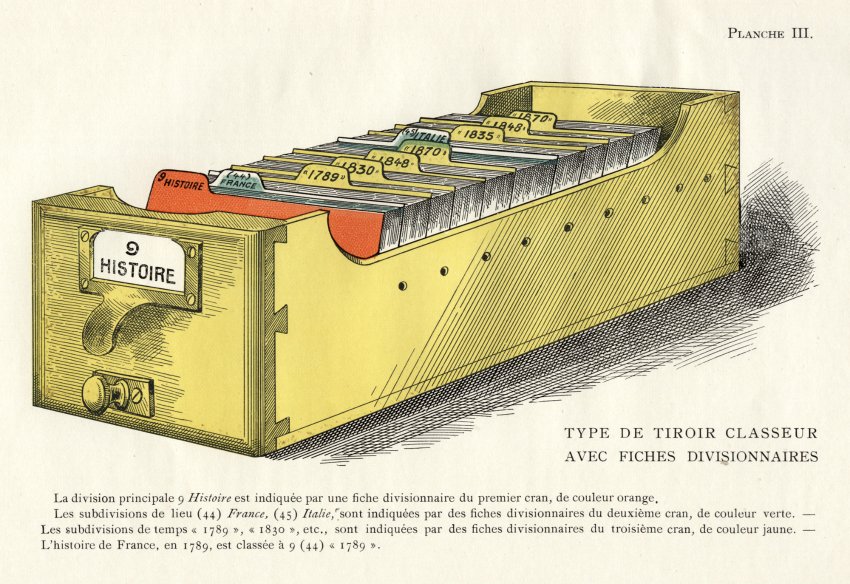
In 1903, Otlet developed a revolutionary index card system for organizing information.
(Image: Mundaneum Archive, Belgium)
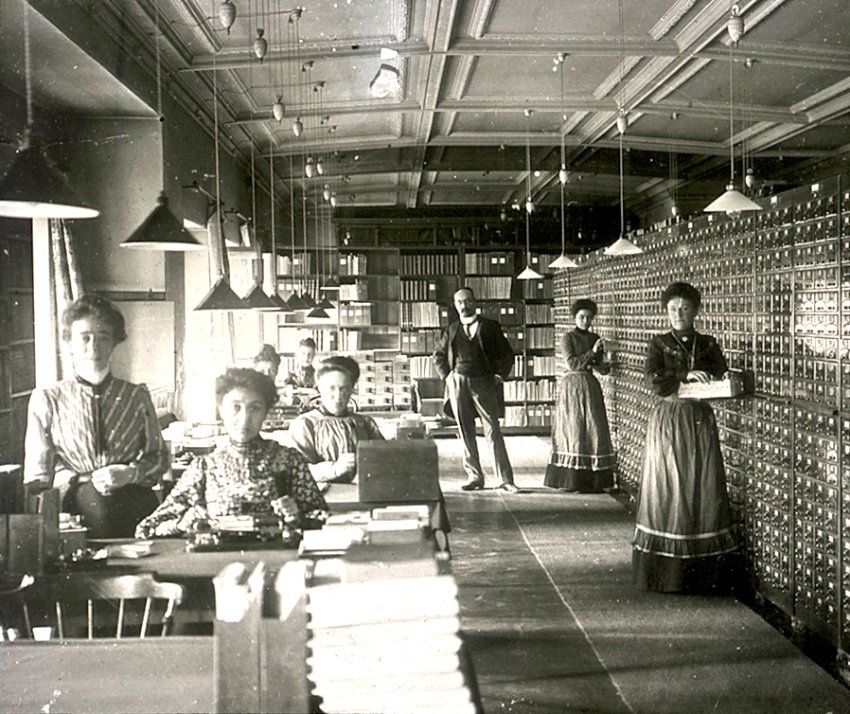
Otlet's primarily female staff answered information requests by hand. Without the digital luxury of keyword searches, a single query could take painstaking hours, even days, of sifting through the elaborate index card catalog.
(Image: Mundaneum Archive, Belgium)
The Mundaneum, which officially opened its doors in 1920, a decade after Otlet first dreamt it up, wasn’t merely a prescient vision for the utilitarian information-retrieval function of the modern internet, but the ideological framework for a far nobler and more ambitious goal to unite the world around a new culture of networked peace and understanding, which would shepherd humanity toward reaching its spiritual potential — an idea that makes the Mundaneum’s fate in actuality all the more bitterly ironic.
At the peak of Otlet’s efforts to organize the world’s knowledge around a generosity of spirit, humanity’s greatest tragedy of ignorance and cruelty descended upon Europe. As the Nazis seized power, they launched a calculated campaign to thwart critical thought by banning and burning all books that didn’t agree with their ideology — the very atrocity that prompted Helen Keller’s scorching letter on book-burning — and even paved the muddy streets of Eastern Europe with such books so the tanks would pass more efficiently. When the Nazi inspectors responsible for the censorship effort eventually got to Otlet’s collection, they weren’t quite sure what to make of it. One report summed up their contemptuous bafflement:
The institute and its goals cannot be clearly defined. It is some sort of … ‘museum for the whole world,’ displayed through the most embarrassing and cheap and primitive methods… The library is cobbled together and contains, besides a lot of waste, some things we can use. The card catalog might prove rather useful.
But behind the “waste” and the “embarrassing” methods of organizing it lay far greater ideas that evaded, as is reliably the case, small minds. Wright outlines the remarkable prescience of Otlet’s vision:
What the Nazis saw as a “pile of rubbish,” Otlet saw as the foundation for a global network that, one day, would make knowledge freely available to people all over the world. In 1934, he described his vision for a system of networked computers — “electric telescopes,” he called them — that would allow people to search through millions of interlinked documents, images, and audio and video files. He imagined that individuals would have desktop workstations—each equipped with a viewing screen and multiple movable surfaces — connected to a central repository that would provide access to a wide range of resources on whatever topics might interest them. As the network spread, it would unite individuals and institutions of all stripes — from local bookstores and classrooms to universities and governments. The system would also feature so-called selection machines capable of pinpointing a particular passage or individual fact in a document stored on microfilm, retrieved via a mechanical indexing and retrieval tool. He dubbed the whole thing a réseau mondial: a “worldwide network” or, as the scholar Charles van den Heuvel puts it, an “analog World Wide Web.”
Twenty-five years before the first microchip, forty years before the first personal computer, and fifty years before the first Web browser, Paul Otlet had envisioned something very much like today’s Internet.
Otlet articulated this vision in his own writing, describing an infrastructure remarkably similar to the underlying paradigm of the modern web:
Everything in the universe, and everything of man, would be registered at a distance as it was produced. In this way a moving image of the world will be established, a true mirror of [its] memory. From a distance, everyone will be able to read text, enlarged and limited to the desired subject, projected on an individual screen. In this way, everyone from his armchair will be able to contemplate creation, in whole or in certain parts.
Otlet’s prescience, Wright notes, didn’t end there — he also envisioned speech recognition tools, wireless networks that would enable people to upload files to remote servers, social networks and virtual communities around individual pieces of media that would allow people to “participate, applaud, give ovations, sing in the chorus,” and even concepts we are yet to crack with our present technology, such as transmitting sensory experiences like smell and taste.

Otlet's sketch for the 'worldwide network' he envisioned
(Image: Mundaneum Archive, Belgium)
But Otlet’s most significant vision wasn’t about the technology of it — it was about politics and peace, the very things that most bedevil the modern web, from cyber terrorism to the ongoing struggle for net neutrality. Wright writes:
An ardent “internationalist,” Otlet believed in the inevitable progress of humanity toward a peaceful new future, in which the free flow of information over a distributed network would render traditional institutions — like state governments — anachronistic. Instead, he envisioned a dawning age of social progress, scientific achievement, and collective spiritual enlightenment. At the center of it all would stand the Mundaneum, a bulwark and beacon of truth for the whole world.
But when the Nazis swept Europe and crept closer to Belgium, it became clear to Otlet that not only the physical presence of the Mundaneum but also its political ideals stood at grave risk. He grew increasingly concerned. In swelling desperation to save his life’s work, he sent President Roosevelt a telegram offering the entire collection to the United States “as nucleus of a great World Institution for World Peace and Progress with a seat in America.” Otlet’s urgent plea made it all the way to the Belgian press, who printed the telegram, but he never heard back from Roosevelt. He send a second telegram, even more urgent, once Belgium was invaded, but again received no response. Finally, in a final act of despair, he decided to make “an appeal on behalf of humanity” and try persuading the Nazi inspectors that the Mundaneum was worth saving. Predictably, they were unmoved. A few days later, Nazi soldiers destroyed 63 tons’ worth of books Otlet’s meticulously preserved and indexed materials that constituted the heart of his collection.
Otlet was devastated, but continued to labor quietly over his dream of a global information network throughout the occupation. Four months after the liberation of Paris, he died. And yet the ghost of his work went on to greatly influence the modern information world. Wright contextualizes Otlet’s legacy:
While Otlet did not by any stretch of the imagination “invent” the Internet — working as he did in an age before digital computers, magnetic storage, or packet-switching networks — nonetheless his vision looks nothing short of prophetic. In Otlet’s day, microfilm may have qualified as the most advanced information storage technology, and the closest thing anyone had ever seen to a database was a drawer full of index cards. Yet despite these analog limitations, he envisioned a global network of interconnected institutions that would alter the flow of information around the world, and in the process lead to profound social, cultural, and political transformations.
By today’s standards, Otlet’s proto-Web was a clumsy affair, relying on a patchwork system of index cards, file cabinets, telegraph machines, and a small army of clerical workers. But in his writing he looked far ahead to a future in which networks circled the globe and data could travel freely. Moreover, he imagined a wide range of expression taking shape across the network: distributed encyclopedias, virtual classrooms, three-dimensional information spaces, social networks, and other forms of knowledge that anticipated the hyperlinked structure of today’s Web. He saw these developments as fundamentally connected to a larger utopian project that would bring the world closer to a state of permanent and lasting peace and toward a state of collective spiritual enlightenment.
And yet there’s a poignant duality in how the modern web came to both embody and defy Otlet’s ideals:
During its brief heyday, Otlet’s Mundaneum was also a window onto the world ahead: a vision of a networked information system spanning the globe. Today’s Internet represents both a manifestation of Otlet’s dream and also, arguably, the realization of his worst fears. For the system he imagined differed in crucial ways from the global computer network that would ultimately take shape during the Cold War. He must have sensed that his dream was over when he confronted Krüss and the Nazi delegation on that day in 1940. But before we can fully grasp the importance of Otlet’s vision, we need to look further back, to where it all began.
Comparing the Mundaneum with Sir Tim Berners Lee’s original 1989 proposal for the world wide web, both premised on an essential property of universality, Wright notes both the parallels between the two and the superiority, in certain key aspects, of Otlet’s ideals compared to how the modern web turned out:
[Otlet] never framed his thinking in purely technological terms; he saw the need for a whole-system approach that encompassed not just a technical solution for sharing documents and a classification system to bind them together, but also the attendant political, organizational, and financial structures that would make such an effort sustainable in the long term. And while his highly centralized, controlled approach may have smacked of nineteenth-century cultural imperialism (or, to put it more generously, at least the trappings of positivism), it had the considerable advantages of any controlled system, or what today we might call a “walled garden”: namely, the ability to control what goes in and out, to curate the experience, and to exert a level of quality control on the contents that are exchanged within the system.
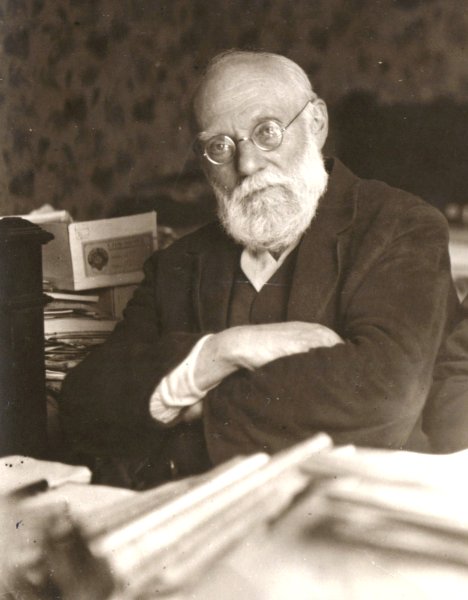
Paul Otlet in 1932, months before the Nazis destroyed his Mundaneum
(Image: Mundaneum Archive, Belgium)
But Otlet’s greatest ambition, as well as the one most enduring due to its as-yet unfulfilled fruition, was that of the Mundaneum’s humanistic effect in strengthening the invisible bonds that link us together — an ethos rather antithetical to the individualistic, almost narcissistic paradigm of today’s social web. Wright explains:
The contemporary construct of “the user” that underlies so much software design figures nowhere in Otlet’s work. He saw the mission of the Mundaneum as benefiting humanity as a whole, rather than serving the whims of individuals. While he imagined personalized workstations (those Mondotheques), he never envisioned the network along the lines of a client-server “architecture” (a term that would not come into being for another two decades). Instead, each machine would act as a kind of “dumb” terminal, fetching and displaying material stored in a central location.
The counterculture programmers who paved the way for the Web believed they were participating in a process of personal liberation. Otlet saw it as a collective undertaking, one dedicated to a higher purpose than mere personal gratification. And while he might well have been flummoxed by the anything-goes ethos of present-day social networking sites like Facebook or Twitter, he also imagined a system that allowed groups of individuals to take part in collaborative experiences like lectures, opera performances, or scholarly meetings, where they might “applaud” or “give ovations.” It seems a short conceptual hop from here to Facebook’s ubiquitous “Like” button.
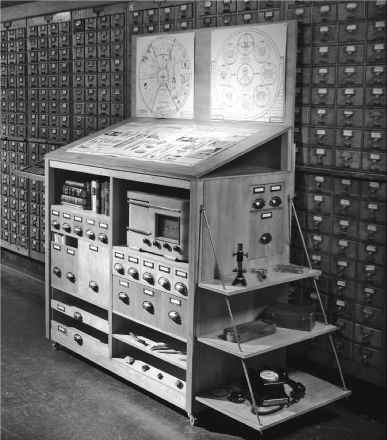
A reproduction of Otlet's original Mondotheque desk
(Image: Mundaneum Archive, Belgium)
In this regard, Otlet’s idea of collective intelligence working toward a common good presaged modern concepts like crowdsourcing and “cognitive surplus” as well as initiatives like Singularity University. Wright considers the essence of his legacy:
Otlet’s work invites us to consider a simple question: whether the path to liberation requires maximum personal freedom of the kind that characterizes today’s anything-goes Internet, or whether humanity would find itself better served by pursuing liberation through the exertion of discipline.
Considering the darker side of the modern internet in information monopolies like Google and Facebook, Wright reflects on how antithetical this dominance of private enterprise is to Otlet’s vision of a democratic, publicly funded international network. “He likely would have seen the pandemonium of today’s Web as an enormous waste of humanity’s intellectual and spiritual potential,” Wright writes and as he contemplates the messy machinery of money and motives propelling the modern web:
Would the Internet have turned out any differently had Paul Otlet’s vision come to fruition? Counterfactual history is a fool’s game, but it is perhaps worth considering a few possible lessons from the Mundaneum. First and foremost, Otlet acted not out of a desire to make money — something he never succeeded at doing — but out of sheer idealism. His was a quest for universal knowledge, world peace, and progress for humanity as a whole. The Mundaneum was to remain, as he said, “pure.” While many entrepreneurs vow to “change the world” in one way or another, the high-tech industry’s particular brand of utopianism almost always carries with it an underlying strain of free-market ideology: a preference for private enterprise over central planning and a distrust of large organizational structures. This faith in the power of “bottom-up” initiatives has long been a hallmark of Silicon Valley culture, and one that all but precludes the possibility of a large-scale knowledge network emanating from anywhere but the private sector.
But rather than a hapless historical lament, Wright argues, Otlet’s work can serve as an ideal — moral, social, political — to aspire to as we continue to shape this fairly young medium. It could lead us to devise more intelligent intellectual property regulations, build more sophisticated hyperlinks, and hone our ability to curate and contextualize information in more meaningful ways. He writes:
That is why Paul Otlet still matters. His vision was not just cloud castles and Utopian scheming and positivist cant but in some ways more relevant and realizable now than at any point in history. To be sure, some of his most cherished ideas seem anachronistic by today’s standards: his quest for “universal” truth, his faith in international organizations, and his conviction in the inexorable progress of humanity. But as more and more of us rely on the Internet to conduct our everyday lives, we are also beginning to discover the dark side of such extreme decentralization. The hopeful rhetoric of the early years of the Internet revolution has given way to the realization that we may be entering a state of permanent cultural amnesia, in which the sheer fluidity of the Web makes it difficult to keep our bearings. Along the way, many of us have also entrusted our most valued personal data — letters, photographs, films, and all kinds of other intellectual artifacts — to a handful of corporations who are ultimately beholden not to serving humanity but to meeting Wall Street quarterly earnings estimates. For all the utopian Silicon Valley rhetoric about changing the world, the technology industry seems to have little appetite for long-term thinking beyond its immediate parochial interests.
[…]
Otlet’s Mundaneum will never be. But it nonetheless offers us a kind of Platonic object, evoking the possibility of a technological future driven not by greed and vanity, but by a yearning for truth, a commitment to social change, and a belief in the possibility of spiritual liberation. Otlet’s vision for an international knowledge network—always far more expansive than a mere information retrieval tool—points toward a more purposeful vision of what the global network could yet become. And while history may judge Otlet a relic from another time, he also offers us an example of a man driven by a sense of noble purpose, who remained sure in his convictions and unbowed by failure, and whose deep insights about the structure of human knowledge allowed him to peer far into the future…
His work points to a deeply optimistic vision of the future: one in which the world’s knowledge coalesces into a unified whole, narrow national interests give way to the pursuit of humanity’s greater good, and we all work together toward building an enlightened society.
Cataloging the World: Paul Otlet and the Birth of the Information Age is a remarkable read in its entirety, not only in illuminating history but in extracting from it a beacon for the future. Complement it with Vannevar Bush’s 1945 “memex” concept and George Dyson’s history of bits. And lest we forget, it all started with a woman — Ada Lovelace, Lord Byron’s illegitimate daughter and the world’s first computer programmer.
Thanks, Liz
Donating = Loving
Bringing you (ad-free) Brain Pickings takes hundreds of hours each month. If you find any joy and stimulation here, please consider becoming a Supporting Member with a recurring monthly donation of your choosing, between a cup of tea and a good dinner.
| ♥ $7 / month♥ $3 / month♥ $10 / month♥ $25 / month |

You can also become a one-time patron with a single donation in any amount.

 Brain Pickings has a free weekly newsletter. It comes out on Sundays and offers the week’s best articles. Here’s what to expect. Like? Sign up.
Brain Pickings takes 450+ hours a month to curate and edit across the different platforms, and remains banner-free. If it brings you any joy and inspiration, please consider a modest donation – it lets me know I'm doing something right.


Iceland, with its extreme landscapes, jagged lava fields and Northern Lights, is arguably one of the most photogenic countries in the world. So it’s no surprise that over half a million tourists flock there every year to shoot the landscape. But UK-based photographer Andy Lee, on his first visit to the country, came back with a series of photos titled “Blue Iceland” that captured the waterfalls, peaks and roads in, literally, a whole new light. Using infrared photography to pick up invisible light rather than visible light, Lee transformed Iceland into a series of stark, moody and somewhat dreamlike silhouettes. At times the austere rock formations and glowing waterfalls almost appear to be painted. You can see much more of Lee’s work over on his portfolio site. In the words of Lee himself, “Infrared and Iceland, a match made in heaven.” (via PetaPixel)

Bunker.jordanSAURON


Bunker.jordanWooooo Titan!
If you’ve been a faithful reader of Lights in the Dark over the past five years you know that I just love Cassini (and you probably do too!) In orbit around Saturn since 2004, Cassini has taken us on an intimate tour of the Saturnian system for a decade now, revealing the incredible beauty of the ringed planet and its family of moons like no spacecraft ever has before. Thanks to Cassini and the Huygens probe, we have seen the surface of Titan for the first time, witnessed the jets of Enceladus, discovered many previously-unknown moons (and moonlets) and basically learned more about Saturn over the past ten years than since Galileo first pointed his telescope at it.

Cassini’s will dive through a gap in Saturn’s rings in 2017 and sample the planet’s upper atmosphere (NASA/JPL-Caltech)
Although nearing the end of its life span, Cassini still has a few good years left and scientists are taking full advantage of its remaining time around Saturn to learn as much as they can before the spacecraft makes its final dive into the planet’s atmosphere in 2017.* The video above shows what awaits Cassini in the years ahead — some of its best discoveries may be yet to come. Check it out!
Learn more about the Cassini mission and read about its latest discoveries here and here.
*The exact plan for the end of Cassini’s mission has not yet been finalized.