The Juventae Chasma on Mars contains dunes of all sizes, from the smallest ripples through the largest draa towering hundreds of meters tall.

The Juventae Chasma on Mars contains dunes of all sizes, from the smallest ripples through the largest draa towering hundreds of meters tall.

Well-preserved fossils of pterosaurs are extremely hard to come by, which makes this recent find of 40 male and female individuals all the more incredible. Along with the discovery of a spectacular new crested species, paleontologists have also found the first 3-dimensional fossilized pterosaur eggs.


Firms Show Off Foldable OLED Panels @ Nikkei Technology Online.
The book-type and three-fold displays can be bent up to curvature radii of 2mm and 4mm, respectively. They can be bent more than 100,000 times, SEL said.

Remember The Neverending Story? I’m afraid to go back and rewatch it through adult eyes, so it lives perfectly in my memory. Instructables user laurakenora took her appreciation for the film to the next step by building an Atreyu riding Falkor costume, and it gives me all sorts of nostalgic feelings. To build the Luckdragon, she used wire fencing, white fleece, white fur, suspenders, and styrofoam balls. Falkor’s skeleton was made from garden fencing, and to cover it in fur, she took the following steps:
-Now that you have the skeleton for the body you need to create a “skin” to attach the fur. If your fencing holes are pretty big, you may want to stuff Falcor’s legs with a little newspaper to give them shape.
-Next you will need to cover the entire body with paper that will act as Falcor’s skin. I used cut up paper bags. Duct tape them to the wire skeleton.
-For Falcor’s fur use spray glue to attach it to the “skin.” Do as big of sections of fur as you can manage at a time. This will leave less seems. I chose to put white fleece on Falcor’s legs and fur all over his body. You can do any combination of fur and fleece that you like.
-For the tail, I made a cylinder shape with the white fur and tapered it at the end. I used a combination of spray glue and safety pins to get the tail into its shape. I painted the safety pins with white out so they wouldn’t show. Make sure you make the tail short enough that it won’t drag on the floor.

Read more at Instructables.

Sharon Gaudin from Computerworld writes about how the line between robots and humans is quickly blurring:
As robotics quickly advance, scientists say the lines between robots and humans is beginning to blur.
That means one day with robotic prosthetics that work seamlessly with a human’s muscles, with tiny robots that swim in our blood streams and fix medical problems and nano-scale robots implanted in our brains, we will become robotic humans.
As scary and sci-fi as that may sound, researchers say robotics will cure diseases, make amputees feel whole again and greatly extend our lives.
“It’s not a question of whether it’s fanciful,” said Daniel Wilson, author of the novel Robopocalypse and a robotics engineer with degrees in machine learning and robotics from Carnegie Mellon University. “Thinking of the nanorobots swimming in your blood cells is still pretty far out there, but there are much more concrete examples really in the works…. By utilizing technology, you’re able to improve your body beyond anything you could do in the past.”
Many, if not most people, will be wary of the idea of the melding of humans and robots, with images of Star Trek’s evil cyborgs running through their heads. The fictional characters — with both human and mechanical parts — have superhuman strengths but have lost their individualism.
Despite frightening images in the Star Trek movie series and Robocop, these actually are exciting times because the advances in robotics, said Victor Walker, a robotics research scientist at Idaho National Laboratory, an Idaho Falls, Idaho-based facility that focuses on energy and national defense research.“We are currently in this revolution today,” Walker told Computerworld. “I think there’s potential there. We don’t want to replace humans. We want to enhance humans.”

With the advent of 3D printers, printable circuits, and other “one-machine-to-rule-them-all” automated systems, printing fully functional items is fast becoming a reality. The lamp seen above starts out as a flat piece of cardboard with circuits printed onto it — apply some electricity and it will fold itself up, creating a lamp — it even has a capacitive touch sensor for turning it on!
This ingenuity comes straight from Harvard researchers who presented the project “Self-assembling Sensors for Printable Machines” at the IEEE International Conference on Robotics and Automation (ICRA) just last Tuesday in Hong Kong. It’s not fully printable (wires and the LED had to be soldered in by hand) but it’s an amazing proof of concept — there’s also an Arduino off-screen taking care of controlling it.
The cardboard is a sandwich of shape-memory polymers which are triggered by heat, generated by running electricity through thin layers of copper trace. It takes a long time to assemble so the following video has been sped up 32x speed.
Fascinating stuff!
[Via Hacked Gadgets]


It’s been almost three years since Japanese builder Chaosbrick (カオス煉我) created the first LEGO version of the wildly popular digital pop star and Vocaloid character Hatsune Miku (初音ミク). Since then there have been plenty of other versions, by such builders as Moko, Mike Dung, LegoWyrm and even yours truly. But now Chaosbrick has returned to outdo them all with this life sized version!

Construction of the model began in October 2013 and took 6 months to complete, during which time the builder teased fans with work in progress shots from his Twitter feed. The final model uses over 20,000 bricks, and by all accounts it was quite a feat of engineering to make such a tall and slender LEGO model stay in one piece. But the end result is spectacular in its detail and accuracy, and should meet the expectations of even the most hardened Hatsune fan. Especially with the cheeky inclusion of some brick-built fan service ;-)
A serendipitous adventure in science communication.
When artist, designer, and educator David Delgado first arrived at NASA’s Jet Propulsion Laboratory to work with the artist-in-residence there, he was immediately struck by the strange signs around the space, often cryptic and seemingly nonsensical. He found himself captivated by the disconnect between the dry, mundane language of these cautions and the immensely interesting processes, materials, and operations they were trying to describe. A solitary keyhole, almost alien in its arbitrary placement, bears the label “lazer bypass” — something partway between Alice in Wonderland and Alice in Quantumland, or the set of a science fiction movie.

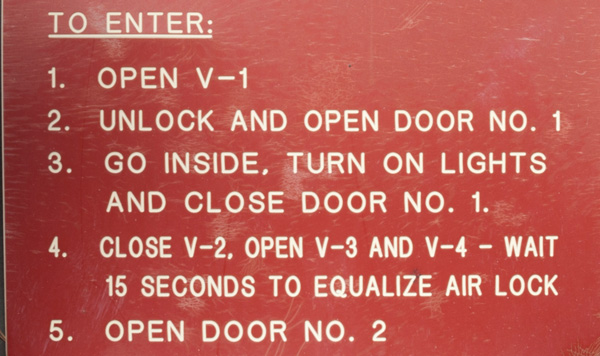

When his friend Lee Overtree, Artistic Director of the wonderful arts education nonprofit Story Pirates, came to visit, he too took amused notice of the signs. Using Delgado’s photographs, he decided to compose a song using the app Songify to autotune his reading of the warning text from the various signs.
I recently bumped into Delgado at the World Science Festival, where he told me the story of their sign-turned-song, as an aside to an unrelated conversation about Ray Bradbury’s conversation with Carl Sagan and Arthur C. Clarke. I was instantly smitten with this geeky labor of love. So, with high permission all the way up from NASA’s Media Office, here is the end result for our shared delight:
More of Delgado’s original photographs of the signs below:


Complement with NASA’s formal Art Program, featuring Serious Art by such luminaries as Andy Warhol, Annie Leibovitz, and Norman Rockwell, then take a tour of JPL’s predecessors with these gorgeous vintage photos of NASA facilities.
Donating = Loving
Bringing you (ad-free) Brain Pickings takes hundreds of hours each month. If you find any joy and stimulation here, please consider becoming a Supporting Member with a recurring monthly donation of your choosing, between a cup of tea and a good dinner.
| ♥ $7 / month♥ $3 / month♥ $10 / month♥ $25 / month |

You can also become a one-time patron with a single donation in any amount:

 Brain Pickings has a free weekly newsletter. It comes out on Sundays and offers the week’s best articles. Here’s what to expect. Like? Sign up.
Brain Pickings takes 450+ hours a month to curate and edit across the different platforms, and remains banner-free. If it brings you any joy and inspiration, please consider a modest donation – it lets me know I'm doing something right.


The “Giant Impact” hypothesis has the Moon formed from an impact between early Earth and a Mars-sized body (NASA)
While it may not be a true “smoking gun” (there have been four and a half billion years of cooling off, after all!) scientists in Germany have found further support for the currently accepted scenario of the origin of our Moon, based on chemical analysis of rocks brought back by Apollo astronauts. (And yes, we really went to the Moon.)
The Moon has played a very important role in the evolution of Earth as well as all life on Earth. Its gravitational tug powers the tides, for one, which create very important ecological niches along the coastlines of every land mass, and it also acts as an “anchor” for our planet, slowing its rate of rotation and stabilizing its axial tilt (although its formation may be partly responsible for the tilt in the first place, but that’s just fine because we got the four seasons as a result.)
But the Earth didn’t always have the Moon. Earth most likely formed without any moon, but during the early rock-’em-sock-’em days of the Solar System when there were still many objects flying about, our barely-cooled Earth happened to have a run-in with another protoplanet. Now referred to as Theia, this other world was about the size of Mars — that is, half the diameter of Earth — and, as the “Giant Impact” hypothesis goes the collision between it and our planet blew out a large amount of molten material from both worlds into orbit around Earth (and totally destroying Theia in the process.)
While a debris ring may have been present for a short time, eventually all that stuff merged to form one or possibly briefly two bodies that coalesced into a single spherical satellite. Add four-plus billion years of cratering, cooling, and gradual outward spiraling and you get the Moon we all know and love today. (If you don’t love the Moon, you can get out right now. ;) )

Rock collecting during Apollo 12 (NASA photo)
While this scenario makes the most sense based on how the Earth-Moon system is observed to be today, the tricky part of confirming this hypothesis has come in the form of composition of materials in both worlds. If an object of Theia’s size were to have impacted Earth to create the Moon, at the angles thought to have occurred, the makeup of the Moon should be a bit of both. But exactly how much hasn’t yet been determined or agreed upon — models have ranged from the Moon being anywhere from 8% to 90% of the ill-fated Theia… not to mention any significant differences between Earth and the Moon remained unfound.
As it turns out though, new analysis of oxygen isotopes in Apollo rock samples, performed by a research team led by Daniel Herwartz from the University of Cologne in Germany, show the Moon may be an even 50/50 mix of both Earth and Theia. And while the preliminary results are far from glaring, they do help support the Giant Impact hypothesis… if just enough to put another point on its side.
“It is a relief that a [disparity in ratios] has been found, since the total absence of difference between Earth and moon would be hard to explain,” Caltech planetary scientist David Stevenson wrote to AAAS Science writer Daniel Clery.
Read more about these findings here and here.


Bunker.jordanhttp://www.raytheon.com/media/kill-vehicles-are-all-about-protection/
These things are insane.
https://www.youtube.com/watch?v=VB_Fvi7eV0s
The success or failure of an upcoming U.S. ballistic missile defense test could affect when the Pentagon deploys 14 more ground-based interceptors to defend against possible missile threats from North Korea. The test— planned for June 22—will focus on the "kill vehicle," which is supposed to destroy incoming missiles.


Captain Jack Harkness is a fan favorite character in the world of Doctor Who and Torchwood. Other than his signature coat and vortex manipulator, you can piece most of his costume together using off-the-shelf items. Matt Munson did exactly that and achieved a look very close to the dashing Captain’s. He broke down where he purchased everything, and it’s beneficial to read because it shows that sometimes cosplay is all about hunting down and purchasing the right items. Here’s where he found the shirt, suspenders, and belt for the outfit:
Shirt – From Old Navy. Men’s Non-Iron Regular-Fit. I chose “Ink Blue”. Jack wears many different shirt and suspender combinations in the show, so you’ll need to pick one you like and go from there. I like the navy blue, and this shirt, with the light colored buttons, seems a decent match. It’s not perfect, and it’s not the same manufacturer as the ones used in the show, but it looks great.
http://oldnavy.gap.com/browse/product.do?cid=79372&vid=1&pid=897435&scid=897435052
Suspenders – I went with light grey suspenders, as those are the color Jack wears when he sports the navy shirt. Get the button on kind, not the clasp on, or the combo button/clasp. I got mine here:
http://www.bestsuspenders.com/products/Bostonian-Y-Back-Button-On-Light-Grey.html
To attach the suspenders to the trousers, I went to Michael’s (My LEAST favorite store) and just grabbed off the shelf a bag of black buttons. They came in a variety of sizes and hole counts. I chose ones that best matched the ones on the pants, though it didn’t matter as they would be covered by the belt.
Belt – I am wearing a medium brown belt from Fossil. This was something I had on hand that happened to match some screen caps I found. Someone on LJ sourced the manufacturer of one of Jack’s actual costume belts to Belstaff, though I found the belt to be prohibitively expensive for my needs. See the bottom of this post for a link to the LJ article.

Read more at Matt’s blog.
Bunker.jordanCOFFEE

when you keep starting your sentence over and over again because no one is paying attention to you