
Bromley + Jacobsen Architecture


Machine Gun Kellys
written by Kevin Panetta
Drawn by Brooke A. Allen
This is my actual favorite thing.
"You like anything with girls beating up dudes" they tell me and I say "yes"

my mom is nursing these kittens because their mommy got hurt, they have no patience
Good news everyone!
Adrian Drake (BrickFrenzy) is back with another MEGA awesome build for Brickworld this year. This time, it’s a life-sized Bender from Futurama:
At 6 feet tall (including antenna) and built with approximately 20,000 pieces – it may surprise you that this build only took about Adrian a month to build. I think this was the single most photographed build at Brickworld, and earned Adrian the Judge’s Choice Award and nomination for Best Mega Creation.
Of course no life sized bender would be complete without a functional chest cavity (featuring one of Brickworld’s finest traditional drinks).

As a huge Futurama fan, I couldn’t help but get caught up in life-sized-Bender Fever, and decided to build Nixon’s head (minus jar) to put on Bender’s body (ARROOOOO!).

Oh and Adrian totally trusted me enough to let me put on Bender’s Head.
A special thanks to Adam Myers for letting me build Nixon from his collection in Chicago, and for loaning out Nixon head to Adrian to display at BrickFair VA.
Here’s a fiendishly clever little concept from Angus MacLane, the guy that made character building more accessible by dreaming up CubeDudes. And like CubeDudes, I suspect this pattern is destined to be widely imitated – with or without the couches. Each vignette features a brick-built superhero or screen character kicking back after a long day’s superheroing (…or in some cases, chestbursting).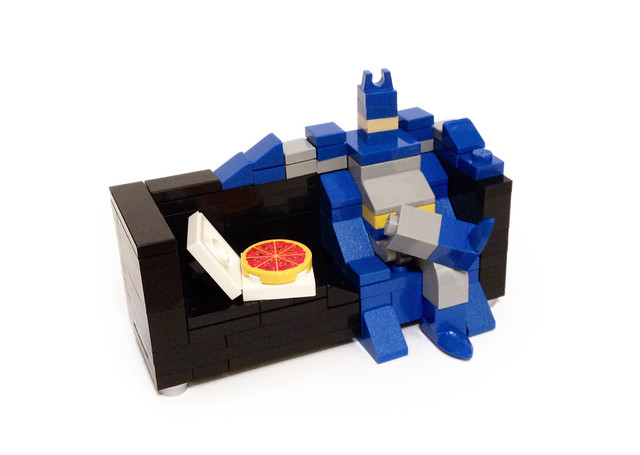
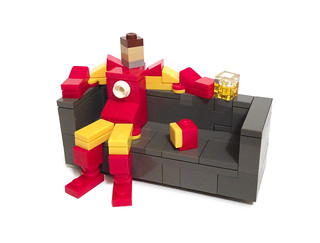


Angus hopes to continue the series over the coming months, with even more examples of superhuman relaxation. And if Destro’s demeanor is any indication, I suspect the villains will turn out to be having a worse day than the heroes!


European Dagger
The handle is ornated with figure holding a tazza in a Renaissance attire while the scabbard features different army trophies.
Source: Copyright © 2014 Expertissim

LILITH SNAKE KISS~
Star honeymoon mandala sounds pretty
Burning sensitive uterus…
^^^SCREming
Dark Honeymoon Inferno.
yassss
Dark Love-Me Sniper
i feel like I kind of got shafted here, not gonna lie.

Recent studies have found that long periods in zero gravity can cause the heart to become more spherical as depicted in this comic by Maki Naro. via PopularScience.net
Microgravity, which seems like zero gravity, but is actually a state of free-fall caused by a spacecraft’s orbit around the Earth, has long been known to wreak havoc on the human body. Without having to support the weight of the body, bones begin to lose density and muscles atrophy, requiring astronauts to exercise regularly to stave off the effects. Without gravity to pull fluids downwards, astronauts often experience a phenomenon colloquially known as “puffy-face-chicken-legs syndrome”. More recently, this increase in fluid around the brain has been linked to changes in astronauts’ vision. Fluid shift has also been blamed for a diminished sense of smell and taste.
Now, a study presented at the American College of Cardiology’s 63rd Annual Scientific Session has added possible heart troubles to that list. The study, titled “Affect of Microgravity on Cardiac Shape: Comparison of Pre- and In-flight Data to Mathematical Modeling” showed that like most things in space, the human heart can become more spherical during long-term space missions. The heart, like other muscles in the body, is susceptible to atrophy because it does not have to work as hard in space. So it is important for scientists to develop effective ways for astronauts to maintain proper heart health. In the study, twelve astronauts took ultrasound images in order to monitor their heart health before, during, and after their mission. What they discovered was that their hearts became more spherical by a factor of 9.4%.
The good news is that the effect is temporary, and may actually provide useful data in treating heart conditions here on Earth that effect the heart’s ability to pump blood.
 Each Saturday Morning here at Adafruit is Saturday Morning Cartoons! Be sure to check our cartoon and animated posts both nostalgic and new that inspire makers of all ages! You’ll find how-tos for young makers, approaches to learning about science and engineering, and all sorts of comic strip and animated Saturday Morning fun! Be sure to check out our Adafruit products featuring comic book art while you’re at it!

A Chatbot won a Turning Test contest after 10 out of 30 people thought it was human. By Maki Naro. via Popsci.com
By now you’ve all been swept up in the cult of personality of Eugene Goostman, the chatbot that made news when it convinced 10 out 30 judges at the University of Reading’s 2014 Turing Test that it was human, thus winning the contest. With the announcement, every news source with two hundred words to spare was quick to crown Eugene Goostman as king of bots. But we should know better by now.
In 1950, British mathematician and cryptanalyst Alan Turing introduced the idea of a test to see if a machine could be indistinguishable from a human. Promptly dubbed the Turing Test, a passing grade is the holy grail of artificial intelligence. Think of the Voight-Kampff test in Blade Runner. Except at the end, you don’t shoot a replicant. Yet. In its current incarnation, the human judge sits down at a computer and begins texting with an unseen partner. Being unable to see who they are talking to, the judge must rely on conversation cues to decide whether their partner is human or machine. Turing famously predicted that by the year 2000, a computer program would be able to convince 30% of people that it was human. The event organizers used this prediction—taken somewhat out of context, as Turing never set any specific guidelines for what a Turing Test should be—to set the win conditions of the Turing Test.
I did get a chance to talk to Goostman, before the droves of people wanting to do the same crashed the servers. Despite Oz’s harsh critique (he tends to go a bit overboard), I have to truthfully report that he’s good. Far from perfect, but not bad. Goostman makes all the mistakes the chatbots before him have made: he dodges questions, he changes the subject, he makes vague answers, he repeats things back to you in ways that no normal human does in a cute attempt to show that he’s listening, and of course he says really stupid stuff that doesn’t make any sense. Goostman’s creators explain his quirks away by giving him a fictional back story. See, Eugene is a 13-year-old Ukranian kid. He has favorite foods and a pet guinea pig, and he feels okay derailing important interrogations to tell you these things. I would have shot him as a replicant ages ago.
I don’t buy any of this, by the way. One, it’s insulting to 13-year-olds, plenty of whom can hold a conversation without resorting to non sequitur. It’s also insulting to people who speak English as a second language, for the same reasons. Goostman’s background is a crutch, but it’s not the first time a bit of social engineering was used to make up for a bot’s inadequacies. The notorious MGONZ program had some poor fellow going for 90 minutes. Its trick? MGONZ was combative, vulgar, and insulting. Any alarms going off in your head when testing MGONZ would be attributed to the mannerisms of an asshole, rather than a computer. Bypassing your brain’s psychopath detector is a neat trick, and much more entertaining than the foreign teenager shtick.
Eugene Goostman did not pass the Turing Test. He won the University of Reading contest. He met Turing’s benchmark within 14 years of the predicted date. But he’s not a perfect AI at all, and we have a long way to go, and a lot to learn in the process. I don’t actually think the judges were morons. But I hope they felt silly afterwards.
Each Saturday Morning here at Adafruit is Saturday Morning Cartoons! Be sure to check our cartoon and animated posts both nostalgic and new that inspire makers of all ages! You’ll find how-tos for young makers, approaches to learning about science and engineering, and all sorts of comic strip and animated Saturday Morning fun! Be sure to check out our Adafruit products featuring comic book art while you’re at it!

“Many believe that Merle Haggard also played that night, but if you look closely you can see a different date beside Haggard’s name”
- Ruby Jones


Evelyn Nesbitt – one of the 20th Century’s first style icons and the woman said to have inspired the Gibson Girl look was a young model /actress thrust into the limelight in New York when her name was involved in the infamous murder of Stanford White, a respected architect in 1906. He was sensationally murdered at point blank range in a theater by Harry Thaw – Evelyn’s jealous and psychotic husband.She appeared in a demure corseted suit which had women ordering copies within days.
Bunker.jordanI actually have one of this guy's albums, strangely enough.
The forthcoming documentary The Viking of 6th Avenue chronicles the life and musical career of legendary New York icon Moondog. Musicians including Blondie, Jarvis Cocker (Pulp), John Zorn, and Philip Glass offer their testimonials on his influence on their music in the film and his is a really intriguing story.
Please support the film’s Kickstarter campaign.

Moondog at Herald Square, 1953. Picture by Solon Bannos
“Moondog, born Louis Thomas Hardin (May 26, 1916 – September 8, 1999), was a blind American composer, musician, poet and inventor of several musical instruments. Moving to New York as a young man, Moondog made a deliberate decision to make his home on the streets there, where he spent approximately twenty of the thirty years he lived in the city. Most days he could be found in his chosen part of town wearing clothes he had created based on his own interpretation of the Norse god Odin. Thanks to his unconventional outfits and lifestyle, he was known for much of his life as “The Viking of 6th Avenue”.

Picture by Stefan Lakatos

Picture by Beatrice Frehn

Picture by Frederick Callies

Picture by Peter Martens
See also:

The horrifying Undead Teds bears are back. And now they've been upgraded to be even more terrifying. Behold the giggling, face-ripping Undead Teds Peek-A-Boo Edition. You've done it again folks—we'll be sleeping with the light on.


Five years ago today, NASA launched its Lunar Reconnaissance Orbiter into space. It's been snapping high-resolution images of the moon's surface ever since, revealing secrets about its true "dark side," scouting out landing sites for future missions, and returning gorgeous images the likes of which have never been observable from Earth.


Oregon's endangered silverspot butterflies typically pupate into chrysalises over the course of several hours, in a nocturnal process rarely observed by humans. But in this time-lapse footage, members of the Oregon Zoo's butterfly lab have combined over 15,000 photographs to compress the transformation into a matter of seconds.


Bunker.jordanThis looks so goddamn cool
How A Seemingly Impossible Game Is Possible @ Kotaku
Rather than build every ship, plant or creature by hand, the developers of No Man’s Sky created an engine that randomly (within specified boundaries) creates the world for them.
Ream pulls up a blue-ish menu with lines of code written across the screen and quickly clicks across it to pull up a very specific menu within their engine. Before I know it, he’s selected an option for trees and I’m staring at one. There’s a blueprint for a fairly standard-looking tree off on the right. He clicks a button that says “view variants.” Dozens of new trees—of different shapes, sizes, and colors—pop up on the left.
“This is our toolset,” Murray says as we scroll through the trees. “We built our own engine. It’s super crappy, but it’s kind of like Unity or something like that. We’ve written it all around procedural generation. And that’s kind of what we spent the first year, when it was just four of us, what we spent our time doing. And then the last month before the VGXs we built the trailer using that.”
We go through a few other objects that are procedurally generated in the game. Rhinos, space ships. Ream clicks “view variants” on all of them. And then he keeps clicking them and, sure enough, new variants keep showing up.
“You’re building a blueprint,” Murray said. “And that’s true of everything in the game. So say one of our artists will build something and that will take say a week. But what they get from that is every possible variant of that. So if you build a cat, you also get a lion and a tiger and a panther and things that you’ve never seen—kind of mutations beyond that.”
“Why we’re doing it is because it’s interesting to us. My attitude has been, ‘Let’s just do something crazy and go bankrupt doing it.’ That’s what I’ve always said. But I don’t wanna just make games at the same scale as Joe Danger and still be doing that in 10 years. I just want to try one big thing. So that was the attitude and that was really freeing. As a genuine thing, not like we went into it like, ‘Sure! We’ll try this and this with the mindset of and it will probably go horribly wrong but we’ll go out with a bang,’ which we still might.”

Bunker.jordanwonderful


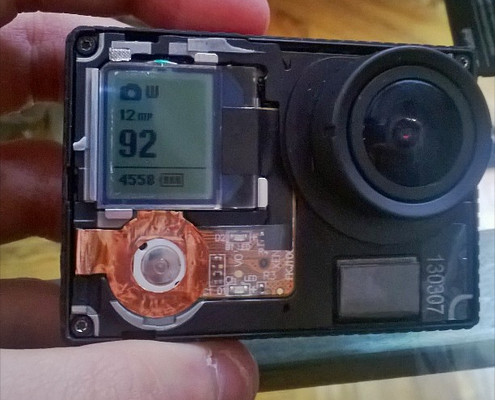
GoPro cameras come out of the box with a huge set of features. Most people will be satisfied, or possibly even overwhelmed by the available options, but if you’re able to do some of these hacks, you’ll be able to expand your camera’s capabilities even more. They can, however, void your warranty, so as with most hacking, do these at your own risk.
 By far the simplest way to extend your GoPro’s capabilities is by placing a text file in your GoPro camera’s root folder called Autoexec.ash. You can download a number of scripts on chernowee.com, which should be very easy to modify per [Konrad's] insights. Use of these scripts is quite powerful, and one can modify elements of the camera from simply blinking the LEDs, to changing video capture properties, to many other useful settings.
You can check these out on his page, or here’s his Github account if you prefer that method. He’s quick to point out that this will void your warranty, so proceed with caution. Although tempting to try, I don’t (yet) have a pressing situation that “stock” GoPro features don’t address. The risk may be small, but for me the reward is almost nonexistent.

If writing a script to reside on your GoPro isn’t really your style, or feels too risky, you can always use a script on your computer to control the camera. [Adrian] did just that, writing a Python script to control the time lapse frequency beyond the “stock” 60 seconds. There are many more commands that can be done over WiFi with a similar scripting technique, which [Korad] his listed on his GitHub page here.
Also outlined on [Adrian's] page is that it’s actually pretty simple to log on to your GoPro with a computer and browse around. This type of “hacking” would be something interesting for even the most time-constricted “script kiddies.”
This WiFi script comes via Reddit, which claims it is not hacking… Go ahead, feel free to write “not a hack” in the comments!
In case you weren’t impressed enough with 14-year-old [Konrad's] Autoexec.ash hacking, or his list of WiFi commands, he also lists the functions of the pins on the BacPac connectors on his site (and disassembled one, as seen in the first picture). I had never really thought about using this as an access point for more buttons or outputs, but naturally, there is a lot of IO capability running out through this port.
One could imagine hooking up an Arduino or Raspberry Pi to this bus, and controlling the camera through it. Especially given the RGB video output pins, it’s hard not to think of the interesting hacks that could come from this type of control. If you’ve ween working on some BacPac hacks already we want to hear about it!
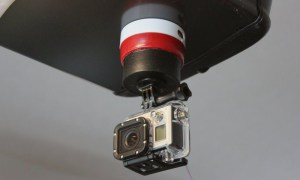 Switching gears, probably my favorite class of GoPro “hacks” is the DIY ways that people come up with to mount them. Among the most useful, and simplest, is the kitchen timer GoPro mount. We’ve featured a couple of interesting models, including this excellent mount using Ikea parts. Here’s one that I made using a different style timer with a magnetic base, leading to some unique mounting possibilities.
On the more extreme end, you could launch your GoPro into the air with a slingshot, or there’s always the single-GoPro bullet-time rotation hack. [HAD] alum [Caleb] demonstrates this quite successfully here, but you might have also seen this excellent effect using a ceiling fan, and fireworks. Everything is better with fire!
Mounting + Software = Extra Awesome
Finally, if you “happen” to have 6 GoPro cameras, a 3D printer to make the mount, and software to stitch the video together, you can create an incredible spherical panorama video. Watching the results below makes me feel like I’m about to fall off of the earth into space, but it’s hard not to keep looking! [Via Reddit]
 Jeremy Cook is a manufacturing engineer with 10 years experience as his full-time profession, and has a BSME from Clemson University. Outside of work he’s an avid maker and experimenter, working on everything from hobby CNC machinery, to light graffiti, and even the occasional DIY musical instrument. When he’s not busy creating (or destroying) something, you can find him on Twitter @JeremySCook


LEARNerds – FE Exam Review, Engineering, Math, Physics Questions Daily.
At LEARNerds we believe that learning doesn’t always need to be SO HARD… So we decided to reshape it to fit your life. We’re laying a path to help you review Engineering Fundamentals everyday in fun, uncomplicated, bite-sized doses… So that you can finally START and actually STICK WITH learning.
LEARNerds gets you back up to speed, by making Engineering Practice a fun, daily, ridiculously-simple part of your life. Every morning at 7AM (EST) we jumpstart your day with a daily Engineering Question.

Just about a month ago we featured a costume of a human version of Smaug the Magnificent from The Hobbit that was almost done. Kialna Cosplay finished the build in time for AnimeCon, and the results are amazing. Since last time she added horns to the head and built and installed a dragon tongue. She also added LEDs to the inside of the mask for the firebreathing effect. Even though the costume looks wonderful, she’s already planning to improve Smaug in the near future.


Head movement and lights test:
At AnimeCon:
See more photos and information over at The RPF and Kialna’s Facebook page.
via Fashionably Geek, top photo by Jeroen Weimar Photography
Bunker.jordanyeah.... about that...

Bunker.jordansadness

Stephanie Kwolek, Kevlar Inventor, Dies at 90.
Stephanie Kwolek, a pioneering female chemist at DuPont who invented the exceedingly tough fibers widely used in Kevlar body armor, has died, colleagues said Friday.

If you’re dressing as Astrid from How to Train Your Dragon, you’re going to need an axe. According to Instructables user Kion Designs, you can build one with a small budget and a free Friday night. She used a sheet of foam about 5 cm thick and sketched the general shape of the axe on it. After she cut it out, she smoothed it with an X-acto knife:
Use an X-acto knife or cutter to sharpen the axe’s blades.
I used a 6x100cm round wood as the handle and glued both sides of the axe to it using hot glue.
Support the construction with a little bit of tape!
After the shape was right, she sanded the surface to make it smooth and covered everything but the axe’s edges with a thin piece of foam to add support. You could probably also do this with glue. Once it was covered, she sprayed on dark gray paint and touched it up with some silver paint to create a metal effect. She added some authenticity to the axe’s handle by added some notches and scratches with a scissor to make it look like it’d been used in a battle.

Read more at Instructables.


Google Launches Made with Code
Girls Inc., Girl Scouts of the USA, National Center for Women & Information Technology, MIT Media Lab, TechCrunch, and Seventeen Join Efforts to Inspire Girls to Code
Mountain View, CA, June 19, 2014 — Today, Google is joining with supporters, including Chelsea Clinton, Girls Inc., Girl Scouts of the USA, Mindy Kaling, MIT Media Lab, National Center for Women & Information Technology (NCWIT), Seventeen and TechCrunch, to kick off Made with Code. The initiative will aim to inspire millions of girls to learn to code, and to help them see coding as a means to pursue their dream careers.
“Coding is a new literacy and it gives people the potential to create, innovate and quite literally change the world,” said Susan Wojcicki, CEO of YouTube. “We’ve got to show all girls that computer science is an important part of their future, and that it’s a foundation to pursue their passions, no matter what field they want to enter. Made with Code is a great step toward doing that.”
Made with Code includes:
- Blocklybased coding projects like designing a bracelet 3D printed by Shapeways, learning to create animated GIFs or building beats for a music track.
- Video profiles of girls and women who explain how they’re using code to do what they love in fashion, music, dance, animation, cancer research and more.
- A resource directory for parents and girls to find more information about new local events, camps, classes and clubs.
- Collaborations with organizations like Girl Scouts of the USA and Girls, Inc. to introduce Made with Code to girls in their networks, encouraging them to complete their first coding experience.
All of this attempts to solve a fastgrowing problem in computer science. “I think coding is cool, but most girls don’t. Less than 1 percent of high school girls see computer science as part of their future,” said Mindy Kaling, the actress, comedian and writer. “Made with Code lets girls see coding not just as something they can do, but something they’d love to do.”
“When I received my first computer in the mid80s, women comprised 37 percent of CS graduates. Today, despite ever increasing job opportunities, it’s less than 16 percent. We need to help girls see themselves as the next generation of coders, and, with efforts like Made with Code and the No Ceilings Initiative, make sure there’s full participation in technology’s future.” — Chelsea Clinton, Vice Chair of the Clinton Foundation.
Google is also committing $50 million over three years to support programs working to increase gender diversity in CS. We’re piloting a project with DonorsChoose.org to reward teachers that support girls who take CS courses on Codecademy or Khan Academy. We’re also working with the Science and Entertainment Exchange to encourage more female engineer characters depicted family TV and film. This is just a first step, and it builds on the $40 million we’ve invested since 2010 in organizations like Code.org, Black Girls Code, Technovation and Girls Who Code.
These efforts are based on Google’s new nationwide research, which shows that CS exposure is crucial in pre-college years, parental encouragement is key and that girls who have positive perceptions of CS as a career, and understand its potential for social impact, are much more likely to pursue it.
“The numbers hurt: Women constitute more than half of the professional workforce, but only a quarter of workforce in tech,” said Lucy Sanders, CEO, and co-founder of NCWIT. “It’s a problem, bordering on a crisis. We won’t solve it easily, or quickly. But Made with Code is a great step in the direction of reversing this trend, and getting more and more girls to use coding to accomplish amazing things by doing what they love.”
Made with Code kicks off tonight with an event in New York City where over 100 teenage girls from local organizations and public schools will work on coding projects and witness firs thand how women use code in their dream jobs, like Danielle Feinberg (Pixar), Miral Kotb (iLuminate Dance Technology) and Erica Kochi (UNICEF’s Innovation Unit). The event will also feature girl coders like Brittany Wenger who’s using code to fight cancer.
Supporters of and organizations involved with Made with Code include: Adafruit, American School Counselor Association, Black Girls Code, Code.org, Codecademy, Computer Science Teachers Association, DonorsChoose.org, Girls Inc., Girl Scouts of the USA, Girls Who Code, iLuminate, KIPP Schools, littleBits, National Association for College Admission Counseling, National Coalition of Girls’ Schools, National Center for Women & Information Technology, Mindy Kaling, MIT Media Lab, Mozilla Webmaker, PSTA, Seventeen, Shapeways, Sew Electric, Seventeen, Shapeways, Teach for America, TechCrunch, Technovation Challenge, and U.S. Fund for UNICEF.

Limor Fried (ladyada) – the founder and engineer of Adafruit is participating in the event and efforts.
Connect:
Made with Code (site).
Made with Code on Google+
Made with Code YouTube Channel.
Made with Code on Twitter.
#madewithcode tweets on Twitter.
Explore #madewithcode on Google+
Made with Code – Film (video).
Limor Fried (Ladyada) on madewithcode.com & video.
Articles:
NEW PUSH TO GET GIRLS INTO COMPUTER SCIENCES – AP By MARTHA MENDOZA.
Google enlists Chelsea Clinton to get girls to code – FORBES by Miguel Helft.
Inspiring the Next Generation of Creators: Announcing Our Collaboration with Google on Made with Code to Inspire Millions of Girls to Code & Create – Shapeways by Peter Weijmarshausen.
$50 million Google coding initiative targets girls – USA TODAY by Marco della Cava
Things you love are Made with Code – Google blog by Susan Wojcicki, CEO of YouTube
DonorsChoose.org gift codes for getting girls to code – Donor’s choice
New push to get girls into computer sciences – Washington Post

