
Bunker.jordan
Shared posts
20 Apr 23:23


European Dagger Dated: 19th century (made in the style of 17th...
European Dagger
- Dated: 19th century (made in the style of 17th century)
- Measurements: overall length 43.2cm
The dagger has a straight, double-edged blade, deeply grooved and pierced at the centre, with two parallel fullers on the entire length. The blade is also provided with a pierced tang with fuller. The iron hilt has baluster-shaped quillons with large, twisted ends, while the large pommel is chiselled in the shape of a bud. The grip features iron wire binding and moor’s heads.
Source: Copyright 2015 © Czerny’s International Auction House S.R.L.
firehose, Tertiarymatt and one other like this


15 Apr 21:51
Using Freezer Paper in Cosplay
by Amy Ratcliffe
If you spend any time in the kitchen – and even if you don’t – freezer paper is likely somewhere in your cupboard. Freezer paper seems to stack up in my cupboards even though I don’t use it often at all. You can continue to use freezer paper to wrap frozen goods or cheese but know that the material can come in handy for cosplay and craft purposes, too. It’s effective for at least a couple of uses and inexpensive. Inexpensive supplies that I already have in my house are my favorite kind of supplies.
You’ve probably noticed that freezer paper has one shiny side. The slick coating adheres to surfaces like fabric when heat is applied. Note that wax paper is not the same thing as freezer paper since it’s coated on both sides. This isn’t a case where you can just substitute materials; freezer paper is necessary. Since the paper can stick to fabric, it’s really helpful in a couple of areas:
Preserving patterns – Sewing patterns can be flimsy and way too easy to rip. It’s one of the many frustrations I experience when sewing. You can alleviate some of those issues by tracing the pattern onto freezer paper with a pencil. You can then iron the freezer paper shiny side down directly onto fabric until it adheres. Using an iron on a medium to medium high (no steam!) setting will do the trick. Next, cut the fabric along the pattern. Once you’re done cutting, peel the freezer paper off the fabric. Tada, you have a reusable pattern that you didn’t have to pin or weigh down.

Stencils – Whether you want to make the perfect lightning bolt for a Ms. Marvel costume or a custom t-shirt or top to match something you’ve seen in pop culture, freezer paper can help. You can use the method mentioned above if you need to cut out fabric of a given shape. Print any given symbol, transfer it to freezer paper, iron it down, cut around it, and peel the freezer paper off. If you need to create a stencil, you can print the symbol on something like a Silhouette Cameo cutter or print it on paper and transfer it to freezer paper. You’ll iron the freezer paper on and then fill in the stencil with fabric or acrylic paints. Carefully peel away the freezer paper once the paint is dry. The above photo shows a project of mine in progress. You can read a thorough tutorial at Baamf Cosplay’s Tumblr.
Tertiarymatt, Rosalind and one other like this
15 Apr 17:58
Section: Space
Tags: Apollo, Astronauts, Auction, Bonhams, Lunar, Moon, NASA, Spacewalk
Related Articles:

A preview of the Bonhams 7th annual Space History Sale
by Colin Jeffrey
Bunker.jordan*drool*

Section: Space
Tags: Apollo, Astronauts, Auction, Bonhams, Lunar, Moon, NASA, Spacewalk
Related Articles:
- Bonhams auctioning Mercury space suit and other astro-memorabilia
- Two slightly used space suits for sale
- Shannon Lucid's spacesuit heads to auction
- Doctor Who memorabilia set to hit the auction block
- Rare Tiffany & Co. bicycle up for auction
- First Hasselblad camera and Zeiss lens in space up for auction
Tertiarymatt, firehose and one other like this
15 Apr 16:52


Cinquedea SwordDated: circa 1530Culture: ItalianThe sword has an...
Cinquedea Sword
- Dated: circa 1530
- Culture: Italian
The sword has an etched blade that is partially gilded. The scenes depicted on the blade are “Leda and the Swan” and “Jupiter and Io”. The guard and pommel are made of iron and gilded.
Source: Copyright © 2015 Fricker Historische Waffe
Tertiarymatt, firehose and one other like this


15 Apr 16:50


sciencepatrolhq: The Kaiju Bar is open for business! Originally...
The Kaiju Bar is open for business! Originally conceived as a pop-up restaurant to be open for only one year, manager Baltan’s success with the Kaiju-themed eatery has led to a re-opening in a new location in Kawasaki. New foods (including some tasty looking Twintail fried ship), new merchandise (Birdon compressed air!?) and you can take a photo of yourself to recreate a scene from Ultraseven. Very cool!
Tertiarymatt, bernot and 3 others like this

15 Apr 16:36
Section: Motorcycles
Tags: Auction, Benelli, Bonhams, Brough Superior, Collectibles, H&H Classic Auctions, Harley Davidson, Linto, Mondial, Moto Guzzi, Suzuki, Vincent, Yamaha
Related Articles:

Vincent Black Shadow & Linto 500 head H&H Classic Auctions bill
by Mike Hanlon
Bunker.jordan*drool*

Section: Motorcycles
Tags: Auction, Benelli, Bonhams, Brough Superior, Collectibles, H&H Classic Auctions, Harley Davidson, Linto, Mondial, Moto Guzzi, Suzuki, Vincent, Yamaha
Related Articles:
- Legendary Vincent makes a comeback
- Jim Redman’s Ex-Works Honda 250cc RC164 Grand Prix motorcycle for sale
- Ducati to sell 2010 and 2011 MotoGP race bikes at auction
- Ducati to auction 2005 MotoGP-winning bike
- 1950 Vincent Series C White Shadow sells for US$224,250
- World MotoGP Championship-winning Suzuki for sale
Bunker.jordan likes this
15 Apr 16:34
Section: Medical
Tags: Arizona State University, Cancer, Genetic engineering, Salmonella
Related Articles:

Modified Salmonella eats away at cancer, without a side order of food poisoning
by Nick Lavars

Section: Medical
Tags: Arizona State University, Cancer, Genetic engineering, Salmonella
Related Articles:
- Salmonella bacteria used to stop viruses
- Toxin-producing stem cells fight brain tumors where it matters most
- Graphene derivative interferes with seemingly invincible cancer stem cells
- Injected bacteria found to reduce tumors in rats, dogs and humans
- Axolotl eggs could provide a potent weapon in fight against cancer
- Biodegradable nanoparticles promise end to toxic chemotherapy treatments
15 Apr 16:34
Section: Science
Tags: Cellular, Google Maps, Imaging, University of New South Wales
Related Articles:

"Google Maps for the Body" zooms in from whole organs down to individual cells
by Richard Moss

Section: Science
Tags: Cellular, Google Maps, Imaging, University of New South Wales
Related Articles:
- Now you can explore mountain tops, with Google Maps Street View
- Google Maps for iOS now available
- Google street view: 360 degree views from any point on the map.
- Google adds 3D Helicopter View to Google Maps
- Google Maps 6.0 for Android features indoor mapping
- Google Street View users now able to "go back in time"
baron, Tertiarymatt and 3 others like this
15 Apr 15:37
Internet of Hair #WearableWednesday
by Leslie Birch

Katia Vega has already worked with eyelashes and conductive makeup to trigger drones. Now she is taking things undercover with touch sensitive hair extensions, according to Bits & Pieces from the Embedded Design World. Sounds weird, but it’s great if you want to control something without bringing attention to the action–just touch your hair.
Normally, while someone touches her own hair, unconsciously she is bringing comfort to herself and at the same time is emitting a non-verbal message decodable by an observer. However, when she touches on Hairware, she is not just making this unconscious behaviour because she will be triggering an object,” Vega writes. “Thus, we add new functionalities to hair extensions, turning them into a seamless device that recognizes auto-contact behaviors concealed to outside observers.

Katia’s Hairware, uses metalized hair pieces in combination with non-conductive hair pieces. That’s how she is able to keep the pieces from shorting on the skin. When used with bluetooth, it’s possible to do many smartphone functions. Check out her video for a demo.
I’ve been very intrigued by Katia’s work because she’s thinking about the everyday movements that can be used as triggers, so it’s working from the human side first. Most companies create a product starting with an object that they must transform to be people friendly. I suspect we will be seeing more and more need for people trained in user centered design as the path of wearables continues.
So, would you like to learn about capacitive sensing? Check out our 5 Pad Capacitive Touch Sensor Breakout Board. This is an easy way to create up to five touch switches in your project. Just hook up some power and some wires or conductive material and you are ready to go. No microcontroller needed, so its easy peasy.

 Every Wednesday is Wearable Wednesday here at Adafruit! We’re bringing you the blinkiest, most fashionable, innovative, and useful wearables from around the web and in our own original projects featuring our wearable Arduino-compatible platform, FLORA. Be sure to post up your wearables projects in the forums or send us a link and you might be featured here on Wearable Wednesday!
Bunker.jordan likes this
15 Apr 15:37
Brooklyn Got Spacesuits #WearableWednesday
by Leslie Birch

Since I’m just coming off NASA’s International Space Apps Challenge, I was psyched to find out that spacesuits are actually being designed in Brooklyn. According to NYMag, Final Frontier Design is creating suits that perform better with a price tag of $65,000. The team behind the suits is Ted Southern and Nikolay Moiseev, which rang a bell to me. I remembered a space glove project that was on display in some vacuum chamber at Eyebeam a few years ago, and it turns out, it was done by Ted. So, it looks like another wearable tech success story for New York. Here’s the background.
Southern, an artist and designer who began his career working on technical costumes for movies and theater, and Moiseev, who spent 20 years working for the Russian space-suit company Zvezda, got their start after winning a NASA challenge to design an astronaut glove — their model outperformed NASA’s technology. Now they describe their company as “a private design firm crafting aerospace safety garments for the future of space travel.”

Part of the success of the new suit is using 3D printing to create cost effective buckles. Other benefits include an easier-to-use helmet, lighter fabrics and improved flexibility on joint areas. The article talks about the process being used at their workshop on a costume for Cirque du Soleil.
I watched as he cut a pattern out of nylon similar to one used in the space suit’s lining and fused it together with a soldering iron for a stronger bond than sewing. It’s light, it’s nearly tear-proof, and it’s just one example of the practical application of the technologies that are discovered when making things for space.
The company is also developing tech clothing for earthlings, including a ski outfit with characteristics of a spacesuit. The jacket will include 3D printed locks at the wrist, where gloves will attach. This will keep air out, while keeping heat in. A new lightweight fabric called dyneema will aid in the warmth, with its high rated insulation.

It’s interesting that Final Frontier Design works with costumes, ski wear and NASA suits. The need for a combination of tech and cloth is still small, but the future is coming. So, if you want to help the cause, think like a costume designer. You should also check out our cool costume book. There’s a little something for everyone, and even if you don’t design for NASA, you can always make a great Baymax costume for your kid.

Every Wednesday is Wearable Wednesday here at Adafruit! We’re bringing you the blinkiest, most fashionable, innovative, and useful wearables from around the web and in our own original projects featuring our wearable Arduino-compatible platform, FLORA. Be sure to post up your wearables projects in the forums or send us a link and you might be featured here on Wearable Wednesday!
Bunker.jordan likes this
15 Apr 01:53
 Every Tuesday is Art Tuesday here at Adafruit! Today we celebrate artists and makers from around the world who are designing innovative and creative works using technology, science, electronics and more. You can start your own career as an artist today with Adafruit’s conductive paints, art-related electronics kits, LEDs, wearables, 3D printers and more! Make your most imaginative designs come to life with our helpful tutorials from the Adafruit Learning System. And don’t forget to check in every Art Tuesday for more artistic inspiration here on the Adafruit Blog!
Jason Borders Carves Insanely Detailed Patterns Into Animal Skulls And Bones #ArtTuesday
by Jessica

Via Beautiful/Decay.
Jason Borders has been collecting different animal skulls from before he started school. Always looking for more objects to add to his cabinet of curiosities, he explored his local neighborhoods picking up bits of bones and cartilage. Years later, he has turned that obsession into an art form, showcasing his talent in galleries, shops and collections around the country. He carves patterns and designs that resemble traditional Mehndi tattoos. He usually lets the shape of the skull or bone that he is working on dictate the design he carves. He then covers the work in ink or a striking color.
Borders remembers the day his hobby turned a bit more serious with amusement. After discovering the carcass of an elk while in the desert, and loading it all into his car – an action that almost got him arrested, took it back to his garage. There he cleaned the bones and noticed something that helped him take his craft to the next level.
Looking at the Dremel and looking at the bones next to each other, I picked it up and started working on it. The garage was right underneath my house, and I ended up filling the house with bone dust, and made myself really sick and made my wife really angry. Then I did it another four years, but I’m much more careful these days. (Source)


Every Tuesday is Art Tuesday here at Adafruit! Today we celebrate artists and makers from around the world who are designing innovative and creative works using technology, science, electronics and more. You can start your own career as an artist today with Adafruit’s conductive paints, art-related electronics kits, LEDs, wearables, 3D printers and more! Make your most imaginative designs come to life with our helpful tutorials from the Adafruit Learning System. And don’t forget to check in every Art Tuesday for more artistic inspiration here on the Adafruit Blog!
14 Apr 23:00
Every Tuesday is Art Tuesday here at Adafruit! Today we celebrate artists and makers from around the world who are designing innovative and creative works using technology, science, electronics and more. You can start your own career as an artist today with Adafruit’s conductive paints, art-related electronics kits, LEDs, wearables, 3D printers and more! Make your most imaginative designs come to life with our helpful tutorials from the Adafruit Learning System. And don’t forget to check in every Art Tuesday for more artistic inspiration here on the Adafruit Blog!
An Artist’s Brainstorm: Put Photos On Those Faceless Ebola Suits #ArtTuesday
by Jessica

npr has a great story on artist Mary Beth Heffernan and her idea to put photos on ebola suits.
How often does this happen: You’re listening to a news story describing some problem halfway around the world and you say to yourself, “I know how to fix that!” It’s not your area of expertise. It’s not a place you know. But you are sure that if you went there you could solve the problem.
Los Angeles artist Mary Beth Heffernan is the rare person who decided to actually give it a try. Last summer, Heffernan, who is also an art professor at Occidental College, became obsessed with Ebola — particularly the images of the health care workers in those protective suits, or PPE as they’re called for short.
“They looked completely menacing,” says Heffernan. “I mean they really made people look almost like storm troopers. I imagined what would it be like to be a patient? To not see a person’s face for days on end?”
And what really got Heffernan is that as far as she could tell, there was an easy fix.
“I found myself almost saying out loud: ‘Why don’t they put photos on the outside of the PPE? Why don’t they just put photos on?'”
Here was her idea: Snap a photo of the health worker with a big smile on their face. Hook up the camera to a portable printer and print out a stack of copies on large stickers. Then every time the worker puts on a protective suit they can slap one of their pictures on their chest, and patients can get a sense of the warm, friendly human underneath the suit.
“It’s not a sophisticated response,” she says. “It’s almost stupidly simple.”
Anyone could do this, she thought. And then she thought, I should do this.
The timing was good. She had a sabbatical coming up and a $5,000 grant to work on an art project. She decided to use the money to get her photo kits to West Africa. This would be her art project.
I had to ask Heffernan: How is this art?
She explains: “This is in the spirit of social sculpture. This is part of that history of making art that’s about action, about changing society.”
Soon Heffernan’s kitchen table was piled high with printers to test and applications for more funding. But her biggest challenge was connecting to the people who run Ebola treatment centers.
She reached out to 75 people. And in mid-January, one of her emails reached a key official in Liberia: Dr. Moses Massaquoi, the Ebola case manager for the country.
Massaquoi says Heffernan wasn’t the first person to write him pitching some untested scheme. In fact, it was getting to be kind of a pain.
“We’ve had tons of emails!” he says. “And I was like, ‘Can you just stop writing me emails?'”
But Massaquoi says Heffernan’s proposal stood out. He’d worked in Ebola wards and the photos made so much sense. He wrote back immediately.
Read the full story here.

Every Tuesday is Art Tuesday here at Adafruit! Today we celebrate artists and makers from around the world who are designing innovative and creative works using technology, science, electronics and more. You can start your own career as an artist today with Adafruit’s conductive paints, art-related electronics kits, LEDs, wearables, 3D printers and more! Make your most imaginative designs come to life with our helpful tutorials from the Adafruit Learning System. And don’t forget to check in every Art Tuesday for more artistic inspiration here on the Adafruit Blog!
14 Apr 22:58

Turn Songs into 3D-Printed Sculptures You Can ‘Listen To’ with Reify
by Christopher Jobson

Since the earliest days of Winamp and other media players with vizualization software that transformed our favorite songs into pulsing animations, we’ve all grown accustomed to “seeing” music on a computer screen. A new company called Reify aims to put those same sound wave interpretations in your hands, as 3d-printed sculptures. Lead by founder and CEO Allison Wood, the team is creating software that turns any snippet of audio—from rock music to spoken poetry—into curious objects 3d-printed from bronze, plastic, or even coconut husk.
Reify is also creating software that allows you to ‘scan’ the sculptures with your phone to interpret them back into audio. It’s not clear from their concept video if the music is recognizable, but that’s probably not the point. These sound sculptures seem to be more about visual presentation than media like vinyl or a phonograph.
The Reify project has the unique distinction of being the fastest growing company born from NEW INC, the first museum-led (non-profit) incubator conceived by the New Museum in 2013. You can see many more music sculptures on their Tumblr, and read a bit more over on NEW INC. (via the Creator’s Project)

“Ride of the Valkyries” by Richard Wagner


“Spin, Spin” by Gordon Lightfoot

“How Music Works” by David Byrne
Guimoretti, Serafin.shane and 5 others like this
14 Apr 22:58
Section: Medical
Tags: Cancer, MIT, The Immune System
Related Articles:

New technique puts two branches of the immune system to work fighting cancer
by Chris Wood

Section: Medical
Tags: Cancer, MIT, The Immune System
Related Articles:
- Fingernail-sized implant successfully eliminates tumors in mammals
- New ‘gene therapy’ vaccine approach gives hope in fight against cancer
- Genetically engineered immune cells watched in real-time as they kill cancer
- Synthetic molecule uses salt to trigger self-destruction of cancer cells
- Glowing compound could lead to more effective cancer surgery
- Scientists destroy tumors in mice using light therapy
Tertiarymatt, Bunker.jordan likes this
14 Apr 22:57

Metazoa: Mixed-Media Cabinets by ‘ROA’ Reveal the Hidden Anatomy of Animals
by Christopher Jobson

Composition II: Lutrinate, Salmonidae, Anguilliformes
Belgian artist ROA (previously) just opened his first solo show at Jonathan LeVine Gallery in NYC titled Metazoa. The new series of mixed media works feature the artist’s familiar black and white depictions of animals painted on various cabinet-like furniture pieces that can be opened or shifted to reveal anatomical details. ROA often chooses to depict animals native to where he is working, specifically species that have been forced from their native habitats and now live on the outskirts of urban areas. Here’s a comment about ROA’s decision to depict the beaver, New York’s state animal, via Jonathan LeVine:
ROA views the beaver, the state animal of New York, as a metaphor for the idea that nature has the ability to reclaim itself. The recovery of the beaver in New York City after it was previously thought extinct is exemplary of how humans and animals affect each other and reflects the artist’s interest in how animals evolve within urban landscapes. Wherever man settles, the desire to explore beyond the borders of survival leads to the extinction of species. This extermination due to mankind’s impact not only disrupts the natural balance but also leads to drastic cosmic changes, which ROA aims to convey by depicting the life, transience and carrion of animals.
Metazoa will be on view through May 2, and you can see plenty more gallery views and an interview with the artist during a studio visit on Arrested Motion from earlier this year.

Composition I: Castor, Didelphimorphia, Sciuridae

Composition I: Castor, Didelphimorphia, Sciuridae (DETAIL)

Cervidae Tableau Dormant

Composition III: Alligatoridae, Testudinidae, Gastropoda

Erethizon Dorsatum

NY Canidae

Sylvilagus Audubonii

Cabinet Specula Crania
firehose, Chaz French and 8 others like this
14 Apr 22:55
The Eiffel Tower Embraces Renewable Energy With Wind Power
by Rebecca Houlihan

Renwable energy company installed two vertical axis wind turbines on the iconic tower. via the guardian
One of the world’s most iconic sites has become the latest high profile venue to embrace renewable energy, after the installation of two vertical axis wind turbines as part of the Eiffel tower’s high profile renovation project.
US-based onsite renewables specialist Urban Green Energy (UGE) announced on Tuesday that it has fitted two turbines at the site capable of delivering 10,000kWh of electricity annually, equivalent to the power used by the commercial areas on the Eiffel tower’s first floor.
The company said the two UGE VisionAIR5 turbines are “virtually silent” and have been painted to match the rest of the tower.It added that the site for the turbines 400 feet above the ground had been strategically chosen to maximise energy production and allow the turbines to take advantage of relatively steady winds.
Vertical axis wind turbines tend to deliver lower outputs than conventional turbines, but they are designed to operate in urban areas where winds tend to be less predictable and can come from multiple directions.
Nick Blitterswyk, chief executive of UGE, said the project represented something of a publicity coup for the global renewables industry.“The Eiffel tower is arguably the most renowned architectural icon in the world, and we are proud that our advanced technology was chosen as the Tower commits to a more sustainable future,” he said in a statement. “When visitors from around the world see the wind turbines, we get one step closer to a world powered by clean and reliable renewable energy.”
The wind turbines form part of a major green retrofit project for the Eiffel tower, which has seen it also install energy efficient LED lights and a 10 metre squared solar thermal array that will provide around half of the hot water needs of the site’s two pavilions. In addition, heat pumps have been installed to heat the facilities and a rainwater recovery system has installed.
14 Apr 22:55
Chameleons Change Colors With Crystals
by Rebecca Houlihan

Scientists have discovered that chameleons rearrange crystals inside specialized skin cells to change colors. via BBC
Swiss researchers have discovered how chameleons accomplish their vivid colour changes: they rearrange the crystals inside specialised skin cells.
It was previously suggested that the reptiles’ famous ability came from gathering or dispersing coloured pigments inside different cells.
But the new results put it down to a “selective mirror” made of crystals.
They also reveal a second layer of the cells that reflect near-infrared light and might help the animals keep cool.
Reptiles make colours in two ways: they have cells full of pigment for warm or dark colours, but brighter blues and whites come from light bouncing off physical elements like these crystals: so-called “structural colours”.
These colours can also be mixed. A vibrant green might arise from a structural blue overlaid by yellow pigment.

Published in the journal Nature Communications, the study was a collaboration between quantum physicists and evolutionary biologists at the University of Geneva.
First of all, the team noticed there were no big, spidery cells containing yellow or red pigment that could explain the shifts in hue.
They hit upon the importance of the crystals when they looked inside a type of cell called an “iridophore” using an electron microscope. Whichever angle they looked at them from, the crystals formed an incredibly neat, regular pattern – just the sort of arrangement that creates structural colours.
“When you see this with the eye of a physicist, you know it will have an effect on light,” said senior author Prof Michel Milinkovitch.
So Prof Milinkovitch and his colleagues set out to establish whether these crystals might explain not just the chameleon’s bright colours, but its changes to those colours as well.Looking closely at video footage of the colour changes, they saw a pattern (from blue, through green, into yellow and orange) that could not be explained by the pigments available in the chameleon’s skin. But when they modelled what changes might be produced by shifting the spacing of the crystals, they found a very close match.
And, crucially, when they compared a tiny piece of “relaxed” chameleon skin with a sample from the same animal when it was “excited” (showing off in front of another male), there was an obvious change in the crystal pattern.
“The net effect is that it will work as a selective mirror,” Prof Milinkovitch told the BBC.
“Light will go through except for very specific wavelengths. If the distance between the layers is small, it reflects small wavelengths, like blue; if the distance is large it reflects larger wavelengths – for example, red.”
Tertiarymatt, Bunker.jordan likes this
14 Apr 22:52
Every Tuesday is Art Tuesday here at Adafruit! Today we celebrate artists and makers from around the world who are designing innovative and creative works using technology, science, electronics and more. You can start your own career as an artist today with Adafruit’s conductive paints, art-related electronics kits, LEDs, wearables, 3D printers and more! Make your most imaginative designs come to life with our helpful tutorials from the Adafruit Learning System. And don’t forget to check in every Art Tuesday for more artistic inspiration here on the Adafruit Blog!
Pale Blue Dot Visualized
by Kelly
Check out this beautiful visualization of Carl Sagan’s ‘Pale Blue Dot.’ Video from ORDER on Vimeo.
A visual response to Carl Sagan’s famed ‘Pale Blue Dot’ monologue, where he muses on our planet’s appearance in a photograph taken by the Voyager 1 space probe. The most distant photograph ever taken of Earth.
This was a personal project, designed and created in After Effects with extensive sound work created to sit along side the music from ‘Cosmos’ and the spoken word from Sagan.
Every Tuesday is Art Tuesday here at Adafruit! Today we celebrate artists and makers from around the world who are designing innovative and creative works using technology, science, electronics and more. You can start your own career as an artist today with Adafruit’s conductive paints, art-related electronics kits, LEDs, wearables, 3D printers and more! Make your most imaginative designs come to life with our helpful tutorials from the Adafruit Learning System. And don’t forget to check in every Art Tuesday for more artistic inspiration here on the Adafruit Blog!
14 Apr 22:23
Getting Some Body Panels on Hulkbuster!
by admin
Bunker.jordanThis guy obviously has way too much time on his hands. I like it.
I thought it was about time to start covering the 3D printed frame of Hulkbuster. More pictures over on the main project page.
firehose, Tertiarymatt and one other like this
14 Apr 22:10
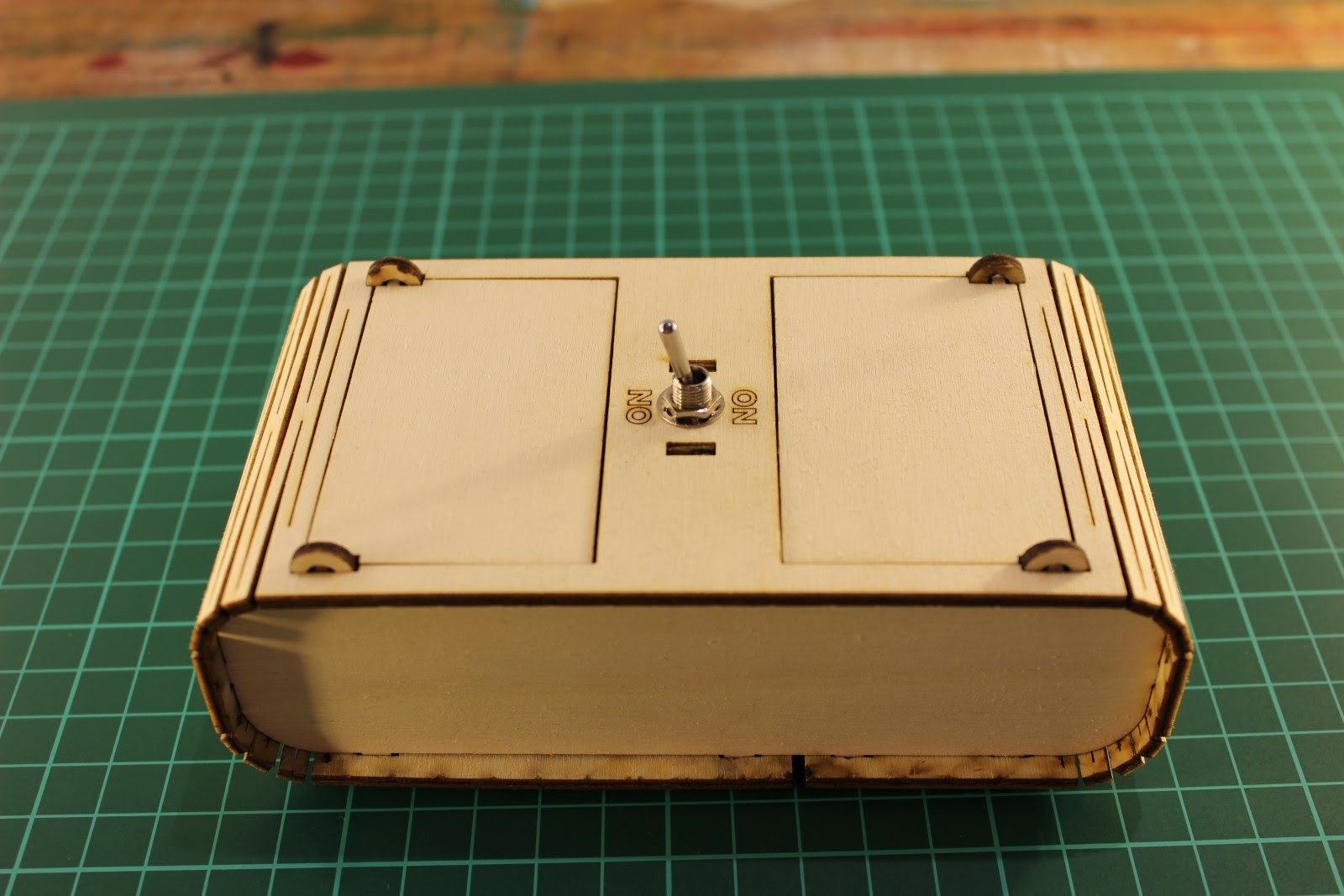


Project #5: Useless Machine 2.0 x2
by Martin Raynsford
.JPG)
With the new box design I was able to revisit the double useless machine, this was always a bit temperamental and so was taken out of the shop. This version solves all of the previous issues, it uses the same geared motors and the same brackets as the single machine rather than modified servos (which were the cause of previous issues). The box is the same glueless design so it's really fast to put together and although I haven't been able to squeeze a PCB into here yet but the electronics have been improved. The little switch on the side turns the machine of once both arms are back inside the box.
.JPG)
.JPG)
.JPG)
13 Apr 20:21
Section: Motorcycles
Tags: Bulldog, Fuel efficiency, Honda, Liquid-cooled
Related Articles:

Honda's Bulldog 400 concept: The tough small-capacity tourer for the masses
by Mike Hanlon
Bunker.jordan93 mpg....

Section: Motorcycles
Tags: Bulldog, Fuel efficiency, Honda, Liquid-cooled
Related Articles:
- Honda releases new prototypes – the True Adventure and the RC213V-S MotoGP replica
- Honda FCX fuel cell vehicle on show at Indy Japan 300
- In pictures: The 42nd Tokyo Motorcycle Show 2015
- Home Energy Station to expand fuel cell applications
- Honda's FCV takes fuel cell vehicle concept a step farther
- Honda’s new US$900, 110cc, 164mpg CB Twister
Tertiarymatt, Bunker.jordan likes this